Category: Science

Staying active!

An interesting article about the benefits of being active.

I try and stay as active as I can mainly by bicycle riding. This article from The Conversation shows the importance of this. It is just a shame that they do not mention being old and active; as in being 80!

ooOOoo

Some pro athletes keep getting better as they age − neuroscience can explain how they stay sharp

Recovery and mental resilience support the development of neuroplasticity, which helps athletes like Allyson Felix stay sharp. AP Photo/Charlie Riedel

Fiddy Davis Jaihind Jothikaran, Hope College

In a world where sports are dominated by youth and speed, some athletes in their late 30s and even 40s are not just keeping up – they are thriving.

Novak Djokovic is still outlasting opponents nearly half his age on tennis’s biggest stages. LeBron James continues to dictate the pace of NBA games, defending centers and orchestrating plays like a point guard. Allyson Felix won her 11th Olympic medal in track and field at age 35. And Tom Brady won a Super Bowl at 43, long after most NFL quarterbacks retire.

The sustained excellence of these athletes is not just due to talent or grit – it’s biology in action. Staying at the top of their game reflects a trainable convergence of brain, body and mindset. I’m a performance scientist and a physical therapist who has spent over two decades studying how athletes train, taper, recover and stay sharp. These insights aren’t just for high-level athletes – they hold true for anyone navigating big life changes or working to stay healthy.

Increasingly, research shows that the systems that support high performance – from motor control to stress regulation, to recovery – are not fixed traits but trainable capacities. In a world of accelerating change and disruption, the ability to adapt to new changes may be the most important skill of all. So, what makes this adaptability possible – biologically, cognitively and emotionally?

The amygdala and prefrontal cortex

Neuroscience research shows that with repeated exposure to high-stakes situations, the brain begins to adapt. The prefrontal cortex – the region most responsible for planning, focus and decision-making – becomes more efficient in managing attention and making decisions, even under pressure.

During stressful situations, such as facing match point in a Grand Slam final, this area of the brain can help an athlete stay composed and make smart choices – but only if it’s well trained.

In contrast, the amygdala, our brain’s threat detector, can hijack performance by triggering panic, freezing motor responses or fueling reckless decisions. With repeated exposure to high-stakes moments, elite athletes gradually reshape this brain circuit.

They learn to tune down amygdala reactivity and keep the prefrontal cortex online, even when the pressure spikes. This refined brain circuitry enables experienced performers to maintain their emotional control.

Creating a brain-body loop

Brain-derived neurotrophic factor, or BDNF, is a molecule that supports adapting to changes quickly. Think of it as fertilizer for the brain. It enhances neuroplasticity: the brain’s ability to rewire itself through experience and repetition. This rewiring helps athletes build and reinforce the patterns of connections between brain cells to control their emotion, manage their attention and move with precision.

BDNF levels increase with intense physical activity, mental focus and deliberate practice, especially when combined with recovery strategies such as sleep and deep breathing.

Elevated BDNF levels are linked to better resilience against stress and may support faster motor learning, which is the process of developing or refining movement patterns.

For example, after losing a set, Djokovic often resets by taking deep, slow breaths – not just to calm his nerves, but to pause and regain control. This conscious breathing helps him restore focus and likely quiets the stress signals in his brain.

In moments like these, higher BDNF availability likely allows him to regulate his emotions and recalibrate his motor response, helping him to return to peak performance faster than his opponent.

Rewiring your brain

In essence, athletes who repeatedly train and compete in pressure-filled environments are rewiring their brain to respond more effectively to those demands. This rewiring, from repeated exposures, helps boost BDNF levels and in turn keeps the prefrontal cortex sharp and dials down the amygdala’s tendency to overreact.

This kind of biological tuning is what scientists call cognitive reserve and allostasis – the process the body uses to make changes in response to stress or environmental demands to remain stable. It helps the brain and body be flexible, not fragile.

Importantly, this adaptation isn’t exclusive to elite athletes. Studies on adults of all ages show that regular physical activity – particularly exercises that challenge both body and mind – can raise BDNF levels, improve the brain’s ability to adapt and respond to new challenges, and reduce stress reactivity.

Programs that combine aerobic movement with coordination tasks, such as dancing, complex drills or even fast-paced walking while problem-solving have been shown to preserve skills such as focus, planning, impulse control and emotional regulation over time.

After an intense training session or a match, you will often see athletes hopping on a bike or spending some time in the pool. These low-impact, gentle movements, known as active recovery, help tone down the nervous system gradually.

Outside of active recovery, sleep is where the real reset and repair happen. Sleep aids in learning and strengthens the neural connections challenged during training and competition.

A tennis player wearing all white hits a forehand
Serbian tennis player Novak Djokovic practices meditation, which strengthens the mental pathways that help with stress regulation. AP Photo/Kin Cheung

Over time, this convergence creates a trainable loop between the brain and body that is better equipped to adapt, recover and perform.

Lessons beyond sport

While the spotlight may shine on sporting arenas, you don’t need to be a pro athlete to train these same skills.

The ability to perform under pressure is a result of continuing adaptation. Whether you’re navigating a career pivot, caring for family members, or simply striving to stay mentally sharp as the world changes, the principles are the same: Expose yourself to challenges, regulate stress and recover deliberately.

While speed, agility and power may decline with age, some sport-specific skills such as anticipation, decision-making and strategic awareness actually improve. Athletes with years of experience develop faster mental models of how a play will unfold, which allows them to make better and faster choices with minimal effort. This efficiency is a result of years of reinforcing neural circuits that doesn’t immediately vanish with age. This is one reason experienced athletes often excel even if they are well past their physical prime.

Physical activity, especially dynamic and coordinated movement, boosts the brain’s capacity to adapt. So does learning new skills, practicing mindfulness and even rehearsing performance under pressure. In daily life, this might be a surgeon practicing a critical procedure in simulation, a teacher preparing for a tricky parent meeting, or a speaker practicing a high-stakes presentation to stay calm and composed when it counts. These aren’t elite rituals – they’re accessible strategies for building resilience, motor efficiency and emotional control.

Humans are built to adapt – with the right strategies, you can sustain excellence at any stage of life.

Fiddy Davis Jaihind Jothikaran, Associate Professor of Kinesiology, Hope College

This article is republished from The Conversation under a Creative Commons license. Read the original article.

ooOOoo

… “you can sustain excellence at any stage of life.” Even at 80 years old? 😉

A lovely story about a snake

It’s from The Dodo website.

This is fabulous and I don’t intend to say anymore.

ooOOoo

Woman Rescues Snake — Then Watches In Awe As She Gives Birth In Her Hand

She couldn’t believe it …

By Maeve Dunigan

Published on July 23, 2025.

Earlier this month, a homeowner called Tidewater Wildlife Rescue with an urgent request. A common garter snake was hopelessly tangled in a piece of netting in their yard. Could someone come help?

Rescue volunteer Serenity Reiner quickly headed to the scene.

TIDEWATER WILDLIFE RESCUE

Reiner and her rescue partner, Daniel, used scissors to cut away big pieces of the net. Then, Daniel gently held the snake as Reiner snipped away netting closer to the animal’s body.

“We were very focused,” Reiner told The Dodo. “We wanted to be as fast as possible to limit [her] stress.”

The rescuers were almost finished when they noticed something amazing — the snake was giving birth in their hands.

TIDEWATER WILDLIFE RESCUE

Reiner hastily removed the remaining netting as the mama snake birthed two babies. Then, she took the snake and her little ones to a wooded area behind the house and released them back into the wild.

Surprisingly, despite their size, baby garter snakes don’t need to live with their mom for very long. In fact, as the rescue notes, these young snakes are completely independent from the moment they’re born and can immediately find food on their own.

TIDEWATER WILDLIFE RESCUE

According to the U.S. National Park Service, garter snakes typically give birth to 15-40 babies at a time. Reiner suspects this mama welcomed many more little ones into the world once she was safe in the forest.

The rescuer encouraged the homeowners to use animal-safe netting next time. She’s grateful that, in this case, everything turned out OK.

“I felt so much joy knowing that she was able to go back to her normal life unharmed,” Reiner said.

ooOOoo

Wonderful!

Logical thinking, in animals!

It is what we share with animals, but it is not as straightforward as one thinks!

The range of thinking, in terms of logical thinking, even in humans, is enormous. And when we watch animals, especially mammals, it is clear that they are operating in a logical manner. By ‘operating’ I am referring to their thought processes.

So a recent article in The Conversation jumped out at me. Here it is:

ooOOoo

Humans and animals can both think logically − but testing what kind of logic they’re using is tricky

For some mental processes, humans and animals likely follow similar lines of thinking. Catherine Falls Commercial/Moment via Getty Images

Olga Lazareva, Drake University

Can a monkey, a pigeon or a fish reason like a person? It’s a question scientists have been testing in increasingly creative ways – and what we’ve found so far paints a more complicated picture than you’d think.

Imagine you’re filling out a March Madness bracket. You hear that Team A beat Team B, and Team B beat Team C – so you assume Team A is probably better than Team C. That’s a kind of logical reasoning known as transitive inference. It’s so automatic that you barely notice you’re doing it.

It turns out humans are not the only ones who can make these kinds of mental leaps. In labs around the world, researchers have tested many animals, from primates to birds to insects, on tasks designed to probe transitive inference, and most pass with flying colors.

As a scientist focused on animal learning and behavior, I work with pigeons to understand how they make sense of relationships, patterns and rules. In other words, I study the minds of animals that will never fill out a March Madness bracket – but might still be able to guess the winner.

Logic test without words

The basic idea is simple: If an animal learns that A is better than B, and B is better than C, can it figure out that A is better than C – even though it’s never seen A and C together?

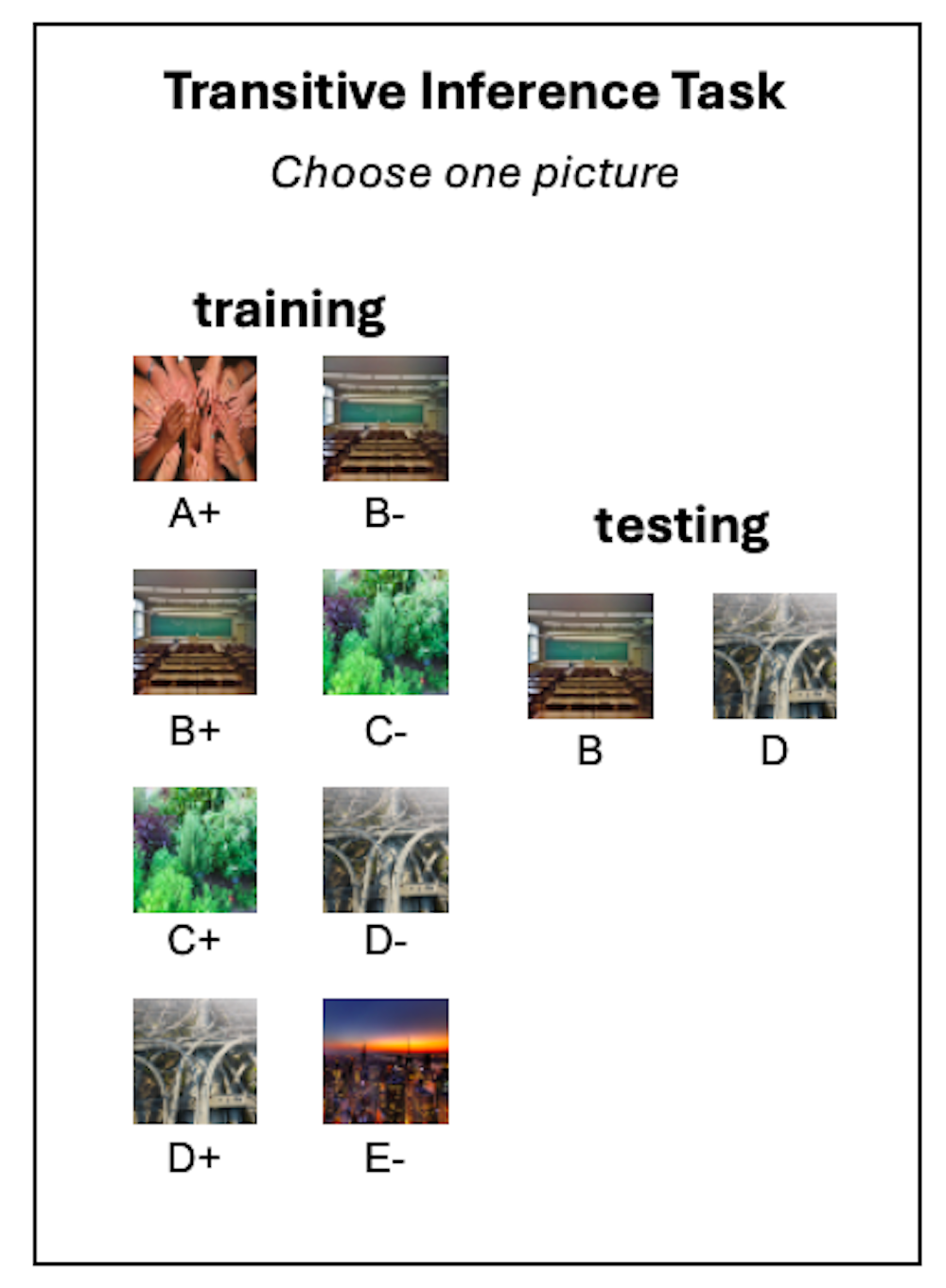
In the lab, researchers test this by giving animals randomly paired images, one pair at a time, and rewarding them with food for picking the correct one. For example, animals learn that a photo of hands (A) is correct when paired with a classroom (B), a classroom (B) is correct when paired with bushes (C), bushes (C) are correct when paired with a highway (D), and a highway (D) is correct when paired with a sunset (E). We don’t know whether they “understand” what’s in the picture, and it is not particularly important for the experiment that they do.

Comparing four pairs of images labeled a range of A to D in a training column, then one pair of images in the tesitng column
In a transitive inference task, subjects learn a series of rewarded pairs – such as A+ vs. B–, B+ vs. C– – and are later tested on novel pairings, like B vs. D, to see whether they infer an overall ranking. Olga Lazareva, CC BY-ND

One possible explanation is that the animals that learn all the tasks create a mental ranking of these images: A > B > C > D > E. We test this idea by giving them new pairs they’ve never seen before, such as classroom (B) vs. highway (D). If they consistently pick the higher-ranked item, they’ve inferred the underlying order.

What’s fascinating is how many species succeed at this task. Monkeys, rats, pigeons – even fish and wasps – have all demonstrated transitive inference in one form or another.

The twist: Not all tasks are easy

But not all types of reasoning come so easily. There’s another kind of rule called transitivity that is different from transitive inference, despite the similar name. Instead of asking which picture is better, transitivity is about equivalence.

In this task, animals are shown a set of three pictures and asked which one goes with the center image. For example, if white triangle (A1) is shown, choosing red square (B1) earns a reward, while choosing blue square (B2) does not. Later, when red square (B1) is shown, choosing white cross (C1) earns a reward while choosing white circle (C2) does not. Now comes the test: white triangle (A1) is shown with white cross (C1) and white circle (C2) as choices. If they pick white cross (C1), then they’ve demonstrated transitivity.

Comparing two sets of three shapes labeled a range of A to C in a section, then one trio of shapes in the tesitng section
In a transitivity task, subjects learn matching rules across overlapping sets – such as A1 matches B1, B1 matches C1 – and are tested on new combinations, such as A1 with C1 or C2, to assess whether they infer the relationship between A1 and C1. Olga Lazareva, CC BY-ND

The change may seem small, but species that succeed in those first transitive inference tasks often stumble in this task. In fact, they tend to treat the white triangle and the white cross as completely separate things, despite their common relationship with the red square. In my recently published review of research using the two tasks, I concluded that more evidence is needed to determine whether these tests tap into the same cognitive ability.

Small differences, big consequences

Why does the difference between transitive inference and transitivity matter? At first glance, they may seem like two versions of the same ability – logical reasoning. But when animals succeed at one and struggle with the other, it raises an important question: Are these tasks measuring the same kind of thinking?

The apparent difference between the two tasks isn’t just a quirk of animal behavior. Psychology researchers apply these tasks to humans in order to draw conclusions about how people reason.

For example, say you’re trying to pick a new almond milk. You know that Brand A is creamier than Brand B, and your friend told you that Brand C is even waterier than Brand B. Based on that, because you like a thicker milk, you might assume Brand A is better than Brand C, an example of transitive inference.

But now imagine the store labels both Brand A and Brand C as “barista blends.” Even without tasting them, you might treat them as functionally equivalent, because they belong to the same category. That’s more like transitivity, where items are grouped based on shared relationships. In this case, “barista blend” signals the brands share similar quality.

Child looking at colorful toy cars arranged in a line across a table or bed
How researchers define logical reasoning determines how they interpret results. Svetlana Mishchenko/iStock via Getty Images

Researchers often treat these types of reasoning as measuring the same ability. But if they rely on different mental processes, they might not be interchangeable. In other words, the way scientists ask their questions may shape the answer – and that has big implications for how they interpret success in animals and in people.

This difference could affect how researchers interpret decision-making not only in the lab, but also in everyday choices and in clinical settings. Tasks like these are sometimes used in research on autism, brain injury or age-related cognitive decline.

If two tasks look similar on the surface, then choosing the wrong one might lead to inaccurate conclusions about someone’s cognitive abilities. That’s why ongoing work in my lab is exploring whether the same distinction between these logical processes holds true for people.

Just like a March Madness bracket doesn’t always predict the winner, a reasoning task doesn’t always show how someone got to the right answer. That’s the puzzle researchers are still working on – figuring out whether different tasks really tap into the same kind of thinking or just look like they do. It’s what keeps scientists like me in the lab, asking questions, running experiments and trying to understand what it really means to reason – no matter who’s doing the thinking.

Olga Lazareva, Professor of Psychology, Drake University

This article is republished from The Conversation under a Creative Commons license. Read the original article.

ooOOoo

Fascinating! I quote: “… a reasoning task doesn’t always show how someone got to the right answer.

Olga finishes her article on reasoning with the statement that scientists are still trying to understand what it means to reason!

The recent history of flying

A copy of an article published by Historic England.

As many of you know I flew during my years when I was based in England. I flew as a hobby. Very quickly I realised that looking at the ground from a few thousand feet up gave one a unique view of the landscape.

ooOOoo

50 Years of Flying for Heritage

Damian Grady

Damian Grady is the Historic England Aerial Reconnaissance Manager. He joined the Royal Commission on the Historical Monuments of England in 1990 to map archaeology from aerial photographs and from 1998 became responsible for managing the aerial reconnaissance programme.

Published 8 February 2017

On Wednesday 8 February 2017 Historic England celebrated 50 years of our flying programme. Since those early days in 1967 much has changed, but reconnaissance, the act of flying to record and monitor sites and landscapes of archaeological interest, is still at the heart of the work carried out by our research teams.

This article was originally written in 2017 to mark the 50th anniversary but we have kept it live as it continues to be read and enjoyed.

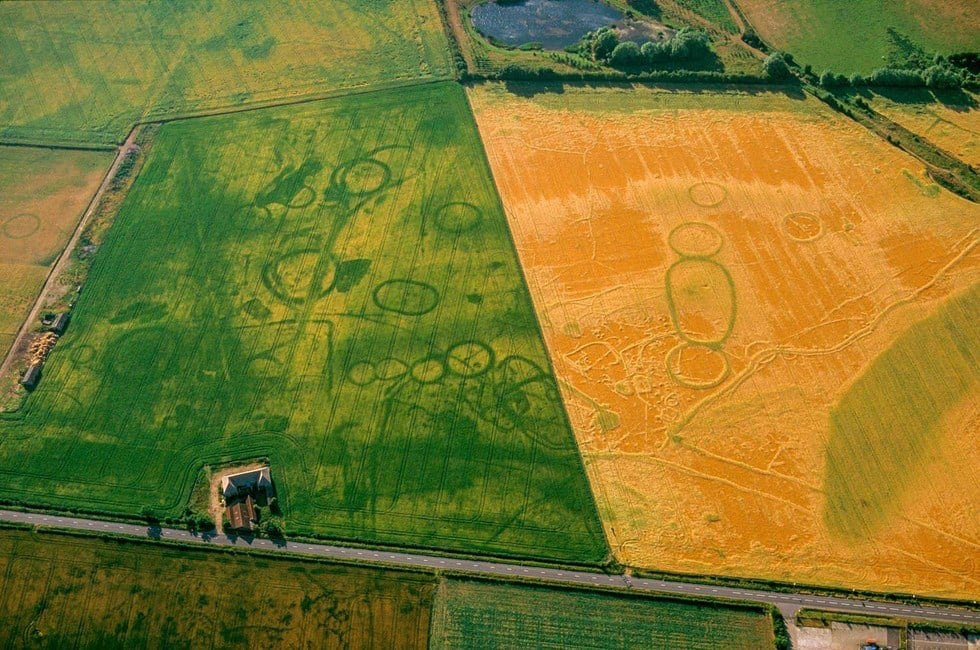
Cropmarks of prehistoric barrow cemetery and enclosures near Eynsham, Oxfordshire photographed on 01 September 1995 (NMR15291/21) © Crown copyright.Historic England Archive: Photographer – Roger Featherstone

Beginnings

On a cold February afternoon in 1967 an Auster, four-seater, light aircraft took off from Fairoaks airfield on the outskirts of south west London. This was the first test flight of the Royal Commission on the Historical Monuments of England (RCHME), one of the predecessors of Historic England. On-board was the pilot, a photographer, Ron Parsons and John Hampton. John was responsible for setting up the RCHME Air Photo Library in 1965 to implement the commission’s resolution (1964) to “use air photography to build up rapidly a record of field monuments throughout England.”

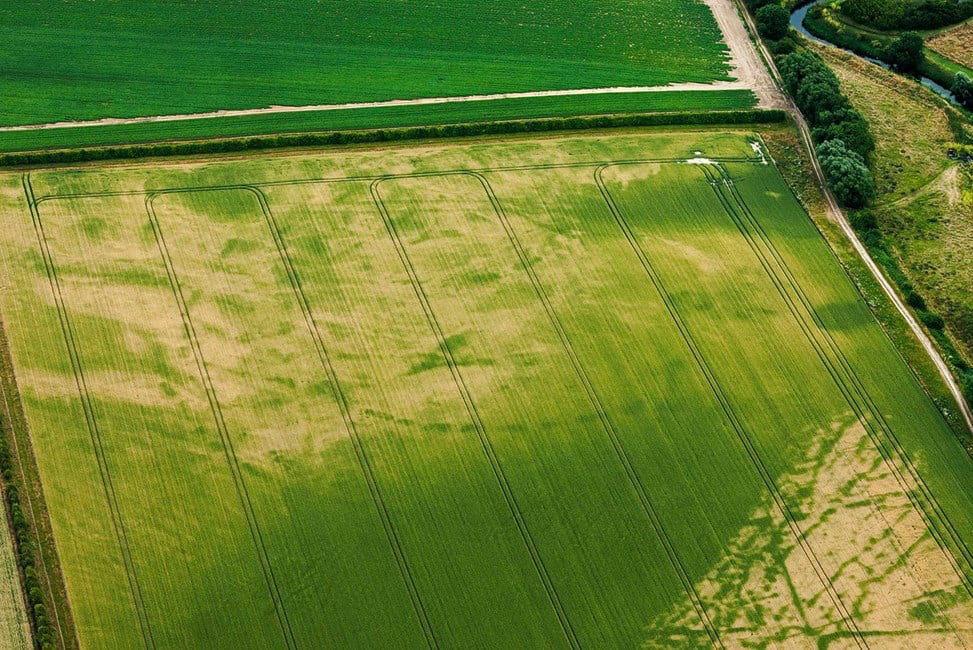
In the beginning this involved acquiring aerial photographs to build up a library of images of archaeological sites. By 1967 it was felt that RCHME should take its own oblique aerial photographs in support of its field survey work. Oblique photographs are taken at an “oblique” angle to the ground, as opposed to directly from above. They are usually taken with a hand held camera through the open window of a plane. The main target at this time was cropmarks; the walls and ditches of buried archaeology can affect the rate at which plants grow over them, causing differences in colour and height. These cropmarks are not always visible on the ground, so the best way to look for them is from the air.

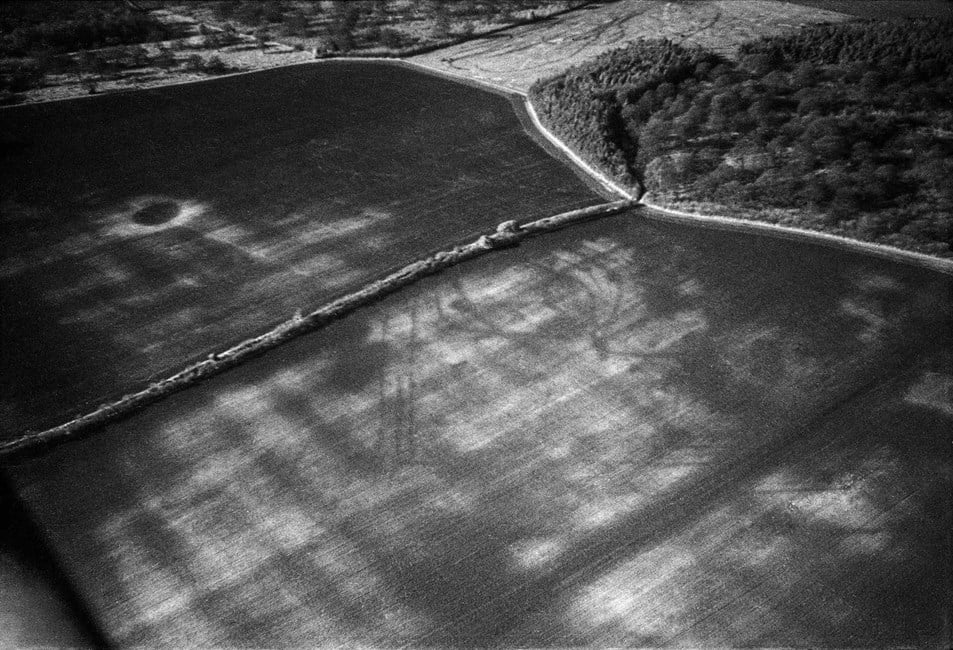
A prehistoric enclosure near Wootton St. Lawrence, Hampshire, recorded on the first flight on 08 February 1967 (NMR 20/3a) © Crown copyright. Historic England Archive: Photographer – Ron Parsons

This first flight was very much an experiment. Flying from Fairoaks to Basingstoke, Tidbury Ring and back they photographed prehistoric sites on the chalk soils of Hampshire. Many of the sites had been ploughed recently and were seen as colour differences in the soil and germinating crops. During the 1.5 hour flight John Hampton learned a number of valuable lessons, such as the best height to fly, the best angle to use and to make sure there was plenty of film! The lessons learned from this and subsequent flights formed the foundation of 50 years of flying by the aerial reconnaissance team in RCHME, English Heritage and now Historic England.

Growth of the archive

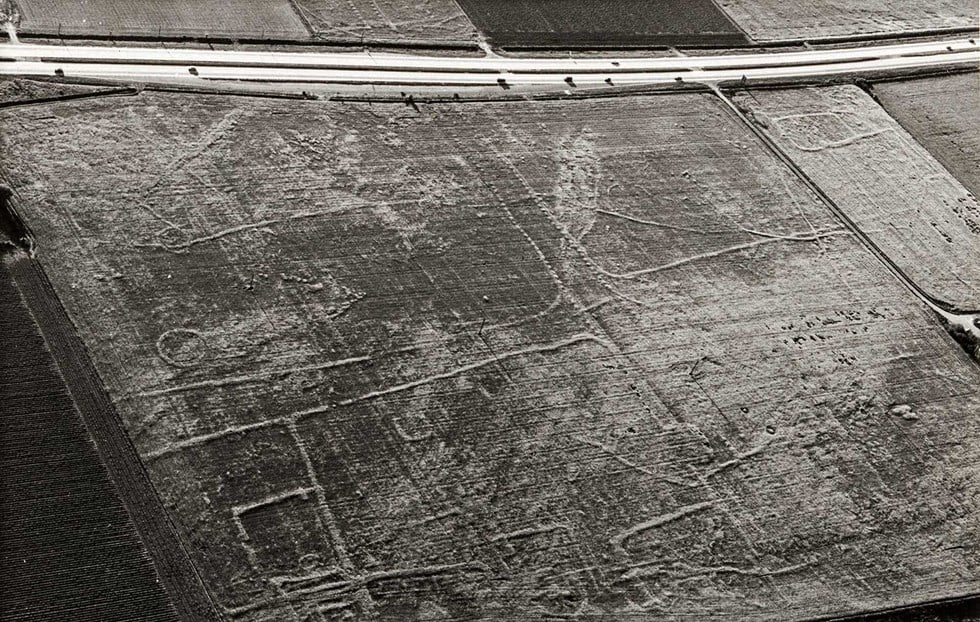
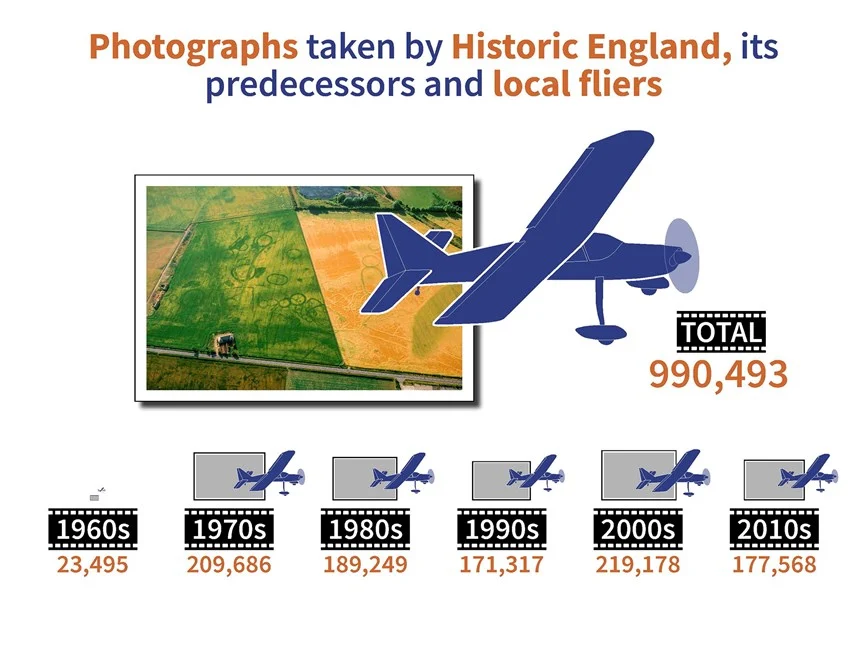
At about the same time as this first flight the collection of aerial photographs grew with the arrival of the Crawford Collection from the Ordnance Survey. Later, in the 1970s, the Air Photo library acquired many more aerial photographs from archaeologists and private fliers keen to discover archaeological sites. One such flier was Derrick Riley who took this photograph of an Iron Age/Roman field system in Nottinghamshire.

Cropmarks of a prehistoric field system in Nottinghamshire taken by Derrick Riley on 06 June 1976  (DNR 847_17). © Historic England Archive (Derrick Riley Collection)

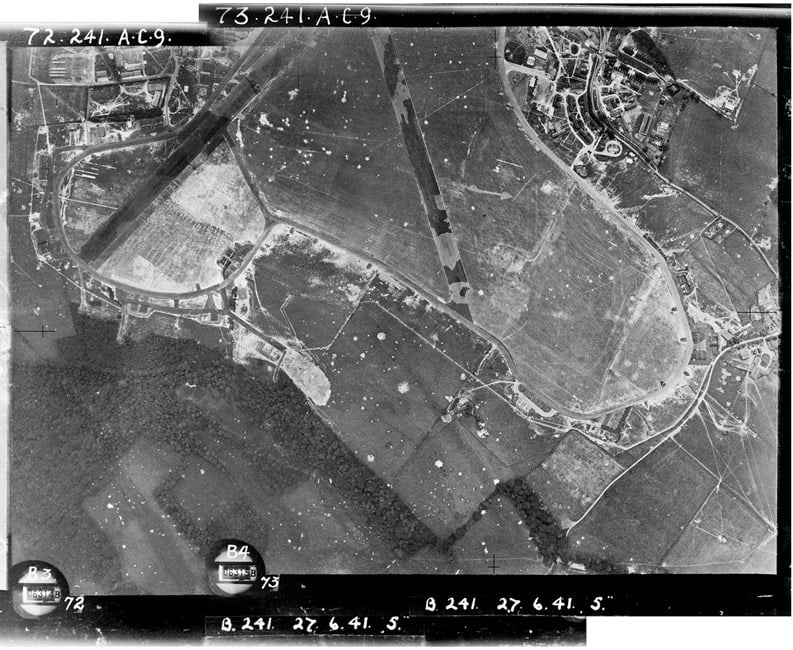
The oblique photographs acquired and taken by RCHME were ordered by kilometre square and stored in distinctive red boxes. Then in the 1980s there was a rapid growth with the acquisition of the Department of the Environment collection of vertical aerial photos. This collection included all prints taken of England by the RAF since the start of WWII such as the image below. This shows the airfield at Biggin Hill, near London with evidence of the many bomb craters sustained during German air raids. Further expansion came in the 1990s with the acquisition of the Ordnance Survey archive and in 2007 with the Aerofilms collection.

Photo mosaic of RAF images of Biggin Hill airfield taken on 27 June 1941, showing a camouflaged runway and filled in bomb craters (RAF_241_72 and 73). Source: Historic England Archive (RAF collection).

Mapping from aerial photographs

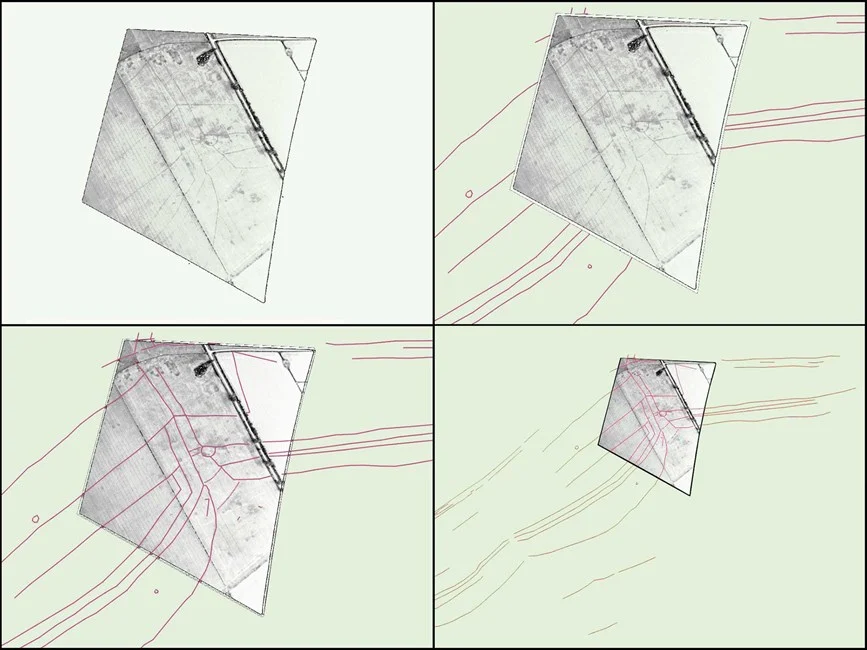
In the 1970s John Hampton and his team looked at various ways of interpreting and mapping from the aerial photographs taken by RCHME and acquired from local fliers. Along with others, they experimented with a variety of mapping techniques from sketch plotting to photogrammetry. An important step in the development of this process was the project to map the archaeology around the Iron Age hillfort of Danebury. This approach was scaled up by RCHME to map the prehistoric archaeology visible as cropmarks on the Yorkshire Wolds. This project used computer aided rectification of oblique aerial photographs, a process that was being developed. 

In the late 1980s, as the archive acquired more aerial photographs, RCHME developed a systematic methodology to interpret, map and record all archaeological features, not just cropmarks, visible on aerial photographs. Pilot projects in Kent, Hertfordshire and the Thames Valley were set up to develop the methodology further. 

Computer-aided rectification, interpretation and mapping allows information from many individual photographs to be combined, revealing extensive landscape features. Here you can see the process from the original rectified photo to how it fits into the wider landscape. Photo (NMR 1580/04A) © Historic England Archive (Derrick Riley Collection)

Increasing our range

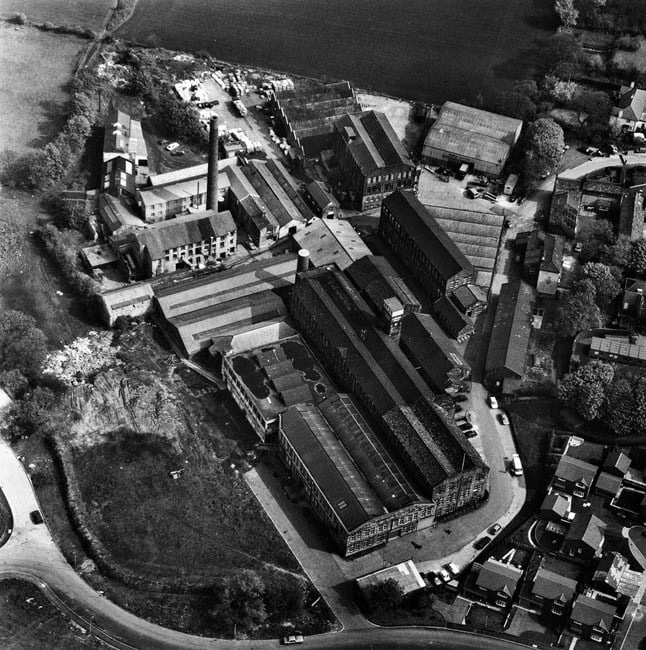
In the 1990s the range of subjects photographed increased as RCHME used aerial photographs to record the large building complexes they were surveying that were undergoing major changes at the time. These included textile mills, hospitals, prisons and Cold War military sites. For some of these sites such as the textile mill below in Leeds, these photographs are the last record we have as development pressures have since led to their demolition.

Laneside Paper mill (foreground) and Churwell knitting mill (top centre), Morley, Leeds, photographed on 17 May 1985, and since demolished (NMR2613_57) © Crown copyright.Historic England Archive: Photographer – Mike Hesketh-Roberts

New discoveries

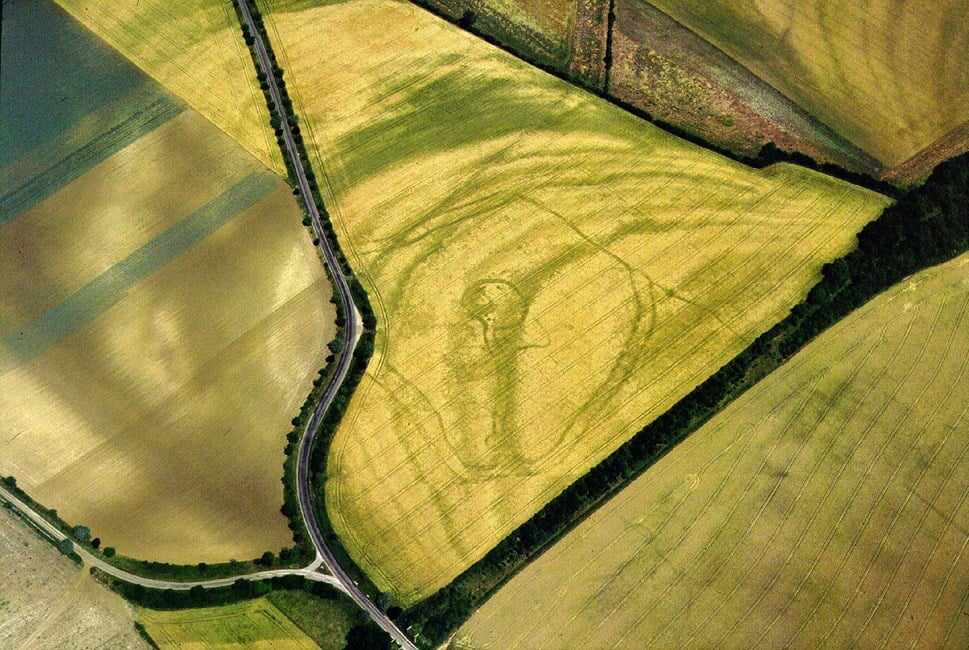
The 1990s also saw new discoveries across the country especially in the hot summers of 1995 and 1996. Below is just one such site, a “banjo” enclosure, so called because of the shape; a circular enclosure with a long funnel neck leading into it. See other examples of new sites discovered in the 1990s and at other times in the gallery below. 

Cropmarks of an Iron Age Banjo enclosure, Rollright, Oxfordshire photographed on 20 July 1995 (NMR 15350_33). © Crown copyright. Historic England Archive.

Expansion

In the 1990s the political changes and opening up of eastern Europe led to archaeologists visiting the survey and archive teams to learn from our experience of flying, mapping and archiving aerial photographs. This led to us joining forces with other aerial archaeologists from western Europe to set up training courses in Hungary and Poland. This in turn led to further work exchanges and training courses across Europe. 

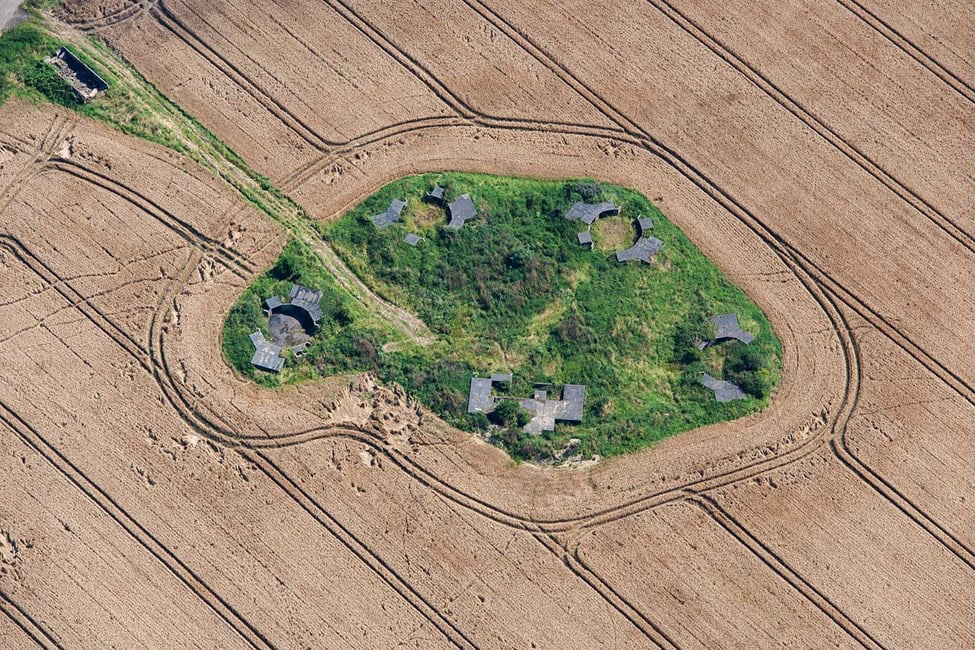
The late 1990s saw RCHME and EH working together to supply aerial photographs to help Field Monument Wardens monitor the condition of scheduled monuments. Following the merger of the two organisations in 1999 this became an important aspect of the flying programme. In the image below the World War Two anti-aircraft battery might appear to be safe since it has been removed from the cultivation that surrounds it. However, it is still at risk from being overgrown by scrub. 

World War Two Heavy Anti-aircraft battery near Bolton upon Dearne, Barnsley photographed on 10 August 2012 (NMR 28324/002). © Historic England Archive

New technology

The new century saw important technological developments taken up by the flying and mapping teams.  The reconnaissance teams began experimenting with digital cameras in 2003 and the archive developed standards for the long term preservation of digital data. The last negative film shot in the air was 2006. The archive now holds over 200,000 digital aerial photographs taken by the reconnaissance teams. 

In 2001 English Heritage used lidar, a system of airborne laser scanning, for a review of mapping of the Stonehenge World Heritage site. Since then HE have developed our use of the data and now use it as a regular source for any mapping and interpretation projects. 

The early 2010s saw more new discoveries, of which these are our favourite examples

The distinctive elongated pits of a newly discovered Neolithic enclosure in Cambridgeshire, seen here as cropmarks in a field of wheat on 06 July 2015 (NMR 29353_034) © Historic England Archive: Photographer – Damian Grady

The discovery of new archaeological sites is still the most exciting part of the flying programme, but since the first flight in 1967 the scale, range and scope has changed. New sensors and camera technology are allowing us to look at new ways of taking aerial photographs. New software and access to other aerial data such as lidar allows us to see, map and understand the historic landscape in ways that could only have been dreamed about in 1967. 

Since our systematic analysis of new and archive aerial photographs began in the late 1990s we have discovered over 122,000 new archaeological sites like the one above.

ooOOoo

I very much hope that republishing this article is in order. An email to the Press Office of Historic England requesting permission has been sent last Sunday afternoon.

This morning, 30th July, I received the following email:

To use the aerial images you have seen on our webpage ’50 Years Flying’ athttps://historicengland.org.uk/whats-new/research/50-years-flying/ , please make a note of the image reference numbers and then visit our Aerial Photography Explorer website at https://historicengland.org.uk/images-books/archive/collections/aerial-photos/ . If you then navigate to the oblique image search screen and fill in the reference number under the ‘file contains’ tab you will be taken to that image. By then hovering over that image a share/embed option will appear that will allow you to use the images free of charge on non-commercial websites and some social media sites such as X and Facebook. Our reference is 150356.

Deep brain stimulation for Parkinson’s sufferers.

Smart brain-zapping implants.

I was just catching up on emails and saw this item from Nature.

I do not have the permission to share the whole article with you but feel that it is alright to share these two paragraphs:

Keith Krehbiel lived with Parkinson’s disease for nearly 25 years before agreeing to try a brain implant that might alleviate his symptoms. He had long been reluctant to submit to the surgery. “It was a big move,” he says. But by 2020, his symptoms had become so severe that he grudgingly agreed to go ahead.

Deep-brain stimulation involves inserting thin wires through two small holes in the skull into a region of the brain associated with movement. The hope is that by delivering electrical pulses to the region, the implant can normalize aberrant brain activity and reduce symptoms. Since the devices were first approved almost three decades ago, some 200,000 people have had them fitted to help calm the tremors and rigidity caused by Parkinson’s disease. But about 40,000 of those who received devices made after 2020 got them with a special feature that has largely not yet been turned on. The devices can read brain waves and then adapt and tailor the rhythm of their output, in much the same way as a pacemaker monitors and corrects the heart’s electrical rhythms, says Helen Bronte-Stewart, a neurologist at Stanford University in California.

I am going to try and contact Helen at Stanford University to gather more details and, hopefully, to obtain her permission to share the complete article with you.

Black holes

How black holes challenge our technological world.

I had no idea until reading this recent article that distant black holes are essential for measuring accurately where we are. Have a read.

ooOOoo

Scientists look to black holes to know exactly where we are in the Universe. But phones and wifi are blocking the view

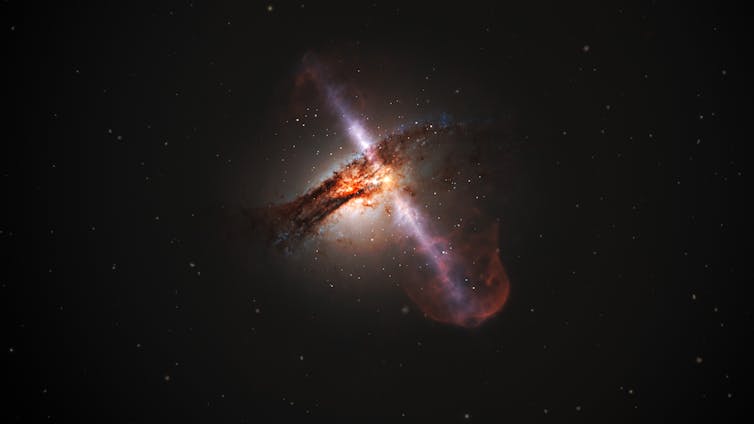
ESA / Hubble / L. Calçada (ESO), CC BY

Lucia McCallum, University of Tasmania

The scientists who precisely measure the position of Earth are in a bit of trouble. Their measurements are essential for the satellites we use for navigation, communication and Earth observation every day.

But you might be surprised to learn that making these measurements – using the science of geodesy – depends on tracking the locations of black holes in distant galaxies.

The problem is, the scientists need to use specific frequency lanes on the radio spectrum highway to track those black holes.

And with the rise of wifi, mobile phones and satellite internet, travel on that highway is starting to look like a traffic jam.

Why we need black holes

Satellites and the services they provide have become essential for modern life. From precision navigation in our pockets to measuring climate change, running global supply chains and making power grids and online banking possible, our civilisation cannot function without its orbiting companions.

To use satellites, we need to know exactly where they are at any given time. Precise satellite positioning relies on the so-called “global geodesy supply chain”.

This supply chain starts by establishing a reliable reference frame as a basis for all other measurements. Because satellites are constantly moving around Earth, Earth is constantly moving around the Sun, and the Sun is constantly moving through the galaxy, this reference frame needs to be carefully calibrated via some relatively fixed external objects.

As it turns out, the best anchor points for the system are the black holes at the hearts of distant galaxies, which spew out streams of radiation as they devour stars and gas.

These black holes are the most distant and stable objects we know. Using a technique called very long baseline interferometry, we can use a network of radio telescopes to lock onto the black hole signals and disentangle Earth’s own rotation and wobble in space from the satellites’ movement.

Different lanes on the radio highway

We use radio telescopes because we want to detect the radio waves coming from the black holes. Radio waves pass cleanly through the atmosphere and we can receive them during day and night and in all weather conditions.

Radio waves are also used for communication on Earth – including things such as wifi and mobile phones. The use of different radio frequencies – different lanes on the radio highway – is closely regulated, and a few narrow lanes are reserved for radio astronomy.

However, in previous decades the radio highway had relatively little traffic. Scientists commonly strayed from the radio astronomy lanes to receive the black hole signals.

To reach the very high precision needed for modern technology, geodesy today relies on more than just the lanes exclusively reserved for astronomy.

Radio traffic on the rise

In recent years, human-made electromagnetic pollution has vastly increased. When wifi and mobile phone services emerged, scientists reacted by moving to higher frequencies.

However, they are running out of lanes. Six generations of mobile phone services (each occupying a new lane) are crowding the spectrum, not to mention internet connections directly sent by a fleet of thousands of satellites.

Today, the multitude of signals are often too strong for geodetic observatories to see through them to the very weak signals emitted by black holes. This puts many satellite services at risk.

What can be done?

To keep working into the future – to maintain the services on which we all depend – geodesy needs some more lanes on the radio highway. When the spectrum is divided up via international treaties at world radio conferences, geodesists need a seat at the table.

Other potential fixes might include radio quiet zones around our essential radio telescopes. Work is also underway with satellite providers to avoid pointing radio emissions directly at radio telescopes.

Any solution has to be global. For our geodetic measurements, we link radio telescopes together from all over the world, allowing us to mimic a telescope the size of Earth. The radio spectrum is primarily regulated by each nation individually, making this a huge challenge.

But perhaps the first step is increasing awareness. If we want satellite navigation to work, our supermarkets to be stocked and our online money transfers arriving safely, we need to make sure we have a clear view of those black holes in distant galaxies – and that means clearing up the radio highway.

Lucia McCallum, Senior Scientist in Geodesy, University of Tasmania

This article is republished from The Conversation under a Creative Commons license. Read the original article.

ooOOoo

The last paragraph of Lucia’s article is key, in my opinion. Hopefully me posting this article will assist in the task of increasing awareness,

What makes us happy?

It is seemingly a simple question but in practice not so.

Listening to danger or telling others of a danger is a very ancient practice. For it is better to share a potential danger than not to. It was easy to look this up:

Modern sense of “risk, peril, exposure to injury, loss, pain, etc.” (from being in the control of someone or something else) evolved first in French and was in English by late 14c. For this, Old English had pleoh; in early Middle English this sense is found in peril. For sound changes, compare dungeon, which is from the same source.

Thus a post on The Conversation that was about happiness caught my eye.

I am delighted to share it with you.

ooOOoo

Philly psychology students map out local landmarks and hidden destinations where they feel happiest

Rittenhouse Square Park in Center City made it onto the Philly Happiness Map. Matthew Lovette/Jumping Rocks/Universal Images Group via Getty Images

Eric Zillmer, Drexel University

What makes you happy? Perhaps a good night’s sleep, or a wonderful meal with friends?

I am the director of the Happiness Lab at Drexel University, where I also teach a course on happiness. The Happiness Lab is a think tank that investigates the ingredients that contribute to people’s happiness.

Often, my students ask me something along the lines of, “Dr. Z, tell us one thing that will make us happier.”

As a first step, I advise them to spend more time outside.

Achieving lasting and sustainable happiness is more complicated. Research on the happiest countries in the world and the places where people live the longest, known as Blue Zones, shows a common thread: Residents feel they are part of something larger than themselves, such as a community or a city.

So if you’re living in a metropolis like Philadelphia, where, incidentally, the iconic pursuit of happiness charge was ratified in the Declaration of Independence, I believe urban citizenship – that is, forming an identity with your urban surroundings – should also be on your list.

A small boat floats in blue-green waters in front of a picturesque village.
The Greek island of Ikaria in the Aegean Sea is a Blue Zone famous for its residents’ longevity. Nicolas Economou/NurPhoto via Getty Images

Safety, social connection, beauty

Carl Jung, the renowned Swiss psychoanalyst, wrote extensively about the relationship between our internal world and our external environment.

He believed that this relationship was crucial to our psychological well-being.

More recent research in neuroscience and functional imaging has revealed a vast, intricate and complex neurological architecture underlying our psychological perception of a place. Numerous neurological pathways and functional loops transform a complex neuropsychological process into a simple realization: I am happy here!

For example, a happy place should feel safe.

The country of Croatia, a tourist haven for its beauty and culinary delights, is also one of the top 20 safest countries globally, according to the 2025 Global Peace Index.

The U.S. ranks 128th.

The availability of good food and drink can also be a significant factor in creating a happy place.

However, according to American psychologist Abraham Maslow, a pioneer in the field of positive psychology, the opportunity for social connectivity, experiencing something meaningful and having a sense of belonging is more crucial.

Furthermore, research on happy places suggests that they are beautiful. It should not come as a surprise that the happiest places in the world are also drop-dead gorgeous, such as the Indian Ocean archipelago of Mauritius, which is the happiest country in Africa, according to the 2025 World Happiness Report from the University of Oxford and others.

Happy places often provide access to nature and promote active lifestyles, which can help relieve stress. The residents of the island of Ikaria in Greece, for example, one of the original Blue Zones, demonstrate high levels of physical activity and social interaction.

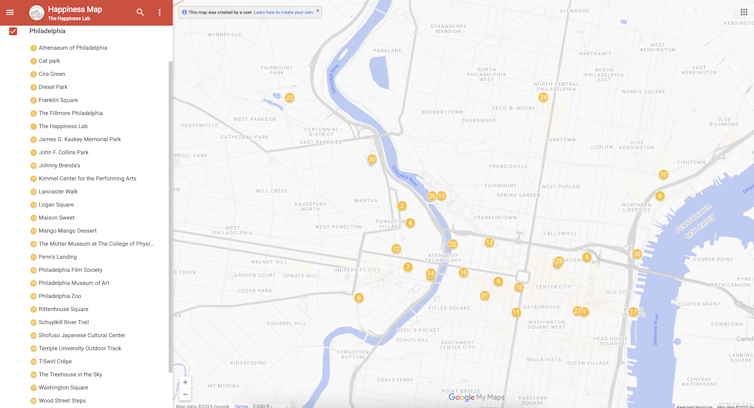
A Google map display on right with a list of mapped locations on the left.
A map of 28 happy places in Philadelphia, based on 243 survey responses from Drexel students. The Happiness Lab at Drexel University

Philly Happiness Map

I asked my undergraduate psychology students at Drexel, many of whom come from other cities, states and countries, to pick one place in Philadelphia where they feel happy.

From the 243 student responses, the Happiness Lab curated 28 Philly happy places, based on how frequently the places were endorsed and their accessibility.

Philadelphia’s founder, William Penn, would likely approve that Rittenhouse Square Park and three other public squares – Logan, Franklin and Washington – were included. These squares were vital to Penn’s vision of landscaped public parks to promote the health of the mind and body by providing “salubrious spaces similar to the private garden.” They are beautiful and approachable, serving as “places to rest, take a pause, work, or read a book,” one student told us.

Places such as the Philadelphia Zoo, Penn’s Landing and the Philadelphia Museum of Art are “joyful spots that are fun to explore, and one can also take your parents along if need be,” as another student described.

The Athenaeum of Philadelphia, a historic library with eclectic programming, feels to one student like “coming home, a perfect third place.”

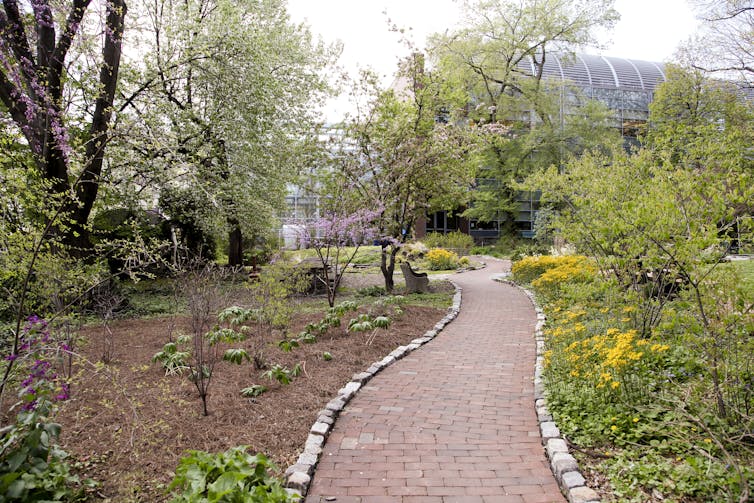
Some students mentioned happy places that are less known. These include tucked-away gardens such as the John F. Collings Park at 1707 Chestnut St., the rooftop Cira Green at 129 S. 30th St. and the James G. Kaskey Memorial Park and BioPond at 433 S. University Ave.

A stone-lined brick path extends through a nicely landscaped outdoor garden area.
The James G. Kaskey Memorial Park and BioPond in West Philadelphia is an urban oasis. M. Fischetti for Visit Philadelphia

My students said these are small, unexpected spots that provide an excellent opportunity for a quiet, peaceful break, to be present, whether enjoyed alone or with a friend. I checked them out and I agree.

The students also mentioned places I had never heard of even though I’ve lived in the city for over 30 years.

The “cat park” at 526 N. Natrona St. in Mantua is a quiet little park with an eclectic personality and lots of friendly cats.

Mango Mango Dessert at 1013 Cherry St. in Chinatown, which is a frequently endorsed happiness spot among the students because of its “bustling streets, lively atmosphere and delicious food,” is a perfect pit stop for mango lovers. And Maison Sweet, at 2930 Chestnut St. in University City, is a casual bakery and cafe “where you may end up staying longer than planned,” one student shared.

I find that Philly’s happy places, as seen through the eyes of college students, tend to offer a space for residents to take time out from their day to pause, reset, relax and feel more connected and in touch with the city.

Happiness principals are universal, yet our own journeys are very personal. Philadelphians across the city may have their own list of happy places. There are really no right or wrong answers. If you don’t have a personal happy space, just start exploring and you may be surprised what you will find, including a new sense of happiness.

See the full Philly Happiness Map list here, and visit the exhibit at the W.W. Hagerty Library at Drexel University to learn more.

Read more of our stories about Philadelphia.

Eric Zillmer, Professor of Neuropsychology, Drexel University

This article is republished from The Conversation under a Creative Commons license. Read the original article.

ooOOoo

For me, an Englishman living in Oregon, feeding the wild deer each morning gives me untold joy and happiness. It is my ‘personal happy space’.

So thank you, Prof. Zillmer, for writing this.

The mystery of Dark Matter

This very interesting article is worth a read.

Patrice Ayme published a post on Wednesday, 25th June, 2025 that is deeply conected to the following post from The Conversation.

His post was called: ‘How Does The Universe Expand? The Way Cosmologists Decided That It Does, FLRW Metric! A Causal Loop Is At The Heart Of Modern ΛCDM Cosmology!’

Thus I recommend that you read that article and then the one that is republished by me, with permission, from The Conversation.

ooOOoo

The Vera C. Rubin Observatory will help astronomers investigate dark matter, continuing the legacy of its pioneering namesake

The Rubin Observatory is scheduled to release its first images in 2025. RubinObs/NOIRLab/SLAC/NSF/DOE/AURA/B. Quint

Samantha Thompson, Smithsonian Institution

Everything in space – from the Earth and Sun to black holes – accounts for just 15% of all matter in the universe. The rest of the cosmos seems to be made of an invisible material astronomers call dark matter.

Astronomers know dark matter exists because its gravity affects other things, such as light. But understanding what dark matter is remains an active area of research.

With the release of its first images this month, the Vera C. Rubin Observatory has begun a 10-year mission to help unravel the mystery of dark matter. The observatory will continue the legacy of its namesake, a trailblazing astronomer who advanced our understanding of the other 85% of the universe.

As a historian of astronomy, I’ve studied how Vera Rubin’s contributions have shaped astrophysics. The observatory’s name is fitting, given that its data will soon provide scientists with a way to build on her work and shed more light on dark matter.

Wide view of the universe

From its vantage point in the Chilean Andes mountains, the Rubin Observatory will document everything visible in the southern sky. Every three nights, the observatory and its 3,200 megapixel camera will make a record of the sky.

This camera, about the size of a small car, is the largest digital camera ever built. Images will capture an area of the sky roughly 45 times the size of the full Moon. With a big camera with a wide field of view, Rubin will produce about five petabytes of data every year. That’s roughly 5,000 years’ worth of MP3 songs.

After weeks, months and years of observations, astronomers will have a time-lapse record revealing anything that explodes, flashes or moves – such as supernovas, variable stars or asteroids. They’ll also have the largest survey of galaxies ever made. These galactic views are key to investigating dark matter.

Galaxies are the key

Deep field images from the Hubble Space Telescope, the James Webb Space Telescope and others have visually revealed the abundance of galaxies in the universe. These images are taken with a long exposure time to collect the most light, so that even very faint objects show up.

Researchers now know that those galaxies aren’t randomly distributed. Gravity and dark matter pull and guide them into a structure that resembles a spider’s web or a tub of bubbles. The Rubin Observatory will expand upon these previous galactic surveys, increasing the precision of the data and capturing billions more galaxies.

In addition to helping structure galaxies throughout the universe, dark matter also distorts the appearance of galaxies through an effect referred to as gravitational lensing.

Light travels through space in a straight line − unless it gets close to something massive. Gravity bends light’s path, which distorts the way we see it. This gravitational lensing effect provides clues that could help astronomers locate dark matter. The stronger the gravity, the bigger the bend in light’s path.

Many galaxies, represented as bright dots, some blurred, against a dark background.
The white galaxies seen here are bound in a cluster. The gravity from the galaxies and the dark matter bends the light from the more distant galaxies, creating contorted and magnified images of them. NASA, ESA, CSA and STScI

Discovering dark matter

For centuries, astronomers tracked and measured the motion of planets in the solar system. They found that all the planets followed the path predicted by Newton’s laws of motion, except for Uranus. Astronomers and mathematicians reasoned that if Newton’s laws are true, there must be some missing matter – another massive object – out there tugging on Uranus. From this hypothesis, they discovered Neptune, confirming Newton’s laws.

With the ability to see fainter objects in the 1930s, astronomers began tracking the motions of galaxies.

California Institute of Technology astronomer Fritz Zwicky coined the term dark matter in 1933, after observing galaxies in the Coma Cluster. He calculated the mass of the galaxies based on their speeds, which did not match their mass based on the number of stars he observed.

He suspected that the cluster could contain an invisible, missing matter that kept the galaxies from flying apart. But for several decades he lacked enough observational evidence to support his theory.

A woman adjusting a large piece of equipment.
Vera Rubin operates the Carnegie spectrograph at Kitt Peak National Observatory in Tucson. Carnegie Institution for Science, CC BY

Enter Vera Rubin

In 1965, Vera Rubin became the first women hired onto the scientific staff at the Carnegie Institution’s Department of Terrestrial Magnetism in Washington, D.C.

She worked with Kent Ford, who had built an extremely sensitive spectrograph and was looking to apply it to a scientific research project. Rubin and Ford used the spectrograph to measure how fast stars orbit around the center of their galaxies.

In the solar system, where most of the mass is within the Sun at the center, the closest planet, Mercury, moves faster than the farthest planet, Neptune.

“We had expected that as stars got farther and farther from the center of their galaxy, they would orbit slower and slower,” Rubin said in 1992.

What they found in galaxies surprised them. Stars far from the galaxy’s center were moving just as fast as stars closer in.

“And that really leads to only two possibilities,” Rubin explained. “Either Newton’s laws don’t hold, and physicists and astronomers are woefully afraid of that … (or) stars are responding to the gravitational field of matter which we don’t see.”

Data piled up as Rubin created plot after plot. Her colleagues didn’t doubt her observations, but the interpretation remained a debate. Many people were reluctant to accept that dark matter was necessary to account for the findings in Rubin’s data.

Rubin continued studying galaxies, measuring how fast stars moved within them. She wasn’t interested in investigating dark matter itself, but she carried on with documenting its effects on the motion of galaxies.

A quarter with a woman looking upwards engraved onto it.
A U.S quarter honors Vera Rubin’s contributions to our understanding of dark matter. United States Mint, CC BY

Vera Rubin’s legacy

Today, more people are aware of Rubin’s observations and contributions to our understanding of dark matter. In 2019, a congressional bill was introduced to rename the former Large Synoptic Survey Telescope to the Vera C. Rubin Observatory. In June 2025, the U.S. Mint released a quarter featuring Vera Rubin.

Rubin continued to accumulate data about the motions of galaxies throughout her career. Others picked up where she left off and have helped advance dark matter research over the past 50 years.

In the 1970s, physicist James Peebles and astronomers Jeremiah Ostriker and Amos Yahil created computer simulations of individual galaxies. They concluded, similarly to Zwicky, that there was not enough visible matter in galaxies to keep them from flying apart.

They suggested that whatever dark matter is − be it cold stars, black holes or some unknown particle − there could be as much as 10 times the amount of dark matter than ordinary matter in galaxies.

Throughout its 10-year run, the Rubin Observatory should give even more researchers the opportunity to add to our understanding of dark matter.

Samantha Thompson, Astronomy Curator, National Air and Space Museum, Smithsonian Institution

This article is republished from The Conversation under a Creative Commons license. Read the original article.

ooOOoo

It is difficult to say anything more as my comment will mean practically nothing compared to Patrice Ayme and Samantha Thompson.

I am just grateful that these fine people publish their research with permission for it to be republished elsewhere. Thank you!

This strange and beautiful place

Pondering on space.

Like so many people, I am fascinated by the universe. Just our own universe is staggering. Here are some items published on the NASA website.

Solar System Facts

Our solar system includes the Sun, eight planets, five officially named dwarf planets, hundreds of moons, and thousands of asteroids and comets.

Our solar system is located in the Milky Way, a barred spiral galaxy with two major arms, and two minor arms. Our Sun is in a small, partial arm of the Milky Way called the Orion Arm, or Orion Spur, between the Sagittarius and Perseus arms. Our solar system orbits the center of the galaxy at about 515,000 mph (828,000 kph). It takes about 230 million years to complete one orbit around the galactic center.

Now to the centre of our universe. And it give me pleasure to republish this account.

ooOOoo

Where is the center of the universe?

In space, there are four dimensions: length, width, height and time. scaliger/iStock/NASA via Getty Images Plus

Rob Coyne, University of Rhode Island

About a century ago, scientists were struggling to reconcile what seemed a contradiction in Albert Einstein’s theory of general relativity.

Published in 1915, and already widely accepted worldwide by physicists and mathematicians, the theory assumed the universe was static – unchanging, unmoving and immutable. In short, Einstein believed the size and shape of the universe today was, more or less, the same size and shape it had always been.

But when astronomers looked into the night sky at faraway galaxies with powerful telescopes, they saw hints the universe was anything but that. These new observations suggested the opposite – that it was, instead, expanding.

Scientists soon realized Einstein’s theory didn’t actually say the universe had to be static; the theory could support an expanding universe as well. Indeed, by using the same mathematical tools provided by Einstein’s theory, scientists created new models that showed the universe was, in fact, dynamic and evolving.

I’ve spent decades trying to understand general relativity, including in my current job as a physics professor teaching courses on the subject. I know wrapping your head around the idea of an ever-expanding universe can feel daunting – and part of the challenge is overriding your natural intuition about how things work. For instance, it’s hard to imagine something as big as the universe not having a center at all, but physics says that’s the reality.

The universe gets bigger every day.

The space between galaxies

First, let’s define what’s meant by “expansion.” On Earth, “expanding” means something is getting bigger. And in regard to the universe, that’s true, sort of. Expansion might also mean “everything is getting farther from us,” which is also true with regard to the universe. Point a telescope at distant galaxies and they all do appear to be moving away from us.

What’s more, the farther away they are, the faster they appear to be moving. Those galaxies also seem to be moving away from each other. So it’s more accurate to say that everything in the universe is getting farther away from everything else, all at once.

This idea is subtle but critical. It’s easy to think about the creation of the universe like exploding fireworks: Start with a big bang, and then all the galaxies in the universe fly out in all directions from some central point.

But that analogy isn’t correct. Not only does it falsely imply that the expansion of the universe started from a single spot, which it didn’t, but it also suggests that the galaxies are the things that are moving, which isn’t entirely accurate.

It’s not so much the galaxies that are moving away from each other – it’s the space between galaxies, the fabric of the universe itself, that’s ever-expanding as time goes on. In other words, it’s not really the galaxies themselves that are moving through the universe; it’s more that the universe itself is carrying them farther away as it expands.

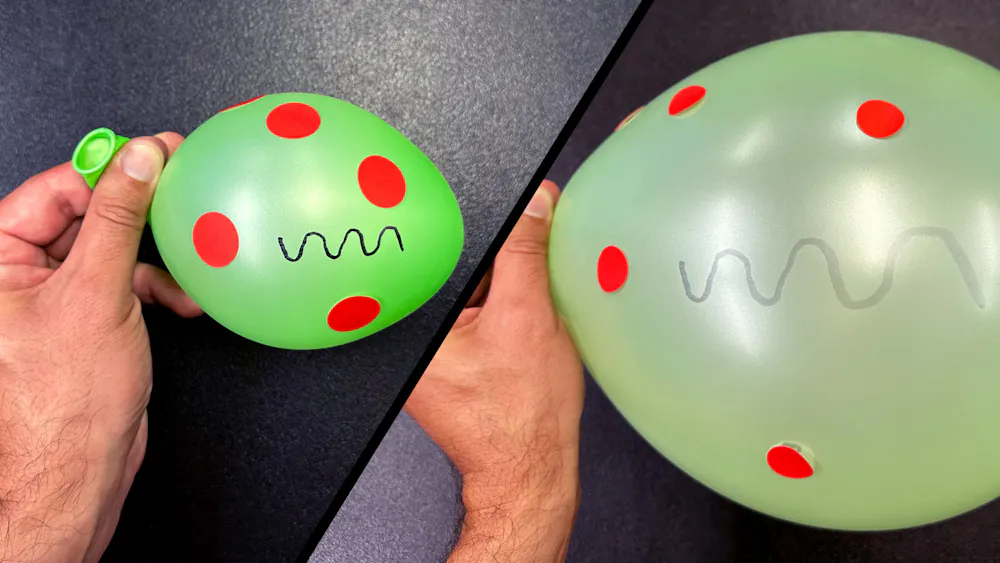
A common analogy is to imagine sticking some dots on the surface of a balloon. As you blow air into the balloon, it expands. Because the dots are stuck on the surface of the balloon, they get farther apart. Though they may appear to move, the dots actually stay exactly where you put them, and the distance between them gets bigger simply by virtue of the balloon’s expansion.

split screen of a green balloon with red dots and a squiggle on the surface, lightly inflated and then much more blown up
It’s the space between the dots that’s growing. NASA/JPL-Caltech, CC BY

Now think of the dots as galaxies and the balloon as the fabric of the universe, and you begin to get the picture.

Unfortunately, while this analogy is a good start, it doesn’t get the details quite right either.

The 4th dimension

Important to any analogy is an understanding of its limitations. Some flaws are obvious: A balloon is small enough to fit in your hand – not so the universe. Another flaw is more subtle. The balloon has two parts: its latex surface and its air-filled interior.

These two parts of the balloon are described differently in the language of mathematics. The balloon’s surface is two-dimensional. If you were walking around on it, you could move forward, backward, left, or right, but you couldn’t move up or down without leaving the surface.

Now it might sound like we’re naming four directions here – forward, backward, left and right – but those are just movements along two basic paths: side to side and front to back. That’s what makes the surface two-dimensional – length and width.

The inside of the balloon, on the other hand, is three-dimensional, so you’d be able to move freely in any direction, including up or down – length, width and height.

This is where the confusion lies. The thing we think of as the “center” of the balloon is a point somewhere in its interior, in the air-filled space beneath the surface.

But in this analogy, the universe is more like the latex surface of the balloon. The balloon’s air-filled interior has no counterpart in our universe, so we can’t use that part of the analogy – only the surface matters.

A blown-up purple balloon on a blue background.
Trying to figure out how the universe works? Start by contemplating a balloon. Kristopher_K/iStock via Getty Images Plus

So asking, “Where’s the center of the universe?” is somewhat like asking, “Where’s the center of the balloon’s surface?” There simply isn’t one. You could travel along the surface of the balloon in any direction, for as long as you like, and you’d never once reach a place you could call its center because you’d never actually leave the surface.

In the same way, you could travel in any direction in the universe and would never find its center because, much like the surface of the balloon, it simply doesn’t have one.

Part of the reason this can be so challenging to comprehend is because of the way the universe is described in the language of mathematics. The surface of the balloon has two dimensions, and the balloon’s interior has three, but the universe exists in four dimensions. Because it’s not just about how things move in space, but how they move in time.

Our brains are wired to think about space and time separately. But in the universe, they’re interwoven into a single fabric, called “space-time.” That unification changes the way the universe works relative to what our intuition expects.

And this explanation doesn’t even begin to answer the question of how something can be expanding indefinitely – scientists are still trying to puzzle out what powers this expansion.

So in asking about the center of the universe, we’re confronting the limits of our intuition. The answer we find – everything, expanding everywhere, all at once – is a glimpse of just how strange and beautiful our universe is.

Rob Coyne, Teaching Professor of Physics, University of Rhode Island

This article is republished from The Conversation under a Creative Commons license. Read the original article.

ooOOoo

That last paragraph says it all: ‘So in asking about the center of the universe, we’re confronting the limits of our intuition.’

Just wonderful!

Keeping one’s garden wild

A great TED Talk.

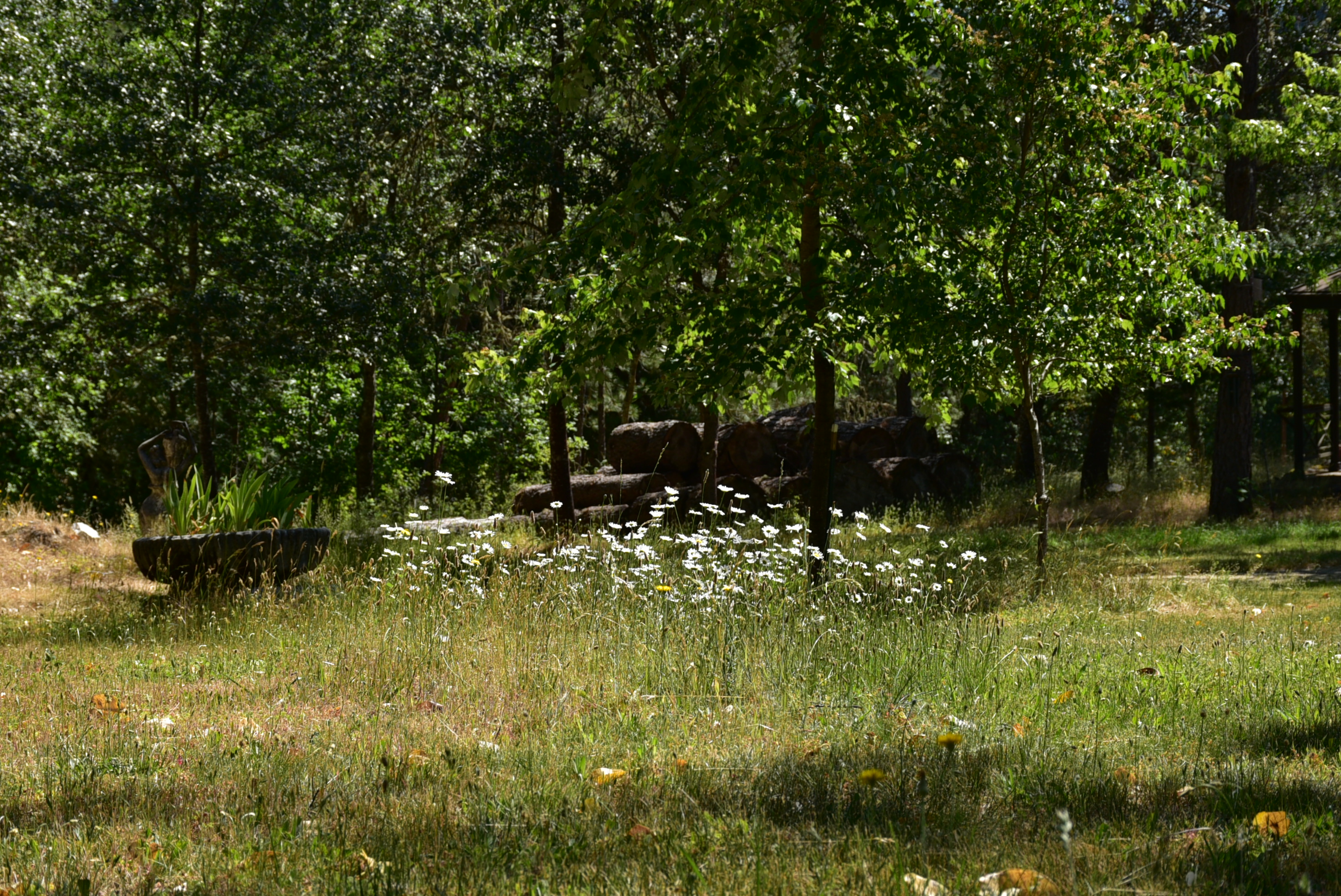
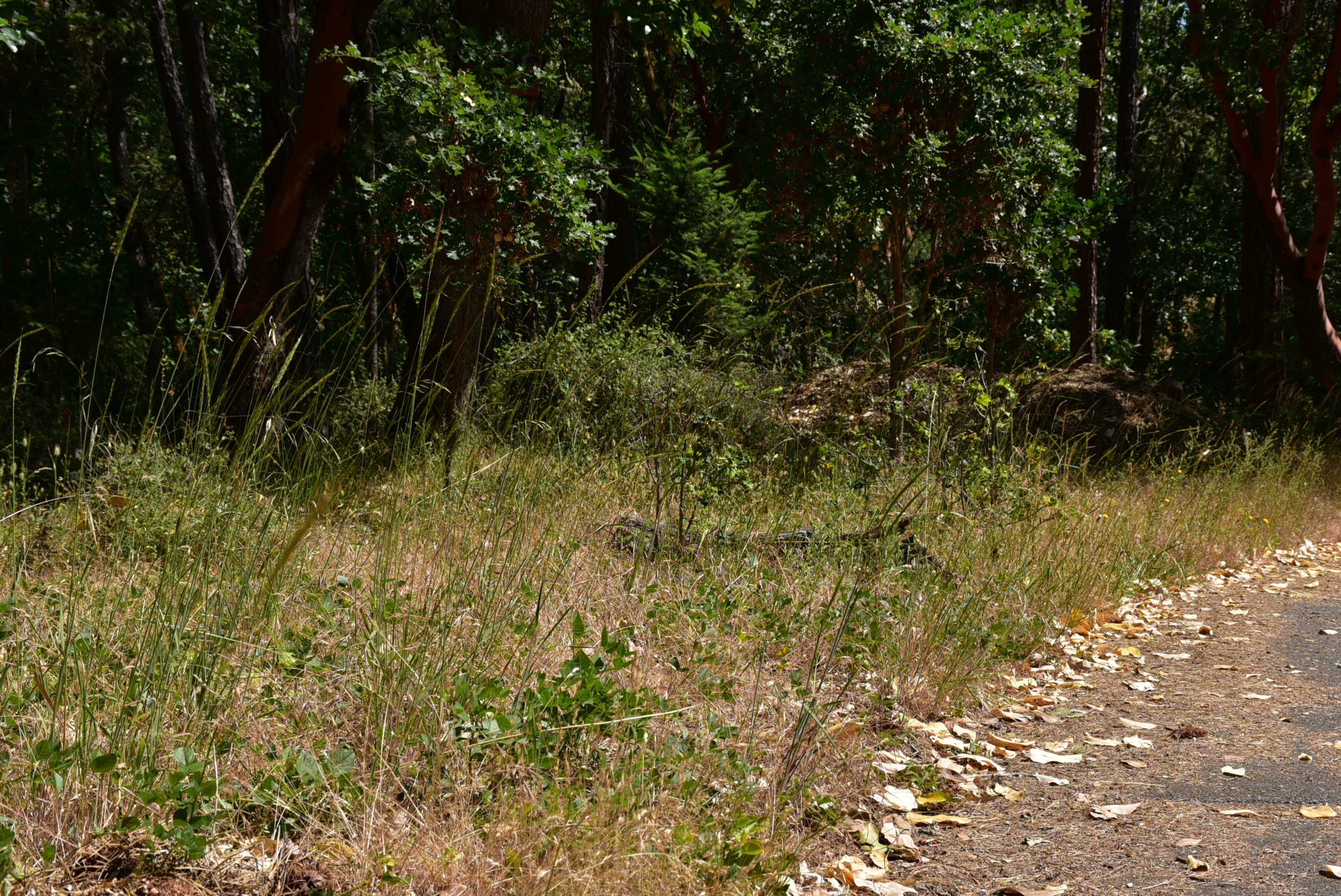
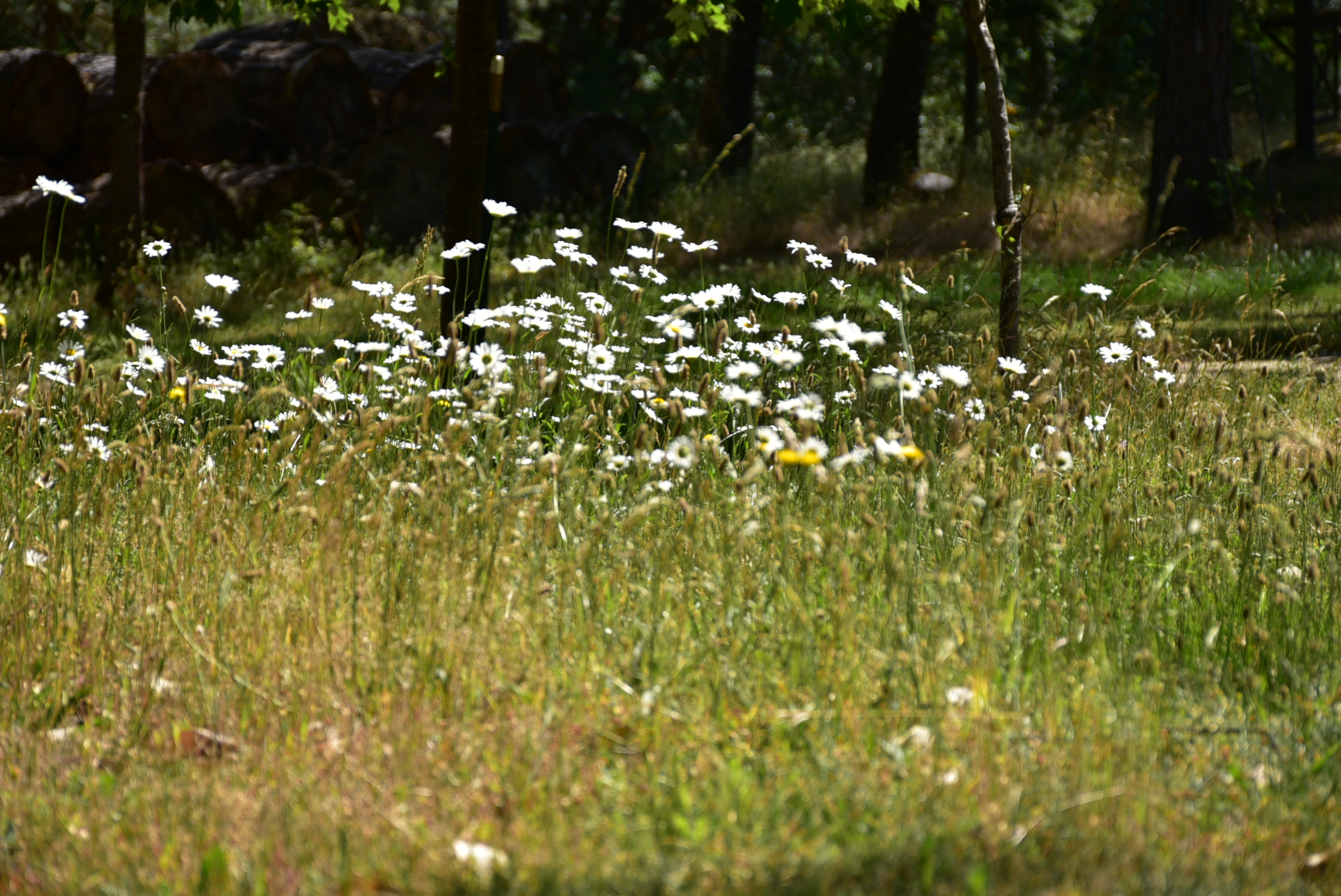
We live on 13 acres. Even the land near to the house is difficult to keep tidy so when Jean and I saw this TED Talk given by Rebecca McMacin we were overjoyed. For having a tidy garden does much greater harm to wildlife than keeping it wild.

Before I get to the TED video, I just want to show you some photos I took last Saturday.

oooo

oooo

Now to the TED Talk

Here is the description of the talk.

Many gardeners work hard to maintain clean, tidy environments … which is the exact opposite of what wildlife wants, says ecological horticulturist Rebecca McMackin. She shows the beauty of letting your garden run wild, surveying the success she’s had increasing biodiversity even in the middle of New York City — and offers tips for cultivating a garden that can be home to birds, bees, butterflies and more.

Here is Rebecca’s background.

Rebecca McMackin is an ecologically obsessed horticulturist who helps people create and care for beautiful gardens that provide habitat for birds, butterflies and soil microorganisms.

Why you should listen

Rebecca McMackin spent a decade as director of horticulture at Brooklyn Bridge Park, where she employed organic principles to manage 85 acres of diverse parkland. During her time overseeing the park’s ecology, stick bugs, rare mantids, threatened bees and lady bugs all returned to the park. The park’s urban biodiversity and successful use of ethical management strategies influenced thousands of people and other urban parks to adopt similar approaches.

In addition to her work designing public gardens, McMackin writes, lectures and teaches on ecological landscape management and pollination ecology. She recently installed an 8,000-square-foot native wildflower garden for the entrance to the Brooklyn Museum. She was a Loeb Fellow at the Harvard Graduate School of Design, while her work has been published by and featured in The New York Times, the Landscape Institute and on NPR and PBS.

oooo

The video is just 12 minutes long and I encourage you to view it.