We live on a finite Earth. But really understanding what that means is difficult. I guess because most of us think that in our own little way we can’t really be doing any harm to the planet – I mean what’s another few grams of CO2?
Al Bartlet, University of Colorado
Well here’s Dr Albert Bartlett of the Department of Physics at the University of Colorado chatting about arithmetic! And if you go to his website, you will come across this quote on the home page:
“Can you think of any problem in any area of human endeavor on any scale, from microscopic to global, whose long-term solution is in any demonstrable way aided, assisted, or advanced by further increases in population, locally, nationally, or globally?”
Want to sit in on his famous lecture, “Arithmetic, Population and Energy: Sustainability 101”? Well you can.
The lecture is broken down into 8 10-minute videos, each of them on YouTube. The first two instalments are here , Part Three and Four here and Parts Five and Six in this post. The concluding two parts are tomorrow. Part Five
We live on a finite Earth. But really understanding what that means is difficult. I guess because most of us think that in our own little way we can’t really be doing any harm to the planet – I mean what’s another few grams of CO2?
Al Bartlet, University of Colorado
Well here’s Dr Albert Bartlett of the Department of Physics at the University of Colorado chatting about arithmetic! And if you go to his website, you will come across this quote on the home page:
“Can you think of any problem in any area of human endeavor on any scale, from microscopic to global, whose long-term solution is in any demonstrable way aided, assisted, or advanced by further increases in population, locally, nationally, or globally?”
Want to sit in on his famous lecture, “Arithmetic, Population and Energy: Sustainability 101”? Well you can.
The lecture is broken down into 8 10-minute videos, each of them on YouTube. The first two instalments are here with Part Three and Four in this post. The remaining four parts over the next two days.
We live on a finite Earth. But really understanding what that means is difficult. I guess because most of us think that in our own little way we can’t really be doing any harm to the planet – I mean what’s another few grams of CO2?
Al Bartlet, University of Colorado
Well here’s Dr Albert Bartlett of the Department of Physics at the University of Colorado chatting about arithmetic! And if you go to his website, you will come across this quote on the home page:
“Can you think of any problem in any area of human endeavor on any scale, from microscopic to global, whose long-term solution is in any demonstrable way aided, assisted, or advanced by further increases in population, locally, nationally, or globally?”
Want to sit in on his famous lecture, “Arithmetic, Population and Energy: Sustainability 101”? Well you can.
The lecture is broken down into 8 10-minute videos, each of them on YouTube. The first two instalments are in this post with each of the following three days having the next two.
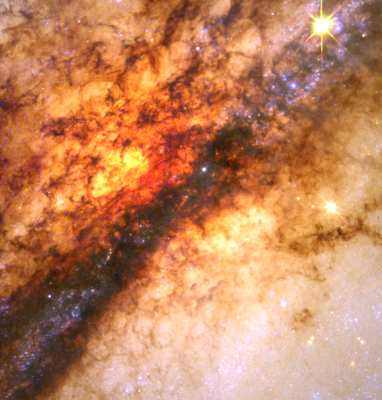
The Hubble Space Telescope (HST) has been in space for 20 years!
This week, twenty years ago, the HST was launched into orbit. There’s much online if you want to read about it both on WikiPedia and on the Hubble web site so this post is going to offer just two items.
A beautiful picture
Nucleus of Galaxy Centaurus A
And an interesting audio slideshow tribute from the BBC – click here, introduced thus:
Take a look at some of the sights it has seen in that time with Professor Alec Boksenberg from the Institute of Astronomy in Cambridge – who was on the European team that helped build Hubble.
By Paul Handover (in awe of what is beyond our skies)
A week or so ago, the BBC under their Beautiful Minds series, screened a programme about James Ephraim Lovelock, more popularly known as Professor Jim Lovelock.
Prof. James Lovelock
(Picture taken from this article – in itself well worth reading.)
The programme demonstrated that Lovelock’s mind is more than beautiful, it is still capable, at 90 years of age, of thinking in ways that are very rare in today’s societies where conformity is such a powerful force.
As always, WikiPedia has an excellent reference on Prof. Lovelock and I encourage you to read it plus Lovelock’s own website which makes up in content what it may lack for presentation!
Luckily there is an extract from the BBC programme on YouTube – please watch this and reflect on exactly what Lovelock is saying.
And if you are up for more, then settle down for thirteen minutes and watch this next video.
James Lovelock is the Darwin of our times.
Now to put this into some context (this is me speaking as a layman!).
This is being written at 15:00 UTC on Tuesday, 20th April. It’s still anyone’s guess as to when the airspace that commercial aircraft fly in will be free from volcanic fallout.
Nature disposing
Based in Arizona but planning to fly to the UK in about three weeks, it’s also very frustrating finding really good, accurate information to help one think through plans and back-up plans.
But here’s a web site for UK glider (sailplane) pilots that goes a very long way to providing really solid information. Check it out. (And, once again, thanks to Yves Smith of Naked Capitalism for finding the site.)
The expression “mind-boggling” seems most appropriate here.
After reading my book, “The Ascent of Science“, referred to yesterday, I gathered together just a few of the randomly-miscellaneous statistics which most struck me. No doubt there are plenty more! PLEASE SEND ME YOUR MOST AMAZING NATURAL STATISTICS!
We are carbon-based creatures. EVERY SINGLE CARBON ATOM in our bodies
was created in a supernova explosion of a giant star. We are truly “Children of the Stars”.
The “Nature” of our world and existence is indeed almost unbelievable.
MOLECULES: They are extremely small: a teaspoonful of water contains about 200,000,000,000,000,000,000,000 molecules. If everyone on the planet set out to count these molecules one per second it would take over ONE MILLION YEARS.
A molecule of hydrogen in a steel cylinder travels at about 3,800 mph.
Molecules NEVER stop moving. A molecule in the air makes 6,000 MILLION collisions with other molecules PER SECOND.
The above two facts explain why the progress of molecules through space is extremely slow unless assisted by an external force (e.g. the wind)
Every second, your skin is subject to bombardment by 2*10 to the power 24 (200,000,000,000,000,000,000,000,000) blows from molecules in the air.
ELECTRONS: When you switch on a light bulb, approximately 3*10 to the power 19 (30 million million million) electrons flow through your lamp EVERY SECOND
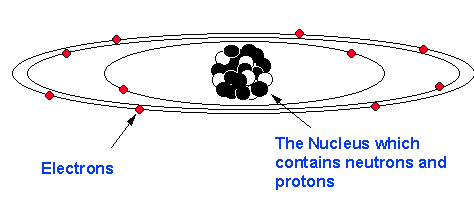
THE ATOM
NOT drawn in "real" proportions
A man is about 10 BILLION times larger than an oxygen atom. If an atom were the size of a golf ball then a man would stretch from earth to the moon.
A teaspoonful of solid nuclei of atoms would weigh about 500 million tons.
The nucleus of a typical atom contains about 99.8% of the total mass of the atom.
The diameter of an atom is about 100,000 times the diameter of the central nucleus.
Most of an atom is empty space. Imagine a sphere of FIVE MILES to represent an atom. The nucleus on the same scale would be the size of a tennis ball.
Most of your body is empty space …..
A black hole is supposed to consist entirely of material from the nucleus; all the “empty space” has been stripped away. A black hole of the mass of the earth would be ONE CENTIMETER in diameter.
COLLAPSED STARS
There is believed to be a black hole at the centre of our galaxy with the mass of ONE MILLION times that of our Sun.
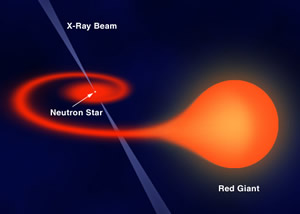
A pulsar or neutron star is a collapsed star that spins on its axis up to three or four thousand times per second.
A pulsar is ONE HUNDRED TIMES DENSER than a white dwarf, which is what our Sun will become once its nuclear fuel has been used up.
Pulsars sometimes send out gigantic amounts of visible light, equivalent to many times the total light emitted by the Milky Way.
A tablespoon of material from a neutron star would weigh about 3 BILLION TONS.
THE HUMAN EAR
can distinguish around 400,000 different sounds.
can detect sounds so quiet that the vibratory movement induced in the eardrum is not much more than the width of a calcium atom.
a science class at Woolverstone Hall School, late 50s - click to see more
Apart from hearing and knowing that many people are suffering terrible hardships in this world, I find few things more depressing than to hear young people say “I’m not interested in science”.
We are part of Nature. Science is the study of Nature.
How can it possibly NOT be the most interesting and endlessly-fascinating of subjects? There is a shortage of well-trained science teachers in Britain. There are too many students doing courses on “Football Management”, “Media Studies” or even “sociology”.
Why is this? I can’t explain it. Can anyone else?
I am not a scientist, having had to abandon the study of physics and biology – two subjects I loved – because I was better at languages. Too many youngsters have to drop science at the age of 16. What an absolute folly in the technological age, even 50 years ago.
My point is not just that science is important but that it is so interesting. Is the problem that some kids find it “too hard”? That must be poor teaching, surely? You gear your lessons to your students.
One positive point about British schools – at least in my distant experience – was the great use made of practical work. I so looked forward to that in physics: boiling up water in calorimeters, mucking about with levers and pulleys, passing electrical currents through each other …. I looked on physics lessons as a game, not a boring school subject.
Yes, science CAN be hard, especially for those not that good at maths. Some of the most brilliant minds on the planet do science; we cannot hope to understand all they do. But this doesn’t matter, does it?
ISBN: 0-19-511699-2
As for maths, I have recently been reading a most stupendous book, one that I cannot recommend too highly to any layman interested in science. Shown right, this was written by Brian Silver, former Professor of Physical Chemistry at the Technicon Institute of Technology in Israel.
I read and re-read this book every night, each time hoping – somewhat in vain – that I will eventually understand what quantum mechanics and relativity really are. But I read it, too, with a tinge of sadness, for Brian Silver died in 1997, just prior to the publication of his book, which I personally feel is a masterpiece of its kind.
In this book Professor Silver takes us through the history of science from Antiquity and before right up to the end of the 20th century. As well as chapters on all the major fields and discoveries of science from Pythagoras to Hawking we have fascinating snippets of biographical information about the science greats: Galileo, Copernicus, Newton, Herschel, Boyle, Hooke, Faraday, Lavoisier, Maxwell, Mendel, Darwin, Planck, Bohr, Heisenberg, Schrödinger, Einstein, Rutherford, Crick and so many more.
Their biographies themselves make fascinating reading, let alone their discoveries.
I read a book some years ago about Joseph Salk and the development of the polio vaccine. This was a hundred times more exciting than the most classy whodunnit, recounting the story of one of the greatest triumphs of medicine. Do you know anyone with polio? Nor do I, though I did when I was a kid in the 50s and of course there are many in “developing” nations still today, as we spend billions on CERN and not enough on medicine for the deprived of this world. Interwoven with the factual accounts of science and scientists considerable attention is given to philosophy and the placing of scientists and their discoveries in their historical context. A dry, purely factual book this isn’t, with the final chapters on cosmology, the origin of the universe and the meaning of life. (But don’t expect any answers to the last two!!)
Maths? Well, Professor Silver puts Michael Faraday right up there among the immortals. An astounding practical scientist/technologist, he made major discoveries in the field of electricity that affect the lives of everyone on the planet today. But his maths wasn’t too good! So much so that he pleaded with James Clerk Maxwell to write his equations in a more understandable way!
So you don’t have to be a great mathematician to do good things in science. If only I’d realized that before, I could have been another Faraday!
This book should be a standard textbook for all 6th formers, not just those doing science. I salute the brilliant and too-soon departed author.
Very early on in the life of this Blog, indeed on the second day, I wrote a short article about the NASA mission to the moon, some 40 years after the event. You see, for me that has been the historic event of my lifetime.
I believe that this nation should commit itself to achieving the goal, before this decade is out, of landing a man on the Moon and returning him safely to the Earth. No single space project in this period will be more impressive to mankind, or more important in the long-range exploration of space; and none will be so difficult or expensive to accomplish.
Apollo 11 badge
That speech before Congress by President Kennedy was on the 25th May, 1961. I was 16 and was enthralled by the idea of being alive when man first set foot on another planetary body. That came about on July 20th, 1969 at which time I was living and working in Sydney, Australia. I took three days off work, rented a TV and watched every minute of the event.
Exploration is a core need of man. By pushing out the boundaries of our knowledge we continue to offer hope to mankind.
So it is with great disappointment that it has been announced by President Obama that the manned mission programs to the moon are to be severely curtailed – that sounds terribly like political speak for cancelled!
As Eugene Cernan (last astronaut to set foot on the moon) said:
I’m quite disappointed that I’m still the last man on the Moon. I thought we’d have gone back long before now.
I think America has a responsibility to maintain its leadership in technology and its moral leadership… to seek knowledge. Curiosity’s the essence of human existence.
Curiosity is indeed the essence of human existence.
That curiosity and the investment in space exploration by NASA on behalf of the whole world has shown us some remarkable findings about Saturn and it’s majestic rings. Just watch the video segments in this piece from the BBC.
The one-time cost of Cassini-Huygens mission was $3.26 billion. Just 0.3% of the cost of one year’s expenditure on U.S. defense spending.
Science missions like Cassini enhance cooperation between nations, and greatly contribute to scientific progress which benefits everyone.
Perhaps the big Banks would like to pick up the cost of further manned missions to the Moon?
Don’t know what time it is? Hardly surprising in Spring and Autumn.
Today is exactly one month before the United Kingdom ‘moves’ its clocks forward and enters British Summer Time; 1am (UTC) on Sunday 28th March 2010. Is that date the same across the world? One would think so because it makes life, especially international air transport, so much easier.
But no! In fact the way that time zones are applied and changed for Daylight Saving is a complete hotch-potch.
In the United States of America, daylight saving starts at 2am on March 14th, 2010. And just three years ago that start time would have been the first Sunday in April. Changes were made in the US Energy Policy Act of 2005.
Other parts of the world observe Daylight Saving Time as well. While European nations have been taking advantage of the time change for decades, in 1996 the European Union (EU) standardized an EU-wide “summertime period.” The EU version of Daylight Saving Time runs from the last Sunday in March through the last Sunday in October. During the summer, Russia’s clocks are two hours ahead of standard time. During the winter, all 11 of the Russian time zones are an hour ahead of standard time. During the summer months, Russian clocks are advanced another hour ahead. With their high latitude, the two hours of Daylight Saving Time really helps to save daylight. In the southern hemisphere where summer comes in December, Daylight Saving Time is observed from October to March. Equatorial and tropical countries (lower latitudes) don’t observe Daylight Saving Time since the daylight hours are similar during every season, so there’s no advantage to moving clocks forward during the summer.
Of course, someone had to create a web-site to track all these various time zones and changes. Here it is.
Last year, the BBC News website published an interesting article about the Greenwich Meridian aka The Prime Meridian. The setting of the Prime Meridian was done just over 125 years ago, in October 1884. When one thinks of the importance in having a standard meridian, both for time keeping and navigation, I would have guessed that it went back much further in time.
The other aspect that was news to me was that the conference had been convened at the request of the American President Chester Arthur.
From that BBC article:
Until the 19th Century, many countries and even individual towns kept their own local time based on the sun’s passage across the sky and there were no international rules governing when the day would start or finish.
However, with the rapid expansion of the railways and communications networks during the 1850s and 1860s, setting a standard global time soon became essential.
“The world was in a very big mix-up,” explains Dr Avraham Ariel, author of Plotting the Globe. “People had lots of prime meridians. Earlier in Europe there were 20 prime meridians. The Russians had two or three, the Spanish had their own and so on.”
Thus that famous line in the grounds of the National Maritime Museum at Greenwich, London is not as old as many might have thought.





 Enlarge Image
 Learning from Dogs