Category: Science

David Bohm and the Implicate Order

I was much taken by Patrice’s guest post of yesterday and have managed a short break from the travails of my Master’s degree to post an article by David Pratt, that has been part of my research.  Jon.

David Bohm and the Implicate Order

By David Pratt
David Bohm

The death of David Bohm on 27 October 1992 is a great loss not only for the physics community but for all those interested in the philosophical implications of modern science. David Bohm was one of the most distinguished theoretical physicists of his generation, and a fearless challenger of scientific orthodoxy. His interests and influence extended far beyond physics and embraced biology, psychology, philosophy, religion, art, and the future of society. Underlying his innovative approach to many different issues was the fundamental idea that beyond the visible, tangible world there lies a deeper, implicate order of undivided wholeness.

David Bohm was born in Wilkes-Barre, Pennsylvania, in 1917. He became interested in science at an early age, and as a young boy invented a dripless teapot, and his father, a successful businessman, urged him to try to make a profit on the idea. But after learning that the first step was to conduct a door-to-door survey to test market demand, his interest in business waned and he decided to become a theoretical physicist instead.

In the 1930s he attended Pennsylvania State College where he became deeply interested in quantum physics, the physics of the subatomic realm. After graduating, he attended the University of California, Berkeley. While there he worked at the Lawrence Radiation Laboratory where, after receiving his doctorate in 1943, he began what was to become his landmark work on plasmas (a plasma is a gas containing a high density of electrons and positive ions). Bohm was surprised to find that once electrons were in a plasma, they stopped behaving like individuals and started behaving as if they were part of a larger and interconnected whole. He later remarked that he frequently had the impression that the sea of electrons was in some sense alive.

In 1947 Bohm took up the post of assistant professor at Princeton University, where he extended his research to the study of electrons in metals. Once again the seemingly haphazard movements of individual electrons managed to produce highly organized overall effects. Bohm’s innovative work in this area established his reputation as a theoretical physicist.

In 1951 Bohm wrote a classic textbook entitled Quantum Theory, in which he presented a clear account of the orthodox, Copenhagen interpretation of quantum physics. The Copenhagen interpretation was formulated mainly by Niels Bohr and Werner Heisenberg in the 1920s and is still highly influential today. But even before the book was published, Bohm began to have doubts about the assumptions underlying the conventional approach. He had difficulty accepting that subatomic particles had no objective existence and took on definite properties only when physicists tried to observe and measure them. He also had difficulty believing that the quantum world was characterized by absolute indeterminism and chance, and that things just happened for no reason whatsoever. He began to suspect that there might be deeper causes behind the apparently random and crazy nature of the subatomic world.

Bohm sent copies of his textbook to Bohr and Einstein. Bohr did not respond, but Einstein phoned him to say that he wanted to discuss it with him. In the first of what was to turn into a six-month series of spirited conversations, Einstein enthusiastically told Bohm that he had never seen quantum theory presented so clearly, and admitted that he was just as dissatisfied with the orthodox approach as Bohm was. They both admired quantum theory’s ability to predict phenomena, but could not accept that it was complete and that it was impossible to arrive at any clearer understanding of what was going on in the quantum realm.

It was while writing Quantum Theory that Bohm came into conflict with McCarthyism. He was called upon to appear before the Un-American Activities Committee in order to testify against colleagues and associates. Ever a man of principle, he refused. The result was that when his contract at Princeton expired, he was unable to obtain a job in the USA. He moved first to Brazil, then to Israel, and finally to Britain in 1957, where he worked first at Bristol University and later as Professor of Theoretical Physics at Birkbeck College, University of London, until his retirement in 1987. Bohm will be remembered above all for two radical scientific theories: the causal interpretation of quantum physics, and the theory of the implicate order and undivided wholeness.

In 1952, the year after his discussions with Einstein, Bohm published two papers sketching what later came to be called the causal interpretation of quantum theory which, he said, “opens the door for the creative operation of underlying, and yet subtler, levels of reality.” (David Bohm and F. David Peat, Science, Order & Creativity, Bantam Books, New York, 1987, p. 88.) He continued to elaborate and refine his ideas until the end of his life. In his view, subatomic particles such as electrons are not simple, structureless particles, but highly complex, dynamic entities. He rejects the view that their motion is fundamentally uncertain or ambiguous; they follow a precise path, but one which is determined not only by conventional physical forces but also by a more subtle force which he calls the quantum potential.The quantum potential guides the motion of particles by providing “active information” about the whole environment. Bohm gives the analogy of a ship being guided by radar signals: the radar carries information from all around and guides the ship by giving form to the movement produced by the much greater but unformed power of its engines.

The quantum potential pervades all space and provides direct connections between quantum systems. In 1959 Bohm and a young research student Yakir Aharonov discovered an important example of quantum interconnectedness. They found that in certain circumstances electrons are able to “feel” the presence of a nearby magnetic field even though they are traveling in regions of space where the field strength is zero. This phenomenon is now known as the Aharonov-Bohm (AB) effect, and when the discovery was first announced many physicists reacted with disbelief. Even today, despite confirmation of the effect in numerous experiments, papers still occasionally appear arguing that it does not exist.

In 1982 a remarkable experiment to test quantum interconnectedness was performed by a research team led by physicist Alain Aspect in Paris. The original idea was contained in a thought experiment (also known as the “EPR paradox”) proposed in 1935 by Albert Einstein, Boris Podolsky, and Nathan Rosen, but much of the later theoretical groundwork was laid by David Bohm and one of his enthusiastic supporters, John Bell of CERN, the physics research center near Geneva. The results of the experiment clearly showed that subatomic particles that are far apart are able to communicate in ways that cannot be explained by the transfer of physical signals traveling at or slower than the speed of light. Many physicists, including Bohm, regard these “nonlocal” connections as absolutely instantaneous. An alternative view is that they involve subtler, nonphysical energies traveling faster than light, but this view has few adherents since most physicists still believe that nothing-can exceed the speed of light.

The causal interpretation of quantum theory initially met with indifference or hostility from other physicists, who did not take kindly to Bohm’s powerful challenge to the common consensus. In recent years, however, the theory has been gaining increasing “respectability.” Bohm’s approach is capable of being developed in different directions. For instance, a number of physicists, including Jean-Paul Vigier and several other physicists at the Institut Henri Poincaré in France, explain the quantum potential in terms of fluctuations in an underlying ether.

In the 1960s Bohm began to take a closer look at the notion of order. One day he saw a device on a television program that immediately fired his imagination. It consisted of two concentric glass cylinders, the space between them being filled with glycerin, a highly viscous fluid. If a droplet of ink is placed in the fluid and the outer cylinder is turned, the droplet is drawn out into a thread that eventually becomes so thin that it disappears from view; the ink particles are enfolded into the glycerin. But if the cylinder is then turned in the opposite direction, the thread-form reappears and rebecomes a droplet; the droplet is unfolded again. Bohm realized that when the ink was diffused through the glycerin it was not a state of “disorder” but possessed a hidden, or nonmanifest, order.

In Bohm’s view, all the separate objects, entities, structures, and events in the visible or explicate world around us are relatively autonomous, stable, and temporary “subtotalities” derived from a deeper, implicate order of unbroken wholeness. Bohm gives the analogy of a flowing stream:

On this stream, one may see an ever-changing pattern of vortices, ripples, waves, splashes, etc., which evidently have no independent existence as such. Rather, they are abstracted from the flowing movement, arising and vanishing in the total process of the flow. Such transitory subsistence as may be possessed by these abstracted forms implies only a relative independence or autonomy of behaviour, rather than absolutely independent existence as ultimate substances.

(David Bohm, Wholeness and the Implicate Order, Routledge & Kegan Paul, London, Boston, 1980, p. 48.)

We must learn to view everything as part of “Undivided Wholeness in Flowing Movement.” (Ibid., p. 11.)

Another metaphor Bohm uses to illustrate the implicate order is that of the hologram. To make a hologram a laser light is split into two beams, one of which is reflected off an object onto a photographic plate where it interferes with the second beam. The complex swirls of the interference pattern recorded on the photographic plate appear meaningless and disordered to the naked eye. But like the ink drop dispersed in the glycerin, the pattern possesses a hidden or enfolded order, for when illuminated with laser light it produces a three-dimensional image of the original object, which can be viewed from any angle. A remarkable feature of a hologram is that if a holographic film is cut into pieces, each piece produces an image of the whole object, though the smaller the piece the hazier the image. Clearly the form and structure of the entire object are encoded within each region of the photographic record.

Bohm suggests that the whole universe can be thought of as a kind of giant, flowing hologram, or holomovement, in which a total order is contained, in some implicit sense, in each region of space and time. The explicate order is a projection from higher dimensional levels of reality, and the apparent stability and solidity of the objects and entities composing it are generated and sustained by a ceaseless process of enfoldment and unfoldment, for subatomic particles are constantly dissolving into the implicate order and then recrystallizing.

The quantum potential postulated in the causal interpretation corresponds to the implicate order. But Bohm suggests that the quantum potential is itself organized and guided by a superquantum potential, representing a second implicate order, or superimplicate order. Indeed he proposes that there may be an infinite series, and perhaps hierarchies, of implicate (or “generative”) orders, some of which form relatively closed loops and some of which do not. Higher implicate orders organize the lower ones, which in turn influence the higher.

Bohm believes that life and consciousness are enfolded deep in the generative order and are therefore present in varying degrees of unfoldment in all matter, including supposedly “inanimate” matter such as electrons or plasmas. He suggests that there is a “protointelligence” in matter, so that new evolutionary developments do not emerge in a random fashion but creatively as relatively integrated wholes from implicate levels of reality. The mystical connotations of Bohm’s ideas are underlined by his remark that the implicate domain “could equally well be called Idealism, Spirit, Consciousness. The separation of the two — matter and spirit — is an abstraction. The ground is always one.” (Quoted in Michael Talbot, The Holographic Universe, HarperCollins, New York, 1991, p. 271.)

As with all truly great thinkers, David Bohm’s philosophical ideas found expression in his character and way of life. His students and colleagues describe him as totally unselfish and non-competitive, always ready to share his latest thoughts with others, always open to fresh ideas, and single-mindedly devoted to a calm but passionate search into the nature of reality. In the words of one of his former students, “He can only be characterized as a secular saint.” (B. Hiley & F. David Peat eds., Quantum Implications: Essays in Honour of David Bohm, Routledge & Kegan Paul, London, 1987, p. 48.)

Bohm believed that the general tendency for individuals, nations, races, social groups, etc., to see one another as fundamentally different and separate was a major source of conflict in the world. It was his hope that one day people would come to recognize the essential interrelatedness of all things and would join together to build a more holistic and harmonious world. What better tribute to David Bohm’s life and work than to take this message to heart and make the ideal of universal brotherhood the keynote of our lives.

(Reprinted from Sunrise magazine, February/March 1993. Copyright © 1993 by Theosophical University Press)

And for a fascinating insight into Bohm and his beautiful brain, watch this:

By Jon Lavin

Cosmic Modesty Required

THE UNIVERSE TEACHES AWE AND HUMILITY

This is a guest post from an old friend of Learning from Dogs, Patrice Ayme.  Patrice writes his own Blog here and this article is published with gratitude and with awe! If you can, because the article more than deserves this, find somewhere quiet for half-an-hour to read this – it may well change the way you think about everything.

Theme: Is there extraterrestrial life? Extraterrestrial intelligence? A related question: how big is the universe? On all these subjects considerable and very surprising progress is in the making. I describe some of the new ideas and facts in plain language, from Plate Tectonics to Cosmic Inflation.

Facing the enormity of it all, honest minds will find honor and pleasure in telling the truth, and nothing but the truth (carefully distinguishing it from hope we can believe in). Some physicists, searching for the limelight, have presented some science fiction, or some science fantasy, or let’s say scientific working hypotheses, philosophically grounded, as real, established science. This is misleading and dangerous: science is truth, and that is why the public supports it. Let’s keep it that way.

Sometimes all that science does, but that is fundamental, is to find new uncertainties we did not previously suspect. A basic humility that needs to be taught to people and politicians is that knowledge is not just about learning what we know, but also about learning that there are new dimensions to what we don’t know.

One certainty: our Earth is rare and fragile. Earth was a primordial deity of the Greeks, Gaia, viewed as female, nourishing humankind. Gaia is an on-going miracle, of self regulation, with extremely complicated biology and physics entangled. The more we observe the cosmos, the more we see that’s hell out there. Gaia is a rare deity, Pluto is the rule. Here are some inklings.

***

ALIEN SOLAR SYSTEMS EVERYWHERE:

Many planets have been discovered around many stars. Solar systems (= several planets orbiting the same star) have also been discovered. In one of these systems three planets around a dwarf red star are all in the inhabitable zone (= neither too cold nor too hot, so that liquid water exists on a planet there). One of them is smack in the middle of the balmy zone. It seems clear that most stars will be found to have planets (we are above 30%, and our present detection methods are very crude).

Still there does not seem to be many civilizations out there. As Enrico Fermi put it:”Where is everybody?

Far enough from the dangerous galactic center, with its zooming stars, high radiation, and gigantic black hole, but not far enough to miss the full wealth of the periodic table, with its many elements, there is a narrow band all around the galaxy, the inhabitable zone, with at least 50 billion suns (within the trillion suns of the Milky Way).

Everything indicates that there are billions of colonizable planets in the inhabitable zone of our galaxy: colonialism has a great future (once we find how to get there). Life could have started on many of these planets. But on most of these, it was quickly annihilated: hellish, incandescent “super-earths” (= rocky planet with masses up to 10 times Earth) ready to fall into their star, abound.

***

INGREDIENTS FOR LIFE: MAGNETOSPHERE, TECTONICS, MOON…

The obvious candidate for the start of life is next door. It is Mars (Venus may have qualified too, the early Sun being 25% weaker; but Venus has long turned into hell, destroying all biological remnants). Everything indicates that life started on Mars. It would be very surprising that it did not.

Probably even OUR life started there. Impacts of asteroids and comets would have thrown living material from Mars to Earth. Mars meteorites have been found in Antarctica, lying on the ice. It has been observed that the temperatures within a Mars meteorite could stay very low: no more than around 40 Celsius, during the entire Mars-Earth transfer.

The Earth stayed too hot for life much longer than Mars, due to its much greater thermal inertia, large, intense radioactive core, greater number of impacts, and having thoroughly melted after the giant impact which created our life fostering Moon.

But then, after an auspicious start, Mars lost most of most of its atmosphere (probably within a billion years or so). Why? Mars is a bit small, its gravitational attraction is weaker than Earth (it’s only 40%). But, mostly, Mars has not enough a magnetic field. During Coronal Mass Ejections, CMEs, the Sun can throw out billions of tons of material at speeds up to and above 3200 kilometers per seconds. It’s mostly electrons and protons, but helium, oxygen and even iron can be in the mix.

The worst CME known happened during the Nineteenth Century, before the rise of the electromagnetic civilization we presently enjoy. Should one such ejection reoccur now, the electromagnetic aspect of our civilization would be wiped out.It goes without saying that we are totally unprepared, and would be very surprised. Among other things, all transformers would blow up, and they take months to rebuild. we would be left with old books in paper, the old fashion way. A CME can rush to Earth in just one day. (Fortunately the Sun seems to be quieting down presently, a bit as it did during the Little Ice Age.)

When a CME strikes a planet, the upper atmosphere is hit by a giant shotgun blast. Except a shotgun blast goes around 300 meters per second, 10,000 times slower than a CME. So, per unit of mass, the kinetic energy of a powerful CME is at least ten billion times more powerful than a shotgun blast. Since the liberation speed is going to be around ten kilometers per second, on an average life supporting planet, to be hit by projectiles going at 3,000 kilometers per second is going to knock all too much of the upper air atoms into space. That’s how Mars lost most of its atmosphere. And thus its ocean and much of its greenhouse. So now Mars is desperately airless, dry, and cold.

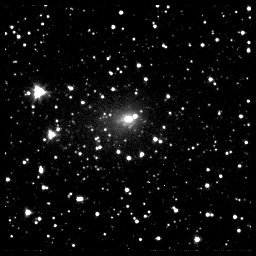
A cluster of new stars forming in the Serpens South cloud

(More on the Serpens constellation here. Ed.)

***

Both Mars and Venus are at the limit of the inhabitable zone. But Venus does not have a magnetic field worth this name. Thus Venus lost a lot of its hydrogen (hence water; the rest is tied up in sulfuric acid, H2SO4).

It is known that the Earth’s strong magnetic field originates from the motion of huge masses of liquid metal within.

So a solar wind shield, a magnetosphere, is tied to the plate tectonic of a very dynamical planet with a powerful nuclear reactor deep inside. Whereas Venus and Mars are tectonically inert, at least, most of the time; maybe they wake up every half a billion years or so, for a big eruption. If Mars and Venus had been very tectonically active planets, may be they would be teeming with life (but that depends upon the distribution of heavy radioactive nuclei in a gathering solar system, an unknown subject, obviously non trivial, since Earth got them, and not the other two).

In any case the Earth’s magnetic shield protects life from the worst abuse of the Sun, as it deflects most of the CMEs out and around (they sneak back meekly as Aurora Borealis).

Another factor in the stable environment Earth provides for life is the Moon. The Earth-Moon system divides its angular momentum, between each other and the orbital motion of the Moon. This prevents the Earth to lay its rotation axis on its side: such a wobbling could not be compensated by the rest of the system. So it does not happen.

Mars, though, not being so impaired, wobbles between 15 and 35 degrees (causing weird, pronounced super-seasonal variations).

In any case, everything indicates that extremely primitive life appears quickly. But complex life needs time, lots of time, to evolve. Animal life and intelligence needs even more time. However, what strikes me in the new solar systems discovered so far, is how alien and unstable they are (this is partly a bias of the present detection methods).

Many of these systems have huge Jupiter styles planets in low orbit around their stars. It’s pretty clear that they fell down there, destroying the entire inner system in their path.

Other notions threaten life; gamma ray explosions, supernovas, and simply passing next to another star, throwing a solar system into chaos, and some Jupiters down into a fatal spiral. Our Sun, though, is pretty much cruising far from any star, in a cosmic void right now, perhaps left by a supernova explosion. Maybe we have been lucky for 4 billion years.

***

COSMIC GRANDEUR VERSUS MONKEY BUSINESS:

Many a physicist, or cosmologist, talks about the beginning of time, and other various notions pertaining to the grandest imagined machinery of the universe, as if they had found God, and it was themselves they were looking for (as Obama would put it). They claim to know their garden, the universe, pretty well (having apparently being there, at the moment of creation).

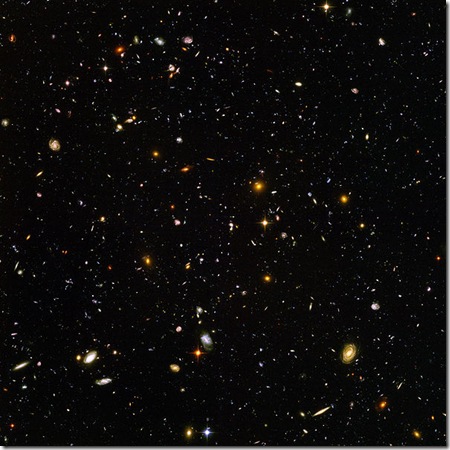
Verily, what we know for sure is what we see in pictures, and that’s plenty:

Hubble Ultra Deep Field: 10,000 galaxies. How many men?

Notions such as the “edge of the universe” are much less scientifically robust than some scientists claim. When some talk about the “First Three Minutes”, one can only laugh, even if countless Nobel Prizes in physics subscribe to the notion. Physics is relative, the search for glory, absolute. At least so do monkeys behave.

The concept of time in Quantum Mechanics and Relativity are in complete contradiction. One is absolute, the other relative. So nobody knows for sure what time is, and what is truly its relation to space (nor do we know what space is, much beyond the pretty pictures given by the telescopes). Speaking of the history of time is completely meaningless, except as poetry. Or scientific sounding poetry. Too many holes in the logic.

Even using standard science to buttress one’s reflection, the size of the universe could well be at least a 1,000 bigger than the 14 billion light year piece that we presently observe. In truth, we have literally no idea. Even when sticking to conventional theory, which predicts only one thing in that respect, namely that the universe is bigger than what we see (it predicts it by requiring it actually, see below).

Another thing is sure: it’s incredibly immense out there, and not just in physical size, but also in conceptual size. We know lower bounds for the universe in size and complexity, but have no idea whatsoever about the upper bounds. Dark Energy is a perfect example. Fifteen years ago, Dark Energy was unknown. Now it makes up 74% of the mass of the universe.

***

PRESENTING SCIENTIFIC PHILOSOPHY AS SCIENCE IS NOT WISE:

It is not a good thing when highly uncertain science is presented as certain, just as much as really true parts of science. It is not just immodest. It undermines, and threatens, science deeply.

Because presenting as certain what is not so is just a lie. But science is truth, and that is why society supports it.

To present as true what is not so ridiculizes the notion of certainty. When, ultimately, the ineluctable collapse of immodest pseudo-certainty occurs, all of science gets slashed with doubt. American witches can run as republican candidates for the US Senate on completely crazed platforms, mumbling about mice with human brains (this happened in the last USA election). Scientists ought not to make craziness respectable by leveraging it themselves. Crazy is crazy, especially when a scientist does it. It’s craziness squared.

Make no mistake: speculation is central to science and even more to philosophy. Just speculation ought to be labeled as such. When I talk about my own TOW theory, I do not present it as fact and certitude.

Most of recent (last 120 years) physics was totally unexpected. A lot of it is true, no doubt, in some sense. Some of it is completely false, too, most probably, in the most fundamental sense. The more fundamental science gets, the more it gets subjected to representations which can be misleading. Thus when some physiology or solid state physics gets established, it will not be shattered. Not so for Quantum Field Theory (most of which being an extrapolation over an energy domain where it has not been tested).

Science, like philosophy, is not just a body of knowledge, but also a method. Both have to use common sense as much as possible. Philosophy uses the external edge of knowledge, the first inklings, the first warnings, the smallest indices, the irreproducible experiments. Thus any scientist searching for really shattering new science will pass through the philosophical method, as a mandatory passage to greater certainty.

When science is proclaimed, it has to be certain. Science is truth in which one can have faith. A lot of the most glitzy cosmology comes short of that. (Thus the adventures of the alleged Big Bang should not be used as an argument to fund expensive accelerators: there are enough good reasons to fund them, not to use the bad ones!) The surest part of cosmology is actually its pretty pictures.

***

INFLATE OUR CLAIMS, IF THE OLD ONES DID NOT WORK OUT:

All of recent conventional cosmology’s biggest and noisiest concepts rest on something called the Inflaton Field. One could say that it is just as much a rabbit out of a hat as in the best circus acts. There is no justification for it, except to explain what we see: something very big, very homogeneous, apparently contradicting relativity. The universe in its entirity.

The mystery that Cosmic Inflation tries to explain was this: as new regions of the universe come into view (at the speed of light!), it is observed that the new regions are exactly as the region we already know; same aspect, same background temperature, etc. How did they know how to look the same? They could not have talked to each other! Light did not have time to go from one to the other!

According to standard Einsteinian relativity, our region, and those regions, some on the opposite side of the universe from each other, have no common history! (Those new regions which appear are NOT within our past light cone… To use relativity lingo.)

In the USSR, Einstein’s work was criticized in minutia, for ideological reasons (Note1). So the great astrophysicist Zeldovitch came up in 1965 with the idea of inflation (the discovery is attributed to Guth, 1980, in the USA, because the USA buried the USSR, and America is a super power blessed by God, as the resident of the White House reminds his flock every day).

Einstein’s Relativity speaks of the speed of light within space, but not of the speed of space (so to speak). Speed of light is limited within space, speed of space is not limited. So it was breezingly supposed space had inflated at a gigantic speed, before slowing down. So the new regions coming into view had a sort of common history, after all.

From a philosophical perspective, to invent an explanation to explain a specific effect is called an ad hoc hypothesis. It can be a correct way to advance science, if it has predictive power (But differently from the neutrino, or the W, or the Higgs, how do you check for it? Finding the Inflaton particle? The Inflaton is supposed to have given birth to most other particles). In the meantime, it provides some hand waving to explain away an otherwise obvious contradiction with Relativity.

But it is not enough that some of the best theories in physics are weird, with the logical consistency of gruyere.

The apparent discovery of Dark Matter and especially Dark Energy, have brought a new twist. Dark Energy is completely unexplainable.

Dark Energy attracted attention to the fact that Quantum field theory is both the most precise and the most false theory ever contemplated (QFT is off in its prediction of vacuum energy by a factor of ten to the power 120, or so, the greatest mistake in theory, in the entire history of hominids… it would make even baboons scream in dismay.)

NASA-ESA Hubble

Billions of galaxies can be seen when we look as far as we can see. Here is a tiny detail, as far as we can see, without using a gravitational lens. [NASA-ESA Hubble]. Baffling. We are going to need a bigger imagination.

It’s hard for me to escape the feeling that the universe is much older than what standard cosmology believes, as I look at these very ancient, but very diverse galaxies in a piece of sky (Note 2).

Dark energy was discovered when it was realized, in super novae studies, that the universe’s expansion was accelerating (so energy is injected).

A natural question, though is this: ”If, as it turned out, the expansion is accelerating now, maybe it was at standstill much earlier?” Then the universe, even the small piece we can see, would be older and bigger than we have imagined so far. Don’t be afraid of the simple questions. Einstein asked himself at 16 what would happen if he looked at a mirror when going at the speed of light (Note 1).

Time will tell, as long as astronomy gets massively funded. Astronomy (astrophysics, cosmology, etc.) is one of the fields of science where fabulous progress is certain if it gets funded enough (the breakthroughs it made and will make in basic technology, to design the new instruments are very useful to the rest of society too).

In any case, the national debt is secure: it has a long way to go, before it can fill up the entire universe…

***

Patrice Ayme

***

Note 1.

Einstein’s views on space and time came under the label “Theory of Relativity”. That incorporated Lorentz’s work on the correct space-time transformation group compatible with Maxwell equations.

That is why looking at a mirror will not work, at the speed of light, if the conventional addition of speed used by Galileo was really true, because light could not catch up: light could not be seen at the speed of light (just as sound cannot be heard if one goes away from it at the speed of sound). So Galilean Relativity did not work (the first scientists who pointed that out were not Einstein, but Lorentz, Fitzgerald, and Poincare’, among others; Lorentz got the Nobel Prize for it).

Soviet scientists were irritated by the exaggeratedly sounding “Relativity” (since only Marx was absolute). They pointed out that the “Theory of General Relativity” should be called the “Theory of Gravitation”, and then they made more pointed critiques.

Ideology is important in science. The “multiverse” theory, a support of string theory, is a case in point. The multiverse ideology exists, because string theory has nothing to say about the measurement process, so it sweeps that inconvenient truth below an infinity of rugs. The multiverse cannot be fought scientifically, because it is not science. But it is philosophically grotesque, since it consists in claiming that all lies are true, somewhere else.

***

Note 2

The oldest galaxy was detected by Europeans at the Very Large Telescope in the high Chilean desert, in 2004, using a galactic super cluster as a lens (giving the VLT an aperture between 40 and 80 meters), had a redshift of 10, with an apparent age of more than 13 billion years.

***

Note on the notes: What did Einstein do in Relativity? He used an axiomatic method, with two axioms only (Principle of modern Relativity and Constancy of Light Speed).

Both axioms had been proclaimed by Poincare’, as Einstein knew, but Poincare’ had not realized that, with these two axioms only, all the known formulas could be derived in a few pages, as Einstein did (after doing away with the “Ether”, the substance in which waves were supposed to be waving). Einstein said he was influenced by empiricist philosophy from Hume and Mach.

The final story has not been written yet: and if the waves made the space? (TOW.)

It almost goes on for ever.

The almost everlasting heavens above us.

There is so much information around us these days that it’s easy to forget how incredibly advantaged are those today that wish to learn about everything and anything.  It was just such a meander around the internet that brought me to a website called Science Daily, a wonderful daily digest of top science news items.

And a browse through that web site brought me to this piece on the creation of the very first stars in the universe.

June 1, 2007 — Astronomers removed light from closer and better known galaxies and stars from pictures taken with the Spitzer Space Telescope. The remaining images are believed to be the first objects in space, 13 billion light years away.

The first stars in our universe are long gone, but their light still shines, giving us a peek at what the universe looked like in its early years.

Astrophysicists believe they’ve spotted a faint glow from stars born at the beginning of time. Harvey Moseley, Ph.D., an astrophysicist at the NASA Goddard Space Flight Center in Greenbelt, Maryland, says, “The reason they’re faint is just because they’re very, very far away, they’re over at the far edge of the universe.”

I don’t know about you but I find this so deeply inspiring – a reminder of the instinctive nature of man to enquire and explore.  And it is this exploratory instinct that will pull us all through from the challenges that we all face today.

Anyway, I’m wandering off the subject!

Do read the piece in full here and then watch the following video from Avi Loeb.

Oh, want to know how far 13 billion light years is?  Brace yourself!

Light travels at 186,000 miles per second or more properly expressed 299,792.458 km/sec.  See here.  (Brilliant website by the way) That is 10 trillion kilometres a year.

So 13 billion light years is simply! 10 trillion multiplied by 13 billion kilometres.  Anyone got a larger calculator?

By Paul Handover

To the heavens

Life is about journeys – here’s a spectacular example

Yesterday while I was travelling the 5,450 flight miles between London Heathrow and Los Angeles airports, another marvel of flight technology approached a small lump of rock far out in space.  I speaking of NASA’s Deep Impact/EPOXI spacecraft passing within 450 miles of the Comet Hartley 2.

“There are billions of comets in the solar system, but this will be only the fifth time a spacecraft has flown close enough to one to snap pictures of its nucleus,” says Lori Feaga of the EPOXI science team. “This one should put on quite a show!”

Cometary orbits tend to be highly elongated; they travel far from the sun and then swing much closer. At encounter time, Hartley 2 will be nearing the sun and warming up after its cold, deep space sojourn. The ices in its nucleus will be vaporizing furiously – spitting dust and spouting gaseous jets.

“Hartley 2’s nucleus is small, less than a mile in diameter,” says Feaga. “But its surface offgasses at a higher rate than nuclei we’ve seen before. We expect more jets and outbursts from this one.”

The EPOXI Mission website is here, from which has been selected this photograph of the Comet.

The details of this photograph are:

Caption: This EPOXI mission image of comet 103P/Hartley 2 was taken 34 days from Encounter (E-34d) using the Medium Resolution Instrument (MRI) and a clear filter. Science Team member Dr. Dennis Wellnitz combined three successive one-minute exposures to make this single image. The mid-exposure time was 2010/10/01 16:22:51 UTC. The comet was 1.12 AU from the Sun and 0.23 AU (35 million km) from the spacecraft.

Of course, when this Post is published, automagically, you will have to go onto the mission website to see the very latest information.

I will be more interested in catching a South-West airline flight into Phoenix.

By Paul Handover

Professor James Lovelock, the way forward

Prof. Lovelock is a most amazing thinker.

This makes fascinating listening and thinking. I am referring to the BBC4 programme, Eureka Moment, first broadcast in March 2010.

Lovelock

Some frightening stuff to reflect on, however, he is a tremendously positive person. His level of thinking and orginality is breath taking. Painful and not pleasant, but a snapshot of a possible outcome.

Interesting from a David Hawkins point of view to measure his level of integrity on the scale of human consciousness that Hawkins developed.

I’m delighted to see that the BBC still has a huge amount available about Lovelock’s claims.  A small extract from here.

The man who achieved global fame for his theory that the whole earth is a single organism now believes that we can only hope that the earth will take care of itself in the face of completely unpredictable climate change.

Interviewed by Today presenter John Humphrys, videos of which you can see below, he said that while the earth’s future was utterly uncertain, mankind was not aware it had “pulled the trigger” on global warming as it built its civilizations.

Here’s a video, taken quite recently, of the Professor explaining his approach to his science.

But whatever, don’t lose heart. Keep the faith in a better future, as Paul wrote yesterday.

By Jon Lavin

Man is very, very close to Dolphin

Dolphin DNA very close to Human DNA

I had real trouble in writing yesterday’s Post about the appalling slaughter of the dolphins in Japan. Perhaps there was something out there in the ether that recognised the pain that I was sharing with so many thousands of other dolphin lovers.

Because while I was writing the article, into my in-box came something from Save Japan Dolphins about how close dolphins are to mankind, in DNA terms.

The article opened thus:

Seema Kumar, of Discovery Channel Online, writes that scientists have discovered that the genetic make-up of dolphins is amazingly similar to humans. They’re closer to us than cows, horses, or pigs, despite the fact that they live in the water.

David Busbee of Texas A&M University is then quoted as saying:

Busbee says, “If we can show that humans are similar to dolphins, and anything that endangers dolphins is an equal concern for humans, it may be easier to persuade governments to keep oceans clean.

And make it easier for all honest and loving people to join the fight to stop that most dastardly murdering of dolphins in Taiji, Japan.

If you do nothing else, at least sign up to receiving the latest news from Save Japan Dolphins – which is how this Post was conceived.


Kissing not killing, please.


By Paul Handover

Space exploration on peanuts!

Up, up and (nearly) away!

(Apologies for the minimalist post today.  Bit under the cosh in terms of free time.)

My good buddy, Dan Gomez, forwarded this piece on very, and I mean ‘very’, low cost space flight, courtesy of the Brooklyn Space Program.

Enjoy!

By Paul Handover

So I said to this dolphin …

Fascinating research on how dolphins develop ‘speech’

Once again, I am indebted to Yves Smith for posting a link in the edition of Naked Capitalism published on the 1st October that really caught my eye.  This follows nicely after my piece a couple of days ago about how the stray dogs in Moscow are learning new ways to survive.

It was a piece on the BBC Earth website about how dolphins attempt to learn the language of other dolphin groups.

The BBC article starts thus:

Just magnificent

When two dolphin species come together, they attempt to find a common language, preliminary research suggests.

Bottlenose and Guyana dolphins, two distantly related species, often come together to socialise in waters off the coast of Costa Rica.

Both species make unique sounds, but when they gather, they change the way they communicate, and begin using an intermediate language.

That raises the possibility the two species are communicating in some way.

Biologist Dr Laura May-Collado of the University of Puerto Rico in San Juan made the discovery studying dolphins swimming in the Gandoca-Manzanillo Wildlife Refuge of the southern Caribbean coast of Costa Rica.

Later the article says:

As yet, Dr May-Collado cannot be sure if both species are changing the way they communicate, or whether it is one species attempting to call more like the other.

That is because her sound equipment could only record the total calls produced by mixed species groups of dolphins, and could not separate out sounds made by individuals.

“This limits how much I can say about how much they are communicating,” says Dr May-Collado.

However, dolphins are known to have an extraordinary ability to change their calls when ‘talking’ to other individuals, or to ensure they are heard over the din of background noise pollution.

So “I wouldn’t be surprised that they can modify their signals to mimic, and even possibly communicate with other species. Particularly when their home ranges force them to interact on a daily basis, which is the case of this study,” she says.

Read the full piece here or access details of the publication here.

And, finally, enjoy this:

By Paul Handover

In my lifetime?

Possibly the greatest discovery of all time.

What would that be?  Finding evidence that there is intelligent life on another planet.

With the assumption, of course, that there is intelligent life on Planet Earth 😉

So what prompted this article?

Simply that the British Magazine The New Scientist on its website has a recent article with the intriguing heading of Found: first rocky exoplanet that could host life.

Here are some extracts:

Astronomers have found the first alien world that could support life on its surface. It is both at the right distance from its star to potentially harbour liquid water and probably has a rocky composition like Earth.

“That’s the most exciting exoplanet I’ve seen yet,” says James Kasting of Pennsylvania State University in University Park, who was not involved in the discovery.

The planet orbits a dim red dwarf star 20 light years from Earth called Gliese 581. Four planets were already known around the star, with two lying near the inner and outer edges of the habitable zone, where liquid water – and therefore potentially life – could exist on its surface.

A rocky world has been found squarely in the middle of the star Gliese 581's habitable zone (Image: Lynette Cook)

The article continues:

The discovery suggests habitable planets must be common, with 10 to 20 per cent of red dwarfs and sun-like stars boasting them, the team says. That’s because Gliese 581 is one of just nine stars out to its distance that have been searched with high enough precision to reveal a planet in the habitable zone.

“If you take the number of stars in our galaxy – a few hundred billion – and multiply them by 10 or 20 per cent, you end up with 20 or 40 billion potentially habitable planets out there,” says Vogt. “It’s a very large number.”

For more years than I can imagine, I have always thought that the most amazing scientific find of my lifetime would be the discovery of life on another planet.

I’m 65 at present – wonder what the odds are? But surely this announcement by The New Scientist does increase them?

V838 Monocerotis

Awesome!  Plain and simply awesome.

V838 Monocerotis

From the Hubble website.  Here’s the description of the image:

“Starry Night”, Vincent van Gogh‘s famous painting, is renowned for its bold whorls of light sweeping across a raging night sky. Although this image of the heavens came only from the artist’s restless imagination, a new picture from the NASA/ESA Hubble Space Telescope bears remarkable similarities to the van Gogh work, complete with never-before-seen spirals of dust swirling across trillions of kilometres of interstellar space.

This image, obtained with the Advanced Camera for Surveys on February 8, 2004, is Hubble’s latest view of an expanding halo of light around a distant star, named V838 Monocerotis (V838 Mon).

The illumination of interstellar dust comes from the red supergiant star at the middle of the image, which gave off a flashbulb-like pulse of light two years ago. V838 Mon is located about 20,000 light-years away from Earth in the direction of the constellation Monoceros, placing the star at the outer edge of our Milky Way galaxy.

Credit:

NASA, the Hubble Heritage Team (AURA/STScI) and ESA

Here are my thoughts.

A single light-year is approximately 6 trillion miles, or 9,460,730,472,580.8 kms for the metric brigade!  Thus 20,000 light-years is 120,000 trillion miles, or 120,000,000,000,000,000 miles.

It is beyond imagination – yet it is real!

It humbles one beyond measure that in this short lifetime on mine, science has reached out so far.  And then one looks more closely to home and remains appalled that we have learnt so little about living in peace and with integrity on this funny third rock from the Sun.

The ultimate paradox!

By Paul Handover