Category: Religion

A return to integrity

Can we mend our broken ways? Just possibly.

Yesterday’s long rant was the outcome of me promising ‘a debate’ with Patrice Ayme.  Succinctly, I had disagreed with a comment from Patrice where he had written: “Force is the truth of man. Everything else is delusion, even the vegetarian style.” and wanted to respond within the space of a post rather than the more restrictive comment.

For my disagreement with Patrice had been essentially about his statement, ‘Force is the truth of man‘.  I don’t recall a war in the last 50 years that has been a force for good.

But then it was Alex’s comment, see below, that stopped me short.  For I realised that I was confusing ‘force’ with ‘war’ and that was probably a big mistake on my behalf.  Of course, I’m writing this without the benefit of knowing better what Patrice meant in his comment! Blogging, as powerful a media as it is, does not provide for immediate interaction!

Nevertheless, Alex’s comment yesterday was powerfully inspirational.  Because so many of us (and I include me in that ‘us’) all too often behave as though we are a species utterly divorced from Nature.

I closed yesterday’s post with these words;

So what to do?  Because I am fundamentally at odds with the sentiment expressed by Patrice Ayme; “Force is the truth of man. Everything else is delusion, even the vegetarian style.

The answer takes us to tomorrow’s post, A return to integrity.

And, yes, it does mention dogs!  Rather a lot as it happens!

Dogs are the one species that man has lived with longer than any other species.  So when we refer to the qualities of the dog it is simply because we are so familiar with them.  In no way does that exclude the numerous other species that bond with man and share the same wonderful qualities.

Qualities so easily seen: Love, Honesty, Loyalty, Trust, Openness, Faithfulness, Forgiveness and Affection. Together they are Integrity.

Of course dogs will kill a rabbit, for example, as readily as a cat will kill a mouse.  In this respect force is the truth of Nature.

The only way for species man to survive on this planet is for every element of man’s existence on this planet to be rethought of in terms of the natural order.  Read the comment left by Alex in yesterday’s post:

Hi Paul, what you highlight are examples of disconnection between humanity with nature and each other. I have on my own blog highlighted a concept of Ubuntu – “I am because we are” – which is only possible when the self realises they are part of an inter-connected network of life. Your example of islands of fragmented forest where disconnected wildlife are dying out is how it is with disconnected humanity, we are doomed to destruction because we are cut off from the life-giving connection to nature.

All the problems you highlight are symptoms of the disease of disconnection, until there is reconnection to nature none of these symptoms can be successfully addressed.

War is an integral part of nature, when people seek to dismiss this then they add to the disconnection from nature. I was stung in the face by a drunken wasp a few days ago, this is how it is with nature, it is beautiful but also brutal. Peace and balance are illusions, life is in a becoming because of unbalance and strife. I advocate harmony, like a downhill skier we do not seek to control our surroundings, but instead act in harmony by moving around the obstacles such as rock and tree.

Disconnection can be as large as destroying whole forests by ignorant energy policies to those idiots who kicked a puffball to pieces before I could harvest it, or the new owners of my former home who have taken a chainsaw to all the trees and bushes in the garden. People who are disconnected do not consider how their actions impact nature or people contrary to the philosophy of Ubuntu.

I am because we are!” Each and every one of us is where we are today, for good or ill, because of what we are: part of Nature.  It’s so incredibly obvious – we are a natural species – yet who reading this wouldn’t admit at times to behaving “as though we are a species utterly divorced from Nature.”

Millions of us have pets and animals that we love.  Yet we still miss the key truth of our pets.  That we are a part of Nature, subject to Natural order, just as much as our pets are.  We have so much to learn from our animals.

Take this rather sad story but, nonetheless, a formidable story of the integrity of one species for another.  Watch the video.

oooo

Take this rather happier story about the integrity of one species for another. Watch the video.

oooo

Thus when we see the extraordinary benefits that arise from love and trust, from loyalty and faithfulness, and much more, why oh why is so much of our society fundamentally broken?

As John Hurlburt wrote in a recent email, it is because, “we are spiritual bankrupt. We spend too much of our time thinking about ourselves and what we want and too little of our time thinking about other people and what we all need.”  John went on to add that this spiritual bankruptcy had preceded our moral and economical bankruptcy. He pointed out that the solution to our moral and financial problems, as well as our salvation as individuals and as a species, is spiritual. “We simply need to love the Nature of God, the earth and each other regardless of what we may believe God to be.”

Now whether you are a religious soul, or a heathen, or somewhere in the middle, it matters not.  For if we continue to defy Nature and the natural laws of this planet we are going to be dust before the end of this century.  Again in John’s powerful words:

Denying climate change is a death wish.

Nature always wins in the long run.

Nature is balanced. Are we?

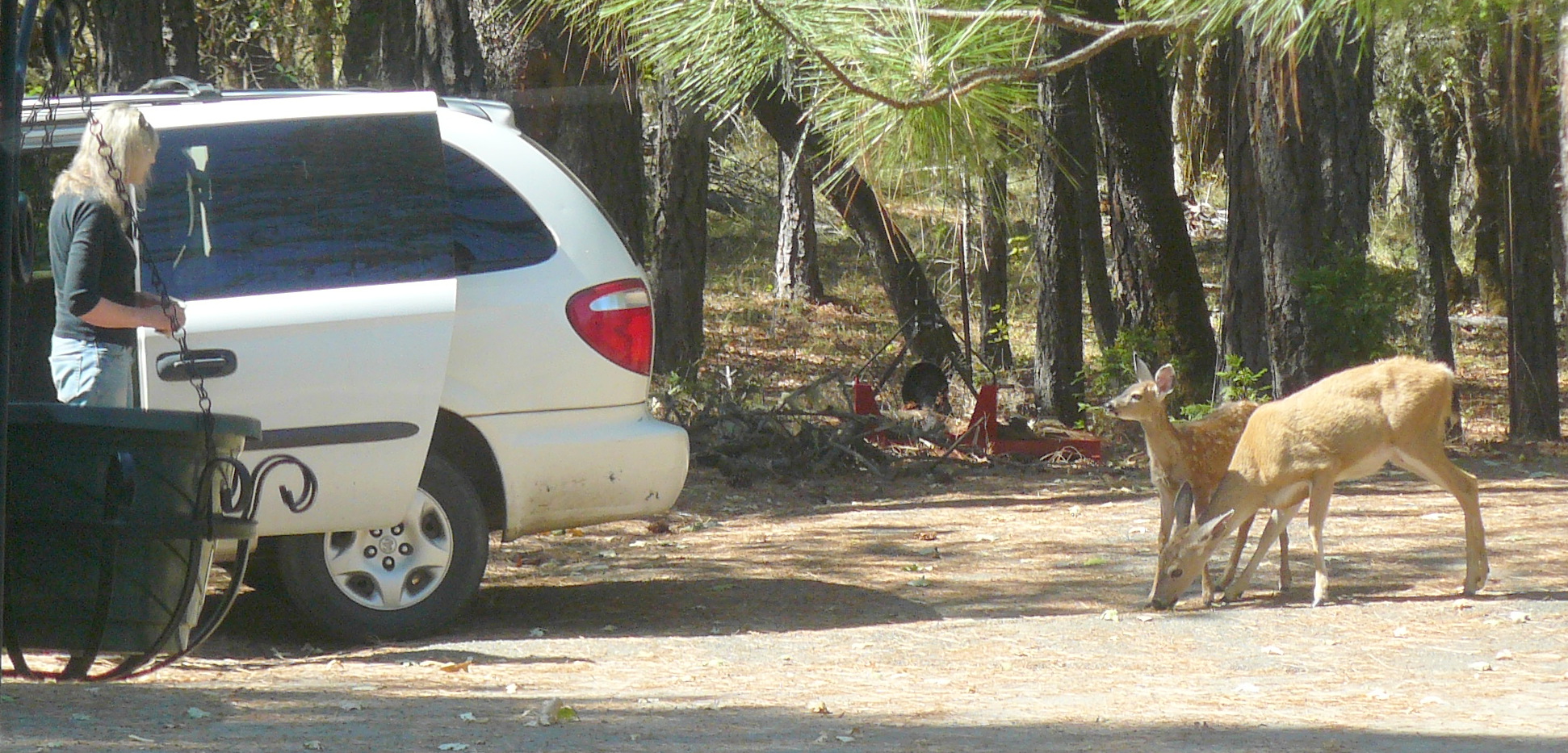
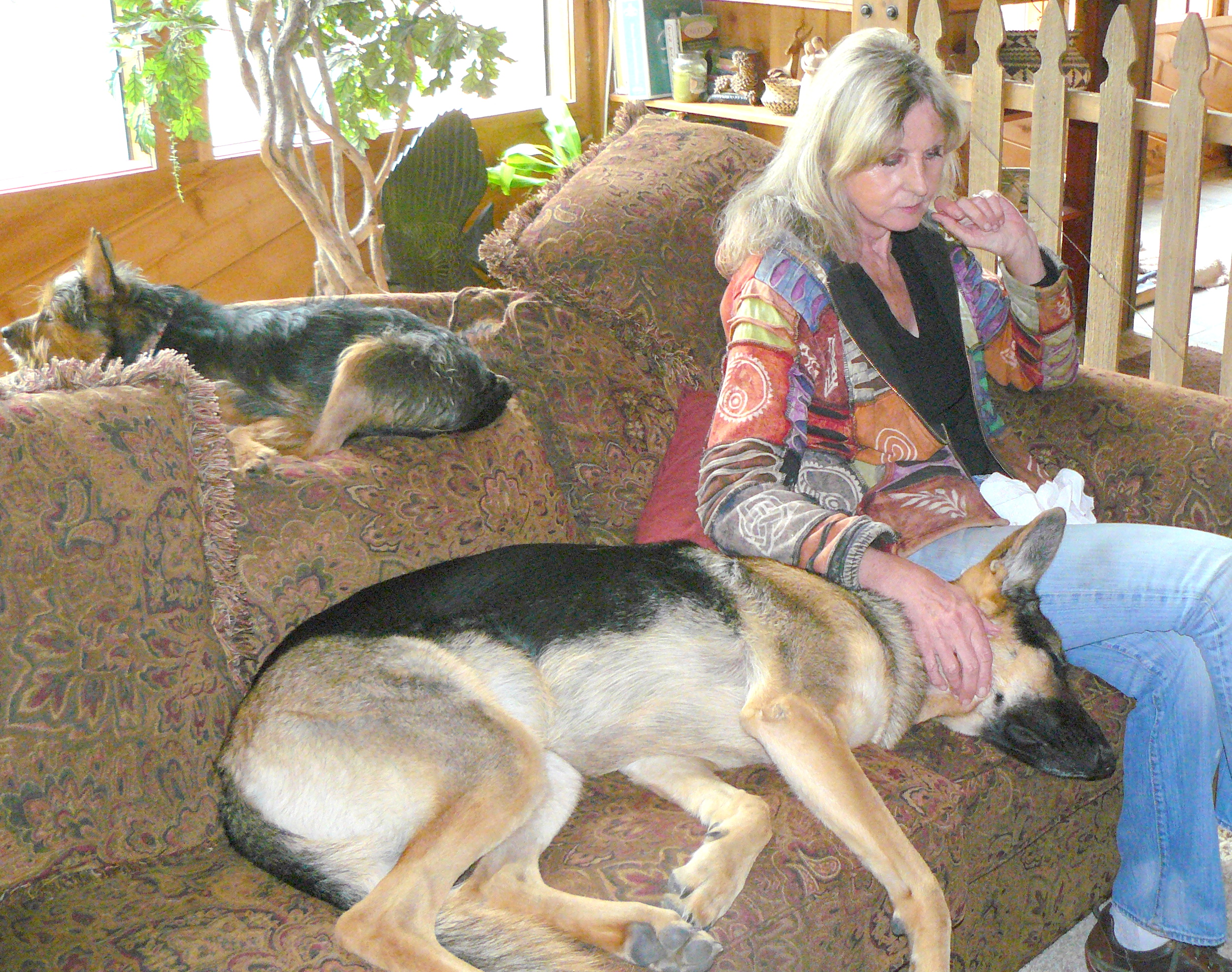
As if to endorse the great examples that Nature offers us in terms of the benefits of love and trust, take a look at these three recent photographs from here in Oregon.
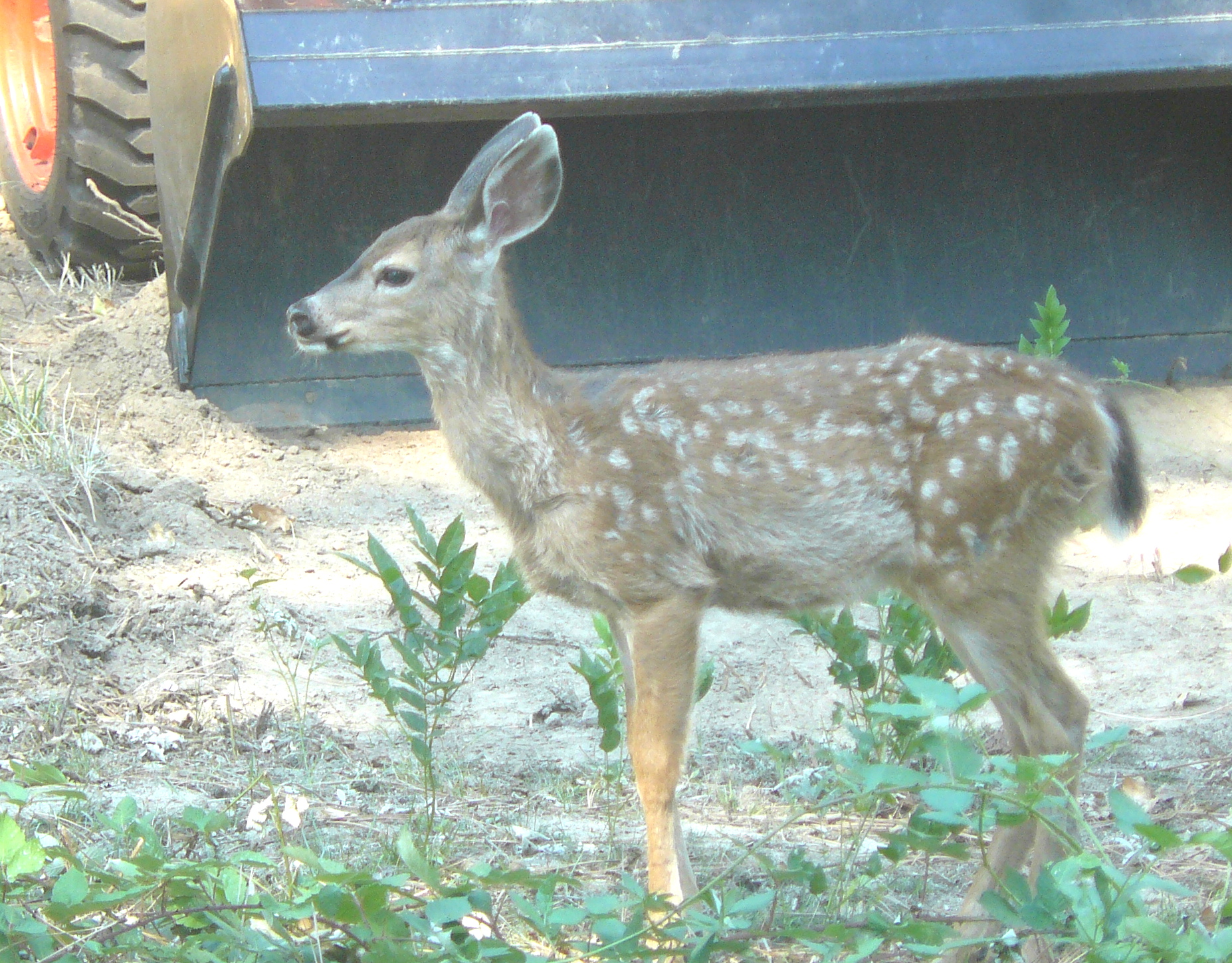
A young timid deer responding to me sitting quietly on the ground.
A young timid deer showing her trust of me as I sat quietly on the ground less than 30 feet away.

oooo

A mother and her fawn trusting Jean's love for them, and getting a good feed!
A mother and her fawn trusting Jean’s love for them, and getting a good feed!

oooo

Sweeny, on back of settee, and Cleo in peace and comfort.
Little Sweeny and Cleo converting trust to peace and happiness.  (Not to mention Jean!)

Now these are not photographs to ‘ooh’ and ‘ah’ over, these are reminders that kindness, generosity, selflessness and trust are part of Nature.  All the great virtues and values of man do not come from a vacuum, they come to us via Nature.

We have been blessed by an evolution that has allowed mankind to achieve remarkable things.  Even to the point of leaving the confines of our planet and setting foot on the Moon and sending probes from out of our Solar System.  There’s a sense, a distinctly tangible sense, that man has conquered all; that we have broken the link from being part of Nature; from being of Nature.

And now Mother Earth is reminding all of her species, every single one of them including species man, that everything is bound by her Natural Laws.

Does this mean that man has to revert to some form of pre-civilised stone-age era?  Of course not!  Progress can be as much within the Natural order than in competition with it, as it has been in recent times.  In fact, Professor Pat Shipman explains our progress is benefited by being part of that Natural order.  Here’s how Amazon describe her book, The Animal Connection.

The Animal Connection: A New Perspective on What Makes Us Human

A bold, illuminating new take on the love of animals that drove human evolution.

Why do humans all over the world take in and nurture other animals? This behavior might seem maladaptive—after all, every mouthful given to another species is one that you cannot eat—but in this heartening new study, acclaimed anthropologist Pat Shipman reveals that our propensity to domesticate and care for other animals is in fact among our species’ greatest strengths. For the last 2.6 million years, Shipman explains, humans who coexisted with animals enjoyed definite adaptive and cultural advantages. To illustrate this point, Shipman gives us a tour of the milestones in human civilization-from agriculture to art and even language—and describes how we reached each stage through our unique relationship with other animals. The Animal Connection reaffirms our love of animals as something both innate and distinctly human, revealing that the process of domestication not only changed animals but had a resounding impact on us as well.

It’s a powerful read and greatly recommended.  Here’s an extract from the book [page 274, my emphasis]:

Clearly, part of the basis of our intimacy with tame or domesticated animals involves physical contact.  People who work with animals touch them.  It doesn’t matter if you are a horse breeder, a farmer raising pigs, a pet owner, a zoo keeper, or a veterinarian, we touch them, stroke them, hug them.  Many of us kiss our animals and many allow them to sleep with us.  We touch animals because this is a crucial aspect of the nonverbal communication that we have evolved over millennia.  We touch animals because it raises our oxytocin levels – and the animal’s oxytocin levels.  We touch animals because we and they enjoy it.

From the first stone tool to the origin of language and the most recent living tools, our involvement with animals has directed our course.

So to round this off.  These last two posts came from my need to debate with Patrice the statement that “Force is the truth of man.”  If Patrice’s meaning was that the truth of man is subject to the force of Nature, then I agree one-hundred percent.

For the time for man to recognise that the force of Nature is “the truth of man” is running out.

Each of us, whoever you are, for the sake of your children and for all of the children in the world, embrace today the qualities, the values of Nature.

Love, Honesty, Loyalty, Trust, Openness, Faithfulness, Forgiveness, Affection.

(Unknown author)

If you can resist treating a rich friend better than a poor friend,

If you can face the world without lies and deceit,

If you can say honestly that deep in your heart you have no prejudice against creed, colour, religion or politics,

Then, my friend, you are almost as good as your dog.

Let us learn from dogs.

Let us return to integrity.

Passionate involvement!

This is beginning to look like a theme!

Regular followers will be aware that both Monday’s post, The growth of empathy, and Tuesday’s post, Questions without answers, had a common theme. That of “the rising consciousness of all the millions of ordinary people just trying to leave the world in a better place”, as I wrote on Monday, in contrast, even stark contrast, with the blindness, for want of a stronger term, of those charged with governing our societies.

Around 12:45 on Monday I received a note that there was another follower of Learning from Dogs. Here is that note:

dcardiff just started following you at http://learningfromdogs.com. They will receive an email every time you publish a post. Congratulations.

You might want to go see what they’re up to! Perhaps you will like their blog as much as they liked yours!

Like many other bloggers I try and go to whatever blog site that follower has and leave a ‘thank you’ message.

So off I went to Gotta Find a Home.  The blogsite is by Dennis Cardiff and the sub-title of the blog is The plight of the homeless.

Here’s how Dennis introduces his blog:

Throughout the past few years I have come to know many people, now friends, who for various reasons are, or were, homeless. Antonio, slept on a park bench and was beaten, had his teeth kicked out, for no other reason than his choice to sleep outdoors. He is a small, gentle man who has a phobia about enclosed spaces.

Craig, slept on the sidewalk in the freezing cold. I see him every morning and am never sure if, when I lift the corner of his sleeping bag, I will find him dead or alive. Sometimes, he confided, he would prefer never to awake.

Joy is a friend who fell on hard times. She slept behind a dumpster in back of Starbucks. I have seen her with blackened eyes, bruised legs, cracked ribs, cut and swollen lips. I usually see her sitting on the sidewalk ‘panning’ for change.

I can’t do much for these people except to show them love, compassion, an ear to listen, perhaps a breakfast sandwich and a coffee. I would like to do more. To know them is to love them. What has been seen cannot be unseen. I have started to write an account of their daily lives. I intend to turn this into a book and have it published. That is my goal.

I am writing articles and biographies of Joy and other street people. They have been informed that they don’t have to use their real names, that any profits would go back to the homeless and that it could be a vehicle to say whatever they want to the population at large.

Not only does that stir one’s heart and conscience but more so the fact that there are 6,069 followers of Dennis’s blog.

Please, please go along to Gotta Find A Home and embrace what wonderful people like Dennis and countless others are doing in this world. Go and read how the blogsite came about:

My lungs ached, as frost hung in the bitterly cold December morning air, making breathing difficult. I trudged in the falling snow toward Place Bell where I work, in the city’s gray, concrete, office tower canyon. I dodged other pedestrians, also trying to get to work on time, I noticed a woman seated cross-legged on the sidewalk with her back against the wall of the library. A snow-covered Buddha wrapped in a sleeping bag, shivering in the below freezing temperature. I guessed her to be in her forties. Everything about her seemed round. She had the most angelic face, sparkling blue eyes and a beautiful smile. A cap was upturned in front of her. I thought,There but for the grace of God go I. Her smile and blue eyes haunted me all day.

In the past I’ve been unemployed, my wife and I were unable to pay our mortgage and other bills, we went through bankruptcy, lost our house, my truck. Being in my fifties, my prospects looked dim. It could have been me, on the sidewalk, in her place.

I’ve been told not to give money to pan handlers because they’ll just spend it on booze. I thought to myself, What should I do, if anything? What would you do? I asked for advice from a friend who has worked with homeless people. She said, “The woman is probably hungry. Why don’t you ask her if she’d like a breakfast sandwich and maybe a coffee?”

That sounded reasonable, so the next day I asked, “Are you hungry? Would you like some breakfast, perhaps a coffee?”

“That would be nice,” she replied.

When I brought her a sandwich and coffee she said to me, “Thank you so much, sir. You’re so kind. Bless you.” I truly felt blessed.

This has become a morning routine for the past two and a half years. The woman (I’ll call Joy) and I have become friends. Often I’ll sit with her on the sidewalk. We sometimes meet her companions in the park. They have become my closest friends. I think of them as angels. My life has become much richer for the experience.

Reflect on how when you see a homeless person with so little, how so often they have a dog.

The power of love.
The power of love.

To close, let me tell you more about the photograph.  I saw it on the blogsite Erick’s Odyssey in the following post.

This is how a real man treats his best friend

A friend of mine posted this photo on their Facebook wall. Like most people when they first see it, I was overwhelmed with several emotions.

First of all, I felt a swell of compassion for these two. I don’t even know them, but I was immediately concerned with their wellbeing. I wanted them to be warm and fed, and protected.

Secondly, I was touched with the apparent love and friendship shared by the two, even though they are not even of the same species. I thought, “They may have nothing, but they have each other, so they have everything.” I don’t know by what circumstance this man and this dog came to be together, living on the streets, but I think it is a reflection of the callousness of our society.

Whatever the reason they are homeless, they are an opportunity for us, those who have the necessities of life in abundance, to show kindness and compassion. Remember this the next time you drive by a similar scene in your warm car. Remember that if you were in their shoes, you would want, or even if you would be too ashamed to ‘want,’ you would ‘need’ someone to help you.

Our apathy is what makes us truly destitute.

Yet another example of the power of this new world of interconnectedness and how, ultimately, those connections between all those millions who care will bring about a new caring era!

Unlocking the inner parts of our brain.

The healing power of meditation and self-reflection.

Yesterday, I wrote about two seemingly disconnected events that appeared to resonate together.  One of those was a comment left by reader Patrice Ayme.

But that harmony didn’t stop with those two events.  Here’s how it continued to flow.

Patrice has a recently published post called Consciousness I.  To be honest, some of the concepts have been a bit of a struggle for me to understand.  However, at one point in that essay, Patrice wrote:

Meditation is a most precious, most human state of consciousness. Whereas sentience is shared with many animals on this planet, obviously, not so with the capacity for meditation. meditation allows to shut down most (over-) used neuronal circuitry, and engage more strategically important parts of the brain.

Action without meditation is as slavedom without wisdom.

That really struck a chord with me because, once again, the power of meditation has been brought into focus.  Regular readers of Learning from Dogs may recall that just six days ago, I wrote a piece called Maybe home is found in our quietness.  There were three references to meditation in that post that I will take the liberty of repeating today.

The first was:

A few weeks ago when meeting our local doctor for the first time since we moved to Oregon, I had grumbled about bouts of terrible short-term memory recall and more or less had shrugged my shoulders in resignation that there was nothing one could do: it was just part of getting older, I guessed!

“On the contrary”, responded Dr. Hurd, continuing, “There’s growing evidence that our information-crowded lives: cell phones; email; constant TV; constant news, is pumping too much for our brains to manage.”

Dr. Hurd continued, “Think about it!  Our brains have to process every single sensory stimulus.  The research is suggesting that our brains are being over-loaded and then the brain just dumps the excess data.  If that is the case, and the evidence is pointing in that direction, then try thirty minutes of meditation each day; give your brain a chance to rest.”

Then later on in that post came:

The second was a recent science programme on the BBC under the Horizon series.  The programme was called,The Truth About Personality.

…….

Within the programme came the astounding fact that even ten minutes a day meditation can help the brain achieve a more balanced personality (balance in terms of not being overly negative in one’s thoughts).

The last one was in a short talk by writer Pico Iyer  meditating on the meaning of home, the joy of traveling and the serenity of standing still.

Now come forward just three days to last Tuesday evening. Jean and I sat down and more or less randomly wondered if there was something of interest to watch on the website Top Documentary Films.  Just by chance, we came across a film by filmmaker Isabelle Raynauld with the title of Mystical Brain.

Here’s a tiny snippet from the film:

Filmmaker Isabelle Raynauld offers up scientific research that suggests that mystical ecstasy is a transformative experience.

It could contribute to people’s psychic and physical health, treat depression and speed up the healing process when combined with conventional medicine.

This documentary reveals the exploratory work of a team from the University of Montreal who seek to understand the states of grace experienced by mystics and those who meditate. In French with English subtitles.

However, as interesting as this snippet is, the power of the film is in the area of spirituality and the way that meditation can open up the brain to an incredible range of mystical experiences, as well as the impressive health benefits of slowing the mind.  Maybe, just maybe, the power of religious and spiritual experience is being understood, with some very surprising results.

So please watch the whole documentary on-line. The website of the Mind & Life Institute will also be of interest.

To underscore why the film should be watched, there is much about the nature of the theta rhythms in the brain.  The relevance of these?  Simply that when the brain is generating these regular slow oscillations the human condition is one of great peace.

Dhalia showing us humans how easy it is to meditate!

Call it prayer, meditation, relaxation, building internal energy or life force, compassion, love, patience, generosity or forgiveness; what does it matter.  It’s what it is doing to you that matters!

So when you bury your face in the warm fur of your beautiful dog and both you and your dog appear to be transported to some beautiful, magical place you have entered that indestructible sense of well-being.

Actually, let me make one small correction. Both you and your dog have entered that indestructible sense of well-being.

Only one way to finish today’s post: I think, therefore I am!” René Descartes.

Truth is Relative

(Reposted from The Liberated Way with the generous permission of Alex Jones)

Go beyond the appearance and the behaviour to the nature that underpins everything. 

The truth of being a cat is relative only to this cat.

Recent events got me thinking about what truth is.  I find that nobody has a monopoly on truth, that truth is relative.  Take for example the colour red, I see red as red, the bee sees red as black.  Truth is the product of self, the bee brain makes red black and my brain red as red; truth in this sense is relative to the beholder of the truth.

God.

Take the example of God, some believe in God, some reject God, some like me sit on the fence as agnostics.  Those that believe in God differ on what God is: energy, gravity, a mind, with no mind, in creation, separate from creation.  God is one of those ideas that can neither be disproved or proven with any certainty.  Truth is relative to the beholder.

Nothing is certain.

Truth then to me is never one conclusion, but can be a diversity of conclusions.  Red can be red but can also be black depending on the beholder, thus truth is relative.  It is better to say I believe the truth to be, rather than say this is the truth.  With the universe composed of visible and hidden variables, always changing and in feedback loops nothing can be claimed with any certainty.

Belief.

Since truth is relative it is better to say that I act and think according to a belief rather than a truth, the same for everyone.  When the word belief is mentioned some people choke on it, they believe that the universe is deterministic, that there is only one truth, often the one they believe it to be.  It is apparent neither Bee nor I have a monopoly on the truth of what the colour red is, we hold different beliefs of the colour red relative to ourselves.

The hubristic need to monopolise belief.

I see no harm in a world holding a diversity of beliefs.  So what if a Native American believes a tree has a spirit, a belief based on animism? Yet to the Christian missionary the Native American is a lost soul to be saved, and to the Atheist the Native American is one to be converted to the progress of modern science.  The outsider has this need to force their own beliefs onto the Native American, resulting in widespread suicide, mental illness, drug abuse and alcoholism amongst the people whose belief systems they obliterated.  The need of some to westernise Islam or Islam to convert the West sets the scene for a so-called clash of civilisations: violence, hate, fear and anger.

Black swans.

Even in my own empirical and inductive approach to truth, I know I can only draw a probability of truth.  I may count 1000 white swans on a lake and conclude the world only has white swans, then one day a black swan appears.  I have to be open to the possibility of black swans, which is a position of humility.

Hubris hates diversity of belief.

The individual or group who claims their truth is the only truth is gripped in hubris.  Truth is relative, there can be many truths. Hubris follows through to control, the individual or group needs and acts to force their belief upon other people who have a different belief of a truth relative to them.  Those inflicted with hubris hate diversity, they only want one truth, that of their own.  The horrors of Nazi Germany, or the Crusades or of Vietnam were because a group of people wanted a world based on their own beliefs with all other beliefs eliminated.

Grounding belief like roots of a tree.

A belief should be grounded like a tree has roots that anchors it into the ground, otherwise it moves into fantasy.  To ground a belief it is to be tested by asking questions, by looking for observable, experiential or demonstrable evidence of its existence.  A belief untested but accepted without question is ignorance, it is opinion.

Follow the common.

When Heraclitus suggests “follow the common”, he means to deal with things based upon their nature: it is common for all ducks to love water; it is common for all energy to flow; it is common for all things to evolve or change through strife.  Heraclitus suggests people go beyond appearances and behaviour to the underlying nature of the universe, and in this one grounds belief in the common of reality rather than in the ignorance of opinion.

Deeper insights into who we are.

Two fascinating perspectives.

1. A conversation with Charles Taylor – THE 2008 KYOTO PRIZE

Video Messages from Dr. Charles MargraveTaylor, the Laureate of 2008 KYOTO PRIZE, Arts and Philosophy. “Feelings on receiving the Kyoto Prize” “What philosophers can do for society” “Future interest and theme”(2008/11/11)

Wikipedia describes Charles Taylor thus,

Charles Margrave Taylor, CC GOQ FRSC (born November 5, 1931) is a Canadian philosopher from Montreal, Quebec best known for his contributions to political philosophy, the philosophy of social science, and intellectual history. This work has earned him the prestigious Kyoto Prize and the Templeton Prize, in addition to widespread esteem among philosophers. In 2007, Taylor served with Gérard Bouchard on the Bouchard-Taylor Commission on Reasonable Accommodation with regard to cultural differences in the province of Quebec. Taylor currently teaches at McGill University in the Department of Religious Studies. He is a practicing Roman Catholic.

There is also a fuller biography presented here.

2. How we see circumstances is so much more important – Rory Sutherland on Perspectives.

The circumstances of our lives may matter less than how we see them, says Rory Sutherland. At TEDxAthens, he makes a compelling case for how reframing is the key to happiness.

The TED profile of Rory Sutherland explains that:

From unlikely beginnings as a classics teacher to his current job as Vice Chairman of Ogilvy Group, Rory Sutherland has created his own brand of the Cinderella story. He joined Ogilvy & Mather’s planning department in 1988, and became a junior copywriter, working on Microsoft’s account in its pre-Windows days. An early fan of the Internet, he was among the first in the traditional ad world to see the potential in these relatively unknown technologies.

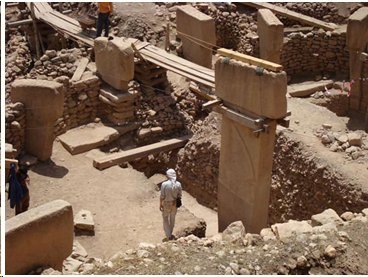
Göbekli Tepe

The most amazing ancient site, possibly in the world.

I know this is a bit of a giant leap from yesterday’s Post but bear with me.  A short while ago, my friend Suzann sent me a link to some information about the archaeological site in Eastern Turkey known as Göbekli Tepe.  Suzann, as many regular readers will know, was the person who caused me to meet Jeannie back in December 2007 when Su invited me to spend Christmas with her and Don, her husband, at their home down in San Carlos, Mexico.

Before I go on to write about Göbekli Tepe let me also muse on another fascinating connection between Suzann and me.  That is that Su and I were sharing the same waters in the Eastern Mediterranean around 1991.  Here’s an extract from a recent email from Su.,

Don’s brother’s boat was Hana Ho.from Honolulu, Hawaii, a Tayana 55…gorgeous thing! They sailed in the Med for years around that time…it is possible you could have run into them…..

When we first flew in to Cyprus June of 1991, Bob’s boat was up on the hard. It took another 5 days to finish, and we had to climb straight up and down a steep, rickety ladder each time we went out, because we slept on the boat every night….was it ever hot and muggy! and no bathroom facilities in use!! But had a lovely time in Cyprus and really got out and saw things there. Delicious food!!

Then we sailed over toward the Turkey/Syrian border area and then gunk-holed west along the coast, ending up at Izmer, after visiting places like Antalya, Kekova Roads,Fethiya and the magnificent Rock Tombs, Marmaris, Bodrum, Kisadasi, Ephesus to name a few….

I, too, was living on a yacht, over-wintering in Cyprus, and cruising the Turkish and Greek coasts during the summer.  Anyway, enough of these musings.

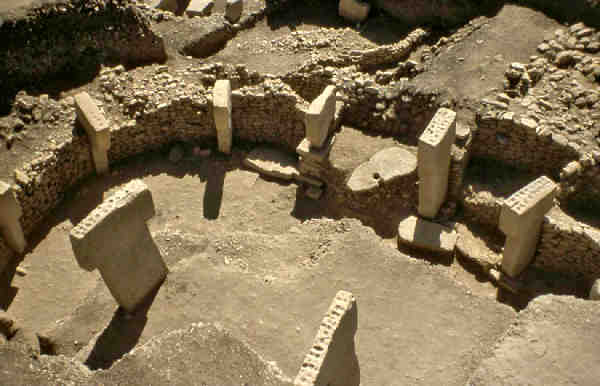
A scene from Gobekli Tepe

Göbekli Tepe is old.  I mean seriously old.  For example, I’m very familiar, being an Englishman, with the mystery and antiquity of Stonehenge.  But even the revised estimates of Stonehenge’s age, now believed to be 3,000 B.C., don’t measure up to the age of Göbekli Tepe.

The Smithsonian website explains much in a fascinating article about Gobekli Tepe, (do click on that link as the Smithsonian article is extremely interesting).

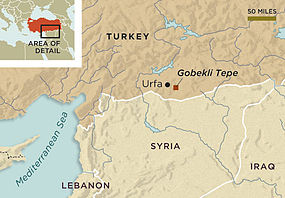
Six miles from Urfa, an ancient city in southeastern Turkey, Klaus Schmidt has made one of the most startling archaeological discoveries of our time: massive carved stones about 11,000 years old, crafted and arranged by prehistoric people who had not yet developed metal tools or even pottery. The megaliths predate Stonehenge by some 6,000 years. The place is called Gobekli Tepe, and Schmidt, a German archaeologist who has been working here more than a decade, is convinced it’s the site of the world’s oldest temple.

[my italics]

Imagine, there are fewer years between today and the building of Stonehenge than there are between the construction of Göbekli Tepe and Stonehenge!  Think about that!

Anyway, enjoy this video,

and if that grabs your interest then there is a longer 25-minute radio broadcast by Klaus Schmidt that is on YouTube, see below:

German archeologist Klaus Schmidt, from the German Archaeological Institute, who has been working as the head archeologist at Göbekli Tepe, a temple site located in southeastern Turkey close to the boarder to Syria. Klaus has been excavating there since 1994 and he joins us to talk about the excavation work, and to give us his impressions and theories about the site and the people who built it and worshiped at this ancient temple site. The temple is believed to have been erected in the 10th millennium BC (about 11,500 years ago). It is believed to be the oldest human-made place of worship, it’s even been called the Garden of Eden. Only about 3-5% of the site has been excavated so far, which has unveiled several stone circle rooms, only one of which has been dug down to the floor. As many as 20 such structures are thought to exist under the ground at the site, these have been detected by radar scans. These stone circles have large T-shaped pillars, some of the heaviest stones weigh up to 50 tons. The monoliths are decorated with carved reliefs of animals, abstract pictograms, sacred symbols and similarities to Neolithic cave paintings have been pointed out. The carefully carved figurative reliefs depict lions, bulls, boars, foxes, gazelles, donkeys, snakes and other reptiles, insects, arachnids, and birds, particularly vultures and water fowl. Göbekli Tepe means “Hill with a potbelly” although there already exists other interpretations of the name, connected to the word “Zep Tepi” or “The First Time” a period in beliefs of a mythological golden age when the gods lived amongst humanity together with half-divine offsprings of gods and humans. Is Göbekli Tepe the Garden of Eden? June 24, 2010

If you want more to read then I can do no better than recommend the article that Suzann linked to in her email.  It’s here and it starts thus,

Gobekli Tepe: 12,000 Years Old and Rewriting Human History

“This time what came first was the temple and then the city.”

– Klaus Schmidt, Ph.D., German Archaeological Institute

12,000-year-old circles of limestone columns weighing from 7 to 15 tons or more have been excavated in Gobekli Tepe, Turkey, about 6 miles northeast of Urfa.

Older than Egypt, Sumeria and Stonehenge, 40 standing T-shaped columns have so far been uncovered in four circles 98 feet (30 meters) in diameter. To date, no metal tools have been found since meticulous digging and dating began in 1994. Only 5% of the temple complex in repeating circles has been uncovered.

Ground-penetrating radar surveys indicate there might be at least 250 more standing stones in 18 still-buried circles. Finely honed reliefs and some 3-dimensional sculptures on the limestone columns depict boars, foxes, lions, birds, snakes, scorpions, vultures, reptiles, humans and other figures.

You’ll have to read the rest of the article here.

Sort of puts the history of man into perspective!

Reaching out across nations.

An unanticipated reward from Blogging.

When I started writing Learning from Dogs, way back on July 15th 2009, I didn’t have a clue as to the world I was entering, figuratively speaking.  But there have been many unanticipated rewards including the great pleasure of the way that this strange virtual world of the Internet brings people together.  One connection recently made was with a young Bangladeshi living in the city of Dhaka, more of his background here.

Nakib recently published a powerful and moving Post and has been gracious in allowing me to republish it, as follows:

The vulture that waited for the child to die

Given below is the 1994 Pulitzer price-winning photograph taken by Kevin Carter during the Sudan famine of 1994.

The photo shows a famine-stricken child crawling towards a United Nations food camp, which was located at least one kilometer away from the place shown. The vulture on the other hand is waiting eagerly for the child to die so that it can devour it.

I do not know what message the photograph revokes on your head but every time I look at it I feel blessed that I have been provided enough at least to satisfy my hungry stomach and keep me energetic enough to write blogs. I feel small and humble when I think of all the people suffering out there— homeless and starved— yet trying their best to make some sense of the complex notion known as life. It tells me that I have been blessed for a reason, for a purpose, and whatever I have been provided with should not go in vain. I can infer that my powers should be used well, at least for that little kid on the above photograph for whom Fate had sealed a quicksand of reality too hard to acknowledge for many of us hedonists out here.

Most importantly, to me the photograph conveys an emotion; a reality that many of us are too blind to grasp. I think of how people throughout the world are suffering to no ends yet amidst everything trying again and again to find the silver lining associated with the black cloud. I realize that there is a lot happening outside my comfortable apartment and Biology textbook that needs looking after, that there is a lot of people who strive hard yet achieve nothing in return. It amazes me when I try to ponder God’s sense of justice and egalitarianism.

So is it okay for the blessed 25% of the population in this world to waste everything that life has given them while the the rest 75% live amidst severe poverty, oppression and inequality?  Is it okay to go overboard with New Year parties while exactly at the same hour millions of people across the globe are suffering from the fangs of social deprivation? Is it okay to let things be as they are and forget about everything so as to harmoniously embrace useless ambitions and lustful desires?

Have we all truly forgotten to share our wealth and about the latent human being that exists inside everyone of us? Have we truly gottten rid of all those emotions that make us human beings? Is this what the world is for: for some to live lavishly while for the rest to suffer endlessly?

Three months after he took the photograph Kevin Carter, after suffering from several periods of depression, committed suicide.

Dated on the day the photo was taken, the following note was found from his diary:

Dear God, I promise I will never waste my food no matter how bad it can taste and how full I may be. I pray that He will protect this little boy, guide and deliver him away from his misery. I pray that we will be more sensitive towards the world around us and not be blinded by our own selfish nature and interests. I hope this picture will always serve as a reminder to us that how fortunate we are and that we must never ever take things for granted.

As for the child, no one really knows what happened to him; not even the South African photographer who had left the place immediately after the photo was taken. I try to appease myself by saying that the child never existed in the first place. God simply intended to provide us with a glimpse of the truth of life, to remind us how blessed we are. I hope this is true.

oooOOOooo

Very, very moving and beautifully expressed.

Ecology and faith

The National Preach-In held the week-end of February 11th/12th.

Some while ago, I signed up for a week-end organised by the Arizona Interfaith Power & Light.  It was part of a national programme inviting faith leaders from across the country to give sermons and reflections on climate change over the weekend of February 10-12, 2012.  My interest was simply to learn more about the week-end.

Then I quickly discovered that Father Dan from our church, St. Paul’s, had also signed up.  In my innocence I offered to help in any way which was quickly met by a response that bowled me over, “Well, you can be the homilist and give the sermon!”  Thus it came about that at yesterday’s 8am and 10am services yours truly rather uncertainly delivered the sermon.  John H., who with my dear wife Jeannie, did so much to turn my rambling thoughts into a coherent theme, encouraged me to publish the sermon as today’s Post on Learning from Dogs.  It now follows.

oooOOOooo

St. Paul’s Episcopal Church, Payson, Arizona

The 6th Sunday after the Epiphany

Year B

February 12th, 2012

2 Kings 5:1-14 X Psalm 30 1:13 X 1 Corinthians 9:24-27 X Mark 1:40-45

It was just a photograph. OK, one taken 43 years ago but, so what! Well, the late Galen Rowell, the famous Californian wilderness photographer called it, “the most influential environmental photograph ever taken.”

We are talking about the photograph called ‘Earthrise’ taken from Apollo 8 on December 24th, 1968 during the first manned mission to the Moon. Each of you should have a copy of that picture close by. Look at it now and let your imagination be carried back to that Apollo 8 capsule and that momentous experience.

As the Earth rose above the horizon of the moon, NASA astronaut Frank Borman uttered the words, “Oh my God! Look at that picture over there! Here’s the Earth coming up. Wow, is that pretty.” Bill Anders then took the ‘unscheduled’ photograph.

Then recall that evening, Christmas Eve 1968, when the three NASA crew members took turns reading from the book of Genesis to what was probably the biggest audience ever in the history of television, Frank Borman finishing with the words, “God called the dry land earth, and the gathering of the waters He called seas; and God saw that it was good.

Our planet is good, and so beautiful, and so precious to life. Life that arose in just a fraction of time after the Solar System formed 3.7 billion years ago; the oldest traces of life have been found in fossils dating back 3.4 billion years. That miracle of life.

Who hasn’t gazed into a clear, Arizonan, night sky and been lost in the beauty above our heads. Or felt the wind, flowing across ancient lands, kiss our face. We stand so mite-like, so insignificant in all this immensity of creation; God’s creation.

Our dreams, our hopes and failures, everything we are, have ever been and ever will be, nothing more than a swirl of dust across a desert track.

Jeremiah was called to be a prophet in 626 BC, some 2,638 years ago. In Jeremiah 12:4 he wrote, “How long will the land mourn, and the grass of every field wither? For the wickedness of those who live in it, the animals and the birds are swept away…

Words from so long ago! But Jeremiah would, surely, have gasped with disbelief had he realised how, some 2,600 years later, ‘the land now mourns and the grasses so wither’.

Jeremiah reveals much that we all could learn about ourselves. The other prophets couldn’t be accused of hiding behind their work but Jeremiah, out of all of them, allowed us to see the evidence of his own spiritual condition. He was a man of deep feelings and sensibilities and in his book there are five laments over the serious spiritual and moral condition of God’s people. That’s us, by the way!

In that time of Jeremiah, the world population was 100 million persons; slightly less than the population of Mexico today.

Some 1,350 years later, 1,000 A.D., the global population was 265 million.

But by the year 2,000 A.D., our population had increased to 6,000 millions! Put another way, that’s an increase of 5.7 million people every year for a 1,000 years !

Any guesses on the increase in the last 12 years, since 2,000? Well, the global population has increased by 990 million. About 90 million every year!

It is utterly unsustainable at present levels of Western consumption, let alone with poorer nations trying to ‘catch up’.

Last September, our House of Bishops issued A Pastoral Teaching. Our Bishops believe those ancient words of Jeremiah describe these present times. They call us to repentance, to change.

That Pastoral Teaching, in part, says, “Christians cannot be indifferent to global warming, pollution, natural resource depletion, species extinctions, and habitat destruction, all of which threaten life on our planet. Because so many of these threats are driven by greed, we must also actively seek to create more compassionate and sustainable economies that support the well-being of all God’s creation.

Our bishops refer to The Anglican Communion Environmental Network that calls to mind the dire consequences that our environment faces, again I quote: “We know that we are now demanding more than the earth is able to provide. Science confirms what we already know: our human footprint is changing the face of the earth and because we come from the earth, it is changing us too. We are engaged in the process of destroying our very being. If we cannot live in harmony with the earth, we will not live in harmony with one another.

Let those words enter our souls: “If we cannot live in harmony with the earth, we will not live in harmony with one another.” Planet Earth mirrors our souls! Nothing new about that. In 1975, Berkeley physicist Fritjof Capra wrote in his book The Tao of Physics, “we can never speak of nature without, at the same time, speaking about ourselves”.

Fr. Dan reflected in his January 22nd sermon on the questions, “Am I really free? Can I really change?” ….. and continued with the words from Jesus, “The time is fulfilled, the Kingdom of God has come near, Repent.” Fr. Dan reminded us that the word ‘repent’ indicates that we can change. We can change, we must, and we will.

Otherwise we will learn the truth of that Cree prophecy, “When all the trees have been cut down, when all the animals have been hunted, when all the waters are polluted, when all the air is unsafe to breathe, only then will you discover you cannot eat money.

OK, from out of the mouths of North American Braves to out of the mouths of English babes.

The ‘eat money’ phrase reminds me of a story I heard years ago, back in England. You need to imagine a dilapidated, rural Anglican church with a dwindling congregation. A young boy was given a five pound note to put in the collection plate. When the offering came around, he didn’t put it in. However, after the end of the service, he went up to the vicar, shook his hand and gave him the five pound note. The vicar asked him, “Why are you giving me this money? Why didn’t you put it in the collection plate?”

The young boy answered, “Because my Mummy told me you’re the poorest vicar we’ve ever had!”

Let me stay in Britain. Martin Rees is a British cosmologist and astrophysicist and has been Britain’s Astronomer Royal since 1995.

Sir Martin Rees, indeed Lord Rees as he is now, has been Master of Trinity College, Cambridge since 2004 and was President of the Royal Society between 2005 and 2010.

In a presentation in 2005, he said this, “We can trace things back to the earlier stages of the Big Bang, but we still don’t know what banged and why it banged.

Lord Rees continued, “But the unfinished business for 21st-century science is to link together cosmos and micro-world with a unified theory. And until we have that synthesis, we won’t be able to understand the very beginning of our universe. You want to not only synthesise the very large and the very small, but we want to understand the very complex. And the most complex things are ourselves, midway between atoms and stars.”

Hang on to that word ‘midway’ as I continue reading from Rees’ presentation.

We depend on stars to make the atoms we’re made of. We depend on chemistry to determine our complex structure. We clearly have to be large, compared to atoms, to have layer upon layer of complex structure. We clearly have to be small, compared to stars and planets — otherwise we’d be crushed by gravity.

And in fact, we are midway. It would take as many human bodies to make up the sun as there are atoms in each of us. The geometric mean of the mass of a proton and the mass of the sun is 50 kilogrammes (110 lbs), within a factor of two of the mass of each person here. Well, most of you anyway!

Back to me! Just reflect on the magnificence of that fact! Science and poetry so beautifully woven together. We, as in humankind, the poetic manifestations of God’s unbelievable creation. Our relationship with the atoms perfectly balanced with our relationship with the sun. Brings a whole new meaning to seeing starlight in the eyes of the one you love!

It is all so beautiful, so magical, so spiritual, so God-like. It is also so fragile and vulnerable.

There is a copy of that Pastoral Teaching available for you on your way out of Church. I implore you to read it, nay more than read it, hold it close to your heart. Within that teaching all of us are invited to join our Bishops in a 5-point commitment for the good of our souls and the life of the world, our beautiful planet; the essence of those 5 points being:

That we, as brothers and sisters in Christ, commit ourselves:

  • To repent all acts of greed, over-consumption, and waste;
  • To pray for environmental justice, for sustainable development;
  • To practice environmental stewardship and justice, energy conservation, the use of clean, renewable sources of energy; and wherever we can to reduce, reuse, and recycle;
  • To uproot the political, social, and economic causes of environmental destruction and abuse;
  • To advocate for a “fair, ambitious, and binding” climate treaty, and to work toward climate justice through reducing our own carbon footprint and advocating for those most negatively affected by climate change.

As our Bishops wrote, “May God give us the grace to heed the warnings of Jeremiah and to accept the gracious invitation of the incarnate Word to live, in, with, and through him, a life of grace for the whole world, that thereby all the earth may be restored and humanity filled with hope.”

I started with the taking of a photograph 43 years ago that forever changed our view of our planet. Now is the time to change our relationship with our planet, to love it and cherish it; it’s the only one we have. Otherwise, we may not have another 43 years left.

Or in the words from today’s Psalm, “O LORD my God, I cried out to you, and you restored me to health.

Amen.

All Watched Over by Machines of Loving Grace

Three very thought-provoking films

Over the last week we have watched all three 0ne-hour films made by the BBC, aired in 2011,  under the title of the heading of this post, All Watched Over by Machines of Loving Grace.  The films are available on the website Top Documentary Films, the direct link is here.  As that website explains,

A series of films about how humans have been colonized by the machines they have built. Although we don’t realize it, the way we see everything in the world today is through the eyes of the computers. It claims that computers have failed to liberate us and instead have distorted and simplified our view of the world around us.

1. Love and Power. This is the story of the dream that rose up in the 1990s that computers could create a new kind of stable world. They would bring about a new kind global capitalism free of all risk and without the boom and bust of the past. They would also abolish political power and create a new kind of democracy through the Internet where millions of individuals would be connected as nodes in cybernetic systems – without hierarchy.

2. The Use and Abuse of Vegetational Concepts. This is the story of how our modern scientific idea of nature, the self-regulating ecosystem, is actually a machine fantasy. It has little to do with the real complexity of nature. It is based on cybernetic ideas that were projected on to nature in the 1950s by ambitious scientists. A static machine theory of order that sees humans, and everything else on the planet, as components – cogs – in a system.

3. The Monkey in the Machine and the Machine in the Monkey. This episode looks at why we humans find this machine vision so beguiling. The film argues it is because all political dreams of changing the world for the better seem to have failed – so we have retreated into machine-fantasies that say we have no control over our actions because they excuse our failure.

Adam Curtis is a documentary film maker, whose work includes The Power of Nightmares,The Century of the SelfThe Mayfair SetPandora’s BoxThe Trap and The Living Dead.

As was eluded, the three films are deeply thought-provoking.  There is a ‘taster’ to the first film on YouTube, as below,

Adam Curtis, the film maker, has a blog site under the BBC Blogs umbrella.  The entry on that blog-site by Adam in connection with these films is here, and makes interesting reading.  It also includes a longer trailer than the one from YouTube, above.

Finally, there are comprehensive writings on all three films on the WikiPedia website here.  To give you a taste, here’s what was written about the third film,

The Monkey In The Machine and the Machine in the Monkey

This programme looked into the selfish gene theory which holds that humans are machines controlled by genes which was invented by William Hamilton. Adam Curtis also covered the source of ethnic conflict that was created by Belgian colonialism’s artificial creation of a racial divide and the ensuing slaughter that occurred in the Democratic Republic of the Congo, which is a source of raw materialfor computers and cell phones.

William Hamilton went to Kisangani in the Democratic Republic of the Congo while the Second Congo War was raging. He went there to collect Chimpanzee faeces to test his theory that HIV was due to a medical mistake. Unfortunately he caught malaria, for which he took aspirin, which caused a haemorrhage and he died. However his selfish gene theory lived on.

In 1960 Congo had become independent from Belgium, but governance promptly collapsed, and towns became battle grounds as soldiers fought for control of the mines. America and the Belgians organised a coup and the elected leader was assassinated, creating chaos. The Western mining operations were largely unaffected however.

Bill Hamilton was a solitary man, and he saw everything through the lens of Darwin’s theory of evolution. When he wanted to know why some ants and humans gave up their life for others, he went to Waterloo station and stared at humans for hours, and looked for patterns. In 1963 he realised that most of the behaviours of humans was due to genes, and looking at the humans from the genes’ point of view. Humans were machines that were only important for carrying genes, and that it made sense for a gene to sacrifice a human if it meant that another copy of the gene elsewhere would prosper.

In the 1930s Armand Denis made films that told the world about Africa. However, his documentary gave fanciful stories about Rwanda’s Tutsis being a noble ruling elite originally from Egypt, whereas the Hutus were a peasant race. In reality they were racially the same and the Belgian rulers had ruthlessly exploited the myth. But when it came to create independence, liberal Belgians felt guilty, and decided that the Hutus should overthrow the Tutsi rule. This led to a blood bath, as the Tutsis were then seen as aliens and were slaughtered.

So, all in all, this is a great personal recommendation and, it goes without saying, those of you that do watch the films and want to comment, would love to hear from you.

Soul friend

Reflections on the Irish poet and author, John O’Donohue.

John O'Donohue

While many will have heard the name of this wonderfully inspirational man, John O’Donohue is not a name known to the masses.  Yet his writings are, without fail, beautifully moving.  Indeed, this Post was prompted by me coming across a piece from his first book, Anam Cara, meaning ‘soul friend’ in Gaelic, and, as any dog owner will attest, dogs are the animal example of a soul friend to a human.

John tragically died well before his time, in January 2008, just three days after his 56th birthday.  As the John O’Donohue website reveals,

John O’Donohue vanished from among us on January 4, 2008 as physical presence, but it is impossible to write about John as someone who “was”; he so thoroughly “is”. In the context of the immense presence of his absence, the following biographical facts and dates can serve only as time-bound points of orientation for those who wish to try and locate history.

John was born in January 1956, the first of four children to Patrick and Josie O’Donohue. At the age of 18, John entered the novitiate at Maynooth where he completed his BA in English and Philosophy in 1977 and his degree in Theology, in 1980. He was ordained to the priesthood in 1982, received his MA in 1982 and, in 1986 began work on a doctorate at the University of Tubingen in Germany. John was awarded his Ph.D in Philosophical Theology in 1990. In his dissertation, Person als Vermittlung, (published in Germany in 1993), John developed a new concept of Person through a re-interpretation of the philosophy of Hegel. The prestigious Review of Metaphysics commended him for “breaking new ground in our thinking about consciousness . . . [with] a richer and deeper notion of Personhood.” In John’s words: “Hegel struck me as someone who put his eye to the earth at a most unusual angle and managed to glimpse the circle toward which all things aspire.”

There is so much more to say and write about this lovely man, but for another time.  Let me close by publishing this extract from Anam Cara. But a plea!  Before you plunge ahead and read these words, just slow yourself down.  The thoughts behind the words below are profound, romantic and applicable to all, yes, every one of us.  They offer peace and calmness – embrace them with a peaceful and calm mind.

The eye celebrates Motion

The human eye adores movement and is alert to the slightest flicker. It enjoys great moments of celebration when it beholds the ocean as the tide comes in, and tide upon tide repeats its dance against the shore. The eye also loves the way light moves; summer light behind a cloud crawling over a meadow. The eye follows the way the wind shovels leaves and sways trees. The human person is always attracted to motion. As a little baby you wanted to crawl, then to walk, and as an adult you feel the continuous desire to walk into independence and freedom.

Everything alive is in movement. This movement we call growth. The most exciting form of growth is not mere physical growth, but the inner growth of one’s soul and life. It is here that the holy longing within the heart brings one’s life to motion. The deepest wish of the heart is that this motion does not remain broken or jagged, but develops sufficient fluency to become the rhythm of one’s life.

The secret heart of time is change and growth. Each new experience which awakens in you adds to your soul and deepens your memory. The person is always a nomad, journeying from threshold to threshold, into ever different experiences. In each new experience, another dimension of the soul unfolds. It is no wonder that from ancient times the human person has been understood as a wanderer. Traditionally, these wanderers traversed foreign territories and unknown places. Yet, Stanislavsky, the Russian dramatist and thinker, wrote: “The longest and most exciting journey is the journey inwards.”

There is a beautiful complexity of growth within the human soul. In order to glimpse this, it is helpful to visualise the mind as a tower of windows. Sadly, many people remain trapped at one window, looking out every day at the same scene in the same way. Real growth is experienced when you draw back from one window, turn and walk around the inner tower of the soul and see all the different windows that await your gaze. Through these different windows, you can see new vistas of possibility, presence and creativity. Complacency, habit and blindness often prevent you from feeling your life. So much depends on the frame of vision – the window through which we look.

Think about the times we live in, challenging times for so many.  Then realise that what we see (and feel) is so dependent on how we look.  Let me repeat those last few lines, “Through these different windows, you can see new vistas of possibility, presence and creativity. Complacency, habit and blindness often prevent you from feeling your life. So much depends on the frame of vision – the window through which we look.”