Category: Religion

Forgive the introspection: Part Two

A good philosophical “coating of thought”.

In yesterday’s Part One, I focused on the hugely damaging effects of inequality in society. Reinforced only last Monday by an article by Professor Adam Levitin, a Professor of Law at Georgetown Law School. (Who also recently served on the Consumer Financial Protection Bureau’s Consumer Advisory Board and was Special Counsel to the Congressional Oversight Panel for the Troubled Asset Relief Program.) Levitin’s article was published by Naked Capitalism and opened with this statement:

A lot of Americans — right and left — are frustrated with what has happened to the middle class. The gap between the superrich and the rest of the country has widened, and it seems like everyone is having to work harder just to stay in place: wages have been stagnant, two-incomes are nearly mandatory (creating a subsidiary child care issue), and millions have lost their home equity in foreclosures. While there are a lot of people who bemoan the fate of the middle class, and even some want to do something about it, they don’t or can’t do the heavy lifting necessary to figure out why the system is broken and who wants to ensure it remains that way.

(I strongly encourage you to read the rest of the article.)

Trust me, as a good middle class Brit (albeit now living in America), it’s not just Americans who are frustrated!

However, one happening in this modern world is wonderful. I’m speaking of the ways that ideas can circulate around the world.

Better than that, the wonderful way we can “listen in” on the reflections of others in a manner that would have been impossible twenty years ago.

A few days ago, Patrice Ayme (PA) published a post called Human Kind, Yet Evil Rule. As so frequently happens, it attracted a clutch of fascinating responses.  One of those responses came from a PA reader who writes under the name of EugenR. EugenR offered in his response a fascinating dialogue between a group of persons, and I saw that dialogue as promoting the value of philosophising about the more challenging aspects of present life.

Eugene explained, “It was edited from a conversation in the past. I found it to be a relevant response to the essay.” It matters not the names of the people described by the initials, what matters so much more is the value of an introspective “coating of thought”.

ooOOoo

EugenR: The worst rule the world, because they are the worst.

GD: Not for long

EugenR: For ever

GD: What about Non Violent Civil Disobedience ?

EugenR: At the end the “Non Violent Civil Disobedience” is a human organization, and as such it will either die out, or in worse case will have an organizational structure in which the worst bullies will be on the top. There is nothing new under the sun.

GD: At the end the truth, that at the age of internet is a simple finger click away, will win.

EugenR: At the end the truth wins, the question is when and at what price. In between the lie and cruelty celebrates. Just remember the last century events (Hitler, Stalin, Mao Zedong, Pol Pot, Mugabe i mean Dr Mugabe, etc.). All of them are gone (except the least evil Dr Mugabe). Did you know Pol Pot studied in Paris? Don’t be upset by history but learn from it. And now you have the Islam fundamentalism, that is all about cultural and religious non tolerance, racism (Sudan, Darfur, etc.), legitimization of enslavement of the non Muslims, intellectual degradation of women, death penalty for apostasy (Under current laws in Islamic countries, the actual punishment for the apostate (or murtadd مرتد) ranges from execution to prison terms. Islamic nations with sharia courts use civil code to void the Muslim apostate’s marriage and deny child custody rights, as well as his or her inheritance rights for apostasy. Twenty-three Muslim-majority countries, as of 2013, additionally covered apostasy in Islam through their criminal laws.), etc.

GD: The real question is do we have less fear because we have more access to knowledge? Or more fear because the media has portrayed fear as the new normal? I am not sure that mass herd mentality works in modern society anymore. And that is how dictators ruled. The new fear is forced acceptance. It is worse. Or should I say financially forced acceptance.

AH: I believe that unarmed truth and unconditional love will have the final word in reality. This is why right, temporarily defeated, is stronger than evil triumphant. Take the example of Martin Luther King, Jr.

EugenR: Yes, they were in history few good leaders who won. Martin Luther King is among them, others are N.Mandela, M. Gandhi, V. Havel all of them won, but at what personal price. Two of them murdered, two served years in jail. And anyway after them came some scoundrels destroyed anyway their achievements. Still the strife for self evident justice (that’s what these leaders were after) must go on. But who are the new Mendelas, Gandhis, Kings or Havels? In the best case those who came after them are at the best Obamas.

AH: It is a process. In the last 500 years from time of Galileo (who was threatened by his Church for telling the truth about the nature of the planets) to today there has been tremendous progress on a global scale. We with progressive values and committed to the path of love, must remember that darkness is also part of human nature (perhaps an essential part) and remain vigilant — and hopeful.

EugenR: I assume you never lived in a country where the government terrorizes its citizens. Try to express your truth in one of the terror countries, like Saudi Arabia, Iran, Afghanistan, Pakistan, etc. Try to say there, it is wrong not to let women to have education (about 50% of them are illiterate). Try to say something about freedom of faith. Communism was wiped out only 20 year ago, its leftovers are regimes like the one in N. Korea but also Cuba. You say, ……darkness is also part of human nature…. The question is not if darkness is part……..it definitely is and nobody can deny it, but how do you fight it. In most of the cases the fight is with even more darkness.

AH: I have never lived in a terrorizing country. I did have terrorizing parents and an entrenched belief in a terrorizing Pentecostal God. I am a racial minority in a world that devalues everything I do because of my skin colour. We all have our challenges. In the end, it is arrogant for me to think you can make (force) people do what I think they should do or feel what I think they should feel. This is exactly the mindset of the dictator and I reject that thinking completely. The best I can do is look at my inner signaling. I seek to elevate my own consciousness and change myself for the better. The next step is the social conversation. I share my thinking and values with others in the hope that they too will be inspired to change themselves for the better.

Darkness cannot drive out darkness: only light can do that.
Hate cannot drive out hate: only love can do that.
Martin Luther King, Jr.

EugenR: Sorry Alexi, this time M.L.King had it wrong. The Nazis were defeated by Stalin, just because his cruelty did not have limits, while the Nazis limited their cruelty only to the non Germans. Without Stalin the Western powers would never stand against the Nazis.

AH: If you think about it carefully, the darkness of Hitler was replaced by the darkness of Stalin. This was true for the USSR, East Germany, East Berlin and most of East Europe. So Stalin did not drive out darkness, he just replaced it with his own dark shadow.
Alexi: Stalin was in control by 1923, ten years before Hitler (Lenin tried to stop him at the end of his life).

PA: The French started the nuclear bomb program in 1938. Nobel Laureate Irene Curie was certain that a bomb could be made. The program went to Manhattan, in total secret to the Nazis, and total opening to Stalin. Hitler would have been nuclear bombed into submission.

EugenR: If we speak about destiny probably Hitler would survive even the nuclear bomb, as he survived about 30 assassination attempts. If to believe in God here you have him. God is against humanism and humanity, and mainly against his “chosen people”. As he misled His Own People, some Jewish rabies made a trial of God in some extermination camp, and their verdict was, Death penalty. But then after the verdict they went to the next ceremonial pray. The religion is not about morality (mostly in contrary), not about reality or evidence, not about belief in truth (I know many skeptic believers), not even about tribalism since there are religious newcomers, who did not grow in the tribal tradition.

It is all this about some false answers to questions of eternal life? It can be right for some, but not for everyone. So tell me, what it is all about? The faith in communism did not include even belief in eternal life, and still it has so many followers. It seems religion or faith is a need of the human spices to believe in some fundamental dogma, be it even an obvious lie, all it needs is enough followers, and supporters of a false idea. In a way to be a football club fun is also a religion.

ooOOoo

As I said, I found the dialogue a compelling example of thinking ideas through.
More than a book review,

a whole new way of looking at you and me, and the rest of humanity.

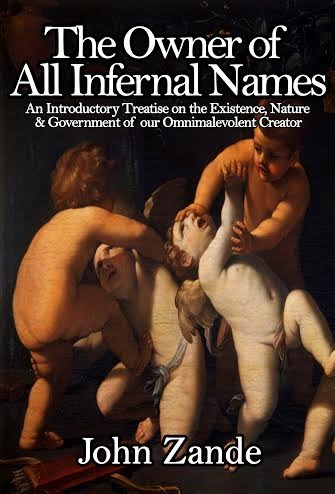
Back on September 16th, I published the post Of paradoxes, and headaches! It included the fact that I was about 20% of the way through John Zande’s book The Owner of All Infernal Names.

John Zande cover_zpsz7wuq9cc

On Tuesday evening of this week, I finished the book and, without doubt, I shall be publishing a review on Amazon books by the end of the week. First, I wanted to share a longer reflection of Zande’s book with all of you dear readers.

ooOOoo

One of the many five-star reviews of this book that has been published on the relevant Amazon page opens simply: “This is a beautifully written, terribly uncomfortable book to read.” I couldn’t better that summary. This is, indeed, a beautifully written book. Yet it is also a book that will forever change the way you think about species: Homo sapiens.

Zande offers a powerful argument that, “Following then the Principle of Sufficient Reason, the observer concludes with a level of argued certainty that a Creator must exist.” Then sets out to demonstrate that this Creator, far from being an expression of universal love, is fundamentally an expression of universal suffering. Reminding the reader that, “This world was never good. It was never peaceful, and never without suffering.”

For the first time in my life, Zande’s words had cause for me to reflect on something that, hitherto, had never dawned on me. That if there is a God, why have I, and countless others, assumed that this God be necessarily benevolent. The evidence presented in Zande’s book is comprehensive: that there was an evil origin to the universe and, more directly, that the deep, and growing, suffering of the pinnacle of evolution, us humans, can be traced back to that evil origin. Better than that, frequently the book is almost scientific. And in the best of scientific traditions, Zande adopts the position of a neutral witness.

Whether or not you are relaxed about that previous paragraph, and I suspect many readers will not, it is impossible not to be in awe of the beauty, the power, and the eloquence of Zande’s words. Take this opening paragraph of Zande’s chapter titled A SIGHTLESS CREATION.

It is a basal vagary, a question that screams for attention and if left unresolved – if left problematic – could invalidate all practicalities of a functioning Creation lorded by a maximally wicked Creator: Would sentient, attentive, self-respecting life choose to live in a world underwritten by evil? Could self-aware life endure a thoroughly hopeless reality?

Whether one is a believer in a religious god or not, it will also be impossible not to have one’s deepest emotions and beliefs about the nature of humankind stirred very deeply around. No-one who reads this book will be left unchanged.

If you have ever pondered about the way the world is heading, or more accurately put, about the way that we humans are managing our existence on Planet Earth, then you need to read this book. Period!

ooOOoo

Reinforcing what I have just written is the latest essay from George Monbiot, that will be published on Learning from Dogs on Friday.

The male of the species, Part One

Dogs, women and men.

I did warn you, my dear reader, at the end of yesterday’s post that my introspective mood continues!

Over today and tomorrow, I want to explore why we humans can be so incredibly clever, especially in a group sense, yet the males of our species find it so difficult to express themselves, and what that means for the future of humanity (at the risk of sounding a tad pompous).

More or less at random, a dip into yesterday’s selection of blogs brought to light some deeply disturbing items.

Professor William Even, Professor of Economics at the Farmer School of Business at Miami University was reported in The Conversation saying that:

As of 2014, there were approximately 39 million people aged 16-24 in the US, and 5.4 million of them were neither employed nor in school. That’s almost 14% of the age cohort, or more than two-and-a-half times the national rate of unemployment.

In that same bulletin from The Conversation, John Shepherd, a Professorial Research Fellow in Earth System Science at the University of Southampton in England, in writing about the challenges of directly removing CO2 from the atmosphere, stated (my emphasis):

A new paper in Nature Communications shows just how big the required rates of removal actually are. Even under the IPCC’s most optimistic scenario of future CO2 emission levels (RCP2.6), in order to keep temperature rises below 2℃ we would have to remove from the atmosphere at least a few billion tons of carbon per year and maybe ten billion or more – depending on how well conventional mitigation goes.

We currently emit around eight billion tonnes of carbon per year, so the scale of the enterprise is massive: it’s comparable to the present global scale of mining and burning fossil fuels.

Then Raúl Ilargi Meijer authored an item on The Automatic Earth blog, a blog that usually writes almost exclusively about money matters. His article was called: Power and Compassion. He opens his essay:

Time to tackle a topic that’s very hard to get right, and that will get me quite a few pairs of rolling eyes. I want to argue that societies need a social fabric, a social contract, and that without those they must and will fail, descend into chaos.

Then after referring to the European Union, he goes on to write (my emphasis):

Though it may look out of far left field for those of us -and there are many- who think in economic and political terms only, we cannot do without a conscious definition of a social contract. We need to address the role of compassion, morals, even love, in our societies. If Jesus meant anything, it was that.

There have been times through history when this subject would have been much easier to breach, but we today almost seem to think they are irrelevant, that we can do without them. We can’t. But in the US, people get killed at traffic stops every day, and in Europe, they die of sheer negligence. Developments like these will lead to ‘centers that cannot hold’.

In that part of the media whirlwind that we at the Automatic Earth expose ourselves to, virtually all discussions about our modern world, and what goes wrong with it, which is obviously a whole lot, are conducted in rational terms, in financial and political terminology.

But that’s exactly what we should not be doing. Because it’s never going to get us anywhere. In the end, let alone in the beginning too, we are not rational creatures. And if and when we resort to only rational terms to define ourselves, as well as our world and the societies we create in that world, we can only fail.

For a society to succeed, before and beyond any economic and political features are defined, it must be based solidly on moral values, a moral compass, compassion, humanity and simple decency among its members. And those should never be defined by economists or lawyers or politicians, but by the people themselves. A social contract needs to be set up by everyone involved, and with everyone’s consent. Or it won’t last.

How and why that most basic principle got lost should tell us a lot about where we are today, and about how we got here. Morals seem to have become optional. The 40-hour death struggle of Cecil the lion exemplifies that pretty well. And no, his is not some rare case. The lack of morals involved in killing Cecil is our new normal.

Let me now set the stage for what I want to write about tomorrow. And I’m going to do that by referring to a TED Talk that was recorded by historian and author Yuval Noah Harari. Here’s how that TED Talk was introduced:

Seventy thousand years ago, our human ancestors were insignificant animals, just minding their own business in a corner of Africa with all the other animals. But now, few would disagree that humans dominate planet Earth; we’ve spread to every continent, and our actions determine the fate of other animals (and possibly Earth itself). How did we get from there to here? Historian Yuval Noah Harari suggests a surprising reason for the rise of humanity.

Yuval Harari’s talk is based firmly on his thesis presented in his book: Sapiens: A Brief History of Humankind. (There’s a review of his book in The Guardian newspaper.) Namely:

The book surveys the history of humankind from the evolution of archaic human species in the Stone Age up to the twenty-first century. Its main argument is that Homo sapiens dominates the world because it is the only animal that can cooperate flexibly in large numbers. The book further argues that Homo sapiens can cooperate flexibly in large numbers, because it has a unique ability to believe in things existing purely in its own imagination, such as gods, nations, money and human rights. The author claims that all large scale human cooperation systems – including religions, political structures, trade networks and legal institutions – are ultimately based on fiction.

Other salient arguments of the book are that money is a system of mutual trust; that capitalism is a religion rather than only an economic theory; that empire has been the most successful political system of the last 2000 years; that the treatment of domesticated animals is among the worst crimes in history; that people today are not significantly happier than in past eras; and that humans are currently in the process of upgrading themselves into gods.

It is my contention that humankind’s evolution, our ability to “cooperate flexibly in large numbers”, is rooted in the gender differences between man and woman. A contention that I expand upon tomorrow.

Has the human ‘pack’ moved on!

Believers and non-believers alike owe Pope Francis a giant ‘thank you’.

As regular followers of this place will have heard before, one of the roles of the ‘alpha’ dog, or more accurately referred to these days as the Mentor dog, in other words the female dog that in the days before domestication was the leader of her pack, was to move her pack if she intuited that the pack’s home range was not sustaining them. (Her other role was pick of the male dogs!)

Thus the title of today’s post came to me as just possibly the metaphorical equivalent. That the global human ‘pack’ has been sharply reminded by one of the world’s key religious leaders that ‘more of the same’ isn’t going to work for much longer.

Quite rightly, there has been a huge amount of reporting and analysis of last week’s Papal Encyclical. But one of the most beautiful and profoundly eloquent came from the writer Jennifer Browdy. If you haven’t come across her before then do drop across to her website; you will love what she presents!  I have been a subscriber to her blog posts for some time and that was how I came across her post called: And the Walls Came Tumbling Down: Pope Francis Shows Us the Way. Jennifer very kindly gave me permission to republish her post today.

ooOOoo

And the Walls Came Tumbling Down: Pope Francis Shows Us the Way

By Jennifer Browdy

The Encyclical on climate change and the environment released by Pope Francis this week has all the magic of the fall of the Berlin Wall in 1991. Back then, the antagonism between the U.S. and the U.S.S.R. seemed implacable and unresolvable, a fight to the death. And then suddenly the wall came down and the world walked through, marveling, into a new era.

Now we have another abrupt shift, this time of a religious order. The leaders of the Catholic Church can hardly be accused of being “radical tree-huggers.” And yet here is Pope Francis, solemnly exhorting his flock of a billion Catholics worldwide to be respectful to Mother Earth and all the living beings she supports. In the blink of an eye, the language of Native American spirituality has been taken up by the same Catholic Church that once tortured and executed indigenous peoples precisely because of their different religious beliefs.

I urge you to read the entire Encyclical for yourself. It is a truly remarkable document, worth serious study. Of many passages I’d like to underline, here are two:

228 Care for nature is part of a lifestyle which includes the capacity for living together and communion. Jesus reminded us that we have God as our common Father and that this makes us brothers and sisters. Fraternal love can only be gratuitous; it can never be a means of repaying others for what they have done or will do for us. That is why it is possible to love our enemies. This same gratuitousness inspires us to love and accept the wind, the sun and the clouds, even though we cannot control them. In this sense, we can speak of a “universal fraternity”.

229 We must regain the conviction that we need one another, that we have a shared responsibility for others and the world, and that being good and decent are worth it. We have had enough of immorality and the mockery of ethics, goodness, faith and honesty. It is time to acknowledge that light-hearted superficiality has done us no good. When the foundations of social life are corroded, what ensues are battles over conflicting interests, new forms of violence and brutality, and obstacles to the growth of a genuine culture of care for the environment.

Here we find spiritual ecology enshrined as Catholic doctrine. And one thing about the Catholic Church—it is big on obedience. For believers, to ignore the Pope is to risk hellfire and damnation. In this case, though, the hellfire and damnation will be earthly, if we do not listen to the wise advice of Pope Francis and curb the insanity of industrial growth that goes beyond the limits of the planet to support.

Scientists appeal to our sense of reason, presenting compelling evidence that if we continue on our present path of wasteful consumption of the Earth’s resources, we will destroy our own future as a flourishing species. Religious leaders appeal to human beings’ moral conscience in invoking the responsibility of current parents and grandparents to leave a livable world to our descendants. It is up to the politicians, though, to translate vision into practice.

For too long, Christian conservatives in the U.S. have played the role of the ideological wing of Big Business, using money, manipulation and scare tactics to buy politicians and votes. In the face of the new Papal Encyclical, can American Christians really continue in good conscience to support the worst of the planet’s polluters and plunderers? Can they continue to elect mercenary politicians who hold our country hostage to the highest bidder?

If all good people who love our Earth and its creatures were to translate our love into action, as Pope Francis has just done so forcefully, I have no doubt the seemingly invincible wall of the industrial growth society we’ve been living with these past 200 years would melt away, revealing the path into a green, prosperous future.

“Where there’s a will, there’s a way,” the saying goes. Pope Francis has just shown us the will, and the way. It is now the task of us ordinary citizens to break the stranglehold of Big Business on politics and insist that our politicians follow his lead.

I close with an excerpt from the Pope’s “Christian Prayer in Union with Creation,” a vision of ecological interdependence if ever there was one:

“Triune Lord, wondrous community of infinite love,

teach us to contemplate you

in the beauty of the universe,

for all things speak of you.

“Awaken our praise and thankfulness

for every being that you have made.

Give us the grace to feel profoundly joined to everything that is.

God of love, show us our place in this world

as channels of your love

for all the creatures of this earth,

for not one of them is forgotten in your sight.

Enlighten those who possess power and money

that they may avoid the sin of indifference,

that they may love the common good, advance the weak,

and care for this world in which we live.”

Amen.

Browdy
And the meek shall inherit the Earth…. Photo by J. Browdy, 2015

ooOOoo

I am sure that, whatever your religious or spiritual persuasion, you will agree with me with regard to the beauty of Jennifer’s essay. I know there are millions and millions of people who will want to look back in a few years time and see how Pope Francis’ legacy literally saved our lives.

Our love for the natural ways of the world.

“In defending the natural world, we should be honest about our motivations – it’s love that drives us, not money.”

Not my words but the opening line from a brilliant essay published yesterday by George Monbiot.

I can add very little to the power of Mr. Monbiot’s essay other than to ‘top and tail’ his words with a couple of photographs taken here at home. Plus not forgetting to add that the essay is republished with George Monbiot’s very kind permission.

A view of our property looking out to the North-East. Our boundary is the other side of the line of trees. (Photo taken July, 2012)

ooOOoo

Channelling the Joy

17th June 2015

In defending the natural world, we should be honest about our motivations – it’s love that drives us, not money.

By George Monbiot, published in the Guardian 17th June 2015

Who wants to see the living world destroyed? Who wants an end to birdsong, bees and coral reefs, the falcon’s stoop, the salmon’s leap? Who wants to see the soil stripped from the land, the sea rimed with rubbish?

No one. And yet it happens. Seven billion of us allow fossil fuel companies to push shut the narrow atmospheric door through which humanity stepped. We permit industrial farming to tear away the soil, banish trees from the hills, engineer another silent spring. We let the owners of grouse moors, 1% of the 1%, shoot and poison hen harriers, peregrines and eagles. We watch mutely as a small fleet of monster fishing ships trashes the oceans.

Why are the defenders of the living world so ineffective? It is partly, of course, that everyone is complicit; we have all been swept off our feet by the tide of hyperconsumption, our natural greed excited, corporate propaganda chiming with a will to believe that there is no cost. But perhaps environmentalism is also afflicted by a deeper failure: arising possibly from embarrassment or fear, a failure of emotional honesty.

I have asked meetings of green-minded people to raise their hands if they became defenders of nature because they were worried about the state of their bank accounts. Never has a hand appeared. Yet I see the same people base their appeal to others on the argument that they will lose money if we don’t protect the natural world.

Such claims are factual, but they are also dishonest: we pretend that this is what animates us, when in most cases it does not. The reality is that we care because we love. Nature appealed to our hearts, when we were children, long before it appealed to our heads, let alone our pockets. Yet we seem to believe we can persuade people to change their lives through the cold, mechanical power of reason, supported by statistics.

I see the encyclical by Pope Francis, which will be published on Thursday, as a potential turning point. He will argue that not only the physical survival of the poor, but also our spiritual welfare depends on the protection of the natural world; and in both respects he is right.

I don’t mean to suggest that a belief in God is the answer to our environmental crisis. Among Pope Francis’s opponents is the evangelical Cornwall Alliance for the Stewardship of Creation, which has written to him arguing that we have a holy duty to keep burning fossil fuel, as “the heavens declare the glory of God; and the firmament proclaims his handiwork”. It also insists that exercising the dominion granted to humankind in Genesis means tilling “the whole Earth”, transforming it “from wilderness to garden and ultimately to garden city”.

There are similar tendencies within the Vatican. Cardinal George Pell, its head of finance, currently immersed in a scandal involving paedophile priests in Australia, is a prominent climate change denier. His lecture to the Global Warming Policy Foundation was the usual catalogue of zombie myths (discredited claims that keep resurfacing), nonsequiturs and outright garbage, championing, for example, the groundless claim that undersea volcanoes could be responsible for global warming. There are plenty of senior Catholics seeking to undermine the Pope’s defence of the living world; which could explain why his encyclical was leaked.

What I mean is that Pope Francis, a man with whom I disagree profoundly on matters such as equal marriage and contraceptives, reminds us that the living world provides not only material goods and tangible services, but is also essential to other aspects of our well-being. And you don’t have to believe in God to endorse that view.

In his beautiful book The Moth Snowstorm, Michael McCarthy suggests that a capacity to love the natural world, rather than merely to exist within it, might be a uniquely human trait. When we are close to nature, we sometimes find ourselves, as Christians put it, surprised by joy: “a happiness with an overtone of something more, which we might term an elevated or, indeed, a spiritual quality.”

He believes we are wired to develop a rich emotional relationship with nature. A large body of research suggests that contact with the living world remains essential to our psychological and physiological well-being. (A paper published this week, for example, claims that green spaces around city schools improve children’s mental performance).

This does not mean that all people love nature; what it means, McCarthy proposes, is that there’s a universal propensity to love it, which may be drowned out by the noise that assails our minds. As I’ve found while volunteering with the outdoor education charity Wide Horizons, this love can be provoked almost immediately, even among children who have never visited the countryside before. Nature, McCarthy argues, remains our home, “the true haven for our psyches”, and retains an astonishing capacity to bring peace to troubled minds. Acknowledging our love for the living world does something that a library full of papers on sustainable development and ecosystem services cannot: it engages the imagination as well as the intellect. It inspires belief; and this is essential to the lasting success of any movement.

Is this a version of the religious conviction from which Pope Francis speaks? Or could his religion be a version of a much deeper and older love? Could a belief in God be a way of explaining and channelling the joy, the burst of love that nature sometimes provokes in us? Conversely, could the hyperconsumption that both religious and secular environmentalists lament be a response to ecological boredom: the void that a loss of contact with the natural world leaves in our psyches?

Of course, this doesn’t answer the whole problem. If the acknowledgement of love becomes the means by which we inspire environmentalism in others, how do we translate it into political change? But I believe it’s a better grounding for action than pretending that what really matters to us is the state of the economy. By being honest about our motivation we can inspire in others the passions that inspired us.

www.monbiot.com

ooOOoo

Will close this thoughtful essay from Mr. Monbiot with another photograph.

Same view but this time on a foggy Autumn day in 2013.

It truly is love that drives our relationship with nature.

Easter weekend reflection

As read over on Find Your Middle Ground.

For Christians the world over the Easter weekend is the religious moment of the year.

For all of humanity, believers and non-believers alike, the following simple but powerful words ought to be a reminder of eternal values for every day of the year.

ooOOoo

Today’s Quote from Theresa

Beautiful words and image from Theresa at Soul Gatherings. Let it settle in.💛

Originally posted on Soul Gatherings:

purple-trees

In the end, only three things matter:
how much you loved,
how gently you lived,
and how gracefully you let go of things
not meant for you.

~ The Buddha ~

ooOOoo

Thanks Val for allowing me to republish this. (Val Boyco of Find Your Middle Ground.)

Misery Is Optional

Another guest essay from the old lamplighter.

It seems to me that it is so incredibly easy to be influenced, even engulfed, by bad news.

Back on the 20th I posted an item that had been sent to me by John Hurlburt, who is the old lamplighter, called Interstellar News.

Here’s another essay from John that is a great reminder of that old adage: We are what we think.

ooOOoo

Lost

Misery Is Optional

There’s always been a delicate balance in the struggle between growth and stagnation. The emerging universe invariably prevails. The good news is that absolutely insisting upon the denial of reality naturally backfires in the long run. Common sense has repeatedly saved our collective bacon from the fire as our species has faced former crises. The stakes have never been higher.

There’s a natural balance that runs through our relatively brief species history. Extreme cultural alternatives include plutocracy and anarchy. There’s no question that if we’re not an active supporter of an inclusive solution we contribute to our collective dissolution.

Nero fiddled while Rome burned. There’s a current global analogy. Global media communications reflect hate, divisiveness and violence. The obvious truth is essentially ignored. A result is our present state of angst, paranoia and associated stress disorders. We compensate with bread and circuses.

Indifference doesn’t have to be a local reality. We’re all naturally connected in whatever we conceive of as God. We share a common soul. If we are wise we’ll act accordingly. We’ll accept our inherent responsibilities as stewards of Creation. The fulfilment of positive actions in according with the nature of our being is a blessing that keeps on giving.

an old lamplighter

ooOOoo

These are beautiful words and whatever one’s religious or spiritual convictions if we don’t recognise that we are all “naturally connected” then it won’t be long before we run out of bread and circuses – and deservedly so.

Going to close this post by using the following picture and quotation taken from the latest Terry Hershey newsletter.

Machado

Beyond living and dreaming
there is something more important: waking up.

Antonio Machado

Written with a heavy heart!

Such a need to learn from our dogs!

A couple of items that recently landed in my ‘in-box’ had me in pain; emotional pain that is. I agonised over republishing them but then thought it felt like a duty to promulgate this particular terrible aspect of life. Trust me, today’s post is going to generate a deal of passion (see reference to TIME magazine at the end of the post). Also it is not something that should be read by a young person under the age of sixteen.

The first item was an email sent to me by dearest Suzann and is republished here with Suzann’s kind permission.

(For those that may not know or recall, Suzann, and her husband Don, invited me to spend the Christmas of 2007 with them at their home in San Carlos, Mexico. Suzann and Jean, who then lived in San Carlos, had been good friends for many years working together to rescue the many feral dogs found on the streets in San Carlos and surrounding areas. Indeed, Suzann continues to rescue those needy dogs and find loving homes for them. Out of the 9 dogs here at home in Oregon, 6 are ex-rescue dogs from Mexico.)

This is what Suzann sent:

I am so sorry to have to send this to you, but it needs to get out there for people to know.
What can we do?
1. Make others aware of this atrocious and vile assault on innocent people, so people will WAKE UP to the evil that is happening in this world!
2. PRAY!
3. If you are not a believer, send to others that you know who are, so they can send it on.
The whole world needs to see this!!
Thank you.
suzann

YOUR PRAYERS ARE THE NEED OF THE HOUR.

PLEASE SEND THIS TO AS MANY AS YOU CAN.

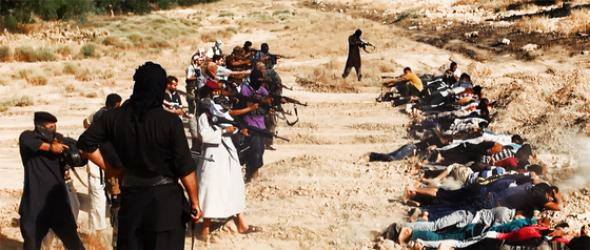
PLEASE LOOK AT THESE PICTURES. ISIS IS KILLING CHRISTIAN CHILDREN. ONE WAS CRUCIFIED. PLEASE PRAY.
Be sure to see the 4 photos below. The whole world needs to see what kind of people these ISIS terrorists are.

Su1

oooo

Su2

oooo

Su3

oooo

Su4

Here is an urgent prayer request for all of us!!
She asked that it be forwarded ASAP to as many people possible:

Dear Friend: Just a few minutes ago, I received the following text message on my phone, from Sean Malone who leads Crisis Relief International (CRI), We spoke briefly on the phone, and I assured him that we would share this urgent prayer need with all our contacts.
We lost the city of Queragosh. It fell to ISIS and they are beheading children systematically. This is the city we have been smuggling food to. ISIS has pushed back Kurdish Forces, and is within 10 minutes of where our CRI team is working. Thousands more fled into the city of Erbil last night. The UN evacuated its staff in Erbil. Our team is unmoved and will stay. Prayer cover needed!!!.

Please pray sincerely for the deliverance of people of northern Iraq from the terrible advancement of ISIS and its extreme Islamic goals for mass conversion or death for Christians in this area.

May I plead with you not to ignore this email? Do not forward it before you have prayed through it. Then send it to as many people as possible.
Send it to friends and Christians you know. Send it to your prayer group. Send it to your pastors. Any one you can think of. We need to stand in the gap for our fellow Christians.

I was still struggling to ground, as it were, my emotional response to Suzann’s item when a second item came into my ‘in-box’. It was a new post over on Patrice Ayme’s blogsite. This, too, is republished in full with Patrice’s kind permission.

ooOOoo

Savage, The Franks? Islam Is Worse

Our friend the half-philosophers may start to huff and puff, as “Franks” were citizens of a federation (actually two of them, the one of the Sea, and the one of the River; the one of the Sea, or more exactly, Salt, is now known as Salian, or Salic).

Whereas “Islam” is a thought system, devised by some Arab warriors (PBUH), who got a good gig going for themselves.

To put in the same basket an ethnicity and a religion is what some half-philosophers would love to call a “category mistake”. The irony is that I know (the basics of) Category Theory, and they don’t.

In Category Theory, there is a concept called a functor, which allows to go from one category to another.

islamists

In other words, because I know of functors, I can mix and match different categories such as Franks and Islam, and be relaxed about it (instead of being all gripped and unimaginative, as is the average constipated half-philosopher. Notice in passing that the concept “functor” was invented by the philosopher Carnap in linguistics).

The historian Pirenne, long ago, suggested the thesis that the collapse of the economy in the High Middle Ages was caused by the Islamists (Islam confiscated most of the Roman empire, and imposed a total embargo, cutting not just the Paper route, but the Silk Road as well).

In other news, On Fascism, Russian & Islamist Edition, Feb 26, 2015, a plan surfaced for the invasion of Ukraine, written more than a year ago, by some major Russian plutocrats, who have influence on Putin and are best buddies with the leadership of the Russian “Orthodox” Church.

Don’t worry, anybody involved will soon die, and things will calm down; this is Putin’s way.

There is a clear self-censorship going on throughout the West right now, because people are scared of these fanatics, the Putinists, and the Islamists. This, in turn, is deleterious to any critical mood, thus discourse, thus adverse to fixing any problem.

One cannot have a sane public discourse if one cannot even draw a human being. Having public insanity in place of public discourse will affect the Republic, to the point it will die, and that is why it died in all and any nation that submitted to Submission (aka “Islam”).

TODAY’S ISLAMISTS: MORE BARBARIAN THAN THE FRANKS, SIXTEEN CENTURIES AGO:

As it rose, Christianism destroyed the Roman Republic (or what was left of it). In 363 CE, under fanatical emperor Jovian, an ex-general, a systematic policy of burning libraries got started (Jovian may have been behind the assassination of laic emperor Julian; I am speculating). In 381 CE under ex-general Theodosius, then emperor, laws were passed to enact a “War Against the Philosophers“. Heresy (“making a choice”) became punishable by death.

The Roman empire, which still had many characters of a Republic (which officially it was… Now a “Christian” Republic) exploded.

However, in the next century, in the West, the Franks took control and build a Catholicism so moderate that it made Paganism, Judaism, and Apostasy all legal (and conversions in all directions).

Interestingly, the Franks, who soon built what they called “Europe”, as an empire, have the reputation of uncouth savages. “Frank” means Ferocious, not just Free.

But the Franks had no problem with Catholics becoming Jews, entire villages converted, until the priest was the only Christian in town. Charlemagne himself, four centuries after the Franks acceded to power, had his friends call him “David”, because he wanted to be like Israel’s King David (not a friend of God, according to the Bible).

Compare with the savagery of Islam: Somebody who leaves Islam is to be killed, say the Hadiths.

So what of the supposed great intellectual tradition of “Islam”? That sounds strange, on the face of it. What about the great intellectual tradition of Christianism? Well, the answer is that there is no such a thing. As soon as he became a fanatical Christian, Pascal produced nothing. All great “Christian” intellectuals are intellectuals first, and, second spent the reminder of their mental capabilities avoiding the fire in which the church wanted to throw them.

In France alone, around the year 1530 CE, three major philosophers were burned alive for having contradicted Catholicism. This explains why Descartes, a century later, preferred to live in the Netherlands.

Contrarily to repute, the situation with Islam was even worse. At least, in the West, intellectuals could engage the Church in full combat, and they often won. This is a direct consequence of the Frankish leadership submitting the Christian leadership, starting in the Fifth Century. After that time, the Church was never again the government of the West (except inside the Papal states, a gift of Charlemagne, later de facto rescinded).

Famously, around 1300 CE, Philippe IV of France and his vassal the English king engaged in full submission of the Pope and his army. The Pope and the Templars both ended judged, dead, and, more importantly, taxed.

So what of these great Muslim thinkers? The answer is that most of them were, truly Jewish or Christians, or very recently “converted”, or then did not finish too well.

ISLAMIST SCHOLARS WANT TO KILL YOU:

The fact is, the greatest Muslim university, Al Azhar in Cairo, is definitively founded on what the Franks, 15 centuries ago, would have viewed as barbarian principles. It actually refused to condemn the “Islamist State” as not conforming to Islam.

Al Azhar has decided that those who renounce Islam and their children ought to be killed:

“In the name of Allah Most Gracious Most Merciful

Al-Azhar

Fatwa Committee

A question from Mr. Ahmed Darwish who presented the question through Mr. (Blanked out) of German nationality:

A Muslim man of Egyptian nationality married a Christian woman of German nationality. The two spouses agreed that the aforementioned Muslim man would enter the Christian religion and join the Christian creed.

What is the ruling of Islam regarding this person’s situation?
Are his children considered Muslims or Christians and what is their ruling?
The Answer:

All praises are due to Allah, lord of all the worlds. And peace and blessings be upon the greatest of all messengers, our master Muhammad and upon his family and companions all together. As for what follows:

We inform that he has apostatized after having been in a state of Islam, so he should be asked to repent. If he does not repent, he should be killed according to the sharia.

As for his children, so long as they are small they are Muslims. After they have attained maturity, if they remain in Islam then they are Muslims. If they leave it, then they should be asked to repent. If they do not repent, they should be killed. And Allah knows best.

President of the Fatwa Committee of Al-Azhar

Seal of the Committee

September 23, 1978”

http://www.councilofexmuslims.com/index.php?topic=24511.0

Our civilization was founded on rejecting this sort of savagery on the part of Christianism. When the Islamists appeared, the Franks considered them to be a Christian sect, the Sons of Sarah (Saracens). Let’s persist in rejecting the savagery.

Antique Greece was not just defined by what it built, but what it rejected: the Barbarians (those whose talk sounded animal-like: barr… baa). One cannot be positive all the times, otherwise positivity itself loses meaning.

Patrice Ayme’

PS: After publishing the preceding essay, it came to light that the Islamist State, applying literally the savage texts that guide them, destroyed Mesopotamian art more than twice older than the invention of Islam by the raiders (Muhammad and the father of his six-years-old child bride, etc.). 

There is no savagery but savagery, and Islam is its prophet?

ooOOoo

Not to have upsetting reactions to these items from Suzann and Patrice would be abnormal. Both Su’s item and the post from Patrice had me going round in emotional circles. Ranging from seeing our species as cruel, barbarous creatures to thinking that maybe there are times when the only proper course of action is to take up arms against savages. Along the lines of that quote about the only thing that evil needs to succeed is for good people to do nothing.

Finally, it was the editorial in the latest (March 9th.)  TIME magazine, written by the Editor, Nancy Gibbs, that had my head nodding.  Here’s a little of what Nancy Gibbs wrote:

Analyzing a threat as complex and diffuse as ISIS requires a global effort, and so our special report reflects the work of dozens of journalists on three continents with decades of experience reporting on the Middle East.

………

We invited Max Boot of the Council on Foreign Relations and Karl Vick, our former Jerusalem bureau chief, who is now based in New York City, to argue the case for and against the U.S.’s sending ground troops into the fight.

It was the next sentence that underlined for me why I had so many conflicting emotions (my emphasis).

The hardest thing about confronting a group like ISIS,” Karl observes, “is seeing past the fear they delight in projecting to discern the threat it actually presents. But they make dispassion really difficult.

Makes our dogs look like profoundly straightforward, loving animals! Why, oh why, can’t the human race essentially be as straightforward and loving!

Oil, money, banks, guns and blood.

The history of power, control, those who wield it, and where it has taken us all.

There is a real pain in me as I start into today’s post. A pain that comes from agonising over whether or not to write in this vein. A pain that has its roots in me being forced to accept that global politics, money and power-plays are much worse than I ever wanted to believe.

What, you must be asking, has got me plunging so far into this dark place? When just twenty-four hours ago I was writing of peace, calm and deep meditation?

Simply a film!

A film that was uploaded by the BBC a few days ago exclusively on to their BBC iPlayer platform.

The film is called Bitter Lake and here’s the trailer.

The full film is 2 hours, 20 minutes long. (But note that the film is age-restricted for obvious reasons.)

I can’t encourage you to watch it. For if you do, the world may never seem the same to you.

But Jeannie and I did watch it and think it should be shared widely. And, yes, it has changed the world for us.

Here’s how it is described by Adam Curtis and the BBC.

Published on Jan 26, 2015
Shown exclusively on the BBC iPlayer service in the UK
This upload is for those outside of the UK

http://www.bbc.co.uk/blogs/adamcurtis

Politicians used to have the confidence to tell us stories that made sense of the chaos of world events.

But now there are no big stories and politicians react randomly to every new crisis – leaving us bewildered and disorientated.

And journalism – that used to tell a grand, unfurling narrative – now also just relays disjointed and often wildly contradictory fragments of information.

Events come and go like waves of a fever. We – and the journalists – live in a state of continual delirium, constantly waiting for the next news event to loom out of the fog – and then disappear again, unexplained.

And the formats – in news and documentaries – have become so rigid and repetitive that the audiences never really look at them.

In the face of this people retreat from journalism and politics. They turn away into their own worlds, and the stories they and their friends tell each other.

I think this is wrong, sad, and bad for democracy – because it means the politicians become more and more unaccountable.

I have made a film that tries to respond to this in two ways.

It tells a big story about why the stories we are told today have stopped making sense.

But it is also an experiment in a new way of reporting the world. To do this I’ve used techniques that you wouldn’t normally associate with TV journalism. My aim is to make something more emotional and involving – so it reconnects and feels more real.

BBC iPlayer has given me the opportunity to do this – because it isn’t restrained by the rigid formats and schedules of network television. It’s a place you can go to experiment and try out new ideas.

It is also liberating – both because things can be any length, and also because it allows the audience to watch the films in different ways.

The film is called Bitter Lake. It is a bit of an epic – it’s two hours twenty minutes long.

It tells a big historical narrative that interweaves America, Britain, Russia and Saudi Arabia. It shows how politicians in the west lost confidence – and began to simplify the stories they told. It explains why this happened – because they increasingly gave their power away to other forces, above all global finance.

But there is one other country at the center of the film.

Afghanistan.

This is because Afghanistan is the place that has repeatedly confronted politicians, as their power declines, with the terrible truth – that they cannot understand what is going on any longer. Let alone control it.

The film shows in detail how all the foreigners who went to Afghanistan created an almost totally fictional version of the country in their minds.

They couldn’t see the complex reality that was in front of them – because the stories they had been told about the world had become so simplified that they lacked the perceptual apparatus to see reality any longer.

And this blindness led to a terrible disaster – support for a blatantly undemocratic government, wholesale financial corruption and thousands of needless deaths.

A horrific scandal that we, in our disconnected bubble here in Britain, seem hardly aware of. And even if we are – it is dismissed as being just too complex to understand.

But it is important to try and understand what happened. And the way to do that is to try and tell a new kind of story. One that doesn’t deny the complexity and reduce it to a meaningless fable of good battling evil – but instead really tries to makes sense of it.

I have got hold of the unedited rushes of almost everything the BBC has ever shot in Afghanistan. It is thousands of hours – some of it is very dull, but large parts of it are extraordinary. Shots that record amazing moments, but also others that are touching, funny and sometimes very odd.

These complicated, fragmentary and emotional images evoke the chaos of real experience. And out of them I have tried to build a different and more emotional way of depicting what really happened in Afghanistan.

A counterpoint to the thin, narrow and increasingly destructive stories told by those in power today.

And I must include this comment from the relevant page on BBC Blogs:

Quite simply one of the best films I’ve ever watched. The theme and content made so many connections linking events of the last 40 years. It’s perhaps time to reflect on power ,control and those who wield it . The official narrative is not our narrative , we have a choice to decide what we believe . Time to reflect and make that choice.
Thanks for such an informing film.

Here is the film.

Making sense of who we are?

The psychology of self.

One of the huge differences between humans and our beloved dogs is that dogs live entirely in the present and do not engage in abstract thinking. Indeed, one of the most glorious aspects of owning a dog is being able to lose oneself in those moments of intimacy between yourself and your dog. Here’s a wonderful example of that when Bridget from Oregon Wild visited us recently and enjoyed a moment of bliss with Hazel.

P1150348

So with that in mind, I am now going to be very un-dog-like and very human by offering an essay that is most abstract in manner.  Not my essay, I should hasten to add, but a recent essay from George Monbiot, republished here with his kind permission. Then tomorrow, I want to stay with the abstract theme and include a recent essay from Terry Hershey.

ooOOoo

A Small and Shuffling Life

Why, in this age of freedom, are we so confined? And what can we do to reclaim our lives?

By George Monbiot, published in the New York Times, 19th January 2015

Live free or die: this is the maxim of our age. But the freedoms we celebrate are particular and limited. We fetishise the freedom of business from state control; the freedom not to pay taxes; the freedom to carry guns and speak our minds and worship whom we will. But despite – in some cases because of – this respect for particular freedoms, every day the scope of our lives appears to contract.

Half a century ago, we were promised that rising wealth would mean less work, longer vacations and more choice. But our working hours rise in line with economic growth, and they are now governed by a corporate culture of snooping and quantification, of infantilizing dictats and impossible demands, which smothers autonomy and creativity. Technologies that promised to save time and free us from drudgery (such as email and smartphones) fill our heads with a clatter so persistent it stifles the ability to think.

Public spaces in our cities are reduced to pasteurised piazzas, in which loitering without intent to shop is treated as suspicious. Protest is muted by dozens of constraining laws. Young people, who have no place in this dead-eyed, sanitised landscape, scarcely venture from their bedrooms. Political freedom now means choosing between alternative versions of market fundamentalism.

Even the freedoms we do possess we tend not to exercise. We spend hours every day watching other people doing what we might otherwise be doing: dancing, singing, playing sport, even cooking. We venture outdoors to seek marginally different varieties of stuff we already possess. “Getting and spending, we lay waste our powers / Little we see in Nature that is ours,” wrote William Wordsworth (1), and it is truer today than it was then.

We entertain the illusion that we have chosen our lives. Why, if this is the case, do our apparent choices differ so little from those of other people? Why do we live and work and travel and eat and dress and entertain ourselves in almost identical fashion? It’s no wonder, when we possess and use it so little, that we make a fetish out of freedom.

Perhaps we have forgotten the bitter complaint made by Benjamin Franklin in 1753. “When an Indian Child has been brought up among us, taught our language and habituated to our Customs, yet if he goes to see his relations and make one Indian Ramble with them, there is no perswading him ever to return.”(2) But when European Americans “have been taken prisoners young by the Indians, and lived a while among them, tho’ ransomed by their Friends, and treated with all imaginable tenderness to prevail with them to stay among the English, yet in a Short time they become disgusted with our manner of life … and take the first good Opportunity of escaping again into the Woods, from whence there is no reclaiming them.” In 1785 Hector de Crèvecoeur asked two European refuseniks why they would not come home. “The reasons they gave me would greatly surprise you: the most perfect freedom, the ease of living, the absence of those cares and corroding solicitudes which so often prevail with us.”(3)

We arose in a thrilling, terrible world. The African savannahs on which the first hominims evolved were dominated by sabretooth and false sabretooth cats, giant hyaenas and bear dogs. When human beings arrived in the Americas, 14,000 years ago, they found ground sloths the weight of elephants; a beaver eight feet from nose to tail; armadillos like small cars; giant lions and sabretooths; short-faced bears whose shocking armoury of teeth and claws suggests they drove giant lions and sabretooths off their prey. A bird in Argentina had a wingspan of 26 feet. Fanged salmon nine feet long migrated inland from the Pacific coast.

We carry with us the psychological equipment, rich in instinct and emotion, required to navigate that world. But our survival in the modern economy requires the use of few of the mental and physical capacities we possess. Sometimes it feels like a small and shuffling life. Our humdrum, humiliating lives leave us, I believe, ecologically bored.

At times this sensation has overwhelmed me. It happened in a newly-discovered bone cave in southern England. The walls and floor were encrusted with calcite crystals, that glittered in the torchlight. One of the archaeologists with whom I was exploring it handed me the atlas vertebra of a Bronze Age cow. Then he picked up another bone, this time with both hands: another atlas vertebra, but monstrous. “It’s the same species as the first one. But this is the wild version. The aurochs.” As I turned it over in my hands, feeling its great weight, I experienced what seemed like an electric jolt of recognition. It felt raw, feral, pungent, thrilling. The colour seemed to drain from modern life.

I felt it again when stalking up a tidal channel with a trident, trying to spear flounders. After two hours scanning the sand intently for signs of the fish, I was suddenly transported by the fierce conviction that I had done it a thousand times before. I felt it most keenly when I stumbled across the fresh corpse of a deer in a wood. I hoisted it onto my shoulders. As soon as I felt its warmth on my back, my skin flushed, my hair stood on end and I wanted to roar. Civilisation slid off like a bathrobe. I believe that in these cases I accidentally unlocked a lumber room in the mind, in which vestigial faculties shaped by our evolutionary past are stored. These experiences ignited in me a smouldering longing for a richer and rawer life than the one I lead.

Unless we are prepared to reject civilization altogether and live in the woods, there is no complete answer to this predicament. But I think there is a partial one. Across many rich nations, especially the United States, global competition is causing the abandonment of farming on less fertile land. Rather than trying to tame and hold back the encroaching wilds, I believe we should help to accelerate the process of reclamation, removing redundant roads and fences, helping to re-establish missing species, such as wolves and cougars and bears, building bridges between recovering habitats to create continental-scale wildlife corridors, such as those promoted by the Rewilding Institute(4).

This rewilding of the land permits, if we choose, a partial rewilding of our own lives. It allows us to step into a world that is not ordered and controlled and regulated, to imagine ourselves back into the rawer life from which we came, to discover, perhaps, the ecstasy I experienced when I picked up that deer. We don’t have to give up our washing machines and computers and spectacles and longevity to shed our ecological boredom and recover some measure of the freedom that has been denied to us. Perhaps we do need to remember who we are.

George Monbiot’s book Feral: rewilding the land, the sea and human life is published this month by the University of Chicago Press.

References:

1. http://www.bartleby.com/145/ww317.html

2. Benjamin Franklin, 9th May 1753. The Support of the Poor. Letter to Peter Collinson.

http://www.historycarper.com/1753/05/09/the-support-of-the-poor/

3. J. Hector St. John de Crèvecoeur, 1785. Letters from an American Farmer and Other Essays. Letter 12. Edited by Dennis D. Moore. Harvard University Press.

4. http://rewilding.org/rewildit/

ooOOoo

So tomorrow, the second part with Terry Hershey and a short talk by Professor Dan Gilbert, Professor of Psychology at Havard University.