Category: Politics

Copenhagen – the unspoken issue

It’s getting crowded down here!

For those readers who are not regular BBC television viewers, the Beeb has for many years run an excellent factual/science & nature series under the name of Horizon.  Just recently there was a programme with the title of How Many People Can Live on Planet Earth?
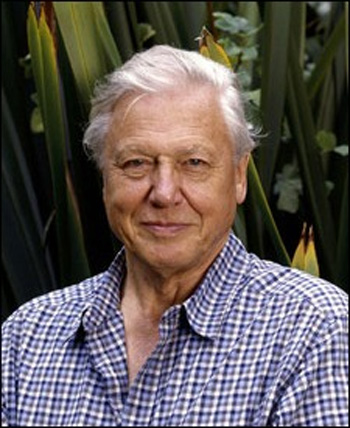
Sir David Attenborough

It was presented by that familiar face on the BBC in terms of the natural world, Sir David Attenborough.  It was an appropriate and worthy person to present the information.

But before getting into some of the details underpinning the programme, there seems to been an enormous and unspoken omission at Copenhagen – why no debate about global population trends?

Luckily the media noticed the rather obvious exclusion.  Here’s the UK Daily Telegraph newspaper (online version) of the 8th December, 2009. An extract:

Population growth is the one issue accused of causing driving climate change that no one at the Copenhagen climate summit dares to talk about.

The argument is that more people consume more resources, therefore producing more greenhouse gases that cause global warming.

The global population is currently at 6 billion and could rise to 11 billion by 2050 if fertility rates continue, not only threatening the climate, but food shortages and conflict as well.

Organisations like the Optimum Population Trust, that is backed by Sir Jonathan Porritt, Dame Jane Goodall and Sir David Attenborough, advocate birth control as a way of slowing climate change.

As Sir David has said: “I’ve never seen a problem that wouldn’t be easier to solve with fewer people, or harder, and ultimately impossible, with more.”

A study by the London School of Economics found contraception is almost five times cheaper as a means of preventing climate change than conventional green solutions such as investing in green technology.
Read more of this Post

Greg Craven and the power of social media

There’s a new power on the streets and it may make politicians feel very uncomfortable!

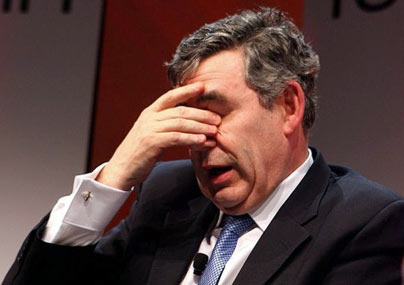
The Rt Hon Gordon Brown

Like me, you probably haven’t heard of Greg Craven.  I hadn’t until about 24 hours before starting to write this Post (that would be Friday afternoon, Mountain Time, on the 11th December).

I was doing some research for an earlier Post about Copenhagen and came across a YouTube video created by Greg.  More details and links later after making a more fundamental point.

This video of Greg’s has had 2,704,000 viewings! The information on that YouTube ‘page’ has had over 7,500,000 viewings. Greg has now written a book and so on, and so on.

In other words, the personal message that Greg is conveying has reached an unbelievable number of people.  That would have been impossible without the power and reach of modern social media software systems: YouTube, Facebook, Linked-In, Twitter, MySpace, Digg, at al.

In the past, information has flowed outwards in a much more ‘top down’ way.  Hierarchical, as it is called.   That has suited those that wish, in some way, to control the message.  While individuals would always chatter and gossip with their peers, there was a finite limit to that before “Send reinforcements, we are going to advance” morphed into “Send three and fourpence, we are going to a dance”!

The example of Greg Craven shows only too well how information can now flow.  Out of anyone’s control, spreading virally.

Having made my point, I want to return to the subject matter that Greg is championing – but will include that in a separate Post.

Politicians!  Be very careful what you say.  We are all listening now, in one way or another, and ready to pounce if we don’t trust your words!

By Paul Handover

The Shame of Tibet

Transcripts from our bug in the Ministry of Misinformation, Whitehall, London

Good morning, Perkins ….

If you say so, Sir

Oh Dear …. I can tell there’s something wrong, Perkins … you’d better get it off your chest.

It’s this Tibet business, Sir, …

Tibet! Goodness me, Perkins! You do worry about such small things!

I wouldn’t exactly call Tibet, small, Sir.

But it’s thousands of miles away, Perkins, in a country of which we know little, and the British people even less.

Perhaps, but no man is an island and all that …

Perkins, we do have work to do, you know!

But nobody takes the Tibetans’ rights, seriously, Sir.

Well, it depends what you mean by “seriously”, Perkins.

But they are an occupied people! The Chinese Han are ethnically-swamping them! If the Americans did that to the Canadians, for example, there’d be all hell let loose …

Oh come, come, Perkins! You can’t compare Canadians to Tibetans! The latter are an underdeveloped, uncivilized race! The Chinese are bringing them into the modern world. They’re investing billions in the country.

Yes, to turn Tibet into a part of China, with Han culture …

But it is part of China, Perkins.

Only because the Chinese seized it by force. What right do they actually have to rule Tibet? Until they started moving millions of Chinese into the country there were practically no Chinese there at all. It was a thousand-year-old and totally different – and to the Chinese Han – alien culture.

What right, Perkins? Well, I’m sorry to disillusion you, but their bigger army gave them the right and after all, possession is nine-tenths of the law!

But they are so arrogant. And so-called democracies don’t say a word. India has even banned a march by a few hundred exiled Tibetans. The west continues to trade with and enrich China so that it can buy arms to oppress its minorities. It’s sickening, Sir.

Only if you have a conscience, Perkins. I’m sorry to see you are still afflicted by conscience.

I don’t think you are taking this seriously, Sir.

I am, Perkins; it’s just that nothing can be done.

You mean, nothing that doesn’t hurt us a bit, don’t you Sir?

Well, that goes without saying, Perkins! Do you really think the British consumer is going to accept to have to pay more for his DVD-recorder just to put a bit of pressure on China!!!

I’m sorry, Sir. It stinks. China supports North Korea, and they’ve just executed 15 people just for trying to flee the country. When North Koreans do get out of the hell of their regime, the Chinese often send them back. And yet we allow them to hold the Olympic Games! To set doves free in a gesture of peace! It is horrible, Sir.

Yes, Perkins. It’s called politics.

But it is preposterously hypocritical, Sir. Have you read “The Universal Declaration of Human Rights”?

Not recently, Perkins …

Well, what about this bit in Article 21?

The will of the people shall be the basis of the authority of government; this will shall be expressed in periodic and genuine elections which shall be by universal and equal suffrage and shall be held by secret vote or by equivalent free voting procedures.

Well, what about it, Perkins?

Well, members of the UN are supposed to subscribe to that, aren’t they, Sir? But a majority don’t, do they? China certainly doesn’t, does it?

I’m not sure I can answer three questions at once, Perkins. But I’ll give it some thought over the weekend …….

And what are you doing over the weekend, Sir?

As it happens, Perkins, I’m playing golf with the Chinese Ambassador …..

By Chris Snuggs

The Future of the British National Health Service

Is Britain’s Health Service now terminally ill.

Near the end of November came more bad news from the British National Health Service, an institution that many Brits both love and hate at the same time.  The truth is that the NHS has simply become too big, too bureaucratic and is in many areas failing though over-regulation and poor management.

Not that it lacks managers of course;  I believe there are more managers per bed than in any other country of Europe.

Why is it that the more managers you have the worse the overall performance ends up? Too much working by committee and passing the buck for failure, perhaps?

It has to be broken up; vast organisations just don’t work. Smaller is beautiful. I feel confident the world will eventually understand this; already there are serious calls for the big banks to be split up after the credit fiasco and just recently we read about  calls for some of the big British supermarkets to be ‘smallered’. This is significant, coming from one of the “Neo-Conservative” gurus likely to have great influence in the next British government.

Have we passed through a period of worshipping size, power, takeovers, mergers, money, financial domination, vast stock options, fees for lawyers, obscene bonuses and instant gratification?

Economies of scale are one thing, but at some point other factors reduce their value to society as a whole. The bigger an institution of any kind the greater the possible abuse. And sadly, at some time or other there will be abuse, as we have seen so often.

The period of “Big is Beautiful” may be ending, and not before time.

By Chris Snuggs

Housing and the Economic Recovery

Perhaps the housing market is the best economic indicator?

As an economist, I am frequently asked for my predictions on when the economy is going to turn around.  Have we reached the bottom?  Have we begun to recover?  Might we go into a second, perhaps more severe recession?

Those are tough questions to answer.  Business cycles are notoriously difficult to predict.  In fact, about the only thing we know for sure is that no two business cycles are alike. Each is unique in some significant way.

Changes in the housing market may be one of the most meaningful indicators of a recovery, because housing stability is such a fundamental indicator of how households are budgeting their income.  Notice that I did not say that the level of homeownership was a useful indicator; instead, I look to changes in the housing market, either away from or toward an apparently sustainable and affordable supply of homes, for evidence of where in the business cycle the economy may be.

Despite record low mortgage rates and first-time home buyer credits, the U.S. housing market remains anemic.  Rising foreclosures in several major metropolitan areas will keep housing prices low for some time to come.

The U.S. currently has about 1.7 million excess housing units available.  Typically, about 1.3 million new households are formed in the U.S. per year.  But with the unemployment rate topping 10%, new household formation will fall to about 1 million per year.  If new home construction remains at its current level of about 600,000 units per year, it will take over 4 years (1.7 million/400,000) for the excess supply of housing to be absorbed and housing prices to recover.

Recovery rates will be much slower in some markets, such as in Florida, Nevada, and California, but I believe that the rest of the U.S. along with most other developed economies are looking at a three- to four-year period of time before housing and thus the overall levels of output return to their pre-recession levels.

By Sherry Jarrell

Commercial Real Estate and the U.S. Financial System

This is not over yet, folks

The U.S. banking system remains vulnerable to sizeable potential losses as the housing market struggles to recover.

Estimates of these losses range from $500 billion to $1 trillion (£312 bn – £625 bn). The Federal Reserve Board is especially concerned about the impact of commercial real estate on many regional and small banks across the country.  Occupancy and rental rates continue to decline dramatically as 2009 draws to a close, and the worst seems yet to come.

Commercial real estate loans on banks’ balance sheets total almost $1.1 trillion dollars.  With near-term commercial real estate losses topping $100 billion, the Wall Street Journal estimates that as many as one-third of small and mid-size U.S. banks could experience financial distress.


Troubled banks restrict lending until they can raise more capital.  In this illiquid market, expect banks to fight for survival by raising lending rates, shortening maturities, and lowering loan amounts.  Credit will continue to shrink in the U.S., which spells big trouble for any economic recovery.

By Sherry Jarrell

More French Anglo-Saxon Bashing

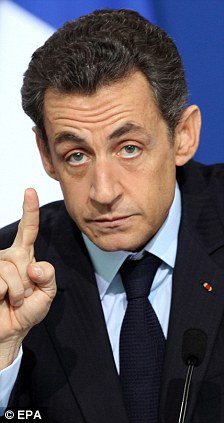
Pres. N Sarkozy

“Do you know what it means for me to see for the first time in 50 years a French European commissioner in charge of the internal market, including financial services, including the City (of London)? I want the world to see the victory of the European model, which has nothing to do with the excesses of financial capitalism.” (As quoted by The Daily Telegraph.)

“Victory”? So we were at  war, then? Oh dear ….. you are 60 years out of date old boy, or perhaps 500 years! Does Agincourt still hurt so much?

One has for some time had the feeling that Europe’s leaders are a mediocre lot, with “statesmen” being very thin on the ground. Unfortunately, this impression has just been reinforced by Nicholas Sarkozy’s outrageous, finger-wagging gloating about the appointment of Michel Barnier to the EU post of  Internal Markets Commissioner.

From this lofty position this mighty expert on world financial markets threatens to regulate the City to “European” (aka French) “‘standards”.  The rationale will be to avoid another financial crisis by “reining in” the banks. The not-so-hidden agenda will be to sap the vitality of London so that Paris and Frankfurt in particular can cream off some of the rich pickings.

This is stupid and reprehensible for a number of reasons.

Firstly, any cutting-off of the City at the knees will not result in financial firms emigrating to sclerotic, over-regulated, pretentious, high-cost, overblown Europe but to the USA or elsewhere. True, the US is reeling at present, but I for one won’t bet on the mighty beast remaining on its knees for very long. And when it does rise up again, Europe will still be the same old bureaucratic, state-interfering, suffocating, high-tax business and financial environment that we know and hate.

Moreover, Sarko’s diatribe is extraordinarily partisan. If London’s City is a world financial centre, then this is to Europe’s advantage as much as Britain’s.  Sapping its vitality will hurt Europe, ensuring that more financial business flows elsewhere. In the electronic age, it is not fine French wines or German Wurst that will keep these companies in France or Germany.

And what sort of pro-Europe message are such comments going to send to ordinary British voters, who all polls suggest would actually vote to leave Europe if given a choice, which of course they will not be? Britain has lost almost all its once-mighty fishing industry, still pays to support French farming, has almost no indigenous motor industry any more … but at least we have the City. If Sarko’s hatchet-man gets his way, it will be regulated to its knees …..

Sarkozy’s comments were the most prattish, partisan, nationalistic and stupid comments ever made by one of the principal leaders of Europe. And apart from anything else, Barnier has to swear to uphold the interests of ALL EUROPE when taking up his post; the fact that he is French should be IRRELEVANT. The nationalistic cynicism of Sarkozy’s comments are breathtaking. There have  been frantic efforts by Barnier himself to backtrack in recent days, as London seethed at Sarko’s comments. But you can’t undo the past. Sarkozy said what he said; one has no reason to suppose he didn’t mean it.

Yes, there have been terrible excesses, but not all the City is to blame. And German and Franco banks hardly kept their snouts  out of the trough, almost ALL European banks having been clobbered,  so inter-connected is the banking world. And I for one haven’t forgotten the shameful fiasco at French Credit Lyonnais a few years ago, nor the recent £5 billion loss ($8 bn) by a rogue trader at Société Générale two years ago.

“The European Model”? It is laughable ……. Continental Europe has nothing to teach us about creating a healthy economy and sustainable jobs.

Sadly, Sarkozy’s narrow-minded nationalism have been matched by the stupefying incompetence of the British government in failing to block the appointment of Barnier, a well-known regulator à la française and the last thing Europe needs. We need reforms, yes, but throwing the baby out with the bathwater was never a good idea, and nor is it now.

And Mr President – less of that finger-wagging please …..

By Chris Snuggs

Let’s Introduce Obama’s Left Hand to his Right

To post or … what to post?

As I was perusing the business press this morning, an article caught my eye:  “That would make a great post!” I thought to myself.  I continued reading through the rest of the articles, intending to go back to the one that piqued my interest to compose a comment.  Of course, when I went back, I could not find it!

Trouble internally

But in the process of looking for that particular paragraph, I noticed something troubling. Something that, should my students’ papers include the same, would bring their score down by a full letter grade, if not more.

Read more of this Post

Paul Krugman’s Endless Ego

A small challenge to a Nobel prize winner in Economics!

In a recent New York Times op-ed, Paul Krugman continues his boundless quest to become the “it” guy in the world of economics.  I have taken issue with his command of basic economic facts in the past — a gutsy, if not insane thing to do given the man was awarded a Nobel Prize in Economics.

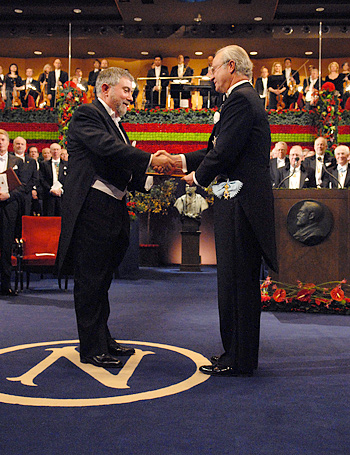
Krugman accepting the Nobel Prize

This post is more about ego than economics, however.

In this op-ed, Mr. Krugman says (and I kid you not),

But after the debacle of the past two years, there’s broad agreement — I’m tempted to say, agreement on the part of almost everyone not on the financial industry’s payroll — with Mr. Turner’s assertion that a lot of what Wall Street and the City do is “socially useless.” And a transactions tax could generate substantial revenue, helping alleviate fears about government deficits. What’s not to like?

Well, I disagree with the idea that what Wall Street does is socially useless.  And I am not on the financial industry’s payroll.

Nope, I’m just a simple economist, using my head, training, and experience to consider this idea, map out the pros and cons, and analyze the logical end-game of such a tax.  I conclude that it is a really bad idea.

Why?  There are lots of reasons, but I will mention only two.

  • One, raising taxes reduces private economic activity, which will curtail growth, reduce tax revenues and increase the deficit.
  • Two, taxes distort the price signal between suppliers and demanders of goods and services, including financial capital, reducing economic efficiency.

His reasons?  Other than citing one academic study (while ignoring the many others that reach a different conclusion), he gives no economic reasons for his views.  Instead, he make claims. He claims, for example, that “socially damaging behavior … caused our current crisis.”  He says that the financial services industry is “bloated” and needs to be cut down to size.   He says that the new tax is okay because it raises revenues for the government which, he claims, should make us all feel better about the deficit and, apparently, the size and nature of government spending under Obama. And, the lamest of all, for no other reason than to hide behind their skirt, he claims the existence of some phantom majority, apparently to create the impression that anyone with a different view is clearly in the minority.   A tactic that should be beneath a Noble Prize winner, but one that runs through his work with increasing frequency over time.

But, Mr. Krugman, I so disagree with you.  And even in an op-ed piece — perhaps especially in an op-ed piece – I believe that one needs to reign in an ego that would parade claims as facts, especially when each of those claims is disputed by your fellow economists, none of whom stooped so low as to imply that you were paid for your views.

By Sherry Jarrell

Aerial photography

Some chilling reminders of the reality of war!

Britain has a National Collection of Aerial Photography.  It is held within the offices of the Royal Commission on the Ancient and Historical Monuments of Scotland – perfectly logical!

A summary of the different collections is listed here, many of them wartime photographs that bring a multitude of emotions to the surface: incredible bravery of the pilots; photographic standards of 70 years ago, man’s inhumanity to man; and so on.

I pondered a bit about writing this Post because, well ….. well…, see what you make of it!

Author's Mum

Being born in England in the early part of November, 1944, World War 2 still resonates within me.

Early home in an industrial part of West London meant that my mother and father had a ring-side view of the German V1 and V2 rockets that were being visited on London at that time.

My mother, 90, still recounts her enormous sense of relief when VE Day was announced (May 8th, 1945) because she then thought that her son’s future life was more or less assured.

So back to these aerial photographs held in those collections.

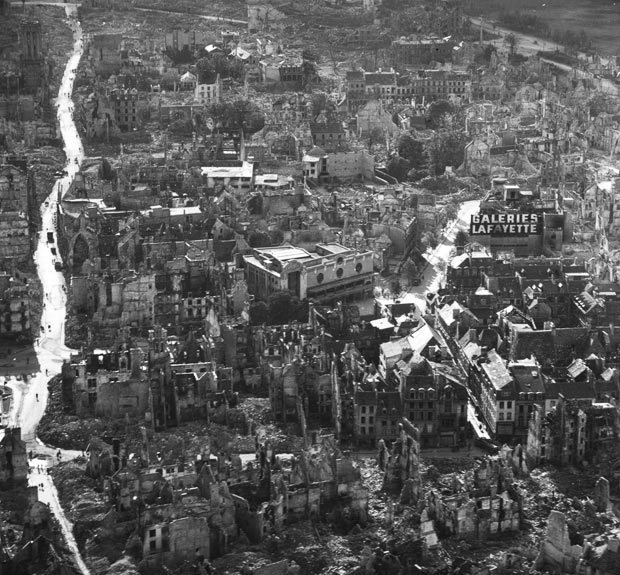
Here’s a picture of the visitation of war on the beautiful French town of Caen.

Linger a while and look at the damage, mostly to private homes.  The photograph was taken just slightly more than a month before I was born.

So where’s this Post leading to….?

Read more of this Post