Category: Politics

Synchronicity of minds, part one.

A collection of essays and ideas that unite in a common theme.

Back in those times before dogs became the domesticated friends of man, the leader of the pack, the alpha female, had two key pack roles.  One of them was having first pick of the males, for mating purposes, and the other was knowing when their territory was no longer conducive to her pack’s interests.  When that happened the ‘boss lady’ was the one to signal that the pack had to find another, more beneficial, homestead.

While mankind is in desperate need of learning so many of the qualities of dogs the one example that is beyond us is finding a new homestead. This planet is the only homestead we have.

This basic and fundamental concept seems to be missing from the minds of leaders and power-brokers.  Missing big time!

Coincidentally, over recent days there have been three essays from three different authors that scream out the madness, to put it nicely, of the way of our world just now. Let me dip into those three essays.

First, to a recent essay from Tom Engelhardt over at TomDispatch.

American Jihad 2014 
The New Fundamentalists 
By Tom Engelhardt

In a 1950s civics textbook of mine, I can remember a Martian landing on Main Street, U.S.A., to be instructed in the glories of our political system.  You know, our tripartite government, checks and balances, miraculous set of rights, and vibrant democracy.  There was, Americans then thought, much to be proud of, and so for that generation of children, many Martians were instructed in the American way of life.  These days, I suspect, not so many.

Still, I wondered just what lessons might be offered to such a Martian crash-landing in Washington as 2014 begins.  Certainly checks, balances, rights, and democracy wouldn’t top any New Year’s list.  Since my childhood, in fact, that tripartite government has grown a fourth part, a national security state that is remarkably unchecked and unbalanced.  In recent times, that labyrinthine structure of intelligence agencies morphing into war-fighting outfits, the U.S. military (with its own secret military, the special operations forces, gestating inside it), and the Department of Homeland Security, a monster conglomeration of agencies that is an actual “defense department,” as well as a vast contingent of weapons makers, contractors, and profiteers bolstered by an army of lobbyists, has never stopped growing.  It has won the undying fealty of Congress, embraced the power of the presidency, made itself into a jobs program for the American people, and been largely free to do as it pleased with almost unlimited taxpayer dollars.

The expansion of Washington’s national security state — let’s call it the NSS — to gargantuan proportions has historically met little opposition.  In the wake of the Edward Snowdenrevelations, however, some resistance has arisen, especially when it comes to the “right” of one part of the NSS to turn the world into a listening post and gather, in particular, American communications of every sort.  The debate about this — invariably framed within the boundaries of whether or not we should have more security or more privacy and how exactly to balance the two — has been reasonably vigorous.  The problem is: it doesn’t begin to get at the real nature of the NSS or the problems it poses.

If I were to instruct that stray Martian lost in the nation’s capital, I might choose another framework entirely for my lesson.  After all, the focus of the NSS, which has like an incubus grown to monumental proportions inside the body of the political system, would seem distinctly monomaniacal, if only we could step outside our normal way of thinking for a moment.  At a cost of nearly a trillion dollars a year, its main global enemy consists of thousands of lightly armed jihadis and wannabe jihadis scattered mainly across the backlands of the planet.  They are capable of causing genuine damage — though far less to the United States than numerous other countries — but not of shaking our way of life.  And yet for the leaders, bureaucrats, corporate cronies, rank and file, and acolytes of the NSS, it’s a focus that can never be intense enough on behalf of a system that can never grow large enough or be well funded enough.

It’s a long, deeply thoughtful essay that deserves your full read.  This is how it closes:

After 12 long years in Afghanistan and an Obama era surge in that country, the latest grim National Intelligence Estimate from the U.S. intelligence community suggests that no matter what Washington now does, the likelihood is that things there will only go from bad enough to far worse.  Years of a drone campaign against al-Qaeda in the Arabian Peninsula hasstrengthened that organization; an air intervention in Libya led to chaos, a dead ambassador, and a growing al-Qaeda movement in northern Africa — and so it repetitively goes.

Similarly, intelligence officials brag of terrorist plots — 54 of them! — that have been broken up thanks in whole or in part to the National Security Agency’s metadata sweeps of U.S. phone calls; it also claims that, given the need of secrecy, only four of them can be made public.  (The claims of success on even those four, when examined by journalists, have proved less than impressive.)  Meanwhile, the presidential task force charged with reviewing the NSA revelations, which had access to a far wider range of insider information, came to aneven more startling conclusion: not one instance could be found in which that metadata the NSA was storing in bulk had thwarted a terrorist plot. “Our review,” the panel wrote, “suggests that the information contributed to terrorist investigations by the use of section 215 telephony meta-data was not essential to preventing attacks.” (And keep in mind that, based on what we do know about such terror plots, a surprising number of them were planned or sparked or made possible by FBI-inspired plants.)

In fact, claims of success against such plots couldn’t be more faith-based, relying as they generally do on the word of intelligence officials who have proven themselves untrustworthy or on the impossible-to-prove-or-disprove claim that if such a system didn’t exist, far worse would have happened.  That version of a success story is well summarized in the claim that “we didn’t have another 9/11.”

In other words, in bang-for-the-buck practical terms, Washington’s national security state should be viewed as a remarkable failure.  And yet, in faith-based terms, it couldn’t be a greater success.  Its false gods are largely accepted by acclamation and regularly worshiped in Washington and beyond.  As the funding continues to pour in, the NSS has transformed itself into something like a shadow government in that city, while precluding from all serious discussion the possibility of its own future dismantlement or of what could replace it.  It has made other options ephemeral and more immediate dangers than terrorism to the health and wellbeing of Americans seem, at best, secondary.  It has pumped fear into the American soul.  It is a religion of state power.

No Martian could mistake it for anything else.

Tom Engelhardt, a co-founder of the American Empire Project and author of The United States of Fear as well as a history of the Cold War, The End of Victory Culture, runs the Nation Institute’s TomDispatch.com. His latest book, co-authored with Nick Turse, is Terminator Planet: The First History of Drone Warfare, 2001-2050.

Follow TomDispatch on Twitter and join us on Facebook or Tumblr. Check out the newest Dispatch Book, Ann Jones’s They Were Soldiers: How the Wounded Return From America’s Wars — The Untold Story.

Copyright 2014 Tom Engelhardt

Now let’s move from the USA to the UK.  George Monbiot penned an essay on the 6th January about the growing loss of freedoms in my old home country.  He opens:

Dead Zone

January 6, 2014

A shocking new bill threatens to make this country feel like a giant shopping mall.

By George Monbiot, published in the Guardian 7th January 2014

Until the late 19th Century, much of our city space was owned by private landlords. Squares were gated, streets were controlled by turnpikes. The great unwashed, many of whom had been expelled from the countryside by acts of enclosure, were also excluded from desirable parts of town.

Social reformers and democratic movements tore down the barriers, and public space became a right, not a privilege. But social exclusion follows inequality as night follows day, and now, with little public debate, our city centres are again being privatised or semi-privatised. They are being turned by the companies that run them into soulless, cheerless, pasteurised piazzas, in which plastic policemen harry anyone loitering without intent to shop.

Streetlife in these places is reduced to a trance-world of consumerism, of conformity and atomisation, in which nothing unpredictable or disconcerting happens, a world made safe for selling mountains of pointless junk to tranquilised shoppers. Spontaneous gatherings of any other kind – unruly, exuberant, open-ended, oppositional – are banned. Young, homeless and eccentric people are, in the eyes of those upholding this dead-eyed, sanitised version of public order, guilty until proven innocent.

Then a few paragraphs later, the essay continues:

The existing rules are bad enough. Introduced by the 1998 Crime and Disorder Act, anti-social behavour orders (Asbos) have criminalised an apparently endless range of activities, subjecting thousands – mostly young and poor – to bespoke laws. They have been used to enforce a kind of caste prohibition: personalised rules which prevent the untouchables from intruding into the lives of others.

You get an Asbo for behaving in a manner deemed by a magistrate as likely to cause harassment, alarm or distress to other people. Under this injunction, the proscribed behaviour becomes a criminal offence. Asbos have been granted which forbid the carrying of condoms by a prostitute, homeless alcoholics from possessing alcohol in a public place, a soup kitchen from giving food to the poor, a young man from walking down any road other than his own, children from playing football in the street. They were used to ban peaceful protests against the Olympic clearances.

Inevitably, over half the people subject to Asbos break them. As Liberty says, these injunctions “set the young, vulnerable or mentally ill up to fail”, and fast-track them into the criminal justice system. They allow the courts to imprison people for offences which are not otherwise imprisonable. One homeless young man was sentenced to five years in jail for begging: an offence for which no custodial sentence exists. Asbos permit the police and courts to create their own laws and their own penal codes.

All this is about to get much worse. Tomorrow the Anti-social Behaviour, Crime and Policing Bill reaches its report stage (close to the end of the process) in the House of Lords. It is remarkable how little fuss has been made about it, and how little we know of what is about to hit us.

The bill would permit injunctions against anyone of 10 or above who “has engaged or threatens to engage in conduct capable of causing nuisance or annoyance to any person.” It would replace Asbos with Ipnas (Injunctions to Prevent Nuisance and Annoyance), which would not only forbid certain forms of behaviour, but also force the recipient to discharge positive obligations. In other words, they can impose a kind of community service on people who have committed no crime, which could, the law proposes, remain in force for the rest of their lives.

The bill also introduces Public Space Protection Orders, which can prevent either everybody or particular kinds of people from doing certain things in certain places. It creates new dispersal powers, which can be used by the police to exclude people from an area (there is no size limit), whether or not they have done anything wrong.

Please read the original essay in full as well as refer to background links that were included in that original.  I will offer the closing paragraphs.

The Home Office minister, Norman Baker, once a defender of civil liberties, now the architect of the most oppressive bill pushed through any recent parliament, claims that the amendments he offered in December will “reassure people that basic liberties will not be affected”(11). But Liberty describes them as “a little bit of window-dressing: nothing substantial has changed.”(12)

The new injunctions and the new dispersal orders create a system in which the authorities can prevent anyone from doing more or less anything. But they won’t be deployed against anyone. Advertisers, who cause plenty of nuisance and annoyance, have nothing to fear; nor do opera lovers hogging the pavements of Covent Garden. Annoyance and nuisance are what young people cause; they are inflicted by oddballs, the underclass, those who dispute the claims of power.

These laws will be used to stamp out plurality and difference, to douse the exuberance of youth, to pursue children for the crime of being young and together in a public place, to help turn this nation into a money-making monoculture, controlled, homogenised, lifeless, strifeless and bland. For a government which represents the old and the rich, that must sound like paradise.

www.monbiot.com

The last of the three essays was about Europe, being an essay on Naked Capitalism two days ago.

Written by Don Quijones, a freelance writer and translator based in Barcelona, Spain who also publishes the blog Raging Bull-Shit, the essay was originally posted at Testosterone Pit.

Death By A Thousand Cuts: The Silent Assassination Of European Democracy

As is gradually dawning on more and more people across the old continent, the European Union is riddled with fatal flaws and defects. Chief among them is the single currency which, rather than serving as the Union’s springboard to global dominance, could well be its ultimate undoing.

Another huge problem with the EU is its acute lack of transparency. Staggering as it may seem, in the last 20 years the Union has not passed a single audit. Indeed, so opaque is the state of its finances that in 2002 Marta Andreasen, the first ever professional accountant to serve as the Commission’s Chief Accountant, refused to sign off the organization’s 2001 accounts, citing concerns that the EU’s accounting system was “open to fraud.” After taking her concerns public, Andreasen was suspended and then later sacked by the Commission.

However, by far the EU’s greatest — and certainly most dangerous — structural flaw is its gaping democratic deficit. To paraphrase Nigel Farage, the stridently anti-EU British MEP, not only is the EU undemocratic, it is fundamentally anti-democratic.

Yet again, the essay must be read in full.  As with the others, I will include the closing paragraphs:

Of course none of this would be possible if it weren’t for the abject failure of modern nation-state democracy — not only in Europe, but across the globe. As Mair wrote in the first paragraph of his book, although the political parties themselves remain, “they have become so disconnected from the wider society, and pursue a form of competition that is so lacking in meaning, that they no longer seem capable of sustaining democracy in its present form.”

The European elites have masterfully exploited this crisis of representative democracy and the resultant voter disaffection and apathy to enshrine a new system of rule by bureaucrats, bankers, technocrats and lobbyists (as I reported in Full Steam Ahead For the EU Gravy Train, Brussels is home to the second biggest lobby industry in the world, just behind Washington). If anything, we can expect this trend to accelerate in 2014 as the Eurocrats seek to consolidate their power grab through the imposition of EU-wide banking and fiscal union. Once that’s done, the quest for the holy grail of full-blown political union will begin in earnest.

Whether the EU is able to pull of this ultimate coup de grace in its decades-long coup d’état will depend on two vital factors: its ability to continue preventing economic reality from impacting the financial markets; and the willingness of hundreds of millions of European people to be herded and corralled into a new age of technocracy.

oooo

“the abject failure of modern nation-state democracy — not only in Europe, but across the globe.”

Don Quijones wrote that with a focus on Europe.  But also a recognition that right across the world the rights and safeguards of everyday citizens are being dangerously undermined.  I will return tomorrow with Part Two and an insight into the growing power of those everyday citizens.
 

Legitimate hope.

It’s too easy to be overwhelmed with negativity.

Many will have read yesterday’s post about the slaughter of elephants by ivory poachers and felt, as I did, a feeling of despair in the pit of one’s soul.  We seem to be living in such challenging times with so much madness about us.  It’s incredibly easy to feel as if this is some sort of ‘end of times’ period.

Today’s post tells us that there is always hope.

Let’s remind ourselves that elephants are very intelligent animals.  As I wrote last November in a post with the title of Smart Animals:

There was a fascinating article on the BBC news website a few weeks ago that went on to explain:

10 October 2013

Elephants ‘understand human gesture’

By Victoria GillScience reporter, BBC News
African elephants have demonstrated what appears to be an instinctive understanding of human gestures, according to UK scientists. In a series of tests, researcher Ann Smet, of the University of St Andrews, offered the animals a choice between two identical buckets, then pointed at the one containing a hidden treat.

From the first trial, the elephants chose the correct bucket.

The results are published in the journal Current Biology.

(The two video clips on the BBC website are really worth watching.)

A story published in the Daily Mail just a few days ago underlines the intelligence of elephants.

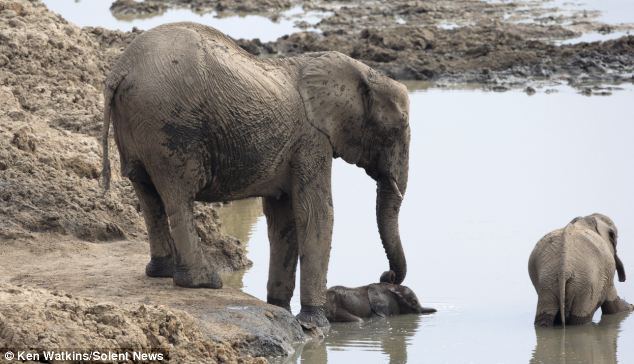
This adorable baby elephant had to be rescued by its mother’s huge trunk after it got stuck in the mud while taking a bath.

The youngster was enjoying a quiet dip in the water but became stranded when it struggled to pull itself out of the lake.

He had to be lifted to safety by its mother and her trusty trunk, which acted as a crane as she carried the three-month-old calf out of the water.

Stuck in the mud: The baby elephant slipped while taking a dip and was unable to haul himself out of the lake.

oooo

A mother's touch: Fortunately the calf's mother was able to scoop him up in her trunk and haul him to safety.
A mother’s touch: Fortunately the calf’s mother was able to scoop him up in her trunk and haul him to safety.

The rest of the story may be read here.

Also what needs to be highlighted are the organisations that are actively working on behalf of the elephants.

The Independent Newspaper have their own elephant campaign.

Elephant Crisis

In 2011, more African elephants were killed than any other year in history. The figures for 2012 and 2013 are not yet known, but are likely to be even higher. At current rates, in twelve years, there will be none left.

It is a familiar cause, but it has never been more urgent. Poaching has turned industrial. Armed militia fly in helicopters over jungle clearings, machine gunning down entire herds. Their tusks are then sold to fund war and terrorism throughout the continent and the wider world. Ivory is still illegal, but as China booms, it is more popular than ever.

This campaign will raise money to support rangers on the ground to protect Kenya’s elephants from armed poachers, together with Space for Giants’ longer term work to create new wildlife sanctuaries where elephants will be safe, forever. More can be found about the charity at Space for Giants

The article above includes two videos.  A shorter one that can be viewed on the paper’s campaign website. Then there is a longer, five-minute, video also on YouTube and included below.

Offering a donation to help is only a click away.

Then there is the David Sheldrick Wildlife Trust helping animals in Africa. And, finally, the campaign over at Bloody Ivory where one can sign a petition and donate towards stopping elephant poaching.

Thus, like so many aspects of life, never give up trying to help those less fortunate.

Without hope there is nothing.

The Pain and the Hope, continued.

Part Three of reflections on where we are today.

Those of you who watched Part One of Awakening the Dreamer that was published yesterday could be excused for thinking that it was a very gloomy window on our world at the start of 2014.

Park those feelings and watch Part Two.

The Hope

[vimeo http://vimeo.com/52496263]

ooOOoo

Tomorrow, Friday, I will complete this run of four days by dropping in on a few of the organisations named in these films plus a few other items.

The Pain and the Hope

Part Two of reflections on where we are today.

First things first!

A very Happy New Year to you and all your loved ones!

Yesterday (I’m tempted to write last year!), I posted a little tale about the donkey in the well; essentially a message about being happy.

My original plan for today was to post a series of photographs of some animals next door that our neighbours, Larry and Janell, have recently adopted.

But then Jean and I watched a documentary two evenings ago that had us both spellbound. The documentary, Awakening the Dreamer, consisted of two 45-minute films.  The first highlighting the precarious nature of our present times.  The second showing the accelerating pace of people all across the world actively changing things for the better.  Hence the title of the post The Pain and the Hope.

So here’s Part One.   I do so hope you can find the time to watch it.

The Pain

ooOOoo

The trials of Steve Marsh

This is worthy of support.

Some seven days ago, there was an item on Permaculture News about Steve Marsh’s fight with Monsanto.  Here is that article in full.  I strongly recommend watching the longer video at the end of the post.  It’s an incredibly important issue for all lovers of healthy food.

ooOOoo

Help This Farmer Stop Monsanto’s GM Canola

Posted December 20, 2013 by  & filed under GMOs.

You might not have heard of Steve Marsh yet but this man could lose everything to protect your right to eat GM-free food.

Who is Steve Marsh?

Steve Marsh is an Australian farmer who lost his organic certification when Monsanto’s genetically modified (GM) canola blew onto his farm from a neighbouring property in 2010. Since then, Steve lost most of his income and has been struggling to get his organic certification back.

Monsanto has a no liability agreement with GM farmers that prevent them from being sued. The only avenue Steve had to protect his livelihood was to take his neighbour to court. It is due to start on the 10th February 2014 in the Western Australian Supreme Court and is scheduled to run for three weeks.

Donate Now to Support Steve!

A landmark case for a GM-free future

This is the world’s first case of an organic farmer using the courts to recover loss and damages from a GM farmer. This case has been described as a landmark case to determine who should take responsibility in case of GM contamination. If Steve wins it will set a precedent to guide the application of common law to GM contamination and will be of interest to lawmakers worldwide.

We don’t want to be part of the global GM experiment underway with barely tested, unlabeled and uncontrolled GM foods infiltrating our food supplies. When people like Steve stand up for their rights in spite of what he may lose, it gives us a chance to stand alongside him.

Take action!

Steve’s neighbour is well supported and well funded by a pro-GM organization and we are helping to raise funds and awareness for Steve’s case.

Have a look at the short video above explaining his story and share it with friends, family and work colleagues. Please make a donation to support this landmark case and protect the future of GM-free food.

Donate Now to Support Steve!

ooOOoo

Jean and I have made a donation.  We hope you can find your way to supporting this campaign.

This is the longer version of that video above.

Animal rights.

This cougar was looking for love.

I forget how I came across this editorial in the Chicago Tribune but it was published a month ago, to the day.  What is more to the point is that the editorial was inspiring and I vowed to republish it.  With the absence of any formal permission to republish the editorial I thought it best to leave it for a few weeks.  When you read it you will realise just why it needed to be shared with you.

ooOOoo

Editorial: The cougar killed in Illinois was looking for love

ILLINOIS DEPARTMENT OF NATURAL RESOURCESThis cougar was shot last week by a state conservation officer in Whiteside County. The animal needn’t really have been killed.
ILLINOIS DEPARTMENT OF NATURAL RESOURCES.
This cougar was shot last week by a state conservation officer in Whiteside County. The animal needn’t really have been killed.

He was lean, athletic and had traveled hundreds of miles, most likely from the Black Hills of southwestern South Dakota. He had attacked no one as he passed hundreds of towns and many more farms, each of them a lethal threat to his mission. Yet for lack of a better wildlife management plan in Illinois, the young cougar couldn’t get past a conservation officer armed with a state-issued rifle.

The necropsy says the cougar killed last week as he hid near Morrison, 130 miles west of Chicago, died of gunfire. In truth he died of official neglect: Even though more cougars and possibly wolves likely will be visiting Illinois, state lawmakers and the Department of Natural Resources haven’t forged policies that could allow the tranquilization, capture and survival of animals whose ancestors blissfully roamed the Midwest long before humans intruded on their turf.

Given his hunting skills, the young male could have homesteaded anywhere in the Upper Midwest and dined on the bountiful deer population for the rest of his life. Instead, his four huge paws carried out the imperative that drove him: With larger, older males driving him away from the females on their home ranges, this cougar came looking for love.

A farmer called authorities to report a large cat running from a cornfield toward his farmstead and, sure enough, a responding conservation officer found the cat under a corncrib, probably hiding until darkness would allow it to flee.

We won’t second-guess the officer, who consulted with law enforcement and wildlife personnel before killing the cougar. That said, this was an outcome that didn’t have to be. A magnificent creature might well be headed back to South Dakota if Illinois had learned lessons after Chicago police shot and killed a cornered cougar in the Roscoe Village neighborhood five years ago.

What all of us, legislators included, have to understand is that the return of feline or canine predators to their traditional realms doesn’t mean the animals want to hurt anyone. Even as this episode unfolded, millions of National Geographic readers were receiving the magazine’s December issue, with an 18-page spread: “Ghost Cats … Cougars are quietly reclaiming lost ground.” The relevant passage: “Cougars have attacked humans on about 145 occasions in the U.S. and Canada since 1890. Just over 20 of those assaults — an average of one every six years — proved fatal.”

Yet in this case, with an animal that had threatened no one while bypassing thousands of Midwesterners, a DNR spokesman rationalized that, “Public safety is what we’ll make the decision on every time.” The rest of DNR’s explanation is similarly lame: The department otherwise would have had to find someone to capture and move the animal. This officer thought the situation too unsafe to call a veterinarian to tranquilize the cat. Conservation officers don’t carry tranquilizer guns. That thinking led the DNR to the specious excuse that if the officer had shot the cougar with the wrong dosage of tranquilizer, the animal could have been harmed or killed accidentally. That excuse evokes the February 1968 explanation from a U.S. major to an Associated Press correspondent about the Vietnamese provincial city of Ben Tre: “It became necessary to destroy the town to save it.”

We were struck by sensible comments last week from Bruce Patterson, curator of mammals at Chicago’s Field Museum, who wonders why this animal had to be shot when it evidently was hiding during daylight and hadn’t threatened anyone: “It’s possible to manage wildlife while still keeping it around.”

When we editorialize about humans slaying wild predators, some readers say our concern should be — as it constantly is — directed instead to the needless killings of young people, and not toward one lost, probably frightened animal.

Fair enough, although it’s possible to think about both. Just as we know there will be more homicides, we know that more big predators likely are coming to Illinois. So we’ll look back to what we expressed after the 2008 killing of the cougar in Roscoe Village: We hope Illinois comes away from last week’s episode with more than one dead cougar and a communal sadness. Illinois should develop a reliable protocol that errs on the side of trying to preserve the life of the lost animal — not of making the ad hoc decision to kill it and then resolving the ambiguities in favor of that decision.

That’s what happened here. A logical first step now: Give cougars protection under the Illinois Wildlife Code; they lack that protection now only because there is no known breeding population in this state. But with trail cameras capturing photos of one or more cougars in Jo Daviess, Morgan, Pike and Calhoun counties last fall, the animals evidently are re-establishing themselves in a state where they haven’t been known to live since 1870. In recent years, wolves have dipped into Jo Daviess, the state’s northwest corner. A black bear even visited there, evidently for a few days.

Lawmakers, DNR officials, you can do better. So can the rest of us, first by using sites such as cougarnet.org to offset our visceral fear with scientific knowledge.

Wild animals roam this state. Always have and, we hope, always will. As we urged here in 2008: The same Illinois that was unprepared for the last cougar had better get ready for the next. He’s probably en route.

ooOOoo

As you contemplate your New Year resolutions for 2014 please resolve to protect our animals.

Scum worse than a dog!

G’rrr!

I am indebted to Per Kurowski who yesterday sent me an email about the atrocious recent act in North Korea.  Per writes the blog A view from the Radical Middle and has been a good friend of Learning from Dogs.

Per’s email read:

Lowly opinions on dogs

Paul

With respect to the execution of Jang Song Thaek the North Korea government issued a statement calling him “Despicable human scum who was worse than a dog”… and I just felt you could have a real serious issue with that.

Merry Christmas

Per

My reply to Per included, “I did hear about the statement and your thought also crossed my mind, then something came along and I forgot to do anything about it. Will be corrected in a post coming out tomorrow.”

Per’s email included a link to a Financial Times article that is not visible unless one registers with the FT.  However the relevant section reads thus:

Jang Song Thaek

Jang’s summary execution – reported by state media on Friday – marked a spectacular demise for a man seen until recently as the most powerful adviser to Kim Jong Un. It also raised questions about the potential for further instability in the court of the world’s youngest national leader.

Describing him as “despicable human scum”, state media said Jang had been put to death immediately after his conviction for treason by a military tribunal, where he confessed to having plotted a coup against Mr Kim.

If one then goes to the full text of that state media report, then one reads (my emboldening):

It is an elementary obligation of a human being to repay trust with sense of obligation and benevolence with loyalty.

However, despicable human scum Jang, who was worse than a dog, perpetrated thrice-cursed acts of treachery in betrayal of such profound trust and warmest paternal love shown by the party and the leader for him.

Frankly, if one cogitates about just a few of the qualities of dogs: integrity, loyalty, unconditional love, trust, openness, forgiveness, affection – then this world would be one hell of a better place to live for all humans if only we learnt to live like dogs.

G’rrrr!

Thanks Per!

Different ways of looking at life.

A fascinating essay by Corey Robin

Like me, I suspect you haven’t come across this author before.  The connection for me was made by a link in Thursdays selection of Links from Naked Capitalism. It was “Socialism: Converting Hysterical Misery into Ordinary Unhappiness for a Hundred Years Corey Robin (martha r). Today’s must read.”

I was intrigued and went across to Corey Robin’s website to read the article. On the website I learnt a little more:

Corey Robin
Corey Robin – Photo by Sasha Maslov

I teach political science at Brooklyn College and the CUNY Graduate Center. I’m the author of The Reactionary Mind: Conservatism from Edmund Burke to Sarah Palin and Fear: The History of a Political Idea. My articles have appeared in the New York Times, Harper’s, the London Review of Books, and elsewhere. I also blog at Crooked Timber and Jacobin. I am currently working on a book about the political theory of the free market.

I live in Brooklyn with my wife, daughter, and too many cats.

So to the essay.

oooOOOooo

Socialism: Converting Hysterical Misery into Ordinary Unhappiness for a Hundred Years

In yesterday’s New York Times, Robert Pear reports on a little known fact about Obamacare: the insurance packages available on the federal exchange have very high deductibles. Enticed by the low premiums, people find out that they’re screwed on the deductibles, and the co-pays, the out-of-network charges, and all the different words and ways the insurance companies have come up with to hide the fact that you’re paying through the nose.

For policies offered in the federal exchange, as in many states, the annual deductible often tops $5,000 for an individual and $10,000 for a couple.

Insurers devised the new policies on the assumption that consumers would pick a plan based mainly on price, as reflected in the premium. But insurance plans with lower premiums generally have higher deductibles.

In El Paso, Tex., for example, for a husband and wife both age 35, one of the cheapest plans on the federal exchange, offered by Blue Cross and Blue Shield, has a premium less than $300 a month, but the annual deductible is more than $12,000. For a 45-year-old couple seeking insurance on the federal exchange in Saginaw, Mich., a policy with a premium of $515 a month has a deductible of $10,000.

In Santa Cruz, Calif., where the exchange is run by the state, Robert Aaron, a self-employed 56-year-old engineer, said he was looking for a low-cost plan. The best one he could find had a premium of $488 a month. But the annual deductible was $5,000, and that, he said, “sounds really high.”

By contrast, according to the Kaiser Family Foundation, the average deductible in employer-sponsored health plans is $1,135.

It’s true that if you’re a family of three, making up to $48,825 (or, if you’re an individual, making up to $28,725), you’ll be eligible for the subsidies. Those can be quite substantive at the lower ends of the income ladder. But as you start nearing those upper limits (which really aren’t that high; below the median family income, in fact), the subsidies start dwindling. Leaving individuals and families with quite a bill, as even this post, which is generally bullish on Obamacare, acknowledges.

Aside from the numbers, what I’m always struck by in these discussions is just how complicated Obamacare is. Even if we accept all the premises of its defenders, the number of steps, details, caveats, and qualifications that are required to defend it, is in itself a massive political problem. As we’re now seeing.

More important than the politics, that byzantine complexity is a symptom of what the ordinary citizen has to confront when she tries to get health insurance for herself or her family. As anyone who has even good insurance knows, navigating that world of numbers and forms and phone calls can be a daunting proposition. It requires inordinate time, doggedness, savvy, intelligence, and manipulative charm (lest you find yourself on the wrong end of a disgruntled telephone operator). Obamacare fits right in with that world and multiplies it.

I’m not interested in arguing here over what was possible with health care reform and what wasn’t; we’ve had that debate a thousand times. But I thought it might be useful to re-up part of this post I did, when I first started blogging, on how much time and energy our capitalist world requires us to waste, and what a left approach to the economy might have to say about all that. It is this world of everyday experience—what it’s like to try and get basic goods for yourself and/or your family—that I wish the left (both liberals and leftists) was more in touch with.

The post is in keeping with an idea I’ve had about socialism and the welfare state for several years now. Cribbing from Freud, and drawing from my own anti-utopian utopianism, I think the point of socialism is to convert hysterical misery into ordinary unhappiness. God, that would be so great.

• • • • • •

There is a deeper, more substantive, case to be made for a left approach to the economy. In the neoliberal utopia, all of us are forced to spend an inordinate amount of time keeping track of each and every facet of our economic lives. That, in fact, is the openly declared goal: once we are made more cognizant of our money, where it comes from and where it goes, neoliberals believe we’ll be more responsible in spending and investing it. Of course, rich people have accountants, lawyers, personal assistants, and others to do this for them, so the argument doesn’t apply to them, but that’s another story for another day.

The dream is that we’d all have our gazillion individual accounts—one for retirement, one for sickness, one for unemployment, one for the kids, and so on, each connected to our employment, so that we understand that everything good in life depends upon our boss (and not the government)—and every day we’d check in to see how they’re doing, what needs attending to, what can be better invested elsewhere. It’s as if, in the neoliberal dream, we’re all retirees in Boca, with nothing better to do than to check in with our broker, except of course that we’re not. Indeed, if Republicans (and some Democrats) had their way, we’d never retire at all.

In real (or at least our preferred) life, we do have other, better things to do. We have books to read, children to raise, friends to meet, loved ones to care for, amusements to enjoy, drinks to drink, walks to take, webs to surf, couches to lie on, games to play, movies to see, protests to make, movements to build, marches to march, and more. Most days, we don’t have time to do any of that. We’re working way too many hours for too little pay, and in the remaining few hours (minutes) we have, after the kids are asleep, the dishes are washed, and the laundry is done, we have to haggle with insurance companies about doctor’s bills, deal with school officials needing forms signed, and more.

What’s so astounding about Romney’s proposal—and the neoliberal worldview more generally—is that it would just add to this immense, and incredibly shitty, hassle of everyday life. One more account to keep track of, one more bell to answer. Why would anyone want to live like that? I sure as hell don’t know, but I think that’s the goal of the neoliberals: not just so that we’re more responsible with our money, but also so that we’re more consumed by it: so that we don’t have time for anything else. Especially anything, like politics, that would upset the social order as it is.

…We saw a version of it during the debate on Obama’s healthcare plan. I distinctly remember, though now I can’t find it, one of those healthcare whiz kids—maybe it was Ezra Klein—tittering on about the nifty economics and cool visuals of Obama’s plan: how you could go to the web, check out the exchange, compare this little interstice of one plan with that little interstice of another, and how great it all was because it was just so fucking complicated.

I thought to myself: you’re either very young or an academic. And since I’m an academic, and could only experience vertigo upon looking at all those blasted graphs and charts, I decided whoever it was, was very young. Only someone in their 20s—whipsmart enough to master an inordinately complicated law without having to make real use of it—could look up at that Everest of words and numbers and say: Yes! There’s freedom!

That’s what the neoliberal view reduces us to: men and women so confronted by the hassle of everyday life that we’re either forced to master it, like the wunderkinder of the blogosphere, or become its slaves. We’re either athletes of the market or the support staff who tend to the race.

That’s not what the left wants. We want to give people the chance to do something else with their lives, something besides merely tending to it, without having to take a 30-year detour on Wall Street to get there. The way to do that is not to immerse people even more in the ways and means of the market, but to give them time and space to get out of it. That’s what a good welfare state, real social democracy, does: rather than being consumed by life, it allows you to make your life. Freely. One less bell to answer, not one more.

oooOOOooo

The loss of self?

Trying to find a balance in these strange times.

I wrote down the title of today’s post a few days back.  Jean and I had just watched the BBC Panorama Special regarding Amazon UK.  It had been screened on the 25th November and was described:

It’s the online retailer that has transformed the way we shop, but how does Amazon treat the workers who retrieve our orders? Working conditions in the company’s giant warehouses have been condemned by unions as among the worst in Britain. Panorama goes undercover to find out what happens after we fill our online shopping basket.

Or more fully reported in a BBC News item, as this extract reveals:

A BBC investigation into a UK-based Amazon warehouse has found conditions that a stress expert said could cause “mental and physical illness”.

Prof Michael Marmot was shown secret filming of night shifts involving up to 11 miles of walking – where an undercover worker was expected to collect orders every 33 seconds.

It comes as the company employs 15,000 extra staff to cater for Christmas.

Amazon said in a statement worker safety was its “number one priority”.

Undercover reporter Adam Littler, 23, got an agency job at Amazon’s Swansea warehouse. He took a hidden camera inside for BBC Panorama to record what happened on his shifts.

He was employed as a “picker”, collecting orders from 800,000 sq ft of storage.

A handset told him what to collect and put on his trolley. It allotted him a set number of seconds to find each product and counted down. If he made a mistake the scanner beeped.

Adam Little undercover Amazon warehouse
Adam Littler went undercover as a “picker” at Amazon’s Swansea warehouse

“We are machines, we are robots, we plug our scanner in, we’re holding it, but we might as well be plugging it into ourselves”, he said.

The 30-minute Panorama programme is on YouTube and is included in this post just below.

http://www.youtube.com/watch?v=Ta7hTfI69xc

OK, back to my theme for today.

As I started to explain, the reaction to watching the Panorama programme was to feel sickened by the way these workers were being treated.

Not helped when yesterday, the UK Daily Mail newspaper added their own story of another undercover reporting operation at Amazon.   Here’s an extract from the last third of the piece, reported by Carole Cadwalladr:

It is taxes, of course, that pay for the roads on which Amazon’s delivery trucks drive, and the schools in which its employees are educated.

Taxes that all its workers pay, and that, it emerged in 2012, Amazon tends not to pay.

On UK sales of £4.2 billion in 2012, it paid £3.2 million in corporation tax. In 2006, it transferred its UK business to Luxembourg and reclassified its UK operation as simply an ‘order fulfilment’ business.

The Luxembourg office employs 380 people. The UK operation employs 21,000. You do the sums.

Brad Stone tells me that tax avoidance is built into the company’s DNA. From the very beginning it has been ‘constitutionally oriented to securing every possible advantage for its customers, setting the lowest possible prices, taking advantage of every known tax loophole or creating new ones’.

In Swansea I chat to someone called Martin for a while. It’s Saturday, the sun is shining and the warehouse has gone quiet. The orders have been turned off like a tap.

‘It’s the weather,’ he says. ‘When it rains, it can suddenly go mental.’ We clear away boxes and the tax issue comes up.

‘There was a lot of anger here,’ he says. ‘People were very bitter about it. But I’d always say to them: “If someone told you that you could pay less tax, do you honestly think you would volunteer to pay more?”’

He’s right. And the people who were angry were also right. It’s an unignorable fact of modern life that, as Stuart Roper of Manchester Business School tells me, ‘some of these big brands are more powerful than governments. They’re wealthier. If they were countries, they would be pretty large economies.

‘They’re multinational and the global financial situation allows them to ship money all over the world. And the Government is so desperate for jobs that it has given away large elements of control.’

MPs like to attack Amazon and Starbucks and Google for not paying their taxes, but they’ve yet to actually create legislation compelling them to do so.

Then if that wasn’t sufficient to make me want to live on a desert island, along comes George Monbiot pointing out that even the BBC, to me the most respected and trusted news organisation on the planet, has been economical with the truth.

The BBC’s disgraceful failure to reveal who its contributors are speaking for.

By George Monbiot, published on the Guardian’s website 29th November 2013

Do the BBC’s editorial guidelines count for anything? I ask because it disregards them every day, by failing to reveal the commercial interests of its contributors.

Let me give you an example. Yesterday the Today programme covered the plain packaging of cigarettes. It interviewed Mark Littlewood, director-general of the Institute of Economic Affairs, an organisation which calls itself a thinktank.

Mishal Husain introduced Mark Littlewood as “the director of the Institute of Economic Affairs, and a smoker himself”.

Fine. But should we not also have been informed that the Institute of Economic Affairs receives funding from tobacco companies?

It’s bad enough when the BBC interviews people about issues of great importance to corporations when it has no idea whether or not they are funded by those companies, and makes no effort to find out.

It’s even worse when those interests have already been exposed, yet the BBC still fails to mention them.

Both the Institute of Economic Affairs and the Adam Smith Institute have for years been funded by tobacco firms. The IEA has been funded by British American Tobacco since 1963, and is also paid by Philip Morris and Japan Tobacco International. It has never come clean about this funding, and still refuses to say which other corporations sponsor it.

The power of self.

Then along came three items that pulled my back from the brink of despair and disgust.

The first came from the blog of the UK’s Transition Network, Transition Times. Rob Hopkins wrote an article on December 5th called The day I closed my Amazon account.  Please read it if you feel unsettled by the Amazon situation.  The last two paragraphs are:

Me, I resolve to buy less, but better.  Less, but longer-lasting.  Less, but local.  The thought of where we will end up in 5 years time, 10 years time, 20 years time, if companies like Amazon continue as they are, really frightens me. It’s not good, it’s not right.  It’s not about our needs, it’s about the needs of huge investors.  I want a different world for my boys.

I can’t, on my own, do that much about it.  I can’t insist that the UK government legislate so that, as in Holland, the Recommended Retail Price (RRP) is the legal minimum at which any book can be sold, although I think that is grounds for a really timely campaign.  Because of that, Amazon don’t really operate in Holland.  Bring back the RRP for books here, and let’s have a level playing field.  As I say, I can’t do much, but I can withdraw my support. I just have withdrawn my support.  It feels surprisingly unsettling, as one does after ending a relationship, but it was the right thing to do.  It may be a drop in the ocean, but if enough people do it….

The second was coming across something called The Restart Project in London.  I had never heard of them before.  But it gets better because these London folk are part of a global movement.  Which in the words of The Restart Project can be explained thus:

A spontaneous, global, grassroots repair movement

Sitting in London, we at The Restart Project have been inspired by Holland, the US, Australia, and now we realize that there are many more community repair and fixit groups than we ever knew of before… Milan, Barcelona, Finland, the list just grows.

Some groups have regular events in their own spaces and some are pop-up groups.

The most remarkable thing is that we are not just all doing similar things, we are doing them in the same way and with similar motivations

1) learning, skillsharing and community are a premium. No judgment. Openness and inclusivity, all are made to feel welcome.

2) the idea is NOT a freebie fix. The idea is that people get involved in the repair, taking responsibility for their stuff and taking back control. It’s about behaviour change, not just about waste prevention

and

3) importantly – fun!

Please help us map repair groups, to connect people to their local repair gurus and fixit friends – and who knows, inspire the creation of more.

“Just repair, don’t despair!”

Just repair, don’t despair!  That shouted out at me.  The more that the world we live in is consumed by the power-brokers and greed-mongers.  The more that our traditional view of politics is seen to be out-dated and incorrect, then the more we have do within our own lives, within our own communities and with our friends, loved ones and families to show we can repair our world a darn site quicker than the ‘dark forces’ can break it.

My third example of hope is tomorrow in a post called The power of self.

More on that democratic deficit.

Improving democracy through deliberation.

Yesterday, I introduced the essay by George Monbiot, Why Politics Fails.  He opened his essay with the sub-heading: Nothing will change until we confront the real sources of power.

His last paragraph read:

So I don’t blame people for giving up on politics. I haven’t given up yet, but I find it ever harder to explain why. When a state-corporate nexus of power has bypassed democracy and made a mockery of the voting process, when an unreformed political funding system ensures that parties can be bought and sold, when politicians of the three main parties stand and watch as public services are divvied up by a grubby cabal of privateers, what is left of this system that inspires us to participate?

And who would disagree with those closing sentiments!

Then just four days ago there was an item on Permaculture News that continued where Mr. Monbiot left off.  It was an interview by Marcia Gerwin of Professor Lyn Carson that sets out a positive approach to correcting the widely-acknowledged issue so well articulated by George Monbiot.

Professor Lyn Carson, is a Professor at the University of Sydney.  As Professor Carson’s website Active Democracy explains:

Hi, I’m Lyn Carson, welcome to my website. I hope to provide easy access to information which individuals, groups or organisations can use to enhance citizens’ involvement in the activities of local, state or federal government.

I’m currently a professor with the Business Programs Unit at the University of Sydney, Australia. I’m researching in the fascinating area of community engagement and deliberative democracy. I’m teaching ‘critical thinking’ which will have resonance for those familiar with public deliberation.

Democracy, for me, is active, interactive, deliberative and genuinely representative of the wider population. It’s as valid to speak of a democratic personality (Gould, 1988) as it is to speak of a democratic workplace or a democratic society. We can enact in microcosm what we imagine for the level of nation state. We need not restrict our thinking to systems of government—we can do democracy at any time, any place.

Like C. Douglas Lummis, I see democracy as the antithesis of centralised power:

…democracy is one of those beautiful, absolute clear principles… that poses a maddening, tantalizing puzzle to humankind and launches us on the historic project of seeking to realize it in our collective life (Lummis, 1982).

I note the words of Frances Moore Lappé (2006): “To save the democracy we thought we had, we must take it to where it’s never been.” One way of saving democracy—or causing a democratic breakout (Blaug, 1999)—is to involve citizens in political decision making.

I’ve written numerous articles on public participation in decision making—from setting up citizens’ juries to improving community consultation in your local council. Go to Publications if you’d like to download some of my written works. Your feedback is warmly encouraged after you have roamed around this site.

Here is that article that was published on Permaculture News.

Marcin Gerwin: There are many people who are disappointed in the way the democratic system works. They see politicians arguing and making decision in the interest of their political parties rather than the common good. What is wrong with modern democracy?

Lyn Carson: The difficulties that relate to modern democracy probably start with the use of that term. We have begun to believe that the system of

Professor Lyn Carson

representative government that is pervasive in both the West and increasingly in other locations is actually a democracy. I think we do well to reflect on the origins of democracy, and how democracy was first conceived. We know it was a very different system. We also know that representative government was designed during periods of the French, the American and the English revolutions to perpetuate elites. It was certainly designed to ensure that those who had money, who had property — usually men in the early days — would have their power maintained. I think what we have are the remnants of that.

Democracy is a beautiful ideal in its true sense of people power or the ability for people to make decisions about their own destinies, about things that affect them. In locations where we’ve been able to replicate at least of some of the qualities of ancient Athens, which was the cradle of democracy, then I think we can say that democracy can take root and can actually deliver its promise. It may serve us better not to use the word, I would suggest, to describe what it is that we have, which is far from the notion of genuine democracy. If we call it representative government or even an oligarchy we might start to realise what it is that we have.

MG: I think politicians will not be happy to hear that. They like to present themselves as democrats and some of them don’t acknowledge that there is a problem with a political system.

LC: Scholars are increasingly using the term “democratic deficit” to describe what is happening in the world. There is a widening gap between the governed and those who are doing the governing. There is a crisis of trust, and a growing mistrust because of what is called short-termism — political parties, because of the system, have an eye on the next election and not on the long-term needs of either humans or the even bigger picture, the environment and planetary survival. What we try to create in deliberative democracy are circumstances where all of the voices are in the room, where we can create what we call a “miniature population” or “mini-public” that resembles the entire population so it can achieve what we call a descriptive representation.

At the moment we have representation in parliaments, but it’s not descriptive of the wider population. In Australian parliament there is an inordinate number of lawyers, policy advisers, unionists — usually male — and they don’t resemble the entire population. As deliberative democrats what we are trying to do is to tune into the wider population. We can’t ask the entire population constantly. We can certainly ask what their opinions are but we actually want their judgment, which can only be arrived through a process of very deep deliberation, through a lot of education, through a lot of sharing of information, experience and stories. We want to achieve a very different democratic space than anything that we see in parliaments.

MG: Do you think that mini-publics could be used for actual decision-making instead of public consultations only?

LC: In deliberative democracy we talk about three ideals. That’s the notion of inclusion, or representativeness — that’s the principle of the miniature population. The second ideal is deliberation — you need people to be able to really wrestle with the complexity of an issue, to be fully informed, to argue it out, to use reason, to use storytelling, including emotion. The third ideal is the notion of influence. It is incredibly important that it is attached to decision-making. The NewDemocracy Foundation, that I’m a director of, deals only with projects that have influence. We have continually proved that we can achieve representativeness and deliberation, but the most difficult to achieve is influence. And that’s because elected representatives don’t want to give up power. They believe that they have a mandate to govern and they are disinclined to do so.

But there have been some fantastic examples where elected representatives have done just that. We’ve had a premier of a state in Western Australia who promised to act on the decisions of mini-publics. As Minister for Planning and Infrastructure she stood by citizens’ recommendations. We’ve had a participatory budget in New South Wales with Canada Bay Council. The local government agreed to abide by its decisions. It was the only reason we agreed to be involved. So it is happening. It’s not happening enough, but it’s certainly possible. I would suggest that none of us should proceed with mini-publics anymore unless it has the imprimatur of the decision-maker. It’s a little wearisome to keep proving that we can do these robust processes and then have the decision-makers ignoring the recommendations.

MG: What does the participatory budgeting work like in Australia?

LC: In the case of Canada Bay people were randomly selected, we had a group of 40 who came together face to face over five weekends. They deliberated on the entire budget of the council, they listened to expert speakers, they spent many hours having discussions. They split into small working parties to consider different aspects of the budget and they worked hard to deliver their recommendations to council and it was considered in a council meeting.

MG: Five weekends is a lot of time. Did the citizens receive a compensation for being involved in participatory budgeting?

LC: They received compensation, but it was a very small amount, something like 50 dollars a day or a weekend. It’s not huge and people don’t actually need a lot of money. They don’t want the equivalent of their salary. It’s an honorarium, a way to say “we value your participation”.

MG: If it was possible to change the law, would you like to have the decisions made by mini-public binding just like those made in referendums?

LC: That’s certainly my dream and there’s no reason why it can’t be so. A couple of examples exist. In Denmark there was a Danish Board of Technology which routinely convened mini-publics and fed those recommendations into the parliament. The parliament had to say why it wasn’t going to abide by those recommendations. That’s in a way the closest we’ve come to it. There’s a law in Tuscany in Italy, it’s called the Tuscan Law 69 which had a trigger mechanism which said that if there was a controversial issue it had to go to a deliberative process and again the regional government had to say why it would not act on those recommendations.

If I had a dream it would be to say that we would routinely convene policy juries to consider issues like education, health, transport and so on. You wouldn’t want to do it for everything. The whole point is to use these processes when and where appropriate, otherwise you would be bogging down the decision-making process which is often working quite well just through the current mechanisms that we have. It’s only when controversy emerges or long-term decisions have to be made, or when politicians are reluctant to act.

MG: What about the referenda? Are they a good way of making decisions?

LC: I’m not a fan of referenda. The reason is that they lack the deliberative element. We’ve had many referenda in Australia. I think we’ve had 44 and 36 of them was unsuccessful. That’s because the issue tends to become very polarized unless it has bi-partisan support, from the two major parties. They are inevitably rejected by the population because it’s so easy to run a negative campaign. Australian governments provide a lot of information when there is a referendum. But this can be quite confusing and citizens need an opportunity to deliberate on them, as they do in Oregon with the Citizens Initiative Review, or to have serious discussions with other people. A referendum for me without that deliberative component is nothing more than an opinion poll. It’s absolutely destined to failure unless you have all the major parties supporting it.

The citizen-initiated referendum sounds good on the surface because there is a groundswell of support, but what I would like to see is the groundswell of support demanding a deliberative process and then letting that deliberative process make a decision instead of putting it to a referendum.

MG: For some people it may be hard to accept that only those who are chosen by lot are going to make a decision instead of everybody as in referenda.

LC: That’s going to vary from country to country. In Australia we have a great deal of faith in random selection because it’s fair. Everyone has an equal opportunity to be selected. We also have an independent Australian Electoral Commission that has earned public confidence and it could have oversight of such lotteries. As long as you have faith in the process there shouldn’t be a problem. The difficulty is that it is not a routine to do that, although in Australia it is quite a routine to do that through criminal juries — people are randomly selected to sit on those juries. So actually we understand that process and we have faith in it to make very binding decisions about whether or not someone is guilty or not guilty, whether they should go to jail for life. We actually give that power to citizens at the moment. If that process doesn’t exist in a country, then yes, it needs to become a routine in order for trust to develop.

OOOO

Wouldn’t be at all surprised to find that many, if not all, that read that interview had heads nodding in agreement.

Back on Lyn Carson’s website you can find an interesting selection of her publications.  I, for one, will be browsing through them.