Category: Politics

The Natural order.

Back to the basics of life.

Regular readers of Learning from Dogs will recall that just under a week ago I published an essay under the title of A bedtime story for mankind.  The post centred around an essay from Patrice Ayme.  Patrice’s essay could be summarised as follows: “At the present rate of greenhouse gases emissions, within nine years, massively lethal climate and oceanic changes are guaranteed.

Then just last Sunday, Patrice published a second essay reinforcing that first one.  The subsequent essay was called Ten Years to Catastrophe.  I was minded to republish that but upon reflection thought that there was a better option.  That was to explore the deep, core questions that both of Patrice’s essays raised in my mind and, presumably, must be raised in the minds of countless thousands of others.  Questions along the lines of a comment I submitted to that subsequent post from Patrice.

Do you have an idea, even a sense, of when global leaders, elected Governments, the ‘movers and shakers’ in societies, will truly embrace the global catastrophe that is heading our way?

And a supplementary question: What would be the indicators that Governments were acknowledging the task ahead?

Frankly, they weren’t especially good questions but they were an attempt by me to open up a debate on whether or not this is the “beginning of the end” of life for us humans.  Central to what was going through my mind was the core question of how did it all go wrong?

Welcome to Payson, AZ

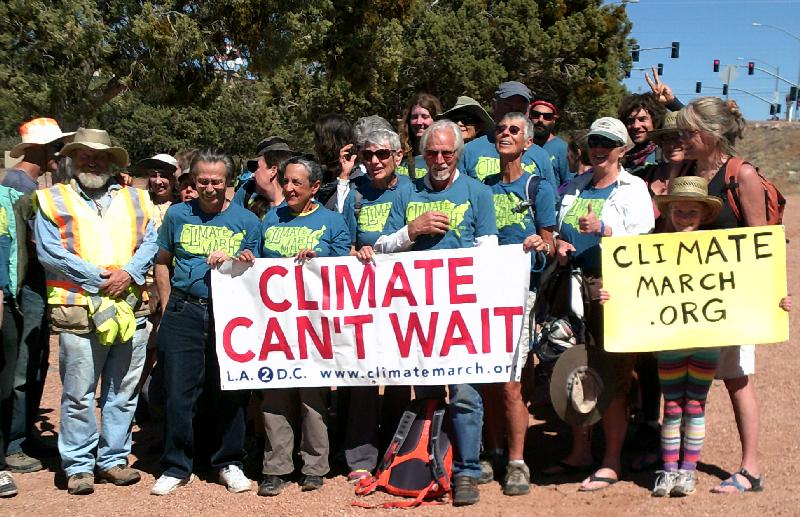
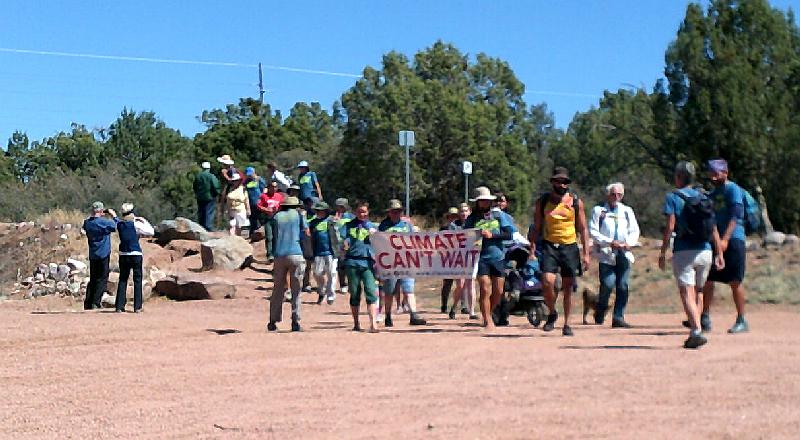
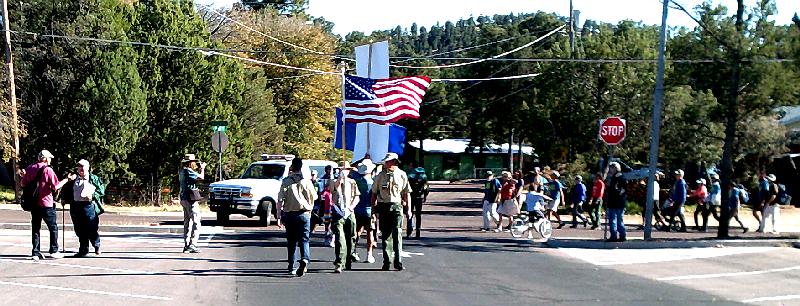
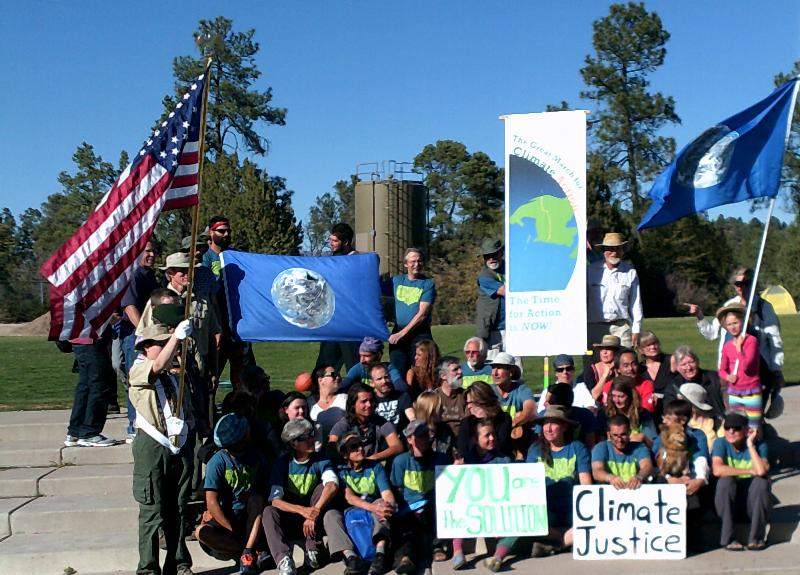
On Monday evening, I rang John Hurlburt, a close friend of Jean and me from our Payson, Arizona days and kicked around those questions .  It was a most enlightening conversation.  John is an active founder member of Transition Town Payson and Payson recently welcomed the Great March for Climate Action in their walk from Los Angeles to Washington D.C. (An essay on that event coming soon.)

Anyway, from out of that conversation with John came the idea of a series of essays here on Learning from Dogs about the past, present and future of man’s relationship with Nature.  The aim is to offer an essay on a weekly basis but we’ll see how it goes.  Wherever possible, I will use the essays and posts from other bloggers that reinforce the vision. As always, your feedback in the form of ‘Likes’ or comments will reflect on the value of the essays to you.

After John and I finished the call, he sent me an email with what could be best described as his vision for these essays.  Here is that email [my emphasis].

Integral Vision

Everything fits together. Otherwise, we’d simply be disassociated atoms.

Human beings are a consciously aware component of Nature. We have a DNA-level directive to survive as a species and as individual members of a species …. in that order!

We are consciously aware components of the conscious interaction between energy and matter in a predominently smoothly emerging cyclic universe with departures from time to time into pockets of chaos.

We disconnect from reality when we become self-centered, often during the various stages of our lives. When we are blessed we continue to live and learn.

Issues of ideology, rational thought, economics, politics, religion, history and science become insignificant in comparison to the whelming power of Nature.

Such is life. It comes with the territory. Spirituality, Nature and Science describe the metanexus in which we live.

Maintain an even strain,

an old lamplighter

Ref: Episcopal “Catechism of Creation”

Ideas, feedback and comments, as always, hugely welcomed.

A bedtime story for mankind.

The latest IPCC report is more than dry science; it’s our future!

Regular readers of Learning from Dogs will be aware that yesterday I published a post called A bedtime story for Jimmy.  It was prompted by learning of an eight-year-old who was offered the opportunity of shooting a wild turkey early last Saturday morning.  The penultimate paragraph read as follows:

If we care for nature then we care for the health of our lands, for our forests and for our seas. We are careful with how we live our lives. If we care for nature then as we live our lives we do our best to leave things better for those that come after us.

Little did I know when writing my post that on the same day of publication would be a chilling post from Patrice Ayme; a post that Patrice has generously given me permission to republish in full.

Indeed, little did I know that when I composed my preface to Jimmy’s story and included these words:

However, this eight-year-old lad is facing a future that demands that he and all his generation accept that embracing nature, totally and whole-heartedly, is their only hope of not being the last generation of humans on this beautiful planet.

That less than twenty-four hours later Patrice’s perspective on the latest IPCC report made that sentence of mine far from hyperbole!  Here is that essay from Patrice.

ooOOoo

Terminal Greenhouse Crisis.

A CRASH TECH PROGRAM IS NEEDED, & HAS TO INVOLVE HYDROGEN.

At the present rate of greenhouse gases emissions, within nine years, massively lethal climate and oceanic changes are guaranteed.

Such is the conclusion one can draw from the Inter Governmental Panel On Climate Change of the UN (the IPCC, with its top 300 climate scientists from all over the world). About 78% of the emissions have to do with heating, cooking, and basic, necessary industrial activities, such as making cement.

They are not elective.

As Bad As An Asteroid?

Notes: CO2 FOLU = CO2 emissions from Forestry and Other Land Use. F-gases = Fluorinated gases covered under the Kyoto Protocol. At the right side of the figure: Emissions of each greenhouse gas with associated error bars (90% confidence interval).

Only a crash program of construction of several hundreds of new technology nuclear fission plants, an all-out renewable energy program, with massive solar plants all over the American South and the (similar latitude) Sahara desert, plus a massive hydrogen economy to store the wind and solar energy could allow us to mitigate the massive lethal change incoming.

In other words, it is already too late to avoid the massive lethal change.

What’s the problem? Simple mathematics. It’s evaluated that human activities in the last century or so released 515 billion tons of greenhouse gases. The IPCC and the best experts believe that 800 to 1,000 billion tons of such gases would bring a rise of global temperatures of two degrees Celsius.

At the present rate, that’s nine years to reach the upper reaches: one trillion tons of GHG.

Most of the temperature rise will be in the polar regions, melting those, and inducing worldwide climate catastrophe, especially if emissions of polar methane turn apocalyptic. The polar regions are the Achilles heel of the Earth’s present biosphere. By striking there mostly, enormous changes can be brought to bear, as they would destroy the Earth’s air conditioning and oceanic circulation.

In 2014, trade winds in the Pacific had four times the energy they usually have, creating abnormally intense ocean upwelling off the west coast of North America, thus a high pressure ridge (thus a drought there), causing a world wide oscillation of the jet stream that dragged cold polar air down the east coast of the USA, before rebounding as continual storms and rain on the west coast of Europe, and so forth.

Nobody can say the weather was normal: precipitation in England beat all records, dating 250 years, whereas most of California experienced extreme drought.

At this point, warm water is piling down to 500 meters depth in the western Pacific in what looks like a preparation for a massive El Nino, similar to the one in 1997-98. If this happens, global temperature records will be smashed next year.

Massively lethal means death to the world as we know it, by a thousand cuts. It means cuts to democracy, privacy, life span, food intake. Some of these are already in plain sight: the Ukraine war is already a war about gas, no less an authority as dictator Putin says so.

Tom Friedman in “Go Ahead, Vladimir, Make My Day.” takes the situation lightly. “SO the latest news is that President Vladimir Putin of Russia has threatened to turn off gas supplies to Ukraine if Kiev doesn’t pay its overdue bill, and, by the way, Ukraine’s pipelines are the transit route for 15 percent of gas consumption for Europe. If I’m actually rooting for Putin to go ahead and shut off the gas, does that make me a bad guy?

Because that is what I’m rooting for, and I’d be happy to subsidize Ukraine through the pain. Because such an oil shock, though disruptive in the short run, could have the same long-term impact as the 1973 Arab oil embargo — only more so. That 1973 embargo led to the first auto mileage standards in America and propelled the solar, wind and energy efficiency industries. A Putin embargo today would be even more valuable because it would happen at a time when the solar, wind, natural gas and energy efficiency industries are all poised to take off and scale. So Vladimir, do us all a favor, get crazy, shut off the oil and gas to Ukraine and, even better, to all of Europe. Embargo! You’ll have a great day, and the rest of the planet will have a great century.”

It’s not so simple. The investments needed are massive, and all the massive investments so far have to do with fracking… Which is, ecologically speaking, a disaster. 3% methane leakage makes fracking worse than burning coal. And this leakage is apparently happening.

Unbelievably, some of the countries with coal beds got the bright idea to burn the coal underground. Australia, about the worst emitter of CO2 per capita, experimented with that. It had to be stopped, because some particularly toxic gases (such as toluene) were coming out, not just the CH4 and CO the apprentice sorcerers were looking for.

Carbon Capture and Storage does not exist (but for very special cases in half a dozen special locations, worldwide, not the thousands of locales needed). And CSS will not exist (profitably).

What technology exist that could be developed (but is not yet)? Not just Thorium reactors. The hydrogen economy is a low key, and indispensable economy. Water can be broken by electricity from wind and sun, and then energy can be stored, under the form of hydrogen. Nothing else can do it: batteries are unable to store energy efficiently (and there is not enough Lithium to make trillions of Lithium batteries).

The hydrogen technology pretty much exist, including for efficient storage under safe form (one thick plate of a material that cannot be set aflame can store 600 liters of hydrogen).

Another advantage of storing hydrogen is that oxygen would be released. Although it may seem absurd to worry about this, too much acidity in the ocean (from absorption of CO2) could lead to phytoplankton die-off, and the removal of half of oxygen production.

In this increasingly weird world, that’s where we are at.

Oh, by the way, how to stop Putin? Europe should tell the dictator he can keep his gaz. Now. As good an occasion to start defending the planet, and not just against fascism.

Patrice Aymé

ooOOoo

I can’t add anything at a scientific level to what Patrice has written.  But I can offer this.  Each and every one of us needs to make sure the message is spread as far and wide as possible (you are free to share and republish this post) and then do something, however small it may seem, to make a difference. And do it now!

For the sake of all the Jimmys in the world – and all the turkeys!

Trust, truth and community, Pt. 3.

How a very ancient concept has modern attributes.

One might be forgiven for thinking that community is an odd bed-fellow with trust and truth.  Many might think that faith would be a more logical third leg, so to speak.

However, I hope to show that in today’s world where trust and truth are beleaguered qualities a rethinking of community is critically vital for the long-term health of mankind.

Community

Can’t resist a third look-up in Roget’s Thesaurus.

community noun

Persons as an organised body: people, public, society.

For me two words jump out from that definition: persons; organised.

The challenge is that the word organised is easily interpreted as an organisation with leaders and followers.  But that’s not how community is regarded in the context of this third essay.

“No man is an island”, John Donne wrote in 1624.

This is a quotation from John Donne (1572-1631). It appears in Devotions upon emergent occasions and seuerall steps in my sicknes – Meditation XVII, 1624:

“All mankind is of one author, and is one volume; when one man dies, one chapter is not torn out of the book, but translated into a better language; and every chapter must be so translated…As therefore the bell that rings to a sermon, calls not upon the preacher only, but upon the congregation to come: so this bell calls us all: but how much more me, who am brought so near the door by this sickness….No man is an island, entire of itself…any man’s death diminishes me, because I am involved in mankind; and therefore never send to know for whom the bell tolls; it tolls for thee.”

Thus for the vast majority of people on the face of this planet, we are linked to others and how we live our lives is fundamentally influenced by those others about us.  In a past life, I lived in the village of Harberton in South Devon.  The population of Harberton was 300 persons.

An E. M. Morison (Totnes) postcard, bearing a 3p stamp, which gives a sending date between Feb 1971 and Sept 1973.

Now I was lucky when I moved into Harberton because my two sisters, Rhona and Corinne, had lived in the area for many years and it was easy for me to be positioned as ‘the brother’.  Nevertheless, the way that the village embraced all newcomers was wonderful and within a very short time one felt a settled member of the community.

Same for Jean and me as relative newcomers to our property just 4 miles from Merlin, Oregon. All of our neighbours have embraced us and helped us understand this new rural life that we have embarked on.  We feel part of the local community.

Yet it doesn’t stop there.

Obviously, I’m a WordPress user!  Learning from Dogs is a WordPress blog!  But were you aware of the size of the WordPress community? (As of now!)

How many posts are being published?

Users produce about 44.5 million new posts and 56.7 million new comments each month.

How many people are reading blogs?

Over 409 million people view more than 14.7 billion pages each month.

Even my funny little blog has 959 followers!

What that figure doesn’t reveal is how many of my followers have offered support, openness and real loving friendship. None better demonstrated than by the comments left by readers when I announced the recent death of Dhalia.

Think of the way that untold numbers of internet users rely on that ‘worldwide web’ for referrals, opinions or knowledge about anything ‘under the sun’.

So while there might be many aspects of our new technological world that create unease, the opportunities for having ‘virtual’ friends to complement our social friends make this era unprecedented.

I would go so far as to say this. That the way that knowledge and information can be shared around the world in no time at all may be our ultimate protection against those who would seek to harm us and this planet.

How to close these essays? Perhaps no better than as follows:

On Wednesday evening we were joined by neighbours, Dordie and Bill.  My post on truth came up in discussion. Bill mentioned that he had read about a person who had spent many years studying the texts of all the world’s major religions.  What had emerged was that across all those great religions there was a common view as to what the long-term health and survival of societies requires.

It is this: the telling of truth and the keeping of promises!


Immediate concern? Try this!

Talk about extreme ends of the spectrum!

Yesterday, I posted about the prediction that in four billion years the Milky Way galaxy would collide with the Andromeda galaxy.  I called the post Not of immediate concern.

Today, I am writing about something that is of immediate concern. That is if you regard the next couple of decades as ‘immediate’.

The post is prompted by an item that was published on the BBC News website two days ago.  It carried the title Climate inaction catastrophic – US

Climate inaction catastrophic – US

By Matt McGrath
Environment correspondent, BBC News, Yokohama, Japan

The costs of inaction on climate change will be “catastrophic”, according to US Secretary of State John Kerry.

Mr Kerry was responding to a major report by the UN which described the impacts of global warming as “severe, pervasive and irreversible”.

He said dramatic and swift action was required to tackle the threats posed by a rapidly changing climate.

Our health, homes, food and safety are all likely to be threatened by rising temperatures, the report says.

Scientists and officials meeting in Japan say the document is the most comprehensive assessment to date of the impacts of climate change on the world.

In a statement, Mr Kerry said: “Unless we act dramatically and quickly, science tells us our climate and our way of life are literally in jeopardy. Denial of the science is malpractice. There are those who say we can’t afford to act. But waiting is truly unaffordable. The costs of inaction are catastrophic.”

Putting to one side the mild irony of a representative of the US Government wringing his hands about what mankind is doing to our climate, the report is valuable and potentially significant.

The report was from the Intergovernmental Panel on Climate Change (IPCC) which is, as their website explains:

The Intergovernmental Panel on Climate Change (IPCC) was established by the United Nations Environmental Programme (UNEP) and the World Meteorological Organization (WMO) in 1988 to assess the scientific, technical and socio-economic information relevant for the understanding of human induced climate change, its potential impacts and options for mitigation and adaptation.

Watch this 5-minute video of Stanford professor Dr. Chris Field, co-chair of that IPCC working group, addressing some of the key questions raised by this latest report.  In particular, focus on Dr. Field discussing the potential of the loss of the Greenland ice cap around 3 min 30 seconds.

Back to the BBC report (which you should read in full!).  Back to Dr. Chris Field being quoted as saying:

I think the really big breakthrough in this report is the new idea of thinking about managing climate change as a problem in managing risks. Climate change is really important but we have a lot of the tools for dealing effectively with it – we just need to be smart about it.

BBC climate-change-impacts_v2

It would be easy to get into the mindset that humanity is not going to change its ways in time.

But, then again, the pace of growing awareness about what the changes are that we all need to make, and make relatively soon, is dramatic.

Maybe, just maybe, this will turn out alright!

Fingers-crossed1

For all the young people in the world, I do so hope!


Once again – the need for integrity.

No apologies for another banging of this drum!

Last Friday’s post Has it always been like this? was comprised mainly of a republication of a recent George Monbiot essay.  The closing paragraph of that essay read:

Stories like this remind me that much of life is a struggle against disappointment. Perhaps I’m an idiot, but I expected a world that was so much better. I still believe it’s possible. But getting there requires a daily struggle against those who would mislead us.

George is certainly no idiot for expecting a better world, or to put it another way, if George is an idiot for such an expectation then there are millions of fellow idiots out there.

That essay from George Monbiot opened, thus:

Almost everything is fake. The brave proverbs with which we were brought up – the truth will out, cheats never prosper, virtue will triumph – turn out to be unfounded. For the most part, our lives are run and our views are formed by chancers, cheats and charlatans. [Ed. my emphasis!]

They construct a labyrinth of falsehoods from which it is almost impossible to emerge without the help of people who devote their lives to navigating it. This is the role of the media. But the media drags us deeper into the labyrinth.

So with those words still ringing in your ears, settle down for just sixteen minutes and watch anti-corruption activist, Charmian Gooch‘s recent TED Talk.

Anonymous companies protect corrupt individuals – from notorious drug cartel leaders to nefarious arms dealers – behind a shroud of mystery that makes it almost impossible to find and hold them responsible. But anti-corruption activist Charmian Gooch hopes to change all that. At TED2014, she shares her brave TED Prize wish: to know who owns and controls companies, to change the law, and to launch a new era of openness in business.

And if, having watched Charmian’s very compelling talk, you want to support her, then go to the Global Witness website.

Has it always been like this?

An essay from George Monbiot that highlights a world most would rather not think about.

It was past 4pm when I realised that I didn’t have a post for tomorrow (today!).  I went through my email folder that I devote for potential blog posts and came across this recent essay from George Monbiot.  Some time ago George gave me a general permission to republish his essays here on Learning from Dogs.

As it happens, this essay from George resonated unpleasantly with an article that I read this morning on the Permaculture Research Institute website.  It was called 10 Ways to Prepare for a Post-Oil Society.  Take this extract, for example:

2. We have to produce food differently.

The Monsanto/Cargill model of industrial agribusiness is heading toward its Waterloo. As oil and gas deplete, we will be left with sterile soils and farming organized at an unworkable scale. Many lives will depend on our ability to fix this. Farming will soon return much closer to the center of American economic life. It will necessarily have to be done more locally, at a smaller-and-finer scale, and will require more human labor. The value-added activities associated with farming — e.g. making products like cheese, wine, oils — will also have to be done much more locally. This situation presents excellent business and vocational opportunities for America’s young people (if they can unplug their iPods long enough to pay attention). It also presents huge problems in land-use reform. Not to mention the fact that the knowledge and skill for doing these things has to be painstakingly retrieved from the dumpster of history. Get busy.

When I read the full piece it made me feel angry that those in power both sides of ‘The Pond’ display no focus or interest in the future of modern societies over the next 25-years; well none that I can pick up!  Yet when you speak to friends, neighbours and people one meets when out-and-about, almost without exception people are nervous about just where it’s all heading – and that’s even before Russia and the Ukraine comes up!

Read George’s essay and see what comes to your mind.  Oh, and do leave a comment!

Follow the smoke trails!

ooOOoo

How the media gives Big Tobacco everything it wants.

By George Monbiot, published in the Guardian 18th March 2014

Almost everything is fake. The brave proverbs with which we were brought up – the truth will out, cheats never prosper, virtue will triumph – turn out to be unfounded. For the most part, our lives are run and our views are formed by chancers, cheats and charlatans. [Ed. my emphasis!]

They construct a labyrinth of falsehoods from which it is almost impossible to emerge without the help of people who devote their lives to navigating it. This is the role of the media. But the media drags us deeper into the labyrinth.

There are two kinds of corporate lobbyists in the UK. There are those who admit they are lobbyists but operate behind closed doors, and there are those who operate openly but deny they are lobbyists. Because David Cameron has broken his promise to shine “the light of transparency on lobbying in our country and … come clean about who is buying power and influence” we still “don’t know who is meeting whom. We don’t know whether any favours are being exchanged. We don’t know which outside interests are wielding unhealthy influence. … Commercial interests – not to mention government contracts – worth hundreds of billions of pounds are potentially at stake.” (All that was Cameron in 2010 by the way)(1). At the same time, the media is bustling with people working for thinktanks which refuse to say who is paying them, making arguments which favour big business and billionaires.

Perhaps the most prominent is the Institute of Economic Affairs. Like most groups of this kind, it refuses to disclose its funding. But there’s a trail of smoke. We now know that it has been taking substantial sums from British American Tobacco (BAT), Japan Tobacco International, Imperial Tobacco and Philip Morris International(2,3). BAT has funded the institute since 1963(4). By pure coincidence, the IEA has fiercely defended the tobacco companies from efforts to regulate their products.

In their indispensable new book A Quiet Word, Tamasin Cave and Andy Rowell explain why corporations want other people to front their campaigns. “The third party has the credibility of looking independent; seems to be motivated by something other than self-interest and profit; and therefore has a much greater chance of being believed. Credibility, authenticity and the impression of independence are key. It is about separating the message from the self-interested source.”(5) While many controversial companies use this tactic, it is particularly important for tobacco firms; first because no one trusts them; secondly because they are banned from seeking to influence public health policy, under the Convention on Tobacco Control, which the UK has ratified(6).

Last year a presentation made in 2012 by Philip Morris International (which sells Marlboro and other brands) was leaked(7). It explained how the company intended to fight the proposed plain packaging rules in the UK. Plain packaging is a misnomer: the packs show only horrible photographs of medical conditions caused by smoking. The evidence suggests that they’re a powerful deterrent(8). Philip Morris listed the arguments that should be made in the media to try to prevent the government from introducing plain packaging, identified the BBC as a key outlet, and named the Institute of Economic Affairs and the Tax Payers’ Alliance as potential “media messengers”(9).

So you might imagine that the media – and the BBC in particular – would exercise a certain amount of caution when interviewing think tanks funded by tobacco companies about the regulation of tobacco. Such as disclosing that they are, er, funded by tobacco companies. You would of course be wrong.

At the end of last year the BBC’s Today programme interviewed Mark Littlewood, the head of the Institute of Economic Affairs, about plain packaging(10). It failed to inform listeners that the IEA has received funding from tobacco companies. Mark Littlewood used two of the arguments recommended by Philip Morris in that leaked document: there’s no evidence that plain packaging affects the number of people who smoke, and it stimulates a black market in cigarettes.

I encouraged readers to complain, on the grounds that the BBC’s failure to disclose his interests in the issue he was discussing flatly contravenes three of its editorial guidelines. The BBC’s responses astonished me. First it claimed that it was not “appropriate or necessary” to include this information, on the grounds that the IEA doesn’t publish it(11). In other words, if you’re not candid about who funds you, you’re off the hook. Then, as the complaints continued, it maintained that “all we have to go on are newspaper reports. In the absence of any independent verification therefore, it remains an allegation”(12).

When the BBC was told that tobacco companies have admitted funding the IEA, the reasoning changed again. Now it argues that it would be wrong to assume “that an organisation adopts a particular position on an issue because it receives funding from an interested party”: it might have formed the position first and received the money as a consequence(13). That’s true, though it’s hard to see what difference it makes: if think tanks survive and prosper because their position just happens consistently to align with the grimmest of corporate interests, the politics of the relationship don’t change very much. In either case, surely listeners should be allowed to make up their own minds. Who would not wish to be told that an organisation whose spokesperson is defending Big Tobacco on the Today programme receives money from Big Tobacco? What kind of broadcaster does not see that as relevant information?

Since then, the IEA’s staff have been interviewed by the BBC about tobacco eight more times(14). In none of the interviews I have listened to are their interests declared. It’s all about to blow up again, as the government’s review of plain packaging reports at the end of this month, and the thinktanks will be trundling all over the media(15). The petition I published on change.org, calling on the BBC to disclose its contributors’ financial interests, has 11,000 signatures so far(16). If they reach 20,000, I’ll present it.

Stories like this remind me that much of life is a struggle against disappointment. Perhaps I’m an idiot, but I expected a world that was so much better. I still believe it’s possible. But getting there requires a daily struggle against those who would mislead us.

www.monbiot.com

References:

1. http://toryspeeches.files.wordpress.com/2013/11/david-cameron-rebuilding-trust-in-politics.pdf

2. http://www.theguardian.com/society/2013/jun/01/thinktanks-big-tobacco-funds-smoking

3. http://www.tobaccotactics.org/index.php/Institute_of_Economic_Affairs

4. As above.

5. Tamasin Cave and Andy Rowell, 2014. A Quiet Word: Lobbying, Crony Capitalism and
Broken Politics in Britain. Bodley Head, London.

6. Article 5.3. http://whqlibdoc.who.int/publications/2003/9241591013.pdf

7. www.tobaccotactics.org/index.php/PMI%E2%80%99s_Anti-PP_Media_Campaign

8. Crawford Moodie et al, no date give. Plain Tobacco Packaging: A Systematic Review. Report for the Department of Health by the Centre for Tobacco Control Research, University of Stirling. http://phrc.lshtm.ac.uk/papers/PHRC_006_Final_Report.pdf.

9. www.tobaccotactics.org/index.php/PMI%E2%80%99s_Anti-PP_Media_Campaign

10. Today, 28th November 2013. BBC Radio 4.

11. BBC Complaints, 4th December 2013.

12. BBC Complaints, 9th January 2014.

13. BBC Editorial Complaints Unit, 19th February 2014.

14. http://www.iea.org.uk/in-the-media/media-coverage

15. http://www.thelancet.com/journals/lancet/article/PIIS0140-6736%2814%2960480-3/fulltext?version=printerFriendly

16. https://www.change.org/en-GB/petitions/the-bbc-always-disclose-the-financial-interests-of-the-people-you-interview-in-the-issues-they-are-discussing

ooOOoo

Won’t be the first time, nor the last time, that I mention the need, the critical need, for human society to learn the value of integrity: the quality that we see coming from our animals day-in; day-out!

Sometimes one just has to wonder ….

…. about the most peculiar species of all: man!

A number of essays and items from a variety of sources have passed my screen in recent times that ….. well, you complete the sentence! Let me illustrate; in no particular order.

I have long been a follower of the writings of George Monbiot.  Those who haven’t come across Mr. Monbiot before can avail themselves of his background and dip into his articles, many of which underscore my proposition that we really are a peculiar race.  For example, just three days ago George Monbiot published an article under the title of The Benefits Claimants the Government Loves.  It highlights one mad aspect of UK Policy.

Corrupt, irrational, destructive, counter-productive: this scarcely begins to describe our farming policy.

By George Monbiot, published in the Guardian 4th March 2014

Just as mad cow disease exposed us to horrors – feeding cattle on the carcasses of infected cattle – previously hidden in plain sight, so the recent floods have lifted the lid on the equally irrational treatment of the land. Just as BSE exposed dangerous levels of collusion between government and industry, so the floods have begun to expose similar cases of complicity and corruption. But we’ve heard so far just a fraction of the story.

You really do need to read the article in full to get your arms around the terrible state of affairs of the UK benefits scandal.  But try this:

As a result of these multiple failures by the government, even Farmers’ Weekly warns that “British soils are reaching crisis point” (16). Last week a farmer sent me photos of his neighbours’ fields, where “the soil is so eroded it is like a rockery. I have the adjoining field … my soil is now at least 20 cm deeper than his.” In the catchment of the River Tamar in Devon, one study suggests, soil is being lost at the rate of five tonnes per hectare per year (17).

I could go on. I could describe the complete absence of enforceable regulations on the phosphates farmers spread on their fields, which cause eutrophication (blooms of algae which end up suffocating much of the freshwater ecosystem) when they run into the rivers. I could discuss the poorly-regulated use of metaldehyde, a pesticide that is impossible to remove from drinking water (18). I could expand on the way in which governments all over Europe have – while imposing a temporary ban for flowering crops – permitted the use of neonicotinoid insecticides for all other purposes, without any idea of what their impact might be on animals in the soil and the rivers into which they wash. The research so far suggests it is devastating, but they were licensed before any such investigation was conducted (19).

There is just one set of rules which are effective and widely deployed: those which enforce the destruction of the natural world. Buried in the cross-compliance regulations is a measure called GAEC 12 (20). This insists that, to receive their money, farmers must prevent “unwanted vegetation” from growing on their land. (The rest of us call it wildlife habitat). Even if their land is producing nothing, they must cut, graze or spray it with herbicides to get their money. Unlike soil erosion, compaction and pollution, breaches of this rule are easy to detect and enforce: if the inspectors see trees returning to the land, the subsidy can be cut off altogether.

Perhaps a clue to the extreme unfairness of who is in receipt of UK benefits can be explained by the fact expressed by George Monbiot above, “The biggest 174 landowners in England take £120m between them.

With that in mind, let’s move on.  Move on to a recent essay from Patrice Ayme: WAR MAKES HISTORY! To say it makes disturbing reading is, trust me, an understatement.  But in the context of the UK’s rich landowners, as George Monbiot explained above, try this closing extract from Patrice’s essay:

We are a deeply equalitarian species. Out of equality rises our superior cultural performance. Plutocracy, the rule of the Dark Side, denies giving, love, and the equality which make us possible. Thus plutocracy is a denial of our species. Only an anger great enough to destroy it, will save us, and the biosphere. And there is hope: greed is neither as natural, nor as strong as anger.

It’s time to get angry against dictator Putin. Angry now is better than very sorry tomorrow.

War makes history. Of this we must think, if we want to make history better.

Patrice Aymé

Frankly, my own knowledge of these ‘dark forces’, of the influence of money and power, is practically zero. But the more that one looks at the madness of so many aspects of mankind’s existence, the more one thinks the truth, as Patrice writes it, is the real truth.  Indeed, here’s how Patrice opens his essay:

WAR MAKES HISTORY

HERE WE GO AGAIN

The earlier unjustifiable, unprovoked fascism, greedy plutocracy, imperial overstretch, murderous paranoia and other aspects of the Dark Side get smashed, the better.

Such is the most basic lesson of the 1930s.

For the millions of us that live relatively comfortable lives, it’s easy to read this stuff, nod sagely, and wonder if the heating needs to be left on this coming night.  But, pardon the pun, wake-up calls as to the approaching nightmares (sorry!) are not hard to find.

Try this from an interview with Elizabeth Kolbert, as recently published on Grist:

In “The Sixth Extinction,” Elizabeth Kolbert reports from the frontlines of a dying world

By 

betsy-kolbert-cropped
University of Montana

The New Yorker writer and acclaimed author Elizabeth Kolbert has a penchant for depressing topics. Her 2006 book, Field Notes from a Catastrophe, helped push climate change into the mainstream (with bonus points for not mincing words in the title).

Now that climate change is safely keeping most of us up at night, Kolbert turned her pen to another big bummer: the sixth extinction. We’re currently losing species at a rate of 1,000 to 10,000 times higher than unassisted nature wiping out the occasional newt. While humans weren’t responsible for the last five mass extinctions, our fingerprints are all over this one. Yep: We collectively have the force of an asteroid when it comes to erasing species (high five, guys!) and for the most part, our response has been classic Urkel.

That interview concludes:

Q. You also write about some efforts to save species. Could you share some of those?

A. I happened to go to the San Diego Zoo, where they have a very impressive conservation program. I was there to see something called the “frozen zoo.” It’s just a bunch of vats of liquid nitrogen with cell lines from, in many cases, highly endangered animals and, in one case, an animal that doesn’t exist anymore, a Hawaiian bird. The idea is pretty much what it sounds like: You have these cell lines, you’re going to keep them alive forever, and eventually people are going to figure out how to resurrect some of these species. Or maybe if you don’t want to go quite that sci-fi, we’ll take the cell lines, we’ll do a DNA analysis, we’ll try to figure out why this population is having trouble.

They took me to see this bird named Kinohi, one of the last Hawaiian crows. He’s “reluctant to part with his genetic material,” let’s put it that way. He had been taken from this breeding facility on Maui to San Diego, and he is ministered to by a PhD physiologist who is trying to, let’s say, pleasure this bird, so that he will give up some sperm, so she can artificially inseminate a bird back in Maui. When I visited he had not yet, you know, come through. She was literally preparing to try again — I don’t know if it has ever worked, I should call her.

That was really, to me, emblematic of this crazy situation we find ourselves in. We’re incredibly smart, we’ve figured out how to freeze cell lines and quite possibly bring back extinct animals — we’re willing to pleasure crows. And yet, the Hawaiian Islands are called the extinction capital of the planet — it’s an absolutely devastated ecosystem. Many, many birds are extinct already; those that aren’t are just clinging to existence. Those forces are not changing and, in fact, things are getting worse. There used to be no mosquitoes in Hawaii; there are now mosquitoes. They carry avian malaria, and as the climate warms, avian malaria is moving up the slopes so that even these refugees species that are high on the mountains are increasingly not there. A lot of birds are in terrible trouble there.

All of these things are happening at once and, once again, they’re all true. People are devoting a lot of time and energy and love to trying to preserve these species, and meanwhile the world is increasingly screwed up. So that is how I end the book: They can both be true; it’s not one or the other.

Did you notice the reference to yet another example of mankind’s madness? “That was really, to me, emblematic of this crazy situation we find ourselves in. We’re incredibly smart, we’ve figured out how to freeze cell lines and quite possibly bring back extinct animals — we’re willing to pleasure crows. And yet, the Hawaiian Islands are called the extinction capital of the planet — it’s an absolutely devastated ecosystem.

I believe inherently that the great majority of individuals are good people.  Take Kevin Richardson for instance. Not for him money and power.  Just a passion to save lions.  Oh, and hugging them!  Just watch, and be moved.

Don’t know how to close this? Maybe using a quotation from Ernest Hemingway:

The world breaks everyone, and afterward many are strong at the broken places.

So in these broken times, let all the good people come out strong – stronger than those who are corrupt, irrational, destructive and counter-productive!

It is the ultimate time for hope and faith in the power of goodness!

Synchronocity!

Funny how things go around!

According to the online version of the Merriam Webster dictionary, one of the two definitions of synchronicity is:

:  the coincidental occurrence of events and especially psychic events (as similar thoughts in widely separated persons or a mental image of an unexpected event before it happens) that seem related but are not explained by conventional mechanisms of causality —used especially in the psychology of C. G. Jung

That seems sufficiently apt to warrant the choice of title for today’s post.

Here’s why!

Yesterday, Chris Snuggs left a comment to my post Unconditional love. Essentially, Chris made the argument that much of what we see as wrong with the world is not new; not new at all [my insertion of the image of and link to the Great Fire of London].

Great Fire of London. September 2nd-5th, 1666.

What I mean is, the danger of thinking that today’s events are somehow special and different in kind than throughout history, a feeling generated by the fact that WE are living NOW. However, is it not true that ALL ages of Mankind have seen disasters, wars, dangers, catastrophes, including natural ones? How must those have felt who lived through the 30 Years War, the plague, the Great Fire of London, Stalin’s purges and of course the holocaust?

Even in these present times, Chris doubted that mankind had not been here before [my emphasis]:

WHAT then is special about OUR era? Well, Patrice is and rightly very concerned about the kleptocracy. The staggering statistic that emerged the other day about 85 individuals having as much wealth as 3,5 BILLION people was yet another wake-up call, especially as history seems to tell us that A) there have ALWAYS been kleptocracies and B) they ALWAYS end in revolution, dictatorship or social collapse. But the point is, this is nothing NEW. On the contrary, it has in many societies been the normal progression of things for millenia.

So what about Global Warming, as in man-caused? Chris wrote:

No, all my uncertainties lie in the area of GW. It’s pretty clear that there Is global warming, but A) Is it our fault? B) What should we DO about it? and C) Is it too late anyway?

The notion that it is too late to prevent widespread, major consequences from the heating of our planet is widely shared; I sing the siren’s song myself.

So when an item came along yesterday from Transition Network’s blog courtesy of Rob Hopkins pointing out that Chris, me and many others may be wrong to sing the ‘doom and gloom’ song, it naturally caught my eye.  A quick call to the Transition Network team in Totnes, Devon gave me permission to republish on Learning from Dogs, so here it is. Thanks TN team.  (My thoughts follow the TN piece.)

ooOOoo

Lipkis on Holmgren: “Our job is to make viable the alternative and have it ready”

You know how sometimes someone will just put something you were thinking far more eloquently and clearly than you would have been able to? On Thursday we’ll be posting an interview with Andy Lipkis of TreePeople in Los Angeles. When I talked to Andy last week, it was 80°F, and a state of drought emergency had just been declared (in LA, not Totnes, it was raining here, as usual). At the end of the interview, I asked for his thoughts on the recent debate sparked by David Holmgren’s Crash on Demand article. I asked him “Can we achieve the action on climate change that we need within the existing paradigm, or do we need to deliberately bring the economy down, to deliberately crash it?”.  Here’s what he told me.

Andy Lipkis
Andy Lipkis

“This system is so armoured to defend itself from a deliberate crash that much of our resources and intelligence networks are focused on exactly stopping that. On the flip side, the crash is already happening. We don’t have to engineer it: it’s already been engineered into the system. Check it out: Infrastructure systems are in breakdown in major cities around the world, with severe climate exceeding the designed capacity for storms, floods, water shortages, heat events resulting in increasing numbers of people being dislocated, injured or killed.  In the US, taxpayers are unwilling or unable to pay for the rapidly inflating costs for upgrading and climate-proofing the outmoded infrastructure systems, all the while, climate change denial campaigns prevent communities from preparing for and protecting themselves from the impacts.

I think our job is to make viable the alternative and have it ready. If we’ve really done our homework, we could scale this thing in a flash in California right now because this crash is upon us. And I hope we’re going to be able, perhaps within months…I invented a cistern that could replace the backyard fence or wall, that could hold 5,000 – 20,000 gallons and could be manufactured locally. The City’s going “hey, maybe we should do that now”. Now. Because it’s going to rain again, even if this drought lasts some years, we could deploy them quickly, just as they did in Australia’s 12 year drought.

I think we’ve been trained to spend time on these battles, on the negativity, and we lose people.  We’ve lost precious decades. The crash is on its way. We don’t have to do anything. We need the time to convert people and move people. We need to use examples of Australia and what’s happening now in California to tell those stories, because I agree, denial, defending the system is keeping it pumping.  But as you saw from Snowden and all the evidence, for those of us who went through the ‘60s and ‘70s in protest, I don’t think that’s going to succeed. If we focus on that our best leaders are going to end up in jail for too long.

When you look at how fast people change when you add inspiration, when you add attraction, people change on a dime! When we were growing up, there were – I don’t know if you had The Munsters?  One of the only people who we all knew who was doing yoga and eating yoghurt was Uncle Fester. But when we started seeing beautiful, sexy male and female bodies doing that, it started selling, moving people by the millions and then billions to choose these lifestyles.

I’m not saying the marketplace is the only answer, I’m just saying that if we choose attraction and inclusion we can create those markets, as you’re starting to do. Your stories over and over again on what’s happening with local currency – it’s time to tell the stories better and use those market forces, because people will choose those because they’re less painful and more attractive. And to be smart, to say wow, yeah.

The Bush administration was ready for all Americans to be protesting to try to stop the Iraq war. They expected that, they built that into their design. I was so amazed that they could say they didn’t care what the people said, that I had to think through why they did not care about that. How did they make it resilient?  Because all they cared about was as long as people kept consuming, especially petroleum, their objective was being met. They were counting on no-one changing lifestyles.

The most radical thing sometimes that you can do is actually vote with your feet and vote with your dollars. I was going – “wow, yeah, they’re counting on people complaining”. Protesting and not changing. I started thinking that even the Obama administration is still using the same metrics as the Bush administration was, saying people won’t change on energy. “It’s going to take 35 years to reduce our energy use by 30%”. Well that’s bullshit, because we can choose to do that in a week.

So, I decided that I was going to show that that’s possible even in my own lifestyle. I drive a Prius which is especially fuel efficient, but I’m going to stop driving that car two or three days a week. I told my secretary to book meetings downtown where I could get the bus to. I got out of the car, took the bus, and it actually became a really cool thing. I started investing my dollars in the local bus system. I did it for over two years.  I blogged about it. A lot of other people stopped full time car use,  and right at the right time as gasoline prices were spiking, a proposal came out to build a new transit system. It’s always been rejected in LA, but the voters at that moment chose to fund 40 billion dollars to build a new subway system in Los Angeles so we could get out of our cars. It’s a radical move, but it’s starting to happen.

So maybe that’s a long complicated answer, but we’ve built the right foundation. Our happiness, our health is the answer. It’s infectious. Our job is to be that much more infectious and inclusive. And don’t put up barriers of titles. Don’t put up barriers of shame and blame. Be open to learning fast and welcoming people in. We’re hacking the system and making it so much better. If we invite that kind of creativity, the generation that’s inheriting this right now is really ready to take this home.

ooOOoo

Don’t know about you but I find that compelling. It’s far too easy to wait for others to fix the problems. Too easy to see the issues as insurmountable. Each of us has the ability and the common-sense to make a change in our lives. Whether it is a small, medium or large change in your behaviour, you will make a difference.

So if you have been inspired by this, as Jeannie and I have been, commit to making a difference.

From Environmentalism to Ecologism, Part Three.

The concluding Part Three of Martin Lack’s guest essay.

Part One is here: Part Two is here.

ooOOoo

Can ecologism be regarded as an ideology in its own right? (Part 3)

Therefore, having now surveyed all the relevant “territory”, we shall now consider the third and final part of the answer to the question as proposed in the Introduction.

Ecologism – Neither left nor right, but out in front?

According to Philip Shabecoff, it was members of the European Green parties that were the first to assert that they are “neither left nor right but out in front” (2000: 109).

For this to be true, ecologism would have to represent a new paradigm that rejects (or at least challenges) beliefs central to conventional politics (of any orientation). This, it is here argued, is indeed the case: In a discussion of the libertarian ideas of John Locke and Adam Smith, William Ophuls observed that they “…have not gone unchallenged, but with very few exceptions, liberals, conservatives, socialists, communists, and other modern ideologies have taken abundance for granted and assumed the necessity of further growth” (Ophuls 1977: 145).

What is the problem with modernity?

As suggested by Anthony Giddens, modernity encompasses “…modes of social life or organisation which emerged in Europe from about the seventeenth century onwards and which subsequently became more or less worldwide in their influence” (Giddens 1991: 1).

The problem is that the accumulation of personal wealth has become the sole objective of many people in modern society; and perpetual growth is posited as a means whereby even the poorest might achieve it.

Karl Marx (as cited by Jon Elster) coined the term “money fetishism” to describe the belief that money (and/or precious metals) have intrinsic (use) value rather than just instrumental (exchange) value, which Marx felt was as misguided as the religious practice of endowing inanimate objects with supernatural powers (Elster 1986: 56-7).

However, whereas Karl Marx saw capitalism as the problem, the ideology that he gave his name to is just as guilty of Daly’s “growthmania”. For example, whereas Jack Goody accepts that capitalism has been “…connected with the growth of rationality and of secularisation; more recently with urbanisation and industrialisation”, he also notes that for Marxist regimes “…modern meant industrialisation without capitalism” (Goody 2004: 6).

The terms “use value” and “exchange value” were first put forward by Aristotle (384-322 BC) who, according to Daly, also recognised the danger of focusing on the latter (i.e. whereby the accumulation of wealth becomes an end in itself) and, alluding to Marx’s criticism, Daly suggested that the paperless economy (where no useable commodities actually change hands) is the logical end-point for money fetishism (Daly 1992: 186).

Finally, on the subject of the consequences of “the problem”, although the centrally-planned economies of the former USSR and China would appear to have had their day, the flaws of the capitalist system they seem so keen to embrace have also revealed themselves in recent time. For example, when John Gray came to write the introduction to the second edition of his book “False Dawn: The Delusions of Modern Capitalism”, he included the following comment:

In the first edition of this book, published in March 1998, I wrote: ‘Today’s regime of global laissez-faire will be briefer than even the belle époque of 1870 to 1914, which ended in the trenches of the first world war’… Not much more than a decade ago this seemed outlandish, but there have since been many signs that global capitalism was heading for a fall (Gray 2009: xii).

Does ecologism provide the answers?

The starting point for ecologism is the concept of carrying capacity (the maximum population of a species) that an ecosystem can support in perpetuity (Dryzek 2005: 27). In this instance, the species is Homo sapiens and the ecosystem is the planet Earth. Therefore, in 1968, Hardin suggested that these limits exist and must be faced. In 1993, frustrated by the absence of discussion on population growth in international politics, he pointed out that:

Two centuries of intermittent wrestling with population problems have produced useful insights about the reality and nature of limits… Four centuries of sedation by the delusion of limitlessness have left humanity floundering in a wilderness of rhetoric… From this it must be inferred that someday political conservatism will once again be defined as contented living within limits. The limitless world view will have to be abandoned (Hardin 1993: 5-6).

In 1968, his solution had been “...mutual coercion, mutually agreed upon by the majority of the people affected” (Hardin 1968: 1247). However, in an apparent reference to the work of an array of scholars including Malthus, Hardin, Meadows, Ehrlich and others, Daly lamented that:

Anyone who asserts the existence of limits is soon presented with a whole litany of things that someone once said could never be done but subsequently were done… Continuing to study economies only in terms of the [exchange value of money] is like studying organisms only in terms of the circulatory system, without ever mentioning the digestive tract. (Daly 1992: 185-186).

Much more recently, Daly has reminded us that, “Ecological limits are rapidly converting ‘economic growth’ into ‘uneconomic growth’-that is throughput growth that increases costs by more than it increases benefits, thus making us poorer not richer” (Daly 2007: 39).

So, it would seem that the challenge of living “within our planet’s means” remains significant; one that few politicians are willing to discuss (because there are no votes to be gained in doing so). It is this fact that the environment cannot speak for itself (i.e. it is disenfranchised) that led Goodin to the conclusion that “nature has interests… as deserving of protection as anyone else’s, which must be ‘encapsulated’ as part of a discursive participatory democracy” (Goodin 1996: 835).

Similarly, whereas Goodin used the term “encapsulated interests” (to describe how one party’s interests are incorporated in those of another), Dobson suggested that non-human animals and future generations of humans (and maybe even other species) are “new environmental constituencies” requiring human representatives to look after their interests (Dobson 1996: 125).

All that needs to be decided is who we shall admit into the “community of justice” (i.e. how radical you want to be).

Citing Low and Gleeson (1998) and Baxter (1999), Derek Bell therefore distinguishes environmental and ecological justice as follows: Environmental justice concerns the distribution of environmental benefits and burdens among human beings. Whereas ecological justice is concerned with justice between human beings and the rest of the natural world (Bell 2006: 208). Furthermore, Bell also spells out the importance of this distinction (just in case any reader has not appreciated it yet) as follows:

Advocates of environmental justice merely insist that the instrumental value of the environment to humans should be recognised in a theory of social justice or justice among humans. Ecological justice makes the much more radical claim that justice extends beyond relations among humans so that we can talk about ‘justice to nature’ (Bell 2006: 208).

Conclusions

The question that has been addressed herein is whether or not ecologism can or should be regarded as a political ideology in its own right given that both socialists and conservatives can lay claim to some aspects of ecological politics.

In order to provide a defensible answer to this question, it was necessary to define what is meant by ecological politics (i.e. the pursuit of policies that are concerned with the environment; but which are not merely or predominantly anthropocentric) and ecologism (i.e. the pursuit of environmental policies that are biocentric or ecocentric). This therefore highlighted the fact that the two are not the same thing; and that ecological politics also includes anthropocentric environmentalism.

However, it has been demonstrated that, rather than being a simple dividing line within the field of ecological politics, anthropocentrism and ecocentrism represent opposite ends of a spectrum along which it is possible to adopt a variety of philosophical positions. Furthermore, although it has also been demonstrated that it is very difficult to be entirely one thing or the other, when faced with difficult policy decisions, almost everyone (both socialists and conservatives included), tends to favour self-preservation. Therefore, the default position of all humans tends to be towards the anthropocentric end of the spectrum.

Nevertheless, to avoid the tautological response to the question (“ecologism must be regarded as a distinctive political ideology in its own right because it is!”), it was deemed necessary to demonstrate how and why both socialists and conservatives can lay claim to ecological politics (although the majority of both socialists and conservatives do not do so) and, therefore, how and why the ecologism that both find so challenging must be regarded as a political ideology in its own right.

In so doing, it has been shown that some socialists find common cause with those that seek equal rights for the environment; whereas some conservatives may do so in pursuit of maintaining the status quo. However, both generally assume the necessity of further growth (Ophuls); what Daly called ‘growthmania’. Furthermore, capitalism is fixated upon the inherent value of things we may consume; whereas Marxism (an extreme form of socialism) is fixated upon the inherent value of things we may produce. However, ecologism insists that nature has inherent – if not intrinsic – value in and of itself; independent of our finding a use for it.

Ecologically-minded scientists and economists have pointed out that the Earth is finite and its capacity to accommodate humans is finite; whereas the evidence of at least the last 40 years is that many prefer to refuse to accept this reality and, as Schumacher pointed out, are spending environmental capital as if it were income. Therefore, because ecologism demands justice that is ecological (ecocentric) – not just environmental (anthropocentric), it represents a fundamental challenge to conventional politics and, as such, must be regarded as a distinctive political ideology in its own right.

References

Baxter, B. (1999), Ecologism: An Introduction. Edinburgh: Edinburgh University Press.

Bell, D. (2006), ‘Political Liberalism and Ecological Justice’ [online], Analyse & Kritik 28, pp.206-22. [Paper originally presented at ECPR General Conference, Marburg, 18–21 September 2003]. Available at <http://analyse-und-kritik.net/2006-2/AK_Bell_2006.pdf> [accessed 18 April 2011].

Daly, H. (1992), Steady State Economics (2nd edition). London: Earthscan.

Daly, H. (2007), Ecological Economics and Sustainable Development, Selected Essays of Herman Daly. Cheltenham: Edward Elgar.

Dobson, A. (1996), ‘Representative democracy and the environment’, in Lafferty, W. and Meadowcroft, J (eds), Democracy and the Environment: Problems and Prospects. Cheltenham: Edward Elgar, pp.124-39.

Dryzek, J. (2005), The Politics of the Environment (2nd edition). Oxford: Oxford University Press.

Ehrlich, P & Ehrlich, A. (1996), Betrayal of Science and Reason. New York: Island Press.

Elster, J. (1986), An Introduction to Karl Marx. Cambridge: Cambridge University Press.

Giddens, A. (1991), The Consequences of Modernity. Cambridge: Polity Press.

Goodin, R. (1996), ‘Enfranchising the earth, and its alternatives’, Political Studies, 44, pp.835-49.

Goody, J. (2004), Capitalism and Modernity: The Great Debate. Cambridge: Polity Press.

Gray, J. (2009), False Dawn: The Delusions of Modern Capitalism, 2nd edition. London: Granta.

Hardin, G. (1993), Living Within Limits: Ecology, Economics, and Population Taboos. Oxford: Oxford University Press.

Low, N. and Gleeson, B. (1998), Justice, Society and Nature: An Exploration of Political Ecology. London: Routledge.

Malthus, T. (1798), An Essay on the Principle of Population. London: J Johnson.

Ophuls, W. (1977), Ecology and the Politics of Scarcity. San Francisco: Freeman & Co..

Shabecoff, P., (2000), Earth Rising: American Environmentalism in the 21st Century, Washington DC: Island Press.

ooOOoo

I know a good number of readers have followed Martin’s essay since Tuesday and I would like to thank Martin, on my own account and on behalf of all LfD readers, for giving me the opportunity to republish the essay.

From Environmentalism to Ecologism, Part Two

Part Two of the three-part guest essay by Martin Lack.

The background to this major essay was covered yesterday, in the introduction to Part One.

ooOOoo

Can ecologism be regarded as an ideology in its own right? (Part 2)

A question of values

According to Carter (2007: 14-15), there is no consistent use of terminology regarding the value ascribed to different entities, so it would seem sensible to use that which he outlines:

  • Instrumental value: The value which something has for someone as a means to an end (also known as utility value).

  • Inherent value: The value which something has because it is considered desirable (e.g. precious metals such as silver, gold and platinum).

  • Intrinsic value: The value which something has because of what it is – typically essential for the existence of life (e.g. sunlight, clean air, and clean water).

As Carter points out (2007: 15), as well as being inconsistently applied to individual entities by those doing the valuing, these terms are not mutually exclusive (i.e. “being valuable in one way does not preclude being valuable in another way”). However, what is clear is that the value judgements that any individual makes will determine their attitude towards consumption and/or pollution of the Earth’s natural resources.

In setting out his “Green Theory of Value”, Robert Goodin boldly acknowledged that, ideally, it should “tell us both what is to be valued and why” (Goodin 1992:19). However, before explaining his own theory of value, Goodin identifies the two main alternatives as capitalist (consumer-based) value; and Marxist (producer-based) value (Goodin 1992: 23-4). Goodin’s green theory of value is thus distinct from both of these because the value-imparting properties are neither those of the consumer nor producer; they are (or at least should be) “natural resource based”; although he specifically does not claim that his theory “is correct utterly to the exclusion of all others” (Goodin 1992: 25-6).

Applying Carter’s typology of value (above) to Goodin’s argument, capitalists would appear to be focussed upon the inherent value of things they consume; and Marxists upon the instrumental value of the things they produce. In contrast to both of these, Goodin seeks to justify the assertion that nature itself should always be considered, independent of the presence or activity of humans, to have inherent – if not intrinsic – value. However, he seems to shy away from the logical conclusion of his argument; that all nature has intrinsic value that does not require the presence of valuers (Goodin 1992: 42-45). This is presumably part of an appeal to reason, which such an extreme view would probably not have.

A question of perspective

If anthropocentrism is a way of thinking “…that regards humans as the source of all value and is predominantly concerned with human interests”, then, in simplistic terms, ecocentrism is one “…that regards humans as subject to… ethical, political and social prescriptions… equally concerned with both humans and non-humans” (Carter 2007: 14). However, as with most things in life, it is not as simple as these definitions imply. For example, from an anthropocentric perspective, it is possible to be concerned about the welfare of individual domesticated animals; and yet not be concerned about the survival of entire endangered species.

Equally, one of the biggest debates in ecological politics may revolve around how one defines “moral persons” (Rawls, 1972: 504-5); or legitimate “recipients of justice” (Garner 2003: 11), although many would probably agree with what Jeremy Bentham (1748-1832) said: “The question is not, can they reason? Not, can they talk? But, can they suffer?” (cited in Dobson 2006: 220-1). However, the contentious and unresolved nature of this debate has led to the appearance of terms such as “shallow” and “deep”; which may be applied to anthropocentrism and ecocentrism alike (with “deep” denoting a more extreme position in either case). Therefore:

Rather than define different perspectives according to which side of the ecocentric/anthropocentric divide they lie, they can be located along a continuum, which moves from ecocentrism through various gradations of anthropocentrism to ‘strong anthropocentrism’ (Carter 2007: 36).

Once it is recognised that there is a range of possible positions that may be adopted (rather than a choice that has to be made), it is possible – as Eckersley has done – to characterise at least five different positions, which are as follows:

  1. Resource conservation – the wise use of natural resources for human benefit: Eckersley suggests that the conservation movement was founded upon the Judeao-Christian notion of humans having “dominion” over the Earth; rather than any duty of “stewardship”, as exemplified by Gifford Pinchot (the first chief of the US Forest Service) (Eckersley 1992: 35).

  2. Human welfare ecology – an appeal to enlightened self-interest: Eckersley cites Barry Commoner’s “four laws of ecologyas (1) everything is connected to everything else; (2) everything must go somewhere; (3) nature knows best; and (4) there’s no such thing as a free lunch (Eckersley 1992: 37-8).

  3. Preservationism – seeking the aesthetic preservation of wilderness areas: Whereas Gifford Pinchot wanted to preserve nature for development (i.e. maximise the utility of natural resources for human benefit), John Muir (of the Sierra Club) wanted to preserve nature from development (i.e. minimise the human impact on the natural environment) (Eckersley 1992: 39).

  4. Animal liberationism – the prevention of cruelty to certain animals: A comparatively modern, radical, development; which can trace its heritage back to “humane” societies formed in the eighteenth and nineteenth centuries, such as the RSPCA (Eckersley 1992: 42).

  5. Ecocentrism – seeking the preservation of nature for its own sake (Eckersley, 1992: 46).

With regard to the latter, given that Eckersley recognised the fact that these positions lie upon a “wide spectrum of differing orientations towards nature”, whose end-points are anthropocentrism and ecocentrism (1992: 33), this could be better defined as deep ecocentrism. However, even using these five labels, it is not hard to see why it is difficult to categorise people: For example, the human welfare ecologists could be regarded as quite ecocentric (if they recognise the validity and/or importance of each and every one of Barry Commoner’s “four laws of ecology”); whereas animal liberationists could be regarded as quite anthropocentric (if they are only concerned about domesticated pets and/or individual animals).

The ecocentric end of the spectrum has also been described as that of “deep ecology” (Devall and Sessions 1985: 70), and “biospherical egalitarianism” (Naess 1989: 170). However, whilst preferring the term “biocentric egalitarianism” for the latter, Carter points out that – as indeed was conceded by Naess (1989: 28) – food is an essential requirement for life and, therefore, an entirely egalitarian position is untenable:

Certainly, any principle along the lines of biocentric egalitarianism would be impossible to implement. Taking it to the extreme, how could a human justify killing any animal or fish, or consuming a vegetable, bean or berry? All involve some restraint on another entity’s capacity to live and flourish (Carter 2007: 36).

So, it would seem that an entirely ecocentric position is hard to maintain, but can the same be said for an entirely anthropocentric position? This, as we shall now see, has been the subject of much debate.

A question of justice

When someone says, “I want justice!” it is normally because they feel they have been wronged in some way; and want what they feel they deserve (i.e. fairness). Hence, Paul Sterba opens his chapter in “Political Theory and the Ecological Challenge” on this subject by saying, “Justice requires giving what is deserved” (Sterba 2006: 148). However, within the sphere of environmental politics, when faced with difficult choices, human beings tend to ‘circle the wagons’ and protect their own kind.

In the introduction to his book “Theory of Ecological Justice”, Brian Baxter uses the example of Sir David Attenborough’s response to the prospect of humans causing species extinctions (i.e. “Surely, it is sad indeed that our descendants should inherit a natural world that is more impoverished than the one we inherited?”) to suggest that all humans are almost incapable of being anything other than anthropocentric (Baxter 2005: 1). However, Attenborough was probably deliberately making the question rhetorical; just as Baxter was probably being provocative in order to retain the interest of readers. Nevertheless, in a wide-ranging consideration of the subject, Baxter discusses the work of numerous authors, to advocate the case for “moral consideration” to be given to sentient non-humans (Baxter 2005: 45).

This would appear to be in accordance with Bentham’s conclusion that it is the ability to suffer that should confer the right to fair treatment. Indeed, one such author Baxter considered, David DeGrazia, proposed the principle of “equal consideration” for all sentient non-humans but pointed out that this could not guarantee justice; merely a fair hearing. He also pointed out that granting equal consideration would not automatically confer upon them the right to moral consideration, but it would be revolutionary; because much animal experimentation (he uses the term “exploitation”) would then seem to be unjustifiable (DeGrazia 1996: 37-38).

Dobson has written a great deal on the subject of justice. In a characteristically thought-provoking contribution to a recent collection of essays on the subject (regarding the difficulties of combining social justice and environmental sustainability; in effect asking “What is to be sustained and for whose benefit?”), he discusses who should be the legitimate “recipients of justice”; and what should be the consequential scope of the “community of justice” thus determined (Dobson 2003: 87-94).

Baxter sees the three main principled objections to the notion of ecological justice as being that justice need only be distributed to (1) those able to voluntarily co-operate to produce and/or preserve environmental benefits; (2) those with property rights; and (3) those capable of reciprocity (Baxter 2005: 77). Baxter deals with the first and last of these reasonably easily, as follows: (1) bacteria are beneficial and slaves were not volunteers (2005: 78-9); and (3) mentally-incapacitated people do not cease to be human because they cannot interact with their surroundings or respond to stimuli (2005: 77-8). However, objection (2) seems a little more intractable (2005: 86). Finally, Baxter concludes that if these objections can indeed be rejected, ecological justice represents a fundamental challenge to the laissez-faire attitude of liberalism (2005: 94).

However, for now, the final word on the question of justice will be given to Dobson, who almost seemed to be responding to Baxter, by saying: “Just who is throwing down the gauntlet here? Is political ecology a challenge for citizenship, or is citizenship a challenge for political ecology?” (Dobson 2006: 216). Whilst acknowledging the historical existence of at least two types of citizenship; namely liberal and civic republican (stressing right-claiming and responsibility-taking respectively), Dobson highlights at least two fundamental challenges to any notion of citizenship (i.e. feminism and cosmopolitanism) (2006: 217-8). However, much more space is given to the ways in which the notion of citizenship is a challenge to ecological politics. Again, this is indicative of the fact that ecologism should be regarded as a distinctive political ideology in its own right.

References

Baxter, B. (2005), A Theory of Ecological Justice. London: Routledge.

DeGrazia, D. (1996), Taking Animals Seriously: Mental Life and Moral Status. Cambridge: Cambridge University Press.

Devall, B. and Sessions, G. (1985), Living as if Nature Mattered. Layton UT: Peregrine and Smith.

Dobson, A. (2003), ‘Social justice and environmental sustainability: ne’er the twain shall meet?’, in Agyeman, J., Bullard, R., and Evans, B. (eds.), Just Sustainabilities: Development in an Unequal World. London: Earthscan, pp.83-95.

Dobson, A. (2006), ‘Citizenship’, in Dobson, A. and Eckersley, R., Political Theory and the Ecological Challenge. Cambridge: Cambridge University Press, pp.216-231.

Garner, R. (2003) ‘Animals, politics and justice: Rawlsian liberalism and the plight of non-humans’, Environmental Politics, 12 (2), pp.3-22.

Goodin, R. (1992), Green Political Theory. Cambridge: Polity Press.

Naess, A. (1989), Ecology, Community and Lifestyle. Cambridge: Cambridge University Press

Rawls, J. (1972), A Theory of Justice. Oxford: Oxford University Press.

Sterba, P. (2006), ‘Justice’, in Dobson, A. and Eckersley, R., Political Theory and the Ecological Challenge. Cambridge: Cambridge University Press, pp.148-64.

ooOOoo

The final part, Part Three, will be published tomorrow.