Category: Photography

Saturday Smile

Changing the world – one wolf at a time.

I read this wonderful story yesterday morning and wanted to share it with you all. It is a story carried by The Madras Pioneer.

ooOOoo

Wolf pups born on Warm Springs Reservation

Holly M. Gill, Thursday, September 06, 2018

A male and a female wolf have been photographed with their two pups on the northern part of the reservation.

PHOTO COURTESY OF THE CONFEDERATED TRIBES OF WARM SPRINGS – Two wolf pups with the adult male of the pack are caught on a remote trail camera on the Warm Springs Reservation. The wolf pups are believed to be the first born on the reservation since the 1940s.

For at least the past four years, a large male wolf has been observed roaming parts of the Warm Springs Reservation. Now, the wolf, his mate and two pups have also been seen on trail cameras.

On Aug. 27, the Confederated Tribes of Warm Springs Branch of Natural Resources confirmed that the single male first observed in 2014, and his mate, first seen in 2016, have produced two pups.

“In early September 2014, biologists suspected that a large male wolf of unknown origin, more than likely from Northeast Oregon, had a mate on the Warm Springs Reservation and Mount Hood National Forest, when remote cameras captured several images of two or more wolves in the area,” said wildlife biologist Austin Smith Jr., of the tribes’ Natural Resources Branch.

PHOTO COURTESY OF THE CONFEDERATED TRIBES OF WARM SPRINGS – A female gray wolf from the Warm Springs/White River pack seems to be caught on a remote trail camera teaching her pup, on the right, how to howl. In August, the Confederated Tribes of Warm Springs’ Branch of Natural Resources caught the photos of the two adult wolves and two pups, which are estimated to be 3 to 4 months old.

“Initially, last year, we had been getting multiple reports from technicians and contractors working in the area, that there was a group of wolves in the area,” said Smith. “We were trying to verify that, but we couldn’t confirm that there was a pup.”

In August, Smith thought there might be new pups, so he and a high school intern walked to the “rendezvous site,” where the wolves had been seen last year. “We managed to track them to an area and we saw a pup, about the size of a dog. We saw it take off, and ended up setting up a camera.”

After they saw the pup, Smith notified the U.S. Fish and Wildlife Service, which keeps track of wolf activity. At the end of 2017, Oregon had at least 124 gray wolves, including two known as the White River pair.

“They are in the southern portion of Wasco County, the northern part of the reservation, and the White River wildlife management area,” said Smith. “ODFW named the pack off of what area they’re covered in. We call them the Warm Springs pack.”

With assistance from USFW Biologist John Stephenson, the tribes set up remote trail cameras, which have been yielding numerous images of the wolves, including the pups.

“I was pretty surprised,” said Smith, noting that the pups are the first verified instance of wolves reproducing on the reservation since the mid-1940s. “It was the first time we had officially seen wolf pups.”

Gray wolves, which had historically been common in Oregon, were eradicated in the late 1940s. In 1974, wolves were listed as endangered by the federal Endangered Species Act. The state enacted its own Endangered Species Act in 1987, requiring the Oregon Department of Fish and Wildlife to conserve wolves.

According to ODFW, the wolves in Oregon are part of the Northern Rocky Mountain wolf population, which was reintroduced in Idaho and Yellowstone National Park in the mid-1990s. The first wolf made its way to Oregon in the late 1990s.

Over the past decade, the documented population of wolves in Oregon has increased from about three in 2008, to 14 at the end of 2009, to 124 at the end of 2017. Most packs are located in Northeast Oregon.

Wolves have been wandering through Oregon for years, but the new group seems to have established itself on the reservation, said Smith. “Once they’re a breeding pair, they officially become a pack.”

Smith said that the wolves are an important resource on the reservation. “They’re a culturally significant and sensitive species,” he said. “They usually pick an area where they have enough food source. The numbers of deer and elk have increased on the reservation.”

The wolf pups are probably 3 to 4 months old, and weigh 75 to 100 pounds, he estimated.

“Typically, when they’re in the denning period, it runs from spring until early summer,” said Smith. “During that time, the female will stay in the den, while the male and siblings are out hunting. They will bring back food for the female.”

“Typically, they’re out of the den after a couple months, and pretty mobile by then,” he said. “These pups were probably born in June.”

The tribes’ Branch of Natural Resources will continue to monitor the pack and its movements to ensure an accurate population count.

ooOOoo

I must repeat what was quoted as being said by Austin Smith Jr. because it so perfectly explains what we see in our dogs. (My emphasis.)

Smith said that the wolves are an important resource on the reservation. “They’re a culturally significant and sensitive species,” he said.

Well done Oregon and in particular well done the good folk of the Warm Springs Reservation.

Here are a couple of photographs I found online to share with you.

oooo

Mount Jefferson, Oregon.

Thinking of culturally significant and sensitive  animals, I must go and hug a dog or six!
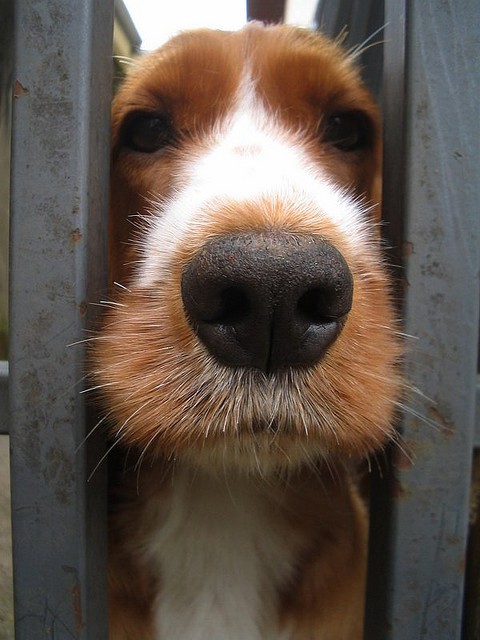
Picture Parade Two Hundred and Fifty-Six

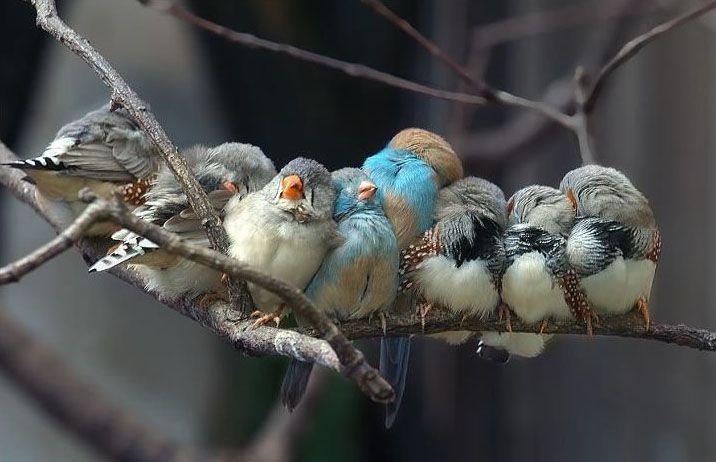
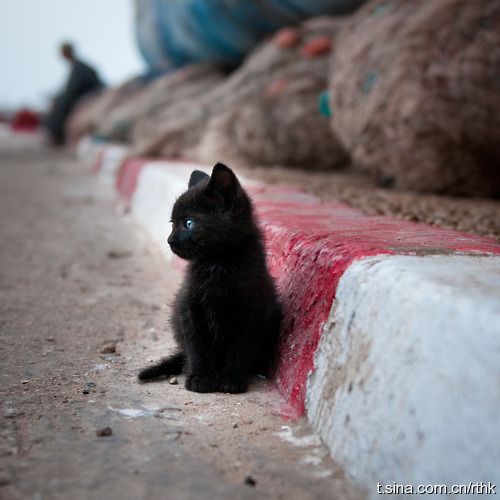
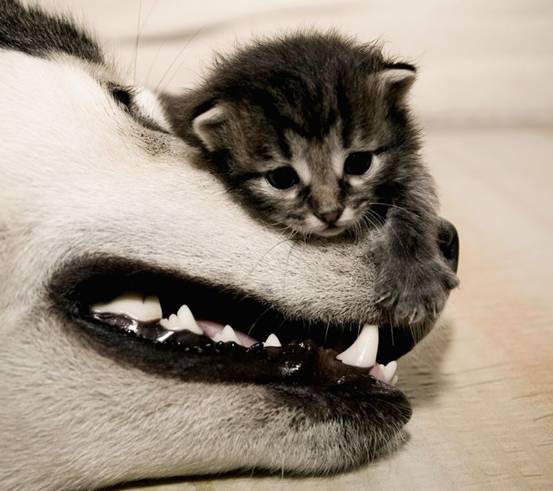
More of those wonderful photographs sent to me by Su.

(Now moving beyond the world of dogs! But you will still love them!)

oooo

oooo

oooo

oooo

oooo

oooo

oooo

Come back in a week’s time for another set of these wonderful photos.

Thank you, Su!!

Trees and drought.

The scientific findings of how the height of trees affects their ability to cope with drought.

I subscribe to the online Physics World website and a recent article tickled my fancy. Because it was supported by what we see here at home.

That is that shorter and taller trees do not handle drought conditions as well as medium-height trees.

First the article and then some supporting evidence from home.

ooOOoo

ECOSYSTEMS
RESEARCH UPDATE

Medium-height trees survive drought best

04 Sep 2018

Courtesy iStock_MilosJokic.jpg

Forests with canopy heights of around 18 metres are more resistant to the effects of severe drought than those with shorter and taller trees, according to researchers in China and the US.

In the past, studies have disagreed on whether forests with lower or higher canopies will be more likely to make it through prolonged spells of hot, dry weather. The discrepancy has made it difficult for forest managers, who need to know which tree heights to encourage to ensure the highest growth and survival rates during extreme drought.

Study leader Peipei Xu at Beijing Normal University in China and her colleagues believe the issue is increasingly pressing. “Climate data indicate that warm areas of land are increasing, and the warmed areas are also drying,” says Chuixiang Yi at the City University of New York, US. “Hot-dry-induced forest mortality poses a significant global concern for the future as carbon dioxide continues to rise and the climate continues to warm.”

Xu, Yi and the rest of the team aimed to quantify the relationships between canopy height, growth and survival rates during drought accurately for the first time. They analysed data gathered during a severe drought in the southwestern US in 2002 that showed the effect on the ring widths of tree trunks, a useful indicator of their yearly growth. In addition, satellite data revealed how the density of vegetation changed over the course of the drought; the team used this to calculate both leaf growth and tree mortality rates.

The results revealed that trunk and leaf growth under drought conditions increased with canopy height for trees shorter than 18 metres but decreased with height for trees taller than 18 metres. “Our results indicate that both high and small trees have relatively low drought resistance,” says Yi.

After establishing these relationships, the researchers could determine the biological mechanisms governing tree growth and survival during drought.

“All organic matter in a tree is formed on the leaves at the top of the tree by photosynthesis,” Yi explains. “Tall trees have a longer water transport path from roots to leaves and [it’s] more difficult to overcome tissue resistance and … gravity, particularly under dry conditions. The roots of small trees are short, and their abilities to access water and nutrient supplies unavailable to the surface soil layer are extremely limited.”

The researchers believe that using their results to inform the active management of canopy structure could safeguard vulnerable forests. As climate models predict hotter, drier droughts becoming more commonplace, this could be essential to combat forest dieback – a phenomenon that will also drive climate change.

“Our findings provide insights into how to manage forests or plant what trees to increase forest drought resistance in facing hot-dry climate conditions to mitigate climate change,” says Yi.

The team reported the findings in Environmental Research Letters (ERL).

ooOOoo

So turning to home.

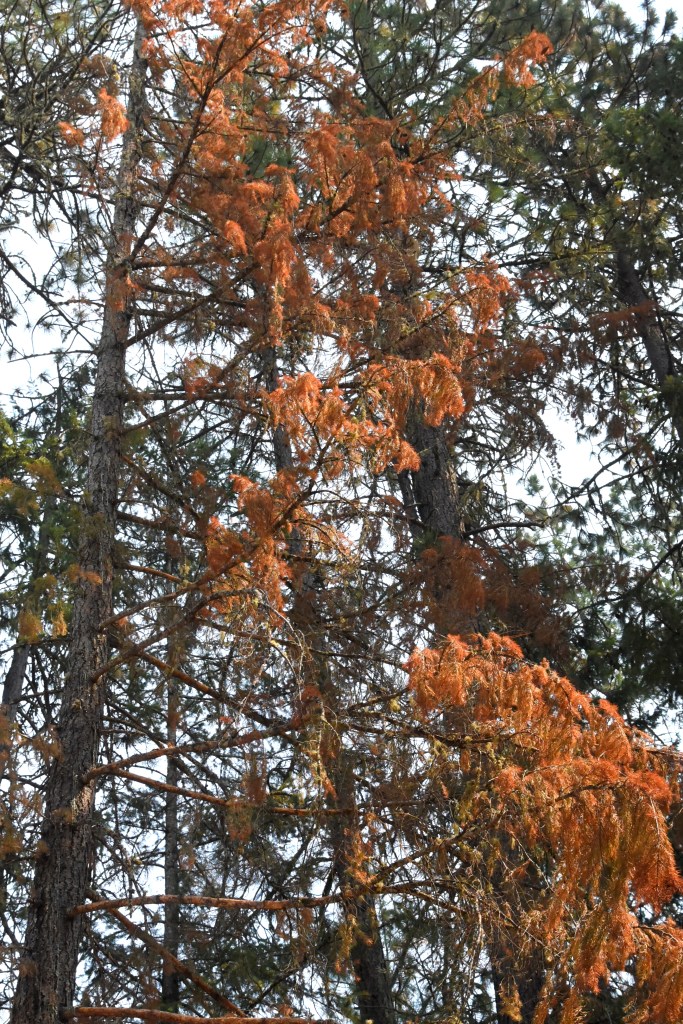
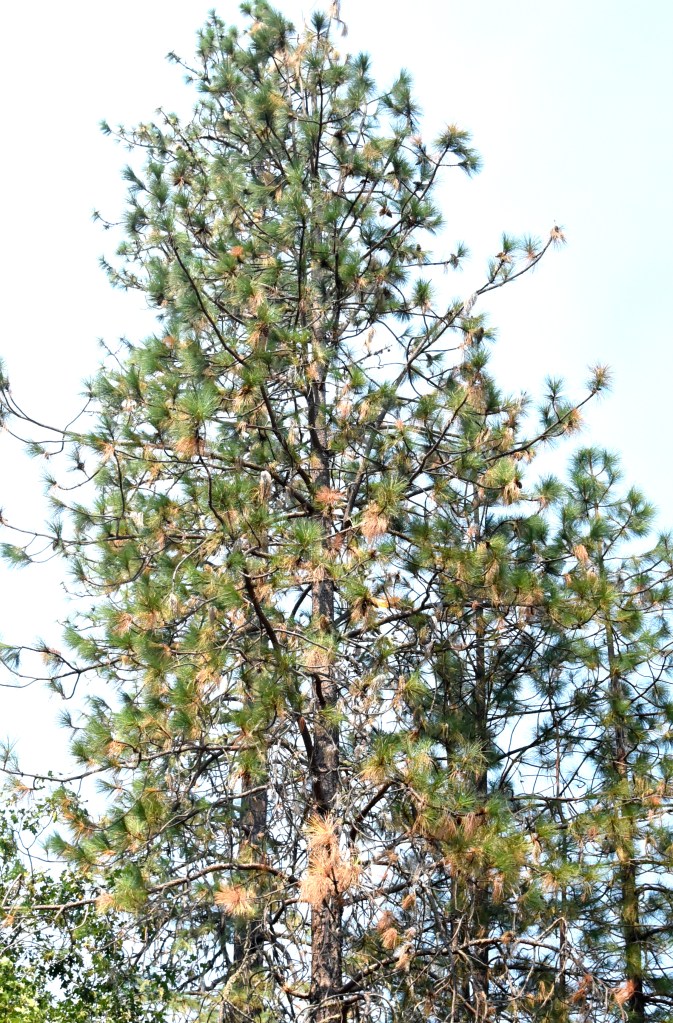
Here are a couple of photographs of tall trees to the Northern side of the house that are clearly showing some stress.

A tall fir tree that is due for removal because it is clearly dead.

oooo

Another tall tree, this time a pine, showing signs of stress.

oooo

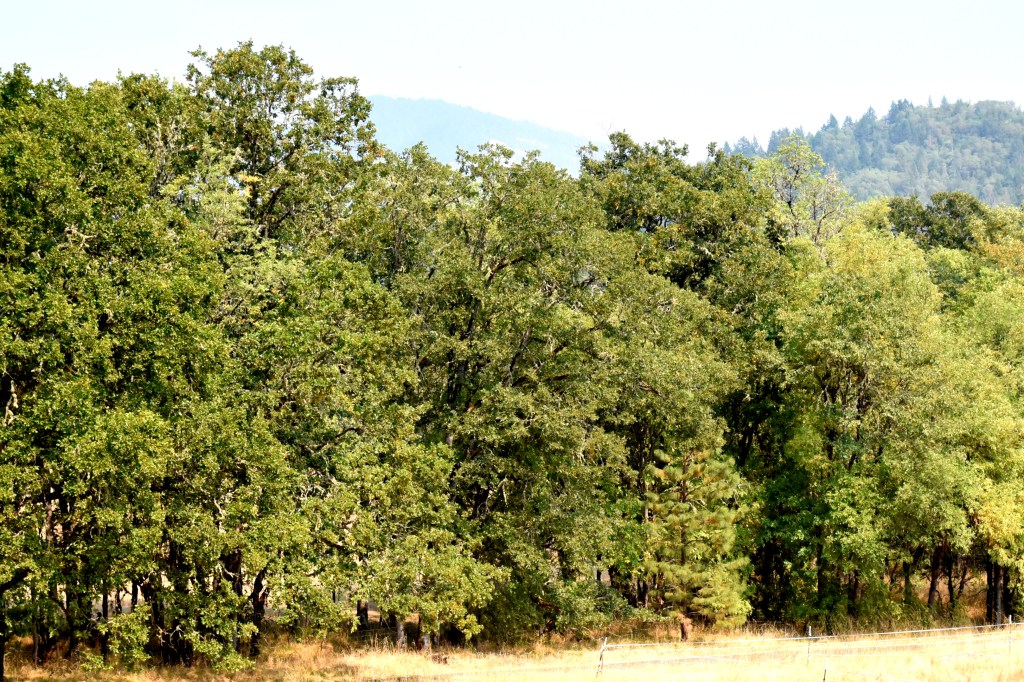
Now in stark contrast look at the trees in the photo below. (Oh, that’s the smoky summit of Mount Sexton, elevation 3,829 ft., in the distance.)

Medium-height trees that border the Northern side of our driveway from the road to the house.

As our taller trees are felled each year we are planting new young trees, two for every tree felled, in one of our grass fields.

Because it is not just Jeannie and me, and all the wild birds, who love our trees!

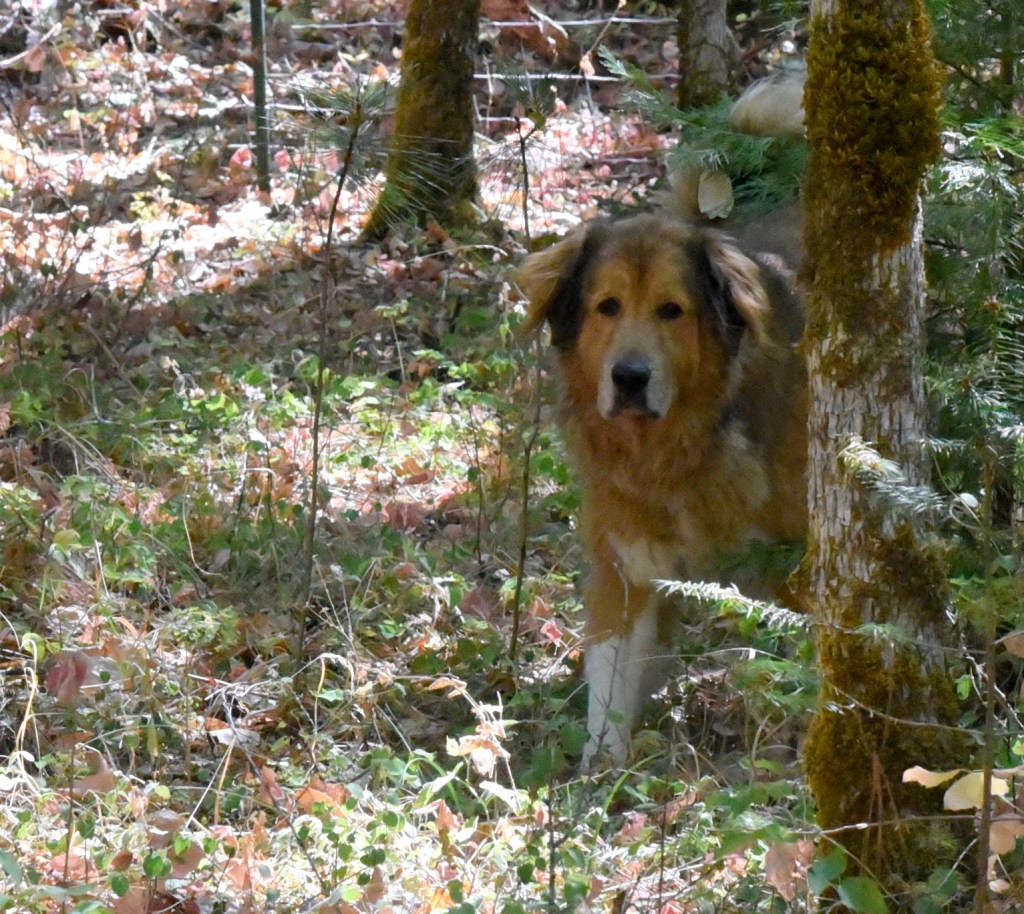
Do you know, I feel the need to pee!

oooo

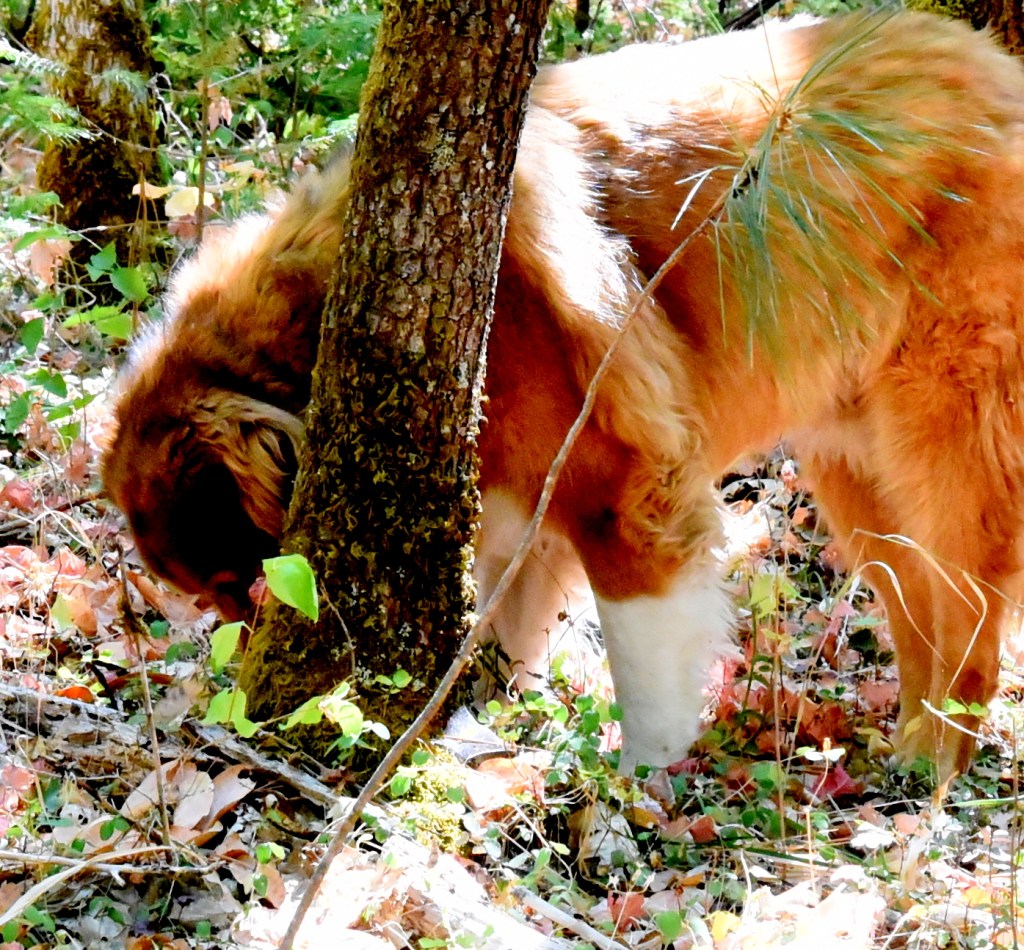
This seems to have a good smell about it!

oooo

Ah! That’s so much better!

Will close with another photo with a tree in it taken a few nights ago.

We must never, ever lose our trees!

Too close to home!

A post that involves dogs but not what I had in mind!

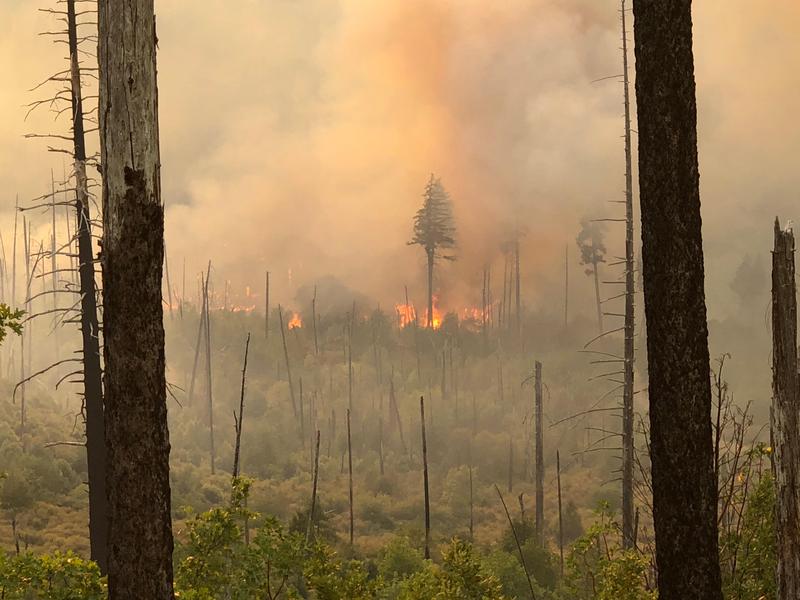
Last Saturday I published a post The burning of our forests! that included a photograph of the nearby Klondike fire.

Courtesy Jeffersen Public Radio

Then last Sunday I was speaking to Maija, my daughter back in England, and she was asking how the fires were and I distinctly recall saying: “Sweetheart, I think we are over the worst!

That same Sunday evening, around 9:45pm, in other words two evenings ago, one of our neighbours, Margo, who lives on 60 acres adjacent to the west of us, called with real alarm in her voice:

Paul, have you seen the fire that is burning just to the North-East of us?

I replied that I had not but immediately went to our deck that runs the whole Eastern length of our house. Mount Sexton is just a few miles to the North-East of us.

This is what I saw!

Taken on the 2nd September, 2018 at 21:44 PDT

Apparently, a short while previously the wind had blown down a tree that had fallen across some high-voltage power lines causing sparking that had, in turn, ignited the extremely dry grassland.

The fire was between Oxyoke Road and Three Pines Road and roughly 2 miles from us line of sight.

That explained why some thirty minutes before, in the last of the light of the setting sun, there had been a number of helicopter flights come across us en route to dropping fire retardant close by. It hadn’t occurred to me that it was an incident so close to us.

Many of us living nearby then called each other to spread the word.

Jeannie and I, in turn, drew up an evacuation checklist and started getting things ready. More importantly, getting ourselves psychologically prepared to have to vacate the property at very short notice: Jeannie and me: six dogs; two horses; two parakeets; three cats; two chickens!

Thankfully an order to evacuate did not come during the night.

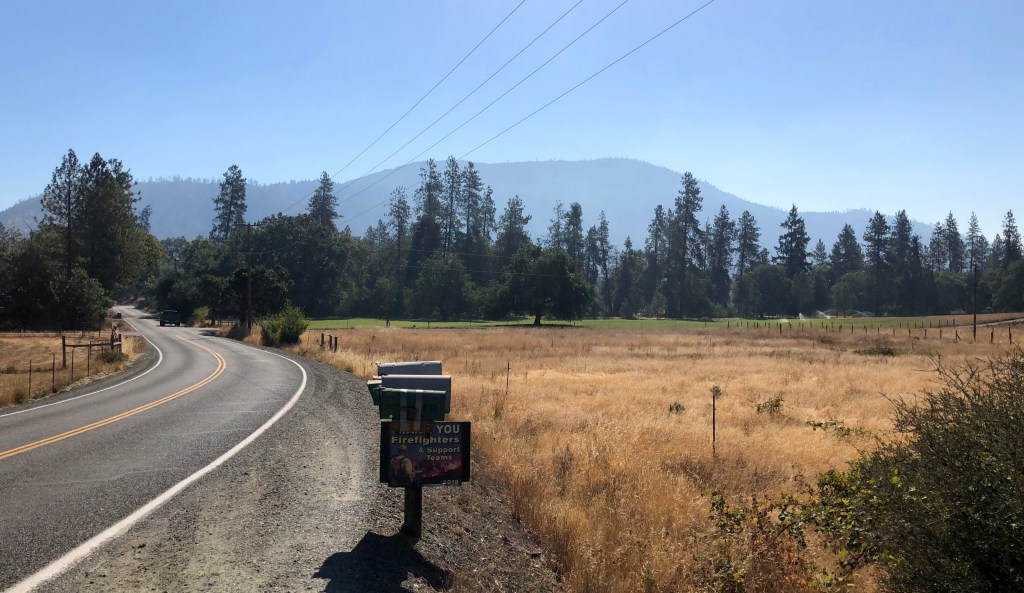
So yesterday morning I grabbed my bike and rode to Oxyoke Road. On the way I stopped to photograph the smoke in the air.

Three Pines Road looking to the East.

Once at Oxyoke Road I chatted to a search and rescue volunteer on duty controlling the traffic.

His report, as of 11:30 on September 3rd, was that the fire was just 15% contained, was “pretty active”, and that they were keeping an eye on the winds that were expected to be rather gusty later on that afternoon. I am writing this at 13:40 on the 3rd and the present winds are 6 mph, gusting 12 mph, from the North-West.

I rode back home to brief Jeannie and found her working her way through an idea for evacuating the dogs!

H’mmm! I am not sure Pedy is getting the message!

But a few words from Sweeny seemed to sort things out.

So there you are my good people, a post about dogs! Sort of!

Fingers crossed we will speak again tomorrow!

Assuming we don’t have a repeat of last night’s spectacular sights!!

Photo taken by Holmes Ariel of the Hugo Road Neighbourhood Watch group.

At least this rural living keeps one fit!

Local history

The Grave Creek Covered Bridge

Jeannie and I decided to take a few hours away from the house and go and do some local exploring.

Just 10 miles North of us, indeed the next exit (71) from Highway I-5, is the famous Grave Creek Covered Bridge.

We parked up and soaked it all in.

While there was an information board next to the bridge it was very easy to find the details online on the Southern Oregon travel site.

The Grave Creek Covered Bridge is one of the few covered bridges that remain in southern Oregon. From Vancouver B.C. to the Mexican border, it is the only one visible from the I-5 freeway. Be sure to visit the Applegate Trail Interpretive Center while in Sunny Valley. It provides a first hand look into the local area, history, fabulous displays, theatre & more.

In the fall of 1846, the first emigrant train from Fort Hall, Idaho, to travel the southern route to the Willamette Valley camped on the north side of this creek, then Woodpile Creek. Martha Leland Crowley, 16 years old died of typhoid fever during this encampment and was buried 150 feet north of the creek on the east side or a white oak tree that was later removed for the present roadway, Thus the name “Grave Creek”.

When James H. Twogood laid out his land claim in the fall of 1851 and filed it on May 1st 1852, he named it the Grave Creek Ranch in memory of that unfortunate incident.

McDonough Harkness, his partner, was the first postmaster of Josephine County in the newly named town of Leland on March 28,1855. Harkness was killed by the Indians in April 1856 while riding dispatch for the Army during the second Indian War of southern Oregon which started in October of 1855.

The bridge was built in 1920 and is 105 feet long.

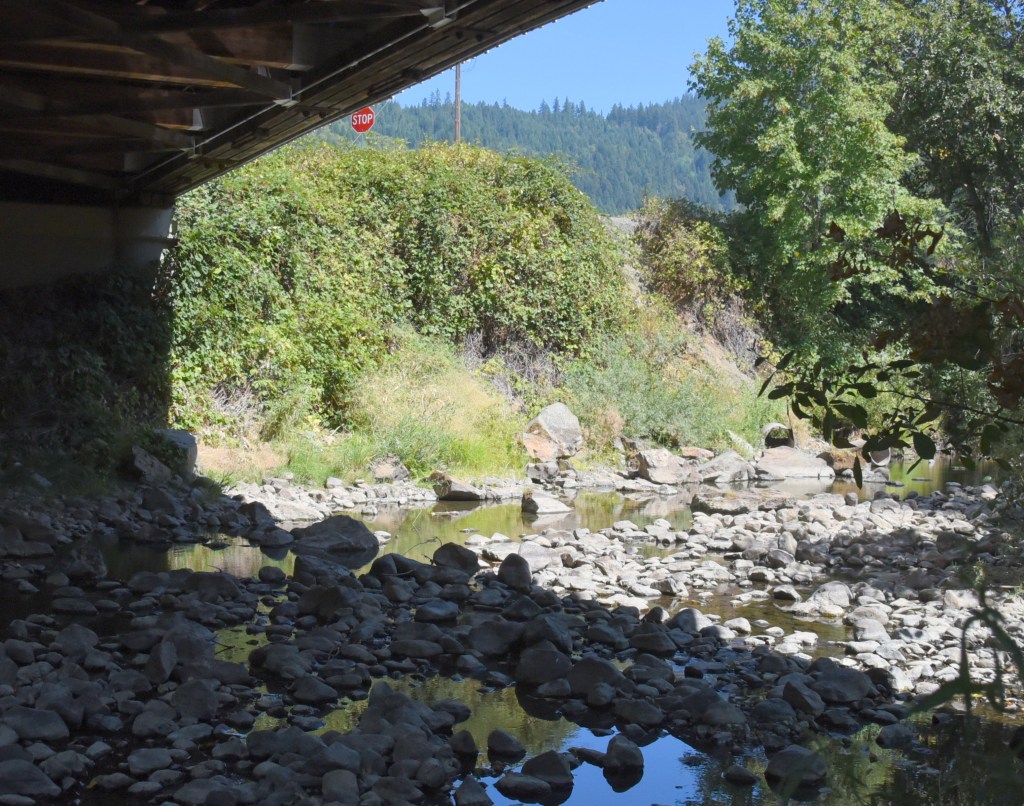
Unsurprisingly, the creek had very little water in it.


But that didn’t diminish in the slightest the magic of this place out in the vast Oregon countryside.

WikiPedia has a nice entry explaining the rationale behind building a covered bridge.

A covered bridge is a timber-truss bridge with a roof and siding which, in most covered bridges, create an almost complete enclosure. The purpose of the covering is to protect the wooden structural members from the weather. Uncovered wooden bridges typically have a lifespan of only 10 to 15 years because of the effects of rain and sun. The brief moment of relative privacy while crossing the bridges earned them the name “Kissing Bridges”.

Back to dogs tomorrow!


Picture Parade Two Hundred and Fifty-Four

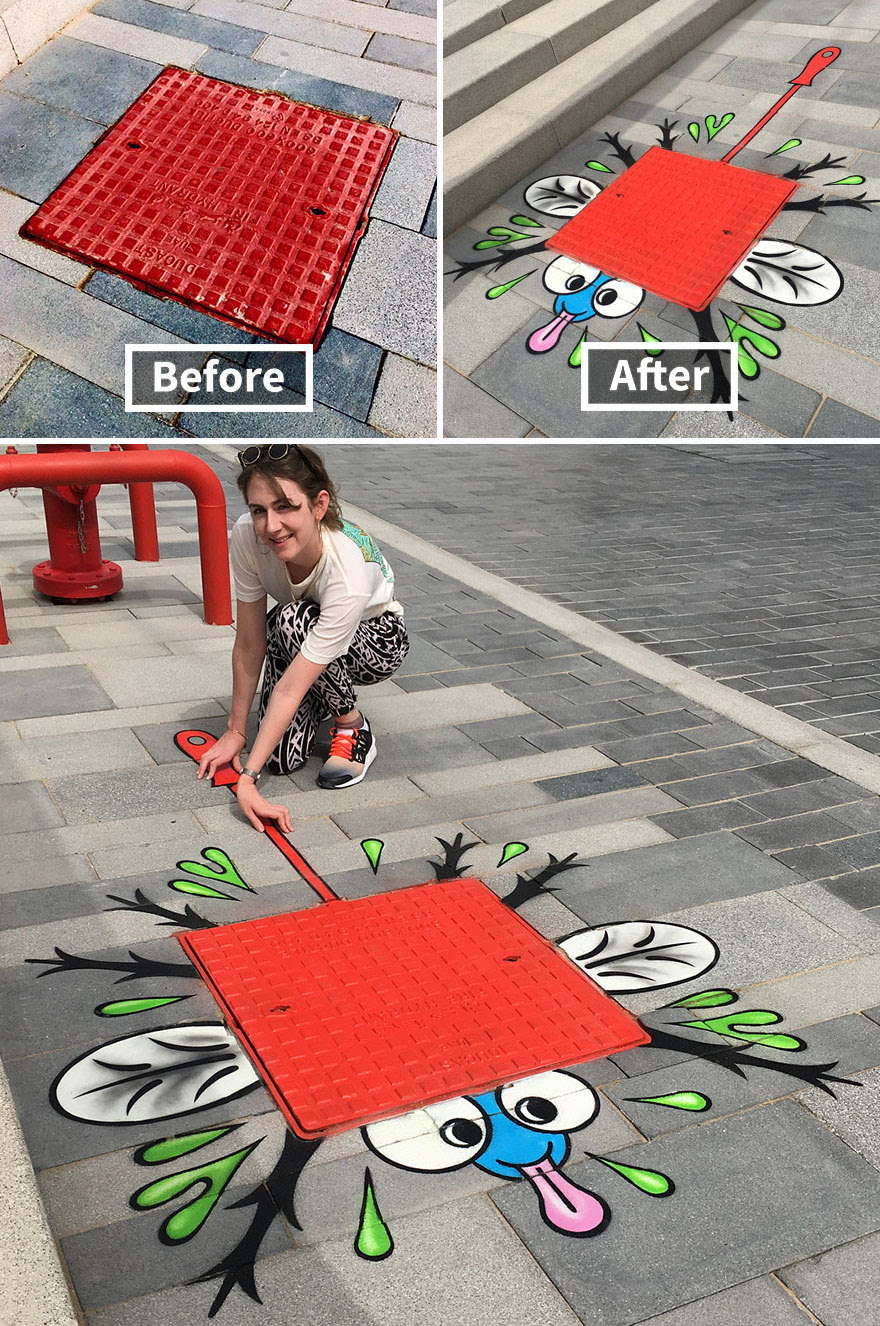
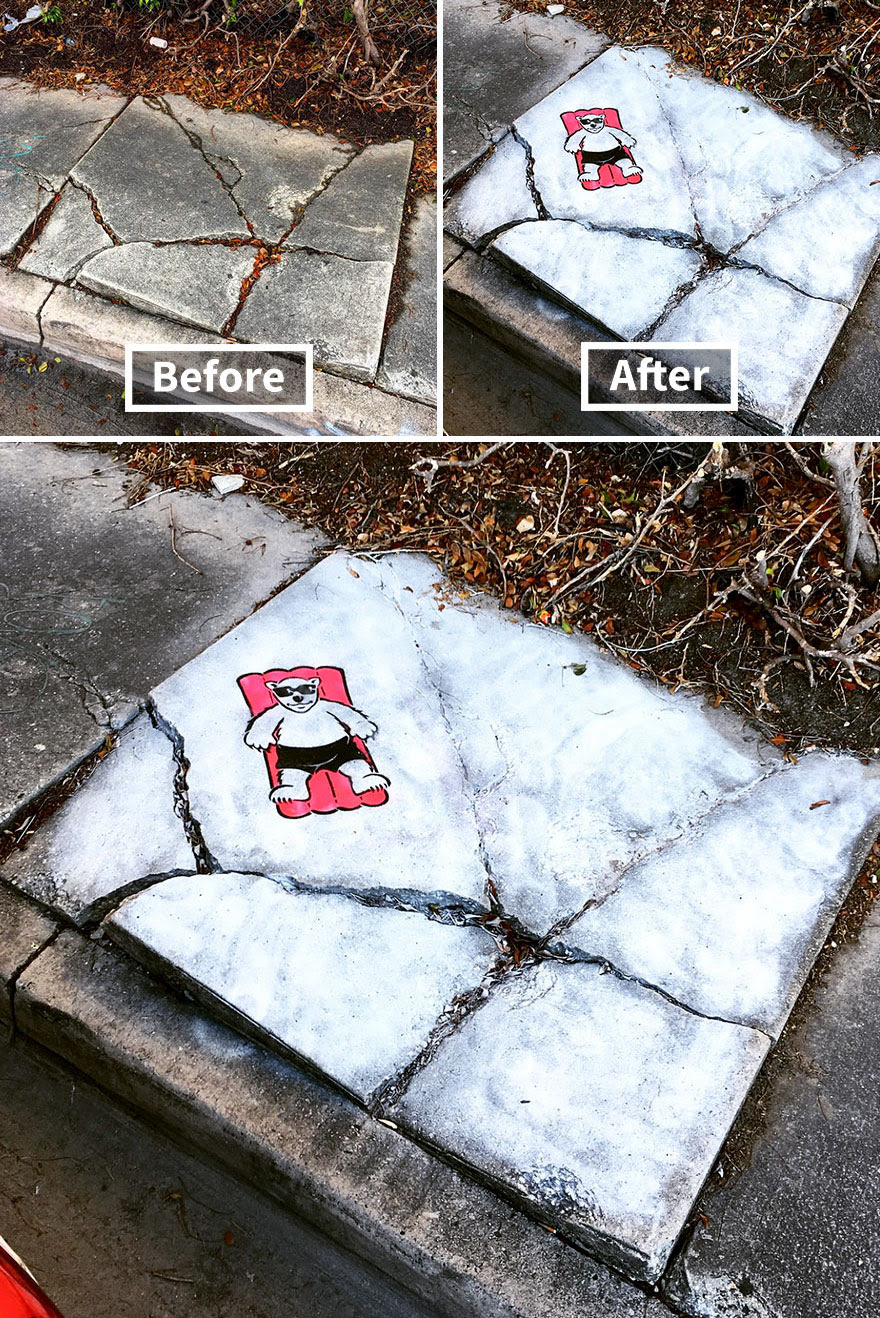
Street Improvements!

After those wonderful Kennel Club photographs I was truly intrigued as to how I could follow them up with today’s Picture Parade.

Then dear neighbour and very good friend, Dordie, came to the rescue.

For it was Dordie who sent me the following! I will share all twelve of them with you today!

oooo

oooo

oooo

oooo

oooo

oooo

oooo

oooo

oooo

oooo

oooo

There are some very imaginative and creative souls out there!

Thank you, Dordie!

A little birdie told me!

… not to be in such a hurry to shut the garage door!

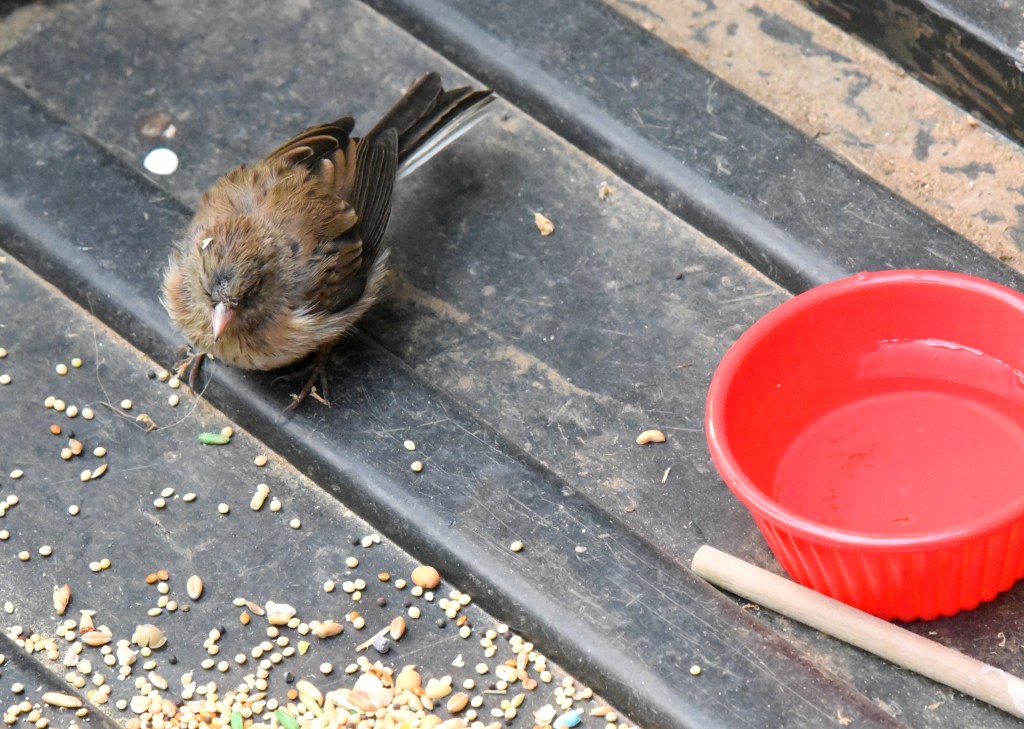
I went out to the garage yesterday morning to sort out a few things and found a small bird almost fast asleep in a trolley cart I use about the place.

It clearly had got caught inside the garage when I closed the electric door the previous evening. (Some of the local birds do come in to the garage to feast on insects and spiders that they come across.)

(That’s sawdust in the bottom of the cart.)

I called Jeannie to come out and look at the little chap and she had the brilliant idea of feeding the bird some of the bird food we give our two parakeets. Plus, she brought out a bowl of water.

It worked!

In next to no time the aforesaid bird had had sufficient to eat and it was time to relax in the warm air.

Twenty minutes later he had flown away!

OK!!

The real point of today’s post is to advise you that my son, Alex, and his longterm partner, Lisa, are staying with us for a few days and quite naturally blogging is going to be on the back-burner.

Rather than go ‘silent’ I am going to share with you over the next six days a beautiful series of posts on the clouds.

Will explain more tomorrow!

Summer crawlies …

…. and what they mean for our beloved dogs!

As frequently happens, recently I was sent an email from someone I hadn’t previously been in contact with. It was Sienna Penfold and this is what she wrote:

Hello Paul,
My name is Sienna, and I’m a full-time mom and a regular contributor to highstylife.com. Proud owner of two beautiful dogs (Coco & Hulk) and beautiful cat adopted from a shelter.
Since I’m equally passionate about my pets and my job I’ve decided to share my knowledge and experiences. I love the combination of sharing information and learning from others. Stories I like to write are mostly connected to pets and lifestyle.

You all know me well enough to know what my response was!!

So here is Sienna’s guest post.

ooOOoo

Be Prepared! Tips to Protect Your Dog and Your Family from Dangerous Parasites

by Sienna Penfold, August 21st., 2018

Every year during spring, summer, and most of fall, every pet parent becomes painfully aware of all the crawlies that enjoy the nice weather as much as our furry buddies do. From annoying fleas, which can also carry various diseases, all the way to worms, and ticks, the sunny days of the warm season come with a slew of responsibilities for every family – because, unfortunately, all these insects also pose a risk for us and our kids as well, not just for our pets.

Even if you do your best to prevent any type of an infection, you should also stay alert for any early signs of a flea infestation, and any presence of ticks and other parasites that can wreak havoc on your pooch’s as well as your own health. Let’s go through some of the key symptoms, preventative measures, and possible treatments to make your summers all the more comfortable and worry-free!
Keep an eye on your furball

Fleas and ticks are the most common external parasites that your pooch may have, and while it’s always best to focus on prevention, some dogs are more prone to having these pests and thus need more attention from you. Keep in mind that there are almost 2,000 species of fleas out there, and you may find some to be more resilient than others. The following are some of the simplest symptoms your dog will exhibit in case they have fleas:

  • Frequent scratching and skin irritations such as psoriasis, redness, and hair loss
  • Flea droppings in your dog’s coat (which you can check when grooming them and examining their hair against a contrasting surface such as a white piece of paper)
  • Excessive licking and biting
  • Pale gums

On the other hand, ticks are the next most common parasite found in nature, and its many species carry a wide range of diseases that can endanger your dog’s health or even life. These are the symptoms to keep an eye on:

  • Skin irritation and itchiness
  • Loss of appetite
  • Vomiting
  • Diarrhea
  • Lack of energy

A potential internal parasite infection, coming from a wide range of worms, heartworm included, may cause all of the above symptoms as well as the following issues:

  • Scooting, or dragging their rears against the floor
  • Coughing
  • A rounded belly
  • Visible parasites in fecal matter

The most effective preventative measures

Depending on your furry friend’s health and specific conditions (if any are present), you can mix and match several useful solutions to prevent any parasite issues. For example, regular grooming, including twice-a-day combing, regular baths with suitable shampoos, and even natural remedies as a part of their diet, such as a smidgen of garlic, and spraying apple cider vinegar mixed with water, can help.

Topical solutions come in various forms, from repellant collars to topicals, and are applied once a month, mostly on a dog’s back. However, you should keep in mind that not every form of protection is all-encompassing, meaning that they sometimes don’t include heartworm protection, which are transferred through mosquito bites.

A great option is a monthly spot-on topical such as Advocate dog flea treatment which also keeps your pooch safe against heartworms, and worms. Remember to weigh your pooch beforehand, because all of these treatments are used in different doses depending on how heavy your dog is.

Protecting your environment

Even though you cannot possibly keep your dog away from all risky spots, especially if you take them to natural spots such as rivers, mountains, and meadows, you can still decrease their risk with the right hygiene rules.

If your pooch lives indoors, make sure you vacuum and clean your home every day, or at least every other day, to remove any potential flea eggs. Removing carpets is one of the best ways to prevent an infestation, although your furniture still leaves plenty of room for them to bask in.

Using flea and tick-repellent substances such as apple cider vinegar in your homemade cleaning supplies, can also help you protect your rooms. Make sure to wash your own linens as well as your dog’s bedding on a regular basis, with items such as the Seventh Generation detergent with predominantly plant ingredients, which are perfectly pet and kids-safe. If you dress your dog, you can use the same detergent to wash their sweaters, and make sure they don’t harbor any unwanted pests!

Since all of these parasites transmit many diseases that can also come with all of the listed as well as with more severe symptoms, it’s best to check your dogs from head to toe, especially in those hidden nooks such as between their toes, behind and inside their ears and around their tails. However, it’s always a good idea to have your vet check with you on a regular basis, and make sure that whatever may be causing those symptoms is not a parasite, but a harmless issue, such as an upset stomach.

ooOOoo

Don’t know about you but we found that a very informative guest post!

Want some more?? Please let me know!

As always, I have no commercial interest in or knowledge of any the products and companies mentioned by Sienna.

Our incredible dogs!

Serendipity hard at work!

Why that sub-heading?

Simply because yesterday Anita from Anitashope blog left the following comment:

This article popped up after I responded to todays post but I also have to respond to this one as I need to tell you about Mimi. Mimi is my coon hound black lab mix and she will NOT make eye contact with you when a treat is involved. She will come sit by you and look off in the distance like “I am not looking at you”, then she will cut her eyes sideways just to make sure the treat is still there. Its hilarious.

The post where her comment was left was one that I published back on March 13th, 2017. It included the most beautiful photograph of Oliver’s eyes. I had forgotten that picture.

So for that reason alone, it is being republished today.

ooOOoo

The love and admiration for this beautiful animal goes on and on!

It seems as though it is almost on a weekly basis that new and incredible facts about our dear, dear dogs come to the surface.

So what prompted this from me today!

Only a wonderful article that was originally published in New Scientist but then was carried by The Smithsonian. I am hoping that by fully linking this post to both the New Scientist article and the essay in The Smithsonian I am at liberty to republish it for all you good people.

ooOOoo

Dogs Use Deception to Get Treats, Study Shows

When a human partner withheld tasty snacks, the dogs got sneaky

Would these eyes deceive you? New study says yes. (johan63/iStock)

By Brigit Katz     smithsonian.com
March 10, 2017
There is plenty of evidence to suggest that dogs, in addition to looking adorable in sweaters, possess fairly sophisticated cognitive abilities. They recognize emotion, for example, and respond negatively to antisocial behavior between humans. Man’s best friend can also get pretty tricksy when it comes to scoring snacks. As Brian Owens reports for New Scientist, a recent study found that dogs are capable of using deceptive tactics to get their favorite treats.

The study, published in the journal Animal Cognition, was led by Marianne Heberlein of the Department of Evolutionary Biology and Experimental Studies at the University of Zürich. Heberlein told Owens that the idea for the study was born when she observed her pet pooches engaging in deceptive behavior; one sometimes pretends to see something interesting outside, prompting the other to give up his sleeping spot.

To find out if dogs engage in similar shenanigans with humans, Heberlein and a team of researchers paired 27 dogs with two different partners, Stanley Coren explains in Psychology Today. One of these partners would repeatedly go to the bowl of a given dog, fish out a treat, and give it to the pup. The other would show the treat to the dog, and then put it in her pocket. Perhaps unsurprisingly, the dogs began to show a preference for the more generous partners, and would approach them spontaneously.

Once one partner had been established as co-operative, the other as competitive, the dogs were taught to lead their partners to one of two boxes, both containing food, with the command “Show me the food.” And the same pattern was repeated: when the dogs led the co-operative partner to a treat, they got to eat it. The competitive partner withheld the treat.

Researchers then showed the dogs three covered boxes. One contained a sausage, the second contained a less-yummy dry biscuit, and the third was empty. Once again, the process of treat giving and withholding was repeated, but this time with a twist: when the dog was reunited with its owner, the owner asked it to choose one of the boxes. If there was a treat inside the box, the dog was allowed to eat it. But “if the dog chose the box which had been opened before,” Coren explains, “the owner just showed the empty box to the dog.”

Over the course of a two-day testing period, the dogs were repeatedly presented with this conundrum. They had been trained to lead both partners to boxes containing food, but they knew that the competitive partner would not let them eat the snacks. They also knew that if any snacks remained inside the boxes once they were reunited with their owners, they would get a chance to eat them. So the dogs got a little devious.

Researchers observed the pooches leading the co-operative partner to the box containing the sausage more often than expected by chance. They led the competitive partner to the sausage less often than expected by chance. And here’s where things get really interesting: the dogs took the competitive partner to the empty box more frequently than the co-operative partner, suggesting that they were working through their options and engaging in deliberate deception to maximize their chances of getting both treats.

“It is as though the dog is thinking, ‘Why should I tell that selfish person where the best treat [is] if it means that I will never get it?’,” writes Coren.

“These results show that dogs distinguished between the co-operative and the competitive partner,” the authors of the study write, “and indicate the flexibility of dogs to adjust their behaviour and that they are able to use tactical deception.”

Rest assured, dog lovers: your pooches may be sneaky, but they still love you more than cats.

Read more: http://www.smithsonianmag.com/smart-news/dogs-use-deception-get-treats-study-shows-180962492/#5r1vc6gkyLQoIQaL.99
Give the gift of Smithsonian magazine for only $12! http://bit.ly/1cGUiGv
Follow us: @SmithsonianMag on Twitter

ooOOoo

The article from Brigit opened up with a picture of a pair of eyes; a pair of dog’s eyes.

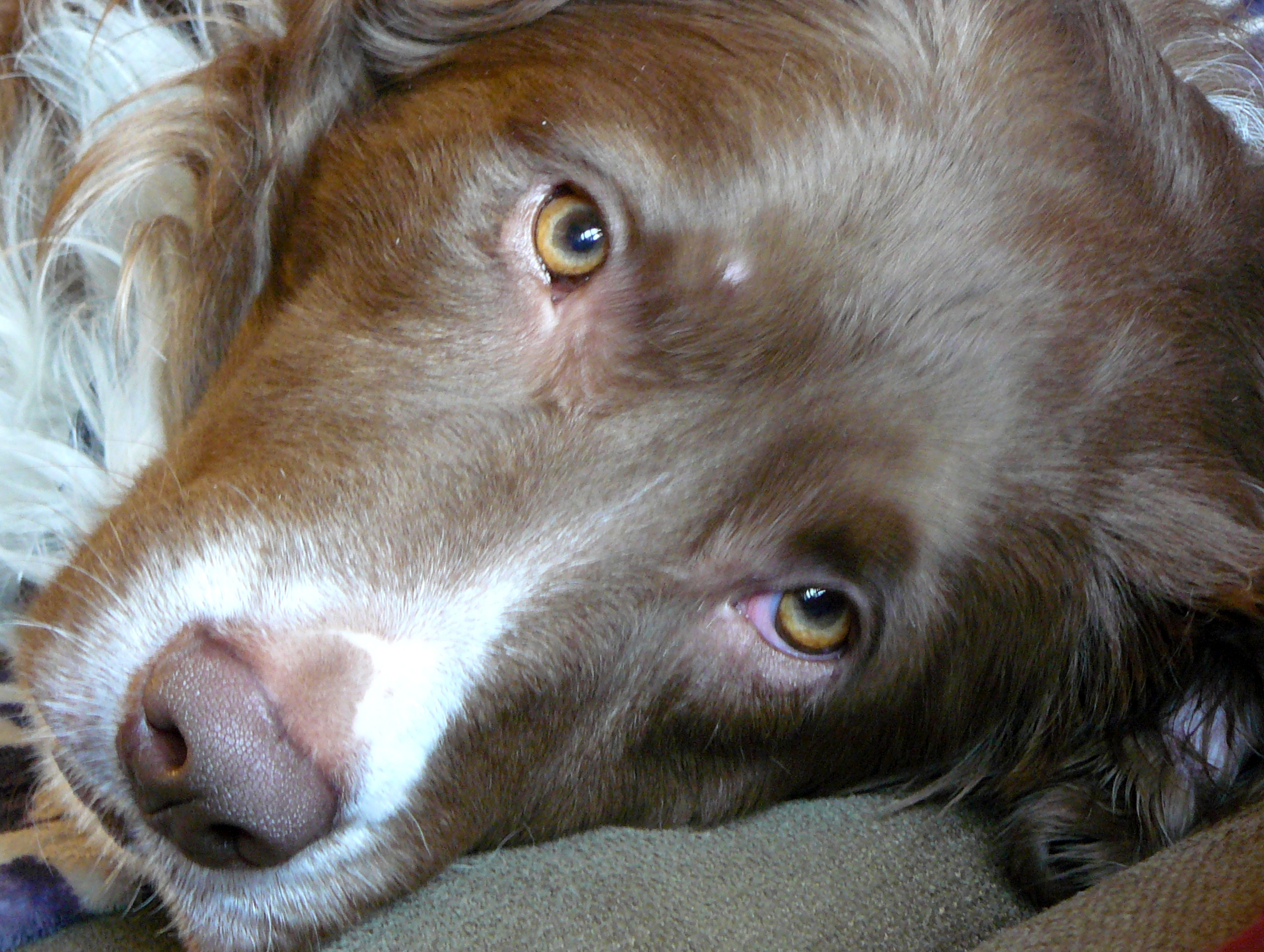
I don’t know about you but some dogs have eyes that reach out and seem to illuminate one’s soul.

Our Oliver has just that set of eyes. I will close today’s post with a photograph of Oliver’s eyes that was taken yesterday afternoon.

Talk about the power of non-verbal communication!

ooOOoo

I will never, ever get tired of looking at the face of such a gorgeous, loving dog as our dearest Oliver. Never; Ever!