I’m not going to do anything other than launch straight into this post. Taken from EarthSky.
ooOOoo
Curiosity rover on Mars snags highest-resolution panorama yet
Posted by Eleanor Imster in Space | Today’s Image|March 5, 2020
This just in … a new super-cool composite from Curiosity on Mars. The panorama contains more than 1,000 images taken last Thanksgiving and assembled over the past few months … 1.8 billion new pixels of Martian landscape!
Yesterday (March 4, 2020) NASA released a panoramic image of the Martian surface captured by the Curiosity rover. It’s the highest-resolution panorama yet of the planet’s surface.
Composed of more than 1,000 images taken during the 2019 Thanksgiving holiday and carefully assembled over the ensuing months, the composite contains 1.8 billion pixels of Martian landscape. The rover’s Mast Camera, or Mastcam, used its telephoto lens to produce the panorama; meanwhile, it relied on its medium-angle lens to produce a lower-resolution, nearly 650-million-pixel panorama that includes the rover’s deck and robotic arm.
The panorama showcases Glen Torridon, a region on the side of Mount Sharp that Curiosity is exploring. They were taken between November 24 and December 1, 2019, when the mission team was out for the Thanksgiving holiday. NASA said:
Sitting still with few tasks to do while awaiting the team to return and provide its next commands, the rover had a rare chance to image its surroundings from the same vantage point several days in a row.
| NASA’s Curiosity rover captured its highest-resolution panorama of the Martian surface between November 24 and December 1, 2019. Image via NASA/ JPL-Caltech/ MSSS.| Along with an almost 1.8-billion-pixel panorama that doesn’t feature the rover, NASA’s Curiosity also captured a 650-million-pixel panorama that features the rover itself. Image via NASA/ JPL-Caltech/ MSSS.
It required more than 6 1/2 hours over the four days for Curiosity to capture the individual shots. Mastcam operators programmed the complex task list, which included pointing the rover’s mast and making sure the images were in focus. To ensure consistent lighting, they confined imaging to between noon and 2 p.m. local Mars time each day.
In 2013, Curiosity produced a 1.3-billion-pixel panorama using both Mastcam cameras; its black-and-white Navigation Cameras, or Navcams, provided images of the rover itself.
Bottom line: Highest-resolution yet panorama of Martian surface by Mars Curiosity rover.
Eleanor Imster has helped write and edit EarthSky since 1995. She was an integral part of the award-winning EarthSky radio series almost since it began until it ended in 2013. Today, as Lead Editor at EarthSky.org, she helps present the science and nature stories and photos you enjoy. She also serves as one of the voices of EarthSky on social media platforms including Facebook, Twitter and G+. She and her husband live in Tennessee and have two grown sons.
ooOOoo
When one stops and reflects one can’t hide the scale of progress that humans have achieved. It is incredible!
It is also a struggle to take the situation so expertly spoken about by George Monbiot in yesterday’s post and square it with the achievement covered in today’s post.
Coyotes are not dogs but they are cousins to the dog.
All of which made the following story on Mother Nature News one that had to be shared. I just hope that a link to the original story is sufficient for copyright.
This is the story!
ooOOoo
Coyote finds old dog toy, acts like a puppy
A photographer spotted a coyote as it trotted into her yard and explored a toy left in the snow. What she managed to capture on camera is the beauty of play.
This coyote took a liking to a blue stuffed dog toy and had a playful romp in the snow with it. (All photos: Pamela Underhill Karaz)
Photographer Pamela Underhill Karaz lives in Trenton Falls, New York, in a rural area. Her own property is 48 acres of forest and field, which means she gets to see her fair share of wildlife right in her own backyard. “We’ve had coyotes living around us for years. We hear them mostly during the summer evenings,” she told MNN. But something much more than simply hearing a few coyote howls happened two years ago.
She tells us, “Our driveway is a quarter-mile long and lined with 45-year-old balsam trees. Being a photographer, I’m always on the lookout for wildlife activity. I spotted the coyote while having our morning coffee. He was one-third of the way down our driveway. He went to the middle, looked across then decided to come back up a bit. He left his scent on a downed branch (that’s how I know it was a male), then went into the trees and popped out up at the edge of our yard. Looked around, checked out and sniffed some tracks in our yard and when he was further along he noticed the toy. He made his way over to it, sniffed around it where our dog had rolled, sniffed the toy, picked it up, dropped it, sniffed it again.”
Then that’s when the magic happened. “[He] picked it up then proceeded to toss it up in the air and play with it, just like a dog would toss a toy around. It lasted perhaps five to 10 minutes, from picking up the toy, tossing it in the air, picking it up again and almost bucking around with it … then he just casually trotted off with it.”
Underhill Karaz notes that her dogs often leave their stuffed toys out in the yard and more than one has disappeared before. She guesses that this is perhaps not the first time the coyote had played (and run off with) her dogs’ toys.
Many animal species exhibit play, and yet we humans can’t help but look on in awe when we recognize it in species beyond the domestic dogs and cats we keep as companions. We get so used to thinking of wildlife as efficient and purposeful, wasting no energy. For the young of many species, play is indeed an essential part of growing up. Through play, juveniles learn everything they’ll need for adulthood from how to hunt to how to fight to how to navigate the social structure of their community. So we look on with joy but without much surprise when fox pups romp with each other and bear cubs tumble around together. But when the play carries on into adulthood, that’s when we stare with amazement, remembering we aren’t the only animals who like to inject a little joy into our day with silliness.
“This was such a wonderful reminder that all animals, the wild and the not so wild (our pets) are really not so different,” Underhill Karaz says. “They have personalities, they have feelings, and they do their best to survive in what is sometimes a very unfriendly world. They are not so very different than us.”
Let me repeat that last paragraph that Pamela wrote:
“This was such a wonderful reminder that all animals, the wild and the not so wild (our pets) are really not so different,” Underhill Karaz says. “They have personalities, they have feelings, and they do their best to survive in what is sometimes a very unfriendly world. They are not so very different than us.”
I would just add that like dogs coyotes are creatures of integrity!
Coming up to two weeks and thanks to Tom and Gilliwolfe we, too, have shared every step of the way. As usual, taken from here.
Enjoy Day Eleven!
ooOOoo
Day 11: Indiana to Arriate 14k
By Tom and Chica, 30th January, 2020
Written by Tom’s wife.
After her two day camping adventure, we gave Chica a day off and once again Merlin stepped into the breach. Also, Synnove, our lovely neighbour here in Jimera was going along for the day.
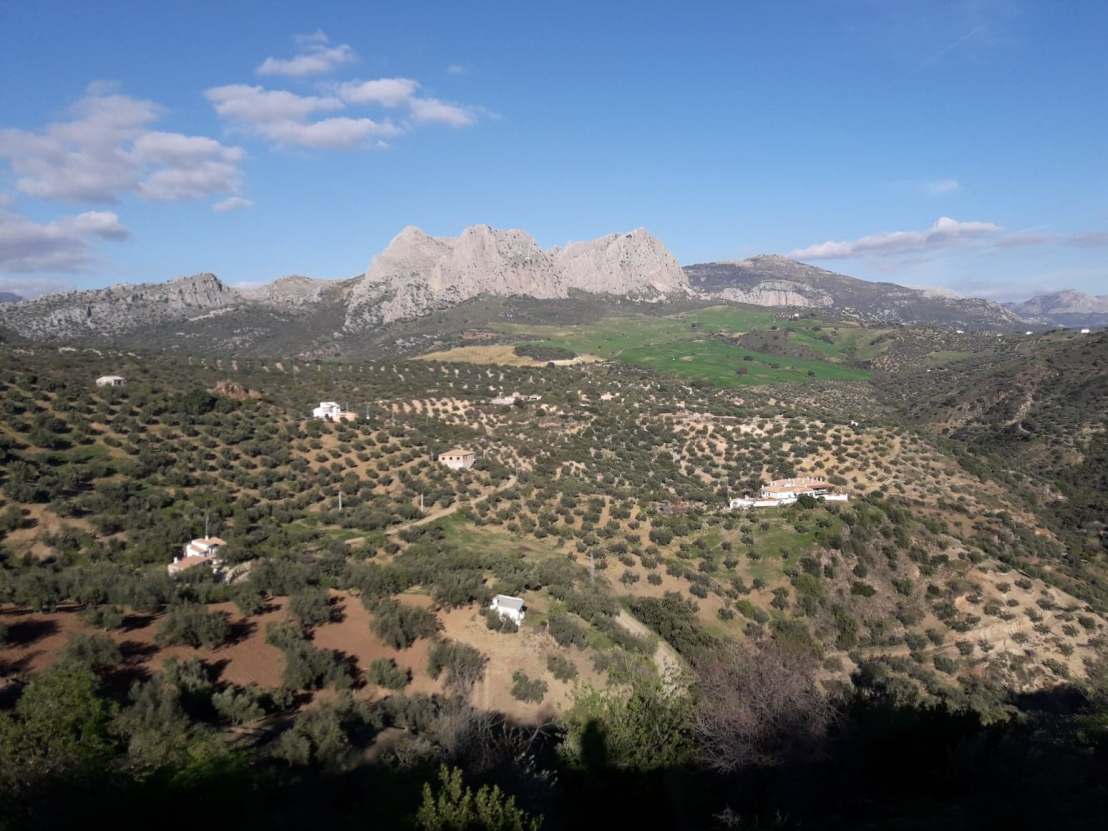
Starting from Indiana and heading towards the city of Ronda, this was gentler country of pasture and olive orchards. The cliffs that surround the city drew nearer and seemed particularly impressive when viewed from below.
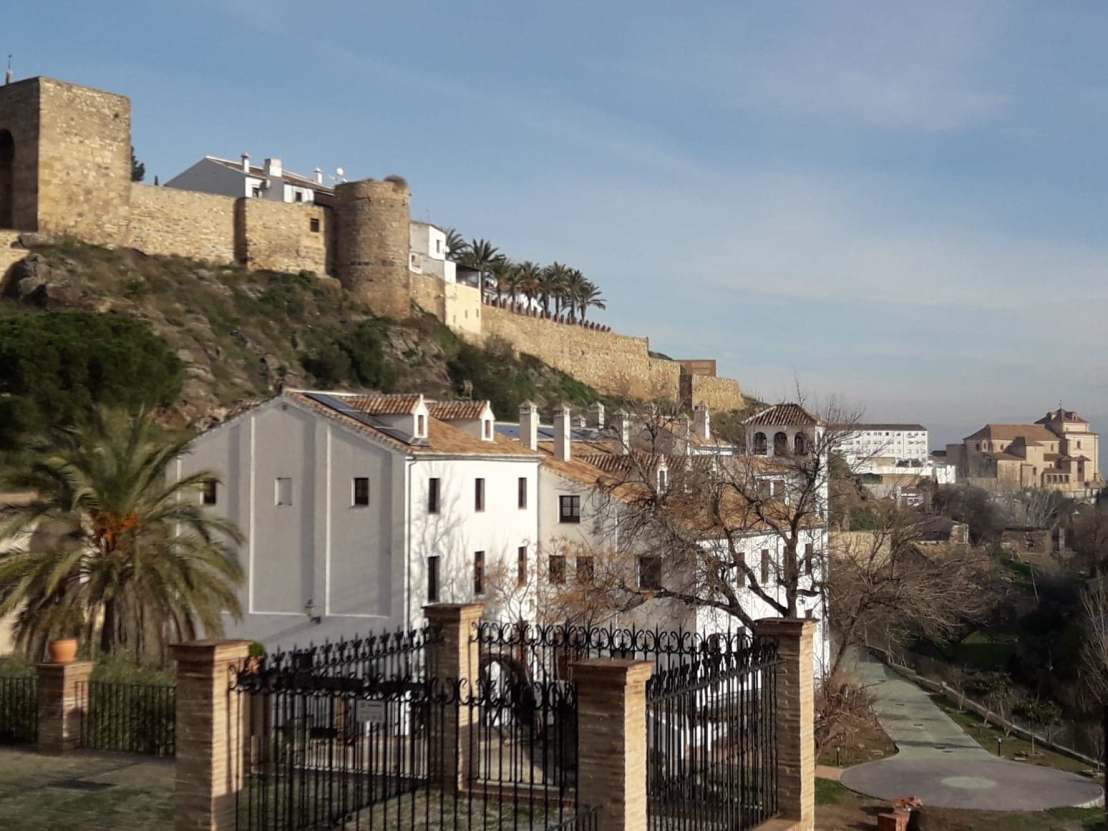
A steep winding path took them up to the top of the cliffs and into the old town. They crossed the famous Puente Nuevo bridge which separates the ‘new’ town built around the 12th century from the ancient Moorish old town. The view is spectacular and you have to jostle for position the get the essential ‘me on the bridge in Ronda’ pic.
After a coffee here, they headed to the top of the town, past the railway station, through the industrial area and back into the countryside. Merlin took all this in his stride and it became clear that he was the better option for the urban parts of the journey. Chica would have found this quite stressful.
After a slight map reading error leading to an unscheduled tour of the surrounding area, they resorted to GPS and found their way back to the route, which headed north-east towards Arriete. The going was easy; tarmacked road though cultivated fields and grazing land. Every property here seems to be guarded by a gang of barking dogs and most have ‘Beware of the Dog’ signs of varying degrees of crudity, but this one was rather good, they thought.
Reaching Arriete, they headed to the station. Technically, dogs are not allowed on trains in Spain but we have managed to take ours a short distance by looking pathetic and saying “No entiendo” (I don’t understand) a lot. This was unnecessary here as the lady in the ticket office was clearly a dog lover and made a huge fuss of Merlin. We’ll see if they’re as lucky tomorrow when Tom and Chica try and get the train back to Arriate. Then I can have a lie-in!
ooOOoo
I love that about putting the dog on the train! 🙂
Just a small but fascinating item on this amazing walk. The walk along GR7.
Susan said in response to yesterday’s post: “It feels as if we are joining them on their adventure.”
I said I truly felt the same way.
This walk of Tom and his dogs is so wonderfully described, and written up by Gilliwolfe, that it does feel that we are sharing the adventure; albeit in spirit only.
The photographs are to die for as well.
Here’s the next chapter.
ooOOoo
Days 9 and 10 Bonacoaz to Indiana via Montejaque 34k
By Tom and Chica, 29th January, 2020.
Written by Tom’s wife.
Another glorious day but it took us quite a while to get organised. Tom was determined not to forget anything vital for the first overnighter so it was 10.30 by the time we left. Making our way back to Benacoaz through Ubrique, where Los Alcornacales gives way to the Sierra de Grazalema, the landscape looked stunning in the sunshine.
Setting off all together, we climbed out of the village between fields dotted with wild iris onto the ridge above where I left the intrepid pair for their two-day trek. Tom had done this walk before a few years ago and had loved it so was keen to revisit.
Grazalema Natural Park was designated a Unesco Biosphere reserve in 1977 and the Sierra de Grazalema was declared the first natural park in Andalucia in 1984. It is one of Spain’s most ecologically outstanding areas. The 51,695 hectare park is famous for its spectacularly rugged limestone landscape of cliffs, gullies, caves and gorges.
The region is well known for being the rainiest place in Spain, with an annual rainfall of 2,200mm, which means that the 1,300 Mediterranean plant species that have been registered here, many of them endemic and some of them unique to the Sierra, flourish.
The town of Grazalema, which nestles between two rugged peaks is well worth a visit, not only because of its spectacular setting, but because there is a bakery selling the best cakes I’ve ever tried. Sadly for Tom, this wasn’t on today’s route.
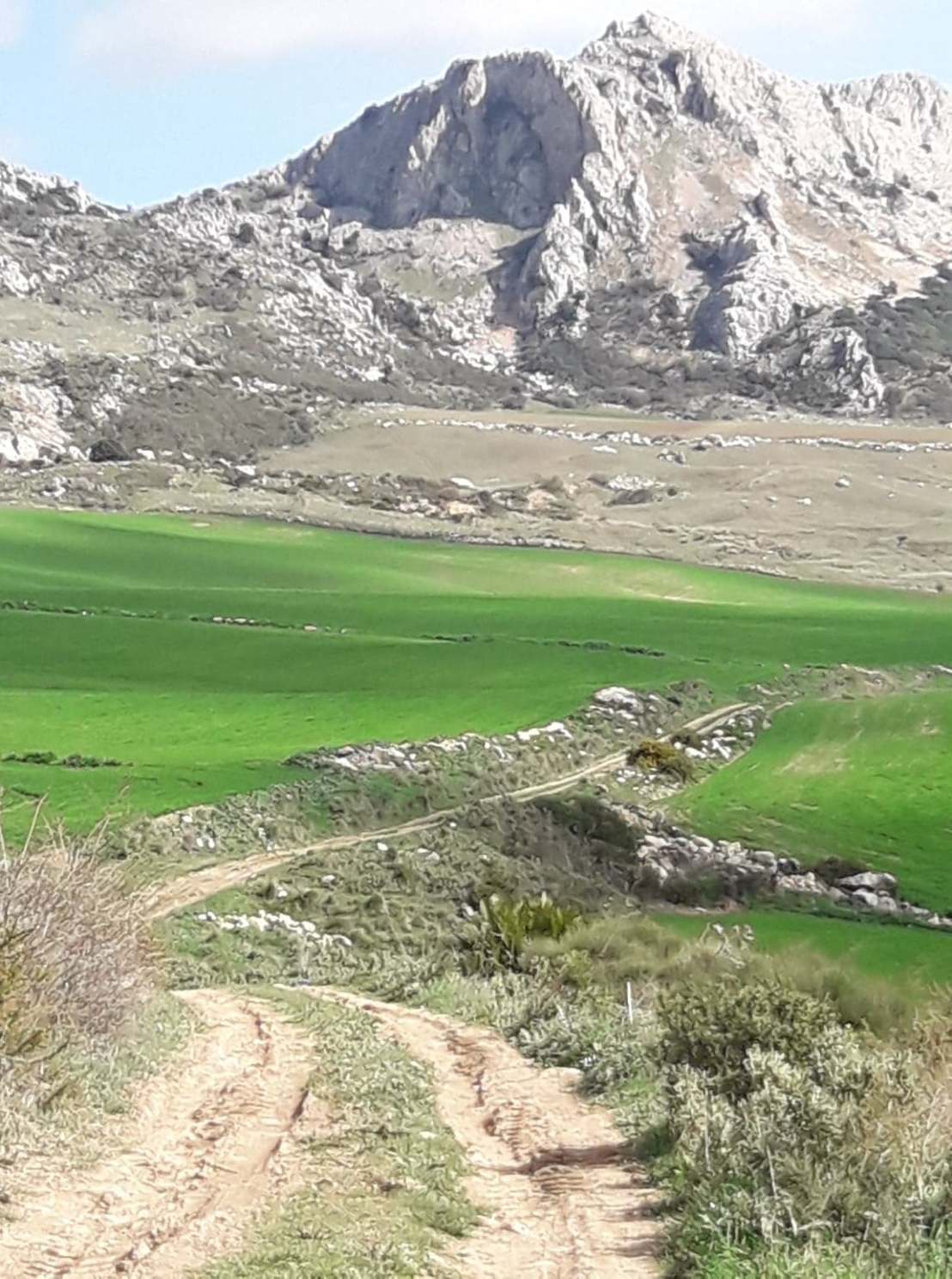
With large birds of prey cruising on the thermals above, the pair headed down the concrete track – easy on the feet – through the forest with views to the Montes Grupo de Libar (Libar mountain range) beyond. The path then climbed up a rocky staircase between peaks before descending through scrubland to the vast flat-bottomed Libar valley. This is really a high plain and the lush grass provides grazing for the local cattle, giving the area the appearance of a prairie in a Western.
They headed west on an undefined path until reaching a large stone hut which offers shelter to hikers in summer but was closed up, presumably not anticipating mad Englishmen and their dogs arriving in mid-winter. However, it provided a good spot to strike camp, with water and a table for cooking and eating. Once she’d been fed and watered, Chica wanted to go to bed. She sat in her night jacket demanding entry to the tent but had to wait while Tom ate his freeze-dried hot pot!
Sleep was a little disturbed as Chica growled at the various grunts and howls in the night. At one point, Tom got up to investigate, concerned that there may be a hoard of marauding wild boar in the vicinity. There wasn’t, but the clear night sky was beautiful so far from civilisation.
In the morning, it was cold as the surrounding peaks screened the sun. Out of the early mist, a herd of small deer, probably roe, crossed the valley and a fox passed close by, alerting a sleepy Chica who opened one eye and then went back to sleep.
By 10, breakfasted and packed, they continued to the end of the high plain. From here the track gradually descended towards the pueblo blanco (white village) of Montejaque. Here they relaxed in a café for a while before continuing over the next range of hills to meet me on the road a few miles outside Ronda. Chica looked very pleased to see us!
“Was it as good as you remembered?” I asked.
“Absolutely, and more.”
“And the camping? Everyone here thought you’d freeze to death”
“Ha – as if! It was great!”
ooOOoo
Wonderful! Just take, for example, that last photograph. What colours, what intense contrast, what a beautiful scene.
That isn’t the only one by far!
I don’t want this walk to end and I’m sure you echo my thoughts.
For my previous post was entitled Day Eight etc. and this one is also called Day Eight.
Ah well, it’s the content that counts!
Which is to say that the next three days are, again, devoted to Tom’s walk along GR7.
ooOOoo
Day 8: Cerra de la Fantasia to Benacoaz 16k
By Tom and Chica, 27th January, 2020.
Written by Tom’s wife.
Authors note: Because we have had such a long weather delay, I have decided to number only the days that Tom and Chica actually walk otherwise it is going to give a very unrealistic idea of how long it takes. That is why today is Day 8 and the last walking day was originally Day 10 (but is now Day 7). I have updated all the blog references to correspond.
We were up with the lark this morning. Earlier in fact, as it was still dark but we were keen after such a long rain delay. We left the village in fog and went in and out of the sun and mist all the way up to the start point miles into the forest. It was still murky there too and we didn’t hang around as there was a gathering of hunters. Their dogs were in trailers, barking with excitement as this is probably the only time they ever get let out of their cages. But what happens to them after the end of the season next week? I can’t bear to think about it. But that’s why we’re doing this – so onwards and upwards my faithful duo!
After coming out of the forest onto the road, the trees gave way to scrub and the track roughly followed the same route as the road. The mist made it hard to get a feel for the surrounding landscape at first but then as the mist became patchy there were glimpses of the majestic valley and surrounding mountains – a truly spectacular view but impossible to capture on a phone camera.
The track crossed the road and descended to the river – Rio de Ubrique – which heads towards the town of the same name. After a bit of a clamber up a steep, wet, rocky and rather unsavoury path between agricultural outbuildings, we popped out right next to the town sign.
It was a pleasant stroll through the comparatively large and bustling town centre. The sun was now properly out and so Tom stopped in a plaza outside the Town Hall and had a coffee while Chica scrounged titbits by breathing in and contriving to look half starved! Carrying on up through the narrow streets, they arrived at the Convento de Capuchinos where a sign to Benacoaz pointed up a cobbled road: the Calzada Romana (Roman Road).
This proved quite tough on the feet as the cobbles were uneven and scattered but after 3.5k it emerged into the village of Bonacoaz, perched on the side of the mountain with vast panoramic views south – stunning end to today’s beautiful walk.
ooOOoo
I know I have said it before, and undoubtedly I will say it again, but this account of Tom’s walk with his two dogs is astounding! They have been walking for over a week and they are experiencing countryside and more that must be unique to Spain.
I was born towards the tail end of 1944; six months before the end of WWII in Europe.
As such I was in my early twenties when NASA came to the wider attention of millions of people with their effort to put a man on the moon. It was enthralling to look up at the night sky when a moon was present and think that in time there would be a man standing on the moon’s surface.
Now that I am 75 many things have changed. But one of them has not: Staring up at the night sky and getting lost in thought. Luckily we live in a rural location without artificial light anywhere nearby and the night skies are very clear.
All of which takes me back to my days of sailing. From 1986 until 1991 I lived on a deep-water ketch, a Tradewind 33, based in Larnaca, in Cyprus. Each Spring, I would solo across to the Turkish coast, or the Greek coast, and meet up with friends, or my son and daughter, and go coastal cruising. Then in the last year I sailed for England. I well recall seeing the night sky all around me with the stars practically down the watery horizon.
But more of that some other day. Now back to the moon.
All of which is to republish this post and I do hope you will be able to read it fully.
ooOOoo
NASA video reconstructs the harrowing lunar journey of Apollo 13
NASA’s reconstruction of the moon’s far side is based off images received by its Lunar Reconnaissance Orbiter spacecraft. (Photo: NASA/Snapshot from video/YouTube)
On April 15, 1970, NASA astronauts Jim Lovell, Jack Swigert and Fred Haise aboard Apollo 13 set a Guinness World Record for the highest absolute altitude attained by a crewed spacecraft at a distance of 248,655 miles from Earth. Nearly 50 years later, that unplanned record still stands as part of a mission beset by technical glitches and saved by engineering heroism.
“We didn’t slow down, unlike the others, when we got to the moon because we needed its gravity to get back, so we hold the altitude record,” Lowell told the Financial Times in 2011. “I never even thought about it. Records are only made to be broken.”
Gliding by the moon’s far side at an altitude of only 158 miles, the crew of Apollo 13 were, at the time, one of only a handful of humans to ever gaze upon this strange and relatively-unknown terrain of our closest neighbor. Because the moon is tidally locked, a phenomenon in which an orbiting body takes just as long to rotate around its own axis as it does to revolve around its partner, only one side ever faces the Earth.
Using imagery collected by its Lunar Reconnaissance Orbiter spacecraft, NASA has recreated views observed by Apollo 13 during the crew’s harrowing 25-minute journey around the moon’s far side.
“This video showcases visualizations in 4K resolution of many of those lunar surface views, starting with earthset and sunrise, and concluding with the time Apollo 13 reestablished radio contact with Mission Control,” the agency said in a release. “Also depicted is the path of the free return trajectory around the Moon, and a continuous view of the Moon throughout that path. All views have been sped up for timing purposes — they are not shown in ‘real-time.'”
This video uses data gathered from the Lunar Reconnaissance Orbiter spacecraft to recreate some of the stunning views of the Moon that the Apollo 13 astronauts saw on their perilous journey around the farside in 1970. These visualizations, in 4K resolution, depict many different views of the lunar surface, starting with earthset and sunrise and concluding with the time Apollo 13 reestablished radio contact with Mission Control. Also depicted is the path of the free return trajectory around the Moon, and a continuous view of the Moon throughout that path. All views have been sped up for timing purposes — they are not shown in “real-time.” Credits: Data Visualization by: Ernie Wright (USRA) Video Produced & Edited by: David Ladd (USRA) Music provided by Universal Production Music: “Visions of Grandeur” – Frederick Wiedmann
According to Lowell, despite the astronauts’ extremely close proximity, the moon was not the most awe-inspiring scene outside the spacecraft window.
“The impression I got up there wasn’t what the moon looked like so close up, but what the Earth looked like,” he said.
“The lunar flights give you a correct perception of our existence. You look back at Earth from the moon and you can put your thumb up to the window and hide the Earth behind your thumb. Everything you’ve ever known is behind your thumb, and that blue-and-white ball is orbiting a rather normal star, tucked away on the outer edge of a galaxy. You realize how insignificant we really all are. Everything you’ve ever known — all those arguments and wars — is right behind your thumb.”
ooOOoo
Did you watch the video? It’s amazing and is literally the dark side of the moon!
Apollo 13 was the seventh crewed mission in the Apollo space program and the third meant to land on the Moon. The craft was launched from Kennedy Space Center on April 11, 1970, but the lunar landing was aborted after an oxygen tank in the service module (SM) failed two days into the mission. The crew instead looped around the Moon, and returned safely to Earth on April 17. The mission was commanded by Jim Lovell with Jack Swigert as command module (CM) pilot and Fred Haise as lunar module (LM) pilot. Swigert was a late replacement for Ken Mattingly, who was grounded after exposure to rubella.
Accidental ignition of damaged wire insulation inside the oxygen tank as it was being routinely stirred caused an explosion that vented the tank’s contents. Without oxygen, needed both for breathing and for generating electric power, the SM’s propulsion and life support systems could not operate. The CM’s systems had to be shut down to conserve its remaining resources for reentry, forcing the crew to transfer to the LM as a lifeboat. With the lunar landing canceled, mission controllers worked to bring the crew home alive.
Although the LM was designed to support two men on the lunar surface for two days, Mission Control in Houston improvised new procedures so it could support three men for four days. The crew experienced great hardship caused by limited power, a chilly and wet cabin and a shortage of potable water. There was a critical need to adapt the CM’s cartridges for the carbon dioxide removal system to work in the LM; the crew and mission controllers were successful in improvising a solution. The astronauts’ peril briefly renewed interest in the Apollo program; tens of millions watched the splashdown in the South Pacific Ocean by television.
An investigative review board found fault with preflight testing of the oxygen tank and the fact that Teflon was placed inside it. The board recommended changes, including minimizing the use of potentially combustible items inside the tank; this was done for Apollo 14. The story of Apollo 13 has been dramatized several times, most notably in the 1995 film Apollo 13.
Los Alcornacales – cork and pork and much, much more.
By Tom and Chica, 24th January, 2020
Written by Tom’s wife.
So far, during this part of the walk, Tom and Chica have been travelling through the unique habitat of Los Alcornacales. We fell in love with this beautiful area the first time we visited back in 2013. As we are rained off at the moment, I thought I’d take the opportunity to research more about the area, especially the amazing cork oaks which comprise large areas of the forest.
Granted natural park status in 1989, Natural Park Los Alcornacales occupies a protected area of 170,025 hectares in Andalusia. Soil, moisture and traditional uses have been the main factors in the conservation of the largest productive area of cork trees anywhere on the Iberian Peninsula. Located in the province of Cadiz and part of Malaga (mainly in the municipality of Jimena de la Frontera, where we have just been walking), it runs from the mountains down to the recently created Estrecho Nature Park on the coast and is home to a variety of landscapes, flora, fauna, history and folklore.
This rich diversity is mainly due to the many rivers, streams and reservoirs but also the moisture that comes from the coast. This latter accumulates to form banks of mist in the deep, narrow gorges known as ‘canutos’. In these conditions, the ancient laurel forest flora has flourished. Characterised by smooth, bright leaves, it can make the most of the moisture and limited light that penetrates the alders growing on the edge of the gorges. So, amidst the scent of laurel and the beauty of flowering rhododendrons, you can walk through this dense forest accompanied by the sound of dippers, kingfishers, blackcaps and finches.
Egyptian mongooseGriffon vulture
In the more clay-rich areas lower down you can see the wild olive tree, cleared from time immemorial to make way for pasture for the region’s most typical livestock, the brown Retinta cow. On the valley sides, the Mediterranean scrub of rockrose, heather, lavender, daphne and hawthorn is perfect for Andalusian deer, as well as buck, roe deer and carnivores such as genets, badgers and also the Egyptian mongoose – the largest population anywhere on the Iberian Peninsula.
Cork production
Los Alcornacales and the surrounding areas are home to the Iberian cork industry. As well as its most well-recognised use as bottle-stoppers, cork is also found in many products from car construction to aeroplane insulation.
The cork oak, quercus suber, is a native of both the northern and southern shores of the Mediterranean. Its age is unknown, but quercus suber or its ancestors have been around for at least 147 million years. It is a prophyte, ie a species adapted to survive fire. While other species rely on seed propagation to survive fires, the cork layer protects the stem of the tree so it only has to regenerate branches. This makes it very well adapted to the fire-prone forest of southern Spain.
Archaeologists have found evidence of tribes actively working with cork oak in northern Africa before 6,000 BC. Early man would have used the various species of oak for fire wood, tools, weapons; and for building as the hunter-gatherers began to settle. Similar evidence has been found in Andalucía and other parts of southern Spain dating back 4,000 years BC or more.
However, it would take a few thousands more years before the special sealant qualities of cork would be utilised. This property is due solely to the presence of one particular constituent: suberin. Suberin is a fatty substance found in the cells of the denser forms of cork which stops the passage of air or liquid.
Cork was probably first used as a sealant in containers by the Greeks and Phoenicians, for wines and other liquids in pottery containers but it would take the invention of the glass bottle, a fairly recent innovation in historical terms, for cork to finally meet glass. Legend claims that Friar Perignon, a French monk, discovered this use for cork on a slender glass bottle neck in the seventeenth century. As news of its efficacy spread, so a new industry appeared.
Cutting the cork is a highly skilled task and requires two years training. It is unusual for a tree to survive ring barking (the bark being removed around the complete circumference) and it needs to be done with care and at the right time. The cutters’ experience tells them how far to cut up the tree to avoid harming it. Cutting is only legally permitted between 15 June and 15 August which is when gangs roam the oak forests, each of the usually five members having a specific role, from chief cutter to lowly carrier.
These gangs traverse the forest in a nine-year cycle, allowing the trees they cut to regenerate the cork in the intervening period. Their mules roam free in the forest except for the two month harvest period when they trek back and forth between harvest site and cork factory. So expert is their knowledge of the routes that, once loaded, a tap on the back will send them off unaccompanied. The town of Cortes de la Frontera actually holds burro-loading contests at its annual summer feria, with a prize for the most ingenious loading of a burro.
What we see lying curled on the ground is still many stages away from fitting into the neck of a bottle. At the factory the cork is boiled in a vast, deep pool of water, which renders it malleable for flattening and then processing by machine. The cork then goes through several levels of compression, depending on its destination. It emerges as very thin sheets of varying sizes, perhaps thinner than a child’s little finger. It is then checked for quality – the oak trade has five levels, from excellent to poor – and the oak is assigned to an appropriate use.
Most interestingly, however, is how it does reach the bottles we uncork. Bottle corks are stamped out by machines at different widths for wine, champagne and cognac (Spanish cork is treasured by French brandy producers). When they pile up in the dumpers beneath the pressing machines, they look like big wooden pennies. These are graded by quality, and then carefully fed into further compressing machines. Cork makers reckon that it would be a waste of good cork to use it throughout a wine or champagne cork, so lower quality cork is placed in the middle, highest quality at either end, where the cork meets both wine and outside air. These layers are then compressed so tightly we do not even notice that a cork we pull is not one single unit but a compression of up to eight layers crushed together. The finished corks are then dispatched to bottling plants across Europe and beyond.
There have, of course, been concerns about the rise of the plastic cork. Its proponents say that it prevents a bottle being ‘corked’, ie, spoiled, by air penetrating the old-fashioned cork. Its detractors argue that, beyond the aesthetics of levering a wad of white plastic out of your favourite wine, it doesn’t allow the alcohol to breathe naturally. (French brandies breathe so profusely that the distilleries are wreathed in fumes which promote fungi on the roofs and keep nearby cattle happily sozzled year-round.) Yet with even the British supermarket buyer seemingly moving upmarket in their choice of corked drinks, and the Spanish and French keeping their noses in the air over plastic stoppers, it seems the Iberian peninsula can hold on to its two billion euro cork industry yet.
Other uses for cork include flooring. We have some of this in our bathroom at home. A long way from the basic dull cork tiles of old, now it comes in stunning patterns and looks beautiful. It is also sustainable, provides excellent insulation and is lovely and warm to walk on. If I could, I’d floor the whole house with this.
Iberian pigs
The Iberian pig is a traditional breed of the domestic pig (Sus scrofa domesticus) that is native to the Iberian Peninsula and is currently found in herds clustered in the central and southern part of Portugal and Spain. Its origins can probably be traced back to the Neolithic, when animal domestication started.
The most commonly accepted theory is that the first pigs were brought to here by the Phoenicians from the Eastern Mediterranean coast, probably along the old droving tracks one of which our route, the GR7, roughly follows. They interbred with wild boar and this cross gave rise to the ancestors of what are today’s Iberian pigs.
Prized Iberico ham
The production of Iberian pork is deeply rooted to the Mediterranean ecosystem. It is a rare example in world pig farming where the pig contributes so decisively to the preservation of the ecosystem. The Iberian breed is currently one of the few examples of a domesticated breed which has adapted to a pastoral setting where the land is particularly rich in natural resources, in this case acorns from the holm oak, gall oak and cork oak.
The numbers of the Iberian breed had been drastically reduced since 1960 due to several factors such as the outbreak of African swine fever and the lowered popularity of animal fats. In the past few years, however, the production of pigs of the Iberian type has increased to satisfy a renewed demand for top-quality meat and cured products. Now, though, there is controversy over the providence of the highly prized Iberico ham as breeders cash in on the market and produce a similar but much less sustainable product more cheaply, thus threatening this ancient livelihood.
The Iberian pig can be either red or black or in between. In traditional management, animals ranged freely in sparse oak forest (dehesa in Spain, montado in Portugal). They are constantly on the move and therefore burn more calories than confined pigs. This, in turn, produces the fine bones typical of this kind of jamón ibérico. At least a hectare of healthy dehesa is needed to raise a single pig. True dehesa is a richly diverse habitat with four different types of oak that are crucial in the production of prime-quality ham. The bulk of the acorn harvest comes from the holm oak (Quercus ilex) but also the Pyrenean oak (Quercus pyrenaica) and Portuguese or gall oak (Quercus lusitanica) and the late cork oak season, which extends the acorn-production period from September almost to April.
Some recent research from Cordoba university concluded {the translation isn’t perfect but you get the idea}:
‘The couple Iberian pig and dehesa has proved to be very effective; so much [so] the Iberian pig is called the dehesa jewel, but the first needs this agro-ecosystem to reach its highest quality properties (organoleptic and nutritional ones); and the second needs a clear commercial differentiation for Iberian pork and cured products in order to receive a high price to maintain and conserve the dehesa. Spanish authorities should be responsible for protecting this traditional system from fraud and unfair competition. In this way, farmers economy could be enough to conserve this unique ecosystem and its values for the whole society.’*
Whether you eat pork or not you may still believe as I do, that this traditional and sustainable way of producing it is better for the ecosystem and the pigs than intensive farming on a huge scale. And we love seeing the black pigs snuffling through the forest. I hope it can be protected along with the rest of this remarkable and stunningly beautiful area.
ooOOoo
Well I must say that this is a tremendous post and a privilege to be able to republish it.
Gilliwolfe did an incredible job in composing the post and inserting all the photographs. Well done!
I want to get further ahead in the story of this walk and I get the very clear impression that you are in agreement with this.
My readership numbers have been high and there have been no negative responses to the generous offer from Tom and his wife to republish Tom’s long and interesting walk along the Spanish pathway GR7.
So on we go!
ooOOoo
Day 7: Jimena de la Frontera to Cerra de la Fantasia 20k
By Tom and Chica, 22nd January, 2020
Written by Tom’s wife.
The last two days were non-walking days, one for bad weather and another to move base again. Now we have the luxury of being in a house for a while in Jimera de Libar, a village we know well.
So the day started with the drive back to Jimena and the weather looked reasonable. Again, Merlin refused to be left so the three of them set off up the path, climbing steadily for the first hour and a half.
Climbing path.Spanish Fir / Pinsapo (Abies Pinsapo) in the background
The path eventually levelled out and passed beneath the rocky outcrops of the Altos de Paneron and Cerro de Marin. After a bare rocky sections where the route was harder to determine, they went into dense forest of oak and Spanish fir (we love these and call them lollipop trees because of their shape). Both dogs in great form, but Tom was mean and moody :).
Dark clouds were gathering from all directions but the view to the coast was still impressive. However, it wasn’t long before the rain began and the temperature dropped.
Looking south – you can just see the sea.
Fortunately the rest of the route was on a well-defined and signposted track, winding down through the cork oaks in the midst of the Los Alcornacales. It was here deep in the forest that I eventually picked them up. I had forgotten that smaller Spanish roads aren’t always roads as I know them and the last five and a half miles I was driving along a rough track with no mobile signal, not at all sure I was in the right place. Even though we have a 4×4, I made very slow progress and it was with considerable relief that I found them, damp but completely unconcerned.
ooOOoo
I wonder why Tom felt “mean and moody”? Gilliwolfe doesn’t say.