The wonderful combination of paragliding and flying with hawks.
Thanks to Dan Gomez for passing me a short video about this amazing activity. It was a matter of moments to find out the background. But first a picture.
Copyright Scott Mason
There’s a full description of the history of parahawking, as it is called, on WikiPedia.
Parahawking is a unique activity combining paragliding with elements of falconry. Birds of prey are trained to fly with paragliders, guiding them to thermals for in-flight rewards and performing aerobatic maneouvres.
Parahawking was developed by British falconer Scott Mason in 2001. Mason began a round-the-world trip in Pokhara, Nepal, where many birds of prey – such as the griffon vulture, steppe eagle andblack kite – can be found. While taking a tandem paragliding flight with British paraglider Adam Hill, he had the opportunity to see raptors in flight, and realized that combining the sport of paragliding with his skills as a falconer could offer others the same experience. He has been based in Pokhara ever since, training and flying birds during the dry season between September and March.
The team started by training two black kites, but have since added an Egyptian vulture and a Mountain hawk-eagle to the team. Only rescued birds are used – none of the birds has been taken from the wild.
There’s an interesting website for those that want to take a closer including more details about Scott Mason and his team here.
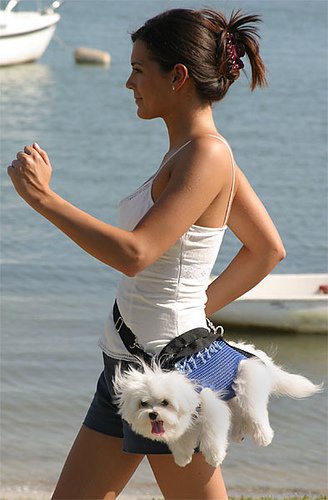
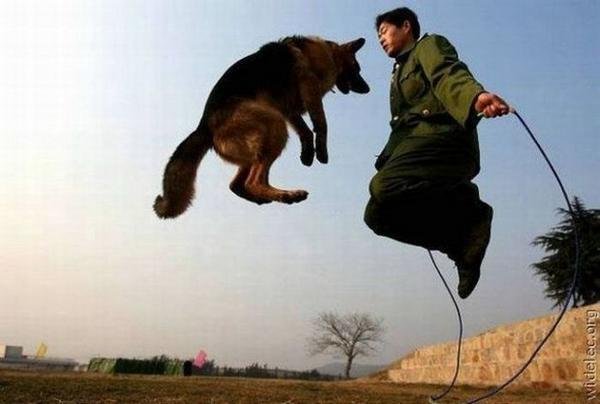
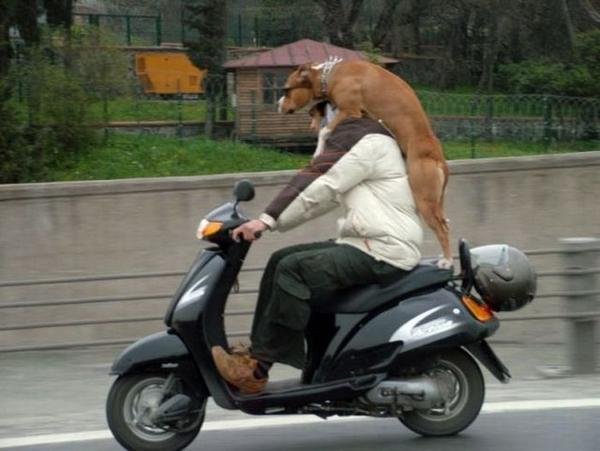
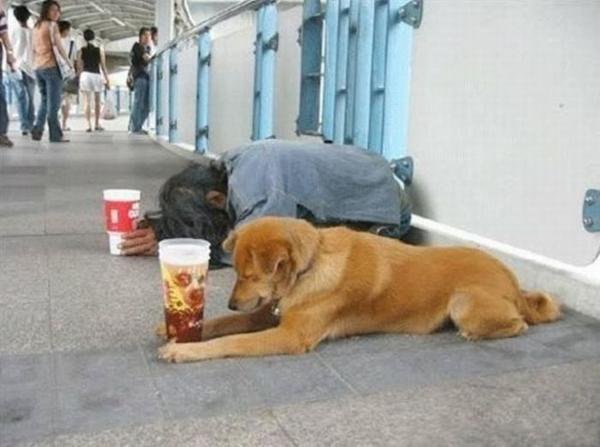
Just some wonderful pictures of people and their pet dogs!
It’s 2pm Mountain Time on the 28th. I wanted to get a deeper post written for tomorrow (today as you are reading this!) but somehow too many things have been happening today.
So I’m ‘cheating’ and using a recent email sent to me by Cynthia Gomez, Dan’s lovely wife, that was called When your dog is your best friend. It contained some fabulous photographs of people and their pet dogs. A quick Google search showed that they came from a website devoted to finding homes for pets, Just One More Pet. Enjoy the pics.
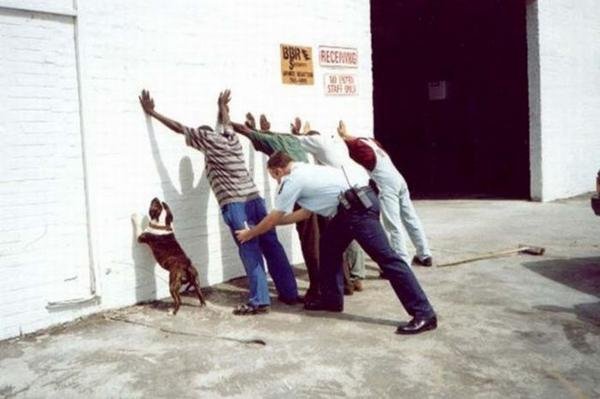
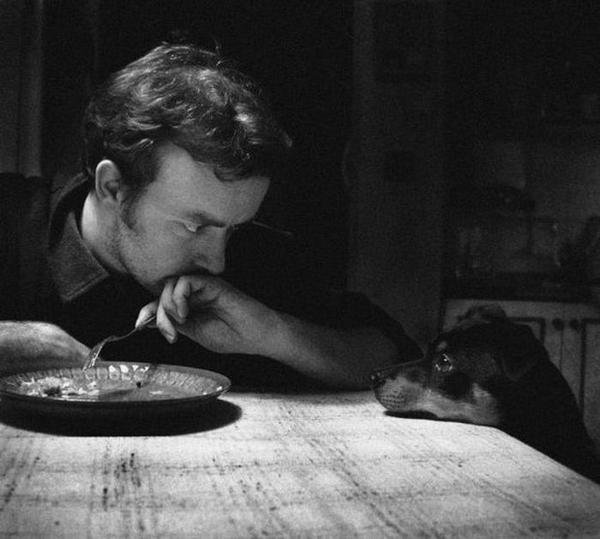
Cute dog!Even matching helmets!Makes your heart skip as well!A team of two.Cool rider, man!Difficult to resist!I love a good frisk!A beautiful bond - always!
Thanks Cynthia for sharing those – heart-melting stuff!
A focus on Tim Bennett’s movie, What a Way To Go: Life at the end of Empire
We first came across this film, made by independent film-maker Tim Bennett, on the Top Documentary Films website, see here. The title to this article comes from that introduction, from which is quoted,
Tim Bennett, middle-class white guy, started waking up to the global environmental nightmare in the mid-1980s. But life was so busy with raising kids and pursuing the American dream that he never got around to acting on his concerns. Until now…
Bennett journeys from complacency to consciousness in his feature-length documentary, What a Way To Go: Life at the End of Empire. He reviews his Midwestern roots, ruthlessly examines the stories he was raised with, and then details the grim realities humans now face: escalating climate change, resource shortages, degraded ecosystems, an exploding global population and teetering global economies.
Now to be honest, this is a film that is both captivating and, in parts, pretty grim. A couple of trailers and other background material were posted on Learning from Dogs back in February.
The film also has an excellent web site What a Way To Go Movie which contains much background material including the opportunity to watch the film for free, click here. Or a quick YouTube search will bring you to here.
My own view is that this is a ‘must see’ film. Not because I want all of you to wallow in doom and gloom, far from it, but because, as Paul Gilding writes in his book, The Great Disruption, the quicker that mankind recognises the massive levels of denial presently in place, the quicker that mankind will commit to the scale of change that is required. That’s where Paul Gilding’s approach differs from the movie, The End of Empire. Gilding is optimistic that man will bring about change simply because fairly soon, in just a few years, it will be obvious at all levels in our societies that there simply is no choice!
I subscribe to Naked Capitalism, as many of you will be aware, and in their 20th July release were the following photos,
In fact, a quick Google search reveals that the photographs have been widely circulated over recent years and in all probability the source and original story are long lost by now.
I love taking photographs but this takes the cake!
(Note: there’s an option in WordPress to insert a ‘read more‘ link, the effect of which is to limit what you, dear reader, can see when you first come to a Blog article. I prefer normally not to insert that link. But for reasons that will soon be very obvious, it has to be used in this Post.)
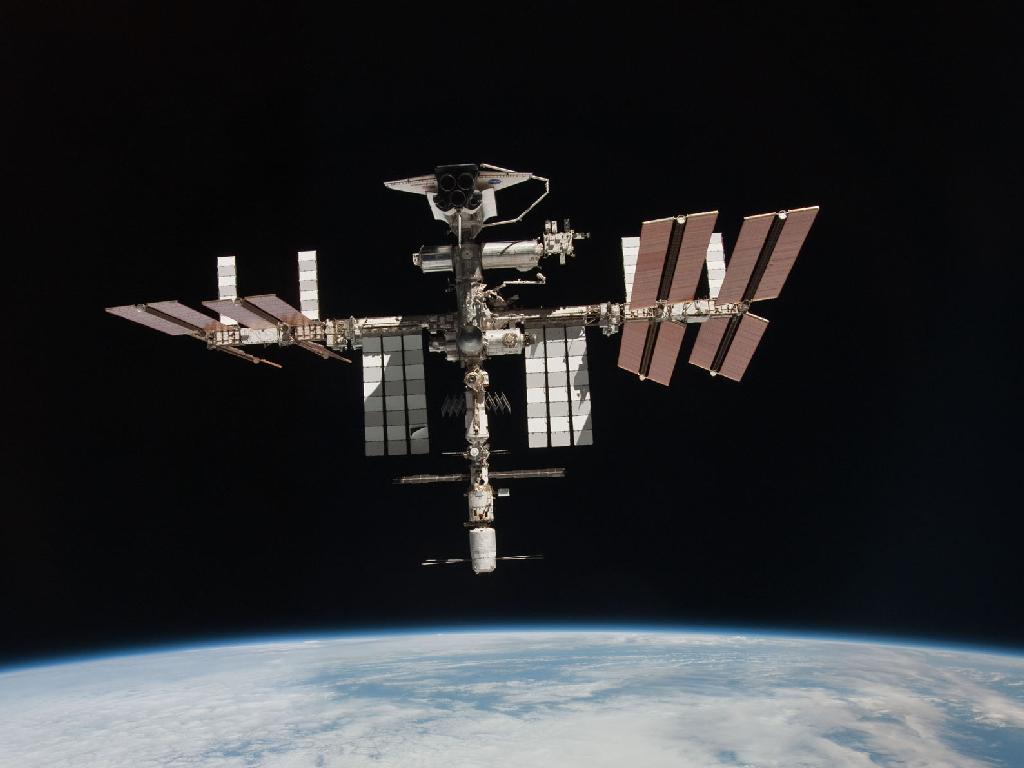
It is a stunning image and one that is bound to be reproduced over and over again whenever they recall the history of the US space shuttle.
The picture was taken by Italian astronaut Paolo Nespoli as he left the International Space Station in May in a Soyuz capsule to return to Earth.
Safety procedures mean the Russian vehicle would never normally be in transit when a shuttle is present.
It makes this the first-ever image of an American orbiter docked to the ISS.
Endeavour sits firmly on the bow of the station, which is moving across the surface of the Earth at a speed of 27,000km/h (17,000mph) and at an altitude of approximately 355km (220 miles).
Nespoli’s camera is looking along the ISS’s truss, or backbone, which carries the four sets of giant solar wings. The stern is occupied by Europe’s robotic freighter – the Johannes Kepler ship.
The pictures were acquired on 23 May but were only released by the US space agency (Nasa) on Tuesday [7th June, PH]. They had been eagerly awaited by space fans.
Nespoli had spent a lot of time during his 159-day stay at the station taking pictures of Earth and life aboard the international outpost. Many of these images were posted on his mission Flickr account. It was widely expected therefore that the European Space Agency astronaut would get some excellent shots during the unique departure.
Enthusiasts on the ground with telescopes routinely try to snap a shuttle attached to the ISS, and some of the results have been very impressive. But none of these pictures compares to the majestic portrait acquired by Nespoli so close to the orbiting complex.
The timing and subject are also perfect. Endeavour is seen here making her final sortie into orbit, making the last big US assembly item delivery – a $2bn particle physics experiment known as the Alpha Magnetic Spectrometer. The seven-tonne machine now sits on top of the platform.
Endeavour was also the orbiter chosen to take up the first American segment of the platform when the project had just got started in the late 1990s.
The youngest of Nasa’s shuttles returned to Earth on 1 June and will now be prepared for public display at a science museum in California. Sister ship Atlantis stands ready on the launch pad in Florida for a swansong of her own in July. Once her mission is done, no orbiter will ever fly again.
Nespoli’s crewmates in the Soyuz were Russian cosmonaut and Expedition 27 commander Dmitry Kondratyev; and Nasa astronaut Cady Coleman. Apart from the photo opportunity, their departure was a standard ISS crew rotation flight.
Their replacements blasted off from Kazakhstan on Tuesday in another Soyuz vehicle. Nasa astronaut Mike Fossum, Russian cosmonaut Sergei Volkov and Japanese astronaut Satoshi Furukawa are scheduled to arrive at the ISS on Thursday, raising its complement once again to six individuals.
The venerable Soyuz will be the only way for astronauts and cosmonauts to reach the platform in the years following the retirement of the shuttle fleet.
Nasa hopes some US commercial carriers will become available in the middle of the decade.
The NASA weblink attributed above is here, from which can be read,
This image of the International Space Station and the docked space shuttle Endeavour, flying at an altitude of approximately 220 miles, was taken by Expedition 27 crew member Paolo Nespoli from the Soyuz TMA-20 following its undocking on May 23, 2011 (USA time). The pictures taken by Nespoli are the first taken of a shuttle docked to the International Space Station from the perspective of a Russian Soyuz spacecraft. Onboard the Soyuz were Russian cosmonaut and Expedition 27 commander Dmitry Kondratyev; Nespoli, a European Space Agency astronaut; and NASA astronaut Cady Coleman. Coleman and Nespoli were both flight engineers. The three landed in Kazakhstan later that day, completing 159 days in space.
Do go to the NASA website here as there are a total of 40 stunning images.
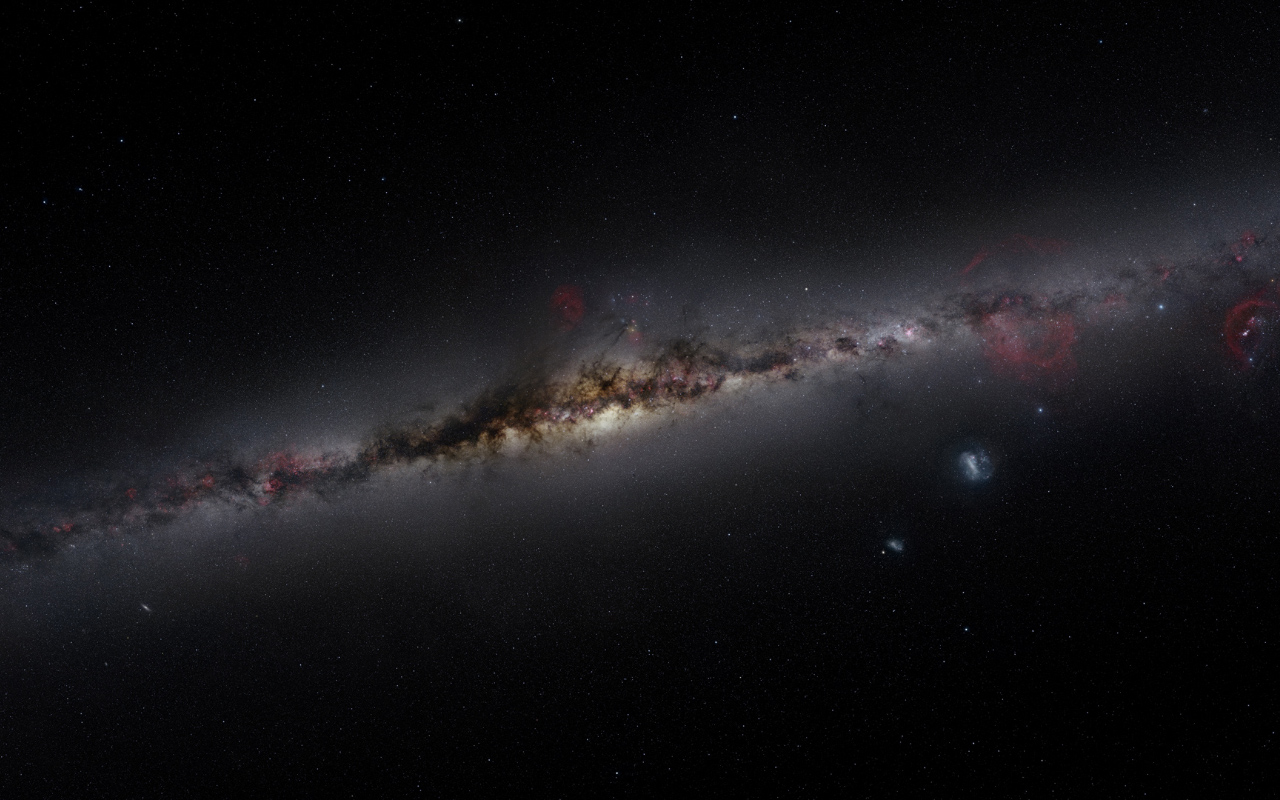
Tens of millions of stars, the glowing factories of newborn ones, and a rich tapestry of dust all floating on a stage of unimaginable proportions.
The image is from the Photopic Sky Survey website. From which also comes the following,
What do you see? This was the anthropic question of a year-long photographic project dubbed the Photopic Sky Survey, meant to reveal the entire night sky as if it rivalled the brightness of day. In it we see tens of millions of stars, the glowing factories of newborn ones, and a rich tapestry of dust all floating on a stage of unimaginable proportions. I hope you enjoy this new view of our place in the universe as much as I have enjoyed making it.
The Photopic Sky Survey is a 5,000 megapixel photograph of the entire night sky stitched together from 37,440 exposures. Large in size and scope, it portrays a world far beyond the one beneath our feet and reveals our familiar Milky Way with unfamiliar clarity. When we look upon this image, we are in fact peering back in time, as much of the light—having traveled such vast distances—predates civilization itself.
Well done, Nick Risinger, for all your efforts and for presenting such a magnificent detailed view of the heavens above.
Plus, more or less the same time, this came to my attention, from the BBC News website.
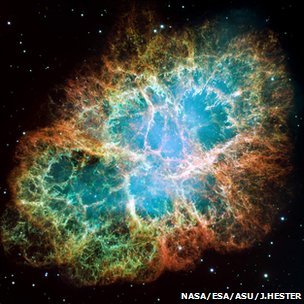
A Hubble classic: The Crab Nebula is about 6,500 light-years from Earth
The Crab Nebula has shocked astronomers by emitting an unprecedented blast of gamma rays, the highest-energy light in the Universe.
It seems to have come from a small area of the famous nebula, which is the wreckage from an exploded star.
The object has long been considered a steady source of light, but the Fermi telescope hints at greater activity.
The gamma-ray emission lasted for some six days, hitting levels 30 times higher than normal and varying at times from hour to hour.
While the sky abounds with light across all parts of the spectrum, Nasa’s Fermi space observatory is designed to measure only the most energetic light: gamma rays.
These emanate from the Universe’s most extreme environments and violent processes.
The Crab Nebula is composed mainly of the remnant of a supernova, which was seen on Earth to rip itself apart in the year 1054.
At the heart of the brilliantly coloured gas cloud we can see in visible light, there is a pulsar – a rapidly spinning neutron star that emits radio waves which sweep past the Earth 30 times per second. But so far none of the nebula’s known components can explain the signal Fermi sees, said Roger Blandford, director of the Kavli Institute for Particle Astrophysics and Cosmology, US.
Beautiful images that will make appreciate the majesty of wild animals.
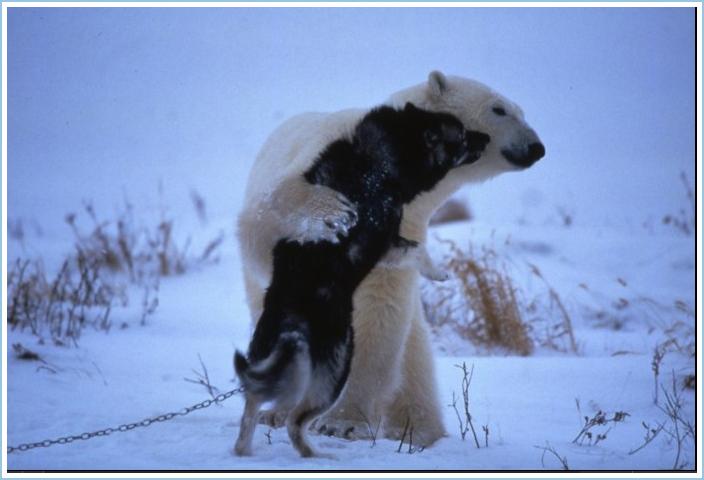
First a big thank you to Mary and Ed G. for passing me an email that contained fabulous photographs of the polar bear playing with a husky dog. From that email it was the matter of a few moments to find more on the Internet.
Let’s start with a YouTube video of a short talk by Stuart Brown called Animals at Play.
Then another YouTube video that is from FirstScience TV, which appears to be a defunct website.
These charming pictures were taken by renowned nature photographer Norbert Rosing, whose work has appeared inNational Geographic and other magazines, as well as several books including The World of the Polar Bear (Firefly Books, 1996), in which Rosing recounts the story of how these particular photographs came to be taken.
The location was a kennel outside Churchill, Manitoba owned by dog breeder Brian Ladoon, who kept some 40 Canadian Eskimo sled dogs there when Rosing visited in 1992. A large polar bear showed up one day and took an unexpected interest in one of Ladoon’s tethered dogs. The other dogs went crazy as the bear approached, Rosing says, but this one, named Hudson, “calmly stood his ground and began wagging his tail.” To Rosing and Ladoon’s surprise, the two “put aside their ancestral animus,” gently touching noses and apparently trying to make friends.
Just beautiful!
If you want to watch the whole sequence of photographs including background notes to each picture, click here.
A wonderful tribute to Yuri Gagarin and all his team.
When I recently wrote of it being 41 years since Swigert on board Apollo 13 transmitted “Okay, Houston, we’ve had a problem here.” I also included a closing reflection as follows,
Finally, this Post is published, not only on the 41st anniversary of that memorable Apollo Flight but the day after the 50th anniversary of Yuri Gagarin’s first flight of a human into space, the 12th April, 1961.
Coincidentally, our favourite documentary film website, Top Documentary Films, featured on April 14th the new film First Orbit. We watched the film that night. It was a most unusual format for a film, yet a most haunting experience. Watching the credits, it then became clear that the film was a co-operative venture made especially for the 50th anniversary of that remarkable, historic flight.
Of course, had I previously been aware of the venture and this remarkable film then it would have been promoted on Learning from Dogs in good time before the anniversary date. However, better late than never!
Indeed, there is a dedicated website in recognition of this First Orbit. Here’s the background to the film,
April 12th 1961 – Yuri Gagarin is about to see what no other person has seen in the history of humanity – the Earth from space. In the next 108 minutes he’ll see more than most people do in a lifetime. What sights awaited the first cosmonaut silently gliding over the world below? What was it like to view the oceans and continents sailing by from such a height?
By matching the orbital path of the Space Station, as closely as possible, to that of Gagarin’s Vostok 1spaceship and filming the same vistas of the Earth through the new giant cupola window, astronaut Paolo Nespoli, and documentary film maker Christopher Riley, have captured a new digital high definition view of the Earth below, half a century after Gagarin first witnessed it.
Weaving these new views together with historic, recordings of Gagarin from the time, (subtitled in Englsih) and an original score by composer Philip Sheppard, we have created a spellbinding film to share with people around the world on this historic anniversary.
The music in the film is most beautiful, quite moving. Here’s the background to the music from the First Orbit website,
First Orbit’s producer Christopher Riley first worked with Philip in 2006 on the Sundance Award winning feature documentary film ‘In the Shadow of the Moon‘ and since then Philip had been working on a new suite of music inspired by spaceflight.
“We’d been working with some of these tracks on another project” says Chris, “and we suddenly realised how perfectly they could compliment ‘First Orbit’ as well. We contacted Philip to ask his permission to use them, only to find that his entire Cloud Song album was already in orbit onboard the International Space Station!”
“NASA astronaut Cady Coleman, had them on her iPod” says Philip. “Her husband Josh Simpson is a friend of mine and they’d listened to a lot of my music together before she left, so I made up a playlist for her!”
Quite by coincidence Cady had been listening to the music in ‘First Orbit’ at one end of the Space Station whilst European Space Agency astronaut Paolo Nespoli was shooting for the film at the other end, without either of them knowing the connection!
Back on Earth Chris and the film’s editor Stephen Slater took Philip’s tracks from Cloud Song and weaved them together with Paolo’s new views of the Earth to create the different moods of the film; from the first views of snowy Siberia to the darkness of night over the Pacific Ocean and the homecoming over Africa, as Gagarin starts to re-enter the atmosphere.
The result is a mesmerising combination of imagary and music which we hope convey the spectrum of emotions which no doubt went through Yuri’s mind as he gazed down upon the Earth.
Finally, here’s the film. It’s an hour and thirty-nine minutes and, as I said, an unconventional film experience. But if any part of you either remembers the event or wonders what it was like, those 50 years ago, then find somewhere out of reach of interruptions and watch the film.




 Learning from Dogs