Category: Photography

Rivers of ice

or should that be rivers of tears for our planet!

Our beautiful planet

A chance dip into the BBC News website a few days ago allowed me to come across an article about the vanishing glaciers in the Himalayas.  It just about broke my heart.  Here’s what it said,

Rivers of ice: Vanishing glaciers

Stunning images from high in the Himalayas – showing the extent by which many glaciers have shrunk in the past 80 years or so – have gone on display at the Royal Geographical Society in central London.

Between 2007 and 2010, David Breashears retraced the steps of early photographic pioneers such as Major E O Wheeler, George Mallory and Vittorio Sella – to try to re-take their views of breathtaking glacial vistas.

The mountaineer and photographer is the founder of GlacierWorks – a non-profit organisation that uses art, science and adventure to raise public awareness about the consequences of climate change in the Himalayas.

Rivers of Ice: Vanishing Glaciers of the Greater Himalaya can be seen at the RGS in London until 11 November 2011. Admission free.

All photos courtesy GlacierWorks and Royal Geographical Society. Map copyright Jay Hart. All images subject to copyright.

Music courtesy KPM Music. Audio slideshow production by Paul Kerley. Publication date 11 October 2011.

Then follows a 3:59 film made by David Breashears that is so beautiful as well as so upsetting.  I don’t have a way of linking to the film directly but it’s easy to watch, just click here and be very moved.

David Breashears has his own website, from where one can learn that,

David Breashears is an accomplished filmmaker, adventurer, author, mountaineer, and professional speaker. Since 1978, he has combined his skills in climbing and filmmaking to complete more than forty film projects.

In 1983, Breashears transmitted the first live television pictures from the summit of Mount Everest, and in 1985 became the first American to reach the summit of Mount Everest twice.

In the spring of 1996, Breashears co-directed and co-produced the first IMAX film shot on Mount Everest. When the now infamous blizzard of May 10, 1996 hit Mount Everest, killing eight climbers, Expedition Leader Breashears and his team were in the midst of making this historic film. In the tragedy that soon followed, Breashears and his team stopped filming to provide assistance to the stricken climbers. After returning to Base Camp, Breashears and his team then regrouped and reached the summit of the mountain on May 23, 1996, achieving their goal of becoming the first to record IMAX film images at Earth’s highest point. Breashears has said that if there is a lesson to be learned from the May 1996 tragedy, it is that for him, success that year was not to be found in reaching the summit, it was that everyone on his team returned safely. The film, titled EVEREST, premiered in March 1998.

As was written in that BBC item, David is the founder of GlacierWorks which is full of beautiful, albeit tinged with sadness, images of the glaciers featured in that BBC item.  As the GlacierWorks website explains on the home page,

The Mighty Himalayan Glaciers are Vanishing.

The rate of recession is unprecedented, accelerating and, without some remedy to the problem of climate change, unstoppable. GlacierWorks is a non-profit organization that uses art, science, and adventure to raise awareness about the consequences of climate change in the Greater Himalaya.

Read that first sentence again, “The rate of recession is unprecedented, accelerating and, without some remedy to the problem of climate change, unstoppable.” [my emphasis]

There are a number of videos on YouTube if you search for David Breashears, none up to the beauty of the slide show in the BBC item so don’t miss that at all.  However, the following is also worth watching,

OK, a change of topic but one that connects with the underlying message about the disappearing glaciers.  This was an article in the American The Nation newspaper written by Naomi Klein, following her speech to the demonstrators at Occupy Wall Street.  The article really should be read in full but I wanted to highlight just the following words from Naomi,

The point is, today everyone can see that the system is deeply unjust and careening out of control. Unfettered greed has trashed the global economy. And it is trashing the natural world as well. We are overfishing our oceans, polluting our water with fracking and deepwater drilling, turning to the dirtiest forms of energy on the planet, like the Alberta tar sands. And the atmosphere cannot absorb the amount of carbon we are putting into it, creating dangerous warming. The new normal is serial disasters: economic and ecological.

We all know, or at least sense, that the world is upside down: we act as if there is no end to what is actually finite—fossil fuels and the atmospheric space to absorb their emissions. And we act as if there are strict and immovable limits to what is actually bountiful—the financial resources to build the kind of society we need.

The task of our time is to turn this around: to challenge this false scarcity. To insist that we can afford to build a decent, inclusive society—while at the same time, respect the real limits to what the earth can take.

Thanks to Bill Mitchell of Billy Blog for linking me to the Naomi Klein speech.

We can afford to build a decent, inclusive society and we must – not tomorrow but now.  Start with your local community, think about transition.  Some of our grandchildren will be mountaineers – let them see the beautiful rivers of ice.
After George comes Brutus

Big thanks to Cynthia S. for forwarding this to me.

Before writing about Brutus, did you read yesterday’s item about George, the rescue dog, and the wonderful effort to raise funds for more life-saving efforts?  If not, read it here. Whatever you can spare, please donate to this super cause.

Now to Cynthia’s item, that has been fairly widely spread across the internet.

How to hug a baby

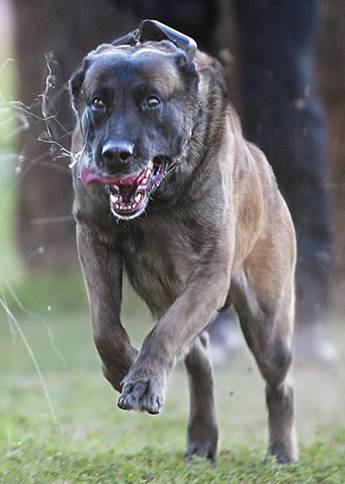
Brutus

Thought you might like to know about this dog and his history, I especially like the ending, Cynthia.

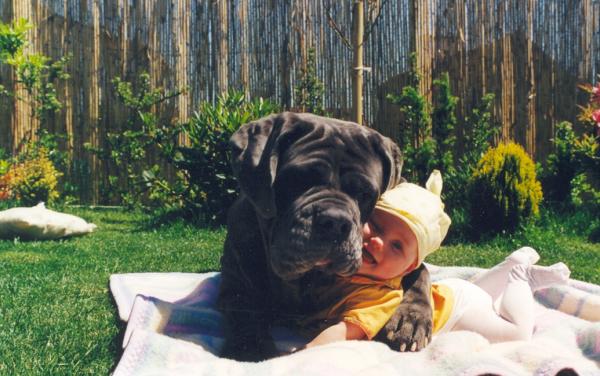
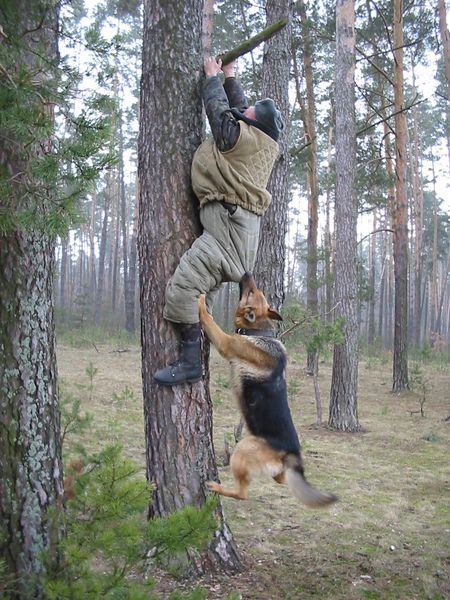
The dog above is Brutus, a military dog at McChord.. . He’s huge, part Boxer and part British Bull Mastiff, and tops the scales at 200 lbs. His handler took the picture and explains, “Brutus is running toward me because he knows I have some Milk Bone treats, so he’s slobbering away! I had to duck around a tree just before he got to me in case he couldn’t stop, but he did.”

Brutus was the recipient of the Congressional Medal of Honor last year from his tour in Iraq.  His handler and four other soldiers were taken hostage by insurgents.  Brutus and his handler communicate by sign language and he gave Brutus the signal that meant ‘go away but come back and find me’.  The Iraqis paid no attention to Brutus.  He came back later and quietly tore the throat out of one guard at one door and another guard at another door.  He then jumped against one of the doors repeatedly (the guys were being held in an
old warehouse) until it opened.  He went in and untied his handler and they all escaped.  Brutus is the first dog to receive this honor, the Congressional Medal of Honor.  If he knows you’re ok, he’s a big old lug and wants to sit in your lap.  Enjoys the company of cats..

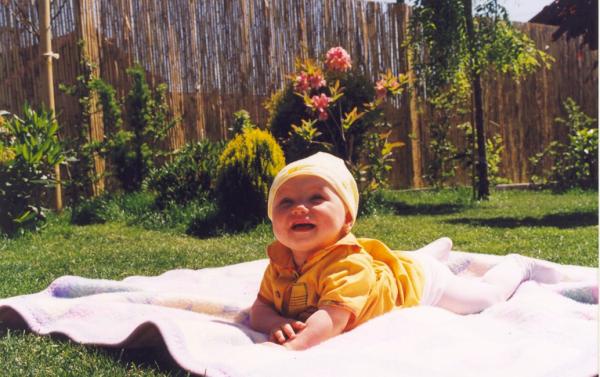
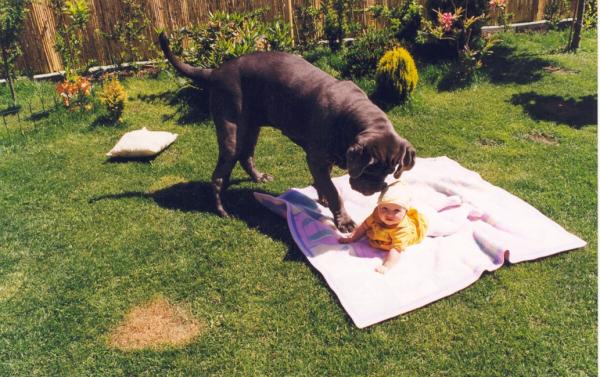
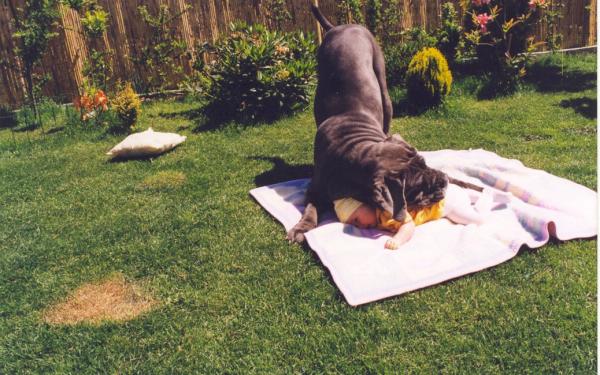
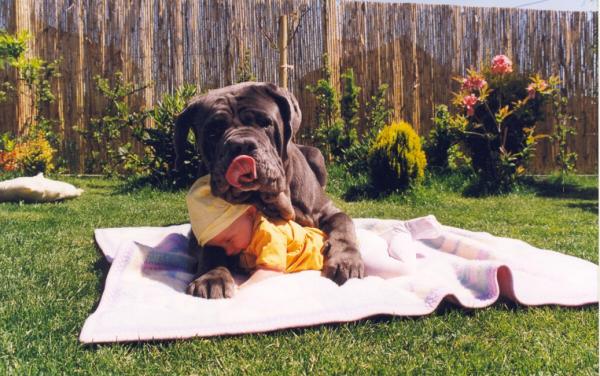
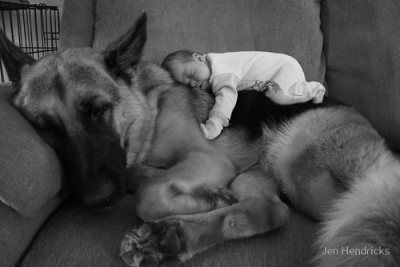
Instructions for properly hugging a baby with Brutus

(A quick Google search found that the words accompanying the same pictures on Daniela’s website, The Daily Tail, were perfect, thus they have been used.)

Step One – Place the baby on a flat, uncluttered surface. Important: Do not attempt this without the assistance of a qualified parent.

Step One

Step Two –  Conduct a sniff test to verify the specimen is actually a baby. The scent of baby powder is usually sufficient evidence.

Step Two

Step Three – Carefully adjust the baby’s position until its head faces the mother’s camera. Note: Babies have two ends. The end covered with a hat or hair is the head. The end covered with a diaper is the butt. Babies do not have tails.

Step Three

Step Four – Lay your body down over baby. Do not apply pressure. While gently placing your paws around the baby’s body, lick your lips to condition them for the kiss (essential part of the hug).

Step Four

Step Five – Lean in toward the baby and let your heart melt. Repeat as necessary until the parent finds the camera and takes a perfect picture.

Step Five

Thanks Cynthia for this lovely story.

Please Help a George

A canine charitable opportunity that deserves wide support.

The details that follow strike a chord with me, strike a chord in a big way.  When I first came to live with Jean back in 2008 it was clear that this wasn’t going to be a normal relationship.  Why?  Because, at that time Jean had 12 dogs living with her in San Carlos, Mexico and my arrival, together with my Shepherd dog, Pharaoh (see home page for a picture of him), took that number to 13.  Jean’s dogs were all Mexican rescues; she also ran her own local humane society in San Carlos and over the years had found homes for literally dozens of dogs.

One of those Mexican rescues was a dog called Loopy, who had been terribly treated by local Mexicans.  The consequence when I arrived, a stranger in the middle of Loopy’s life with Jean, was that Loopy was very aggressive towards me; my hands have small scars to bear witness to the number of nips Loopy launched in my direction.

It took over a year before I was able to just let my hand ‘accidentally’ brush her side.  Slowly Loopy’s trust in me built up until now I can press my face to her face and cuddle her for ages.  (To underline the love that Loopy bestows on me, I will get Jean to take a picture and publish that before the end of the week.)  So with that in mind, let me turn to the details recently sent to me by friend and colleague, Dapinder Singh, from England.

———————

George and loving owner, Ian.

This is George. He was in an English dog pound and condemned to death.

He had been very badly abused, one eye blinded by what was thought to be a kick, he trusted no-one and had rejected all human contact.  He was desperate and in despair.

After an exhaustive search for anyone who take on the rescue of George, we (as in Doris Banham) took him into our care just a day before he was due to be euthanased.  His veterinary problems were easier to deal with than the mental ones.  His eye was damaged beyond repair causing him constant pain so it had to be removed, teaching George to trust again was much harder.

That journey back to trusting humans was long, George had suffered severe and terrible abuse,  but there was no question of giving up on him and slowly but surely he began to live again as we fought to undo the wrongs that had been done to him. After some months with us, a wonderful family came to the rescue and offered George his ‘forever’ home where he found the love that he so deserved. His family are completely devoted to him.

His story, however, could have been a very different one were it not for the work of the team at Doris Banham’s. Below is an extract written by the lovely family who adopted him and from our fantastic volunteer, Sheila, who helped bring George back to life again.

“Hi, Sheila. Here is a shot of George in his new garden. He is settling down very well and seems to be very happy. I will keep you posted as to his progress. All the best Liz and Ian.”

There were a number of photographs sent to Sheila, however I have taken editor’s liberty and moved them to the foot of the article – I want you to stay with this to the point where you can see how to help.  Here’s Sheila’s reply,

“WELL THESE BOUGHT ME TO TEARS , OUR GEORGE , THIS IS TRUE RESCUE , THIS IS ALL DOWN TO YOU DORIS BANHAM NOTHING ELSE TO SAY …” SHEILA X.

Are there other Georges out there?  You bet! Far too many of them, right across the world.  So let’s all do something to help these special creatures, who show us humans just what unconditionally love feels like.

Friday 4th November, 7.30pm – Come to the Hellaby Hall Hotel, Old Hellaby, Maltby, Yorkshire, S66 8SN

Call for tickets now to the Pound Dog Ball telephone number (UK) 07772 538513 or email pogpublications@yahoo.com  Full details here.

Please help all the Georges out there by supporting this Charity Fundraising Event: Black Tie, Dinner/Dance at Hellaby Hall, Rotherham, 7.30pm, on Friday 4th November. It’s a don’t miss night…..3 course meal, live entertainment all night and dancing ’til late!!!! It’s going to be a great night.

If you can’t make the Ball but would like to send in a donation then please post a cheque, made out to Pound Dog Ball, to the following address:

c/o Jennifer Smith

Clumber Lodge,

50 Hemingfield Road

Wombwell, S73 0LY.

Or if you prefer an electronic donation, further details are:

Pound Dog Ball
A/C 31542265
Sort 40-45-29 (HSBC)

The account is a charity account, set up only for this event.  Once the money has been paid to the charities the account will be closed.

All monies raised will be shared between http://www.dogsos.co.uk/ (Doris Banham) and http://www.barnsleyanimalrescue.org.uk/  (Barnsley Animal Rescue Charity)

I know that Dapinder, and everyone else involved in helping these precious animals, sends you their heartfelt thanks.

Finally, more photos of George enjoying life as all dogs should. What a wonderful story, an honour to be able to publish it, and promote the Ball, on Learning from Dogs.  Please help.

Be entranced

Our beautiful planet home; the only one we have.

With great thanks to Dan G. for sending me the link.

Science educator James Drake built this amazing timelapse video from the perspective of the International Space Station as it flew over North and South America. He created this video by downloading a series of 600 photographs that were available online at theGateway to Astronomy Photograph of Earth, and then stitching them together into a complete video. You can see more of James work at his blog: infinity imagined.

Yet another Saturday smile!

With big thanks to Cynthia S. for sending me the pics.

GET OUT AND ENJOY NATURE

Don’t sit around  the house . . . Get out and enjoy  nature!

No! I'm not stealing your eggs!
So much for offering him a biscuit!
Hey! Gimme a fish!
Just want our tummies rubbed!
Hope you're being nice to my friend!
What part of the word 'no' you have trouble with, mister?

.. .. never mind, let’s just go back inside. .

Saturday smile, continued

Starting to turn into a bit of a theme for Saturdays.

Today’s pics courtesy of Pauline C.

Carried on a sunbeam.


Bonding with a capital 'B'!


Bonding, part two!


Ah, a warm fire, a comfy chair ....


Something's slight odd! Any ideas guys?


The pic says it all!

Not good if detached.

The power of real words

Yesterday, I published a soft little item showing some reflective pictures and rather appropriate words of attachment.  Little did I know that some very powerful word forces were planning same day to really thump me around the head.  Here’s what happened.

The church that Jean and I go to on a regular basis is very inspiring.  Two reasons come to mind.  The first is the love and friendship that the congregation offer, both to regulars and visitors alike.  The second is the spiritual inspiration gifted to the priest and, boy oh boy, does that come out through his sermons.  Indeed, the rest of this article was motivated by yesterday’s sermon.

Take a look at the American railway ticket above.  Turn your head and look at the right-hand part.  What do you read?  ‘This check is not good if detached‘.  Now let me quote a little from the sermon,

It is difficult to care for people in the world when we are not a caring community.  It is totally absurd to speak of peace in a world when we do not have peace in our community.  It is impossible to be an instrument of love in the world if we are not a community of love.

What is true in the Church is of course true in the world as a whole.  We do need to learn to live together.  Railway tickets used to carry the words, “Not good if detached.”  That is true of life in general.  Our survival and progress as people on this planet are dependent on our interrelatedness.

See the beautiful spiritual inspiration that comes from those gifted to draw such powerful word pictures.  Take that last word ‘interrelatedness’.  Jean and I are studying at the local college for a Master Gardener’s Certificate.  For the simple reason that we have to find a way to tame our wild garden, comprised mainly of decomposed granite granules, so that we can grown our own vegetables, have some chickens, that sort of thing.

The last session was about botany.  To a complete non-gardener like me it was, nonetheless, fascinating.  What moved me beyond measure was the detail and complexity of all things botanical; grasses, trees, shrubs, flowering plants, you name it.  It was the interconnectedness of it all.  Here’s an example.

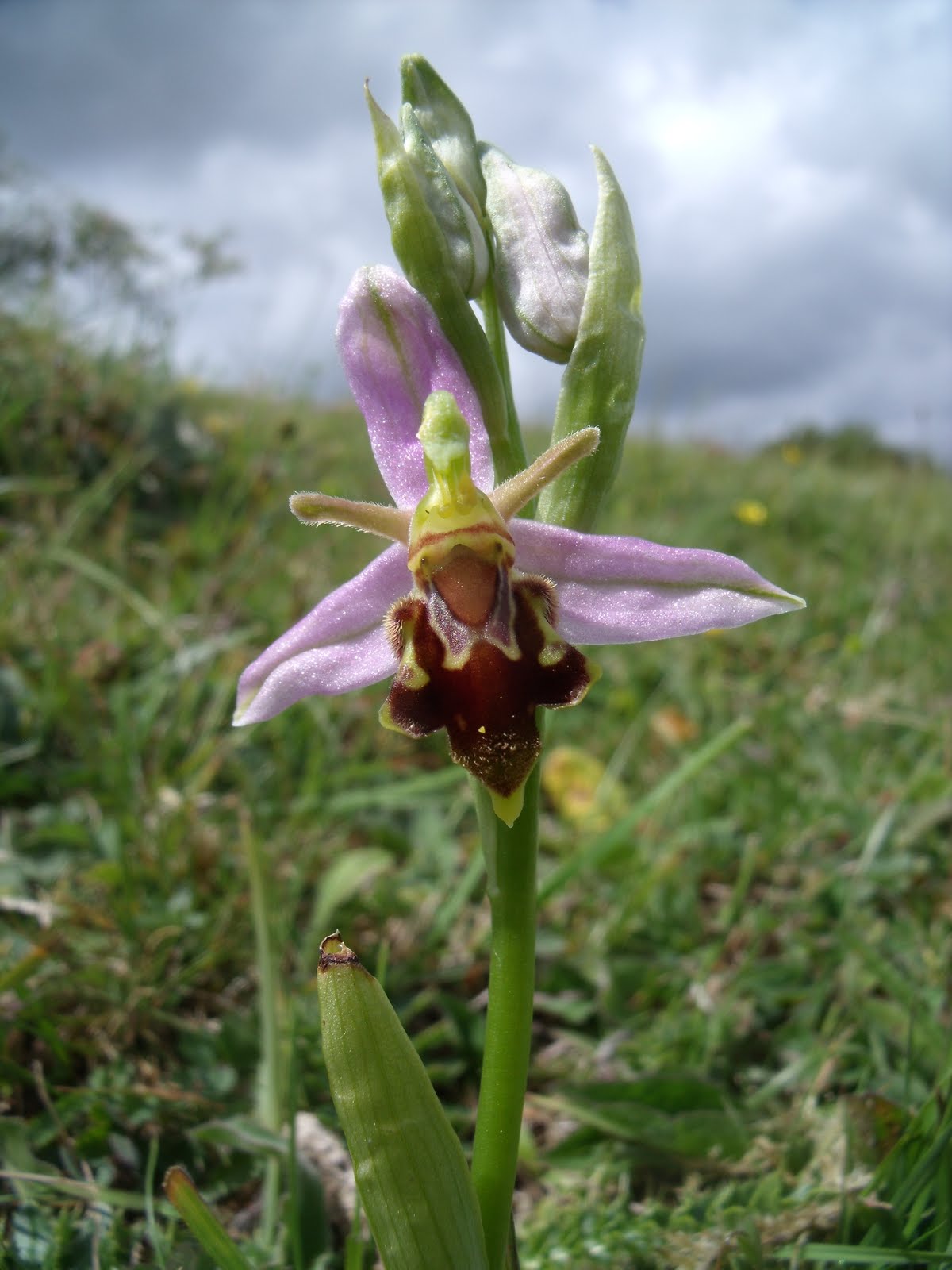
Not a female wasp, just an orchid.

Certain orchids dupe male wasps into trying to mate with them.  Here are a few extracts from a piece in the New Scientist website,

Few can resist the allure of a beautiful rose, but some wasps outdo even the most ardent flower lover. Presented with the right specimen, a male orchid dupe wasp ejaculates right on the petals.

Many insects mistake flowers for femmes, but few go as far as these wasps, says Anne Gaskett, a biologist at Macquarie University in Sydney, Australia, who led a study of the insects’ amorous intentions toward two species of Australian tongue orchids. “It’s just so hard [for the wasps] to resist,” she says.

——

Orchids are known for toying with males. Many species produce female-mimicking perfumes that lure males into spreading pollen. But most insects merely touch down on the flowers.

——

But why might an orchid provoke such misdirected affection? Gaskett thinks that her experiments show an extreme form of sexual deception that helps the flowers spread their own seed.

Think about that the next time you order flowers!

Now have a quick watch of this video extract from the BBC,

OK, let me get back to that botany class.  As our teacher pointed out, lose that particular species of wasp and the planet probably loses that species of orchid.  Think about the interconnectedness of that, and much more in the beautiful planet all around us.  It is such a marvellous, beautiful, complex and interconnected world.  We need constant reminding of that fact.  Which is where yesterday’s sermon hit the mark again.

Inspired by the pictures from a flight to the moon in 1968, American poet Archibald MacLeish spoke these beautiful words:

To see the earth as it truly is, small, blue, beautiful in the eternal silence where it floats, is to see ourselves as riders on the earth together …

That is a wonderful image, riders on the earth together.  It speaks of our togetherness as a human race, brothers and sisters on this fragile island within the vastness of the universe.  Brothers and sisters … that really need to know … that we are brothers and sisters.

We need to do all that we can to build bridges, to mend bridges, to stay together as a true community… because we are:

Not good if detached.  Amen.

What a powerful sermon.  What inspired power in those words.  Real words.

Earthrise, from Apollo 8, 1968

Forgive me for holding your attention just a tad longer.  This is the full Archibald MacLeish’s quotation, referred to in the sermon above.

To see the earth as it truly is, small and blue and beautiful in that eternal silence where it floats, is to see ourselves as riders on the earth together, brothers on that bright loveliness in the eternal cold—brothers who know now they are truly brothers.

Archibald MacLeish, American poet, ‘Riders on earth together, Brothers in eternal cold,’ front page of the New York Times, Christmas Day, 25 December 1968

This is what Frank Borman, who was on Apollo 8, had published in Newsweek, 23 December 1968,

When you’re finally up at the moon looking back on earth, all those differences and nationalistic traits are pretty well going to blend, and you’re going to get a concept that maybe this really is one world and why the hell can’t we learn to live together like decent people.

This is what Frank Borman was reported as saying in the press in early 1969,

I think the one overwhelming emotion that we had was when we saw the earth rising in the distance over the lunar landscape . . . . It makes us realize that we all do exist on one small globe. For from 230,000 miles away it really is a small planet.

and this,

The view of the Earth from the Moon fascinated me—a small disk, 240,000 miles away. It was hard to think that that little thing held so many problems, so many frustrations. Raging nationalistic interests, famines, wars, pestilence don’t show from that distance.

The power in those words. The power of the truth about our interconnectedness and the power of Not good if detached.

Let me leave you with a fragment from another Blogsite that I came across quite by chance while researching for this piece.

A blog is a voice, the inner voice, telling, in this case, what is going on, inside and out. And in me, that means it should also be about my spiritual path. My spiritual life is as important to me as breathing. Without connection with the One, what is life? What is it for?

Not good if detached.  Amen.

Amen indeed.

More love in many forms.

A fascinating and beautiful insight into wild turkeys!

Yesterday, I published a couple of stories that demonstrated that close, loving bonds can form between different species, including an orang-utan and a dog, and a duck and a man.

By chance, Jean and I came across another example of cross-species bonding.  This time between Joe Hutto, an American living in Florida, and a brood (is that the right description?) of newly-born wild turkeys.  The first thing these tiny birds saw when they opened their eyes after breaking clear of their egg was Joe, and they immediately imprinted him as their ‘mother’.

Joe spent a complete year and more being ‘mother’ to these birds right up to the point where they naturally flew the nest, so to speak.  Joe’s experiences led to a book, Illumination in the Flatwoods, and from that to a BBC Natural World special My Life as a Turkey, regrettably not available to viewers outside the UK.

But speaking to someone who did watch the BBC film, it was clear that it was a most beautiful and touching account of how young wild turkeys can bond to a human.  Here’s part of the programme review in the British Guardian newspaper,

By Sam Wollaston, Guardian.co.uk

Joe Hutto’s life changed when a local farmer in the Florida flatlands where he lives left a stainless steel dog bowl full of wild turkey eggs on the porch of his cabin. Joe put them in an incubator, and waited. Some weeks later, cracks began to appear. This is the crucial time: “imprinting” only occurs in the first few moments after hatching. So Joe put his face down to the level of the opening eggs and the first poult emerged, wet and confused. Joe made a chirping, clucky noise, the poult looked him square in the eye, “and something very unambiguous happened in that moment”.

The little turkey stumbled and crawled across to Joe, and huddled up against his face. It recognised Joe as its mother. In the next few hours, Joe became mother to 15 more baby turkeys and remained so for the next 18 months. My Life as a Turkey: Natural World Special (BBC2) tells that story.

Across to the programme details from the BBC2 website (may not be available 26 days after the date of this article),

Biologist Joe Hutto was mother to the strangest family in the world, thirteen endangered wild turkeys that he raised from egg to the day they left home.

For a whole year his turkey children were his only companions as he walked them deep through the Florida Everglades. Suffering all the heartache and joy of any other parent as he tried to bring up his new family, he even learnt to speak their language and began to see the world through turkey eyes. Told as a drama documentary with an actor recreating the remarkable scenes of Joe’s life as a turkey mum.

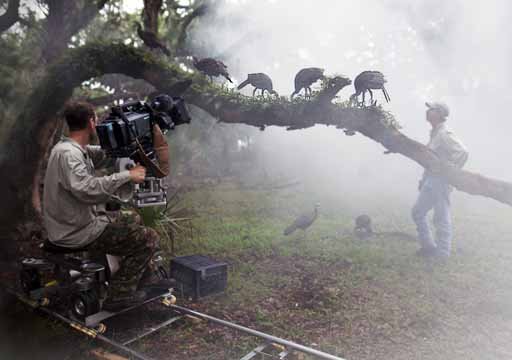
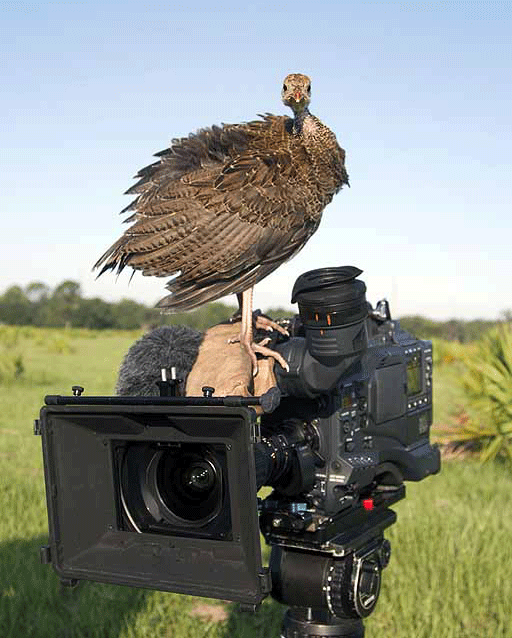
Behind the scenes image of turkeys and Jeff Palmer (actor) in misty forest in Florida. Cameraman (Mark Smith) on track & dolly shows how some of the beautiful sweeping shots were filmed.

Sam Wollaston of the Guardian continues,

It’s not hard to see how the little birds were taken in. Joe’s moustache does look a bit like feathers, he has a long scraggy neck, an understanding of the forest, and a tentative, birdlike walk. He takes them out, to catch their first grasshoppers; he teaches them how to roost. For Joe, as for any mother, parenthood is an emotional rollercoaster ride. There is the joy of seeing his babies grow, but almost constant worry. Grief too, when one is taken by a rat snake, and another by a hawk, and two more get sick (bird flu?) and die.

Adolescence arrives with all its associated problems. The males start fighting; only the toughest will get to mate. “I had no way of knowing how I was going to be part of this rite of passage,” says Joe. Steady now, Joe, let’s not take this too far, you’re not supposed to mate with any of them. For one, they’re your children. They’re also turkeys. That would be doubly wrong. Sometimes I think Joe spends too much time alone in the forest.

Quite so!  However, the film was so beautifully shot that it was very, very easy to forget that this was a re-enactment of Joe’s original experience.  That love is all about how you make someone, or in these cases, some other creature, feel.  Another couple of pictures from the BBC website,

Lights, camera, action!
Jeff Palmer (actor) sat on large felled tree on his cell phone with a dozen wild turkeys.

One final extract from the Sam Wollaston article in The Guardian newspaper,

My Life as a Turkey isn’t simply a wildlife film though. It’s not just about wild animals, it’s about one man’s relationship with wild animals, and that’s what makes it so fabulous. Serious animal behaviourists may not agree, but if you throw a human being in there, it all suddenly becomes a lot more interesting. I’m thinking Ring of Bright Water, Gorillas in the Mist, I’m definitely thinking Werner Herzog’s brilliant Grizzly Man about a man named Tim whose friendship with bears went wrong and he ended up inside one. My Life as a Turkey has something of Grizzly Man about it – a man obsessed, alone in a beautiful place, living with wild animals. But, although Joe was attacked, he didn’t end up inside one of his turkeys thankfully. There would have been a certain irony to that, especially if it had happened at Thanksgiving.

Anyway, it’s a lovely film – beautiful, charming, funny, sad, thought-provoking even. What thoughts did it provoke in me? That I need to go and see my mum.

Unfortunately, as mentioned above if you are outside the UK you are not able to watch the film via the BBC iPlayer system.  But you can buy the book.

Joe Hutto's book of his life with wild turkeys.

Available from Amazon, here’s just one of the reviews,

My review is not unbiased because Joe Hutto, author of “Illumination in the Flatwoods,” and I have been friends for almost 25 years.

Joe is the most humble man I’ve ever known. I am honored that he brought me the original manuscript to read. It was so beautiful I could have cried.

With the same graceful writing skills used by conservationists Aldo Leopold (“Sand County Almanac”) and Herbert Stoddard (“Memoirs of a Naturalist”), Joe gives a masterful mix of documentary-style nature reporting and heartfelt thoughts on the meaning of life. As dramatic as that sounds, I think most readers will agree that “Illumination in the Flatwoods” is a life-changing book.

You will never regret the dollars you spend to buy this book nor the time it takes you to read it. . .

Kathy McCord Cooley

“Love is just love, it can never be explained.”

Butting in!

With thanks to Jean who gave me a photocopy of this image!

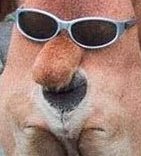
First we see just an ordinary dog ….

Just a dog.

then we see something that you can’t quite make out …

Sure I recognise this face??

Continue reading “Butting in!”

Lose yourself in the night sky

Time to forget about all the ‘stuff’ in the news.

Dogs have that wonderful ability to savour the moment and just enjoy the present.  Seems to me that there is just a bit too much going on at the moment in the big wide world and we could do a lot worse than take a chair out into the garden, or wherever, and enjoy the majesty of one of the light shows that the universe can put on.

But first an acknowledgement to Mike Shedlock, more details here.  I subscribe to his daily newsletter and it was there that, rather uncharacteristically for an economic blog, I saw the reference to the Perseids meteor shower which, annually, provides vivid viewing for us earth-bound creatures this time of the year.

Mike gave the link to an article in National Geographic Daily News, from which I quote,

A Perseid meteor appears to strike the peak of Mount Rainier, Washington, in 2010. Photograph by Siddhartha Saha, Your Shot

Andrew Fazekas

for National Geographic News

Published July 25, 2011

A celestial traffic jam may be on tap this week as two meteor showers combine forces to put on a brilliant sky show.

One of the best shooting star events of the year is the annual August Perseid meteor shower. (See Perseids pictures.) However this year’s peak, on August 12, happens to coincide with a bright full moon—drastically cutting down the number of meteors visible to the naked eye.

Yet while the main event might be blocked out by the blinding moonlight, the opening act promises to be much better.

(See “Year’s Biggest Full Moon, Mars Create Sky Show [2010].”)

This year the lesser known Delta Aquarid meteor shower is expected to peak on Friday night, when the Delta Aquarids’ more productive Perseid cousin is just starting to ramp up.

Together the showers will produce anywhere between 15 and 30 shooting stars per hour under clear, dark skies.

If this tickles your fancy then go to that article and read how best to view this wonderful sky show.

We haven’t seen them from this part of the world (i.e. Payson, Arizona), but down in South-West England it was easy to get up onto the moors (Dartmoor).  Sunset at this time of the year down in Devon is around 7pm local time and by 8pm there was often a beautiful cloudless night sky.

Wikipedia has some good background information on the Perseid meteor shower including, what I didn’t realise, that,

The Perseid meteor shower has been observed for about 2000 years, with the earliest information on this meteor shower coming from the Far East.  Some Catholics refer to the Perseids as the “tears of St. Lawrence“, since 10 August is the date of that saint’s martyrdom.

I think most people are aware, again from Wikipedia, that,

The shower is visible from mid-July each year, with the peak in activity being between August 9 and 14, depending on the particular location of the stream. During the peak, the rate of meteors reaches 60 or more per hour. They can be seen all across the sky, but because of the path of Swift-Tuttle’s orbit, Perseids are primarily visible in the northern hemisphere. As with all meteor showers, the rate is greatest in the pre-dawn hours, since the side of the Earth nearest to turning into the sun scoops up more meteors as the Earth moves through space.

But to come back to the National Geographic piece, as above, this year could be better than normal.  As I wrote,

This year the lesser known Delta Aquarid meteor shower is expected to peak on Friday night, when the Delta Aquarids’ more productive Perseid cousin is just starting to ramp up.

Together the showers will produce anywhere between 15 and 30 shooting stars per hour under clear, dark skies.

So I know it could be a tough choice – politics or standing in awe under a night sky – but, go on, force yourself!

Try that night sky.