A powerful and well-argued position from Waiving Entropy.
This is a cogent discussion article that was published back in July, 2013. Waiving Entropy is a blog that ranges across many aspects of life. As their About page states:
Waiving Entropy is a blog with humble aims. What began in 2011 as a gesture toward self-improvement evolved into a vitalizing outlet for creative expression. To write is to live more fully, and it has now become something I can scarcely imagine life without — a kind of formless, free-floating impulse that hovers about like a pregnant cloud. Fortunately, blogging is a kind of catharsis for the restless. Nothing eases an active mind like seeing your ideas materialize in a meaningful way in front of you, which is to say I write for myself first and foremost. This blog acts as both heat sink and hard drive, helping me offload scattered collections of thoughts and organize them into a coherent whole.
First, let me (with the help of WikiPedia) explain the difference between atheism and non-theism. It is in the form of a diagram:

So onto the article.
It is a long but a most interesting read.
ooOOoo
What Would Convince You?
July 10th, 2013

As an atheist and former theist I am on occasion asked what it would take to change my mind on this central metaphysical question. What met conditions or circumstances would reincorporate into my worldview the conviction that God exists and, more specifically, that Christianity offers the best explanation for the world we observe?
However we may currently identify, and however strong our convictions in any one area, we must take these questions seriously. If we possess well considered reasons justifying our beliefs, then we should also consider possibilities that could weaken or undermine those beliefs. A worldview which can never be moved around, reconfigured into different shapes, is a worldview better characterized by creed and dogma than by epistemic openness and intellectual integrity. If we are to be responsible in our commitment to truth, our positions must ultimately be defeasible — open to revision in light of new information — lest we fall victim to playing tennis without the net.
With this in mind, my overriding approach is that a belief should be demonstrable on the weight of evidence and argument. If new information is forthcoming, if the evidence (or interpretation of that evidence) changes, or if arguments with greater explanatory scope and internal consistency are offered, it is our epistemic duty to honestly assess these new inputs and what it entails for our existing orientation. This is a basic feature used to build conclusions in philosophy and science and can be broadly exported to other areas of our discourse.
Before we dive in, it will be useful to clarify an oft-omitted distinction that tends to bog down discussions on this topic. The distinction is that between a “direct participant” deity — the god of theism — who intervenes in space and time and cares about how the drama of life plays out, and the noninterventionist, “absentee landlord” variety of deism. The latter is irrelevantbecause its existence and nonexistence are logically identical (from our perspective) and thus is not the focus of this essay. Rather, I will deal here with the former, a transcendent being that has a hand in the natural order and is in some sense involved in the affairs of humans. This is the territory of theism, the regime with the most relevance to our daily lives and metaphysical luggage.
The “God Hypothesis”
Contrary to some atheists, I don’t subscribe to the notion that there is, in principle or otherwise, a falsifiable “God hypothesis.” Refuting God is not like refuting the proposition All swans are white by finding a gaggle of black-plumaged swans in Scandinavia, thereby bringing us closer to the truth about the nature of swans. While I do think certain religious beliefs have been rendered untenable by the lights of modern science and historical inquiry, I don’t think we can definitively adjudge an entity’s nonexistence in the case of theism.
What we can do, however, is point out the lack of evidence where evidence ought to be — in other words, build an evidential case for nonexistence. And this is where popular conceptions of theism tend to break apart, because a god that intervenes in space and time is a god that is accessible to scientific study. In a world where Christians and other monotheists profess belief in a meddler god who influenced ancient texts, answers prayers, appoints semi-sane politicians to run for office, and worked all manner of miracles throughout history, the utter vacuum of evidence for such assertions begins to speak volumes. If demons and angels and spirits and souls were part of the furniture of reality, then their effects in the world should have been clearly documented by now. Given all that is attributed to these ethereal entities, this paradox should at the very least strike a person as strange.
Accordingly, though we may not be able to conclusively rule out the God of theism and his confederacy of celestial beings — à la Russell’s teapot — we can be reasonably confident that no such entities exist, in short, because things that don’t exist leave no evidence behind. They can’t, after all, because they don’t exist.
If we want to be more careful in our language here, rather than claim outright that God does not exist we can simply say that we see no good evidence for God, and therefore (recalling John Dewey) a verdict cannot be reached on the question unless and until good reasons to warrant the belief are found. It’s an important distinction, in the same way that a jury for a criminal trial either finds sufficient evidence to convict, or not. A ‘not guilty’ verdict does not mean the defendant is innocent, only that there is insufficient evidence to establish guilt.
The purpose here is to offer 20 examples that would move a jury, namely me, beyond reasonable doubt. In so doing, we will look at a number of expectations that could be considered consistent with the claim that God exists and then see how those expectations correspond to the world we actually observe. As noted above, most of the following will interface with the generic god of theism and in the process make direct contact with Christianity in particular. My personal view is that a wider appreciation of reality reveals a universe that does not appear the way we would expect if theism were true, leaving nonbelief as a supremely rational position to hold.
1. If evolution were false. That is to say, if our scientific understanding of the diversity of life were irreparably refuted. The theological challenge presented by common descent has less to do with any putative conflict between science and fundamentalist religion than the larger dissonance it poses for teleological value systems. Those who flippantly maintain that evolution and faith are compatible rarely come to terms with what the great Book of Nature really tells us: We are an evolutionary accident, an infinitesimal, stochastically produced whimper in a four billion-year chain of existence that when compressed to a single year has man emerging within the final fifteen minutes of the calendar. If we truly are God’s chosen — the foreordained purpose of all that is and ever will be — why so much time spent with “unensouled” microbes?
This can be a tough pill to swallow precisely because it taps into something more profound than clumsy interpretations of ancient texts. Not only do evolution and deep time blunt our cosmic significance, but its ends are achieved through the instrument of death. Within the context of natural selection, death is not an unnatural state but is in fact integral to the process: it is the mechanism by which less fit individuals are removed from the gene pool, allowing those left standing to carry on. The corrosive influence of this most foundational of scientific formalisms was perhaps best expressed in a letter to the editor popularized by the late Stephen Jay Gould:
“Pope John Paul II’s acceptance of evolution touches the doubt in my heart. The problem of pain and suffering in a world created by a God who is all love and light is hard enough to bear, even if one is a creationist. But at least a creationist can say that the original creation, coming from the hand of God was good, harmonious, innocent and gentle. What can one say about evolution, even a spiritual theory of evolution? Pain and suffering, mindless cruelty and terror are its means of creation. Evolution’s engine is the grinding of predatory teeth upon the screaming, living flesh and bones of prey…If evolution be true, my faith has rougher seas to sail.”
Those who prefer a “God-guided” evolutionary model, moreover, must contend with the abundance of suboptimal design and overt inefficiencies with which nature is replete. Classic examples like the recurrent laryngeal nerve and the crossing of the air and food passages in vertebrates seem far removed from the realized premeditated vision of a competent architect. And if we owe our presence here to the illimitable wisdom of a Master Engineer who populated the planet in special acts of creation — as alleged by literalist readers of Genesis — we would not expect the rampant dysteleology evident in nature any more than we would expect the indisputable genetic, embryological, paleontological, and biogeographic evidence pointing to common descent.
Far from suggesting humanity occupies the climax of any cosmic production, the available evidence suggests we are an accidental scene in an otherwise haphazardly produced drama. The privileged plank on which so many religions place humanity is permanently deposed through the lens of evolution. To believe that there is some discarnate, phantasmic agency out there that harbors deep concern for our species is perhaps the most delusional, nay, conceited notion one can countenance.
2. If God appeared to me or made its presence known to me. The canonical gospels of the Christian New Testament are filled with post-mortem appearances. Jesus is said to have appeared to Cephas (Saint Peter) and the apostles, and to more than 500 others. In the Hebrew Bible Yahweh appears to Moses so often the two are on a first-name basis. A god concerned about the affairs of its creation, about what we believe and our eventual destination, could appear to every one of us, convincing us instantly of its existence and preeminence — yet we are left only with silence. Indeed, a direct manifestation would very likely convince me posthaste, though I would of course first ensure that I had not been in a chemically induced or comatose state at the time.
3. If we were not made of “star stuff.” Imagine the human race were composed of material utterly foreign to the rest of the cosmos. Suppose that baked into our biology were elements or unique forms of matter or energy not found in any other species, or anywhere else in the universe. Such radical discontinuity would at the very least be tantalizing enough to wax poetic about our “specialness.” Drawing a straight line from here to Jesus would be rather naïve, as scientific inquiry could lead us to other, more mundane reasons for our sui generiscomposition. But this would be a good launching pad for theism.
As the science shows, however, there are universal inheritance patterns linking up the diversity of all life on Earth. The DNA and RNA found in all living things — from microbes and archaea to plants and mammals — are altered over time in response to changing circumstances, with more closely related kin sharing more features (and DNA) in common than more remote kin. Our bodies are littered with echoes of Homo sapiens’ evolutionary ancestry — from retroviral DNA, pseudogenes, and vestigial structures to the assortment of point mutations we share with our chimpanzee cousins. We all come from common clay, an inspiring and beautiful fact in its own right.
4. If a natural disaster were stopped in its tracks. There would be no explaining away a major cataclysm being miraculously averted, say, the tsunami which thumped the island of Sumatra in December 2004, laying waste to a quarter million people, 40% of which were children. A hurricane that mysteriously changed direction or an approaching asteroid that was inexplicably deflected away from Earth, trouncing the known laws of physics: divine involvement of this magnitude would likely blow the lid off my ideological center. By contrast, the biblical Yahweh saw fit to intervene on behalf of the fleeing Israelites by parting the Red Sea, and on behalf of Elisha by issuing flesh-hungry bears to maul his antagonizers. Alas, the God of the Bible has apparently grown lax over the years.
The problem of justice in a world created by a personal force remains unsolved, though certainly not unchallenged. The moral position on matters of avertable harms declares the bystander to be guilty, and as the eternal Bystander, God, should he exist, must be indicted as the worst offender of all.
5. If the efficacy of prayer could be conclusively demonstrated as superior to modern medical remedies. To date there have been several well-controlled, double-blind studies on the efficacy of prayer. In each of these studies, the null hypothesis was confirmed (i.e., prayer was shown to have no effect on patient condition). One of the largest and most significant of these studies was funded by the Templeton Foundation, who of course was trying to prove the opposite. Templeton solicited Christian petitioners across America and provided them with the first name and last initial of 1,802 patients to pray for. The whole unctuous affair lasted for months, and the results were published in the American Heart Journal in April 2006. No relationship observed.1
6. If we were to observe a true medical miracle. Qualifying phenomena include an amputee regrowing a limb — a capacity granted to starfish and many reptiles but not to us — or some other marvel outside the confines of our genetic toolkit. Or perhaps one of the millions of children who die every year being resurrected after declared death. Were the saints in Matthew more precious than these children, year after year?

7. If miracles like the ones crowding the Bible had occurred since the arrival of video cameras and modern methods of recording and preservation. Contrasting the Yahweh who intervened spectacularly in ancient times — taking up residence in a burning bush, raining fire down from the sky to establish Baal’s inferiority — or the Jesus who walked on water and transformed it into wine, with the utter absence of such enchanting productions following the arrival of video capture would seem to clinch the case against Judeo-Christianity almost singlehandedly. A falloff in miracle claims at precisely the moment our technology is capable of documenting them is not what we would expect were God as active in the world as many believers proclaim.

8. If we found two cultures who had independently received an identical revelation. As secular author David McAfee has noted, “If one religion were ‘true’, we would expect to see, even if only once in all of recorded history, a religious missionary that had stumbled upon a culture that shared the same revelations — brought forth by the same deity.”
Were we to discover that two uncontacted peoples inhabiting opposite ends of the planet worshipped the same god, lionized the same verbatim scriptures, and were bestowed duplicate revelations, this would strongly suggest divine origin or supernatural agency. Even more convincing would be the arrival of an extraterrestrial civilization that was found to have had an identical revelation to one here on Earth.

Instead, what we have found is that geography and birthparents are the leading predictors for religious affiliation. Which god one believes in and which values one adheres to are predominantly determined by the culture in which one happens to be born. This is not what we should expect if a single revelation had a more tactile connection to the truth. We find, moreover, that none of the major world religions sync up with one another; many are mutually contradictory, and even members of the same religion often disagree as much among themselves as they do with those of other faiths. Within the framework of personal revelation, we should expect more consensus in the realm of religious experience, with internal agreement and conversion rates tipped in favor of those claims with something real behind them.
Religious demographics are better explained anthropologically, in which cultural traditions, beliefs, and norms are largely rooted in that culture’s heritage and social environment. And this is as true now as it was in the ancient world. The biblical writers, like those of the Islamic, Buddhist, and Hindu scriptures, drew from and adapted existing ideas to speak to their particular historical perspective.
9. If divine messages were embedded within our mathematical or physical laws.Were we to find some hidden intelligible code in our numeral systems or field equations escaping all plausible coincidence, this might suggest a message from above. An example could be a discernible pattern located in pi‘s unending chain of decimals that only makes sense in the context of Hindu or Christian scriptures. Suppose the pattern could be cross-walked perfectly to our oldest biblical manuscripts in their original Hebrew or Greek to the extent that we could read the scriptures strictly from the decimals. Or perhaps a string of prime numbers that could not possibly have arisen by sheer chance and carried unmistakable signs of intelligence.2
This one is abstract, and astute sci-fi fans will recognize traces of these ideas from Carl Sagan’s 1985 novel Contact.
The Problem of Senseless Suffering
10. If there were not 10,000 different genetic disorders, and counting. The wrong DNA in the wrong place can prove fatal to those with lackluster genetic heritage. Maladies big and small, especially those occurring throughout one’s life, can usually be traced to irregularities in one or a combination of genes. Some gene-based diseases threaten our quality of life and beleaguer us daily, while others kill us outright with devastating effectiveness. Such malfunctions of our biological makeup account for more than 150,000 babies per year in the U.S. alone who die from birth defects during or shortly after birth. That’s 411 every single day that an all-powerful God must choose not to rescue.
Granted, these tragic circumstances are simply the result of evolution in action paired with imperfect cell repair mechanisms. Unless we were to short-circuit the very processes which keep us humming along, genetic mistakes will continue to be a part of life for the foreseeable future. But surely that doesn’t prevent God from tidying up some of the delinquent DNA we’ve accumulated across evolutionary time. Could a God who fashioned cellular superstructures not rid our species of this “natural evil” that nudges us toward mortality through no fault of our own?
11. If the infant mortality rate (IMR) dropped faster than could be accounted for by scientific advances. IMR is the total number of newborn babies who die under one year of age divided by the total number of births per year. Two hundred years ago, there was a 50 percent chance of your child not surviving past its first year. By 1850, IMR for babies born in America was 217 per 1,000 for whites and 340 for African Americans. By 1950, global IMR was down to 152 per 1,000 babies born (15.2 percent).
It is thanks to advancements in medicine and biomedical science that these numbers have been reduced to 4.3 percent today and continue to fall. Were this rate to experience a sudden sharp drop on a global scale that could not be explained by improvements in healthcare, it might just indicate that God is looking out for us and cares what happens down here.
Yet nothing like this has been observed. New life is still shuttered at staggering rates across the third world from malnutrition, infectious diseases, and a miscellany of genetic factors. One can only imagine how high these numbers have climbed historically, prior to when these types of records were kept. Salvation of these newborns has clearly been delivered by the hands of science, not by any god or goddess.
12. If the people of one religion experienced dramatically less suffering relative to all others. Consider that in 1990 around 12.6 million children died who were under the age of five. In 2011 the under-five toll was 7 million, and this figure is lower by about two-thirds compared with just a couple of centuries prior. One of the leading causes is malnourishment and starvation, which currently affects 800 million people — 11 percent of the world population — many of whom will not survive to the end of the year. Hunger alone accounts for more than a third of child mortality.
To put these figures in perspective, consider that every 4.5 seconds some under-five child will have died somewhere around the world. By the time you have finished reading this essay, and while men and women of faith are thanking God for parking spots and promotions, some several dozen children will have perished in misery, most likely from overwhelmingly Christian countries in sub-Saharan Africa. Yahweh is portrayed in the Bible as the Ultimate Provider, showering manna from the sky to nourish the Israelites in time of need. Once again, we see this deity has apparently grown more callous with time.
If a single faith group were special enough to reap God’s favor, we might expect different outcomes among the world’s religions. Against the harsh realities outlined above, we might see longer life expectancies, lower infant, child, and maternal mortality, fewer epidemics, and an overall higher quality of life for Jain-majority communities, say. Yet religion doesn’t seem to play a role in any of these factors, each of which are better predicted by geography, socioeconomic status, and access to healthcare. If anything it is non-religious societies which predominantly meet these conditions. Indeed, as Greg Gaffin writes in Anarchy Evolution: Faith, Science, and Bad Religion in a World Without God:
“By every objective measure, open, liberal, secular societies are healthier than closed, bigoted, superstitious ones. Countries with a high percentage of nonbelievers are among the freest, most stable, best educated, and healthiest nations on earth. When nations are ranked according to a Human Development Index, which measures such factors as life expectancy, literacy rates, and educational attainment, the five highest-ranked countries — Norway, Sweden, Australia, Canada, and the Netherlands — all have high degrees of nonbelief. Of the fifty countries at the bottom of the index, all are intensely religious.”
13. If we did not have such a somber record of mass extinctions. Our excavation of the past has revealed that the glamour and diversity of life on Earth was punctuated by great loss and collapse. Depending on how you count species, anywhere from 30 billion to 4,000 billion (that’s 4 trillion) have met their demise, which means that 99.99 percent of everything that has ever lived is no longer with us.
The most recent event was the Chicxulub impact marking the Cretaceous-Paleogene (K-Pg) boundary. This 10-mile wide asteroid not only laid the dinosaurs to rest but wiped out 75 percent of all extant species. Yet even this is eclipsed by the Permian-Triassic (P-Tr) extinction, the most ruinous event on record. Swings in climate and geologic activity around 252 mya saw 96 percent of all marine life and 70 percent of terrestrial vertebrates blink out of existence. In taxonomic terms, some 57 percent of all families and 83 percent of all genera along the tree of life went extinct, as did over 90 percent of all species sea, land, and air.
What is the most reasonable inference one can draw from these facts? I submit that an omniamorous creator god is about the last thing one would deduce from such information.
14. If our own species had not been jerked to the precipice of extinction multiple times in our relatively brief time on this planet. Consider man’s evolutionary past. Anatomically modern humans first arose around 200,000 years ago. For our ancestors, life was less a gift than a burdensome, calamitous, and affliction-laden existence. The absence of anything we would call medicine or quality of life meant death was a hurried and unrelenting affair, with average life expectancy hovering below age thirty.
Disasters such as the supervolcanoes of Yellowstone and Lake Toba, genetic diseases, epidemics, and virus outbreaks variously culled our population numbers to the low thousands in a series of bottlenecks that very nearly signaled the death knell for our species. At our nadir, we were but a few thousand casualties short of joining the 99.99 percent of other species in annihilation. And if events had proceeded a bit differently, we might not be here at all.
It was Ambrose Bierce who wrote: “Religions are conclusions for which the facts of nature supply no major premises.” Our universe is no idyll. Nature’s a serial killer, the boldest and most successful that’s ever lived. It’s clever, it’s ruthless, and it’s highly efficient. Indeed, it seems as if the universe was engineered for the express purpose of snuffing out life forms with unmetered brutality. Is such a universe consistent with a benevolent God?3
Christianity’s House of Cards
15. If the Bible were non-discrepant, free of error, and internally consistent. A central feature of revealed religion is that God authors books. He doesn’t code software. He doesn’t produce feature films or compose plays. Rather, within the narrative of Judeo-Christianity, God is said to have inspired a diverse collection of writings sometime between the years 1000 BCE and 135 CE. What might we expect of a corpus inspired by the Creator of the universe? Maybe not one riddled with contradictions and inconsistencies. Given the claims made on its behalf, we would expect to find a level of perfection which transcends that of ordinary, man-made works, and such excellence would be positive evidence in favor of those claims. We do not find this.
No religious texts pass this test.
16. If the Bible, or any purported holy text, contained prescient moral and scientific truths. What about matters of ethics and morality and insights about the physical world? Here again, given the extraordinary claims made on its behalf, the Bible should exhibit an ethical blueprint that transcends the rate of cultural evolution observed across history. Yet on issues such as slavery, the status of women, penalties for various innocuous (and imaginary) crimes, and the treatment of unbelievers, the biblical texts are found to be par for the Bronze Age course.
Consider the issue of slavery. In the time of St. Paul and the other New Testament writers, enslavement was a common and completely accepted social institution, as ubiquitous in Judea, Galilee, and the Roman Empire writ large as stock trading is to our own. What better opportunity to condemn in clear and certain terms and bring an early end to a practice that would haunt and oppress the underprivileged for the better part of the next two thousand years? Yet neither Paul nor any other biblical figure is recorded as saying anything in opposition. Not even Jesus, supposed moral exemplar to the stars, utters a word against slaveholding.4
Likewise, the Bible is bereft of insights about the universe: no scientific precocity, nothing that has stood the test of time. As Sam Harris has noted, there isn’t a single sentence in the Bible that could not be uttered by someone today or that could not have been uttered “by someone for whom a wheelbarrow would have been a breathtaking example of emerging technology.” If within the pages of the Bible or other (prescientific) text we were to find passages on DNA, electricity, principles of infectious disease, astronomical and cosmological truths, references to common descent and DNA, quarks, Higgs or other subatomic particles, then one could easily advance a sensible case for divine inspiration.

As it stands, the Bible, like other primitive works, is a product of its time. Its authors betray a manifest ignorance on matters pertaining to nature and ethical judgment, just as we would expect of a work sprung from the ancient world. The confluence of these problems casts considerable doubt on the very idea that the Judeo-Christian texts are of heavenly origin. If truly these were instructional messages vouchsafed to humanity by an all-knowledgeable, all-loving agency, we should expect to see the apotheosis of ethical counsel, the consummation of moral enlightenment, and the cutting edge in cosmic literacy. We do not find this.
17. If the biblical texts were purely preserved. Most Christians assume their nicely printed and bound book, conveniently translated into modern English idiom, contains the pure, unvarnished words passed down from their time of origin. This could not be further from the truth. In fact, we have not one of the autographs (originals) for any text in either the Old or New Testaments. As with any document from antiquity, the originals were lost or destroyed a long time ago. What survives are copies of the originals several centuries removed from their point of provenance.
When we compare the later manuscripts to our earliest witnesses, we find hundreds of thousands of variants, some material in nature (the alternate endings for Mark’s gospel, the Johanine Comma, the silencing and disesteeming of women in Paul’s epistles), some less so (innocent copy errors and the like). The evidence of our manuscript traditions confirms that these texts have been edited, revised, and redacted down through the centuries, often by way of mistake but also for theological and political motives, and the further back we go in the catalog the more errors that appear. If God deemed it prudent to deliver us a textbook of instruction, then why was the same care not taken in preserving it for us?
“For most people, the Bible is a non-problematic book. What people don’t realize is that they’re reading translations of texts, and we don’t have the originals. Given the circumstance that God didn’t preserve the words, the conclusion seemed inescapable to me that he hadn’t gone to the trouble of inspiring them.” —Bart Ehrman
18. If we had a more reliable historical record of the life and deeds of Jesus. As far as we know, Jesus didn’t leave any writings of his own behind, and neither did any of his disciples (who were most likely illiterate; see here and here) or anyone who knew him. Christians are often surprised to learn that we don’t actually know who wrote the gospels; the titles we see at the top today were added centuries later. The gospel accounts were written anonymously by Greek-speaking persons (read: not Aramaic) several decades after Jesus’ death.
To be fair, Jesus is hardly alone on this score. Our surviving sources for most historical figures are non-autographic, non-eyewitness, and in many cases irreconcilably contradictory. This does not mean historical reconstruction is impossible, but it does complicate the task. Where Jesus differs relative to most figures from the ancient world is, firstly, that accounts of him have come down to us in the form of the gospels, which are largely theological in nature. Particularly compared to other contemporary works by the Roman-era Josephus, Tacitus, Plutarch, or Suetonius, we are not reading rote history when we read the canonical material.
Second, many of the miracles attributed to him we would expect to be externally attested if they did in fact occur. Mark tells of a darkness which covered the earth upon Jesus’ last breath and is strangely specific as to its duration (from noon to three in the afternoon). Matthew describes a rock-splitting earthquake accompanied by a parade of corpses leaving empty tombs behind. Paul informs us that the resurrected Jesus appeared to more than five hundred people at once. Surely these goings-on made it into other writings of the day? Except nowhere outside the Bible do we find mention of any of these miraculous events. Not even the other New Testament writers mention them.
In fact, the only legitimate references we have to Jesus outside the New Testament canon are from the Jewish historian Josephus, writing around 93 CE, and the Roman senator-cum-historian Tacitus, writing in the second century. And neither make any mention of the miracle wonders front and center in the gospel narratives. Taken together, the scattered and contradictory nature of the historical sources calls into question any confidence surrounding the details of his life, leaving the truth about what he said and did largely inaccessible and uncertain.
It’s important to note here that such silence and contradiction are not evidence against the very existence of Jesus as a historical figure. The reality is that Jesus simply did not make that big a splash in his day. That the source material is so scant is only surprising or problematic if one subscribes to Jesus the miracle-worker as opposed to Jesus the obscure, illiterate, penniless Jew whose life was posthumously embellished by his most devoted followers. Thus the fact that we have no extra-canonical sources for Jesus’ miracles merely serves as evidence against the historicity of those miracles, not against the historicity of Jesus himself.5
19. If Christianity were not so divided and had not repeatedly found itself on the wrong side of history, all the while citing divine revelation. Christians claim their God embodies absolute morality, yet they are in absolute disagreement over what those morals are. One would expect a group with a direct landline to the Creator to agree upon moral matters. They do not. And they have not. With no modicum of irony, those with no religion tend to experience much greater unity on ethical matters than do religionists.
In the same way, Christians claim their faith is uniquely characterized by a relationship with God, yet they are in consummate disagreement over God’s nature and God’s will and basic Christian doctrine, testified by the 41,000+ denominations and splinter sects. When it would take the better part of a lifetime or two to sift through all of these non-negotiable disagreements and sub-disagreements, clearly we have missed the revelation. Is God not available for an air-clearing Q&A to set the record straight?

20. In a certain sense, the foregoing is ultimately beside the point. It stands to reason that an infinitely wise god that made entrance to heaven dependent on proper belief would know exactly what criteria each of us would require. An all-knowing god that craves certain convictions on the part of bipedal mammals and longs for our attention in the form of a personal relationship would doubtless find this essay of marginal utility. An infinitely capable god that cares sincerely about the safe haven of our souls would spare no expense, and leave no measure untaken, in ensuring our demands for evidence had been met.
That the god theists insist is real and present in our world has altogether failed to do so may point to the thin foundation on which these belief systems rest. A god that has made itself impossible to detect — that, indeed, has ostensibly crafted a universe using processes indistinguishable from nature itself — and neglected to act on our behalf when and where such intercession was most desperately needed, undercuts our expectations of a cosmos governed by a benevolent watchman.
“Fix reason firmly in her seat, and call to her tribunal every fact, every opinion. Question with boldness even the existence of a god; because if there be one he must approve of the homage of reason more than that of blindfolded fear.”
—Thomas Jefferson, letter to Peter Carr, 10 August 1787
I challenge my Christian friends to compile a similar list. If practicing theists were genuinely concerned with the truth of their beliefs, they should be able to replicate this exercise. What array of facts, happenings, or circumstances might it take to convince a theist of the truth of atheism?
- Interestingly, in the single blind study (where the patients were aware they were being prayed for), the patient’s condition actually worsened. It is thought that anxiety crept in because the patients assumed they should be recovering since they were being prayed for, and when they didn’t, this stressed them out even more than the illness itself.[↩]
- Though this would also be consistent with the simulation hypothesis.[↩]
- That the world contains too much suffering for it to be the creation of a good God is an idea dating back to the days of Epicurus. Often when the argument from evil is raised, the theist will respond by calling attention to all of the goodness and beauty in the world. Consider Van Gogh and Picasso, Roethke and Rachmaninov, Mozart and Chopin and Bach and Miles Davis, or Caravaggio and Rothko, they may intone. But can this not be turned around? To whom, then, should we be grateful for the likes of Elizabeth Bathory, Talat Pasha, Josef Mengele, Osama bin Laden, Adolf Hitler, Kim Il Sung, Nero, Caligula, Ivan the Terrible, Idi Amin, Pol Pot, or Vlad the Impaler?If you would count the former ensemble as evidence for God, in the interest of consistency is it not only fair you should count the latter cast as evidence against God? This thought experiment has been posed by a number of philosophers, including most recently Stephen Law in the form of the “Evil God Challenge” (YouTube animation here; foreword to a new book by John Zande here). The argument contends the following: If goodness is sufficient evidence to rule out the existence of a supremely evil being, then why isn’t evil sufficient evidence to rule out a supremely good being? Try though they might, theists cannot have their cake and eat it too.[↩]
- As historian Morton Smith has argued: “There were innumerable slaves of the emperor and of the Roman State; the Jerusalem Temple owned slaves; the High Priest owned slaves (one of them lost an ear in Jesus’ arrest); all of the rich and almost all of the middle class owned slaves. So far as we are told, Jesus never attacked this practice. He took the state of affairs for granted and shaped his parables accordingly. As Jesus presents things, the main problem for the slaves is not to get free, but to win their master’s praise. There seem to have been slave revolts in Palestine and Jordan in Jesus’ youth (Josephus, Bellum, 2:55-65); a miracle-working leader of such a revolt would have attracted a large following. If Jesus had denounced slavery or promised liberation, we should almost certainly have heard of his doing it. We hear nothing, so the most likely supposition is that he said nothing.”[↩]
- Myth and legend often, but not always, point to some historical kernel. Just because we have no good reasons to accept the fantastical claims attributed to St. Francis of Assisi, for example — on whose body it is said miraculously appeared stigmata impressed by a seraph with six wings — does not ipso facto give us reason to doubt the very existence of the figure behind them. Mythological accretion over time is common to sacred narratives, however historically rooted those narratives may originally have been. What I have found is that those who are quick to reject the consensus of scholarship (on any question, not just the historical Jesus question) do so because it is ideologically convenient for them to do so.From my perspective, the question “Did Jesus exist?” is an uninteresting one, and I would go so far as to say an irrelevant one, at least for the naturalist, because the question of historicity is subordinate to the much larger questions about supernaturalism, whether gods exist, and so forth. If we have good reasons for thinking the miracles and other supernatural contents of the gospels amount to fiction and fabrication, then should it matter that an itinerant, parabolic sermonizer was perambulating around Galilee two thousand years ago? If the figure to which the gospels point was exclusively human, endowed with no different attributes from you and I, then the question of historicity should strike the naturalist as trivial. If Jesus existed, he was simply another self-styled prophet about whom legendary stories developed. And if Jesus was merely an historicized amalgam of antecedent mythology, the naturalist position is no more or less secure.Of course, the Christian faith is pinned entirely on whether the gospel accounts are historically true as regards the nature of Jesus. So the better question is, “What kind of Jesus existed?” An answer to this question in line with Christian orthodoxy is very difficult to defend. Given how much of the gospel accounts is considered historically dubious — such as the fabrications surrounding Jesus’ birth, in which the Septuagint’s mistranslation of the Hebrew rendering for “young woman” in Isaiah was used by the author of Matthew to render ‘parthenos‘ (‘virgin’); the likely fictitious trial before Pontius Pilate; the three-hour darkness that apparently no contemporary observer noticed; the rock-splitting earthquake that history apparently felt apt to omit; the parades of corpses thronging the streets of Jerusalem for which there exists no extra-canonical account — what confidence do we have in the central tenets of Christian faith that have coalesced around the figure of Jesus, namely that he performed miracles in violation of physical law and physical causality culminating in that pinnacle of contra-physics known as the resurrection? Unfortunately, it doesn’t give us much confidence at all.In short, sure, a rabbi touting himself as the Messiah likely existed with some threadbare connection to the narratives in the gospels, along with the scores of other Messianic figures around that time period who and for whom were claimed many of the same things. But this isn’t what all the hubbub was ever about.
ooOOoo
Well if you have read to the end then you are to be congratulated.
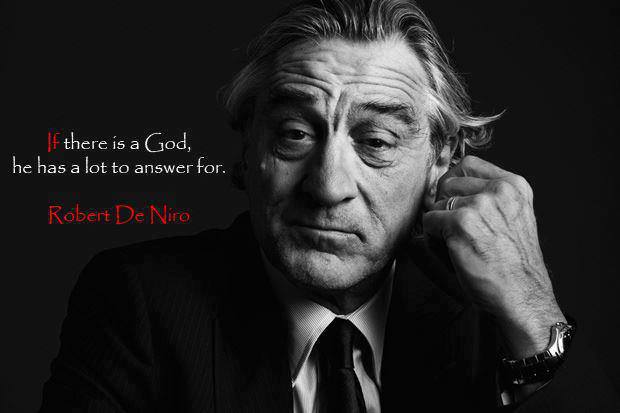
I think it is the best argument that I have seen for the truth. I greatly admire the many people in the world that believe in some form of religion, especially in the USA, but as that quote above from Robert De Niro says: “If there is a God then he has a lot to answer for!”

























 Acting Director and Astronomer, Dyer Observatory, Vanderbilt University


 Learning from Dogs