Category: Philosophy

Two years today!

Learning from Dogs first saw the light of day two years ago.

It all started on July 15th, 2009, during a very hot summer down in San Carlos, Mexico where I was first living with Jean.

Now, some 1,000 posts later life is very different.  Jean and I are now married and living incredibly happily, with our twelve dogs and six cats, in Payson, Arizona, some 80 miles NE of Phoenix, up at 5,000 feet on the fringe of the world’s largest Ponderosa Pine forest.

Ponderosa pine forest

So apologies if today’s Post is partly reflective on the last two years.  It also seems appropriate to revisit the reasons why so many articles on the Blog aren’t about dogs.

I feel the need to do that because the number of new readers now is just staggering.

The first full month was August 2009.  Wordpress stats reveal that there were 1,172 unique viewers of the Blog.  The last full month was, of course, June 2011.  Wordpress figures were 31,664 unique viewers!  That’s over a 1,000 viewers a day, and the trend is still upwards!

I am, of course, deeply moved by this response.  Thank you, one and all!

In writing Learning from Dogs, I have tried to stay close to the theme that dogs are a metaphor for change for mankind.  But that doesn’t mean that this is a doggy Blog.

As I wrote on the Welcome page, “Dogs live in the present – they just are!  Dogs make the best of each moment uncluttered by the sorts of complex fears and feelings that we humans have. They don’t judge, they simply take the world around them at face value.”

Learning from Dogs is a Blog about the fundamental truths that we need to be reminded of, for our long-term survival. Dogs teach us the importance of integrity, of faith and loyalty and of unconditional love.

But just as importantly, dogs are a reminder that our evolution to Neolithic man may have been an evolutionary mistake.  Stay with me for just a while.

Dogs were domesticated a mind-numbing number of years ago.  There is good evidence that dogs were co-operating with man 30,000 years ago.  However, one might speculate why the DNA of the dog separated from the grey wolf approximately 100,000 years ago.  Was it because they evolved even that far back as domesticated companions to man?  Science can’t tell us that yet.

But 30,000 years ago man was most definitely a hunter-gatherer.  Archaeologists have pondered whether the domesticated dog allowed man to be so successful as a hunter-gatherer that, in time, man was able to evolve into farming which, of course, we describe more accurately as the Neolithic Revolution.

Here’s an extract from WikiPedia,

The “Neolithic” Revolution is the first agricultural revolution—the transition from hunting and gathering to agriculture and settlement. Archaeological data indicate that various forms of domestication of plants and animals arose independently in six separate locales worldwide ca. 10,000–7000 years BP (8,000–5000 BC), with the earliest known evidence found throughout the tropical and subtropical areas of southwestern and southern Asia, northern and central Africa and Central America.

However, the Neolithic Revolution involved far more than the adoption of a limited set of food-producing techniques. During the next millennia it would transform the small and mobile groups of hunter-gatherers that had hitherto dominated human history, into sedentary societies based in built-up villages and towns, which radically modified their natural environment by means of specialized food-crop cultivation (e.g., irrigation and food storage technologies) that allowed extensive surplus food production.

These developments provided the basis for concentrated high population densities settlements, specialized and complex labor diversification, trading economies, the development of non-portable art, architecture, and culture, centralized administrations and political structures, hierarchical ideologies and depersonalized systems of knowledge (e.g., property regimes and writing).

There’s one sentence that just jumps off the ‘page’.  It’s this one. “During the next millennia it would transform the small and mobile groups of hunter-gatherers that had hitherto dominated human history

Here’s a quick bit of history about Homo Sapiens, from here,

Neanderthal man: from 230,000 years ago

Around 250,000 years ago Homo erectus disappears from the fossil record, to be followed in the Middle Palaeolithic period by humans with brains which again have increased in size. They are the first to be placed within the same genus as ourselves, as Homo sapiens(‘knowing man’).

By far the best known of them is Neanderthal man — named from the first fossil remains to be discovered, in 1856, in the Neander valley near Dusseldorf, in Germany. The scientific name of this subspecies is Homo sapiens neanderthalensis. The Neanderthals are widely spread through Europe and the Middle East, and they thrive for an extremely long period (from about 230,000 to 35,000 years ago). Bones of animals of all sizes, up to bison and mammoth, and sophisticated stone tools are found with their remains.

Thus as a species we, as in H. sapiens, survived for approximately 200,000 years as hunter-gatherers!

Now after just 12,000 years, give or take, as ‘farmers’ we are facing the real risk of extinction. Go back to that WikiPedia extract above and re-read “concentrated high population densities settlements, specialized and complex labor diversification, trading economies, the development of non-portable art, architecture, and culture, centralized administrations and political structures, hierarchical ideologies and depersonalized systems of knowledge (e.g., property regimes and writing)“.

If you want to fully comprehend the mess we, as in man, have got ourselves into, then watch the stunning movie What a Way To Go: life at the end of the empire.  That movie website is here or you can watch it from here.  (I will be reviewing the film on Learning from Dogs in the next couple of weeks.)

The filmmakers, Tim Bennett and Sally Erickson, towards the end of the film muse if mankind must go back to some form of hunter-gatherer society, not literally, of course, but ‘back’ to a form of society that is fundamentally sustainable with the world upon which we live.  As successful as Neanderthal man.  Here’s where dogs may have critically important lessons for mankind.

  • Dogs form small packs, up to a maximum of 50 animals
  • They have a simple hierarchy within the pack; the alpha female (who has first choice of breeding male and makes the very big decisions about whether the pack should move to a better territory), the beta male (always a dominant male that teaches the young pups their social skills and breaks up fights within the pack – my Pharaoh, as seen on the home page, is a beta GSD), and the omega dog (the clown dog, male or female. whose role is to keep the pack happy through play).
  • They survive through an extraordinary relationship with humans but if they have to revert to the ‘wild’ they survive as hunter-gatherers.

Maybe humans, at heart, also share certain similar characteristics:

  • We are happiest in social groups of less than 50
  • We much prefer simple methods of group order, where rules and discipline are managed within the group.  (Think about how easily we form all sorts of local clubs and groups.)
  • A ‘local’ approach to survival through deep and extensive group co-operation would be so much more effective than what most of us presently experience in our societies.

That’s why so many of the articles that appear on Learning from Dogs focus on the madness of what we experience so often in our present enormous, faceless, distant societies.

Back to Sally Erickson, one of the film makers mentioned earlier.  Here’s what she wrote in her Blog

Our world is in need of healing at every level. We as a species aren’t going to survive, the way we are going. If we don’t heal ourselves, evolve a new consciousness, and fundamentally change the way we live, human beings won’t make it.

Where’s it all heading?  Who knows?  I am reminded of that wonderful quote attributed to Niels Bohr but, more likely, from an unknown author (although Mark Twain is often suggested), “Prediction is very difficult, especially about the future.

Happy Birthday, Learning from Dogs.  Thank you to all of you that have supported this venture over the last two years.
The peculiar nature of H. sapiens

Just a few recent items to underline what a strange species we are!

This is being written on the 8th, not too many hours after the successful launch of the very last Shuttle space flight.  Forget the [valid] question of cost, this launch sufficiently inspired nearly a million people to travel to the Kennedy Space Center to watch this historic flight.  That adventuring drive is a wonderful aspect of mankind.

Now to another view of mankind.

Washington’s Blog of the 3rd July, 2011 has an in-depth review of how “the Japanese government, other governments and nuclear companies have covered up the extent of the Fukushima crisis.”  In that excellent piece, there is a reference to material in the British Guardian newspaper (I’m taking the liberty of re-publishing quite a long extract from Washington’s Blog).

British Shenanigans

It’s not just the Japanese. As the Guardian notes:

British government officials approached nuclear companies to draw up a co-ordinated public relations strategy to play down the Fukushima nuclear accident just two days after the earthquake and tsunami in Japan and before the extent of the radiation leak was known.

Internal emails seen by the Guardian show how the business and energy departments worked closely behind the scenes with the multinational companies EDF Energy, Areva and Westinghouse…

Officials stressed the importance of preventing the incident from undermining public support for nuclear power.

***

The Conservative MP Zac Goldsmith, who sits on the Commons environmental audit committee, condemned the extent of co-ordination between the government and nuclear companies that the emails appear to reveal.

***

The official suggested that if companies sent in their comments, they could be incorporated into briefs to ministers and government statements. “We need to all be working from the same material to get the message through to the media and the public.

***

The office for nuclear development invited companies to attend a meeting at the NIA’s headquarters in London. The aim was “to discuss a joint communications and engagement strategy aimed at ensuring we maintain confidence among the British public on the safety of nuclear power stations and nuclear new-build policy in light of recent events at the Fukushima nuclear power plant”.

Other documents released by the government’s safety watchdog, the office for nuclear regulation, reveal that the text of an announcement on 5 April about the impact of Fukushima on the new nuclear programme was privately cleared with nuclear industry representatives at a meeting the previous week. According to one former regulator, who preferred not to be named, the degree of collusion was “truly shocking”.

The Guardian reports in a second article:

The release of 80 emails showing that in the days after the Fukushima accident not one but two government departments were working with nuclear companies to spin one of the biggest industrial catastrophes of the last 50 years, even as people were dying and a vast area was being made uninhabitable, is shocking.

***

What the emails shows is a weak government, captured by a powerful industry colluding to at least misinform and very probably lie to the public and the media.

***

To argue that the radiation was being released deliberately and was “all part of the safety systems to control and manage a situation” is Orwellian.

And – as the Guardian notes in a third article – the collusion between the British government and nuclear companies is leading to political fallout:

“This deliberate and (sadly) very effective attempt to ‘calm’ the reporting of the true story of Fukushima is a terrible betrayal of liberal values. In my view it is not acceptable that a Liberal Democrat cabinet minister presides over a department deeply involved in a blatant conspiracy designed to manipulate the truth in order to protect corporate interests”. -Andy Myles, Liberal Democrat party’s former chief executive in Scotland

“These emails corroborate my own impression that there has been a strange silence in the UK following the Fukushima disaster … in the UK, new nuclear sites have been announced before the results of the Europe-wide review of nuclear safety has been completed. Today’s news strengthens the case for the government to halt new nuclear plans until an independent and transparent review has been conducted.” -Fiona Hall, leader of the Liberal Democrats in the European parliament

It’s us, all of us, that create the systems, the political and government systems that are at the heart of this approach to life.

But it’s also us, all of us, that ‘write’ such beautiful stories as this one from NPR Music.

Paul Simon has brought joy to so many for so long, but on this night he made Rayna Ford’s dream come true. During a show in Toronto on May 7, Rayna Ford, a fan from Newfoundland, called out for Simon to play “Duncan,” and said something to the effect that she learned to play guitar on the song. In a moment of astonishment and disbelief, Paul Simon invited her on stage, handed her a guitar and asked her to play it for the crowd. When she strapped on the guitar, the audience went crazy. In a few strums, the band played along, tears ran down Rayna Ford’s cheeks and Simon stood by her side in smiles.

It was an absolute moment of sobbing joy for Ford and for the crowd. It was a moment so beautiful, so human, it could almost be a story in a Paul Simon song. Excuse me while I wipe my own tears. Go Rayna and all the Raynas out there with dreams. As the song says:

Oh, oh, what a night
Oh, what a garden of delight
Even now that sweet memory lingers
I was playing my guitar
Lying underneath the stars
Just thanking the Lord
For my fingers,
For my fingers

What a strange lot we are!

Unreliable witnesses.

The obvious may not be that obvious!

Think you can think independently?

Watch this video from Simon Singh

Then there’s Michael Shermer who describes himself as follows:

Dr. Michael Shermer is the Founding Publisher of Skeptic magazine, the Executive Director of the Skeptics Society, a monthly columnist for Scientific American, the host of the Skeptics Distinguished Science Lecture Series at Caltech, and Adjunct Professor at Claremont Graduate University.

Finally, Joe Keohane (with thanks to Tom M. for the intro.)

Joe wrote a fascinating article that appeared in the Boston Globe last July that opens,

How facts backfire

Researchers discover a surprising threat to democracy: our brains

By Joe Keohane

July 11, 2010

It’s one of the great assumptions underlying modern democracy that an informed citizenry is preferable to an uninformed one. “Whenever the people are well-informed, they can be trusted with their own government,” Thomas Jefferson wrote in 1789. This notion, carried down through the years, underlies everything from humble political pamphlets to presidential debates to the very notion of a free press. Mankind may be crooked timber, as Kant put it, uniquely susceptible to ignorance and misinformation, but it’s an article of faith that knowledge is the best remedy. If people are furnished with the facts, they will be clearer thinkers and better citizens. If they are ignorant, facts will enlighten them. If they are mistaken, facts will set them straight.

This is a very smart article and much recommended, do read it fully here.

That’s all clear and straightforward then!


What is freedom? Part Three

The Trap – 3 – We Will Force U 2 Be Free

[Note: Part Two of The Trap is available to watch in my post of the 7th where one can also link back to Part One. Ed.]

This is another brilliant Adam Curtis documentary originally produced for the BBC. It talks about the modern political realities, where the policies came from and the massive failures of those ideals and how they have ended up exactly where they did not want to be. What is discussed in this episode is the alternative idea to freedom that currently exists and traps the western societies in which we live.

And more on consciousness!

Two recent videos highlight the mystery and fascination of determining what, exactly, is consciousness.

Before I get started, it crossed my mind that some readers on Learning from Dogs might struggle finding any link between the the title of the Blog and such esoteric topics as consciousness.  Let me try and explain.  On the home page of this Blog is written,

But 10,000 years of farming the planet’s plant and mineral resources have brought mankind to the edge of extinction, literally as well as metaphorically.

Dogs know better!  Time again for man to learn from dogs!

Here’s a recent comment I made to an article on Naked Capitalism,

In a much broader sense, it feels to me as though we have been partying on the edge of a global volcano for years and years. Greece is surely a metaphor for the craziness of so many countries.

Continuing that broader sense, the period that we are in, from political, economical, societal, environmental and ethical perspectives, seems bust. Good will eventually come out of this transition, of that I have no doubt, but what a fascinating period in which to be alive!

I firmly believe that the period we are presently living through is a transition between the last, say 30 years (in a sense, many more decades than that) and a more aware, sensitive period where mankind embraces a deeper, sustainable, relationship with the planet that is home and life to all of us.  Frankly, there is no choice!

Thus the nature of consciousness, our awareness of self, is a crucial element of the future.  The greater our self-awareness, the greater our self-understanding and from that better self-understanding comes all hope of recognising our attitudes and knowing that it is our attitudes that drive our behaviours.

So here follow two videos.  Settle back and be entranced!

The first is the last episode in a brilliant BBC series broadcast in 2007, probably one of the best TV series on psychology and neuroscience ever produced.  The full series is on Top Documentary Films but the last episode called The Final Mystery is all about consciousness.  Beware you are going to never see the world in quite the same way!

Here it is, The Final Mystery presented by neuroscientist Susan Greenfield.

The second video is from Season Two of the Through the Wormhole series.  It is called Is there Life after Death? and also explores the deeper aspects of consciousness.  As the introduction to the video says,

In the premiere episode of the second season of Through the Wormhole, Morgan Freeman dives deep into this provocative question that has mystified humans since the beginning of time.

Modern physics and neuroscience are venturing into this once hallowed ground, and radically changing our ideas of life after death.

Freeman serves as host to this polarized debate, where scientists and spiritualist attempt to define what is consciousness, while cutting edge quantum mechanics could provide the answer to what happens when we die.

Here’s the film; same health warning applies!  You are going to see the world differently after watching this!

Finally, do you have a dog at home?  If you do, ponder on how their conscious world engages them.  If science can’t explain human consciousness then all we have is our own intuition with regard to animals.  Not sure about you but when one is feeling a little low and a dog comes up and lays a head across you I feel a very strong conscious connection.

What is freedom? Part Two

The Trap – 2 – The Lonely Robot

Part One of The Trap is available to watch in my Post of the 4th, US Independence Day.  It also provides some background thoughts.  It really is a most powerful set of programmes so, if you haven’t already done so, best to watch Part One first.

This is Part 2 of the brilliant Adam Curtis documentary originally produced for the BBC. It talks about the modern political realities, where the policies came from and the massive failures of those ideals and how they have ended up exactly where they did not want to be. This episode focuses on the 1990’s and how the politicians decided to apply the model of a free market economy to the rest of society and consequences of these actions being felt all over the world in western democracies.

What is freedom?

As a US resident since just mid-April, perhaps no better day than July 4th to pose this question.

As a British citizen, born in London towards the end of WWII, I am well aware that Britain has had a long tradition of ‘owning’ colonies.  In 1770 explorer James Cook charted the East coast of Australia and returned to Britain recommending colonisation in the area that became known as Botany Bay, now part of Sydney.  Britain’s response was to set up a penal colony in 1778.

In 1617 the British East India Company was given permission by an Indian rajah to trade in India.  Via lots of convolutions that I don’t understand, that led to the British Crown taking over in 1857.

So far as America is concerned, the British ended up with 13 colonies along the Eastern seaboard during the period 1607 to 1733.  Then we had the British West Indies and Canada and …… well, you get the message!

Wikipedia has a summary of the US independence timetable,

During the American Revolution, the legal separation of the Thirteen Colonies from Great Britain occurred on July 2, 1776, when the Second Continental Congress voted to approve a resolution of independence that had been proposed in June by Richard Henry Lee of Virginia.  After voting for independence, Congress turned its attention to the Declaration of Independence, a statement explaining this decision, which had been prepared by a Committee of Five, with Thomas Jefferson as its principal author. Congress debated and revised the Declaration, finally approving it on July 4. A day earlier, John Adams had written to his wife Abigail:

The second day of July, 1776, will be the most memorable epoch in the history of America. I am apt to believe that it will be celebrated by succeeding generations as the great anniversary festival. It ought to be commemorated as the day of deliverance, by solemn acts of devotion to God Almighty. It ought to be solemnized with pomp and parade, with shows, games, sports, guns, bells, bonfires, and illuminations, from one end of this continent to the other, from this time forward forever more.

Adams’s prediction was off by two days. From the outset, Americans celebrated independence on July 4, the date shown on the much-publicized Declaration of Independence, rather than on July 2, the date the resolution of independence was approved in a closed session of Congress.

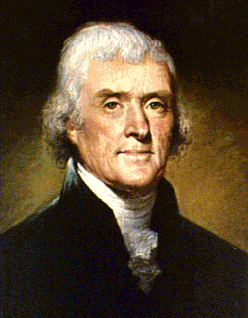
Thomas Jefferson April 13, 1743 – July 4, 1826

Thomas Jefferson became the third President of the United States of America.  As one of the founding fathers, Jefferson envisioned America as an “Empire of Liberty”.

So it came to pass that Independence Day is annually celebrated on July 4.   The celebrations have deep roots in the American tradition of political freedom.

Reflect then on that notion of liberty and freedom as you watch the first episode from a most compelling series from Adam Curtis that was broadcast by the BBC in 2007. The series is called The Trap, the first programme entitled “F**k You Buddy” (11 March 2007)

Individual freedom is the dream of our age. It’s what our leaders promise to give us, it defines how we think of ourselves and, repeatedly, we have gone to war to impose freedom around the world. But if you step back and look at what freedom actually means for us today, it’s a strange and limited kind of freedom.

Politicians promised to liberate us from the old dead hand of bureaucracy, but they have created an evermore controlling system of social management, driven by targets and numbers. Governments committed to freedom of choice have presided over a rise in inequality and a dramatic collapse in social mobility. And abroad, in Iraq and Afghanistan, the attempt to enforce freedom has led to bloody mayhem and the rise of an authoritarian anti-democratic Islamism. This, in turn, has helped inspire terrorist attacks in Britain. In response, the Government has dismantled long-standing laws designed to protect our freedom.

The Trap is a series of three films by Bafta-winning producer Adam Curtis that explains the origins of our contemporary, narrow idea of freedom. It shows how a simplistic model of human beings as self-seeking, almost robotic, creatures led to today’s idea of freedom. This model was derived from ideas and techniques developed by nuclear strategists during the Cold War to control the behavior of the Soviet enemy.

Part Two of this article is being published on the 7th, next Thursday, and Part Three next Monday, the 11th.

The Trap, Adam Curtis

This coming next couple of weeks is going to see me reflecting on some of the powerful messages that flow from three one-hour documentaries by Adam Curtis during a series of programmes for the BBC in 2007.

For today, just enjoy the BBC trailer. (Assuming ‘enjoy’ is the right expression!)

Day of rest!

Apologies to all the readers of Learning from Dogs but it’s been a busy week since returning from the UK and it feels right to take the day off!

As Ralph Waldo Emerson said, “Let us be silent, that we may hear the whispers of the gods.”

Ralph Waldo Emerson

And spend a few moments watching this 

Paws of love

They are such wonderful, amazing creatures – man’s longest and best friend, the dog.

A couple of events caused me to be reminded about the preciousness of our relationship with the dog.  The first was coming across this article in The Boston Globe.  It is entitled, A friendly paw to a veteran and is all about how therapy dogs bring relief and joy to veterans.  Incidentally, the story was written by good friend to Learning from Dogs, Daniela Caride who has her own blog, The Daily Tail.  Here’s how that article opens,

NORTHAMPTON — Carter the Chesapeake Bay retriever, Sassy the Pomeranian, and Spyder the German shepherd spend most of their time playing, begging for treats, and getting belly rubs just like other pet dogs. But their unconditional love gains a purpose every time their owners take them to the hospital to visit veterans.

They are therapy dogs — canines trained to give affection to strangers — and they are becoming more popular in veteran facilities. An increasing number of dog owners are willing to volunteer at VA homes and hospices, where 6 million veterans get treated for acute and chronic health conditions. The service they provide is invaluable, health care specialists say.

Read the rest of it here.

The second event was coming across something that I wrote nearly three years ago.  Here it is in full.

The knowing eyes of your best friend

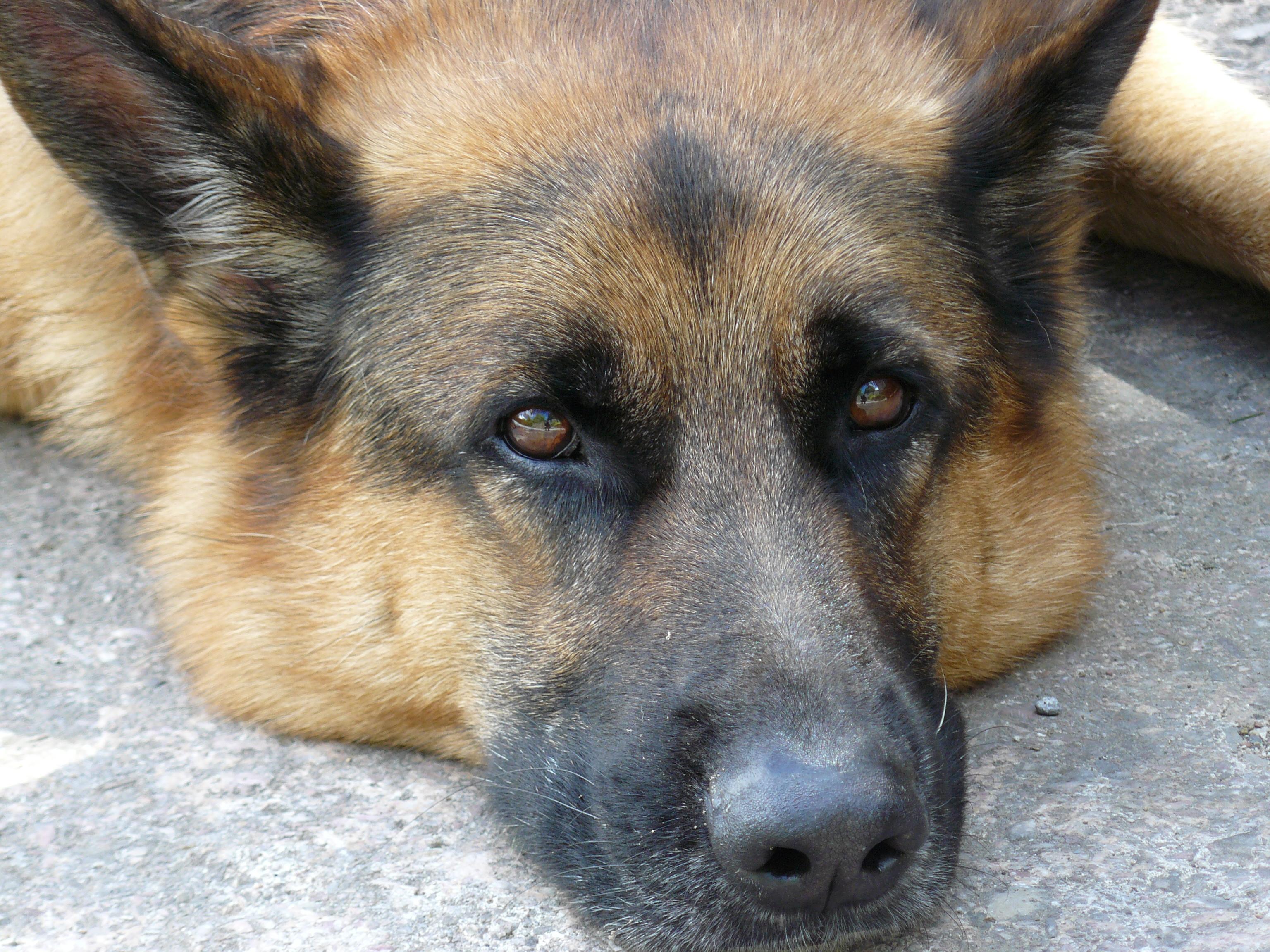
Pharaoh

(Based on an article sent to me, unfortunately from an unknown author, and modified to reflect the special relationship that I have with my 4 year old German Shepherd, Pharaoh. Paul Handover, 14 September, 2007.)

I am your dog and have something I would love to whisper in your ear. I know that you humans lead very busy lives. Some have to work, some have children to raise, some have to do this alone. It always seems like you are running here and there, often too fast, never noticing the truly grand things in life.

Look down at me now. While you sit at your computer. See the way my dark, brown eyes look at yours.

You smile at me. I see love in your eyes. What do you see in mine? Do you see a spirit? A soul inside who loves you as no other could in the world? A spirit that would forgive all trespasses of prior wrong doing for just a single moment of your time?  That is all I ask.  To slow down, if even for a few minutes, to be with me.

So many times you are saddened by others of my kind passing on. Sometimes we die young and oh so quickly, so suddenly that it wrenches your heart out of your throat. Sometimes, we age slowly before your eyes that you may not even seem to know until the very end, when we look at you with grizzled muzzles and cataract-clouded eyes. Still the love is always there even when we must take that last, long sleep dreaming of running free in a distant, open land.

I may not be here tomorrow. I may not be here next week. Someday you will shed the water from your eyes, that humans have when grief fills their souls, and you will mourn the loss of just ‘one more day’ with me. Because I love you so, this future sorrow even now touches my spirit and grieves me. I read you in so many ways that you cannot even start to contemplate.

We have now together. So come and sit next to me here on the floor and look deep into my eyes. What do you see? Do you see how if you look deeply at me we can talk, you and I, heart to heart. Come not to me as my owner but as a living soul. Stroke my fur and let us look deep into the other’s eyes and talk with our hearts.

I may tell you something about the fun of working the scents in the woods where you and I go. Or I may tell you something profound about myself or how we dogs see life in general. I know you decided to have me in your life because you wanted a soul to share things with. I know how much you have cared for me and always stood up for me even when others have been against me. I know how hard you have worked to help me be the teacher that I was born to be. That gift from you has been very precious to me. I know too that you have been through troubled times and I have been there to guard you, to protect you and to be there always for you. I am very different to you but here I am. I am a dog but just as alive as you.

I feel emotion. I feel physical senses. I can revel in the differences of our spirits and souls. I do not think of you as a dog on two feet; I know what you are. You are human, in all your quirkiness, and I love you still.

So, come and sit with me. Enter my world and let time slow down if only for a few minutes. Look deep into my eyes and whisper in my ears. Speak with your heart and I will know your true self. We may not have tomorrow but we do have now.

There is no question that one of the important aspects of life that we can surely learn from dogs is the ability to stay in the present as much as we can.  Easier to write than accomplish, of course.  But letting go of the past (because it’s gone) and making the best of today as opposed to worrying about the future (because that interferes in the joy of today) is still a powerful reminder of that we would do well to keep close to our heart.