Category: Philosophy

Living in the present.

Cherishing the here and now.

Over a week ago there was a fascinating and very thought-provoking BBC radio broadcast by Mr. John Gray, the political philosopher and author of the book False Dawn: The Delusions of Global Capitalism, .

Mr. John Gray

The BBC website then carried a further article by John Gray.  But before quoting from that article, I do recommend that you put aside just 14 minutes to listen to that broadcast.  If you click here you will be taken to the BBC podcast page for the Point of View series and then scroll down to the item that is headlined: The End, yet again? 26 Dec 2011.

There will see that a simple ‘right click & save target as’ allows you to download the audio file so you can listen at your pleasure.

Indeed, having listened to Point of View over the many years when living in England, I can thoroughly recommend them.  Described on the website, “Weekly reflections on topical issues from a range of contributors including historian Lisa Jardine, novelist Sarah Dunant and writer Alain de Botton.”

Here are some extracts from the John Gray article that appeared on the BBC website.

A Point of View: The endless obsession with what might be

If we can stop thinking about what the future might bring and embrace the present for what it is, we would be a lot better off, writes John Gray.

It’s been some time now since history didn’t end. Twenty-odd years ago, when the Berlin Wall was coming down, there were many who believed that there would be no more serious conflicts.

The American writer Francis Fukuyama, who promoted the idea of the end of history in the autumn of 1989, declared that the chief threat in future would be boredom. A new era, different from any before, had arrived.

Of course it hadn’t. The end of the Soviet Union was followed by conflicts and upheavals of the sort that happen when empires fall apart – war in the Caucasus and economic collapse in Russia, for example.

In any realistic perspective the idea that a single event – however large – could mark the end of human conflict was absurd. But those who were seduced by the idea were not thinking in realistic terms.

They were swayed by a myth – a myth of progress in which humanity is converging on a universal set of institutions and values. The process might be slow and faltering and at times go into reverse, but eventually the whole of humankind would live under the same enlightened system of government.

When you’re inside a myth it looks like fact, and for those who were inside the myth of the end of history it seems to have given a kind of peace of mind. Actually history was on the move again. But since it was clearly moving into difficult territory, it was more comfortable to believe that the past no longer mattered.

Then later on in the article, John writes,

Life’s framework

The implication is that sudden shifts are relatively rare in history. But consider continental Europe over the past 70 years – until recently a normal human lifetime. Unless they were Swedish or Swiss, an ordinary European man or woman lived during that period under several quite different systems of government.

Nearly all of Europe, some of it democratic, succumbed for a time to Nazism or fascism. Half of Europe moved from Nazism to communism with only a brief interval of democracy. Most of that half, though not Russia, became functioning democracies after the end of the Cold War.

Not only have political forms changed during a normal lifetime, systems of law and banking have come and gone along with national currencies. The entire framework in which life was lived has changed not once, but several times. In any longer historical perspective discontinuities of these kinds are normal.

The article then concludes, thus,

We seem to be approaching one of those periods of discontinuity that have happened so often in the past. It may seem unthinkable that the European banking system could implode, or that a global currency like the euro could dissolve into nothing.

Yet something very much like that was the experience of citizens of the former Soviet Union when it suddenly melted down, and there is nothing to say something similar could not happen again.

For believers in progress it must be a dispiriting prospect. But if you can shake off this secular myth you will see there is no need to despair. The breakdown of a particular set of human arrangements is not after all the end of the world.

Surely we would be better off if we put an end to our obsession with endings. Humans are sturdy creatures built to withstand regular disruption. Conflict never ceases, but neither does human resourcefulness, adaptability or courage.

We tend to look forward to a future state of fulfilment in which all turmoil has ceased. Some such condition of equilibrium was envisioned by the American prophet of the end of history with whom I began.

As Fukuyama admitted, it’s not an altogether appealing vision. But living in fear of the end is as stultifying as living in hope of it. Either way our lives are spent in the shadow of a future that’s bound to be largely imaginary.

Without the faith that the future can be better than the past, many people say they could not go on. But when we look to the future to give meaning to our lives, we lose the meaning we can make for ourselves here and now.

The task that faces us is no different from the one that has always faced human beings – renewing our lives in the face of recurring evils. Happily, the end never comes. Looking to an end-time is a way of failing to cherish the present – the only time that is truly our own.

I have extracted more than perhaps I ought, and there was so much more to read than is presented here.  So please go to the BBC website and read it in full; it’s a very powerful essay.

You may also be interested in learning more about John Gray’s pivotal book: False Dawn: The Delusions of Global Capitalism

Finally, let me take you back to a piece that I wrote back in September about Transitions.  I closed that piece thus,

There is significant evidence, real hard evidence, that the patterns of mankind’s behaviours of the last few decades cannot continue.  Simply because mankind will go over the edge of self-extinction.  Darwin’s evidence and all that!  We have to accept that humans will see the bleedin’ obvious before it is too late.  We have to keep the faith that our species homo sapiens is capable of huge and rapid change when that tipping point is reached, so eloquently written by Paul Gilding in his book, The Great Disruption, reviewed by me here.  We have to embrace the fact that just because the world and his wife appears to be living in total denial, the seedlings of change, powerful change, are already sprouting, everywhere, all over the world.

So let’s welcome those changes. Let’s nurture those seedlings, encourage them to grow and engulf our society with a new richness, a new fertile landscape.

Let’s embrace the power of now, the beauty of making today much better and letting go of tomorrow.

For today, I am in charge of my life,

Today, I choose my thoughts,

Today, I choose my attitudes,

Today, I choose my actions and behaviours.

With these, I create my life and my destiny.

It’s very difficult to make predictions, especially when they involve the future!

The Versatile Blogger Award

My rather slow response to my Versatile Blogger award!

Last Friday morning, the 16th, I turned on my PC to discover that lovely Kathryn Johnston of 4amWriter had nominated Learning from Dogs for the Versatile Blogger Award.  I was blown away especially as since then the connections I have made with other writers have been wonderful.

However, a more prompt acknowledgement on LfD seems to have escaped me until today.  I quickly learnt that there is a proper protocol associated with the response to the award.

  1. Thank the award-giver and link back to them in your post.
  2. Share 7 things about yourself.
  3. Pass this award along to 15 blogs you enjoy reading.
  4. Contact your chosen bloggers to let them know about the award.

So here goes!

Award logo

So first, a very big thank you to Kathryn of 4amWriter for including me in her list.  As she said on her post, “This title says it all! If you love dogs, this is a must-visit!”  That’s generous of Kathryn.  Dogs are a very powerful reminder of an uncomplicated way to live, as described on the Home Page.  The Vision behind the Blog is:

  • Our children require a world that understands the importance of faith, integrity and honesty
  • Learning from Dogs will  serve as a reminder of the values of life and the power of unconditional love – as so many, many dogs prove each and every day
  • Constantly trying to get to the truth …
  • The power of greater self-awareness and faith …

Seven things about me!

H’mm, what to say.

  1. Born in London 6 months before the end of WWII,
  2. Been a business-to-business salesman most of my life,
  3. Started my own business in 1978 and remained in ‘self-employment’ until quite recently,
  4. Lived on my own boat, based in Larnaca, Cyprus, for 5 years,
  5. A keen glider pilot for many years at Rattlesden Gliding Club in Suffolk, later a private pilot,
  6. Always wanted to write,
  7. And, finally, happier than I have ever been being married to Jean, having met in Mexico in 2007, moving out there with Pharaoh, my GSD, in 2008 and subsequently arriving in Payson, Arizona in 2010 with 11 dogs and 6 cats!

So here are the 16 Blogs (I use that description loosely) that I wish to pass this award to:

  • Yves Smith of Naked Capitalism.  How Yves finds the time to produce the huge volume of articles and website links every day is beyond me.
  • James Kwak and Simon Johnson of Baseline Scenario.  James and Simon were, for me, an early source of openness about the key issues affecting the global economy that slammed into our collective faces in 2008.
  • Patrice Ayme of the Blog of his own name.  Patrice’s sub-heading on his Blog reads, “Intelligence at the core of humanism.”  Again, a prolific writer with a huge intellect that he puts to wonderful use.  Just pick anything that he has written to see that proved in spades.
  • Patrick Smith of Patrick Smith Photography. Just breath-taking photographs.  Do visit his website.
  • Bill McKibben of 350.org.  The headline on the website says, “We’re building a global movement to solve the climate crisis.”  Say no more!
  • Michelle of Dog Kisses’s blog.  Wonderful blog – just go there and enjoy it.
  • Sue of Sue Dreamwalker. Again, just a wonderful Blog – do please visit.
  • Vlatko, the owner of Top Documentary Films.  We do not subscribe to any television channels at home so Vlatko’s resource is so valuable for us.  Huge selection of free documentary films to watch.
  • Deanna Raeke and Andrea Rosebrock of the Blog For The Love of a Dog.  Very active in fighting all corners on behalf of man’s oldest companion.
  • Rob Hopkins and his team at Transition Network.  Rob is one of the leading voices for changing to a sustainable relationship with this planet.  He is based in Totnes, Devon, my local town for many years when I lived in the village of Harberton.  His books on Transition are masterpieces.
  • Victoria Brown, Daniel Honan and team at Big Think.  As their headline says, “A forum where top experts explore the big ideas and core skills defining the 21st century.”  Fabulous resource.
  • All the Directors and team at Sustainable Arizona.  As is described on their site, Sustainable Arizona is about, “Our nonprofit organization is made up of volunteers and professionals committed to making sustainable development possible. We accomplish this by encouraging businesses that add true value to our communities while preserving the environment.
  • Anthony Watts of Watt’s Up With That. With over 9,000 followers and over 98 million viewers this very reasonably can be regarded as the world’s most viewed climate website.  Anthony’s 3 million monthly visitors puts my 40,000 into perspective!
  • The whole team at the US-based National Wildlife Federation.  Their MissionAs America’s largest conservation organization, National Wildlife Federation works with more than 4 million members, partners and supporters in communities across the country to inspire Americans to protect wildlife for our children’s future!
  • Peter Russell of Spirit of Now.  Peter writes on his Blogsite, “There are many observations I make in daily life—some profound, some mundane—mostly concerning the natural world around, or the nature of the inner world of mind. Some incline us to wonder and awe. Others make us think, and question our assumptions.”  Never before have we needed so much to think about the way we think!
  • Nakibul Hoq, blogging from Bangladesh in the city of Dhaka under the Blog name of Freedom to Survive.

I shall be passing on the ‘award’ to all bloggers today.

Let me close again by saying such a big thank you to Kathryn of 4amWriter and, from that, how quickly I came across Limebird Writers who, I know, will be a great source of support as I face 2012 and ‘the novel’!

Kepler 22b

In a sense the discovery of a potential life-supporting planet isn’t news.

What do I mean by that sub-heading?

Many (and I mean ‘many’) years ago I was a student at Faraday House Electrical Engineering College in Southampton Row, London.  The College was closely associated with London University and one year there was an invite to attend a lecture by the famous British astronomer, Sir Bernard Lovell.

Sir Bernard Lovell and the Jodrell Bank radio telescope

Despite that lecture being about 45 years ago, I still recall Sir Bernard explaining the statistics of the universe to demonstrate that the odds of another planet somewhere ‘out there’ that could support life were huge.  (Just as an aside do read this interesting story of Jodrell Bank picking up signals from the Russian Lunar 15 just as Neil Armstrong and Buzz Aldrin prepared to leave the moon’s surface.)

So with the positive identification of this planet some 600 light-years away, Sir Bernard’s speculation has been proved spot-on.

But in another very real sense, the discovery of Kepler 22b is astounding.  Step outside the science of the find and just cogitate a little about the implications; the deep philosophical issues that Kepler 22b raises.  Here’s an extract from Northern Voices Online news,

The excitingly named Kepler 22b, a planet believed to have been discovered orbiting a star a mere 600 light years away, is being hailed as a “New Earth”. But sci-fi fans shouldn’t get too excited just yet: as always with these stories, the likelihood is that we have not met the neighbours. Or, if we have, they probably aren’t very exciting conversationalists.

Talking about the likelihood of intelligent life on Kepler 22b, Dr Lewis Dartnell, of the Centre for Planetary Sciences at UCL, said, “There are big hurdles that life has to get over, and we don’t know how big a hurdle the origin of life itself is. You simply can’t tell with a single datum – you can’t do stats when N=1.

The N that Dr Dartnell mentioned was earth: the only known planet inhabiting intelligent life forms, or better still, life forms of any kind.

Dr Dartnell further adds, “The interesting thing will be when we go to Mars and Europa and see whether there are bacteria there. It would be enormously significant if life is found there. But the next step, once Kepler has looked at a lot of planets, will be to see what their atmospheres are made of, using infrared spectroscopy.

“If one or two of them have oxygen in the atmosphere, it may be a transient thing – like Venus, undergoing a runaway greenhouse effect – but if we find, say, 20 Earth-like planets, all with the signature of oxygen in their atmosphere, then that would be very unlikely. Life would be the more reasonable explanation,” concluded Dr Dartnell.

Read the rest of this article here.

There are many news reports online but this short video caught my eye.

The latest NASA report is here from which is quoted,

NASA’s Kepler Mission Confirms Its First Planet in Habitable Zone of Sun-like Star

NASA’s Kepler mission has confirmed its first planet in the “habitable zone,” the region where liquid water could exist on a planet’s surface. Kepler also has discovered more than 1,000 new planet candidates, nearly doubling its previously known count. Ten of these candidates are near-Earth-size and orbit in the habitable zone of their host star. Candidates require follow-up observations to verify they are actual planets.

The newly confirmed planet, Kepler-22b, is the smallest yet found to orbit in the middle of the habitable zone of a star similar to our sun. The planet is about 2.4 times the radius of Earth. Scientists don’t yet know if Kepler-22b has a predominantly rocky, gaseous or liquid composition, but its discovery is a step closer to finding Earth-like planets.

Previous research hinted at the existence of near-Earth-size planets in habitable zones, but clear confirmation proved elusive. Two other small planets orbiting stars smaller and cooler than our sun recently were confirmed on the very edges of the habitable zone, with orbits more closely resembling those of Venus and Mars.

“This is a major milestone on the road to finding Earth’s twin,” said Douglas Hudgins, Kepler program scientist at NASA Headquarters in Washington. “Kepler’s results continue to demonstrate the importance of NASA’s science missions, which aim to answer some of the biggest questions about our place in the universe.”

So let me leave you with this tantalising thought.  One day it will be confirmed that there is intelligent life on a planet out there in the universe.  That is likely to be one of the astounding events ever in the history of man on this planet.  Even trying some wild guesses about how that will change mankind’s self-perception is more than difficult – yet it will change the way we look at ourselves irrevocably!

I pray that I am still alive when that happens, as I’m sure many others must do.

The power of truth

Three things cannot be long hidden: the sun, the moon, and the truth.

The above is a quote attributed to the Buddha.  It is perfect as an introduction to today’s piece.

When I sat down at my PC yesterday afternoon I was planning to finish off a Post about the BBC’s fabulous Frozen Planet TV series.  But a check of my email changed all that.  Because there was an email from Merci O., someone in Payson that Jean and I know well.  Merci had sent me an email with a link to the following YouYube video.

Watch and be moved.

This is a non-commercial attempt to highlight the fact that world leaders, irresponsible corporates and mindless ‘consumers’ are combining to destroy life on earth. It is dedicated to all who died fighting for the planet and those whose lives are on the line today. The cut was put together by Vivek Chauhan, a young film maker, together with naturalists working with the Sanctuary Asia network (www.sanctuaryasia.com).

Content credit: The principal source for the footage was Yann Arthus-Bertrand’s incredible film HOME http://www.homethemovie.org/. The music was by Armand Amar. Thank you too Greenpeace and http://timescapes.org/

The Gift of Happiness

A fascinating article by Robert Holden, Ph.D

Let me offer thanks to Resurgence Magazine for the written permission to reproduce this article in full, see terms at the end of the article. More background information about Robert Holden may be obtained from his own website and, finally, the Happiness Project website is here.

——————————-

Robert Holden

The Gift of Happiness

Robert Holden was at the forefront of ‘Happiness’ research. Here, he reflects on how that topic – initially laughed off the agenda – has gained credibility and explains why happiness is important

When I set up The Happiness Project, in 1994, the original goal was simple: talk happiness. In my training in psychology, philosophy and psychotherapy my teachers didn’t talk about happiness. We focused solely on the causes of unhappiness. This didn’t feel right to me. After all, how can you know what the causes are if you do not know what happiness is?

My goal, then, was to stimulate a conversation, so as to deepen our appreciation of what happiness is, its benefits, what enables it, and what blocks it. One conversation I focused on was the question of whether happiness is learned and whether it can be taught. To investigate this further, I created an eight-week happiness programme (which still runs today) called Be Happy.

Today happiness is a much more popular conversation than when The Happiness Project began. We are all talking more about happiness than ever before. The conversation is alive and well. Universities, hospitals, economists and governments publish new studies on happiness every week. So, what we have learned? And where does this conversation about happiness need to go next?

Let’s start with what happiness researchers refer to as ‘static happiness’. In a recent US study, it was found that when people in the 1940s were asked, “How happy are you?” the average score was 7.5 out of 10, whereas today the average score is 7.4 out of 10. In other words, in spite of all the ‘progress’ we appear to have made in the last 50 years or so, our happiness levels have remained mostly static. This tells me we need more conversations to clarify what real happiness is. For instance, we need to discern between pleasure, satisfaction and joy; and on my eight-week happiness programme we always begin by asking people, “What is your definition of a happy life?” and, “Are you living it?”

Happiness researchers have also found that most of us are only semi-happy. In 2006, I participated in a BBC documentary called The Happiness Formula. It reported, “the proportion of people saying they are ‘very happy’ has fallen from 52% in 1957 to just 36% today.” Clearly, research like this is questioning our most basic assumptions about what happiness is, and what we think will make us happy. That’s a good thing. An honest inquiry into happiness is an opportunity to rethink your life. It is one of the gifts of happiness.

Do you really know what makes you happy? This is the question both psychologists and economists are asking now. The evidence suggests we do not know. For instance, many of us believe that more money will make us happier. Some money does help, especially to cover the basics of food, rent, clothing, etc. After that, the correlation between more money and greater happiness is vague. Martin Seligman, former president of the American Psychology Association, and one of the founders of the Positive Psychology movement, concludes most forcibly: “The change in purchasing power over the last half century in the wealthy nations carries the same message: real purchasing power has more than doubled in the United States, France and Japan, but life satisfaction has changed not a whit.”

An inquiry into happiness challenges you to rethink everything. For example, almost everyone agrees with the idea that if their life circumstances improve, their levels of happiness will increase. This is the basis for almost every political and economic strategy the world over. And yet scientific research into happiness tells us this is wrong. New Zealand researcher Richard Kammann reports, “Objective life circumstances have a negligible role to play in a theory of happiness.” The same research concludes that your attitude and personal choices have a far greater influence on your happiness levels.

Another popular theory is that a better education will make our children happier. This has resulted in more tests for preschool children, more focus on regular exams, and more money spent on private education. Surely this increases happiness? “Sorry, Mom and Dad, neither education nor, for that matter, a high IQ paves the road to happiness,” states Claudia Wallis, who compiled a report called The New Science of Happiness for TIME magazine.

Happiness challenges us to rethink what is a “better education” for our children. I support the idea of happiness lessons for children at school, as pioneered at Wellington College by psychologist Nick Baylis and college Master Anthony Seldon [read his thoughts on this important topic in his article Stillness in Schools]. One opposing argument for happiness lessons at school is that children should not be “taught” happiness, but that they should be allowed to think about happiness for themselves. However, this is precisely the aim of these happiness lessons. The approach is inquiry, not dictation.

People who attend my happiness programme are always telling me, “I wish I’d learned this at school.” It’s time then for more conversations about happiness in school, and at home with our children. I encourage all my students and clients to talk more about happiness with their families. Why? Because one of the ways we evolve is through conversation. Drawing happiness with our children or talking about happiness with our partner helps us to clarify things, to heal, to come together, and ultimately to live a happier life.

And now, even governments and politicians want to talk about happiness. In Britain, David Cameron has commissioned a new survey called Measuring National Well-being. A new organisation called Action for Happiness [see what founder Richard Layard says about this new movement in his article A Better Way of Life] is working closely with the government to help create better social change in society. Again, some people are concerned that governments should not “tell us” how to be happy. I agree with this, but I don’t think governments are trying to tell us. Like us, they are simply trying to understand what happiness is, and how we can be happier.

In my latest book, Be Happy, I have written: “Your definition of happiness will influence every significant decision in your life.” It is essential, therefore, that individuals and governments alike keep happiness on the agenda because, more than ever before, humanity needs a better understanding of happiness. We have learned so much, about atoms and galaxies and other things, but we still do not understand ourselves very well; we still go to war too often, and there is still too much suffering.

I remain deeply committed to talking about happiness. Why? Because I believe that happiness is our true nature (it is the natural state of our Unconditioned Self), and for that reason happiness brings out the best in us, both individually and collectively. Happiness research has found a strong link between happiness and altruism, for instance. In a recent study by a Charities Commission, it was reported that the highest predictor of generous giving is not your income level: it’s your happiness level.

Good things come from real happiness. Happier people make better choices, which is good for society and the planet. Your happiness is a gift to the world. I believe this with all my heart.

—————————–

Robert Holden is director of The Happiness Project. His latest book, Be Happy;, is published by Hay House. For more about the eight-week happiness programme visit: http://www.happiness.co.uk

The Gift of Happiness features in Resurgence issue 269, November/December 2011.

This article is reprinted courtesy of Resurgence magazine – at the heart of earth, art and spirit. To buy Resurgence, read further articles online or find out about The Resurgence Trust, visit: http://www.resurgence.org

All rights to this article are reserved to Resurgence, if you wish to republish or make use of this work you must contact the copyright owner to obtain permission

—————————–

One final note from yours truly.  Perhaps the art of happiness is yet another thing we can learn from dogs!

A smile from ear to ear!

More on this new era

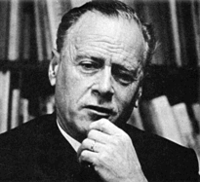
Some reflections from Herbert Marshall McLuhan

In a sense this piece today connects with the conclusions from my review of David Kauders’ new book The Greatest Crash; that we are transitioning into a new era.

That’s why I was fascinated to come across a long essay about Herbert Marshall McLuhan written by Michael Valpy and published in the The Globe and Mail last July.

Marshall McLuhan in the 1970s

WikiPedia has a comprehensive description of Mr. McLuhan.

Let me quote some extracts from that article to illustrate why I made the connection with my book review.

The University of Toronto professor of English credited with foreseeing the Internet 30 years before it was invented and broadcasting scores of ideas about how electronic communications media was changing the way humans think has been redeemed from labels of McLuhanacy and psuedo-scientific charlatanism.

His work no longer is described, as it was in one erudite journal of the 1970s, as “a hoax so gigantic that it shows every sign of becoming an international intellectual scandal.”

Later on in the article,

Deciding recently to pay a visit to the McLuhan coach house, she wrote: “To be perfectly honest, I had never heard of McLuhan until I moved into residence at SMC, and accidentally stumbled into the book and media studies program. But as I quickly learned, Marshall McLuhan is kind of a big deal. You know that phrase that you hear everywhere: ‘The medium is the message?’ Yeah, that was McLuhan.”

And McLuhan’s problem – one of his problems – is that his message couldn’t escape his medium. As Douglas Coupland points out in a 2009 McLuhan biography, the wonderful, whimsical, boundlessly optimistic and imaginative sixties society that embraced him and lapped up his ideas morphed into the gloom of a change-fatigued seventies society that tired of hearing from him. Yet the brand remained strong. “You know that phrase that you hear everywhere: ‘The medium is the message?’” Ms. Kellogg asks us. “Yeah, that was McLuhan.”

Think of his intellectual history as a journey between two mountain peaks passing through a shadowed valley.

When one thinks of the power of the many new tools we lump under the title ‘social media’ then it’s easy to think that the way that humans are now communicating will have profound implications.  Even this humble Blog was read by over 31,000 in the month of October.  Back to the article,

McLuhan believed that each new technology created a new human environment and thus a new way of thinking. The medium-is-the-message meant that the content of electronic media is insignificant; it is the medium itself that has the greater impact on the environment. In other words, it wasn’t what we were seeing on TV that was important; it was the fact that we were watching TV (and not doing other things) that altered our brains.

And because, as Prof. Francis points out, McLuhan saw humans as essentially communicative animals, he believed it was the technologies of communication that were primary in shaping who we were, what we thought, and how we acted, with effects that often were subliminal and therefore not recognized.

Finally, the article concludes thus,

To truly understand McLuhan and his ideas, says Prof. Scheffel-Dunand, students have to read him.

Most students of McLuhan today, she says, read scholars who write about McLuhan rather than read McLuhan himself. Which is a mistake, she says, because McLuhan wrote as a poet: he wrote metaphorically, aphoristically, he wrote in what he called “mosaics.”

Biographer Philip Marchand agrees. “My suggestion for students is to begin with the articles written by McLuhan – ‘Acoustic Space’ and ‘The Effect of the Printed Book on the language of the 16th century’ and a couple others that appear in the anthology entitled Explorations in Communication. These articles are lucid, comprehensible introductions to McLuhan’s thought.”

To rejoin UpbeaT blogger Emily Kellogg on her coach house tour: “I don’t want to bore you, dear readers, but I just can’t help gushing. I dig this stuff. These kind of conversations, are the things that make an undergraduate degree worth pursuing. They’re the ones that give you an adrenalin rush because you’re thinking so quickly – and your brain kind of feels like a trapeze artist jumping from idea to idea.

There’s also something innately cool about having an intellectual conversation that ranges from iPhones to Heidegger in five seconds flat in the place that housed Marshall McLuhan as he wrote the books that revolutionized the field of media research.”

Ms. Kellogg: 2011 medium of McLuhan’s message.

Michael Valpy is a freelance writer based in Toronto.

Endlessness surrounds us and infinity is within!

Stirring the mental pot for a Friday morning!

Not too long ago, I came across the website The Big Think.  It tickled my curiosity to the extent that I subscribed.  On November 6th an essay was published with the wonderful title of Consciousness: The Black Hole of Neuroscience‘.  Couldn’t resist that!  Here’s how that essay started,

What’s the Big Idea?

“By the word ‘thought’ (‘pensée’) I understand all that of which we are conscious as operating in us.” –Renee Descartes

The simplest description of a black hole is a region of space-time from which no light is reflected and nothing escapes. The simplest description of consciousness is a mind that absorbs many things and attends to a few of them. Neither of these concepts can be captured quantitatively. Together they suggest the appealing possibility that endlessness surrounds us and infinity is within.

That last sentence jumped off the page at me – hence me using it as the title of this post.

If this interests you at all, then do read the full item.  That closes like this …

Hirsch sees it more practically. Though functional imaging has not explained where perception comes from, it has important applications for unconscious patients. “The boundaries have been broken a little bit, clinically,” she says. “As we study patients with disorders of consciousness, we can probe their levels of awareness in ways that other traditional ways of asking them to respond.”

It’s no different than any other aspect of the brain that we cannot presently explain, she says:

For example, we don’t understand how the brain creates colors. That’s a perception that is very private – I don’t know that your perception of blue is like my perception of blue, for example. Smells are another one. I don’t know that your perception of the smell of an orange is like mine. These are the hard problems of neuroscience and philosophy that we haven’t made a great deal of progress on.

What do you think? Is the distinction between “hard problems” and “soft problems” useful, or reductive? Does the brain create consciousness? Will we ever empirically understand where it comes from or how it works?

This post is part of an ongoing series, The 21st Century Brain.

But that’s not the end of it.  Browsing the comments revealed a link to the Blog called NeuroLogica Blog.  The author is Steven Novella, MD.  Here’s a flavour of Steven’s competencies.

Dr. Novella is an academic clinical neurologist at Yale University School of Medicine. He is the president and co-founder of the New England Skeptical Society. He is the host and producer of the popular weekly science podcast, The Skeptics’ Guide to the Universe. He is also a senior fellow and Director of Science-Based Medicine at theJames Randi Educational Foundation (JREF), a fellow of the Committee for Skeptical Inquiry (CSI) and a founding fellow of the Institute for Science in Medicine.

The NeuroLogicaBlog covers news and issues in neuroscience, but also general science, scientific skepticism, philosophy of science, critical thinking, and the intersection of science with the media and society.

Dr. Novella also contributes every Sunday to The Rogues Gallery, the official blog of the SGU, every Monday to SkepticBlog, and every Wednesday to Science-Based Medicine, a blog dedicated to issues of science and medicine.

I couldn’t resist doing a search on Dr. Novella’s blog using the search term ‘consciousness’.  What a rich vein!  Here’s just one example of what came to light,

Subconscious Motivation

Neuroscience research has been increasingly fleshing out the fascinating and complex relationship between the subconscious processing of the brain and our conscious awareness. We all labor under the illusion that our decisions, feelings, and behaviors are all conscious. When we do something, it seems, it is because we wanted to do it. We are very good, in fact, at retrofitting a logical explanation for why we consciously did something.

But much of our brain’s decision making occurs at a subconscious level. When presented with a choice various parts of our brains make a calculation – processing the choice, weighing varying factors based upon some neuro-algorithm, and then present that choice to our conscious mind (the global workspace, if you accept this hypothesis). Research shows that if we change the subconscious algorithm, by suppressing, for example, one part of the brain, the decision-making process is altered. We are not aware of this, and we still are under the illusion that the decision was completely conscious.

Strongly recommend that you read the article in full; it is deeply fascinating.  And then laugh out loud, as I did, when you read the first comment made to that article,

I find this fascinating even though I am not conciously aware of why!

This is not ‘rocket science’!

We all live on one, finite, planet.  Full stop!

When putting together the short item for yesterday, Sunday, I was taken by the power of such simple concepts as beauty, harmony, love, the natural world.  Then I came across an article published by Tom Engelhardt, of TomDispatch fame, a little over two weeks ago.  It was a guest essay by Chip Ward and is reproduced below.

Learning from Dogs is about integrity.  In the sense that dogs, both literally and metaphorically, offer mankind an alternative, and more integrous, way of living.  As I wrote in one of the background items to Learning from Dogs, over two years ago,

Because of this closeness between dogs and man, we (as in man!) have the ability to observe the way they live.  Now I’m sure that scientists would cringe with the idea that the way that a dog lives his life sets an example for us humans, well cringe in the scientific sense.  But man seems to be at one of those defining stages in mankind’s evolution where the forces bearing down on the species homo sapiens have the potential to cause very great harm.  If the example of dogs can provide a beacon of hope, a incentive to change at a deep cultural level, then the quicker we ‘get the message’, the better it will be.

Dogs:

  • are integrous ( a score of 210) according to Dr David Hawkins
  • don’t cheat or lie
  • don’t have hidden agendas
  • are loyal and faithful
  • forgive
  • love unconditionally
  • value and cherish the ‘present’ in a way that humans dream of achieving
  • are, by eons of time, a more successful species than man.

So with those thoughts in mind, please read Chip’s essay as published on TomDispatch.  It is reproduced with the written permission of Tom Engelhardt

Someone Got Rich and Someone Got Sick
Nature Is the 99%, Too
By Chip Ward

What if rising sea levels are yet another measure of inequality? What if the degradation of our planet’s life-support systems — its atmosphere, oceans, and biosphere — goes hand in hand with the accumulation of wealth, power, and control by that corrupt and greedy 1% we are hearing about from Zuccotti Park?  What if the assault on America’s middle class and the assault on the environment are one and the same?

Money Rules: It’s not hard for me to understand how environmental quality and economic inequality came to be joined at the hip.  In all my years as a grassroots organizer dealing with the tragic impact of degraded environments on public health, it was always the same: someone got rich and someone got sick.

In the struggles that I was involved in to curb polluters and safeguard public health, those who wanted curbs, accountability, and precautions were always outspent several times over by those who wanted no restrictions on their effluents.  We dug into our own pockets for postage money, they had expense accounts.  We made flyers to slip under the windshield wipers of parked cars, they bought ads on television.  We took time off from jobs to visit legislators, only to discover that they had gone to lunch with fulltime lobbyists.

Naturally, the barons of the chemical and nuclear industries don’t live next to the radioactive or toxic-waste dumps that their corporations create; on the other hand, impoverished black and brown people often do live near such ecological sacrifice zones because they can’t afford better.  Similarly, the gated communities of the hyper-wealthy are not built next to cesspool rivers or skylines filled with fuming smokestacks, but the slums of the planet are. Don’t think, though, that it’s just a matter of property values or scenery.  It’s about health, about whether your kids have lead or dioxins running through their veins.  It’s a simple formula, in fact: wealth disparities become health disparities.

And here’s another formula: when there’s money to be made, both workers and the environment are expendable.  Just as jobs migrate if labor can be had cheaper overseas, I know workers who were tossed aside when they became ill from the foul air or poisonous chemicals they encountered on the job.

The fact is: we won’t free ourselves from a dysfunctional and unfair economic order until we begin to see ourselves as communities, not commodities.  That is one clear message from Zuccotti Park.

Polluters routinely walk away from the ground they poison and expect taxpayers to clean up after them.  By “externalizing” such costs, profits are increased.  Examples of land abuse and abandonment are too legion to list, but most of us can refer to a familiar “superfund site” in our own backyard.  Clearly, Mother Nature is among the disenfranchised, exploited, and struggling.

Democracy 101: The 99% pay for wealth disparity with lost jobs, foreclosed homes, weakening pensions, and slashed services, but Nature pays, too.  In the world the one-percenters have created, the needs of whole ecosystems are as easy to disregard as, say, the need the young have for debt-free educations and meaningful jobs.

Extreme disparity and deep inequality generate a double standard with profound consequences.  If you are a CEO who skims millions of dollars off other people’s labor, it’s called a “bonus.”  If you are a flood victim who breaks into a sporting goods store to grab a lifejacket, it’s called looting.  If you lose your job and fall behind on your mortgage, you get evicted.  If you are a banker-broker whodesigned flawed mortgages that caused a million people to lose their homes, you get a second-home vacation-mansion near a golf course.

If you drag heavy fishnets across the ocean floor and pulverize an entire ecosystem, ending thousands of years of dynamic evolution and depriving future generations of a healthy ocean, it’s called free enterprise.  But if, like Tim DeChristopher, you disrupt an auction of public land to oil and gas companies, it’s called a crime and you get two years in jail.

In campaigns to make polluting corporations accountable, my Utah neighbors and I learned this simple truth: decisions about what to allow into the air we breathe, the water we drink, and the food we eat are soon enough translated into flesh and blood, bone and nerve, and daily experience.  So it’s crucial that those decisions, involving environmental quality and public health, are made openly, inclusively, and accountably.  That’s Democracy 101.

The corporations that shred habitat and contaminate your air and water are anything but democratic.  Stand in line to get your 30 seconds in front of a microphone at a public hearing about the siting of a nuclear power plant, the effluent from a factory farm, or the removal of a mountaintop and you’ll get the picture quickly enough: the corporations that profit from such ecological destruction are distant, arrogant, secretive, and unresponsive.  The 1% are willing to spend billions impeding democratic initiatives, which is why every so-called environmental issue is also about building a democratic culture.

First Kill the EPA, Then Social Security: Beyond all the rhetoric about freedom from the new stars of the Republican Party, the strategy is simple enough: obstruct and misinform, then blame the resulting dysfunction on “government.”  It’s a great scam.  Tell the voters that government doesn’t work and then, when elected, prove it.  And first on the list of government outfits they want to sideline or kill is the Environmental Protection Agency, so they can do away with the already flimsy wall of regulation that stands between their toxins and your bloodstream.

Poll after poll shows that citizens understand the need for environmental rules and safeguards.  Mercury is never put into the bloodstreams of nursing mothers by consensus, nor are watersheds fracked until they are flammable by popular demand.  But the free market ideologues of the Republican Party are united in opposition to any rule or standard that impedes the “magic” of the marketplace and unchecked capital.

The same bottom-line quarterly-report fixation on profitability that accepts oil spills as inevitable also accepts unemployment as inevitable. Tearing apart wildlife habitat to make a profit and doing the same at a workplace are just considered the price of doing business. Clearcutting a forest and clearcutting a labor force are two sides of the same coin.

Beware of Growth: Getting the economy growing has been the refrain of the Obama administration and the justification for every bad deal, budget cut, and unbalanced compromise it’s made.  The desperate effort to grow the economy to solve our economic woes is what keeps Timothy Geithner at the helm of the Treasury and is what stalls the regulation of greenhouse gasses.  It’s why we are told we must sacrifice environmental quality for pipelines and why young men and women are sacrificed to protect access to oil, the lubricant for an acquisitive economic engine.  The financial empire of the one percenters and the political order it has shaped are predicated on easy and relentless growth.  How, we are asked, will there be enough for everyone if we don’t keep growing?

The fundamental contradiction of our time is this: we have built an all-encompassing economic engine that requires unending growth.  A contraction of even a percent or two is a crisis, and yet we are embedded in ecosystems that are reaching or have reached their limits.  This isn’t complicated: There’s only so much fertile soil or fresh water available, only so many fish in the ocean, only so much CO2 the planet can absorb and remain habitable.

Yes, you can get around this contradiction for a while by exploiting your neighbor’s habitat, using technological advances to extend your natural resources, and stealing from the future — that is, using up soil, minerals, and water your grandchildren (someday to be part of that same 99%) will need.  But the limits to those familiar and, in the past, largely successful strategies are becoming more evident all the time.

At some point, we’ll discover that you can’t exist for long beyond the boundaries of the natural world, that (as with every other species) if you overload the carrying capacity of your habitat, you crash.  Warming temperatures, chaotic weather patterns, extreme storms, monster wildfiresepic droughtsBiblical floods, anavalanche of species extinction… that collapse is upon us now.  In the human realm, it translates into hunger and violence, mass migrations and civil strife, failed states and resource wars.

Like so much else these days, the crash, as it happens, will not be suffered in equal measure by all of us.  The one percenters will be atop the hill, while the 99% will be in the flood lands below swimming for their lives, clinging to debris, or drowning. The Great Recession has previewed just how that will work.

An unsustainable economy is inherently unfair, and worse is to come.  After all, the car is heading for the cliff’s edge, the grandkids are in the backseat, and all we’re arguing about is who can best put the pedal to the metal.

Occupy Earth: Give credit where it’s due: it’s been the genius of the protesters in Zuccotti Park to shift public discourse to whether the distribution of economic burdens and rewards is just and whether the economic system makes us whole or reduces and divides us.  It’s hard to imagine how we’ll address our converging ecological crises without first addressing the way accumulating wealth and power has captured the political system.  As long as Washington is dominated and intimidated by giant oil companies, Wall Street speculators, and corporations that can buy influence and even write the rules that make buying influence possible, there’s no meaningful way to deal with our economy’s addiction to fossil fuels and its dire consequences.

Nature’s 99% is an amazingly diverse community of species.  They feed and share and recycle within a web of relationships so dynamic and complex that we have yet to fathom how it all fits together.  What we have excelled at so far is breaking things down into their parts and then reassembling them; that, after all, is how a barrel of crude oil becomes rocket fuel or a lawn chair.

When it comes to the more chaotic, less linear features of life like climate, ecosystems, immune systems, or fetal development, we are only beginning to understand thresholds and feedback loops, the way the whole becomes greaterthan the sum of its parts.  But we at least know that the parts matter deeply and that, before we even fully understand them, we’re losing them at an accelerating rate.  Forests are dying, fisheries are going, extinction is on steroids.

Degrading the planet’s operating systems to bolster the bottom line is foolish and reckless.  It hurts us all.  No less important, it’s unfair.  The 1% profit, while the rest of us cough and cope.

After Occupy Wall Street, isn’t it time for Occupy Earth?

Chip Ward co-founded and led Families Against Incinerator Risk and HEAL Utah. A TomDispatch regular, he wrote about campaigns to make polluters accountable in Canaries on the Rim: Living Downwind in the West and about visionary conservationists in Hope’s Horizon: Three Visions for Healing the American Land.

Copyright 2011 Chip Ward

The view from the window.

Perhaps ancient man is still alive and well in all of us.

Two delightful events have provided the fuel for today’s post which, I warn you, is much more the personal mental ramble than the usual daily post on Learning from Dogs.  So, health warning, continue reading at your own risk, or be safe and switch off now!

Before getting in to my perambulations, just a word of thanks to you for your support.  Last month, there were 31,291 viewers of Learning from Dogs and 71 of you have chosen to subscribe.  I am humbled by your interest.  Don’t ever hesitate to give me feedback or, if you prefer, comment to a specific post.

OK, to the theme of today.

On Wednesday I had an enjoyable lunch with a friend from here in Payson, Dennis L.  Sitting in the Crosswinds restaurant at Payson airport is one of the most beautiful eating spots in terms of the view from the window.  So it’s a very conducive place to relax and try put the world to rights!  Conversation ranged across a variety of topics but frequently touched on the lunacy of so many things to do with man, especially when it comes to the government of peoples.

Dennis and I also acknowledged that entering politics with a set of passionate ideals, as we were sure many persons did, would quickly run up against the skein of vested interests that must permeate governments from top to bottom.

Yes Minister was a satirical comedy written by Antony Jay and Jonathan Lynn that ran for many years.  It was extraordinarily funny, here’s a 3-minute clip,

That programme underlined, far better than anything else, how governments most probably work in reality.

Dennis and I were clear, as so many millions of other global citizens must be, that the complexity of commerce, politics, national interests, global finance, and more, had created ‘systems’ of decision making that were utterly disconnected with the needs of mankind having a long and stable future on the only finite home around, Planet Earth.

Then today (Thursday), Jean and I attended our regular weekly gardening course at the local college in Payson.  Today’s subject was Arizona’s Climate and the tutor, Mike C., was a professional climatologist and meteorologist.  It was fascinating, indeed, totally absorbing.  Mike’s graphs and slides about the climate, some showing data for the last 1,000 years, underlined the incredible complexity and interconnectedness of the processes that made up the global climate system.

Once again that use of the word ‘complexity’.  He confirmed that there was no scientific doubt that the world was warming as a result of changes to the Earth’s atmosphere, science certain most of it is caused by increasing concentrations of greenhouse gases produced by human activities such as deforestation and burning fossil fuels.

Mike closed the session with an interesting reflection.  He reminded the audience that mankind is still essentially wired, in evolutionary terms, to know how to react to an attacking tiger or similar wild beast, as in the fight or flee response, than know how to deal with such complex, despite intellectually obvious, threats as global climate change, rising sea levels and many other totally unsustainable practices.  Mike held the view that only when man had the threat in his face equivalent to that of the attacking tiger would there be a wholesale change.

On the home page of this blog, I write,

As man’s companion, protector and helper, history suggests that dogs were critically important in man achieving success as a hunter-gatherer.  Dogs ‘teaching’ man to be so successful a hunter enabled evolution, some 20,000 years later, to farming,  thence the long journey to modern man.  But in the last, say 100 years, that farming spirit has become corrupted to the point where we see the planet’s plant and mineral resources as infinite.  Mankind is close to the edge of extinction, literally and spiritually.

In the context of homo sapiens, Latin for “wise man” or “knowing man”, then we know that modern man, anatomically, originated in Africa about 200,000 years ago.  Modern man only evolved from hunter/gatherer to farmer around 10,000 years ago, a tiny proportion of H. sapiens existence and, in evolutionary terms, no time at all.

The DNA of the domesticated dog separated from that of the wolf around 100,000 years ago.  No one knows for sure when man and dog came together but there is archaeological evidence of dogs being buried in mens’ graves around 30,000 years ago.  That’s an association over a huge time period.

Dennis and Mike, between them, triggered in my mind something fundamental.  Perhaps modern society, with all it’s bizarre behaviours and so many totally illogical practises (especially, in terms of a long-term relationship with our planet), could be understood.  Understood from the perspective of our social behaviours, built so much on technology, having raced far on to the point where they are now practically out of sight of our instinctive evolutionary behaviours.  We really don’t know how to change those core behaviours.

In contrast, dogs have remained much more stable with regard to their evolutionary progress and their external world.  Consider that the last big change for the domesticated dog was the association with man and that is at least three times as long ago as man becoming farming man.  No wonder when we curl up with our dog it has echoes of a time thousands of years before we could even spell the word, ‘politician’.  Echoes of a stability that seems now so way beyond reach.

And the view from the window of the Crosswinds ……

Mogollon Rim, North of Payson, AZ., in Winter

All Watched Over by Machines of Loving Grace

Three very thought-provoking films

Over the last week we have watched all three 0ne-hour films made by the BBC, aired in 2011,  under the title of the heading of this post, All Watched Over by Machines of Loving Grace.  The films are available on the website Top Documentary Films, the direct link is here.  As that website explains,

A series of films about how humans have been colonized by the machines they have built. Although we don’t realize it, the way we see everything in the world today is through the eyes of the computers. It claims that computers have failed to liberate us and instead have distorted and simplified our view of the world around us.

1. Love and Power. This is the story of the dream that rose up in the 1990s that computers could create a new kind of stable world. They would bring about a new kind global capitalism free of all risk and without the boom and bust of the past. They would also abolish political power and create a new kind of democracy through the Internet where millions of individuals would be connected as nodes in cybernetic systems – without hierarchy.

2. The Use and Abuse of Vegetational Concepts. This is the story of how our modern scientific idea of nature, the self-regulating ecosystem, is actually a machine fantasy. It has little to do with the real complexity of nature. It is based on cybernetic ideas that were projected on to nature in the 1950s by ambitious scientists. A static machine theory of order that sees humans, and everything else on the planet, as components – cogs – in a system.

3. The Monkey in the Machine and the Machine in the Monkey. This episode looks at why we humans find this machine vision so beguiling. The film argues it is because all political dreams of changing the world for the better seem to have failed – so we have retreated into machine-fantasies that say we have no control over our actions because they excuse our failure.

Adam Curtis is a documentary film maker, whose work includes The Power of Nightmares,The Century of the SelfThe Mayfair SetPandora’s BoxThe Trap and The Living Dead.

As was eluded, the three films are deeply thought-provoking.  There is a ‘taster’ to the first film on YouTube, as below,

Adam Curtis, the film maker, has a blog site under the BBC Blogs umbrella.  The entry on that blog-site by Adam in connection with these films is here, and makes interesting reading.  It also includes a longer trailer than the one from YouTube, above.

Finally, there are comprehensive writings on all three films on the WikiPedia website here.  To give you a taste, here’s what was written about the third film,

The Monkey In The Machine and the Machine in the Monkey

This programme looked into the selfish gene theory which holds that humans are machines controlled by genes which was invented by William Hamilton. Adam Curtis also covered the source of ethnic conflict that was created by Belgian colonialism’s artificial creation of a racial divide and the ensuing slaughter that occurred in the Democratic Republic of the Congo, which is a source of raw materialfor computers and cell phones.

William Hamilton went to Kisangani in the Democratic Republic of the Congo while the Second Congo War was raging. He went there to collect Chimpanzee faeces to test his theory that HIV was due to a medical mistake. Unfortunately he caught malaria, for which he took aspirin, which caused a haemorrhage and he died. However his selfish gene theory lived on.

In 1960 Congo had become independent from Belgium, but governance promptly collapsed, and towns became battle grounds as soldiers fought for control of the mines. America and the Belgians organised a coup and the elected leader was assassinated, creating chaos. The Western mining operations were largely unaffected however.

Bill Hamilton was a solitary man, and he saw everything through the lens of Darwin’s theory of evolution. When he wanted to know why some ants and humans gave up their life for others, he went to Waterloo station and stared at humans for hours, and looked for patterns. In 1963 he realised that most of the behaviours of humans was due to genes, and looking at the humans from the genes’ point of view. Humans were machines that were only important for carrying genes, and that it made sense for a gene to sacrifice a human if it meant that another copy of the gene elsewhere would prosper.

In the 1930s Armand Denis made films that told the world about Africa. However, his documentary gave fanciful stories about Rwanda’s Tutsis being a noble ruling elite originally from Egypt, whereas the Hutus were a peasant race. In reality they were racially the same and the Belgian rulers had ruthlessly exploited the myth. But when it came to create independence, liberal Belgians felt guilty, and decided that the Hutus should overthrow the Tutsi rule. This led to a blood bath, as the Tutsis were then seen as aliens and were slaughtered.

So, all in all, this is a great personal recommendation and, it goes without saying, those of you that do watch the films and want to comment, would love to hear from you.