Dear readers, from time to time I am approached by other authors who have flattered me by asking if I would like to publish their Blog posts from time to time. So I have been doubly flattered by having two authors contact me in the last week.
So to the first. It is with great pleasure that I welcome Jane Brackman, Ph.D., author of the blog Doctor Barkman Speaks who will, from time to time, republish her posts on Learning from Dogs. I have no doubt that you will enjoy her scientific expertise regarding dogs
So today, please enjoy …
oooOOOooo
HOW DOGS THINK – NEW SCIENCE LOOKS INSIDE THEIR MINDS WITH MRI IMAGING
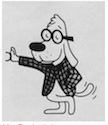
Canine illustrator Robert Dickey assigned thoughts and feeling to his Boston Terrier based on the dogs’s expressions. Here he illustrates contentment, sympathy and misery. (Dogs from Life, Page & Co., 1920)
**
“Are you gonna eat that? Are you gonna eat that? I’ll eat it.”
Is this what dogs think? Or do they experience more complex thoughts? Apparently science is getting pretty close to figuring it out. If not exactly WHAT they’re thinking, then where in the brain the thoughts are coming from. Since brains are pretty much the same across mammal species, if researchers identify which parts of the the brain light up, based on what humans have said, they can guess what the dogs’ thoughts are, too.
A couple of smart guys, Gregory Berns and Andrew Brooks of Emory University, watching a military dog assist Navy Seals as they overran the Osama Bin Laden compound, got a brilliant idea. If you can teach dogs to jump out of helicopters, surely dogs could be trained to enjoy themselves inside an fMRI machine while scientists calculate what the dogs are thinking by scanning their brains.
The researchers, who are dog-lovers, explained, “We want to understand the dog-human relationship, from the dog’s perspective. From the outset, we wanted to ensure the safety and comfort of the dogs. We wanted them to be unrestrained and go into the scanner willingly.”
So they recruited a professional dog trainer, Mark Spivak, and two companion dogs, a Feist Terrier named Callie and a Border Collie named McKenzie. The team said that both dogs were trained over several months to walk into an fMRI scanner and hold completely still while researchers measured their brain activity.
In the photo below Callie wears ear protection as she
prepares to enter the scanner. The research team
includes, from left, Andrew Brooks, Gregory Berns and Mark Spivak.
(Credit: Photo by Bryan Meltz)
This is what the researchers wrote in the journal article that was published in PLOS last week:
Because of dogs’ prolonged evolution with humans, many of the canine cognitive skills are thought to represent a selection of traits that make dogs particularly sensitive to human cues. But how does the dog mind actually work? To develop a methodology to answer this question, we trained two dogs to remain motionless for the duration required to collect quality fMRI images by using positive reinforcement without sedation or physical restraints. The task was designed to determine which brain circuits differentially respond to human hand signals denoting the presence or absence of a food reward.
Eventually they hope to answer the more profound questions we all ask: Do dogs have empathy? Do they know when we are happy or sad? How much language do they really understand?” (And here’s one from me- When they pee on the carpet and we don’t find it until the next day, when we scold them do they know why we are scolding them?)
Well, I don’t know about you but I found this a most fascinating article. All of us who live around dogs, both physically and emotionally, sense the closeness, may I use the word ‘magic’, of the relationships.
Take a look at the photograph below. Until I left the UK in 2008, a few of us owned a lovely old Piper Super Cub. It was a joy to fly. I used frequently to take Pharaoh to the grass airfield, Watchford Farm, up on the Devon moors. One day he showed such interest in the aircraft that I lifted him up to the passenger’s seat, strapped him in and taxied all over the grass airfield. This picture shows something that is difficult to explain otherwise – Pharaoh’s real joy at sharing the adventure. Of course, I didn’t fly with him, that would have been a step too far, but we did taxi almost up to take-off speed. Dr. Barkman, what do you make of that?
A moving, insightful postscript to the life of the late Ernest Callenbach.
This is a continuation of the republication of a recent TomDispatch Tomgram. As I explained in Part One published yesterday I have been a follower of Tom Dispatch for some time and frequently find the essays most interesting. However, reading the words of Ernest Callenbach touched me in many ways, some of which are still evolving. Callenbach was clearly a man who many years ago not only foresaw how our world was heading but via his writings was able to articulate the solutions. Today, as the video at the end of the Post so clearly exemplifies, those solutions are spot on.
The other point that strikes me is that in leaving this ‘message’ on his computer asking for it to be released after his death, Callenbach isn’t trying to prove anything. We are reading the words of a person who feels so strongly about the fate of mankind that he wants those words to be his epitaph for ever more. Trust me. When you read the words below you will be as touched as I was, indeed still continue to be. It is a rare privilege to republish them.
Ernest ‘Chick’ Callenbach Epistle to the Ecotopians
By Ernest Callenbach[This document was found on the computer of Ecotopia author Ernest Callenbach (1929-2012) after his death.]
To all brothers and sisters who hold the dream in their hearts of a future world in which humans and all other beings live in harmony and mutual support — a world of sustainability, stability, and confidence. A world something like the one I described, so long ago, in Ecotopia and Ecotopia Emerging.
As I survey my life, which is coming near its end, I want to set down a few thoughts that might be useful to those coming after. It will soon be time for me to give back to Gaia the nutrients that I have used during a long, busy, and happy life. I am not bitter or resentful at the approaching end; I have been one of the extraordinarily lucky ones. So it behooves me here to gather together some thoughts and attitudes that may prove useful in the dark times we are facing: a century or more of exceedingly difficult times.
How will those who survive manage it? What can we teach our friends, our children, our communities? Although we may not be capable of changing history, how can we equip ourselves to survive it?I contemplate these questions in the full consciousness of my own mortality. Being offered an actual number of likely months to live, even though the estimate is uncertain, mightily focuses the mind. On personal things, of course, on loved ones and even loved things, but also on the Big Picture.
But let us begin with last things first, for a change. The analysis will come later, for those who wish it.
Hope. Children exude hope, even under the most terrible conditions, and that must inspire us as our conditions get worse. Hopeful patients recover better. Hopeful test candidates score better. Hopeful builders construct better buildings. Hopeful parents produce secure and resilient children. In groups, an atmosphere of hope is essential to shared successful effort: “Yes, we can!” is not an empty slogan, but a mantra for people who intend to do something together — whether it is rescuing victims of hurricanes, rebuilding flood-damaged buildings on higher ground, helping wounded people through first aid, or inventing new social structures (perhaps one in which only people are “persons,” not corporations). We cannot know what threats we will face. But ingenuity against adversity is one of our species’ built-in resources. We cope, and faith in our coping capacity is perhaps our biggest resource of all.
Mutual support. The people who do best at basic survival tasks (we know this experimentally, as well as intuitively) are cooperative, good at teamwork, often altruistic, mindful of the common good. In drastic emergencies like hurricanes or earthquakes, people surprise us by their sacrifices — of food, of shelter, even sometimes of life itself. Those who survive social or economic collapse, or wars, or pandemics, or starvation, will be those who manage scarce resources fairly; hoarders and dominators win only in the short run, and end up dead, exiled, or friendless. So, in every way we can we need to help each other, and our children, learn to be cooperative rather than competitive; to be helpful rather than hurtful; to look out for the communities of which we are a part, and on which we ultimately depend.
Practical skills. With the movement into cities of the U.S. population, and much of the rest of the world’s people, we have had a massive de-skilling in how to do practical tasks. When I was a boy in the country, all of us knew how to build a tree house, or construct a small hut, or raise chickens, or grow beans, or screw pipes together to deliver water. It was a sexist world, of course, so when some of my chums in eighth grade said we wanted to learn girls’ “home ec” skills like making bread or boiling eggs, the teachers were shocked, but we got to do it. There was widespread competence in fixing things — impossible with most modern contrivances, of course, but still reasonable for the basic tools of survival: pots and pans, bicycles, quilts, tents, storage boxes.
We all need to learn, or relearn, how we would keep the rudiments of life going if there were no paid specialists around, or means to pay them. Every child should learn elementary carpentry, from layout and sawing to driving nails. Everybody should know how to chop wood safely, and build a fire. Everybody should know what to do if dangers appear from fire, flood, electric wires down, and the like. Taking care of each other is one practical step at a time, most of them requiring help from at least one other person; survival is a team sport.
Organize. Much of the American ideology, our shared and usually unspoken assumptions, is hyper-individualistic. We like to imagine that heroes are solitary, have super powers, and glory in violence, and that if our work lives and business lives seem tamer, underneath they are still struggles red in blood and claw. We have sought solitude on the prairies, as cowboys on the range, in our dependence on media (rather than real people), and even in our cars, armored cabins of solitude. We have an uneasy and doubting attitude about government, as if we all reserve the right to be outlaws. But of course human society, like ecological webs, is a complex dance of mutual support and restraint, and if we are lucky it operates by laws openly arrived at and approved by the populace.
If the teetering structure of corporate domination, with its monetary control of Congress and our other institutions, should collapse of its own greed, and the government be unable to rescue it, we will have to reorganize a government that suits the people. We will have to know how to organize groups, how to compromise with other groups, how to argue in public for our positions. It turns out that “brainstorming,” a totally noncritical process in which people just throw out ideas wildly, doesn’t produce workable ideas. In particular, it doesn’t work as well as groups in which ideas are proposed, critiqued, improved, debated. But like any group process, this must be protected from domination by powerful people and also over-talkative people. When the group recognizes its group power, it can limit these distortions. Thinking together is enormously creative; it has huge survival value.
Learn to live with contradictions. These are dark times, these are bright times. We are implacably making the planet less habitable. Every time a new oil field is discovered, the press cheers: “Hooray, there is more fuel for the self-destroying machines!” We are turning more land into deserts and parking lots. We are wiping out innumerable species that are not only wondrous and beautiful, but might be useful to us. We are multiplying to the point where our needs and our wastes outweigh the capacities of the biosphere to produce and absorb them. And yet, despite the bloody headlines and the rocketing military budgets, we are also, unbelievably, killing fewer of each other proportionately than in earlier centuries. We have mobilized enormous global intelligence and mutual curiosity, through the Internet and outside it. We have even evolved, spottily, a global understanding that democracy is better than tyranny, that love and tolerance are better than hate, that hope is better than rage and despair, that we are prone, especially in catastrophes, to be astonishingly helpful and cooperative.
We may even have begun to share an understanding that while the dark times may continue for generations, in time new growth and regeneration will begin. In the biological process called “succession,” a desolate, disturbed area is gradually, by a predictable sequence of returning plants, restored to ecological continuity and durability. When old institutions and habits break down or consume themselves, new experimental shoots begin to appear, and people explore and test and share new and better ways to survive together.
It is never easy or simple. But already we see, under the crumbling surface of the conventional world, promising developments: new ways of organizing economic activity (cooperatives, worker-owned companies, nonprofits, trusts), new ways of using low-impact technology to capture solar energy, to sequester carbon dioxide, new ways of building compact, congenial cities that are low (or even self-sufficient) in energy use, low in waste production, high in recycling of almost everything. A vision of sustainability that sometimes shockingly resembles Ecotopia is tremulously coming into existence at the hands of people who never heard of the book.
___________________
Now in principle, the Big Picture seems simple enough, though devilishly complex in the details. We live in the declining years of what is still the biggest economy in the world, where a looter elite has fastened itself upon the decaying carcass of the empire. It is intent on speedily and relentlessly extracting the maximum wealth from that carcass, impoverishing our former working middle class. But this maggot class does not invest its profits here. By law and by stock-market pressures, corporations must seek their highest possible profits, no matter the social or national consequences — which means moving capital and resources abroad, wherever profit potential is larger. As Karl Marx darkly remarked, “Capital has no country,” and in the conditions of globalization his meaning has come clear.
The looter elite systematically exports jobs, skills, knowledge, technology, retaining at home chiefly financial manipulation expertise: highly profitable, but not of actual productive value. Through “productivity gains” and speedups, it extracts maximum profit from domestic employees; then, firing the surplus, it claims surprise that the great mass of people lack purchasing power to buy up what the economy can still produce (or import).
Here again Marx had a telling phrase: “Crisis of under-consumption.” When you maximize unemployment and depress wages, people have to cut back. When they cut back, businesses they formerly supported have to shrink or fail, adding their own employees to the ranks of the jobless, and depressing wages still further. End result: something like Mexico, where a small, filthy rich plutocracy rules over an impoverished mass of desperate, uneducated, and hopeless people.
Barring unprecedented revolutionary pressures, this is the actual future we face in the United States, too. As we know from history, such societies can stand a long time, supported by police and military control, manipulation of media, surveillance and dirty tricks of all kinds. It seems likely that a few parts of the world (Germany, with its worker-council variant of capitalism, New Zealand with its relative equality, Japan with its social solidarity, and some others) will remain fairly democratic.
The U.S., which has a long history of violent plutocratic rule unknown to the textbook-fed, will stand out as the best-armed Third World country, its population ill-fed, ill-housed, ill-educated, ill-cared for in health, and increasingly poverty-stricken: even Social Security may be whittled down, impoverishing tens of millions of the elderly.
As empires decline, their leaders become increasingly incompetent — petulant, ignorant, gifted only with PR skills of posturing and spinning, and prone to the appointment of loyal idiots to important government positions. Comedy thrives; indeed writers are hardly needed to invent outrageous events.
We live, then, in a dark time here on our tiny precious planet. Ecological devastation, political and economic collapse, irreconcilable ideological and religious conflict, poverty, famine: the end of the overshoot of cheap-oil-based consumer capitalist expansionism.
If you don’t know where you’ve been, you have small chance of understanding where you might be headed. So let me offer a capsule history for those who, like most of us, got little help from textbook history.
At 82, my life has included a surprisingly substantial slice of American history. In the century or so up until my boyhood in Appalachian central Pennsylvania, the vast majority of Americans subsisted as farmers on the land. Most, like people elsewhere in the world, were poor, barely literate, ill-informed, short-lived. Millions had been slaves. Meanwhile in the cities, vast immigrant armies were mobilized by ruthless and often violent “robber baron” capitalists to build vast industries that made things: steel, railroads, ships, cars, skyscrapers.
Then, when I was in grade school, came World War II. America built the greatest armaments industry the world had ever seen, and when the war ended with most other industrial countries in ruins, we had a run of unprecedented productivity and prosperity. Thanks to strong unions and a sympathetic government, this prosperity was widely shared: a huge working middle class evolved — tens of millions of people could afford (on one wage) a modest house, a car, perhaps sending a child to college. This era peaked around 1973, when wages stagnated, the Vietnam War took a terrible toll in blood and money, and the country began sliding rightward.
In the next epoch, which we are still in and which may be our last as a great nation, capitalists who grew rich and powerful by making things gave way to a new breed: financiers who grasped that you could make even more money by manipulating money. (And by persuading Congress to subsidize them — the system should have been called Subsidism, not Capitalism.) They had no concern for the productivity of the nation or the welfare of its people; with religious fervor, they believed in maximizing profit as the absolute economic goal. They recognized that, by capturing the government through the election finance system and removing government regulation, they could turn the financial system into a giant casino.
Little by little, they hollowed the country out, until it was helplessly dependent on other nations for almost all its necessities. We had to import significant steel components from China or Japan. We came to pay for our oil imports by exporting food (i.e., our soil). Our media and our educational system withered. Our wars became chronic and endless and stupefyingly expensive. Our diets became suicidal, and our medical system faltered; life expectancies began to fall.
And so we have returned, in a sort of terrible circle, to something like my boyhood years, when President Roosevelt spoke in anger of “one third of a nation ill-housed, ill-fed, ill-clothed.” A large and militant contingent of white, mostly elderly, Anglo-Saxon, Protestant right wingers, mortally threatened by their impending minority status and pretending to be liberty-lovers, desperately seek to return us still further back.
Americans like to think of ours as an exceptional country, immune through geographical isolation and some kind of special virtue to the tides of history. Through the distorted lens of our corporate media, we possess only a distorted view of what the country is really like now. In the next decades, we shall see whether we indeed possess the intelligence, the strength, and the mutual courage to break through to another positive era.
No futurist can foresee the possibilities. As empires decay, their civilian leaderships become increasingly crazed, corrupt, and incompetent, and often the military (which is after all a parasite of the whole nation, and has no independent financial base like the looter class) takes over. Another possible scenario is that if the theocratic red center of the country prevails in Washington, the relatively progressive and prosperous coastal areas will secede in self-defense.
Ecotopia is a novel, and secession was its dominant metaphor: how would a relatively rational part of the country save itself ecologically if it was on its own? AsEcotopia Emerging puts it, Ecotopia aspired to be a beacon for the rest of the world. And so it may prove, in the very, very long run, because the general outlines of Ecotopia are those of any possible future sustainable society.
The “ecology in one country” argument was an echo of an actual early Soviet argument, as to whether “socialism in one country” was possible. In both cases, it now seems to me, the answer must be no. We are now fatally interconnected, in climate change, ocean impoverishment, agricultural soil loss, etc., etc., etc. International consumer capitalism is a self-destroying machine, and as long as it remains the dominant social form, we are headed for catastrophe; indeed, like rafters first entering the “tongue” of a great rapid, we are already embarked on it.
When disasters strike and institutions falter, as at the end of empires, it does not mean that the buildings all fall down and everybody dies. Life goes on, and in particular, the remaining people fashion new institutions that they hope will better ensure their survival.
So I look to a long-term process of “succession,” as the biological concept has it, where “disturbances” kill off an ecosystem, but little by little new plants colonize the devastated area, prepare the soil for larger and more complex plants (and the other beings who depend on them), and finally the process achieves a flourishing, resilient, complex state — not necessarily what was there before, but durable and richly productive. In a similar way, experiments under way now, all over the world, are exploring how sustainability can in fact be achieved locally. Technically, socially, economically — since it is quite true, as ecologists know, that everything is connected to everything else, and you can never just do one thing by itself.
Since I wrote Ecotopia, I have become less confident of humans’ political ability to act on commonsense, shared values. Our era has become one of spectacular polarization, with folly multiplying on every hand. That is the way empires crumble: they are taken over by looter elites, who sooner or later cause collapse. But then new games become possible, and with luck Ecotopia might be among them.
Humans tend to try to manage things: land, structures, even rivers. We spend enormous amounts of time, energy, and treasure in imposing our will on nature, on preexisting or inherited structures, dreaming of permanent solutions, monuments to our ambitions and dreams. But in periods of slack, decline, or collapse, our abilities no longer suffice for all this management. We have to let things go.
All things “go” somewhere: they evolve, with or without us, into new forms. So as the decades pass, we should try not always to futilely fight these transformations. As the Japanese know, there is much unnoticed beauty in wabi-sabi — the old, the worn, the tumble-down, those things beginning their transformation into something else. We can embrace this process of devolution: embellish it when strength avails, learn to love it.
There is beauty in weathered and unpainted wood, in orchards overgrown, even in abandoned cars being incorporated into the earth. Let us learn, like the Forest Service sometimes does, to put unwise or unneeded roads “to bed,” help a little in the healing of the natural contours, the re-vegetation by native plants. Let us embrace decay, for it is the source of all new life and growth.
Ernest Callenbach, author of the classic environmental novel Ecotopiaamong other works, founded and edited the internationally known journal Film Quarterly. He died at 83 on April 16th, leaving behind this document on his computer.
Copyright Ernest Callenbach 2012
The above video is 56 minutes long. It consists of Ernest Callenbach and Harvey Wasserman chatting together in front of a camera. But please don’t let that put you off watching it. The video is deeply fascinating. In it Ernest Callenbach (ECOTOPIA, 1975) and Harvey Wasserman (SOLARTOPIA, 2007) discuss the role of the visionary novelist in opening public discourse to ‘outside the box’ possibilities. They look at the many elements of Callenbach’s Ecotopian vision that have actually come into being (and some that haven’t yet) and explore the catalytic power of realistic hope to shape the present and the future. They agree the time has come to democratically enlarge our vision of sustainable society from local, national and regional spheres to the planetary context.
Finally, I was delighted to come across a review recently written in The New York Times that is recommended to you. Here’s how NYT author Mark Bittman closed that review:
Callenbach, who grew up in central Pennsylvania and lived to be 83, led a life as “American” — whatever that means — as any of us. The messages I take from him are these: hope is necessary, organizing is imperative, and a government by and for the vast majority of the people must not be considered impossible.
A remarkable insight into our present world and hopes for the future.
As many of you dear readers will know, I am incredibly fond of the essays that Tom Engelhardt of TomDispatch fame publishes on a regular basis. Indeed, it was just a week ago that I published a Tomgram from Bill McKibben. Had it not been for Tom querying if I had read his Ernest Callenbach last-words piece I might have missed what, for me, has been one of the most profound ‘mind-stretching’ reads for a very long time.
I pondered for most of a morning as to whether to publish Tom’s essay in one piece, as Tom presented it, or to break it down into two. Our much shorter attention-spans as a result of the world we now live in worked against it being two parts. But I also wanted to include other materials that give an insight into the late Ernest Callenbach so, in the end, this TomDispatch is republished as two pieces. I trust that works for you.
So without further ado, here is Tom’s introduction to the last words of Ernest Callenbach.
Tomgram: Ernest Callenbach, Last Words to an America in Decline
Thirty-five years later, it was still on my bookshelf in a little section on utopias (as well it should have been, being a modern classic). A friend had written his name inside the cover and even dated it: August 1976, the month I returned to New York City from years of R&R on the West Coast. Whether I borrowed it and never returned it or he gave it to me neither of us now remembers, but Ecotopia, the visionary novel 25 publishers rejected before Ernest Callenbach published it himself in 1975, was still there ready to be read again a lifetime later.
Callenbach once called that book “my bet with the future,” and in publishing terms it would prove a pure winner. To date it has sold nearly a million copies and been translated into many languages. On second look, it proved to be a book not only ahead of its time but (sadly) of ours as well. For me, it was a unique rereading experience, in part because every page of that original edition came off in my hands as I turned it. How appropriate to finish Ecotopia with a loose-leaf pile of paper in a New York City where paper can now be recycled and so returned to the elements.
Callenbach would have appreciated that. After all, his novel, about how Washington, Oregon, and Northern California seceded from the union in 1979 in the midst of a terrible economic crisis, creating an environmentally sound, stable-state, eco-sustainable country, hasn’t stumbled at all. It’s we who have stumbled. His vision of a land that banned the internal combustion engine and the car culture that went with it, turned in oil for solar power (and other inventive forms of alternative energy), recycled everything, grew its food locally and cleanly, and in the process created clean skies, rivers, and forests (as well as a host of new relationships, political, social, and sexual) remains amazingly lively, and somehow almost imaginable — an approximation, that is, of the country we don’t have but should or even could have.
Callenbach’s imagination was prodigious. Back in 1975, he conjured up something like C-SPAN and something like the cell phone, among many ingenious inventions on the page. Ecotopia remains a thoroughly winning book and a remarkable feat of the imagination, even if, in the present American context, the author also dreamed of certain things that do now seem painfully utopian, like a society with relative income equality.
“Chick” — as he was known, thanks, it turns out, to the chickens his father raised in Appalachian central Pennsylvania in his childhood — was, like me, an editor all his life. He founded the prestigious magazine Film Quarterly in 1958. In the late 1970s, I worked with him and his wife, Christine Leefeldt, on a book of theirs, The Art of Friendship. He also wrote a successor volume to Ecotopia (even if billed as a prequel), Ecotopia Emerging. And as he points out in his last piece, today’s [tomorrow’s, Ed.] TomDispatch post, he, too, has now been recycled. He died of cancer on April 16th at the age of 83.
Just days later, his long-time literary agent Richard Kahlenberg wrote me that Chick had left a final document on his computer, something he had been preparing in the months before he knew he would die, and asked if TomDispatch would run it. Indeed, we would. It’s not often that you hear words almost literally from beyond the grave — and eloquent ones at that, calling on all Ecotopians, converted or prospective, to consider the dark times ahead. Losing Chick’s voice and his presence is saddening. His words remain, however, as do his books, as does the possibility of some version of the better world he once imagined for us all. Tom
Let’s find out a bit more about ‘Chick’ ahead of his words tomorrow.
Born April 3, 1929 in Williamsport, Pennsylvania, he attended the University of Chicago, where he was drawn into the then ‘new wave’ of serious attention to film as an art form. After six months in Paris at the Sorbonne, watching four films a day, he returned to Chicago and earned a Master’s degree in English and Communications.
For many years Callenbach edited the Natural History Guides at the U.C. Press. He began to take environmental issues and their connections to human value systems, social patterns, and lifestyles just as seriously as he had taken film. He was heavily influenced by Edward Abbey. He is therefore known as an author of green books, namely as author of the ecologicalutopiasEcotopia (1975) and Ecotopia Emerging (1981). (While his novel popularized the term “ecotopia,” it was actually coined by the ethnographer E. L. Anderson.)
In terms of concepts of human involvement with the ecology, as well as some of the economic and social concepts, the Ecotopia books are related to what is known as the sustainability movement. Callenbach’s Ecotopian concept is not “Luddite” — he does not reject high technology, but rather his fictional society shows a conscious selectivity about technology. As an example, with its emphasis on personal rather than impersonal interaction, Callenbach’s Ecotopian society anticipates the development and liberal usage of videoconferencing.
Indeed, for all his involvement with print publications, Callenbach remained quite interested in visual media. Aspects of his book Ecotopia in some ways anticipated “reality TV” — which emerged into recognition, and was given a label as a genre, 20 or more years later — because in the story the daily life of the legislature and some of that of the judicial courts is televised in this fictional society, and televised debates (including technical debates concerning ecological problems) met a need and desire among citizens.
Finally, there are a number of good videos featuring Ernest Callenbach’s visionary ideas and one of his longer ones will be included tomorrow.
To close today’s Post let me leave you with this.
THE TEN COMMANDMENTS OF MOTHER EARTH by Ernest Callenbach
I. Thou shall love and honor the Earth for it blesses thy life and governs thy survival.
II. Thou shall keep each day sacred to the Earth and celebrate the turning of its seasons.
III. Thou shall not hold thyself above other living things nor drive them to extinction.
IV. Thou shall give thanks for thy food, to the creatures and plants that nourish thee.
V. Thou shall educate thy offspring for multitudes of people are a blessing unto the Earth when we live in harmony.
VI. Thou shall not kill, nor waste Earth’s riches upon weapons of war.
VII. Thou shall not pursue profit at the Earth’s expense but strive to restore its damaged majesty.
VIII. Thou shall not hide from thyself or others the consequences of thy actions upon the Earth.
IX. Thou shall not steal from future generations by impoverishing or poisoning the Earth.
X. Thou shall consume material goods in moderation so all may share the Earth’s bounty.
Some of life’s lessons are easy to learn – once we have been taught!
Readers be warned! This is one of my more subjective posts written in the hope that many will ‘connect’ with the emotions expressed.
Learning touch from Casey
I want to explore the power of touch.
Not just in a direct manner such as a hug or an arm around the shoulder but also the way that love can reach out and ‘touch’ us from afar. I’m going to do that by recounting something that Jean and I have experienced over the last couple of weeks. Here we go!
A while after we had moved to Payson in February, 2010 both Jean and I noticed that I was getting forgetful. Initially we thought it was just a characteristic of the vestibular migraine that I was diagnosed with in 2009 but eventually it seemed a good idea to have a local doctor here in Payson check me out. That examination took place last April 24th., a little over two weeks ago. The doctor dropped a huge bombshell in our laps by saying that she thought that I was exhibiting signs of early-onset Alzheimer’s Disease!
To say that I was shocked was an understatement. Jean was beside herself with worry as her late American husband, who had died in 2005, had suffered badly from Alzheimer’s Disease for his last two years. We had 48-hours of wall-to-wall worry!
A few days later, I was getting very angry at the lack of gentleness in the way that the doctor had spoken to me. Jean had the brilliant idea of contacting a retired doctor friend. His response was loud and clear; he advised me to get a second opinion and continued by recommending a neurologist that he knew well. That appointment was held this last Tuesday, May 8th, down in Phoenix.
The neurologist asked me many questions, including such verbal tests as how many animals can you name in a minute, spell the word ‘world’ backwards, deduct 7 from 95 (and then keep deducting 7 from the resultant answer!!), and then undertook a physical examination including co-ordination skills, blood flow in the neck and other relevant aspects.
All of which lead him to the conclusion that I was not showing any signs of dementia. My forgetfulness was normal for someone of my age (67 last birthday) especially taking into account all the life changes of the past few years.
Then the neurologist went on to warn me about anxiety. He said it was a ‘killer’ of healthy bodies and healthy minds, especially as we got older. So my anxiety over my sister’s dementia, my half-sister living in Devon, England, whom I am very close to, is now badly affected by vascular dementia and got me thinking I might be following in her path, and my anxiety over thinking my life now was ‘too good to be true’, was getting in the way of me being a relaxed, ‘go with the flow’ individual.
Thus a couple of extremely stressful and worrying weeks came to a most wonderful conclusion; an outcome that couldn’t have been better. The degree of emotional and psychological disruption that Jean and I have been through was not however without some major lessons being learnt.
Being scared – I’ve always taken for granted that I would have good health throughout my life, aided and abetted by the fact that I have never been admitted to hospital and have avoided serious illnesses. The first doctor’s so-called diagnosis was one giant slap-in-the-face especially realising that the future in store could be a steady decline in my cognitive skills.
For the first time in my life I was truly scared and last Monday, the day before the visit to the neurologist, I broke down in Jean’s arms saying how scared I was. Revealing such vulnerability was not easy for me but being held by Jean under those circumstances was deep and pure bliss. As the saying goes, ‘If one doesn’t run the risk of being lost, then one can never be found.’
Love and friendship – The number of people that came up to Jean and me, gave us big hugs and said that they would be thinking of us during our trip down to Phoenix last Tuesday was indescribably beautiful. So many showed such a depth of feeling for what Jean and I were going through. Many others from distant places sent encouraging emails or telephoned. It all amounted to preventing us from feeling alone and reinforced our determination that whatever the medical outcome, we would find a way of handling it.
The power of the mind – my brother-in-law, in a recent telephone call, said that once the mind latches on to an idea, it does everything it can to reinforce that idea, however illogical it may be. Thus over the last couple of weeks, every time I dropped something, or forgot where I had put my glasses, or wasn’t clear which day of the week it was, and on and on, I used that as ‘proof’ that I was rapidly losing my mind. It should serve as a strong warning that we can literally think ourselves into a crisis!
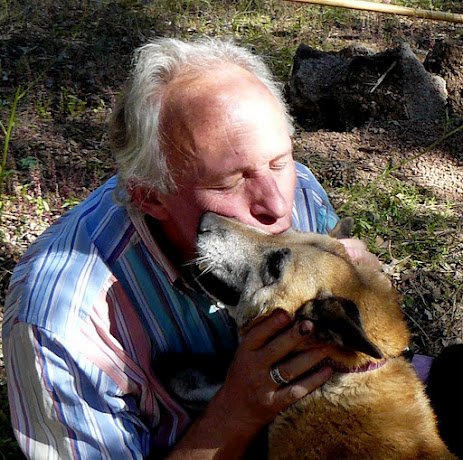
The love between a dog and a human – hugging a dog when one is feeling emotionally vulnerable is beyond measure. Dogs always sense when we humans are feeling fragile and they offer their uncomplicated hearts to us without any condition or need for return. That selfless love is an inspiring example of what we all need to learn to give one another.
Touch and social intimacy – we have so much to learn from dogs when it comes to touch and social intimacy. We are all needy for touch.
Which leads me providentially to a recent item from Terry Hershey. Terry came to Payson in March, 2011 and he was a most inspirational speaker. I have followed him ever since.
Last Monday’s Sabbath Moment included the following story, republished with Terry’s kind permission – the story is all about touch!
Caroline was very sad. Caroline was only six years old and her father had just died. In fact, her father had been assassinated.
Sitting in the back of big black limousine, Caroline Kennedy didn’t quite know what to do with her sadness. On the seat next to her sat her nanny, Maud Shaw, and next to Maud, Caroline’s younger brother John.
Through the windshield Caroline could see her mother, Jackie, and her uncles, Robert and Ted, walking in front of the limousine as it slowly made it’s way down the Boulevard to St. Matthew’s Cathedral. Looking out of her side of the car, Caroline recognized the friendly face of Secret Service agent, Robert Foster. She liked and trusted Robert Foster.
Not knowing what to do with her sadness, and on impulse, she rolled down the window and stuck out her six-year old hand. Agent Foster had a choice to make. Secret Service agents are not allowed to have their hands occupied, needing to be ready for any emergency. But Robert Foster didn’t even think twice. He held Caroline’s hand tightly the entire way to the cathedral.
Later, Agent Foster said it was all he could do to “fight back his own tears of sadness, for little Caroline Kennedy.” When asked about his kindness, he seemed surprised, “All I did was hold a hand,” he answered.
Terry then goes on to say,
We all know sadness. Life breaks for each one of us in different ways and in different places. And sometimes the sadness seems too much to carry.
It requires courage to roll down the window, to connect or ask or invite. For whatever reason, there is a knee-jerk need to deny any sadness, or dismiss it, or apologize for it. “I’m sorry,” people will say, wiping away their tears, as if their sadness is a violation of some tenet of propriety. Heaven forbid if any humanity is exposed.
So sometimes I am afraid to ask. Not sometimes; most times. I don’t want to appear weak. Asking for help is a hard pill to swallow.
I spent Saturday in Clearwater, Florida, with a group talking about intimacy and communication. (Yes, it is easier to talk about than to practice.) Here’s what I told the group.
If we don’t bring it with us, we’re not going to find it there. Which means intimacy–trust, vulnerability, authenticity, honesty–begins here.
With me. With this me.
I was raised in a religious environment that taught me to eradicate my messiness (to quash my sadness or grief or untidiness).
I now believe differently. I now know that we find and express acceptance, love and grace (the place where we can be fully human), in our messy, imperfect, and fully thorny selves. In other words: We can embrace this life–without any need to photoshop it.
To be human is to be vulnerable. I am capable of being wounded and cut and sad… which also means that I am capable of being kind and generous and present.
In such moments of heartache, I can have the courage to ask for a hand to hold.
In such moments of heartache, I can have the courage to hold a hand the needs to be held.
Robert Foster didn’t think twice about holding a hand that needed to be held. And he wasn’t posturing or amassing heavenly brownie points. He was doing what needed to be done.
Here’s the deal: we don’t need more remedies or advice. We need more touch. We become more human when we touch. Why? Because when we touch, we are seen. And when we are seen, we recognize that our value is not tied solely to our sorrow.
And we, you and I, will find no better lesson to learn from our beautiful canine friends, than this lesson of touch.
“Exact knowledge is the enemy of vitalism.” Francis Crick.
On the face of it, I’m going to write about two totally disparate aspects of the brain. Or are they?
I subscribe to Naked Capitalism and one of my favourite aspects of Yves’s daily email presentation are the Links. They cover an incredibly broad range of news items.
So it was perhaps a week ago or thereabouts that one of those links was to an item in the British newspaper, The Daily Mail. Here’s how the article started,
Power really does corrupt as scientists claim it’s as addictive as cocaine
More than a hundred years after noted historian Baron John Acton coined the phrase ‘power tends to corrupt, and absolute power corrupts absolutely’ scientists claim the saying is biologically true.
The feeling of power has been found to have a similar effect on the brain to cocaine by increasing the levels of testosterone and its by-product 3-androstanediol in both men and women.
This in turn leads to raised levels of dopamine, the brain’s reward system called the nucleus accumbens, which can be very addictive.
Across in the English paper The Daily Telegraph, Dr Ian Robertson writes on this subject and says,
Unfettered power has almost identical effects, but in the light of yesterday’s Leveson Inquiry interchanges in London, there seems to be less chance of British government ministers becoming addicted to power. Why? Because, as it appears from the emails released by James Murdoch yesterday, they appeared to be submissive to the all-powerful Murdoch empire, hugely dependent on the support of this organization for their jobs and status, who could swing hundreds of thousands of votes for or against them.
Submissiveness and dominance have their effects on the same reward circuits of the brain as power and cocaine. Baboons low down in the dominance hierarchy have lower levels of dopamine in key brain areas, but if they get ‘promoted’ to a higher position, then dopamine rises accordingly. This makes them more aggressive and sexually active, and in humans similar changes happen when people are given power. What’s more, power also makes people smarter, because dopamine improves the functioning of the brain’s frontal lobes. Conversely, demotion in a hierarchy decreases dopamine levels, increases stress and reduces cognitive function.
OK, moving on. On April 29th., there was an article on the Big Think website with the intriguing title of You Are Not Your Brain!
What’s the Big Idea?
“Contemporary research on consciousness in neuroscience rests on unquestioned but highly questionable foundations. Human nature is no less mysterious now than it was a hundred years ago,” writes philosopher Alva Noë in his book Out of Our Heads.
It’s a bold assertion in an age when fMRI has enabled us to see images of the brain functioning in real time, and when many prominent public intellectuals (Stephen Hawking, Eric Kandel) have argued, either implicitly or vociferously, in favor of reductionism. The “brain-as-calculating machine” analogy assumes that human thought, personality, memory, and emotion are located somewhere in the gray matter protected by the skull. In other words, you — at least, the waking you who gets out of bed in the morning — are your brain.
But you’re not, says Noë. Just as love does not live inside the heart, consciousness is not contained in a finite space — it’s something that arises, something that occurs: a verb rather than a noun. And since the publication of Francis Crick’s influential The Astonishing Hypothesis: The Scientific Search for the Soul, scientists have been looking for it in all the wrong places.
That’s enough of me republishing the article – if it grabs your interest, do go and read it in full here.
And here’s Francis Crick with an extract from his DVD on the Scientific Search for the Soul
A noted scientist discusses free will, consciousness, attention and memory and their relationship to the human nervous system. In a wide ranging discussion, Crick points out that the hypothesis that the brain is the seat of consciousness has not yet been proven.
Francis Crick, Ph.D., received the Nobel Prize in 1962 for the discovery of DNA’s central role in the process of genetic reproduction. He is author of Life Itself, What Mad Pursuit and The Astonishing Hypothesis.
“Chance is the only source of true novelty.” Francis Crick
Some people seem to have a knack for saying it how it should be!
My sub-heading, above, applies to many people right across the world. But the reason that this was triggered in my mind for today’s post, was a recent item on Christine’s excellent Blog, 350 or bust. Read more about that Blog here. I subscribe to that Blog.
Gene Roddenberry, the creator of the amazingly popular Star Trek series, was a man ahead of his time. Here is one of the things he had to say about humanity and our problems (with one editorial comment from me!):
“I believe in humanity. We are an incredible species. We’re still just a child creature, and we’re still being nasty to each other [Stephen Harper: are you listening?]. And all children go through those phases. We’re moving into adolescence now. When we grow up, man, we’re going to be something!”
But what caught my eye were these comments to the Post.
The first one from a Mickey Haist that read,
It’s a nice goal, but would clenching our teeth and willing progress be of any effect? After all, children don’t spontaneously mature – they’re raised.
Have to say that I was left unsure by what Mr. Haist was trying to convey. But not so Christine! This was the first of her two replies,
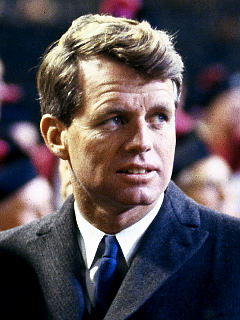
No teeth clenching allowed! Robert Kennedy once said “Each time a person stands up for an ideal, or acts to improve the lot of others, or strikes out against injustice, he or she sends forth a tiny ripple of hope. And crossing each other from a million different centers of energy and daring, those ripples build a current that can sweep down the mightiest walls of oppression and resistance.”
It’s not about everyone doing everything, it’s about each of us doing what we can. Not taking action because the problem is too big is not the answer.
And her second reply,
And Mickey – if the challenge of climate change/ocean acidification/biodiversity loss that we are facing as a species (taking the rest of the natural world with us) doesn’t make us mature, then nothing will. But I believe it will – as Paul Gilding says, humans are slow but not stupid!
Paul Gilding’s excellent website is always a great read, by the way.
But do reread those words of Robert Kennedy, they are powerfully inspiring.
Robert Kennedy
Each time a person stands up for an ideal, or acts to improve the lot of others, or strikes out against injustice, he or she sends forth a tiny ripple of hope. And crossing each other from a million different centers of energy and daring, those ripples build a current that can sweep down the mightiest walls of oppression and resistance.
Despite the fact that these words were said in response when South Africans suffered the tyranny of apartheid, the words are, perhaps, even more relevant today. Mankind has to combine the many ‘ripples of hope’ and build that current that will sweep away the crazy selfishness that is preventing us from living in harmony with this beautiful planet for hundreds of years ahead.
A remarkable story about two very clever men and an equally clever dog!
Five days ago, I received an email from a Richard Hake quite out of the blue! This is what it said,
Dear Paul Handover,
I’m taking the liberty of cc’ing this to Tim Pennings since he may be interested in your blog “Learning from Dogs.”
As founding author of the great blog “Learning from Dogs”, I thought you might be interested in the work of Tim Pennings.
Paraphrasing from the Hope College website:
*~*~*~*~*~*~*~*~*~*~*~*~*~*~*~*~*~*~*~*~*~*
Tim Pennings is a professor of mathematics at Hope College and owner of a famous Welsh Corgi dog, Elvis, who knows calculus. He has given over a hundred talks – including several speaking tours – based on his papers “Do Dogs Know Calculus?” [Pennings (2003)] and “Do Dogs Know Bifurcations?” [Minton & Pennings (2007)]. Articles about Elvis are easily found on Google and Youtube. For example:
1. “A Dog, a Ball, and Calculus” Ivars Peterson’s MathTrek,
2. “Calculating Dogs” Ivars Peterson’s MathTrek ,
3. “Dog Plays Fetch With Calculus” YouTube (see below)
4. “Elvis The Calculus Dog at Roanoke College” Vime0 Videos.
*~*~*~*~*~*~*~*~*~*~*~*~*~*~*~*~*~*~*~*~*~*
Regards,
Richard Hake, Emeritus Professor of Physics, Indiana University
Honorary Member, Curmudgeon Lodge of Deventer, The Netherlands
President, PEdants for Definitive Academic References which Recognize the Invention of the Internet (PEDARRII)
Well what fun!
Let me start with that YouTube video mentioned above:
Tim Pennings of Hope College in Madison, Wisconsin takes a look at the mathematics his dog Elvis uses to play fetch.
And here are a number of wonderful pictures of Elvis from which comes this one:
Elvis: Professor Tim Pennings' dog.
More may be learnt about Tim Pennings from here, from which I quote:
I am a professor of mathematics at Hope College. My areas of research and writing include dynamical systems (the shadowing property in particular), mathematical modeling, and the infinite. I have directed the Mathematics REU Site since 1995 and have mentored research students almost every year since 1990. A complete list of published papers, talks, and other professional activity is included in my vitae.
I have a famous Welsh Corgi dog, Elvis, who knows calculus. Here are some pictures of us. We have given over a hundred talks – including several speaking tours – based on our papers “Do Dogs Know Calculus?” and “Do Dogs Know Bifurcations?” (written with Roland Minton) both published in the The College Mathematics Journal of the MAA. Articles about Elvis are easily found on Google and Youtube.
Finally, the author of the email, Richard Hake, is no slouch! Here’s Richard’s Blog Hake’sEdStuff and information on his academic background.
A discovery of some writing from the past triggers memories.
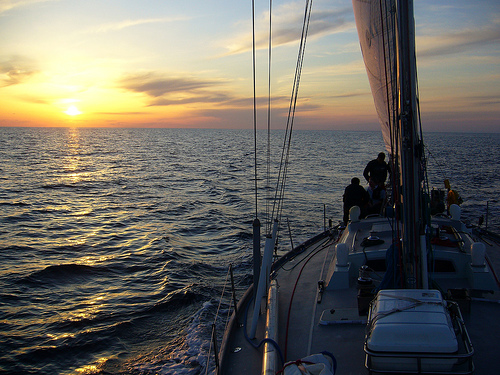
Way back on the 15th November, 2009, I wrote a post about single-handed sailing and how it caused me much disquiet. Rather than just leave you with a link to that reflection, I’m going to include the post again, below. The reason is that a few days ago, in looking through some of my earlier writings in conjunction with a writing group that Jean and I belong to, I came across a piece that I wrote following a solo voyage from Larnaca in Cyprus, west along the Mediterranean Sea and then out over the Atlantic from Gibraltar to Horta on the island of Faial in the Azores. That last leg was a little over 1,100 nautical miles (1,300 land miles) and took me eight days.
So first here’s that earlier post from 2009.
A personal reflection on this rather strange way of travelling!
The recent Post about young Jessica Watson sailing alone around the world raised a few comments but also reminded me of my own experiences of solo sailing.
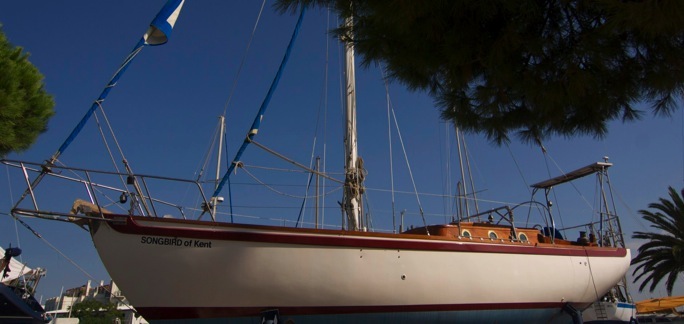
Some years ago, having successfully sold my own IT company, I warmed to the idea of being a full-time yachtie! A second-hand Tradewind 33 was discovered on the Island of Corfu. (Now here’s a surprise! I was just browsing the web looking for a picture of a Tradewind and came across my old yacht currently up for sale. Her name is Songbird of Kent! Picture below.)
Tradewind 33 - Songbird of Kent
Anyway, the deal was done and having sold my house in England I flew out to Corfu to collect Songbird of Kent. Inevitably it was a number of months before the boat was ready to head out into the Mediterranean but in early Spring 1988 it was time to explore the long coastlines of Greece and Turkey.
After a fantastic summer cruising from one idyllic anchorage to another mostly with friends or family on board, it was time to find a winter haven. Many recommended Larnaca Marina in Cyprus. Thus it was late in the summer of 1988 that I said goodbye to friends and set out on my own to cross from Antalya in Turkey to Cyprus and along the South coast of Cyprus to Larnaca, on the SE side of the island.
That sea crossing, a little over 200 nautical miles, was to become a regular solo experience at the start and end of each summer season. Impossible to do in a single day thus it always included a night at sea and rarely, if things didn’t go well with the weather, a couple of nights. I hated it! Maybe it was the sudden transition from coastal sailing to a deep water crossing, often going from having friends on board to being alone, but whatever it was I never enjoyed my time on my own and knew that long-distance solo sailing was never going to be my scene.
Anyway, I ended up spending several very happy winters in Larnaca.
One time, there was news of a Frenchman who had come into Larnaca on his way home to France having nearly completed a circumnavigation of the world. He was on his own!
I was astounded to hear how someone could do this and made a point of calling round to his berth. The boat was a beautiful, solid steel yacht, the very epitome of a craft that could challenge the oceans. The owner’s name was Pierre (it would be!). Pierre invited me aboard and we went down to his saloon to drink a hot coffee – real French coffee!
Inevitably the conversation turned to the challenges of sailing alone. Pierre said that the big cargo ships at sea moved quickly relative to the speed of a yacht so at night he set an alarm for every 15 minutes. That was the time that a ship could go from being hull down over the horizon to being close enough to be a hazard. Thus while at sea Pierre got up briefly every 15 minutes during the night to avoid being run down! It sounded totally exhausting.
Then Pierre asked me about the sailing I had done and whether I had sailed on my own. I declared my trivial journeys back and forth from Cyprus to Turkey and revealed that being on my own made me very, very unhappy. Pierre was surprised to hear that as he admitted that being at sea alone was one of the most tranquil and peaceful experiences ever. Pierre asked how long these solo journeys took. I replied, two or three days.
“Ah!”, he said, “That is the problem.” “I, too, hate the three days. It is always a period where you adjust and it is terrible.“
“My friend, you must find a way to be alone for more than three days. You will see that it is very different.“
It was some years before that opportunity came about but, in the end, I did undertake a solo journey of 8 days. Pierre was right. The first three days were hell, the rest were heaven!
Thank you, Songbird of Kent, you gave me some fabulous memories!
By Paul Handover
Now on to my writings about being out at sea alone on a small yacht.
Being at Sea
Going to sea in a small vessel is a profound experience.
In harbour we build up a reliance on things external. We have no need to worry if there is insufficient food on board, we can plug into the dockside power supply, sleep through the night undisturbed and we can wander off and enjoy the company of others if the boat feels a little claustrophobic.
Then slowly, imperceptibly, but with huge force, arrives the need to move on. The realisation that our cosy life connected to the busy, bustling and self-obsessed world of shoreside is not fulfilling our search for adventure and for the truths that lay over the horizon. It is time to leave.
The act of casting off is always exciting as it heralds a new adventure. But it also carries feelings of loss and apprehension as one lets go of the bonds of a previous certainty. The first few hours are filled with the workload of getting one’s craft shipshape and battened down for the unknown seas. Then gradually comes the realisation that the land is now less the dominating visual feature than the vastness of the seascape that is ahead. But with the land in sight, albeit a distant horizon behind one, you can still sense the life you are leaving.
Now all that surrounds you is the sea. You are now truly disconnected from the land. It is often at this point that despondency and uncertainty play with your mind; after all this new life is still very unfamiliar compared to the warmth of that island home that still resonates in your heart. Time to remind yourself of why you wanted to take this voyage.
A small boat is very fragile. Just a centimetre of hull separating you from the unimaginable depths of the ocean beneath your keel. Not until the end of your voyage, when you draw your boat up, metaphorically on to that beach, will you ever stop feeling how close fate is, how it rides on your shoulder night and day. That, of course, is why we go to sea. It is the place where we taste life, where we savour each moment of the present because the future seems too bound up in the mystery, the uncertainty of the ocean. You are in charge of your tiny craft. Your survival depends on how you manage your small ship, how you navigate these seas, how you read the weather ahead and avoid the storms.
Soon your life on the ocean becomes everything to you. You have time to reflect on so much that is left behind. The distance seems to dissolve all the nuisances, bring into focus all the things that are important to you. There is no certainty with the ocean apart from the knowledge that you are very small and very, very vulnerable and yet, in a sense, also so strong.
In the end, we have to break away from our insecurities and our emotional dependencies on external people and situations because, without that, we are never able to command our own life and the destiny that flows from that captaincy. There is a real strength in knowing ourselves as we would know our own boat. If we really know every spar, sail, rope and fitting, if we have real understanding of the strengths and weaknesses of our small vessel then we are able to know when to breast the waves or when to turn and run before the storm. We are secure that our small craft will protect us day and night.
Thus self-knowledge gives us the same freedom to manage our lives, to know when to fight and when to turn away. And just as after every long voyage the boat will need hours of careful maintenance so our own souls need regular love and caring from our spiritual keeper.
A Biological Basis for the Unconscious? Surely not?
Ten days ago or thereabouts, I saw a piece on Big Think about the unconscious. The title of the piece was as the sub-heading: A Biological Basis for the Unconscious? I was intrigued, to say the least, and wanted to write about that on Learning from Dogs.
Today, the question of how people make decisions is an animated and essential one, capturing the attention of everyone from neuroscientists to lawyers to artists. In 1956, there was one person in all of New York known for his work on the brain: Harry Grundfest. An aspiring psychiatrist who was born in Austria in the 1930’s, Eric Kandel took an elective in brain science during medical school and found himself studying alongside Grudfest at Columbia University.
“What is it you want to study?” Grundfest asked Kandel. “I want to know where the id, the ego, and the super-ego are located in the brain,” Kandel replied. Grundfest looked at him as if he was crazy. “I haven’t got the foggiest notion whether these constructs exist,” he said. “But the way to approach the brain is to study it one cell at a time. Why don’t you study how the cells work?”
Now it would be improper to republish the whole article, not having permission to so do, and I thoroughly recommend you going to the article here and reading it completely from the Big Think website.
But there are a number of interesting videos on YouTube and the one I have selected is a great example of Kandel’s power of mind. As the short description of the video reveals, “A Conversation With Nobel Laureate Eric Kandel, Who Continues to Look Forward at 80.”
Brilliant mathematics without the need for a calculator!
Thanks to the bottomless resources of the Internet, I could quickly find a relevant quote or two to open up today’s Post. Rene Descartes (1596-1650) was reputed to have said, “Perfect numbers like perfect men are very rare.”
Sorry, couldn’t resist that! It wasn’t the quote relevant to this essay but it was too good to miss. (Descartes was also the person who coined the phrase: I think therefore I am!)
The quote that I thought was relevant was this one from Descartes, “With me everything turns into mathematics.” Well until I read something recently on the Big Think website I would have been certain that the emotions, such as happiness, were well beyond reach of the logical power of mathematics. I was wrong!
….. argues (against Einstein, as it happens), that everything that counts can and ought to be counted. A hotelier by trade, he says that GDP and the bottom line are blunt instruments for measuring the health of a society or a business. After the dot.com crash of 2001, and a visit to the Buddhist nation of Bhutan, which has a “Gross National Happiness” index, Conley and his team decided to create indices for measuring the well-being of their employees and customers.
And a paragraph later continues,
In Emotional Equations, Conley takes the mathematics of human happiness a step further, creating simple formulas like anxiety = uncertainty x powerlessness, which, when used systematically, he says, can give individuals and organizations a concrete method for addressing the human needs that drive them.
The description of the book on the Amazon website is thus,
Mr Chip Conley
Using brilliantly simple math that illuminates universal emotional truths, Emotional Equations crystallizes some of life’s toughest challenges into manageable facets that readers can see clearly—and bits they can control. Popular motivational speaker and bestselling author Chip Conley has created an exciting, new, immediately accessible visual lexicon for mastering the age of uncertainty. Making mathematics out of emotions may seem a counterintuitive idea, but it’s an inspiring and incredibly effective one in Chip Conley’s hands. When Conley, dynamic author of the bestselling Peak, suffered a series of tragedies, he began using what he came to call “Emotional Equations” (like Joy = Love – Fear) to help him focus on the variables in life that he could deal with, rather than ruminating on the unchangeable constants he couldn’t, like the bad economy, death, and taxes. Now this award-winning entrepreneur shares his amazing new self-help paradigm with the rest of us. Emotional Equations offers an immediately understandable means of identifying the elements in our lives that we can change, those we can’t, and how they interact to create the emotions that define us and can help or hurt our progress through life. Equations like “Despair = Suffering – Meaning” and “Happiness = Wanting What You Have/Having What You Want” (Which Chip presented at the prestigious TED conference) have been reviewed for mathematical and psychological accuracy by experts. Conley shows how to solve them through life examples and stories of inspiring people and role models who have worked them through in their own lives. In these turbulent times, when so many are trying to become “superhuman” to deal with our own and the world’s problems, Emotional Equations arms readers with effective formulas for becoming super human beings.
So it all seems not quite so daft as one might initially guess. Indeed, settle down for twenty minutes and watch Chip eloquently explain his ideas captured at that TED Conference referred to above.
There’s also an audio conversation with Mr. Conley that you can download free from here.
Finally, let me close with yet another quote from Rene Descartes, “It is not enough to have a good mind. The main thing is to use it well.” Amen to that!

 A couple of smart guys, Gregory Berns and Andrew Brooks of Emory University, watching a military dog assist Navy Seals as they overran the Osama Bin Laden compound, got a brilliant idea. If you can teach dogs to jump out of helicopters, surely dogs could be trained to enjoy themselves inside an fMRI machine while scientists calculate what the dogs are thinking by scanning their brains.





 Learning from Dogs