I can’t recall why it was many months ago that I came across the website of Frontiers in Science. But I did and, in particular, I came across a fundamental difference between the two species. In an article entitled: A simple reason for a big difference: wolves do not look back at humans, but dogs do.I’m going to take a chance, as in not having formal permission to republish it, in reposting it in full here. Because it means so much to me and other dog lovers!
ooOOoo
A simple reason for a big difference: wolves do not look back at humans, but dogs do.
Adám Miklósi, Enikö Kubinyi, József Topál, Márta Gácsi, Zsófia Virányi and Vilmos Csányi
Department of Ethology, Eötvös University, Budapest, Pázmány P. 1c, 1117, Hungary. miklosa@ludens.elte.hu
The present investigations were undertaken to compare interspecific communicative abilities of dogs and wolves, which were socialized to humans at comparable levels. The first study demonstrated that socialized wolves were able to locate the place of hidden food indicated by the touching and, to some extent, pointing cues provided by the familiar human experimenter, but their performance remained inferior to that of dogs. In the second study, we have found that, after undergoing training to solve a simple manipulation task, dogs that are faced with an insoluble version of the same problem look/gaze at the human, while socialized wolves do not. Based on these observations, we suggest that the key difference between dog and wolf behavior is the dogs’ ability to look at the human’s face. Since looking behavior has an important function in initializing and maintaining communicative interaction in human communication systems, we suppose that by positive feedback processes (both evolutionary and ontogenetically) the readiness of dogs to look at the human face has lead to complex forms of dog-human communication that cannot be achieved in wolves even after extended socialization.
ooOOoo
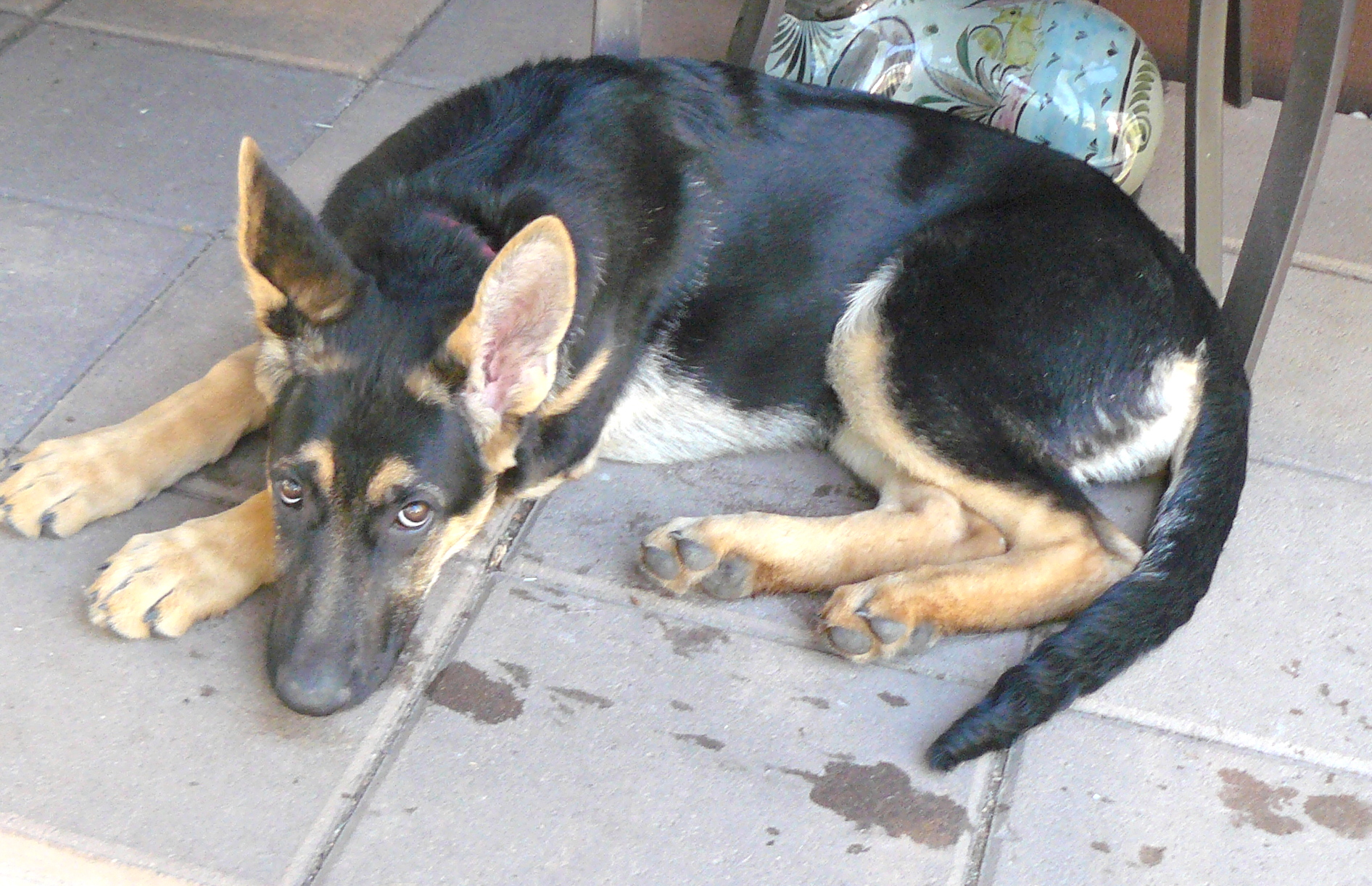
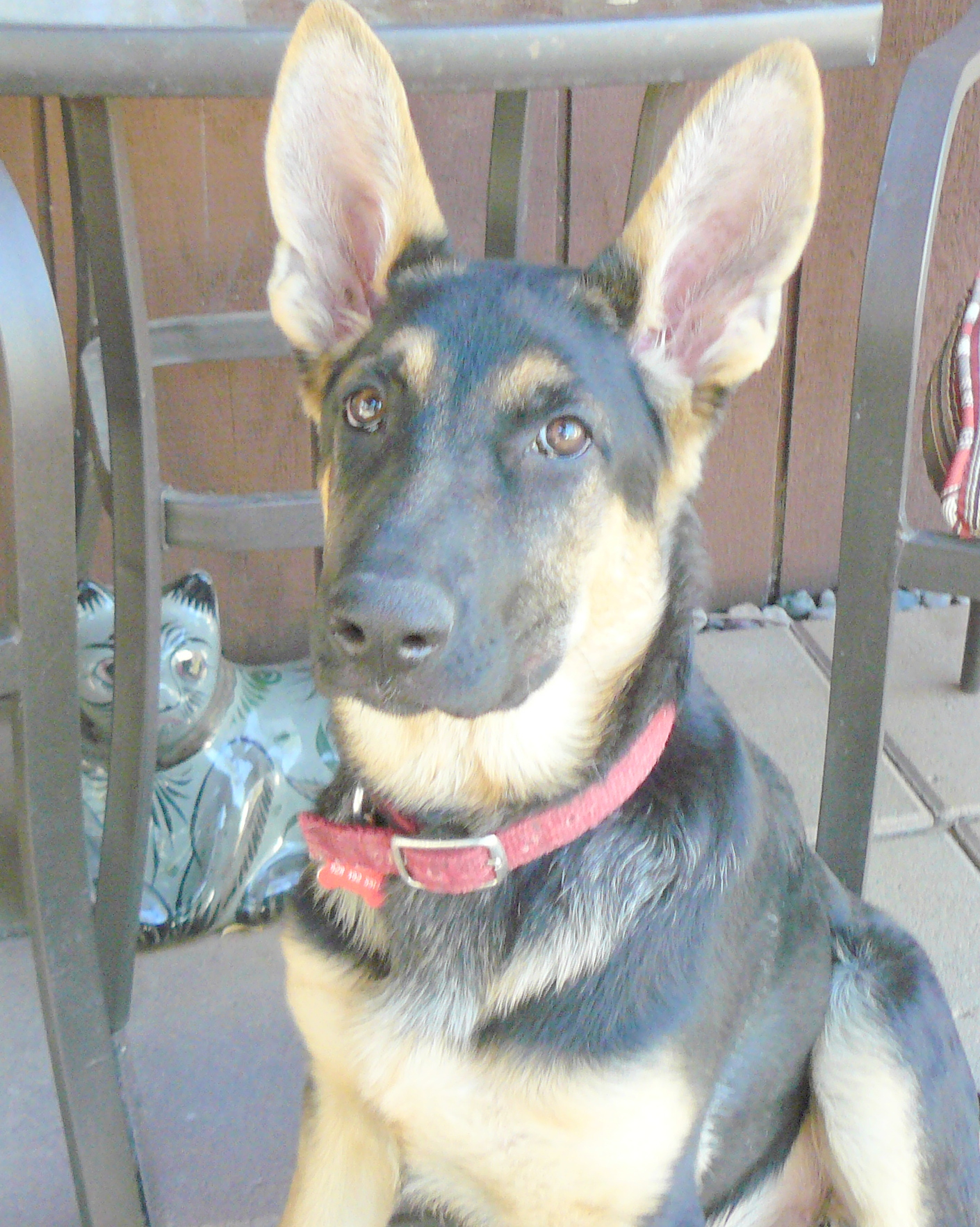
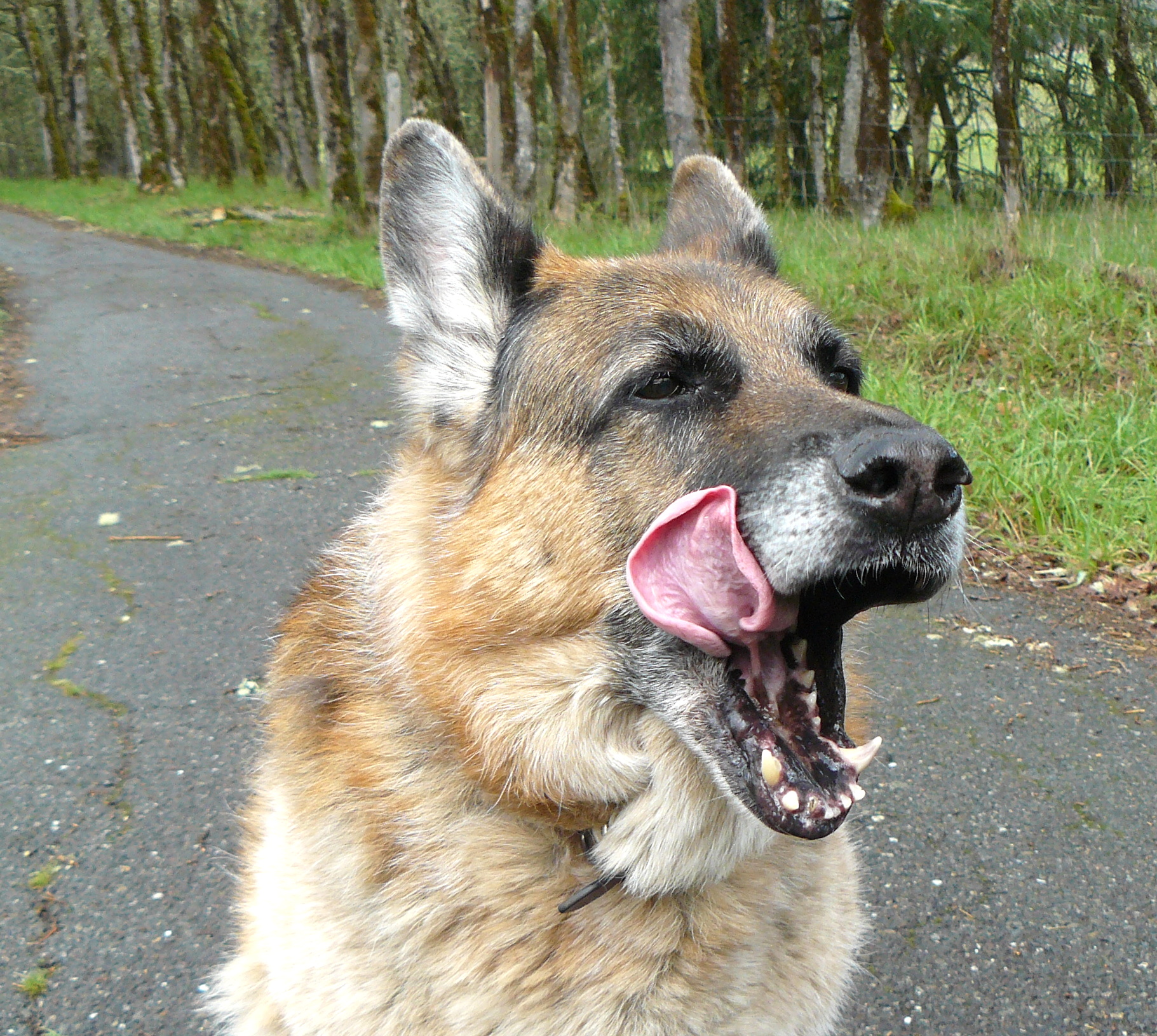
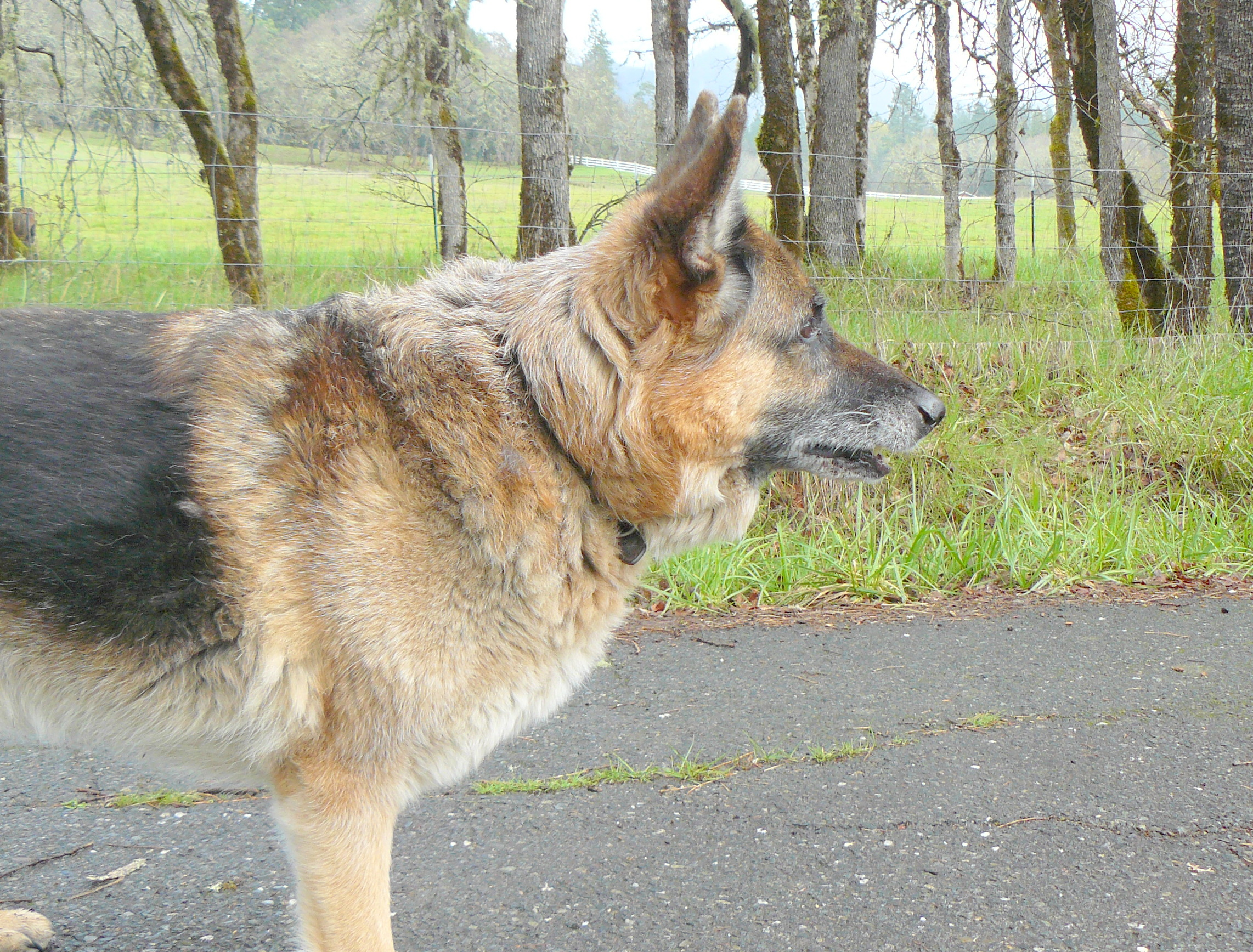
Actually, that article from the Department of Ethology at Eötvös University in Budapest is just an excuse for me to post three photographs confirming the good scientists results!
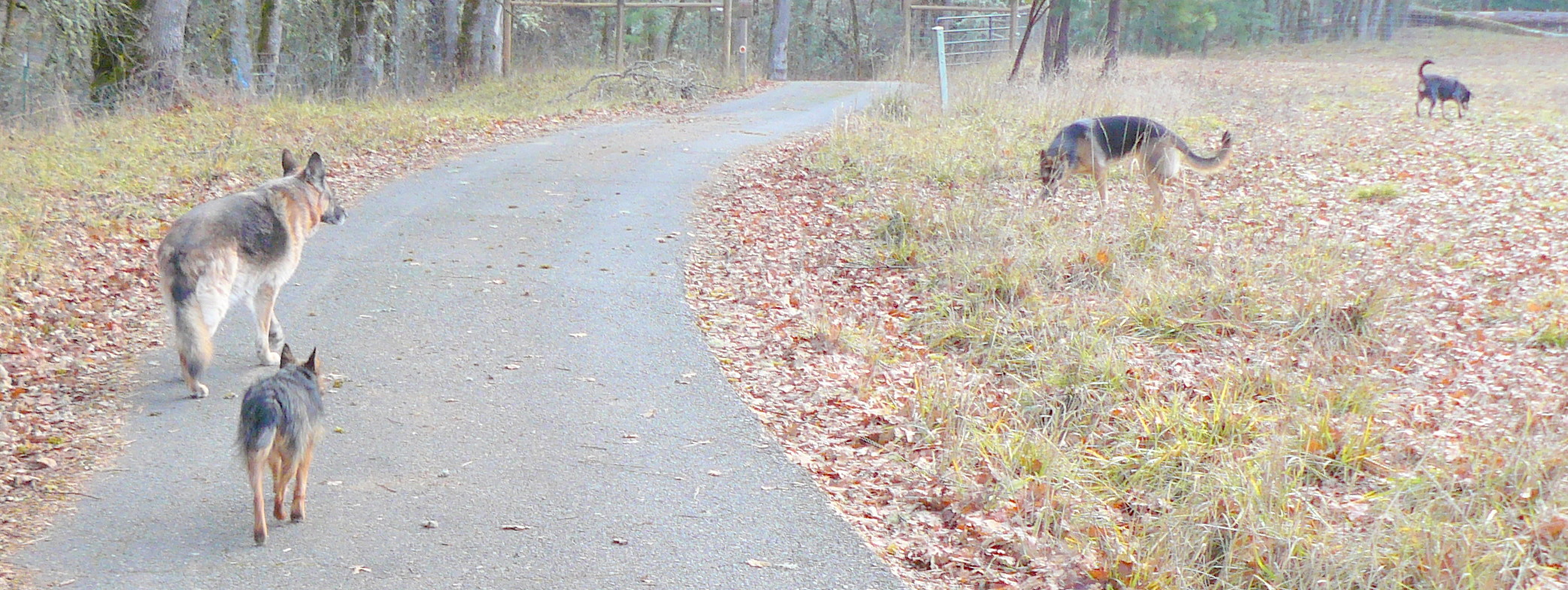
Young Cleo, May 12th, 2012.
oooo
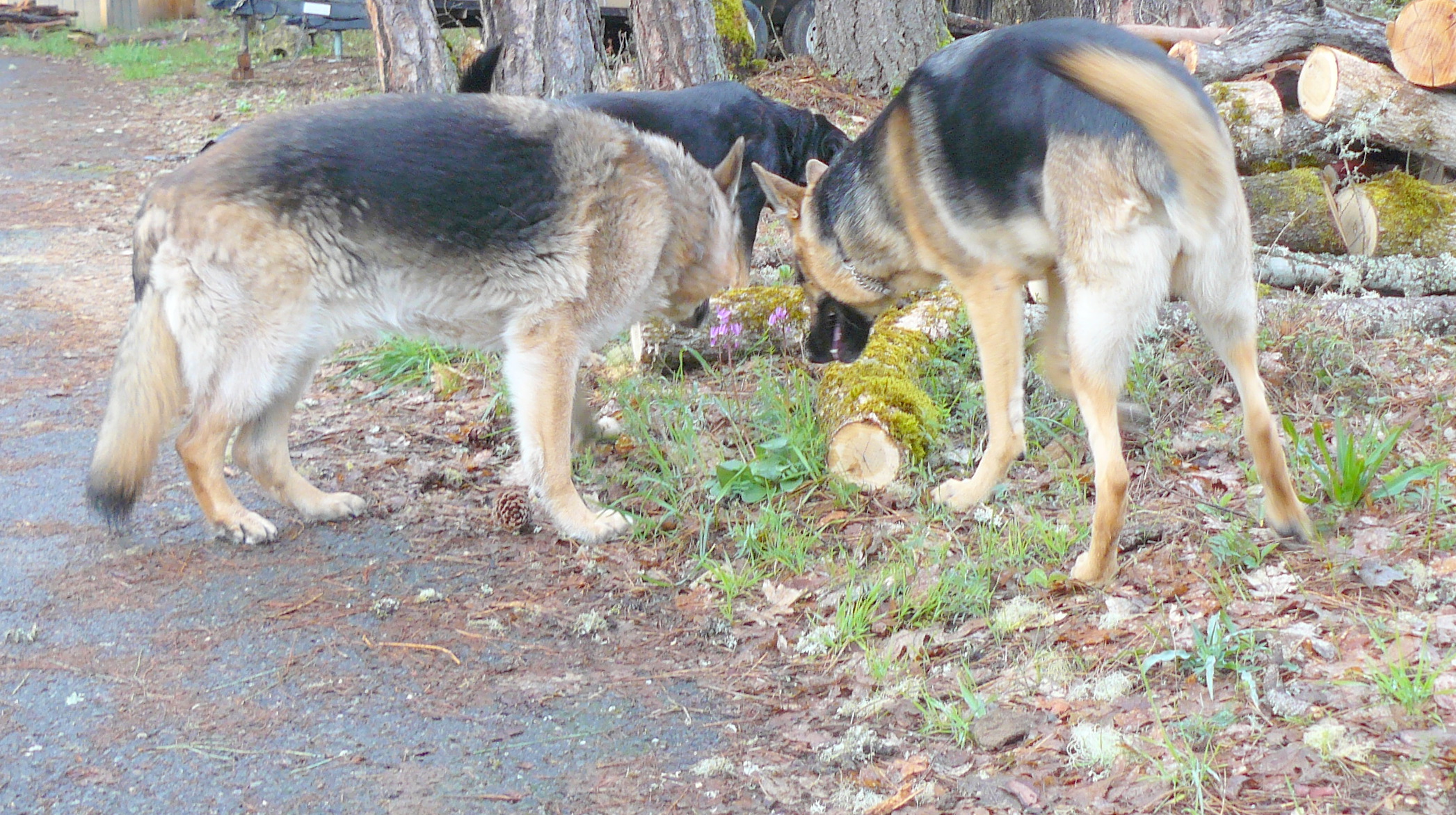
Mr Pharaoh’s look from June, 2007.
oooo
The second Cleo look from May, 2012.
oooo
There’s no question in my mind that millions of dog lovers across the world know the intimacy that is conveyed in a dog’s eyes!
If you do a search on Learning from Dogs for Terry Hershey you will find that his name comes up from time to time. Way back in March, 2011, I published a post announcing a visit by Terry to Payson, AZ where Jean and I were then living. Having had the opportunity to listen to Terry speaking and to meet him in person, I have maintained a subscription to his weekly Sabbath Moment ever since.
Thus it was that last Sunday in came the regular missive from Terry. They are always good but last Sunday’s was spectacularly good. In response to my request to publish the full Sabbath Moment here on Learning from Dogs, there was a prompt reply to the affirmative.
Thus with no further ado, here is Terry’s Sabbath Moment for May 5th, 2014, in full.
ooOOoo
Artists
May 5, 2014
It seems that in the spiritual world, we do not really find something until we first lose it, ignore it, miss it, long for it, choose, it, and personally find it again–but now on a new level.Richard Rohr
Mystery is at the heart of creativity. That, and surprise. Julia Cameron
I was born fragile, farther said. I was just born that way. He said I was a nervous baby. Just born like that.David Helfgott
I saw the angel in the marble and carved until I set him free.Michelangelo
oooo
Lorraine Hunt Lieberson began her career as an accomplished viola player. While on tour in Europe (in the late 1980s), her viola was stolen. She could have replaced it. As would be imagined, the theft threw her into a state of feeling lost and uncertain. She stopped playing. After awhile, Lorraine began to work with only instrument she had, her voice.
When asked, Lorraine stresses that her decision to go into singing happened quite naturally. “There were a lot of encouragements along the way, but no individual, earth-shaking event that made me change,” she says. “But, back in 1988, when my viola was stolen, I took that as a sort of omen.” (And although she hasn’t yet replaced her stolen viola, she avows that “the viola is always with me in spirit when I sing.”)
Interestingly, Lorraine is shy about being interviewed; she has no press agent. But when she sings she is known for an ever-widening swath of ardor and awe that she leaves in her wake. An intensity. Her voice–her singing–touches hearts and lives. The irony is that the gift–the artistry–she has given us all, began when life turned left.
Ask any class of kindergarten students, “How many of you are artists?”
How many raise their hands? Every single one of them.
Ask fourth graders. Maybe half.
Seventh graders. A handful.
Seniors in high school. Maybe one.
It’s quite the educational system we have created. We begin with artists, and we slowly wean it out of them.
I do know this: it is easy to lose sight of that artist that resides inside of each one of us. Whether lost or buried or stuck or forgotten or dismissed or ignored… or “stolen.” (Whenever I lead a retreat, Crayolas are mandatory–because it is an unwritten spiritual principle that you cannot learn about life unless you color. It is curious then, how many–otherwise secure adults–will say, “I’m not very good at coloring.” I will say, “Who said anything about being ‘good’ at it?” Our mind has already morphed from play and wonder to mastery and proficiency.)
When we tag or label or describe ourselves, “artist” is seldom used. Where I was raised, artist was a phase you went through (a dream), you know, to grow out of, to, move on to something more useful and sensible–in order to get a real job.
Yes, of course we are all inner artists, but the cynical part of me tells me that it all sounds too much like a mantra meant to be chanted standing in a circle at a “be all you can be” conference. Sure, it all sounds good.
But I’m not sure what it really means.
In the opening scenes of Shine, we first meet the middle-aged David Helfgott (played by acclaimed Australian stage actor Geoffrey Rush), babbling to himself incessantly and wandering in the rain, in a state of transition. Behind him is the isolated existence as a child piano prodigy whose emotional turmoil led to a nervous breakdown, and a series of stays in various mental institutions. Ahead of him is his eventual reconnection with the world around him, guided by both love and his virtuoso talent that has been long abandoned. We witness the awakening of the artist. In the movie (and in real life), David eventually moves toward that which gives life.
So, what is this artist? It is the place in our spirit that births…
creativity, enchantment, imagination, play, risk and wonder.
There is no doubt that we hide it. We don’t believe it. Or we judge it as inadequate.
But here’s the deal: The artist in David did not reside only in the talent or prodigy or genius, but in the spontaneity, vitality, innocence, passion and delight. And the artist in Lorraine wasn’t detoured by life’s unkindness.
For me, the tragedy is that (in the name of love) David’s father (Peter) squeezes the artist out of the prodigy. But in truth, it doesn’t always require a pathological “love” to hide or extinguish the light.
In the movie rendition, there is a scene that stops my heart. David and his father are walking home after a competition. David has placed second.
(In his father’s eyes, anything other that first is a failure.) The father is seething, and there is no hiding his disgust. David has lived his entire life absorbing his father’s pathology, doing his very best to make his Daddy happy. The father walks ahead, hurried, his spirit heavy. David follows. On the sidewalk, in chalk, there is a hopscotch pattern.The camera follows from behind, and we see young David unconsciously, intuitively, childlike, hopping and skipping and jumping — the joy and the light (and the artistry) of his childhood still alive.
I don’t want to lose sight of that childlike artistry inside of me. I’m home for a week or so, and the garden is abounding and teeming with life and color and enchantment. The peony buds profligate, the bearded iris blooms beguiling, the columbine exquisite. The branches of the Japanese Maple, heavy with spring rain, deferentially bow. I once asked my analyst why I was in therapy. He told me it would make me a better gardener. Gardening can be strong medicine–an elixir that nurtures and shapes the soul. For that reason, it is a tonic seldom taken straight with no ice. Gardening has way of seeping into your soul, and one day you find yourself, in the words of poet May Sarton, spending the first half hour of the morning “enjoying the air and watching for miracles,” the joy and the light still alive.
oooo
I dip my pen in the blackest ink, because I’m not afraid of falling into my inkpot.Ralph Waldo Emerson
ooOOoo
Hope you all enjoyed this just as much as I did!
But I can’t close without mentioning something that struck me the very first time I read the essay. It is this.
That list that describes artistry: creativity, enchantment, imagination, play, risk and wonder. It’s not a million miles from describing the way our younger dogs behave when we take them for a walk around the property most days after lunch.
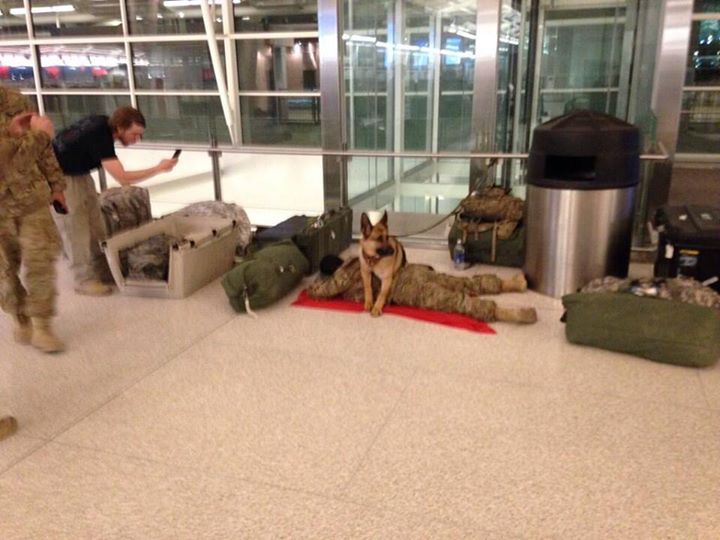
The following photograph was sent to me by Suzann who in turn received it from Joyce. Thanks to you both. Included with the photograph is the background to the picture.
Indianapolis International Airport
“One of our photographers returning to the Indianapolis International Airport took this photo of a soldier getting special guard duty from man’s best friend as she catches a nap in the terminal. About 10 soldiers and two dogs were in a group at the airport tonight. It wasn’t clear if they were coming home or heading out, but we thank them (and the dogs!) for their service!” – WTHR-TV
I’m going to skip the many comments that have been attached to the photograph, however smart and witty they are, and focus on the fundamental lesson that dogs, and many other creatures, offer mankind. It is this.
Our society only functions in a civilised manner when there is a predominance of trust about us. When we trust the socio-politico foundations of our society. When we trust the legal processes. When we trust that while greed and unfairness are never absent, they are kept well under control.
Having trust in the world around us is an intimate partner to having faith in our world.
At a time when inequality is making frequent headlines and Russia is sabre-rattling over Ukraine let us never lose sight of the primary importance of trust.
For without trust there can be no faith and without trust there can be no love.
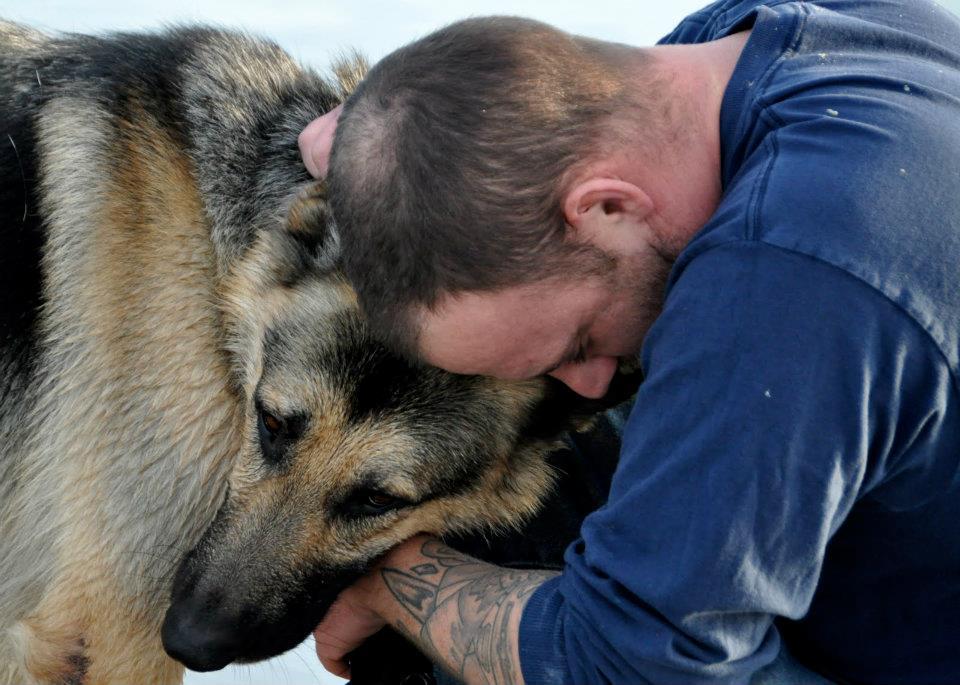
Here’s another photograph of the greatest ‘dog-teacher’ of them all; the German Shepherd dog.
Regular readers of Learning from Dogs will recall that just under a week ago I published an essay under the title of A bedtime story for mankind. The post centred around an essay from Patrice Ayme. Patrice’s essay could be summarised as follows: “At the present rate of greenhouse gases emissions, within nine years, massively lethal climate and oceanic changes are guaranteed.”
Then just last Sunday, Patrice published a second essay reinforcing that first one. The subsequent essay was called Ten Years to Catastrophe. I was minded to republish that but upon reflection thought that there was a better option. That was to explore the deep, core questions that both of Patrice’s essays raised in my mind and, presumably, must be raised in the minds of countless thousands of others. Questions along the lines of a comment I submitted to that subsequent post from Patrice.
Do you have an idea, even a sense, of when global leaders, elected Governments, the ‘movers and shakers’ in societies, will truly embrace the global catastrophe that is heading our way?
And a supplementary question: What would be the indicators that Governments were acknowledging the task ahead?
Frankly, they weren’t especially good questions but they were an attempt by me to open up a debate on whether or not this is the “beginning of the end” of life for us humans. Central to what was going through my mind was the core question of how did it all go wrong?
Welcome to Payson, AZ
On Monday evening, I rang John Hurlburt, a close friend of Jean and me from our Payson, Arizona days and kicked around those questions . It was a most enlightening conversation. John is an active founder member of Transition Town Payson and Payson recently welcomed the Great March for Climate Action in their walk from Los Angeles to Washington D.C. (An essay on that event coming soon.)
Anyway, from out of that conversation with John came the idea of a series of essays here on Learning from Dogs about the past, present and future of man’s relationship with Nature. The aim is to offer an essay on a weekly basis but we’ll see how it goes. Wherever possible, I will use the essays and posts from other bloggers that reinforce the vision. As always, your feedback in the form of ‘Likes’ or comments will reflect on the value of the essays to you.
After John and I finished the call, he sent me an email with what could be best described as his vision for these essays. Here is that email [my emphasis].
Integral Vision
Everything fits together. Otherwise, we’d simply be disassociated atoms.
Human beings are a consciously aware component of Nature. We have a DNA-level directive to survive as a species and as individual members of a species …. in that order!
We are consciously aware components of the conscious interaction between energy and matter in a predominently smoothly emerging cyclic universe with departures from time to time into pockets of chaos.
We disconnect from reality when we become self-centered, often during the various stages of our lives. When we are blessed we continue to live and learn.
Issues of ideology, rational thought, economics, politics, religion, history and science become insignificant in comparison to the whelming power of Nature.
Such is life. It comes with the territory. Spirituality, Nature and Science describe the metanexus in which we live.
Maintain an even strain,
an old lamplighter
Ref: Episcopal “Catechism of Creation”
Ideas, feedback and comments, as always, hugely welcomed.
One might be forgiven for thinking that community is an odd bed-fellow with trust and truth. Many might think that faith would be a more logical third leg, so to speak.
However, I hope to show that in today’s world where trust and truth are beleaguered qualities a rethinking of community is critically vital for the long-term health of mankind.
Community
Can’t resist a third look-up in Roget’s Thesaurus.
community noun
Persons as an organised body: people, public, society.
For me two words jump out from that definition: persons; organised.
The challenge is that the word organised is easily interpreted as an organisation with leaders and followers. But that’s not how community is regarded in the context of this third essay.
“No man is an island”, John Donne wrote in 1624.
This is a quotation from John Donne (1572-1631). It appears in Devotions upon emergent occasions and seuerall steps in my sicknes – Meditation XVII, 1624:
“All mankind is of one author, and is one volume; when one man dies, one chapter is not torn out of the book, but translated into a better language; and every chapter must be so translated…As therefore the bell that rings to a sermon, calls not upon the preacher only, but upon the congregation to come: so this bell calls us all: but how much more me, who am brought so near the door by this sickness….No man is an island, entire of itself…any man’s death diminishes me, because I am involved in mankind; and therefore never send to know for whom the bell tolls; it tolls for thee.”
Thus for the vast majority of people on the face of this planet, we are linked to others and how we live our lives is fundamentally influenced by those others about us. In a past life, I lived in the village of Harberton in South Devon. The population of Harberton was 300 persons.
An E. M. Morison (Totnes) postcard, bearing a 3p stamp, which gives a sending date between Feb 1971 and Sept 1973.
Now I was lucky when I moved into Harberton because my two sisters, Rhona and Corinne, had lived in the area for many years and it was easy for me to be positioned as ‘the brother’. Nevertheless, the way that the village embraced all newcomers was wonderful and within a very short time one felt a settled member of the community.
Same for Jean and me as relative newcomers to our property just 4 miles from Merlin, Oregon. All of our neighbours have embraced us and helped us understand this new rural life that we have embarked on. We feel part of the local community.
Yet it doesn’t stop there.
Obviously, I’m a WordPress user! Learning from Dogs is a WordPress blog! But were you aware of the size of the WordPress community? (As of now!)
How many posts are being published?
Users produce about 44.5 million new posts and 56.7 million new comments each month.
How many people are reading blogs?
Over 409 million people view more than 14.7 billion pages each month.
Even my funny little blog has 959 followers!
What that figure doesn’t reveal is how many of my followers have offered support, openness and real loving friendship. None better demonstrated than by the comments left by readers when I announced the recent death of Dhalia.
Think of the way that untold numbers of internet users rely on that ‘worldwide web’ for referrals, opinions or knowledge about anything ‘under the sun’.
So while there might be many aspects of our new technological world that create unease, the opportunities for having ‘virtual’ friends to complement our social friends make this era unprecedented.
I would go so far as to say this. That the way that knowledge and information can be shared around the world in no time at all may be our ultimate protection against those who would seek to harm us and this planet.
How to close these essays? Perhaps no better than as follows:
On Wednesday evening we were joined by neighbours, Dordie and Bill. My post on truth came up in discussion. Bill mentioned that he had read about a person who had spent many years studying the texts of all the world’s major religions. What had emerged was that across all those great religions there was a common view as to what the long-term health and survival of societies requires.
It is this: the telling of truth and the keeping of promises!
A most fitting guest essay after yesterday. The following is published with the kind permission of the author, Jeremy Nathan Marks. I have done a ‘screen grab’ of the image associated with his blog post so you can experience it as you would see and read it from The Sand County. It seemed perfect as a follow-on to yesterday’s post Life, and mortality.
ooOOoo
The Sand County
“In wildness is the preservation of the world.” -Henry David Thoreau
My Wish for the World
If I could leave behind but one lasting accomplishment from my life it would be to have changed the hearts and minds of all those people who accept or practice cruelty towards animals. Now there are a great many worthy causes in this world which fully deserve the attention of all those who believe in justice, in fairness, and in mercy. But I also know that each of us -perhaps- has a cause that stands above and beyond all of the other noble concerns that we know exist. For me this cause is the humane treatment of animals. And when I say animals I mean ALL animals. Permit me to explain. My wife and I have two dogs. Both are mutts and both were adopted through the Animal Rescue Foundation of Ontario (ARF). I have blogged about ARF before and can only offer the highest praise for the organization. Courtesy of ARF, we have been provided with free dog training classes which have proved to be an invaluable resource in learning about dog behaviour. Better yet, the dog trainer we have worked with has made herself available for our questions outside of class. Whenever we have encountered a behavioural challenge that we have not understood or have been unsure of a proper method of approach, this trainer has been very obliging. Importantly, she believes in positive reinforcement and does not believe in the use of pain, dominance, or stress as a means of conditioning dogs. For my wife and me, this fits in with our moral beliefs and our ethics. Our eldest dog, who just turned one year old, is a 60 lbs. shepherd mix who has a “leash anxiety,” if I may call it that. When we are out on a walk and she sees another dog she becomes quite agitated and will bark loudly and lunge at the other dog. This has puzzled us because our dog loves to play with others and is frequently socialized. We grew increasingly concerned because our use of treats and positive reinforcement was not working. And because our dog is a large shepherd, we both have worried that she might develop a reputation and become a source of fear or suspicion by other people in our neighbourhood. In due course, we contacted our trainer for advice. She suggested that rather than putting our dog in a stressful situation by repeatedly walking her past other dogs (and trying to control her behaviour when she becomes agitated) we should take her out of the situation instead. So, when we see another dog approaching we turn around and walk in a different direction, all the while rewarding our dog with treats and telling her she is a good girl. We have recently started doing so and the improvements are showing. So, let us fast forward to today. . . This afternoon we took both of our dogs on a 20 km hike along the Thames River. The trail is like so many other trails; it forms a narrow path through the woods which makes passing other trail goers challenging at points. If another dog were to come toward us this narrowness would pose something of a challenge because we cannot turn around (and head home). Also, because the trail runs through the woods, there aren’t often places to step aside and let other dogs pass by without our oldest detecting them. Inevitably we encountered another dog. We were approached by a small dog that was off leash (which is posted as unlawful, actually). We heard the dog before we saw it and prepared ourselves for some nervousness on the part of our oldest. When the dog approach some barking ensued and I tried to move our dog, as best I could, off the trail to let the family that was approaching us pass by with their dog. When we informed the family that our dog is uncomfortable around other dogs when she is leashed they did not seem to understand that we wanted them to pass by us quickly. When our eldest became excited one of the women turned to us and said that we should “knee our dog in her side to show her who is dominant.” I was appalled. Some woman, whom I have never met, who knows nothing about our dog or our relationship with our dog, was suggesting we use violence against her to show her who is boss. . . And this is a woman with a dog of her own! My wife later remarked to me, as we were driving home, that she would not feel entitled to the love and affection our dogs offer us if we used violence on them in any way. I thought what she said was beautiful and captured the principle of the matter perfectly. We want our dogs to love us and to trust us. How would we have any right to their love and affection if we were to lead them to believe that -at any moment and for no apparent reason- we might use painful force on them? Dogs do not understand why you use violence against them. They do not reason or understand cause-and-effect the same way that humans do. This is not a fault. It does not mean they are stupid or of lesser value than human beings. It does not mean they deserve to be treated with cruelty or brutality. Dogs experience violence as pain and suffering that is inflicted out of the blue. They are not only unprepared for it, but are often completely defenceless against it. How could we ever defend such an inhumane practice? It troubles me immensely that someone, whom I do not know, could so nonchalantly counsel me to violence against my dog. Her arrogant presumption aside, this was a monstrous act. It was barbaric. Nowhere in polite society would someone get away with counseling violence against a child. . . or against someone who is weaker. Yet violence against animals, even against dogs who supposedly occupy a place closer to human hearts than most other animals, is countenanced and even endorsed. (I won’t even begin to explain why the Dog Whisperer horrifies and saddens me.) If a young child was caught torturing animals we would all raise the alarm. The torture of animals, by a young child, is seen as an early warning sign of severe mental disturbance and has been linked to homicidal tendencies and highly violent behaviour. One of the great villains of American literature, the character Popeye from William Faulkner’s novel Sanctuary is depicted as a torturer of animals in his youth. Now I know that increasingly there are laws on the books in many nations that are designed to prevent cruelty to animals and to prosecute perpetrators. This is a positive development that I certainly applaud. But I would argue that there is something broader, more troubling in our relationship with animals that goes beyond the bounds of this current posting. It is a topic I will return to time and again at this blog. What troubles me is how animals are frequently seen as objects if they are even seen or thought of at all. The damage that our destruction of the forests, deserts, plains, and oceans of this world does to countless species is something that has been well documented. We do this because we are interested in acquiring the resources we feel are vital to ensuring our survival. . . but often it is our comfort or our “way of life” that really is the central reason for our pursuit of these things. There is a deep seated human arrogance which treats animals as inferior forms of life. We see them as less sophisticated because they cannot compete with us for power on this planet. We suffer from what Aldo Leopold called an “Abrahamic view” toward the land. Somewhere biblical “dominion” over nature became domination. This is tragic. And it is not necessary. I was deeply troubled by what I experienced today and it reminded me that if I could leave behind but one lasting accomplishment it would be to somehow awaken a sense of love, of mercy, and a thirst for justice where the animal life on this planet is concerned. Just imagine what realizing that love would really mean. By achieving a love that transcends the will to power, the will to control, and the will to domination our embrace of animals really is, after all, the achievement of that revelatory love that is at the heart of the great religions and the religious spirit. Love for animals is love for justice and mercy. It is reverence for life. And it is peace. I think Henry Beston captures these sentiments beautifully: “Remote from universal nature, and living by complicated artifice, man in civilization surveys the creature through the glass of his knowledge and sees thereby a feather magnified and the whole image in distortion. We patronize them for their incompleteness, for their tragic fate in having taken form so far below ourselves. And therein we err, and greatly err. For the animal shall not be measured by man. In a world older and more complete than ours they move finished and complete, gifted with extensions of the senses we have lost or never attained, living by voices we shall never hear. They are not brethren; they are not underlings; they are other nations, caught with ourselves in the net of life and time, fellow prisoners of the splendour and travail of the earth.” -from The Outermost House, by Henry Beston (quoted from Farley Mowat’s A Whale For The Killing)
ooOOoo
I’m sure you will join me in thanking Jeremy for writing such a beautiful and heart-felt essay.
Possibly the most important lesson we can learn from dogs!
I was aware when writing the concluding part of Meet the dogs – Pharaoh that the next day I would be faced with writing about a subject that is a whole degree more difficult. Death!
It must have been in my mind when I wrote “of the need to smell the flowers in this short life of ours.”
What has prompted today’s post?
Simply that Dhalia developed a limp in her front, right-hand, leg. That was a few weeks ago. Naturally, we took her to our local vet, Dr. Codd, who diagnosed a strained elbow joint probably as a result of arthritis; Dhalia is believed to be ten-years-old. With the recommended medication, the limp came to an end.
Then about two weeks ago, the elbow weakness appeared in her left-hand, front leg.
On Monday, we returned to Dr. Codd who took further X-rays and sought a second opinion. That second opinion came back with the probability that it was a “osteoproliferative neoplastic lesion” or bone cancer to you and me! It’s not one-hundred-per-cent certain but likely.
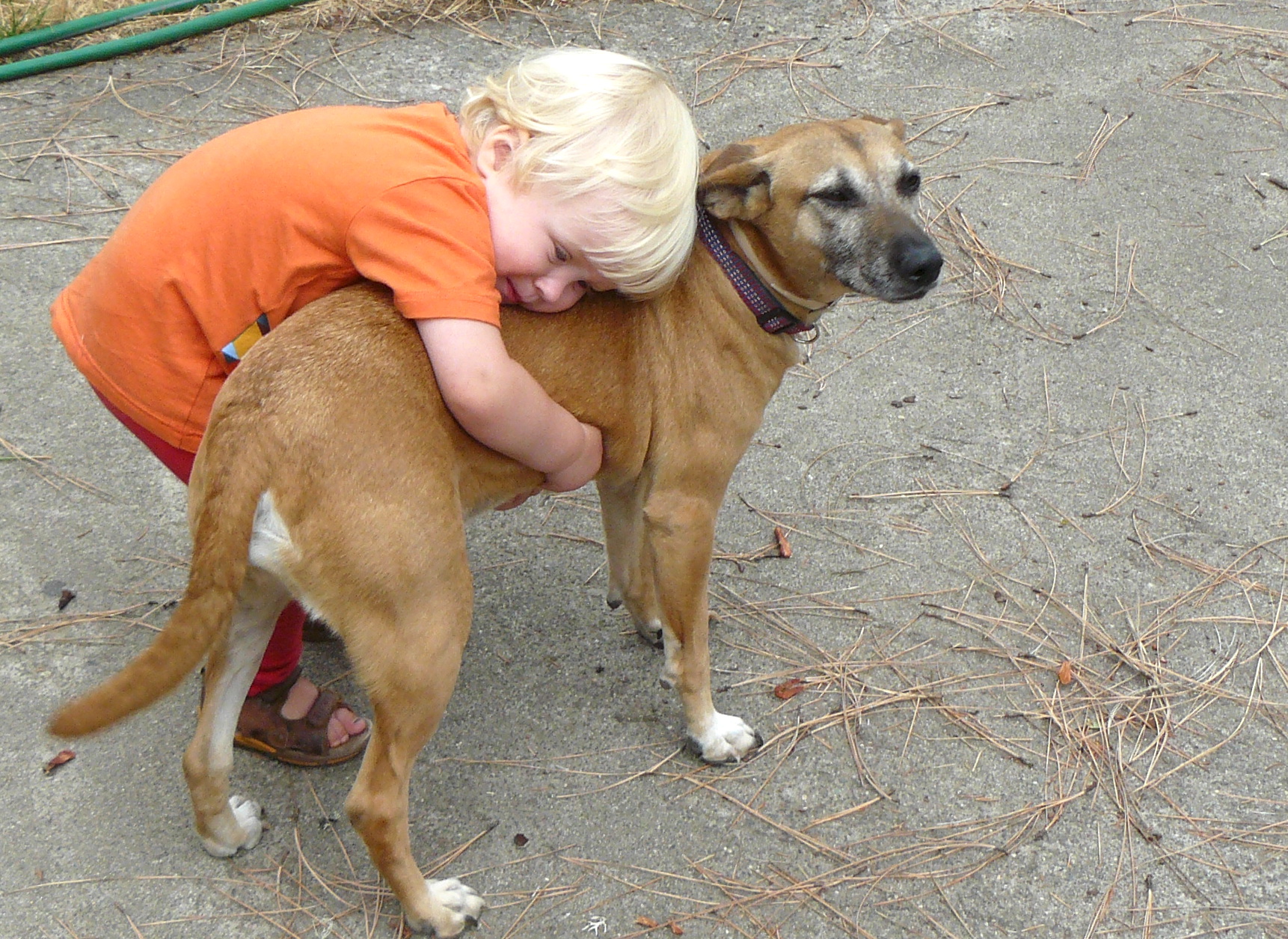
It only seemed like yesterday that Jean wrote about Dhalia in our ‘Meet the dogs’ series. That post included this photograph.
Love and Trust – Grandson Morten hugging Dhalia, September 2013.
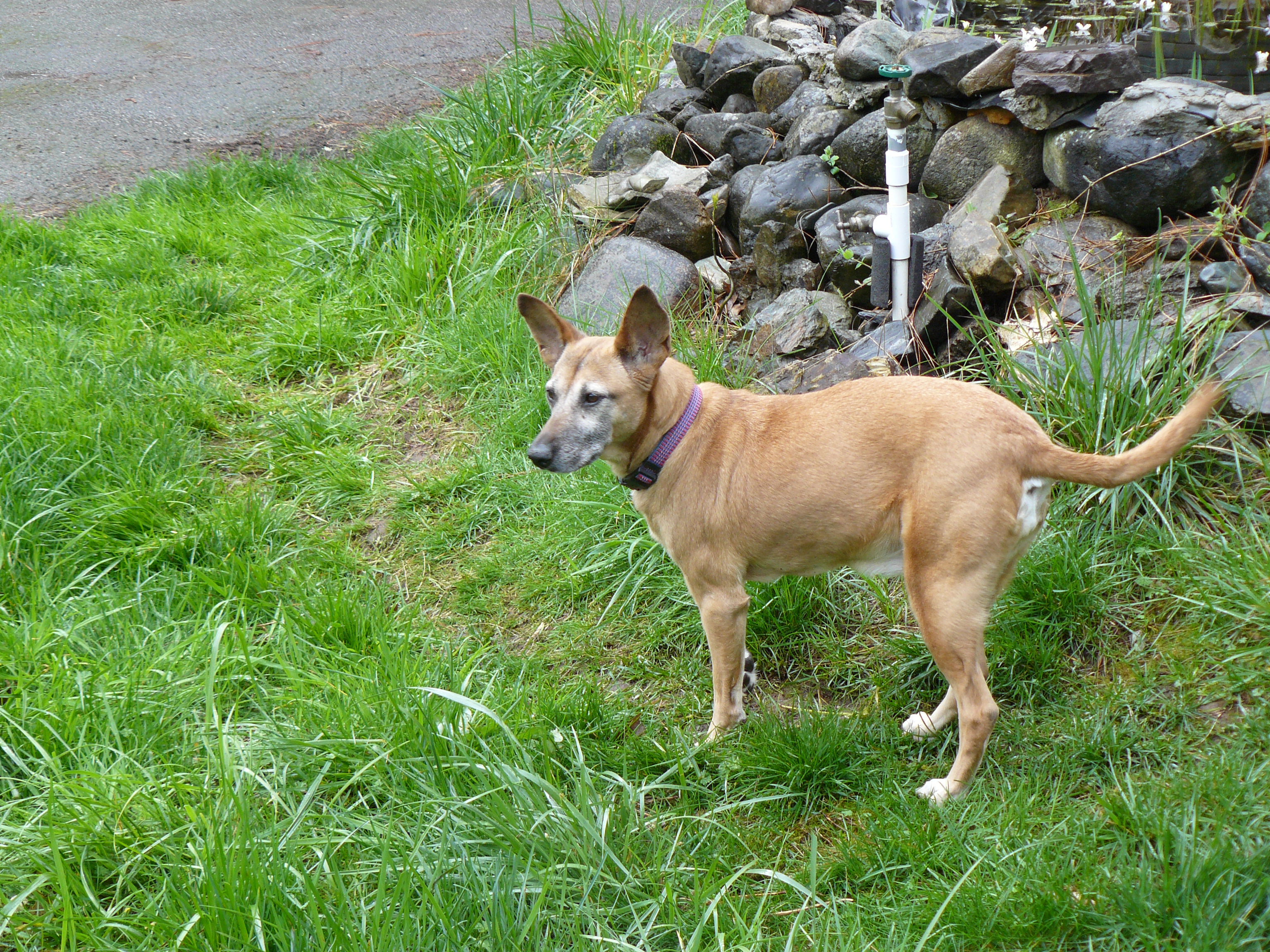
Jean is very sad, as one would expect, nay we both are. Dhalia, like Hazel and some of the other dogs here at home, has a loving openness towards humans that is truly remarkable when one learns of how these dogs came to be rescued: Dhalia being found by Jean living rough in a desolate part of a Mexican desert. This is what Jean wrote in that ‘Meet the dogs‘ account:
I named her Dhalia and after treatments for mange she became quite beautiful. She was the pivotal part of a short story, Messages from the Night, Paul wrote back in 2011. Under her sweet exterior remains that same will to survive so evident when I rescued her all those years ago. There has been more than one occasion that she has brought me a recently killed squirrel or an ancient bone. We love our Dhalia: she still reaches out with her front paw when she seeks attention. Dhalia will be ten-years-old this year.
Somehow, Dhalia’s possible last few weeks of life resonated with much else going on. Close to us, the recent death of a chicken, and one of our cats that does not have much longer to live. In the wider world, the Washington State mud-slide, flight MH370, and the Ukraine. The news media treat death as almost a trivial, incidental part of the scheme of things.
It takes others to offer words that elevate death to its deserved meaning. Take, for example, author Brian Beker, who writes the blog The Dog in the Clouds. Brian recently wrote the following post:
Prayer for an eagle
Please say a prayer for beautiful bald eagle who just died a death he did not deserve.
He was stuck on the ground near a concrete barrier on a stretch of interstate under construction in Arkansas. I spotted him with his head down, facing into the traffic that was passing a foot away from him.
He was an adult bald eagle-big and brave, facing down the oncoming 18 wheelers.
There was no place to pull off, concrete barriers on both sides, so I went to the next exit and backtracked. My adrenaline was rushing in horror and fear. My plan was just to stop and block traffic, and pick him up. But he had been killed by the time I got back to him three or four minutes later.
I failed that bird.
I hope he is circling over the lakes and trees he loves.
Back to learning about death from our dogs.
Dhalia’s possible terminal condition; my Pharaoh being the age he is; somewhere in there has come the recognition that we should embrace life yet also embrace our mortality; our death. As Leonardo da Vinci was reputed to have said, “While I thought that I was learning how to live, I have been learning how to die.”
What does death mean; truly mean? I don’t know. All I know is that death is the end of a life. That our immortality is only an echo, a reverberation of who we were and what we stood for. Or no better put than by American lawyer, Albert Pike, who left these words before he died on April 2nd, 1891 (Yes, I looked it up!)
What we have done for ourselves alone dies with us;
what we have done for others and the world remains and is immortal.
Last thought from our dogs. Recall that yesterday, I wrote, “Pharaoh has been my greatest inspiration of the power of unconditional love; of the need to smell the flowers in this short life of ours.”
Day in, day out, anyone with dogs in their lives know how often they offer us simple acts of love.
A life of simple acts of love – now that does give death a meaning!
In yesterday’s first part of my recollection of having Pharaoh in my life for over ten years, I focussed on the early days. Today, I want to take a more philosophical view of the relationship, right up to the present day.
The biggest, single reward of having Pharaoh as my friend goes back a few years. Back to my Devon days and the time when Jon Lavin and I used to spend hours talking together. Pharaoh always contentedly asleep in the same room as the two of us. It was Jon who introduced me to Dr. David Hawkins and his Map of Consciousness. It was Jon one day who looking down at the sleeping Pharaoh pointed out that Dr. Hawkins offered evidence that dogs are integrous creatures with a ‘score’ on that Map of between 205 and 210. (Background story is here.)
So this blog, Learning from Dogs, and my attempt to write a book of the same name flow from that awareness of what dogs mean to human consciousness and what Pharaoh means to me. No, more than that! From that mix of Jon, Dr. David Hawkins, experiencing the power of unconditional love from an animal living with me day-in, day-out, came a journey into my self. Came the self-awareness that allowed me to like who I was, be openly loved by this dog of mine, and be able to love in return. As is said: “You cannot love another until you love yourself.”
Moving on.
Trying to pick out a single example of the bond that he and I have is practically impossible. I have to rely on photographs to remind me of the thousands of times that a simple look or touch between Pharaoh and me ‘speaks’ to me in ways that words fail. Here’s an extract from my celebration of Pharaoh’s tenth birthday last June 3rd; written the following day. It comes pretty close to illustrating the friendship bond.
oooo
For many years I was a private pilot and in later days had the pleasure, the huge pleasure, of flying a Piper Super Cub, a group-owned aircraft based at Watchford Farm in South Devon. The aircraft, a Piper PA-18-135 Super Cub, was originally supplied to the Dutch Air Force in 1954 and was permitted by the British CAA to carry her original military markings including her Dutch military registration, R-151, although there was a British registration, G-BIYR, ‘underneath’ the Dutch R-151. (I wrote more fully about the history of the aircraft on Learning from Dogsback in August 2009.)
Piper Cub R151
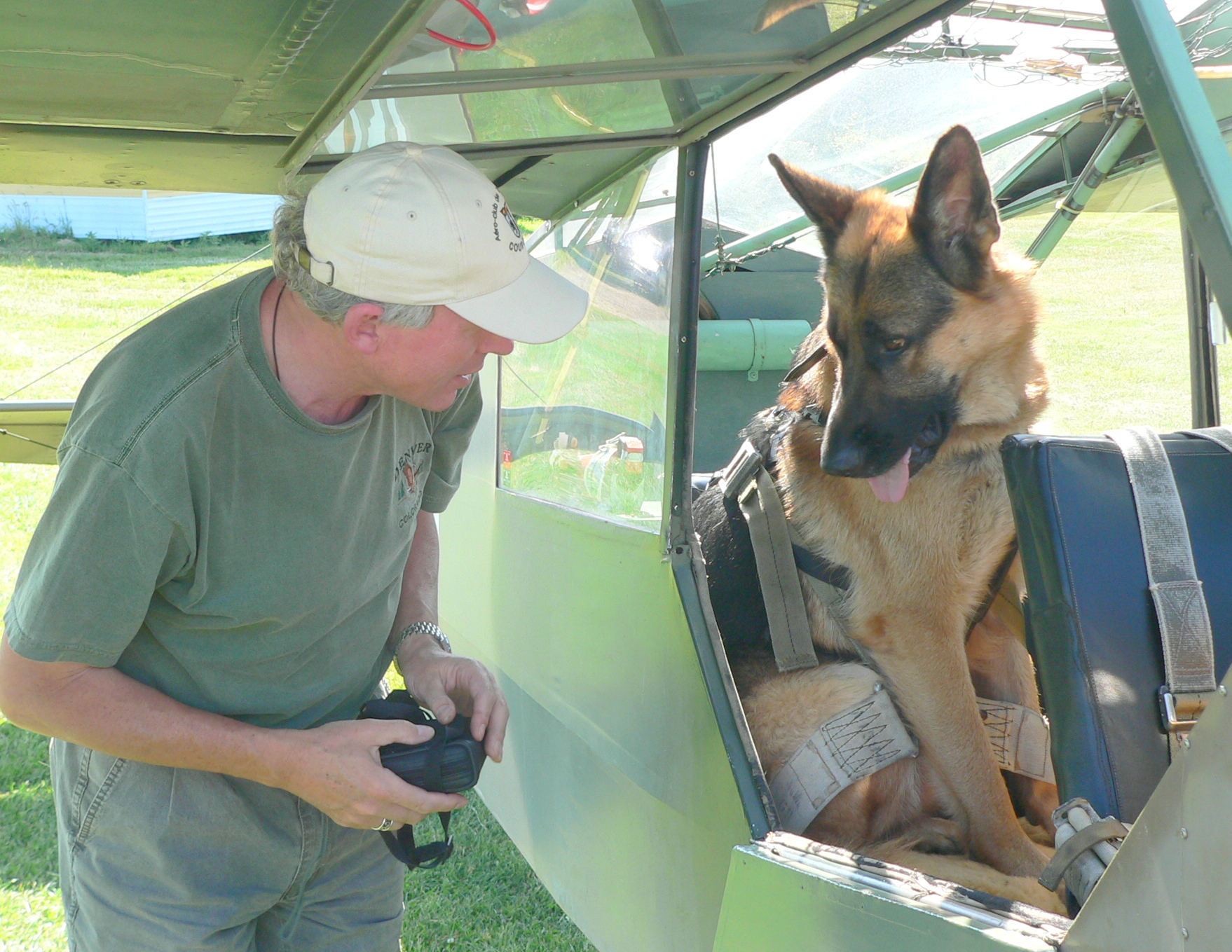
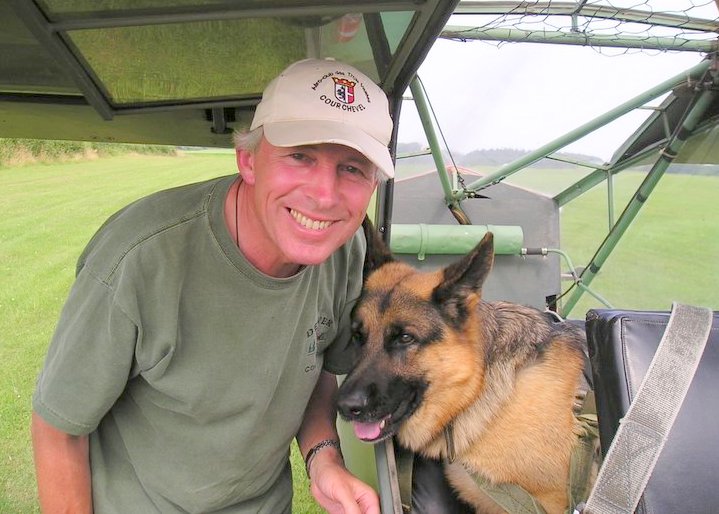
Anyway, every time I went to the airfield with Pharaoh he always tried to climb into the cockpit. So one day, I decided to see if he would sit in the rear seat and be strapped in. Absolutely no problem with that!
Come on Dad, let’s get this thing off the ground!
My idea had been to fly a gentle circuit in the aircraft. First I did some taxying around the large grass airfield that is Watchford to see how Pharaoh reacted. He was perfectly behaved.
Then I thought long and hard about taking Pharaoh for a flight. In the Cub there is no autopilot so if Pharaoh struggled or worse it would have been almost impossible to fly the aircraft and cope with Pharaoh. So, in the end, I abandoned taking him for a flight. The chances are that it would have been fine. But if something had gone wrong, the outcome just didn’t bear thinking about.
So we ended up motoring for 30 minutes all around the airfield which, as the next picture shows, met with doggie approval. The date was July 2006.
That was fun!
oooo
Moving on again. This time to another flying experience. To the day when Pharaoh and I flew out of London bound for Los Angeles and a new life with Jeannie and all her dogs (16 at that time) down in San Carlos, Sonora County, Mexico. The date: September 15th, 2008. Just ten months after I had met Jean in Mexico and realised that this was the woman that I was destined to love! (Now you will understand why I described earlier the Jon Lavin, Dr. Hawkins, Pharaoh mix as the biggest, single reward of having Pharaoh as my friend!)
There followed wonderful happy days for me and Pharaoh. Gorgeous to see how Pharaoh became so much more a dog, if that makes sense, from having his own mini-pack around him. Those happy days taking us all forwards to Payson, AZ, where Jean and I were married, and then on to Merlin, Oregon arriving here in October, 2012.
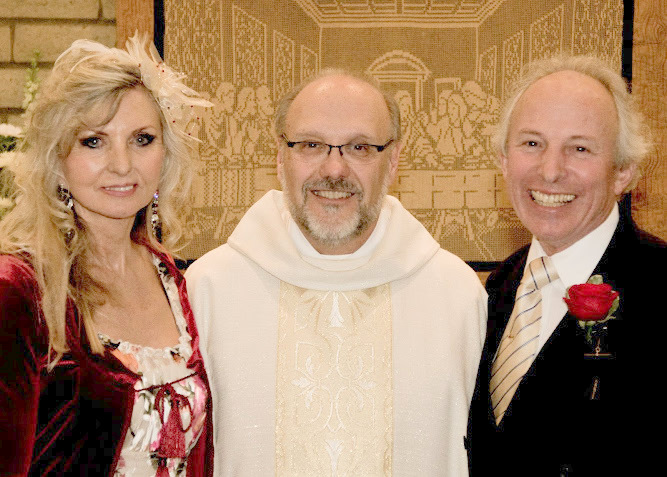
Fr. Dan Tantimonaco with the newly weds!
oooo
Pharaoh ‘married’ to his dearest friends. December, 2013.
oooo
Smelling the flowers! Pharaoh and Cleo with Hazel in the middle. Taken yesterday.
I could go on! Hopefully, you get a sense, a very strong sense, of the magical journey that both Pharaoh and I have experienced since I first clasped him in my arms back in September, 2003.
Both Pharaoh and I are in the Autumn of our lives, he is 11 in June; I am 70 in November, and we both creak a little. But so what! Pharaoh has been my greatest inspiration of the power of unconditional love; of the need to smell the flowers in this short life of ours.
Reason I state that is, as of yesterday morning, some 19,070,066 viewings of the following video had taken place.
But so what!
That number shows that despite the advertising insertions, despite the video promoting a commercial concern at the close, there are plenty of us who want to be reminded of the power of words.
Whatever words we utter should be chosen with care
for people will hear them and be influenced by them
for good or ill.
Buddha.
Footnote:
Jean and I were pottering around yesterday afternoon getting everything ready for Ranger’s arrival planned for Tuesday. In the back of my mind was some self-criticism for just sticking today’s post up in front of you, in the sense that it was just too easy. Not that the message isn’t powerful but does it relate to the essence of this blog – exploring what we can learn from dogs?
Then it struck me as blindingly obvious! Of all the things that dogs offer us humans, the one key aspect of their integrity is their unconditional love. The way that dogs love us acknowledges our existence at a ‘being-to-being’ level.
That’s the power of that short video. That the passing lady stopped and acknowledged the existence of the blind beggar-man.









 Learning from Dogs