Category: Philosophy

The implications of inequality

What on earth has inequality to do with dogs!

A fair question one might think. Because this blog is primarily about what we humans should be learning from our dogs. Well, I do see a connection, a message of learning for us. Stay with me for a while.

But first, here’s how I open up Chapter 18 Sharing in my book – Learning from Dogs.

Here’s a silly story that made me laugh when I first came across it.

A man in a casino walks past three men and a dog playing poker.
“Wow!” he says, “That’s a very clever dog.“
“He’s not that clever,” replies one of the other players.
“Every time he gets a good hand he wags his tail.“

This clever dog couldn’t hide his happiness and had to share it by wagging his tail. OK, it was a little bit of fictional fun but we all recognise that inherent quality in our dogs, how they share so much of themselves in such an easy and natural fashion.

Now if one was being pedantic one would say that sharing is not the same as equality. Yet I see them as two separate seats in life’s common carriage.

Many lovers of dogs know that when they lived a life in the wild, slowly evolving from the grey wolf, they replicated, naturally, the pack characteristics of wolves. As in the pack size was around 25 to 30 animals. Yes, there was a hierarchy in the pack but that really only presented itself in the status of three animals: the female ‘alpha’ dog; the male ‘beta’ dog; the ‘omega’ dog that could be of either gender. Ninety percent of the pack were animals on equal standing. If only that was how we humans lived.

A few days ago there was an essay published on The Conversation blogsite under the title of Why poverty is not a personal choice, but a reflection of society.

It opened with this photograph.

A homeless camp in Los Angeles, where homelessness has risen 23 percent in the past year, in May 2017. AP Photo/Richard Vogel

Let me emphasize this: “A homeless camp in Los Angeles, where homelessness has risen 23 percent in the past year, in May 2017.”

Here are two small extracts from that article:

Research Investigator of Psychiatry, Public Health, and Poverty Solutions, University of Michigan


As someone who studies poverty solutions and social and health inequalities, I am convinced by the academic literature that the biggest reason for poverty is how a society is structured. Without structural changes, it may be very difficult if not impossible to eliminate disparities and poverty.


About 13.5 percent of Americans are living in poverty. Many of these people do not have insurance, and efforts to help them gain insurance, be it through Medicaid or private insurance, have been stymied. Medicaid provides insurance for the disabled, people in nursing homes and the poor.

Four states recently asked the Centers for Medicare and Medicaid Services for permission to require Medicaid recipients in their states who are not disabled or elderly to work.

This request is reflective of the fact that many Americans believe that poverty is, by and large, the result of laziness, immorality and irresponsibility.

In yesterday’s post celebrating July 4th, where I shared that lovely picture sent to me by Neil Kelly from my Devon days, there was an exchange of comments between me and author Colin Chappell. Colin is the author of the book Who Said I Was Up For Adoption.

First, in response to Colin saying “That pic really says it all doesn’t it!”, I replied:

No question. Indeed, one might ‘read’ that picture at many levels. From the level of providing a smile for the day all the way through to a very profound observation on life itself.

Colin then replied to me:

I ‘ll go straight for the profound perspective! As I recently noted on another blog, I cannot recall anybody from history who became famous for their material possessions. In fact, I recently read an article written after an individual had surveyed a few thousand gravestones… and they drew the same conclusion. There was not a single epitaph which alluded to a material possession. Dogs know all that intuitively, so why does our superior (?) mind have trouble grasping such a simple perspective?

I then responded by saying that I thought it would make a fabulous introduction to today’s post. The heart of which I am now coming to.

Here in our local city, Grants Pass, there is a Freethinkers and Humanists group. They meet once a month. Jerry Reed from that group some time ago recommended to me reading the book The Spirit Level authored by Richard Wilkinson and Kate Pickett.

Jerry and I were exchanging emails in the last couple of days and he reminded me of that book.

There it was sitting on my bookshelf with a bookmark in at page 62. For reasons that escape me, I had become distracted and forgotten to stay with the book. Despite me being very interested in the proposition.

I said as much in an email reply to Jerry. He then replied to my email with this:

Hey, that happens to me a lot too, very frequently. So, I frequently settle for a video that might capture the essence of the book in considerably less time, while also maintaining my attention much better.

So, if you want a video about what Wilkinson has to say, here’s the one I recommend:

Here is that video. It is a little under 17 minutes long. Please watch it.

Published on Oct 24, 2011

http://www.ted.com We feel instinctively that societies with huge income gaps are somehow going wrong. Richard Wilkinson charts the hard data on economic inequality, and shows what gets worse when rich and poor are too far apart: real effects on health, lifespan, even such basic values as trust.

I haven’t got anything profound to say by way of closing today’s post.

But what I will say is that if our societies, especially in certain countries not a million miles from home, more closely emulated the sharing and caring that we see in our dogs then that really would be wonderful.
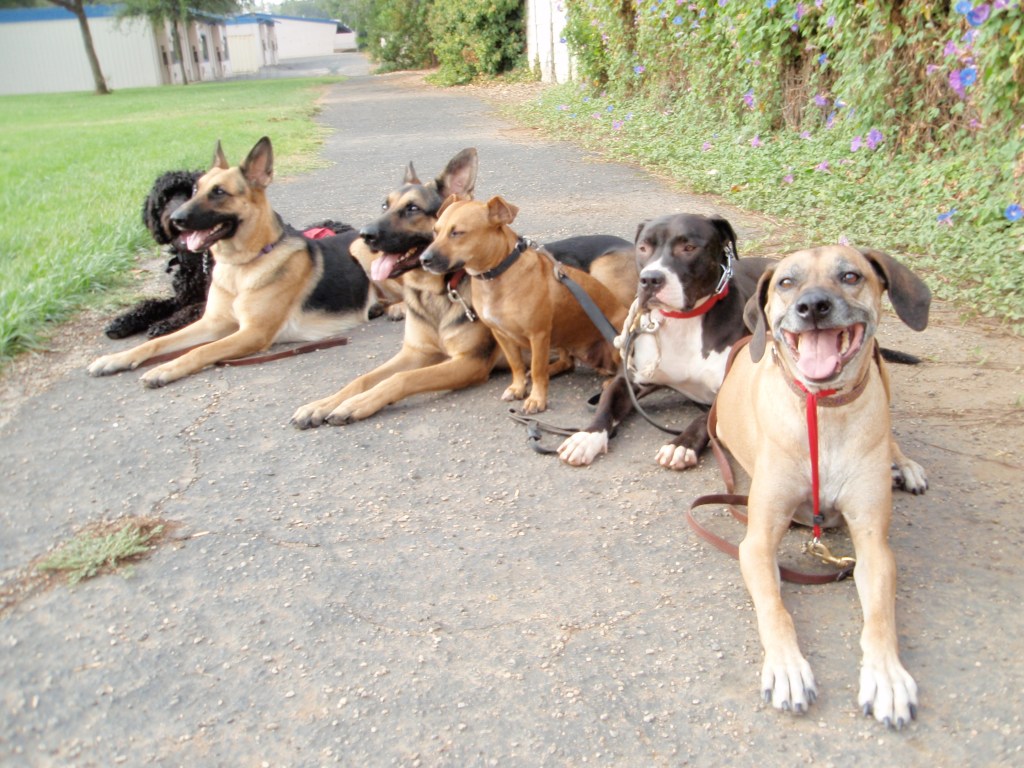
Image seen on this website: http://enlightendogs.com/about/testimonials-2/

Happy July 4th!

If you will allow this old Brit to recognise the 4th July!

Speaking of Brits, the following was sent to me by Neil, a close friend from my previous days living in South Devon, England.

Perfect!

Thanks Neil!

Picture Parade Two Hundred and Two

The second set of wonderful photographs sent in by Marg.

Following on from the first set a week ago.

“We can judge the heart of a man according to his love for animals” Immanuel Kant

oooo

“Do not call me dog, I do not deserve such a high qualification…” “I am not as faithful or loyal…I am only a human being”

oooo

“Every child should have two things: a dog and a mother who let him have one”

oooo

It is shameful for our species being the dog, (man’s best friend) when the man is the dog’s worst friend.“ Eduardo Lamazón

oooo

Do not accept the admiration of your dog as an obvious conclusion that you are wonderful“ Ann Landers

oooo

“The dog knows, but does not know that he knows“ Pierre Teilhard de Chardin

oooo

“Who said you can not buy happiness, when you are thinking about puppies“ Gene Hill

oooo

“If your dog doesn’t like someone, you probably should not either.”

You do know, good people, that I get as much pleasure from presenting Picture Parades as you get from viewing them.

More in a week’s time!

Picture Parade Two Hundred and One

Margaret (MargfromTassie) comes up with wonderful pictures for you.

These will make today’s Post and the next three Picture Parades. And there was me worrying about where I would find more Picture Parades!!

(Note that on the original Powerpoint images some of them had neat sayings as overlays. In the conversion from pps to jpg formats those were not carried across. I have them as introductions to each picture.)

MAN’s BEST FRIEND!

oooo

“A life without a dog is a mistake” – Karl Zuckmayer

oooo

“Women and cats will do what pleases them, dogs and men should relax and get used to the idea” – Robert A. Heinlein

oooo

“The love for animals, enhances the cultural level of the people.”F. Salvochea

oooo

When you leave a dog behind because he “grew old”, your children will learn the lesson. Maybe they will do the same to you when you are an old man. Think about it….

oooo

“The dog has made man their God, if the dog was an atheist, it would be perfect” – Paul Valery

oooo

“Love is when your dog licks your face, even if you leave it alone the whole day” – Anita, 4 years old

oooo

“It doesn’t matter if an animal can reason. It matters only that it is capable of suffering and that is why I consider it my neighbor” – Albert Schweitzer

Another glorious set from ‘Marg’ next week

Pharaoh, my teacher.

Another tribute to dear Pharaoh.

The most profound thing that I learned from Pharaoh is that dogs are creatures of integrity. That goes back to a day in June, 2007. Some six months before I met Jeannie in Mexico in December, 2007. I was sitting in Jon’s home office just a few miles from where Pharaoh and I were then living in South Devon.

It was a key chapter in Part Four of my book where I examine all the qualities that we humans need to learn from our dogs.

So here is Chapter 13 from my book Learning from Dogs. (Written in ‘English’ English!)

ooOOoo

Chapter 13
Integrity

In the Introduction to this book I mentioned how the notion of “learning from dogs” went back to 2007 and me learning that dogs were creatures of integrity. Let me now elaborate on that.
It is a Friday morning in June in the year 2007. I am sitting with Jon at his place with Pharaoh sleeping soundly on the beige carpet behind my chair. I didn’t know it at the time but it was to become one of those rare moments when we gain an awareness of life that forever changes how we view the world, both the world within and the world without.

“Paul, I know there’s more for me to listen to and I sense that we have established a relationship in which you feel safe to reveal your feelings. However, today I want to talk about consciousness. Because I would like to give you an awareness of this aspect of what we might describe under the overall heading of mindfulness.”
I sat quietly fascinated by what was a new area for me.

“During the years that I have been a psychotherapist, I’ve seen an amazing range of personalities, probably explored every human emotion known. In a sense, explored the consciousness of a person. But what is clear to me now is that one can distil those different personalities and emotions into two broad camps: those who embrace truth and those who do not.”

Jon paused, sensing correctly that I was uncertain as to what to make of this. I made it clear that I wanted him to continue.

“Yes, fundamentally, there are people who deny the truth about themselves, who actively resist that pathway of better self-awareness, and then there are those people who want to know the truth of whom they are and seek it out when the opportunity arises. The former group could be described as false, lacking in integrity and unsupportive of life, while the latter group are diametrically opposite: truthful, behaving with integrity and supportive of life.”
It was then that Jon lit a fire inside me that is still burning bright to this day. For he paused, quietly looking at Pharaoh sleeping so soundly on the carpet, and went on to add, “And when I look at dogs, I have no question that they have a consciousness that is predominantly truthful: that they are creatures of integrity and supportive of life.”
That brought me immediately to the edge of my seat, literally, with the suddenness of my reaction causing Pharaoh to open his eyes and lift up his head. I knew in that instant that something very profound had just occurred. I slipped out of my chair, got down on my hands and knees and gave Pharaoh the most loving hug of his life. Dogs are creatures of integrity. Wow!

****

Later, when driving home, I couldn’t take my mind off the idea that dogs were creatures of integrity. What were those other values that Jon had mentioned? It came to me in a moment: truthful and supportive of life. Dogs have a consciousness that is truthful, that they are creatures of integrity and supportive of life: what a remarkable perception of our long-time companions.
I had no doubt that all nature’s animals could be judged in the same manner but what made it such an incredibly powerful concept, in terms of dogs, was the unique relationship between dogs and humans, a relationship that went back for thousands upon thousands of years. I realised that despite me knowing I would never have worked it out on my own, Jon’s revelation about dogs being creatures of integrity was so utterly and profoundly obvious.

As I made myself my usual light lunch of a couple of peanut butter sandwiches and some fruit and then sat enjoying a mug of hot tea, I still couldn’t take my mind off what Jon had revealed: dogs are examples of integrity and truth. I then thought that the word “examples” was not the right word and just let my mind play with alternatives. Then up popped: Dogs are beacons of integrity and truth. Yes, that’s it! Soon after, I recognised that what had just taken place was an incredible opening of my mind, an opening of my mind that didn’t just embrace this aspect of dogs but extended to me thinking deeply about integrity for the first time in my life.

Considering that this chapter is titled “Integrity”, so far all you have been presented with is a somewhat parochial account of how for the first time in my life the word “integrity” took on real meaning. That until that moment in 2007 the word had not had any extra significance for me over the thousands of other words in the English language. Time, therefore, to focus directly on integrity.

If goodness is to win, it has to be smarter than the enemy.

That was a comment written on my blog some years ago, left by someone who writes their own blog under the nom-de-plume of Patrice Ayme. It strikes me as beautifully relevant to these times, times where huge numbers of decent, law-abiding folk are concerned about the future. Simply because those sectors of society that have much control over all our lives do not subscribe to integrity, let alone giving it the highest political and commercial focus that would flow from seeing integrity as an “adherence to moral and ethical principles; soundness of moral character; honesty.” To quote my American edition of Roget’s Thesaurus.

Let me borrow an old pilot’s saying from the world of aviation: “If there’s any doubt, there’s no doubt!”

That embracing, cautious attitude is part of the reason why commercial air transport is one of the safest forms of transport in the world today. If you had the slightest doubt about the safety of a flight, you wouldn’t board the aircraft. If you had the slightest doubt about the future for civilisation on this planet, likewise you would do something! Remember, that dry word civilisation means family, children, grandchildren, friends, and loved ones. The last thing you would do is to carry on as before!

The great challenge for this civilisation, for each and every one of us, is translating that sense of wanting to change into practical, effective behaviours. I sense, however, that this might be looking down the wrong end of the telescope. That it is not a case of learning to behave in myriad different ways but looking at one’s life from a deeper, more fundamental perspective: living as a person of integrity. So perfectly expressed in the Zen Buddhist quote: “Be master of mind rather than mastered by mind.” Seeing integrity as the key foundation of everything we do. Even more fundamental than that. Seeing integrity as everything you and I are.

It makes no difference that society in general doesn’t seem to value integrity in such a core manner. For what is society other than the aggregate of each and every one of us? If we all embrace living a life of integrity then society will reflect that.

Integrity equates to being truthful, to being honest. It doesn’t mean being right all the time, of course not, but integrity does mean accepting responsibility for all our actions, for feeling remorse and apologising when we make mistakes. Integrity means learning, being reliable, and being a builder rather than a destroyer. It means being authentic. That authenticity is precisely and exactly what we see in our dogs

The starting point for what we must learn from our dogs is integrity.

ooOOoo

The face of integrity!

The day after.

Trying to cope.

This is a very personal, possibly rather mixed-up, set of reflections of how the day after Pharaoh died felt for me. Some of you may prefer not to read this or view the photos.

I sat down to write this, late morning Tuesday, as it was becoming too hot to stay outside. I felt inspired to be 100% honest about my feelings and the photographs are, in essence, copies of the pictures that are in my head.

I woke early yesterday, a little after 4am, and started listening to BBC Radio Four using ear-phones plugged into my tablet while Jeannie slept on.

But I couldn’t get the images of Monday out of my head. Such that it seemed unreal to think that less than thirty-six hours previously Pharaoh was sleeping quietly near his bed, albeit unable to walk on his own.

Then, in what seemed like the flick of a finger, Jeannie was offering Pharaoh my dinner plate Monday evening.

For every evening, unless we had eaten a very spicy meal, Pharaoh always licked my plate clean.

A routine that had gone on for years.

I lay there in bed as 1pm arrived in England (5am PDT) and BBC Radio 4 was broadcasting The World At One. Despite the gloomy headlines still focusing on that terrible fire at the Grenfell Tower in London (not three miles from where I was born in 1944), the images of Monday kept thundering into my consciousness.

How dear friend, Jim Goodbrod, and I had driven into Allen Creek Veterinary Hospital, where Jim is a visiting DVM each week, to collect the required amount of euthanasia drug (apparently just 1 c.c. for every 10 lbs of animal weight – looking at it in the syringe it seemed such a small amount of fluid to bring an end to Pharaoh’s life.)

Then over breakfast, as in Tuesday morning, Jean said how difficult it was watching Pharaoh yesterday (Monday) when Jim and I were away getting the meds because it seemed to her that Pharaoh sensed something was happening outside the run of a normal morning.

Continuing with Monday. When Jim returned, accompanied by his wife, Janet, and knelt down to examine Pharaoh his analysis was that the time was right. Pharaoh had lost massive amounts of muscle tissue from his rear legs and hips.

It was time. Jean and I settled down sitting on the floor alongside Pharaoh’s bed. Pharaoh shifted his body and placed his wonderful, furry head across my outstretched legs. It was time.

Jim injected Pharaoh with an anesthetic. Slowly, gently Pharaoh fell fast asleep. Jim shaved a patch of fur from Pharaoh’s front, right lower leg.  Janet pinched a vein in Pharaoh’s leg and moments later, Jim injected the euthanasia drug. Jean and I continued to stroke Pharaoh’s forehead but frequently looked down to where the rise and fall of Pharaoh’s lungs was visible.

Then at 11:57 PDT Monday, June 19th., there was no more breathing. Jim took out a stethoscope and confirmed that there was no heart-beat. Jim closed Pharaoh’s eyelids while Jean and I sat quietly just holding on to Pharaoh. A few minutes later, Jean and I had wriggled out from under Pharaoh and then Jim slipped a plastic sack over the rear half of Pharaoh’s still body.

Pharaoh had died without pain and in the most gentle way imaginable.

Back to Tuesday, as in yesterday, and now Jean and I were awake and I was reading every comment and response to the post Adieu, Mon Brave.

I must tell you that the love and compassion extended by every single one of you, including the numerous emails sent to me, is the most precious, special recognition of what Pharaoh meant to me, to my Jeannie, and to you all.

Thank you! Thank you so much!

Time then for a call into England and to let Sandra Tucker know that Pharaoh had died. For Pharaoh had been born at Jutone, the GSD breeding kennels run by Sandra Tucker, and Jim, in Hennock, Devon.

Pharaoh’s legacy will live on forever. What he stood for. What he represented. What I learned from Pharaoh. What he inspired in me. That inspiration that will live with me until it’s my turn to take my last breath.

Then it was time to get up and try and stay occupied. But I didn’t warrant for seeing Pharaoh’s empty bed as I walked out of the bedroom into the living-room.

It looked so empty, so lonely.

I burst into tears.

I turned on my heels and went out to feed the horses and the wild deer. As is done every morning.

Walking back to the house, I stepped up on to the rear deck and looked up at the line where the tops of the forest trees on the hills to the East meet the morning sky. It was a clear, cloudless sky.

The sun was within seconds of rising above that skyline. I took a photograph and then the sun had risen. It was 06:24 am. Fifteen hours to the minute before the exact moment of the Summer Solstice this evening (21:24 PDT).

I don’t know what it all means other than in some mysterious, natural fashion, everything is connected.

Dear, sweet, noble Pharaoh.

The science of love.

Yes, really!

Here’s a photograph of Pharaoh taken on the 3rd December, 2005. Taken in my home in Harberton, Devon, some two years before I met Jeannie.

It’s not the world’s best photograph but I start today’s post with it simply because there is a look in Pharaoh’s eyes that spells out love to me in capital letters. Always has since the day I took that photograph.

Here’s an enlargement of the photo offering a closer look at Pharaoh’s expression in those eyes.

Right from the very first moment that I held Pharaoh I sensed the start of a loving bond. Did I choose to love Pharaoh? Well, of course I did! Was it a conscious decision? I don’t think so!

All of which is my introduction to a fascinating essay about the science of love that recently appeared on the Care2 site.

Enjoy!

ooOOoo

Can You Choose to Love? Science Suggests You Can

By: Zoe Blarowski June 2, 2017

About Zoe

Love may often feel spontaneous and sometimes even out of control. But is it, really? Research is starting to show that you can change the intensity of love you feel towards others. Similar to emotions like fear or sadness, love can be influenced simply by how you think about a situation.

Is love under your control?

One study looked at altering love feelings in people who were either in a romantic relationship or had recently broken up from one. Each participant started by viewing pictures of their current lover or their ex-partner to bring up their current feelings towards them.

Then, researchers asked them to think about positive aspects of their partner, relationship or possible future scenarios. Their feelings towards their current or previous partners were assessed again.

The second part of the study asked participants to think of negative things about their partner, such as what’s wrong with them or their relationship.

Perhaps it’s not surprising that participants reported having greater love feelings after thinking positive thoughts. Whereas, they reported decreased lovingness after the negative thoughts. It was the same for everyone, whether they were in a relationship or had recently broken up.

Researchers felt this shows great potential for people to take more control of their emotional world, which could in turn benefit their lives and relationships.

Interestingly, thoughts also appeared to affect everyone’s overall mood and feelings about life in general. The positive thoughts improved people’s mood and disposition, whereas the negative thoughts brought everyone down.

This may highlight the importance of how positive and negative thoughts in general can affect our mental health.

How can you put this to use?

You can likely think of times in your own life when it would be helpful to either decrease or increase your love for another person.

Have you ever had an unwanted crush on someone? For instance, obsessing over a celebrity you’ll likely never meet can cause more frustration than joy in your life. Or maybe you’ve fallen for someone who’s not available, either physically or emotionally.

These are times when it’s in your best interest to end your attachment to the person and move on.

In addition, research has shown that thinking negatively about an ex-partner or your previous relationship helps you get over a break-up. The reverse is also true – if you think positively about an ex, it’s more difficult to heal and move on.

Keep this in mind if you’re going through a break-up, or need to reduce your feelings towards someone for another reason.

Try asking yourself questions like these:

  • What annoys me about this person?
  • Did we ever have a fight?
  • Why were we a bad match for each other?
  • What didn’t work in our relationship?
  • What could go wrong if we stayed together?

Reframing your thoughts is also a much healthier way to try to get over someone than taking self-destructive action to distract yourself, such as drinking too much.

On the other hand, the world always needs a lot more love to go around. Increasing your love towards others is often one of the best things you can do to help yourself and everyone in your life.

Unfortunately, the top reason married couples give for getting a divorce is growing apart and falling out of love. It’s true the intensity of love feelings usually fluctuates throughout a long-term relationship, but a decrease in feelings doesn’t have to mean the end.

If you’re starting to question whether or not you should stay in a long-standing relationship, take a closer look at your situation before making a final decision. Do you still respect and care for your partner? Do you still have lots in common? Is it possible you’re just in a temporary slump?

Questions like these may help to re-frame how you feel about your relationship:

  • What are some of your partner’s best qualities?
  • Why did you get together in the first place?
  • Are there things you’d like to do with your partner in the future?
  • What makes you a good match for each other?
  • Do you enjoy spending time with your partner?

Romantic partners who view each other in a positive light have been shown to actually have happier relationships. This is likely true for all relationships. Choosing more positive thoughts can go a long way towards creating greater harmony with all your loved ones.

Sharing your thoughts and telling others why you love them is even better.

ooOOoo

As my dearest Jeannie will confirm, I have never been the most comfortable person in terms of verbalising my love for her, despite Jean being the dream loving partnership of my life. Jean, on the other hand, expresses her love for me many times each day.

Maybe this essay offers an insight into the different ways we love?

For Jean also tells the dogs individually many times each day that she loves them. I feel the same but don’t say it anything like as often.

So is science showing us why the difference between Jean and me? I think so.

Yet another thing that we learn from dogs. Or more specifically that I have to learn from dogs!

Tell them every day how much I love them!

Who do you think you are?

Talk about extremes of topics!

Yesterday it was gliding, tomorrow it is going to be a celebration of Pharaoh’s 14th birthday and today it is about you!

Kadam Morten Clausen is a Buddhist teacher. Now I would be the first to stick up my arm and say that my understanding of Buddhism is pretty poor. But in the days many years back when I spent time exploring a number of Asian countries I found the culture surrounding Buddhism very appealing. (And I write as someone who is not a religious believer.)

Back to Morten Clausen.

The Kadampa Meditation Center in New York, where Kadam is a resident teacher, describe him as follows:

Kadam Morten Clausen is the Eastern US National Spiritual Director of the New Kadampa Tradition and Resident Teacher at the Kadampa Meditation Center New York City, and also Bodh Gaya Center in Bayside, Queens. For over 30 years he has been a close disciple of Venerable Geshe Kelsang Gyatso, who gave him the title “Kadam,” indicating that he is a senior lay teacher of the Kadampa Tradition.

Kadam Morten met his teacher, Geshe Kelsang, while attending university in England. He taught widely throughout the UK and helped develop many Kadampa Centers in England. Kadam Morten has been teaching in the US for more than 20 years and has established centers throughout the New York area, as well as Washington DC, Virginia, and Puerto Rico. In addition to his local teaching responsibilities, he teaches and guides retreats regularly throughout the United States and Europe.


Kadam Morten is greatly admired as a meditation teacher and is especially known for his clarity, humor and inspirational presentation of Dharma. His teachings are always practical and easy to apply to everyday life. Through his gentle and joyful approach and his peaceful example, he has helped many people find true happiness in their hearts.

So what’s this all about when I say that today’s post is about you?

Enjoy the following, recently published on the Big Think site:

ooOOoo

Science and Buddhism Agree: There Is No “You” There

Still in the month of May!

Figurative and literal cracks!

My rather cryptic sub-heading will make sense very soon.

Just ten days ago I published a post The Month of May. It explained why May had always been a special month in my life and then went on to introduce an article published by The Smithsonian Using a New Roadmap to Democratize Climate Change.

That article featured the former president of Iceland, Olafur Grimsson, and how he was encouraging new solutions to climate change. Primarily via a new organisation called RoadMap. (Did you sign up??)

There is change in the air. People are starting to make a better future. Cities across the USA (and elsewhere undoubtedly) are pledging to go 100 percent renewable. Here’s what Grist published on May 4th.

ooOOoo

Cities all over the U.S. are pledging to go 100 percent renewable.

Atlanta, Georgia (Shutterstock)

On Monday, Atlanta lawmakers voted unanimously to power the city entirely with clean energy sources by 2035.

Atlanta is the 27th city to make the pledge, according to the Sierra Club. These kinds of municipal promises have been popping up nationwide over the past few months. Here’s a recap:

“We know that moving to clean energy will create good jobs, clean up our air and water, and lower our residents’ utility bills,” said Kwanza Hall, an Atlanta City Council member and mayoral candidate, in a statement. “We have to set an ambitious goal or we’re never going to get there.”

A round of applause for local climate progress!

ooOOoo

Lovely to see the city of Portland on that list.

Keep it coming. For we need to see cracks of change; cracks of hope.

Cracks to counter literal cracks.

ooOOoo

The crack that’s redrawing the world’s map.

(From the BBC Culture Newsletter 5th May.)

The shape of the world is hanging by a thread – or rather, according to experts, by a 110 mile-long (177km) rift. That’s the extent of a rapidly expanding crack in an enormous ice shelf in Antarctica. When the Larsen C shelf finally splits, the largest iceberg ever recorded (bigger than the US state of Rhode Island and a third the size of Wales) will snap off into the ocean. Widening each day by 3 ft (1 m), the groaning cleft is on the verge of dramatically redrawing the southern-most cartography of our planet and is likely to lead, climatologists predict, to an acceleration in the rise of sea levels globally.

 An aerial photo of the frigid fissure, taken late last year when it was discovered that the pace of the icy tear was quickening, was suddenly back in the news this week with the announcement that a second rift in the shelf had been detected. The fracture leads our eye along a zig-zagging path – from the backward gaze of the plane’s right engines to the pristine polar blue of the horizon in the distance. The jaggedness of the cleft, which takes our vision on a journey whose ultimate destination is unfathomable, seems at once monumental and terrifyingly fragile. The photo intensifies our helplessness in the face of cataclysmic change. It freezes the potential destruction in the blink of a camera’s shutter, while at the same time hinting at a catastrophe that we can witness unfolding but are utterly powerless to stop.

A second rift was recently discovered in the Larsen C ice shelf on the Antarctic peninsula (Credit: NASA/John Sonntag)

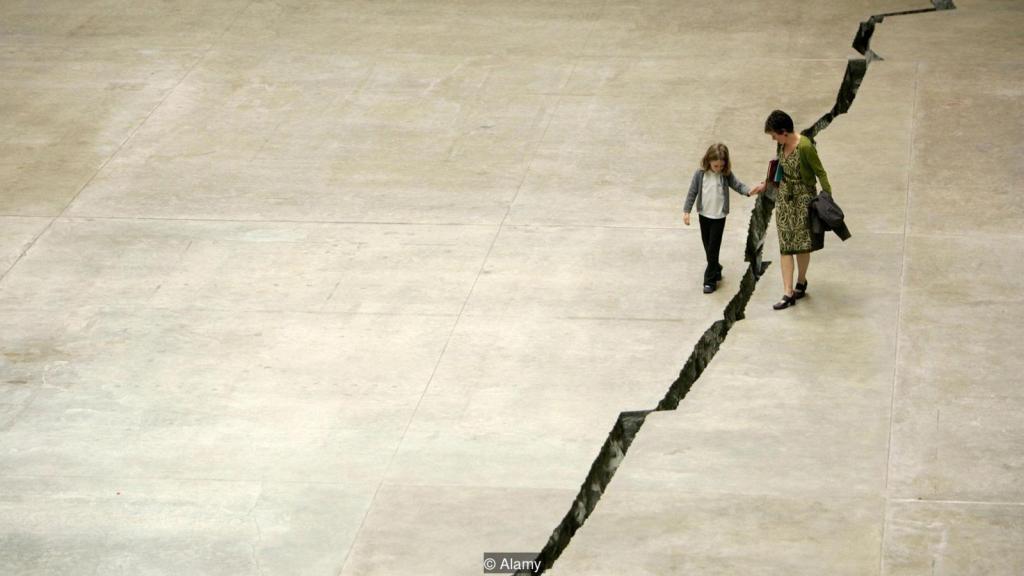
As a visual statement, the aerial photo of the Larsen C crack is, by definition, incomparable; never before has the world marked the glacial advance of such a sublime and fearsome fracture in its very fabric. Yet the reemergence of the image in the news anticipates the ten-year anniversary of one of the most intriguing and innovative large-scale works in contemporary art – a work whose power relies for its thought-provoking effect on the peculiar poetry of ruinous rifts. In October 2007, the Colombian-born artist Doris Salcedo unveiled in London an ambitious installation in the cavernous space of Tate Modern’s Turbine Hall – a piece that split reaction down the middle.

Inviting gallery-goers into the otherwise empty and austere interior of the former Bankside Power Station, Salcedo subverted expectations. Rather than offering visitors a hall of temporarily installed sculptures, she orchestrated the contemplation instead of a ragged subterranean breach that appeared to rip open the concrete floor of the structure – a crevice that extended from one end of the yawning space to the other.

For the Colombian artist Doris Salcedo’s 2007 work, Shibboleth, a giant crack was made in the concrete floor of Tate Modern’s Turbine Hall (Credit: Alamy)

Salcedo deepened the mystery of her bold and experimental conceptual work by giving to it the curious title Shibboleth – a biblical word which, when mispronounced, was said to have exposed the outsider status of individuals. Complicating matters still further, the artist insisted that her work was a comment not on the folly of material ambitions, but on racism – that deep cultural scar that tears at the foundations of humanity. Placed side-by-side, this week’s photo from Antarctica and the image captured a decade ago of Doris Salcedo’s challenging Shibboleth share both a brutal beauty and a common theme: the brittleness of being.

If you would like to comment on this story or anything else you have seen on BBC Culture, head over to our Facebook page or message us on Twitter.

And if you liked this story, sign up for the weekly bbc.com features newsletter, called “If You Only Read 6 Things This Week”. A handpicked selection of stories from BBC Future, Earth, Culture, Capital and Travel, delivered to your inbox every Friday.

ooOOoo

“the brittleness of being.”

Please, all of us, let’s make a positive difference so that we can soften the edges of that brittleness.

Little by little!

It takes so little good news to uplift one’s heart!

For reasons I can’t readily put my finger on it’s been feeling like a bit of a struggle recently. But that’s enough of that! For our gorgeous dogs have yet another lesson for me: How little it takes for a dog to wag it’s tail!

I so frequently share stuff that I read over on the Care 2 site and why not because as the home page declares:

40,107,687 members: the world’s largest community for good

Just three days ago there was a wonderful article shared on the Care 2 site about some dogs being rescued from a so-called backyard breeder. Better than that, it highlighted the wonderful consequence of a donation from George and Amal Clooney.

Here’s the story.

ooOOoo

9 Dogs Successfully Rescued From Backyard Breeder Thanks to George and Amal Clooney

By: Alicia Graef May 5, 2017

About Alicia Follow Alicia at @care2

Nine lucky dogs have just had their world turned upside down in the best way possible.

Camp Cocker Rescue, based in California, just took in the “Mojave 9″ who were being kept by a backyard breeder. They’ll be getting all the love and veterinary care they desperately need thanks to a generous donation made by George and Amal Clooney.

The nine dogs have had little human contact, and are all in need of extensive veterinary treatment for health issues ranging from mammary tumors and dental disease to skin and ear infections to ingrown toenails. The organization relies on donations, and expenses for this rescue operation were quickly rising.

“We literally didn’t know how we were even going to begin to start paying for all of these new dogs that we took in on the same day,” Camp Cocker’s founder Cathy Stanley told PEOPLE.

Now, the organization is celebrating a generous and unexpected donation of $10,000 made by George and Amal Clooney, who are parents to two adopted cocker spaniels from Camp Cocker — Einstein and Louie.

Their donation is going to help cover the cost of care for these dogs, who have never been to a vet. The Clooney’s will also be matching donations up to $10,000 for the rest of May.

“After we all did happy dances and cried with happiness for this unbelievable matching donation offer – we then asked the donors if (and only if they gave us their permission) . . . if we could reveal their names to our supporters in order to help us reach our big goal this month. They were so very gracious to give us permission to reveal their names,” Camp Cocker wrote in an update.

While this was a huge boost for them, Camp Cocker is quick to point out that no donation is too small to help.

“We have a philosophy where we want to be very inclusive of all of our supporters and it’s important to us that no matter how small of a donation, every person feels like their donation is meaningful and that we appreciate them,” Stanley added.

Hopefully news about the Mojave 9 and the attention it’s getting will help raise awareness about rescue and inspire more people to get involved … and will help find each of these precious dogs their perfect forever home.

For more on how to help, and info on how to adopt one of these dogs, check out Camp Cocker Rescue and follow updates on Facebook.

Photo credit: Thinkstock

ooOOoo

Here’s the video that accompanied that story.

And there’s only one way to close.

By thanking George and Amal for their wonderful generosity and their love for ex-rescue dogs!

Thanks, you two!

So little good news makes such a huge positive difference!