Or rather letting Deinah Storm offer a guest post.
This is a guest post. It stays with the theme of loyalty. The loyalty of dogs towards their dead masters.
ooOOoo
8 Dogs Who Remained Loyal to Their Now-Gone Masters
By Deinah Storm, December 5th, 2108
A dog has always been a man’s best friend. Having a pet dog is always great. You have a partner to go with anywhere you want. Also, you won’t feel alone when you have a pet dog. Dogs are creatures that are filled with joy; no wonder fur parents from around the world try to give their best to show how they care for their pooch—be it to provide them the best dog food, regularly visit the vet, or keep dog house warm.
The love and affection that dogs give their owners are comparable to a mother’s love. It is unconditional and lasts a lifetime, and even beyond. Here is a list of eight dogs who remained loyal to their now-gone masters.
Hachiko
You may have heard of this name before already. Hachiko’s story has been all over the world. They even made movies about this loyal dog. He was originally owned by a Japanese professor at Tokyo University named Eizoburo Ueno. His students were the ones who nudged him to adopt this beautiful Akita dog. Every day that the professor goes to work, he goes to the train station to take the train. Hachiko always waited for him to return so they could go home together. After having been partners for only less than a year, Eizoburo Ueno died tragically while he was at work. So that day, Hachiko was waiting in vain for his master to return. But, he never did. Still, Hachiko waited every single day of his life for his now-gone to return to the train station. People were feeding Hachiko and giving him treats until he got old and died. A lot of people mourned over his death, and a statue was built for him.
Capitan
Capitan was a dog owned by an Argentinian man named Michael Guzman. He was bought by Michael for his son Damian as a gift. They always had a special bond and loved each other. When Mr. Guzman passed away after just a year, Capitan could not be found by the Guzman family. Eventually, they were able to locate him. He was beside his master’s grave. Capitan stayed there for six long years until he passed away.
Hawkeye Hawkeye was a labrador who was owned by a Navy SEAL who died in a helicopter crash in Afghanistan. A photo went viral during his funeral service. It was a picture of Hawkeye lying sadly in front of his master’s casket. He stayed there for the whole service. It is disheartening for dogs to lose their owners. Thankfully, the best friend of the deceased took Hawkeye and cared for him.
Ruswarp
Ruswarp was owned by Graham Nuttall. One day, they went on a walk along the mountains in Wales. But, they did not return. So, Graham’s friends alerted the police. A search was done. But after several weeks, they could not be found. Eventually, after eleven weeks of being missing, another person found Graham beside a stream together with Ruswarp. Ruswarp never left his master’s side even after several weeks. Ruswarp was so weak and ill when they were found. A statue of Ruswarp was unveiled at a train station which he and his owner helped save.
Fido
Fido was owned by a factory worker in Italy. His name literally translates to “faithful.” He always went with his master to the bus station and waited for him to come back every single day. One tragic day, his owner was killed in the factory due to a bombing attack. Fido waited all day for his owner to return. He eventually returned home, but every single day he waited by the train station for fourteen years until he died.
Shep
Shep was owned by a shepherd. One day, his shepherd was ill and was rushed to the hospital. Shep waited outside the hospital until his owner died. He followed his owner’s casket as it was loaded onto a train to be sent home. Shep waited by the train station for five years. Every single day, he checked each person who went off the train. He stayed there until Shep tragically died in the train station when he became deaf and went to the tracks where a train hit him.
Greyfriars Bobby
Bobby was owned by a police officer. When the officer died, Bobby never left his grave for fourteen years. When Bobby died, he was buried near his master. He had a gravestone which read “Greyfriars Bobby — died 14th January 1872 — aged 16 years — Let his loyalty and devotion be a lesson to us all.” He had a statue made for him across the place where they are buried.
Waghya
Waghya was owned by the King of the Maratha Empire. Traditionally, when a king dies, his remains are cremated. So, when the king died, Waghya never left his side until he was about to be incinerated. When the funeral pyre was lit, Waghya leaped into his death.
Dogs are forever loyal and loving
Dogs bring love and happiness to the world. They are there forever for humans. They will love you for all of eternity. So, love your dogs and care for them. They will never let you down.
It would be wrong of me to close without thanking Deinah. It’s a great guest post.
Finally, Deinah’s bio:
Author’s Bio: Deinah Storm is a pet lover from the US that’s had cats and dogs all her life. When she’s not walking the dogs with her family, she spends time writing informational and interesting blogs about pets to share with pet lover communities.
The following article looks deeply into the dog’s life. Or rather the end of the dog’s life.
For the fact of the matter is that we all have this coming to us. Some turn to religion; some know that we are on our own. Every living creature shares the same fate as us humans.
Yet there is something very special about the dog. Something that sets the dog apart. Something that elevates the dog into more than an animal, despite how silly that is to write. But you know what I mean.
Enough from me. Let me turn to the following article that was published on The Conversation website and is republished within the terms of that site.
ooOOoo
Why losing a dog can be harder than losing a relative or friend
By Frank T. McAndrew Cornelia H. Dudley, Professor of Psychology, Knox College
March 9, 2017
Recently, my wife and I went through one of the more excruciating experiences of our lives – the euthanasia of our beloved dog, Murphy. I remember making eye contact with Murphy moments before she took her last breath – she flashed me a look that was an endearing blend of confusion and the reassurance that everyone was ok because we were both by her side.
When people who have never had a dog see their dog-owning friends mourn the loss of a pet, they probably think it’s all a bit of an overreaction; after all, it’s “just a dog.”
However, those who have loved a dog know the truth: Your own pet is never “just a dog.”
Many times, I’ve had friends guiltily confide to me that they grieved more over the loss of a dog than over the loss of friends or relatives. Research has confirmed that for most people, the loss of a dog is, in almost every way, comparable to the loss of a human loved one. Unfortunately, there’s little in our cultural playbook – no grief rituals, no obituary in the local newspaper, no religious service – to help us get through the loss of a pet, which can make us feel more than a bit embarrassed to show too much public grief over our dead dogs.
Perhaps if people realized just how strong and intense the bond is between people and their dogs, such grief would become more widely accepted. This would greatly help dog owners to integrate the death into their lives and help them move forward.
An interspecies bond like no other
What is it about dogs, exactly, that make humans bond so closely with them?
For starters, dogs have had to adapt to living with humans over the past 10,000 years. And they’ve done it very well: They’re the only animal to have evolved specifically to be our companions and friends. Anthropologist Brian Hare has developed the “Domestication Hypothesis” to explain how dogs morphed from their grey wolf ancestors into the socially skilled animals that we now interact with in very much the same way as we interact with other people.
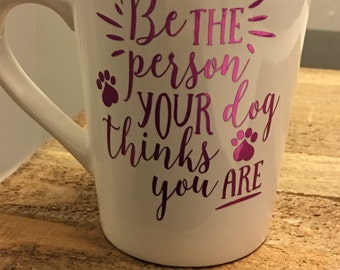
Perhaps one reason our relationships with dogs can be even more satisfying than our human relationships is that dogs provide us with such unconditional, uncritical positive feedback. (As the old saying goes, “May I become the kind of person that my dog thinks I already am.”)
This is no accident. They have been selectively bred through generations to pay attention to people, and MRI scans show that dog brains respond to praise from their owners just as strongly as they do to food (and for some dogs, praise is an even more effective incentive than food). Dogs recognize people and can learn to interpret human emotional states from facial expression alone. Scientific studies also indicate that dogs can understand human intentions, try to help their owners and even avoid people who don’t cooperate with their owners or treat them well.
Our strong attachment to dogs was subtly revealed in a recent study of “misnaming.” Misnaming happens when you call someone by the wrong name, like when parents mistakenly calls one of their kids by a sibling’s name. It turns out that the name of the family dog also gets confused with human family members, indicating that the dog’s name is being pulled from the same cognitive pool that contains other members of the family. (Curiously, the same thing rarely happens with cat names.)
It’s no wonder dog owners miss them so much when they’re gone.
Psychologist Julie Axelrod has pointed out that the loss of a dog is so painful because owners aren’t just losing the pet. It could mean the loss of a source of unconditional love, a primary companion who provides security and comfort, and maybe even a protégé that’s been mentored like a child.
The loss of a dog can also seriously disrupt an owner’s daily routine more profoundly than the loss of most friends and relatives. For owners, their daily schedules – even their vacation plans – can revolve around the needs of their pets. Changes in lifestyle and routine are some of the primary sources of stress.
According to a recent survey, many bereaved pet owners will even mistakenly interpret ambiguous sights and sounds as the movements, pants and whimpers of the deceased pet. This is most likely to happen shortly after the death of the pet, especially among owners who had very high levels of attachment to their pets.
While the death of a dog is horrible, dog owners have become so accustomed to the reassuring and nonjudgmental presence of their canine companions that, more often than not, they’ll eventually get a new one.
So yes, I miss my dog. But I’m sure that I’ll be putting myself through this ordeal again in the years to come.
ooOOoo
I don’t want to think of losing any more of our family but it will surely happen. As night follows day!
The challenge of how you think, and whether or not it is similar to how others think has long intrigued us.
Tam Hunt has written an article that now ponders on whether how we think, how we are conscious of the world around us, depends on how that ‘thing’ vibrates.
Over to Tam.
ooOOoo
Could consciousness all come down to the way things vibrate?
By Tam HuntAffiliate Guest in Psychology, University of California, Santa Barbara
Why is my awareness here, while yours is over there? Why is the universe split in two for each of us, into a subject and an infinity of objects? How is each of us our own center of experience, receiving information about the rest of the world out there? Why are some things conscious and others apparently not? Is a rat conscious? A gnat? A bacterium?
These questions are all aspects of the ancient “mind-body problem,” which asks, essentially: What is the relationship between mind and matter? It’s resisted a generally satisfying conclusion for thousands of years.
Chalmers thought the mind-body problem should be called “hard” in comparison to what, with tongue in cheek, he called the “easy” problems of neuroscience: How do neurons and the brain work at the physical level? Of course they’re not actually easy at all. But his point was that they’re relatively easy compared to the truly difficult problem of explaining how consciousness relates to matter.
Over the last decade, my colleague, University of California, Santa Barbara psychology professor Jonathan Schooler and I have developed what we call a “resonance theory of consciousness.” We suggest that resonance – another word for synchronized vibrations – is at the heart of not only human consciousness but also animal consciousness and of physical reality more generally. It sounds like something the hippies might have dreamed up – it’s all vibrations, man! – but stick with me.
How do things in nature – like flashing fireflies – spontaneously synchronize? Suzanne Tucker/Shutterstock.com
All about the vibrations
All things in our universe are constantly in motion, vibrating. Even objects that appear to be stationary are in fact vibrating, oscillating, resonating, at various frequencies. Resonance is a type of motion, characterized by oscillation between two states. And ultimately all matter is just vibrations of various underlying fields. As such, at every scale, all of nature vibrates.
Something interesting happens when different vibrating things come together: They will often start, after a little while, to vibrate together at the same frequency. They “sync up,” sometimes in ways that can seem mysterious. This is described as the phenomenon of spontaneous self-organization.
When fireflies of certain species come together in large gatherings, they start flashing in sync, in ways that can still seem a little mystifying.
Lasers are produced when photons of the same power and frequency sync up.
The moon’s rotation is exactly synced with its orbit around the Earth such that we always see the same face.
Examining resonance leads to potentially deep insights about the nature of consciousness and about the universe more generally.
External electrodes can record a brain’s activity. vasara/Shutterstock.com
Sync inside your skull
Neuroscientists have identified sync in their research, too. Large-scale neuron firing occurs in human brains at measurable frequencies, with mammalian consciousness thought to be commonly associated with various kinds of neuronal sync.
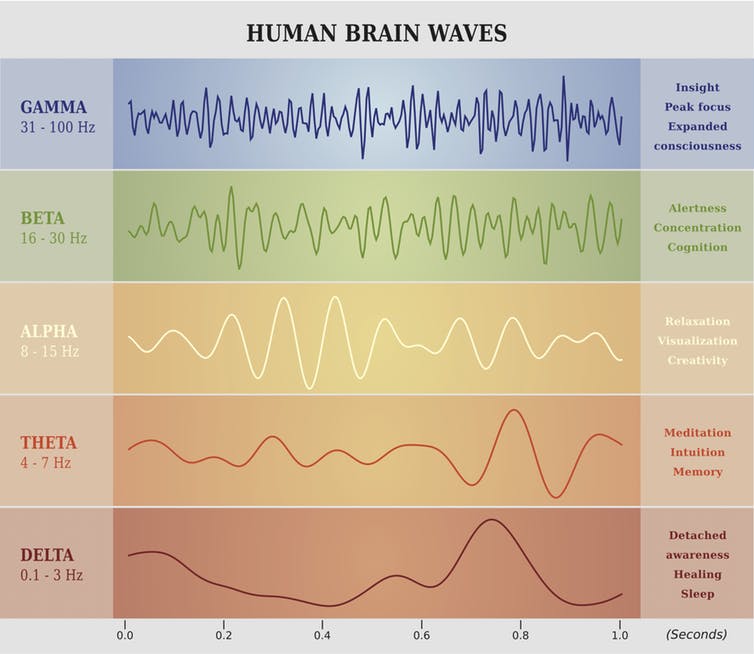
Fries focuses on gamma, beta and theta waves. These labels refer to the speed of electrical oscillations in the brain, measured by electrodes placed on the outside of the skull. Groups of neurons produce these oscillations as they use electrochemical impulses to communicate with each other. It’s the speed and voltage of these signals that, when averaged, produce EEG waves that can be measured at signature cycles per second.
Each type of synchronized activity is associated with certain types of brain function. artellia/Shutterstock.com
Gamma waves are associated with large-scale coordinated activities like perception, meditation or focused consciousness; beta with maximum brain activity or arousal; and theta with relaxation or daydreaming. These three wave types work together to produce, or at least facilitate, various types of human consciousness, according to Fries. But the exact relationship between electrical brain waves and consciousness is still very much up for debate.
Fries calls his concept “communication through coherence.” For him, it’s all about neuronal synchronization. Synchronization, in terms of shared electrical oscillation rates, allows for smooth communication between neurons and groups of neurons. Without this kind of synchronized coherence, inputs arrive at random phases of the neuron excitability cycle and are ineffective, or at least much less effective, in communication.
A resonance theory of consciousness
Our resonance theory builds upon the work of Fries and many others, with a broader approach that can help to explain not only human and mammalian consciousness, but also consciousness more broadly.
Based on the observed behavior of the entities that surround us, from electrons to atoms to molecules, to bacteria to mice, bats, rats, and on, we suggest that all things may be viewed as at least a little conscious. This sounds strange at first blush, but “panpsychism” – the view that all matter has some associated consciousness – is an increasingly accepted position with respect to the nature of consciousness.
The panpsychist argues that consciousness did not emerge at some point during evolution. Rather, it’s always associated with matter and vice versa – they’re two sides of the same coin. But the large majority of the mind associated with the various types of matter in our universe is extremely rudimentary. An electron or an atom, for example, enjoys just a tiny amount of consciousness. But as matter becomes more interconnected and rich, so does the mind, and vice versa, according to this way of thinking.
Biological organisms can quickly exchange information through various biophysical pathways, both electrical and electrochemical. Non-biological structures can only exchange information internally using heat/thermal pathways – much slower and far less rich in information in comparison. Living things leverage their speedier information flows into larger-scale consciousness than what would occur in similar-size things like boulders or piles of sand, for example. There’s much greater internal connection and thus far more “going on” in biological structures than in a boulder or a pile of sand.
Under our approach, boulders and piles of sand are “mere aggregates,” just collections of highly rudimentary conscious entities at the atomic or molecular level only. That’s in contrast to what happens in biological life forms where the combinations of these micro-conscious entities together create a higher level macro-conscious entity. For us, this combination process is the hallmark of biological life.
The central thesis of our approach is this: the particular linkages that allow for large-scale consciousness – like those humans and other mammals enjoy – result from a shared resonance among many smaller constituents. The speed of the resonant waves that are present is the limiting factor that determines the size of each conscious entity in each moment.
As a particular shared resonance expands to more and more constituents, the new conscious entity that results from this resonance and combination grows larger and more complex. So the shared resonance in a human brain that achieves gamma synchrony, for example, includes a far larger number of neurons and neuronal connections than is the case for beta or theta rhythms alone.
What about larger inter-organism resonance like the cloud of fireflies with their little lights flashing in sync? Researchers think their bioluminescent resonance arises due to internal biological oscillators that automatically result in each firefly syncing up with its neighbors.
Is this group of fireflies enjoying a higher level of group consciousness? Probably not, since we can explain the phenomenon without recourse to any intelligence or consciousness. But in biological structures with the right kind of information pathways and processing power, these tendencies toward self-organization can and often do produce larger-scale conscious entities.
Our resonance theory of consciousness attempts to provide a unified framework that includes neuroscience, as well as more fundamental questions of neurobiology and biophysics, and also the philosophy of mind. It gets to the heart of the differences that matter when it comes to consciousness and the evolution of physical systems.
It is all about vibrations, but it’s also about the type of vibrations and, most importantly, about shared vibrations.
ooOOoo
Well, I’m not sure of the relevance but I’m bound to say that I am going to the doctor once a week for Alpha-Sim resetting. The reason I mention it is the Alpha frequency in the above brain wave chart. I sit very quietly for about 90 minutes and it does seem to provide some benefit.
I can do no better than republish in full the following:
(Simply because I scarcely understand it!)
ooOOoo
Why the number 137 is one of the greatest mysteries in physics
Famous physicists like Richard Feynman think 137 holds the answers to the Universe.
By PAUL RATNER, 31st October, 2018.
The fine structure constant has mystified scientists since the 1800s.
The number 1/137 might hold the clues to the Grand Unified Theory.
Relativity, electromagnetism and quantum mechanics are unified by the number.
Does the Universe around us have a fundamental structure that can be glimpsed through special numbers?
The brilliant physicist Richard Feynman (1918-1988) famously thought so, saying there is a number that all theoretical physicists of worth should “worry about”. He called it “one of the greatest damn mysteries of physics: a magic number that comes to us with no understanding by man”.
That magic number, called the fine structure constant, is a fundamental constant, with a value which nearly equals 1/137. Or 1/137.03599913, to be precise. It is denoted by the Greek letter alpha – α.
What’s special about alpha is that it’s regarded as the best example of a pure number, one that doesn’t need units. It actually combines three of nature’s fundamental constants – the speed of light, the electric charge carried by one electron, and the Planck’s constant, as explains physicist and astrobiologist Paul Davies to Cosmos magazine. Appearing at the intersection of such key areas of physics as relativity, electromagnetism and quantum mechanics is what gives 1/137 its allure.
Physicist Laurence Eaves, a professor at the University of Nottingham, thinks the number 137 would be the one you’d signal to the aliens to indicate that we have some measure of mastery over our planet and understand quantum mechanics. The aliens would know the number as well, especially if they developed advanced sciences.
The number preoccupied other great physicists as well, including the Nobel Prize winning Wolfgang Pauli (1900-1958) who was obsessed with it his whole life.
“When I die my first question to the Devil will be: What is the meaning of the fine structure constant?” Pauli joked.
Pauli also referred to the fine structure constant during his Nobel lecture on December 13th, 1946 in Stockholm, saying a theory was necessary that would determine the constant’s value and “thus explain the atomistic structure of electricity, which is such an essential quality of all atomic sources of electric fields actually occurring in nature.”
One use of this curious number is to measure the interaction of charged particles like electrons with electromagnetic fields. Alpha determines how fast an excited atom can emit a photon. It also affects the details of the light emitted by atoms. Scientists have been able to observe a pattern of shifts of light coming from atoms called “fine structure” (giving the constant its name). This “fine structure” has been seen in sunlight and the light coming from other stars.
The constant figures in other situations, making physicists wonder why. Why does nature insist on this number? It has appeared in various calculations in physics since the 1880s, spurring numerous attempts to come up with a Grand Unified Theory that would incorporate the constant since. So far no single explanation took hold. Recent research also introduced the possibility that the constant has actually increased over the last six billion years, even though slightly.
If you’d like to know the math behind fine structure constant more specifically, the way you arrive at alpha is by putting the 3 constants h,c, and e together in the equation —
As the units c, e, and h cancel each other out, the “pure” number of 137.03599913 is left behind. For historical reasons, says Professor Davies, the inverse of the equation is used 2πe2/hc = 1/137.03599913. If you’re wondering what is the precise value of that fraction – it’s 0.007297351.
ooOOoo
Now, as I said in my introduction, I don’t understand this. But it doesn’t stop me from marvelling at the figure.
These next couple of weeks are going to be challenging!
So ….. I am returning to a post I published a year ago.
Sabrina’s Loyalty
Lisa Mae DeMasi offers you all a beautiful guest post.
ooOOoo
How this Handler and Service Dog Nurture One Another
by Lisa Mae DeMasi
At two years old, Lady’s ribs protruded from her coat and her belly was swollen with milk.
Like the thirteen other Labs that had arrived at a rest stop in Union, CT on the straight 12½-hour drive from Muncie, IN, she was presented to us on a crisp autumn day amid the chaos of respective adopters.
My husband Dennis had never experienced the warmth and companionship of having a dog and well, I surprised him with Lady, who we quickly renamed to Sabrina. The very afternoon we picked her up, we raced to the park, wanting her to feel the joy of freedom and play. My husband’s face lit up and while I was thrilled at the opportunity to befriend and care for Sabrina; it meant closing the 20-year gap since our beloved German Shepard from my childhood passed away.
Until laying my eyes on Sabrina’s profile, my heart couldn’t entertain loving another dog.
And what canine isn’t after the same love?
In Sabrina’s case, she couldn’t know of the family members that awaited to embrace her presence. Within days of the initial hair-raising excitement, the cat sought out occasions to groom her ears. Our pet rat was free to waddle the kitchen floor un-bothered, and the pair of bonded bunnies in want of company stretched out beside her on the living room floor.
Dog, cat, rat, rabbit?
You bet.
And Dennis and me?
Like kids again.
Sabrina settled into the folds of our lives, well-nourished and exercised in Boston’s epic snowfall in the winter of 2009-2010, taking careful watch over all of us. The fear expressed in her eyes pre-adoption disappeared.
Eight years later, she watches over me in particular. Thirty years ago, I was struck and thrown from the passenger side of a car until my abdomen collided with the steering wheel—blunt force that called for iterative repair to my digestive system and caused permanent damage to the nerves that signal my bladder is full.
Today when I’m busy working away, Sabrina will alert me to get up every couple of hours to make a trip to the restroom by gently placing her head in my lap.
When I suffer acute intestinal cramping, Crohns-like symptoms, she’ll sit at my side and lean her body against mine. Her calm and steady source of nurturing, helps me to relax and mitigates the cramps.
In 2008, the Department of Justice amended the Americans with Disabilities Act (ADA). This was amended to include digestive, bowel and bladder impairments that limit major life activities as the disabled, calling for employers to make reasonable accommodations and if the individual elects, to allow task-oriented service animals [dog or miniature horse] to accompany them on the job.
Sabrina, serving in the capacity of a sensory/medical assist – alerting me to get up and take care of myself – qualifies.
The HR Director, Debra Susler of Reputation Institute in Cambridge, MA this past April would not allow Sabrina to accompany me on-the-job. I sent her an elaborate email explaining my condition and Sabrina’s certification. She did not reply to me but to my supervisor.
She said “no”.
My response?
I walked out of the place
Sabrina: rescue dog to devoted helper dog.
Respectively, Sabrina’s competencies and understanding of language cease to astound us and her behavior on-the-job at Dell EMC is so well-mannered, coworkers never run out of compliments.
And bystanders in public? The grocery store, pharmacy, gym, dentist, doctor?
Gazes from cell phones are broken, conversations fall short.
Then, come the smiles. A question. Praises. The feel-good moment.
Sabrina brings people together.
I recently read a distressing post from a woman who said every time she looks into a service dog’s eyes, she sees sadness. Even Ingrid Newkirk, CEO and Co-Founder of PETA, has told me, “the life of a typical service dog is a terrible one.”
It’s true. Any canine enslaved to servitude is doomed a dog’s life unlived.
Service animals are working animals, not pets.
The ADA confirms it.
But that’s not the relationship Sabrina and I share [and I understand it can’t be the same with other handlers and service dogs]. In addition to being my devoted helper, Sabrina teaches me to exist in the moment — just like she does. To enjoy the sight of the sun shimmering through the trees, the call of the birds, the fragrance of wildflowers, the feel of the soft soil I tread a few yards behind her when we’re on our hikes.
What more could a dog do for a girl?
ooOOoo
There is something rather special about Lisa’s guest post; special in an introspective way!
That will be better appreciated if you go across to Lisa’s blog site at Nurture Is My Nature.
In particular when you read, via her ‘About’ link, what Lisa offers about herself. Republished here in full.
ooOOoo
As time goes by and you’re getting older and stuff like that—getting older sucks. You know, I hear all this crap about, ‘Oh, you can age with dignity.’ Really? —Mickey Rourke
Lisa’s creative work has recently placed second in Fiftiness’s 2017 Writing Contest (Why I Love Bike Commuting in Boston) and been featured in the anthologies, Unmasked, Women Write About Sex & Intimacy After Fifty (9/17, print) and The Best of Vine Leaves Literary Journal (11/17, print). Her essays have been published in the lit journals and several other media outlets. She considers Massachusetts her home, but has lived in Connecticut, Vermont, New York State and two other planets called Wyoming and Arizona. She earned a B.A. from Regis College and an MBA from Babson College, and holds a Master certificate in Reiki.
Lisa is seeking a development editor [that gets her] to work on her collection of essays and her memoir.
Just the view at night from one small planet, the one that I happen to live on, Planet Earth, reveals millions upon millions of stars. It is then beyond inconceivable that there are not, in turn, countless numbers of other planets.
Extending this line of thought and recognising that a ‘mere’ billion years after the formation of our solar system and Planet Earth, some 4.54 billion years ago, the earliest life appeared, we can’t surely be alone!
Granted it was only cyanobacteria, as in blue-green algae, but, but, but ……… that this evolution of life on Planet Earth, and that evolution eventually leading to intelligent life, including the gift to us humans of the genetic separation of the dog from the wolf some 100,000 years ago, has not occurred on other planets is also totally inconceivable.
So, dear Mr. Cosmos, why have we not detected any signs of that intelligent life. Where are they?
Are we alone in the universe? New Drake equation suggests yes
A fresh take on the decades-old Drake equation incorporates new factors and greater uncertainty, suggesting a high likelihood that humanity is alone in the universe.
At the Los Alamos National Laboratory in 1950, physicist Enrico Fermi famously posed to his colleagues a simple question borne of complex math: ‘Where are they?’
He was asking about aliens—intelligent ones, specifically. The Italian-American scientist was puzzled as to why mankind hasn’t detected any signs of intelligent life beyond our planet. He reasoned that even if life is extremely rare, you’d still expect there to be many alien civilizations given the sheer size of the universe. After all, some estimates indicate that there is one septillion, or 1,000,000,000,000,000,000,000,000, stars in the universe, some of which are surrounded by planets that could probably support life.
So, where are they, and why aren’t they talking to us?
Now, as the article reveals, there is a lot to tackling this question, much of it involving statistics and mathematics, but it does prove one very important fact: Finding another planet as good for life and humanity as this one is just about impossible.
This is our only home!!
My wish, dear Mr. Cosmos, to you is this: That before I die it becomes clear beyond question that the peoples of this sweet Planet, from the lone individual living on some island out in the wilderness to the Governments of the most powerful nations on Earth, understand that nothing is more important than loving, caring for and looking after Planet Earth.
I remain, dear Mr. Cosmos, your respectful servant.
The idea of writing a letter to the moon is not a new one and it came to me when listening to an item yesterday morning, Pacific Time, broadcast by the BBC on Radio 4. The item was the news that Elon Musk has announced that:
Elon Musk’s company SpaceX has unveiled the first private passenger it plans to fly around the Moon.
Japanese billionaire and online fashion tycoon Yusaku Maezawa, 42, announced: “I choose to go to the Moon.”
The mission is planned for 2023, and would be the first lunar journey by humans since 1972.
On September 18, 1977, as it headed toward the outer solar system, Voyager 1 looked back and acquired a stunning image of our Earth and moon.
You will surely remember that first image taken of the Planet Earth and your good self in the same frame.
Here is the 1st-ever photo of the Earth and moon in a single frame. Voyager 1 took the photo on September 18, 1977, when it was 7.25 million miles (11.66 million km) from Earth. Image Number: PIA00013 via NASA/JPL.
Now here we are some 41 years later and, my, how things have changed.
But something, dear Mr. Moon, has never changed for you. That is the sight of our most beautiful planet. Plus, I would go so far as to venture that what makes our planet such a beautiful sight, one that has captivated us humans when we have gone into space and looked back at home, is the magic of our atmosphere.
Picture taken by a NASA satellite orbiting the earth some 200 miles above the planet’s surface.
So, so thin …. and so, so fragile.
It is akin to the thinness of the skin of an onion.
In fact, Mr. Moon, that layer that we earthlings call the troposphere, the layer closest to Earth’s surface varies from just 4 miles to 12 miles (7 to 20 km) thick. It contains half of our planet’s atmosphere!
Everything that sustains the life of air-breathing creatures, human and otherwise, depends on the health of this narrow layer of atmosphere above our heads. Now the thickness of that layer varies depending on the season and the temperature of the air. But let’s use an average thickness of 8 miles (say, 13 km) because I want to explore in my letter to you some comparisons.
In your infinite gaze down upon your mother planet you will have seen the arrival of H. sapiens, out of ancestral H. erectus, that took place roughly 315,000 years ago.
You will also have seen from your lofty vantage point the growth of both CO2 levels in the planet’s atmosphere and the average land-ocean temperature. Forgive me quoting something at you, but:
OBSERVABLE CHANGES IN THE EARTH
SINCE THE INDUSTRIAL REVOLUTION
While politicians have been busy debating the merits of climate science, the physical symptoms of climate change have become increasingly apparent: since the industrial revolution, sea level has grown by 0.9 inches, the atmospheric concentration of carbon dioxide has risen to unprecedented levels, average global temperatures have increased by about 1.0 degree Celsius and, to top it off, the global population has jumped by nearly 600 percent; 15 of the 16 hottest years on record occurred in the 21st century, and 2016 is likely to be the warmest year ever recorded.
Now the Industrial Revolution was all but over back in 1840 and the last 178 years have seen an explosion in the way we use energy, in all its forms. Plus we have to accept that back then the global population was around 1 billion persons. It is now over 7 billion.
Between 1900 and 2000, the increase in world population was three times greater than during the entire previous history of humanity—an increase from 1.5 to 6.1 billion in just 100 years.
So on to my comparisons.
The radius of our beautiful planet is about 3,959 miles (6,371 km). The average thickness of the troposphere is 8 miles (13 km).
Thus the ratio of thickness of our liveable atmosphere to the radius of the planet is 8 divided by 3,959. That is a figure of 0.002! Our atmosphere is 1/1000th of the size of the radius of our planet.
Hang on that figure for a moment.
In the last 178 years humanity has transformed our consumption of energy and especially carbon-based fuels. H. sapiens has been around for 315,000 years.
Thus the ratio of these present ‘modern’ times (the last 178 years) to the arrival of us back then (315,000 years ago) is 178 divided by 315,000. That is a (rounded) figure of 0.0006. Our modern times are just 1/10,000th of the time that so-called modern man has been on this planet.
So, dear Mr. Moon, you must despair that in so short a number of years, proportionally ten times smaller than the ratio of the troposphere to the radius of our planet, we funny creatures have done so much damage to what we all depend on to stay alive – clean air!
Or maybe, my dear companion of the night sky, because you are celebrating your 4.1 billionth year of existence, what we humans are doing is all a bit of a yawn.
Sincerely,
This old Brit living in Oregon.
ooOOoo
My dear friends (and I’m now speaking to you dear reader, not the moon!) when you reflect on the fragility of our atmosphere, well the layer we depend on for life, you realise without doubt that each and every one of us must make this pledge.
“I promise to do everything possible to reduce my own personal CO2 output and to ensure that both to my near friends and my political representatives I make it clear that we must turn back – and turn back now!”
Or, as George Monbiot writes in closing a recent essay (that I am republishing tomorrow): “Defending the planet means changing the world.”
Venturing into strange lands.
A collection of items has been crossing my ‘in-box’ in recent weeks and while many of the topics are, on the face it, not connected, for reasons I am not entirely sure about they seem to fall under the same umbrella; as in being of the same coherent theme.
Let me list some of these topics: the age of the universe; climate change; CO2 levels; the certainty of death; the history of the last half-million years; what our dogs teach us; and more!
Naturally, Jeannie and I have been kicking around these topics, aided and abetted by Dan Gomez, my Californian friend of some 40 years (and my ‘Best Man’ when Jean and I were married in 2010 and, more or less directly, the catalyst of me and Jean meeting in 2007!)
But I get the sense that many of you wonderful people that follow this place also scratch your head not infrequently and ponder on these ‘interesting’ times.
I don’t have any answers. But I do want to share how, over the last few weeks, I have been seeking some meaning, some peace, to the big issues that have the potential to make these times pretty uncomfortable if not a tad scary.
I shall not be extending this introspection each day but probably ( and I’m guessing) a couple of times a week I shall be dipping into the barrel!
Starting off with climate change, maybe tomorrow or Wednesday.
But what of today!
Today I am publishing another Dog Food Recall alert that came out late last week!
ooOOoo
Performance Dog Pet Food Recall
September 12, 2018 — Bravo Packing, Inc. of Carneys Point, New Jersey, is recalling all Performance Dog products, a frozen raw pet food, because they have the potential to be contaminated with Salmonella.
What’s Recalled?
The following products are affected by the recall:
Performance Dog
Package Size: 2-pound plastic sleeve
Mfg Date Code: 071418
Performance Dog
Package Size: 5-pound plastic sleeve
Mfg Date Code: 071418
Performance Dog comes frozen in 2-pound and 5-pound plastic sleeves.
The recalled product has manufacture date code 071418.
The manufacture date codes are printed on the boxes that contain the plastic sleeves, but not on the individual plastic sleeves.
Therefore, if the cardboard box has been discarded, there are no unique identification numbers on the individual sleeves that allow customers to determine that they possess the recalled products.
If you purchased this product since July 14, 2018 and cannot determine whether it is affected by the recall, the FDA recommends that you exercise caution and throw the product away.
About Salmonella
Salmonella can cause illness in animals eating the products, as well as people who handle contaminated pet products, especially if they have not thoroughly washed their hands after having contact with the products, infected animals or any surfaces exposed to these products.
Healthy people infected with Salmonella should monitor themselves for some or all of the following symptoms: nausea, vomiting, diarrhea or bloody diarrhea, abdominal cramping and fever.
Rarely, Salmonella can result in more serious ailments, including arterial infections, endocarditis (an infection of the heart muscle), arthritis, muscle pain, eye irritation and urinary tract symptoms.
People who have these symptoms after having contact with this product or an animal that has eaten this product should contact their healthcare providers.
Pets with Salmonella infections may be lethargic and have diarrhea or bloody diarrhea, fever, and vomiting.
Some pets will have decreased appetite, fever and abdominal pain.
Pets exposed to contaminated food can be infected without showing symptoms.
If your pet has consumed the recalled product and has these symptoms, please contact your veterinarian.
Infected animals can also shed Salmonella through their feces and saliva, spreading pathogens into the home environment and to humans and other animals in the household.
No human or animal illnesses have been reported to date.
What Caused the Recall?
Bravo Packing, Inc. is voluntarily recalling this product after a sample of Performance Dog, collected during an FDA inspection, tested positive for Salmonella.
Performance Dog generally works with the distributor Tefco, located in Brooklyn , New York, that fills orders to brick-and-mortar retail stores or to consumers directly.
What to Do?
Consumers with questions should contact Bravo Packing, Inc. at 856-299-1044 (Monday thru Friday, 6 AM to 2 PM, Saturday 4 AM to 9 AM ET) or through the company’s website at http://www.bravopacking.com.
U.S. citizens can report complaints about FDA-regulated pet food products by calling the consumer complaint coordinator in your area.
Or go to http://www.fda.gov/petfoodcomplaints.
Canadians can report any health or safety incidents related to the use of this product by filling out the Consumer Product Incident Report Form.
Science confirms what we instinctively understand!
That the way a dog looks deep into our eyes is more than emotional froth!
Follower of this blog, Anita, left a comment to yesterday’s post. This is what she wrote (my emphasis):
This has been a wonderful compilation of awesome photos. You must do it again sometime. Dogs are so wonderful and such great companions. They do have eyes that see straight through our very souls and ready to love us at the drop of a hat.
One of our dogs here at home, Oliver, has those eyes. When he stares into my own eyes it feels as though at some mystical level Oliver and I are connected.
Young Oliver and those eyes! (Taken 1st March, 2018.)
So imagine my surprise when reading yesterday the lead essay in The Smithsonian about the evolution of the domesticated dog and me coming across this:
The relationship has become so close that even our brains are in sync. Witness a study showing that dogs hijack the human brain’s maternal bonding system. When humans and dogs gaze lovingly into one another’s eyes, each of their brains secretes oxytocin, a hormone linked to maternal bonding and trust.
In other words, science confirms what I experience as being real!! (Undoubtedly shared by many of you!)
Long ago, before your four-legged best friend learned to fetch tennis balls or watch football from the couch, his ancestors were purely wild animals in competition—sometimes violent—with our own. So how did this relationship change? How did dogs go from being our bitter rivals to our snuggly, fluffy pooch pals?
The new drama Alpha answers that question with a Hollywood “tail” of the very first human/dog partnership.
Europe is a cold and dangerous place 20,000 years ago when the film’s hero, a young hunter named Keda, is injured and left for dead. Fighting to survive, he forgoes killing an injured wolf and instead befriends the animal, forging an unlikely partnership that—according to the film—launches our long and intimate bond with dogs.
Just how many nuggets of fact might be sprinkled throughout this prehistoric fiction?
We’ll never know the gritty details of how humans and dogs first began to come together. But beyond the theater the true story is slowly taking shape, as scientists explore the real origins of our oldest domestic relationship and learn how both species have changed along canines’ evolutionary journey from wolves to dogs.
When and where were dogs domesticated?
Pugs and poodles may not look the part, but if you trace their lineages far enough back in time all dogs are descended from wolves. Gray wolves and dogs diverged from an extinct wolf species some 15,000 to 40,000 years ago. There’s general scientific agreement on that point, and also with evolutionary anthropologist Brian Hare’s characterization of what happened next. ’The domestication of dogs was one of the most extraordinary events in human history,” Hare says.
But controversies abound concerning where a long-feared animal first became our closest domestic partner. Genetic studies have pinpointed everywhere from southern China to Mongolia to Europe.
Scientists cannot agree on the timing, either. Last summer, research reported in Nature Communications pushed likely dates for domestication further back into the past, suggesting that dogs were domesticated just once at least 20,000 but likely closer to 40,000 years ago. Evolutionary ecologist Krishna R. Veeramah, of Stony Brook University, and colleagues sampled DNA from two Neolithic German dog fossils, 7,000 and 4,700 years old respectively. Tracing genetic mutation rates in these genomes yielded the new date estimates.
“We found that our ancient dogs from the same time period were very similar to modern European dogs, including the majority of breed dogs people keep as pets,” explained Dr. Veeramah in a release accompanying the study. This suggests, he adds, “that there was likely only a single domestication event for the dogs observed in the fossil record from the Stone Age and that we also see and live with today.”
End of story? Not even close.
In fact, at least one study has suggested that dogs could have been domesticated more than once. Researchers analyzed mitochondrial DNA sequences from remains of 59 European dogs (aged 3,000 to 14,000 years), and the full genome of a 4,800-year-old dog that was buried beneath the prehistoric mound monument at Newgrange, Ireland.
Comparing these genomes with many wolves and modern dog breeds suggested that dogs were domesticated in Asia, at least 14,000 years ago, and their lineages split some 14,000 to 6,400 years ago into East Asian and Western Eurasian dogs .
But because dog fossils apparently older than these dates have been found in Europe, the authors theorize that wolves may have been domesticated twice, though the European branch didn’t survive to contribute much to today’s dogs. Greger Larson, director of the Wellcome Trust Palaeogenomics & Bio-Archaeology Research Network at Oxford University, suggests that the presence of older fossils in both Europe and Asia, and the lack of dogs older than 8,000 years in between those regions, supports such a scenario.
“Our ancient DNA evidence, combined with the archaeological record of early dogs, suggests that we need to reconsider the number of times dogs were domesticated independently. Maybe the reason there hasn’t yet been a consensus about where dogs were domesticated is because everyone has been a little bit right,′ Larson said in a statement accompanying the study.
Perhaps more intriguing than exactly when or where dogs became domesticated is the question of how. Was it really the result of a solitary hunter befriending an injured wolf? That theory hasn’t enjoyed much scientific support.
One similar theory argues that early humans somehow captured wolf pups, kept them as pets, and gradually domesticated them. This could have happened around the same time as the rise of agriculture, about 10,000 years ago. The oldest fossils generally agreed to be domestic dogs date to about 14,000 years, but several disputed fossils more than twice that age may also be dogs or at least their no longer entirely wolf ancestors.
Since more recent genetic studies suggest that the date of domestication occurred far earlier, a different theory has gained the support of many scientists. “Survival of the friendliest” suggests that wolves largely domesticated themselves among hunter-gatherer people.
“That the first domesticated animal was a large carnivore, who would have been a competitor for food—anyone who has spent time with wild wolves would see how unlikely it was that we somehow tamed them in a way that led to domestication,” says Brian Hare, director of the Duke University Canine Cognition Center.
But, Hare notes, the physical changes that appeared in dogs over time, including splotchy coats, curly tails, and floppy ears, follow a pattern of a process known as self-domestication. It’s what happens when the friendliest animals of a species somehow gain an advantage. Friendliness somehow drives these physical changes, which can begin to appear as visible byproducts of this selection in only a few generations.
“Evidence for this comes from another process of domestication, one involving the famous case of domesticated foxes in Russia. This experiment bred foxes who were comfortable getting close to humans, but researchers learned that these comfortable foxes were also good at picking up on human social cues,” explains Laurie Santos, director of the Canine Cognition Center at Yale University. The selection of social foxes also had the unintended consequence of making them look increasingly adorable—like dogs.
Hare adds that most wolves would have been fearful and aggressive towards humans—because that’s the way most wolves behave. But some would have been friendlier, which may have given them access to human hunter-gatherer foodstuffs..
“These wolves would have had an advantage over other wolves, and the strong selection pressure on friendliness had a whole lot of byproducts, like the physical differences we see in dogs,” he says. “This is self-domestication. We did not domesticate dogs. Dogs domesticated themselves.”
A study last year provided some possible genetic support for this theory. Evolutionary biologist Bridgette von Holdt, of Princeton University, and colleagues suggest that hypersocial behavior may have linked our two species and zero in on a few genes that may drive that behavior.
“Generally speaking, dogs display a higher level of motivation than wolves to seek out prolonged interactions with humans. This is the behavior I’m interested in,” she says.
Von Holdt’s research shows that the social dogs she tested have disruption to a genomic region that remains intact in more aloof wolves. Interestingly, in humans genetic variation in the same stretch of DNA causes Williams-Beuren syndrome, a condition characterized by exceptionally trusting and friendly behaviors. Mice also become more social if changes occur to these genes, previous studies have discovered.
The results suggest that random variations to these genes, with others yet unknown, may have played a role in causing some dogs to first cozy up with humans.
“We were able to identify one of the many molecular features that likely shape behavior,” she adds.
How have dogs changed since becoming our best friends?
Though the origins of the dog/human partnership remain unknown, it’s becoming increasingly clear that each species has changed during our long years together. The physical differences between a basset hound and wolf are obvious, but dogs have also changed in ways that are more than skin (or fur) deep.
One recent study shows how by bonding with us and learning to work together with humans, dogs may have actually become worse at working together as a species. Their pack lifestyle and mentality appear to be reduced and is far less prevalent even in wild dogs than it is in wolves.
But, Yale’s Laurie Santos says, dogs may have compensated in other interesting ways. They’ve learned to use humans to solve problems.
“Several researchers have presented dogs and wolves with an impossible problem (e.g., a puzzle box that can’t be opened or a pulling tool that stops working) and have asked how these different species react,” Santos explains. “Researchers have found that wolves try lots of different trial and error tactics to solve the problem— they get at it physically. But at the first sign of trouble, dogs do something different. They look back to their human companion for help. This work hints that dogs may have lost some of their physical problem-solving abilities in favor of more social strategies, ones that rely on the unique sort of cooperation domesticated dogs have with humans. This also matches the work showing that dogs are especially good at using human social cues.”
The relationship has become so close that even our brains are in sync. Witness a study showing that dogs hijack the human brain’s maternal bonding system. When humans and dogs gaze lovingly into one another’s eyes, each of their brains secretes oxytocin, a hormone linked to maternal bonding and trust. Other mammal relationships, including those between mom and child, or between mates, feature oxytocin bonding, but the human/dog example is the only case in which it has been observed at work between two different species.
The intimacy of this relationship means that, by studying dogs, we may also learn much about human cognition.
“Overall, the story of dog cognitive evolution seems to be one about cognitive capacities shaped for a close cooperative relationship with humans,” Santos says. “Because dogs were shaped to pick up on human cues, our lab uses dogs as a comparison group to test what’s unique about human social learning.” For example, a recent Yale study found that while dogs and children react to the same social cues, dogs were actually better at determining which actions were strictly necessary to solve a problem, like retrieving food from a container, and ignoring extraneous “bad advice.” Human kids tended to mimic all of their elders’ actions, suggesting that their learning had a different goal than their canine companions’.
We may never know the exact story of how the first dogs and humans joined forces, but dogs have undoubtedly helped us in countless ways over the years. Still, only now may we be realizing that by studying them, they can help us to better understand ourselves.
I can do no better than to repeat those last two sentences of the essay by Brian Handwerk:
We may never know the exact story of how the first dogs and humans joined forces, but dogs have undoubtedly helped us in countless ways over the years. Still, only now may we be realizing that by studying them, they can help us to better understand ourselves.
For, boy of boy, do we humans need help when it comes to better understanding ourselves!
I wasn’t planning to publish a post for today. But then a recent post from Patrice Ayme spurred me to so do.
Let me explain.
Our nearest town, Grants Pass, has the wonderful Rogue River flowing through it and alongside it there is Riverside Park. To quote:
Riverside Park in Grants Pass was set aside by our founders for the enjoyment of our citizens and guests.
People come from all over to Riverside Park to watch the majestic Rogue River as it courses its’ way through our city.
As you can see it is a popular place for ducks and geese.
Last Tuesday, we had a contractor completing some new guttering for the house. Terry, the owner of TC Gutters, ran out of the coated aluminium he was folding into the correct shape using a rather cute machine!
Terry apologised and said that he would need to run back into Grants Pass to pick up some more of the sheeting.
He returned a little later and I went over to chit-chat with him.
He was unexpectedly downcast.
“Terry, is there a problem?”
“Paul, when I was in town, down at the bottom of 6th Street near the bridge, there was a flock of ducks crossing the road.”
Terry paused for quite a while; I stood there next to him with not a clue as to what was coming.
He sighed, and continued: “Instinctively, I slowed down along with a number of other drivers. But what really upset me was the fact that a few drivers were clearly gleefully driving into the ducks and killing them!”
It hurt me to hear that; very much so!
Is it too strong for me to regard those drivers who thought it great fun to drive into those ducks as being evil?

 Deinah Storm is a pet lover from the US that’s had cats and dogs all her life. When she’s not walking the dogs with her family, she spends time writing informational and interesting blogs about pets to share with pet lover communities.



 At two years old, Lady’s ribs protruded from her coat and her belly was swollen with milk.
 In Sabrina’s case, she couldn’t know of the family members that awaited to embrace her presence. Within days of the initial hair-raising excitement, the cat sought out occasions to groom her ears. Our pet rat was free to waddle the kitchen floor un-bothered, and the pair of bonded bunnies in want of company stretched out beside her on the living room floor.
 Eight years later, she watches over me in particular. Thirty years ago, I was struck and thrown from the passenger side of a car until my abdomen collided with the steering wheel—blunt force that called for iterative repair to my digestive system and caused permanent damage to the nerves that signal my bladder is full.
 calling for employers to make reasonable accommodations and if the individual elects, to allow task-oriented service animals [dog or miniature horse] to accompany them on the job.
 Sabrina brings people together.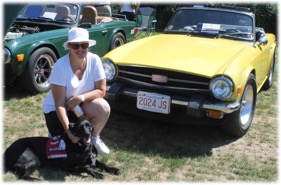





 Learning from Dogs