Now I am sure that I share with countless others a poor understanding of what IVF is. Here’s a Wikipedia extract:
In vitro fertilization or fertilisation (IVF) is a process by which an egg is fertilised by sperm outside the body: in vitro (“in glass”). The process involves monitoring and stimulating a woman’s ovulatory process, removing an ovum or ova (egg or eggs) from the woman’s ovaries and letting sperm fertilise them in a liquid in a laboratory. The fertilised egg (zygote) is cultured for 2–6 days in a growth medium and is then implanted in the same or another woman’s uterus, with the intention of establishing a successful pregnancy.
Obviously that applies to women.
A quick web search revealed that the IVF procedure is commonly used in livestock. Here’s a graphic example of that (literally):
All of which leads nicely in to the Science Alert story.
ooOOoo
These are the world’s first puppies born through IVF
Cutest science ever.
PETER DOCKRILL 11 DEC 2015
The world’s first litter of puppies born through in vitro fertilisation (IVF) represents the culmination of decades of research and has resulted in seven adorable pups called Cannon, Red, Green, Cornelia, Buddy, Kiwi and Ivy le Fleur.
But the achievement goes beyond almost intolerable cuteness. The researchers say successfully breeding puppies via IVF opens the door for saving endangered canid species and using gene-editing techniques to eradicate heritable diseases in dogs.
“Since the mid–1970s, people have been trying to do this in a dog and have been unsuccessful,” said Alex Travis, a reproductive biologist from Cornell University.
To develop the litter of pups, the researchers had to fertilise eggs from donor mothers with sperm from donor fathers in the lab, before transferring the embryos to a host female. 19 embryos were transferred to the host female in total, who gave birth to seven healthy pups.
Credit: Cornell University
Two of the pups came from a beagle mother donor and a cocker spaniel father donor, and the other five came from two pairings of beagle mothers and fathers.
The team had to overcome a number of challenges to make the process work. Picking the right time to collect mature eggs from the female oviduct proved difficult, as dogs’ reproductive cycles occur only twice per year typically. The researchers found delaying the egg collection by one day resulted in greater fertilisation than previous attempts.
An additional barrier was preparing the sperm for fertilisation, which is normally performed by the female tract. But the researchers found they could simulate these conditions by adding magnesium to the cell culture. “We made those two changes, and now we achieve success in fertilisation rates at 80 to 90 percent,” said Travis.
The researchers’ IVF process, described in PLOS One, will enable conservationists to store the semen and eggs of endangered canids and also help protect rare dog breeds.
Credit: Cornell University
“We can freeze and bank sperm, and use it for artificial insemination,” said Travis. “We can also freeze oocytes, but in the absence of in vitro fertilisation, we couldn’t use them. Now we can use this technique to conserve the genetics of endangered species.”
The IVF process should also lead to better genome-editing techniques in the future. This issue is particularly pertinent in light of the way that humans have bred dogs over many centuries. With the paired selection of mates for desired traits leading to detrimental genetic baggage due to inbreeding, this gives researchers a chance to eliminate diseases that certain breeds are now predisposed to.
“With a combination of gene-editing techniques and IVF, we can potentially prevent genetic disease before it starts,” said Travis.
We don’t always hear a lot about endangered canid species, but here are five candidates that this research will helpfully be able to help sooner rather than later.
ooOOoo
If you are like me and rarely follow the links in online stories then let me alert you to the last one. It’s an article in Scientific American that opens, thus:
The 5 Most Endangered Canine Species
By John R. Platt on May 9, 2013
Domesticated dogs are some of the most popular animals on the planet, but their cousins in the wild aren’t always as beloved. For thousands of years humans have persecuted wolves, jackals, dingoes, foxes and other members of the family Canidae, pushing many species into or close to extinction. Here are five of the most endangered canine species and subspecies, three of which only continue to exist because a few people and organizations have taken extraordinary efforts to save them.
I don’t have copyright permission to offer more. So all I will do is to list the names of those five most endangered species:
Apologies for the short intro but my internet connection is still not 100% and I didn’t want to fuss around and lose the window in which to present this fascinating article on ScienceAlert sent to me by Dan Gomez.
ooOOoo
Dogs give food to their ‘friends’ in first-of-its-kind study
Treats for everybody! But more for pals.
PETER DOCKRILL 17 DEC 2015
Voluntary acts of kindness and positive outward gestures without thought of reward are two of the more redeeming aspects of human society, but to what extent do these prosocial behaviours exist in other animals?
A new study by researchers in Austria suggests that dogs are prosocial among their own kind too, with an experiment involving the voluntary offering of food between the animals showing that dogs also understand the concept of giving.
“Dogs and their nearest relatives, the wolves, exhibit social and cooperative behaviour, so there are grounds to assume that these animals also behave prosocially toward conspecifics,” said Friederike Range, an ethnologist at the Messerli Research Institute. “Additionally, over thousands of years of domestication, dogs were selected for special social skills.”
But measuring prosocial behaviour in dogs isn’t easy, says Range, because they’re so very social with humans. It can be difficult to tell between seemingly prosocial acts and behaviours that could actually just be the dog obediently reacting to cues and unintended communications from researchers.
So to take people out of the equation as much as possible, Range and his colleagues conducted an experiment where two dogs were set up by themselves in cages side by side. One of the dogs, called the donor dog, had the ability to extend one of two trays toward a receiver dog, using its mouth to pull on a string.
One of these trays contained a treat, while the other was empty. The dogs had been trained over weeks to understand how the tray-pulling system worked, and the donor dog in each instance knew that it would receive nothing itself if it gave the treat to its fellow canine (other than the pleasure perhaps of knowing it had done a kindness to its counterpart).
The researchers found that dogs, in the absence of any ulterior motive, do indeed exhibit prosocial behaviour, by voluntarily giving food to other dogs. But, having said that, they can be accused of preferential treatment.
“Dogs truly behave prosocially toward other dogs. That had never been experimentally demonstrated before,” said Range. “What we also found was that the degree of familiarity among the dogs further influenced this behaviour. Prosocial behaviour was exhibited less frequently toward unfamiliar dogs than toward familiar ones.”
In other words, dogs look out for their friends more than they do random strangers, but the same could be said of our own prosocial behaviour. Humans have the capacity for kindness, but we demonstrate it more frequently with those with which we are more familiar.
The findings are reported in Scientific Reports, but now that we know dogs are prosocial, that of course means there are other puzzles for the researchers to solve. Why do dogs act this way? Is it a result of domestication, their cognitive complexity, or has it been shaped by the species’ reliance on cooperative activities, such as foraging together? As dog lovers, we can’t wait to hear the answers.
Three days ago I was within just a few minutes of queuing this for a blog release when the internet went down. So now that things are back (to normal?) it gives me very great pleasure to publish this guest post.
ooOOoo
My Dog, My Mentor.
We humans share the planet with an enormous variety of life forms. In fact, there are so many organisms in our world that scientists cannot agree even on an estimate of how many exist. Anywhere between two and 100 million, we are told. Those numbers are staggering, leaving me feeling small alongside all those with whom I share terrestrial space.
Today my thoughts come to rest on one specific type of world inhabitant––just one out of the multiple millions: the canine! The one who allegedly is man’s (and woman’s) best friend! I have had close contact with dogs since I was a young child, so it’s hardly surprising that I have a great deal of love and respect for them.
No longer are dogs simply farm animals or household pets. They rescue the lost and wounded after natural disasters, serve in combat, their keen sensitivities are used to detect disease in its early stages, their presence brings comfort to the ill or elderly, they accompany their seeingimpaired human counterpart, detect illegal and harmful substances in public places. In short, they frequently provide expertise and skill that exceed that of humans.
People are hesitant to admit this, always desiring to be on top. To be the best and the most developed. Since we seem to have great difficulty simply living alongside one another, we tend to keep score: higher/ lower; bigger/ smaller; better/ worse; superior/ inferior. One result of this scoring system is that we consider ourselves vastly superior to our animal sisters and brothers–– superior in intelligence, capacity for reason, emotion, creativity and relationship.
Carl Safina, marine conservationist, professor and author, challenges this notion of superiority, stating humans are not necessarily unique (or superior), but simply the most extreme: capable of the most compassion and the worst violence; possessing the greatest capacity for creativity and at the same time most able and willing to inflict destruction on one another and on other inhabitants of this planet.
Yet, animals do not respond in kind. Certainly, they will protect and defend themselves and their own, but humans display vastly more aggression. At times, animals choose to exhibit unsurpassed magnanimity towards humans.
Focusing this phenomenon on the family dog, it may surprise us that not WE but THEY seem to provide the greatest benefit in the human / canine relationship. If we are observant, we will be humbled by the fact that characteristics, effortlessly displayed in our pets, are the very same qualities we strive for and often fall short in attaining. Take gratitude, for example. My darling Maltese––gone since September 11, 2015––waited hours for his human to return home to love on, walk with and feed him. When I walked in the door, he did not unleash venom or aggression for having been left alone while I was away working. His tail wagging knew no bounds––he simply adored the moment he was again joined by his human.
But me? My mind would play all kinds of games when similarly “neglected”: It’s been weeks since I heard from her, it’s about time she called. I didn’t do anything to deserve this silence!
And then there’s unconditional love. What about the times I would become impatient with my furry family member? At times he was distracted on walks, simply delighted by all the sounds, smells and sights of the outdoors. But, I had a goal and a time limit, giving rise to frustration at his digressions. However, my dog wasn’t frustrated. On the contrary, he not only endured my impatient scolding––calls to move on, to hurry––but reciprocated with lavish love the very next moment. How did he do that?
Why is my dog, (whether instinctively or cognitively is actually irrelevant) capable of exhibiting the very virtue I strive for, fail at, attempt repeatedly, become frustrated over failing yet again? The list of virtues seems endless:
kindness,
patience,
resiliency,
forgiveness,
encouragement,
empathy,
sensitivity,
contentment,
the innate ability to live in the moment.
My furry family member expressed––indeed he lived them all.
And what about me? I exhibit these qualities periodically. Sporadically. Brokenly. With enormous, conscious effort.
In his final months, my small Maltese slowed down, had increasing difficulty with mobility, became disoriented, nearly blind and partially deaf. In a word: dependent. Yet his trust, courage and peace were astounding. In his final days he became quiet, hardly uttering a sound, yet the pictures of those days bear witness to his alertness and awareness. He knew!
Could it be that he was quiet because he was at peace with what had been and what was to come? I believe that because he had given all he had to give, in the best way he had been able to give it, he was able to quietly await and accept his departure as well.
What will it be like for me to grow old? Limited? Increasingly dependent? I don’t know! Will I know that the value of my existence is not tied with activity or productivity? Will I learn to live in the moment––grateful, at peace, content?
How will I face the imminent transition from this life to the next? I don’t know! Will my last days be characterized with peace? Absorbing and bestowing love? Satisfied with small things? Inwardly at rest?
These reflections will accompany me for years.
There are questions that are equally relevant––and perhaps more immediate:
How can I have a more sane understanding of my place in this expansive and exquisite terrestrial community?
What will enhance a sense of respect and appreciation for the dizzying variety of species I live alongside?
What will it take for me to continue growing and learning as a human?
These seem profound questions in light of growing disregard for human and animal life. It is not unlikely, however, that sharing space with dogs will help me grow into a more gracious and balanced person.
This is just an interim post while I get my act together today (it’s 08:07am).
For yesterday morning, around 7am, we lost our internet service and it was only restored a couple of hours ago.
There’s an announcement from me coming out before the end of the day about my book and a way for anyone interested in reading a section to be able to download a few chapters.
More later!
Thanks Doranne for sharing that wonderful reminder.
We humans take self-awareness for granted. The key measure, as I understand it, is our ability to recognise ourselves, as in a mirror or photograph, for example.
I have more than once mentioned in posts in this place, that the evolutionary journey for us humans and our canine companions has resulted in the two species now sharing a number of psychological and physical ailments.
But what has been implicitly understood is that the one thing that dogs and us do not share is self-awareness. Hitherto, it has been believed that dogs do not recognise themselves in the mirror test.
All of which is an introduction to an item that was recently posted on the ScienceAlert website and was brought to my attention by dear friend Dan Gomez.
ooOOoo
Guise Barbiani, Flickr
Dogs show signs of self-consciousness in new ‘sniff test’ We knew it!
BEC CREW 10 DEC 2015
Self-awareness might seem like the most basic part of life to us humans, but it’s a surprisingly rare concept when it comes to other animals. While great apes, dolphins, orcas, rhesus macaques, Eurasian magpies, and a single Asiatic elephant have all passed the self-recognition test, everything from pandas and pigeons to sea lions, gorillas, and several species of monkey have failed to show signs of consciousness.
Dogs were also on that list of failures – until now. Traditionally, self-consciousness is evaluated via the ‘mirror test’. If an animal uses its own reflection to examine or touch a red mark that’s been applied to its body without its knowledge, scientists can confirm that they possess some sense of self. But what if the animal isn’t that visually oriented?
“I believed that because dogs are much less sensitive to visual stimuli with respect to what, for example, humans and many apes are, it is likely that the failure of this and of other species in the mirror test is mainly due to the sensory modality chosen by the investigator to test the self-awareness and not, necessarily, to the absence of this latter,” says evolutionary biologist Roberto Cazzolla Gatti from Tomsk State University in Russia.
Gatti was prompted into this line of thinking by the fact that in past mirror tests, dogs have shown no interest in looking at their reflection in the mirror, but they will go ahead and sniff the area and possibly even urinate around it. While this got them a big old “fail” in previous studies, Gatti thought the behaviour warranted a closer look.
Back in 2001, renowned animal behaviour expert, Marc Bekoff, investigated the ‘mirror sniffing’ phenomenon via an experiment dubbed the ‘yellow snow test’. Yep it’s exactly what it sounds like. Over a five-year period, Bekoff took his dog Jethro on walks during the winter months, and timed how long he would sniff clumps of snow soaked in his own or other dogs’ urine.
“Bekoff would wait until Jethro or other known female and male dogs urinated on snow, and then scoop up the clump of yellow snow as soon as Jethro was elsewhere and did not see him pick it up or move it (Bekoff used clean gloves each time and took other precautions to minimise odour and visual cues).
Bekoff then moved the yellow snow varying distances down the path so that Jethro would run across the displaced urine: (i) within about 10 seconds, (ii) between 10 and 120 seconds later, or (iii) between 120 and 300 seconds later. After Jethro arrived, Bekoff recorded how long he sniffed at the yellow snow, whether he urinated over it using the typical male raised-leg posture, and whether urination immediately followed the sniffing (‘scent marking’).”
Not surprisingly, Jethro paid a lot less attention to his own urine than he did to that of other dogs, so Bekoff concluded that his pet had to have some sense of self to be able to distinguish between scents. But with a sample size of one, the experiment wasn’t exactly going to set the scientific community on fire.
Gatti decided to come up with something a little more convincing. Called the Sniff Test of Self-Recognition (STSR), the experiment involved collecting urine samples from four stray dogs and systematically exposing them to the scents. He repeated this four times a year at the beginning of every season.
“I placed within a fence five urine samples containing the scent of each of the four dogs and a ‘blank sample’, filled only with cotton wool odourless,” he says. “The containers were then opened and each dog was individually introduced to the inside of the cage and allowed to freely move for 5 minutes. The time taken by each dog to sniff each sample was recorded.”
Just like Jethro, each dog spent way more time smelling the urine samples of other dogs than their own, which supports the hypothesis that they know their own scent and aren’t that interested in it. The result was stronger the older the dog, which suggests that self-awareness develops with age.
It might seem obvious that dogs would know their own scent, but if you’ve ever seen a dog bark at its own reflection, or completely ignore it – totally unaware of its own appearance and movements – you can see the significance.
“I demonstrated that even when applying it to multiple individuals living in groups and with different ages and sexes, this test provides significant evidence of self-awareness in dogs and can play a crucial role in showing that this capacity is not a specific feature of only great apes, humans, and a few other animals, but it depends on the way in which researchers try to verify it,” says Gatti.
Now, I know what you’re thinking: that sample size of four is pretty crap. And yep, it is, so we can’t really call this an official “pass” just yet. But the fact that we may well need to rethink the mirror test and figure out how to better align it with how certain species see the world is certainly worthy of a proper investigation. Certain behaviours such as empathy have been linked to self-awareness, and thanks to the ‘yawn test’, there’s evidence that dogs feel empathy towards their owners.
We’ll just have to wait and see if scientists are prepared to conduct a giant yellow snow test to put this conundrum to bed once and for all. In the meantime, here’s dolphins passing the mirror test adorably:
ooOOoo
Speaking of self-awareness, today, December 12th, is the centenary of the birth of Frank Sinatra.
Photo of Frank SINATRA, posed, c.early 1960s (Photo by GAB Archive/Redferns)
Today’s post is inspired by something I read that is very special.
The last time I published a post headed What is love?, back in 2012, I included this:
I would imagine that there are almost as many ideas about the meaning of love as there are people on this planet. Dictionary.com produces this in answer to the search on the word ‘love’.
love
[luhv] noun, verb, loved, lov·ing. noun
a profoundly tender, passionate affection for another person.
a feeling of warm personal attachment or deep affection, as for a parent, child, or friend.
sexual passion or desire.
a person toward whom love is felt; beloved person;sweetheart.
(used in direct address as a term of endearment, affection,or the like): Would you like to see a movie, love?
But, I don’t know about you, those definitions leave something missing for me. Here’s my take on what love is, and it’s only by having so many dogs in my life that I have found this clarity of thought.
“Love is trust, love is pure openness, love is knowing that you offer yourself without any barriers. Think how you dream of giving yourself outwardly in the total surrender of love. Reflect on that surrender that you experience when deeply connecting, nay loving, with your dog.“
One of the very special qualities of our dogs is their natural and instinctive ability to love, unconditionally, both us humans and other animals around them (with some notable exceptions; of course.)
Yet as much as we want to learn unconditional love from our dogs, there is something just too complex about us humans to manage that. Possibly rooted in our inability to really live in the present, another quality our dogs also demonstrate so perfectly.
“What is love” was the most searched phrase on Google in 2012, according to the company. In an attempt to get to the bottom of the question once and for all, the Guardian has gathered writers from the fields of science, psychotherapy, literature, religion and philosophy to give their definition of the much-pondered word.
So I sub-titled today’s post by saying that I was inspired by something.
Here it is, recently published over on The Conversation and republished within their terms. I think you are going to love it!
ooOOoo
The life-changing love of one of the 20th century’s greatest physicists
December 9, 2015
Author: Richard Underman, Chancellor’s Professor of Medicine, Liberal Arts, and Philanthropy, Indiana University
Love is for everyone. mawazeFL/Flickr, CC BY-NC
One of the great short stories of the 20th century is Nobel Laureate Isaac Bashevis Singer’s The Spinoza of Market Street. It tells of an aged scholar who has devoted his life to the study of Spinoza’s great work, Ethics. Protagonist Dr Fischelson has lost his library job and, like his hero, been expelled from his religious community for his heretical views. Looking down from his garret with disdain at the crowded street below him, he devotes his days to solitary scholarship. At night he gazes up through his telescope at the heavens, where he finds verification of his master’s wisdom.
Then one day Dr Fischelson falls ill. A neighbor, an uneducated “old maid,” nurses him back to health. Eventually, though the good doctor never understands exactly how or why, they are married. On the night of the wedding, after the unlikeliest of passionate consummations, the old man gazes up at the stars and murmurs, “Divine Spinoza, forgive me. I have become a fool.” He has learned that there is more to life than the theoretical speculations that have preoccupied him for decades.
The history of modern physics boasts its own version of Fischelson. His name was Paul Dirac. I first encountered Dirac in physics courses, but was moved to revisit his life and legacy through my service on the board of the Kinsey Institute for the Study of Human Sexuality and teaching an undergraduate course on sexuality and love.
A brilliant but very strange man
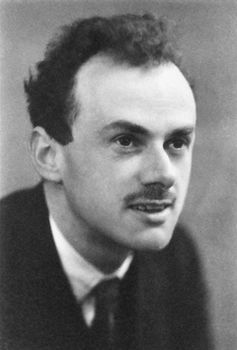
Born in Bristol, England, in 1902, Dirac became, after Einstein, the second most important theoretical physicist of the 20th century. He studied at Cambridge, where he wrote the first-ever dissertation on quantum mechanics. Shortly thereafter he produced one of physics’ most famous theories, the Dirac equation, which correctly predicted the existence of antimatter. Dirac did more than any other scientist to reconcile Einstein’s general theory of relativity to quantum mechanics. In 1933 he received the Nobel Prize in Physics, the youngest theoretical physicist ever to do so.
At the time Dirac received the Nobel Prize, he was leading a remarkably drab and, to most eyes,
Paul Dirac in 1933. Nobel Foundation via Wikimedia Commons
unappealing existence. As detailed in Graham Farmelo’s wonderful biography, The Strangest Man: The Hidden Life of Paul Dirac, Mystic of the Atom, on which I rely heavily in this article, Dirac was an incredibly taciturn individual. Getting him to utter even a word could prove nearly impossible, leading his mischievous colleagues to introduce a new unit of measure for the rate of human speech, the Dirac, which amounted to one word per hour.
Dirac was the kind of man who would “never utter a word when no word would do.” Farmelo describes him as a human being completely absorbed in his work, with absolutely no interest in other people or their feelings, and utterly devoid of empathy. He attributes this in part to Dirac’s tyrannical upbringing. His father ruthlessly punished him for every error in speech, and the young Dirac adopted the strategy of saying as little as possible.
Dirac was socially awkward and showed no interest in the opposite sex. Some of his colleagues suspected that he might be utterly devoid of such feelings. Once, Farmelo recounts, Dirac found himself on a two-week cruise from California to Japan with the eminent physicist Werner Heisenberg. The gregarious Heisenberg made the most of the trip’s opportunities for fraternization with the opposite sex, dancing with the flapper girls. Dirac found Heisenberg’s conduct perplexing, asking him, “Why do you dance?” Heisenberg replied, “When there are nice girls, it is always a pleasure to dance.” Dirac pondered this for some minutes before responding, “But Heisenberg, how do you know beforehand that the girls are nice?”
Love finds the professor
Then one day, something remarkable entered Dirac’s life. Her name was Margit Wigner, the sister of a Hungarian physicist and recently divorced mother of two. She was visiting her brother at the Institute for Advanced Study in Princeton, New Jersey, where Dirac had just arrived.
Known to friends and family as “Manci,” one day she was dining with her brother when she observed a frail, lost-looking young man walk into the restaurant. “Who is that?” she asked. “Why that is Paul Dirac, one of last year’s Nobel laureates,” replied her brother. To which she replied, “Why don’t you ask him to join us?”
Thus began an acquaintance that eventually transformed Dirac’s life. Writes Farmelo:
His personality could scarcely have contrasted more with hers: to the same extent that he was reticent, measured, objective, and cold, she was talkative, impulsive, subjective, and passionate.”
A self-described “scientific zero,” Manci embodied many things that were missing in Dirac’s life. After their first meeting, the two dined together occasionally, but Dirac, whose office was two doors down from Einstein, remained largely focused on his work.
After Manci returned to Europe, they maintained a lopsided correspondence. Manci wrote letters that ran to multiple pages every few days, to which Dirac responded with a few sentences every few weeks. But Manci was far more attuned than Dirac to a “universally acknowledged truth” best expressed by Jane Austen: “A single man in possession of a good fortune must be in want of a wife.”
She persisted despite stern warnings from Dirac:
I am afraid I cannot write such nice letters to you – perhaps because my feelings are so weak and my life is mainly concerned with facts and not feelings.
When she complained that many of her queries about his daily life and feelings were going unanswered, Dirac drew up a table, placing her questions in the left column, paired with his responses on the right. To her question, “Whom else should I love?” Dirac responded, “You should not expect me to answer this question. You would say I was cruel if I tried.” To her question, “Are there any feelings for me?” Dirac answered only, “Yes, some.”
Realizing that Dirac lacked the insight to see that many of her questions were rhetorical, she informed him that “most of them were not meant to be answered.” Eventually, exasperated by Dirac’s lack of feeling, Manci wrote to him that he should “get a second Nobel Prize in cruelty.” Dirac wrote back:
You should know that I am not in love with you. It would be wrong for me to pretend that I am, as I have never been in love I cannot understand fine feelings.
Yet with time, Dirac’s outlook began to change. After returning from a visit with her in Budapest, Dirac wrote, “I felt very sad leaving you and still feel that I miss you very much. I do not understand why this should be, as I do not usually miss people when I leave them.” The man whose mathematical brilliance had unlocked new truths about the fundamental nature of the universe was, through his relationship with Manci, discovering truths about human life that he had never before recognized.
Soon thereafter, when she returned for a visit, he asked her to marry him, and she accepted immediately. The couple went on two honeymoons little more than month apart. Later he wrote to her:
Manci, my darling, you are very dear to me. You have made a wonderful alteration in my life. You have made me human… I feel that life for me is worth living if I just make you happy and do nothing else.
A Soviet colleague of Dirac corroborated his friend’s self-assessment: “It is fun to see Dirac married, it makes him so much more human.”
In Dirac, a thoroughly theoretical existence acquired a surprisingly welcome practical dimension.
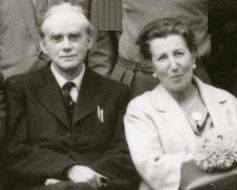
Paul and Manci in 1963. GFHund via Wikimedia Commons, CC BY
A man who had been thoroughly engrossed in the life of the mind discovered the life of the heart. And a human being whose greatest contributions had been guided by the pursuit of mathematical beauty discovered something beautiful in humanity whose existence he had never before suspected.
In short, a brilliant but lonely man found something new and wonderful that had been missing his entire life: love. As my students and I discover in the course on sexuality and love, science can reveal a great deal, but there are some aspects of reality – among them, love – that remain largely outside its ambit.
ooOOoo
Picking up on that last sentence, “there are some aspects of reality – among them, love – that remain largely outside its ambit.” all I can offer is to introduce dogs to the students!
I struggled for ages wondering how to close today’s post. In the end, decided on the following:
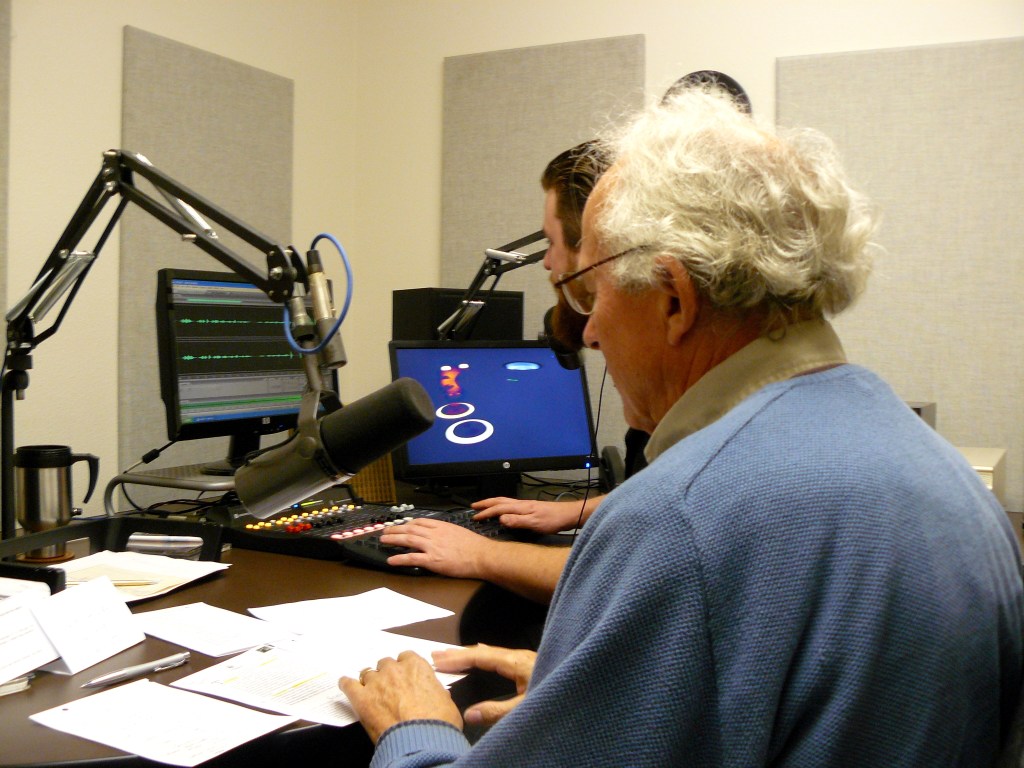
In exactly twenty-four hours from now, you will have the opportunity to listen to Kyle Dunlap of the radio station KAJO interviewing me about my book: Learning from Dogs.
The interview, that was pre-recorded on the 23rd November, is part of KAJO’s community broadcasts where they speak to local authors. As a newbie author, I was delighted and flattered to be asked to participate.
Anyway!
The broadcast is a little after 12:45 Pacific Standard Time on Tuesday, 8th December. If you are not in the USA, you can check the equivalent time easily at The World Clock website.
You will see the On Air button to click just to the right of the KAJO 1270am logo. Here is the “Click to Listen Live” button grabbed from the KAJO website at 3:20pm yesterday.
It will have Kyle Dunlap’s name on it when you “tune in” at 12:45 tomorrow.
If you do listen to the interview do leave a comment below – good or bad! 😉














 Learning from Dogs