Loving our wilderness is another vital loving relationship
I quite deliberately named today’s post so that it would extend the theme of loving relationships posted yesterday.
So the recent announcement from the White House, “White House announced President Obama signed proclamations Friday to protect almost 2 million acres of pristine lands.” is to be welcomed with open arms. The article published in The Press Enterprise explained that those millions of acres were in California.
The Castle Mountains, shown, will be declared a national monument in the Mojave Desert, along with Sand to Snow and Mojave Trails. KURT MILLER, STAFF PHOTOGRAPHER
President Barack Obama established three national monuments today, Feb. 12, that cover almost 2 million acres in the Mojave Desert, the White House announced.
Obama used his power under the Antiquities Act to sign a proclamation designating the Mojave Trails, Sand to Snow and Castle Mountains national monuments. The move bypasses similar legislation, introduced by Sen. Dianne Feinstein, D-Calif., that has languished for years in Congress.
Feinstein asked the president in August to use his executive power to create the monuments. She praised the action in a statement: “I’m full of pride and joy knowing that future generations will be able to explore these national monuments and that the land will remain as pristine and as it is today. To a city girl like me, this expanse of desert, with its ruggedness and unique beauty, is nothing short of awe-inspiring.”
While on the subject of California, there is more good news from the Canis lupus 101 blog.
ooOOoo
Wolves get a grudging welcome from Northern California ranchers
By Tim Holt February 11, 2016
Photo: Oregon Fish And Wildlife
Wolves such as OR 25, a 3-year-old male, have crossed the Oregon border, and Northern California ranchers are preparing to accommodate them.
We are going to have a viable population of wolves in the far northern reaches of California, and it will be with the grudging cooperation of our ranchers.
That was the takeaway from a public hearing held last month in Yreka (Siskiyou County), where the state’s Department of Fish and Wildlife invited public comment on its draft plan for accommodating our new four-footed residents, and where there were as many Stetsons in the audience as you’d see at a cowboy poetry convention.
Where are the wolves?
Yes, there was some foaming at the mouth, some evidence of the government-hating libertarianism this region is known for. “We don’t want people in Sacramento telling us how to live our lives,” grumbled one rancher.
But on the whole, there was a lot of thoughtful comment by those in attendance, and the beginnings of a dialogue between those who are charged with facilitating the wolves’ re-entry, and those who will be most affected by it. There was a focus on practical, down-to-earth matters — the threat to one’s livelihood when livestock are killed by predators, and the impracticality of maintaining 24-hour surveillance on sprawling ranch lands.
There was not much discussion of the nonlethal methods that can be used to ward off wolf depredations, although a number of speakers strongly urged that radio collars be put on wolves so ranchers can be warned if they’re getting near their cattle or sheep. That idea is already in the draft wolf management plan, as well as hazing techniques that include spotlights and air horns, as well as guard dogs and mobile electric fences.
Suzanne Asha Stone was on hand as the Rocky Mountain field representative for Defenders of Wildlife. After listening to some of the ranchers’ comments, she said, “This is verbatim what we heard in Idaho 20 years ago,” when wolves were introduced in Yellowstone National Park. Ranchers in that state were naturally concerned about the impact those wolves would have on their livelihoods. Two decades later, through programs Stone and her organization have helped implement, nonlethal strategies have reduced wolf kills of livestock in Idaho to “near zero,” she said. And that’s with a wolf population than now totals 770.
According to Stone, “It takes a while living with wolves before people realize that their worst fears won’t come true.”
I think most ranchers in California’s far north respect the wildlife around them, but their relationship with it is complicated by the need to make a living. Looking closely at the strategies used in Idaho would be a good first step in helping convince them that there are ways to reconcile ranching with the presence of this new predator.
John Wayne has long been a conservative icon, the personification of rugged individualism in the Wild West. In the 1963 movie “McLintock,” made late in his career, Wayne plays a cattle rancher and land baron. At one point he tells his daughter what he plans to do with his holdings after he dies: “I’m gonna leave most of it to the nation, really, for a park, where no lumber mill (can) cut down all the trees for houses with leaky roofs, nobody’ll kill all the beavers for hats for dudes, nor murder the buffalo for robes.”
John Wayne was no tree hugger. But neither, like the ranchers up here, should he be reduced to a simple stereotype.
ooOOoo
Back to Governments or is this case the U.S. Government and a little-known unit known as Wildlife Services. Another arm reaching out to love our wilderness? H’mmm. Not according to Wolves of Douglas County blog:
PUBLISHED FEBRUARY 12, 2016
Wildlife Services—ever heard of it? No, not the U.S. Fish and Wildlife Service. That’s something different. The Fish and Wildlife Service is part of the Department of the Interior, charged with enforcing wildlife laws, restoring habitat, and protecting fish, plants, and animals. Wildlife Services isn’t your state fish and game commission, either, which issues hunting and fishing licenses and manages local wildlife.
Wildlife Services is a federal agency under the U.S. Department of Agriculture, and it specializes in killing wild animals that threaten livestock—especially predators such as coyotes, wolves, and cougars. Outside the ranching community, Few have heard of Wildlife Services.
Since 2000, the agency has killed at least two million mammals and 15 million birds. Although it’s main focus is predator control in the West, Wildlife Services also does things like bird control nationwide at airports to prevent crashes and feral pig control in the South.
The challenges facing the European Union ripple out across the whole of the free world.
I note that this is the second Friday where there is an abrupt change from the run of posts during the previous few days. For last Friday I republished a George Monbiot article on Rigging the Market and today there is another Monbiot article that I want to share with you; shared with you with the kind permission of Mr. Monbiot.
Unlike last Friday’s Monbiot article that clearly had global implications, at first sight this article about the European Union has no relevance to those of us not living with EU boundaries. But that would be wrong. For the importance of protecting a country’s sovereignty and the democratic processes within that country is supreme across all democratically elected governments.
ooOOoo
The Lesser Evil
10th February 2016
I am starting to hate the European Union. But I will vote to stay in.
By George Monbiot, published in the Guardian, 10th February 2016
By instinct, like many on the left, I am a European. I recognise that many issues – perhaps most – can no longer be resolved only within our borders. Among them are grave threats to our welfare and our lives: climate change and the collapse of the living world; the spread of epidemics whose vectors are corporations (obesity, diabetes and diseases associated with smoking, alcohol and air pollution); the global wealth-grab by the very rich; antibiotic resistance; terrorism and conflict.
I recognise that the only legitimate corrective to transnational power is transnational democracy. So I want to believe; I want to belong. But it seems to me that all that is good about the European Union is being torn down, and all that is bad enhanced and amplified.
Nowhere is this clearer than in the draft agreement secured by David Cameron. For me, the most disturbing elements are those which have been widely described in the media as “uncontroversial”: the declarations on regulations and competitiveness. The draft decisions on these topics are a long series of euphemisms, but they amount to a further dismantling of the safeguards defending people, places and the living world.
What David Cameron described in parliament as “pettifogging bureaucracy” are the rules that prevent children from being poisoned by exhaust fumes, rivers from being turned into farm sewers and workers from being exploited by their bosses. What the European Commission calls reducing the “regulatory burden for EU business operators” often means increasing the costs the rest of us must carry: costs imposed on our pockets, our health and our quality of life. “Cutting red tape” is everywhere portrayed as a good thing. In reality, it often means releasing business from democracy.
There is nothing rational or proportionate about the deregulation the European Commission contemplates. When Edmund Stoiber, the conservative former president of Bavaria, reviewed European legislation, he discovered that the combined impact of all seven environmental directives incurred less than 1% of the cost to business caused by European law. But, prodded by governments like ours, the Commission threatens them anyway. It is still considering a merger and downgrading of the habitats and birds directives, which are all that impede the destruction of many of our precious places and rare species.
Alongside such specific threats, the European Union is engineering treaties that challenge the very principle of parliamentary control of corporations. As well as the transatlantic trade and investment partnership (TTIP), it has been quietly negotiating something even worse: a trade in services agreement (TISA). These claim to be trade treaties, but they are nothing of the kind. Their purpose is to place issues in which we have a valid and urgent interest beyond the reach of democratic politics. And the European Commission defends them against all comers.
Are such tendencies accidental, emergent properties of a highly complex system, or are they hardwired into the structure of the European Union? The more I see, the more it seems to me that the EU’s problems are intrinsic and systemic. The organisation that began as an industrial cartel still works at the behest of the forces best equipped to operate across borders: transnational corporations. The European Commission remains a lobbyists’ paradise: opaque, sometimes corruptible, almost unnavigable by those without vast resources.
So should those who seek a decent, protective politics vote to stay or vote to leave? If you wish to remain within the European Union because you imagine it is a progressive force, I believe you are mistaken. That time, if it ever existed, has passed. The EU is like democracy, diplomacy and old age. There is only one thing to be said for it: it is not as bad as the alternative.
If you are concerned about arbitrary power, and the ability of special interests to capture and co-opt the apparatus of the state, the UK is in an even worse position outside the European Union than it is within. Though the EU’s directives are compromised and under threat, they are a lot better than nothing. Without them we can kiss goodbye to the protection of our wildlife, our health, our conditions of employment and, one day perhaps, our fundamental rights. Without a formal constitution, with our antiquated voting arrangements and a corrupt and corrupting party funding system, nothing here is safe.
The government champs and rears against the European rules that constrain it. It was supposed to have ensured that all our rivers were in good ecological condition by the end of last year: instead, lobbied by Big Farmer and other polluting businesses, it has achieved a grand total of 17%. On behalf of the motor industry, it has sought to undermine new European limits on air pollution, after losing a case in the Supreme Court over its failure to implement existing laws. Ours is the least regulated labour market in Europe, and workers here would be in an even worse fix without the EU.
On behalf of party donors, old school chums, media proprietors and financial lobbyists, the government is stripping away any protections that European law has not nailed down. The EU’s enthusiasm for treaties like TTIP is exceeded only by David Cameron’s. His defence of national sovereignty, subsidiarity and democracy mysteriously evaporates as soon as they intrude upon corporate power.
I believe that we should remain within the union. But we should do so in the spirit of true scepticism: a refusal to believe anything until we have read the small print; a refusal to suspend our disbelief. Is it possible to be a pro-European Eurosceptic? I hope so, because that is what I am.
Two things come to mind by way of finishing today’s post.
The first is that quotation by Douglas Adams:
To give real service you must add something which cannot be bought or measured with money, and that is sincerity and integrity.
“.. sincerity and integrity.” As we see day after day in the behaviour of our dogs.
The second is Section 1 of ARTICLE 1 of The Constitution of The United States of America.
All legislative Powers herein granted shall be vested in a Congress of the United States, which shall consist of a Senate and House of Representatives.
For the last two days there has been a post running explaining the desparate need for donations to be sent to MaxMello, the Brazilian charity run by Sandra Guilarducci and her husband, Francisco, in Ibiuna, Brazil.
Earlier yesterday, John Zande in Brazil sent me an email:
Morning Paul. Sandra wrote to G this morning. Portuguese and English translation below.
ah querida Dionete…ando tão cansada, tão cansada… na segunda de carnaval lá estava eu num laboratório em Cotia com a minha cachorra Nicole, fazendo eletrocardiograma e hemograma. Não paramos nunca aqui. Tem tantos cães soltos no sítio em Piedade por falta de canis e isso gera um estresse que vc nem imagina, além de brigas. Dentro da minha casa, aqui em Ibiúna, vivem 62 cães, que não podem ficar lá fora porque senão os outros matam, aqui em IBiúna o espaço é super pequeno. Enfim…, sempre correndo com eles, sempre tem um ou outro com problemas de saúde, ainda tenho vários pra castrar e…não tem fim. Mas a sua ajuda tem sido importantíssima pra gente. Que Deus te abençõe sempre e sempre. Ficamos emocionados demais com essas publicações no exterior (graças a vc, claro !) e esperamos cheios de esperanças mesmo, que isso gere frutos em pról de toda essa galerinha que abrigamos. Que vc e seus amigos envolvidos nessa nossa luta sejam cobertos de prosperidade, saúde e bênçãos. Quando puder, vamos marcar de vir aqui, será um prazer imenso poder te abraçar e agradecer pessoalmente. Forte abraço, cheio de gratidão.
Ah dear Dionete …I am soooo tired… on Monday I had to take my dog Nicole to a clinic in Cotia for an ECG and blood test. We never stop around here. There are too many dogs in the property in Piedade – we don’t have kennels for all of them – and the amount of stress it generates is almost too much to bear. And the fights! Here in Ibiúna I have to keep 62 dogs inside my house; they can’t go outside otherwise they will be killed by the others. And they don’t have much room. Anyway… always running up and down for them, there’s always one or another who gets sick or needs treatment, many to still be neutered… it’s an endless task. But your help has been very important for us. May God bless you always and forever. We are thrilled to see these publications abroad (thanks to you, of course!) and do hope it generates the help these little creatures desperately need. May you and your friends involved in our struggle be covered with prosperity, health and blessings. Let’s try to set up a visit. It will be an immense pleasure to hug you and thank you personally. Big hugs full of gratitude
So all of you who have cared for Sandra and Francisco know that it counts.
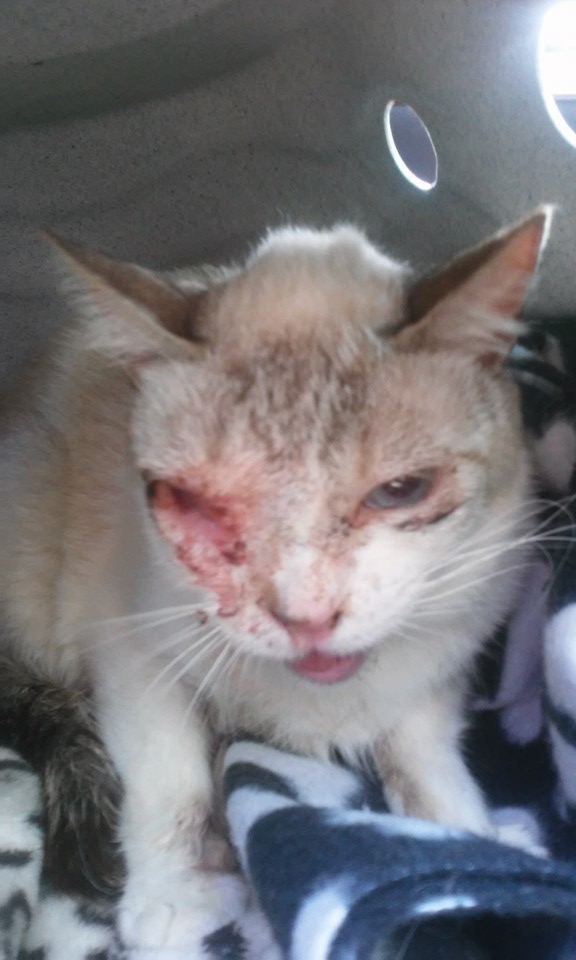
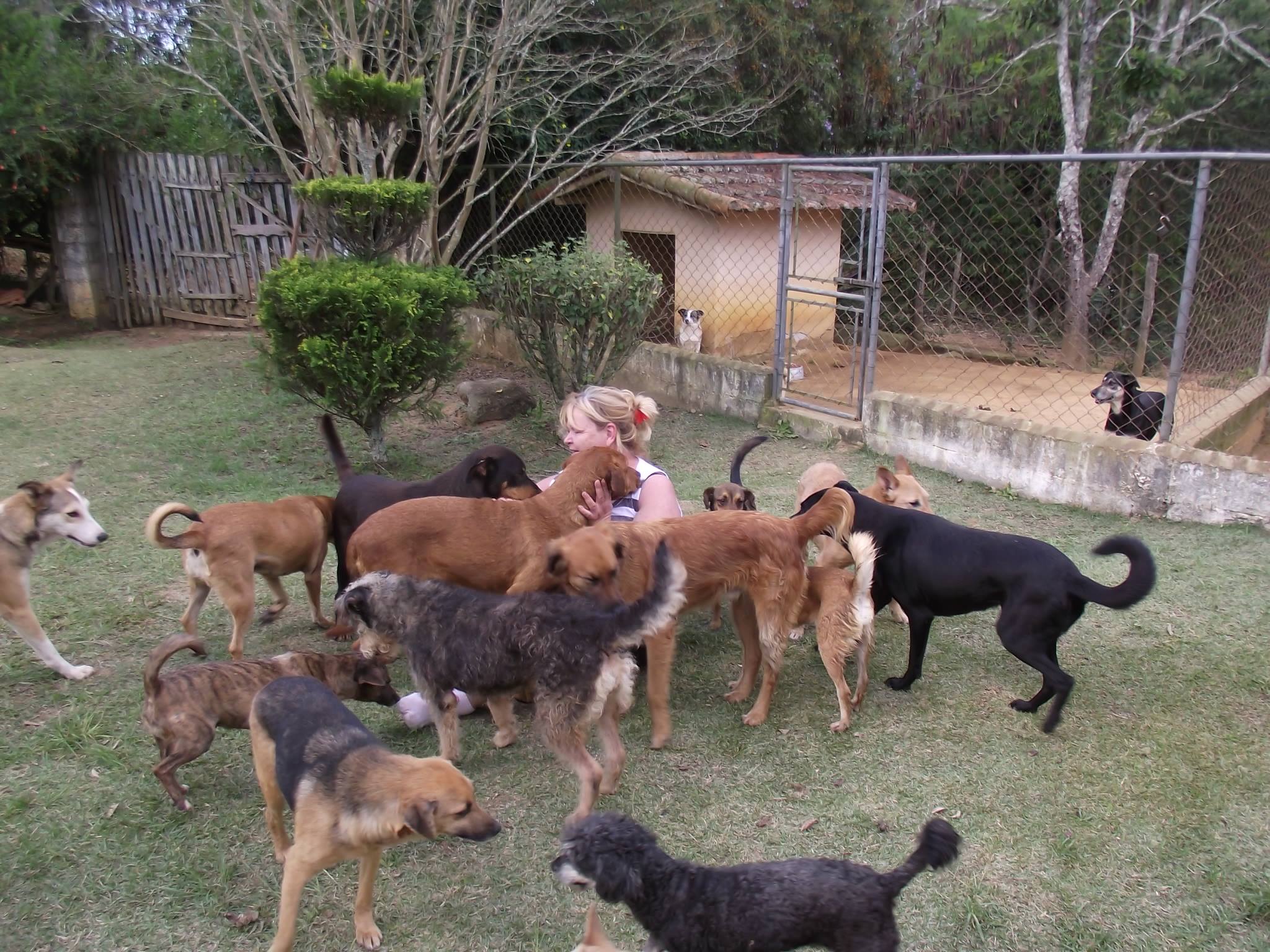
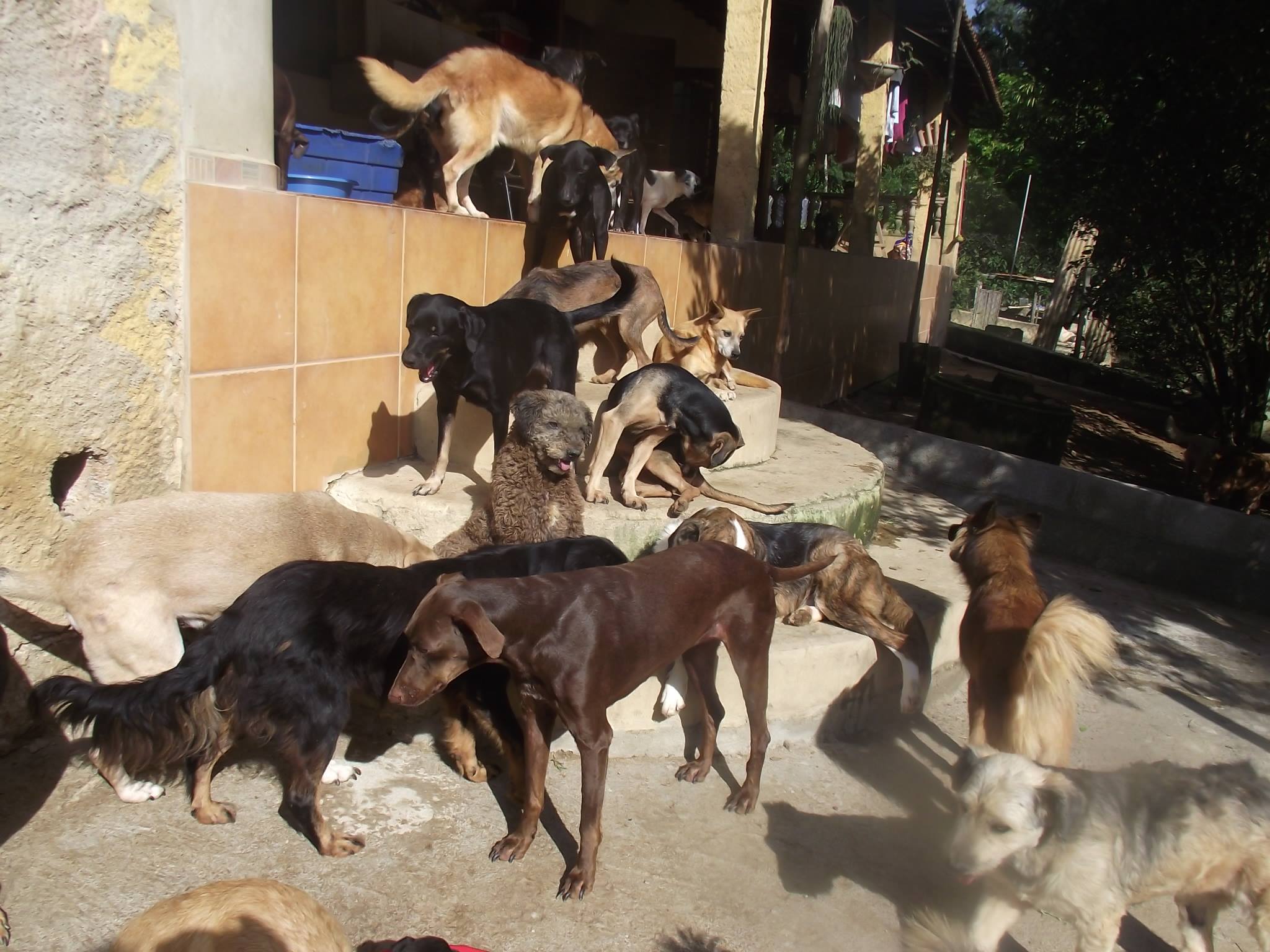
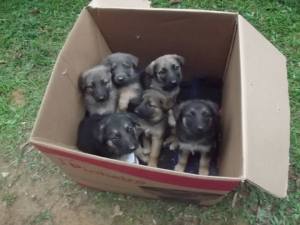
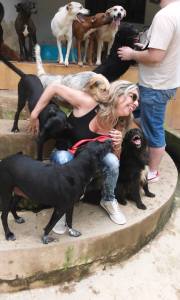
Do drop across to their Facebook page here, from where the following photographs have been taken.
oooo
oooo
oooo
oooo
oooo
oooo
So, once again, if you can see your way to help, by sharing this information or by making even the tiniest donation, then please do. The MaxMello PayPal account is: associacaomaxmello@gmail.com
Big hugs to every one of you out there!
Update: This is a translation of a recent comment left by Sandra on MaxMello’s Facebook page.
Friends, thanks to the generosity of you guys have raised almost 9 thousand Real. Our survival challenge continues, but we know that we are not alone in this fight. Our total debt is 36,450 Real and we need help to stamp her out. Any amount makes a big difference. As we have received many requests for the bank details, follow the possibilities:
Bradesco
Agência:1937-2
Current account: 16505-0
Social Security Number: 766.545.758-49
Sandra Maria Guilarducci
Caixa econômica federal
Agency: 0800
Arr. Operational: 003
Current account: 692-4
A Social Security Number: 16.729.925/0001-08
To those who are outside of Brazil, the transfer can be made via Paypal to the email associacaomaxmello@gmail.com
Very, very thank you all for the affection and solidarity.
This is a very simple message – please help MaxMello.
(Please note: To ensure the widest readership of this post I am running it for two days. I.e. the next post will be on Thursday, 11th.)
Yesterday I republished a post from John Zande. It explained how Sandra Guilarducci and her husband, Francisco, in Ibiuna, Brazil were caring for over 350 dogs and 32 cats. If you haven’t read that post then go no further in today’s post until you have read about the desparate need for funds.
Here’s a section from yesterday’s post (but please do read it in full):
Today, MaxMello burns through 5 tonnes of food every month, and a small army of vets help with reduced fees. But it all adds up. It has added up, and over this past weekend, Sandra was forced to admit that she and Francisco (weighed down with over 30,000 reis debt, about $10,000 US, to vets and pet food suppliers) had reached the point beyond which they simply could no longer afford to keep the shelter open. Sandra put out an urgent call to other NGO’s, saying she will keep the sick, the crippled, and the old (the one’s that stand little to no chance of adoption) but new shelter-homes would have to be found for the hundreds of other rescues under their care. With every NGO we know of here in Sao Paulo being already full, this is, in all honesty, an impossible situation. These are good people, and they (and their keep) are in genuine need of a hand.
Please, help keep MaxMello open and donate to the MaxMello PayPal account: associacaomaxmello@gmail.com.
But just as important as making whatever donation you can is letting Sandra and Francisco know you care.
Yesterday, Jean and I sent a letter to John for John’s wife to translate from English into Portugese as Sandra and Francisco do not speak English. We wanted them to read our letter in this post.
So this is the letter in Portugese:
Sandra e Francisco,
Aqui no sul do Oregon, hoje temos 9 cachorros e 4 gatos; há três anos, quando viemos para cá, eram 14 cães e 7 gatos. Eu simplesmente não consigo imaginar o que deve ser cuidar de 350 cachorros e 32 gatos, ainda mais divididos entre duas propriedades diferentes, separadas por 200 km!
Entretanto, Jean sabe bem o tamanho do amor e da dedicação que movem sua paixão por esses animais maravilhosos – porque ela vivia em San Carlos, no México (na Península Baja) e dedicava a vida a recolher os cachorros de rua de lá, tratando de sua saúde, dando-lhes amor e conseguindo adotantes para eles nos EUA. Ao longo de vários anos, Jean acredita ter resgatado mais de 200 cães. A alimentação e tratamento de todos esses animais foram custeados por ela e o marido, Ben, que morreu em 2005.
Foi meio por acaso que a conheci, em San Carlos, no Natal de 2007, e me via com os olhos cheios de lágrimas ao ver a afeição que os cachorros dela demonstravam ao me ver, toda vez que ia visitá-la em sua casa. E essa afeição deve ter causado um efeito profundo em mim, pois, quando voltei para a Inglaterra, em janeiro de 2008, Jean e eu percebemos que queríamos ficar juntos para o resto da vida. Mais tarde, nesse mesmo ano, ao lado do meu pastor alemão, Pharaoh, voltei para San Carlos. Não demorou muito, com 14 cachorros e 7 gatos, fomos para o Arizona, onde nos casamos, e por fim, no segundo semestre de 2012, viemos para o Oregon, onde estamos até hoje.
Pouco antes de sairmos de San Carlos, em 2010, uma cachorra foi deixada na porta de nossa casa. Era uma mestiça de rottweiler e devia ter acabado de dar cria porque ainda estava cheia de leite. Nós a batizamos de Hazel e quase de cara ela mostrou sua natureza amorosa para Jean, para mim e os outros animais. Hazel é uma inspiração para a humanidade graças ao perdão e ao amor incondicional que oferece ao mundo.
Por isso, aceite essas poucas palavras minhas e de Jean, endereçadas aos dois, como uma pequena amostra de amor e gratidão que sentimos por vocês e que certamente também serão sentidos pelos leitores e seguidores do Learning from Dogs
And here is the letter in English:
Sandra and Francisco,
Here in Southern Oregon we have 9 dogs and 4 cats, down from the 14 dogs and 7 cats when we moved here some 3 years ago. I cannot simply imagine what it must entail to care for 350 dogs and 32 cats let alone care for them in two locations seperated by 200 kms!
However Jean can imagine the level of love and commitment that fuels your passion for looking after these wonderful animals. For Jean, when she lived in San Carlos, Mexico (on the Baja Peninsula) devoted her life to rescuing Mexican street dogs, loving them back to health and then finding homes for them in the USA. Over the many years Jean believes she found homes for well over 200 dogs. The feeding and caring of these animals was funded personally by Jean and her late husband, Ben, who died in 2005.
Quite by chance, I met Jean in San Carlos the Christmas of 2007 and was moved to tears on numerous occasions by the loving affection shown by her dogs to this visitor to Jean’s home. That affection must have rubbed off on me for by the time I returned to England in January, 2008 Jean and I wanted to be together for the rest of our lives. Later in 2008, together with my German Shepherd, Pharaoh, I travelled out to San Carlos. Subsequently, with 14 dogs and 7 cats, we moved to Arizona to be married and then, in the Autumn of 2012, came up here to our home in Oregon.
Shortly before we left San Carlos in 2010 to go to Arizona, a female dog was dumped outside the house. She was a Rottweiler crossbreed and must have just given birth to puppies for she was still in milk. We named her Hazel and she very quickly showed her most beautiful and loving nature to Jean and me and to the other animals. Hazel is an inspiration to humankind of what flows from offering forgiveness and unconditional love to the world.
So please take these few words from Jean and me, sent to you both, as a small measure of the love and gratitude that we feel for you, and I know will be felt by many of the readers and followers of Learning from Dogs.
I also want to republish a comment from yesterday’s post, left by Mr. Merveilleux, because it speaks such perfect common-sense:
As Zande’s explained, the current exchange rate means donations go a very long way. Keep in mind the minimum wage in Brazil is only around £130 p/month. By skipping one little luxury this month, like going out for a meal today, and sending what one would have spent on that to the shelter, we can all make make a substantial difference to the lives of these animals.
My suggestion is for people not to just reach for the change they’ve got in the car ashtray, but consider a little, insignificant sacrifice that will do one no harm, but will have a disproportionately positive effect.
Skip one bottle of champagne, or a bottle of wine, or don’t buy flowers this week… skip any little thing that one doesn’t really *need*, and put that money to good use.
Let me move on a tad.
As is obvious to any visitors to this place in the last 6 weeks, I have just published my first book. It is called Learning from Dogs, the same name as this blog. I am also donating 50% of the net proceeds from all sales of my book to our local Rogue Valley Humane Society.
However, for the whole of the month of February I shall be donating the other 50% of net proceeds to MaxMello.
So, please, buy the book and help two fabulous charities. The book is available as a paperback, priced $15.95, or either of two eBook formats, MOBI and EPUB, priced at $5:39. Full details here: Buy the Book.
Of course, you may also buy the book from Amazon or you can order it from most booksellers.
If you prefer to purchase it direct from me but do not wish to pay online, then mail me (as in Paul Handover) a cheque for $18.67 ($15.95 + P&P of $2.72) and I will send it to any part of the USA. (For overseas paperback purchasers who do not wish to pay online then email me your address details and I will respond within 48 hours.) My email address is learningfromdogs (at) gmail (dot) com
All of this is part of never forgetting how important it is to care for our dogs – they are man’s oldest companion and have devoted themselves to caring for us for possibly 40,000 years. Is it asking too much to help these dogs in Brazil in return!
Hazel showing her love and caring for our cat, George. Both animals are ex rescues from Mexico. Picture taken last Sunday evening.
A wonderful story of the love for dogs and cats shown by two people in Brazil.
As is the way in this world of blogging, a few months ago I connected with John Zande. He is an Australian living in Brazil and blogs under the name of The Superstitious Naked Ape. John is also the author of the book The Owner of All Infernal Names, which I reviewed last October (and greatly enjoyed!).
All the proceeds from the sale of John’s book go towards animal rescue and shelter in Brazil and that offers a strong clue to the purpose of today’s post.
So with that in mind, please read the following post published by John on February 3rd and republished here with John’s permission. (And please make a note to return tomorrow and read the sequel that will explain how you and I can make a positive difference.)
ooOOoo
The MaxMello Association for the Support of Animal Life needs an urgent hand
“You can judge a man’s true character by the way he treats his fellow animals.”
― Paul McCartney
Twelve years ago, Sandra Guilarducci and her husband, Francisco, started the NGO Associação MaxMello de Amparo à Vida Animal (MaxMello Association for the Support of Animal Life) in Ibiuna (a small city in Sao Paulo state, Brazil), to rescue, treat, house, and place stray and abandoned dogs in loving homes. Animal dumping is a tremendous problem in Brazil, and MaxMello today is home to over 350 dogs and 32 cats sheltered in two properties’s separated by 200 kilometres; a drive Sandra undertakes every single day. Sandra and Francisco never once imagined taking care of so many, but over the years their shelter has become a convenient dumping ground with boxes of puppies simply left on the road, together with the old, the sick, and the unwanted. These are not people who can say, “No,” so every four-legged case left on the road, or rescued by Sandra and Francisco in and around Ibiuna, gets a home and all medical assistance they require.
Today, MaxMello burns through 5 tonnes of food every month, and a small army of vets help with reduced fees. But it all adds up. It has added up, and over this past weekend, Sandra was forced to admit that she and Francisco (weighed down with over 30,000 reis debt, about $10,000 US, to vets and pet food suppliers) had reached the point beyond which they simply could no longer afford to keep the shelter open. Sandra put out an urgent call to other NGO’s, saying she will keep the sick, the crippled, and the old (the one’s that stand little to no chance of adoption) but new shelter-homes would have to be found for the hundreds of other rescues under their care. With every NGO we know of here in Sao Paulo being already full, this is, in all honesty, an impossible situation. These are good people, and they (and their keep) are in genuine need of a hand.
Please, help keep MaxMello open and donate to the MaxMello PayPal account: associacaomaxmello@gmail.com. This urgent and immediate appeal has so far raised R$4,500 since the weekend, which is truly fantastic, but we are still a long, long way from giving Sandra and Francisco the breathing room they need to keep this shelter open.
Below is a MaxMello video (in English), with other videos on their You Tube page, including news reports produced by the TV stations, Record and SBT. This link, Associação MaxMello de Amparo à Vida Animal, will take you to their Facebook page, and for anyone interested, you can review their current debts there. Please take 30 minutes to scroll through the Facebook photos and watch the videos, and you will see the selfless work Sandra and Francisco do. Any help anyone can provide would be enormously, enormously, appreciated.
Donations, again, can be made via PayPal, at: associacaomaxmello@gmail.com
ooOOoo
As I wrote in my introduction, please come back and read the sequel post tomorrow.
Nothing at all to do with dogs, or with integrity if it comes to that!
Regular followers of this place know that I am a tremendous fan of George Monbiot, the Englishman who so regularly exposes stuff that needs to be aired and discussed. As his About page explains:
Here are some of the things I love: my family and friends, salt marshes, arguments, chalk streams, Russian literature, kayaking among dolphins, diversity of all kinds, rockpools, heritage apples, woods, fishing, swimming in the sea, gazpacho, ponds and ditches, growing vegetables, insects, pruning, forgotten corners, fossils, goldfinches, etymology, Bill Hicks, ruins, Shakespeare, landscape history, palaeoecology, Gavin and Stacey and Father Ted.
Here are some of the things I try to fight: undemocratic power, corruption, deception of the public, environmental destruction, injustice, inequality and the misallocation of resources, waste, denial, the libertarianism which grants freedom to the powerful at the expense of the powerless, undisclosed interests, complacency.
Here is what I fear: other people’s cowardice.
I still see my life as a slightly unhinged adventure whose perpetuation is something of a mystery. I have no idea where it will take me, and no ambitions other than to keep doing what I do. So far it’s been gripping.
Way back in the early days of Learning from Dogs, the blog that is, not the book, George was very gracious in giving me blanket permission to republish his posts, and many of them have appeared in this place.
So now read George Monbiot’s latest Rigging the Market. It is yet another example of what is going wrong in these times.
ooOOoo
Rigging the Market
3rd February 2016
Oil, the industry that threatens us with destruction, is being bailed out with public money
By George Monbiot, published in the Guardian 3rd February 2016
Those of us who predicted, during the first years of this century, an imminent peak in global oil supplies could not have been more wrong. People like the energy consultant Daniel Yergin, with whom I disputed the topic, appear to have been right: growth, he said, would continue for many years, unless governments intervened.
Oil appeared to peak in the United States in 1970, after which production fell for 40 years. That, we assumed, was the end of the story. But through fracking and horizontal drilling, production last year returned to the level it reached in 1969. Twelve years ago, the Texas oil tycoon T. Boone Pickens announced that “never again will we pump more than 82 million barrels”. By the end of 2015, daily world production reached 97 million.
Instead of a collapse in the supply of oil, we confront the opposite crisis: we’re drowning in the stuff. The reasons for the price crash – an astonishing slide from $115 a barrel to $30 over the past 20 months – are complex: among them are weaker demand in China and a strong dollar. But an analysis by the World Bank finds that changes in supply have been a much greater factor than changes in demand. Oil production has almost doubled in Iraq, as well as in the US. Saudi Arabia has opened its taps, to try to destroy the competition and sustain its market share: a strategy that some peak oil advocates once argued was impossible.
The outcomes are mixed. Cheaper oil means that more will be burnt, accelerating climate breakdown. But it also means less investment in future production. Already, $380 billion that was to have been ploughed into oil and gas fields has been held back. The first places to be spared are those in which extraction is most difficult or hazardous. Fragile ecosystems in the Arctic, in rainforests, in remote and stormy seas, have been granted a stay of execution.
BP reported a massive loss on Tuesday, partly because of low prices. A falling oil price drags down the price of gas, exposing coal mining companies to the risk of bankruptcy: good riddance to them. But some renewables firms are being tanked by the same forces: just as natural gas prices plunge, governments like the UK’s are stripping them of their subsidies. One day they will compete unaided, but not yet.
To cheer or lament these vicissitudes is pointless. They are chance events that counteract each other, and will at some point be reversed. The oil age, that threatens the conditions sustaining life on Earth, will come to an end through political, not economic, change. But the politics, for now, are against us.
Already, according to the IMF, more money is spent, directly and indirectly, on subsidising fossil fuels than on funding health services. The G20 countries alone spend over three times as much public money on oil, gas and coal than the whole world does on renewable energy. In 2014, subsidies for fossil fuel production in the UK reached £5 billion. Enough? Oh no. While essential public services are being massacred through want of funds, last year the government announced a further £1.3 billion in tax breaks for oil companies in the North Sea. Much of this money went to companies based overseas. They must think we’re mad.
Last week, David Cameron flew to Aberdeen, where he announced another £250 million of funding for, er, free enterprise, much (though not all) of which will be used to prop up oil and gas. A further £20 million of public money will be spent on seismic testing. Expect more whale strandings, and ask yourself why the industry that threatens our prosperity shouldn’t cover its own bloody costs.
The energy secretary, Amber Rudd, says she stands “100% behind” this “fantastic industry”. She will “build a bridge to the future for UK oil and gas”. Had she been born 300 years ago, I expect she would have said the same about the slave trade. In a few years’ time, her observations will look about as pertinent and about as ethical.
Oil companies have already been granted “ministerial buddies” to “improve access to government” – as if they didn’t have enough already. Now they get an “oil and gas ambassador”, and a new ministerial group, to “reiterate the UK Government’s commitment to supporting the oil and gas industry”. A leaked letter shows that Amber Rudd and other ministers want to silence local people, by transferring the power to decide whether fracking happens from elected councils to an unelected commission. Let’s sack the electorate and appoint a new one.
Compare all this to the government’s treatment of renewables. Local people have been given special new powers to stop onshore windfarms from being built. To the renewables companies Amber Rudd says this, “We need to work towards a market where success is driven by your ability to compete in a market, not by your ability to lobby government”. Strangely, the same rules do not apply to the oil companies. Your friends get protection. The free market is reserved for enemies.
Yes, I do mean enemies. An energy transition threatens the kind of people who attend the Conservative party’s fundraising balls. It corrodes the income of old school friends and weekend guests. For all the talk of enterprise, old money still nurtures its lively hatred of new money, and those who control the public purse use it to protect the incumbents from the parvenus. As they did for the bankers, our political leaders ensure that everyone must pay the costs imposed by the fossil fuel companies – except the fossil fuel companies.
So they lock us into the 20th Century, into industrial decline and air pollution, stranded assets and – through climate change – systemic collapse. Governments of this country cannot resist the future forever. Eventually they will succumb to the inexorable logic, and recognise that most of the vast accretions of fossil plant life in the Earth’s crust must be left where they are. And those massive expenditures of public money will prove to be worthless.
Crises expose corruption: that is one of the basic lessons of politics. The oil price crisis finds politicians with their free-market trousers round their ankles. When your friends are in trouble, the rigours imposed religiously upon the poor and public services suddenly turn out to be negotiable. Throw money at them, trash their competitors, rig the outcome: those who deserve the least receive the most.
I don’t know about you but I take the view that this essay from Monbiot is to be embraced. Simply because the more that stuff like this is aired, discussed and shared then the more likely that we ordinary folk can make a social and a political difference.
I’m seventy-one years old and aware that the ageing process is “alive and well” within me. It primarily is revealed by a degree of brain atrophy that is evidenced by very poor recall. There is no question that it worries Jean and, at times, worries me as well. Adding to the recognition that these are my “senior” years is the awareness that the people that one knows all tend to be a similar sort of age and, inevitably, you don’t have to go far to hear of someone who is very ill, or has recently died.
So the motivation is very strong to stay as fit and healthy; both in body and mind.
Thus a recent article over on the Care2 site about the world’s oldest dog seemed more than a tad relevant to yours truly and will hopefully connect with others who know they are never going to see twenty-one again!
It’s often said that happiness is the key to a long life, but is the same true in the lives of dogs?
Let’s take a look at the world’s oldest living dog. His name was Bluey and he lived to be an astounding 29 1/2 years old. As a puppy in 1910, Bluey joined the household of Les Hall in Victoria, Australia.
Every morning, Bluey went to work among the cattle and sheep. He enjoyed the great outdoors and had constant companionship. He ate a diet that largely consisted of wild kangaroo and emu (not unhealthy animals raised in factory farms). Retiring from his official ‘job’ several years before his death, Bluey remained valued and respected even though he was no longer “useful.”
Ask Yourself These Three Questions
So what about your dog? Are you providing the essential building blocks for a long life? It all boils down to these three questions. Answer honestly, and if you don’t like what you find, today may be the day to turn over a new “leash.”
1. Am I Listening to My Dog?
No, your dog can’t speak in full sentences but how hard is it to understand his needs? Chances are, it’s pretty easy. Is your dog full of anxiety because you’ve worked a 10 hour day leaving him alone in the house, or worse yet, locked in a cage? When your dog greets you with excitement at the door, do you take the time to grab the leash and go for a long walk or do you scold him for bothering you? Is your dog getting up very, very slowly from painful joints?
Try listening, really listening, to the things your dog is telling you over and over again. Try this exercise. Think of two memories of times when your dog was happiest. Chances are that you were being active outdoors together. Could you re-create those experiences, even on a small scale, each week?
2. Do I Break My Promises?
Are you guilty of breaking promises to yourself and to your dog? Do you procrastinate? Make a dedicated practice of fulfilling your promises to your dog, the same way as you would care for your own needs. It’s just like brushing your teeth. Schedule in items like these:
A 20 minute walk in the morning before you leave for work.
A neighbor to come and let your dog outside at lunchtime.
Adhering to a schedule of six month veterinary check-ups, especially for mature dogs.
Washing food and water bowls daily.
A long walk at the end of the day.
And most of all, doing those things you know your dog loves most.
3. Am I Putting My Stress Onto My Dog?
If you’ve had a bad day, do you let it spill over? Can you check your troubles at the front door or do you bring them with you and spread your grief? Although it is difficult, take a few deep breaths and remind yourself that your truest friend in the world is not the one you want to hurt today.
ooOOoo
This business of learning from our dogs just goes on and on!
Ice caves are temporary structures that appear at the edge of glaciers. They look amazingly beautiful from the inside. This particular cave is located on the frozen lagoon of the Svínafellsjökull glacier in Skaftafell, Iceland. The centuries old ice coming down the slopes of Öræfajökull via Svínafellsjökull glacier has metamorphosed into highly pressurized glacier ice that contains almost no air bubbles. The lack of air means that it absorbs almost all visible light, apart from the blue fraction which is then visible to the naked eye. However, this blue ice can be seen only under certain circumstances. It can be seen in winter after long periods of rain when the surface layer of the glacier has been washed away. It can be seen in ice-caves like this one and on floating icebergs that have recently rolled over.
This cave in the glacier ice is the result of glacial mill, or Moulin where rain and melt water on the glacier surface are channeled into streams that enter the glacier at crevices. The waterfall melts a hole into the glacier while the ponded water drains towards lower elevations by forming long ice caves with an outlet at the terminus of the glacier. The fine grained sediments in the water along with wind blown sediments cause the frozen meltwater stream to appear in a muddy colour while the top of the cave exhibits the deep blue colour. Due to the fast movement of the glacier of about 1 m per day over uneven terrain, this ice cave cracked up at its end into a deep vertical crevice, called cerrac. This causes the indirect daylight to enter the ice cave from both ends resulting in homogeneous lighting of the ice tunnel.
There are many beautiful photographs available if you conduct a web search. Here are some examples.
We crawl slowly on hands & knees into a long frozen chamber, under a brilliant cathedral of crystal blue waves. Superman would feel right at home in this ice cave.
When the Man of Steel wants to get away from the hustle & bustle of Metropolis, he flies to his “Fortress of Solitude” hidden in the Arctic. A magnificent crystal castle built using Krypton alien technology.
What if I told you Superman’s crystal fortress is real?
Deep under Iceland’s massive Vatnajökull Glacier, beautiful caves of ice are formed by rivers of meltwater.
Too dangerous to visit in the spring & summer due to a threat of collapse, cold winter temperatures strengthen the ice and make exploration possible.
A fellow photographer convinced me to go during my Iceland road trip.
So many who devote so much time and energy, and money no doubt!
Let me state quite clearly my position with regard to hunting wild animals – I abhor it! Technically speaking if someone’s only means of feeding themselves, as in staying alive, is through hunting then I guess that is acceptable. But hunting for any other purposes is beyond the pale. I know that many people, including friends, who live in this part of America would heartedly disagree with my position on hunting. So be it.
Thus when Jean and I look at those who work so hard to protect, sustain and support wild animals we are almost speachless with our admiration for them.
So what’s brought all this on today?
For a long time I have been a follower of the blogsite Canis Lupus 101. On the home page of Canis Lupus 101, on the left-hand sidebar, one can read a plea from Maggie Caldwell, Press Secretary for @Earthjustice, that, in part, says:
For centuries, wolves have been viewed with suspicion and hostility, based in humankind’s deep-rooted fear of the unknown and need to control the natural world.
The film offers an abbreviated history of the relationship between wolves and people—told from the wolf’s perspective—from a time when they coexisted to an era in which people began to fear and exterminate the wolves.
The return of wolves to the northern Rocky Mountains has been called one of America’s greatest conservation stories. But wolves are facing new attacks by members of Congress who are gunning to remove Endangered Species Act protections before the species has recovered.
Our millions of magnificient and adorable dogs owe their place in today’s world to the wolf. The fact that those who care are still fighting hard to save the wild wolf shows how disgraceful it is for those that see no harm in hunting wolves. Hunting a wolf in my book is hardly any different than going out and hunting a dog!
So with all that out of me, now read about the following glorious efforts to save the wild Mexican wolf. Originally published over on Canis Lupus 101.
ooOOoo
Thursday, January 28, 2016
Poaching slows Mexican wolf population recovery (video)
Brandon Loomis, The Republic | January 27, 2016
The annual Mexican gray wolf population survey in Alpine, Ariz., shows that poaching is slowing the species’ recovery.
After the wild Mexican wolf population tops 100 for the first time, 15 illegal shootings may slow recovery.
(Photo: Mark Henle, Mark Henle/The Republic)
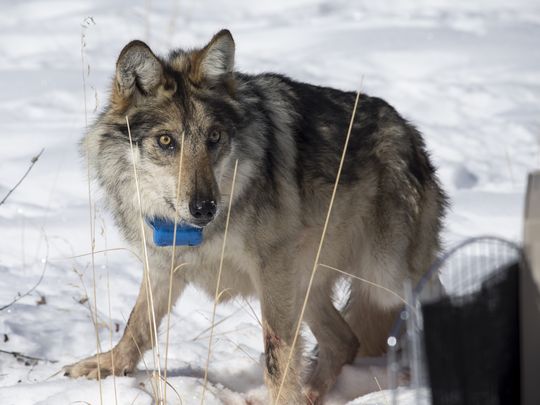
ALPINE — Biologists hauled a 60-pound Mexican gray wolf from the chopper on Monday, limp but healthy with a lush winter mane. They called it the wolf’s worst day in months — dazed from having been darted from above, still rapidly licking his nose through a blindfold muzzle — but the male wolf was one of the fortunate among a divisive and still-embattled breed that has weathered an especially perilousyear of poachings.
Unknown shooters have illegally killed at least 15 Mexican wolves since officials reported a year ago that a record 110 were roaming wild in eastern Arizona and western New Mexico, according to a lead state biologist on the recovery program.
The poaching losses tripled from 2014, and were likely unprecedented in the 18 years since the first captive-bred lobos brought their once-exiled howls back to the Blue Range spanning the Apache and Gila national forests.
Wolf-recovery specialists, like those in Alpine this week, are working to make sure the survivors flourish instead of backsliding to a more critically endangered status.
The team of federal and state biologists carried Wolf No. M1342 on a mesh sling. They brought the wolf inside their pine-ringed Alpine field station and slid him onto a slab wooden table for a checkup and shots to keep him robust for an important breeding season this spring. They injected a second sedative that would put the wolf out cold for about an hour.
The scientists gathered round the Elk Horn pack’s would-be alpha male, prodding veins for intravenous fluids and pushing an oxygen tube up his black nostrils.They were counting on the wolf to return healthy to his young mate on snowy Escudilla Mountain, and produce their first successful litter to help extend recent annual gains in a slow-recovering population.
AZCENTRAL
As recently as five years ago, there were an estimated 50 Mexican wolves in the wild, less than half of last year’s count. Whether this year’s survey finds the population continuing to grow will depend on the 40 or so pups observed since last spring. Historically, about half of pups have survived their first year.
Besides the wolves that were shot, about a dozen more adults are missing, “fate unknown.”
M1342 was lucky to have a dart dangling from his paw, and not a trail of lead fragments through his chest. Shootings have always been a key threat since the 1998 reintroduction.
The anti-wolf mentality commonly known as “shoot, shovel and shut up” is hard to combat. Bullets typically pass through a wolf’s body and leave little useful evidence, said Jeff Dolphin, Mexican wolf field supervisor for the Arizona Game and Fish Department. “You just can’t be everywhere at once,” Dolphin said.
Only a handful of what may be dozens of shooters have faced charges related to killing one of the protected wolves since 1998. Federal, state and non-governmental organizations offer a combined reward of up to $58,000 for information leading to the arrest and conviction of a wolf poacher.
A controversial task
Susan Dicks, a U.S. Fish and Wildlife veterinarian examines Wolf No. M1342. (Photo: Mark Henle/The Republic)
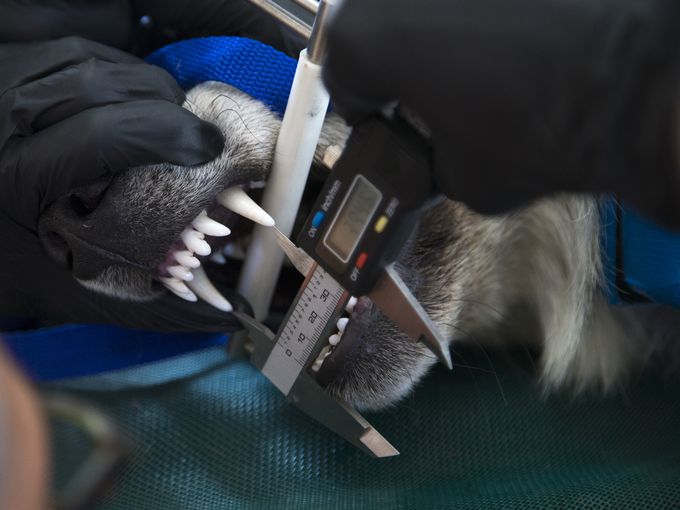
U.S. Fish and Wildlife Service veterinarian Susan Dicks coached the team of biologists and field technicians tending to M1342: how to draw blood for DNA and other tests; where to inject a rabies vaccine; how to determine age by measuring teeth; how to increase fluids or pour cooling alcohol on the paws if his temperature rises past 103 or so.
Besides the preventive medicine and data collection, the prime objective for M1342’s capture during a yearly aerial wolf survey was to fit it with a new transmitter collar. The collar he had received in a similar operation last year hadn’t functioned, so biologists only knew the wolf’s whereabouts by occasional observation. Uncollared wolves are difficult to track to ensure they’re not getting into trouble, such as by attacking livestock.
Not every wild Mexican wolf is collared, but scientists like to have them on a wolf of every generation in a pack. Last year’s survey counted 19 packs, including eight known to have a breeding pair.
AZCENTRAL
Studies show that these free-ranging wolves eat elk upward of 80 percent of the time, but cows are also occasionally on the menu. A government and non-profit fund pays for the losses. So far, the wolf program has paid out $68,000 for 50 confirmed livestock losses in 2015, and another $25,000 in claims is awaiting action by a compensation council. “It’s such a controversial program, and (people) want us to manage these animals,” Dicks explained. “The way we manage is with that collar. It communicates and tells us what they’re doing.”
The latest in a string of political struggles over the lightweight cousin of more plentiful northern gray wolves involves where they should be allowed.
Wolf advocates say they need unoccupied territory such as the forests around the Grand Canyon to sustain a population large and dispersed enough to withstand sudden die-offs. The governors of Arizona, New Mexico, Colorado and Utah recentlyco-signed a letter to the federal program opposing such a northern expansion into previously undocumented wolf territory and instead backing a push south into Mexico.
The number of wolves needed to ensure long-term survival also is in dispute. Some want to hold the line around today’s numbers, but others say at least a sevenfold increase is needed.
Mexican wolf biologist Julia Smith carries Wolf No. M1342 from the helicopter to the Alpine field station. He was darted from a helicopter to have his radio collar replaced.
Federal recovery effort
Mark Henle/The Republic Arizona is a partner in the federal recovery effort within a recovery zone that stretches from New Mexico and onto the Mogollon Rim. Officials say the state has spent $3 million since the recovery program began with captive animals in the 1980s.
This week, the team said one wolf had roamed west to within 35 miles of Payson, though it was unclear whether it was wandering alone. Others were prowling below the Rim, south of Alpine.
M1342’s gray-brown fur was thick, with no signs of mange or fleas, but Dicks squeezed an anti-parasite lotion onto the skin between the shoulders as an extra precaution. The team slid the wolf into a large dog crate and set the wolf outside to recover his senses for a truck ride back up the mountain to freedom. “We’re trying to help them out before breeding season,” Dicks said. “The population is so small.”
The subspecies had dropped to seven holdouts in Mexico during the late 20th century, survivors of private and government hunters who cleared the region of what had commonly been considered a menace. They were removed from the wild and stocked a captive breeding program that at last count fostered more than 250 wolves at 55 sites in the U.S. and Mexico.
AZCENTRAL
A few years ago, the population struggled to stay atop 50 from one year to the next, hindered not just by illegal shootings or natural causes, but by government agents shooting or removing to captivity wolves that attacked livestock. Since then, the program has focused its efforts on conflict-avoidance, said John Oakleaf, field coordinator for the U.S. Fish and Wildlife Service.
With help from partners such as Defenders of Wildlife, the government has enlisted ranchers who accept payment for the wolves’ presence but also get help from range riders protecting cattle. It may have kept the number of illegal shootings from climbing even higher. “In the end,” Oakleaf said, “the tolerance of humans for wolves is what allows them to persist or not persist in the wild. It’s what drove them to extinction, or near extinction, and it’s what’s driving them toward recovery now.”
Final numbers next month
The Fish and Wildlife Service will release the final numbers from this year’s count next month. Until then, total deaths aren’t officially tallied, but Oakleaf acknowledged the illegal shootings will be “as high as we’ve ever documented.”
Dolphin put the number at 15, and said he doubts the population estimate will remain above 100 this year. Still, he’s optimistic after years of bigger struggles to stabilize the population.
All of the wolves now in the wild were born out there, which may make them better adapted than their parents were to hunting and surviving on game. A recent experiment showed that it’s possible to drop a captive-bred pup or two in with newborn wild litters, and the wild packs will raise them as their own. “The urgent thing is to get more wolves with genetically diverse backgrounds on the ground as quickly as possible.”
Wolf advocates are also cautiously optimistic, though they believe the packs need more territory, and more of a boost from now-rare releases of captive pairs in new haunts. “If you put (captive-bred) pups in the dens of existing packs, you may be increasing the number of animals,” Center for Biological Diversity wolf specialist Michael Robinson said, “but you’re not increasing their distribution.”
A common complaint of wolf proponents is that Mexican wolves, coming from such a limited breeding stock, lack genetic diversity and pay for it with smaller litters than other wolves have. “The urgent thing is to get more wolves with genetically diverse backgrounds on the ground as quickly as possible,” Robinson said.
Returning groggily to the wild
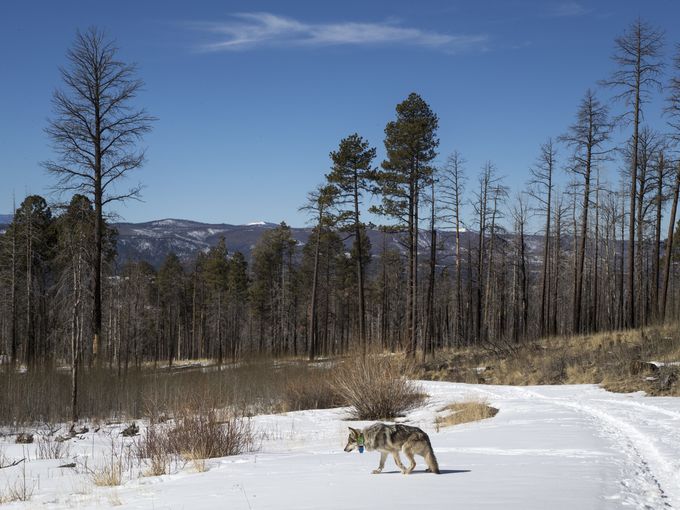
Wolf No. M1342 is released at Escudilla Mountain. (Photo: Mark Henle/The Republic)
After M1342 had regained enough of his senses to lift his head and sit up in the crate, Arizona Game and Fish biologist Brent Wolf and two colleagues loaded the crate onto a four-wheel-drive pickup and drove him back up Escudilla Mountain.
They drove as far as the truck would take them without getting stuck in the snow, getting as near as possible to the spot where the helicopter crew had darted M1342 and then set down to take the male from his mate.The return crew set the crate down at the edge of a snowy alpine meadow surrounded by scraggly willows and fat ponderosa pines, many of them torched and left bare by the massive 2011 Wallow Fire.
The groggy wolf took a few minutes to crawl out, then sat in the snow for several more. His golden-brown eyes stared toward the crew inside the pickup, and he licked the dart wound while waiting for the sedation to free his hind legs. The wolf walked slowly across the meadow, likely to be reunited with his mate once he heard a howl.
The two are believed to have mated last year, but did not produce any surviving pups, Wolf said. That’s common among first-timers, he said, and their experience should help them when they try again. “I’d be shocked if they didn’t have pups this spring,” Wolf said while reversing and turning the truck to head back down the mountain.
GALLERY
Mexican wolf biologist Julia Smith carries Wolf No. M1342 from the helicopter to the Alpine field station. He was darted from a helicopter to have his radio collar replaced. Mark Henle/The RepublicJulia Smith holds Wolf No. M1342 on his way to the Alpine field station. Mark Henle/The RepublicMexican wolf biologist Brent Wolf weighs Wolf No. M1342 in the Alpine field office. Mark Henle/The RepublicWolf No. M1342’s teeth are measured. Mark Henle/The RepublicMeasurements are taken of Wolf No. M1342’s paws. Mark Henle/The RepublicWolf No. M1342 is 3 years old and a member of the Elk Horn Pack. Mark Henle/The RepublicWolf No. M1342 got a checkup and shots to keep him robust for the important breeding season this spring. Mark Henle/The RepublicFrom left, Dr. Susan Dicks and intern Rowan Converse carry Wolf No. M1342’s kennel. Mark Henle/The RepublicFrom left, interns Hannah Manninen and Becca Thomas-Kuzilik release Wolf No. M1342 at Escudilla Mountain. Mark Henle/The RepublicWolf No. M1342 walked slowly across the meadow, likely to be reunited with his mate once he heard a howl. Mark Henle/The RepublicWolf No. M1342 and his mate are believed to have mated last year, but did not produce any surviving pups. Researchers say their experience should help the wolves when they try again. Mark Henle/The Republic
ooOOoo
Golly, I so do admire the good people who undertake this caring work on behalf of the wolves. And great photographs Mark Henle of The Republic.


 Yes, there was some foaming at the mouth, some evidence of the government-hating libertarianism this region is known for. “We don’t want people in Sacramento telling us how to live our lives,” grumbled one rancher.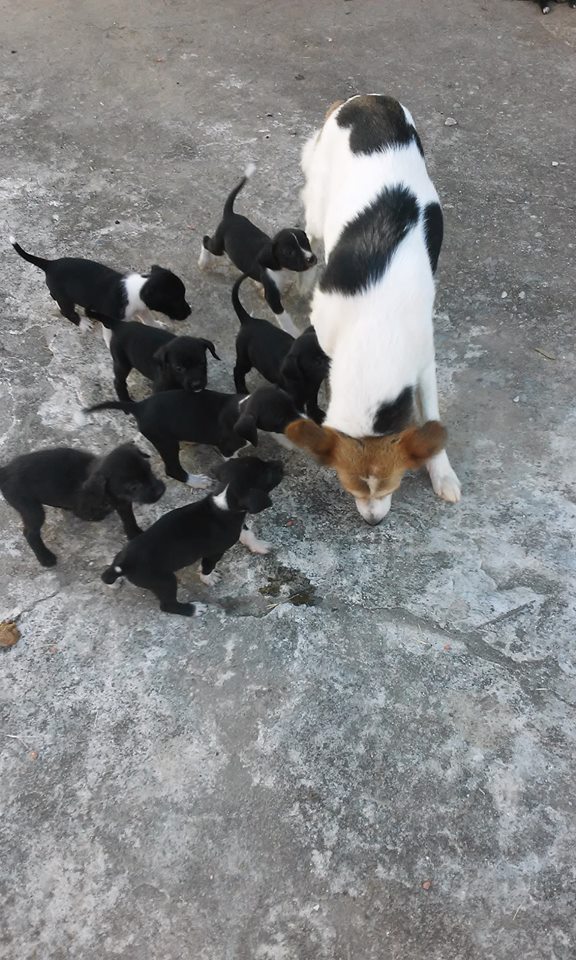






![Skaftafell-ice-cave-1[2]](https://learningfromdogs.com/wp-content/uploads/2016/02/skaftafell-ice-cave-12.jpg)











 Learning from Dogs