Prince William interviews Sir David at Davos 2019
I thought this sufficiently important to share with you.
Tomorrow back to our beloved dogs.
Dogs are animals of integrity. We have much to learn from them.
Category: People
Prince William interviews Sir David at Davos 2019
I thought this sufficiently important to share with you.
Tomorrow back to our beloved dogs.
A difficult post!
I am going to publish a TomDispatch essay. Or rather, I am going to republish a piece written for Tom Engelhardt by Dahr Jamail. It doesn’t make for comfortable reading.
For a few days I agonised whether or not to republish it.
Then Tom wrote in an email to me: “Here’s what I think… or have, at least, thought these last 17 years… It’s better to plug on and do what you know should be done, say what you know should be said, no matter the state of the world, no matter whether anyone’s listening. That’s their problem, not ours. Better to do your best and hope that just one person notices and maybe just once that will be the person who makes all the difference.”
He is right.
ooOOoo
Posted by Dahr Jamail, January 15, 2019.
Dahr Jamail, a TomDispatch regular, reported strikingly from Iraq in the years after the 2003 American invasion of that country. Since then, he’s refocused the skills he learned as a war reporter on covering a fossil-fuelized war against the planet (and humanity itself). It goes by the mild name of climate change or global warming and, while a Trump tirade about the border or just about anything else gets staggering attention, the true crisis this planet faces, the one that our children and grandchildren will have to grimly deal with, remains distinctly a secondary matter not just in the news but in American consciousness. Yes, opinions are slowly changing on the subject, but not nearly fast enough. Something about the time scale of this developing crisis — no less that it could, in the end, take out human civilization and so much else — makes it hard to absorb. It’s increasingly evident that we are already living on a climate-changed planet whose weather is grimly intensifying. If you doubt this, just ask the inhabitants of Puerto Rico, Houston, or Paradise (California, that is). Its most devastating consequences will, however, be left to a future that still seems remarkably hard to absorb in an era of the endless Trump Twitch and in a time when we’re becoming ever more oriented to the social media moment.
In 2013, as Dahr Jamail mentions in his piece today, he penned a dispatch for this website on climate change. In my introduction to it, I wrote, “Still, despite ever more powerful weather disruptions — what the news now likes to call ‘extreme weather’ events, including monster typhoons, hurricanes, and winter storms, wildfires, heat waves, drought, and global temperature records — disaster has still seemed far enough off. Despite a drumbeat of news about startling environmental changes — massive ice melts in Arctic waters, glaciers shrinking worldwide, the Greenland ice shield beginning to melt, as well as the growing acidification of ocean waters — none of this, not even Superstorm Sandy smashing into that iconic global capital, New York, and drowning part of its subway system, has broken through as a climate change 9/11. Not in the United States anyway. We’ve gone, that is, from no motion to slow motion to a kind of denial of motion.”
Sadly, with different and more severe examples of every one of the phenomena mentioned above — four of the years since have, for instance, set new heat highs — that paragraph could stand essentially unchanged. In those same years, however, Jamail did anything but stand still. He traveled the planet, producing a remarkable new book, The End of Ice, which is being published today. It holds within its pages the most dramatic (and well-reported) of stories about what both the present and future will mean for us in climate-change terms. If it were up to him, we would all feel the desperate immediacy of our situation as we face the single greatest crisis since that ancestor of ours, Lucy, walked the edge of a lake in Ethiopia so many millions of years ago. I only hope that the passion in his piece today (and in the book it describes) carries a few of us into the new world we now inhabit, whether we care to know about it or not. Tom
The Heat’s On Us
By Dahr Jamail
I’m standing atop Rush Hill on Alaska’s remote St. Paul Island. While only 665 feet high, it provides a 360-degree view of this tundra-covered, 13-mile-long, seven-mile-wide part of the Pribilof Islands. While the hood of my rain jacket flaps in the cold wind, I gaze in wonder at the silvery waters of the Bering Sea. The ever-present wind whips the surface into a chaos of whitecaps, scudding mist, and foam.
The ancient cinder cone I’m perched on reminds me that St. Paul, was, oh so long ago, one of the last places woolly mammoths could be found in North America. I’m here doing research for my book The End of Ice. And that, in turn, brings me back to the new reality in these far northern waters: as cold as they still are, human-caused climate disruption is warming them enough to threaten a possible collapse of the food web that sustains this island’s Unangan, its Aleut inhabitants, also known as “the people of the seal.” Given how deeply their culture is tied to a subsistence lifestyle coupled with the new reality that the numbers of fur seals, seabirds, and other marine life they hunt or fish are dwindling, how could this crisis not be affecting them?
While on St. Paul, I spoke with many tribal elders who told me stories about fewer fish and sea birds, harsher storms and warming temperatures, but what struck me most deeply were their accounts of plummeting fur seal populations. Seal mothers, they said, had to swim so much farther to find food for their pups that the babies were starving to death before they could make it back.
And the plight of those dramatically declining fur seals could well become the plight of the Unangan themselves, which in the decades to come, as climate turbulence increases, could very well become the plight of all of us.

Just before flying to St. Paul, I met with Bruce Wright in Anchorage, Alaska. He’s a senior scientist with the Aleutian Pribilof Islands Association, has worked for the National Marine Fisheries Service, and was a section chief for the National Oceanic and Atmospheric Administration for 11 years. “We’re not going to stop this train wreck,” he assures me grimly. “We are not even trying to slow down the production of CO2 [carbon dioxide], and there is already enough CO2 in the atmosphere.”
 While describing the warming, ever more acidic waters around Alaska and the harm being caused to the marine food web, he recalled a moment approximately 250 million years ago when the oceans underwent similar changes and the planet experienced mass extinction events “driven by ocean acidity. The Permian mass extinction where 90% of the species were wiped out, that is what we are looking at now.”
I wrap up the interview with a heavy heart, place my laptop in my satchel, put on my jacket, and shake his hand. Knowing I’m about to fly to St. Paul, Wright has one final thing to tell me as he walks me out: “The Pribilofs were the last place mammoths survived because there weren’t any people out there to hunt them. We’ve never experienced this, where we are headed. Maybe the islands will become a refuge for a population of humans.”
The Loss Upon Us
For at least two decades, I’ve found my solace in the mountains. I lived in Alaska from 1996 to 2006 and more than a year of my life has been spent climbing on the glaciers of Denali and other peaks in the Alaska Range. Yet that was a bittersweet time for me as the dramatic impacts of climate change were quickly becoming apparent, including quickly receding glaciers and warmer winter temperatures.
After years of war and then climate-change reporting, I regularly withdrew to the mountains to catch my breath. As I filled my lungs with alpine air, my heart would settle down and I could feel myself root back into the Earth.

Later, my book research would take me back onto Denali’s fast-shrinking glaciers and also to Glacier National Park in Montana. There I met Dr. Dan Fagre, a U.S. Geological Survey research ecologist and director of the Climate Change in Mountain Ecosystems Project. “This is an explosion,” he assured me, “a nuclear explosion of geologic change. This… exceeds the ability for normal adaptation. We’ve shoved it into overdrive and taken our hands off the wheel.” Despite its name, the park he studies is essentially guaranteed not to have any active glaciers by 2030, only 11 years from now.
My research also took me to the University of Miami, Coral Gables, where I met the chair of the Department of Geological Science, Harold Wanless, an expert in sea-level rise.
I asked him what he would say to people who think we still have time to mitigate the impacts of runaway climate change. “We can’t undo this,” he replied. “How are you going to cool down the ocean? We’re already there.”
As if to underscore the point, Wanless told me that, in the past, carbon dioxide had varied from roughly 180 to 280 parts per million (ppm) in the atmosphere as the Earth shifted from glacial to interglacial periods. Linked to this 100-ppm fluctuation was about a 100-foot change in sea level. “Every 100-ppm CO2 increase in the atmosphere gives us 100 feet of sea level rise,” he told me. “This happened when we went in and out of the Ice Age.”
As I knew, since the industrial revolution began, atmospheric CO2 has already increased from 280 to 410 ppm. “That’s 130 ppm in just the last 200 years,” I pointed out to him. “That’s 130 feet of sea level rise that’s already baked into Earth’s climate system.”
He looked at me and nodded grimly. I couldn’t help thinking of that as a nod goodbye to coastal cities from Miami to Shanghai.
In July 2017, I traveled to Camp 41 in the heart of the Brazilian Amazon rainforest, part of a project founded four decades ago by Thomas Lovejoy, known to many as the “godfather of biodiversity.” While visiting him, I also met Vitek Jirinec, an ornithologist from the Czech Republic who had held 11 different wildlife positions from Alaska to Jamaica. In the process, he became all too well acquainted with the signs of biological collapse among the birds he was studying. He’d watched as some Amazon populations like that of the black-tailed leaftosser declined by 95%; he’d observed how mosquitoes in Hawaii were killing off native bird populations; he’d explored how saltwater intrusion into Alaska’s permafrost was changing bird habitats there.

His tone turned somber as we discussed his research and a note of anger slowly crept into his voice. “The problem of animal and plant populations left marooned within various fragments [of their habitat] under circumstances that are untenable for the long term has begun showing up all over the land surface of the planet. The familiar questions recur: How many mountain gorillas inhabit the forested slopes of the Virunga volcanoes, along the shared borders of the Democratic Republic of the Congo, Uganda, and Rwanda? How many tigers live in the Sariska Tiger Reserve of northwestern India? How many are left? How long can they survive?”
As he continued, the anger in his voice became palpable, especially when he began discussing how “island biogeography” had come to the mainland and what was happening to animal populations marooned by human development on fragments of land in places like the Amazon. “How many grizzly bears occupy the North Cascades ecosystem, a discrete patch of mountain forest along the northern border of the state of Washington? Not enough. How many European brown bears are there in Italy’s Abruzzo National Park? Not enough. How many Florida panthers in Big Cypress Swamp? Not enough. How many Asiatic lions in the Forest of Gir? Not enough… The world is broken in pieces now.”
“A Terrifying 12 Years”
In October 2018, 15 months after Jirinec’s words brought me to tears in the Amazon, the world’s leading climate scientists authored a report for the U.N. Intergovernmental Panel on Climate Change (IPCC) warning us that we have just a dozen years left to limit the catastrophic impacts of climate change. The gist of it is this: we’ve already warmed the planet one degree Celsius. If we fail to limit that warming process to 1.5 degrees, even a half-degree more than that will significantly worsen extreme heat, flooding, widespread droughts, and sea level increases, among other grim phenomena. The report has become a key talking point of political progressives in the U.S., who, likejournalist and activist Naomi Klein, are now speaking of “a terrifying 12 years” left in which to cut fossil fuel emissions.
There is, however, a problem with even this approach. It assumes that the scientific conclusions in the IPCC report are completely sound. It’s well known, however, that there’s been a political element built into the IPCC’s scientific process, based on the urge to get as many countries as possible on board the Paris climate agreement and other attempts to rein in climate change. To do that, such reports tend to use the lowest common denominatorin their projections, which makes their science overly conservative (that is, overly optimistic).
In addition, new data suggest that the possibility of political will coalescing across the planet to shift the global economy completely off fossil fuels in the reasonably near future is essentially a fantasy. And that’s even if we could remove enough of the hundreds of billions of tons of CO2 already in our overburdened atmosphere to make a difference (not to speak of the heat similarly already lodged in the oceans).
“It’s extraordinarily challenging to get to the 1.5 degree Celsius target and we are nowhere near on track to doing that,” Drew Shindell, a Duke University climate scientist and a co-author of the IPCC report, told the Guardian just weeks before it was released. “While it’s technically possible, it’s extremely improbable, absent a real sea change in the way we evaluate risk. We are nowhere near that.”
In fact, even best-case scenarios show us heading for at least a three-degree warming and, realistically speaking, we are undoubtedly on track for far worse than that by 2100, if not much sooner. Perhaps that’s why Shindell was so pessimistic.
For example, a study published in Nature magazine, also released in October, showed that over the last quarter-century, the oceans have absorbed 60% more heat annually than estimated in the 2014 IPCC report. The study underscored that the globe’s oceans have, in fact, already absorbed 93% of all the heat humans have added to the atmosphere, that the climate system’s sensitivity to greenhouse gases is far higher than thought and that planetary warming is far more advanced than had previously been grasped.
To give you an idea of how much heat the oceans have absorbed: if that heat had instead gone into the atmosphere, the global temperature would be 97 degrees Fahrenheit hotter than it is today. For those who think that there are still 12 years left to change things, the question posed by Wanless seems painfully apt: How do we remove all the heat that’s already been absorbed by the oceans?
Two weeks after that Nature article came out, a study in Scientific Reportswarned that the extinction of animal and plant species thanks to climate change could lead to a “domino effect” that might, in the end, annihilate life on the planet. It suggested that organisms will die out at increasingly rapid rates because they depend on other species that are also on their way out. It’s a process the study calls “co-extinction.” According to its authors, a five to six degree Celsius rise in average global temperatures might be enough to annihilate most of Earth’s living creatures.
To put this in perspective: just a two degree rise will leave dozens of the world’s coastal mega-cities flooded, thanks primarily to melting ice sheets in Greenland and Antarctica, as well as the thermal expansion of the oceans as they warm. There will be 32 times as many heat waves in India and nearly half a billion more people will suffer water scarcity. At three degrees, southern Europe will be in permanent drought and the area burned annually by wildfires in the U.S. will sextuple. These impacts, it’s worth noting, may already be baked into the system, even if every country that signed the Paris climate accord were to fully honor its commitments, which most of them arenot currently doing.
At four degrees, global grain yields could drop by half, most likely resulting in annual worldwide food crises (along with far more war, general conflict, and migration than at present).
The International Energy Agency has already shown that maintaining our current fossil-fueled economic system would virtually guarantee a six-degreerise in the Earth’s temperature before 2050. To add insult to injury, a 2017 analysis from oil giants BP and Shell indicated that they expected the planet to be five degrees warmer by mid-century.
In late 2013, I wrote a piece for TomDispatch titled “Are We Falling Off the Climate Precipice?” Even then, it was already clear enough that we were indeed heading off that cliff. More than five years later, a sober reading of the latest climate change science indicates that we are now genuinely in free fall.
The question is no longer whether or not we are going to fail, but how are we going to comport ourselves in the era of failure?
Listening While Saying Goodbye
It’s been estimated that between 150 and 200 plant, insect, bird, and mammal species are already going extinct every day. In other words, during the two and a half years I worked on my book 136,800 species may have gone extinct.
We have a finite amount of time left to coexist with significant parts of the biosphere, including glaciers, coral, and thousands of species of plants, animals, and insects. We’re going to have to learn how to say goodbye to them, part of which should involve doing everything we humanly can to save whatever is left, even knowing that the odds are stacked against us.
For me, my goodbyes will involve spending as much time as I can on the glaciers in Washington State’s Olympic National Park and North Cascades National Park near where I live, or far more modestly taking in the trees around my home on a daily basis. It’s unclear, after all, how much longer such forest areas are likely to remain fully intact. I often visit a small natural altar I’ve created amid a circle of cedar trees growing around a decomposing mother tree. In this magical spot, I grieve and express my gratitude for the life that is still here. I also go to listen.
Where do you go to listen? And what are you hearing?
For me, these days, it all begins and ends with doing my best to listen to the Earth, with trying my hardest to understand how best to serve, how to devote myself to doing everything possible for the planet, no matter the increasingly bleak prognosis for this time in human history.
Perhaps if we listen deeply enough and regularly enough, we ourselves will become the song this planet needs to hear.
——–
Dahr Jamail, a TomDispatch regular, is a recipient of numerous honors, including the Martha Gellhorn Award for Journalism for his work in Iraq and the Izzy Award for Outstanding Achievement in Independent Media in 2018. His newest book, The End of Ice: Bearing Witness and Finding Meaning in the Path of Climate Disruption (The New Press), has just been published. He is also the author of Beyond the Green Zone and The Will to Resist. He is a staff reporter for Truthout.
[Note: This piece was co-published with Truthout.org.]
Follow TomDispatch on Twitter and join us on Facebook. Check out the newest Dispatch Books, John Feffer’s new dystopian novel (the second in the Splinterlands series) Frostlands, Beverly Gologorsky’s novel Every Body Has a Story, and Tom Engelhardt’s A Nation Unmade by War, as well as Alfred McCoy’s In the Shadows of the American Century: The Rise and Decline of U.S. Global Power and John Dower’s The Violent American Century: War and Terror Since World War II.
Copyright 2019 Dahr Jamail
ooOOoo
How do you feel upon reading this?
Sad? Angry? Resigned? Hopeful?
I’m still too close to it to gauge my own reactions. So I will close with this:
TomDispatch author and naturalist William DeBuys has this to say about it: “In a sane world The End of Ice would be the end of lame excuses that climate change is too abstract to get worked up about. From the Arctic to the Amazon, from doomed Miami to the Great Barrier Reef, Dahr Jamail brings every frontier in our ongoing calamity into close focus. The losses are tangible. And so is the grief. This is more than a good book. It is a wise one.”
Literally!
This is both an unlikely story and a beautiful one.
For a hawk had ‘grabbed’ a puppy but then, for whatever reason, chose to let it go. But that’s enough from me, here’s the story.
ooOOoo
From the clutches of despair to the most compassionate hands.
By CHRISTIAN COTRONEO, January 15, 2019.

Not much is known about the tiny chihuahua who suddenly appeared at a construction site near Austin, Texas, last week.
In fact, he literally fell from the sky.
Workers at the project heard his cries long before they saw him. They figured a puppy was trapped somewhere among the debris.
“They were going around the construction site trying to figure out where these cries were coming from,” Jennifer Olohan, communications director for the Austin Animal Center, tells MNN.
“And then they realized it was actually coming from the sky.”
High above their heads, a puppy was flying through the air — in the clutches of a hawk.
At that very moment, the bird suddenly let go and a tiny screaming puppy — no older than 6 weeks — fell into their midst.
Aside from a few superficial wounds on his head, the chihuahua was surprisingly unhurt. But terrified.

But that didn’t last long, as the workers quickly brought him to a medical clinic, and from there, the puppy found his way into the care of the Austin Animal Center.
“We don’t know where he came from — whether he was born as a stray or whether he was in a home and got out,” Olohan explains.
The unlikely paratrooper’s new name, however, came naturally: He would be called Tony Hawk.

Considering his sheer tininess — not much bigger than a mouse — Tony Hawk probably seemed like a good idea to a hungry hawk.
But maybe he wasn’t ready to deal with all that crying. In any case, Tony Hawk’s fears subsided soon after he found some traction on terra firma.
Mostly because he found a living foster home to ease him into his new life. In a month or so, Tony Hawk will be looking for a forever home.
But Olohan suspects he won’t wait long.
“We’ve had plenty of interest, tons of applications for him,” she says. “He’s certainly not going to have a problem finding a home.”
And so a tiny puppy without a past found himself free from the clutches of despair — thanks to the warm, caring hands that will help him shape a brand new future.

ooOOoo
In a world that sometimes seems a little strange this is a heck of a good news story.
Well done all involved especially the crew at Austin Animal Center.
A very unlikely venue for some dog art.
In my travels around for items about dogs I came across this one. It’s not your usual item. For it features dog art at the 23rd Street station on the IND Sixth Avenue Line in Manhattan’s Chelsea neighbourhood.
ooOOoo
With more than a little help from William Wegman’s Weimaraners
By MATT HICKMAN
December 24, 2018.

Dogs aren’t that unusual of a sight in the bowels of the New York City subway system.
There are service dogs and law enforcement dogs; dogs being transported in tote bags, baskets, backpacks and baby carriages; dogs swaddled beneath heavy winter jackets; very small dogs that come scurrying from the darkest corners of the platform towards … oh wait.
What you don’t see beneath the streets of New York are dogs depicted in public art. This has all changed with the unveiling of “Stationary Figures,” a collection of 11 glass mosaic pooch portraits now on permanent display at the 23rd Street station on the IND Sixth Avenue Line in Manhattan’s Chelsea neighborhood.
No doubt a number of straphangers passing through 23rd Street station, which services the F and M trains and was closed for several months earlier this year while undergoing a major revamping, will find that the pooches in question look familiar — maybe a bit like the average New York commuter: stoic, alert, borderline restless. But it’s mostly because the mosaics, fabricated in stunning detail by Mayer of Munich, are based on images created by none other than Mr. Weimaraner himself, William Wegman.

Although Wegman’s subjects have varied over his lauded career as a photographer, painter and video artist, he’s best known for whimsical compositions that depict his beloved pet Weimaraners in humanlike poses (and sometimes donning wigs and costumes). It all began in the 1970s with Wegman’s first true four-legged muse, the leggy and camera-loving Man Ray. It wasn’t until the mid-1980s, however, that Wegman’s second Weimaraner, Fay Ray, achieved true art world stardom. Fay’s descendants — they include Battina, Crooky, Chundo, Chip, Bobbin, Candy and Penny — have all also modeled for their human.
Wegman’s pet Weimaraners — a German hunting breed dating back to the early 19th century — have the distinction of appearing in the permanent collections of numerous top art museums and being a regular feature on “Sesame Street.” That’s no small feat for an extended family of very good boys and girls.
The dogs depicted in “Stationary Figures” are Flo and her brother, Topper — Wegman’s ninth and 10th Weimaraners, respectively. As the Metropolitan Transportation Authority (MTA), which commissioned the portraits as part of its MTA Arts & Design program, explains: “The portraits highlight Wegman’s deadpan humor by juxtaposing Flo and Topper in poses that suggest the way customers group themselves with waiting for a train at the platform. In some portraits, they’re dressed in human clothes and others they’re in their natural state.”

In addition to showcasing the work of a world-renowned artist (and local Chelsea resident) in an unexpected venue, “Stationary Figures” is meant to bring joy to — and lower the blood pressure of — harried commuters passing through 23rd Street station, which ranks amongst the 50th busiest in the Big Apple. After all, who wouldn’t crack a smile when chancing across a mosaic portrait of a handsome pooch, especially when said handsome pooch is gussied up in a bright red rain slicker and matching cap?
As Mark Byrnes points out for CityLab, this isn’t the first time Wegman’s dogs have brightened up an American subway station. In 2005, two Weimaraners, both outfitted in NASA spacesuits, became permanent fixtures as circular murals above exits at L’Enfant Plaza Metro station in Washington, D.C.
Very good dogs, very poor service
It goes without saying that New York City subway stations, while teeming with various forms of microbial life, have never exactly been known as hotbeds of contemporary art and design.
That, however, began to change with the long-anticipated January 2017 opening of the first phase of the Second Avenue subway line, which features eye-catching new works by Chuck Close, Vik Muniz, Sarah Sze and Jean Shin spread out across four different stations on Manhattan’s Upper East Side. Gov. Andrew Cuomo heralded the Second Avenue line’s secondary function as subterranean contemporary gallery (price tag: $4.5 million) as the “the largest permanent public art installation in New York history.”
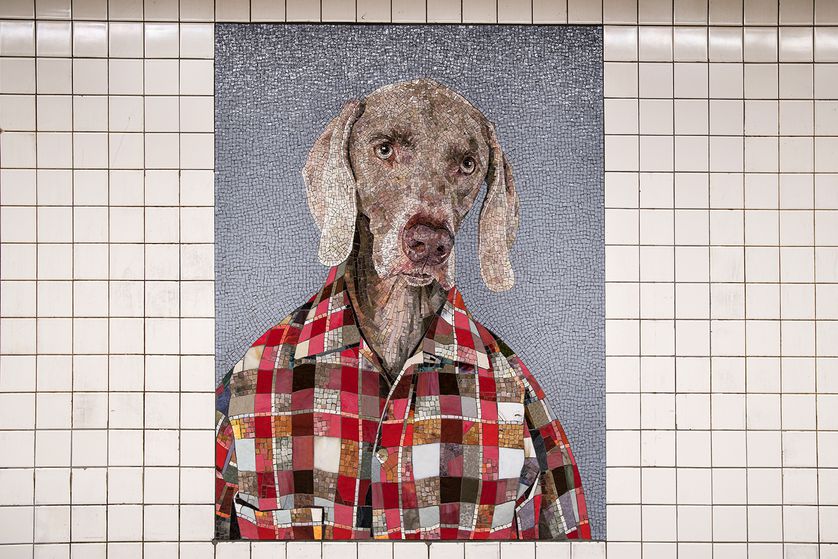
And this is all fine and good — great in fact. The more public art in the subways, the better — especially when it involves local artists of international renown, dapper-looking dogs and an ample dose of wit. Flo and Topper are the best thing to hit the 23rd Station since, well, forever.
Critics, however, have been left wondering as to when significant, tangible improvements to the MTA’s declining service will finally be instituted. And this is especially true with new fare hikes on the horizon.
As is the case with the 23rd Street station, which also received new benches, lighting, tile work, countdown clocks and digital screens as part of its extensive overhaul, what does it matter if the platforms and other public areas look fantastic but the trains aren’t running efficiently? (Byrnes points out that accessibility, or a lack thereof, also remains a major issue at 23rd Street station.)

The MTA needs to do more than outfit stations with delightful distractions to keep straphangers — who mainly just want to get from point A to point B in a minimal amount of time with minimal headache — happy. While mosaics, murals and the like do act as a sort of soothing balm and improve the user experience, public art is ultimately best enjoyed while also not on the verges of tears because three completely packed F trains have gone by and you’re running 30 minutes late.
As for Wegman, described by the New York Post as a “frequent subway commuter,” he doesn’t offer any specific thoughts as to how the MTA can also improve its service.
“I really like what they’re doing as far as making it look better,” he tells the Post. “But how to make them run better, that’s out of my area.”
ooOOoo
Now I can’t really comment any more as the odds of me being on the New York Subway are slim to none. Plus, it’s many years since I travelled on the British Underground.
But that doesn’t stop me from applauding this. Both the authorities for permitting it to happen and especially to William Wegman for such beautiful and outstanding work.
A timely article, again from the Beeb.
On the back of yesterday’s article about dogs obtaining protein from eating soldier ants comes another piece from the BBC about fibre. It has much information some of which I hadn’t come across before.
So it’s another share with you.
ooOOoo
By James Gallagher, Health and science correspondent, BBC News
January 11th, 2019.

If I offered you a superfood that would make you live longer, would you be interested?
Naturally it reduces the chances of debilitating heart attacks and strokes as well as life-long diseases such as type-2 diabetes.
And it helps keep your weight, blood pressure and cholesterol levels down.
I should mention it’s cheap and widely available in the supermarket.
What is it?
Fibre – it’s not the sexiest thing in the world but a major study has been investigating how much fibre we really need to be eating and found there are huge health benefits.
“The evidence is now overwhelming and this is a game-changer that people have to start doing something about it,” one of the researchers, Prof John Cummings, tells BBC News.
It’s well known for stopping constipation – but its health benefits are much broader than that.
How much fibre do we need?
The researchers, at the University of Otago, in New Zealand, and the University of Dundee say people should be eating a minimum of 25g of fibre per day.
But they call this an “adequate” amount for improving health and say there are benefits for pushing past 30g (1oz).
Is that all?
Well, a banana on its own weighs about 120g but that’s not pure fibre. Strip out everything else including all the natural sugars and water, and you’re left with only about 3g of fibre.
Most people around the world are eating less than 20g of fibre a day.
And in the UK, fewer than one in 10 adults eats 30g of fibre daily.
On average, women consume about 17g, and men 21g, a day.

What other foods have more fibre in them?
You find it in fruit and vegetables, some breakfast cereals, breads and pasta that use whole-grains, pulses such as beans, lentils and chickpeas, as well as nuts and seeds.
BBC Food: How carb-clever are you?
What does 30g look like?
Elaine Rush, a professor of nutrition at Auckland University of Technology, has put together this example for getting into the 25-30g camp:
But she says: “It is not easy to increase fibre in the diet.”
Prof Cummings agrees. “It’s a big change for people,” he says. “It’s quite a challenge.”

Are there any quick and easy tips?
The UK’s National Health Service has a page full of them.
They include:
BBC Food: High fibre breakfasts
What will the benefit be?
Well, after analysing 185 studies and 58 clinical trials, the results are in and have been published in the Lancet medical journal.
It suggests if you shifted 1,000 people from a low fibre diet (less than 15g) to a high-fibre one (25-29g), then it would prevent 13 deaths and six cases of heart disease.
That’s during the course of these studies, which tended to follow people for one to two decades.
It also showed lower levels of type-2 diabetes and bowel cancer as well as lower weight, blood pressure and cholesterol levels.
And the more fibre people ate, the better.
What is fibre doing in the body?
There used to be a view that fibre didn’t do much at all – that the human body could not digest it and it just sailed through.
But fibre makes us feel full and affects the way fat is absorbed in the small intestine – and things really become interesting in the large intestines, when your gut bacteria get to have their dinner.
The large intestines are home to billions of bacteria – and fibre is their food.
It’s a bit like a brewery down there, admittedly one you wouldn’t want a pint from, where bacteria are fermenting fibre to make a whole load of chemicals.
This includes short-chain fatty acids, which are absorbed and have effects throughout the body.
“We have this organ set up to digest fibre, which a lot of people just don’t use very much,” says Prof Cummings.
Why is this relevant now?
The fact fibre and whole-grains and fruit and vegetables are healthy should not come as a surprise.
But there is concern people are turning their back on fibre, with the popularity of low-carb diets.
Prof Nita Forouhi, from the University of Cambridge, says: “We need to take serious note of this study.
“Its findings do imply that, though increasingly popular in the community at large, any dietary regimes that recommend very low-carbohydrate diets should consider the opportunity cost of missing out on fibre from whole-grains.
“This research confirms that fibre and whole-grain intakes are clearly important for longer term health.”
The study has been done to help the World Health Organization come up with official guidelines for how much fibre people should be eating to boost health and they are expected next year.
Follow James on Twitter

Analysis from BBC Reality Check
One of the suggested ways of boosting the amount of fibre in your diet is to switch from white bread to brown or wholemeal.
This is what has been happening to sales of those products, based on a succession of government surveys of household spending since 1974.

From the mid-seventies to the mid-eighties, white bread fell while brown and wholemeal rose.
Since then, white bread sales have continued to fall, but brown and wholemeal bread sales have been falling for most of that period, although at a slower rate.
So it looks as if while overall demand for bread has been falling, a higher proportion of bread sold has been higher fibre.
Whole wheat pasta has made less of an impact on sales than higher fibre breads, with a survey for the British Journal of Nutrition finding that pasta accounted for less than 1% of the occasions on which people were consuming whole grains.
ooOOoo
Well nothing much more to be said other than going vegan.
I can’t recall whether I have previously shown this to you …
I don’t think so.
(But see my note at the end of the piece.)
ooOOoo
By Assistant Professor of Marketing, University of Oregon
November 19th, 2018.
At the age of 14, a young Donald Watson watched as a terrified pig was slaughtered on his family farm. In the British boy’s eyes, the screaming pig was being murdered. Watson stopped eating meat and eventually gave up dairy as well.
Later, as an adult in 1944, Watson realized that other people shared his interest in a plant-only diet. And thus veganism – a term he coined – was born.
Flash-forward to today, and Watson’s legacy ripples through our culture. Even though only 3 percent of Americans actually identify as vegan, most people seem to have an unusually strong opinion about these fringe foodies – one way or the other.
As a behavioral scientist with a strong interest in consumer food movements, I thought November – World Vegan Month – would be a good time to explore why people become vegans, why they can inspire so much irritation and why many of us meat-eaters may soon join their ranks.

It’s an ideology not a choice
Like other alternative food movements such as locavorism, veganism arises from a belief structure that guides daily eating decisions.
They aren’t simply moral high-grounders. Vegans do believe it’s moral to avoid animal products, but they also believe it’s healthier and better for the environment.
Also, just like Donald Watson’s story, veganism is rooted in early life experiences.
Psychologists recently discovered that having a larger variety of pets as a child increases tendencies to avoid eating meat as an adult. Growing up with different sorts of pets increases concern for how animals are treated more generally.
Thus, when a friend opts for Tofurky this holiday season, rather than one of the 45 millionturkeys consumed for Thanksgiving, his decision isn’t just a high-minded choice. It arises from beliefs that are deeply held and hard to change.

Veganism as a symbolic threat
That doesn’t mean your faux-turkey loving friend won’t seem annoying if you’re a meat-eater.
The late celebrity chef Anthony Bourdain famously quipped that meat avoiders “are the enemy of everything good and decent in the human spirit.”
Why do some people find vegans so irritating? In fact, it might be more about “us” than them.
Most Americans think meat is an important part of a healthy diet. The government recommends eating 2-3 portions (5-6 ounces) per day of everything from bison to sea bass. As tribal humans, we naturally form biases against individuals who challenge our way of life, and because veganism runs counter to how we typically approach food, vegans feel threatening.
Humans respond to feelings of threat by derogating outgroups. Two out of 3 vegans experience discrimination daily, 1 in 4 report losing friends after “coming out” as vegan, and 1 in 10 believe being vegan cost them a job.
Veganism can be hard on a person’s sex life, too. Recent research finds that the more someone enjoys eating meat, the less likely they are to swipe right on a vegan. Also, women find men who are vegan less attractive than those who eat meat, as meat-eating seems masculine.
Crossing the vegan divide
It may be no surprise that being a vegan is tough, but meat-eaters and meat-abstainers probably have more in common than they might think.
Vegans are foremost focused on healthy eating. Six out of 10 Americans want their meals to be healthier, and research shows that plant-based diets are associated with reduced risk for heart disease, certain cancers, and Type 2 diabetes.
It may not be surprising, then, that 1 in 10 Americans are pursuing a mostly veggie diet. That number is higher among younger generations, suggesting that the long-term trend might be moving away from meat consumption.
In addition, several factors will make meat more costly in the near future.
Meat production accounts for as much as 15 percent of all greenhouse gas emissions, and clear-cutting for pasture land destroys 6.7 million acres of tropical forest per year. While some debate exists on the actual figures, it is clear that meat emits more than plants, and population growth is increasing demand for quality protein.
Seizing the opportunity, scientists have innovated new forms of plant-based meats that have proven to be appealing even to meat-eaters. The distributor of Beyond Meat’s plant-based patties says 86 percent of its customers are meat-eaters. It is rumored that this California-based vegan company will soon be publicly traded on Wall Street.
Even more astonishing, the science behind lab-grown, “cultured tissue” meat is improving. It used to cost more than $250,000 to produce a single lab-grown hamburger patty. Technological improvements by Dutch company Mosa Meat have reduced the cost to $10 per burger.
Watson’s legacy
Even during the holiday season, when meats like turkey and ham take center stage at family feasts, there’s a growing push to promote meatless eating.
London, for example, will host its first-ever “zero waste” Christmas market this year featuring vegan food vendors. Donald Watson, who was born just four hours north of London, would be proud.
Watson, who died in 2006 at the ripe old age of 95, outlived most of his critics. This may give quiet resolve to vegans as they brave our meat-loving world.
ooOOoo
Jeannie has been a vegetarian all her life and I willingly adopted the lifestyle back in 2008 when we first started living together. Then in 2017 we took the final step to becoming vegan on account of there being too much uncertainty about fish, chicken and dairy products.
We both feel great on a vegan diet and more and more people seem to be coming across to this position.
(N.B. And this post has been published before – oh well it won’t do any harm in being repeated.)
Musings about truth, faith and reason.
One of the Christmas cards that we received said this:
So glad we are friends and neighbors. And I will pray you will have a year full of the peace, love and hope that Jesus promises.
With Love, Hugs and Prayers.
Now I understand to a degree why the sender, a neighbour of ours, would write that. But at the same time I do not. We are clearly atheists. Indeed, back in 2012 on first meeting I happened to say that I was not a believer and it produced a shock; a reaction that how could anyone not be a believer.
And I think yesterday’s post supports the view that the reality of the existence of our solar system, all 2.6 billion years of it, shows that religious beliefs of all forms come from an age where the world beyond one’s doorstep was unknown and scary. Things are different now.
But to go back to the age of things.
That existence of our solar system came about some 9.2 billion years, give or take some 60 million years, after the Big Bang.
In other words, the Big Bang, that started the whole thing off, came about three and a half times earlier than the creation of the solar system.
So read the following by Prof. Jerry Coyne. It makes perfect sense.
ooOOoo
Professor Emeritus of Ecology and Evolution, University of Chicago
As the West becomes more and more secular, and the discoveries of evolutionary biology and cosmology shrink the boundaries of faith, the claims that science and religion are compatible grow louder. If you’re a believer who doesn’t want to seem anti-science, what can you do? You must argue that your faith – or any faith – is perfectly compatible with science.
And so one sees claim after claim from believers, religious scientists, prestigious science organizations and even atheists asserting not only that science and religion are compatible, but also that they can actually help each other. This claim is called “accommodationism.”
But I argue that this is misguided: that science and religion are not only in conflict – even at “war” – but also represent incompatible ways of viewing the world.
Opposing methods for discerning truth
My argument runs like this. I’ll construe “science” as the set of tools we use to find truth about the

universe, with the understanding that these truths are provisional rather than absolute. These tools include observing nature, framing and testing hypotheses, trying your hardest to prove that your hypothesis is wrong to test your confidence that it’s right, doing experiments and above all replicating your and others’ results to increase confidence in your inference.
And I’ll define religion as does philosopher Daniel Dennett: “Social systems whose participants avow belief in a supernatural agent or agents whose approval is to be sought.” Of course many religions don’t fit that definition, but the ones whose compatibility with science is touted most often – the Abrahamic faiths of Judaism, Christianity and Islam – fill the bill.
Next, realize that both religion and science rest on “truth statements” about the universe – claims about reality. The edifice of religion differs from science by additionally dealing with morality, purpose and meaning, but even those areas rest on a foundation of empirical claims. You can hardly call yourself a Christian if you don’t believe in the Resurrection of Christ, a Muslim if you don’t believe the angel Gabriel dictated the Qur’an to Muhammad, or a Mormon if you don’t believe that the angel Moroni showed Joseph Smith the golden plates that became the Book of Mormon. After all, why accept a faith’s authoritative teachings if you reject its truth claims?
Indeed, even the Bible notes this: “But if there be no resurrection of the dead, then is Christ not risen: And if Christ be not risen, then is our preaching vain, and your faith is also vain.”
Many theologians emphasize religion’s empirical foundations, agreeing with the physicist and Anglican priest John Polkinghorne:
“The question of truth is as central to [religion’s] concern as it is in science. Religious belief can guide one in life or strengthen one at the approach of death, but unless it is actually true it can do neither of these things and so would amount to no more than an illusory exercise in comforting fantasy.”
The conflict between science and faith, then, rests on the methods they use to decide what is true, and what truths result: These are conflicts of both methodology and outcome.
In contrast to the methods of science, religion adjudicates truth not empirically, but via dogma, scripture and authority – in other words, through faith, defined in Hebrews 11 as “the substance of things hoped for, the evidence of things not seen.” In science, faith without evidence is a vice, while in religion it’s a virtue. Recall what Jesus said to “doubting Thomas,” who insisted in poking his fingers into the resurrected Savior’s wounds: “Thomas, because thou hast seen me, thou hast believed: blessed are they that have not seen, and yet have believed.”

And yet, without supporting evidence, Americans believe a number of religious claims: 74 percent of us believe in God, 68 percent in the divinity of Jesus, 68 percent in Heaven, 57 percent in the virgin birth, and 58 percent in the Devil and Hell. Why do they think these are true? Faith.
But different religions make different – and often conflicting – claims, and there’s no way to judge which claims are right. There are over 4,000 religions on this planet, and their “truths” are quite different. (Muslims and Jews, for instance, absolutely reject the Christian belief that Jesus was the son of God.) Indeed, new sects often arise when some believers reject what others see as true. Lutherans split over the truth of evolution, while Unitarians rejected other Protestants’ belief that Jesus was part of God.
And while science has had success after success in understanding the universe, the “method” of using faith has led to no proof of the divine. How many gods are there? What are their natures and moral creeds? Is there an afterlife? Why is there moral and physical evil? There is no one answer to any of these questions. All is mystery, for all rests on faith.
The “war” between science and religion, then, is a conflict about whether you have good reasons for believing what you do: whether you see faith as a vice or a virtue.
Compartmentalizing realms is irrational
So how do the faithful reconcile science and religion? Often they point to the existence of religious scientists, like NIH Director Francis Collins, or to the many religious people who accept science. But I’d argue that this is compartmentalization, not compatibility, for how can you reject the divine in your laboratory but accept that the wine you sip on Sunday is the blood of Jesus?

Others argue that in the past religion promoted science and inspired questions about the universe. But in the past every Westerner was religious, and it’s debatable whether, in the long run, the progress of science has been promoted by religion. Certainly evolutionary biology, my own field, has been held back strongly by creationism, which arises solely from religion.
What is not disputable is that today science is practiced as an atheistic discipline – and largely by atheists. There’s a huge disparity in religiosity between American scientists and Americans as a whole: 64 percent of our elite scientists are atheists or agnostics, compared to only 6 percent of the general population – more than a tenfold difference. Whether this reflects differential attraction of nonbelievers to science or science eroding belief – I suspect both factors operate – the figures are prima facie evidence for a science-religion conflict.
The most common accommodationist argument is Stephen Jay Gould’s thesis of “non-overlapping magisteria.” Religion and science, he argued, don’t conflict because: “Science tries to document the factual character of the natural world, and to develop theories that coordinate and explain these facts. Religion, on the other hand, operates in the equally important, but utterly different, realm of human purposes, meanings and values – subjects that the factual domain of science might illuminate, but can never resolve.”
This fails on both ends. First, religion certainly makes claims about “the factual character of the universe.” In fact, the biggest opponents of non-overlapping magisteria are believers and theologians, many of whom reject the idea that Abrahamic religions are “empty of any claims to historical or scientific facts.”
Nor is religion the sole bailiwick of “purposes, meanings and values,” which of course differ among faiths. There’s a long and distinguished history of philosophy and ethics – extending from Plato, Hume and Kant up to Peter Singer, Derek Parfit and John Rawls in our day – that relies on reason rather than faith as a fount of morality. All serious ethical philosophy is secular ethical philosophy.
In the end, it’s irrational to decide what’s true in your daily life using empirical evidence, but then rely on wishful-thinking and ancient superstitions to judge the “truths” undergirding your faith. This leads to a mind (no matter how scientifically renowned) at war with itself, producing the cognitive dissonance that prompts accommodationism. If you decide to have good reasons for holding any beliefs, then you must choose between faith and reason. And as facts become increasingly important for the welfare of our species and our planet, people should see faith for what it is: not a virtue but a defect.
ooOOoo
I would love to have your views.
This is incredible!
I will do no more than to post the description of the film that was provided on Top Documentary Films.
STORYLINE
The long-awaited second part of the unauthorized documentary series based on Carl Sagan’s groundbreaking 1994 book has arrived. The insightful Pale Blue Dot: Humility examines how our perspective on the vastness of the cosmos has shaped our shifting sense of self through the ages.
Pieced together as a mosaic of pop culture clips, historical stills and footage, appealing animations, and Sagan’s own audio commentary, the film is a rebuke against the plague of bloated self-importance, and the need to claim superiority over others for control of insignificant specks of territory. Even the field of science has not immune to these selfish pursuits.
From that foundation, Sagan’s probing commentary provides a brief recap of our understanding of the heavens and the Earth throughout history. This evolution of discovery represents an epic and ongoing battle between our quest for supremacy and the reality of our insignificance. For many generations, the deeply held belief that the Earth was the center of the universe was impervious to reason or to revelations obtained through further investigation. Mainstream thinking was slow to evolve when it came to the correlation between the Earth and the Sun, for example, or the age of our planet in comparison to the universe at large. The widespread and steadfast acceptance of various theologies further clouded our capacity for reasoned judgment.
But the ceaseless canvas of the universe – adorned with hundreds of billions of galaxies, distant planets and brilliant stars – provides the ultimate lesson in humility. Our modern understanding of the universe demands a more nuanced and less conceited perspective. Yet our yearning to give special meaning to our existence is a barrier to these scientific discoveries. After all, we have to be here for a reason. As Sagan states during the course of the film, it is a battle between our quest for “deep knowledge and shallow reassurance”.
It is obvious that great care went in to assembling the film, and the flow of complex information is cleanly and artfully presented. Pale Blue Dot: Humility is an affectionate representation and tribute to Sagan’s trailblazing intellect.
But as well as wanting to share this with you it also serves as an introduction to tomorrow’s post.
Won’t say any more just now.
Watch the film.
This was too good to ignore.
ooOOoo
A puppy was saved from a frozen lake by a police diver in Turkey. The rescuer feared the worst but said it was miracle that she survived.
(Now try as I may I can’t embed the video but, please, follow the link to the page.)
https://www.bbc.com/news/av/world-europe-46709311/police-diver-adopts-dog-rescued-from-icy-lake
ooOOoo
It’s inspiring and beautiful what a human will do for a dog!
Last but not least Happy New Year to you.
More of those gorgeous photos by Kristýna Kvapilová.

oooo

oooo

oooo

oooo

oooo

oooo

All taken from here.
Finally, I shall be taking a break over the Christmas holidays and will be back with you on Thursday, 27th December.
You all have a peaceful and relaxing time.

