Category: People

Travel well.

“It is better to travel well than to arrive.” Buddhist quote.

Those of you who are regular readers of Learning from Dogs, and I am flattered at how many there are now, will recall that on March 8th I posted an announcement of the Rev. Terry Hershey coming to Payson to give a couple of seminars based around his best-selling book, Soul Gardening.  Jean and I had the honour of having Terry stay with us for a couple of nights.

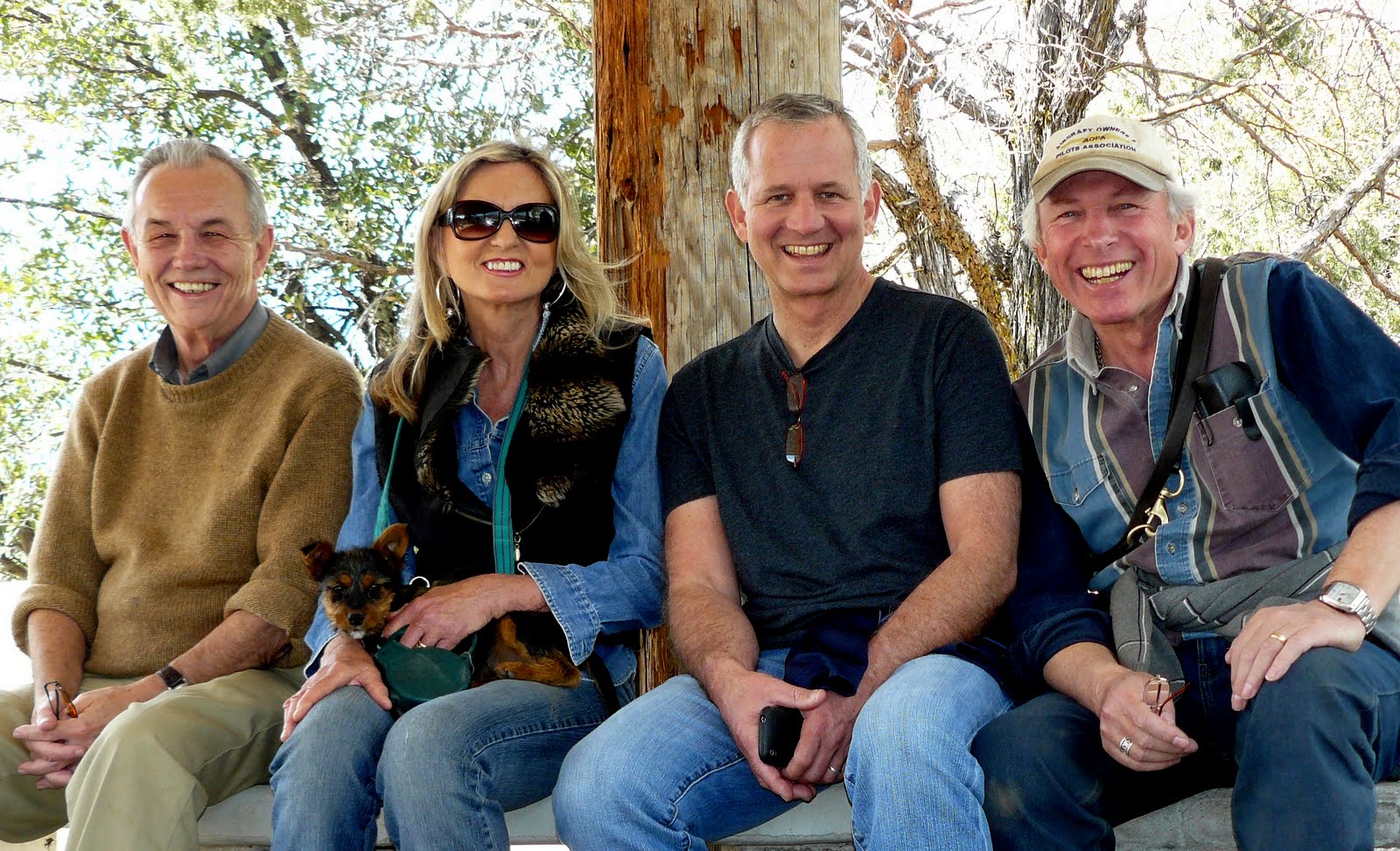
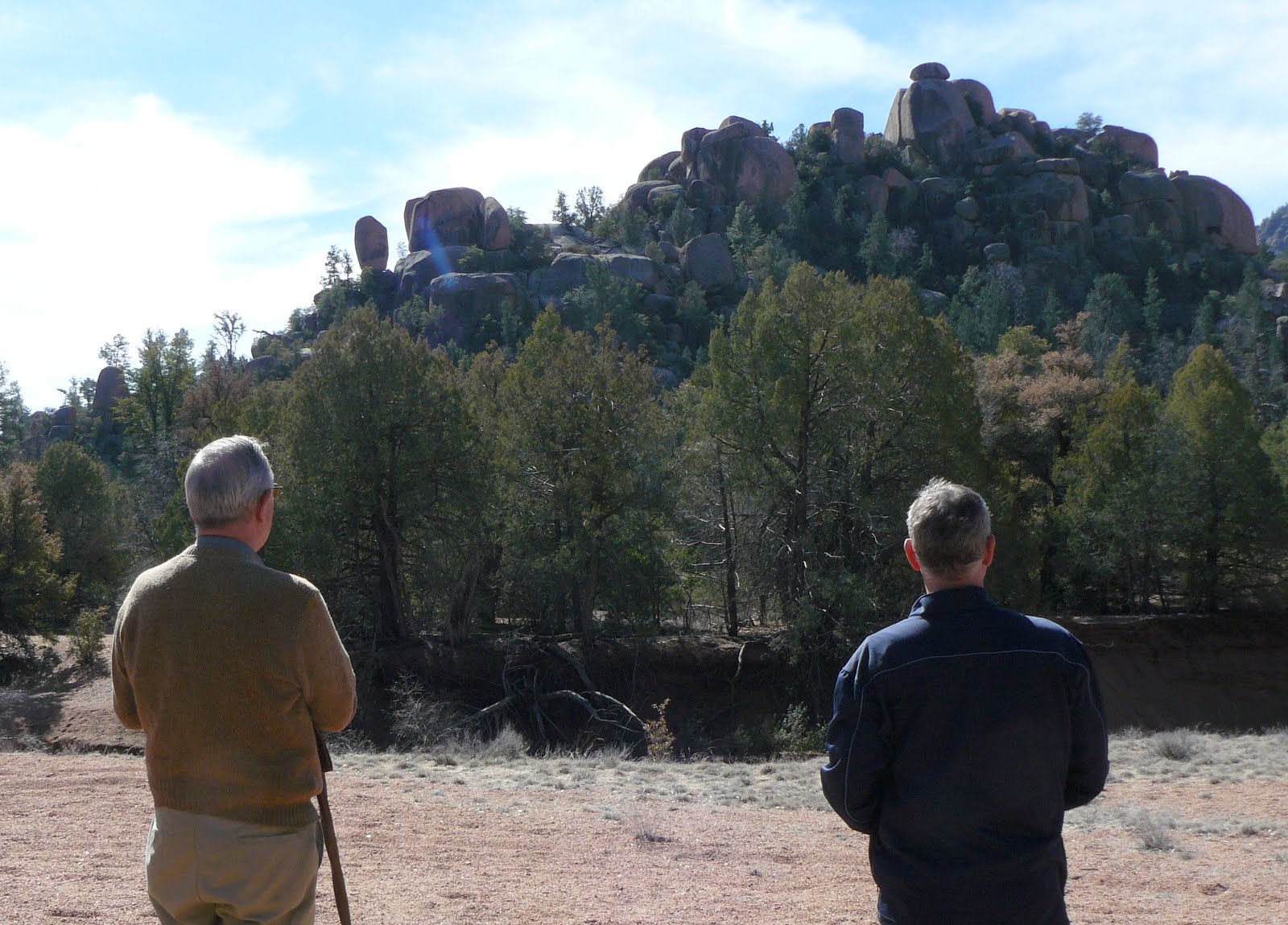
Anyway, on Monday morning, the day Terry was to give his talks, four of us took a couple of hours off in the morning to take a walk around the majestic granite boulders, a couple of miles on from our house.  These great boulders give rise to the name of the road that we live on; Granite Dells Rd.  Most afternoons, Jean and I take Pharaoh and his little pack of dogs for this three-mile walk so today was no different other than the walk being in the morning.

John H and Terry admiring the granite dells.

However, one of the benefits of having Terry with us on the walk was that he pointed out something really obvious that, so far, Jean and I had just taken for granted, i.e. missed!

It’s this. That dogs, when out for a walk off-leash, never travel the same journey, however many times they go on the same walk.  All dog-owners will be aware of this.

Dogs are all over the place, scurrying here and there, following sweet scents, totally absorbed in the intimacy of their relationship with their immediate experience.  There’s no ‘purpose’ to their behaviour, there’s no ‘clock’ running in their head as to what time it is and when they have to be somewhere else.  It is the epitome of travelling well, as from the quote at the start of this article.

The metaphor of how dogs journey as a comparison to how so many of us humans travel with eyes closed, never stopping to smell the roses, was mentioned by Terry when we stopped for group photo towards the end of the walk.  Terry also touched on the importance of living in the present, as dogs do so very, very well, many times during his later talks.

As soon as we make our happiness conditional on ‘getting’ somewhere in the future, our journey rather becomes pointless.


John, Jean, Terry, Paul - being happy in the moment.

What a wonderful day this Monday was.


Enough – from Baseline Scenario

A powerful reflection on values.

I am indebted to James Kwak, the author of this article on Baseline Scenario, for giving me permission to reproduce in full what was published on the 12th March, 2011.

By James Kwak

A friend passed on this article in The Motley Fool by Morgan Housel. It begins this way:

“Enough.

“That’s the title of Vanguard founder John Bogle’s fantastic book about measuring what counts in life.

“The title, as Bogle explains, comes from a conversation between Kurt Vonnegut and novelist Joseph Heller, who are enjoying a party hosted by a billionaire hedge fund manager. Vonnegut points out that their wealthy host had made more money in one day than Heller ever made from his novelCatch-22. Heller responds: ‘Yes, but I have something he will never have: enough.’”

The rest of the article discusses the cases of Rajat Gupta and Bernie Madoff, the former accused (but not criminally) and the latter convicted of illegal activity done after they had already been enormously successful, professionally and financially.

Housel asks, why do people push on — legally or illegally — when they have more of everything than anyone could possibly need? He summarizes the happiness research as follows:

“Money isn’t the key to happiness. What really gives people meaning and happiness is a combination of four things: Control over what they’re doing, progress in what they’re pursuing, being connected with others, and being part of something they enjoy that’s bigger than themselves.”

Of course, even if that’s true (and I think it is, except for the first sentence, on which more below), that doesn’t mean that people realize it. And if people don’t understand the relationship between their actions and their personal outcomes, we have no reason to believe that they will behave in a utility-maximizing way.

That said, renowned economist Justin Wolfers was recently on Planet Money saying that money does, indeed, buy happiness. He was discussing a paper he did with Betsey Stevenson looking at datasets covering many countries over many years. They find a positive relationship between income and subjective well-being, whether in the form of life satisfaction or happiness (although the relationship appears somewhat weaker for happiness).* In particular, they find that there is no satiation point, at least when making cross-country comparison (that is, the positive relationship persists even when you look only at countries that are at least moderately wealth).

At one point in the Planet Money interview, I believe Wolfers did say that when it comes to happiness, someone (Kahneman, I think) had estimated that there is a satiation point at around $75,000 per year. But, he went on, the issue is that we may want subjective states other than simple happiness. So, for example, we may want the subjective feeling of power, whether or not it actually makes us happy in the moment. And those other subjective states may not have satiation points, or they may have little to do with income.

But ultimately I agree with Heller. It is a great thing to have “enough,” and to know you have enough. And that is a feeling that for some people, apparently, no amount of money can buy.

* The difference, put simply, is between whether you feel happy at this moment and whether you feel satisfied with your life as a whole. For more, see this fantastic TED Talk by Daniel Kahneman (which I have recommended before).

The full moon – very full!

Brought forward as a result of the Japanese earthquake.

I had this item scheduled for publication on Friday 18th March, the day before this month’s full moon.  But recent events in Japan made me decide to bring it forward to today for reasons that will be clear when this Post is read further.

The world is set to experience the biggest full moon for almost two decades when the satellite reaches its closest point to Earth next weekend.

On 19 March, the full moon will appear unusually large in the night sky as it reaches a point in its cycle known as ‘lunar perigee’.

Stargazers will be treated to a spectacular view when the moon approaches Earth at a distance of 221,567 miles (356,577 km) in its elliptical orbit – the closest it will have passed to our planet since 1992.

The full moon could appear up to 14% bigger and 30% brighter in the sky, especially when it rises on the eastern horizon at sunset or is provided with the right atmospheric conditions.

Moon apogee and perigee

This phenomenon has reportedly heightened concerns about ‘supermoons’ being linked to extreme weather events – such as earthquakes, volcanoes and tsunamis. The last time the moon passed close to the Earth was on 10 January 2005, around the time of the Indonesian earthquake that measured 9.0 on the Richter scale.

Hurricane Katrina in 2005 was also associated with an unusually large full moon.

Previous supermoons occurred in 1955, 1974 and 1992 – each of these years experienced extreme weather events, killing thousands of people.

However, an expert speaking to Yahoo! News today believes that a larger moon causing weather chaos is a popular misconception.

Dr Tim O’Brien, a researcher at the Jodrell Bank Centre for Astrophysics at the University of Manchester, said: “The dangers are really overplayed. You do get a bit higher than average tides than usual along coastlines as a result of the moon’s gravitational pull, but nothing so significant that will cause a serious climatic disaster or anything for people to worry about.”

But according to Dr Victor Gostin, a Planetary and Environmental Geoscientist at Adelaide University, there may be a link between large-scale earthquakes in places around the equator and new and full moon situations.

He said: “This is because the Earth-tides (analogous to ocean tides) may be the final trigger that sets off the earthquake.”

UPDATE: This was noted in Naked Capitalism on Saturday.

Volcanoes have reportedly erupted in Japan, Indonesia, and Kamchatka Russia today, presumably due to the massive Japanese earthquake. There have been no reports of damage from the eruptions.

Terry Hershey, Payson Visit Announcement

Obviously only relevant to all those that are within reach of Payson, AZ. Apologies to my other readers.

Terry Hershey

Nationally Known Speaker and Writer will offer Free Seminars on March 14

Terry Hershey will visit Payson on Monday, March 14, to speak at Saint Paul’s Episcopal Church beginning at 2:00 p.m. and at the First Church of the Nazarene beginning at 7:00 p.m.

Mr. Hershey is an inspirational speaker, humorist and author who has been featured on The Hallmark Channel, CNN, and PBS.  He holds a mirror up to our fast-forward, disconnected lives, and invites us to share the wisdom of taking an intentional moment to help regain our personal and spiritual balance.

Terry lives, writes and teaches with passion, purpose, heart and grace. He captivates his audience with the motto: “Do less, live more”.  He creates an environment where we are given permission to become involved in the world around us, to want what we already have, to be embraced by moments of grace, to allow the child in us to play under a wide sky, to understand that laughter is a type of prayer and to take delight in our friends.

Terry Hershey is the author of ten books. The one that will be the focus of his inspirational presentation in Payson is “Soul Gardening”; winner of a “Book of the Year” award in 2010. Terry’s stories will nurture your soul and renew your sense of what it means to live fully alive.  To hear Terry speak is a life-affirming experience. Everywhere he appears, the feedback has been unanimously positive. For example:

Terry Hershey was truly humorous, enlightening and inspiring to one and all. He gave us permission to be embraced by grace.

He was truly the highlight of our year!

Terry’s lectures and books inspire one to see that happiness is already inside.

Terry Hershey will be speaking as follows:

Monday afternoon, March 14:

From 2 p.m. to 4 p.m. at Saint Paul’s Episcopal Church parish hall, located at 1000 N. Easy Street, in Payson at the corner of Sherwood Drive.  Note that seating and parking at St Paul’s is limited to about 50 people. If you plan to attend the afternoon session, please call 474-3834 to leave a message reserving a space.

Monday evening, March 14:

From 7 p.m. to 9 p.m. at the First Church of the Nazarene, 200 East Tyler Parkway, located at the northeast corner of Beeline Highway in northern Payson across from the Home Depot.  The parish hall will comfortably accommodate up to 200 people.  Please call 474-5890 to leave a message reserving a space.

These events are open to everyone at no charge.  Refreshments will be available at both sessions. Please plan to bring a friend with you.

Further information may be obtained from:

Paul Handover,  (928) 478 8612

John Hurlburt,   (928) 468 6572

Peter Russell

Life is such a learning experience!

A good friend of Jeannie and me in Payson is John H.  John has stimulated much wonderful thinking and reflection through conversation and the sharing of books and DVDs.  It was John H. who introduced us to Joseph Campbell about whom I wrote on the 14th February.

Well the other day, John handed us a DVD of Peter Russell giving three talks.  We watched it on Sunday evening. An amazing and inspiring experience.  But first some information about Peter Russell from, of course, his own website!  Peter describes himself as follows:


Peter Russell

Peter Russell is a fellow of the Institute of Noetic Sciences, of The World Business Academy and of The Findhorn Foundation, and an Honorary Member of The Club of Budapest. 

At Cambridge University (UK), he studied mathematics and theoretical physics. Then, as he became increasingly fascinated by the mysteries of the human mind he changed to experimental psychology. Pursuing this interest, he traveled to India to study meditation and eastern philosophy, and on his return took up the first research post ever offered in Britain on the psychology of meditation.

His principal interest is the deeper, spiritual significance of the times we are passing through. He has written several books in this area — The TM Technique, The Upanishads, The Brain Book, The Global Brain Awakens, The Creative Manager, The Consciousness Revolution, Waking Up in Time, and From Science to God.

As one of the more revolutionary futurists Peter Russell has been a keynote speaker at many international conferences, in Europe, Japan and the USA. His multi-image shows and videos, The Global Brain and The White Hole in Time have won praise and prizes from around the world. In 1993 the environmental magazine Buzzworm voted Peter Russell “Eco-Philosopher Extraordinaire” of the year.

Now in terms of the video that we watched, it contained three films: The Global Brain; The White Whole in Time; From Science to God.  In a very generous act the talk entitled The Global Brain is available to watch online – just click here. (Haven’t been over the website in detail but I suspect more of Peter’s material is available online.)  That online version is the full talk of 35 minutes but you will get lost in time as you watch it!

But if, for now, you want a feel for Peter’s approach then here are a couple of YouTube videos.  But a health warning, you may never look at the world around you in quite the same way!

and here are the first two parts of Waking up in Time (just over 6 minutes in total)


Just a reflection on nearly 900 posts!!

Prompted by a recent comment from a reader.

This Blog started on July 15th, 2009.  At first there were a group of authors all committed to the vision but for various reasons they all were unable to maintain the very real challenges of writing a daily article and they amended the relationship to that of occasional guest author. My fellow founding author, Jon Lavin, has just completed a very demanding Master’s Degree which, for very valid reasons, has kept his nose to a different grinding wheel for the last 3 years.  My greatest wish is that Jon can return to writing for this Blog simply because the original idea about dogs having much to teach us came from Jon.

The vision of why so many hours are spent managing and writing on Learning from Dogs is encapsulated here.  One of the ideas expressed there is, “Our children require a world that understands the importance of faith, integrity and honesty“.  This aspect has become more and more important in my mind.  Within less than a month of this Post, I will have my first grandchild (the gender is a closely guarded secret!)  When I look at some of the scenarios that could face that grandchild over the next four decades, it’s easy to feel pretty nervous. So being able to use the power of this electronically connected world to ramble on is my way to trying to do something!

This is leading me to the point of this Post.  If it wasn’t for the growing number of readers, now several hundred a day, and the graciousness of those readers to find the time to comment, I think this Blog would have rolled over and gone back to sleep in front of the fire as Pharaoh is wont to do!

The comments have been fabulous and even selecting a couple seems unfair on the rest.  But nonetheless that is what this article is going to include.

Just a few days ago, there was an article about the internet and control.  Dogkisses wrote:

I feel quite positive about technology, including the Internet, but I also wish we could keep things like public libraries and continue to learn skills such as handwriting.

My nephew, an A student in college, recently had to take a handwriting course. My sis was embarrassed ’til she arrived finding many Mothers she knew there for the same reason. Many college students didn’t know how to write.

I volunteered once at a “Center for Independent Living.” One of the main services they offered was free Internet access to people with disabilities. I have since learned how important this is for people who are either bed-ridden or as with Chronic Fatigue Syndrome, stay home much of the time. It is a connection to the world. People can have a sense of community. This is a good thing.

I also love how quickly I can learn little things, such as words and how that might take me somewhere else to learn about something different. Pretty cool.

Maybe some people who have control in certain arenas are afraid that The People who are being controlled will, via the Internet, be heard and all too clearly.

Then last Friday, another reader, Steven Law, added an insightful comment to a Guest Post written by Patrice Ayme last December 10th., the Essence of the Civilizational Crisis, a very profound piece.  This is what Steven wrote:

“To create public money, the money everybody uses (be it cash, electronic transfers, swaps, whatever) we use a private system, with proprietary money creating devices inside (say subprime, or derivatives). Civilization has never worked this way before, as the state previously was careful to stay the one and only money creator.”
What Patrice ignores here is that the State “creates” nothing. And I do not support “private” monopoly of money either.What I would like to entertain is the ability for a true free market (one in which we do not have) to explore competitive money, and yes, privately issued by competing banks. But that these banks would not operate on fractional reserve. They would largely operate their monies on a commodities basket reserve system. Not just precious metals, but multiple commodities as well.
At any rate you can learn more on this by reading F.A. Hayek’s “Good Money”pts. 1 & 2. Also I recommend spending some time at The Von Mises Institute online, great insights and education from an Austrian perspective on these matters.

I like your post, but find a few flaws in the argument. My main point here is that civilization has failed throughout history to keep the State under control and not allow state controlled money monopoly. Fiat currencies have failed miserably throughout history and are doing so again. We have some serious learning lessons coming our way…again.

Just want to expand on what I said about the State not creating anything. How can they create when the monies the receive are largely from coercion as well as monopoly? Therefore any “creation” by the State is at the expense of industry and freedom. Hence the need for a limited government.
I also recommend watching “Corporation Nation” on youtube. It’s pretty long and supports with verifiable evidence the depths our government has reached into fascism.

So there we are! Writing this Blog is a labour of love and having both readers and readers willing to comment keeps the love affair going!  Thank you all, every one of you.

Finally, Steven mentions that YouTube video Corporation Nation.  The whole series of videos is long but if you fancy starting in at the beginning, here it is.

Where are we off to?

More musings on how this present civilisation is going to change, as change it must.

I have a sense that this article is going to spread across a number of posts.  Regular readers of Learning from Dogs will be aware that I am summarising Lester Brown’s excellent book, World on the Edge.  If you have missed those summaries, the last one, Part 4, was here. (Part 3 here, Part 2 here, Part 1 here.)

Details of this excellent book are on the Earth Policy Institute website including the opportunity to download the book for free.

OK, back to the theme of this article, very much connected with the mission of the EPI.

Jean and I watched a video last night from the website Top Documentary Films; great site by the way.  It was called 2210: The Collapse.  This was how the film was described on that website.

Imagine if hundreds of years from now, scientists excavated the abandoned ruins of some of our largest cities, what conclusions would they come to?

It happened to the Romans, the Anasazi, and the Mayans and, inevitably, one day our own modern civilization will also fall. In this two hour special discover how a future civilization might be baffled as to why the population of these once-great cities would suddenly abandon their technology and architecture, and turn their homes into ghost towns.

Some experts believe that there is a very real risk this could happen, and the collapse of the world as we know it is closer than we think.

Examining the parallels between cultures separated by hundreds of years, explore whether the key to preventing such a global collapse today could lie in finding renewable alternatives to our dwindling energy supplies and sustainable resources. Can we learn from the mistakes of the past before it’s too late?

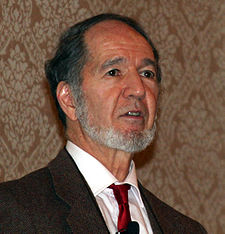
Jared Diamond

In some ways the film didn’t cover any new ground despite it being an interesting way of approaching the subject of the future of our present civilisation.  But what was really worthwhile were the clips from three experts in their various fields.  They were the author Jared Diamond, Daniel Gilbert who is Professor of Psychology at Havard, and Joseph Tainter also an author.  There is much material around from these three gentlemen.

So I am going to start with Jared Diamond.  WikiPedia has Jared’s details.  The following is a video going back to 2003 which is no less relevant in terms of where we are in 2011.  (If you want more of Jared’s ideas, just let me know and they will be included in a future Post.)

“I’ve set myself the modest task of trying to explain the broad pattern of human history, on all the continents, for the last 13,000 years. Why did history take such different evolutionary courses for peoples of different continents? This problem has fascinated me for a long time, but it’s now ripe for a new synthesis because of recent advances in many fields seemingly remote from history, including molecular biology, plant and animal genetics and biogeography, archaeology, and linguistics.”

JARED DIAMOND is Professor of Geography at the University of California, Los Angeles. Until recently he was Professor of Physiology at the UCLA School of Medicine. He is the author of the recently published Collapse: How Societies Choose to Fail or Succeed, and the Pulitzer Prize-winning author of the widely acclaimed Guns, Germs, and Steel: the Fates of Human Societies, which also is the winner of Britain’s 1998 Rhone-Poulenc Science Book Prize.  (From here)

Truth, myth and meaning

A musing on Chief Seattle’s famous speech.

I came across this recently following a bit of a prowl through YouTube.   The YouTube video, although deeply moving, is more myth than factual record; as one finds out if even a small amount of probing is undertaken.

But does it matter?  Maybe those ideas that reach out to us in a spiritual sense are as powerful as myths, perhaps even more so, than as ‘facts’.

Here’s that YouTube video.

Did you watch it all?  I hope so. Did it disturb you to know that this wasn’t a factual rendition?  Probably not.

WikiPedia has a comprehensive account of Chief Seattle and in terms of the speech here’s an extract:

There is a controversy about a speech by Si’ahl concerning the concession of native lands to the settlers.

Even the date and location of the speech has been disputed,[8] but the most common version is that on March 11, 1854, Si’ahl gave a speech at a large outdoor gathering in Seattle. The meeting had been called by Governor Isaac Ingalls Stevens to discuss the surrender or sale of native land to white settlers.Doc Maynard introduced Stevens, who then briefly explained his mission, which was already well understood by all present.[3]

Si’ahl then rose to speak. He rested his hand upon the head of the much smaller Stevens, and declaimed with great dignity for an extended period. No one alive today knows what he said; he spoke in the Lushootseed language, and someone translated his words into Chinook jargon, and a third person translated that into English.

So in terms of looking for the truth, forget it.

But in terms of being inspired to regard the land, and all that depends on it, as sacred then the myth of Chief Seattle’s words is beautiful and powerful, a myth that modern man has just about rejected.

If you want to read the words that are supposed to be the most authentic recording of what the noble Chief said, then these follow.  They are taken from here and the introduction and footnotes are valuable background information.  You may also want to read this account of the speech from the Washington State Library.

The only known photograph of Chief Seattle, taken 1864.


Scraps from a Diary:
Chief Seattle—A gentleman by Instinct
His Native Eloquence, etc., etc.

by Henry A. Smith
10th article in the series “Early Reminiscences”
Seattle Sunday Star, October 29, 1887

Yonder sky that has wept tears of compassion upon my people for centuries untold, and which to us appears changeless and eternal, may change. Today is fair. Tomorrow it may be overcast with clouds. My words are like the stars that never change. Whatever Seattle says, the great chief at Washington can rely upon with as much certainty as he can upon the return of the sun or the seasons. The white chief says that Big Chief at Washington sends us greetings of friendship and goodwill. This is kind of him for we know he has little need of our friendship in return. His people are many. They are like the grass that covers vast prairies. My people are few. They resemble the scattering trees of a storm-swept plain. The great, and I presume — good, White Chief sends us word that he wishes to buy our land but is willing to allow us enough to live comfortably. This indeed appears just, even generous, for the Red Man no longer has rights that he need respect, and the offer may be wise, also, as we are no longer in need of an extensive country.  

There was a time when our people covered the land as the waves of a wind-ruffled sea cover its shell-paved floor, but that time long since passed away with the greatness of tribes that are now but a mournful memory. I will not dwell on, nor mourn over, our untimely decay, nor reproach my paleface brothers with hastening it, as we too may have been somewhat to blame.

Youth is impulsive. When our young men grow angry at some real or imaginary wrong, and disfigure their faces with black paint, it denotes that their hearts are black, and that they are often cruel and relentless, and our old men and old women are unable to restrain them. Thus it has ever been. Thus it was when the white man began to push our forefathers ever westward. But let us hope that the hostilities between us may never return. We would have everything to lose and nothing to gain. Revenge by young men is considered gain, even at the cost of their own lives, but old men who stay at home in times of war, and mothers who have sons to lose, know better.

Our good father in Washington—for I presume he is now our father as well as yours, since King George has moved his boundaries further north—our great and good father, I say, sends us word that if we do as he desires he will protect us. His brave warriors will be to us a bristling wall of strength, and his wonderful ships of war will fill our harbors, so that our ancient enemies far to the northward — the Haidas and Tsimshians — will cease to frighten our women, children, and old men. The in reality he will be our father and we his children. But can that ever be? Your God is not our God! Your God loves your people and hates mine! He folds his strong protecting arms lovingly about the paleface and leads him by the hand as a father leads an infant son. But, He has forsaken His Red children, if they really are His. Our God, the Great Spirit, seems also to have forsaken us. Your God makes your people wax stronger every day. Soon they will fill all the land. Our people are ebbing away like a rapidly receding tide that will never return. The white man’s God cannot love our people or He would protect them. They seem to be orphans who can look nowhere for help. How then can we be brothers? How can your God become our God and renew our prosperity and awaken in us dreams of returning greatness? If we have a common Heavenly Father He must be partial, for He came to His paleface children. We never saw Him. He gave you laws but had no word for His red children whose teeming multitudes once filled this vast continent as stars fill the firmament. No; we are two distinct races with separate origins and separate destinies. There is little in common between us.

To us the ashes of our ancestors are sacred and their resting place is hallowed ground. You wander far from the graves of your ancestors and seemingly without regret. Your religion was written upon tablets of stone by the iron finger of your God so that you could not forget. The Red Man could never comprehend or remember it. Our religion is the traditions of our ancestors — the dreams of our old men, given them in solemn hours of the night by the Great Spirit; and the visions of our sachems, and is written in the hearts of our people.

Your dead cease to love you and the land of their nativity as soon as they pass the portals of the tomb and wander away beyond the stars. They are soon forgotten and never return. Our dead never forget this beautiful world that gave them being. They still love its verdant valleys, its murmuring rivers, its magnificent mountains, sequestered vales and verdant lined lakes and bays, and ever yearn in tender fond affection over the lonely hearted living, and often return from the happy hunting ground to visit, guide, console, and comfort them.

Day and night cannot dwell together. The Red Man has ever fled the approach of the White Man, as the morning mist flees before the morning sun. However, your proposition seems fair and I think that my people will accept it and will retire to the reservation you offer them. Then we will dwell apart in peace, for the words of the Great White Chief seem to be the words of nature speaking to my people out of dense darkness.

It matters little where we pass the remnant of our days. They will not be many. The Indian’s night promises to be dark. Not a single star of hope hovers above his horizon. Sad-voiced winds moan in the distance. Grim fate seems to be on the Red Man’s trail, and wherever he will hear the approaching footsteps of his fell destroyer and prepare stolidly to meet his doom, as does the wounded doe that hears the approaching footsteps of the hunter.

A few more moon, a few more winters, and not one of the descendants of the mighty hosts that once moved over this broad land or lived in happy homes, protected by the Great Spirit, will remain to mourn over the graves of a people once more powerful and hopeful than yours. But why should I mourn at the untimely fate of my people? Tribe follows tribe, and nation follows nation, like the waves of the sea. It is the order of nature, and regret is useless. Your time of decay may be distant, but it will surely come, for even the White Man whose God walked and talked with him as friend to friend, cannot be exempt from the common destiny. We may be brothers after all. We will see.

We will ponder your proposition and when we decide we will let you know. But should we accept it, I here and now make this condition that we will not be denied the privilege without molestation of visiting at any time the tombs of our ancestors, friends, and children. Ever part of this soil is sacred in the estimation of my people. Every hillside, every valley, every plain and grove, has been hallowed by some sad or happy event in days long vanished. Even the rocks, which seem to be dumb and dead as the swelter in the sun along the silent shore, thrill with memories of stirring events connected with the lives of my people, and the very dust upon which you now stand responds more lovingly to their footsteps than yours, because it is rich with the blood of our ancestors, and our bare feet are conscious of the sympathetic touch. Our departed braves, fond mothers, glad, happy hearted maidens, and even the little children who lived here and rejoiced here for a brief season, will love these somber solitudes and at eventide they greet shadowy returning spirits. And when the last Red Man shall have perished, and the memory of my tribe shall have become a myth among the White Men, these shores will swarm with the invisible dead of my tribe, and when your children’s children think themselves alone in the field, the store, the shop, upon the highway, or in the silence of the pathless woods, they will not be alone. In all the earth there is no place dedicated to solitude. At night when the streets of your cities and villages are silent and you think them deserted, they will throng with the returning hosts that once filled them and still love this beautiful land. The White Man will never be alone.

Let him be just and deal kindly with my people, for the dead are not altogether powerless.
 

Amen to that.

Total, utter madness, Pt 4

Continuing the review of Lester Brown’s book World on the Edge.

Regular readers will be aware that I have been summarising each chapter of this pivotal book.  Chapters 2, 3 and 4 are part of the section that Lester Brown calls A Deteriorating Foundation.  But I am aware that wall-to-wall gloom is often too much for people to take in so I wanted to let you know that the third section, The Response: Plan B, is very much a realistic and pragmatic approach to the alternative, a planet that will let countless future generations live in harmony and sustainably.

So please take in the dire situation that we are in by reading these summaries or, better still, buy the book!

Chapter Four, Rising Temperatures, Melting Ice, and Food Security.

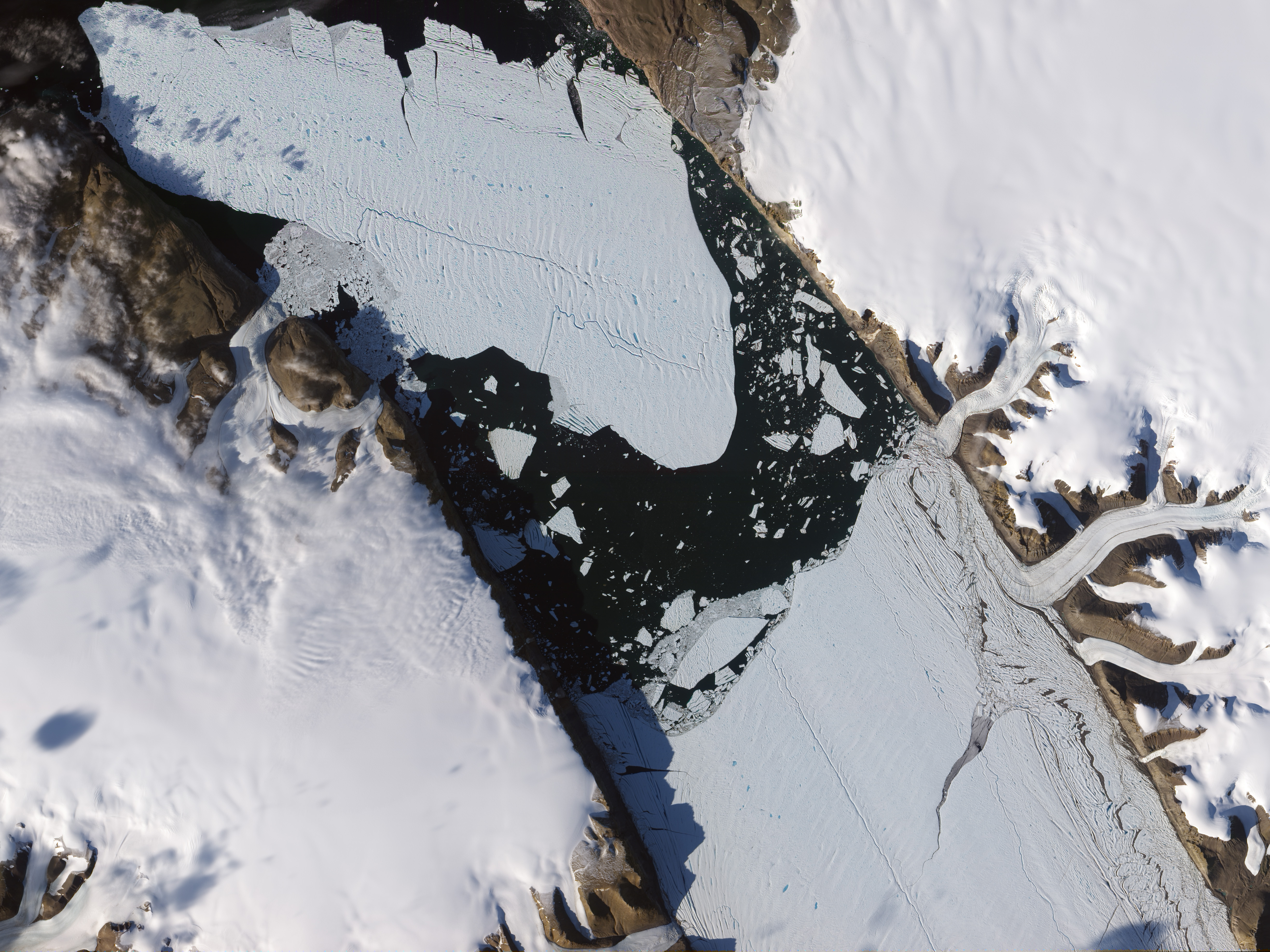
  • The Petermann Glacier calves an iceberg that covered 97 square miles on August 5th, 2010.
  • Scientists for some years have been reporting that the Greenland ice sheet was melting at an accelerating rate.
  • Richard Bates, from the University of St Andrews, part of a team monitoring Greenland ice melt, was reported as saying:

Dr Richard Bates, who is monitoring the ice alongside researchers from America, said the expedition had expected to find evidence of melting this year after “abnormally high” temperatures in the area. Climate change experts say that globally it has been the warmest six months globally since records began.

But he was “amazed to see an area of ice three times the size of Manhattan Island had broken off.

“It is not a freak event and is certainly a manifestation of warming. This year marks yet another record breaking melt year in Greenland; temperatures and melt across the entire ice sheet have exceeded those in 2007 and of historical records.”

  • A temperate rise of between 2C and 7C would cause the entire Greenland ice mass to melt – raising sea-levels world-wide by 23 feet (7 metres)!
  • In the United States last year saw record hot temperatures on the East Coast.
  • On September 27th Los Angeles recorded an all-time high of 113 degrees F, then the official thermometer broke.
  • A nearby thermometer survived to register a temperature of 119 degrees F, a record for the region.
  • Crop ecologists use a rule of thumb that for each 1-degree-Celsius rise in temperature above the optimum during the growing season, we can expect a 10-percent decline in grain yields.
  • Temperatures are rising much faster in the Arctic than elsewhere.  Winter temperatures in the Arctic, including Alaska, western Canada and eastern Russia, have climbed by 4-7 degrees F. over the last half-century.
  • This record rise in temperatures in the Arctic region could lead to changes in climate patterns that will affect the entire planet.
  • Even a 3-foot rise in sea level would sharply reduce the rice harvest in Asia. It would inundate Bangladesh, a country of 164 million people, submerge part of the Mekong Delta ( a region that produces half of Viet Nam’s rice).

That’s enough from me, simply because although this chapter in the book continues with many more frightening facts, I can’t continue to list them in this particular Post.  If the above doesn’t cause you to think and want to change, then a couple of dozen more facts aren’t going to do it either.

Just look at the photograph below and ponder on what we are leaving our children and our grand-children.  Indeed, if you are, say 50 years or younger, ponder on what the next few decades could offer for you.

We have to break our addiction with our modern way of living – or Planet Earth will do it for us.

A mother of an iceberg!

On Aug. 5, 2010, an enormous chunk of ice, roughly 97 square miles (251 square kilometers) in size, broke off the Petermann Glacier, along the northwestern coast of Greenland. The Canadian Ice Service detected the remote event within hours in near real-time data from the Moderate Resolution Imaging Spectroradiometer (MODIS) on NASA’s Aqua satellite. The Petermann Glacier lost about one-quarter of its 70-kilometer (40-mile) long floating ice shelf, said researchers who analyzed the satellite data at the University of Delaware. Taken from here.

Words fail one

Income inequality, when it becomes excessive, is very corrosive to a society.

This is clearly a complex subject because one man’s excess is another man’s just reward for building a successful business that employs his fellow citizens.

Nonetheless, I do want to touch on this sensitive area because, to my mind, they are connected with the tragic story that is the point of this article.

But first, a couple of quotes from an article by Prof. G. William Domhoff of the Sociology Department of the University of California at Santa Cruz.  It was entitled Wealth, Income, Power.

This document presents details on the wealth and income distributions in the United States, and explains how we use these two distributions as power indicators.

Some of the information may come as a surprise to many people. In fact, I know it will be a surprise and then some, because of a recent study (Norton & Ariely, 2010) showing that most Americans (high income or low income, female or male, young or old, Republican or Democrat) have no idea just how concentrated the wealth distribution actually is.

Later on, Prof. Domhoff writes:

The Wealth Distribution

In the United States, wealth is highly concentrated in a relatively few hands. As of 2007, the top 1% of households (the upper class) owned 34.6% of all privately held wealth, and the next 19% (the managerial, professional, and small business stratum) had 50.5%, which means that just 20% of the people owned a remarkable 85%, leaving only 15% of the wealth for the bottom 80% (wage and salary workers). In terms of financial wealth (total net worth minus the value of one’s home), the top 1% of households had an even greater share: 42.7%. Table 1 and Figure 1 present further details drawn from the careful work of economist Edward N. Wolff at New York University (2010).

That table and the whole article is powerful and a well-worth reading. Read it here.

Stay with me a little longer.  Here’s an extract from an article from Nicholos Kristof of the New York Times written in November last year.

Nicholas Kristof

In my reporting, I regularly travel to banana republics notorious for their inequality. In some of these plutocracies, the richest 1 percent of the population gobbles up 20 percent of the national pie.

But guess what? You no longer need to travel to distant and dangerous countries to observe such rapacious inequality. We now have it right here at home — and in the aftermath of Tuesday’s election, it may get worse.

The richest 1 percent of Americans now take home almost 24 percent of income, up from almost 9 percent in 1976. As Timothy Noah of Slate noted in an excellent series on inequality, the United States now arguably has a more unequal distribution of wealth than traditional banana republics like Nicaragua, Venezuela and Guyana.

C.E.O.’s of the largest American companies earned an average of 42 times as much as the average worker in 1980, but 531 times as much in 2001. Perhaps the most astounding statistic is this: From 1980 to 2005, more than four-fifths of the total increase in American incomes went to the richest 1 percent.

By the way, Kristof has his own blog site and added material from him about this topic and readers’ comments are here.

Now to the core of this article on Learning from Dogs which, I passionately believe, is closely tied in to the background theme already expressed here.  It’s from the blogsite Corrente and, once again, I am indebted to Naked Capitalism for having it in a recent set of links.

It concerns Jack, his family and their house.

The House that Jack’s Bank Took

Jack was a friendly man, who always had a pleasant word and a smile and handshake for everyone. The men hung with him at barbeques and discussed sports. He was strong, had a belly, and always wore a baseball cap. He was married to his high school sweetheart, Mary. He was good to his 4 kids and took care of his oldest child when he had a breakdown in his early twenties. He went to all school and family events and encouraged his children in their dreams. He took care of the family needs and finances. He was a small business owner and had invented his product, which a short while ago became outmoded. He always decorated the house with lots of Christmas decorations and candles. They are still up. He lost his house to foreclosure and the family was given 3 days to move out.

He drove into the deep woods and drank poison to make sure he was dead. I knew him. My family knew him; he lived within walking distance of one of us. At his funeral his childhood sweetheart and their children told a lot of Jack stories. The family did their best to resurrect him to our eyes. One of his kids sang and the eldest read a poem he’d written. Mary said she didn’t know what she was going to do and that she would now have to rely on those from town sitting in the packed chapel pews. There are other houses nearby that haven’t been foreclosed on but Jack’s house was nice and had a good view. The bank has now given Mary 3 weeks to move out.

It was written on the 15th February, 2011; you can read it here.  Click on the link and read some of the comments expressed – very powerful.

Wish I could think of something apt to say but I can’t.  All I can feel is great sadness and a horrible feeling in the pit of my stomach that this ‘Jack’ story is being echoed in many other places.