In yesterday’s post Sanity Anchors, I opened by saying, “A few days ago, I exchanged emails with Jon Lavin. In the early days of Learning from Dogs, Jon used to write the occasional post, one of which seems highly relevant some three years later. I will republish it tomorrow.”
So here it is, first presented on the 15th July, 2010.
oooOOOooo
On coming of age
It’s been a partly exhilarating and very scary 12 months since the launch of Learning from Dogs. I can’t remember a time when there has been so much change and uncertainty that hits right down to the foundations of everyone.
Twelve months ago these changes were merely hinted at, and then only to a few in the upper strata of the finance world, from my point of view anyway. How everything seems to have changed now!
Where lies ahead?
Warnings abound about our use of our world’s resources. Our seeming need to procreate without self imposed limit is leading us to a place that coupled with climate change, we will be unable to sustain the current world’s population, let alone the projected increase within 20 years or so. Water is becoming scarce in many parts of the world and so is food.
For those who are awakening from a media-induced slumber which distorts and bends reality to suit who can apply the greatest financial influence and weighting, the reality of the situation we are facing as a planet, is rapidly catching us up.
We still have choices – all is not lost and they will require a highly integrous group of people and thinkers to guide us through the next hundred years or so. In other words, in our children’s or children’s, children’s lifetimes. People who are not driven by the ego, but to serve the highest good.
So what can we do as individuals? Enjoy what we have, perhaps? I think, work on ourselves through awareness and expose ourselves to everything positive and integrous.
Most of our problems lie within, from that thing called an ego, that would rather drive us to death, rather than admit it might be wrong. The world would be an even more positive place if we worked on ourselves and our awareness rather than looking for all the answers ‘out there’, with somebody or something else.
So, how do we work with that? Well, no surprises there really – by bringing in awareness and coming out of the dream state, or nightmare state, depending on how you see things at the moment, and into the Present or Now, as some writers have called it.
How do we do that? It can simply begin by remembering to breathe! So by bringing our awareness to the breath, we come back into our bodies and out of the trance going on in the mind. Approximately 95% of our time is spent in this self-induced trance-like state, by the way.
Think you can’t survive without ‘your mind’ or ‘your thoughts’. There’s no such thing really. By coming out of the mind and back into the body, slowly, with practice and awareness, the noise gently starts to subside and we become aware of spaces of silence or no thought. That is where the answers lie, not in thinking.
The intellect and what we have learned kicks in after the quiet, to allow us to put into action what has come up through the silence.
Most of us have such a huge investment in ‘our thoughts’ or ‘our ideas’. If we could just make the time to sit still, in peace and quiet, so much more would be revealed to us.
So in this brave, new world going forward, to badly quote Einstein, we must aspire to move onto a higher level than the one that triggered this road we are relentlessly pursuing. We need to start becoming aware of the interconnectedness of all beings and focus on activities that are for the highest good, that benefit everyone, rather for the benefit of the few, to the detriment of the many.
By Jon Lavin
oooOOOooo
So let’s make this new year the year where we all slow down, embrace the peace and quiet, so that a clear world is revealed.
The importance of staying grounded in the face of the oncoming storm.
A few days ago, I exchanged emails with Jon Lavin. In the early days of Learning from Dogs, Jon used to write the occasional post, one of which seems highly relevant some three years later. I will republish it tomorrow.
Jon and I go back a few years and most who know me know that it was Jon’s counselling back in 2007 that opened my eyes to something that, literally, changed my life. For the better, I hasten to add!
In our recent email exchange, Jon wrote this:
Just started back at work today. A bit of a shock to the old system! Am wondering what to set my sanity sights on for this coming year in the middle of almost total uncertainty.
Of course! How obvious! The need to ensure that our lives contain anchors of stability, safe places to curl up in, metaphorically speaking, where we can seek refuge from the winds of change. Otherwise, we run the very real risk of being overcome by the uncertainty of the future.
The resonance with small boats and the sea is obvious, and unavoidable in the case of yours truly.
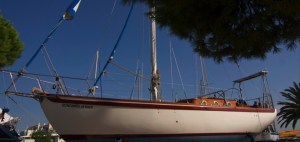
Tradewind 33, Songbird of Kent
For five years I lived on and sailed a Tradewind 33, Songbird of Kent; my base being Larnaca on the island of Cyprus at the Eastern end of the Mediterranean Sea. Contrary to the image of the Mediterranean, it wasn’t uncommon to experience some ‘interesting’ weather; there were times when it could turn very nasty!
The comfort, physical and mental, offered by being tucked up in a small bay, listening to the storm about one, while riding securely to your anchor was beyond imagination.
Jon’s comment underscores the incredible importance of each of us knowing what anchors us to a secure place. So, like any sailor, always keep a weather eye open for those early signs of a storm, and cast your anchor in good time.
Needless to say, having a loving dog or two in one’s life provides a wonderful storm-proof anchor.
A genuine leader is not a searcher for consensus but a molder of consensus.
My concluding essay on the subject of wisdom starts off with this quotation by Martin Luther King, Jr. That he was best known for using nonviolent civil disobedience to achieve political aims in the 1950’s and 60’s may not be inappropriate today.
I started with looking at our brain in recognition of the strange ways in which we humans make sense of the world, then yesterday looked at how we confuse what we do with what is best for us, surely the essence of wisdom. Today, I want to conclude with a reflection on the gap between the new wisdom of millions of citizens and the failure of so many leaders to recognise this wisdom. When I use the word wisdom in this context, it’s probably more in the sense of awareness. The growing awareness by millions of us that something isn’t right and that our democratic representatives and leaders are way behind.
I will support my argument by referring to a number of media items that have surfaced in recent days.
Australia’s “dome of heat” has become so intense that the temperatures are rising off the charts – literally.
The air mass over the inland is still heating up – it hasn’t peaked
The Bureau of Meteorology’s interactive weather forecasting chart has added new colours – deep purple and pink – to extend its previous temperature range that had been capped at 50 degrees.
The range now extends to 54 degrees – well above the all-time record temperature of 50.7 degrees reached on January 2, 1960 at Oodnadatta Airport in South Australia – and, perhaps worryingly, the forecast outlook is starting to deploy the new colours.
“The scale has just been increased today and I would anticipate it is because the forecast coming from the bureau’s model is showing temperatures in excess of 50 degrees,” David Jones, head of the bureau’s climate monitoring and prediction unit, said.
Just reflect on that! 54 degrees Centigrade is 129 degrees Fahrenheit!
On January 4th, just 5 days ago, Bill Moyers held an interview with climate change communication expert Anthony Leiserowitz who explained why climate change gets the silent treatment, and what we should do about it. Here’s a trailer to that programme.
I very strongly recommend you put an hour to one side and watch the full programme available here.
Next comes a recent item on Christine’s fantastic blog 350 or bust. I forgot to ask Christine for permission to reproduce her article but am confident that republishing it on Learning from Dogs carries her full support.
New Report Connects Dots Between Political Inaction & Growing Cost Of Climate Change
“The cost of living is going up and the chance of living is going down. “ –Flip Wilson
A new publication issued by the International Institute for Applied Systems Analysis (IIASA) in the journal “Nature” has reported that the chances of keeping temperatures below a 2 degree rise is now largely in the hands of policy makers.
The challenge of a changing climate can now only be fought with the backing of political agenda – and as most people will agree, this seems bleak.
Of all the uncertainties with regard the effects of climate change, including geophysical and social uncertainties; political uncertainty ranked as the number 1 factor in determining the fate of our species and our planet.
What went wrong? Maybe we have been advertising climate change in an ineffective manner, considering how politically charged the world is?
The burdens of climate change are often communicated in relation to extreme weather events, melting ice caps, lives lost, loss of biodiversity, endangered species etc., but it would appear that to some this doesn’t seem to ring a bell; probably as the bell doesn’t chime as “cha ching cha ching”.
So what happens if we try to communicate climate change in relation to cost?
In 2012, in the United States alone, there were 11 natural disasters that cost over $1 billion – and this does not yet include the almost country wide drought or hurricane sandy, and let’s not forget the multiple other disasters which did not make the 1 billion benchmark. It is predicted that events, like the ones that swept the entire globe in 2012, will increase in frequency and in destructive force if we do not keep temperatures below the 2 degree rise on pre-industrial temperatures.
If we do not change our ways by 2020, the research group have found that the probability of keeping the temperature within the assigned two degree window drops below 50% (best case) or 20% (worst case) – no matter how much money is spent in the effort.
It is predicted that money will not matter; it’s almost bittersweet.
2012 was an eye opening year in terms of our natural environment. From here on out, let’s try change our ways; not our climate. The clock is ticking.
“… the chances of keeping temperatures below a 2 degree rise is now largely in the hands of policy makers.” Further comment by me is pointless – the message is already crystal clear.
The implications of the changes that are being imposed on all of us were picked up in a recent article in the British newspaper The Telegraph: Rising food prices will reap a bitter harvest. Here’s a flavour (sorry!) of the article.
British shoppers should brace themselves for “massive” food price rises in 2013, says the aptly named Mark Price, managing director of Waitrose. Is he correct, or is this just another retailer trying to soften up public opinion before imposing price hikes?
Liam Halligan goes on to write (my emphasis):
It strikes me that Price most certainly is right and his statement deserves more comment and consideration. For it is almost inevitable that many crucial foodstuffs will become considerably more expensive during 2013, not least due to recent weather patterns. More fundamentally, the food price rises we’ll see over the coming year will also reflect longer-term non-cyclical trends, not least the burgeoning world population.
During 2013, in fact, rising food prices are likely not only to have a serious impact on the global economy, but could well spark violence and political upheaval, not least in the Middle East.
The importance of the trend Price has highlighted, then, goes way beyond the tills of upmarket British supermarkets. It’s certainly the case, though, that UK food production looks weak, as heavy rainfall in 2012 meant many crops were ruined and farmers couldn’t plant as much as they wanted for 2013. Despite a very dry first quarter, 2012 was this country’s second-wettest year since records began in 1910.
I don’t want to quote any more from the article but read it and realise how the world in 2013 may be unrecognisable beyond our wildest imaginations.
OK, going to round this off.
Firstly, by asking you to read a recent item in Democracy Journal. This is how the article starts.
Everyone’s Fight: The New Plan to Defeat Big Money
The 2012 campaign is by now mercifully out of our systems, but it remains worth reflecting on some of the dubious firsts that occurred during this election. This was the first presidential campaign to cost more than $2 billion. It was also the first time neither candidate accepted any public financing or the limits that come with it. Finally, it was the first presidential election after Citizens United, the Supreme Court decision that allowed around $600 million in super PAC donations this cycle, and many millions more to nonprofit “social welfare” groups that aren’t required to disclose their donors.
But even these bleak facts don’t do justice to the problem of Big Money. Campaign spending isn’t even our most dire money-in-politics problem. That would be the thousands of lobbyists and many millions of their dollars that are devoted to the warping of our public policy. These powerful lobbies control most outcomes on Capitol Hill, and the problem is far worse than it was 20 years ago.
Annie Leonard spent 20 years working for environmental organizations, studying where our stuff comes from and where it goes. She followed waste from industrialized countries to apartheid-era South Africa, where it was dumped in black townships, to Haiti, where it was disguised as fertilizer and dumped on a beach, to Pakistan, Indonesia and the Philippines where we sent everything from e-waste to used car batteries for recycling in a process too dirty for our own backyard.
Then, in 2007, she made a short animated film about our consumer culture and the damage it does to the environment. The Story of Stuff went viral (chances are you’ve seen it — more than 15 million people have) and spawned a whole series of videos that explain complicated environmental and political concepts in an irresistibly simple and engaging way. We reached Annie via email to talk about the latest installment, The Story of Change. This one’s a bit of a departure — instead of looking at the problem, it proposes a solution.
It included this video:
Can shopping save the world? The Story of Change urges viewers to put down their credit cards and start exercising their citizen muscles to build a more sustainable, just and fulfilling world.
I shall close with another quotation from Martin Luther King, Jr.
“The ultimate measure of a man is not where he stands in moments of comfort and convenience, but where he stands at times of challenge and controversy.”
Thus wrote Laura Leggett Linney. Maybe Laura doesn’t fit into the same folder as Confucius (she’s well and truly alive for one thing) but the quote was perfect, hence the connection.
Yesterday, I offered an overview of the human brain. Today I want to expand on the idea of “how we jumble up how we act with what is best for us” as was put in yesterday’s introduction.
In researching for today’s essay, the power of the Internet quickly found the quotation by ex-President Lyndon B. Johnson that “Doing what’s right isn’t the problem. It’s knowing what’s right.” Reflecting on the escalation of America’s involvement in Vietnam that was a product of LBJ’s term of office, perhaps his quotation carries a certain pathos that wasn’t intended at the time of its pronouncement! In other words, it’s not the ‘knowing‘ but the ‘doing‘ that is critical, as LBJ’s legacy so clearly illustrated. Johnson might have better said, “Knowing what’s right is sometimes hard. Doing what’s right is sometimes even harder.”
To illustrate the challenge of converting these fine concepts into the grind of daily life, I’m going to use a recent essay published by Ian Welsh. Ian is a frustrated author who writes about his experiences in completing a book on Prosperity. It struck me as a fabulous insight into the vagaries of homo sapiens and one that lent itself beautifully to what I am trying to convey today.
Ian very promptly gave me written permission to republish his essay on Learning from Dogs. So what I am going to do is to add my own thoughts to Ian’s essay in a way that hopefully supports the proposition that we are far from being logical creatures.
To know what to do is not enough
by Ian Welsh – January 2nd, 2013
For the past year I’ve been writing a book on prosperity, by which I mean widespread affluence. It’s been slow going, not because I don’t believe I know the general technical requirements of prosperity (I do, if I didn’t, I shouldn’t be wasting anyone’s time, including mine, writing the book), but because the real problem isn’t the technical details like eliminating bottlenecks, or redistributing income, or setting up positive feedback loops, or avoiding fraud, or stopping financialization, or any of the dozens of other subjects I either visit at chapter length or touch on briefly. The problem as with, say, stopping smoking, isn’t so much what to do, it is how it comes that we do it. When do we make the decision we’re willing to do what it takes, sufferer the negative consequences of getting to a better place, and then push ourselves through those consequences?
Let’s dally with that phrase, “isn’t so much what to do, it is how it comes that we do it.” On the 1st January, I published an article called Why?It included a film by Simon Sinek looking at the Why, How, and What of human decision-making. The film supports the thesis that those who succeed act, think and do things differently; the crucial point being that spending time on understanding why you do what you do is very revealing. You can see the resonance between Simon Sinek and Ian Welsh, can’t you? If we better understand ‘why’ we want to do something, we can better think 0f what is the best way of achieving that.
Back to Ian’s essay.
This is a huge problem in individuals, as the weight loss, addiction, psychology, psychiatry and self-help industries attest. There is, generally, more money in not solving a problem, as drug makers with their palliatives understand, than in solving it. The people who have power and money and influence in the status quo are not sure that in a new world, with a new economy, and the new ethics which must undergird that new economy, they will be on top. They are right to believe so. They are creatures of the current world, and in being created, have created the world they are unsteady masters of. Their ethics and morals, their way of business, of living, of apportioning power and influence and money must go if there is to be widespread affluence. Their methods have been tried for 40 odd years now, and if measured against the human weal, have failed. They will not, they cannot adapt, not as a group. They were not selected for the skills it takes to create a new type of affluent society, they have not even been able to maintain the mass affluence of the old society, and not just because they have not wanted to. They would be a different elite, made up of different people with different ethics, talents and skills if they did want to.
This paragraph is just laden with powerful ideas.
First, the recognition that millions opt for the palliative rather than the cure. Second, that these same millions live in present times that are controlled undemocratically by plutocrats. Thirdly, changing to a new, better order is not going to come easily. Ergo, for the last few decades there has been a massive failure of wisdom. Applying that failure to millions does not, of course, avoid the charge that each of us, individual by individual, each in our own tiny manner, has contributed to that failure of wisdom.
Ian amplifies this idea, as you will see by reading on.
Ordinary people also have the wrong ethics, the wrong morality. Much is written about why consumerism is bad, but the ultimate problem of consumerism is not how it makes us feel but that the consumer passively chooses from a menu created by others, not to fill the consumer’s real needs, but to benefit those who created the menu. Such a passive people cannot understand that choosing choices without creating choices is not choice, it is the illusion of choice.
So while my book has a lot of general principles of the sort which books on prosperity often have, such as about trade, and productivity and technological change, that isn’t the most important part. The part that matters isn’t about the technical requirements of prosperity, it’s about why and when people do what is required to achieve prosperity, and when they don’t. And when, having obtained it, they throw it away.
“Such a passive people cannot understand that choosing choices without creating choices is not choice, it is the illusion of choice.” Pick the bones out of that!
On we go. Going to let you read Ian’s closing four paragraphs as one piece.
Our society is ours. A tautology, but one we forget too often. As individuals we often feel powerless, as a mass, we have created our own society. There are real constraints, physical constraints on what society we can have, based on the resources we have, the technology we have mastered and what we understand about ourselves and our world, but those constraints are not, right now, so tight as to preclude widespread affluence, to preclude prosperity.
They are, however, tight enough to preclude continuing to do the same thing, led by the same sorts of people, and expect anything but decline, repeated disasters and eventual catastrophe. We can be affluent and prosperous, we can spread that affluence and prosperity to those who do not have it now, but we cannot do it if we insist on keeping the current forms of our economy, including our current forms of consumption. This does not mean doing with less, it means doing with different things, valuing different things. Those new values will be better for us, objectively, they will make us both happier and healthier, just as most addicts are happier once they’ve broken their addiction, or rather once they’ve gone through withdrawal and rebuilt their lives.
We can choose not to do so. We have, in certain respects, already chosen not to do so, as with our refusal to do anything about climate change until it is too late (the two problems are combined, climate change is a subset of the political and economic problems we have). We can, also, choose to make the necessary changes, not only to avoid the worst catastrophes (disasters are now inevitable, there are consequences to failure, stupidity and greed), but to create an actual, better, world, a world in which the vast majority are healthier, happier and doing work they care about.
The monster facing us, as usual, is us. The monsters are always us, our brothers and sisters, and the one in the mirror. And it is those monsters I’ve been wrestling this past year.
Reflect on those three points that I made earlier: how we don’t put the cure as the top priority, how we are dominated by the greed and power of the relatively few, how difficult changing our present society would be. Not a pretty picture!
Then look at yourself in that mirror, either literally or metaphorically, and say to the face you see peering back at you: “This is my society. Yes, I do feel powerless but I have to embrace the cold, hard truth that I am part of my society and that change will only occur if I subscribe to the new values that I require.”
By three methods we may learn wisdom: First, by reflection, which is noblest; Second, by imitation, which is easiest; and third by experience, which is the bitterest.
Thus spoke Confucius, albeit not in the English language! But, nonetheless, those words from so, so long ago (he lived to the age of 73 – from 551 until 479 BCE) resonate very strongly 2,500 years later.
That was the easy bit!
I’m not entirely clear as to why a variety of items that have crossed my ‘in-box’ in recent days seem to offer some sort of cohesive sense. But they do to me and I’m going to draw them together. I will leave you to be the judge as to how well it worked!
Thus over the next three days I am going to reflect on three topics. The challenge of how we humans make sense of the world, how we confuse what we do with what is best for us, surely the essence of wisdom, and the growing gap between the wisdom of millions of citizens and their leaders.
I should quickly add that much of my musings are due to this scribe standing on the shoulders of giants than seeing clearly from his own level.
Today, I shall start with the brain. Your brain, my brain, the brains of humans. The reason this trilogy starts with the brain is that, ultimately, everything we humans think, feel and do comes from this brain of ours. Our brain is who we are.
Let me offer you this video made by Bristol University in England. Just a little over 6 minutes long it sets out the functional story of our brain.
(An animated tour around the human brain commissioned for Brain Awareness Week in 2010)
But there is so much more to this ancient body organ.
“By the word ‘thought’ (‘pensée’) I understand all that of which we are conscious as operating in us.” –Renee Descartes
The simplest description of a black hole is a region of space-time from which no light is reflected and nothing escapes. The simplest description of consciousness is a mind that absorbs many things and attends to a few of them. Neither of these concepts can be captured quantitatively. Together they suggest the appealing possibility that endlessness surrounds us and infinity is within.
But our inability to grasp the immaterial means we’re stuck making inferences, free-associating, if we want any insight into the unknown. Which is why we talk obscurely and metaphorically about “pinning down” perception and “hunting for dark matter” (possibly a sort of primordial black hole). The existence of black holes was first hypothesized a decade after Einstein laid the theoretical groundwork for them in the theory of relativity, and the phrase “black hole” was not coined until 1968.
Likewise, consciousness is still such an elusive concept that, in spite of the recent invention of functional imaging – which has allowed scientists to visualize the different areas of the brain – we may not understand it any better now than we ever have before. “We approach [consciousness] now perhaps differently than we have in the past with our new tools,” says neuroscientist Joy Hirsch.
Later on is this:
So there’s no reason to assume that consciousness is eternally inexplicable. However, it may never be explained through neurobiology, says David Chalmers, the philosopher who originally made the distinction. “In so many other fields physical explanation has been successful… but there seems to be this big gap in the case of consciousness,” he says. “It’s just very hard to see how [neurological] interactions are going to give you subjective experience.”
The fascinating essay concludes:
It’s no different than any other aspect of the brain that we cannot presently explain, she [Hirsch] says:
For example, we don’t understand how the brain creates colors. That’s a perception that is very private – I don’t know that your perception of blue is like my perception of blue, for example. Smells are another one. I don’t know that your perception of the smell of an orange is like mine. These are the hard problems of neuroscience and philosophy that we haven’t made a great deal of progress on.
What do you think? Is the distinction between “hard problems” and “soft problems” useful, or reductive? Does the brain create consciousness? Will we ever empirically understand where it comes from or how it works?
But it was one of the comments to the piece that jumped off the screen at me. From Beatriz Valdes and slightly edited by me, the comment offered:
Human consciousness happens in the human brain. The human brain’s functions are rooted in what the human senses relay to it. Self consciousness, consciousness of what is around us, is the result of thinking. There would be no thoughts if the brain were a tabula rasa (Latin for blank slate), had no input from the senses. Therefore, consciousness is quite local, quite mortal, quite dependent on the gray matter inside our skulls.
Local and mortal. Very profound (I think!).
So, if you like me suffer from time to time from understanding oneself, don’t worry. There are plenty of others – aren’t there? As Professor Dan Dennett makes it all clear below.
Philosopher Dan Dennett makes a compelling argument that not only don’t we understand our own consciousness, but that half the time our brains are actively fooling us.
Philosopher and scientist Dan Dennett argues that human consciousness and free will are the result of physical processes and are not what we traditionally think they are. His 2003 book Freedom Evolves explores the way our brains have evolved to give us — and only us — the kind of freedom that matters.
Good, glad that’s all clear. 😉
Stay with me for ‘page two’ of Essence of wisdom coming out tomorrow.
This second set carries on from yesterday’s selection. You will see from one of the comments from yesterday that blogger Pedantry noticed there was a problem with” the height description on the second through fifth images in this set“. Feedback from others who had this problem would be helpful as I can pass the details back to WordPress.
oooOOOooo
The Grand Canyon Skywalk
The Grand Canyon Skywalk is a transparent horseshoe-shaped cantilever bridge and tourist attraction in Arizona near the Colorado River on the edge of a side canyon west of the main canyon. USGS topographic maps show the elevation at the Skywalk’s location as 4,770 ft (1,450 m) and the elevation of the Colorado River in the base of the canyon as 1,160 ft (350 m).
In other words, the height of the vertical drop directly under the skywalk is between 500 ft (150 m) and 800 ft (240 m).
Commissioned and owned by the Hualapai Indian tribe, it was unveiled March 20, 2007, and opened to the general public on March 28, 2007. It is accessed via the Grand Canyon West Airport terminal or a 120-mile (190 km) drive from Las Vegas, which includes a 10-mile (16 km) stretch of dirt road which is currently under development.
The Skywalk is east of Meadview and north of Peach Springs with Kingman being the closest major city.
Palawan Underground River or St. Paul Subterranean River.
The longest navigable underground river in the world.
This is the most famous cave in the Philippines. The longest underground river was discovered a few years back in Mexico somewhere in the Yucatan.
The St. Paul underground river in Palawan, Philippines may not be the longest underground river in the world anymore, but it is still the world’s longest navigable underground river. The navigable part of the river inside the 4000-acre cave of the St. Paul subterranean river stretches 15 kilometers in length (9.3 miles). St. Paul Cave is the third deepest cave in the country.
The Seven Sisters waterfall in Norway.
Plitvice Lakes National Park in the Lika region of Croatia.
A hotel window view in the United Arab Emirates!
Jasper Park Lodge, Jasper, Alberta, Canada
Villas Vista Hermosa, Costa Rica
Norway!
Sea caves near Benagil Beach, Algarve, Portugal.
Barcelona, Spain.
The village of Hallstatt in Austria.
Victoria Falls, in southern Africa on the Zambezi River at the border of Zambia and Zimbabwe.
Beautiful display of nature’s balance: Predators and Prey.
At Wat Samphran in Nakhon Pathom Province there is a 17 storey building that has a giant dragon climbing to the roof.
The head is at the top where there is a shrine and the tail is on the ground floor. The dragon is hollow and it is possible to walk up some sections of it.
This house was designed by Rudy Ricciotti. The unique architecture includes a pool house, which is like a window in the living room where you can enjoy not only swimming in the water, but the person swimming in it with the effect of the outdoor landscape which is reflected through the window.
The Aiguille du Midi cable car leaves from the centre of Chamonix. It takes visitors up to 3,842m (12,605 feet) for a stunning view of the French Swiss and Italian alps.
Paradise! Jungfrau Mountain Range in Switzerland
HallgrÃmskirkja (244 ft), is the largest church and the sixth tallest architectural structure in Iceland.
The Melisanni Cave, Greece. This beautiful cave, which was discovered in 1951 and is surrounded by forests, features in Greek mythology as the cave of the nymphs.
New Town Hall in Hanover, Germany.
Thermal baths inside a cave – Miskolc Tapolca, Hungary
Piva Canyon, Bosnia and Herzegovina
…
Lake Mellisani on the island of Kephalonia, Greece.
Manarola, Italy.
oooOOOooo
Hope you found these photographs as captivating as I did.
Today, the 4th January, we have been at our new home in Oregon for exactly 72 days. We knew there would be many differences between Payson, Arizona and Merlin, Oregon all of which could be described as objective, factual differences. However, what was unexpected were the deep, complex emotions associated with moving to this rural part of Josephine County, Oregon. We were utterly unprepared for that.
In fact, I have been staring at this screen for some time unable to put any structure or meaning to this post. So I’m not going to try anymore, just offer some photographs and my reflections in the hope that you can sense where I am coming from.
The Winter storm that came in on the 20th December was, according to locals, unprecedented. We lost our power from the 20th until just before Christmas Eve. It caught us unawares in terms of being ready for this type of winter event. But then the sun came out one afternoon and I took this picture.
It shows the flank of Mt. Sexton, the picture being taken from our deck in front of the house. I found it impossible to describe the effect that this natural beauty had on me; being in awe just scratches the surface of my feelings.
Moving on.
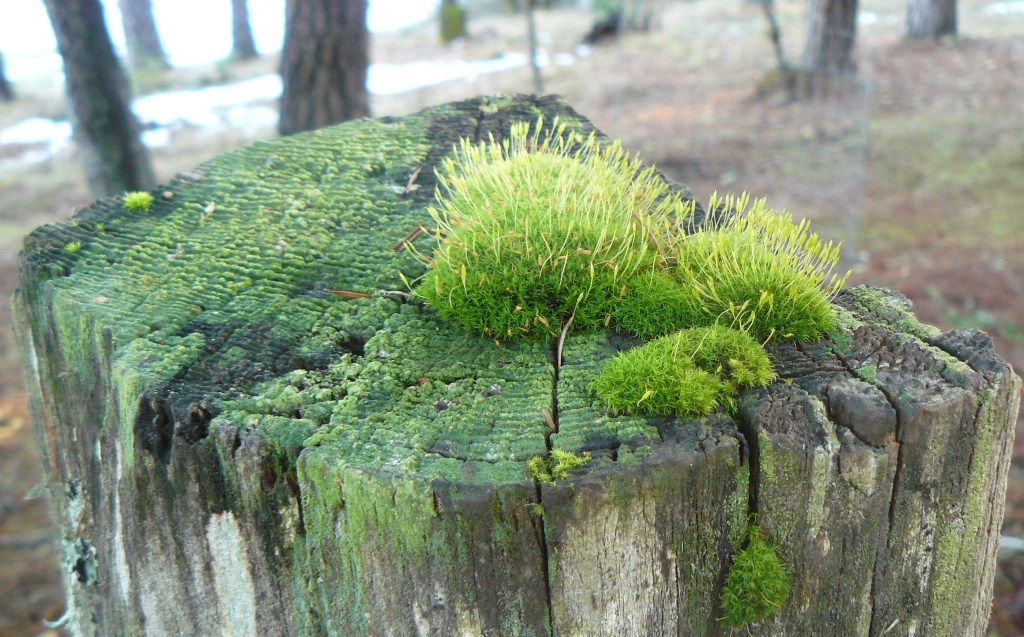
We have been working hard preparing stables in readiness for two miniature horses that we have purchased from our neighbours, Margo and Clarence. Last Tuesday, we were busy at this when I saw another breathtakingly beautiful sight.
Just some growth on the top of an old fence post. But the words utterly fail the image. Here it is.
Then about an hour ago (yesterday), while struggling to write this post, I heard the dogs barking in the bedroom next door. Went into the room and they were ‘speaking’ to some wild deer grazing our pasture land.
Wish I could wrap this all up with some profound view, some wise observations about life and the meaning of the universe!
But I can’t! Can’t make any sense of it at all. How did we get here? How did I meet Jeannie, this most precious woman, back in Christmas 2007? How did I sell up and walk away from Devon, England, with just Pharaoh by my side, to start this unbelievable new life with Jean and all the dogs?
“Why do you get out of bed in the morning, and why should anyone care?”
These words are spoken by Simon Sinek just before the three-minute mark in the video that follows. As Wikipedia explains,
Simon O. Sinek (born October 9, 1973) is an author best known for popularizing a concept of The Golden Circle.
He joined the RAND Corporation in 2010 as an adjunct staff member, where he advises on matters of military innovation and planning. His first TEDx Talk on “How Great Leaders Inspire Action” is the 7th most viewed video on TED.com.
His 2009 book on the same subject, Start With Why: How Great Leaders Inspire Everyone to Take Action (2009) delves into what he says is a naturally occurring pattern, grounded in the biology of human decision-making, that explains why we are inspired by some people, leaders, messages and organizations over others.
He has commented for The New York Times, Wall Street Journal, The Washington Post, Houston Chronicle, FastCompany, CMO Magazine, NPR and BusinessWeek, and is a regular contributor to The Huffington Post, BrandWeek, IncBizNet.
This new year that we are now in is going to require millions of us to think and do differently. As Einstein so famously quoted, “Insanity: doing the same thing over and over again and expecting different results“. More than ever before we need different results and that means thinking and doing differently.
Life has a habit of reflecting our own perceptions back to us.
Dear friend, Bob Derham, can always be counted on to forward something amusing or inspirational. The Boxing Day smile was an example of the former. Today is an example of the latter.
oooOOOooo
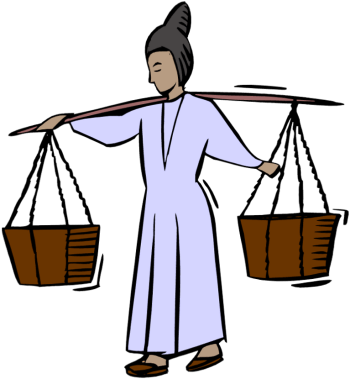
An elderly Chinese woman had two large pots, each hung on the ends of a pole which she carried across her neck.
One of the pots had a crack in it while the other pot was perfect and always delivered a full portion of water.
At the end of the long walks from the stream to the house, the cracked pot arrived only half full.
For a full two years this went on daily, with the woman bringing home only one and a half pots of water.
Of course, the perfect pot was proud of its accomplishments.
But the poor cracked pot was ashamed of its own imperfection, and miserable that it could only do half of what it had been made to do.
After two years of what it perceived to be bitter failure, it spoke to the woman one day by the stream.
‘I am ashamed of myself, because this crack in my side causes water to leak out all the way back to your house.’
The old woman smiled, ‘Did you notice that there are flowers on your side of the path, but not on the other pot’s side?’
”That’s because I have always known about your flaw, so I planted flower seeds on your side of the path, and every day while we walk back, you water them.’
For two years I have been able to pick these beautiful flowers to decorate the table.
Without you being just the way you are, there would not be this beauty to grace the house.’
Each of us has our own unique flaw. But it’s the cracks and flaws we each have that make our lives together so very interesting and rewarding. You’ve just got to take each person for what they are and look for the good in them.
So, to all of my cracked pot friends, have a great day and remember to smell the flowers on your side of the path!
oooOOOooo
Nothing more one can add to that. Well, sorry, there is one thing I can add. That is that dogs love us with all our flaws and quirkiness.





 Learning from Dogs