Category: People

Studs Terkel

Gobsmackingly powerful writing!

Back on the 28th October, Tom Engelhardt published over on TomDispatch: Tomgram: Studs Terkel on Death and Forgiveness in America.  I read the essay early on that morning and was blown away by it; to use the modern venacular.  I checked with Tom that it was alright for me to republish here but decided to delay that for a couple of weeks.

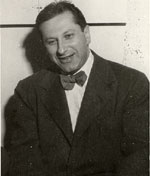
The Tomgram included two essays by Studs Terkel, an author I hadn’t come across, and a terrible omission for this amateur author. His website provides this biographical overview:

Studs Terkel, prize-winning author and radio broadcast personality was born Louis Terkel in New York on May 16, 1912. His father, Samuel, was a tailor and his mother, Anna (Finkel) was a seamstress. He had three brothers. The family moved to Chicago in 1922 and opened a Studs biorooming house at Ashland and Flournoy on the near West side. From 1926 to 1936 they ran another rooming house, the Wells-Grand Hotel at Wells Street and Grand Avenue. Terkel credited his knowledge of the world to the tenants who gathered in the lobby of the hotel and the people who congregated in nearby Bughouse Square, a meeting place for workers, labor organizers, dissidents, the unemployed, and religious fanatics of many persuasions. In 1939 he married Ida Goldberg and had one son.

Terkel attended University of Chicago and received a law degree in 1934. He chose not to pursue a career in law. After a brief stint with the civil service in Washington D.C., he returned to Chicago and worked with the WPA Writers Project in the radio division. One day he was asked to read a script and soon found himself in radio soap operas, in other stage performances, and on a WAIT news show. After a year in the Air Force, he returned to writing radio shows and ads. He was on a sports show on WBBM and then, in 1944, he landed his own show on WENR. This was called the Wax Museum show that allowed him to express his own personality and play recordings he liked from folk music, opera, jazz, or blues. A year later he had his own television show called Stud’s Place and started asking people the kind of questions that marked his later work as an interviewer.

In 1952 Terkel began working for WFMT, first with the “Studs Terkel Almanac” and the “Studs Terkel Show,” primarily to play music. The interviewing came along by accident. This later became the award-winning, “The Studs Terkel Program.” His first book, Giants of Jazz, was published in 1956. Ten years later his first book of oral history interviews, Division Street: America, came out. It was followed by a succession of oral history books on the 1930s Depression, World War Two, race relations, working, the American dream, and aging. His last oral history book, Will the Circle Be Unbroken: Reflections on Death, Rebirth, and Hunger for a Faith, was published in 2001.

Late into his life Terkel continued to interview people, work on his books, and make public appearances. He was the first Distinguished Scholar-in-Residence at the Chicago Historical Society. His last book, P.S.: Further Thoughts from a Lifetime of Listening was released in November 2008. Terkel died on October 31, 2008 at the age of 96.
Although the TomGram includes two essays from Stud, I’m going to split it and republish the first essay, together with Tom’s introduction.

Prepare to be very moved!

ooOOoo

Tomgram: Studs Terkel on Death and Forgiveness in America

Posted by Studs Terkel at 8:00am, October 28, 2014.
Follow TomDispatch on Twitter @TomDispatch.

Studs Terkel, who put oral history on the American map with one spectacular book after another, was a small man who had a knack for making everyone around him feel larger than life. He taught me the first significant lesson I learned as a book editor — and he didn’t even know it. I stumbled into Pantheon Books in the summer of 1976, hired (on the basis of remarkably little) by André Schiffrin, who ran that pioneering publishing outfit. I had only the most minimal idea of what a book editor was or did, but on one thing I was clear: I was going to put new voices between covers. (I would later start calling them “voices from elsewhere, even when the elsewhere is here.”) I couldn’t have been less interested in well known or famous writers. I was, that is, something of a reverse snob.

Nonetheless, one day that first fall André came into my office with the manuscript of Stud Terkel’s memoir, Talking to Myself, which was to be published the following spring. He asked me to read it because Studs — he claimed — wanted my reaction. A longtime Chicago radio personality, who had even hosted an early, unscripted TV show, “Studs’ Place,” set in a fictional bar (the “Cheers” of its era), he was well known indeed. The first book he and André had done together, Division Street: America, had broken into bestsellerdom and neither of them had ever looked back.

Studs didn’t know me from a hole in the wall, so I didn’t take the request seriously until André returned a few days later to ask whether I had read the manuscript. I hadn’t. He said, “Please do. Studs is waiting anxiously.” Anxiously? That was hard to imagine, but when your boss insists… so I went home, read it, and two days later let him know what I thought. (What could you think, given that Studs was fantastic at what he did?) Soon after, he put me on the phone with Studs to tell him just how good it was and make a few modest, last-minute suggestions.

So many years later, I still remember that unforgettable voice (possibly the last on Earth out of which a cigar emerged) saying something like, “Do you really mean it, Tom?” What I’ll specifically never forget was the quaver in it, the shiver that seemed like a caricature of fear. After all, he was the best-known author I’d ever talked to and, as a young man with enough doubts of my own, it had never crossed my mind that a successful writer might feel vulnerable when it came to his latest work or give a damn about the opinion of a total nobody. In a way, that moment taught me everything I needed to know about the essential vulnerability of the writer and, thanks to Studs, I never looked back.

For years, André, who was his editor, would call me in to take a final look at his oral histories. (It was like sending in the second team.) Only after I left Pantheon did I became Studs’ primary editor. It was the experience of a lifetime. Just to give you a little taste of the man, I’m including excerpts from the only letter of his I still have, typed by hand, filled with X’d out words, and further hand-corrected in pen. It came with the first batch of rough interviews for the final book we worked on together, an oral history of political activism aptly titled Hope Dies Last. By that time, Studs was in his early nineties and still a human dynamo. Maxwell Perkins, whom he mentions, was a famed editor who joined the venerable firm of Scribner’s wanting to publish vibrant young voices and ended up working with, among others, F. Scott Fitzgerald, Ernest Hemingway, and most famously the novelist Thomas Wolfe who simply couldn’t stop writing, which meant that his books involved marathon bouts of editing. Here, then, are the first two paragraphs of that letter in his telegraphese.

“Post-election day,” Studs began. “A hell of a time to write about hope… The ton of stuff — good and less than good. Since what you have is the raw stuff — I have already tossed aside about 20 [interviews] — I shall, of course, begin my cuts shortly after you receive this messy letter.

“You’ll be my Maxwell Perkins, though you don’t wear a hat, and I’m your Thomas Wolfe, though a foot and a half shorter than he was…”

And here’s how he ended: “I’m eagerly looking forward to your reactions when you get this bundle. Horrified [though] you may be by its bulk, remember you’re my Maxwell Perkins. If it works out, I’ll buy you a hat.”

What a guy (even if I never got that hat)! I always considered it appropriately Studsian that the book preceding Hope Dies Last was his oral history of death, Will the Circle Be Unbroken?: Reflections on Death, Rebirth, and Hunger for a Faith. Studs himself died in 2008. Circle has just been reissued in paperback with a new Jane Gross introduction by the New Press, the publishing house that André, who died last December, set up after he was forced out of Pantheon by Sy Newhouse, the right-wing owner of its parent company, Random House.

Given the grim panorama of death these days — from beheadings to pandemics — and the hysteria accompanying it all, I thought it might be both a relief and a change of pace at TomDispatch to turn back to Studs’ oral history of death, which as its editor I can testify is moving and uncannily uplifting. That, of course, is not as odd as it sounds from the man who was the troubadour for the extraordinary ordinary American. Thanks to the kindness of his publisher, the New Press, I’ve chosen two interviews from that book which stayed in my mind these last 13 years: the first focuses on an impulse that may be among the hardest to understand and yet most moving to encounter, forgiveness; and the second, from this country’s medical front lines, centers on a subject that, unfortunately, is still all too timely: the trauma deaths of young Americans from gunshot wounds. This is the only book I ever remember editing while, in some cases, crying. Tom

“You Got Into My Heart Violently, But You’re There”

Trauma, Death, and Forgiveness on the Front Lines of American Life
By Studs Terkel

[The following is excerpted from the new paperback edition of Studs Terkel’s oral history of death, Will The Circle Be Unbroken?: Reflections on Death, Rebirth, and Hunger for a Faith, with special thanks to his publisher, the New Press.]

“The Other Son”
Maurine Young

In contrast to her husband’s introspective nature, she is outgoing, a large-boned woman, overflowing with gusto and ebullience. She frequently laughs out loud.

I’m a forty-six-year-old woman of Jewish-Gentile descent — my father’s a Jew, my mother’s a Gentile. My parents divorced when I was young, and I was raised by my stepfather — raised Catholic. He was a truck driver. My younger brother, Mark, became a truck driver. I went to public school. But I went to the Catholic catechism every Wednesday. I did the confirmation and all that kind of stuff. I got close to age twelve, thirteen, and I began to see what I was saved from. I was saved from Hell. But what Catholicism wasn’t teaching me was what I was saved to. They didn’t tell me how to live with God and experience a taste of Heaven on Earth, now. So I began to pull away from the Church. It just didn’t meet my needs.

If I read my Bible I saw that it said very clearly to worship God, then why were people worshiping statues? To me that looked like idolatry. So, as a young teenager, I started asking questions. Then I began to wonder what is this all about? I know that there’s a God, and I know that He loves me, but what else is there? How do you live now? I lived in a very difficult, alcoholic home, and early in my teens began to experiment with drugs — do whatever I felt like doing. In the one sense, I had the Ten Commandments ingrained in me, so I knew what was right and wrong — but I didn’t really care about the consequences. I didn’t really understand the value of a God who loves me, and that because He loves me, I should act loving towards him, which means act loving towards everybody else. I was very, very selfish.

I had been working part-time jobs since I was fourteen. A couple of weeks after I graduated from high school, my dad said, “Get out of the backyard, sitting in your bikini, and get your butt downtown and find a job.” So I went downtown and found a secretarial position. I was seventeen. And then I moved out when I was eighteen, to live with my boyfriend. That didn’t work out. Moved back home and met Steve not that long afterwards, in March of 1975. We moved up here to Rogers Park and had a family. We had twins in May of 1977, Andrew Needham and Samuel Richard, born on different days — May 7 and May 8. And then in 1982, in August, we had Philip; and then in 1987, December, we had Clinton. I was working as a floral designer, part-time, in Skokie. Steve was tuning pianos.

Andrew went out to cash a check with his brother and didn’t come back. He was shot by a young man who had easy access to a handgun and who had graduated from high school the day before and was looking to move up in the gang that he was in, the Latin Kings. He shot Andrew, probably because Andrew didn’t back down with his mouth. He knew that gang members were idiots and didn’t mind telling them what he thought of them when they made signs at him. He was in our car.

When I got to the hospital and found out that he was gone, and I asked the boys what happened and they told me, I said, “Well, you know what? There’ll be no retaliation for this. I just want to make that clear.” Men usually want revenge; women, too, but men usually much quicker. Women will stew for a while. I knew that revenge was wrong, but I also knew that I hated what these kids had done and knew that they deserved to be punished. I pulled out some old journals from that time. These notebooks. Here’s an entry that I wrote July 13th of 1996. Andrew was murdered June 10th of 1996. It reads: “It’s been sixty days since Andrew left us. Forced out of his body by Mario and Roberto. Please, Lord, let justice be served. Plus, punish them. Let them not have a free life.” That’s how I felt. I did not want them to be free, and I was real glad that the police had seen what had happened.

I’m going to backtrack a tiny bit. My twins were three months old. I was sitting on the beach with them. Somebody came up to me and said, “Could we talk to you about Jesus?” And I said, “It’s a public park, it’s a free country, you can sit down.” So they started talking to me about Jesus. This lady turns to me and she says, “So how’s your life?” And her words shot into my chest like a sword. I’m thinking, Oh my God, what does she know? I had just had the twins. I was not coping. I was smoking massive amounts of marijuana. I was up twenty-four hours a day, not knowing how to keep these little babies on a schedule. I was fantasizing throwing one of them out the window. I was having what now I understand to be severe post-partum psychosis. I didn’t have any help. I was really just trying to hold on… So I began to tell this lady and her friends how poorly I was doing. She said, “Would you like to commit your life to Christ again?” And I said, “I really would. Because I realize I’m not doing very well by myself. Something is missing.” So I did that and I prayed that day. Since that day, I’ve been learning how to parent, and to let God love me, and to love and forgive others.

Nineteen years later, when this happened with Andrew being murdered, I said, “OK, I know who I’m following.” What would Jesus do? It was pretty clear. He says: Love your enemies — I consider these little guys my enemies that killed my son. Pray for those who use you, forgive as God has forgiven you. So I thought, OK, what does that mean? Looking back at another journal… this is from January of 1997. I wrote: “What are the obstacles to forgiveness? How can forgiveness free us? How can it free me? Well, first I needed to know that I must face my own pain and grieve. And not keep anger on, sort of as a suit of armor. Admit the wrong that was done to me and experience the rage. But be honest with God about my pain and why. Releasing my anger to him and pardoning the offender makes me feel vulnerable, even out of control. But what’s my choice? If I hold my anger, it will destroy me.” And then I also wrote, “It’s OK to be afraid of being hurt again.” So, obviously, the whole idea of forgiveness was there in the back of my mind the whole time, and I kept thinking: I want to kill them, I want to see them fry. But God says forgive… And I kept going back and forth thinking, How do you do this? Scratching my head. Then I realized I could make the choice and trust that the power to do it would be there. Because I know that my faith, which is just my yes, is the glue that holds God’s power to his promises. And He’s promised that He would do what I ask, He would do the right thing in my life. I’m going to have the faith and forgive and trust that He’s going to take care of it all. So I finally did that about July of 1997, about six months after what I just read to you. I forgave and wrote Mario in prison a letter. He was eighteen, my son was nineteen. I told him about my life. I just wanted him to know how I was raised, and that I had done plenty of things that needed forgiving and God forgave me. So how could I withhold forgiveness from him? I couldn’t. That I love him and God loves him and I forgave him.

I didn’t know that at the same time, he was writing me a letter. As I remember, he was begging forgiveness, saying how sorry he was, how he wished he could bring Andrew back, even trade places. And I believed his letter was sincere. But his letter was unnecessary for my forgiveness. I had been asking to see him.

It’s one thing to write to someone and say you forgive them — it’s another to physically touch them and say you forgive them. It would help me in my healing and him in his, I knew. I felt compelled to do it. I had been asking through his priest when was a good time. Mario kept saying, “I’m not ready. Mrs. Young is pushing too much. I’m not ready.” He was terrified. He thought I might hit him or something. He was not ready to face me. That was July of 1997. I didn’t get to see him until December 17th of 1998. So it took more than a year and a half before he was ready. And I waited. We did correspond. And then I went to visit him with Father Oldershaw, and a retired schoolteacher by the name of Arlene Bozack. She had been visiting him.

When we first got there, the assistant warden, who was Hispanic, was crying. He said, “Mrs. Young, why are you here?” I said, “Well, I’m here to offer forgiveness to the young man who killed my son.” And he said, “Why?” And I said, “Because I care about him, I love him. It’s the right thing to do. I want to do it in person.” He said, “In all my years, this is the first time I’ve ever seen this happen. I really commend what you’re doing.” He was this big, tough-looking Hispanic warden.

I see Mario for the first time. He couldn’t look at me. He had his head hanging down. They sat us around a small round table with four attached seats, told us where to sit. Everybody kept looking at me very suspiciously, like I was going to just jump on this kid and beat the hell out of him. Mario’s got his head hanging down, and all of a sudden he kind of looks, and he can’t make eye contact. I saw that his whole body was starting to shake. All four of us prayed. It was me, Father Oldershaw on my right, Mario was across from me, and Arlene Bozack was to his right.

I grabbed both Mario’s hands from across the table, and I looked at him in the eye, and I said, “I just want you to know that I’m glad to be here.” I knew I had to go first. He just shook his head. Slowly, but surely, the conversation started. Little chitchat, we all took turns talking. I wanted to know about his family and how they were doing. Because the shame that he brought on them — especially being an Hispanic family — that’s so important. And then the conversation changed a bit because I felt like, OK, it’s time for this little guy to hear what he’s done to us. The consequences of his actions. I began to tell him the difficulties that each of our family members was having. As I went through, person by person, saying, one young man’s suicidal, the other one can’t focus, or whatever the problems were for each of us, he listened. He held Arlene’s hand and he trembled and he wept, but he listened.

At some point in the conversation I said, “I love you like you’re my son, like you’re one of mine.” And I was like, “I can’t figure out how this happened!” [Laughs] I thought I was nuts. I didn’t tell him that. I was thinking, I gotta be crazy. So I said, “I love you like you’re my own son. You got into my heart violently, but you’re there. So this has to be a miracle. God did this. Because I didn’t do this. But, as a son, you have responsibilities to know what’s going on and to pray for us, to communicate with us regularly. You’re part of the family now.” Then he pulled out his Bible. I said, “Mario, there’s a Scripture that meant a lot to me and helped me take this step. I wanted to tell you what it is. It’s in Romans, in the twelfth chapter. It says, ‘Never pay back evil for evil to anyone. Respect what is right in the sight of all men. If possible, so far as it depends on you, be at peace with all men.’” I said, “My reaching out and extending and forgiving was my responsibility, and it didn’t depend on whether or not you accepted that forgiveness. I had to do that.” It also says, “Never take your own revenge, but leave room for the wrath of God.” Then I said what was really important was when I got to verse 21. It says, “Do not be overcome by evil, but overcome evil with good.” I said, “Mario, that really meant a lot to me. Because I wanted to win. I did not want this evil thing that you and Roberto did to us to win. I wanted good to win. So that’s why I forgave you and that’s why I love you.”

He was speechless. He looked at me like I had two heads. [She roars with laughter.] He stared at me like: I don’t know what she’s talking about — she’s from another planet. It wasn’t quite sinking in. But he was listening. I heard later that he was confused and didn’t understand it, but it was beginning to make sense. He was actually holding his Bible open to this spot, looking at it over and over and over again. We talked, and then I got to hold him. That was really, really special. Here’s another reason I thought I was crazy: I’m sitting across this little table from him, and it’s all I can do to stay in my seat. I’m thinking: What’s wrong with me? Am I having a nervous breakdown? Everything in me wanted to leap over the table, grab hold of this kid, and rock him like a baby, just hold him. The urge was so overwhelming. The compulsion was so overwhelming, I was afraid that if I couldn’t keep control, I’d be in really big trouble with the guards and the warden. So I resisted that urge the whole time.

On the way back home, I was thinking about it, and then I talked to Arlene and Father Oldershaw. I said, “I’ve got it! I know what was happening. I was getting a taste in my body of how much God loves us. He loves us so much that He wants to leap over the table, grab hold of us, and just rock us because we’re his children.” That love, that forgiveness — I got a taste of what it must have been like for Jesus when he was here and walked the Earth among people that he loved so desperately, so wonderfully. I got a taste of it!

As time went on and we kept corresponding, I did go see him again there, and it was good. I really began to see him maturing, through his letters and through visiting him. I was training him, I was mentoring him — to help him to grow up, to help him in his spiritual walk. His letters changed. They became clearer, he became more willing to take total responsibility. I saw no excuses anymore, I saw a person that was squarely saying: This is where I am and this is where I should be, and God’s changing me right here, and probably being here saved my life. He’s working as a chaplain’s assistant now… [Sighs]… I’m convinced that if I did not forgive and I held on to my anger, that I probably would have become mentally ill. Maybe killed myself, maybe hurt someone else. I felt like God’s hand was on me and he was squashing me into a pancake: You gotta do this — this is the right thing.

I knew that there were great things ahead, although they terrified me, the thought of going out into new territory. Because, I’ll tell ya, I was not a very forgiving person most of my life. I used to hold things against whoever did what to me. It really took the murder of my son and the forgiving of his killer to teach me how to forgive everybody around me. I began to realize: My husband’s not going to be Mr. Perfect. My parents haven’t been perfect parents. My children are not perfect children. My friends are going to let me down. That’s a given. Because they’re human, like I am. There is one perfect, that is God, and He loves me. And that’s good enough for me. So, by forgiving them, like I did Mario, it freed me to really love. My love was, like, stopped up in a bottle or something. It came out in little bits. But for the most part, it was stopped up until I forgave this kid. And then it was like whoosh — this is what I’ve been missing my whole life. [Belly laugh]

I saw Mario just this last month. I’ve met his mom and his dad. They don’t speak any English, but usually one of his sisters is there to interpret. Most of the time, all his mother can do is hold on to me and cry. She’s a very sweet person.

ooOOoo

Did warn you about being very moved!
The book! Part Three: Selfishness

Selfish is a plain word that is easily understood. Well one would easily think so! Thus, one might grant, so too would the word selfishness be easily understood.

Let’s start with the dictionary.

Selfishness: n stinginess resulting from a concern for your own welfare and a disregard of others.
Selfish: adj concerned chiefly or only with yourself and your advantage to the exclusion of others

The dictionary entry for Selfish goes on to explain:

Someone who is selfish cares only about themselves and doesn’t consider others. If a ship is sinking and you refuse to let anyone else into your 4-person lifeboat, you’re extremely selfish.

Selfish combines the pronoun self-, meaning to or for yourself, with the suffix-ish, for “having the character of.” So if your actions are selfish, they all have to do with getting something for yourself, like attention, or candy, or power. Selfish is usually meant to be an insult; someone selfish goes beyond just taking care of themselves, and actively takes from others. The opposite of selfish is self-sacrificing, which means, “giving everything to others and sacrificing your own needs.”

All well and good.

Where it starts to be less than ‘black and white’ is when the issue of boundaries is embraced. In other words, the boundary between what is absolutely selfish, what is moderately selfish, what is moderately self-sacrificing and what is absolutely self-sacrificing. Underlining the subjective nature of the words selfish and selfishness. That’s even before considering that one man’s selfishness is another’s normal behaviour!

There’s a blogsite called Psychology of Selfishness authored by Ifat Glassman, a painter living in Redmond, Washington, USA. I have no knowledge of whether or not she has an academic background in psychology but a post on that blogsite back in February, 2010 certainly offers some intriguing ideas.

Thursday, February 18, 2010
What is Selfishness?
Before I get into what selfishness is I want to briefly answer – why is it important to know what is selfishness and what is not?
The reason is that selfishness is a fundamental principle – whom are you live for – for yourself or for others, and what does it even mean to live for yourself? The answer to these questions can determine the course of your life, the kind of actions you take and the emotional reward you ultimately receive from your life.
Secondly, selfishness is an ethical issue. If one misidentifies what selfishness is, one can experience unearned guilt or live a life which is not as good as one could have.

Ms. Glassman is spot on, in my humble opinion, in regarding selfishness as both an issue of ethics and a fundamental principle of life.

However, she goes on to say, after quoting “one of Ayn Rand greatest achievements was her identification of the true meaning of “selfishness”, to say:

The person who kills and steals and the person who produces and earns are considered as having the same moral quality, since they both do it to promote their own ends.
Is it any wonder, then, that people condemn selfishness – and is it any wonder that so many people feel guilty for any kind of happiness or enjoyment they pursue for themselves, not for others?
The fault here is in the basic understanding of what selfishness is, and in replacing “lack of value for human life” with “selfishness”.

I have a significant problem with the idea that a murderer can have the same moral quality as one who produces and earns and I don’t doubt I am alone with that opinion.

As do I have a problem with a sentence towards the end of her essay, “Selfishness, is actually demanding. Because happiness is demanding.” Clearly a need to turn to Ayn Rand herself for greater clarification.

But before so doing, you and I need to understand what is meant by Objectivism.

The website of The Atlas Society explains:

Objectivism is the philosophy of rational individualism founded by Ayn Rand (1905-1982).

Objectivism holds that there is no greater moral goal than achieving happiness. But one cannot achieve happiness by wish or whim. Fundamentally, it requires rational respect for the facts of reality, including the facts about our human nature and needs. Happiness requires that one live by objective principles, including moral integrity and respect for the rights of others. Politically, Objectivists advocate laissez-faire capitalism. Under capitalism, a strictly limited government protects each person’s rights to life, liberty, and property and forbids that anyone initiate force against anyone else. The heroes of Objectivism are achievers who build businesses, invent technologies, and create art and ideas, depending on their own talents and on trade with other independent people to reach their goals.

Objectivism is optimistic, holding that the universe is open to human achievement and happiness and that each person has within him the ability to live a rich, fulfilling, independent life.

In the introduction to her book, The Virtue of Selfishness, Ayn Rand proposes:

The Objectivist ethics proudly advocates and upholds rational selfishness—which means: the values required for man’s survival qua man—which means: the values required for human survival—not the values produced by the desires, the emotions, the “aspirations,” the feelings, the whims or the needs of irrational brutes, who have never outgrown the primordial practice of human sacrifices, have never discovered an industrial society and can conceive of no self-interest but that of grabbing the loot of the moment.

The Objectivist ethics holds that human good does not require human sacrifices and cannot be achieved by the sacrifice of anyone to anyone. It holds that the rational interests of men do not clash—that there is no conflict of interests among men who do not desire the unearned, who do not make sacrifices nor accept them, who deal with one another as traders, giving value for value.
The meaning ascribed in popular usage to the word “selfishness” is not merely wrong: it represents a devastating intellectual “package-deal,” which is responsible, more than any other single factor, for the arrested moral development of mankind.

In popular usage, the word “selfishness” is a synonym of evil; the image it conjures is of a murderous brute who tramples over piles of corpses to achieve his own ends, who cares for no living being and pursues nothing but the gratification of the mindless whims of any immediate moment.

Yet the exact meaning and dictionary definition of the word “selfishness” is: concern with one’s own interests.

This concept does not include a moral evaluation; it does not tell us whether concern with one’s own interests is good or evil; nor does it tell us what constitutes man’s actual interests. It is the task of ethics to answer such questions.

When Ayn Rand goes on to write about those differences between the murderer and the worker, it shows to me that Ms. Glassman misinterpreted Rand’s proposition. Again, from Ayn Rand’s book:

There is a fundamental moral difference between a man who sees his self-interest in production and a man who sees it in robbery. The evil of a robber does not lie in the fact that he pursues his own interests, but in what he regards as to his own interest; not in the fact that he pursues his values, but in what he chose to value; not in the fact that he wants to live, but in the fact that he wants to live on a subhuman level (see Ayn Rand’s book, “The Objectivist Ethics”).

That’s clearer to me; much more so. Yet it only goes to reinforce the maze within which one can easily become lost when exploring these ideas of selfishness.

Let me offer a little more from Ayn Rand:

If it is true that what I mean by “selfishness” is not what is meant conventionally, then this is one of the worst indictments of altruism: it means that altruism permits no concept of a self-respecting, self-supporting man — a man who supports his life by his own effort and neither sacrifices himself nor others. It means that altruism permits no view of men except as sacrificial animals and profiteers-on-sacrifice, as victims and parasites—that it permits no concept of a benevolent co-existence among men—that it permits no concept of justice.
To redeem both man and morality, it is the concept of “selfishness” that one has to redeem.

The first step is to assert man’s right to a moral existence — that is: to recognize his need of a moral code to guide the course and the fulfillment of his own life . . . .

The reasons why man needs a moral code will tell you that the purpose of morality is to define man’s proper values and interests, that concern with his own interests is the essence of a moral existence, and that man must be the beneficiary of his own moral actions.

Since all values have to be gained and/or kept by men’s actions, any breach between actor and beneficiary necessitates an injustice: the sacrifice of some men to others, of the actors to the nonactors, of the moral to the immoral. Nothing could ever justify such a breach, and no one ever has.

Ayn Rand then closes her Introduction by offering this proposition:

Just as man cannot survive by any random means, but must discover and practice the principles which his survival requires, so man’s self-interest cannot be determined by blind desires or random whims, but must be discovered and achieved by the guidance of rational principles. This is why the Objectivist ethics is a morality of rational self-interest—or of rational selfishness.

Since selfishness is “concern with one’s own interests,” the Objectivist ethics uses that concept in its exact and purest sense. It is not a concept that one can surrender to man’s enemies, nor to the unthinking misconceptions, distortions, prejudices and fears of the ignorant and the irrational. The attack on “selfishness” is an attack on man’s self-esteem; to surrender one, is to surrender the other.

How to summarise all of this with respect to the central theme of this section of the book? Back to that definition of Objectivism from The Atlas Society that was included earlier on. Back to these sentences:

Objectivism holds that there is no greater moral goal than achieving happiness. But one cannot achieve happiness by wish or whim. Fundamentally, it requires rational respect for the facts of reality, including the facts about our human nature and needs. Happiness requires that one live by objective principles, including moral integrity and respect for the rights of others.

Back to one single sentence: “Fundamentally, it requires rational respect for the facts of reality, including the facts about our human nature and needs.

I am drawn to Ernest Hemmingway’s classic novel, For Whom The Bell Tolls. Simply for the reason that the phrase seems so apt for mankind in this 21st century. The bell tolls for all of mankind and will not cease its tolling until we embrace a rational respect for the facts about our human nature and our needs.

1,849 words Copyright © 2014 Paul Handover

The book! Part Three: Introduction

I described in the previous chapter how these are ‘interesting times’; albeit not using that particular phrase. What I wrote was, “ …. the feeling that we humans have to look outside of ourselves to find the inspiration and the motivation needed to make the changes in the sort of short timescales our present circumstances demand.

Expanding that to state: “We live in very challenging times. Widely acknowledged for it seems rare these days to meet someone who doesn’t sense, to one degree or another, a feeling of vulnerability to today’s world. A sense that many aspects of their lives are beyond their control.
These are also times where it is widely acknowledged that the levers of privilege and money are undermining the rights and needs of so many, that there are unprecedented levels of deceit, lying and greed; all enveloped within an abuse of power.
That’s even before we embrace the matter of climate change and whether or not there is a potential “end-of-world” tipping point; the so-called beat of the butterfly’s wing.

The rest of this section, under the theme of the challenges of our present times, of necessity, takes a closer look at six areas that, when I was musing about the construction of this book, came to mind as worthy of a degree of introspection. Six chapters that explore Selfishness, Power and Corruption, Short-termism, Poverty, Greed and, lastly, Materialism.

Now the last thing I want you, dear reader, is to groan and put down the book simply because you have no wish to plough through a litany of all that is wrong with our present times, most of which you are probably familiar with.

My justification for the following chapters is fundamentally wanting you to see where I am coming from and why I believe that these modern times are so very dangerous times for humanity, and much else in the natural world, and that we, as in mankind, have to find a way forward.

That’s how I set out when thinking about the overall objectives of this section. That my purpose was to reveal my own knowledge of each issue, including a good dollop of research, to offer my personal perspective of each same issue, and to allow you, the reader, to form your own conclusions and, inevitably, how much you agree or disagree with me.

But there are also some surprises; well there were for me. As I undertook the research into each aspect of the psychology, and more, of these challenges, I discovered much that had never occurred to me before. I suspect I am not alone regarding these findings.

So gird up your loins for a while as we start into the first aspect of these interesting times. Which is about the power of negativity.

464 words Copyright © 2014 Paul Handover

Whoops!

Yesterday, I published a chapter from ‘the book’ under the title of The Power of Negativity.

However, as I contemplated a number of chapters coming along that, taken collectively, might seem out of place in a book that, essentially, offers a positive message, I decided an introduction was called for.

Thus in thirty minutes time that introduction is published.

I also realised that this introduction should have come before yesterday’s chapter on negativity.

So for those of you that might be following my draft, you poor souls, try and come at the Introduction as if it had been presented before The Power of Negativity.

Now for a complete change of topic!

Neighbour Dordie recently sent me the following.  Here’s Part One.

ooOOoo

The Washington Post’s Mensa Invitational once again invited readers to take any word from the dictionary, alter it by adding, subtracting, or changing one letter, and supply a new definition.

Here are the winners:

1. Cashtration (n.): The act of buying a house, which renders the subject financially impotent for an indefinite period of time.

2. Ignoranus: A person who’s both stupid and an asshole.

3. Intaxicaton: Euphoria at getting a tax refund, which lasts until you realize it was your money to start with.

4. Reintarnation: Coming back to life as a hillbilly.

5. Bozone (n.): The substance surrounding stupid people that stops bright ideas from penetrating. The bozone layer, unfortunately, shows little sign of breaking down in the near future.

6. Foreploy: Any misrepresentation about yourself for the purpose of getting laid

7. Giraffiti: Vandalism spray-painted very, very high.

8. Sarchasm: The gulf between the author of sarcastic wit and the person who doesn’t get it.

9. Inoculatte: To take coffee intravenously when you are running late.

10. Osteopornosis: A degenerate disease. (This one got extra credit)

11. Karmageddon: It’s like, when everybody is sending off all these really bad vibes, right? And then, like, the Earth explodes and it’s like, a serious bummer.

12. Decafalon (n):The grueling event of getting through the day consuming only things that are good for you.

13. Glibido: All talk and no action.

14. Dopeler Effect: The tendency of stupid ideas to seem smarter when they come at you rapidly.

15. Arachnoleptic Fit (n.): The frantic dance performed just after you’ve accidentally walked through a spider web.

16. Beelzebug (n.): Satan in the form of a mosquito, that gets into your bedroom at three in the morning and cannot be cast out.

17. Caterpallor (n.): The color you turn after finding half a worm in the fruit you’re eating.

ooOOoo

Weren’t they fun?!

Part Two later on this week.

The book! Part Two: The power of negativity.

All we have to fear is fear itself.

Our brains are hard-wired to fear the things that could harm us. It’s an essential legacy of our early days when spiders, snakes and other harmful creatures, too numerous to list, could kill us. The part of the brain that protects us in this manner is the amygdala, an area of our brain that could be seen as our “fear centre”. It is an essential part of the body’s panic response system and numerous studies have shown that it lights up when people get scared in response to frightening situations. (Although recent research suggests that it may not be as simple as the amygdala being the direct source of our fear. I’m referring to a paper published in Nature Neuroscience in February, 2013.)

But whatever the precise human biological process in dealing with frightening situations, it doesn’t alter the fact that, to a very great extent, our lives in the twenty-first century are hamstrung by this ancient reflex action we all carry. What I have in mind is how we all tend to react to bad news as compared to good news. How our attention is much more likely to be grabbed by something frightening or sensational than by something positive, with the media headlines being the prime candidates of this.

A web search for classic newspaper headlines brought to light some wonderful old-timers. What about the English newspaper The Sun that ran a now infamous headline ‘Freddie Star Ate my Hamster‘ on its front page on March 13, 1986. The story was untrue, by the way!

Or the Australian Daily Telegraph in 1974 that announced: DARWIN TERROR STORM: 40 DIE!
Or The Washington Post of Monday, July 28th, 1952 that proclaimed: ’Saucer Outran Jet, Pilot Reveals’.

The advertising industry knows full well that making people feel needy, even if only very temporarily, is essential to generating a sale.

Not just the advertising industry. I well recall when I was a humble office equipment salesman for IBM in the UK in the early 1970s and helping spread the acceptance of the IBM Selectric typewriter, or golfball typewriter as it was often called, that when in front of a potential customer, one tried all sorts of questions that focussed on the limitations of the conventional electric typewriter. Asking questions such as how frequently did the typebars clash, or was there ever a need to have a different typeface?

Now these are quaint, almost charming examples of stirring up fear. Utterly trivial when compared to the heavy stuff. Around the time of writing the first draft of this book, in October 2014, the International Business Times ran a headline: US-Russia Nuclear War Could Wipe Out Humanity – Nuclear Physician Warns. The story opening:

A nuclear war that will deplete the ozone layer, emit radioactive pollution, form massive fire storms, and a nuclear winter could ignite between the United States and Russia over the Ukraine crisis. Helen Caldicott, an Australian physician, an advocate of citizen action to address nuclear and environmental crises, the founding president of Physicians for Social Responsibility and a 1985 Nobel Prize nominee warns that the Cold War has returned and could escalate into a nuclear war between Russia and the United States. “It’s an incredibly dangerous situation. … If there’s a nuclear war tonight, that’s the Northern Hemisphere (of the entire world) gone,” she said at the National Press Club Newsmaker press conference.

If there’s a nuclear war tonight, that’s the Northern Hemisphere (of the entire world) gone,”

Now that’s negativity of the first order, and if you detect a slightly light-hearted tone to my words, then that is not intentional. It is just that it’s almost impossible, in my humble opinion, to have any serious, rational response to such a news item. We have no control over the ‘games’ being played by the superpowers, we can do nothing to prevent such an event, and were it to happen there is no practical response one could take.

Still the negativity has the potential to be increased by more extreme dire warnings. And the dire warning of all dire warnings is the one about mankind’s impact on this planet: climate change; loss of natural resources; over population; et al. Again, to a very great extent, we have no control over the ‘big picture’. The difference between a nuclear Armageddon and climate change is that most people can see the signs all around them. That’s a powerful source of personal fear.

There was an article in Psychology Today written by Dr. Alex Lickerman (Alex Lickerman, M.D., is a general internist and former Director of Primary Care at the University of Chicago and has been a practicing Buddhist since 1989.) in October, 2011 under the title of How to Reduce Negativity. Dr. Lickerman made the point that, “Though we all have negative selves, there seem to be only two basic reasons they appear: one is as a result of a lack of self-confidence, or belief that we can solve a particular problem; the other is simply out of habit.

If that is read quickly, it’s easy to take it as “one is as a result of a belief that we can solve a particular problem“, as I did. Then on re-reading it, the meaning became clear. One of the reasons our negativity can appear “is as a result of a lack of belief that we can solve a particular problem …” I underlined a part of the sentence because it needs to sit squarely on the shoulders of our consciousness.

Once one has understood the ease with which the wider world, and especially how it is reported, affects us then we are armed, so to speak, to actively counter any negativity that arises in us.
Now I quoted Dr. Lickerman from a little way into his article in Psychology Today. But his opening words are extremely valuable for all of us to consider.

In one sense, the battle to be happy is a battle against negativity. Bad things happen all the time but how we internalize them, how we react to them, is what ultimately determines their final effect on us — and over that we have simultaneously more and less control than we realize. More, because we assign the meaning of events, not the events themselves, even though it feels as if that meaning is somehow assigned for us. Yet less, because we can rarely simply decide when confronted with a negative life event that is is, in fact, actually positive. To do that, we have to find a way to actually believe it, and that requires a process of continual self-reflection and attitude training; a program designed to strengthen our life force, so to speak.

Later on in Part Four there are a number of chapters that explore the power of positive thoughts and ways of countering the negativity that is so often in our faces.

1,124 words Copyright © 2014 Paul Handover

Kevin Richardson – a repeat posting.

Taking a shortcut and reposting something from 2009

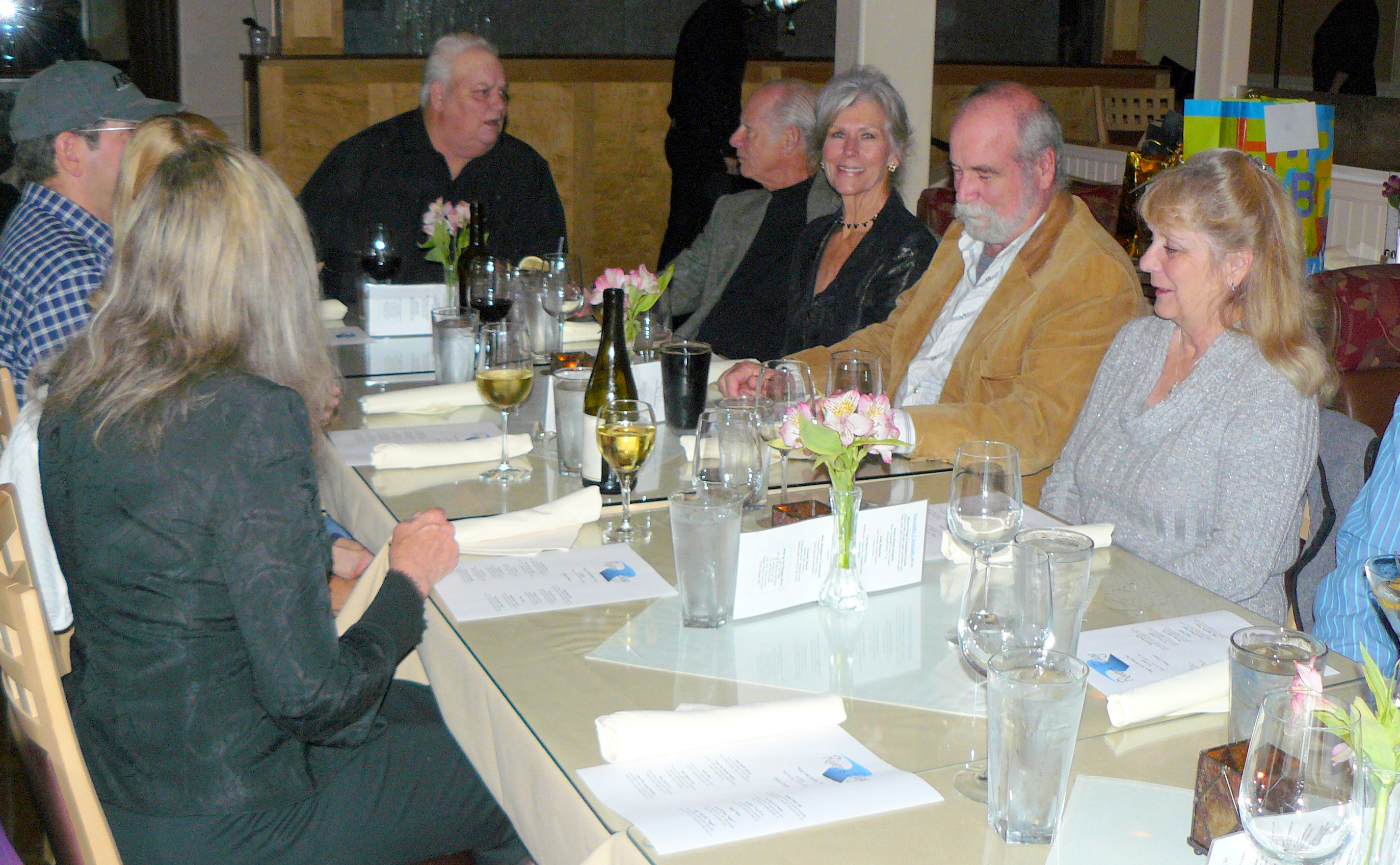
Yesterday, Sunday, was a quiet day. For several good reasons.  Firstly, on Saturday evening Jean and I and eleven of our close neighbours enjoyed a glorious birthday meal at the River’s Edge restaurant in Grants Pass.

P1150242

That meant, inevitably, that Jean and I were a little jaded yesterday.

Secondly, I needed to get my head down and put a few thousand words under my belt in terms of NaNoWriMo and ‘the book’.

Lastly, a comment from a new reader to a post that was published nearly five years ago reminded me of how special a person is Kevin Richardson.  Here’s that comment:

Paul, this article is amazing. Thank you so much for taking the time to write this, I’m a huge fan of Kevin. So is my Marine boyfriend who actually told me to look him up, this man is truly remarkable. I’ve always wanted to work with animals, my dream is to be a veterinary pathologist but lately I’ve been so stressed with school and college I wasn’t sure if I could make it. But Kevin is the one who has motivated me to continue to pursue my dream, so you think there’s a way I could contact him? I know it’s kinda crazy but I would love to get to speak to him. My boyfriend looks up to him alot too and I’ve tried looking for it but I had no luck. If there’s the possibility that you may know where I could find it or somehow contact him I would greatly appreciate it. Thank you so much. Maria.

So here is that post, and can anyone find a way to help Maria? (I have her email address.)

oooo

Remarkable people – Kevin Richardson

December 30th, 2009

Trust is both taught and learnt!

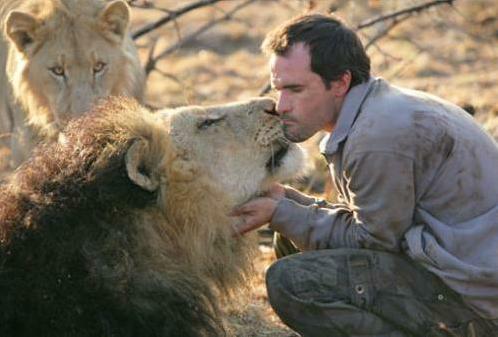
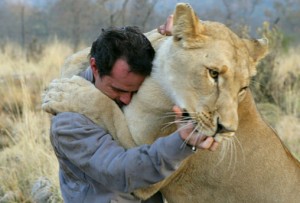
Thanks to Naked Capitalism, we posted an item on the 19th December about an unknown wild-life ranger working in the wildlife refuge area of Lanseria, South Africa.  Here was one of the pictures included in that Post:

The Post finished with an appeal to anyone that knew the name of this Ranger.  Many of you did and responded; thank you!

His name is Kevin Richardson and there is an interesting account of how he works and some of his ‘experiences’ in Revolution Magazine, luckily with online content.  That article is here.  It starts thus:

To do this he does not use the common methods of breaking the animal’s spirit with sticks and chains, instead he uses love, understanding and trust. With this unusual method of training he has developed some exceptionally personal bonds with his students. He sleeps with lions, cuddles newborn hyenas, swims with lionesses.  Kevin can confidently look into their eyes, crouch to the their level and even lie down with them – all taboos in the normal world of wild animal handling – yet he doesn’t get  mauled or attacked.

The article goes on to say that Kevin often works with the animals when they are very young.  Thus he is demonstrating very powerfully that how we behave, especially with our children when they are young, creates the environment for building trust out of consistency of deed and thought.  (By the way, do read some of the comments posted at the end of that Magazine article – some of them make for powerful reading.)

Kevin Richardson at ‘work’.

Luckily, thanks to this wired world we now live in, there is also video of Kevin available on YouTube.  A quick search under Kevin Richardson on YouTube will quickly find a number of videos but here are two that I wanted to share with you.

The first will leave you speechless and possibly wet-eyed!

The second is a promotional video by Kevin encouraging us to buy his recent book – and why not!

This is a very remarkable person and it’s an honour to share this with you.  We have so much to learn from all animals.

oooo

Beats many ‘day’ jobs!

Picture parade sixty-nine

Breathtakingly beautiful planet of ours!

National Geographic’s annual photo contest brings in some of the most extraordinary images from around the globe. Professional and amateur photographers alike submit shots in the categories of people, places, and nature and deliver a visual feast of the world in all its splendor.

Winners of the competition will be announced later this year, but in the meantime, here are some of the striking scenes (along with captions from the photographers) that Nat Geo was kind enough to share with us. Have a look.

"In the Strezlecki desert of Australia, a flock of galahs replenish on the only small water available at the base of this lonely tree. It’s a rare photo opportunity to get such a clear and symmetrical shot of these beautiful birds in flight in the middle of the desert." Location: Strezlecki Desert, Australia.
“In the Strezlecki desert of Australia, a flock of galahs replenish on the only small water available at the base of this lonely tree. It’s a rare photo opportunity to get such a clear and symmetrical shot of these beautiful birds in flight in the middle of the desert.” Location: Strezlecki Desert, Australia. Photo by Christian Spencer.

oooo

"I was finishing up a photo shoot when a wild kangaroo appeared out of nowhere and bounded onto the lake, as if walking on water. This, along with the picturesque sunset combined to create an absolute visual treat!" Location: Noosa, Queensland, Australia.
“I was finishing up a photo shoot when a wild kangaroo appeared out of nowhere and bounded onto the lake, as if walking on water. This, along with the picturesque sunset combined to create an absolute visual treat!” Location: Noosa, Queensland, Australia. Photo by Dave Kan.

oooo

"An early morning ride through Yellowstone National Park in the winter is always a treat. On this very chilly morning, hardly a sound was heard as this herd of bison reminded us that we are the visitors in their land." Location: Yellowstone National Park, Wyoming, United States.
“An early morning ride through Yellowstone National Park in the winter is always a treat. On this very chilly morning, hardly a sound was heard as this herd of bison reminded us that we are the visitors in their land.” Location: Yellowstone National Park, Wyoming, United States. Photo by Karoline Sleichter.

oooo

"This disorienting photo was taken from a cliff overlooking Lake Louise. Two people are enjoying a canoe ride on the lake's turquoise waters. Even boulders the size of large cars seem like pebbles from a high vantage point." Location: Lake Louise, Banff National Park, Alberta, Canada. Photo by Ben Leshchinsky.
“This disorienting photo was taken from a cliff overlooking Lake Louise. Two people are enjoying a canoe ride on the lake’s turquoise waters. Even boulders the size of large cars seem like pebbles from a high vantage point.” Location: Lake Louise, Banff National Park, Alberta, Canada. Photo by Ben Leshchinsky.

oooo

"Blue Ghost fireflies are unique because they stay lit and only hover about a foot off the ground." Location: Brevard, North Carolina. Photo by Spencer Black.
“Blue Ghost fireflies are unique because they stay lit and only hover about a foot off the ground.” Location: Brevard, North Carolina. Photo by Spencer Black.

oooo

"Before dawn [and] 25 degrees below zero. Just a short while [earlier], the rabbit seems to have walked across the snowy field." Location: Biei Hokkaido JAPAN. Photo by Mitsuhiko Kamada.
“Before dawn [and] 25 degrees below zero. Just a short while [earlier], the rabbit seems to have walked across the snowy field.” Location: Biei Hokkaido JAPAN. Photo by Mitsuhiko Kamada.

oooo

"I headed out one night to photograph the Milky Way. As I reached the top of the mountain, this magnificent scene presented itself to me. I immediately wanted to photograph it in all its glory. After trying out a few different exposure times, I settled on duration of roughly 16 minutes. This allowed me to capture the intense glow of the fire along with the surreal star trails seen in the sky." Location: Advancetown Lake, Gold Coast Hinterland, Australia. Photo by Dave Kan.
“I headed out one night to photograph the Milky Way. As I reached the top of the mountain, this magnificent scene presented itself to me. I immediately wanted to photograph it in all its glory. After trying out a few different exposure times, I settled on duration of roughly 16 minutes. This allowed me to capture the intense glow of the fire along with the surreal star trails seen in the sky.” Location: Advancetown Lake, Gold Coast Hinterland, Australia. Photo by Dave Kan.

Utterly stunning photographs.

The book! Part Three: Mankind in the 21st century

Challenges of the present times.

In Part Two, I set out to show two things. Firstly, that we, mankind, are part of nature in every conceivable manner and that unless we recognise that pretty damn quickly then …. then I can do no better than repeat what Professor Dirzo and his colleagues spoke about in July 2014, namely that he and his colleagues :

… issued a warning that the present rate of what he called “defaunation” could have harmful downstream effects on human health. Professor Dirzo explained that despite the “planet’s current biodiversity, the product of 3.5 billion years of evolutionary trial and error being the highest in the history of life.” we may have reached a tipping point.

The warning explained that more than 320 terrestrial vertebrates had become extinct since the year 1500 and that, since then, “Populations of the remaining species show a 25 percent average decline in abundance. The situation is similarly dire for invertebrate animal life.”

Professor Dirzo further went on to explain that “while previous extinctions have been driven by natural planetary transformations or catastrophic asteroid strikes, the current die-off can be associated to human activity.” He even gave this era a name: the era of the “Anthropocene defaunation.”

Secondly, in Part Two, I wanted to offer as much information as I could find on the science of the evolution of the dog and how long the dog had been part of mankind’s history. Simply to support the argument, OK my argument, that we humans are so perilously close to “shooting ourselves in the feet”, so close to the massive annihilation of millions of us, that we need a new era of hope; not tomorrow but now!

Implicit in that last sentence is the feeling that we humans have to look outside of ourselves to find the inspiration and the motivation needed to make the changes in the sort of short timescales our present circumstances demand.

Let me expand on this.

We live in very challenging times. Widely acknowledged for it seems rare these days to meet someone who doesn’t sense, to one degree or another, a feeling of vulnerability to today’s world. A sense that many aspects of their lives are beyond their control.

These are also times where it is widely acknowledged that the levers of privilege and money are undermining the rights and needs of so many, that there are unprecedented levels of deceit, lying and greed; all enveloped within an abuse of power.

That’s even before we embrace the matter of climate change and whether or not there is a potential “end-of-world” tipping point; the so-called beat of the butterfly’s wing.

Yes, these are challenging times. As we are incessantly reminded by the drumbeat of the doom-and-gloom news industry every hour, frequently every half-hour, throughout the day. A symphony of negative energy.

Yet right next to us is a world of positive energy. The world of dogs. A canine world full of love and trust, playfulness and relaxation. A way of living that is both clear and straightforward. Albeit, far from being simple, as anyone will know who has seen the way dogs interact with each other and with us humans.

In other words, dogs offer endless examples of positive behaviours. The wonderful power of compassion for self, and for others, and of loving joy. A way to live that we humans often crave for. A life full of love, hope, play and positive energy. A way to live for the millions of us that desire a positive, compassionate attitude to our own life, and to the lives of all the people around us.

604 words Copyright © 2014 Paul Handover

Seventy years – Just like that!

1944 to 2014 in what seems like the blink of an eye.

At 7:30am UTC on November 8th, 1944 in the antenatal ward of Hampstead Heath General Hospital,  North-West London, yours truly took his first lung-full of air.

It would be impossible to list all the memorable things that have happened in these last seventy years and, anyway, it would bore your pants off!

So all I want to reflect upon were those first six months, despite me not remembering any moment of them.

For on May 8th, 1945 World War II ended.

Here’s the historic announcement by Sir Winston Churchill.

The Allies accepted the unconditional surrender of the defeated Third Reich on May 8, 1945. This brought an end to the Second World War in Europe after 2074 days.

My mother, still very much alive at the age of 94, recalls that on hearing that announcement from Churchill she looked down at me and knew her young baby boy wasn’t going to be killed by a German bomb.

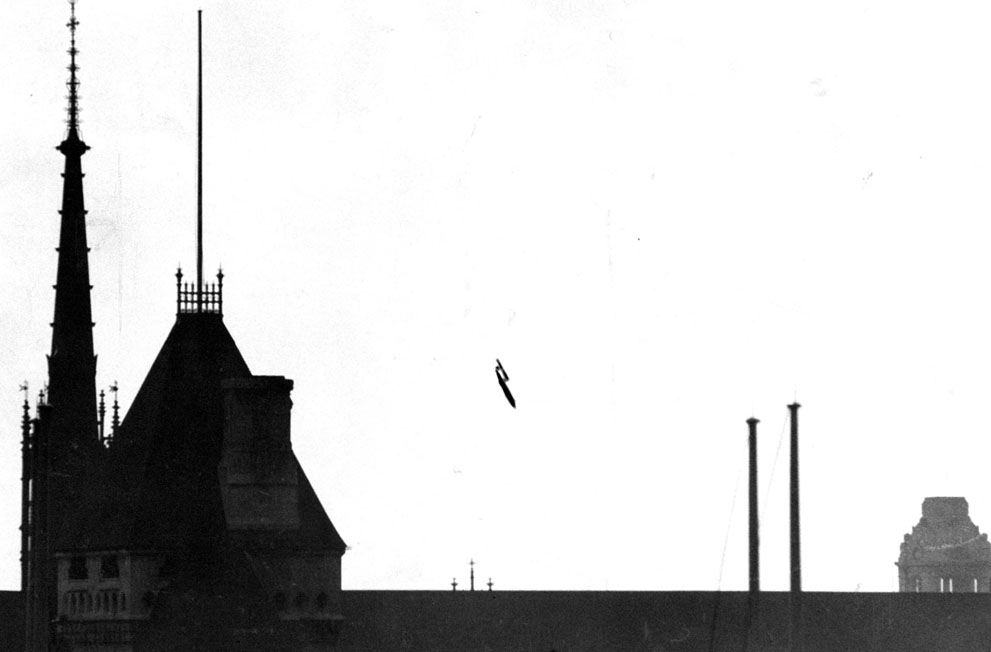
By no means was this a theoretical concern of hers. For in much of the preceding months the Germans had been hammering London with their V-1 “Buzz Bombs”. As this historic photograph shows.

A V-1, “buzz bomb”, plunging toward central London, 1945.


This bomb landed on a side road off Drury Lane blasted several buildings, including the office of the Daily Herald. Known as the Flying bomb, Buzz bomb or Doodlebug, V-1 was the first modern guided missile used in wartime and the forerunner of today’s cruise missile. The V-1 (and later V-2 ) added a new terror to an already terrible war – robot missiles. Once launched, these weapons flew without human intervention to strike distant targets.

Circumstances meant that my mother was living in North-West London when I was born and that’s where I was brought up for the first two years of my life.  Still remember the address: 17 Burnside Crescent, Alperton, North-West London.

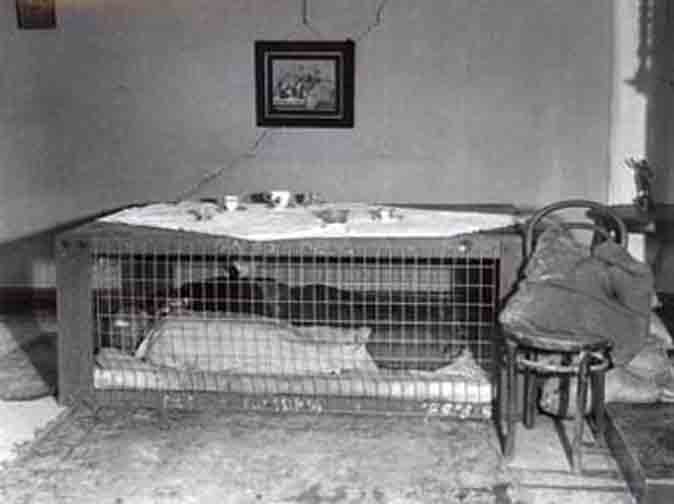
Burnside Crescent was close to factories that were being targeted by the Germans.  That meant that at night my mother and I slept in what was called a Morrison shelter.

An indoor Morrison shelter.

As if to underscore the hazards of early-1945 London, the photograph below is of a young boy, Toni Frisell, the sole family survivor from a V-1 bombing in 1945.

Toni Frissell London bombing 1945 wonder where he is now?
Toni Frissell – wonder where he is now?

So here I am still a living being and still loving my life.

How to close?

By coming all the way forward to modern times and the incredible technology that enables so much. Not just the world of blogging but such things as NASA’s Scientific Visualization Studio from where this compelling video was taken.

I wrote about my first six months that were not remembered one jot!

This quote, therefore, seems an apt statement for the end of today’s post.

“Time moves in one direction, memory in another.”

Quote from the author William Gibson

The book! Part Two: The dog’s ancestor.

Mankind, Nature and Dogs

The dog’s ancestor: the wolf.

When we look at some breeds of dogs, for example the smaller breeds such as the Chihuahua, it beggars believe that thousands of years ago there was a common ancestor to the dog and to today’s wolf. Of course, not so if one looks at, for example, a German Shepherd dog (GSD). Many GSDs look like they are first cousin to a wolf!

However, when we look at the Latin binomial nomenclature for the wolf and the dog it all becomes clear irrespective of the specific dog breed. I am, of course, referring to canis lupus for the wolf and canis lupus familiaris for the dog. For those, like me, that had to refresh their memory of this naming convention, the first part of the name identifies the genus to which the species belongs; the second part identifies the species within the genus. For example, humans belong to the genus Homo and within this genus to the species Homo sapiens.

Thus both the wolf and the dog belong to the same genus. Conforming to the widely held view that the domesticated dog is a direct descendent of the wolf.
So far, so good!

When we turn to the history of how the particular species lupus familiaris split away from lupus then it all becomes much less clear.

Let’s take a little trip along that particular journey.

The widely held view was that sometime during the Mesolithic period, or around 10,000 years ago, when humans started settling down, turning their backs on hunting and gathering, there was contact with humans and wolves that led to (a few) wolves living their lives in and around humans and from thence the long evolutionary journey to the dog.

But it is an understanding that is not fully shared by all in the field.

Take, for example, husband and wife team, Raymond and Lorna Coppinger. In their book Dogs[ 2001 – The University of Chicago Press] , they challenge this view[ page 41] :

The widely popular view is that people created dogs by artificial selection. People took the pups from wolf dens and made pets out of them. They tamed them, trained them, and took them out hunting. After many generations of this regime, the wolves evolved into dogs.

The biological implausibility of this leads me to flights of fancy, and I tend to call it the Pinocchio Hypothesis.

What the wolf-pup-into-dog hypothesis is really depending on is that wolves are related to dogs (true), that dogs easily form associations with people (true), and that therefore wolves must have formed relationships with people in the past (not true).

The Coppingers go on to write[ page 51] that, “There is no archaeological evidence that Mesolithic people had a big enough population of trained or tamed wolves living among them.” Severe doubt is expressed about the connection between wolves and dogs.

Even if Mesolithic[ Page 49 of the book Dogs] people were able to tame generations of wolves, and then train some of them to obey simple commands (for example, to come when called, or sit), still the burning question remains: What changes wolf genes into dog genes?
….
When tamed wolves reproduce, they get wild pups (oriented away from human activity). When dogs reproduce, they get tame pups (oriented toward human activity). The two species are intrinsically, instinctively, generally distinct, one from the other, in this respect.

The Coppingers proposition is that there was a common ancestor to both the wolf and the dog, details of which have not been discovered. That this common ancestor goes back much further in time, sufficiently far so for the differences between wolves and dogs that we see today. Or, indeed, saw back in those earlier days.

Let me return to the Mesolithic period simply because many readers may again share my lack of detailed understanding of when that period was. A quick web search came up with the answer[and others]!

The Mesolithic period is generally regarded as that time period between the last glaciation, at the end of the Paleolithic era, some 12,000 years ago, and the start of the Neolithic era, some 7,000 years ago. In other words, between 7,000 and 12,000 years ago. This was the period where man evolved from a hunter-gather existence, when humans learned to hunt in groups and to fish, when farming communities began to be established as people first discovered how to cultivate crops and began to learn how to domesticate animals and plants.

Strikes me as perfectly reasonable to see this period as the most significant single development in the history of humans.

Returning to the differences between wolves and dogs already apparent as humans entered the Neolithic period one can quite reasonably infer that the split came about many thousands of years before.
That the domesticated dog is originally from the wolf genus is not beyond doubt even if the period when it occurred is unclear.

Dr. George Johnson wrote an article that appeared on the website ON SCIENCE that explored the evolution of the family dog. He found himself wondering about the origins of his dog, Boswell, who had recently died.

This week I found myself wondering about Boswell’s origins. From what creature did the domestic dog arise? Darwin suggested that wolves, coyotes, and jackals — all of which can interbreed and produce fertile offspring– may all have played a role, producing a complex dog ancestry that would be impossible to unravel. In the 1950s, Nobel Prize-winning behaviorist Konrad Lorenz suggested some dog breeds derive from jackals, others from wolves.

Based on anatomy, most biologists have put their money on the wolf, but until recently there was little hard evidence, and, as you might expect if you know scientists, lots of opinions.

The issue was finally settled in 1997 by an international team of scientists led by Robert Wayne of the University of California, Los Angeles. To sort out the evolutionary origin of the family dog, Wayne and his colleagues used the techniques of molecular biology to compare the genes of dogs with those of wolves, coyotes and jackals.

Dr. Johnson went on to explain that Professor Wayne and his team collected, “blood, tissue, or hair from 140 dogs of sixty-seven breeds, and 162 wolves from North America, Europe, Asia, and Arabia. From each sample they extracted DNA from the tiny organelles within cells called mitochondria.

He went on to write:

When Wayne looked at his canine mitochondrial DNA samples, he found that wolves and coyotes differ by about 6% in their mitochondrial DNA, while wolves and dogs differ by only 1%. Already it smelled like the wolf was the ancestor.

Wolves had 27 different sequences in the control region, none of them exactly the same as any dog sequence, but all very similar to the dog sequences, differing from them at most at 12 sites along the DNA, and usually fewer.

Coyote and jackal were a lot more different from dogs than wolves were. Every coyote and jackal sequence differed from any dog sequence by at least 20 sites, and many by far more.

That settled it. Dogs are domesticated wolves.

Dr. Johnson’s penultimate paragraph addressed the question of when dogs first appeared.

The large number of different dog sequences, and the fact that no wolf sequences are found among them, suggests that dogs must have been separated from wolves for a long time. The oldest clear fossil evidence for dogs is 12,000 – 14,000 years ago, about when farming arose. But that’s not enough time to accumulate such a large amount of mitochondrial DNA difference. Perhaps dogs before then just didn’t look much different from wolves, and so didn’t leave dog-like fossils. Our species first developed speech and left Africa about 50,000 years ago. I bet that’s when dogs came aboard, when our hunter-gatherer ancestors first encountered them. They would have been great hunting companions.

The scientist, who writes under the nom-de-plume of Patrice Ayme, wrote an essay in April, 2014 under the title of Neanderthal Superiority. Towards the end of that essay he explains:

NEANDERTHALS INVENTED DOGS, COAL BURNING, SHELL FISH DINING:

Some of the arguments against Neanderthals have been outright ridiculous: not only we were told, without any evidence, that they could not talk, but that the superiority of Africans came from eating shell fish, about 70,000 years ago (along the East Coast of Africa).

However, it has since been discovered that Neanderthal cavemen supped on shellfish on the Costa del Sol 150,000 years ago, punching another torpedo hole in the theory that only Africans ate (supposedly) brain-boosting seafood.

Neanderthals also used coal, as long ago as 73,000 years. Once again, making a fire in present day France, then suffering from a pretty bad glaciation, made more sense than trying to stay warm in the Congo.

Earlier and earlier prehistoric art has been found. It’s getting ever harder to claim that Neanderthals had nothing to do with it. Neanderthals also domesticated, and genetically engineered dogs, from European wolves. That’s very clear.

How do I know this? Simple. The Goyet dog, pictured below, was dated around 32,000 years. In 2010, an even older dog was found in the Altai mountains. Both dogs were derived from Canis Lupus Familiaris, the European wolf, but were quite distant from it, genetically, they had been evolved probably on a time scale of more than 10,000 years, thus well before any arrival of Sapiens Sapiens from Africa.

Those dogs were completely compatible with people, just as contemporary dogs are. Proof? Ancient, 26,000-year-old footprints made by a child and a dog deep in the Chauvet Cave, France. (OK, by then Neanderthals have been just deemed “extinct” by some… However, these are still the same dogs Neanderthals invented.)

In that essay, Patrice included a link to an article that appeared on the NBCNEWS website.

An international team of scientists has just identified what they believe is the world’s first known dog, which was a large and toothy canine that lived 31,700 years ago and subsisted on a diet of horse, musk ox and reindeer, according to a new study.

The discovery could push back the date for the earliest dog by 17,700 years, since the second oldest known dog, found in Russia, dates to 14,000 years ago.

Remains for the older prehistoric dog, which were excavated at Goyet Cave in Belgium, suggest to the researchers that the Aurignacian people of Europe from the Upper Paleolithic period first domesticated dogs. Fine jewellery and tools, often decorated with depictions of big game animals, characterize this culture.

There was study published in the PLOS ONE scientific journal in March 2013 where the lead author, Dr. Robert Losey [Associate Professor in the Department of Anthropology, University of Alberta], explained:

Dog burials appear to be more common in areas where diets were rich in aquatic foods because these same areas also appear to have had the densest human populations and the most cemeteries,

If the practice of burying dogs was solely related to their importance in procuring terrestrial game, we would expect to see them in the Early Holocene (around 9,000 years ago), when human subsistence practices were focused on these animals. Further, we would expect to see them in later periods in areas where fish were never really major components of the diet and deer were the primary focus, but they are rare or absent in these regions.

The PLOS ONE paper went on to report that researchers found that most of the dog burials occurred during the Early Neolithic period, some 7,000-8,000 years ago, and that “dogs were only buried when human hunter-gatherers were also being buried.”

The strong implication being expressed by Dr. Losey is that the relationship between humans and dogs was as close and intimate as we modern-day humans know; to the point of almost taking it for granted. A relationship that had had thousands of years to become the way it was, and still is.

Back to Dr. Losey: “I think the hunter-gatherers here saw some of their dogs as being nearly the same as themselves, even at a spiritual level. At this time, dogs were the only animals living closely with humans, and they were likely known at an individual level, far more so than any other animal people encountered. People came to know them as unique, special individuals.

If dogs had already been part of our lives for some considerable time by the time we humans had turned away from hunting and gathering and started settling down, then we are lead, inexorably, to the question of how did it all begin? What were the circumstances of early man befriending a wolf or two and how from that relationship did it evolve into the tameness that was the start of the dog journey?

Maybe a true story from recent times offers us an insight into the answer to that question. This story was told to me by DR when I was living in Payson, Arizona. An amazing true story of a relationship between a wild wolf and a man. A story of a particular event in the life of Tim Woods, a brother of DR.

It revolves around the coming together of a man sleeping rough, with his dog, on Mingus Mountain, and a fully grown female Grey Wolf. Mingus is in the Black Hills mountain range between Cottonwood and Prescott in the State of Arizona, USA.

DR and his brother, Tim, belong to a large family; there are 7 sons and 2 daughters. Tim had a twin brother, Tom, and DR knew from an early age that Tim was different.

As DR explained,

Tim was much more enlightened than the rest of us. I remember that Tim and Tom, as twin brothers, could feel each other in almost a mystical manner. I witnessed Tom grabbing his hand in pain when Tim stuck the point of his knife into his (Tim’s) palm. Stuff like that! Tim just saw more of life than most other people.

The incident involving the wolf was when Tim was in his late 40s and, as mentioned, was living in a rough shack on the mountain. The shack was simply a plywood shelter with an old couch and a few blankets for the cold nights. The dog was companion, guard and a means of keeping Tim in food; the dog was a great hunter. But Tim was no stranger to living in the wild.

DR again,

Tim was ex-US Army and a great horseman. There was a time when he was up in the Superstition Mountains, sleeping rough, riding during the day. At night Tim would get the horse to lay down and Tim would sleep with his back next to the horse for warmth.

Anyway, Tim was up on Mingus Mountain using an old disk from an agricultural harrow as both a cook-pan and plate. After he had finished eating, Tim would leave his ‘plate’ outside his shack. It would be left out in the open over night.

Tim gradually became aware that a creature was coming by and licking the plate clean and so Tim started to leave scraps of food on the plate. Then one night, Tim was awoken to to the noise of the owner of the ‘tongue’ and saw that it was a large, female grey wolf.

The wolf became a regular visitor and Tim became sure that the wolf, now having been given the name Luna by Tim, was aware that she was being watched by a human.

Over many, many months Luna built up sufficient trust in Tim that eventually she would take food from Tim’s outstretched hand. It was only now a matter of time before Luna started behaving more like a pet[ DR showed my an unaltered photograph taken in 2006 showing Tim lying back on a blanket with his dog across his waist and sitting on its haunches just behind Tim and the dog was Luna the wolf.] dog than the wild wolf that she was.

From now on, Luna would stay the night with Tim and his dog, keeping watch over both of them.

DR also recalls,

I remember Tim being distraught because, without warning, Luna stopped coming by. Then a few months later back she was. Tim never did know what lay behind her absence but guessed it might have been because she went off to have pups.

Unfortunately, this wonderful tale does have a sad ending.

About two years ago, what would have been 2007, Tim lost his dog. He was awakened to hear a pack of coyotes yelping and his dog missing. Then tragically some 6 months later Tim contracted a gall bladder infection. Slowly it became worse. By the time he realised that it was sufficiently serious to require medical treatment, it was too late. Despite the best efforts of modern medicine, Tim died on June 25th, 2009, just 51 years young.

DR’s closing words to me were: “So if you are ever out on Mingus Mountain and hear the howl of a wolf, reflect that it could just be poor Luna calling out for her very special man friend.

I would close this particular chapter by pleading that whoever you are, wherever you are, if you hear the howl of a wolf allow yourself to disappear into your inner thoughts for a few precious moments and know that tens of thousands of years ago there was another Tim and another wolf. Keep that image in your mind for many reasons, not least so for this one. For those of you that have dogs in your lives and know what it feels like to gaze deeply into your dog’s eyes, then next time you are bonded eyes-to-eyes with your dog sense that first Tim cuddling up to that first Luna.

2,911 words Copyright © 2014 Paul Handover