I am speaking of a recent BBC Radio 4 program, but …
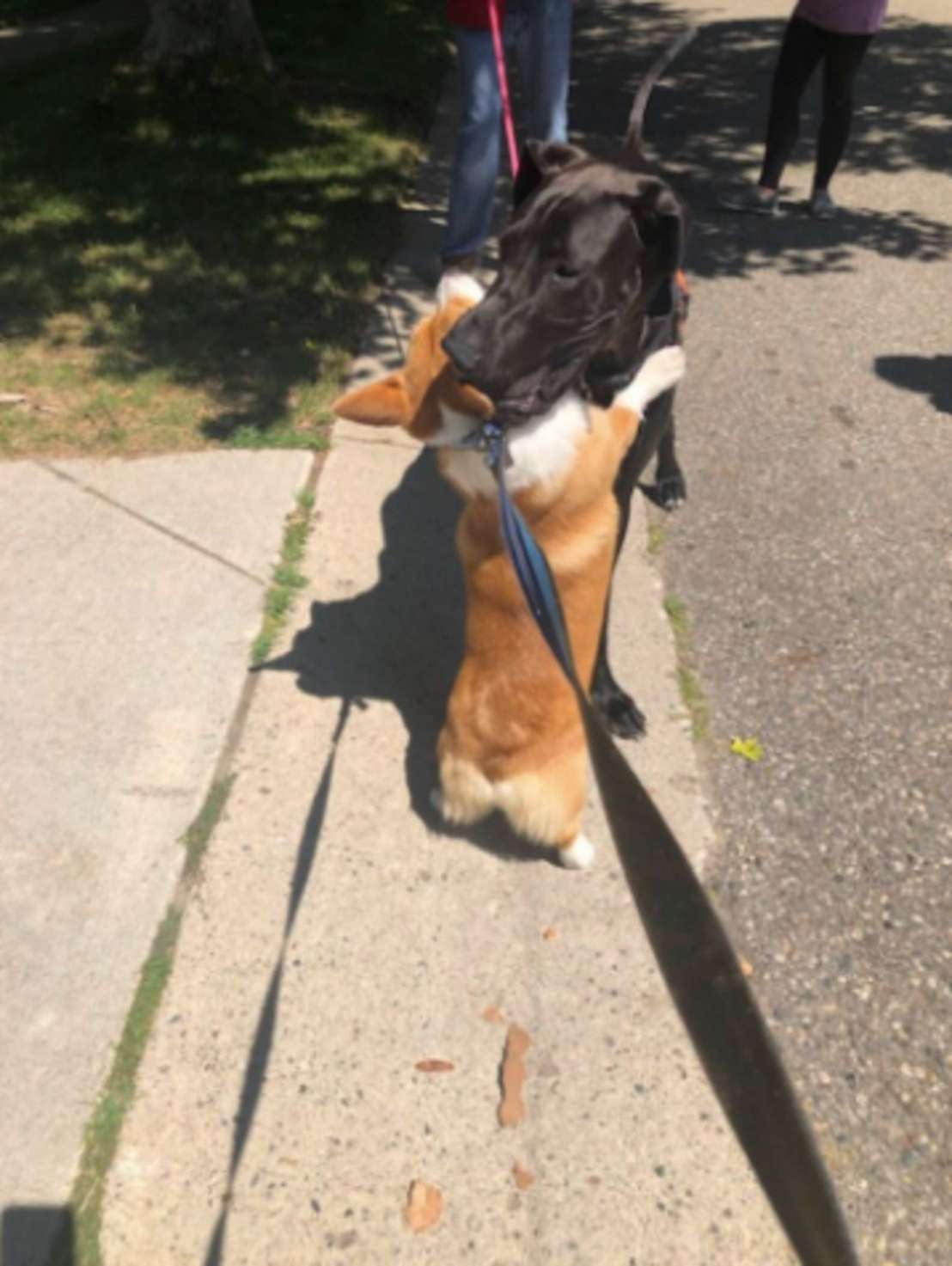
… this loving Corgi seems to have got the message.
There has been a series on BBC Radio 4 about the Anatomy of Touch. This is a small extract from the website that accompanied the program.
Touch is a crucial part of our lives. The right kind of touch can reduce pain, soothe our stress and convey emotion faster than words. It’s a sense that you can’t turn off and we should not underestimate its power.
It’s also a sense that has taken on a new resonance during the pandemic, now that we have to keep our distance and haven’t hugged friends or family we don’t live with for more than half a year.
“He’s the biggest sweetheart” ❤️️
By Lily Feinn
Published on 10/1/2020
Wallace understands that times are tough, and the loving corgi knows how to make things better — with a big hug. Well, as big as his little arms can go.
When Noah Raminick is walking Wallace, he can expect to stop every time Wallace spots another pup. The year-old corgi loves to play and won’t let another dog walk by without giving him an embrace.
INSTAGRAM/IAMWALLACETHECORGI
“He’s the biggest sweetheart,” Raminick, Wallace’s brother, told The Dodo. “He’s always very happy to be around people and other dogs. He loves to give face kisses to people and when he sees another dog, he’s always the one to initiate a play session.”
INSTAGRAM/IAMWALLACETHECORGI
When it comes to large dogs, the low-bodied pup shows no fear and will stand on his hind legs to get the best possible angle for his hug. Wallace’s best friend Daisy is a Great Dane, but the corgi knows that size doesn’t matter.
“They always hug when they see each other,” Raminick said. “And one of her paws weighs as much as Wallace’s entire body.”
INSTAGRAM/IAMWALLACETHECORGI
With smaller dogs, Wallace makes sure to play gently, so he doesn’t spook his new friend. Wallace won’t go in for the hug until he sniffs out whether the other dog is OK with it first.
“The thing I find interesting with his hugging is that he wasn’t trained to do that at all,” Raminick said. “I think it comes down to him being really excited about playing with another dog.”
INSTAGRAM/IAMWALLACETHECORGI
Wallace makes sure to spread the love when he’s with his human family, too. “His favorite things are morning and evening cuddles, playing fetch and me chasing him around the house,” Raminick said. “I don’t think Wallace has any dislikes.”
Wallace’s family is happy for their pup to continue spreading the love to the dogs and people in his neighborhood, adding a little more joy to everyone’s day.
ooOOoo
Back to that Touch website to close:
The three most common words used to describe touch are: “comforting”, “warm” and “love”
People from 112 different countries took part in the Touch Test and it’s striking that “comforting” and “warm” were among the three most common words that people used in every region of the world.
Once again, something that should be taken notice of.
This was recently notified to all concerned in Dog Food Advisor.
ooOOoo
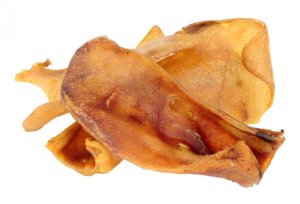
Deadly Salmonella Outbreak Linked to Pig Ears Dog Treats
Pig Ears Dog Treats Stock Image
October 1, 2020 — The Public Health Agency of Canada is alerting consumers it is investigating a deadly outbreak of Salmonella infections occurring in British Columbia, Alberta, and Yukon.
Based on investigation findings to date, exposure to pig ear dog treats has been identified as a likely source of the outbreak.
Some of the individuals who became sick reported feeding their dog Paws Up!and Western Family brands of pig ear dog treats before their illnesses occurred.
These brands are sold at Canadian Tire and Save-On-Foods.
The outbreak investigation is ongoing and it is possible that additional products may be identified.
On September 29, 2020, the supplying company, Masters Best Friend, voluntarily issued a Notice of Stop Sale for Paws Up! and Western Family brands of pig ear dog treats.
These products were sold nationwide in Canada.
Investigation Summary
As of September 29, 2020, there are eight confirmed cases of Salmonella typhimurium illness in the following provinces: British Columbia (5), Alberta (2), and Yukon (1).
Individuals became sick between late February and early August 2020. Three individuals have been hospitalized. In addition, one individual has died.
Individuals who became ill are between 7 and 95 years of age. The illnesses are distributed equally among men (50%) and women (50%).
It is possible that more recent illnesses may be reported in the outbreak because there is a period of time between when a person becomes ill and when the illness is reported to public health officials.
For this outbreak, the illness reporting period is between four and seven weeks.
What to Do?
Given this, do not feed your dog any Paws Up! or Western Family brand pig ear dog treats.
Always wash your hands right after handling dog treats, and ensure that all areas the treats have come in contact with are properly cleaned and sanitized.
This outbreak is a reminder of the importance of safely handling all pet treats, including pig ears and pet food.
These products can be contaminated with bacteria that can make you and others sick if proper handling and cleaning practices are not followed. If contaminated, pet treats and pet food can also make your pets sick. Ill pets can spread bacteria, like Salmonella, to individuals they are in contact with even if they do not show any signs of illness.
For more information on the affected products, please contact Masters Best Friend.
Although products are no longer available for purchase in stores, they may still be in consumer homes.
U.S. citizens can report complaints about FDA-regulated pet food products by calling the consumer complaint coordinator in your area.
This is a wonderful, innovative way to look after dogs.
It’s not that often that something comes along that is wonderfully refreshing, both as an idea and in practice. I am speaking of a way of housing shelter dogs.
It’s the work of Austin Pets Alive and I’m not surprised in the slightest to read from their website:
Austin Pets Alive! is not your average animal shelter. We pioneer innovative lifesaving programs designed to save the animals most at risk of euthanasia.
They are in Texas.
But back to the article which appeared on the Treehugger website.
ooOOoo
This Rescue is Building Tiny Homes for Shelter Dogs
They offer a calm alternative to the chaos of shelter life.
By Mary Jo DiLonardo, October 1st, 2020
The shelter is building two tiny homes for rescue dogs. Austin Pets Alive!
The shelter environment can be incredibly overwhelming for any dog. There are strange sights, smells, and sounds, and the presence of unfamiliar animals and people can be constantly changing. Some pets adapt more quickly than others, while some struggle with the frenetic surroundings.
One animal shelter in Texas is building tiny houses as a solution for those anxious dogs that need a calmer place to stay. The non-profit rescue is creating two small cabins on their shelter grounds complete with heating and air conditioning, dog-friendly furniture, and their own private yards. The cabins will also provide workspaces for staff and volunteers.
The tiny homes should be ready for their first guests later this month.
“The idea is to provide more of a home-like environment for the unique population of dogs Austin Pets Alive! cares for as the safety net for shelter animals who need us most — a place for decompression, training, and quality-of-life purposes,” Director of Operations Stephanie Bilbro tells Treehugger. “It seemed like the best opportunity for the investment, and also has the benefit of being a project that can be repeated as many times as we want!”
Having tiny homes for some of the shelter’s canine residents was a long-time dream of the rescue’s executive director, veterinarian Ellen Jefferson. The rescue put together a committee of staff and volunteers in 2019 to assess the facility and see what improvement could be made.
They decided to build the tiny homes “as a way to provide a better quality of life for some of our longest-stay or most behaviorally challenged dogs”, Bilbro says.
The cabins will house one dog at a time and they will remain there for the rest of their stay until they find a foster or adoptive home. The cabins will primarily be used for dogs who are overstimulated by the standard kennel environment.
Some dogs are scared and overwhelmed by the shelter environment. Austin Pets Alive!
“Overstimulation can lead not only to higher stress in the animal, but can actually be dangerous for a handler, or other animals, if you have a dog who expresses stress by showing impulsive or aggressive behaviors,” Bilbro says.
“Overstimulation is also a big barrier to successful training or behavior modification, so it can be difficult to make progress with dogs like this in a kennel or shelter environment. The cabins will ideally provide a quiet and low-stimulation place for the dogs to decompress and relax in a way that will help our staff and volunteers get through to them easier.”
The rescue is relying on donations to keep saving lives and trying out innovations like these, Bilbro says. When the pandemic first started, the rescue increased its intakes so smaller and more rural shelters that were temporarily closing wouldn’t have to euthanize animals.
The first dogs should be moving into their tiny houses soon. And maybe they won’t be staying long.
“We also hope that the ‘home-like’ environment of the cabins will help us learn a little more about how a dog would act in a home, which could tell us more about what kind of foster or adopter they need for our matchmakers to match them with their forever families,” Bilbro says.
“Would they be calm or anxious, would they be destructive or tidy, are they possibly housetrained, will they let people come into their space without conflict? These are things we would hope to learn from a foster home but without needing to find a foster who is willing to take on a challenging dog, or a dog we don’t know a lot about.”
ooOOoo
I have nothing to do with neither Treehugger nor Austin Pets Alive.
However, I was so impressed with the way they operated that we made a very small donation. So, if there’s anybody else out there who can afford some money then this is the link to donate.
I just donated to Austin Pets Alive!, an organization that serves the animals most at-risk through innovative programs that address the animals’ needs. I’m proud to support a mission that believes that animal shelters should do just that – provide every animal the chance to find their forever home!
“Provide every animal the chance to find their forever home.“
It doesn’t get any better for our lovely dogs than that.
Funnily enough, Jeannie and I were speaking just recently about the creation of breeds, in particular because we were fascinated as to the breed origins of Oliver.
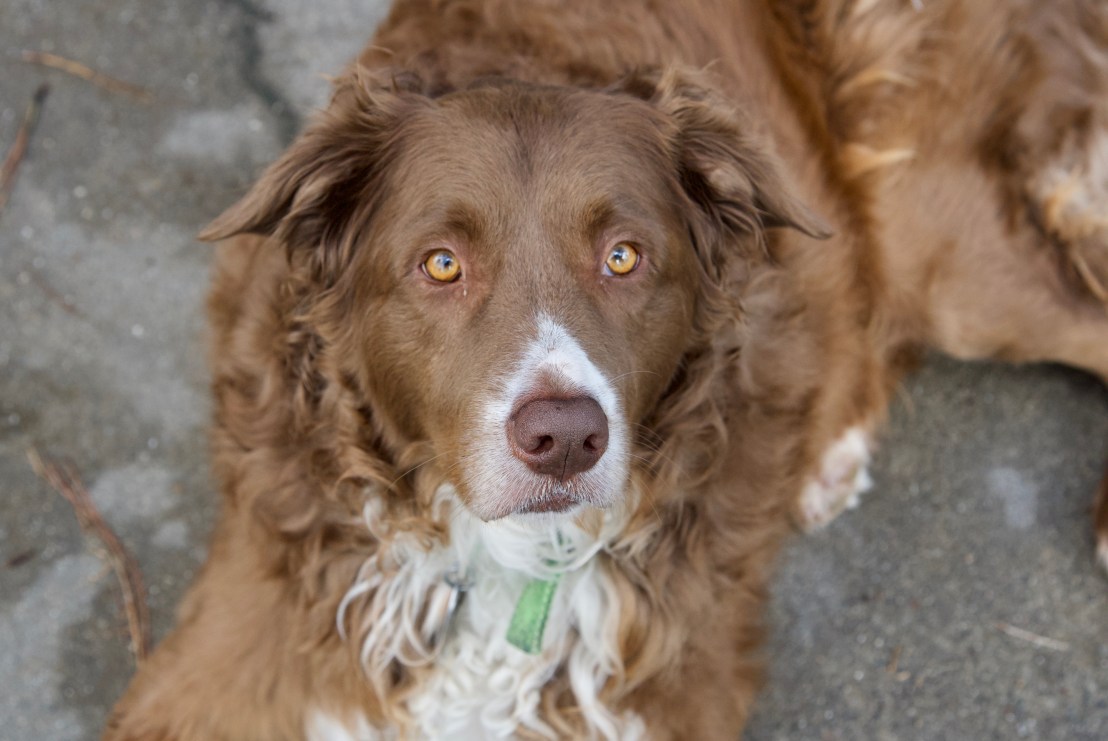
Oliver. Taken at home, 17th May, 2020.
Oliver’s eyes are to die for!
Well a recent article on the Treehugger blog threw some light on this.
I hope it is permissible to share it with you.
ooOOoo
Labradoodles Are More Poodle Than Lab
Study helps deepen understanding about how breeds are formed.
By Mary Jo DiLonardo
Published September 22, 2020
Australian Labradoodles aren’t officially recognized as a breed. Purple Collar Pet Photography / Getty Images
The Australian creator of the Labradoodle was trying to find the perfect guide dog for a blind woman whose husband was allergic to dog hair. He tried about a dozen poodles before breeding a poodle with a Labrador retriever. The resulting Australian Labradoodles became incredibly popular as a mix of two well-liked breeds.
But a new study finds that the breed that developed from that popular cross isn’t an even split of both breeds – it is primarily poodle.
Australian Labradoodles have been around for several decades and have been bred to each other and tinkered with since then. By contrast, many Labradoodles that are found in the U.S. are first-generation mixes of one Labrador and one poodle. These dogs were used as the control dogs in the study, researcher Elaine Ostrander, geneticist at the National Human Genome Research Institute of the National Institutes of Health, tells Treehugger.
“We were interested in taking a genomic snapshot of a breed in the making—the Australian Labradoodle. The breed has only been around since the 1980s as opposed to the many breeds we see at the dog park which have been around since Victorian times and were created in Western Europe,” she says.
The Australian Labradoodle has gone through several generations, with careful and thoughtful addition of Labradors and poodles added, reflecting what breeders and owners want. We wanted to see if genomics could be used to tell what was happening to the genome of these dogs as they evolved into a breed.
The Fédération Cynologique Internationale (FCI), an international federation of many national kennel clubs, recognizes about 350 dog breeds. The American Kennel Club (AKC) recognizes 195 breeds. The Labradoodle is not an official breed.
“We were also curious to see if the breed met the statistical definition of a breed. There are many measures in terms of genomic diversity and ability to ‘breed true’ that are taken into account when determining when a dog population is really a ‘breed’ at the genetic level,” Ostrander says.
Many of these breeds have been created through intense breeding programs focused on enhancing specific traits. When designer breeds are created, the genetic diversity is limited because there are a small number of animals being bred together. This often leads to a high incidence of disease and other problems. Lots of Poodle DNA
For the study, researchers analyzed genetic data from Australian Labradoodles, Labrador retrievers, poodles, and a number of other breeds. The results were published in PLOS Genetics.
Ostrander says they were somewhat surprised at what they found.
“First, the Australian Labradoodle meets the definition of a breed at the statistical level. Those arguing for it to have breed status with various registries have a good argument,” she says. “What we didn’t expect was the degree to which today’s Australian Labradoodle has such a large component of its genome from the poodle. While the breed started as a 50-50 mix, it is clear that poodle traits are highly valued and many more poodles than Labradors have been added to the breed at strategic points.”
That’s likely because poodles have a reputation for being hypoallergenic, she points out, and elicit a lower allergic reaction than many other dog breeds in people with allergies or asthma.
“Owners buy Labradoodles for many reasons including their trainability, family friendly traits, and, importantly, they want a dog that won’t make them sneeze or otherwise respond,” she says. “Interestingly, the Labrador is very much present in every Australian Labradoodle we tested. Likely people are seeking the family-friendly traits of the Labrador and breeders work hard to retain that as well.”
Labradoodles weren’t the first doodle dogs and definitely are not the last. The first poodle mixes were likely Cockapoos because Cocker spaniels and poodles were two of the most popular dog breeds in the U.S. in the 1940s. Today, you’ll find schnoodles (schnauzers), sheepadoodles (Old English sheepdog), and whoodles (soft-coated wheaten terrier). Poodles have been mixed with beagles, pugs, Australian shepherds, corgis, and even Saint Bernards.
The lore behind Australian Labradoodles is that English and American Cocker spaniels were mixed in with the breed early on.
“We did find some minor evidence for the addition of other breeds in some lineages of Australian Labradoodle. Likely this represents the historical relationship of those breeds with the poodle or Labrador more than anything else,” Ostrander says. “We did not see that in every lineage we looked at and where we did see it, the addition was very small and, likely, many generations ago.”
The findings are helpful, the researchers point out, because it shows how quickly genetics can be changed by thoughtful breeding.
“Imagine a breed has a significant risk for a disease. Careful breeding can reduce the incidence of those deleterious variants in just a few generations,” Ostrander says. “This is incredibly important to breeders who have taken very seriously the criticism they have received over the years regarding how established breeds are less healthy than mixes. We all want our dogs to be healthy, regardless of what breed they are.”
ooOOoo
This deserves a very careful read and, to those really interested in the subject, perhaps this will serve as an incentive to do more research. There are links in the article to the FCI and AKC.
And I will finish with the closing statement by Elaine Ostrander: “We all want our dogs to be healthy, regardless of what breed they are.“
An article in The Dodo describes good dogs perfectly.
When we came up from Mexico to Arizona back in 2010 we had 16 dogs. They were all pretty well behaved. When we came to Oregon in 2012 we were down to 12 dogs and, again, pretty well behaved.
But having said that getting all 12 dogs to sit still and look at the camera would have been impossible! I’m not sure I could manage it now and we have only 6 dogs.
Which makes the following article recently published in The Dodo most remarkable.
Have a read!
ooOOoo
Dogs Have The Most Well-Behaved Birthday Party Ever
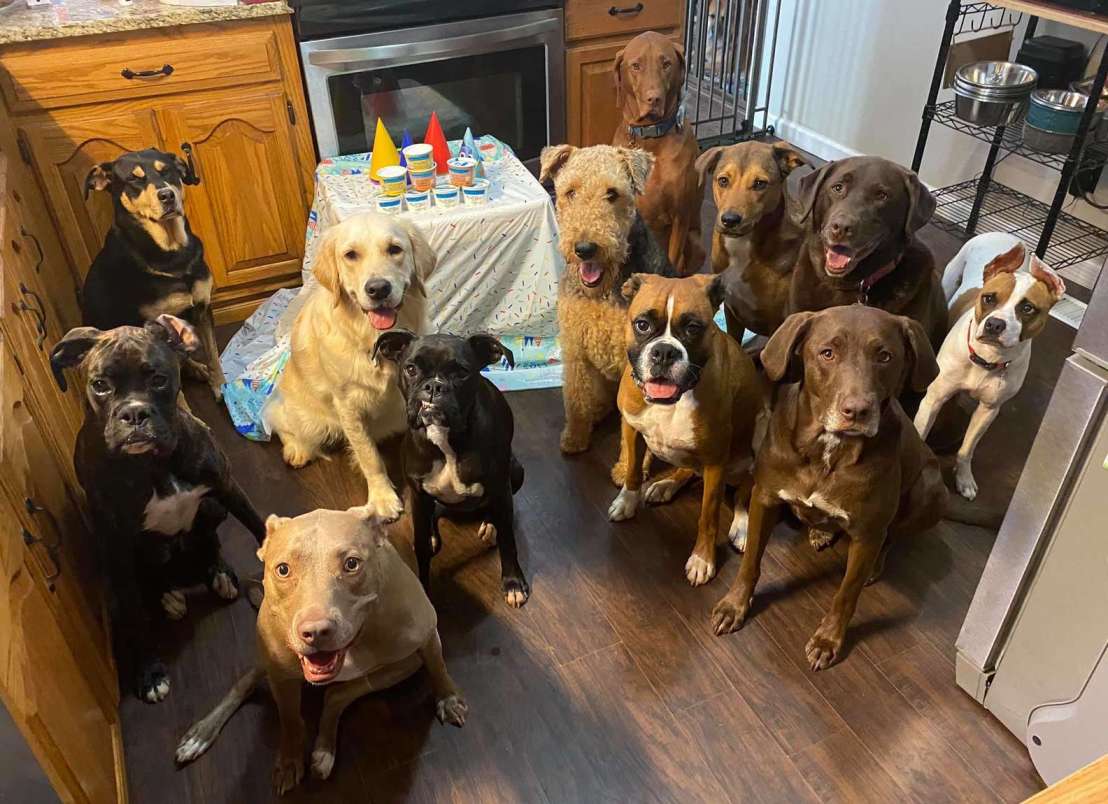
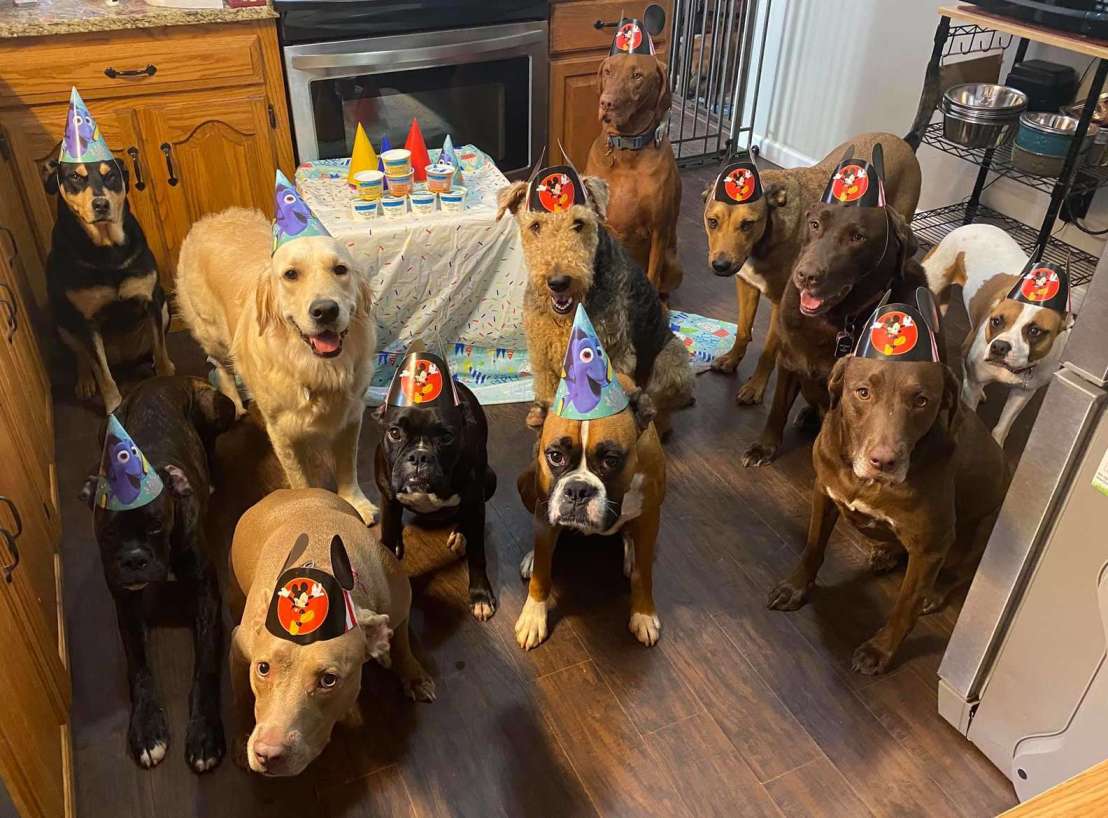
Throwing a party for 12 dogs can get pretty wild, but the pups at Lending Paws Pet Care are the goodest boys and girls you’ll ever meet.
Whenever a dog at the doggy day care has a birthday, Aubrey Thweatt makes sure they get a special party with all their best friends. The celebration includes goodies, party hats and cute photos to commemorate the day.
FACEBOOK/LENDING PAWS PET CARE
“I started doing birthday pics and goodies with my own dogs and so when one of my client’s pups would have a birthday … they would send goodies for the group,” Thweatt, owner of Lending Paws Pet Care, told The Dodo. “It just sort of evolved from there.”
And when it comes to posing for the birthday party photo, these dogs are pros. They don’t even mind wearing a party hat.
FACEBOOK/LENDING PAWS PET CARE
When a gray pittie named Rosemary celebrated her 4th birthday, Thweatt snapped a photo, never expecting it to go viral. But after one of the dog owners posted it on Twitter, people couldn’t get over the dogs’ unique expressions and expert sitting skills.
“They have been coming for years. We do group pictures daily so they are used to it,” Thweatt said. “We do ‘sit and stay’ for everything.”
“We have lots of fun and they literally know the phrase ‘picture time!’” Thweatt added. “They will all run in the direction I’m walking to get to a spot to sit.”
FACEBOOK/LENDING PAWS PET CARE
While at doggy day care, the pups have the run of the house. They can play in the backyard, or relax and recharge during naptime, and always get plenty of praise and treats. After spending so many years together, the pups are all best friends and look forward to spending the day with Thweatt.
“Everything I do is for them,” Thweatt said. “They have the entire house and I am just here to constantly clean up after them and make sure they have lots of playtime and socializing!”
ooOOoo
Aubrey Thweatt knows perfectly how her dogs are to be treated. That is they are loved for being the animals that they are. Dogs are smart. They know their own names. They have a sense of smell that is literally millions of times better than ours. They are very observant of our behaviours.
And this is the result. Dogs that may be photographed in a group perfectly.
Recently I was contacted by a person and I thought it was a scammer. My mistake entirely but it was an unusual name; well it was to me!
As it happens this person not only writes well but does it for a job! It shows.
Because millions of people have cats and dogs and a very large percentage of those will be concerned as to what to do.
ooOOoo
I will amend the post later on this morning and remove your offering.
To be frank, I think that is a real shame. It was a good post and I was up for publishing more from you. But you insisted on advertising your products via a link and, as it were, threw the baby out with the bath water.
But there you go. First time in all my blogging that it has happened and a copy of this email will be put into the blog while at the same time your writing removed.
If you ever change your mind then I shall be pleased to hear from you.
Sincerely,
Paul
ooOOoo
I would take issue with the author over one tiny point. I think, but I have no medical experience on this, that worrying that your dogs and cats may be somehow a carrier for Covid-19 is worrying too far.
Nevertheless, this is a good guest post.
(Subsequent conversations revealed that the author wanted the post cancelled because I wouldn’t add a link to the commercial website.)
This is an older post that for some reason wasn’t published until now!
Apparently dogs can teach us to sleep better!
If you can hear a note of skepticism in my voice then you are not mistaken.
For I am writing this post during the afternoon of Tuesday last. Jeannie and I were going out to dinner with neighbours in the evening and I was wondering if I could squeeze in a siesta fairly soon. Why?
Well last night [Ed. Back in 2017] (as in early on Tuesday morning), at 3am to be exact, a wet nose belonging to a German Shepherd, namely Cleo, was gently pushed into my face. Even in the dark I could sense that Cleo had an upset tummy. I quickly got up and opened our bedroom door; the one that opens onto the deck behind our house.
Five minutes later Cleo was back in the room and a few minutes more saw me back asleep.
At 4am on that same early Tuesday morning I received the second greeting of the day from a wet nose. This time it was Oliver and, yes, he too had an upset tummy. Oliver is not so self-disciplined as Cleo and I had to put on my dressing-gown and take Oliver outside via the front door.
Do you understand why I was so tired that afternoon!
We all know that dogs are the best of friends. They’re more than happy to greet you with excitement when you get home from work, and they’re thrilled to go on adventures with you, too. But dogs are more than just friends. They’re good for your health—in more ways than one.
First, good dog owners know that exercise is the name of the game. If you live on a small property or in an apartment, then it’s necessary to walk your dog regularly. And at the bare minimum, you most likely play tug-o-war inside or wrestle on the floor together. Your dog needs the exercise to stay happy and healthy—and so do you.
Second, your pup doesn’t just keep you active but she lowers your blood pressure. It’s hard to measure if you’ve never been one with blood pressure issues. But if you’re hypertensive, then maybe getting a dog isn’t such a bad idea.
Beyond keeping you active and your heart healthy, science shows that dogs help you sleep better. And sleep, as we know, is a huge part of being healthy. In a recent study of 40 healthy adults without sleeping disorders, scientists discovered that dogs aided in better sleep efficiency. That means you get more out of your sleep time with a fun-loving pet at your side.
And let’s not get this confused with sleeping with your dog in your bed. The same study indicated that people who let their pets sleep on the bed actually had worse sleep, not better. Which makes sense, right? If your pup continually crowds you out of the little space you have, you’re bound to be tirelessly stopping yourself from falling off the bed all night long. Not to mention if the dog needs to be let down for water or to use the bathroom. Your best bet for better sleep is to leave your pooch on the floor.
How to have the best night of sleep ever with your dog
As any dog owner knows, it’s not fun getting up the middle of the night to open doors, fill water bowls or take the dog out to pee. If you want to ensure that you’ll reap all the benefits of better sleep, then try these tips right before bed.
Prepare your dog for bed: Welcome the dog into the room, snuggle for a bit on the bed or floor, and then place your pup on the floor in his bed.
Open a door: Your pup might get restless at night, or scared. Leave a door open for the pup to roam or hide. Unless, of course, your pup can’t handle the freedom of nighttime roaming.
Fill the water bowl: Be sure to always have fresh water nearby. It’s an easy and simple fix when you know your pup likes to get up for a midnight drink.
Create space to borrow: Some dogs like to hide under the bed, in the closet beneath clothes or in the bathroom. The dog might be scared of thunder or lightning or simply find it cozier than out in the open. Ensure your dog’s comfort by keeping these options open.
Don’t forget the dog: Bedtime is often a haze. You’re tired and just want to sleep. Before rushing off to sleep, make sure your dog hasn’t been left outside on the patio or in the backyard.
Does Rocko eat dinner?: Make sure your dog eats a regularly scheduled meal in the evening.
Unexpected events: There are some things you just can’t plan for, like vomiting or diarrhea. Dogs eat strange things when you’re not looking. Respond as compassionately as possible.
Dogs can help you sleep better by making you feel more safe and secure. But if you don’t prepare you and your loyal friend for a good night sleep, then you’ll find yourself waking up in the middle of the night—more than once. Get the most out of your sleep by being prepared, and remember to put your dog on the ground not on the bed for the best night’s sleep possible.
ooOOoo
Now I’m bound to say that since that night in September, 2017 we have not had a problem with our six dogs. I can’t remember since then one of our dogs having an upset tummy that kept us awake.
But I’m sure that there are dog owners who from time to time do have this problem and I hope you find this post useful and interesting, albeit three years late!
Having six dogs here at home we are used to many of them making extra-special relationships.
It’s often the dogs that are extremely different, and I thinking of size here, that form the closest bonds.
More of that later.
But the reason I refer to our dogs here is to endorse in spades what is covered in this article from The Dodo.
ooOOoo
Shelter Dog Separated From His Best Friend Won’t Stop Calling For Him
“Rocky makes him happy.”
By Lily Feinn
Published on 9/18/2020
At Miami Dade animal services, a dog named Schwabo cried for days in his kennel. He missed his family, and most importantly, his best friend Rocky.
The lonely howls pulled at the heartstrings of shelter volunteer Jani Bradford, who watched him stare out the glass divider searching for his friend.
Facebook/Jani Bradford
9-year-old Schwabo and 11-year-old Rocky had spent their lives together until their owner surrendered them due to landlord issues. Without Rocky, Schwabo seemed lost and refused to eat.
“He grew up looking up to Rocky and now, even though he’s older, Rocky is like his big brother,” Bradford said. “He’s very, very attached to Rocky.”
When Schwabo and Rocky first arrived at the shelter, Rocky was placed on the adoption floor while Shwabo, who was limping due to arthritis, was sent to the back for observation. Rocky quickly received an application, but the potential adopter never showed up, so the two dogs were reunited — and Schwabo couldn’t have been happier.
“Schwabo was a different dog from the moment he saw Rocky,” Bradford said.
FACEBOOK/JANI BRADFORD
Though the two are bonded, they couldn’t be more different. “Rocky’s older but he acts like a puppy. He loves playing with the ball, he can play all day long,” Bradford said. “Schwabo acts a little older … He’s very calm, very low maintenance.”
While Rocky likes to live a more active lifestyle, Schwabo just wants to hang out and watch his best friend play.
“Schwabo doesn’t do much — he lays in his bed and loves watching Rocky doing all his goofy stuff,” Bradford said. “Schwabo needs Rocky. He just loves being around him, watching him play all day. Rocky makes him happy.”
FACEBOOK/JANI BRADFORD
Thankfully, the two dogs will never need to worry about being separated again.
FACEBOOK/JANI BRADFORD
ooOOoo
All I can say is well done Jani!
This is a very beautiful story.
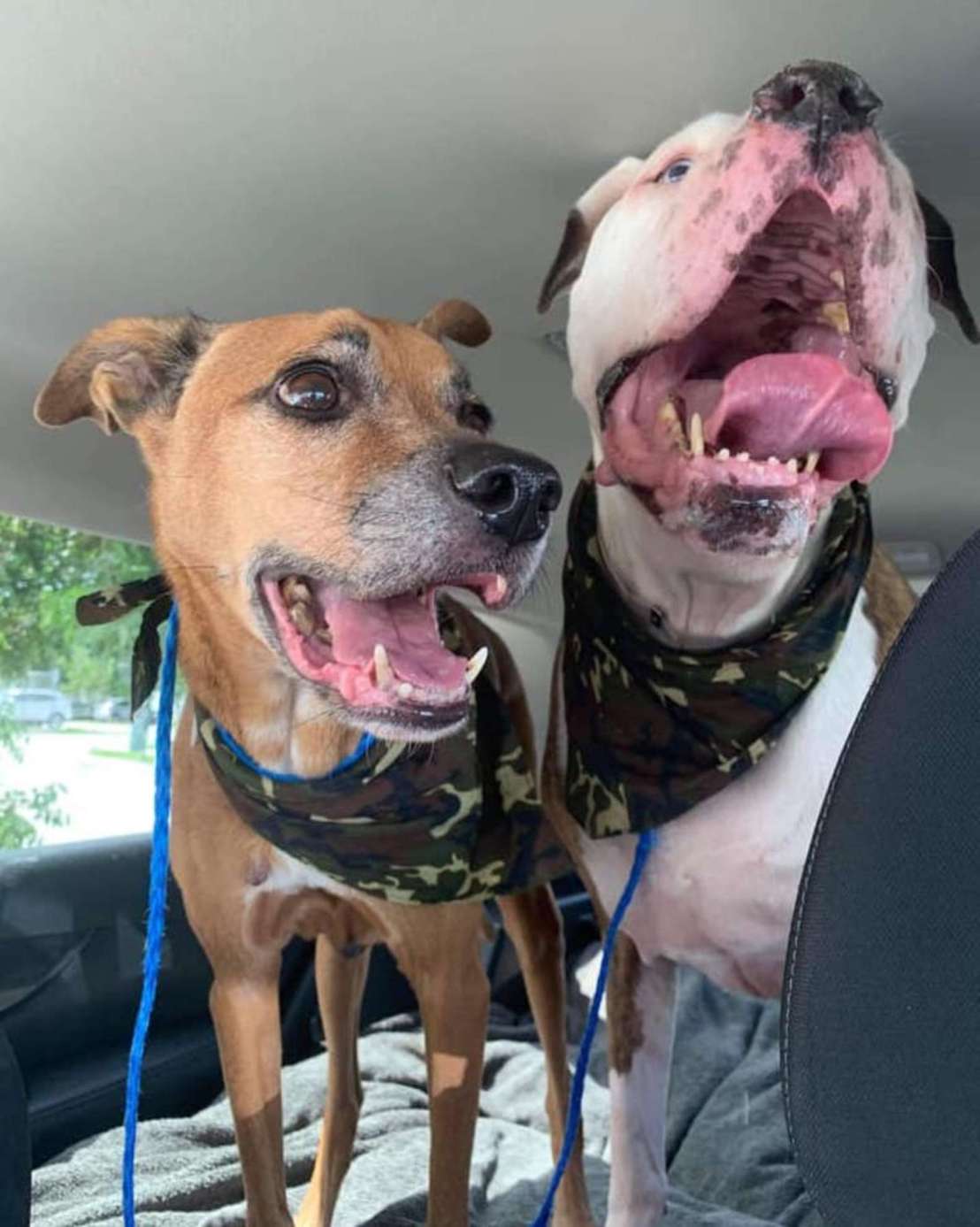
And to come back to our own experiences here at home, here is a picture of Oliver (LHS) and Pedi.
Pedi is wonderful at forming very close bonds with all our larger dogs. That is Brandy and Cleo as well as Oliver above.













 Learning from Dogs