This is a guest post from Joelle Jordan. Let me broadcast my gratitude for this lovely story. For two reasons. The first is that Joelle is very generous in sharing her fine work and the second is that at the time of me putting this Blog post together, 4pm yesterday, I really needed a helping hand – have been short of time all week-end. So thank-you Joelle. Here’s her story.
————————-
Joy is a difficult commodity to come by these days. I don’t mean entertainment, I don’t mean a good laugh, I mean pure joy, where, even just for a single moment, all worries and doubts, frustration and anger are lifted as though by Atlas.
Like so many other humans in our world, I often find myself in a constant state of stress. There always seems to be something to worry about, whether it’s money, job fulfilment, the state of my relationships, getting the house cleaned, finding time to get to the market, and more. If given the chance, I know we all could spend nearly all of our waking hours (and some of our sleeping hours, too) worrying about something. We spend so much time on the many things that inevitably work themselves out, and so little time on things that will create a memory and a crystal moment of joy.
Jordan and Charlie
My little dog Charlie spends his time in the completely opposite fashion; spending his waking hours seeking joy, and committing less time to things that worry him.
Charlie seems to exist normally in three states of being; content, happy and utterly joyful. When I see him in an emotional state other than these, it nearly breaks my heart. I wonder why this little carefree being who brings such happiness to my life should be anything less than blissful at all times.
I notice something about how Charlie handles his stressful moments, however few and far between they may be. A recent example just occurred. My partner and I are teaching him how to behave on a leash. He has generally not given us any problems on a leash and took to the activity rather quickly. My partner can easily walk him to the corner and back, and he happily accompanies her, listening to her commands and responding, exploring his world in the safe company of his mama, creating a nice outing for them both.
However, his behavior closer to the house is less than stellar, barking at people (especially children who are frenetic and loud) and other dogs, generally forgetting that he is neither a big dog nor in charge of everyone, and just acting rather rude. A change in behavior from his human friend and he learned quickly that running after something and barking while on the leash earns him a very sudden and not so gentle stop, all powered by his own momentum, his harness jerking him off his paws and backwards. After the first incident or two, he ran back to me, the little boy that he is, placing his paws on my leg as I squatted down to him, burying his head in my chest. I assured him that he was fine and stroked him, and told him, “You can’t do that, buddy, see what happens?”
Here is where the story could turn into his utter contempt of the harness and leash. Rather, though, after a little stroking and encouragement, he became ready to try again. This time, instead of running and barking after the children at play in the neighbor’s yard, he calmly walked with me to the end of our driveway and then sat quietly and watched them shoot hoops. When it was time to go in, we walked back to the front door, accompanied by the cheering compliments of “Good job!” and pats from my partner. I saw him begin to walk a little taller and prouder, somehow understanding about a job well done and lesson learned. He trotted through the front door in search of his brother, our Chihuahua Jordan. His happy tongue dangled in wait for the promised treat. The stress he’d been seemingly engulfed in was simply released, gone. It was experienced and then just let go.
Perhaps I’m slightly jaded; after all, it was just a simple leash lesson. In truth, this little animal has no responsibilities except to be cute, not to pee in the dining room and not to chew on things. He has no bills to pay; his only worry is probably something vague about his supper. Sometimes, when letting them out of their crates, Charlie is less happy to see me (master, mama, food giver, spoiler) but is nearly bursting to get at and play with his big brother Jordan. Personal feelings (hurt and otherwise) aside, isn’t there a lesson to be learned here? He continues to teach me.
I watch his eyes. I have since I’ve known my little guy; I find them to be fascinating. In Merle’s Door, Ted Kerasote describes Merle as a “four eyed” dog; a dog that seems to have eyebrows (darker fur over his eyes ) that help express his feelings. Charlie is also a four-eyed dog.
Stanley Coren, the astute canine psychologist from the University of British Columbia, has also noted that these “four-eyed” dogs obtained their reputation for psychic powers “because their expressions were easier to read than those of other dogs. The contrasting-colored spots make the movement of the muscles over the eye much more visible.”
Case in point: the other morning Jordan had burrowed under an Indian blanket for it was a little chilly. Charlie, on the other hand, was in simple need of something: play. Jordan, however, was warming and had no interest. Charlie looked up at me, and held a conversation with me with only his eyes: Mom, make him play!
“He doesn’t want to play, bud, I’m sorry.”
He’s under the blanket! That’s the best time to play!
“But he doesn’t want to play right now, Charlie.”
Distraught. His eyebrows were high but off to the side, the classic cartoon expression of distress. If his lip could’ve quivered from holding back tears, it would have. A soft whimper.
How can that be?
It was a less than joyful moment for Charlie, but it was something out of my power to control. All I could do was redirect him. I enlisted him to come help me with the laundry. This is a favorite past-time of his because there are dryer sheets to be rooted out and torn to shreds. As I moved the clothes from the washer to the dryer, I saw that my boy had found his joy again but not in search of dryer sheets: he had jumped into the basket of dirty laundry and discovered a plethora of good and interesting smells, one of my t-shirts now covering his head like a scarf.
He was in heaven for probably the fourth or fifth time that morning.
————————-
Joelle in speaking about joy echoes a part of yesterday’s sermon that I hope to write a little about before the end of the week.
A fascinating point of view of the relationship between humans and animals.
Jean and I were at our regular gardening college class yesterday. It was all about the growing of vegetables. OK, I can hear you thinking, what on earth does that have to do with today’s topic? Simply because the tutor, Cayci V., mused at the start of her lesson how gardeners were great animal lovers and then proceeded to list all the animals she and her husband kept at their home in Globe, about an hour from Payson, Arizona. Cayci admitted to having 5 dogs, 15 cats, 2 emus, 2 llamas, numerous chickens. She also had 2 bison that recently died having been poisoned by Oleander cuttings. Anyway, to the article.
A recent article on the BBC News Magazine was about the need for humans to have contact with animals. It was presented by John Gray who is a political philosopher and author of the book False Dawn: The Delusions of Global Capitalism which argues that free market globalization is unstable and is in the process of collapsing! H’mmm. John is also the author of the book Straw Dogs: Thoughts on Humans and Other Animals, a book that was described by the British Observer newspaper thus,
There is unlikely to be a more provocative or more compelling book published this year than Straw Dogs. A long-time scourge of the delusions of global capitalism, John Gray is one of the most consistently interesting and unpredictable thinkers in Britain. He is unpredictable because, unlike most political commentators, he never ceases to question the underlying assumptions of his own beliefs and prejudices.
Anyway, I’m at risk of digressing, as many of you will regularly notice! The article by John Gray on the BBC News website was published over a couple of weeks ago and, therefore, I feel it not too great a copyright sin to reproduce it in full on Learning from Dogs. It’s a fascinating article.
Why does the human animal need contact with something other than itself, asks John Gray.
Many years ago an eminent philosopher told me he’d persuaded his cat to become a vegan. To begin with I thought he was joking. Knowing a bit about cats, I couldn’t take seriously the idea that they’d give up their predatory ways.
“You must have provided the cat with some pretty powerful arguments,” I said jokingly. “It wasn’t as difficult as you may think,” he replied rather sternly.
He never explained exactly how the transformation was achieved. Was his cat presented with other cats that had converted to veganism – feline role models, so to speak? Had he prepared special delicacies for his cat – snacks that looked like mice but were made of soya, perhaps?
Beginning to suspect that the philosopher might after all be serious, I asked if the cat went out. He told me it did. That answered a part of my puzzlement. Evidently the cat was supplementing its vegan diet by hunting, natural behaviour for cats after all.
I was still a little perplexed though. Cats tend to bring their hunting trophies back home and I wondered how the philosopher had missed seeing them. Had the cat hidden them out of sight? Or were the cat’s trophies prominently displayed but disregarded by the philosopher, marks of atavistic feline behaviour that would eventually disappear as the cat progressed towards a new kind of meat-free life?
The conversation tapered off and I never did get to the bottom of the mystery. The dialogue did set me thinking. Evidently the philosopher thought of the cat as a less evolved version of himself that, with a lot of help, could eventually share his values. But the idea that animals are inferior versions of humans is fundamentally misguided.
Each of the millions of species that evolution has thrown up is different and particular, and the animals with which we share the planet aren’t stages on the way to something else – ourselves. There’s no evolutionary hierarchy with humans perched at the top. The value of animals – or as I’d prefer to say other animals – comes from being what they are. And it’s the fact that they are so different from humans that makes contact with them so valuable to us.
Human qualities
Some philosophers – not many it must be admitted – have in the past understood this. The 16th Century French essayist, Michel de Montaigne, loved cats because he knew he would never be able to enter their minds. “When I play with my cat,” he asked, “how do I know she is not amusing herself with me rather than I with her?”
Montaigne didn’t want his animal companions to be mirrors of himself, he wanted them to be a window from which he could look out from himself and from the human world.
Never more than partly domesticated, cats are never fundamentally humanised. Montaigne found them lovable for precisely this reason, it wasn’t that he was suggesting we should emulate cats. Wiser than the philosopher who believed he’d converted his cat to veganism, he understood that the good life means different things for animals with different natures. What he questioned was the idea that one kind of life, the kind humans alone can live, is always best.
It’s true that cats don’t have some of the capacities we associate with morality. They seem to lack empathy, the capacity of identifying with the emotions of others. This may explain what has often been described as cruelty in their behaviour, toying with captured mice for example. Attributing cruelty to cats seems a clear case of anthropomorphism – the error of projecting distinctively human qualities onto other species.
Cats are not known to display compassion, but neither do they inflict pain and death on each other in order to gratify some impulse or ideal of their own. There are no feline inquisitors or suicide bombers. Pedants will say that this is because cats lack the intellectual equipment that is required to formulate an idea of truth or justice. I prefer to think that they simply decline to be enrolled in fanaticism, another peculiarly human trait.
Dogs seem to be capable of showing human-like emotions of shame, but though they are more domesticated they still remain different from us. And I think it’s their differences from us, as much as their similarities, that makes them such good companions.
Whatever you feel about cats and dogs, it seems clear that the human animal needs contact with something other than itself. For religious people this need may be satisfied by God, even if the God with whom they commune seems too often all-too-human. For many landscape gives a sense of release from the human world, even if the land has been groomed and combed by humans for generations, as it has in England.
The contemplation of field, wood and water intermingling with wind and sky still has the power to liberate the spirit from an unhealthy obsession with human affairs. Poets such as Edward Thomas and Ted Hughes have turned to the natural world in an attempt to escape a purely human view of things. Since they remained human and used human language in the attempt, it’s obvious that they couldn’t altogether succeed. It’s also obvious that searching for a way of looking at the world that’s not simply human expresses a powerful human impulse.
The most intense example of this search I know is that recorded by John Baker in his book The Peregrine. First published in 1967 and recently reissued, the book is seemingly a piece of nature writing which slowly reveals itself as the testament of someone struggling to shed the point of view of a human observer.
Renewed humanity
Baker records his pursuit of two pairs of peregrines, which had arrived to hunt in the part of East Anglia where he lived. Alone he followed the birds for over 10 years. Concentrating the decade-long quest into a single year in order to recount it in the book, he writes of the peregrine: “Wherever he goes, this winter, I will follow him. I will share the fear, and the exaltation, and the boredom of the hunting life.”
He tells us that he came late to the love of birds. “For years I saw them only as a tremor on the edge of vision. They know suffering and joy in simple states not possible for us. Their lives quicken and warm to a pulse our hearts can never reach. They race to oblivion.”
In time the human observer seemed to be transmuted into the inhuman hawk. “In a lair of shadow,” Baker writes, “the peregrine was crouching, watching me… We live, in these days in the open, the same ecstatic fearful life. We shun men.”
Note how Baker switches suddenly from describing the hawk watching him to describing how “we” flee from humans. Baker found a sensation of freedom in the feeling that he and the hawk were fused into one. Sharing in the “exaltation and serenity” of the birds’ life he could imagine that he’d shed his human identity, at least for a time, and could view the world through hawks’ eyes.
Of course he didn’t take this to be literal truth. He knew he couldn’t in the end be anything other than human. Yet he still found the pursuit of the peregrine deeply rewarding, for it opened up a temporary exit from the introspective human world.
John Baker’s devotion to the peregrine hadn’t enabled him to see things as birds see them. What it had done was to enable him to see the world through his own eyes, but in a different way. His descriptions of the landscape of East Anglia are exact and faithful to fact. But they reveal that long-familiar countryside in a light in which it looks as strange and exotically beautiful as anything in Africa or the Himalayas. The pursuit of a bird had revitalised his human perceptions.
What birds and animals offer us is not confirmation of our sense of having an exalted place in some sort of cosmic hierarchy, it’s admission into a larger scheme of things, where our minds are no longer turned in on themselves. Unless it has contact with something other than itself, the human animal soon becomes stale and mad. By giving us the freedom to see the world afresh, birds and animals renew our humanity.
A fascinating, beautiful and incredibly thought-provoking essay.
A couple of days ago, out of the blue, in came an email with this article attached. Was sure that Joelle and I didn’t know each other but so what! One of the lovely aspects of this wired-up world is the ease with which like-minded people can communicate. It’s a pleasure to publish Joelle’s story.
Charlie's first day!
I had been resistant to getting a new dog. We couldn’t afford one; we couldn’t afford the time to train a pup, the sleep deprivation, the continual puppy proofing the areas he would reside in, the contingent poop and pee cleanup. We couldn’t financially afford the shots, the toys, the food, the new crate. It was just too much stuff all at once, and we were just getting established as a couple and as a family.
That wasn’t the true reason I didn’t want a dog. I had been resistant because of a dog I’d had before, the dog I left behind. I loved this dog with all my heart, he was my “first.” I did not want to disrespect that dog by replacing him. I always questioned if my decision to leave him behind with my ex was right. My head always said yes, but my heart always said no. This left a war inside of me of enormous proportions that I could only allow to play out as it would, a sort of inner-Vietnam that ended only with withdrawal, but not with surrender.
So I put my foot down for a long time. “No, no dogs.” I would add the caveat the sake of mollification: “Not yet.” Maybe someday. Maybe someday I would be ready. Maybe someday our home situation would be perfect for a puppy. That would be when we could get a puppy: when we were independently wealthy and didn’t have to work and had all the time in the world to train a pup the proper way. Yeah, then.
I added another caveat to my “no dogs” edict: “I’ll know my dog when I see him.” I knew I would know the right dog for us when I saw him. It would be a chemical thing, like falling in love. I would not be swayed by cute fluff balls and wide expressive eyes. I would not be swayed by the tug of puppy teeth and the scent of puppy breath through a cage as we wandered through the aisles of a rescue. I would not be swayed; I would not be swayed until the perfect time when we were independently wealthy. In this way, I could save our money, our time, and my heart. I would just use my intuition (which I heretofore had never had) to know the when and the which one.
My partner continued to try to bend me, showing me pictures on the internet of homeless pups and rescue pups. She tried every breed; I saw terriers and shih tzus, Pomeranians and Pekinese, Maltese and min-pins. I saw every mutt with a happy, drooly, grinning face, and heard every sad story about why the owners could not keep said dog. And my response was always the same: “Oh, yes, he’s so cute, but no, not yet.”
What it came down to was that I was not ready to forgive myself. It’s not as though the dog I left behind wasn’t loved; I knew my ex loved him as much as I did. I didn’t leave him in some rat hole; it’s a two bedroom, one bath with a fenced back yard. But circumstances dictated that I leave, and leave my boy behind. Did that kind of behavior even warrant the luxury of having another dog again? I wondered in silence but responded with “No, not yet.”
Until one day, while trolling the internet for that love match for me yet again, my partner turned the screen towards me and said, “Baby, look.” Two males, pug crossed with dachshund, both auburn with black muzzles. Their mother had died shortly after birth and their father had gone missing.
I looked.
“Wow, they’re really cute,” I said.
I’m sure my partner was shocked that she didn’t receive my standard, “Oh, yes, they’re so cute, but no, not yet.” She could only pause and let me look at the picture.
“They’re only two hours away, and they don’t want a lot of money, just to cover the shots,” she offered.
“Yeah, they’re really cute,” I responded again.
Something in me said that’s your dog. I knew in theory that it would happen like that, but I was surprised that it actually did happen.
Two days later my partner and I were in the very nice home of some very nice people trying to rehome the last two of the surprise litter of their two lost but beloved house dogs. I sat cross-legged on the floor, and the daughter put the pups down about three feet from me. They were barely bigger than hamsters, just eight weeks old to the day. One of them walked right to me, as though he knew me, crawled in my lap, as though my lap were his home. The other had nothing to do with me, had nothing to do with either my partner or me. The first pup explored me, my fingers, tasting, smelling, intent. I looked up at my partner as I cuddled the warm ball of fur to my neck, and our eyes met. She smiled at me and fished through her purse for the nominal rehoming fee.
That little guy rode home most of the way with me, on my chest, staring into my eyes as I stared back into his. He studied me hard, calmly, gazing, as though memorizing. I thought perhaps that he was imprinting me (as I was him) but I think it was more than that, now that I think back on it. I think he was singing The Byrds, as sometimes he still sings, even now, softly, as he lays against my leg as I write this about him, “To everything, turn, turn, turn, there is a season, turn, turn, turn, and a time for every purpose under heaven.”
I’m sure all you lovely readers will agree that is a very moving story. Thank you Joelle.
Today, delighted to offer a guest post from author Garth Stein
Garth Stein and dog!
But first to how this came about. Way back in June, I was contacted by Wiley Saichek who signed off his email, Marketing Director, Authors On The Web. To be frank, I hadn’t heard of the organisation before. Wiley invited me to participate in something he called a Blog Tour on behalf of Garth Stein. It was connected with Garth’s latest book, The Art of Racing in the Rain.
Jeannie had read it some time ago and thoroughly enjoyed it. The book had been next to my side of the bed for weeks but, ironically, the demands of my own writing had just got in the way of me reading it.
Anyway, back to the Blog Tour!
Apparently, the ideal was to have the guest post published on Learning from Dogs during the period July 18th to August 1st but I dragged my heels waiting and hoping that the story from Garth could include a picture of Comet. The picture has not been forthcoming so here it is anyway. I shall be reviewing Garth’s book The Art of Racing in the Rain as soon as I can get around to reading it.
A Game Called Fetch, by Garth Stein
People often ask me about my dog, Comet. They want to know if she was the inspiration for Enzo, the dog narrator in my book, The Art of Racing in the Rain (and the young reader version, Racing in the Rain: My Life as a Dog). And the answer is, flatly, no. Enzo is a singular character, I tell them, and has no predecessor. Comet is goofy and silly, and is very much not Enzo. But she’s still very smart–in her own Comet way–and has taught me much about the world.
When Comet was just a pup, she hated being left at home; she didn’t like the responsibility of having the house to herself. She would always get into some mischief: eat an entire bunch of bananas, for instance (having peeled them first!). Or claw her way into the pantry looking for cookies. But one day, she communicated her anxiety in a way that was so clear, so unmistakable, there was no doubt at all as to her feelings. We went out for a couple of hours, confining her to the kitchen/dining area of our house. And when we came home, there was a perfectly round, undisturbed puddle of urine on the dining room table.
Now that is a statement. Message received. Since that day, whenever we get ready to leave her alone in the house, she willingly–one might saygratefully–finds her crate, curls up, and waits for us to secure the door.
While Comet may not be able to wax eloquently about philosophy and popular culture as Enzo does, she did teach me an important lesson this summer.
Comet loves playing fetch with a tennis ball. She always has. And she will run herself into the ground chasing balls, so that my arm gets sore throwing a ball for her with my Chuck-It, and I find myself neglecting my cooking duties, my lawn mowing, my reading, my writing, and even my children…all to throw a tennis ball for Comet.
This summer I purchased a GoDogGo. It’s a ball launcher with a bucket of tennis balls and a delayed feed, so one can teach one’s dog to play fetch with herself. A brilliant idea! The machine spits the ball, the dog fetches it, drops it in the bucket, the machine spits it again. Ad infinitum.
And so one weekend this summer, I decided to teach Comet how to use this machine so I could do other things that needed doing, like cleaning gutters and grilling chickens.
Well, she got the idea right away. Launch, fetch, drop. She was really quite good. And then I taught her launch, fetch, drop-in-the-bucket, prepare for re-launch. And she got that, too.
“I have the smartest tennis-ball-dog on the planet,” I thought. “She picked this up in ten minutes! Now I can go have an iced tea while she plays fetch with a ball throwing machine.”
But it didn’t work. As soon as I stepped away, she lost the thread. Ball launch, ball fetch, ball dropped in the bucket. Instead, she dropped it next to the bucket and stared at it while the machine ground its ball-throwing wheels in anticipation.
“Come on, Comet,” I said. “Drop it in the bucket!”
I dropped the ball in the bucket, the launcher launched, Comet fetched, and dropped the ball at my feet.
“In the bucket,” I said. She wagged, sat and barked and waited for me to drop the ball in the bucket.
I spent two days teaching her how to drop the ball in the bucket by herself. Sometimes she’d do it for me–so I knew it was possible!–but the moment I stepped away to attend to some other business, she lost her ability to drop the ball in the bucket. She’d stand over the ball and bark until I came to help her. It was a miserable time.
As Sunday evening arrived, my wife came outside to see how our training was going. I expressed to her my frustration. “She knows what to do,” I said. “She just won’t do it.”
My wife watched as I put the ball in the bucket and the launcher clicked, ratcheting up its gears. Comet had gotten to recognize the clicks that meant the ball would soon be launched, and she sunk to her haunches, tail wagging, staring at the launch tube. And then with a thwack! the ball sailed across the yard and she took off after it, recovered it, dropped it at my feet and barked happily.
“She won’t drop it in the bucket,” I said, bewildered. “She wants me to drop it in the bucket.”
My wife smiled at me my sympathetically. “Comet doesn’t want to play fetch with a machine,” she said. “She wants to play fetch withyou.”
And I realized, in my effort to make my life more efficient, in order to multi-task one more thing during a busy day, that playing fetch is not about economy and efficiency. It’s about playing fetch.
The ball launcher sits in the shed gathering dust these days, but the Chuck-It is always in use. And while Comet might like to spend every waking hour of every day playing fetch, she realizes that I have to put the ball down at some point to cook dinner or play with my family or write a book. But she’s okay with that. Because when we do play fetch together, that’s the only thing we’re doing–we are focused on each other, and that’s what the game is all about.
Sustainable is an overused word these days. All for the right reasons, of course! But how often is the word used in the context of relationships? Of the relationships between the domesticated dog and man? I suspect rarely.
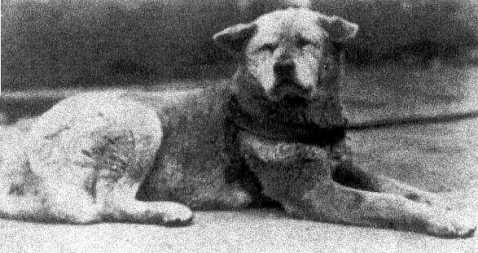
Take the example of the Japanese Akita dog called Hachi, (Hachikō in Japanese) that I wrote about almost a year ago.
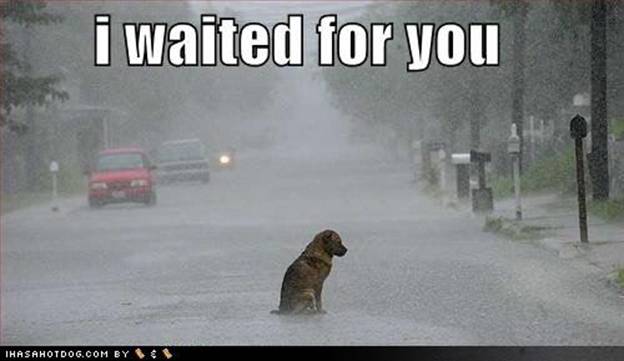
In 1924, Hidesaburō Ueno, a professor in the agriculture department at theUniversity of Tokyo took in Hachikō as a pet. During his owner’s life Hachikō saw him out from the front door and greeted him at the end of the day at the nearby Shibuya Station. The pair continued their daily routine until May 1925, when Professor Ueno did not return on the usual train one evening. The professor had suffered from a cerebral hemorrhage at the university that day. He died and never returned to the train station where his friend was waiting. Hachikō was loyal and every day for the next nine years he waited sitting there amongst the town’s folk.
Hachikō 1925
“…. every day for the next nine years he waited sitting there amongst the town’s folk” Truly a sustainable relationship.
Now to something closer to home; literally.
The Payson Roundup is our local newspaper. Last Tuesday’s edition had the following story which Tom Brossart, Editor, has kindly given me written permission to reproduce here on Learning from Dogs. Thank you, Tom.
Best friends help save man’s life
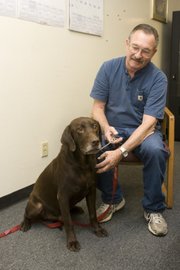
Both Logger and Harold Green are a little gray around the muzzle, but they have lots of good days ahead after Logger helped save Green’s life back on July 1.Photo by Andy Towle
Logger is Harold Green’s best friend. Logger isn’t a flannel-wearing, tattooed burly woodsman; he is a sweet-tempered chocolate Labrador retriever. And this best friend saved Green’s life.
Green makes his home up in Happy Jack. Recently he and Logger drove into the woods and went for a walk, and then Green had a heart attack. He didn’t have a history of heart disease, but all of a sudden his chest became tight. He collapsed and on his way to the ground, he hit a fallen log and wound up hitting his forehead and nose, tearing his bottom lip away from his gums, cutting his chin and breaking a rib.
“Right before I had the heart attack I had a page there was a fire, and that’s the last thing I remember,” he said. Green is an emergency medical technician with the Blue Ridge Fire Department.
He said the next thing he remembers was waking up and trying to call 911. “There was so much blood in my eyes I couldn’t see at first, but Logger licked the blood away.”
Green was conscious long enough to dial 911 and try to explain where he was. He heard the sirens go past him and with that information; the emergency responders had a place to start looking for him.
At that point, Logger left Green’s side to go to the rescue personnel.
“From what they told me, he was like Lassie. He came running to them, barking, and started running back to me, stopped and made sure they were following,” Green said.
The first person on the scene with him was a law enforcement officer with the Forest Service. Green said he told him his nose was bleeding so much he thought it was broken.
Next to arrive was a deputy sheriff. Green said he later learned the guy was off duty, but came to help anyway.
The Blue Ridge ambulance crew arrived next.
“Logger did the same with all of them as he had with the first one on the scene. They told me, without Logger’s help they would have had to search for me a lot longer.”
Green said when they first reached him his heart rate was in the mid-40s and he had no blood pressure. The rescue team stabilized him and carried him out to the ambulance to take him to the fire station where a helicopter could land.
“They said Logger tried to get into the ambulance with me,” Green said.
He said he has little or no memory of everything that took place, when he woke up he was in the hospital in Flagstaff.
Logger couldn’t ride in the ambulance with Green and couldn’t come see him in the hospital, but since he has been out, the dog has not been more than three feet from him for three weeks.
“It is really humbling to have so many friends there to help you out,” Green said.
The people who came to his rescue were all friends and, just like Logger, they did what best friends do, except it was something they do every day, for friends and strangers alike.
Logger has been part of Green’s family for seven years, joining it when he was just a puppy.
Green is the son of longtime Rim Country Realtor Bea Baxter, who has been in the community for around 40 years.
So dear, lovely Logger also demonstrated the same, deep sustainability of relationship that Hachikō did back in 1925. There is so much that we can learn from dogs. Think about sustainability, as it relates to the relationship between dogs and man. It goes back at least 30,000 years. It’s an unimaginable length of time.
In this context, sustainability is an underused word!
A recent item on the BBC website provides a welcome reminder of the power of the relationship between dogs and mankind.
Practically no-one is unaware of the role that dogs provide, for example, as guides for humans with sight impairment. But there’s much more to the ‘service’ dog than that.
A service dog might be described as,
“any guide dog, signal dog, or other animal individually trained to do work or perform tasks for the benefit of an individual with a disability, including, but not limited to, guiding individuals with impaired vision, alerting individuals with impaired hearing to intruders or sounds, providing minimal protection or rescue work, pulling a wheelchair, or fetching dropped items.”
That definition is taken from the United States Code of Federal Regulations for the Americans with Disabilities Act of 1990!
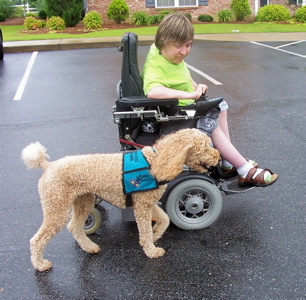
Carrie and Lilly
But then cast your eye over this, as I mentioned, from the BBC on the 26th May, 2011.
Dogs can help reduce stress in parents of children with lifelong developmental disability autism, a study suggests.
The University of Lincoln compared 20 families with dogs with 20 without.
Daniel Mills told a Royal Society of Medicine conference early results suggested any breed could improve communication and relationships.
The veterinary behavioural medicine professor hopes to use video footage to show how dogs can improve child eating, sleeping and tantrum behaviour.
At a three-day Parents’ Autism Workshops and Support course, the families listed more than a thousand ways their dog had helped – from developing language and establishing a routine to using the pet to request action in a non-confrontational way.
Full story is here in which is included Professor Mills saying: “While there is no shortage of opinion on how dogs can help, there has been little money given to scientifically look into this.”
Autism is a challenging condition and anything that can establish a scientific underpinning for the role that dogs can have is to be welcomed whole-heartedly.
Finally, there are quite a few videos online that provide more information about the special, almost magical relationship between dogs and autistic people. Here’s one that is the first part of a series of five.





 Learning from Dogs