Category: People and their pets

That Diamond Jubilee

A further reflection on what has clearly been a wonderful occasion.

Last Sunday, I published a piece about The Queen’s Diamond Jubilee.  Today, I wanted to add a couple of perspectives to this glorious and historic event.

The grand perspective

As seen by someone watching the 1,000 boats on the River Thames to mark The Queen’s Diamond Jubilee.

Then in stark contrast …

The local perspective

… as seen by the camera’s eye in the little village of Littlehempston, South Devon with many of the population of some 200 persons in front of Littlehempston Church.

Picture by Neil Kelly, standing to the right of John, see footnote.

Footnote: Not only is Littlehempston just a few miles from the village of Harberton where I used to live, before my new life with Jean here in Arizona, but both my sister and brother-in-law are in this photo; my sister, Corinne, is the first woman in from the right in the front row, and my brother-in-law, John, is standing just behind her (wearing the white hat).

Update:

Neil sent me a further picture below of the village beacon alight for the Jubilee.

Littlehempston’s Jubilee Beacon


Fighting pet homelessness, one animal at a time.

With big thanks to Trish for sending me these details.

It may seem entirely irrelevant to the wider world to focus on one homeless dog now taken into care and looking for a loving home but if one ‘raises’ the theme to that of which Learning from Dogs is all about, namely Dogs are integrous animals. We have much to learn from them then not so!

I’m not going to waffle around this for much longer except to ask you to go across to Patrice Ayme’s Blog and read his recent essay, Blood: Appetite Comes With Eating.  It’s a very erudite, and deeply upsetting, commentary on something I touched on in a recent Post.  Patrice writes, “Today we have just one civilization. If it dies, it will have no replacement.”  So go and read the full essay.

So when we wonder why there seems such a departure from integrity within the higher echelons of society, it makes my heart leap to be reminded of the innocence and integrity of dogs (and, of course, all of nature’s animals), and the outstanding beauty of all those who love and care for them.

So forget about the big, wide world for a while and read what Trish emailed me,

Tiny Tinker needs a forever home

Tinker

Found fending for himself on the hot streets of South Phoenix, Tinker is six and a half pounds of pure puppy love! This sweet survivor was in very tough shape when he was rescued from the county shelter and brought to the vet. But while he was being examined, Tinker wouldn’t stop trying to kiss everyone around him, and couldn’t stop wagging his tail! Currently recovering in a foster home, this little trooper desperately needs to find a forever home where he’ll be loved for the rest of his life.

Can you help?

Tinker is a spunky sweetheart who loves to snuggle with people. According to the vet, this 12-year-old Chihuahua is the victim of bad genes and neglect. The poor baby was born with only one good eye, permanently dislocated back knees, and terrible teeth. He’ll have dental work done soon, so he can go to his new home with a healthy smile. But first, he needs to recover completely from kennel cough. His ragged ears are most likely the result of flies biting off the edges.

Despite everything, Tinker is one of the happiest little dogs you’ll ever meet. Extremely affectionate and full of energy, blood tests show he’s in overall good health. He’s already neutered, housetrained and up-to-date on his shots. And once he recovers, all he’ll need is medication for his knees to make him more comfortable. Tinker seems to like other dogs, so would welcome canine companions.

Small Chihuahuas can lead very long lives. And if ever a dog deserved to enjoy many years as someone’s cherished pet, it’s Tinker! If you or someone you know can offer him a good home, please contact Jill at (480) 363-8449 or jill@cdsframing.com.  She’d be thrilled to hear from you and delighted to introduce you to the terrific Tinker, who is living in Phoenix.

You can also help Tinker find a home by posting his adoption flyer wherever you work, play or shop.

Thank you for anything you can do to help Tinker and for everything you do for the animals. Each act of kindness brings us one step closer to No More Homeless Pets®.

And from that flyer comes the following information …

Breed: Mix Chihuahua
Location: Phoenix, Arizona
Sex: Male
Age: Senior
Description: Little Tinker found himself abandoned and left to fend for himself on the rough lonely and HOT streets in Phoenix, Arizona. His previous life, he was not well loved or cared for. When I met this little bugger, I fell in immediate love with him and got him fully vetted. He still needs a couple of teeth extractions but he is in excellent health otherwise – all bloodwork came back negative and normal for any possible under-lying medical conditions.

This is one happy boy! GREAT SELF-ESTEEM, his tail never stops wagging and he only weighs 6 1/2 itty bitty little pounds and yes he is around 12 years old. He is now current on all his vaccinations and is neutered. He has a lot of life and spunk about him despite all he has been thru….very lovable, snuggly, and affectionate little pooch. Tinker would love nothing more than to be your sweet little lap boy and car rides – yes, he loves to go in the car with you.

Pleae consider giving him a loving home – he deserves it!!!!
Contact: Jill Lenz Phone: 480-363-8449 Email: jill@cdsframing.com

So if you know someone who could help, then please follow that up.  If you don’t, then circulate these details just as far and wide as possible.  And if you are a person who might be interested or know someone who might be, and you are in another US State, then email or call Jill Lenz and say you saw the details on Learning from Dogs and somehow we can all work out how to get little Tinker in to your arms.

Thank you.

Talking physics with your dog!

Not as silly as one might think!

Back on the 25th April I ran a Post called Dogs and the Mathematics of Calculus that had been prompted by a lovely email from Richard Hake who is Emeritus Professor of Physics at Indiana University.  (Now here’s a question for yours truly; what does it mean for a Professor to be an Emeritus Professor? Answers as comments please.)

It was very well received.  Then just a few days ago Professor Hake, who admits to being a dedicated lurker of this blogsite, sent me another email with a number of fascinating links.  So here goes with one of those links.

Talking to Your Dog About Physics

A conversation with Chad Orzel

So, why do you talk to your dog about physics?

Lots of reasons, but the main one is that I’m a physics professor. Talking about physics is what I do. Sooner or later I talk to everybody about physics.

I bet that’s a big hit at parties.

You might be surprised. I mean, sure, I get a lot of people making faces and saying how much they hated physics when they took it in college. But some of those same people turn right around and start asking interested questions about the subject.

OK, but why the dog?

Talking to the dog about physics is worthwhile because it can help me see how to explain physics to my human students. Humans all come at the subject with the same set of preconceptions about how the world works, and what “should” happen, and it can be very hard to shake those off. That’s a big barrier to understanding something like quantum physics.

Dogs look at the world in a very different way. To a dog, the world is a neverending source of wonder and amazement. You can walk your dog past the same rock every morning, and every morning, she’ll sniff that rock like she’s never sniffed it before. Dogs are surprised by things we take for granted, and they take in stride things that would leave us completely baffled.

Can you give an example?

Well, take the dog’s bowl, for example. Every now and then, we put scraps from dinner in the bowl when she’s not looking, and she’s become convinced that her bowl is magic– that tasty food just appears in it out of nowhere. She’ll wander over a couple of times a day, and look just to see if anything good has turned up, even when we haven’t been anywhere near the bowl in hours.

This puts her in a better position to understand quantum electrodynamics than many humans.

It does?

Sure. One of the most surprising features of QED, in Feynman’s formulation, is the idea of “virtual particles.” You have an electron that’s moving along, minding its own business, and every now and then, particle-antiparticle pairs just pop into existence for a very short time. They don’t stick around very long, but they have a real and measurable influence on the way electrons interact with each other, and with other particles.

You’re making this up, right?

No, not at all. One set of these interactions is described by a number called the “g-factor” of the electron, and this has been measured to something like fifteen decimal places, and the experimental measurement agrees perfectly with the theoretical prediction. If there weren’t electrons and positrons popping out of nowhere, there’s no way you could get that sort of agreement.

So, what’s this have to do with the dog?

Well, like I said, the dog is perfectly comfortable with the idea of stuff popping into existence out of nowhere. If a great big steak were to suddenly appear on your dining room table, you’d probably be a little perturbed. The dog, on the other hand, would feel it was nothing more than her due.

So she’s perfectly ok with the idea of virtual particles, unlike most humans, who tend to say things like “You’re making this up, right?” She was already convinced that there were bunnies made of cheese popping in and out of the backyard, and just regards QED as a solid theoretical justification for her beliefs.

And this helps humans, how, exactly?

Physics has a reputation as a difficult and unapproachable subject, especially in fields like quantum mechanics, where the predictions of the theory confound our human preconceptions. If you can put aside a few of your usual notions of how the world works, and think about how things look to a dog, some aspects of physics that seem absolutely impossible to accept become a lot more approachable.

Why does this matter, though? Isn’t this all stuff that you need a billion-dollar particle accelerator to see?

Actually, no. It’s a common misconception, but most of the really cool aspects of quantum mechanics that we talk about in the book are experiments that are done on a table-top scale. One of them, the “quantum eraser,” you can even do yourself with a laser pointer and a couple of pairs of polarized sunglasses.

OK, but what is it good for, in a practical sense?

Lots of things. It’s not an exaggeration to say that modern life as we know it would be impossible without an understanding of quantum phyiscs. You need to understand quantum ideas to build the lasers we use in modern telecommunications, and the transistors that are the basis of all modern electronics. The computer I’m typing this on wouldn’t exist without quantum physics.

And there are a whole host of future technologies that are based on quantum ideas. There are exotic applications like quantum computers that can do calculations that would be impossible with any normal computer, and quantum cryptography systems that allow us to make unbreakable codes. But even relatively mundane “green” technologies like more efficient light bulbs, batteries, and solar panels rely on quantum ideas to work.

Quantum physics is everywhere, and drives a huge amount of modern science and technology.

So that’s why people should teach quantum physics to their dogs?

Exactly. Also, it’s just about the coolest thing ever.

How to Teach Physics to Your Dog is published by Scribner can be ordered from Amazon.comIndieBound,Barnes and Noble, and Powell’s.

How to Teach Relativity to Your Dog is published by Basic Books and can be ordered from AmazonBarnes & NoblePowell’s.


Talking or sleeping about physics?

OK, two thoughts to close this off.  The first is to remind you of an early sentence that Chad Orzel wrote, “Talking to the dog about physics is worthwhile because it can help me see how to explain physics to my human students.” and to add that in my next life, I wouldn’t mind coming back as one of Chads dogs!

The second thought is that Chad’s talks with his dogs are pretty relaxed affairs, as the picture above bears out!


Thank you, Professor Hake!


Dog goes for a 1,700 km run!

A wonderful news item from the BBC from their China ‘desk’.

Some dog run! All 1,700 kilometres across China

Here’s how it was presented on the BBC News website.

A stray dog has completed a 1700km journey across China after joining a cycle race from Sichuan province to Tibet.

The dog, nicknamed “Xiaosa”, joined the cyclists after one of them gave him food.

He ran with them for 20 days, covering up to 60km a day, and climbing 12 mountains.

Cyclist Xiao Yong started a blog about Xiaosa’s adventures, which had attracted around 40,000 fans by the end of the race.

Yong now hopes to adopt Xiaosa.

Luckily, someone smart grabbed the BBC footage and uploaded it to YouTube thus allowing me to include that below:

I did several Google searches for Xiao Yong’s blog but failed to come across it – never mind, it doesn’t detract from a delightful story this Memorial Day week-end here in America.

Aussie dogs

A rather overdue posting.

Back on April 2nd this year, I posted a piece called I am your dog!  The item was motivated by coming across a personal reflection of the relationship that I had, and still have, with Pharaoh, my German Shepherd dog, back in 2007 when I was still living in England; I met Jean in Mexico Christmas 2007!

Among the many comments was one from Perfect Stranger who writes the fabulous blog Dogs of Doubt.  He said in his comment,

Hi Paul, I do believe this comment belongs on this post … two videos, part of a true story about an Aussie dog, a modern day “Dog on the Tucker Box”, a true blue friend to an entire town who eventually ended up building him a statue … yeah, not “it” but “HIM”.

First video shows you how tough Aussies animals are ,, watch the fight, it’s awesome, I laugh every time I watch it. they say it really happened. 🙂

Second video is the trailer for “Red Dog” – The Pilbara Wanderer!  , hope you get to see the movie

I promised to make that comment a post all on it’s own right – then promptly forgot!  So apologies and here are those two movies.

Welcome Kylie Dunning

The second fascinating contribution from a guest author.

On Monday I mentioned that I had been approached by two authors who wanted to share their articles with the readers of Learning from Dogs and on that day I published a guest post from Dr. Jane Brackman.  Today, I’m delighted to share with you the thoughts of the second of those authors, Kylie Dunning, who describes herself as a writer who holds a strong passion for Psychology, especially in the field of Forensics.  She is a lover of animals and an avid hiker in her spare time.

Trainer Julio Simuel (left) watches as his student “Walker” gets congratulations from admirers following a graduation ceremony at Nash Correctional Institution last Wednesday.

Here now follows Kylie’s essay,

Psychology of Healing: Dogs and Inmate Rehabilitation

In 1981, Sister Pauline Quinn envisioned  a prison pet partnership program where inmates would train dogs for people with disabilities. Designed to benefit unwanted dogs, the inmates, and the future dog owners, the program was initiated in the Washington state prison for women. The success of the program led to dog training programs in prisons all over the country and has since become part of the material in forensic psychology programs and criminal rehabilitation programs.

Male and female inmates train anywhere from three to fifty dogs at a time for adoption into new families, as service animals, and sometimes for specialized purposes such as bomb-sniffing. There are other benefits. The prisoners who worked as trainers hope to find jobs in animal care as soon as they leave prison. Others, serving longer sentences, are given a sense of purpose and an improved outlook. Psychologically, having a dog to care for serves as a form of therapy and decreases depression, and it brings out good qualities in the inmates, even improving their attitude toward each other.

The Nash Correctional Institution in North Carolina has a program called “New Leash on Life,” in partnership with Southern Siberia Rescue, which pays for all the food and medical treatment for the dogs. Three dogs at a time are trained for eight weeks, then offered for adoption. Jerome Peterson, who has served 19 years for a second-degree murder charge, is one of the trainers. He says that teaching the dogs has taught him compassion and made him a better man. “You have to be patient with the dogs,” he explained. “Some have been abused, and some were left stranded.” He says that though only six of the inmates train the dogs, all 980 of the inmates at the medium-security prison benefit from the program. “A lot of guys wake up mad at the world for no reason,” he said. “When they see the dogs, they get happy — excited. Their whole demeanor just changes.”

Lansing Correctional Facility in Kansas, a combined medium- and maximum-security prison, has a population of 2,500 criminals. Their Safe Harbor Prison Dog Program rescues dogs from death row. About 50 of them are trained by about 100 inmates on any given day. So far, about 1,200 dogs of all breeds and ages have found new homes under the program. Inmate Jerry McMullin trains his dogs in 15-minute intervals four times a day, rewarding them with treats he buys for 45 cents a pound at the canteen (out of the dollar a day he earns at his prison job—prisoners aren’t paid for training the dogs). “You don’t want to work with them too long or they stop paying attention. They get bored,” he says. “I use no force or fear, positive reinforcement only.” Inmates like Pete Spencer will go to lengths to help troubled dogs. “I had one who was so physically abused, he had no trust in humans,” Spencer says. “I slept on the floor with him for a month to get his trust and then I taught him commands.”

The inmates can see positive changes from working with dogs. Spencer says of his fellow inmate, “When I first met (McMullin), he was … well, pretty grouchy,” Spencer says. “Now he’s more open and alive and he has a positive outlook.” Other work programs can help prepare inmates for a job after release, but working with dogs may psychologically be a more effective way to rehabilitate them. With prison populations stressing already taxed resources, and the more and more animals in need of homes, the use of dog training programs in prisons is more than a happy accident. It is a creative way of using state resources to do real and lasting change in society.

oooOOOooo

Well what another wonderfully interesting guest post.  Thank you, Kylie.  More please!

Using details in Kylie’s article, it was very easy to find this video, plus the photograph at the head of the article came from the Southern Siberian Rescue website.

Homeless dogs are getting special help from inmates.  The Columbia County Sheriff’s Office has launched their own “New Leash on Life” program that benefits inmates at the Columbia County Jail and the dogs.

Welcome Doctor Barkman!

A delightful contribution from a guest author.

Dear readers, from time to time I am approached by other authors who have flattered me by asking if I would like to publish their Blog posts from time to time.  So I have been doubly flattered by having two authors contact me in the last week.

So to the first.  It is with great pleasure that I welcome Jane Brackman, Ph.D., author of the blog Doctor Barkman Speaks who will, from time to time, republish her posts on Learning from Dogs. I have no doubt that you will enjoy her scientific expertise regarding dogs

So today, please enjoy …

oooOOOooo

HOW DOGS THINK – NEW SCIENCE LOOKS INSIDE THEIR MINDS WITH MRI IMAGING

Canine illustrator Robert Dickey assigned thoughts and feeling to his Boston Terrier based on the dogs’s expressions. Here he illustrates contentment, sympathy and misery.  (Dogs from Life, Page & Co., 1920)
**
Are you gonna eat that? Are you gonna eat that?  I’ll eat it.”
Is this what dogs think?  Or do they experience more complex thoughts?  Apparently science is getting pretty close to figuring it out. If not exactly WHAT they’re thinking, then where in the brain the thoughts are coming from.  Since brains are pretty much the same across mammal species, if researchers identify which parts of the the brain light up, based on what humans have said, they can guess what the dogs’ thoughts are, too.

A couple of smart guys, Gregory Berns and Andrew Brooks of Emory University, watching a military dog assist Navy Seals as they overran the Osama Bin Laden compound, got a brilliant idea.  If you can teach dogs to jump out of helicopters, surely dogs could be trained to enjoy themselves inside an fMRI machine while scientists calculate what the dogs are thinking by scanning their brains.

The researchers, who are dog-lovers, explained, “We want to understand the dog-human relationship, from the dog’s perspective.  From the outset, we wanted to ensure the safety and comfort of the dogs.  We wanted them to be unrestrained and go into the scanner willingly.

So they recruited a professional dog trainer, Mark Spivak, and two companion dogs, a Feist Terrier named Callie and a Border Collie named McKenzie.  The team said that both dogs were trained over several months to walk into an fMRI scanner and hold completely still while researchers measured their brain activity.

In the photo below Callie wears ear protection as she 
prepares to enter the scanner.  The research team 
includes, from left, Andrew Brooks, Gregory Berns and Mark Spivak.  
(Credit: Photo by Bryan Meltz)

This is what the researchers wrote in the journal article that was published in PLOS last week:

Because of dogs’ prolonged evolution with humans, many of the canine cognitive skills are thought to represent a selection of traits that make dogs particularly sensitive to human cues. But how does the dog mind actually work? To develop a methodology to answer this question, we trained two dogs to remain motionless for the duration required to collect quality fMRI images by using positive reinforcement without sedation or physical restraints. The task was designed to determine which brain circuits differentially respond to human hand signals denoting the presence or absence of a food reward.

Eventually they hope to answer the more profound questions we all ask:  Do dogs have empathy? Do they know when we are happy or sad?  How much language do they really understand?”  (And here’s one from me- When they pee on the carpet and we don’t find it until the next day, when we scold them do they know why we are scolding them?)

Do dogs feel guilt?
You can read a brief summary of the project here:  What is Your Dog Thinking? Brain Scans Unleash Canine Secrets.

Or read the entire scholarly article here:

Berns, Gregory, Brooks, Andrew and Spivak, Mark, Functional MRI in Awake Unrestrained Dogs (April 27, 2012). 

Jane Brackman, Ph. D.

oooOOOooo

Well, I don’t know about you but I found this a most fascinating article.  All of us who live around dogs, both physically and emotionally, sense the closeness, may I use the word ‘magic’, of the relationships.

Take a look at the photograph below.  Until I left the UK in 2008, a few of us owned a lovely old Piper Super Cub.  It was a joy to fly.  I used frequently to take Pharaoh to the grass airfield, Watchford Farm, up on the Devon moors.  One day he showed such interest in the aircraft that I lifted him up to the passenger’s seat, strapped him in and taxied all over the grass airfield.  This picture shows something that is difficult to explain otherwise – Pharaoh’s real joy at sharing the adventure.  Of course, I didn’t fly with him, that would have been a step too far, but we did taxi almost up to take-off speed.  Dr. Barkman, what do you make of that?

Watchford Farm, Devon, July 2006.


Windows on the world of dogs!

With big thanks to Rich S. for forwarding these to me – enjoy!

And a little closer to home ….

A picture of Pharaoh as a young puppy in the arms of Sandra Tucker, the owner of Jutone, German Shepherd breeders in Devon, SW England.

Pharaoh, aged 9 weeks, picture taken on the 12th August, 2003.

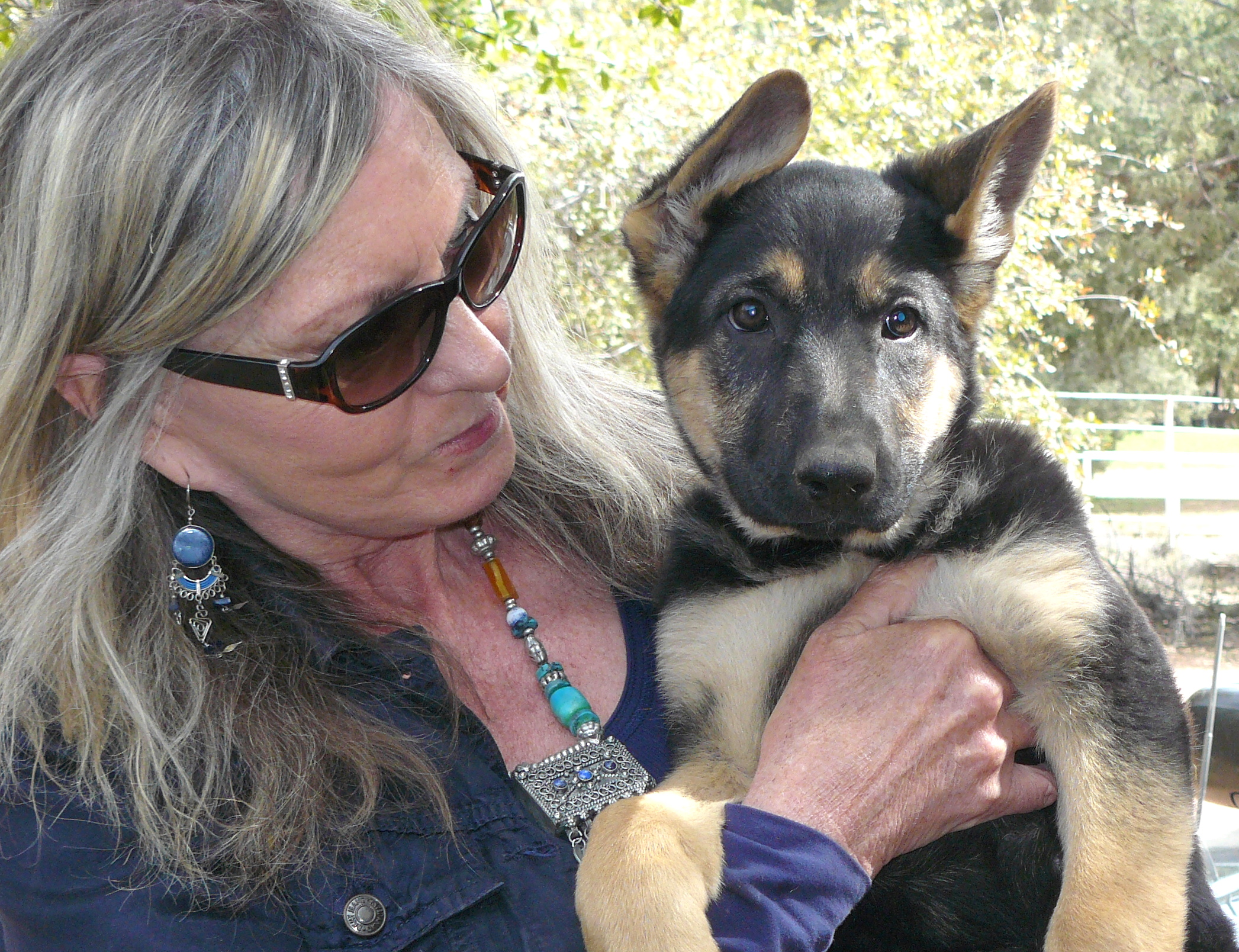
Compared to a picture of Cleo as a young puppy in the arms of Jean here in Payson.

Cleo, aged 8 weeks, picture taken 4th April, 2012

And closing with a picture of Cleo taken yesterday.

Cleo, coming up to 14 weeks.

It’s the way you tell it!

Humour at its best!

Take a couple of minutes off and bury our crazy world with a laugh.  With big thanks to Dan Gomez for forwarding on what had been sent to him by Greg H.

Cleo’s progress!

Now 19 days since our young German Shepherd puppy joined us.

On the 9th April, I wrote a Post about the arrival of young Cleo who became part of our family on the 8th.  Here’s a couple of photographs from that Post.

Little bit of bonding going on!
Welcome, young lady. I'm the boss around here!

So here are a couple more taken yesterday afternoon, the 25th. Cleo was weighed last Monday and was 28 lbs, some 6 lbs gain since the 8th.

Two very loving ladies!
Pharaoh and Cleo already inseparable.

Must say that Cleo has settled in very well with her other four pack mates. Indeed, Cleo, like Sweeny, mixes easily with all the other dogs, not just Pharaoh’s group.