Category: Musings

Adieu Payson

The end of a treasured time in Payson, Arizona.

Today, Jean and I together with our 11 dogs and 5 cats start the 1,200 mile journey to Merlin, Oregon.  While we have only lived in Payson since February, 2010, it has been a time of fantastic experiences.  I had to work through the long process of getting a fiancee visa from the American Embassy in London.  Until that was issued my ‘residence’ in Payson was that of a British tourist with me having to leave the USA every 90 days.

The visa was issued in October, 2010 and I flew immediately to Arizona.  On the 8th November, 2010 Jean and I were issued with a Marriage License Certificate and we were married on the 20th November at St. Paul’s Episcopal Church in Payson.

Fr. Dan Tantimonaco with the newly weds!

We have made many very dear friends here in Payson but Oregon feels like the start of our home in every sense of the word, not just because it is the first home that Jean and I have bought jointly.

One of those dear friends here in Payson has been John Hurlburt, a devoutly spiritual man.  A little over a week ago, he sent me a very thoughtful essay and I wanted to include it today as a guest post in recognition of the way that John and many, many others have embraced these couple of Brits over the last 32 months.  Thank you all.

oooOOOooo

Unity

Everything fits together

The species of animals we know as human beings is a part of everything that exists. We are a very young consciously-aware species that does not begin to know all the answers. What little we do know has a Natural pattern. It would seem that there’s a lamplighter and a navigator in all of us. The lamplighter is our fundamental awareness of being and provides nature’s guidance along life’s pathways.

Our natural navigator is designed for evolutionary competition. There’s a biological survival kit in our DNA. Extreme demand for limited resources generates deadly combat; both within and between species. As a result of competition taken to wretched excess, our global economy is leveraged 22 times beyond any earthly foundation. The unspoken intent to destroy each other over what remains of our planet is becoming increasingly evident.

The human species is engaged in a global war over money, ideals and disappearing finite resources. Ninety-seven percent of the world scientific community has confirmed that the natural effects of heat and discharges generated by human machines and related human activities are the primary cause of recent rapid climate change.

These dedicated scientists are opposed in the media by three percent of their corporate energy-financed peers. An oppressive worldwide network of often offensive politicians is similarly supported and managed accordingly. Nature couldn’t care less about politics, emotions or idealistic arguments.

Human squabbles mean very little in the totality of universal life. The drumbeat of local natural disasters increases steadily. There are no two ways about it. No amount of human ifs or buts can or will change reality. Our human species is in deep serious trouble.

It has been six million years since the first humanoids emerged and two million years since the rise of human civilization. What a sorrow it is to realize what we have done to the earth in just the past two hundred and fifty years. We’ve reached the moon and are exploring Mars. It’s well past time to clean house and re-grow our local garden.

As an old navigator, there’s a sense of urgency regarding the course life on earth has taken. For those who continue to care about facts, the prognosis is not encouraging. We have the know-how for an alternative. We can avoid the perfect storm of going over the edge of an economic cliff and the crush of an environmental crisis in the midst of a war-fuelled, profit-driven, global, corporate fight to the end. The alternative is that we have the know-how to transition rapidly to a reality-based economy and a way of living that’s gentle to the earth. The solution is global, it’s industrial, it’s natural and it’s our best hope. It may well be our only hope. It’s time to light some lamps.

Conscious human awareness emerges as we relax, contemplate, meditate, and communicate openly. These are levels of awareness beyond the limits of our daily human musings. The wisdom which flows from enlightened awareness embraces humility, experience, knowledge, understanding, and faith. Life has never been easy. We’re fragile biological beings. Our mutual growth is the result of sustained efforts over millions of years.

Yet despite attaining a higher level of conscious awareness our human culture continues to operate on a material basis rather than a moral basis. We have become confused by our own importance or the apparent lack thereof. We all too often retreat into a rut, furnish it and turn on the electronics.

By definition, natural processes support species growth in harmony with all natural life. Those natural processes are indistinguishable from the planetary support systems within which all life interacts. Human interaction is local. We spend much of our lives unaware that we are unaware; initially as infants and throughout our lives in deep sleep. When caught up in the pressures of our daily lives, it’s easy to be unaware of being unaware.

It’s time to wake up. Cosmology is an eternal spring from which the waters of the earth still flow. When we turn ourselves inside-out and achieve higher awareness, we discover who, what and where we really and truly are. In a trinity of spirituality, nature and science, we’re cosmically energized beings; spiritual beings sharing a transitory human existence.

Ninety-eight percent of the human population believes in a power beyond species and self. The simplest understanding of this belief is that we humans did not originally create ourselves. All human wisdom and understanding leads to the conclusion that human beings don’t own the earth. We’re caretakers and we’re only passing through. Given that we have a systemic crisis, what do we have to work with?

We have a species that’s squabbling over diminishing resources, an environment and an infrastructure which both desperately require attention, a sustaining objective of equitable global employment, a world economy that’s about to collapse for lack of any real foundation, a burgeoning population which further strains the system and the clear need for a unifying purpose.

Put it all together and what do we have? The navigator is our guide to growth. The navigator shares our wholeness. The lamplighter is our guide to unity. Everything fits together. Each of us is a part of the unity of life. Unity has a natural purpose. It’s time to build a life boat.

John Hurlburt is a former U.S. Navy aviator and successful corporate executive who presently serves as a senior Christian educator and a founding member of an international Transition Town in Payson, Arizona.

oooOOOooo

Don’t know about you, dear reader, but I find those incredibly powerful words.  Words that provide the truth. A truth the whole world needs.  John set out in a personal email to me the three simple fundamentals of our lives. Just a few more words to sum up the truth.

There’s an environmental crisis.  There’s an inevitable global economic abyss touching us all on a daily basis.  The need for a green economic transformation is obvious.

Thank you, John.

Lets try not to get stuck in a rut…

A fascinating look back at making tracks!

This came in from Suzann, Su to her friends, a few days ago.  Suzann is Dan Gomez’s sister and if Dan’s name is familiar it’s because he, too, sends in items for Learning from Dogs, the recent Tad too much cabin pressure being an example.  It was Su that invited me out to San Carlos, Mexico for Christmas 2007 which resulted in me meeting Jean, a long-time friend of Su, and, as they say, the rest is history!  OK, to the article from Su.

oooOOOooo

Here’s a question?

Think about railroad (railways in ‘English’!) tracks.  The US standard railroad gauge (distance between the rails) is 4 feet, 8.5 inches.  That’s an exceedingly odd number.

Why was that gauge used? Because that’s the way they built them in Scotland, and Scots expatriates designed the US railroads.

Why did the Scots build them like that? Because the first rail lines were built by the same people who built the pre-railroad tramways, and that’s the gauge they used.

Why that gauge then?  Because the people who built the tramways used the same jigs and tools that they had used for building wagons, which used that wheel spacing.

Why did the wagons have that particular odd wheel spacing?  Well, if they tried to use any other spacing, the wagon wheels would break on some of the old, long-distance roads in Scotland, because that’s the spacing of the wheel ruts.

So who built those old rutted roads?  Imperial Rome built the first long distance roads in Europe (including Scotland) for their legions.  Those roads have been used ever since. [And rarely repaired! 😉 Ed. ]

And the ruts in the roads? Roman war chariots formed the initial ruts.  Which forever more everyone else had to match for fear of destroying their wagon wheels.

Since the chariots were made for Imperial Rome, they were all alike in the matter of wheel spacing.  Therefore the United States standard railroad gauge of 4 feet, 8.5 inches is derived from the original specifications for an Imperial Roman war chariot.

Bureaucracies live forever….

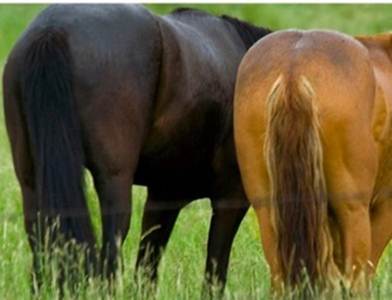
So the next time you are handed a specification or a procedure or process and wonder ‘What horse’s ass came up with this?‘, you may be exactly right.  Imperial Roman army chariots were made just wide enough to accommodate the rear ends of two war horses.

Now, the twist to the story. When you see a Space Shuttle sitting on its launch pad, there are two big booster rockets attached to the sides of the main fuel tank. These are solid rocket boosters, or SRBs.  The SRBs are made by Thiokol at their factory in Utah.

The engineers who designed the SRBs would have preferred to make them a bit fatter, but the SRBs had to be shipped by train from the factory to the launch site. The railroad line from the factory happens to run through a tunnel in the mountains, and the SRBs had to fit through that tunnel.

The tunnel is slightly wider than the railroad track, and the railroad track, as you now know, is about as wide as two horses’ behinds.

oooOOOooo

Just a fabulously interesting account of something we all take for granted, or had done until now! Thank you so much, Su, for sharing that with everyone.

The death of the USA?

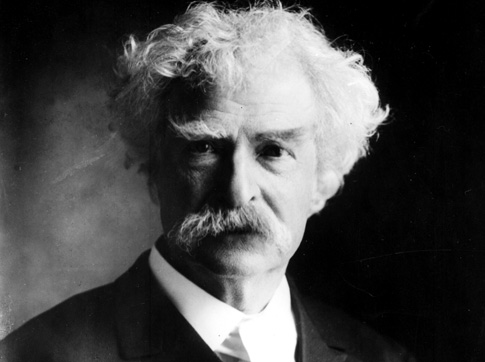
The reports of my death are greatly exaggerated! Mark Twain.

Mark Twain

Origin

Mark Twain quotation after hearing that his obituary had been published in the New York Journal.

Mistaken publications of obituaries aren’t as rare as you might expect. A recent example is of Dave Swarbrick, the British folk/rock violinist, who was killed off mistakenly by the Daily Telegraph in April 1999 when they reported that his visit to hospital in Coventry had resulted in his death. He did at least get the opportunity to read a rather favourable account of his life, not something we all get to do, and to deliver the gag “It’s not the first time I have died in Coventry”.

So why have I opened with this quote from Mark Twain?  Read on and I hope all will be clear.

Integrity is always about getting to the truth!

A little under a week ago I published a couple of posts that proposed that the United States of America is an empire in decline.  The first was What goes up? and the second Might just come down! As a Brit I well know that aspect of British history!

However a recent conversation with a friend of many years back in England, who has also been a shrewd and wise entrepreneur for longer than I care to remember, argued that the evidence for the ‘end of the USA’ could be challenged.

He cited five reasons why he thought the USA would remain, more or less, in its dominant position.  They were:

  1. Spirit of innovation
  2. Relaxed labour laws
  3. The importance of Mexico
  4. The uncertainty of China in terms of the next ’empire’
  5. The likely energy self-sufficiency for the USA in the near-term.

So let me expand on each of those points.

Spirit of innovation

Let me quote from an article in TIME Magazine of the 5th June, 2011,

Innovation is as American as apple pie. It seems to accord with so many elements of our national character — ingenuity, freedom, flexibility, the willingness to question conventional wisdom and defy authority. But politicians are pinning their hopes on innovation for more urgent reasons. America’s future growth will have to come from new industries that create new products and processes. Older industries are under tremendous pressure. Technological change is making factories and offices far more efficient. The rise of low-wage manufacturing in China and low-wage services in India is moving jobs overseas. The only durable strength we have — the only one that can withstand these gale winds — is innovation.

Now there are plenty to argue both ways in terms of the future innovation potential for the USA, as a recent article in The Atlantic does, see American Innovation: It’s the Best of Times and the Worst of Times.  But the spirit of innovation will be a powerful economic potential for the USA for many years to come.

Relaxed labour laws.

Definitely an area that I have little knowledge of except for the subjective notion that compared to many other nations, the laws in the USA are much less of a restraint on economic productivity than elsewhere.

The importance of Mexico.

Importance in the context of providing the USA with a source of cheaper manufacturing facilities.  My English friend thought that this was a significant competitive advantage for the USA.  Now, as it happens, we had a couple staying with us over the week-end of the 6th/7th October.  The husband is a senior manager of Horst Engineering, an American firm based in Guaymas, Sonora County, Mexico.  Here’s a picture from their website,

We are a contract manufacturer of precision machined components and assemblies for aerospace, medical, and other high technology industries. Our core processes include Swiss screw machining, turning, milling, thread rolling, centerless grinding, and assembly. Our extensive supply chain offers our customers a full service logistics solution for managing their precision product requirements. We are ISO9001:2008 and AS9100 registered and proud of our 66 year, three-generation legacy of quality and performance.

I was told that many American and British firms were using Mexico rather than China for a number of reasons.  Not least because Chinese suppliers require full payment before shipment.  Plus that taking into account that financial aspect together with shipping costs and other logistical issues, China wasn’t as ‘cheap’ over all.  Here’s a recent announcement from Rolls Royce,

Rolls-Royce plans new Sonora hub

The burgeoning aerospace industry in Guaymas had its efforts validated recently when the venerable Rolls-Royce chose it as the site for its newest global purchasing office.

Surrounded by several of its aerospace manufacturing suppliers, London-based Rolls-Royce will move into a Guaymas industrial park owned by Tucson-based The Offshore Group to develop a supply hub for commercial jets and military aircraft around the globe.

“Rolls-Royce has very robust booking orders for the next 10 years,” said Joel Reuter, director of communications for Rolls-Royce in North America. “We need to double our production.”

Because a number of Rolls-Royce suppliers already operate in Guaymas, the city was a logical choice, Reuter said.

The uncertainty of China in terms of the next ’empire’

The point made in terms of China taking over ’empire’ status from the USA, as Simon Johnson argues over at Baseline Scenario, is countered by the fact that politically China is an unknown quantity.  Until China endorses some form of democratic process, that unknowingness is not going to disappear.

The likely energy self-sufficiency for the USA in the near-term.

I can’t do better than to ask you to watch this video!  Just 27-minutes long, it is a very interesting review of the energy future of the USA.

As the TED website suggests in terms of why you should listen to Amory Lovins,

Amory Lovins was worried (and writing) about energy long before global warming was making the front — or even back — page of newspapers. Since studying at Harvard and Oxford in the 1960s, he’s written dozens of books, and initiated ambitious projects — cofounding the influential, environment-focused Rocky Mountain Institute; prototyping the ultra-efficient Hypercar — to focus the world’s attention on alternative approaches to energy and transportation.

His critical thinking has driven people around the globe — from world leaders to the average Joe — to think differently about energy and its role in some of our biggest problems: climate change, oil dependency, national security, economic health, and depletion of natural resources.

More on Reinventing Fire may be found here.

So, don’t know about you, but I found those five points deeply convincing.  How about you?  Are the reports of the death of the USA  greatly exaggerated? Do leave a comment.

Creativity, John Cleese style

The art and magic of being creative.

I can’t recall who it was that mentioned this TED video which is a great shame as I really should pay credit to a wonderful examination of the business of being creative.

“Telling people how to be creative is easy – being creative is difficult.” John Marwood Cleese (born 27 October 1939) is an English actor, comedian, writer and film producer. He achieved success at the Edinburgh Festival Fringe and as a scriptwriter and performer on The Frost Report.

In the late 1960s he became a member of Monty Python, the comedy troupe responsible for the sketch show Monty Python’s Flying Circus and the four Monty Python films: And Now for Something Completely Different, The Holy Grail, Life of Brian and The Meaning of Life. In the mid 1970s, Cleese and his first wife, Connie Booth, co-wrote and starred in the British sitcom Fawlty Towers. Later, he co-starred with Kevin Kline, Jamie Lee Curtis and former Python colleague Michael Palin in A Fish Called Wanda and Fierce Creatures.

He also starred in Clockwise, and has appeared in many other films, including two James Bond films as Q, two Harry Potter films, and three Shrek films. With Yes Minister writer Antony Jay he co-founded Video Arts, a production company making entertaining training films. It was founded in 1972 by John Cleese, Sir Antony Jay, and a group of other television professionals. The videos feature well known British actors, and humorously explain business concepts. Productions include Meetings, Bloody Meetings and More Bloody Meetings, and have featured Cleese, Dawn French, Prunella Scales, Hugh Laurie, and Robert Hardy.

In December 1977, Cleese appeared as a guest star on The Muppet Show. Cleese was a fan of the show, and co-wrote much of the episode. He appears in a “Pigs in Space” segment as a pirate trying to hijack the spaceship Swinetrek, and also helps Gonzo restore his arms to “normal” size after Gonzo’s cannonball catching act goes wrong. During the show’s closing number, Cleese refuses to sing the famous show tune from Man of La Mancha, “The Impossible Dream”. Kermit the Frog apologises and the curtain re-opens with Cleese now costumed as a Viking trying some Wagnerian opera as part of a duet with Sweetums. Once again, Cleese protests to Kermit, and gives the frog one more chance. This time, he is costumed as a Mexican maraca soloist. He has finally had enough and protests that he is leaving the show, saying “You were supposed to be my host. How can you do this to me? Kermit — I am your guest!”. The cast joins in with their parody of “The Impossible Dream”, singing “This is your guest, to follow that star…”. During the crowd’s applause that follows the song, he pretends to strangle Kermit until he realises the crowd loves him and accepts the accolades. During the show’s finale, as Kermit thanks him, he shows up with a fictional album, his own new vocal record John Cleese: A Man & His Music, and encourages everyone to buy a copy. This would not be Cleese’s final appearance with the Muppets. In their 1981 film The Great Muppet Caper, Cleese does a cameo appearance as Neville, a local homeowner. As part of the appearance, Miss Piggy borrows his house as a way to impress Kermit the Frog. Cleese won the TV Times award for Funniest Man On TV — 1978-79.

Many people think you are either born with creativity or you aren’t. But John Cleese explains how to become creative and in the video, he talks about such thing as the unconscious mind.

John Cleese has his own website here.

The thinking dog

Science embraces what many intuitively know: Animals have consciousness.

This was published on the Big Think website at the end of August.

Scientists Give Animals Consciousness

Nick Clairmont on August 29, 2012, 2:34 PM

What’s The Big Idea?

Scientists have given animals consciousness. Not through complex manipulation of the brain or through genetic manipulation, but by publicly acknowledging the consensus, for the first time in such a straightforward way, that non-human animals, including some of our evolutionarily distant cousins, have awareness and experience like we do.

The declaration, called The Cambridge Declaration On Consciousness, was signed at the Francis Crick Memorial Conference of Consciousness in Human and Non-Human Animals in the presence of Stephen Hawking in July in Cambridge, U.K. by an international group of scientists including cognitive neuroscientists, neuropharmacologists, neurophysiologists, neuroanatomists and computational neuroscientists.

What do they mean by consciousness? The Declaration treats it as the same as the phrase, “subjective experience.” Philosophers who share this view of consciousness with the scientists often say that something is conscious if there is “something that it is like” to be that thing. So, according to this, a rock is not conscious, because there is nothing “that it is like to be a rock.”

The signing marked the first formalization of the scientific consensus about the consciousness of several non-mammals, including birds, octopuses and even bees.

So if we now turn to that Conference held in Cambridge, England under the subject of Consciousness in Human and and Non Human Animals, we see how that declaration reads,

We declare the following: “The absence of a neocortex does not appear to preclude an organism from experiencing affective states. Convergent evidence indicates that non-human animals have the neuroanatomical, neurochemical, and neurophysiological substrates of conscious states along with the capacity to exhibit intentional behaviors. Consequently, the weight of evidence indicates that humans are not unique in possessing the neurological substrates that generate consciousness. Nonhuman animals, including all mammals and birds, and many other creatures, including octopuses, also possess these neurological substrates.”

The full document is really worth reading, by the way.

There is much more about the conference including some remarkable videos here, from which I will select two.  The first one, in particular, is very moving, and upsetting!  Be warned!

OK, forgive me but I’m going to state the obvious!  Just read the entry on Wikipedia about Orangutans.

Orangutans are among the most intelligent primates and use a variety of sophisticated tools, also constructing elaborate sleeping nests each night from branches and foliage. The apes have been extensively studied for their learning abilities. There may even be distinctive cultures within populations. Field studies of the apes were pioneered by primatologist Birutė Galdikas. Both orangutan species are considered to be Endangered with the Sumatran orangutan being Critically Endangered. Human activities have decimated the populations and ranges of both species. Threats to wild orangutan populations include poaching, habitat destruction and the illegal pet trade. There are several conservation and rehabilitation organisations dedicated to the survival of orangutans in the wild.

Among the most intelligent primates‘! Yet again, an example of mankind treating the planet as a disposable item!  A quick web search came across the Orangutan Foundation so as well as being saddened and angry, there is something we can do; support them.

The second video from that Conference website is about the intelligence of dolphins – enjoy!

Back to the Big Think article, which concludes,

What’s The Significance?

The signatories have indicated that we cannot, at least certainly not for the reasons we have been giving, ignore the fact that animals have the same type of experiences that gives us a reason to treat other humans humanely.

Beyond the ethical ramifications, this declaration is another step in a long line of conclusions that the animal brain displays remarkable plasticity and is able to accomplish highly complex tasks in multiple ways.

While anyone who has gone to a zoo or owned a pet has at least temporarily thought of animals as conscious, there is still a large contingent that strongly believes that humans are exceptional in some morally and scientifically significant way. But, as Christof Koch, who co-presented the declaration notes, “The belief in human exceptionalism, so strongly rooted in the Judeo-Christian view of the world, flies in the face of all evidence for the structural and behavioral continuity between animals and people.”

Well done those scientists!

Getting a good night’s sleep

Some fascinating insights into the nature of sleep.

Of the eleven dogs that we have at home, five are in what Jean and I call our bedroom group.  That group consists of Pharaoh, he of the LfD home page, young puppy GSD Cleo, little Jack Russell cross Sweeny, ex-Mexican rescue dogs Dhalia and Hazel.

Dhalia
Puppy Cleo

Most nights all of them except Pharaoh compete for space on the bed.  Turning over, as we all do during our sleep, is a challenge and I often have to be awake to accomplish the task.  Plus Cleo especially loves to wake me for an early-morning pee around 5am.  Don’t get me wrong, I wouldn’t have it any other way as much of the night, when I have turned to face the edge of the bed, my arm is around either Hazel or Dhalia.  To sleep with an arm around a dog that is cuddled into one’s chest is to stir wonderings of early man sleeping with his (her) dogs many thousands of years ago.

Plus one of the consequences of our regular fasting on Thursday and Friday of each week is that the reduced calorie intake seems to act as a diuretic for me; ergo, I am taking regular trips to the bathroom during the night!

Anyway, the result of these disturbed patterns of ‘sleeping’ is that my ambition of an unbroken 8 hours of sleep is rarely achieved.  So it was with great interest that I saw an article on the Big Think website, “Rethinking the 8-Hour Sleep Imperative, or Why You Should Take Naps“.  Here’s how it opened,

A restful night that includes eight hours of uninterrupted sleep is now more of a fallacy than ever before, partially because technology has demanded we attend to work, family and friends at all hours of the day. “[R]oughly 41 million people in the United States—nearly a third of all working adults—get six hours or fewer of sleep a night, according to a recent report from the Centers for Disease Control and Prevention.” But our own rigidity with respect to sleep patterns may be causing us harm, too, as we demand our bodies conform to the eight-hour regimen rather than observing more natural rhythms.

At the bottom there was a link to an article on The New York Times Sunday Review called Rethinking Sleep.  That set out, following from above,

And sleep deprivation is an affliction that crosses economic lines. About 42 percent of workers in the mining industry are sleep-deprived, while about 27 percent of financial or insurance industry workers share the same complaint.

The author, David K. Randall*, went on to write,

The idea that we should sleep in eight-hour chunks is relatively recent. The world’s population sleeps in various and surprising ways. Millions of Chinese workers continue to put their heads on their desks for a nap of an hour or so after lunch, for example, and daytime napping is common from India to Spain.

One of the first signs that the emphasis on a straight eight-hour sleep had outlived its usefulness arose in the early 1990s, thanks to a history professor at Virginia Tech named A. Roger Ekirch, who spent hours investigating the history of the night and began to notice strange references to sleep. A character in the “Canterbury Tales,” for instance, decides to go back to bed after her “firste sleep.” A doctor in England wrote that the time between the “first sleep” and the “second sleep” was the best time for study and reflection. And one 16th-century French physician concluded that laborers were able to conceive more children because they waited until after their “first sleep” to make love. Professor Ekirch soon learned that he wasn’t the only one who was on to the historical existence of alternate sleep cycles. In a fluke of history, Thomas A. Wehr, a psychiatrist then working at the National Institute of Mental Health in Bethesda, Md., was conducting an experiment in which subjects were deprived of artificial light. Without the illumination and distraction from light bulbs, televisions or computers, the subjects slept through the night, at least at first. But, after a while, Dr. Wehr noticed that subjects began to wake up a little after midnight, lie awake for a couple of hours, and then drift back to sleep again, in the same pattern of segmented sleep that Professor Ekirch saw referenced in historical records and early works of literature.

Later on, Mr. Randall highlights a NASA study …

In a NASA-financed study, for example, a team of researchers led by David F. Dinges, a professor at the University of Pennsylvania, found that letting subjects nap for as little as 24 minutes improved their cognitive performance.

then reports that,

Robert Stickgold, a professor of psychiatry at Harvard Medical School, proposes that sleep — including short naps that include deep sleep — offers our brains the chance to decide what new information to keep and what to toss. That could be one reason our dreams are laden with strange plots and characters, a result of the brain’s trying to find connections between what it’s recently learned and what is stored in our long-term memory. Rapid eye movement sleep — so named because researchers who discovered this sleep stage were astonished to see the fluttering eyelids of sleeping subjects — is the only phase of sleep during which the brain is as active as it is when we are fully conscious, and seems to offer our brains the best chance to come up with new ideas and hone recently acquired skills. When we awaken, our minds are often better able to make connections that were hidden in the jumble of information.

Anyway, do go and read the full article or, perhaps, follow the example of your dog!

Meanwhile, I think I will just take a little …….. nap!

* David K. Randall is a senior reporter at Reuters and the author of “Dreamland: Adventures in the Strange Science of Sleep.”

Brain-to-brain communication

Communication seems to be a bit of a theme just at present!

About 18 months ago, I wrote a piece on Learning from Dogs about Rupert Sheldrake’s fascinating book Dogs That Know When Their Owners Are Coming Home. The reason that this has come up again (and, as it happens, I’m rereading Sheldrake’s book just now) is a recent item on the Big Think website called Can We Have Brain-to-Brain Communication?  Here’s what was written.

Dr. Michio Kaku addresses the question of Collective Intelligence. Some people think that the next big innovation in the coming decades is not going to involve the Internet because we can already connect computers to the human mind. Therefore, Dr. Kaku says this brain-to-brain communication would involve not just the exchange of information, but also the transmission of emotions and feelings, “because these are also part of the fabric of our thoughts.”

There’s also an interesting 4-minute video by Dr. Kaku that may be accessed here.

But then again, many pet owners would probably take it for granted that our cats and dogs can read our mind, as Dr. Sheldrake rather entertainingly explains below.

Before closing today’s post, the research that Dr. Sheldrake has undertaken is very impressive.  His website is here, from which one learns that,

Dr. Sheldrake

Rupert Sheldrake, one of the world’s most innovative biologists and writers, is best known for his theory of morphic fields and morphic resonance, which leads to a vision of a living, developing universe with its own inherent memory.

He worked in developmental biology at Cambridge University, where he was a Fellow of Clare College. He was then Principal Plant Physiologist at the International Crops Research Institute for the Semi-Arid Tropics (ICRISAT), in Hyderabad, India. From 2005 to 2010 he was Director of the Perrott-Warrick project. , funded from Trinity College, Cambridge.

Rupert Sheldrake … Biography 
A Guide to the Website Rupert’s Science and Philosophy

The website is a very useful resource, as this section underlines,

Unexplained Powers of Animals

by Rupert Sheldrake

In the late 1980s and early 1990s I explored a variety of experimental approaches for the investigation of unexplained phenomena that might help to enlarge our scientific view of the world, summarised in my book Seven Experiments That Could Change the World: A Do-It-Yourself Guide to Revolutionary Science (1994).

One of the seven experiments concerned unexplained abilities of animals, and I published a series of papers on the unexplained powers of animals, see Papers on animals .

I summarised much of this research in my book Dogs That Know When Their Owners Are Coming Home, And Other Unexplained Powers of Animals (1999).

My research with Aimée Morgana into the telepathic powers of her African Grey Parrot, Nkisi, led to the celebrated debate at the London RSA with Prof Lewis Wolpert, which is featured on this website The Telepathy Debate 

More information is available on Nkisi, including a tape of one of his conversations with Aimée in The Nkisi project

So if your pet is looking at you as though they know what you are thinking – they probably are!

Hear no evil; or is that hear no climate change?

A new angle on the famous ‘hear no evil, see no evil, speak no evil’ saying!

What climate change??

That new angle being ‘hear no climate change, see no climate change, speak no climate change!

So what has prompted this outburst from me?  It started with me seeing a truly scary graph that was on Peter Sinclair’s Climate Crock blogsite on the 20th September.  That was the graph that was published yesterday on Learning from Dogs under the post title of It’s not rocket science!  If you didn’t see that graph yesterday, don’t read further on until you have looked at it.

Thus while today’s post could easily be interpreted as yet another blogpost from yet another writer about climate change, that is not the case.  What I am doing is taking a quick trip across a few recently published items that really do make it utterly clear what is happening to the Earth’s biosphere, all in support of a very simple question to two gentlemen who are currently in the news; stay with me for all to become clear!

First, back to the blogsite Climate Crocks.  Under the title of Climate Denial Crock of the Week was a recent post by Peter Sinclair about a video from Dr. Jennifer Francis of Rutger’s Institute of Marine and Coastal Sciences.  (Go to that link to watch the video.)

However, this is what caught my eye, (an interview between Dr. Francis and Peter Sinclair).

What she told me in a recent interview was that the sea ice record is not something that we just pay attention to in September – there will, in fact, be reverberations that will make fall and winter “very interesting” around the globe.

Then it was easy to come across this piece on The Weather Channel website,

An unusually strong storm formed off the coast of Alaska on August 5 and tracked into the center of the Arctic Ocean, where it slowly dissipated over the next several days. The center of the storm was located in the middle of the Arctic Ocean.

On Wednesday, the National Snow and Ice Data Center concluded Arctic sea ice is at its lowest late-August level since records began, and the area covered by ice has continued to shrink in September. Since 1979, the 1.54 million square miles of ice is the smallest coverage on record at the North Pole, the report states.

With so many questions surrounding these latest findings, perhaps one of the most immediate is whether this melting of sea ice will affect the upcoming winter across the United States and Northern Hemisphere. Is it possible that a lack of Arctic sea ice could change weather patterns across the globe?

Four meteorologists spoke about these possibilities, and while they didn’t say dramatic weather shifts are imminent in the short-term, they did give some thoughts on what could happen.

One of the meteorologists was Dr. Jeff Masters, Director of Meteorology, Weather Underground. He wrote,

In my December 2011 blog post, I discuss research by Dr. Jennifer Francis of Rutgers University, who found that Arctic sea ice loss may significantly affect the upper-level atmospheric circulation, slowing its winds and increasing its tendency to make contorted high-amplitude loops. High-amplitude loops in the upper level wind pattern (and associated jet stream) increases the probability of persistent weather patterns in the Northern Hemisphere, potentially leading to extreme weather due to longer-duration cold spells, snow events, heat waves, flooding events, and drought conditions.

Several studies published in 2012 have linked Arctic sea ice loss to an increase in probability of severe winter weather in Western Europe, Eastern North America and Eastern Asia.

Then if one goes to that December 2011 blog post, one reads this,

“The question is not whether sea ice loss is affecting the large-scale atmospheric circulation…it’s how can it not?” That was the take-home message from Dr. Jennifer Francis of Rutgers University, in her talk “Does Arctic Amplification Fuel Extreme Weather in Mid-Latitudes?“, presented at last week’s American Geophysical Union meeting in San Francisco. Dr. Francis presented new research in review for publication, which shows that Arctic sea ice loss may significantly affect the upper-level atmospheric circulation, slowing its winds and increasing its tendency to make contorted high-amplitude loops. High-amplitude loops in the upper level wind pattern (and associated jet stream) increases the probability of persistent weather patterns in the Northern Hemisphere, potentially leading to extreme weather due to longer-duration cold spells, snow events, heat waves, flooding events, and drought conditions.

Further on in that blog post, one reads,

Arctic sea ice loss can slow down jet stream winds

Dr. Francis looked at surface and upper level data from 1948 – 2010, and discovered that the extra heat in the Arctic in fall and winter over the past decade had caused the Arctic atmosphere between the surface and 500 mb (about 18,000 feet or 5,600 meters) to expand. As a result, the difference in temperature between the Arctic (60 – 80°N) and the mid-latitudes (30 – 50°N) fell significantly. It is this difference in temperature that drives the powerful jet stream winds that control much of our weather. The speed of fall and winter west-to-east upper-level winds at 500 mb circling the North Pole decreased by 20% over the past decade, compared to the period 1948 – 2000, in response to the extra warmth in the Arctic. This slow-down of the upper-level winds circling the pole has been linked to a Hot Arctic-Cold Continents pattern that brought cold, snowy winters to the Eastern U.S. and Western Europe during 2009 – 2010 and 2010 – 2011.

OK, nearly finished!  Stay with me for one last item.  Did you note in that blog post (the first section quoted) this, “Dr. Francis presented new research in review for publication …“?  Here’s the Abstract from that publication, from which one reads,

Evidence linking Arctic amplification to extreme weather in mid-latitudes

Key Points

  • Enhanced Arctic warming reduces poleward temperature gradient
  • Weaker gradient affects waves in upper-level flow in two observable ways
  • Both effects slow weather patterns, favoring extreme weather

Jennifer A. Francis, Institute of Marine and Coastal Sciences, Rutgers University, New Brunswick, New Jersey, USA

Stephen J. Vavrus, Center for Climatic Research, University of Wisconsin-Madison, Madison, Wisconsin, USA

So to the point of both yesterday’s Post and the information above.

Will someone tell me why Messrs Barack Obama and Willard Mitt Romney so fervently adopt the stance of ‘hear no climate change, see no climate change, speak no climate change!

It’s not as though it’s unimportant!!

The changing ways in which humans communicate

How Virtual Reality Has Changed the English Language and the Way Humans Communicate

Introduction

Is it noise or content?

One of the wonderful consequences of spending far too much time ‘blogging’ is the connections that I have made over the last 27 months.  I have come across a wonderful range of interesting writers and learnt so much more from those links.  However, that’s not all, by a long chalk.  A number of you have offered to contribute an essay to Learning from Dogs. (And if you are reading this and would like to offer a guest post then ‘fill your boots!‘ )

So it was that a few weeks ago I received an email from Alexa Russell.  She offered me a guest post that I found very interesting, leading to it being published today.

I asked Alexa to write a little about herself, to which she replied, “I am a freelance writer who likes to write about technology, education and the changing nature of society. I am currently considering graduate school but fear being scared off by mounting costs and diminishing returns.”

So onto the post, which Alexa explains is about the ways in which virtual reality and digital devices change how we humans communicate and use the English language.  Alexa is the author of several resources on studying English and the value in earning anEnglish PhD.  Here she asks what Learning from Dogs has previously wondered — do we need to understand language in order to get the message?

oooOOOooo

How Virtual Reality Has Changed the English Language and the Way Humans Communicate

Technology has changed the way we communicate in some obvious (and occasionally obnoxious) ways. Grammar, punctuation, and even a more general respect for lexical rules have diminished in favor of speed and facility in text messages, which are now the most common communicative tool. Probably more periods have been omitted in the last two days than in the hundreds of years since the Gutenberg Bible. None will be omitted here, but maybe they should be.

As social networks expand, making an acquaintance at a coffee shop can easily translate to a lifetime connection – thanks to Facebook. And finally, there is a way to sever contact without engaging in direct conflict – defriending. The funniest thing about defriending is that it is usually considered as an unimpeachable revocation, as starkly offensive as a breakup – when in fact the message has not even crossed the digital threshold to the real world.

As virtual reality and networks progress, so too do our attempts to understand exactly what has happened and may happen to our grip on physical reality. There are a myriad of movies that attempt to explore the subject: The Matrix, Inception, and Avatar, to name a few of the most popular. In The Matrix, Neo discovers that he can will himself to do anything, move with almost infinite speed, gain superman strength, as long as he can carry that belief to his avatar in The Matrix. In Avatar, the protagonist cannot walk in real life but is then given a taller, stronger, more agile host to control. Inception tests the boundaries of the physical, as well as the emotional, as the virtual realities of the “hacked” mind have real impact on his or her emotional truth.

The conclusions that all of these movies come to is the same, albeit shocking fact: virtual reality has real-world effects. Neo can die if he believes he has died. Love can transfer from the blue, tall, strong, avatar to the avatar’s handicapped controller. Inception controls the outlook and actions of an individual well beyond the confines of the dreamworld. It can even come to define the rest of the dreamer’s life.

Virtual reality allows us to shed our physical shells and our weak points. There is nothing holding us back from becoming what or who we want to be. The zits and potbellies of real life give way to what is being communicated. Equally, as in the Matrix, World of Warcraft and even in NASA’s new medical diagnosis virtual reality for astronauts, skills can be learned more quickly than ever will be possible in real life. The NASA device gives astronauts an instant how-to guide, which will enable them to collect data and provide diagnoses as if they had years of medical school under their belts.

So, it really shouldn’t be all that surprising that grammar, punctuation, and spelling have lost a lot of their importance. When people communicate through a virtual medium, they can forget things like academic training and rules of grammar. The value of training and rules is diminishing. It is the essence of the message, not its style, that matters. The biggest question, however  is, can you understand the essence?

oooOOOooo

You can understand why it was such a pleasure to receive Alexa’s essay!  And the question left in the air, so to speak, in her closing sentence, is one of huge import.  As we add to, or is it replace, our tradition of the ‘spoken’ word with this new-world of staccato speak, what’s happening to the essence of the message!

I do hope that Alexa will grace these pages again.