Category: Musings

G8 madness!

If it wasn’t so serious, it would be so funny!

I read a recent article posted by Rob Hopkins on the Transition Culture blogsite, a blog that I subscribe to.  Those who are unfamiliar with Rob, the Transition Culture site has his background, from which I quote this snippet:

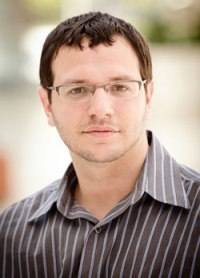
Rob Hopkins, with a familiar Totnes building in the background.

Rob Hopkins brings humour, imagination and vision to the great challenges of our time, and argues that what is needed, above all else, at this time in history, is “engaged optimism”.  The rapidly-spreading Transition movement which he was pivotal in establishing, is an embodiment of that.  Nicholas Crane, presenter of BBC2’s recent ‘Town’ series, recently referred to Transition as “the biggest urban brainwave of the century”.

He is the co-founder of Transition Town Totnes and of the Transition Network. This grew out of many years experience in education, teaching permaculture and natural building, and setting up the first 2 year full-time permaculture course in the world, at Kinsale Further Education College in Ireland, as well as co-ordinating the first eco-village development in Ireland to be granted planning permission.

Anyway, back to the article.  It struck me as so absurd that I tried my hand at asking Rob for permission to republish.  Back, almost immediately, came his positive reply. Thank you, Rob.

Oh, and before going to Rob’s article, for those that, like me, are a bit rusty on the composition of the G8, here’s a Wikipedia extract:

The Group of Eight (G8) is a forum for the governments of the world’s eight wealthiest countries. The forum originated with a 1975 summit hosted by France that brought together representatives of six governments: France, West Germany, Italy, Japan, the United Kingdom, and the United States, thus leading to the name Group of Six or G6. The summit became known as the Group of Seven or G7 the following year with the addition of Canada. The G7, that is active even after the creation of the G8, is composed by 7 of 8 of the wealthiest countries on Earth (as net wealth and not GDP). In 1997, Russia was added to the group which then became known as the G8. The European Union is represented within the G8 but cannot host or chair summits.

Now without any further ado, here is that article.

oooOOOooo

12 Jun 2013

Why even the G8 prefer vibrant, diverse local economies really …

shop

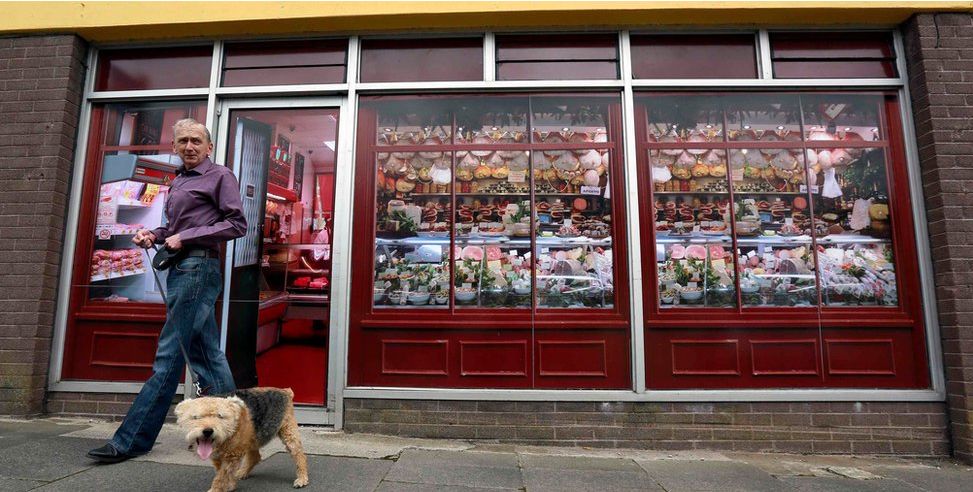
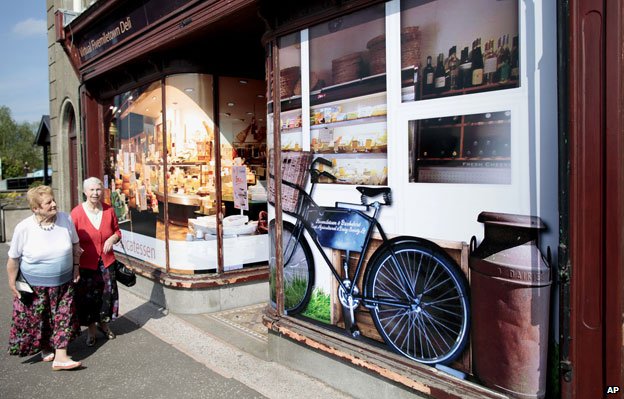
If there was one picture that captured the times we are living through it is this.  It appeared on the BBC website recently with the following caption:

Kevin McGuire walks his dog past a vacant shop in Belcoo, Northern Ireland.  The empty shop is one of a number that have had graphics placed on the windows to make them look like working shops ahead of the G8 summit which takes place nearby later this month.  

Let’s take that a bit more slowly.  Here is a shop, one of many that has gone out of business due, among other things, to the growth-fixated policies of the G8, situated in a place G8 ministers will be driven past en route to their summit.  Rather than their being able to see how things are actually unfolding in the real world, the division and misery being caused by their approach to the economy, the windows have been plastered with stickers that present it as a fully-stocked, thriving shop.  As singer/comic Mitch Benn put it on BBC Radio 4′s The Now Show on Friday,  ”the last thing you’d want would be for a bunch of people meeting to fix the economy to see how bad the economy’s got”.

The BBC reported the story, giving a bit more information about it:

County Fermanagh’s district council sanctioned the fake retail units as part of a £1m makeover before it hosts the G8 summit. The event takes place on 17 and 18 June at the Lough Erne golf resort near Enniskillen.  The chief executive of Fermanagh District Council has defended the optical illusion.

“It was aimed at undeveloped sites at the entrance to the town and then right throughout the county in terms of the other towns and villages, looking at those vacant properties and really just trying to make them look better and more aesthetically pleasing,” says Brendan Hegarty

Here’s the thing that fascinated me most though.  It’s the kind of shop they chose to portray it as.  They didn’t print up large stickers that would present the shop as being a Tesco Metro, a Sainsbury’s Local, an Aldi perhaps, or even branch of one of the banks that contributed significantly to our getting into this mess in the first place.  They didn’t make one huge sticker, one false façade, that showed a new shopping precinct, glittering with all the usual chain stores that dominate every such precinct.  Or a Travelodge perhaps.  Rather they set out deliberately and in considerable detail to portray the kind of vibrant, local, independent business that has either become extinct, or which survives in spite of, rather than because of, the policies of the G8.  Here’s another one…

_68047523_oldladies

The windows are hung with delicious-looking hams, the display features meats and a whole range of delicious local produce, beautifully arranged.  Although the cut-and-paste nature of the graphic design rather gives the game away (the same arrangements of hams appear two or three times), what they are trying to portray here is that most endangered of species, the local, independent butcher.

In the mid-1990s there were 22,000 butchers in the UK, by 2010 there were just 6,553.  The independent butcher is making something of a spirited fightback though, although certainly not aided, in any sense, by the G8.  The butcher that would have occupied that shop no longer exists, most likely because a supermarket opened nearby and completely shifted the balance of the Belcoo economy (any readers from Belcoo who might like to write in and tell us what led to this shop’s demise would be most welcome).

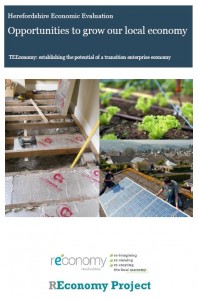
The other day I spoke to Nick Sherwood of REconomy Herefordshire, who has co-ordinated the Herefordshire Economic Evaluation (the second such piece of work, the Totnes one already being published, and Brixton’s coming soon).  Our conversation will be published here soon, but one of the things that really struck me was the following:

We estimate that the top five major supermarkets in Herefordshire account for between 71% – 83% of all household expenditure on ‘brought home’ food and drink, or up to £180m annually. In addition, around £30m per year is spent in the smaller ‘chain’ supermarkets.

Herefordshire-EB-cover-198x300Their conclusion is that the true ‘local spend’ figure, i.e through local, independent businesses in Herefordshire, could be around 16% of the total.  In terms of a national version of that figure, the best I can find is the figure from the Portas Review that states that 8,000 supermarkets now account for over 97% of all UK grocery sales.  Although clearly other smaller supermarkets account for some of the remaining sales, let’s assume, for argument’s sake, that nationally, 3% of what we spend on groceries goes out through local and independent businesses.

I would imagine that everyone seeks an economy that is able to provide jobs, economic activity, stronger and happier communities and community resilience, while also skilfully reducing its carbon emissions on the scale required.  The question of our times though, as far as I’m concerned, is whether that is best achieved by expanding the 97% of our economy currently dominated by huge supermarkets, the kinds of enterprise that the UK government and the G8 see as leading the push for growth, or protecting and enhancing the 3%?

It’s a vital question, because at the moment the push to eradicate the 3% altogether, or at least squeeze it a lot harder, continues apace.  Yet that 3% is better suited to meeting those core needs of ours.  As the recent report by Localise West Midlands on ‘community economic development’ states:

Our research has found strong evidence that local economies with higher levels of SMEs and local ownership perform better in terms of employment growth (especially disadvantaged and peripheral areas), the local multiplier effect, social and economic inclusion, income redistribution, health, civic engagement and well-being than places heavily reliant on inward investment where there are fewer, larger, remotely owned employers.

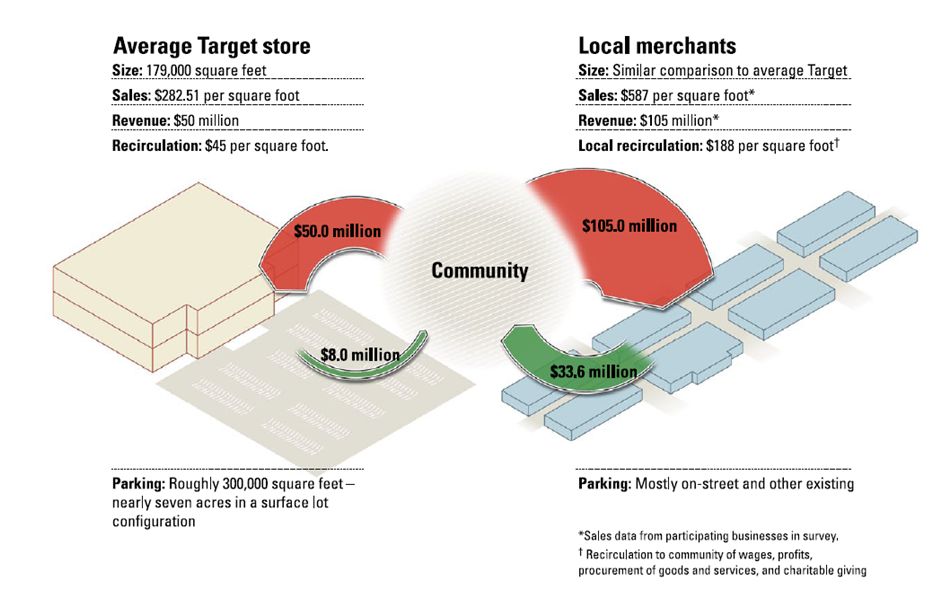
A study focusing on New Orleans compared 179,000 square feet of retail space that is home to 100 independent businesses to the same-sized space that is home to a single supermarket. The former generated $105 million in sales with $34 million staying in the local economy, while the latter generated $50 million in sales with just $8 million staying locally, and necessitated 300,000 square feet of parking space (see graphic below).

shops

Santander’s ‘Market of Hope’ which I wrote about here last year is a great example of how a city can be fed by looking at large retail spaces in such a way that they boost and support the local independent economy rather than undermine it. When Sir Terry Leahy, CEO of Tesco, was asked whether there was any alternative to supermarkets, replied:

“… queueing at one store than trudging down Watford High Street in the rain to another shop … is this what people actually want to go back to?”

But no, it’s not about “going back”, rather about going forward in a way that meets our needs rather than those of the City of London.  What we now know is that even G8 ministers would rather pass through High Streets populated with small, independent butchers, bakers, grocers, would rather see shop windows overflowing with delicious food,  trusting that the relationship they have built up with the shopkeeper over many years will mean that he/she stocks the best produce they can find.  It feels right.  It’s human scale.  It makes sense.  It’s an economy that is ours, it belongs to local people, to the local economy.  Even G8 ministers would now appear to prefer a shopping experience that actually involves interacting with other human beings rather than wandering anonymously around a superstore and then cashing yourself out at the end.

The core argument of The Power of Just Doing Stuff, published on Friday, is that if we really want to achieve our goals of jobs, economic activity, stronger and happier communities and community resilience, while also skilfully reducing our carbon emissions on the scale required, we’d be better off focusing on growing the 3% rather than the 97%.  It’s a pretty simple idea, and, to me at least, a blindingly obvious one, but that doesn’t mean it’s easy.

However, the experience is that this fightback has already begun.  The explosion of new bakeries, pop-up shops, community renewable energy projects, craft breweries, independent record shops, complementary currencies and communities acquiring their own assets is already happening around us, but it needs us to get behind it, to put our shoulders, our spending power, our sheer bloody will, to making it 10%, 30% 70%.  If we want a stable climate, reduced energy vulnerability, economic stability, and a healthy human culture, we really have no choice.  As Maria van der Hoeven of the IEA said recently at the launch of a World Energy Outlook Special Report, Redrawing the Energy-Climate Map, ”the path we are currently on is more likely to result in a temperature increase of between 3.6 °C and 5.3 °C”.

Fortunately, it’s a push that is life-enhancing, thrill-generating and in which we discover a resourcefulness, a kindness and a passion in ourselves that we may have forgotten was there.  I’ll leave you with a quote from the book, from Helen Cunningham of DE4 Food, a social enterprise food hub in Derbyshire that grew out of Transition Matlock.  The project grew from helping a local farmer with lambing and has grown into an innovative new business:

“Never in my life did I imagine that I’d be able to bring lambs into the world! It wasn’t a skill I ever expected to have. It was such a different thing from what we were doing in the rest of our lives, and I think from then we’ve all thought “OK, we can learn these new skills, we can learn how to lamb, we can learn how to grow vegetables and learn how to do Excel Profit and Loss sheets and whatever.” I think we all just really wanted to change the way we live, and change our own personal lives and to change things and live different lives ourselves as well as a different life in our community”.

You can pre-order your copy of The Power of Just Doing Stuff here.

oooOOOooo

As has been said before, and undoubtedly will be said many times more, it really is a very strange world we live in!

Very, very long odds!

Looks like being a Dan Gomez weekend.

Dan sent me an email with a link to a most astounding video.  But before we get to that, just take a look at these images.  Here are the first three from the set of eight.

Eight breathtaking images of baby stars

MNN1

1. Beautiful newborns

In a universe of fantastic images, a newborn star is a mystical masterpiece. Cradled within the dusty arms of a nebula, a baby star seems to blink its way to a new life. The lifespan of a star is a series of sequences. A star may spend most of its life in a “main sequence phase” where nuclear fusion of hydrogen into helium is happening in its core. But before this happens, it lives as a protostar, or baby star.

Thanks to NASA’s advanced infrared space telescopes such as Hubble and Spitzer, we are able to view these star births as never before. Pictured here are newborn stars peeking out “from beneath their natal blanket of dust” in the Rho Ophiuchi dark cloud as seen by the Spitzer Space Telescope. (Text: Katherine Butler)

MNN2

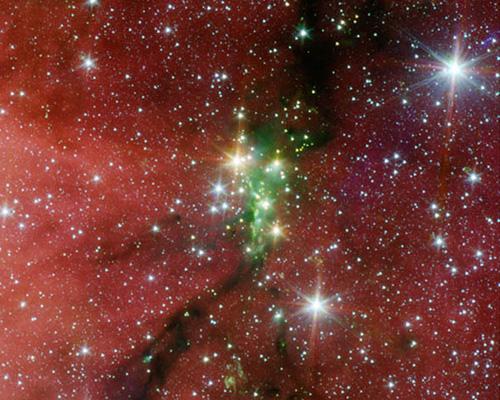
2. Young stars in Serpens

Here the Spitzer Space Telescope reveals the Serpens South star cluster, in which 50 or so young stars exist. They are seen as the “green, yellow, and orange-tinted specks sitting atop the black dust lane.” A supernova or galaxy collision can cause a star to form when huge clouds of hydrogen and helium collapse under mutual gravity. As the cloud collapses, it heats up and starts to spin. Since protostars are covered in dust, they can be seen only through infrared telescopes like Hubble and Spitzer. As Universe Today writes, “After about 100,000 years or so, the protostar stops growing and the disk of material surrounding it is destroyed by radiation.” Then this star, now called a T Tauri or pre-main sequence star, is visible from Earth.

MNN3

3. Bubbly little star

We are used to images of babies blowing bubbles, and it looks like the infants of the cosmos do the same. This image, taken by the Spitzer Space Telescope, shows the HH 46/47 baby star blowing bubbles into space via powerful jets of gas. Located about 1,140 light-years from Earth, HH 46/47 is the bright white star at the middle of the image. Two bubbles reach out in opposite directions and are formed when the jets collide with the dust and gas surrounding the star. As Universe Today reports, “Astronomers think that young stars accumulate material by gravitationally pulling in gas and dust. This process ends when the star gets large enough to create these jets. Any further material is just blown away into space.”

Go and view the remaining five stunning images here.

Now to what was sent by Dan.

Check out this mind-bending video that talks about the “Hubble Ultra Deep Field” image captured by NASA astronomers nearly a decade ago — a photograph that some call “the most important image ever taken.”

It all started back in 1996 when a group of astronomers pointed the Hubble Space Telescope at an empty patch in the sky close to the Big Dipper in hopes of seeing something, anything. At the time, it was considered to be a risky move, given that demand for use of the telescope was so high. What if the experiment yielded no results? What if nothing but an empty image was the final result?

After ten full days of exposing the telescope’s CCD camera sensor to this seemingly vacuous patch of sky, a breathtaking image was produced. Over three thousand galaxies appeared in one image — some as dots, others as spirals. It was a visual reminder of just how big our universe really is. The photo is called the “Hubble Deep Field“:

A Mind Bending Look at the Hubble Ultra Deep Field Photo of the Universe hdf

In 2004, astronomers pointed Hubble near constellation Orion and opened the shutter for a whopping 11 days. Using sensitive detectors and specialized filters, the telescope was able to capture an image with over 10,000 galaxies. This image became known as the “Hubble Ultra Deep Field.”

A Mind Bending Look at the Hubble Ultra Deep Field Photo of the Universe hudf

Scientists later used redshift calculations of the galaxies to turn the photograph into a “fly-thru” view of the photo:

It didn’t end there. Last year, NASA scientists created the Hubble Extreme Deep Field, which has an equivalent exposure time to 23 days and features. It’s the “deepest image of the sky ever obtained” that reveals “the faintest and most distant galaxies ever seen”:

A Mind Bending Look at the Hubble Ultra Deep Field Photo of the Universe deepest

And just think: scientists created these photos by pointing their mega-camera at a tiny speck of the night sky that appears to be completely devoid of visible stars!

oooOOOooo

… a tiny speck of the night sky that appears to be completely devoid of visible stars!

Dan said in his email, “Are we really here?  What are the chances?”

You really have to wonder!  Incredibly long odds.  Both to us being here and to us being the only conscious, intelligent species in the universe.

From small acorns do great oaks grow.

Reflections on the launch of George Monbiot’s new book Feral.

In my recent post, Dealing with Madness, where I referred to the launch of this new book there were comments from Jules that included him saying:

George is appearing at the Hay Festival to sell his book and do a talk this Saturday and it is only a few miles away so may be I will pop in and buy the book.

all the best

Jules

Jules, who has his own blog Bollocks2012, did go across to the Hay Festival and most generously agreed to write up his visit as a guest post.

So I am delighted to offer you Jules’ report today.

oooOOOooo

George at Hay

by Jules Bywater-Lees, 1st June, 2013

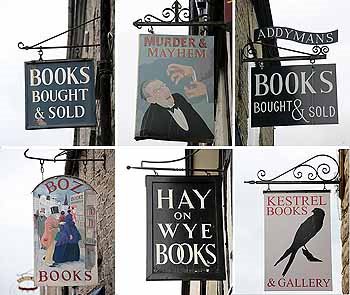
The small Welsh border town of Hay-on-Wye in Powys is just a few miles from where I live. It went from a little backwater with a failing rural economy to become, in the words of Bill Clinton, ‘the Woodstock of the mind’.  All through the vision of eccentrics!

Hay-on-Wye
Hay-on-Wye

The town of Hay-on-Wye is pretty.  It is set in the most beautiful Welsh countryside and even has its own tumble-down castle.  However, back in the 70’s, like so many other small market centres, the town was in decline.  That was until an eccentric bibliophile moved into the castle. The name of that eccentric was Richard Booth.

Richard Booth established a second-hand bookshop in town and, as a publicity stunt, on 1st April 1977 proclaimed himself King of Hay and Head of this new Independent Kingdom!  Hay-on-Wye subsequently became a magnet for the second-hand book lover and trader, and now every other shop is a bookshop giving the town a healthy economy serving the many visitors.

Books, books and more books!

The Hay Literary Festival was devised by Norman and Peter Florence in 1988 and had become sufficiently established internationally for the highlight of Bill Clinton being a speaking guest in 2001. It is rather a corporate festival now attracting big names but the town has developed fringe events, that are both cheaper and more fun.

The reason this back story is relevant is that Hay-on-Wye has always been a gateway town between the urban English and rural Welsh. It is only a few hours drive from London and the nearest ‘wilderness’ for day trippers and holiday makers. A few miles further west and the uplands, or mountains as we call them (few are higher than 1000 feet), are considered by most people to be wild.

George Monbiot lives another 60 miles away to the West on the coast in what is considered deepest Wales where the hills have a barren beauty and the locals speak Britain’s ancient first language. But it is not all that it seems; the moors and hilltops are not natural they are a product of over-grazing. They are the degraded shells of a natural ecosystem. A shadowland; a ghostly memory of a former landscape.

View from Hay Bluff
View from Hay Bluff, just a few miles from Hay-on-Wye, and a powerful example of a bald hill.

Back to this year’s Festival. I coughed up the £8 ticket price and went with friends to have a day of culture. Those friends who came to hear George Monbiot speak were sceptical; for them the hills are beautiful and it is the denuded ‘wildness’ and prancing Spring lambs that gives the landscape so much value.

George makes frequent appearances on television and is very much a leading commentator on the environment and climate change, and his Guardian articles, see postscript, cover his views well so I wasn’t expecting any surprises. If anything I felt sceptical! You see while in principle I agreed with Monbiot’s message of rewilding and supportive of his views on the wide range of subjects he covers, the concept of rewilding appeared to be woolly and vague and lacking the practicalities of how this vision would be achieved. I even prepared a question for the session after his presentation.

Britain is a little country and our national parks are not the same as those elsewhere in the world, a better description would be regulated areas of private ownership. There are a few parks in Wales notable Snowdonia, which amounts to 2,200 square Kilometres (850 square miles), Brecon Beacons, 1,300 Km2 (502 SqM) and larger ones in Scotland such as the Cairngorms of 4,500 Km2 (1,737 SqM). But all of these are tiny compared to Yellowstone National Park with its 9,000 km2 (3,475 SqM and about 100 wolves!). Is it possible to have viable populations of wild animals in such a small area?

My concern is that Britain actually does have a wild landscape of both international importance and scale, with mega fauna, diversity and rare ecosystems that put it on par with the rainforest. It is truly huge with a conservative estimate of 50 to 100 thousand Km2 in area (19,305 to 38,610 square miles) but it is hidden: It is the 31,000 Km (19,260 miles) of coastline and the waters that extend from it. Surely we should be concentrating on its protection rather than allowing the hill tops to grow pretty common native woodland that could support a few hundred wolves, Lynx and beavers at best?

George live, as it were, was a lot more engaging than his appearance on telly and his spoken words a lot more passionate than his written words. I was surprised, and interested.  Like all good story tellers he started off with a mystery. Why do British native trees appear to thrive when they are hacked about into hedges, why do blackthorn trees have thorns so tough and sharp they spike industrial leather gloves and why does the yew and holly have roots so extensive they could hold up a tree twice as big? The answer: Elephants!

Much of what he spoke about is found in his last three Guardian articles so I will spare you the detail but what struck me was his passion. Initially the cynic within wondered if George was just another celebrity seeking a cause.  But such thoughts were dispelled as soon as George started to speak. What was communicated resonated strongly with this idealistic former self who was sufficiently passionate about nature enough to have studied zoology and yearned a human desire for wilderness and, indeed, danger but whose life has otherwise been engaged in more civilised necessities.

Such was the passion expressed by Mr. Monbiot that even I could overlook the practicalities and details; they can be sorted out when they need to be. My friends were impressed and even they were able to see that letting the hills go wild or a least a few of them would enhance their appreciation of our countryside.

But I didn’t buy a signed copy of the book! At £20 for the hardback version I thought it best to order one from my local library or at least wait for the paperback edition on Amazon.

Postscript

Those Guardian articles mentioned are:

My manifesto for rewilding the world, Guardian Newspaper, 27th May.
Until modern humans arrived, every continent except Antarctica possessed a megafauna. In the Americas, alongside mastodons, mammoths, four-tusked and spiral-tusked elephants, there was a beaver the size of a black bear: eight feet from nose to tail. There were giant bison weighing two tonnes, which carried horns seven feet across.

Why Britain’s barren uplands have farming subsidies to blame, Guardian Newspaper, 22nd May

Even before you start reading the devastating State of Nature report, published today, you get an inkling of where the problem lies. It’s illustrated in the opening pages with two dramatic photographs of upland Britain (p6). They are supposed to represent the natural glories we’re losing. In neither of them (with the exception of some distant specks of scrub and leylandii in the second) is there a tree to be seen. The many square miles they cover contain nothing but grass and dead bracken. They could scarcely provide a better illustration of our uncanny ability to miss the big picture.

It’s time we challenged agricultural hegemony, Guardian Newspaper, 6th June

The dam is beginning to crack, faster than I would have believed possible. Britain, one of the world’s most zoophobic nations, is at last considering the return of some of its extinct and charismatic mammal species.

While wolves, lynx, bears, bison, moose, boar and beavers have been spreading across the continent for decades, into countries as developed and populous as ours, and while they have been widely welcomed in those places, here we have responded to this prospect with unjustified horror.

Why the lynx effect would send Scotland wild, Guardian Newspaper, 2nd June

As Edinburgh Zoo’s panda freakshow continues to captivate the witless and the infantile, a real Scottish animal has been allowed to die. Under the noses of Scottish Natural Heritage, which likes to be known as the nation’s leading conservation body, the Scottish wildcat has all but been extinguished from the Highlands. The importance of this news may be deemed worthy of a mere footnote on the schedule of important issues with which Scotland is grappling but it ought to rank much higher. For the wildcat’s demise seems to be part of the neutering and emasculating of our wildest places. That which was previously held to be a quintessential part of what Scotland was originally meant to look like and smell like and sound like is now, it seems, unimportant.

Britain’s paradise has been lost – but there’s still hope for our wildlife, Guardian Newspaper, 24th May

I never imagined being 52. As I grew up catching lizards and newts, rummaging through hedges to find birds’ nests, or prodding flattened hedgehogs with my scuffed Clarks lace-ups, the world was ripe with natural riches. Every scrap of wasteland revealed yet more gems: tadpoles, fox cubs and a confetti of butterflies. And when at the weekends the family Ford Anglia trundled off to the countryside, I strode in shorts into a wildlife nirvana, a utopia, and I explored what I imagined would be a never-ending world of beautiful and exotic creatures.

oooOOOooo

Finally, back to me and all I want to add is that the blogsite for more information on the book Feral is here.

So how to close?  Well having given this post the title of a well-known saying, let me close with one perhaps less familiar but, boy oh boy, so relevant.

“When the oak is felled the whole forest echoes with it fall, but a hundred acorns

are sown in silence by an unnoticed breeze.”

Thomas Carlyle

Being tied to that mast!

What an expanse of learning is out there in this modern interconnected world!

I try to limit my following to those organisations and writers who offer me the opportunity of learning.  Whether something I was previously unaware of or a sight of the world from an unfamiliar perspective, it’s a rare day when something doesn’t ‘pass my screen’ that offers an ‘Ah, ha’ moment.

Such as the following essay by Dave Nussbaum that recently appeared on the Big Think website.  Cheekily, I asked permission to republish and promptly and generously both Dave and Daniel Honan, managing editor of Big Think, said yes.  Thank you, gentlemen.

A quick web search finds that Dave Nussbaum is Adjunct Assistant Professor of Behavioral Science, University of Chicago Booth School of Business.  (I couldn’t avoid wondering if the learned Professor requires extra-large business cards! Sorry for that!)  To fill in a little more about the Professor, one can easily read that:

nausbaum

I am currently an Adjunct Assistant Professor of Behavioral Science at the University of Chicago Booth School of Business. I received my PhD in Social Psychology from Stanford in 2008, working primarily with Claude Steele and Carol Dweck. I recently completed a SSHRC Post-Doctoral Fellowship at the University of Waterloo with Steve Spencer. My research is primarily focused on how people manage and defend their self-image in the face of threats, and how this affects their beliefs and behavior. I also explore how social contexts and psychological processes can either exacerbate threats to self-image or attenuate them. I have found that defensively managing self-image threats can often lead to negative consequences, including academic disidentification, missed learning opportunities, the avoidance of important medical tests, and persistence in failing investments. I believe that by identifying contexts and processes that attenuate threat, individuals and organizations can employ strategies to prevent these maladaptive outcomes.

So moving on past my quip about the length of Professor Nussbaum’s title, the summary above shows that this is one smart cookie!  Just go back and reread “My research is primarily focused on how people manage and defend their self-image in the face of threats, and how this affects their beliefs and behavior.” Then reflect on the range and scale of ‘threats’ facing millions of us across the world.  So research into “how social contexts and psychological processes can either exacerbate threats to self-image or attenuate them“, seems particularly appropriate for these times.

OK, without further ramblings from yours truly, here is that essay.
oooOOOooo

Odysseus Nudged: How Limiting Our Choices Can Give Us More Freedom

by Dave Nussbaum – May 27, 2013

Odysseus

According to legend, the Sirens were beautiful women whose voices were so alluring that when sailors heard their song they could not resist approaching and were drowned on the rocky shores of the island where the Sirens sang. No sailor had heard their song and lived until Odysseus, who, on the counsel of the goddess Circe, had his crew tie him to the mast of his ship. When he heard the Sirens’ song he begged to be released, but his crew, their ears plugged with beeswax, would not unbind him and saved him from his own desires. Odysseus was lucky – he knew that he would be unable to resist the Sirens and had himself bound – but people often have difficulty foreseeing their weakness from a distance. Sometimes they need help.
I love watching my not-quite-two-year-old son learn about the world from his mistakes. I look on with sympathy at his falls and bumps and spills and I try to restrain myself from interceding. But when he’s about to tumble down a flight of stairs I step in. It is difficult to balance preserving his freedom to explore and make his own mistakes with the desire to keep him safe. There’s a lot to be said for giving kids autonomy and letting them learn from experience, but sometimes you have to behave paternalistically and tie them to the mast (or at least install safety gates).

When you start treating grown men and women like you’re their father, though, the charge of paternalism becomes a more serious one. There may be cases in which a heavy-handed approach is necessary (particularly when people’s actions harm others), but we should be careful about using it. A more circumspect approach is libertarian paternalism, described by Richard Thaler and Cass Sunstein in Nudge (and re-articulated more recently by Sunstein in his Simpler) as a way of influencing people to make decisions that they themselves would consider beneficial, without restricting their freedom.

Here, we are not tying Odysseus to the mast – the more appropriate analogy would be to the beeswax that Odysseus had his sailors put in their ears. The wax prevented the sailors from hearing the Sirens’ song and saved them from being lured to their deaths, but it also left them free to remove the wax if that is what they wanted to do. This sort of intervention is an acknowledgment that the sailors’ freedom is important, but also that people are not always perfectly rational. As Carnegie Mellon economist (and psychologist) George Loewenstein recently explained to me, “When people have problems exercising self-control, restricting their choices can, in some cases, leave them more freedom to choose.”

On its face, Loewenstein’s claim may seem paradoxical – isn’t a person most free when presented with all her options and allowed to choose among them? But as the mythical Sirens make clear, there are some options that we are not truly free to resist. Without beeswax in their ears Odysseus’ crew would have been doomed; the wax gave them the freedom to choose.

Take the recent attempt by New York City Mayor, Michael Bloomberg, to forbid stores from displaying cigarettes to their customers. Just like the beeswax did not prevent the sailors’ from choosing to hear the Sirens’ song, hiding cigarettes from view doesn’t prevent people from buying them. But, as Loewenstein explains, it makes it easier for those who may be trying to quit to avoid being lured back in.

When we pass laws that forbid the sale of cigarettes to minors we are being paternalistic. We are tying Odysseus to the mast, whether he likes it or not. But when we ban cigarette advertising that targets children – as the FTC did when it banned Joe Camel ads – we’re not tying anyone down. We are merely acknowledging that children are vulnerable to influences that may lead them to act contrary to their own interests and that they may not be in a position to resist these influences. Banning the display of cigarettes in stores is merely acknowledging that children aren’t the only ones who are vulnerable. The cigarettes, like the sirens, draw us in against our will. Putting them out of sight is like putting wax in our ears – we can easily still give in to temptation if we choose to, but we’re less at its mercy.

You can visit Dave Nussbaum’s blog at www.davenussbaum.com and follow Dave on Twitter at @davenuss79

Images courtesy of Wikimedia Commons and Shutterstock.

oooOOOooo

Just nonsense!

More to nonsense than you might imagine.

The following is published with the kind permission of Pendantry who writes the Wibble blog.  It originally appeared on the blogsite that is described:

The Multiphasic Phlyarological University

The most quisquilian educational establishment in cyberspace

So, without further ado, here is Phlyarology: the study of nonsense.

oooOOOooo

Phlyarology: the study of nonsense

‘Twas brillig, and the slithy toves
Did gyre and gimble in the wabe;
All mimsy were the borogoves,
And the mome raths outgrabe. — Lewis Carroll, Jabberwocky.

Phlyarology is the study of nonsense.

To begin to understand nonsense it may help first if one has a good grasp of sense, for comparison between the two.

General education is obviously useful in this regard; after which perhaps the most important trait is critical thinking. One suggestion for a book that gives a good grounding in critical thinking is ‘What’s the Worst That Could Happen’, by Greg Craven.

Craving Understanding

Nonsense can be interpreted as communication that lacks any coherent meaning; it can be considered synonymous with absurdity and the ridiculous. Artists in many realms have long employed nonsense (though ironically, tragically, many suffer unemployment while doing so). Poets, novelists, lyricists and copywriters often seek refuge in it; and there are entire works that depend upon it as a foundation.

Swans Reflecting Elephants — Salvador Dali

When contemplating the antithesis of sense, one promising candidate for non-sense can be found lurking within surrealism.

And then there’s ‘common sense’, which is a thing to which people often appeal, and yet its use all too often can turn out to be oxymoronic. One example of  ‘common sense’ that results in reality inversion is the persistent case of King Cnut.

In Greek mythology a chimaera is a beast composed of the parts of a lion, a snake and a goat.

In the philosophies of language and science, nonsense is distinguished from sense or meaningfulness. An understanding of nonsense is a necessary field of study in cryptography, as it is essential in separating a signal from noise. But attempts to come up with a coherent and consistent method of distinguishing sense from nonsense are troublesome at best; such may be a slippery chimaera, one that can even perhaps be spied on occasion chewing upon its own tail.

When all else is said and done, phlyarology can be a subject of crucial importance — especially when it comes to considering peak everything (to name but a few paltry aspects that, it would seem, appear to be irrelevant to ‘normal’ life).

Which is, of course, why we’re all here. Assuming, of course, that we are…

“Death is not an event in life: we do not live to experience death. If we take eternity to mean not infinite temporal duration but timelessness, then eternal life belongs to those who live in the present. Our life has no end in the way in which our visual field has no limits.” — Ludwig Wittgenstein, Tractatus, 6.431

I do not believe it is possible to ever fully grok nonsense; and so phlyarology is a never-ending pursuit. But I do believe that this doom can be a thoroughly rewarding and worthwhile one.

Or, to put it another way, stupid nonsense is a serious matter!

Any questions to be directed to Pendantry!

oooOOOooo

So how to close off a post about nonsense?

Well being a Brit sufficiently old to remember The Two Ronnies, a YouTube find that so perfectly shows the skill and professionalism of Ronnie Barker now follows.

You have never heard nonsense sound so wonderful!

More on Pharaoh’s life.

What a wonderful relationship it has been.

Years ago if I was ever to own a dog, it had to be one breed and one breed only: a German Shepherd Dog.

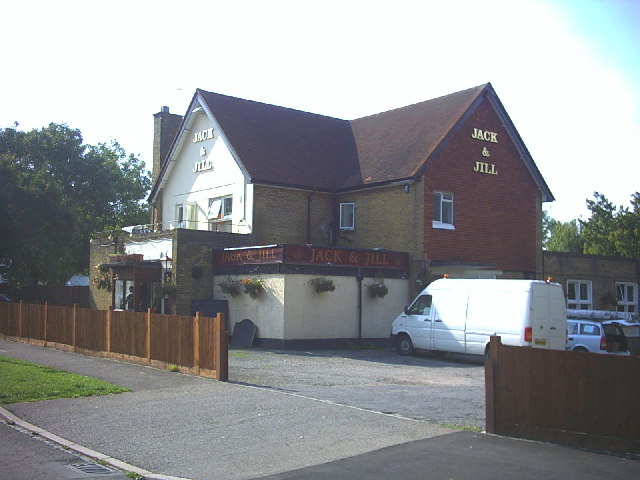
The reason for this was that back in 1955 my father and mother looked after a German Shepherd dog called Boy.  Boy belonged to a lovely couple, Maurice and Marie Davies.  They were in the process of taking over a new Public House (Pub); the Jack & Jill in Coulsdon, Surrey.  My father had been the architect of the Jack & Jill.

Jack & Jill, Longlands Avenue, Coulsdon, Surrey

As publicans have a tough time taking holidays, it was agreed that the move from their old pub to the Jack & Jill represented a brilliant opportunity to have that vacation.  My parents offered to look after Boy for the 6 weeks that Maurice and Marie were going to be away.

Boy was the most gentle loveable dog one could imagine and I quickly became devoted to him; I was 11 years old at the time.  So when years later it seemed the right time to have a dog, there was no question about the breed.  Boy’s memory lived on all those years, and, as this post reveals, still does!

Pharaoh was born June 3rd, 2003 at Jutone Kennels up at Bovey Tracy, Devon, on the edge of Dartmoor.  As the home page of the Jutone website pronounces,

The Kennel was established in 1964 and it has always been the aim to breed the best German Shepherd Dogs for type and temperament. To this end the very finest German bloodlines are used to continue a modern breeding programme.

and elsewhere on that website one learns:

Jutone was established by Tony Trant who was joined by Sandra Tucker in 1976. Sandra continues to run Jutone since Tony passed away in 2004. Both Tony and Sandra qualified as Championship Show judges and Sandra continues to judge regularly. Sandra is the Secretary and a Life Member of the German Shepherd Dog Club of Devon.

93ac7d454b15519effff8014ffffffd3
Tony Trant

Turning to Pharaoh, here are a few more pictures over the years.

Pharaoh, nine months old.

oooOOOooo

One year old: June 3rd 2004.

The next picture of Pharaoh requires a little background information.

For many years I was a private pilot and in later days had the pleasure, the huge pleasure, of flying a Piper Super Cub, a group-owned aircraft based at Watchford Farm in South Devon.  The aircraft, a Piper PA-18-135 Super Cub, was originally supplied to the Dutch Air Force in 1954 and was permitted by the British CAA to carry her original military markings including her Dutch military registration, R-151, although there was a British registration, G-BIYR, ‘underneath’ the Dutch R-151.  (I wrote more fully about the history of the aircraft on Learning from Dogs back in August 2009.)

Piper Cub R151
Piper Cub R151

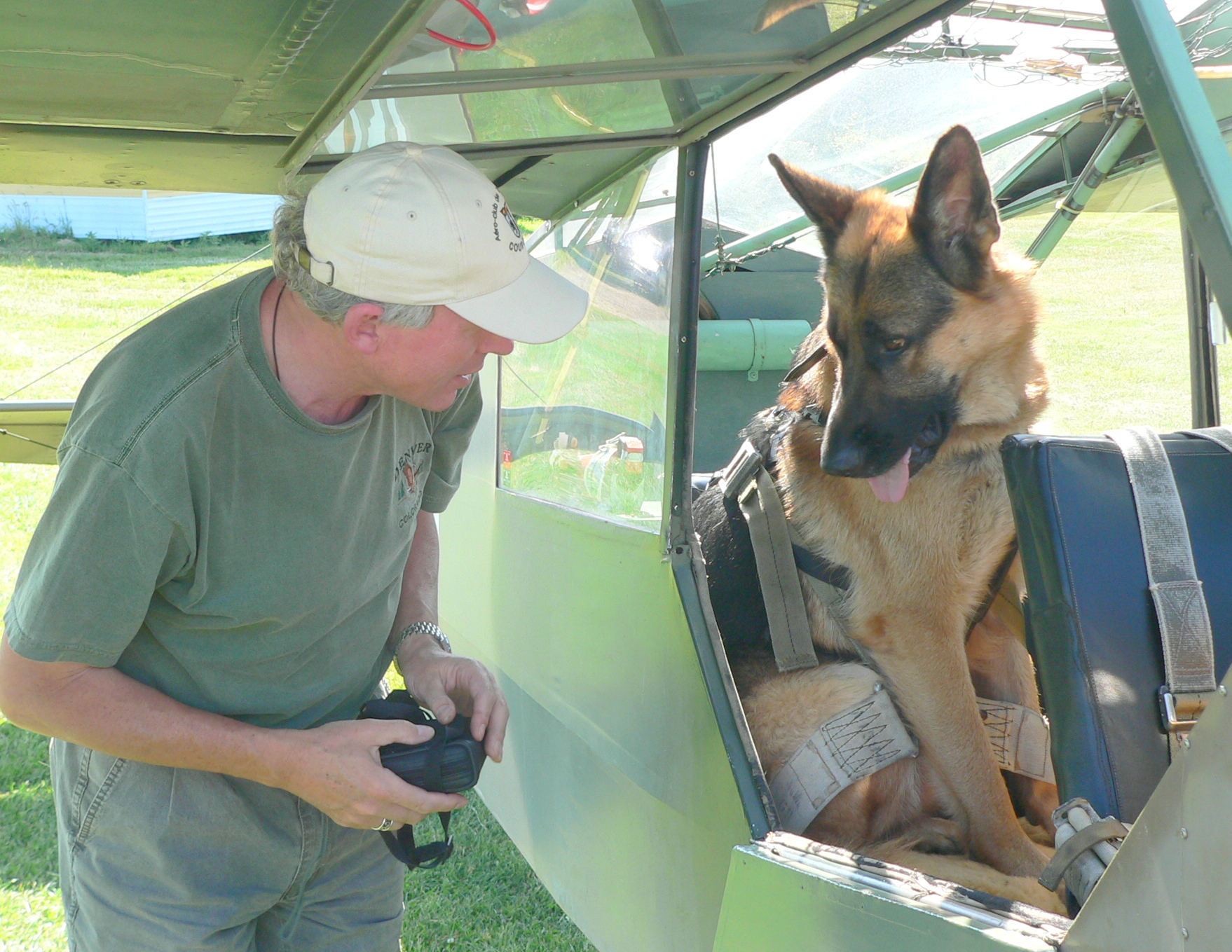
Anyway, every time I went to the airfield with Pharaoh he always tried to climb into the cockpit.  So one day, I decided to see if he would sit in the rear seat and be strapped in.  Absolutely no problem with that!

Come on Dad, let's get this thing off the ground!
Come on Dad, let’s get this thing off the ground!

My idea had been to fly a gentle circuit in the aircraft.  First I did some taxying around the large grass airfield that is Watchford to see how Pharaoh reacted.  He was perfectly behaved.

Then I thought long and hard about taking Pharaoh for a flight.  In the Cub there is no autopilot so if Pharaoh struggled or worse it would have been almost impossible to fly the aircraft and cope with Pharaoh.  So, in the end, I abandoned taking him for a flight.  The chances are that it would have been fine.  But if something had gone wrong, the outcome just didn’t bear thinking about.

So we ended up motoring for 30 minutes all around the airfield which, as the next picture shows, met with doggie approval.  The date was July 2006.

That was fun!
That was fun!

What a dear dog he has been over all the years and, thankfully, still is!

As if to reinforce the fabulous dog he still is, yesterday it was almost as though he knew he had to show how youthful he still was.

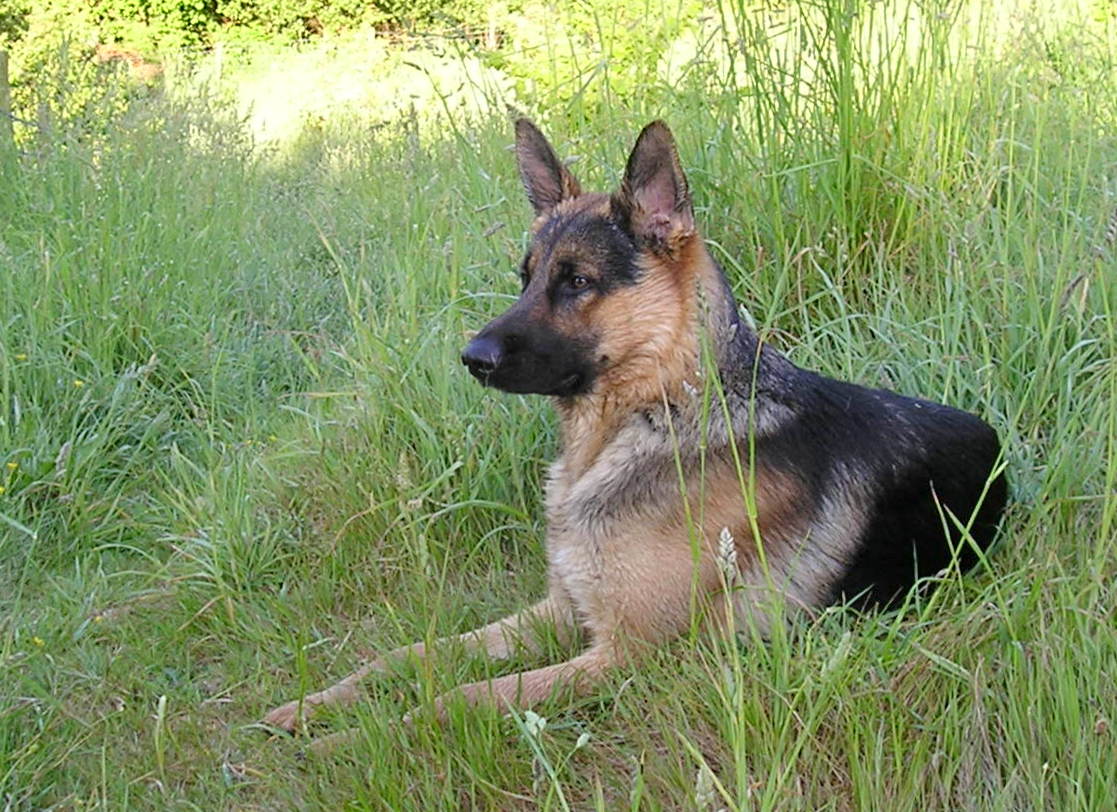
Because, when I took his group of dogs out around 7.30am armed with my camera, Pharaoh was brimming over with energy.

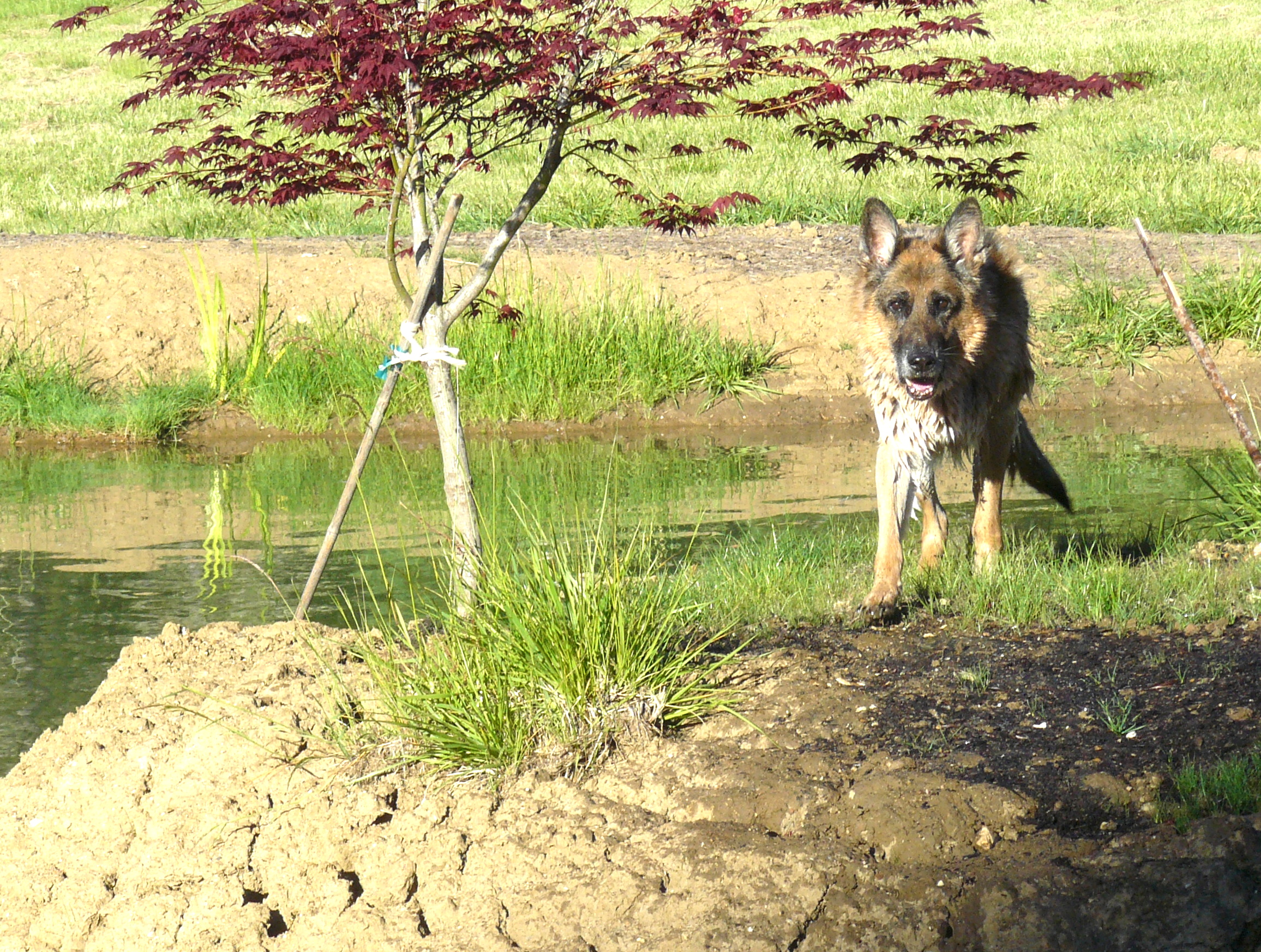
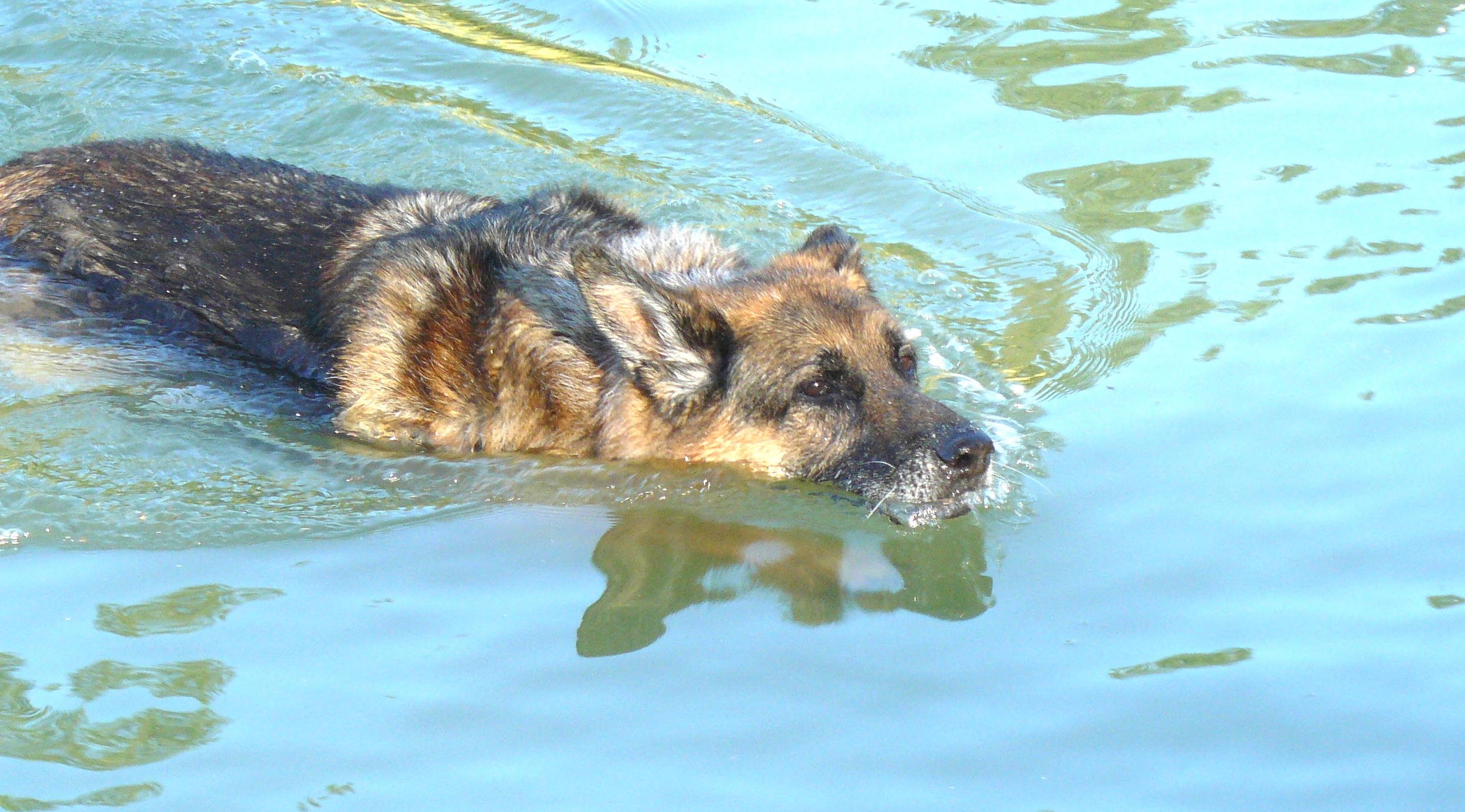
First up was a swim in the pond.

Ah, an early birthday dip! Bliss!

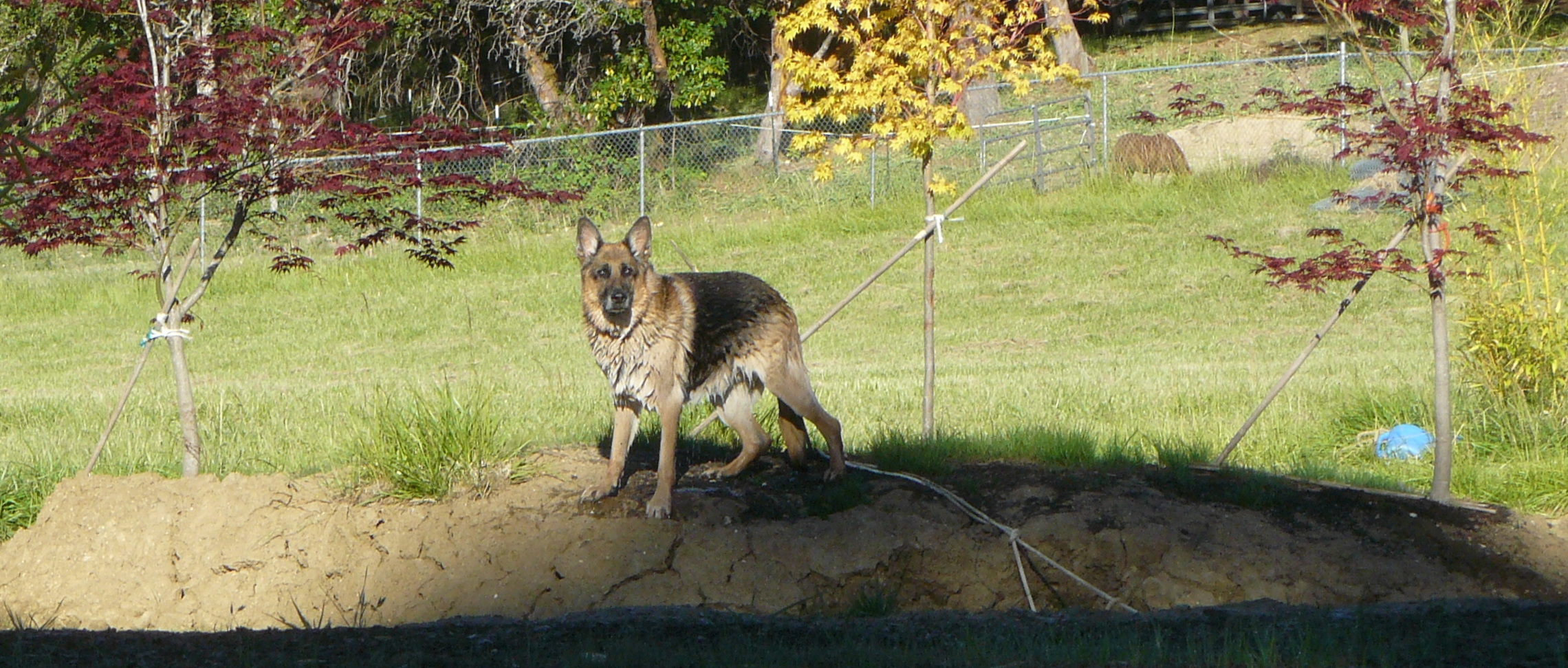
Then in a way he has not done before, Pharaoh wanted to play ‘King of my Island’, which is in the middle of the pond.

Halt! Who goes there!

ooo

This is my island! So there!

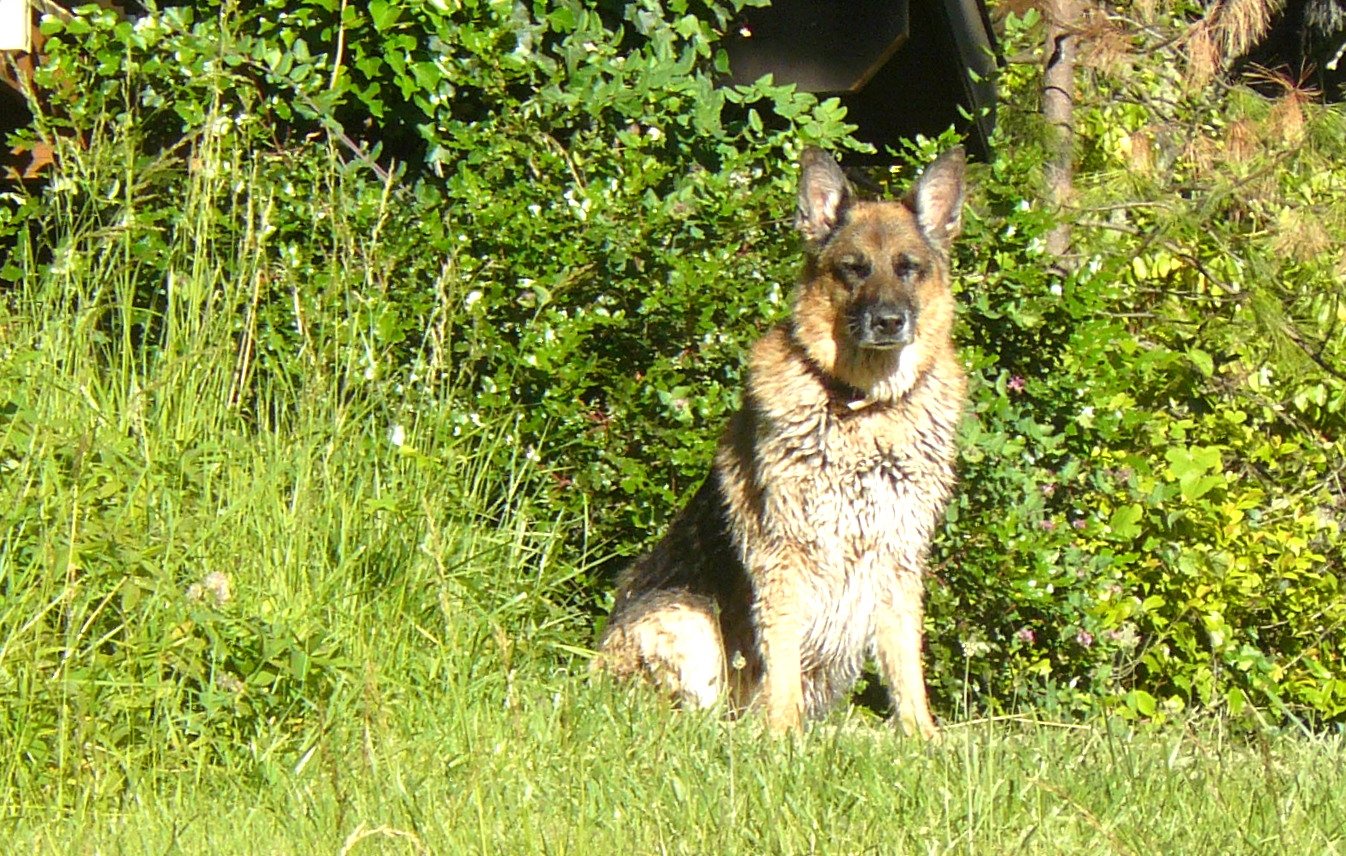
Then a while later, when back on dry land, so to speak, it was time to dry off in the morning sunshine.

Actually, this isn't a bad life!
Actually, this isn’t a bad life!

Long may he have an enjoyable and comfortable life.

Happy Birthday to Pharaoh

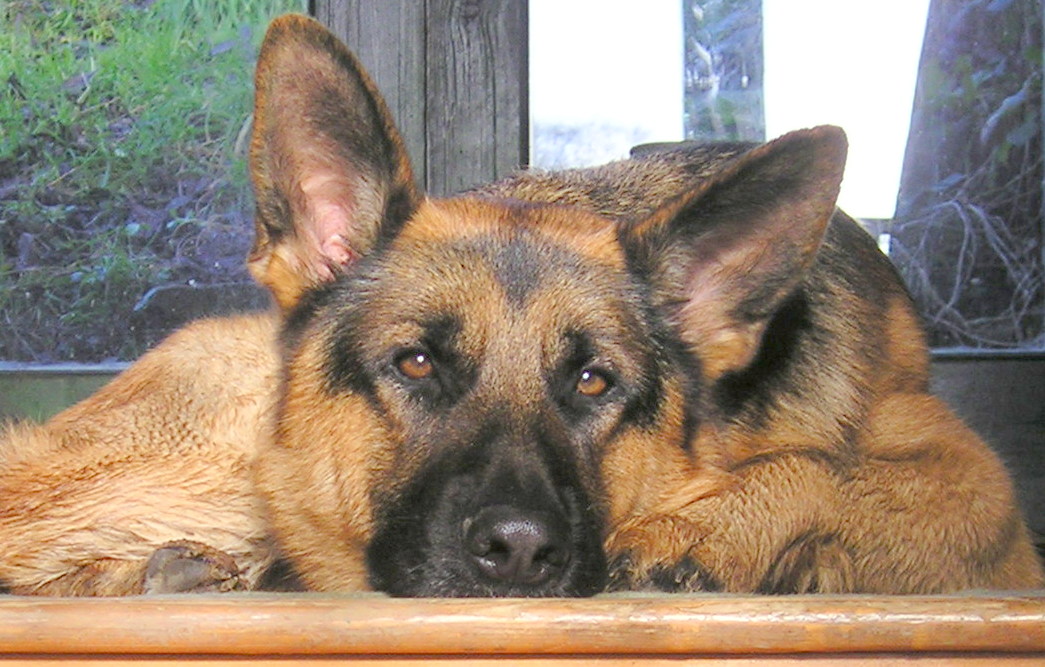
Our lovely old German Shepherd is 10 today.

Yes, Pharaoh was born back on June 3rd 2003.  So today, in human years he is 10.  In the old traditional ‘dog years is seven times times human years‘ he would be 70.  But according to a recent item on BBC News there is a more accurate way of calculating dog years.

Longevity secrets of readers’ pets who lived past 100 ‘dog years’

Thanks to our dog age calculator, people have been reassessing the age of their furry friends.

It put a new spin on the old saying that the age of dogs could be better understood by multiplying the number of years since their birth by seven.

You can read more here.  That dog age calculator is here.

Dog years: The calculator

Working out your dog’s true age used to be a case of simply multiplying it by seven. But it’s more complicated than that, and here’s a handy calculator to do it for you.

A recent Magazine feature explained that:

  • Different breeds of dog age at varying speeds
  • Dogs age at varying speeds at different stages of their lives

With that in mind, we’ve built a calculator for you to work out your dog’s true age – its age in “dog years”.

Alternatively, you can find out how old you would be if you were a dog. You can choose to be a labrador, a spaniel, a whippet, or any one of 20 breeds.

The calculator uses these multipliers for the first two years of a dog’s life:

  • 12.5 for small dogs
  • 10.5 for medium-sized dogs
  • 9 for large dogs

Then, for the third and subsequent years of the dog’s life, each human year has to be multiplied by between 4.3 and 13.4 years, depending on the breed:

Small: Dachshund (Miniature) 4.32, Border Terrier 4.47, Lhasa Apso 4.49, Shih Tzu 4.78, Whippet Medium 5.30, Chihuahua 4.87, West Highland White Terrier 4.96, Beagle 5.20, Miniature Schnauzer 5.46, Spaniel (Cocker) 5.55, Cavalier King Charles 5.77, Pug 5.95, French Bulldog 7.65

Medium: Spaniel 5.46, Retriever (Labrador) 5.74, Golden Retriever 5.74, Staffordshire Bull Terrier 5.33, Bulldog 13.42

Large: German Shepherd 7.84, Boxer 8.90

The calculator does not work for cross breeds, sadly, but on average these live 1.22 years longer than pure breeds, according to Dan O’Neill (from Petts Wood in London…) who is researching the subject for a PhD at the Royal Veterinary College.

Nor does the calculator work for cats. What we can say is that the average life expectancy of a cat is 12.1 years, which equates to 64 human years.

Guidelines issued by the American Association of Feline Practitioners say that cats reach 10 human years in their first six months and are approximately 24 at the age of two years. After this their age increases by four “cat years” every year.

So dear Pharaoh is the equivalent of an 80-year-old human! The breed has an average life expectancy of 9.73 years. (Source: BBC calculations on data from UK Kennel Club and US Veterinary Medical Database.)

Going to leave you for today with three photographs of Pharaoh taken the day I first saw Pharaoh as a puppy, back on the 12th August 2003.  The woman holding Pharaoh is Sandra Tucker who runs Jutone Kennels in Devon, England., where Pharaoh was born 10 years ago this day!

OLYMPUS DIGITAL CAMERA

oooOOOooo

OLYMPUS DIGITAL CAMERA

oooOOOooo

OLYMPUS DIGITAL CAMERA

oooOOOooo

More pictures tomorrow.

Looking into self.

Rounding off the week.

Starting with Monday’s video of Carl Sagan reminding us all that Planet Earth is just a grain of sand in the vast cosmos right through to yesterday’s Dealing with madness post, much of the week has been reminding us all of one very fundamental truth.  No better expressed than in a comment from Patrice Ayme [my emphasis]:

… there is no healthy man without a healthy world.

Regulars will have noted the high levels of debate this week.  Thank you all for those comments.

I have also received a couple of emails with feedback and comments, sent to me on a personal basis.  One of those emails had such a powerful message that I begged for permission to publish it on Learning from Dogs.  I was asked to keep the author’s identity private but, trust me, it is from someone I know well who subscribes to ideas of integrity and honesty in spades.

The author also strongly recommended publishing in association with his personal essay an extract from Chris Hedges’ book “Death of the Liberal Class”.  That extract follows straight on from the essay.

oooOOOooo

Reflections from a Vietnam Combat Veteran

War is an unnatural dichotomy.  Both sides are morally and materially diminished.  A future World War would most probably finish us as the self-appointed predominant intelligent species on planet earth.  It seems worth noting that German industrialists coordinated fundamentalist propaganda to foster the bigotry, hatred and fear which fueled their profitable war engines prior to World War II.

United States commercial media today reflects a financially dominated military-industrial culture with liberty and justice for sale.  The results are divisive and lead to both a declared international war against nebulous assailants we have been taught to dislike and an internal political war that has polarized our once fair nation.

We’ve stopped investing in the future in response to radicals who want to destroy government, human rights and what remains of the earth’s surface resources.  There is an emerging police state mentality on display with a variety of candidates for local dictator.

It’s well past time for moderate republicans to ignore their uber-conservative brethren.  It’s well past time for moderate democrats to renounce their corporate ties.  This will only happen when our financial and political leaders awaken to the reality of what is in the best long-term interests for all life on this planet rather than our present unsustainable global economy.

To complicate the problem, our planet is under attack by a swarm of vociferous human locusts seeking profit without regard to the consequences.  Meanwhile, despite human denial, the universe continues to emerge.  Species which do not adapt to change do not survive.

It’s important to remember that we’re in the midst of a battle that’s as old as the conscious awareness of the human species.  We generally have very little idea of the inclusive nature of our being; let alone the nature of our collective being as a species. We have as yet to learn how to surrender to reality.  The battle is with our own species.

Committing collective suicide for quarterly profit is not a sane way of life.  What we’ve created is a neo-feudal global economy without any foundation that feeds on an empire of consumption.  When we combine a neo-feudal economy with neo-fascist politics we arrive at a moral and biological dead end.

The coup d’état of the current Corporate State is the Citizen’s United ruling that makes money a form of free speech.  Money has no DNA.  In case anyone missed how the “occupy” movement was crushed, there’s no question that we’re rapidly criminalizing all forms of dissent.  These actions are being taking under the 1917 Espionage Act and related state secrets acts.  No discernment of moral value is considered and no public hearings are conducted.  People who speak up are locked up.  We’ve become a fearful and secretive population.

Our self-appointed elite power structure is completely irrational in its belief that human reason is our ultimate power and money is its servant.  We are made of the stuff of the stars.  At best, we’re in our adolescence as a species.  We think we know the answers rather than admitting our ignorance.  What little we know is vastly less than what we have as yet to learn.  We are often unaware of being unaware.

The lives we presently lead can not be sustained in ways that we have become accustomed to; ways we take for granted.  What’s going to need to change?  The simple answer is everything.  Our species has systemically corrupted the small part of the cosmos which sustains our being.  Nature has no sense of humor, no patience for human squabbles and no financial interest.

Fortunately, we already know what we need to do to adapt.  We know how nature works through the wisdom of our earth sciences.  The answer is simple.  Love the earth.  Love life.  Share compassion.  Educate, naturally energize, and transform.  The resulting process of change will help re-establish a realistic world economic foundation.

oooOOOooo

‘Death of the Liberal Class’

By Chris Hedges

From the book “Death of the Liberal Class,” by Chris Hedges.  Excerpted by arrangement with Nation Books, a member of the Perseus Books Group.  Copyright © 2010.

The following selection is taken from the first chapter of the book, published in October 201 by Nation Books.

In a traditional democracy, the liberal class functions as a safety valve. It makes piecemeal and incremental reform possible. It offers hope for change and proposes gradual steps toward greater equality. It endows the state and the mechanisms of power with virtue. It also serves as an attack dog that discredits radical social movements, making the liberal class a useful component within the power elite.

But the assault by the corporate state on the democratic state has claimed the liberal class as one of its victims. Corporate power forgot that the liberal class, when it functions, gives legitimacy to the power elite. And reducing the liberal class to courtiers or mandarins, who have nothing to offer but empty rhetoric, shuts off this safety valve and forces discontent to find other outlets that often end in violence. The inability of the liberal class to acknowledge that corporations have wrested power from the hands of citizens, that the Constitution and its guarantees of personal liberty have become irrelevant, and that the phrase consent of the governed is meaningless, has left it speaking and acting in ways that no longer correspond to reality. It has lent its voice to hollow acts of political theater, and the pretense that democratic debate and choice continue to exist.

The liberal class refuses to recognize the obvious because it does not want to lose its comfortable and often well-paid perch. Churches and universities—in elite schools such as Princeton, professors can earn $180,000 a year—enjoy tax-exempt status as long as they refrain from overt political critiques. Labor leaders make lavish salaries and are considered junior partners within corporate capitalism as long as they do not speak in the language of class struggle. Politicians, like generals, are loyal to the demands of the corporate state in power and retire to become millionaires as lobbyists or corporate managers. Artists who use their talents to foster the myths and illusions that bombard our society live comfortably in the Hollywood Hills.

The media, the church, the university, the Democratic Party, the arts, and labor unions—the pillars of the liberal class—have been bought off with corporate money and promises of scraps tossed to them by the narrow circles of power. Journalists, who prize access to the powerful more than they prize truth, report lies and propaganda to propel us into a war in Iraq. Many of these same journalists assured us it was prudent to entrust our life savings to a financial system run by speculators and thieves. Those life savings were gutted. The media, catering to corporate advertisers and sponsors, at the same time renders invisible whole sections of the population whose misery, poverty, and grievances should be the principal focus of journalism.

In the name of tolerance—a word the Rev. Dr. Martin Luther King Jr., never used—the liberal church and the synagogue refuse to denounce Christian heretics who acculturate the Christian religion with the worst aspects of consumerism, nationalism, greed, imperial hubris, violence, and bigotry. These institutions accept globalization and unfettered capitalism as natural law. Liberal religious institutions, which should concern themselves with justice, embrace a cloying personal piety expressed in a how-is-it-with-me kind of spirituality and small, self-righteous acts of publicly conspicuous charity. Years spent in seminary or rabbinical schools, years devoted to the study of ethics, justice, and morality, prove useless when it comes time to stand up to corporate forces that usurp religious and moral language for financial and political gain.

Universities no longer train students to think critically, to examine and critique systems of power and cultural and political assumptions, to ask the broad questions of meaning and morality once sustained by the humanities. These institutions have transformed themselves into vocational schools. They have become breeding grounds for systems managers trained to serve the corporate state. In a Faustian bargain with corporate power, many of these universities have swelled their endowments and the budgets of many of their departments with billions in corporate and government dollars. College presidents, paid enormous salaries as if they were the heads of corporations, are judged almost solely on their ability to raise money. In return, these universities, like the media and religious institutions, not only remain silent about corporate power but also condemn as “political” all within their walls who question corporate malfeasance and the excesses of unfettered capitalism.

Unions, organizations formerly steeped in the doctrine of class struggle and filled with members who sought broad social and political rights for the working class, have been transformed into domesticated negotiators with the capitalist class. Cars rolling off the Ford plants in Michigan were said to be made by UAW Ford. But where unions still exist, they have been reduced to simple bartering tools, if that. The social demands of unions in the early twentieth century that gave the working class weekends off, the right to strike, the eight-hour workday, and Social Security, have been abandoned. Universities, especially in political science and economics departments, parrot the discredited ideology of unregulated capitalism and have no new ideas. The arts, just as hungry as the media or the academy for corporate money and sponsorship, refuse to address the social and economic disparities that create suffering for tens of millions of citizens. Commercial artists peddle the mythical narrative, one propagated by corporations, self-help gurus, Oprah and the Christian Right, that if we dig deep enough within ourselves, focus on happiness, find our inner strength, or believe in miracles, we can have everything we desire.

Such magical thinking, a staple of the entertainment industry, blinds citizens to corporate structures that have made it impossible for families to lift themselves out of poverty or live with dignity. But perhaps the worst offender within the liberal class is the Democratic Party.

The party consciously sold out the working class for corporate money. Bill Clinton, who argued that labor had nowhere else to go, in 1994 passed the North American Free Trade Agreement (NAFTA), which betrayed the working class. He went on to destroy welfare and in 1999 ripped down the firewalls between commercial and investment banks to turn the banking system over to speculators. Barack Obama, who raised more than $600 million to run for president, most of it from corporations, has served corporate interests as assiduously as his party. He has continued the looting of the U.S. Treasury by corporations, refused to help the millions of Americans who have lost their homes because of bank repossessions or foreclosures, and has failed to address the misery of our permanent class of unemployed.

Populations will endure the repression of tyrants, as long as these rulers continue to manage and wield power effectively. But human history has demonstrated that once those in positions of power become redundant and impotent, yet insist on retaining the trappings and privileges of power, their subject populations will brutally discard them. Such a fate awaits the liberal class, which insists on clinging to its positions of privilege while at the same time refusing to play its traditional role within the democratic state. The liberal class has become a useless and despised appendage of corporate power. And as corporate power pollutes and poisons the ecosystem and propels us into a world where there will be only masters and serfs, the liberal class, which serves no purpose in the new configuration, is being abandoned and discarded. The death of the liberal class means there is no check to a corporate apparatus designed to enrich a tiny elite and plunder the nation. An ineffectual liberal class means there is no hope, however remote, of a correction or a reversal. It ensures that the frustration and anger among the working and middle classes will find expression outside the confines of democratic institutions and the civilities of a liberal democracy.

Dealing with madness!

“No excellent soul is exempt from a mixture of madness.”

So wrote Aristotle .

But it offers little comfort in response to some recent essays that I have been reading.  I closed yesterday’s essay from ‘Our unsustainable way of life‘ with the comment, “If it strikes you as utter, complete madness trust me, you are not alone.”  The madness is still coming!  Stay with me!

I have referred to George Monbiot before; most recently in a republication of his essay The Great Unmentionable.

Feral

George has a new book being published by Allen Lane today under the title of Feral: searching for enchantment on the frontiers of rewilding. I would offer you the link to the book on the Allen Lane website but at the time of writing this post that link is not functioning.  It’s certainly a book I want to read.  You may learn more here.

Anyway, some recent Monbiot essays in the UK Guardian newspaper have been setting the scene for his new book.

On the 22nd May, there was an essay published under the heading of What’s Missing from this Picture? (the link is to George Monbiot’s website).  The essay starts, thus:

Somehow almost all of us have missed the real story behind the disappearance of our wildlife.

By George Monbiot, published on the Guardian’s website, 22nd May 2013

Even before you start reading the devastating State of Nature report, you get an inkling of where the problem lies. It’s illustrated in the opening pages with two dramatic photographs of upland Britain. They are supposed to represent the natural glories we’re losing. In neither of them (with the exception of some distant specks of scrub and leylandii in the second) is there a tree to be seen. The many square miles they cover contain nothing but grass and dead bracken. They could scarcely provide a better illustration of our uncanny ability to miss the big picture:

State of Nature - pic 1

State of Nature - pic 2

The majority of wildlife requires cover: places in which it can shelter from predators or ambush prey, places in which it can take refuge from extremes of heat and cold, or find the constant humidity that fragile roots and sensitive invertebrates require. Yet, in the very regions in which you might expect to find such cover (trees, scrub, other dense foliage) there is almost none. I’m talking about the infertile parts of Britain, in which farming is so unproductive that it survives only as a result of public money. Here, in the places commonly described as Britain’s “wildernesses”, almost nothing remains. And the “almost” has become radically smaller over the past 20 years.

Then a few paragraphs later, comes this:

The uplands of Britain are astonishingly unproductive. For example, 76% of the land in Wales is devoted to livestock farming, mostly to produce meat. But, astonishingly, by value Wales imports seven times as much meat as it exports. Six thousand years of nutrient stripping and erosion have left our hills so infertile that their productivity is miniscule. Even relatively small numbers of livestock can now keep the hills denuded.

Without subsidies, almost all hill-farming would cease. That’s not something I’m calling for, but I do believe it’s time we began to challenge the system and its outcomes. Among them is a policy that’s almost comically irrational and destructive.

So what was it that came at me as utter madness?

It was this:

The major funding that farmers receive is called the single farm payment, which is money given by European taxpayers to people who own land. These people receive a certain amount (usually around £200 or £300), for every hectare they own. To receive it, they must keep the land in what is called “Good Agricultural and Environmental Condition” (GAEC). It’s a term straight out of 1984.

Among the compulsory standards in the GAEC rules is “avoiding the encroachment of unwanted vegetation on agricultural land”. What this means is that if farmers want their money they must stop wild plants from returning. They don’t have to produce anything: to keep animals or to grow crops there. They merely have to prevent more than a handful of trees or shrubs from surviving, which they can do by towing cutting gear over the land.

Oh, and then we learn:

The government of Northern Ireland has been fined £64 million for (among other such offences) giving subsidy money to farms whose traditional hedgerows are too wide. The effect of these rules has been to promote the frenzied clearance of habitats. The system ensures that farmers seek out the remaining corners of land where wildlife still resides, and destroy them.

Leading to the bizarre (and that’s putting it kindly) situation where:

A farmer can graze his land to the roots, run his sheep in the woods, grub up the last lone trees, poison the rivers with sheep dip and still get his money. Some of the farms close to where I lived in mid-Wales do all of those things and never have their grants stopped. But one thing he is not allowed to do is what these rules call “land abandonment”, and what I call rewilding. For no good reason, public money is used both to engineer the mass destruction of habitats through grazing and clearing, and to prevent any significant recovery.

There’s nothing I can add.  Except this.  I am collecting ideas and essays that are going to focus on the positive aspects of this ‘new world order’. I’m going to offer some examples of the power of positive change because as Rebecca Solnit wrote recently there is a case for hope!

Still musing about love.

Five days of writing about love and none the clearer!

So here I am penning Friday’s post about love.  You will recall that on Monday I wrote:

In last week’s telephone conversation MaryAnne spoke so easily about love that I promised her that I would dedicate a post on Learning from Dogs to her.

In fact, rather than one post, I’m setting myself the challenge of writing about love for the entire week, i.e. Monday to Friday.  I will readily admit that over and beyond today’s post, I don’t have more than the vaguest inkling of how the week will pan out.  You have been warned!

Ironically, up until yesterday things fell into place pretty easily.  But I must confess that today’s post has been a struggle. I read the love quotes over on the Brainy Quote website to find some inspiration.  None found.  Not that there weren’t many, many beautiful sayings but the incredible spread of quotations just magnified the difficulty of pinning down something to write about.

Then I did a web search for ‘love stories’.  Came across the story of The Lost Wallet.  It was moving but seemed too perfect a love story – try it yourself if you want.

Then back to the Brainy Quote website and once more meandered through the love quotes.  Saw this one.

For small creatures such as we the vastness is bearable only through love.Carl Sagan

That struck a chord.  A few hours earlier I had been sorting out my photographs and came across this one.

The Herschel Horsehead Nebula.

I had grabbed this image a month ago from the announcement on ESA’s website:

19 April 2013 New views of the Horsehead Nebula and its turbulent environment have been unveiled by ESA’s Herschel space observatory and the NASA/ESA Hubble space telescope.

The Horsehead Nebula lies in the constellation Orion, about 1300 light-years away, and is a popular target for amateur and professional astronomers alike. It sits just to the south of star Alnitak, the easternmost of Orion’s famous three-star belt, and is part of the vast Orion Molecular Cloud complex.

The new far-infrared Herschel view shows in spectacular detail the scene playing out around the Horsehead Nebula at the right-hand side of the image, where it seems to surf like a ‘white horse’ in the waves of turbulent star-forming clouds.

It appears to be riding towards another favourite stopping point for astrophotographers: NGC 2024, also known as the Flame Nebula. This star-forming region appears obscured by dark dust lanes in visible light images, but blazes in full glory in the far-infrared Herschel view.

The image is staggeringly beautiful yet a potent reminder that man, even the totality of our planet, is such an irrelevance in the scheme of things.  We are surrounded by beauty both within and without, yet the fragility of our existance is a ‘vastness’, both literally and psychologically.

Guess what!  Writing that last sentence brought to mind a photograph that I took Wednesday afternoon. As part of the Land Stewardship course Jean and I are taking, the class had gone to the Limpy Creek Botanical area in the Rogue River-Siskiyou National Forest not far from Grants Pass, Oregon.  Here’s that photograph.

P1130363

Reflect on the delicate beauty and vulnerability of that small wild flower. A perfect metaphor for the entire natural world.

So I am going to close this week’s perambulation through love with the thought that if we don’t love our planet with all the ardour and passion of a teenager’s first romance, all those other loves in our lives will ultimately become irrelevant.

Or as Carl Sagan put it:

Our mission is to awaken the broadest possible public to the wonders of nature as revealed by science.

Thank you, MaryAnne.