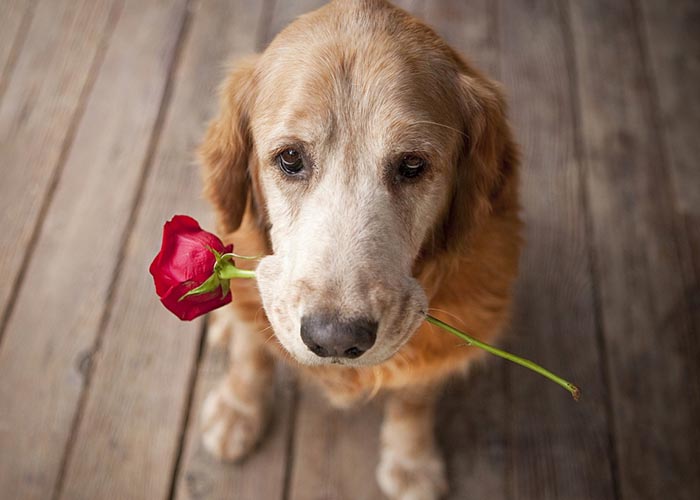
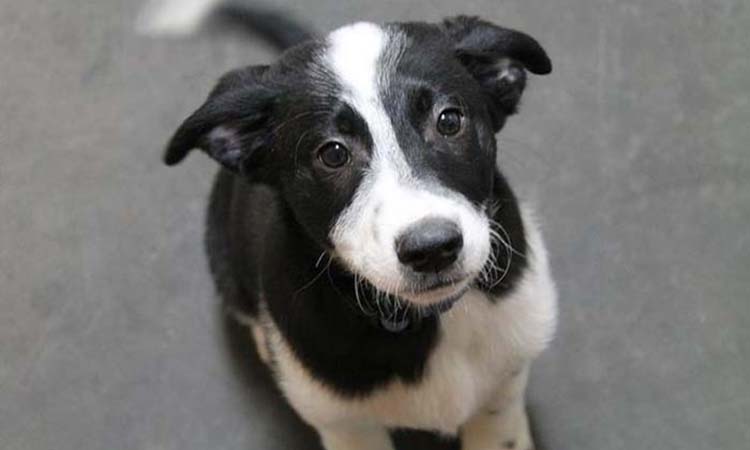
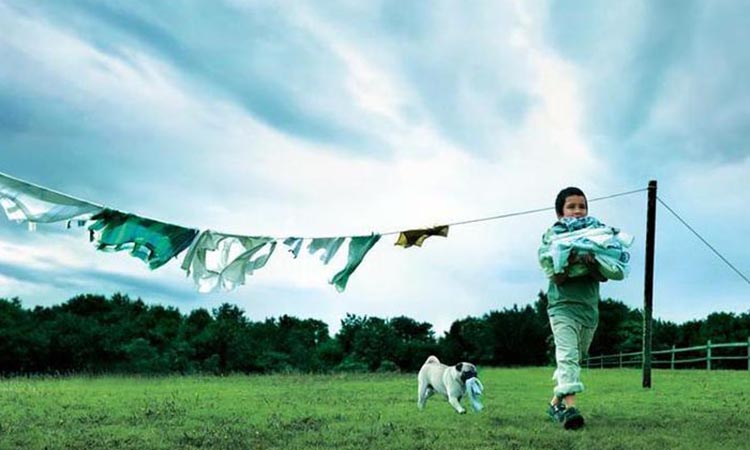
Then the second is a video that was brought to my attention thanks to Neil in South Devon. As Neil so rightly said, “Leaving aside the captions it’s quite moving….”. (And, trust me, believers and non-believers alike, you are going to weep from start to finish, just as Jean and I did!)
In a world where so much is so utterly screwed up it is the most blissful miracle that we have our dogs!
You will recall that last Friday I featured an item under the title of Private First Class Lingo. The item had been brought to my attention by Constance Frankland.
Well here’s another really special story that Constance came across on a website called Arditor and I wanted to share it with you.
ooOOoo
8 Ways Your Dog is Saying “I Love You“
Although dogs don’t speak our language, they are constantly trying to tell us that they love us and always showing love through their actions. Unfortunately, many shrug their shoulders or get annoyed over their dogs’ love gestures.
Here are 8 ways your dog is saying “I love you”…
Tail Wagging
Similar to a cat, a dog’s tail is a communication tool. In fact it is sometimes more accurate in translating its emotions than barking. Held at different positions, a dog’s wag could communicate excitement, fear, threat or submission. If your dog’s tail is held in a relaxed position and wagging all together with its entire butt, it means it is very happy to see you.
Face Licking
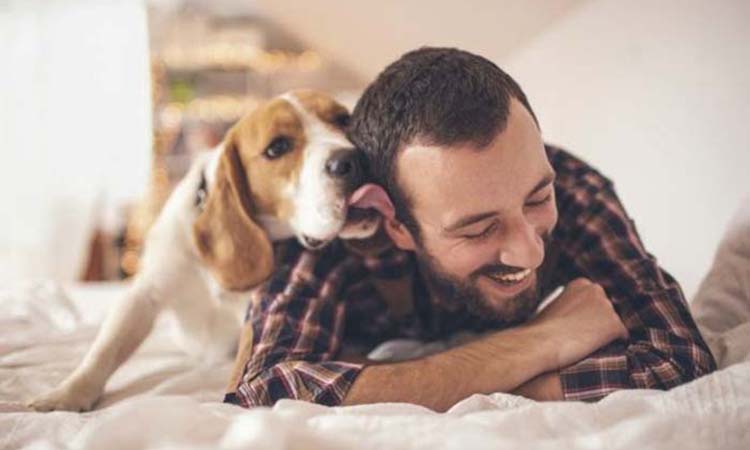
Warm, sticky, wet and stinky! We know this can get annoying but licking a person’s face is a love gesture from a dog. Dogs lick faces for a few reasons. Mainly, if your pet dog is licking your face, he is trying to groom you! Grooming is an intimate gesture only done after a strong connection is made between dogs (so now you know he sees you as one of his kind). On the other hand, if a stranger dog licks your face, it is simply trying to say that he is harmless and friendly.
Following You Wherever You Go
This is another behaviour that can get on your nerves, especially when your dog attempts to follow you to work! However, it is only a dog’s way to show his love, devotion and loyalty to you. Wherever you are, that is where your dog wants to be. Dogs are extreme social creatures and unlike humans, there is no need for solitude.
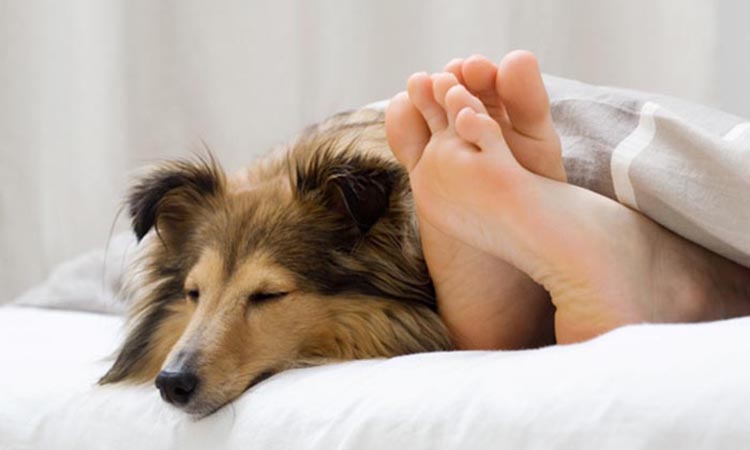
Sleeping with You
Similar to wild wolve packs, wild dogs curl up together to sleep in the night. Rather than sleeping alone in his designated corner, your dog prefers to snuggle right next to you in your bed. If you catch your dog sneaking onto your bed or falling asleep next to you in your couch, it implies that you are his family.
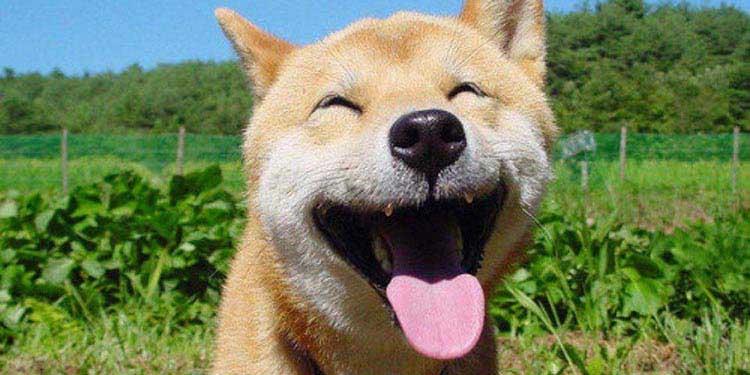
Smiling
It is no surprise when you see something like a smile on your dog. Dogs do smile too! Research has found that dogs can also show and use facial expressions similar to how humans do. A dog’s smile is another way of showing his love and joy to his owner. Having said that, most of us are guilty of not recognizing our dog’s smile.
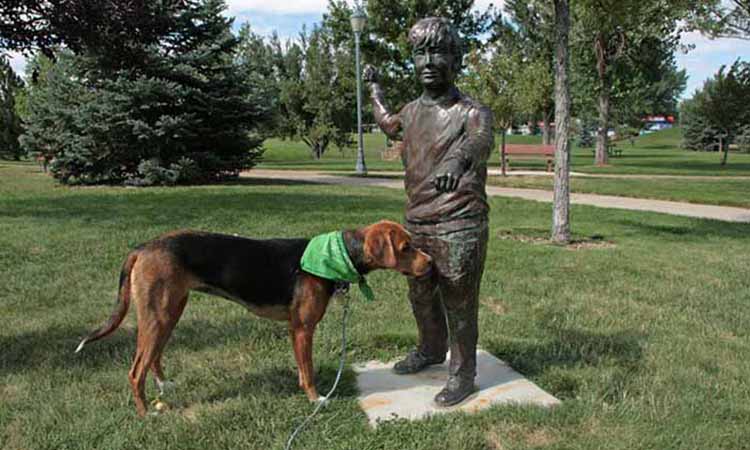
Crotch Sniffing
Argh, this is an embarrassing one and how we wished our dogs can quit going around sniffing crotches. But before you start screaming at your dog, try to understand it. This behaviour is in fact a dog’s perculiar way of greeting. More importantly, apart from a hello, it allows the dog to understand and remember you through your scent.
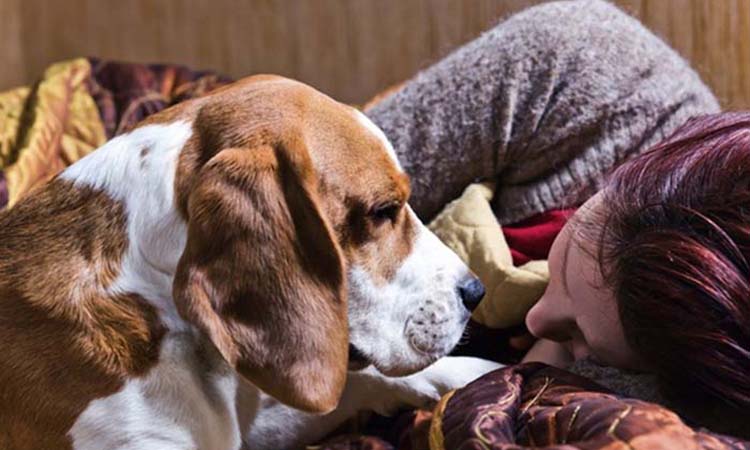
Taking Care of You When You are Sick
Does your dog stay by your bed and watch you the whole time while you are nursing a flu? This is its natural instinct to care for a sick or wounded family member, just as they would in the wild. A dog extends its love and care to its sick or injured owner by quietly and patiently watching over him/her. But make sure you hide any superficial wounds away from your dog! It might actually lick your wound as its form of first aid.
Leaning on You
Whether you are sitting or standing, your dog is leaning on you and wouldn’t budge. You can’t move and you can’t get on with your daily routine. While you are wondering what they are up to, your dog has already got what they needed: your attention. Getting your attention and giving you their attention by leaning on you is their way of showing affection. Next time this happens, stop what you are doing and reciprocate with some love.
ooOOoo
This turned out to be more of a Sunday Picture Parade but it seemed too special to hold it from you until the weekend.
No, our dogs don’t speak a language that we humans would recognise as such but, nonetheless, our dogs communicate in ways that still are as magical and special as our human poetry.
Speaking of poetry, let me close today’s post with this.
Eleanore MacDonald is the author of the blog Notes From An Endless Sea. It’s a blog that I have been following for a while.
On the last day of last year, I published a post that contained the following:
There is much in this new world that concerns me and I know I am not alone with this view. But the rewards of reading the thoughts of others right across the world are wonderful beyond measure.
Little did I know that in just five days time Eleanore would demonstrate “wonderful beyond measure” par excellence! With her very kind permission I republish in full her post from last Sunday. Please don’t read any further until you can be very still and read Eleanore’s post with your total concentration on her stunningly beautiful prose.
I didn’t have to search for it. My word for the year just came to me, and with it, a host of lovely synonyms in its wake. Devotion. Well, devotion––minus the religious connotations––holding hands with dedication, fealty, loyalty, commitment, fortitude and constancy.
In the past I have labored over what it might be for me, that word that embodies all I want to do with my intentions in the year ahead. But this year, it came floating to me like an errant leaf, late falling on a winter’s breeze. It resonated deep within and because it came with an entourage I felt like a farmer with acres and acres of fertile, unblemished land spread before me all waiting for me to plant an endless bounty.
So I start my new cycle, this new year, with the sowing of seeds of intention, digging deeply into this dark, rich soil. It begins with a renewed Devotion and dedication to loving. To magic. And to beauty.
chalice well, glastonburymagic
And writing – something I failed so miserably at conjuring last year. A block is no joke, it is a deep, dark hole that any creative soul can fall into and in my case is called ‘writer’s block’, and it is real. And it sucks. I banish it now with a loyalty to work, those further and continual efforts to paint with words from a palette-full of color.
wordsand more words …
And then there is Fealty. A deep and resonant fealty to my love/partner/mate, to family and those dear ones who love me as I am whether broken or whole; to those who love the animals and celebrate empathy, truth and compassion; to those who will be happy for me when I succeed, and cry with me in my sadness, who try to pick me up when I fall, and push me hard to continue to explore the vast continents of my interior and to walk onward along the path to becoming the best I can possibly be.
Those beloveds who allow me, in all of that vulnerability, to do the same for them.
Loyalty. Loyalty to my path. And to the greater good. To honesty, integrity, goodness, caring, loving––to kindness and empathy, to staying awake with eyes and ears and heart attentive to the big world around us, to laughter, to weeping buckets when I’m overflowing, to connection, to speaking up and speaking out (loudly!), to celebrating beauty and color, and to a nurturance of the evolution of soul and spirit, my own and that of others.
loyaltythere is a world …music
Commitment. To continuing to wield light, through music.
Commitment to seeing the glass half full.
And to the voiceless ones, who really are my reason for being. The animals. Commitment to doing what I can to ease the burden of suffering for those in need of compassion and caring, of rescue and respite.
Dear Ouranosthe grande dame
Commitment to honoring those others who continue to do the hard and mostly thankless work attending to the emergent needs of those barely surviving untenable lives in the shadows; those caring for the pets of the homeless, animals who act as angels for the people of the streets whose only tether left to any comfort in this life is a beloved dog or cat companion; those pulling the newborn kits and pups from garbage bins, or flimsy boxes set in the cold rain along busy streets, those rescuing dogs from a brutal existence of abuse, abandonment, fighting, life at the end of a cold chain; those earthly angels whose hearts have been broken over and over again yet they continue on, continue giving, helping, trying to make a better life and a better world for those left behind. (I have always held that, were humans to collectively realize that the other beings we share this glowing, gorgeous orb with––the animals, the trees, the waters, the land––all require and deserve our recognition, our action, our honor and caring, then the world’s ills would resolve. And so it goes…)
Fortitude. The fortitude to walk my path ahead in constancy, through dark and light with no time or inclination to curl into a ball and sink to the bottom of the well. Life now is too short for that.
Dedication, fealty, loyalty, commitment, fortitude… in action, together they reduce down and distill to a fine and pure constancy of devotion.
I am good with that! Right?
Do you have a ‘word for the year’? If so, do try to hold it close, in honor of its gift. When 2016 comes to pass, I would love to hear what your word was and how it served you. Or, how you served it.
Spreading my wings now… With love and light, and hopes that your year ahead is graced by all that is good,
So here we are on the last day of 2015, the cusp of a new year and who knows what the next twelve months have in store.
All I am going to do is to reflect on the huge potential our modern ‘wired-up’ world offers for learning.
Most will know the saying, “You can’t teach an old dog new tricks.”
But it is wrong!
Here at home, where a number of the dogs are in their old age (Pharaoh is the equivalent in age of 100 human years; one dog year being approximately the same as eight human years) Jean and I see no difficulty in these elderly dogs learning new tricks. Staying with Pharaoh, as an example, his hearing is pretty poor now but he has learnt a whole range of hand signals in recent months and he still communicates very well with us.
There is much in this new world that concerns me and I know I am not alone with this view. But the rewards of reading the thoughts of others right across the world are wonderful beyond measure.
Here’s a tiny dip into some fascinating items and articles that have graced my in-box in just the last twenty-four hours.
Eckhart Tolle’s Moment Reminder: “As far as inner transformation is concerned, there is nothing you can do about it. You cannot transform yourself, and you certainly cannot transform your partner or anybody else. All you can do is create a space for transformation to happen, for grace and love to enter.”
Val Boyco, “Everything comes to us that belongs to us, if we create the capacity to receive it.” ~ Rabindranath Tagore
John Zande in his Sketches on Atheism, “Theism’s most potent, pervasive, irresistibly enchanting gift to frightened but otherwise sane individuals is a belief—a promise—that upon their death they will go home.”
Mother Nature Network, “7 ways to meditate while you move – If you don’t have time for sitting meditation, give one of these active meditations a try.”
George Monbiot, (on the UK floods), “These floods were not just predictable. They were predicted. There were clear and specific warnings that the management of land upstream of the towns now featuring in the news would lead to disaster.”
and my final selection:
Patrice Ayme: (from an essay on Brain & Consciousness) “The best microprocessors you can buy in a store now can do 10 to the power 11 (10^11; one hundred billions) operations per second and use a few hundred watts,” says Wilfred van der Wiel of the University of Twente in the Netherlands, a leader of the gold circuitry effort. “The human brain can do orders of magnitude more and uses only 10 to 20 watts. That’s a huge gap in efficiency.”
So here’s to a new year of wonderful new learnings. And let me leave you with this additional message for 2016.
Namely that The Nation weekly journal are celebrating their 150 years of publishing the magazine. They recently published a 150th Anniversary edition and the front editorial is written by Katrina Vanden Heuval. There is a ‘break out’ to one side on Page 2 of that editorial that reads:
Change is inevitable, but the one constant in The Nation‘s history has been a faith in what can happen if you tell people the truth.
Finding out the truth and sharing it so we can all see what can happen is my wish for 2016.
Happy New Year to all of you, and to all of your friends and loved ones.
The title to today’s post may be a tad misleading, for it doesn’t offer a guide to both aspects of the post.
But first to what prompted the title.
Earlier yesterday, Neil Kelly, friend from my days when I was living in South Devon, sent me a link to a recent BBC News item. Here’s the story:
Maggie the dog made honorary primary school teacher
28 December 2015 Last updated at 04:31 GMT
A dog has become so successful in helping children to read, that she has become an honorary member of staff at a school in the West Midlands.
The idea of getting pupils to read to dogs in order to improve their literacy was first tried out in the UK five years ago, but Maggie, a 10-year-old Shih Tzu, has become so successful that she now has her own staff badge at Earls High school in Halesowen.
Phil Mackie went along to meet Maggie, and Grace, another Shih Tzu, who is training to take over when Maggie retires.
Teaching Assistant Toni Gregory spoke on behalf of the two literary pups.
Unfortunately, the short video of Toni Gregory speaking hasn’t yet made it to YouTube so I can’t include that in the post. But do go across to here and watch the short interview with Toni. Here’s a picture of Maggie.
Moving on!
It’s difficult not to see the connection between Maggie offering teaching services in a UK school and this recent essay from Richard Murphy of the Tax Research UK blog. It is republished in full with Richard’s very kind permission.
Ninety three per cent of all children in the UK are taught in state schools. The parents of the other seven per cent may wish to pretend otherwise but the truth is that the prosperity, well being and future of the UK is dependent upon the ability of state schools to deliver the education our young people need. But, as the Guardian has reported, that is in jeopardy:
Britain’s leading expert on school recruitment has warned that a shortage of trainee teachers is reaching crisis levels in some of the most important subjects in the curriculum.
In evidence submitted to the parliamentary education select committee, TeachVac, an independent vacancy-matching and monitoring service for education professionals, said that it had identified a “woeful” lack of new teachers in several key secondary school subjects.
This is not a minor issue. As they note:
[TeachVac] has identified an 85% shortfall in the number of trainee teachers needed to fill vacancies in both business studies and social sciences. The number of new teachers for design and technology is also more than a third below what it needs to be and there is a 10% shortfall in the number of IT teachers required.
These are core subjects at the heart of the skill base the UK needs. And we may not be able to teach them.
There are three reasons for that. First, when the government portrays any job in the state sector as parasitical – and large parts of the media join in – any recruitment programme is going to be hard.
Second, student debt is crippling for those on what is thought to be middle pay, which is what many teachers can, at best, hope to earn.
And third, pay is just not good enough.
All of those are the direct result of policy. The first is ideological. The second is born of the desire to economically enslave people though debt which underpins neoliberalism. The third is the austerity mantra.
Put them together and this country will be crippled by denying an education to those who need and deserve it.
We need a new narrative.
The need to supply high quality education has to be at the core of that narrative.
I hope parents of those ten and younger realise what is going to happen to their children. It is not good, and they need to get angry, now.
ooOOoo
It strikes me that we need new narratives on so many issues ‘both sides of the pond’. Maybe, just maybe, 2016 kicks some of these new narratives into play.
John left an intriguing question as a comment to yesterday’s post.
Oh to have a time machine!
Tell me, Paul, if you did have one, a time machine, what three moments in history would you visit?
It really grabbed Jean and me and we spent quite a few minutes during the day kicking around ideas. At first, it was easy just to do a web search on epic moments in history and see if any of them related to me. But that seemed too easy. So I have picked three that do connect with my life.
May 8th, 1945
I was born on November 8th, 1944. I was born in North London (Acton). It was the period of the Second World War when the V2 rockets were landing all around. Take, for example, the incident just eleven days after my birth, when on the 19th November, 1944 a V2 landed in Wandsworth causing much damage and many fatalities around Hazlehurst Road and Garratt Lane. Spend a moment reviewing who died, and their ages, in that bombing.
So I was precisely six months old when the armistice was announced on May 8th, 1945. As Wikipedia describes it:
Victory in Europe Day, generally known as V-E Day, VE Day or simply V Day was the public holiday celebrated on 8 May 1945 (7 May in Commonwealth realms) to mark the formal acceptance by the Allies of World War II of Nazi Germany’s unconditional surrender of its armed forces.[1] It thus marked the end of World War II in Europe.
On 30 April, Adolf Hitler, the Nazi leader, committed suicide during the Battle of Berlin. Germany’s surrender, therefore, was authorised by his successor, Reichspräsident Karl Dönitz. The administration headed by Dönitz was known as the Flensburg Government. The act of military surrender was signed on 7 May in Reims, France and on 8 May in Berlin, Germany.
I would have loved to witness, by being in the crowd that day, the King and Queen acknowledging the end of the war in Europe.
May 8, 1945: King George VI and Queen Elizabeth, with Princess Elizabeth and Princess Margaret, are joined by Prime Minister Winston Churchill.
Nevertheless, that day in May, 1945 has been memorable for me for all of my life. Because my mother, who is still alive today, aged 96, (still living in London but spending Christmas with my sister in Cape Town, by the way), held me in her arms and said aloud: “My dear Paul, you are going to live!” I grew up with those loving words deeply rooted within me.
2. Stonehenge – too many moons ago!
For reasons that I am not entirely clear about, I have always been fascinated by the stars. From the point of view of using the stars to help me navigate strange parts of the world, both on land and at sea. I grew up regarding Polaris, the North Star, almost as a companion. Later in my life when sailing solo from Gibraltar to The Azores, a distance of just under 1,150 nautical miles, on a Tradewind 33 yacht, despite having an early GPS unit it was backup to me using a sextant to maintain (some) awareness of my position.
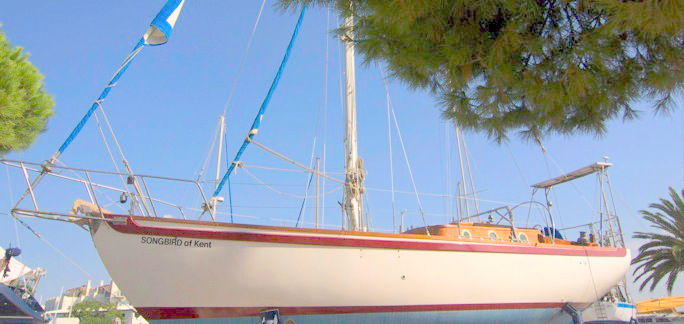
Tradewind 33 – Songbird of Kent. My home for five years.
(Reminds me of a anecdote when I was crewing on a privately-owned East Coast Essex fishing smack. I was asking Bill, the owner, why he always laid his thumb on the position on the chart in response to the question, “Where are we?” Bill’s reply: “That’s as accurate as anyone can be!”)
In 1969, when I was driving across the desert plains of Australia, often with inhabited places more than a 150-mile radius away (the Simpson Desert especially coming to mind) the Southern Cross seemed to keep me grounded and remind me that I was making progress.
Back when I was living just outside Totnes in South Devon, my frequent drives up to London along the A303 took me past Stonehenge in Wiltshire.
The December solstice happens at the same instant for all of us, everywhere on Earth. This year the solstice occurs on Tuesday December 22nd at 04:49 GMT (Universal time) with the sun rising over Stonehenge in Wiltshire at 08:04.
THE EARLIEST MONUMENT
It is possible that features such as the Heel Stone and the low mound known as the North Barrow were early components of Stonehenge,[3] but the earliest known major event was the construction of a circular ditch with an inner and outer bank, built about 3000 BC. This enclosed an area about 100 metres in diameter, and had two entrances. It was an early form of henge monument.[4]
Within the bank and ditch were possibly some timber structures and set just inside the bank were 56 pits, known as the Aubrey Holes. There has been much debate about what stood in these holes: the consensus for many years has been that they held upright timber posts, but recently the idea has re-emerged that some of them may have held stones.[5]
Within and around the Aubrey Holes, and also in the ditch, people buried cremations. About 64 cremations have been found, and perhaps as many as 150 individuals were originally buried at Stonehenge, making it the largest late Neolithic cemetery in the British Isles.[6]
I would have loved being present at Stonehenge when the builders finally were able to stand back and see the Sun “speak” to them at the first Solstice after that point in its construction.
It seems to me to be a most magical place yet Stonehenge offers a mathematical and rhythmic foundation to that magic.
3. First man into space – 12th April, 1961
It was, of course, Yuri Gagarin, who made the first complete orbit of Planet Earth in space.
Yuri Alekseyevich Gagarin
I would have given anything to be in his seat (and suit). For to look out and see our planet as a small object in an enormous outer space would have to change one’s perception of almost everything; for evermore.
My wish for the New Year is that we recognise our place both in history and on our Planet Earth, and care for it as the sole, beautiful home that we have.
Now that global recognition would be a moment in history that I would want to experience before I die!
(Thanks John for inspiring me to jot down these thoughts!)
I thought it would make a nice change to publish tomorrow’s post a little earlier than usual. To be precise to publish it on Dec. 22, at 04:48, Coordinated Universal Time (UTC). Or in our local Pacific Standard Time (PST) UTC-8 hrs or 20:48 Dec. 21., i.e. 20:48 on the evening of the 21st December. (I am seeing the exact time being declared as 04:48 or 04:49 UTC depending on what you read.)
Granted that the Northern Hemisphere tends to deliver the worst of the Winter weather after the shortest day, it still is good to know that for the next six months, the hours of daylight, in the Northern Hemisphere, will be increasing.
My inclination to write a post on the topic was greatly influenced by a most beautiful post over on Val Boyco’s blogsite. It was called And Winter Came. Here’s the video that Val included in her post.
Isn’t that a most beautiful few minutes!
Impossible to top that!
But I can continue including an informative item that was published over on Mother Nature News, and is republished here within the terms of MNN.
ooOOoo
8 things to know about the winter solstice
From when it happens to why, here’s your crash course on the shortest day of the year.
“A day without sunshine is like, you know, night,” quipped Steve Martin – and indeed, even a day with less sunshine can feel a bit dark. Our world depends on the light radiating from that big star we traipse around, and when it’s in short supply, we feel it. But if you count yourself amongst those who don’t love waking up before the sun rises and getting off work after it has set, things are about to lighten up. Hello, winter solstice!
Although winter is really just beginning, we can at least say goodbye to these short little days we’ve been suffering (and don’t let the door hit you on the way out). With that in mind, here’s a collection of curious facts to celebrate the long-awaited return to longer days.
1. There are actually two winter solstices every year
It’s sometimes easy to be hemisphere-o-centric, but the other side of the planet gets a winter solstice too. With the planet’s orbit tilted on its axis, Earth’s hemispheres swap who gets direct sun over the course of a year. Even though the Northern Hemisphere is closer to the sun during the winter, it’s the tilt away from the sun that causes cold temperatures and less light — which is when the Southern Hemisphere is toasty. So while our winter solstice is on Dec. 21 or 22, the Southern Hemisphere celebrates the same on June 21 or 22.
Here’s how that looks from space (kind of):
2. The winter solstice happens in the blink of an eye
Although the solstice is marked by a whole day on the calendar, it’s actually just the brief moment when the sun is exactly over the Tropic of Capricorn that the event occurs.
3. Which is why it happens on different days in the same year
What? Yes! In 2015, the solstice happens on Dec. 22, at 04:49 on the Coordinated Universal Time (UTC) time clock, the time standard that the world regulates its hours by. Which means any location that is at least five hours behind UTC should break out the party hats on Dec. 21. For example, in the United States the winter solstice happens on Dec. 21 at 11:49 p.m. Eastern Standard Time. The rest of the time zones can welcome longer days beginning on the 22nd.
4. It’s the first day of winter … or it’s not, depending on whom you ask
Meteorologists consider the first day of winter to be Dec. 1, but ask an astronomer — or just about anyone else — and they’ll likely answer that the winter solstice marks the start of the season. There are two ways to look at it: meteorological seasons and astronomical seasons. Meteorological seasons are based on the annual temperature cycle, explains NOAA, while astronomical seasons are based on the position of the Earth in relation to the sun.
5. It’s a time of gloriously long shadows
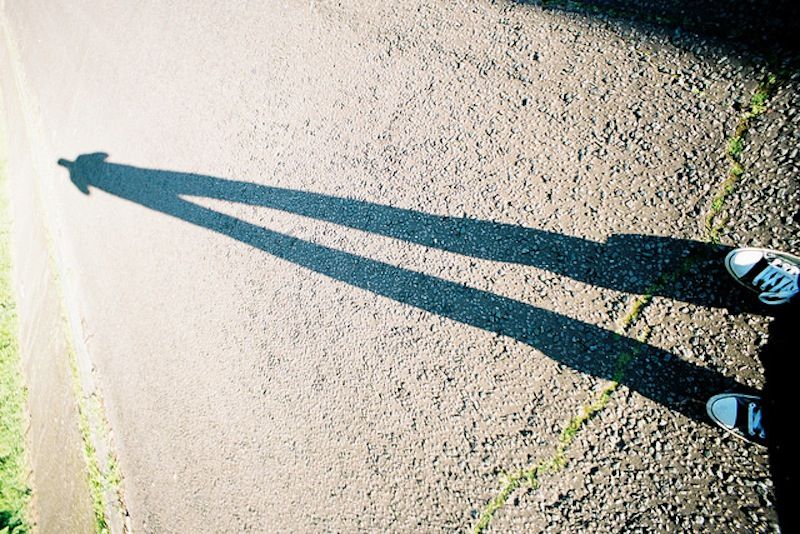
Shadows are at their playful best on the solstice. (Photo: Mike Page/flickr)
If you’re inclined to take pleasure in the little things, like shadows that seem cast from a funhouse mirror, then the winter solstice is the time for you. It’s now that the sun is at its lowest arc across the sky and thus, shadows from its light are at their longest. (Imagine a flashlight directly above your head and one hitting you from the side, and picture the respective shadows.) And in fact, your noontime shadow on the solstice is the longest it will be all year. Relish those long legs while you can.
Since 1793, the full moon has only occurred on the winter solstice 10 times, according to the Farmer’s Almanac. The last one was in 2010, which was also a lunar eclipse! The next full moon on a winter solstice won’t be until 2094.
7. There’s a Christmas connection
Since Christ wasn’t issued a birth certificate, there’s no record of the date when he was supposed to have been born. Meanwhile, humans have been celebrating the winter solstice throughout history — the Romans had their feast of Saturnalia, early German and Nordic pagans had their yuletide celebrations. Even Stonehenge has connections to the solstice. But eventually Christian leaders, endeavoring to attract pagans to their faith, added Christian meaning to these traditional festivals. Many Christmas customs, like the Christmas tree, can be directly traced to solstice celebrations.
8. It’s a reminder to thank Copernicus
Will the real Saint Nick please step forward? (Photo: Wikimedia Commons)
The word “solstice” comes from the Latin solstitium, meaning “point at which the sun stands still.” Since when has the sun ever moved?! Of course, before Renaissance astronomer Nicolaus Copernicus (aka “super smartypants”) came up with the ‘ol heliocentric model, we all figured that everything revolved around the Earth, sun included. Our continued use of the word “solstice” is a beautiful reminder of just how far we’ve come and provides a nice opportunity to give a tip of the hat to great thinkers who challenged the status quo.
Only one way to close. That is with this picture of the sun perfectly aligned with the stones at Stonehenge in Wiltshire, UK at the moment of the Winter Solstice.
The December solstice happens at the same instant for all of us, everywhere on Earth. This year the solstice occurs on Tuesday December 22nd at 04:49 GMT (Universal time) with the sun rising over Stonehenge in Wiltshire at 08:04.
Stay safe and warm wherever you are.
The next post from Learning from Dogs will be published at 00:00 PST Wednesday, 23rd December.
Three days ago I was within just a few minutes of queuing this for a blog release when the internet went down. So now that things are back (to normal?) it gives me very great pleasure to publish this guest post.
ooOOoo
My Dog, My Mentor.
We humans share the planet with an enormous variety of life forms. In fact, there are so many organisms in our world that scientists cannot agree even on an estimate of how many exist. Anywhere between two and 100 million, we are told. Those numbers are staggering, leaving me feeling small alongside all those with whom I share terrestrial space.
Today my thoughts come to rest on one specific type of world inhabitant––just one out of the multiple millions: the canine! The one who allegedly is man’s (and woman’s) best friend! I have had close contact with dogs since I was a young child, so it’s hardly surprising that I have a great deal of love and respect for them.
No longer are dogs simply farm animals or household pets. They rescue the lost and wounded after natural disasters, serve in combat, their keen sensitivities are used to detect disease in its early stages, their presence brings comfort to the ill or elderly, they accompany their seeingimpaired human counterpart, detect illegal and harmful substances in public places. In short, they frequently provide expertise and skill that exceed that of humans.
People are hesitant to admit this, always desiring to be on top. To be the best and the most developed. Since we seem to have great difficulty simply living alongside one another, we tend to keep score: higher/ lower; bigger/ smaller; better/ worse; superior/ inferior. One result of this scoring system is that we consider ourselves vastly superior to our animal sisters and brothers–– superior in intelligence, capacity for reason, emotion, creativity and relationship.
Carl Safina, marine conservationist, professor and author, challenges this notion of superiority, stating humans are not necessarily unique (or superior), but simply the most extreme: capable of the most compassion and the worst violence; possessing the greatest capacity for creativity and at the same time most able and willing to inflict destruction on one another and on other inhabitants of this planet.
Yet, animals do not respond in kind. Certainly, they will protect and defend themselves and their own, but humans display vastly more aggression. At times, animals choose to exhibit unsurpassed magnanimity towards humans.
Focusing this phenomenon on the family dog, it may surprise us that not WE but THEY seem to provide the greatest benefit in the human / canine relationship. If we are observant, we will be humbled by the fact that characteristics, effortlessly displayed in our pets, are the very same qualities we strive for and often fall short in attaining. Take gratitude, for example. My darling Maltese––gone since September 11, 2015––waited hours for his human to return home to love on, walk with and feed him. When I walked in the door, he did not unleash venom or aggression for having been left alone while I was away working. His tail wagging knew no bounds––he simply adored the moment he was again joined by his human.
But me? My mind would play all kinds of games when similarly “neglected”: It’s been weeks since I heard from her, it’s about time she called. I didn’t do anything to deserve this silence!
And then there’s unconditional love. What about the times I would become impatient with my furry family member? At times he was distracted on walks, simply delighted by all the sounds, smells and sights of the outdoors. But, I had a goal and a time limit, giving rise to frustration at his digressions. However, my dog wasn’t frustrated. On the contrary, he not only endured my impatient scolding––calls to move on, to hurry––but reciprocated with lavish love the very next moment. How did he do that?
Why is my dog, (whether instinctively or cognitively is actually irrelevant) capable of exhibiting the very virtue I strive for, fail at, attempt repeatedly, become frustrated over failing yet again? The list of virtues seems endless:
kindness,
patience,
resiliency,
forgiveness,
encouragement,
empathy,
sensitivity,
contentment,
the innate ability to live in the moment.
My furry family member expressed––indeed he lived them all.
And what about me? I exhibit these qualities periodically. Sporadically. Brokenly. With enormous, conscious effort.
In his final months, my small Maltese slowed down, had increasing difficulty with mobility, became disoriented, nearly blind and partially deaf. In a word: dependent. Yet his trust, courage and peace were astounding. In his final days he became quiet, hardly uttering a sound, yet the pictures of those days bear witness to his alertness and awareness. He knew!
Could it be that he was quiet because he was at peace with what had been and what was to come? I believe that because he had given all he had to give, in the best way he had been able to give it, he was able to quietly await and accept his departure as well.
What will it be like for me to grow old? Limited? Increasingly dependent? I don’t know! Will I know that the value of my existence is not tied with activity or productivity? Will I learn to live in the moment––grateful, at peace, content?
How will I face the imminent transition from this life to the next? I don’t know! Will my last days be characterized with peace? Absorbing and bestowing love? Satisfied with small things? Inwardly at rest?
These reflections will accompany me for years.
There are questions that are equally relevant––and perhaps more immediate:
How can I have a more sane understanding of my place in this expansive and exquisite terrestrial community?
What will enhance a sense of respect and appreciation for the dizzying variety of species I live alongside?
What will it take for me to continue growing and learning as a human?
These seem profound questions in light of growing disregard for human and animal life. It is not unlikely, however, that sharing space with dogs will help me grow into a more gracious and balanced person.
 But what does it all MEAN?