Income inequality, when it becomes excessive, is very corrosive to a society.
This is clearly a complex subject because one man’s excess is another man’s just reward for building a successful business that employs his fellow citizens.
Nonetheless, I do want to touch on this sensitive area because, to my mind, they are connected with the tragic story that is the point of this article.
This document presents details on the wealth and income distributions in the United States, and explains how we use these two distributions as power indicators.
Some of the information may come as a surprise to many people. In fact, I know it will be a surprise and then some, because of a recent study (Norton & Ariely, 2010) showing that most Americans (high income or low income, female or male, young or old, Republican or Democrat) have no idea just how concentrated the wealth distribution actually is.
Later on, Prof. Domhoff writes:
The Wealth Distribution
In the United States, wealth is highly concentrated in a relatively few hands. As of 2007, the top 1% of households (the upper class) owned 34.6% of all privately held wealth, and the next 19% (the managerial, professional, and small business stratum) had 50.5%, which means that just 20% of the people owned a remarkable 85%, leaving only 15% of the wealth for the bottom 80% (wage and salary workers). In terms of financial wealth (total net worth minus the value of one’s home), the top 1% of households had an even greater share: 42.7%. Table 1 and Figure 1 present further details drawn from the careful work of economist Edward N. Wolff at New York University (2010).
That table and the whole article is powerful and a well-worth reading. Read it here.
Stay with me a little longer. Here’s an extract from an article from Nicholos Kristof of the New York Times written in November last year.
Nicholas Kristof
In my reporting, I regularly travel to banana republics notorious for their inequality. In some of these plutocracies, the richest 1 percent of the population gobbles up 20 percent of the national pie.
But guess what? You no longer need to travel to distant and dangerous countries to observe such rapacious inequality. We now have it right here at home — and in the aftermath of Tuesday’s election, it may get worse.
The richest 1 percent of Americans now take home almost 24 percent of income, up from almost 9 percent in 1976. As Timothy Noah of Slate noted in an excellent series on inequality, the United States now arguably has a more unequal distribution of wealth than traditional banana republics like Nicaragua, Venezuela and Guyana.
C.E.O.’s of the largest American companies earned an average of 42 times as much as the average worker in 1980, but 531 times as much in 2001. Perhaps the most astounding statistic is this: From 1980 to 2005, more than four-fifths of the total increase in American incomes went to the richest 1 percent.
By the way, Kristof has his own blog site and added material from him about this topic and readers’ comments are here.
Now to the core of this article on Learning from Dogs which, I passionately believe, is closely tied in to the background theme already expressed here. It’s from the blogsite Corrente and, once again, I am indebted to Naked Capitalism for having it in a recent set of links.
It concerns Jack, his family and their house.
The House that Jack’s Bank Took
Jack was a friendly man, who always had a pleasant word and a smile and handshake for everyone. The men hung with him at barbeques and discussed sports. He was strong, had a belly, and always wore a baseball cap. He was married to his high school sweetheart, Mary. He was good to his 4 kids and took care of his oldest child when he had a breakdown in his early twenties. He went to all school and family events and encouraged his children in their dreams. He took care of the family needs and finances. He was a small business owner and had invented his product, which a short while ago became outmoded. He always decorated the house with lots of Christmas decorations and candles. They are still up. He lost his house to foreclosure and the family was given 3 days to move out.
He drove into the deep woods and drank poison to make sure he was dead. I knew him. My family knew him; he lived within walking distance of one of us. At his funeral his childhood sweetheart and their children told a lot of Jack stories. The family did their best to resurrect him to our eyes. One of his kids sang and the eldest read a poem he’d written. Mary said she didn’t know what she was going to do and that she would now have to rely on those from town sitting in the packed chapel pews. There are other houses nearby that haven’t been foreclosed on but Jack’s house was nice and had a good view. The bank has now given Mary 3 weeks to move out.
It was written on the 15th February, 2011; you can read it here. Click on the link and read some of the comments expressed – very powerful.
Wish I could think of something apt to say but I can’t. All I can feel is great sadness and a horrible feeling in the pit of my stomach that this ‘Jack’ story is being echoed in many other places.
More on the way we are most likely treating Planet Earth.
At the start of the week the first of a shortish series of articles was published, reflecting my support of the book, World on the Edge. Here’s what I wrote then:
I have mentioned before the Earth Policy Institute and Lester Brown’s latest book, World on the Edge. Details of the book are here.
At the time of writing this Post (10am US Mountain Time on the 4th Feb.) I have read through to the end of Chapter 5 of the book and will have it completed soon. It’s opening my eyes hugely!
I have decided over the next week or so to summarise each chapter, hoping that this encourages many readers of Learning from Dogs to reflect, go to the EPI website, buy the book or think about making a difference in any way that you can.
So today, I move on to the next chapter.
Chapter two, Falling Water Tables and Shrinking Harvests.
The term ‘fossil aquifer’ demonstrated that not all aquifers are the same. Let me quote, “There are two sources of irrigation water: underground water and surface water. Most underground water comes from aquifers that are regularly replenished with rainfall; these can be pumped indefinitely as long as water extraction does not exceed recharge. But a distinct minority of aquifers are fossil aquifers – containing water put down eons ago. Since these do not recharge, irrigation ends whenever they are pumped dry.“
Saudi Arabia started drilling for water from their underground fossil aquifer when after the Arab oil-export in the 1970s, the Saudis realised that they were dependent on imported grain and set out to create self-sufficiency in grain by way of irrigation.
In January 2008 the Saudis announced that this huge aquifer was largely depleted!
From 2007 to 2010 the Saudi wheat harvest dropped from nearly 3 million tons to around 1 million tons.
The likelihood is that the last Saudi harvest will be around 2012.
One can’t imagine how the management of a fine and proud country such as Saudi Arabia could be so foolish! But slightly closer to home …..
In most of the leading U.S. irrigation states, the amount of irrigated area has peaked and begun to decline.
California, historically the irrigation leader, has seen irrigated areas fall from nearly 9 million acres in 1997 to an estimated 7.5 million acres in 2010, that’s a 16% drop! Why?
Aquifer depletion and diversion of water to fast-growing cities!
Then there’s Texas. Their irrigated area peaked in 1978 at 7 million acres, now down to 5 million acres, a loss of 29%, as the Ogallala fossil aquifer under the Texas panhandle becomes depleted.
Colorado has seen its irrigated are shrink by 15%
Arizona’s irrigated area is shrinking.
Florida’s irrigated area is shrinking.
Then there’s India. Then there’s Mexico. And on and on. I could quote so much more from this single chapter but – you get the message!
Here’s how the chapter ends.
Today more than half the world’s peoples live in countries with food bubbles. The question for each of these countries is not whether the bubble will burst, but when – and how the government will cope with it. [Read that last sentence again, folks. Ed]
Will governments be able to import grain to offset production losses? For some countries, the bursting of the bubble may well be catastrophic. For the world as a whole, the near-simultaneous bursting of several national food bubbles, as aquifers are depleted could create unmanageable food shortages.
This situation poses an imminent threat to food security and political stability. We have a choice to make. We can continue with over-pumping as usual and suffer the consequences. Or we can launch a worldwide effort to stabilise aquifers by raising water productivity – patterning the campaign on the highly successful effort to raise grainland productivity that was launched a half-century ago.
H’mmm. Tough reading.
Amazon Drought in 2005.
The above photograph was taken from this website; here’s an extract from the accompanying article.
Food inflation is here and it’s here to stay. We can see it getting worse every time we buy groceries. Basic food commodities like wheat, corn, soybeans, and rice have been skyrocketing since July, 2010 to record highs. These sustained price increases are only expected to continue as food production shortfalls really begin to take their toll this year and beyond.
This summer Russia banned exports of wheat to ensure their nation’s supply, which sparked complaints of protectionism. The U.S. agriculture community is already talking about rationing corn over ethanol mandates versus supply concerns. We’ve seen nothing yet in terms of food protectionism.
But as I wrote in the previous article, “Be worried, be concerned but don’t panic – you and I, all of us, have the collective power to sort this all out.” Lester Brown’s book sets out some strong advice on the way forward.
This opened my eyes; thought I would share it with you.
I know that many of the several hundred readers of Learning from Dogs are not in the USA. But many are. Hence me deciding, after mulling it over, to publish in full the contents of an email that came in a short while ago from the organisation Change.
Here’s that email.
Dear Paul,
Valentine’s Day, which accounts for 40% of fresh flower sales annually, is fast approaching.
Not always a sweet smell.
If you’re planning to order a bouquet from 1-800-Flowers — the world’s largest florist — you should know where most of those flowers really come from.
At flower farms in Ecuador and Colombia — the countries that export the most to the U.S. — two-thirds of the workers are women. These women are routinely subjected to harassment and even rape from their male supervisors. They suffer eye infections and miscarriages from consistent contact with dangerous pesticides.
In the weeks leading up to Valentine’s Day and Mother’s Day, they’re routinely forced to work 80-hour weeks with no overtime pay. Attempts to form a union are met with opposition by police and armed forces.
Many retailers — such as Whole Foods and Stop & Shop — have taken the important first step of offering Fair Trade flowers to consumers who want no part of these abuses. Fair Trade certified farms must adhere to strict standards for workers’ rights, which prevents the abuses described above.
1-800-Flowers is the largest florist in the world. Yet they offer no Fair Trade flowers at all.
1-800-Flowers uses a certifying agency called Florverde, which ensures that its flower farms measure up to certain environmental standards — this is a good thing. But Florverde has almost no labor standards: A farm can be certified even if it uses forced labor.Indeed, Florverde is owned by the Association of Colombian Flower Exporters, so it has a financial incentive to keep wages low and suppress workers’ rights.
This is the week before Valentine’s Day — more people will purchase flowers during the next seven days than any other week this year. This is our best opportunity to demand a promise from 1-800-Flowers to join its competitors in offering Fair Trade flowers. So after you sign the petition, please share this email widely and post on Facebook — do everything you can topressure 1-800-Flowers to show a little respect for the women who toil in unbearable circumstances. The women without whom they’d have no flowers to sell.
Click the link below to tell 1-800-Flowers to make a promise this Valentine’s Day to sell Fair Trade flowers:
Since this campaign began, the company has emailed to tell us that it will post more information on its website about the farms that supply their flowers. But this is a far cry from selling fair trade products — and we have much more to do to make sure workers are protected. This is the week to do it.
Thanks for taking action,
Patrick and the Change.org team
If you feel so minded to sign the petition, which can be done by people outside the USA, then that may be done here.
An interesting companion to the World on the Edge book
Regular readers of the Blog will know that yesterday an article was published, the first of a series, looking more closely at the book by Lester Brown of EPI called World on the Edge. That article followed on from this Post, Group Human Insanity, and yesterday’s Post, Total, Utter Madness, Pt 1.
Today, if you will forgive the emotional battering that the book and this film create, I want to draw your attention to a film that was produced in 2007, called What A Way To Go: Life at the End of Empire.
It was lent to us by John Hulburt, who lives in Payson, and holds many views that are close to the views of the founders of Learning from Dogs. John has offered to write the odd guest article for the Blog, which is fantastic.
Anyway, back to the film. Here are a couple of trailers.
A 2-minute trailer giving an overview of the film ..
and another one dipping into more detail.
And if you still want more, then here’s an interview of the two behind the film, Producer Sally Erickson and Writer/Director Tim Bennett. Twenty-seven minutes long but so what. Watch it!
We really do have so much to learn from dogs! (Before it’s too late!)
The way we are most likely treating Planet Earth is almost beyond comprehension.
I have mentioned before the Earth Policy Institute and Lester Brown’s latest book, World on the Edge. Details of the book are here.
At the time of writing this Post (10am US Mountain Time on the 4th Feb.) I have read through to the end of Chapter 5 of the book and will have it completed soon. It’s opening my eyes hugely!
I have decided over the next week or so to summarise each chapter, hoping that this encourages many readers of Learning from Dogs to reflect, go to the EPI website, buy the book or think about making a difference in any way that you can.
Chapter One, On the Edge, sets the background:
Summer of 2010 sees record-high temperates in Moscow, Russia’s grain harvest shrank by 40 million tons (40%) to 60 million tons.
Record high temperatures in south-central Pakistan were recorded. Snow and glaciers in the Himalayas melted fast, 20 million Pakistanis were affected by the resultant flooding, 2,000 died, 6 million acres of crops damaged.
A 2002 study by Mathis Wackernagel concluded that, “humanity’s collective demands first surpassed the earth’s regenerative capacity around 1980. By 1999, global demand’s on the earth’s natural systems exceeded sustainable yields by 20 percent. Ongoing calculations show it at 50 percent in 2007. Stated otherwise, it would take 1.5 Earths to sustain our current consumption.” [my emphasis]
“No previous civilisation has survived the ongoing destruction of its natural supports. Nor will ours.”
Let’s turn to NOAA. A few salient points from there State of the Climate – Global Review for 2010.
For 2010, the combined global land and ocean surface temperature tied with 2005 as the warmest such period on record, at 0.62°C (1.12°F) above the 20th century average of 13.9°C (57.0°F). 1998 is the third warmest year-to-date on record, at 0.60°C (1.08°F) above the 20th century average.
The 2010 Northern Hemisphere combined global land and ocean surface temperature was the warmest year on record, at 0.73°C (1.31°F) above the 20th century average. The 2010 Southern Hemisphere combined global land and ocean surface temperature was the sixth warmest year on record, at 0.51°C (0.92°F) above the 20th century average.
The global land surface temperature for 2010 tied with 2005 as the second warmest on record, at 0.96°C (1.73°F) above the 20th century average. The warmest such period on record occurred in 2007, at 0.99°C (1.78°F) above the 20th century average.
2010 is becoming the year of the heatwave, with record temperatures set in 17 countries.
Record highs have occurred in Russia, Belarus and Ukraine – the three nations at the centre of the eastern European heatwave which has lasted for more than three weeks – but also African, Middle Eastern and Latin American countries.
Temperatures in Moscow, which have been consistently 20C above normal, today fell to 31C (86F), and President Dmitry Medvedev cancelled a state of emergency in three out of seven Russian regions affected by forest fires.
Thousand of hectares of forest burned in the fires, killing 54 people and leaving thousands homeless. For days, Moscow was shrouded in smog, and environmentalists raised fears that the blaze could release radioactive particles from areas contaminated in the 1986 Chernobyl disaster.
Wildfires have also swept through northern Portugal, killing two firefighters and destroying 18,000 hectares (44,500 acres) of forests and bushland since late July. Some 600 firefighters were today struggling to contain 29 separate fires.
But the extreme heat experienced in Europe would barely have registered in Iraq, Saudi Arabia, Niger, Pakistan and Sudan, all of which have recorded temperatures of more than 47C (115F) since June. The number of record highs is itself a record – the previous record was for 14 new high temperatures in 2007.
The freak weather conditions, which have devastated crops and wildlife, are believed to have killed thousands of elderly people, especially in Russia and northern India. The 2003 European heatwave killed about 15,000 people.
Be worried, be concerned but don’t panic – you and I, all of us, have the collective power to sort this all out. More about this soon.
Mixed emotions about those other worlds out there.
In recent times, Learning from Dogs has been reflecting on the magic, and fragility, of the planet we all live on.
There was the photograph of the Earthrise that attracted quite a few comments. That was followed up by the amazing photograph of the Earth from Voyager 1 taken in 1990 from 3,762,136,324 miles away! Then the lovely poem from Sue.
So it was interesting to note my mixed emotions to a piece on the BBC News website yesterday. Here’s a flavour.
Worlds away
Astronomers have identified some 54 new planets where conditions may be suitable for life.
Five of the candidates are Earth-sized.
The announcement from the Kepler space telescope team brings the total number of exoplanet candidates they have identified to more than 1,200.
The data release also confirmed a unique sextet of planets around a single star and 170 further solar systems that include more than one planet circling far-flung stars.
Read the rest of the item here. (and there’s a fuller version on NetworkWorld)
So here are those mixed emotions.
Man has been, and still continues to be, wonderfully curious to the point of spending huge sums of money on projects that appear to do nothing more than satisfy that curiosity. (The (Kepler) mission‘s life-cycle cost is estimated at US$600 million, including funding for 3.5 years of operation, from here.) That’s a beautiful trait, in my humble opinion.
Homo Sapiens is a wonderfully innovative and creative species, as so wonderfully presented by Alan Alda on a recent PBS Programme called The Human Spark. (See the YouTube intro at the end of this Post.)
Look at all the inventions and incredible advances to our species that are all around us – including the PC I am using and the World Wide Web that is aiding this message!
For such an intelligent species as us, why is it that we are treating Planet Earth in such a suicidal manner through greed, pollution and over-consumption!
As was reported yesterday, we could be on the verge of total and utter chaos in terms of food. Then also yesterday was a small item about food prices reaching a new global record.
It always struck me as absurd to conclude that this planet is the only habitable planet in the universe – ‘Astronomers estimate there are 1021 stars in the universe. With a conservative estimate of three planets per star (some could have many more, some would have none at all) this puts the estimated number of planets into millions of billions.‘ From here.
So the data coming in from Kepler is truly astounding and, personally, underlines this era as a great time to be alive.
But there simply is no choice in that for decades ahead, if not centuries ahead, Planet Earth is all there is for us. So why do we do it so much harm!
Our civilisation is likely to go to the very limits of survivability before the message that the existing ‘model’ is broken is picked up by every major political party in the world. That is very, very scary to contemplate.
So it looks as though, soon, mankind will face the ultimate decision of all time. Give up and let the chaos overwhelm us all, or … or what? In other words millions of us will have to live with the consequences of our greed.
The ‘or what?’ can only be a faith that it will be OK.
A faith that mankind will use the power of dreams, imagination and energy to create a new future that will, at long last, be a new dawn of democratic and just, integrous existence.
And maybe, just maybe, that could be the Second Coming and maybe, just maybe, the world’s Churches and religions will be our saving grace.
But of that day and hour knoweth no man, no, not the angels of heaven, but my Father only. Matthew 24:36
Fascinating times – a Chinese proverb, ‘It’s better to be a dog in a peaceful time than be a man in a chaotic period.’
Finally, here’s that video of the series preview to The Human Spark.
My copy of Lester Brown’s book World on the Edge arrived on Tuesday and already it’s opening my eyes big time. I do recommend that you think about purchasing the book, or you may download the entire book for free – details here.
Regular visitors to Learning from Dogs will remember that there was mention in a recent Post, Group Human Insanity about Lester Brown’s new book. I have subscribed to regular updates from the EPI and recently received the following; it’s worth reproducing in full, with the permission of the EPI.
Restoring Food Security for All
Takes Action on Many Fronts
Today there are three sources of growing demand for food: population growth; rising affluence and the associated jump in meat, milk, and egg consumption; and the use of grain to produce fuel for cars.
Population growth is as old as agriculture itself. But the world is now adding close to 80 million people per year. Even worse, the overwhelming majority of these people are being added in countries where cropland is scarce, soils are eroding, and irrigation wells are going dry.
Even as we are multiplying in number, some 3 billion of us are trying to move up the food chain, consuming more grain-intensive livestock products. As incomes rise, annual grain consumption per person climbs from less than 400 pounds, as in India today, to roughly 1,600 pounds, as among those living high on the food chain in the United States, where diets tend to be heavy with meat and dairy products.
When the United States attempted to reduce its oil insecurity by converting grain into ethanol, the growth in world grain demand, traditionally around 20 million tons per year, suddenly jumped to over 50 million tons in 2007. Roughly 119 million tons of the 2009 U.S. grain harvest of 416 million tons went to ethanol distilleries, an amount that exceeds the grain harvests of Canada and Australia combined. This massive ethanol distillery investment in the United States launched an epic competition between cars and people for grain.
On the supply side of the food equation, several trends are making it more difficult to expand production rapidly enough to keep up with demand. These include soil erosion, aquifer depletion, more frequent crop-shrinking heat waves, melting ice sheets, melting mountain glaciers, and the diversion of irrigation water to cities.
Farmers are also losing cropland to nonfarm uses. Cars compete with people not only for the grain supply but also for the cropland itself. The United States, for example, has paved an area for cars larger than the state of Georgia. Every five cars added to the U.S. fleet means another acre of land will be paved over—the equivalent of a football field.
The implications for China of this relationship between cars and cropland are startling. In 2009, for the first time, more cars were sold in China than in the United States. If China were to reach the U.S. ownership rate of three cars for every four people, it would have over a billion cars, more than the entire world has today. The land that would have to be paved to accommodate these cars would be two thirds the area China currently has in rice.
This pressure on cropland worldwide is running up against increased demand for soybeans, which are the key to expanding the production of meat, milk, and eggs. Adding soybean meal to livestock and poultry feed sharply boosts the efficiency with which grain is converted into animal protein. This is why world soybean use climbed from 17 million tons in 1950 to 252 million tons in 2010, a 15-fold jump.
Nowhere is the soaring demand for soybeans more evident than in China, where the crop originated. As recently as 1995, China produced 14 million tons of soybeans and consumed 14 million tons. In 2010, it still produced 14 million tons, but it consumed a staggering 64 million tons. In fact, over half of the world’s soybean exports now go to China.
Demand is climbing, but since scientists have failed to increase yields rapidly, the world gets more soybeans largely by planting more soybeans. The soybean is devouring land in the United States, Brazil, and Argentina, which together account for four fifths of world soybean production and 90 percent of exports.
Ensuring future food security was once the exclusive responsibility of the ministry of agriculture, but this is changing. The minister of agriculture alone, no matter how competent, can no longer be expected to secure food supplies. Indeed, efforts by the minister of health and family planning to lower human fertility may have a greater effect on future food security than efforts in the ministry of agriculture to raise land fertility.
Similarly, if ministries of energy cannot quickly cut carbon emissions, the world will face crop-shrinking heat waves that can massively and unpredictably reduce harvests. Saving the mountain glaciers whose ice melt irrigates much of the cropland in China and India during the dry season is the responsibility of the ministry of energy, not solely the ministry of agriculture.
If the ministries of forestry and agriculture cannot work together to restore tree cover and reduce floods and soil erosion, grain harvests will shrink not only in smaller countries like Haiti and Mongolia, as they are doing, but also in larger countries, such as Russia and Argentina—both wheat exporters.
And where water shortages restrict food output, it will be up to ministries of water resources to do everything possible to raise national water productivity. With water, as with energy, the principal potential now is in increasing efficiency, not expanding supply.
In a world where cropland is scarce and becoming more so, decisions made in ministries of transportation on whether to develop land-consuming, auto-centered transport systems or more-diversified systems that are much less land-intensive will directly affect world food security.
In the end, it is up to ministries of finance to reallocate resources in a way that recognizes the new threats to security posed by agriculture’s deteriorating natural support systems, continuing population growth, human-driven climate change, and spreading water shortages. Since many ministries of government are involved, it is the head of state who must redefine security.
At the international level, we need to address the threat posed by growing climate volatility and the associated rise in food price volatility. The tripling of wheat, rice, corn, and soybean prices between 2007 and 2008 put enormous stresses on governments and low-income consumers. This price volatility also affects producers, since price uncertainty discourages investment by farmers.
In this unstable situation, a new mechanism to stabilize world grain prices is needed—in effect, a World Food Bank (WFB). This body would establish a support price and a ceiling price for wheat, rice, and corn. The WFB would buy grain when prices fell to the support level and return it to the market when prices reached the ceiling level, thus moderating price fluctuations in a way that would benefit both consumers and producers.
One simple way to improve food security is for the United States to eliminate the fuel ethanol subsidy and abolish the mandates that are driving the conversion of grain into fuel. This would help stabilize grain prices and buy some time in which to reverse the environmental and demographic trends that are undermining our future. It would also help relax the political tensions over food security that have emerged within importing countries.
And finally, we all have a role to play as individuals. Whether we decide to bike, bus, or drive to work will affect carbon emissions, climate change, and food security. The size of the car we drive to the supermarket and its effect on climate may indirectly affect the size of the bill at the supermarket checkout counter. At the family level, we need to hold the line at two children. And if we are living high on the food chain, we can eat less grain-intensive livestock products, improving our health while helping to stabilize climate. Food security is something in which we all have a stake—and a responsibility.
# # #
Adapted from Chapter 5, “The Emerging Politics of Food Scarcity” and Chapter 12, “Feeding Eight Billion” in Lester R. Brown, World on the Edge: How to Prevent Environmental and Economic Collapse
(New York: W.W. Norton & Company, 2011), available online at www.earth-policy.org/books/wote
It said that about 32% were overexploited, depleted or recovering.
“That there has been no improvement in the status of stocks is a matter of great concern,” said Richard Grainger, one of the report’s authors and FAO senior fish expert.
On the 28th January, Learning from Dogs posted the second of two articles about Planet Earth. The first one was here and the second here. That second piece attracted a lovely comment from Sue of SueDreamwalker. What follows from this point is all Sue’s work.
A very Good Post Paul.
I thought I might share a Poem of mine about Earth I was inspired to write this in 1995, long before we got the weather we are experiencing today… Appologies for its length..
I agree we need to respect… for we are along longs ways from Space hopping..
Earth
Earth gave her body; she gave it us to share
Her breath once sweet now pollutes the air
Her waterways of veins once were crystal clear
Now they hold our garbage lifeless pools and mires
Earth gave her body; she gave it us to share
She gave us animals for pleasure and yes for food
Not to be hunted to extinction penned up and abused
She gave us her Forests for shelter and for fuel
Not for mass developments using greed for cutting tools
Earth gave us her body; she gave it us to share
The soil she gave for harvest of plants that now are rare
For medicine and minerals, silver bronze and gold
Her treasure chests of beauty, we’ve pillaged raped and sold
Earth gave us her body; she gave it us to share
Now her tears are falling, can’t you see her pain?
The bombs that we are testing, fall out, Floods- the Rain.
Wars between each Nation, like stabbings in her back
Earthquakes——- Thunder, Lightning,
She’s Crying with each Crack..
“Enough” she cries “Enough”, as Planet Earth disrupts
Her breaking heart that Bleeds, Volcanoes then Erupts
Her breath now rages Anger, Tornadoes swirl revenge
Beware the Human Race, Planet Earth could still avenge
Earth gave her body she gave it us to share
The beauty is all around us, forever standing there
Let’s not take her for granted, for some day she will rebel
Treat her with some kindness, our fellow man as well.
Earth gave her body, she gives us Life
Let’s stop all our hating, stop the greed and strife
Earth gave us a garden, she gives us love
Love is the only answer, we are told so from above
Earth gave her body, Give her your respect
For she might rebel, turn her back sooner than you’d expect
So help her through her Torment, Heal her wounded sores,
We can start by healing each other around her windy shores
Love her and those upon her, take away her tears,
Her Promise in return,
Rebirth the “ Golden Years!”
Yesterday’s post It’s all we have showing the famous Earthrise picture taken from Apollo 8 generated a lovely follow-up.
One of the comments was from Mike Turner who wrote,
It’s all we have and it’s so insignificant!
The Pale Blue Dot
Mike included a link to an entry on WikiPedia about the tiny, small dot of light in the universe that is Earth, shown in a photograph taken by spaceship Voyager 1 from the edge of the Solar System on February 14th, 1990. Here’s that photograph,
Planet Earth from 3,762,136,324 miles
Can you see our planet home? Earth appears as a tiny dot (the blueish-white speck approximately halfway down the brown band to the right) within the darkness of deep space. In a 2001 article by Space.com, STScI‘s Ray Villard and JPL‘s Jurrie Van der Woude selected this photograph as one of the top ten space science images of all time.
Carl Sagan later wrote about his deep feelings about this photograph. That was almost 20 years ago and, as I reflected just a few days ago, human insanity still seems alive and well; it’s about time that the majority of us recognised the fragility and vulnerability of where we live.
Sagan’s words are reproduced here and should be read by every inhabitant of this planet.
From this distant vantage point, the Earth might not seem of particular interest. But for us, it’s different. Look again at that dot. That’s here, that’s home, that’s us. On it everyone you love, everyone you know, everyone you ever heard of, every human being who ever was, lived out their lives. The aggregate of our joy and suffering, thousands of confident religions, ideologies, and economic doctrines, every hunter and forager, every hero and coward, every creator and destroyer of civilization, every king and peasant, every young couple in love, every mother and father, hopeful child, inventor and explorer, every teacher of morals, every corrupt politician, every “superstar,” every “supreme leader,” every saint and sinner in the history of our species lived there – on a mote of dust suspended in a sunbeam.The Earth is a very small stage in a vast cosmic arena. Think of the rivers of blood spilled by all those generals and emperors so that, in glory and triumph, they could become the momentary masters of a fraction of a dot. Think of the endless cruelties visited by the inhabitants of one corner of this pixel on the scarcely distinguishable inhabitants of some other corner, how frequent their misunderstandings, how eager they are to kill one another, how fervent their hatreds.
Our posturings, our imagined self-importance, the delusion that we have some privileged position in the Universe, are challenged by this point of pale light. Our planet is a lonely speck in the great enveloping cosmic dark. In our obscurity, in all this vastness, there is no hint that help will come from elsewhere to save us from ourselves. [my italics, Ed]
The Earth is the only world known so far to harbor life. There is nowhere else, at least in the near future, to which our species could migrate. Visit, yes. Settle, not yet. Like it or not, for the moment the Earth is where we make our stand.
It has been said that astronomy is a humbling and character-building experience. There is perhaps no better demonstration of the folly of human conceits than this distant image of our tiny world. To me, it underscores our responsibility to deal more kindly with one another, and to preserve and cherish the pale blue dot, the only home we’ve ever known.
“But better to be hurt by the truth than comforted with a lie.”
The quote is from the film, The Kite Runner, which was based on the book of the same name written by Khaled Hosseini.
This Post is not about taking a position, at any level, about the West’s involvement in the war in Afghanistan – far too dangerous territory! But it is a reflection on what truth means.
At first that proposition might appear bizarre, of course we know what truth means. My Thesaurus offers three meanings: Correspondence with fact or truth; Freedom from deceit or falseness; The quality of being actual or factual. Clear? H’mmm not really in this instance.
OK, to the motivation behind this article.
Last Sunday two outwardly disconnected actions came together, as often seems to happen, to cause me to ponder on how my opinions are formed. The actions concerned Afghanistan.
The first was that a friend from the congregation gave me his copy of TIME Magazine for January 17th. In it was an article about a Black Hawk Medevac unit in Afghanistan. From the TIME website:
The Birds Of Hope: With A Black Hawk Medevac Unit In Afghanistan
General William Tecumseh Sherman got it right. War is hell. But even within the cruelty of war, there exists mercy.
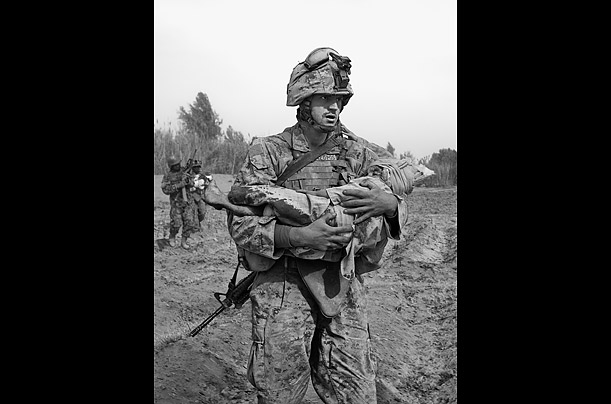
Across a dusty field, two U.S. Marines walk toward a helicopter, each carrying a bloodied and bandaged child. They hold the children as if they were their own. Although at this moment they appear as saviors, a few minutes earlier, they had called in air support in response to enemy fire. The shooter was among children, however (a fact that I have to believe was not known to the Marines), and two were seriously wounded by fragments from machine-gun rounds.
Innocent people are caught in the cross fire in all wars. That’s reality. The two Marines never signed up to hurt kids, and in the shock and confusion, their default reaction was to be protective of the children they indirectly had a hand in wounding. The kids were not left to die, as they might have been in another time and another place by other armies. Instead, a U.S. Army air-ambulance medevac crew was dispatched to fly them to the same medical facility that treats American casualties. If the shooter had survived, he too would have been helped.
The article in TIME Magazine contained some emotionally powerful pictures, such as the one below.
A Marine carries an Afghan child.
The full description of the photograph, taken by James Nachtwey for TIME , is Helping Hand A Marine carries an Afghan child, one of two wounded by coalition aircraft during an air support mission.
My reaction on reading the gruelling story was confused and difficult to articulate clearly but certainly not complimentary! Something along the lines of big and powerful nations, such as the USA, Russia and the United Kingdom, playing out their global strategies with no real insight into the pain and suffering caused by their big ‘war games’.
The second action was that Jean had returned a rental film to the local Blockbuster store and returned with another one that had caught her eye for us to watch on Sunday evening. That film was The Kite Runner based on the book of the same name by Khaled Hosseini.
There’s a good summary of the plot of the film at WikiPedia. Here’s a flavour.
In Kabul, prior to the Soviet invasion of Afghanistan, well-to-do young boy Amir and his loyal young Hazara servant Hassan are best of friends. Amir enjoys writing and literature, reading stories to the eager but illiterate Hassan. Amir’s Baba (father), is contemptuous of Amir’s writing and privately regards him as a weakling for letting Hassan protect him from bullies. Baba’s friend Rahim Khan demonstrates interest and encouragement to Amir. Assef, a bully with rancor towards Hazaras, and two accomplices confront Hassan and Amir, but Hassan prevents the attack with a slingshot, a birthday gift from Amir. Assef swears revenge, ridiculing their relationship as mere master and servant. .
Soon the Soviets invade Afghanistan; forcing Baba, a known anti-communist, to flee the country leaving Rahim Khan as property caretaker. En route to Pakistan, Baba bravely risks his life defending a female refugee from a Soviet soldier who demands to rape her in return for safe passage for all. Baba and Amir eventually reach the United States as humble refugees in Fremont, California. Baba tends a gas station while Amir attends community college and vends at a weekly flea market. There, Amir meets Soraya Taheri; Soraya is interested in Amir’s writing although her father, the ex-General Taheri, a proud traditional Pashtun, is contemptuous. Baba is stricken mortally ill but manages to obtain General Taheri’s permission for Amir to marry Soraya. Although Soraya feels bound to confess her previous relationships, they are happily married despite an inability to conceive children. As foreshadowed in the movie’s first scene, Amir’s debut novel is published, dedicated to Rahim Khan who encouraged his writing.
It was a fabulous film, one of the more thought-provoking films seen in many years. If you haven’t seen it, do so.
So to the point of this article.
The film demonstrated to me that my rather black-and-white opinion of the West’s involvement in Afghanistan was based much more on my instincts that ‘war is bad’ and that the USA tends to throw its military weight around, than having a clue as to the enormous complexities, both at the level of a family and of the nation, that these conflicts entail.
The film showed a much more compassionate aspect to the activities of the USA, specifically in getting involved in Afghanistan and, more generally, in a policy of offering a new home and new hope to those from afar.
And for me, the realisation that while it may be said, ‘There is only one truth’, knowing what that truth is is something very much more challenging!
“The first casualty when war comes is truth“. (Hiram W Johnson, senator for California, 1917)




 Learning from Dogs