Category: Morality

The long heist!

Suddenly, it all makes sense!

Washing one’s hands of the conflict between the powerful and the powerless means to side with the powerful, not to be neutral.” –Paulo Freire

Dear neighbours, Dordie and Bill, lent us a documentary video to watch on Sunday night.  It was called “HEIST: Who Stole the American Dream?

As the film’s website explains:

HEIST: Who Stole the American Dream? is stunning audiences across the globe as it traces the worldwide economic collapse to a 1971 secret memo entitled Attack on American Free Enterprise System. Written over 40 years ago by the future Supreme Court Justice Lewis Powell, at the behest of the US Chamber of Commerce, the 6-page memo, a free-market utopian treatise, called for a money fueled big business makeover of government through corporate control of the media, academia, the pulpit, arts and sciences and destruction of organized labor and consumer protection groups.

But Powell’s real “end game” was business control of law and politics. HEIST’s step by step detail exposes the systemic implementation of Powell’s memo by BOTH U.S. political parties culminating in the deregulation of industry, outsourcing of jobs and regressive taxation. All of which led us to the global financial crisis of 2008 and the continued dismantling of the American middle class. Today, politics is the playground of the rich and powerful, with no thought given to the hopes and dreams of ordinary Americans. No other film goes as deeply as HEIST in explaining the greatest wealth transfer of our time. Moving beyond the white noise of today’s polarizing media, HEIST provides viewers with a clear, concise and fact- based explanation of how we got into this mess, and what we need to do to restore our representative democracy.

It’s an incredibly interesting film, but more of that later.  For me, what was stunningly enlightening was at last understanding the powerful forces at work since Lewis Powell published ‘the memo’ back on August 23, 1971.  Because for me over in Britain, the era of the ’70s’ and ’80s’ were incredibly fulfilling.  First, as a salesman for IBM UK – Office Products Division, from 1970 through to 1978, and then forming and managing my own company through to 1986 when I succumbed to an attractive purchase offer.  Then, when my company was sold, taking a few years off cruising a sailboat in the Mediterranean; based out of Larnaca, Cyprus.

Thus I was immune to the global money and power plays, albeit enjoying rising house prices!  Only Lady Luck protected me from the collapse of 2008 in that I had sold my Devon home in early 2007 and was renting.  Then Lady Luck arranging for me to meet Jean in Mexico, Christmas 2007 (we were born 23 miles apart in London) and subsequently moving out to Mexico with Pharaoh in September, 2008, to be with Jean and all her dogs.  Lady Luck’s magic continued in that we came to Merlin, Oregon because we were able to take advantage of a bank-owned property; moving there in October, 2012.

Of course, the scale of the downturn was obvious and there were many instances of people that I knew losing jobs or homes, or both, and generally having a very rough time.

So back to the film.  Here’s the official trailer.

Uploaded on Feb 17, 2012

Please watch the newly updated trailer for “Heist: Who Stole the American Dream?,” the new, explosive documentary from Frances Causey and Donald Goldmacher exposing the roots of the American economic crisis and the destruction of the American dream. Visit www.Heist-TheMovie.com for more information on how to see the feature film and how to Take Action in restoring democracy and economic justice in the United States.

But here’s another thing that now makes sense: The legitimate anger of so many people, especially those who have some insight into what had been taking place.  No, amend that!  What is still taking place!

Just one example of that legitimate anger, that of Patrice Ayme. Just go across and read his blog post of two days ago: American Circus.

My strong recommendation is that you take an evening off and watch the film. Here’s another preview:

Frances Causey, Co-producer & co-director-Heist & Donald Goldmacher, Co-producer & co-director-Heist join Thom Hartmann. Corporate America is the biggest Welfare reciepient in the country – but that wasn’t always the case. The makers of Heist will tell you how organized money has been able to pull off the biggest “Heist” of the American Dream!

The film also concludes by offering many ways in which individuals can take back control of their lives, reinvigorate local communities, actively show that people-power is unstoppable. As it always has been and always will be.

This post started with a quote and I’m going to close with another.

The day the power of love overrules the love of power, the world will know peace.” -Mahatma Gandhi
Legitimate hope.

It’s too easy to be overwhelmed with negativity.

Many will have read yesterday’s post about the slaughter of elephants by ivory poachers and felt, as I did, a feeling of despair in the pit of one’s soul.  We seem to be living in such challenging times with so much madness about us.  It’s incredibly easy to feel as if this is some sort of ‘end of times’ period.

Today’s post tells us that there is always hope.

Let’s remind ourselves that elephants are very intelligent animals.  As I wrote last November in a post with the title of Smart Animals:

There was a fascinating article on the BBC news website a few weeks ago that went on to explain:

10 October 2013

Elephants ‘understand human gesture’

By Victoria GillScience reporter, BBC News
African elephants have demonstrated what appears to be an instinctive understanding of human gestures, according to UK scientists. In a series of tests, researcher Ann Smet, of the University of St Andrews, offered the animals a choice between two identical buckets, then pointed at the one containing a hidden treat.

From the first trial, the elephants chose the correct bucket.

The results are published in the journal Current Biology.

(The two video clips on the BBC website are really worth watching.)

A story published in the Daily Mail just a few days ago underlines the intelligence of elephants.

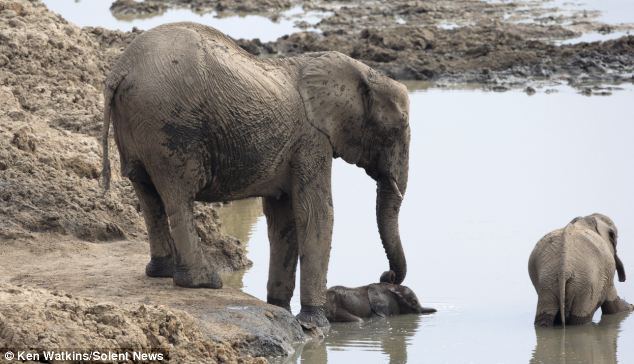
This adorable baby elephant had to be rescued by its mother’s huge trunk after it got stuck in the mud while taking a bath.

The youngster was enjoying a quiet dip in the water but became stranded when it struggled to pull itself out of the lake.

He had to be lifted to safety by its mother and her trusty trunk, which acted as a crane as she carried the three-month-old calf out of the water.

Stuck in the mud: The baby elephant slipped while taking a dip and was unable to haul himself out of the lake.

oooo

A mother's touch: Fortunately the calf's mother was able to scoop him up in her trunk and haul him to safety.
A mother’s touch: Fortunately the calf’s mother was able to scoop him up in her trunk and haul him to safety.

The rest of the story may be read here.

Also what needs to be highlighted are the organisations that are actively working on behalf of the elephants.

The Independent Newspaper have their own elephant campaign.

Elephant Crisis

In 2011, more African elephants were killed than any other year in history. The figures for 2012 and 2013 are not yet known, but are likely to be even higher. At current rates, in twelve years, there will be none left.

It is a familiar cause, but it has never been more urgent. Poaching has turned industrial. Armed militia fly in helicopters over jungle clearings, machine gunning down entire herds. Their tusks are then sold to fund war and terrorism throughout the continent and the wider world. Ivory is still illegal, but as China booms, it is more popular than ever.

This campaign will raise money to support rangers on the ground to protect Kenya’s elephants from armed poachers, together with Space for Giants’ longer term work to create new wildlife sanctuaries where elephants will be safe, forever. More can be found about the charity at Space for Giants

The article above includes two videos.  A shorter one that can be viewed on the paper’s campaign website. Then there is a longer, five-minute, video also on YouTube and included below.

Offering a donation to help is only a click away.

Then there is the David Sheldrick Wildlife Trust helping animals in Africa. And, finally, the campaign over at Bloody Ivory where one can sign a petition and donate towards stopping elephant poaching.

Thus, like so many aspects of life, never give up trying to help those less fortunate.

Without hope there is nothing.

Legitimate anger.

What a greedy, selfish race of people we can be at times!

I’m writing about the subject of elephants.  Or, to put it more precisely and distastefully, the murder of elephants. For the ivory in their tusks.

The post was prompted by a recent item over on Chris Snuggs’ blog Nemo Insula Est.  Chris and I have known each other for quite a few years now; since the time that he was Head of Studies at the French college, ISUGA, in Quimper, France and where I attended as a visiting teacher running a class on Sales & Marketing.

Chris has allowed me to republish the piece in full.  Please read today’s post and then come back tomorrow to see in what ways we can all help.

ooOOoo

The Human Shame in Northern Kenya

03JAN

One of my NYRs was to stop reading bad news, but that lasted about 6 hours ….. there is of course so much of it, and so much that is utterly depressing. One of the first of 2014 was an article in “The Independent”:

Elephant Appeal: Few are willing to say just how bad the poaching crisis is – the elephant population may easily fall into terminal decline

Tragic, to the extreme!

You can get all the details from the article – which is pretty harrowing, with surviving elephants described as being “stricken with grief” as they cluster round their slaughtered brethren – but basically, elephants in the Tsavo East National Park in Northern Kenya are under threat of extinction from poachers from Somalia. This provoked a number of reactions on my part:

DEMAND

  • The price of ivory depends on the demand and supply. The former is very strong and apparently rising, especially in China. For extraordinarily moronic and selfish reasons, ivory is considered artistic and – for example – tiger and rhinoceros parts medicinal and/or possessing aphrodysiac properties.
  • Can China really do NOTHING to stop this cultural abomination? People in the west for the most part stopped acquiring ivory years ago.
  • If China – and other Asia nations – cannot or will not do anything, should the west not apply more pressure? Same applies of course to China’s support of North Korea. YES, sanctions are painful, but nothing NON-painful is likely to work.

THE POACHERS

  • They are execrable, of course …… and yet, many may be extremely poor, and indeed ignorant. There is no excuse in the strictest sense, but it may to some extent be understandable if they see a chance to make several years’ normal income in a single day. This is no different from City bankers, or indeed the Enron directors and many others: greed is sadly rampant on our planet.
  • But  the poachers are not only ignorant and destitute farmers: terrorists are now apparently turning to the ivory trade, too.
  • There are insufficient funds to patrol the parks properly. Kenya is just one more corrupt African state where politicians earn a fortune while basic needs and services are severely underfunded.

MORALITY

I always wonder what if anything goes through the minds of those who spend these obscene sums on frippery and personal self-glorification. Do they ever think that their money could do immense good elsewhere? Would WE be just the same in their shoes?

Is there any solution to this greed?

ooOOoo

Chris wrote his post motivated by the article in The Independent UK newspaper.  But that newspaper was not alone in promulgating the despicable killings of these smart and magnificent creatures.  Here’s a story that was in the UK Daily Telegraph newspaper a year ago.

Horror as entire family of elephants slaughtered for ivory

Armed wildlife rangers on Tuesday night fanned out across eastern Kenya in pursuit of ivory poachers who killed an entire family of 12 elephants in the country’s worst single such slaughter since the 1980s.

By , Nairobi

5:26PM GMT 08 Jan 2013

Eleven adults and one infant calf died in a “targeted and efficient” attack highlighting the growing professionalism of poachers bankrolled by international criminals supplying soaring demand for ivory in the Far East.

Six of the animals lay in one heap, their tusks hacked out with machetes.

None of the family group managed to flee further than 300 yards before they were gunned down and their ivory removed.

The calf, less than a year old, is believed to have been crushed by its dying mother as she fell to the ground.

“It is unimaginable, a heinous, heinous crime,” said Paul Udoto, spokesman for the Kenya Wildlife Service (KWS).

“We have not seen such an incident in recent memory, it’s the worst single loss that we have on record, and our records go back almost 30 years.

“These were professional killers. The attack was targeted and efficient.”

The poachers, armed with automatic rifles, had already fled but there were hopes last night that a massive search involving foot patrols, a dozen vehicles and three aircraft could still find them.

“Every possible resource is being deployed to track down these criminals,” Mr Udoto said. “They will feel the full force of the law.”

But the area where the elephants were killed, in the north of Kenya’s largest wildlife reserve, Tsavo East National Park, is sparsely populated, has few roads, and lies close to Kenya’s border with Somalia.

Privately, conservationists said they feared the poachers and their haul of 22 tusks, worth an estimated GBP175,000 on the Asian market, would already have escaped.

The attack was the latest in a surge of elephant deaths that has seen the number of the animals killed for their ivory in Kenya increase sevenfold in five years, from fewer than 50 in 2007 to 360 in 2012, according to KWS figures.

The increase has led many wildlife experts to declare the current situation a crisis worse even than the mass slaughter of Africa’s elephants in the 1970s and 1980s, which led to a global ivory trade ban in 1989.

I don’t have permission to republish the article so please go here and read the full piece and view a couple of harrowing photographs.

Then come back tomorrow and explore how you and I can do something to help. Please.

Footnotes.

Where we are today?

On New Year’s Day I published the first part of a film called Awakening the Dreamer: Changing the Dream.  Then yesterday came the second part.  I found it a remarkable film.  Because, while the first part reminded the viewer of the list, the long list, of things that are wrong with these present times, the second part highlighted the many currents of positive changes that are taking place here and now.

Without hope there is nothing.

The film is available to watch on Top Documentary Films and here is the introduction offered in that place.

Of all the innumerable beliefs and hypotheses that make up our contemporary industrial perspective on life there is one that is dominant and very frequent. That’s the assumption that we are disconnected, from everyone and everything. This belief configures basically all our ideas and actions. There’s a crucial fallacy that we are separate. But, if there is only one, then whatever I do to you I’m actually doing it to myself, my family, and my children.

Spiritual attitude has long instructed that partition is actually an illusion. However, in the past, the narrative that’s been exchanged in the modern world, whether consciously or unconsciously, has been that the world functions like a huge machine made of separate parts like a big clock. For the past four centuries, the scientific established practice has been trying to take the clock apart, and figure out how it functions, so we can use it for our own ambitions.

This rigid aspect meant that instead of realizing the relation between things, we were analyzing and taking apart those very same things. So, what developed was kind of disintegrated view of the natural world. And we became entranced with the ability that came out of this technology, and we lost our relations to each other; we lost our connection to the enigma of the cosmos.

Although the modern worldview is superior on Earth, it’s valuable to identify that it’s not the only worldview. Traditional, native cultures are not so concentrated on “advancement”, rather they’re focused on their health and persistence of the community, and they see the interdependence of all things. They try to recognize that we’re related to everything… to the animals, fish, plants, trees, birds, and even to the microorganisms. Indigenous people of the world have a particularly important role to play at this moment in history. We need them to come forward and explain how they see things.

The film was produced by the Pachama Alliance, an organisation I hadn’t come across before.  Their website is here and on the About page one learns:

Purpose

The Pachamama Alliance, empowered by our partnership with indigenous people, is dedicated to bringing forth an environmentally sustainable, spiritually fulfilling, socially just human presence on this planet.   Our unique contribution is to generate, and engage people everywhere in, transformational conversations and experiences consistent with this purpose. We weave together indigenous and modern worldviews such that human beings are in touch with their dignity and are ennobled by the magnificence, mystery and opportunity of what is possible for humanity at this time.   We are here to inspire and galvanize the human family to generate a critical mass of conscious commitment to a thriving, just and sustainable way of life on Earth. This is a commitment to transforming human systems and structures that separate us, and to transforming our relationships with ourselves, with one another, and with the natural world.

If you have read this post so far, then you will enjoy this video. More than enjoy it; you will find it inspiring and liberating.

Another organisation mentioned in the film was Bioneers, also not previously known to me.  Their website is here. The organisation describes itself, in part:

Collective Heritage Institute – Bioneers is a non-profit New Mexico corporation founded in 1990 by Kenny Ausubel and Nina Simons. The overarching mission of Bioneers is the advancement of holistic education pertaining to global social, cultural and environmental issues. Bioneers identifies progressive yet nature-honoring solutions to rising challenges of instability, inequality, and unsustainable growth and disseminates this knowledge via independent media, events, and community action networks.

There is much on these two websites to offer hope.

Approaching the New Year!

Part One of reflections on where we are today.

Depending on just where in the world you are, the New Year of 2014 is anything from a few to twenty-four hours away.  How that year turns out will, to a very great extent, depend on millions and millions of behaviours.  In other words, the behavioural choices each of us makes. Because, as millions of us already understand, our world on this, our only, Planet is facing changes potentially beyond our imagination.  Caring for our Planet and all of life upon it is meaningless without those behavioural choices being the right ones for our Planet.

A couple of days ago, I read the following on Facebook.  It seemed an appropriate tale for the start of 2014.

ooOOoo

Now what?
Now what?

One day a farmer’s donkey fell down into a well. The animal cried piteously for hours as the farmer tried to figure out what to do. Finally, he decided the animal was old and the well needed to be covered up anyway; it just wasn’t worth it to retrieve the donkey.

He invited all his neighbors to come over and help him. They all grabbed a shovel and began to shovel dirt into the well. At first, the donkey realized what was happening and cried horribly. Then, to everyone’s amazement he quieted down.

A few shovel loads later, the farmer finally looked down the well. He was astonished at what he saw. With each shovel of dirt that hit his back, the donkey was doing something amazing. He would shake it off and take a step up.

As the farmer’s neighbors continued to shovel dirt on top of the animal, he would shake it off and take a step up. Pretty soon, everyone was amazed as the donkey stepped up over the edge of the well and happily trotted off!

MORAL :

Life is going to shovel dirt on you, all kinds of dirt. The trick to getting out of the well is to shake it off and take a step up. Each of our troubles is a steppingstone. We can get out of the deepest wells just by not stopping, never giving up! Shake it off and take a step up.

Remember the five simple rules to be happy:

  1. Free your heart from hatred – Forgive.
  2. Free your mind from worries – Most never happens.
  3. Live simply and appreciate what you have.
  4. Give more.
  5. Expect less from people but more from yourself.

You have two choices … smile and close this page, or pass this along to someone else to share the lesson.

ooOOoo

Part Two of these reflections is tomorrow.

A very Happy New Year to you.

The trials of Steve Marsh

This is worthy of support.

Some seven days ago, there was an item on Permaculture News about Steve Marsh’s fight with Monsanto.  Here is that article in full.  I strongly recommend watching the longer video at the end of the post.  It’s an incredibly important issue for all lovers of healthy food.

ooOOoo

Help This Farmer Stop Monsanto’s GM Canola

Posted December 20, 2013 by  & filed under GMOs.

You might not have heard of Steve Marsh yet but this man could lose everything to protect your right to eat GM-free food.

Who is Steve Marsh?

Steve Marsh is an Australian farmer who lost his organic certification when Monsanto’s genetically modified (GM) canola blew onto his farm from a neighbouring property in 2010. Since then, Steve lost most of his income and has been struggling to get his organic certification back.

Monsanto has a no liability agreement with GM farmers that prevent them from being sued. The only avenue Steve had to protect his livelihood was to take his neighbour to court. It is due to start on the 10th February 2014 in the Western Australian Supreme Court and is scheduled to run for three weeks.

Donate Now to Support Steve!

A landmark case for a GM-free future

This is the world’s first case of an organic farmer using the courts to recover loss and damages from a GM farmer. This case has been described as a landmark case to determine who should take responsibility in case of GM contamination. If Steve wins it will set a precedent to guide the application of common law to GM contamination and will be of interest to lawmakers worldwide.

We don’t want to be part of the global GM experiment underway with barely tested, unlabeled and uncontrolled GM foods infiltrating our food supplies. When people like Steve stand up for their rights in spite of what he may lose, it gives us a chance to stand alongside him.

Take action!

Steve’s neighbour is well supported and well funded by a pro-GM organization and we are helping to raise funds and awareness for Steve’s case.

Have a look at the short video above explaining his story and share it with friends, family and work colleagues. Please make a donation to support this landmark case and protect the future of GM-free food.

Donate Now to Support Steve!

ooOOoo

Jean and I have made a donation.  We hope you can find your way to supporting this campaign.

This is the longer version of that video above.

Animal rights.

This cougar was looking for love.

I forget how I came across this editorial in the Chicago Tribune but it was published a month ago, to the day.  What is more to the point is that the editorial was inspiring and I vowed to republish it.  With the absence of any formal permission to republish the editorial I thought it best to leave it for a few weeks.  When you read it you will realise just why it needed to be shared with you.

ooOOoo

Editorial: The cougar killed in Illinois was looking for love

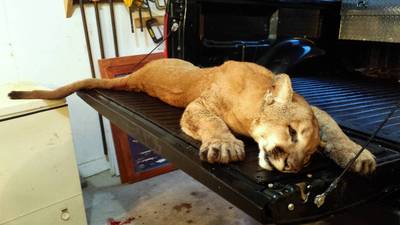
ILLINOIS DEPARTMENT OF NATURAL RESOURCESThis cougar was shot last week by a state conservation officer in Whiteside County. The animal needn’t really have been killed.
ILLINOIS DEPARTMENT OF NATURAL RESOURCES.
This cougar was shot last week by a state conservation officer in Whiteside County. The animal needn’t really have been killed.

He was lean, athletic and had traveled hundreds of miles, most likely from the Black Hills of southwestern South Dakota. He had attacked no one as he passed hundreds of towns and many more farms, each of them a lethal threat to his mission. Yet for lack of a better wildlife management plan in Illinois, the young cougar couldn’t get past a conservation officer armed with a state-issued rifle.

The necropsy says the cougar killed last week as he hid near Morrison, 130 miles west of Chicago, died of gunfire. In truth he died of official neglect: Even though more cougars and possibly wolves likely will be visiting Illinois, state lawmakers and the Department of Natural Resources haven’t forged policies that could allow the tranquilization, capture and survival of animals whose ancestors blissfully roamed the Midwest long before humans intruded on their turf.

Given his hunting skills, the young male could have homesteaded anywhere in the Upper Midwest and dined on the bountiful deer population for the rest of his life. Instead, his four huge paws carried out the imperative that drove him: With larger, older males driving him away from the females on their home ranges, this cougar came looking for love.

A farmer called authorities to report a large cat running from a cornfield toward his farmstead and, sure enough, a responding conservation officer found the cat under a corncrib, probably hiding until darkness would allow it to flee.

We won’t second-guess the officer, who consulted with law enforcement and wildlife personnel before killing the cougar. That said, this was an outcome that didn’t have to be. A magnificent creature might well be headed back to South Dakota if Illinois had learned lessons after Chicago police shot and killed a cornered cougar in the Roscoe Village neighborhood five years ago.

What all of us, legislators included, have to understand is that the return of feline or canine predators to their traditional realms doesn’t mean the animals want to hurt anyone. Even as this episode unfolded, millions of National Geographic readers were receiving the magazine’s December issue, with an 18-page spread: “Ghost Cats … Cougars are quietly reclaiming lost ground.” The relevant passage: “Cougars have attacked humans on about 145 occasions in the U.S. and Canada since 1890. Just over 20 of those assaults — an average of one every six years — proved fatal.”

Yet in this case, with an animal that had threatened no one while bypassing thousands of Midwesterners, a DNR spokesman rationalized that, “Public safety is what we’ll make the decision on every time.” The rest of DNR’s explanation is similarly lame: The department otherwise would have had to find someone to capture and move the animal. This officer thought the situation too unsafe to call a veterinarian to tranquilize the cat. Conservation officers don’t carry tranquilizer guns. That thinking led the DNR to the specious excuse that if the officer had shot the cougar with the wrong dosage of tranquilizer, the animal could have been harmed or killed accidentally. That excuse evokes the February 1968 explanation from a U.S. major to an Associated Press correspondent about the Vietnamese provincial city of Ben Tre: “It became necessary to destroy the town to save it.”

We were struck by sensible comments last week from Bruce Patterson, curator of mammals at Chicago’s Field Museum, who wonders why this animal had to be shot when it evidently was hiding during daylight and hadn’t threatened anyone: “It’s possible to manage wildlife while still keeping it around.”

When we editorialize about humans slaying wild predators, some readers say our concern should be — as it constantly is — directed instead to the needless killings of young people, and not toward one lost, probably frightened animal.

Fair enough, although it’s possible to think about both. Just as we know there will be more homicides, we know that more big predators likely are coming to Illinois. So we’ll look back to what we expressed after the 2008 killing of the cougar in Roscoe Village: We hope Illinois comes away from last week’s episode with more than one dead cougar and a communal sadness. Illinois should develop a reliable protocol that errs on the side of trying to preserve the life of the lost animal — not of making the ad hoc decision to kill it and then resolving the ambiguities in favor of that decision.

That’s what happened here. A logical first step now: Give cougars protection under the Illinois Wildlife Code; they lack that protection now only because there is no known breeding population in this state. But with trail cameras capturing photos of one or more cougars in Jo Daviess, Morgan, Pike and Calhoun counties last fall, the animals evidently are re-establishing themselves in a state where they haven’t been known to live since 1870. In recent years, wolves have dipped into Jo Daviess, the state’s northwest corner. A black bear even visited there, evidently for a few days.

Lawmakers, DNR officials, you can do better. So can the rest of us, first by using sites such as cougarnet.org to offset our visceral fear with scientific knowledge.

Wild animals roam this state. Always have and, we hope, always will. As we urged here in 2008: The same Illinois that was unprepared for the last cougar had better get ready for the next. He’s probably en route.

ooOOoo

As you contemplate your New Year resolutions for 2014 please resolve to protect our animals.

Words fail me!

But there is a very good ending!

There was an item in a recent set of links from Naked Capitalism that caught my eye.

It was a link to a story on Huffington Post that I am taking the liberty of republishing.

ooOOoo

Left To Die In A Trash Heap, Abandoned Dog Gets Remarkable Second Chance

The Huffington Post  |  By  Posted: 12/13/2013 5:19 pm EST

A moving video of the extraordinary recovery — and resilience — of an abandoned dog who was left to die in a trash heap is reminding us this week of the healing power of love, friendship and second chances.

On Nov. 15, when Eldad Hagar first laid eyes on Miley, an abandoned dog living among piles of trash on the outskirts of Los Angeles, his heart broke.

“When I got there, I almost couldn’t believe what I was seeing,” Hagar, the co-founder of animal rescue organization Hope For Paws, told The Huffington Post of his first encounter with the pup. “It’s almost as if this place was struck by a tsunami.”

Miley, covered in mange and infections, was so lifeless and defeated that Hagar, who recorded the dog’s rescue on camera, says she “didn’t even have the energy” to run away from him as he approached her.

Mileytrash1

Hagar says he rushed to Miley’s side after he heard about the pooch’s plight from a local resident. The tipster told him that Miley had been living in the trash heap for at least a few months. It is believed that she was abandoned by her owners.

Though he knew that Miley wouldn’t be in good shape, Hagar says he was still shocked when he finally made contact with her. Her physical deterioration was “definitely one of the worst cases” he’d ever seen, he said.

He knew he had to get Miley to a hospital right away.

Gaining the pup’s trust was no easy feat, however. Hagar says he offered her food and sat with her in the pile of trash for an hour before she was finally ready to leave with him. Then he got her into his car to be brought to the vet.

“She was very lucky we rescued her when we did, because her condition would have continued to deteriorate until she would have died a miserable and painful death,” Hagar said.

After examining Miley, veterinarian Dr. Lisa Youn discovered that the pooch wasn’t just suffering from mange and bacterial infections, but parasites and malnutrition, as well.

“She was in so much pain,” Hagar said.

Mileytrash2

Over the next two weeks, Miley got intensive medical care and was treated with antibiotics, medicine for parasites and frequent medicated baths. Slowly but surely, her spirits began to lift.

It wasn’t, however, until Miley found a best friend that her recovery took a dramatic turn for the better.

Miley met Frankie the chihuahua after he was rescued from a sewer tunnel by Hagar and a friend. The tiny dog had almost drowned, Hagar said, because of a spell of heavy rain.

“He was so scared of everything,” Hagar wrote of Frankie in the video. “Miley took Frankie under her wing and they quickly became really good friends.”

Mileytrash3

Miley and Frankie, who are wonderfully affectionate with each other, are said to be doing well.

The “worst part is behind [them],” Hagar told the HuffPost, adding that Miley should be “100 percent” in a few months.

Watch the adorable duo playing with each other in the video above. To find out more about the work that Hope For Paws does, visit the organization’s website andFacebook page.

ooOOoo

That first YouTube video also had the following comment:

Published on Dec 12, 2013

Please make a small donation to Hope For Paws and help us start 2014 strong with many more rescues. A $5 donation from many people would make all the difference to so many animals: HopeForPaws.org
Hope For Paws took care of Miley’s vet care, but she is now fostered by our friends from The Fuzzy Pet Foundation. Please visit their website to fill an application to adopt her: fuzzyrescue.org
Little guest star – Frankie was also rescued by Hope For Paws (with help from Lisa Chiarelli), and is now being fostered by our friends from The Forgotten Dog Foundation. If you would like to adopt him, please fill an application here: theforgottendog.org
Thanks 🙂
Eldad

The Hope For Paws website is here.  Please, please make a small Christmas donation.  It makes such a difference.  Chapter Twenty-Three of The Book comes out in thirty minutes and, I hope, goes a long way to demonstrate the value of our relationship with dogs over thousands upon thousands of years.

The loss of self?

Trying to find a balance in these strange times.

I wrote down the title of today’s post a few days back.  Jean and I had just watched the BBC Panorama Special regarding Amazon UK.  It had been screened on the 25th November and was described:

It’s the online retailer that has transformed the way we shop, but how does Amazon treat the workers who retrieve our orders? Working conditions in the company’s giant warehouses have been condemned by unions as among the worst in Britain. Panorama goes undercover to find out what happens after we fill our online shopping basket.

Or more fully reported in a BBC News item, as this extract reveals:

A BBC investigation into a UK-based Amazon warehouse has found conditions that a stress expert said could cause “mental and physical illness”.

Prof Michael Marmot was shown secret filming of night shifts involving up to 11 miles of walking – where an undercover worker was expected to collect orders every 33 seconds.

It comes as the company employs 15,000 extra staff to cater for Christmas.

Amazon said in a statement worker safety was its “number one priority”.

Undercover reporter Adam Littler, 23, got an agency job at Amazon’s Swansea warehouse. He took a hidden camera inside for BBC Panorama to record what happened on his shifts.

He was employed as a “picker”, collecting orders from 800,000 sq ft of storage.

A handset told him what to collect and put on his trolley. It allotted him a set number of seconds to find each product and counted down. If he made a mistake the scanner beeped.

Adam Little undercover Amazon warehouse
Adam Littler went undercover as a “picker” at Amazon’s Swansea warehouse

“We are machines, we are robots, we plug our scanner in, we’re holding it, but we might as well be plugging it into ourselves”, he said.

The 30-minute Panorama programme is on YouTube and is included in this post just below.

http://www.youtube.com/watch?v=Ta7hTfI69xc

OK, back to my theme for today.

As I started to explain, the reaction to watching the Panorama programme was to feel sickened by the way these workers were being treated.

Not helped when yesterday, the UK Daily Mail newspaper added their own story of another undercover reporting operation at Amazon.   Here’s an extract from the last third of the piece, reported by Carole Cadwalladr:

It is taxes, of course, that pay for the roads on which Amazon’s delivery trucks drive, and the schools in which its employees are educated.

Taxes that all its workers pay, and that, it emerged in 2012, Amazon tends not to pay.

On UK sales of £4.2 billion in 2012, it paid £3.2 million in corporation tax. In 2006, it transferred its UK business to Luxembourg and reclassified its UK operation as simply an ‘order fulfilment’ business.

The Luxembourg office employs 380 people. The UK operation employs 21,000. You do the sums.

Brad Stone tells me that tax avoidance is built into the company’s DNA. From the very beginning it has been ‘constitutionally oriented to securing every possible advantage for its customers, setting the lowest possible prices, taking advantage of every known tax loophole or creating new ones’.

In Swansea I chat to someone called Martin for a while. It’s Saturday, the sun is shining and the warehouse has gone quiet. The orders have been turned off like a tap.

‘It’s the weather,’ he says. ‘When it rains, it can suddenly go mental.’ We clear away boxes and the tax issue comes up.

‘There was a lot of anger here,’ he says. ‘People were very bitter about it. But I’d always say to them: “If someone told you that you could pay less tax, do you honestly think you would volunteer to pay more?”’

He’s right. And the people who were angry were also right. It’s an unignorable fact of modern life that, as Stuart Roper of Manchester Business School tells me, ‘some of these big brands are more powerful than governments. They’re wealthier. If they were countries, they would be pretty large economies.

‘They’re multinational and the global financial situation allows them to ship money all over the world. And the Government is so desperate for jobs that it has given away large elements of control.’

MPs like to attack Amazon and Starbucks and Google for not paying their taxes, but they’ve yet to actually create legislation compelling them to do so.

Then if that wasn’t sufficient to make me want to live on a desert island, along comes George Monbiot pointing out that even the BBC, to me the most respected and trusted news organisation on the planet, has been economical with the truth.

The BBC’s disgraceful failure to reveal who its contributors are speaking for.

By George Monbiot, published on the Guardian’s website 29th November 2013

Do the BBC’s editorial guidelines count for anything? I ask because it disregards them every day, by failing to reveal the commercial interests of its contributors.

Let me give you an example. Yesterday the Today programme covered the plain packaging of cigarettes. It interviewed Mark Littlewood, director-general of the Institute of Economic Affairs, an organisation which calls itself a thinktank.

Mishal Husain introduced Mark Littlewood as “the director of the Institute of Economic Affairs, and a smoker himself”.

Fine. But should we not also have been informed that the Institute of Economic Affairs receives funding from tobacco companies?

It’s bad enough when the BBC interviews people about issues of great importance to corporations when it has no idea whether or not they are funded by those companies, and makes no effort to find out.

It’s even worse when those interests have already been exposed, yet the BBC still fails to mention them.

Both the Institute of Economic Affairs and the Adam Smith Institute have for years been funded by tobacco firms. The IEA has been funded by British American Tobacco since 1963, and is also paid by Philip Morris and Japan Tobacco International. It has never come clean about this funding, and still refuses to say which other corporations sponsor it.

The power of self.

Then along came three items that pulled my back from the brink of despair and disgust.

The first came from the blog of the UK’s Transition Network, Transition Times. Rob Hopkins wrote an article on December 5th called The day I closed my Amazon account.  Please read it if you feel unsettled by the Amazon situation.  The last two paragraphs are:

Me, I resolve to buy less, but better.  Less, but longer-lasting.  Less, but local.  The thought of where we will end up in 5 years time, 10 years time, 20 years time, if companies like Amazon continue as they are, really frightens me. It’s not good, it’s not right.  It’s not about our needs, it’s about the needs of huge investors.  I want a different world for my boys.

I can’t, on my own, do that much about it.  I can’t insist that the UK government legislate so that, as in Holland, the Recommended Retail Price (RRP) is the legal minimum at which any book can be sold, although I think that is grounds for a really timely campaign.  Because of that, Amazon don’t really operate in Holland.  Bring back the RRP for books here, and let’s have a level playing field.  As I say, I can’t do much, but I can withdraw my support. I just have withdrawn my support.  It feels surprisingly unsettling, as one does after ending a relationship, but it was the right thing to do.  It may be a drop in the ocean, but if enough people do it….

The second was coming across something called The Restart Project in London.  I had never heard of them before.  But it gets better because these London folk are part of a global movement.  Which in the words of The Restart Project can be explained thus:

A spontaneous, global, grassroots repair movement

Sitting in London, we at The Restart Project have been inspired by Holland, the US, Australia, and now we realize that there are many more community repair and fixit groups than we ever knew of before… Milan, Barcelona, Finland, the list just grows.

Some groups have regular events in their own spaces and some are pop-up groups.

The most remarkable thing is that we are not just all doing similar things, we are doing them in the same way and with similar motivations

1) learning, skillsharing and community are a premium. No judgment. Openness and inclusivity, all are made to feel welcome.

2) the idea is NOT a freebie fix. The idea is that people get involved in the repair, taking responsibility for their stuff and taking back control. It’s about behaviour change, not just about waste prevention

and

3) importantly – fun!

Please help us map repair groups, to connect people to their local repair gurus and fixit friends – and who knows, inspire the creation of more.

“Just repair, don’t despair!”

Just repair, don’t despair!  That shouted out at me.  The more that the world we live in is consumed by the power-brokers and greed-mongers.  The more that our traditional view of politics is seen to be out-dated and incorrect, then the more we have do within our own lives, within our own communities and with our friends, loved ones and families to show we can repair our world a darn site quicker than the ‘dark forces’ can break it.

My third example of hope is tomorrow in a post called The power of self.