Category: Morality

The book! Embracing death

Not forgetting:

And shows us the way to embrace death

I’m sure that the human psyche lives in a bubble of delusion. Not always and not extremely so; of course. Clearly, if the level of delusion were abnormal then we couldn’t function properly as social animals. However, just take a quiet moment of self-reflection to muse over the ways that you ‘shelter’ from reality. In directing that last point to you, dear reader, trust me I don’t exclude myself!

There are times when going beyond the self, going out of oneself, is the only way to see the reality of who we are and the world around us; to be able to brush away our delusions. Perfectly expressed by the author, Aldous Huxley: “Experience is not what happens to you; it’s what you do with what happens to you.” Wise words, indeed!

But these fine expressions representing the peak of common sense have one grinding, searing fault. They do not assume the end of a person’s life. I am speaking of death, of the inevitability of our death! That largely unspoken truth no better expressed than through the words[1] of Sharon Salzberg in her book Faith.

What does it mean to be born in a human body, vulnerable and helpless, then to grow old, get sick and die, whether we like it or not?

Anyone who has lost a loved one knows that it is tough; incredibly tough. It is full of pain and anguish amidst a great churning of emotions, all in a very deep-seated and personal manner. That’s the perspective from the loved ones left behind with more life ahead of them. But if one thinks of it in reverse, turns it on its head, what are our fundamental wishes with respect to those we love; what we would want to leave behind when we die?

Fond memories, naturally, but they wouldn’t be our fundamental wishes. This is what those fundamental wishes would be. That our death does not leave pain and anguish in the hearts and souls of those left behind. That it doesn’t leave a pain that cannot be dealt with in a healthy way. Our wishes would be that those whom we loved and who loved us may embrace their loss and move on.

Anyone who has loved a dog has most likely been intimately involved in the end of that dog’s life. It is, to my mind, the ultimate lesson that dogs offer us: how to be at peace when we die and how to leave that peace blowing through the hearts of all the people who loved us.

Our beloved dogs have much shorter life spans than we do, thus almost everyone who has loved a dog will have had to say goodbye to that gorgeous friend at some point in their lives. Very sadly, perhaps, saying goodbye to more than one loved dog.

I see the most precious of parallels in the tragic death of a loved dog and our own death. The parallel between coping with our grief for the loss of a loved dog and reaching out to our loved ones so that they may cope with their grief at losing us.
In other words, knowing what to expect in emotional terms at the loss of our loved dog is helpful, very much so, to us helping our loved ones when comes our time to die.

There are five stages of mourning[2], of dealing with our grief, when we lose our beloved dog: Denial; Anger; Guilt; Depression and Acceptance.

Compare those stages to the five stages of mourning[3], perhaps of dealing with the knowledge that oneself is dying, or a person is dying who is very emotionally close to us. Those five stages are: Denial and Isolation; Anger; Bargaining; Depression and Acceptance.

The parallels are almost perfect.

Whether it is the impending or actual death of a loved dog, a loved person, or ourselves, the similarities between embracing the loss of the loved dog, or the loved person, are powerfully obvious. So, too, are the many different ways each of us embraces the death of a loved dog or a loved person. Let me expand on this last point.

Namely, that each of us will experience each stage of mourning at varying levels of intensity, for varying lengths of time, and sometimes in a different order. Some of the stages may converge and overlap each other. But however you experience the mourning, it is incredibly important to remember that your feelings are completely normal.

As the website of the American Animal Hospital Association points out, on their webpage entitled Life after Dog[4], “… we almost always outlive our beloved companions. Learning to live with loss is an essential part of life.”

That webpage imploring us to honour our emotions, to honour the memory of our dog, and critically, when a child is involved, to help that child cope with the loss of their loved dog. For all, young and old, helping to ease the pain through learning to cope with the loss. Easing the pain through changing one’s schedule, moving furnishings around to help distance the memory of your dog’s favourite sleeping spots, or creating a memorial in one form or another, even writing a letter (or blog post!) to your dog in which one describes all the feelings you have for your recently departed, loved dog.

I was born in 1944. I am therefore the ‘wrong’ side of seventy years old. I was born an Englishman and, according to life expectancy tables from 2012, a male Englishman’s life expectancy is 79.5 years. I am living happily in the USA and, according to those same tables, a male American’s life expectancy is 77.4 years. My mother is alive and an amazingly fit and healthy ninety-five-year-old, at the time of writing this book. My father died at the age of 56 just 5 days before Christmas in 1956. I do not believe in any form of spiritual life after death.

So take your pick!

All that I do know is that loving our dogs, welcoming all the wonderful qualities that our dogs possess, striving always to live peacefully ‘in the present’, just as our dogs do, and, ultimately, as with our faithful companions, taking that last breath in the knowledge that ours was a beautiful life, is what learning from dogs is all about.

Thank you.

1,059 words. Copyright © 2014 Paul Handover

[1] page 34.
[2] http://dogtime.com/dealing-with-grief-of-loss-aaha.html#
[3] http://psychcentral.com/lib/the-5-stages-of-loss-and-grief/000617
[4] http://www.aahanet.org/blog/petsmatter/post/2014/05/20/929363/Life-after-dog-Support-and-resources-on-pet-loss.aspx

A hug never goes amiss!

The many joys of a connected world. As I wrote that sub-heading above, it struck me that the virtual world of blogging partially mimics the real world of life, as in that in nature everything is connected.  To say that everything is connected in the world of blogging is rather far-fetched, but (and you knew there was a ‘but’ coming, didn’t you) there is no question that bloggers tend to gravitate towards other bloggers where there is some sense of resonance. All of which could have been said in far fewer than the eighty-one words above! Try like-minded tend to be drawn to each other! So whether it’s in ten words or eighty-one words, it’s a preamble to the wonderful words of another blogger. I’m referring to the blog Wibble that is authored by Pendantry. Mr. P (and I’m assuming it is a ‘he’) wrote a post for the recent Earth Hug Day on December 12th. I thought it would make a nice republication this last Friday before the Winter solstice in the Northern Hemisphere this coming Sunday.

ooOOoo

Who needs a hug? earth-hug-12dec2014-350x247

Earth hug day‘: 12 December 2014.

who has supported you all your life without asking for anything in return? fresh air, clear water, food, stability and unconditional love… the earth provides. the earth cares. the earth loves!

it’s about time we love her back again… every day – every moment… and with a huge collective earth hug right around the planet!

throw yourself on the ground and hug the earth! run to a tree and hug the earth! put your arms around each other and hug the earth!

hug the earth ♥ share the love

http://www.youtube.com/watch?v=P2vjdE0EgIQ You don’t have to understand what they’re saying — the meaning is clear.

ooOOoo

Our dear, wonderful Planet Earth.

The Book! Part Five: Adaptability.

Thanks to the wonders of the modern dictionary, I am able to understand that about two-hundred years ago, sometime around 1790 to 1800, the word ‘able’ that I just used was added to the word ‘adapt’ to make the word ‘adaptable’. I read that the word is an adjective and that from that comes a related word, a noun: adaptability. That same dictionary informs me that the meaning of adaptability is: “capable of being adapted” or “able to adjust oneself readily to different conditions: an adaptable person.

Now I would be the first to accept that the history of man, the long history of man, reveals a species, namely us, that is incredibly adaptable. Yet, (and you knew there was a ‘yet’ coming!) my sense of how adaptable any one person might be is inextricably wound up with change, and change is often a bitter fruit to taste.

You may recall that I closed the chapter on The process of change, in Part Four, with a snippet quotation from the film Interstellar: “We all want to protect the world, but we don’t want to change.”

That sentiment could be applied to so many aspects of our lives, especially to any form of change that heralded perceived uncertainty, or potential vulnerability; indeed anything that might be regarded as taking us outside our ‘comfort zone’. Granted not everyone, all of the time, yet not no-one at any one time.

Dogs, just like us humans, love routines. However, what strikes me from having lived for a number of years with a great many dogs in the home, variously from sixteen to the nine we have at present[1], is how amazingly easily a dog will adapt to new circumstances, both temporary and long-term changed circumstances.

Somewhere in my research, and I regret not being able to quote the reference, I came across a review of the author Jean Donaldson[2], in connection with her book Culture Clash. This book has shaped modern thinking about the behaviour of dogs and the relationship between dogs and humans.

The reviewer, in discussing the adaptability of dogs, proposes, “Maybe it’s the simple way they view their world. Each thing in their lives seems to fall neatly into its place in their world view. Things to seek out, things to avoid, things to keep, and things to leave behind.

Then a couple of sentences later, the reviewer adding: “I would guess that scavengers need that kind of mind set. Take it as it comes, deal with it, and move on. Dogs seem to have developed a sense of adaptation. They see what needs to be done and simply find a way to do it no matter what the impediments might be.

That last sentence describes an attitude towards adaptability that, in my opinion, would be very rare to find in a person.

I am going to devote the balance of this chapter to a true story. The true story about an Akita breed of dog that lived with its owner in Tokyo back in the first quarter of the 20th century. I included this account, despite the main theme of the story being about the extreme loyalty of the dog, because the dog’s ability to adapt is equally as impressive.

In 1924, Hidesaburō Ueno, a professor in the agriculture department at the University of Tokyo took in an Akita breed of dog as a pet and named him Hachikō. During his owner’s life, Hachikō not only saw Professor Ueno come out from the front door each morning but quickly learned to greet him at the end of the day by going to the nearby Shibuya Station. Hachikō continued this daily routine of going to the station until a day in May 1925, when that evening Professor Ueno did not return on his usual train. The reason being that the professor had suffered a cerebral haemorrhage at the university that day, had died and, therefore, never returned to the train station where his doggy friend was waiting.

Kind persons found Hachikō another home after his master’s death but he routinely escaped, showing up again and again at his old home. Eventually, Hachikō in some doggie manner realised that his master, Professor Ueno, clearly no longer lived at the house. So Hachikō went to look for his master at the train station, where he had accompanied him so many times before. Each day, Hachikō waited for Professor Ueno to return. And each day he did not see his friend among the commuters leaving the station.

Now almost a permanent fixture at the train station, Hachikō inevitably attracted the attention of other commuters. Many of the people who frequented the Shibuya train station had seen Hachikō and Professor Ueno together each day. They now brought Hachikō treats and food to nourish him during his long wait – Hachikō waiting at the train station at the end of every single day.

That same year, it happened that another of Ueno’s faithful students, who had become something of an expert on the Akita breed, saw the dog at the station and followed him when he went back to the home of the former gardener of Professor Ueno: Kikuzaboro Kobayashi. There the student learned the history of Hachikō’s life. Shortly after this meeting with Kikuzaboro, the former student published a documented census of Akitas in Japan. His research found only 30 purebred Akitas remaining, including Hachikō from Shibuya Station.

Professor Ueno’s former student returned frequently to visit the dog and over the years published several articles about Hachikō’s remarkable loyalty. In 1932, one of these articles, published in Tokyo’s largest newspaper, threw the dog into the national spotlight. Hachikō became a national sensation. His faithfulness to the memory of his master impressed the people of Japan as a spirit of family loyalty that all should strive to achieve. Teachers and parents used Hachikō’s vigil as an example for children to follow. A well-known Japanese artist rendered a sculpture of the dog, and throughout the country a new awareness of the Akita breed grew.

Hachikō was so loyal that every day for the next nine years he waited, sitting there amongst the town’s folk, appearing precisely when the train was due at the station.

Hachikō died on March 8, 1935. He was found on a street in Shibuya. His heart was infected with filarial worms and 3-4 yakitori sticks were found in his stomach. His stuffed and mounted remains are kept at the National Science Museum of Japan in Ueno, Tokyo. Hachiko’s legendary faithfulness became a national symbol of loyalty. There is a memorial statue of Hachikō in front of Shibuya Station.

This tale of Hachikō is an astounding tribute to the adaptability of the dog.

1,123 words. Copyright © 2014 Paul Handover

[1] December, 2014
[2] http://www.jeandonaldson.com

The book! Part Five: Openness

I searched around for some meaning, some idea of what openness was really about. It’s such a quick word to run off the tongue, seemingly so easy to grab at the meaning of the word, that it isn’t until one pauses and asks oneself do I really, truly know what the word openness means, what it really conveys, that the doubt creeps in.

The dictionary didn’t help that much. Openness noun 1. The condition of being laid open to something undesirable or injurious. 2. Ready acceptance of often new suggestions, ideas, influences, or opinions.

No, that still didn’t offer a clear meaning of the sense of openness that I see in dogs, especially our dogs.

Then my eye wandered up the dictionary page to the entry immediately above openness; to open-mindedness: noun Ready acceptance of often new suggestions, ideas, influences, or opinions : openness, receptiveness, receptivity, responsiveness.

Bingo! Responsiveness, receptiveness! Those terms did speak to me. That’s how I saw the openness in our dogs.

Dogs don’t appear to engage in introspection, they don’t seem to worry about who they are. Their emotions are clear to us! One might say that dogs wear their emotions on their paws. They engage with the human world about them regardless of our human moods and more-or-less impartial to our situations or our choices. We call them and expect them to come. Perhaps, ask them to go to a part of the house if we are going out, or to stay in a place until we tell them they can move. Dogs appear simply to be there for us, as if only on our terms. As much as each day is unique and different, dogs offer a constancy, a reliability, that feels unmatched by us humans.
We depend on our dogs, as do the vast majority of people who have dogs in their lives. They calm us down in times of trouble; give us a better perspective of life’s ‘big picture’. We can so openly share a sense of joy with our dogs. Dogs give us permission to be silly with them, to hug them, to rub their tummies, to roll around on the floor with them. It is possible, easily so, to learn something from a dog every single day simply from observing sufficiently close these beautiful animals. Dogs ask only in return for food, water and affection.

The openness of dogs has been celebrated in many ways, in song and verse, for centuries. It is still to be celebrated today, for today that wonderful quality of openness is still vibrant in our dogs. It seems so much more than just the product of some evolution of nature. Reflect on the incredible range of species, on all that selective breeding, on the many differences in the environments in which dogs live out their lives. So many dogs and yet every one of them coming to us, to meet us, to be with us, just as they are, with no apologies and no covert agendas. As the author Susan Kennedy[1] once said, “Dogs are miracles with paws.

I have had a dog in my life, my beloved Pharaoh, since 2003. I have had a great number of dogs in my life since meeting Jean in 2007. As many as sixteen and regrettably now down to nine at the time of writing[2] these words. I can’t imagine my life without our dogs. They truly provide unconditional love and they do so without hesitation. It is a simple yet immensely beautiful relationship. That love that we receive from our dogs comes from their openness. A dog’s openness is a gift. A precious, remarkable gift.

Now how on earth can one translate that across to the quality that we humans have to learn; to learn from our dogs? Are there any practical benefits for us in trying to practice the openness we see in dogs? By using the word ‘trying’ I’m admitting some degree of doubt about answering that question in the affirmative. Not doubting that there are benefits, just unclear about how to describe them. Unclear how we humans could ever match the openness of dogs.

So what I am going to do is to try flipping the issue on its head. Just stay with me a little longer.

I have referred to Jon Lavin many previous times in this book. In his world, his world of counselling and therapy, Jon speaks like this. Namely, that in the world of solutions focussed therapy, the area that Jon practices in professionally, the way forward with the person who has come to see Jon is always to focus “on what is working“. Jon explains that while one would initially allow the problems to be voiced, this negativity would always be a tiny piece of the overall process, say less than 5% of the session. That even if a client’s whole world seemed to be failing, there would always be something that was alright, always a 1% that was working, and that would be the place to start.

No better endorsed by the website of the organisation Good Therapy[3]. I quote [my emphasis]:

Solution focused brief therapy (SFBT[4]) targets the desired outcome of therapy as a solution rather than focusing on the symptoms or issues that brought someone to therapy. This technique only gives attention to the present and the future desires of the client, rather than focusing on the past experiences. The therapist encourages the client to imagine their future as they want it to be and then the therapist and client collaborate on a series of steps to achieve that goal.

Returning to the example of openness that we see in our dogs, maybe rather than wringing our hands because we will never be as open as those wonderful dogs around us, perhaps we should flip the idea on its head. Ergo, not strive to be the same as our dogs, just to follow their lead.

In other words, just be more mindful of the need for openness, to practice openness as a conscious idea, and to develop the habits of openness. Holding our dogs up as a marvellous pillar, as a wonderful example, of the goal of greater openness that we all seek.

1,039 words Copyright © 2014 Paul Handover

[1] I am indebted to Susan Kennedy’s writings for inspiring many of the ideas in this chapter.
[2] November, 2014
[3] http://www.goodtherapy.org
[4] Solution focused therapy was developed by Steve De Shazer, Insoo Kim Berg, and their team at the Brief Family Therapy Family Center in Milwaukee, USA.

Happiness is a state of BEING..

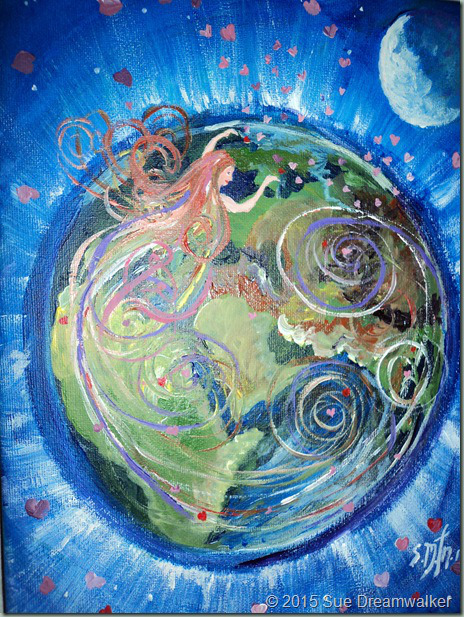
A wonderful post from Sue Dreamwalker.

A couple of weeks ago, back on the 26th November, Sue published a post over on her blog, Dreamwalker’s Sanctuary, that ‘spoke’ to me in ways beyond words.  For when we turn inside of ourselves, when we try to listen to our own deepest experiences, the word ‘soul’ might not be out of place here, we frequently struggle to translate those feelings, those inner voices, into words.  Words seem far too crude! It’s how a beautiful vision of nature can never be perfectly transferred into a photographic image.

So I won’t blather on! Just let your eyes feast on the following:

ooOOoo

Resurrecting a state of BEing.

I am the Sky

I am the Sea

I am in all you see

I am the Wind

Within your breath

I am with you even in Death

I am the space between your thoughts

And nothing of me should scare you naught

I am in everything you do

And all I do is Love You.

I AM

ME..

I wrote that poem sometime ago now.. and I often find myself still searching for that BEing within.. Below is what I posted about BEing in 2011…

What is this “Being” inside of me? inside of ALL of us.. What is it that drives us, makes us tick.. I often talk to that ‘Being’ don’t you? as I search inside and question and listen for the answers.

We call ourselves Human BE-ings.. but what does that mean? Many I think have forgotten that “Being” within themselves as we search externally to IammeBE that something else.. We get bombarded with being told who we should aspire to ‘Be’ like, who to follow, how to pray, etc etc.. we are told what we should wear, what to eat, what products to buy.. and our BE-ing has got lost, swamped by all the exterior material diversions of being told how to live our lives….

We get disillusioned and search outside of ourselves for the Guru or saviour to come and make our lives more meaningful as we endeavour to find that missing part that makes us whole.. .. We are never satisfied with our lot, some even change their own appearances as they strive to BE this image of a person that to them is not the one who looks back at them through the mirror.

Do we really Look into that Mirror and Do we really SEE?

SD2We are divided in schools, Higher education , Top/Bottom of the class,Class distinction, Grades- Culture and Creeds.. We judge each other,we condemn those who have differing views… We look down on those who appear of lesser means — We Label people and we put limits upon ourselves telling ourselves we are not worthy, for society has made us think in terms of possessions and wealth as status symbols..

We become jealous of those whose lives seemed enriched and full, but as we look closer are they enriched? Are they content with that ‘Being’ within? It seems not, for many too are still searching outside of themselves to find that which makes them Happy.. and all that money and wealth shows that Happiness still cannot be bought…

We think ourselves as separate beings, alone, and yet we are all of us part of the Human Race… We are ALL of us HUMAN BEINGS… Something I think many forget as we race to gather yet more and more material ‘Things’ around our selves thinking they will BE the Key to happiness…

Happiness is a state of BEING..

Happiness is not found in any-‘Thing’ other than Within Ourselves…

When we look at the I AM when we really Seek that Inner BEING when we truly Love ourselves the inner core-self.. when we come to LOVE ourselves and stop trying to BE something that we are seeking to BE… only then will we find our True BEING..

We are all connected within that Family of Light

We are ALL BEINGS OF LIGHT ENERGY within this Human Form.

ALL OF US ARE LIGHT BEINGS COME TO EXPERIENCE

..all of us seeking the same thing and all of us forgetting how to connect to that most basic thing..

ONE’s SELF

TO BE- One’s SELF!

We need look no further to make ourselves feel whole and complete, than to

Look WITHIN our BEING.

For instead of seeking to ‘BE’ this or that, Instead of trying to ‘BE’ Wealthy, Wise, … ,searching to ‘BE’ what ever else you think you need to make you Happy

ALL we have to BE is —LOVE

And to ‘BE’- Happy..

‘BE’ Wise,…

To ‘BE’ ALL of these things.

Remember that there is nothing you need do except

‘BE’ in the ‘Moment’ of ‘NOW!’..

and ‘BE’ the Best you know how to BE.. Right now!..

And start BEING who YOU choose to BE..

Love and Blessings

Dreamwalker

And one more thought to add to BE-responsible for your thoughts and Actions.. And BE -aware that your thoughts contribute to the creation of either positive or negative outcomes in the world..

So BE-prepared for the outcomes..

Blessings

Sue

ooOOoo

Do yourself a favour; a big favour – go and read it all through again!

Sue, many, many thanks for letting me republish this!

The book! Part Five: Sharing

Dogs share so much of themselves in such an easy fashion. Here’s a story that made me laugh.

A man in a casino walks past three men and a dog playing poker.
“Wow!” he says, “That’s a very clever dog!“
“He’s not that clever,” replies one of the other players.
“Every time he gets a good hand he wags his tail!“

This very clever dog playing poker couldn’t hide his happiness and had to wag his tail!

One of the remarkable things that is noticed by those that have a number of dogs in their lives is the very natural way that they share so much. In our own case, we live with nine dogs, seven of whom are ex-rescue dogs. It would be fair to imagine that any dog that had come either straight off the street, a feral dog in other words, or from a dog rescue centre, would have some behavioural issues. To a small extent, this has been noticed by us; that some dogs come to us with a few minor, anti-social issues.

But the way that existing dogs in the home quickly assess and welcome a new dog, how they instinctively know that they are going to fit in, is a model of openness and acceptance. But more on that in the forthcoming chapters on those topics of openness and acceptance. Here, I want to stick specifically to sharing.

Sharing is synonymous with selflessness. One couldn’t openly share much of our life if it wasn’t easy to push to the back of one’s mind, one’s consciousness, our need for self. In more easy terms, our egos. For if our egos are dominant then selfless sharing would be very difficult; some might say impossible.

A dog seems to know with certainty that its best interest lays down the pathway of getting on with other dogs in the family. Inevitably, the boundaries of sharing, from the perspective of the dog, indeed from a philosophical angle of this quality in the dog, are intermingled with all the other qualities previously written about, and many of the qualities coming up in the next few chapters. So we observe how dogs will lick each other, snuggle up and sleep together, play together and share; all the attributes of a trustful, loving community.

That natural sharing sense of a dog links effortlessly with our human need for sharing. I had to look up and remind myself who it was that coined the expression: “No man is an island.” It was the English poet John Dunne[1], by the way. A beautiful, masterful reflection on our human need for sharing.

There are numerous benefits for having a dog, or two, in one’s life but possibly the core benefit is the one of never feeling alone. Think how often one sees a homeless person by the side of the road begging for food, money or for a lift somewhere else, and nearby is their dog. Irrespective of the fact, the certainty, that being homeless is tough, is the added certainty that it is a great deal tougher if there is a dog to feed and look after. My strong sense is that the sharing of the lives of two creatures, man and dog, more than offsets the added challenges of having a dog in your life if you have no permanent home.

No better underlined than by an article seen on the online presence of Flagpole Magazine[2], the “locally owned, independent voice of Athens, Northeast Georgia.”

The article[3] was called: Dogs and Their Homeless Owners Share Love, if not Shelter, and was written by Stephanie Talmadge. It opened:

If you walk down Clayton Street, specifically near the College Avenue intersection, you may have received a furry greeting from a little brown, scraggly pup. Usually a blur, due to near-constant wagging, this tiny dog, Malika, spends many of her days guarding that corner for her owners, David and Dorothy Gardener, who are experiencing temporary homelessness.

Though the Gardeners are homeless, little Malika is far from it. She’s not in the pound, waiting to be adopted or rescued before her time runs out. She’s not running around in the streets or woods, fending for herself.

Stephanie Talmadge then makes an important point towards the end of her piece:

Homeless or not, owning a pet is a huge responsibility, and obviously it can be extremely rewarding, well worth the complications it creates. Plus, a person doesn’t have to be homeless to have financial barriers to providing good care. Plenty of dogs who live in permanent housing are neglected and mistreated daily.

Just because someone’s homeless shouldn’t mean they’re not allowed to have a companion animal,” Athens-Clarke County Animal Control Superintendent Patrick Rives says, “And there may be some good reasons for them to [have one]… There is a psychological impact of having a companion animal, and I wouldn’t want to take that away from someone.”

Around 1870, Senator George C. Vest delivered a powerful and moving eulogy for the dog; delivered to the jury at the Old Courthouse in Warrensburg. It was in response to his dog, Old Drum, being shot the previous year. Here are his words:

The best friend man has in the world may turn against him and become his enemy. His son, or daughter, that he has reared with loving care, may prove ungrateful. Those who are nearest and dearest to us, those whom we trust with our happiness and good name may become traitors to their faith. The money a man has he may lose. It flies away from him, perhaps when he needs it most. A man’s reputation may be sacrificed in a moment of ill-considered action. The people who are prone to fall on their knees when success is with us may be the first to throw the stone of malice when failure settles its cloud upon our head.

The one absolutely unselfish friend that man can have in this selfish world, the one that never deserts him, the one that never proves ungrateful or treacherous, is his dog. A man’s dog stands by him in prosperity and poverty, in health and in sickness. He will sleep on the cold ground when the wintry winds blow and the snow drives fiercely, if only to be near his master’s side. He will kiss the hand that has no food to offer, he will lick the wounds and sores that come in encounters with the roughness of the world. He guards the sleep of his pauper master as if he were a prince.

When all other friends desert, he remains. When riches take wing, and reputation falls to pieces, he is as constant in his love as the sun in its journey through the heavens.

If fortune drives his master forth, an outcast in the world, friendless and homeless, the faithful dog asks no higher privilege than that of accompanying him, to guard him against danger, to fight against his enemies. And when that last scene of all comes, and death takes his master in its embrace and his body is laid away in the cold ground, no matter if all other friends pursue their way, there, by the graveside will the noble dog be found, his head between his paws, his eyes sad, but open in alert watchfulness, faithful and true, even in death.

Now when it comes to us humans learning the quality of sharing from our dogs, there is no shortage of examples of humans engaged in wonderful acts of sharing. In undertaking research, I came across an article in the Houston Chronicle[4] headed: What makes us human? Teaching, learning and sharing.

We wanted to understand how all of these behaviors came about specifically for humans,” said Steven Schapiro, an M.D. Anderson professor at the Bastrop facility. “And we wanted to understand why our closest living relatives can’t do all of the kinds of things we do.”

Professor Schapiro went on to explain: “To address their question the scientists devised a series of puzzles with escalating difficulty, the solving of which would produce rewards – stickers of increasing attractiveness for kids; carrots, apples and then grapes for the monkeys.

Then observing:

During the experiment the researchers observed that the children treated the puzzles as a social exercise, working them together and giving verbal instruction to one another. When successful, they shared the rewards.

In contrast the chimpanzees and capuchins appeared to only see the puzzles as a means to obtain rewards, and worked mostly independently and did not learn from their efforts. They never shared.

Humans, then, have ratcheted up their culture by teaching one another, imitating the successful behaviours of others and altruism.

When successful, they shared the rewards.

Who knows if us humans uniquely having dogs in our lives over thousands of years, way back to the times when we depended on our survival through hunting and gathering, if learning to share the hunting and the gathering with our dogs, embedded within us the sharing of rewards? I would like to think so.

I want to end this chapter by promoting two wonderful modern examples of a culture of sharing. Firstly, I’m referring to the Buy Nothing Project[5] that has as it’s subheading: Random Acts of Kindness All Day Long.

As the ‘About’ page[6] explains:

Buy Nothing. Give Freely. Share Creatively.

The Buy Nothing Project began as an experimental hyper-local gift economy on Bainbridge Island, WA; in just 8 months, it has become a social movement, growing to over 25,000 members in 150 groups, in 4 countries. Our local groups form gift economies that are complementary and parallel to local cash economies; whether people join because they’d like to quickly get rid of things that are cluttering their lives, or simply to save money by getting things for free, they quickly discover that our groups are not just another free recycling platform. A gift economy’s real wealth is the people involved and the web of connections that forms to support them. Time and again, members of our groups find themselves spending more and more time interacting in our groups, finding new ways to give back to the community that has brought humor, entertainment, and yes, free stuff into their lives. The Buy Nothing Project is about setting the scarcity model of our cash economy aside in favor of creatively and collaboratively sharing the abundance around us.

It has become a social movement …. collaboratively sharing the abundance around us.

Secondly, to a completely different example, that of software. Let me explain or, better, let me quote from the home-page of the website Open Source Initiative[7]: “Open source software is software that can be freely used, changed, and shared (in modified or unmodified form) by anyone.” [My emphasis]

Here’s the opening paragraph of an article[8] in Forbes Magazine; written by George Bradt.

Why Open Leadership Has Become Essential

You would not be reading this if open source software did not exist. Without open source standards, the Internet would not exist. This article would not exist. Those of you whose parents met on Match.com would not exist. All of you should be thankful for open source software. Now, as the world has changed, open source software’s principles of openness, transparency and meritocracy have become essential standards for leadership in general.

… principles of openness, transparency and meritocracy have become essential standards for leadership in general.” Not just for leadership but for all of mankind! Sharing seems like the way to go!

If I was a dog, it would be impossible to stop my tail wagging!

1,930 words Copyright © 2014 Paul Handover

[1] It was a famous line from “Meditation XVII,”
[2] http://www.flagpole.com/about-us
[3] http://www.flagpole.com/news/news-features/2014/10/08/dogs-and-their-homeless-owners-share-love-if-not-shelter
[4] http://www.chron.com/news/houston-texas/article/What-makes-us-human-Teaching-learning-and-3375389.php
[5] http://buynothingproject.org
[6] http://buynothingproject.org/about/
[7] http://opensource.org
[8] http://www.forbes.com/sites/georgebradt/2014/11/25/why-open-leadership-has-become-essential/

A breath of common-sense.

George Monbiot perfectly spells it out.

Regular readers of this place will know that it is a rare couple of weeks without a republication of a George Monbiot essay.  His voice seems so often to be a ray of common-sense shining into a dark cave of present-day madness. None more obvious than this essay that was published last Monday under the title of There Is An Alternative.

It’s a huge honour to be able to share this with you, dear readers.

ooOOoo

There Is An Alternative

December 8, 2014

The great political question of our age is what to do about corporate power. It’s time we answered it.
By George Monbiot, published in the Guardian 8th December 2014

Does this sometimes feel like a country under enemy occupation? Do you wonder why the demands of so much of the electorate seldom translate into policy? Why the Labour Party, like other former parties of the left, seems incapable of offering effective opposition to market fundamentalism, let alone proposing coherent alternatives? Do you wonder why those who want a kind and decent and just world, in which both human beings and other living creatures are protected, so often appear to find themselves confronting the entire political establishment?

If so, you have already encountered corporate power. It is the corrupting influence that prevents parties from connecting with the public, distorts spending and tax decisions and limits the scope of democracy. It helps to explain the otherwise inexplicable: the creeping privatisation of health and education, hated by almost all voters; the private finance initiative, which has left public services with unpayable debts(1,2); the replacement of the civil service with companies distinguished only by their incompetence(3); the failure to re-regulate the banks and to collect tax; the war on the natural world; the scrapping of the safeguards that protect us from exploitation; above all the severe limitation of political choice in a nation crying out for alternatives.

There are many ways in which it operates, but perhaps the most obvious is through our unreformed political funding system, which permits big business and multimillionaires effectively to buy political parties. Once a party is obliged to them, it needs little reminder of where its interests lie. Fear and favour rule.

And if they fail? Well, there are other means. Before the last election, a radical firebrand said this about the lobbying industry(4): “It is the next big scandal waiting to happen … an issue that exposes the far-too-cosy relationship between politics, government, business and money. … secret corporate lobbying, like the expenses scandal, goes to the heart of why people are so fed up with politics.” That, of course, was David Cameron, and he’s since ensured that the scandal continues. His lobbying act restricts the activities of charities and trade unions, but imposes no meaningful restraint on corporations(5).

Ministers and civil servants know that if they keep faith with corporations while in office they will be assured of lucrative directorships in retirement. Dave Hartnett, who, as head of the government’s tax collection agency HMRC, oversaw some highly controversial deals with companies like Vodafone and Goldman Sachs(6,7), apparently excusing them from much of the tax they seemed to owe, now works for Deloitte, which advises companies like Vodafone on their tax affairs(8). As head of HMRC he met one Deloitte partner 48 times(9).

Corporations have also been empowered by the globalisation of decision-making. As powers but not representation shift to the global level, multinational business and its lobbyists fill the political gap. When everything has been globalised except our consent, we are vulnerable to decisions made outside the democratic sphere.

The key political question of our age, by which you can judge the intent of all political parties, is what to do about corporate power. This is the question, perennially neglected within both politics and the media, that this week’s series of articles will attempt to address. I think there are some obvious first steps.

A sound political funding system would be based on membership fees. Each party would be able to charge the same fixed fee for annual membership (perhaps £30 or £50). It would receive matching funding from the state as a multiple of its membership receipts. No other sources of income would be permitted. As well as getting the dirty money out of politics, this would force political parties to reconnect with the people, to raise their membership. It will cost less than the money wasted on corporate welfare every day.

All lobbying should be transparent. Any meeting between those who are paid to influence opinion (this could include political commentators like myself) and ministers, advisers or civil servants in government should be recorded, and the transcript made publicly available. The corporate lobby groups that pose as thinktanks should be obliged to reveal who funds them before appearing on the broadcast media(10,11), and if the identity of one of their funders is relevant to the issue they are discussing, it should be mentioned on air.

Any company supplying public services would be subject to freedom of information laws (there would be an exception for matters deemed commercially confidential by the information commissioner). Gagging contracts would be made illegal, in the private as well as the public sector (with the same exemption for commercial confidentiality). Ministers and top officials should be forbidden from taking jobs in the sectors they were charged with regulating.

But we should also think of digging deeper. Is it not time we reviewed the remarkable gift we have granted to companies in the form of limited liability? It socialises the risks which would otherwise be carried by a company’s owners and directors, exempting them from the costs of the debts they incur or the disasters they cause, and encouraging them to engage in the kind of reckless behaviour that caused the financial crisis. Should the wealthy authors of the crisis, like Fred Goodwin or Matt Ridley, not have incurred a financial penalty of their own?

We should look at how we might democratise the undemocratic institutions of global governance, as I outlined in my book The Age of Consent(12). This could involve the dismantling of the World Bank and the IMF, which are governed without a semblance of democracy, and cause more crises than they solve, and their replacement with a body rather like the international clearing union designed by John Maynard Keynes in the 1940s, whose purpose was to prevent excessive trade surpluses and deficits from forming, and therefore international debt from accumulating.

Instead of treaties brokered in opaque meetings between diplomats and transnational capital (of the kind now working towards a Transatlantic Trade and Investment partnership), which threaten democracy, the sovereignty of parliaments and the principle of equality before the law, we should demand a set of global fair trade rules, to which multinational companies would be subject, losing their licence to trade if they break them. Above all perhaps, we need a directly elected world parliament, whose purpose would be to hold other global bodies to account. In other words, instead of only responding to an agenda set by corporations, we must propose an agenda of our own.

This is not only about politicians, it is also about us. Corporate power has shut down our imagination, persuading us that there is no alternative to market fundamentalism, and that “market” is a reasonable description of a state-endorsed corporate oligarchy. We have been persuaded that we have power only as consumers, that citizenship is an anachronism, that changing the world is either impossible or best effected by buying a different brand of biscuits.

Corporate power now lives within us. Confronting it means shaking off the manacles it has imposed on our minds.

www.monbiot.com

References:

1. http://www.dropnhsdebt.org.uk/

2. http://www.monbiot.com/2010/11/22/the-uks-odious-debts/

3. http://www.monbiot.com/2014/05/05/land-of-impunity-2/

4. https://tompride.wordpress.com/2014/10/13/lobbying-camerons-deleted-speech-and-his-jaw-dropping-hypocrisy/

5. http://www.lobbyingtransparency.org/

6. http://www.theguardian.com/commentisfree/2010/oct/22/vodafone-tax-case-leaves-sour-taste

7. http://www.theguardian.com/business/2011/oct/11/goldman-sachs-interest-tax-avoidance

8. http://www.theguardian.com/business/2013/may/27/deloitte-appoints-dave-hartnett-tax

9. http://www.theguardian.com/business/2013/may/27/deloitte-appoints-dave-hartnett-tax

10. http://www.monbiot.com/2013/11/29/hidden-interests/

11. http://www.monbiot.com/2011/10/17/show-me-the-money/

12. http://www.monbiot.com/books/the-age-of-consent/

A ‘growing’ awareness.

The pun is deliberate!

Just at the moment there seems to be an incredible explosion of awareness about the need to change. Won’t say anymore other than from the day of the Winter Solstice, less that two weeks away, I will be publishing a number of posts about this new awareness and the implications, the positive implications, for the coming years.

To set the tone, I am republishing an article that appeared on the website of the organisation Nature Needs Half. I am grateful for their permission to so do.

ooOOoo

Nature Needs Half in the Earth Island Journal

Originally published in the Earth Island Journal by William H. Funk

Conservation group promoting an ambitious new proposal for wilderness protection

During the last half century conservationists around the world have won some impressive victories to protect wild places. Here in the US, the Wilderness Act preserves some 110 million acres of public land. Private holdings by groups like The Nature Conservancy safeguard tens of millions of additional acres. The idea of protecting ecosystems from industrial development has spread around the world. There’s the Mavuradonha Wilderness in Zimbabwe, the El Carmen ecosystem in northern Mexico, Kissama National Park in Angola, and the Tasmanian Wilderness in Australia, to name just a few stunning parks and preserves; UNESCO’s world heritage list includes 197 sites of special beauty and/or biodiversity.

Photo by Trey Ratcliff Nature Needs Half has set out an unbelievable challenge: to formally, legally set aside one half of Earth’s land and water as interconnected natural areas.

But conservation biologists now recognize that these sanctuaries are limited in what they can accomplish precisely because they are special — which is to say, rare. Parks and preserves are all too often islands of biological integrity in a sea of human development. To really protect natural systems, healthy biomes need to be the rule, not the exception.

To achieve that vision, The WILD Foundation, a multinational NGO based in Boulder, Colorado, is pushing a bold concept called “Nature Needs Half.” In a world in which even the wealthiest governments routinely abdicate their responsibilities toward future generations and the environment, Nature Needs Half has set out an unbelievable challenge: to formally, legally set aside one half of Earth’s land and water as interconnected natural areas.

This is, of course, a hugely ambitious endeavor, opposing as it does the assumption that Earth’s resources are here to be exploited solely by humans. We live in what some have called the “Anthropocene,” the Age of Man, a world in which every aspect of physical being, from the oceanic depths to the troposphere, has been radically altered by humankind. Rivers are being dammed, forests leveled, oceans emptied and wildlife eradicated. It’s not a pretty picture, but as an empiric truth it’s difficult to refute. Consider a few facts:

The long-term acidification of the oceans by our ongoing buildup of industrial carbon dioxide is killing off coral reefs around the world, resulting in the loss of a critical barrier to storm surge and further endangering coastal areas at heightened risk from rising seas and stronger and more frequent storms.

Hydropower is increasingly being developed in South America, South Asia and sub-Saharan Africa, preventing the migration of anadromous fishes and destroying the elaborate flood-regime ecosystems of biomes like the Amazon.

The accelerating rate of animal and plants extinctions under the twin hammers of climate change and habitat loss is being compared to Earth’s five other extinction events that followed catastrophic geophysical change such as meteor impact or sudden tectonic shifts. In the case of the sixth great extinction, however, the root cause is purely biotic: us. Either from directly causing species decline through poaching, habitat conversion and the introduction of competitive exotic species, or by indirectly altering ecosystems through our industrial assault on the planet’s atmosphere, one in eight birds, one in four mammals, one in five invertebrates, one in three amphibians, and half of the world’s turtles are facing the eternal night of extinction.

Given those facts, the Nature Needs Half goal is startling in the grandiosity of its vision and the ambitious range of its projects. It is also, in a word, fair. “Half the world for humanity, half for the rest of life, to make a planet both self-sustaining and pleasant,” is how eminent naturalist E.O. Wilson explains the idea in his book The Future of Life. Other endorsers include marine explorer Sylvia Earle and the Zoological Society of London. And while the scope and scale of Nature Needs Half is unprecedented, conservation groups such as the World Wildlife Fund recognize that connecting biodiverse “hotspots” must guide preservation efforts.

The stated goal of Nature Needs Half is “to ensure that enough wild areas of land and water are protected and interconnected (usually at least about half of any given ecoregion) to maintain nature’s life-supporting systems and the diversity of life on Earth, to ensure human health and prosperity, and to secure a bountiful, beautiful legacy of resilient, wild nature.” Underlying this objective is the assumption that humanity, despite its often destructively “unnatural” behavior, is inescapably a part of life on Earth, and that efforts to preserve and protect untrammeled wilderness areas are ultimately means of assuring that the ecosystem services people depend upon are available to us in the distant future. We’re all in this together, and the sooner H. sapiens gets that through its pointy little head, the better off we’ll all be.

How is “protected” defined? The International Union for the Conservation of Nature defines it quite flexibly: “A protected area is a clearly defined geographical space, recognized, dedicated and managed, through legal or other effective means, to achieve the long term conservation of nature with associated ecosystem services and cultural values.” Thus any number of means may be put into play to preserve land, from conservation easements in Virginia to armed ranger patrols in Namibia; what matters is the end result, namely the retention of naturally functioning ecosystems over time.

During the past two decades scientists have determined that the planet’s ecoregions need at least 50 percent ecological integrity, and in some cases more, to ensure the survival of their biological productivity over the long term. (In plain language, “ecological integrity” means that an area’s biodiversity and basic processes are mostly intact.) The goals of Nature Needs Half simply echo the empirical scientific reality: to function over time the world’s biomes need at least half of their structural integrity preserved from human alteration. We are currently falling short of that. A recent report from Yale’s Environmental Performance Index states that just17 percent of Earth’s terrestrial areas and inland waters, and less than 10 percent of marine areas, are currently protected (though for many parks and refuges in poorer countries this protection is often illusory), while about 43 percent remains relatively open and undeveloped, with low human populations and generally undamaged ecosystems.

Nature Needs Half is pursuing its aim in two simultaneous directions: the protection of at least half of the planet’s mostly intact contiguous wilderness areas — concentrating on Eurasian boreal forests, the Amazon basin and Antarctica — and the identification and protection of those fragments or hotspots of abundant biodiversity that have become isolated islands in a sea of human activity.

The aims of Nature Needs Half are precisely the kind of bold approach, rooted in cutting-edge science, which our increasingly desperate times call for. In an Anthropocene of radical climate change and accelerating species extinctions, nothing less than a grand vision of what might yet be achieved will bring about the preservation of our remaining unspoiled landscapes. As the most farsighted wilderness preservation program on Earth, Nature Needs Half promises to be the kind of revolutionary undertaking that, if its aims are fully or even mostly achieved, will be looked back on centuries from now as perhaps the most important attainment in modern human history.

William H. Funk
William H. Funk is a freelance writer, documentary filmmaker and environmental lawyer living in Virginia’s Shenandoah Valley. His work explores the confluences of the natural world, history, culture, law and politics, and as an attorney he has had broad experience with land preservation and endangered species. He may be contacted at williamfunk3@icloud.com or williamhfunk.weebly.com

ooOOoo

Rather puts my next book chapter, Community, into perspective; that chapter being published in thirty minutes time.

Breaking the silence

The second essay this week from George Monbiot

Part of me feels that I am being sucked in to too much ‘doom and gloom’ with the republication of this recent essay from George Monbiot.  I guess it’s a fine balance between spreading the word about the reality of life, in this case in the United Kingdom, or living in sweet innocence of the current state of affairs of ‘man’. But I found George Monbiot’s essay so shocking, in terms of the terrible inequality in British life, that it really did deserve the widest promulgation.

All I can offer in mitigation is that in thirty minutes time, I publish the next chapter of my book: How humans view dogs However, because this chapter is nothing more than setting the scene for the main chapters in Part Five, thirty minutes later comes leading chapter, specifically on Love, under the overall theme of Part Five: What we need to learn.

Your feedback, as always, would be wonderful.

ooOOoo

Breaking the Silence

December 2, 2014

It’s time to bring the Highland Spring south, and, like Scotland, introduce democracy to this quasi-feudal nation.

By George Monbiot, published in the Guardian 3rd December 2014

Bring out the violins. The land reform programme announced by the Scottish government is the end of civilised life on earth, if you believe the corporate press. In a country where 432 people own half the private rural land(1), all change is Stalinism. The Telegraph has published a string of dire warnings, insisting, for example, that deer stalking and grouse shooting could come to an end if business rates are introduced for sporting estates(2). Moved to tears yet?

Yes, sporting estates – where the richest people in Britain, or oil sheikhs and oligarchs from elsewhere, shoot grouse and stags – are exempt from business rates: a present from John Major’s government in 1994(3). David Cameron has been just as generous with our money: as he cuts essential services for the poor, he has almost doubled the public subsidy for English grouse moors(4), and frozen the price of shotgun licences(5), at a public cost of £17m a year.

But this is small change. Let’s talk about the real money. The Westminster government claims to champion an entrepreneurial society, of wealth creators and hard-working families, but the real rewards and incentives are for rent. The power and majesty of the state protects the patrimonial class. A looped and windowed democratic cloak barely covers the corrupt old body of the nation. Here peaceful protestors can still be arrested under the 1361 Justices of the Peace Act. Here, the Royal Mines Act 1424 gives the Crown the right to all the gold and silver in Scotland(6). Here the Remembrancer of the City of London sits behind the Speaker’s chair in the House of Commons(7), to protect the entitlements of a Corporation that pre-dates the Norman conquest. This is an essentially feudal nation.

It’s no coincidence that the two most regressive forms of taxation in the UK – council tax banding and the payment of farm subsidies – both favour major owners of property. The capping of council tax bands ensures that the owners of £100 million flats in London pay less than the owners of £200,000 houses in Blackburn(8,9). Farm subsidies, which remain limitless as a result of the Westminster government’s lobbying(10), ensure that every household in Britain hands £245 a year to the richest people in the land(11). The single farm payment system – under which landowners are paid by the hectare – is a reinstatement of a mediaeval levy called feudal aid(12): a tax the vassals had to pay to their lords.

If this is the government of enterprise, not rent, ask yourself why capital gains tax (at 28%) is lower than the top rate of income tax. Ask yourself why principal residences, though their value may rise by millions, are altogether exempt(13). Ask yourself why rural landowners are typically excused capital gains tax, inheritance tax and the first five years of income tax(14). The enterprise society? It’s a con, designed to create an illusion of social mobility.

The Scottish programme for government(15) is the first serious attempt to address the nature of landholding in Britain since David Lloyd George’s budget of 1909. Some of its aims hardly sound radical until you understand the context. For example it will seek to discover who owns the land. Big deal. Yes, in fact, it is. At the moment the owners of only 26% of the land in Scotland have been identified(16).

Walk into any mairie in France or ayuntamiento in Spain and you will be shown the cadastral registers on request, on which all the land and its owners are named. When The Land magazine tried to do the same in Britain(17), it found that there was a full cadastral map available at the local library, which could be photocopied for 70p. But it was made in 1840. Even with expert help, it took the magazine several weeks of fighting official obstruction and obfuscation and cost nearly £1000(18) to find out who owns the 1.4 km2 around its offices in Dorset. It discovered that the old registers had been closed and removed from public view, at the behest of a landed class that wishes to remain as exempt from public scrutiny as it is from taxes. (The landowners are rather more forthcoming when applying for subsidies from the rural payments agency, which possesses a full, though unobtainable, register of their agricultural holdings). What sort of nation is this, in which you cannot discover who owns the ground beneath your feet?

The Scottish government will consider breaking up large land holdings when they impede the prospects of local people(19). It will provide further help to communities to buy the land that surrounds them. Compare its promise of “a fairer, wider and more equitable distribution of land” to the Westminster government’s vision of “greater competitiveness, including by consolidation”(20): which means a continued increase in the size of land holdings. The number of holdings in England is now falling by 2% a year(21), which is possibly the fastest concentration of ownership since the acts of enclosure.

Consider Scotland’s determination to open up the question of property taxes, which might lead to the only system that is fair and comprehensive: land value taxation(22). Compare it to the fleabite of a mansion tax proposed by Ed Miliband, which, though it recoups only a tiny percentage of the unearned income of the richest owners, has so outraged the proprietorial class that some of them (yes Griff Rhys Jones, I’m thinking of you(23)) have threatened to leave the country. Good riddance.

The Scottish government might address the speculative chaos which mangles the countryside while failing to build the houses people need. It might challenge a system in which terrible homes are built at great expense, partly because the price of land has risen from 2% of the cost of a house in the 1930s to 70% today(24). It might take land into public ownership to ensure that new developments are built by and for those who will live there, rather than for the benefit of volume housebuilders. It might prevent mountains from being burnt and overgrazed(25) by a landowning class that cares only about the numbers of deer and grouse it can bag and the bragging rights this earns in London clubs. As Scotland, where feudalism was not legally abolished until 2000(26), becomes a progressive, modern nation, it leaves England stuck in the pre-democratic past.

Scotland is rudely interrupting the constructed silences that stifle political thought in the United Kingdom. This is why the oligarchs who own the media hate everything that is happening there: their interests are being exposed in a way that is currently impossible south of the border.

For centuries, Britain has been a welfare state for patrimonial capital. It’s time we broke it open, and broke the culture of deference that keeps us in our place. Let’s bring the Highland Spring south, and start discussing some dangerous subjects.

http://www.monbiot.com

References:

1. http://bit.ly/1vi0kuK

2. http://www.telegraph.co.uk/news/uknews/scotland/11262856/Future-bleak-for-grouse-shooting-and-deer-stalking.html

3. http://www.andywightman.com/?p=3975

4. Defra has tried to pass this off as payments for “moorland farmers”, but all owners of grazed or managed moorlands, of which grouse moors are a major component, are eligible. https://www.gov.uk/government/news/cap-boost-for-moorland

5. http://www.theguardian.com/uk-news/2014/apr/22/cameron-blasted-battle-shotgun-licence-fees

6. The Land Reform Review Group, 2014. The Land of Scotland and the Common Good.
http://www.scotland.gov.uk/About/Review/land-reform/events/FinalReport23May2014

7. http://www.monbiot.com/2011/10/31/wealth-destroyers/

8. http://www.theguardian.com/commentisfree/2014/mar/29/why-do-we-pay-more-council-tax-than-knightsbridge-oligarchs

9. This assumes that a house in Blackburn valued at £69,000 in 1991 would cost around £200,000 today. http://www.blackburn.gov.uk/Pages/Council-tax-charges.aspx

10. http://www.monbiot.com/2014/03/03/the-benefits-claimants-the-goverment-loves/

11. Defra, 31st August 2011, by email.

12. http://en.wikipedia.org/wiki/Feudal_aid

13. http://www.theguardian.com/business/2014/sep/22/charge-capital-gains-tax-main-residencies-says-housing-expert

14. http://www.ft.com/cms/s/2/99ae5756-1d89-11df-a893-00144feab49a.html#ixzz3Kexs2dL2

15. http://www.scotland.gov.uk/Publications/2014/11/6336

16. http://www.andywightman.com/?p=3816

17. http://www.thelandmagazine.org.uk/issue/land-issue-14-summer-2013

18. http://www.thelandmagazine.org.uk/issue/land-issue-14-summer-2013

19. http://www.scotland.gov.uk/Publications/2014/11/6336

20. http://archive.defra.gov.uk/foodfarm/policy/capreform/documents/110128-uk-cap-response.pdf

21. Compare the figures, Agriculture in the United Kingdom 2013: http://bit.ly/1vLQSi4
to the figures in the 2011 version: https://www.gov.uk/government/statistics/agriculture-in-the-united-kingdom-2011

22. http://www.theguardian.com/commentisfree/2013/jan/21/i-agree-with-churchill-shirkers-tax

23. http://www.theguardian.com/commentisfree/2014/nov/04/griff-rhys-jones-mansion-tax-soft-option

24. The Land Reform Review Group, 2014. The Land of Scotland and the Common Good. http://www.scotland.gov.uk/About/Review/land-reform/events/FinalReport23May2014

25. http://www.theguardian.com/commentisfree/2014/may/19/vote-yes-rid-scotland-of-feudal-landowners-highlands

26. http://www.scotland.gov.uk/Topics/Justice/law/17975/Abolition

Faithful dog Masha.

Another wonderful dog story, courtesy of Chris Snuggs.

Over four years ago, I published a post under the title of Faithful dog Hachikō. It was the heart-wrenching story of a Japanese Akita dog called Hachi, Hachikō in Japanese, that continued to wait for his master’s return, Hidesaburō Ueno, for years after the professor’s death.  Here’s an extract from that post:

In 1924, Hidesaburō Ueno, a professor in the agriculture department at the University of Tokyo took in Hachikō as a pet. During his owner’s life Hachikō saw him out from the front door and greeted him at the end of the day at the nearby Shibuya Station. The pair continued their daily routine until May 1925, when Professor Ueno did not return on the usual train one evening. The professor had suffered from a cerebral hemorrhage at the university that day. He died and never returned to the train station where his friend was waiting. Hachikō was loyal and every day for the next nine years he waited sitting there amongst the town’s folk.

Hachikō was given away after his master’s death, but he routinely escaped, showing up again and again at his old home. Eventually, Hachikō apparently realized that Professor Ueno no longer lived at the house. So he went to look for his master at the train station where he had accompanied him so many times before. Each day, Hachikō waited for Professor Ueno to return. And each day he did not see his friend among the commuters at the station.

The permanent fixture at the train station that was Hachikō attracted the attention of other commuters. Many of the people who frequented the Shibuya train station had seen Hachikō and Professor Ueno together each day. They brought Hachikō treats and food to nourish him during his wait.

This continued for nine years with Hachikō appearing precisely when the train was due at the station

A few days ago, Chris sent me details of a faithful dog story that appeared in the English Daily Telegraph newspaper on the 26th November. The story was headed: Loyal dog waits for owner who will never return at hospital for two years. It opened, thus:

A loyal dog has shown up every day for two years at a hospital where her master passed away.

Masha appears at the Siberian hospital’s reception area every morning, the Siberian Times reports.

Her owner was admitted to the hospital in Novosibirsk region, south western Siberia, two years ago after falling ill.

Masha is well cared for by staff who make sure she has a warm bed and food every night. The faithful canine was the elderly man’s only visitor, staff say, and used to run home every night to stand guard before returning the next morning.

If we then go across to that Siberian Times story, we see that the wonderful Masha is linked to Hachikō.

Heartbroken little dog becomes Siberia’s own ‘Hachiko’

By Kate Baklitskaya and Derek Lambie – 24 November 2014

For past year devoted Masha has been waiting in a hospital for the beloved owner who will never return.

'One day, and we very much want this day to come soon, our Masha will trust somebody.' Picture: Svyatoslav Odarenko
‘One day, and we very much want this day to come soon, our Masha will trust somebody.’ Picture: Svyatoslav Odarenko

A little dog that waits in vain at a Siberian hospital for the owner who has already died has been dubbed Russia’s own Hachiko. Heartbroken Masha has been turning up looking for her beloved master every day since he passed away at the facility in Novosibirsk last year.

It is a tale mirroring that of the famously loyal Akita dog Hachiko in Japan, who arrived at a train station every evening for 10 years to greet its owner even though he had died.

Masha has become a well-known, and much loved, figure at the Novosibirsk District Hospital Number One, where patients and workers ensure she has a warm bed and food to eat.

But, aware of her obvious sadness at being unable to find her owner, staff are hoping an animal lover will come forward to adopt her and give her a new home.

Chief doctor Vladimir Bespalov told Novosibirsk Vesti TV: ‘You see her eyes, how sad they are – it’s not the usual shiny eyes for when a dog is happy. You can see this in animals in the same way as with people.

‘There is nothing medicine can do for her here, but we are still hoping that Masha will be able to find another owner. One day, and we very much want this day to come soon, our Masha will trust somebody.’

Masha, who looks like a dachshund with short legs, has been coming into the reception at the hospital in Koltsovo every day for the past two years since her owner was admitted. The man, a pensioner from the village of Dvurechie several kilometres away, had fallen ill and had turned up with his pet.

There are three heart-rending photographs of Masha that you really must look at. The article then concludes:

Whilst he was staying on the ward, Masha was his only visitor and she even trotted off home to guard the house before returning to the hospital in the morning.

Sadly he died a year ago but the loyal dog has continued to turn up every day, perhaps because she has nowhere to live, or because she believes her master is still there.

Nurse Alla Vorontsova said: ‘She is waiting for him, for her owner. Just recently a family tried to adopt her, but Masha ran away and returned to the hospital. She was taken on Friday evening, and at 3am on Saturday she was back here.’

Masha’s story is similar to that of the famous Japanese dog Hachiko, who used to greet his master on his return from work at the Shibuya train station in Tokyo.

When his owner, agricultural science professor Hidesaburo Ueno, died in 1925 he continued to visit the station every night for 10 years still expecting to meet him off his 4pm train.

In 1935 the dog’s body was found in a Tokyo street and his remains were stuffed, mounted and put on display in Japan’s National Science Museum, while a bronze statue was erected outside Shibuya. A Hollywood movie of the sad story, starring Richard Gere, was released in cinemas in 2010.

There are also similarities to Greyfriars Bobby, a little Scottish terrier who was unwilling to leave his dead master’s grave in Edinburgh, Scotland, for 14 years in the 19th century.

What wonderful, loyal, loving friends dogs are to us humans.