The fabulous story of the restoration of a British Navy Supermarine Seafire Mk.XV
From time to time I let on that in the past I was a keen private pilot and before that a glider (sailplane) pilot. My son has been a commercial airline pilot for many years. Inevitably, one gets to know other pilots, a few of whom become firm friends. One such friend is Bob Derham who recently sent me this story about the restoration of a Supermarine Seafire. For anyone interested in classic aircraft, the story of this particular aircraft is fascinating.
Seafire Mk. XV
While WikiPedia has a good description of the type, there’s a fine description of this particular aircraft over at the Salute website, (the photo above came from that website) from which I offer:
Supermarine Seafire Mk. XV
This airplane is one of only four known Seafire Mk. XVs to exist in the world and it may be the only flying Supermarine Seafire Mk. XV in the world. Dr. Wes Strickler’s immaculate Supermarine Seafire Mk. XV (also known as the “hooked Spitfire”) is based in Columbia, MO, was restored by Jim Cooper, and made its first post-restoration flight in 2010. The Supermarine Seafire was a naval version of the Supermarine Spitfire specially adapted for operation from aircraft carriers. The Seafire’s mission was primarily as a short range interceptor. The name Seafire was derived by abbreviating the longer name “Sea Spitfire”.
The Mk XV variant of the Seafire was powered by a Griffon VI (single-stage supercharger, rated at 1,850 hp driving a 10 ft 5 in Rotol propeller. It appeared to be a naval Spitfire F Mk XII but was an amalgamation of a strengthened Seafire III airframe and wings with the wing fuel tanks, retractable tailwheel, larger elevators and broad-chord “pointed” rudder of the Spitfire VIII. The engine cowling was from the Spitfire XII series, being secured with a larger number of fasteners and lacking the acorn shaped blister behind the spinner. A vee-shaped guard forward of the tailwheel prevented arrestor wires getting tangled up with the tailwheel.
One problem which immediately surfaced was the poor deck behavior of this mark, especially on take-off. At full power the slipstream of the propeller, which swung to the left (as opposed to the Merlin, which swung to the right), often forced the Seafire to swing to starboard, even with the rudder hard over on opposite lock. This sometimes led to a collision with the carrier’s island. The undercarriage oleo legs were still the same as the much lighter Merlin engined Spitfires, meaning that the swing was often accompanied by a series of hops. This undercarriage also gave it a propensity of the propeller tips “pecking” the deck during an arrested landing and occasionally bouncing over the arrestor wires and into the crash barrier.
Wing span: 36ft 10in. Max takeoff weight: 7,640 lb. Max speed: 359 mph. Power: 1,850 hp.
This is an example of incredible dedication! Jim Cooper in front of the Seafire.
When you watch the film, Jim Cooper makes it clear that there were others on the restoration project. But the film also makes it clear that without Jim this beautiful aircraft would never have been restored, let alone restored to a flying machine.
Settle back and enjoy!
Uploaded on Aug 18, 2010 by Scott Schaefer
“While Sarah Hill and I were taping the first Central Missouri Honor Flight special in the Ozark Hangar at Columbia Regional Airport in January 2009, I noticed Jim Cooper working on a plane in the corner of the hangar. I love airplanes and this sight piqued my interest.
The corner was enclosed by plastic from floor to ceiling and inside sat a plane, wings folded toward the ceiling and a paint job that left more to be desired. It was the Seafire XV – one of only a handful still in existence. As soon as I saw the plane and learned a few facts about it, I knew I wanted to do a story on it and follow Cooper through the rest of the restoration process.
Cooper had already been working on the Seafire for nearly a year and half by the time we met, but there was still plenty of work that had to be done. I started shooting that night and throughout the next year and half, whenever Cooper would move to a different stage in the restoration, he’d call and I would head to the hangar to shoot video. I didn’t shoot every part of the process, but tried to capture the big ones ?cleaning the plane, painting, revealing the paint job, testing the landing gear, testing the engine and of course the first flight.
After 10 trips to the airport, 130 miles and nearly 6 hours of video, it was time to start the editing process. Once all the video was in the system, I spent 14 hours typing the details from of every sound and interview captured in the video. That log was essential in writing the story. I needed to know exactly what was said in order to organize everything into a story that would hopefully hold people’s interest. After I had a rough script written, I began to edit the video. After about 15 hours in the edit bay tweaking every little audio and video cut? then re-tweaking them? I was finally finished. Nineteen months later. It was a tough job picking the best four minutes from six hours of video, but in the end, I think I accomplished what I set out to do.”
Leave you with another photograph.
One of a kind!
If you wanted to see the aircraft in the air, then it will be at this year’s EAA OSHKOSH. I’ve always wanted to go but never made it! Anyone fancy baby-sitting some dogs and horses around the end of July? 😉
Anyone, anywhere can celebrate Peace Day. It can be as simple as lighting a candle at noon, sitting in silent meditation, or doing a good deed for someone you do not know. Or it can involve getting your co-workers, organization, community or government engaged in a large event.
The impact if millions of people in all parts of the world, coming together for one day of peace, is immense, and does make a difference.
International Day of Peace is also a Day of Ceasefire – personal or political. Take this opportunity to make peace in your own relationships as well as impact the larger conflicts of our time. Imagine what a whole Day of Ceasefire would mean to humankind.
Can’t argue with that or with this year’s UN Secretary-General Ban Ki-moon’s message for today’s International Day of Peace.
So don’t forget!
Wherever you are in the world, take a minute off at mid-day and be at peace.
I had completely forgotten about the story of Zanjeer. But thanks to a recent email from John Lewis, friend from previous Devon days, it seemed fitting for today’s post.
Zanjeer was a Labrador Retriever who served as a detection dog with the Mumbai Police. During the time of the 1993 Mumbai bombings, Zanjeer detected arms and ammunition, including 3,329 kg of RDX explosives.
Here’s how Zanjeer’s death was reported back in November, 2000.
Police dog Zanjeer dead
Date: 2000-11-17
Police sniffer dog Zanjeer, who detected arms and ammunition used in 1993 serial explosions, died at a veterinary hospital at Parel last night, Bomb Detection and Disposal Squad sources said.
The nine-year-old Labrador was admitted to the hospital last month after it developed swellings in the lungs and paws.
Among the eight dogs with the squad, Zanjeer was regarded as a hero. It had two handlers, Ganesh Andale and V G Rajput. Zanjeer had detected 3,329 kgs of RDX, nine sticks of gelatine, five kg of other explosives, 18 AK-56 rounds, five pistol rounds and 6,406 other rounds during the blast investigations.
Zanjeer was born on January 7, 1992, and was inducted into the squad on December 29, 1992. It was trained at the Dog Training Centre of the Criminal Investigation Department at Shivaji Nagar in Pune.
Zanjeer (7 January 1992 – 16 November 2000) was a Labrador Retriever who served as a detection dog with the Mumbai Police. During the time of the 1993 Mumbai bombings, Zanjeer detected arms and ammunition, including 3,329 kg of RDX explosives.
Zanjeer was trained at the Dog Training Centre of the Criminal Investigation Department at Shivaji Nagar in Pune, India. He joined the Mumbai Police Bomb Detection and Disposal Squad on 29 December 1992 and was handled by Ganesh Andale and V G Rajput.
The name Zanjeer comes from the 1973 Hindi film Zanjeer but he was also called “Ginger” because of his coat colour.
Not including his contributions during the 1993 attacks, Zanjeer helped to recover 11 military bombs, 57 country-made bombs, 175 petrol bombs, and 600 detonators.
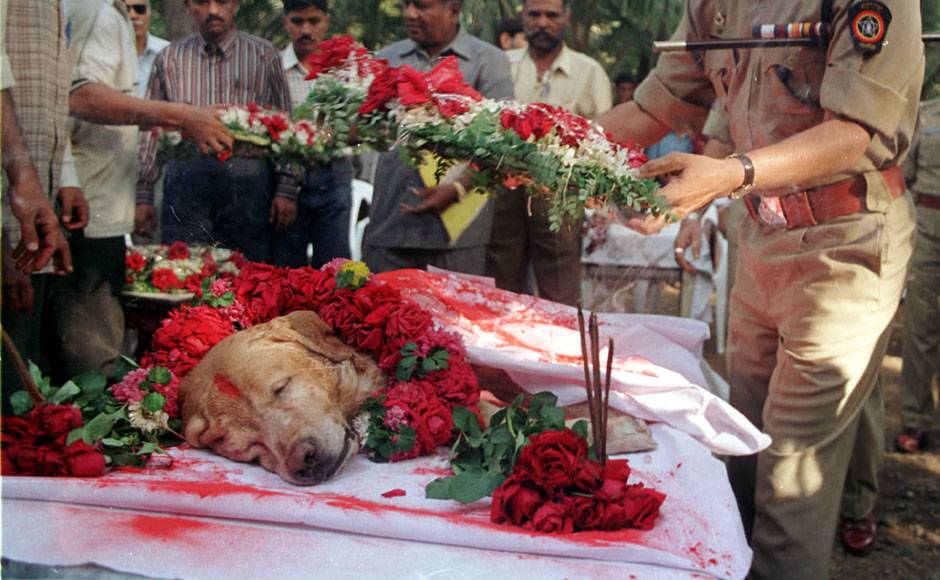
Zanjeer, the labrador: Unlikely hero of 1993 Mumbai blasts
A senior police officer lays a floral wreath on Mumbai’s most famous dog Zanjeer, who worked with the Bomb Squad, following his death from bone cancer in the city, November 17, 2000.Zanjeer, a golden labrador, saved thousands of lives during the serial bomb blasts in the city in March 1993 by detecting more than 3,329 kgs of the explosive RDX, 600 detonators, 249 hand grenades and 6406 rounds of live ammunition. He was buried with full honours during a ceremony attended by senior police officials. Reuters
Twenty years ago! My, how the years slip by!. Thanks John.
Once again, I am indebted to Tom Engelhardt of TomDispatch fame for granting me permission to republish yet another fascinating essay.
In fact, this post was scheduled for Learning from Dogs very shortly after Tom’s essay appeared on TomDispatch some 5 months ago. For reasons that escape me now, I parked it and then forgot about it. But what is striking is that, as Tom points out in his introduction, the essay from Noam Chomsky was originally published on Tom Dispatch in April 2011, the thick end of 21 months ago. It reads as if it was off the press today. What a truly strange world we all live in.
I include a link to Noam Chomsky’s website after the essay, so now to Tom’s introduction:
oooOOOooo
The Persian Gulf
In Noam Chomsky’s “Who Owns the World?” — the most popular TomDispatch post of all time (which means the last 10 years) — he wrote of one key imperial principle: “The U.S. cannot tolerate ‘any exercise of sovereignty’ that interferes with its global designs.” Hence, the under-reported but staggering U.S. build-up in the Persian Gulf.
Of late, most “build-up” publicity has gone to the Obama administration’s “pivot” to Asia (to “contain” China), including an announcement that 60% of U.S. naval power will sooner or later be deployed to Asian waters. But much of this remains a promise for the future. The real “pivot” focus of the moment, if it can even be called that after all these years, remains Iran.
That country is largely surrounded by American military bases continually being built up, including a new missile defense radar station at a secret site in Qatar, part of a developing U.S. regional anti-missile system. In addition, there is an ongoing build-up of U.S. commando forces; of the military power of U.S. regional allies, thanks to new weapons systems of all sorts regularly being put on offer by Washington; of U.S. naval forces in the Persian Gulf, already enormous and still growing, including not one but two aircraft carrier battle groups, minesweepers, a new “floating base” for possible special operations forces, and tiny drone submersibles being “rushed” to the region. And don’t forget a similarly large-scale build-up of U.S. air power, including the deployment of the most advanced U.S. fighter plane, the F-22, to a base in the United Arab Emirates.
Add this to a series of warlike acts, including ever-tightening oil sanctions against Iran, the release of cyber worms meant to infect Iranian computer systems connected to its nuclear program, and an evident Israeli campaign to assassinate Iranian nuclear scientists, and you have quite a “pivot” in what is, let’s not forget, the oil heartlands of the planet. Much of this is being covered in a scattered, almost absentminded way in the mainstream media. Yet anyone familiar with how World War I began knows that massive military build-ups or mobilizations — and a rickety Iranian regime is doing its best to respond regionally with its own mini-military build-up — can lead to war, whether either side actually intends it or not. A U.S. ship recently firing on an Indian boat — and killing one fisherman — near Iran is a reminder of where such inherently trigger-happy situations can lead.
Add to all this the fact that the planet’s former self-proclaimed “sole superpower” is visibly decaying and increasingly desperate to maintain its pretensions to global dominance, and you have a formula for future disaster. Isn’t it sad in its own way that Chomsky’s piece, first posted at this site in April 2011 (like the 2004 Chalmers Johnson piece reposted last Sunday), is in no way outmoded? It’s not faintly ready for the dustbin of history, and in fact, it remains ahead of its moment. In this sense, the United States is a Chomskyan nation, eerily following the path he’s laid out for it and so, undoubtedly, heading for something ugly indeed. Tom
Is the World Too Big to Fail?
The Contours of Global Order
By Noam Chomsky
The democracy uprising in the Arab world has been a spectacular display of courage, dedication, and commitment by popular forces — coinciding, fortuitously, with a remarkable uprising of tens of thousands in support of working people and democracy in Madison, Wisconsin, and other U.S. cities. If the trajectories of revolt in Cairo and Madison intersected, however, they were headed in opposite directions: in Cairo toward gaining elementary rights denied by the dictatorship, in Madison towards defending rights that had been won in long and hard struggles and are now under severe attack.
Each is a microcosm of tendencies in global society, following varied courses. There are sure to be far-reaching consequences of what is taking place both in the decaying industrial heartland of the richest and most powerful country in human history, and in what President Dwight Eisenhower called “the most strategically important area in the world” — “a stupendous source of strategic power” and “probably the richest economic prize in the world in the field of foreign investment,” in the words of the State Department in the 1940s, a prize that the U.S. intended to keep for itself and its allies in the unfolding New World Order of that day.
Despite all the changes since, there is every reason to suppose that today’s policy-makers basically adhere to the judgment of President Franklin Delano Roosevelt’s influential advisor A.A. Berle that control of the incomparable energy reserves of the Middle East would yield “substantial control of the world.” And correspondingly, that loss of control would threaten the project of global dominance that was clearly articulated during World War II, and that has been sustained in the face of major changes in world order since that day.
From the outset of the war in 1939, Washington anticipated that it would end with the U.S. in a position of overwhelming power. High-level State Department officials and foreign policy specialists met through the wartime years to lay out plans for the postwar world. They delineated a “Grand Area” that the U.S. was to dominate, including the Western hemisphere, the Far East, and the former British empire, with its Middle East energy resources. As Russia began to grind down Nazi armies after Stalingrad, Grand Area goals extended to as much of Eurasia as possible, at least its economic core in Western Europe. Within the Grand Area, the U.S. would maintain “unquestioned power,” with “military and economic supremacy,” while ensuring the “limitation of any exercise of sovereignty” by states that might interfere with its global designs. The careful wartime plans were soon implemented.
It was always recognized that Europe might choose to follow an independent course. NATO was partially intended to counter this threat. As soon as the official pretext for NATO dissolved in 1989, NATO was expanded to the East in violation of verbal pledges to Soviet leader Mikhail Gorbachev. It has since become a U.S.-run intervention force, with far-ranging scope, spelled out by NATO Secretary-General Jaap de Hoop Scheffer, who informed a NATO conference that “NATO troops have to guard pipelines that transport oil and gas that is directed for the West,” and more generally to protect sea routes used by tankers and other “crucial infrastructure” of the energy system.
Grand Area doctrines clearly license military intervention at will. That conclusion was articulated clearly by the Clinton administration, which declared that the U.S. has the right to use military force to ensure “uninhibited access to key markets, energy supplies, and strategic resources,” and must maintain huge military forces “forward deployed” in Europe and Asia “in order to shape people’s opinions about us” and “to shape events that will affect our livelihood and our security.”
The same principles governed the invasion of Iraq. As the U.S. failure to impose its will in Iraq was becoming unmistakable, the actual goals of the invasion could no longer be concealed behind pretty rhetoric. In November 2007, the White House issued a Declaration of Principles demanding that U.S. forces must remain indefinitely in Iraq and committing Iraq to privilege American investors. Two months later, President Bush informed Congress that he would reject legislation that might limit the permanent stationing of U.S. Armed Forces in Iraq or “United States control of the oil resources of Iraq” — demands that the U.S. had to abandon shortly after in the face of Iraqi resistance.
In Tunisia and Egypt, the recent popular uprisings have won impressive victories, but as the Carnegie Endowment reported, while names have changed, the regimes remain: “A change in ruling elites and system of governance is still a distant goal.” The report discusses internal barriers to democracy, but ignores the external ones, which as always are significant.
The U.S. and its Western allies are sure to do whatever they can to prevent authentic democracy in the Arab world. To understand why, it is only necessary to look at the studies of Arab opinion conducted by U.S. polling agencies. Though barely reported, they are certainly known to planners. They reveal that by overwhelming majorities, Arabs regard the U.S. and Israel as the major threats they face: the U.S. is so regarded by 90% of Egyptians, in the region generally by over 75%. Some Arabs regard Iran as a threat: 10%. Opposition to U.S. policy is so strong that a majority believes that security would be improved if Iran had nuclear weapons — in Egypt, 80%. Other figures are similar. If public opinion were to influence policy, the U.S. not only would not control the region, but would be expelled from it, along with its allies, undermining fundamental principles of global dominance.
The Invisible Hand of Power
Support for democracy is the province of ideologists and propagandists. In the real world, elite dislike of democracy is the norm. The evidence is overwhelming that democracy is supported insofar as it contributes to social and economic objectives, a conclusion reluctantly conceded by the more serious scholarship.
Elite contempt for democracy was revealed dramatically in the reaction to the WikiLeaks exposures. Those that received most attention, with euphoric commentary, were cables reporting that Arabs support the U.S. stand on Iran. The reference was to the ruling dictators. The attitudes of the public were unmentioned. The guiding principle was articulated clearly by Carnegie Endowment Middle East specialist Marwan Muasher, formerly a high official of the Jordanian government: “There is nothing wrong, everything is under control.” In short, if the dictators support us, what else could matter?
The Muasher doctrine is rational and venerable. To mention just one case that is highly relevant today, in internal discussion in 1958, president Eisenhower expressed concern about “the campaign of hatred” against us in the Arab world, not by governments, but by the people. The National Security Council (NSC) explained that there is a perception in the Arab world that the U.S. supports dictatorships and blocks democracy and development so as to ensure control over the resources of the region. Furthermore, the perception is basically accurate, the NSC concluded, and that is what we should be doing, relying on the Muasher doctrine. Pentagon studies conducted after 9/11 confirmed that the same holds today.
It is normal for the victors to consign history to the trash can, and for victims to take it seriously. Perhaps a few brief observations on this important matter may be useful. Today is not the first occasion when Egypt and the U.S. are facing similar problems, and moving in opposite directions. That was also true in the early nineteenth century.
Economic historians have argued that Egypt was well-placed to undertake rapid economic development at the same time that the U.S. was. Both had rich agriculture, including cotton, the fuel of the early industrial revolution — though unlike Egypt, the U.S. had to develop cotton production and a work force by conquest, extermination, and slavery, with consequences that are evident right now in the reservations for the survivors and the prisons that have rapidly expanded since the Reagan years to house the superfluous population left by deindustrialization.
One fundamental difference was that the U.S. had gained independence and was therefore free to ignore the prescriptions of economic theory, delivered at the time by Adam Smith in terms rather like those preached to developing societies today. Smith urged the liberated colonies to produce primary products for export and to import superior British manufactures, and certainly not to attempt to monopolize crucial goods, particularly cotton. Any other path, Smith warned, “would retard instead of accelerating the further increase in the value of their annual produce, and would obstruct instead of promoting the progress of their country towards real wealth and greatness.”
Having gained their independence, the colonies were free to ignore his advice and to follow England’s course of independent state-guided development, with high tariffs to protect industry from British exports, first textiles, later steel and others, and to adopt numerous other devices to accelerate industrial development. The independent Republic also sought to gain a monopoly of cotton so as to “place all other nations at our feet,” particularly the British enemy, as the Jacksonian presidents announced when conquering Texas and half of Mexico.
For Egypt, a comparable course was barred by British power. Lord Palmerston declared that “no ideas of fairness [toward Egypt] ought to stand in the way of such great and paramount interests” of Britain as preserving its economic and political hegemony, expressing his “hate” for the “ignorant barbarian” Muhammed Ali who dared to seek an independent course, and deploying Britain’s fleet and financial power to terminate Egypt’s quest for independence and economic development.
After World War II, when the U.S. displaced Britain as global hegemon, Washington adopted the same stand, making it clear that the U.S. would provide no aid to Egypt unless it adhered to the standard rules for the weak — which the U.S. continued to violate, imposing high tariffs to bar Egyptian cotton and causing a debilitating dollar shortage. The usual interpretation of market principles.
It is small wonder that the “campaign of hatred” against the U.S. that concerned Eisenhower was based on the recognition that the U.S. supports dictators and blocks democracy and development, as do its allies.
In Adam Smith’s defense, it should be added that he recognized what would happen if Britain followed the rules of sound economics, now called “neoliberalism.” He warned that if British manufacturers, merchants, and investors turned abroad, they might profit but England would suffer. But he felt that they would be guided by a home bias, so as if by an invisible hand England would be spared the ravages of economic rationality.
The passage is hard to miss. It is the one occurrence of the famous phrase “invisible hand” in The Wealth of Nations. The other leading founder of classical economics, David Ricardo, drew similar conclusions, hoping that home bias would lead men of property to “be satisfied with the low rate of profits in their own country, rather than seek a more advantageous employment for their wealth in foreign nations,” feelings that, he added, “I should be sorry to see weakened.” Their predictions aside, the instincts of the classical economists were sound.
The Iranian and Chinese “Threats”
The democracy uprising in the Arab world is sometimes compared to Eastern Europe in 1989, but on dubious grounds. In 1989, the democracy uprising was tolerated by the Russians, and supported by western power in accord with standard doctrine: it plainly conformed to economic and strategic objectives, and was therefore a noble achievement, greatly honored, unlike the struggles at the same time “to defend the people’s fundamental human rights” in Central America, in the words of the assassinated Archbishop of El Salvador, one of the hundreds of thousands of victims of the military forces armed and trained by Washington. There was no Gorbachev in the West throughout these horrendous years, and there is none today. And Western power remains hostile to democracy in the Arab world for good reasons.
Grand Area doctrines continue to apply to contemporary crises and confrontations. In Western policy-making circles and political commentary the Iranian threat is considered to pose the greatest danger to world order and hence must be the primary focus of U.S. foreign policy, with Europe trailing along politely.
What exactly is the Iranian threat? An authoritative answer is provided by the Pentagon and U.S. intelligence. Reporting on global security last year, they make it clear that the threat is not military. Iran’s military spending is “relatively low compared to the rest of the region,” they conclude. Its military doctrine is strictly “defensive, designed to slow an invasion and force a diplomatic solution to hostilities.” Iran has only “a limited capability to project force beyond its borders.” With regard to the nuclear option, “Iran’s nuclear program and its willingness to keep open the possibility of developing nuclear weapons is a central part of its deterrent strategy.” All quotes.
The brutal clerical regime is doubtless a threat to its own people, though it hardly outranks U.S. allies in that regard. But the threat lies elsewhere, and is ominous indeed. One element is Iran’s potential deterrent capacity, an illegitimate exercise of sovereignty that might interfere with U.S. freedom of action in the region. It is glaringly obvious why Iran would seek a deterrent capacity; a look at the military bases and nuclear forces in the region suffices to explain.
Seven years ago, Israeli military historian Martin van Creveld wrote that “The world has witnessed how the United States attacked Iraq for, as it turned out, no reason at all. Had the Iranians not tried to build nuclear weapons, they would be crazy,” particularly when they are under constant threat of attack in violation of the UN Charter. Whether they are doing so remains an open question, but perhaps so.
But Iran’s threat goes beyond deterrence. It is also seeking to expand its influence in neighboring countries, the Pentagon and U.S. intelligence emphasize, and in this way to “destabilize” the region (in the technical terms of foreign policy discourse). The U.S. invasion and military occupation of Iran’s neighbors is “stabilization.” Iran’s efforts to extend its influence to them are “destabilization,” hence plainly illegitimate.
Such usage is routine. Thus the prominent foreign policy analyst James Chace was properly using the term “stability” in its technical sense when he explained that in order to achieve “stability” in Chile it was necessary to “destabilize” the country (by overthrowing the elected government of Salvador Allende and installing the dictatorship of General Augusto Pinochet). Other concerns about Iran are equally interesting to explore, but perhaps this is enough to reveal the guiding principles and their status in imperial culture. As Franklin Delano Roosevelt’s planners emphasized at the dawn of the contemporary world system, the U.S. cannot tolerate “any exercise of sovereignty” that interferes with its global designs.
The U.S. and Europe are united in punishing Iran for its threat to stability, but it is useful to recall how isolated they are. The nonaligned countries have vigorously supported Iran’s right to enrich uranium. In the region, Arab public opinion even strongly favors Iranian nuclear weapons. The major regional power, Turkey, voted against the latest U.S.-initiated sanctions motion in the Security Council, along with Brazil, the most admired country of the South. Their disobedience led to sharp censure, not for the first time: Turkey had been bitterly condemned in 2003 when the government followed the will of 95% of the population and refused to participate in the invasion of Iraq, thus demonstrating its weak grasp of democracy, western-style.
After its Security Council misdeed last year, Turkey was warned by Obama’s top diplomat on European affairs, Philip Gordon, that it must “demonstrate its commitment to partnership with the West.” A scholar with the Council on Foreign Relations asked, “How do we keep the Turks in their lane?” — following orders like good democrats. Brazil’s Lula was admonished in a New York Times headline that his effort with Turkey to provide a solution to the uranium enrichment issue outside of the framework of U.S. power was a “Spot on Brazilian Leader’s Legacy.” In brief, do what we say, or else.
An interesting sidelight, effectively suppressed, is that the Iran-Turkey-Brazil deal was approved in advance by Obama, presumably on the assumption that it would fail, providing an ideological weapon against Iran. When it succeeded, the approval turned to censure, and Washington rammed through a Security Council resolution so weak that China readily signed — and is now chastised for living up to the letter of the resolution but not Washington’s unilateral directives — in the current issue ofForeign Affairs, for example.
While the U.S. can tolerate Turkish disobedience, though with dismay, China is harder to ignore. The press warns that “China’s investors and traders are now filling a vacuum in Iran as businesses from many other nations, especially in Europe, pull out,” and in particular, is expanding its dominant role in Iran’s energy industries. Washington is reacting with a touch of desperation. The State Department warned China that if it wants to be accepted in the international community — a technical term referring to the U.S. and whoever happens to agree with it — then it must not “skirt and evade international responsibilities, [which] are clear”: namely, follow U.S. orders. China is unlikely to be impressed.
There is also much concern about the growing Chinese military threat. A recent Pentagon study warned that China’s military budget is approaching “one-fifth of what the Pentagon spent to operate and carry out the wars in Iraq and Afghanistan,” a fraction of the U.S. military budget, of course. China’s expansion of military forces might “deny the ability of American warships to operate in international waters off its coast,” the New York Times added.
Off the coast of China, that is; it has yet to be proposed that the U.S. should eliminate military forces that deny the Caribbean to Chinese warships. China’s lack of understanding of rules of international civility is illustrated further by its objections to plans for the advanced nuclear-powered aircraft carrier George Washington to join naval exercises a few miles off China’s coast, with alleged capacity to strike Beijing.
In contrast, the West understands that such U.S. operations are all undertaken to defend stability and its own security. The liberal New Republic expresses its concern that “China sent ten warships through international waters just off the Japanese island of Okinawa.” That is indeed a provocation — unlike the fact, unmentioned, that Washington has converted the island into a major military base in defiance of vehement protests by the people of Okinawa. That is not a provocation, on the standard principle that we own the world.
Deep-seated imperial doctrine aside, there is good reason for China’s neighbors to be concerned about its growing military and commercial power. And though Arab opinion supports an Iranian nuclear weapons program, we certainly should not do so. The foreign policy literature is full of proposals as to how to counter the threat. One obvious way is rarely discussed: work to establish a nuclear-weapons-free zone (NWFZ) in the region. The issue arose (again) at the Non-Proliferation Treaty (NPT) conference at United Nations headquarters last May. Egypt, as chair of the 118 nations of the Non-Aligned Movement, called for negotiations on a Middle East NWFZ, as had been agreed by the West, including the U.S., at the 1995 review conference on the NPT.
International support is so overwhelming that Obama formally agreed. It is a fine idea, Washington informed the conference, but not now. Furthermore, the U.S. made clear that Israel must be exempted: no proposal can call for Israel’s nuclear program to be placed under the auspices of the International Atomic Energy Agency or for the release of information about “Israeli nuclear facilities and activities.” So much for this method of dealing with the Iranian nuclear threat.
Privatizing the Planet
While Grand Area doctrine still prevails, the capacity to implement it has declined. The peak of U.S. power was after World War II, when it had literally half the world’s wealth. But that naturally declined, as other industrial economies recovered from the devastation of the war and decolonization took its agonizing course. By the early 1970s, the U.S. share of global wealth had declined to about 25%, and the industrial world had become tripolar: North America, Europe, and East Asia (then Japan-based).
There was also a sharp change in the U.S. economy in the 1970s, towards financialization and export of production. A variety of factors converged to create a vicious cycle of radical concentration of wealth, primarily in the top fraction of 1% of the population — mostly CEOs, hedge-fund managers, and the like. That leads to the concentration of political power, hence state policies to increase economic concentration: fiscal policies, rules of corporate governance, deregulation, and much more. Meanwhile the costs of electoral campaigns skyrocketed, driving the parties into the pockets of concentrated capital, increasingly financial: the Republicans reflexively, the Democrats — by now what used to be moderate Republicans — not far behind.
Elections have become a charade, run by the public relations industry. After his 2008 victory, Obama won an award from the industry for the best marketing campaign of the year. Executives were euphoric. In the business press they explained that they had been marketing candidates like other commodities since Ronald Reagan, but 2008 was their greatest achievement and would change the style in corporate boardrooms. The 2012 election is expected to cost $2 billion, mostly in corporate funding. Small wonder that Obama is selecting business leaders for top positions. The public is angry and frustrated, but as long as the Muasher principle prevails, that doesn’t matter.
While wealth and power have narrowly concentrated, for most of the population real incomes have stagnated and people have been getting by with increased work hours, debt, and asset inflation, regularly destroyed by the financial crises that began as the regulatory apparatus was dismantled starting in the 1980s.
None of this is problematic for the very wealthy, who benefit from a government insurance policy called “too big to fail.” The banks and investment firms can make risky transactions, with rich rewards, and when the system inevitably crashes, they can run to the nanny state for a taxpayer bailout, clutching their copies of Friedrich Hayek and Milton Friedman.
That has been the regular process since the Reagan years, each crisis more extreme than the last — for the public population, that is. Right now, real unemployment is at Depression levels for much of the population, while Goldman Sachs, one of the main architects of the current crisis, is richer than ever. It has just quietly announced $17.5 billion in compensation for last year, with CEO Lloyd Blankfein receiving a $12.6 million bonus while his base salary more than triples.
It wouldn’t do to focus attention on such facts as these. Accordingly, propaganda must seek to blame others, in the past few months, public sector workers, their fat salaries, exorbitant pensions, and so on: all fantasy, on the model of Reaganite imagery of black mothers being driven in their limousines to pick up welfare checks — and other models that need not be mentioned. We all must tighten our belts; almost all, that is.
Teachers are a particularly good target, as part of the deliberate effort to destroy the public education system from kindergarten through the universities by privatization — again, good for the wealthy, but a disaster for the population, as well as the long-term health of the economy, but that is one of the externalities that is put to the side insofar as market principles prevail.
Another fine target, always, is immigrants. That has been true throughout U.S. history, even more so at times of economic crisis, exacerbated now by a sense that our country is being taken away from us: the white population will soon become a minority. One can understand the anger of aggrieved individuals, but the cruelty of the policy is shocking.
Who are the immigrants targeted? In Eastern Massachusetts, where I live, many are Mayans fleeing genocide in the Guatemalan highlands carried out by Reagan’s favorite killers. Others are Mexican victims of Clinton’s NAFTA, one of those rare government agreements that managed to harm working people in all three of the participating countries. As NAFTA was rammed through Congress over popular objection in 1994, Clinton also initiated the militarization of the U.S.-Mexican border, previously fairly open. It was understood that Mexican campesinos cannot compete with highly subsidized U.S. agribusiness, and that Mexican businesses would not survive competition with U.S. multinationals, which must be granted “national treatment” under the mislabeled free trade agreements, a privilege granted only to corporate persons, not those of flesh and blood. Not surprisingly, these measures led to a flood of desperate refugees, and to rising anti-immigrant hysteria by the victims of state-corporate policies at home.
Much the same appears to be happening in Europe, where racism is probably more rampant than in the U.S. One can only watch with wonder as Italy complains about the flow of refugees from Libya, the scene of the first post-World War I genocide, in the now-liberated East, at the hands of Italy’s Fascist government. Or when France, still today the main protector of the brutal dictatorships in its former colonies, manages to overlook its hideous atrocities in Africa, while French President Nicolas Sarkozy warns grimly of the “flood of immigrants” and Marine Le Pen objects that he is doing nothing to prevent it. I need not mention Belgium, which may win the prize for what Adam Smith called “the savage injustice of the Europeans.”
The rise of neo-fascist parties in much of Europe would be a frightening phenomenon even if we were not to recall what happened on the continent in the recent past. Just imagine the reaction if Jews were being expelled from France to misery and oppression, and then witness the non-reaction when that is happening to Roma, also victims of the Holocaust and Europe’s most brutalized population.
In Hungary, the neo-fascist party Jobbik gained 17% of the vote in national elections, perhaps unsurprising when three-quarters of the population feels that they are worse off than under Communist rule. We might be relieved that in Austria the ultra-right Jörg Haider won only 10% of the vote in 2008 — were it not for the fact that the new Freedom Party, outflanking him from the far right, won more than 17%. It is chilling to recall that, in 1928, the Nazis won less than 3% of the vote in Germany.
In England the British National Party and the English Defence League, on the ultra-racist right, are major forces. (What is happening in Holland you know all too well.) In Germany, Thilo Sarrazin’s lament that immigrants are destroying the country was a runaway best-seller, while Chancellor Angela Merkel, though condemning the book, declared that multiculturalism had “utterly failed”: the Turks imported to do the dirty work in Germany are failing to become blond and blue-eyed, true Aryans.
Those with a sense of irony may recall that Benjamin Franklin, one of the leading figures of the Enlightenment, warned that the newly liberated colonies should be wary of allowing Germans to immigrate, because they were too swarthy; Swedes as well. Into the twentieth century, ludicrous myths of Anglo-Saxon purity were common in the U.S., including among presidents and other leading figures. Racism in the literary culture has been a rank obscenity; far worse in practice, needless to say. It is much easier to eradicate polio than this horrifying plague, which regularly becomes more virulent in times of economic distress.
I do not want to end without mentioning another externality that is dismissed in market systems: the fate of the species. Systemic risk in the financial system can be remedied by the taxpayer, but no one will come to the rescue if the environment is destroyed. That it must be destroyed is close to an institutional imperative. Business leaders who are conducting propaganda campaigns to convince the population that anthropogenic global warming is a liberal hoax understand full well how grave is the threat, but they must maximize short-term profit and market share. If they don’t, someone else will.
This vicious cycle could well turn out to be lethal. To see how grave the danger is, simply have a look at the new Congress in the U.S., propelled into power by business funding and propaganda. Almost all are climate deniers. They have already begun to cut funding for measures that might mitigate environmental catastrophe. Worse, some are true believers; for example, the new head of a subcommittee on the environment who explained that global warming cannot be a problem because God promised Noah that there will not be another flood.
If such things were happening in some small and remote country, we might laugh. Not when they are happening in the richest and most powerful country in the world. And before we laugh, we might also bear in mind that the current economic crisis is traceable in no small measure to the fanatic faith in such dogmas as the efficient market hypothesis, and in general to what Nobel laureate Joseph Stiglitz, 15 years ago, called the “religion” that markets know best — which prevented the central bank and the economics profession from taking notice of an $8 trillion housing bubble that had no basis at all in economic fundamentals, and that devastated the economy when it burst.
All of this, and much more, can proceed as long as the Muashar doctrine prevails. As long as the general population is passive, apathetic, diverted to consumerism or hatred of the vulnerable, then the powerful can do as they please, and those who survive will be left to contemplate the outcome.
Noam Chomsky is Institute Professor emeritus in the MIT Department of Linguistics and Philosophy. He is the author of numerous best-selling political works. Recent books include a new edition of Power and Terror, The Essential Chomsky(edited by Anthony Arnove), a collection of his writings on politics and on language from the 1950s to the present, and Hopes and Prospects, also available as an audiobook. His web site is http://www.chomsky.info. To catch Timothy MacBain’s latest Tomcast audio interview in which Chomsky discusses the recent shredding of the principles of the Magna Carta, click here or download it to your iPod here. This piece is adapted from a talk given in Amsterdam in March 2011.
Copyright 2011 Noam Chomsky
As I indicated in my introduction, Noam’s website is here. Hope you can call back tomorrow as I continue with a look at the world we now live in.
So long overdue to saying ‘no’ to more drilling for oil and gas!
Just five days ago, I republished an essay from Tom Engelhardt of TomDispatch fame called The more it changes, the more it’s the same thing. Despite Tom’s permission for me to republish any of the essays that appear on TomDispatch, I do try to be very selective and not republish too often.
However, what was published by Tom on the 18th, just three days ago, is so powerful that it requires the widest readership possible. That’s why Tomgram: Ellen Cantarow, “Little Revolution,” Big Fracking Consequences is being republished on Learning from Dogs today and tomorrow. The reason I have split the essay into two parts is because I want to add some other material. Tom’s publication is in one part so if you can’t wait for my sequel tomorrow, then click here.
Here’s something that I want to draw your attention to:
If you’re 27 or younger, you’ve never experienced a colder-than-average month
By Philip BumpThis image sums up 2012, temperature-wise.
Nowhere on the surface of the planet have we seen any record cold temperatures over the course of the year so far. Every land surface in the world saw warmer-than-average temperatures except Alaska and the eastern tip of Russia. The continental United States has been blanketed with record warmth — and the seas just off the East Coast have been much warmer than average, for which Sandy sends her thanks.
I saw this on the Grist website yesterday. Here are the next couple of paragraphs from that Grist article:
The average temperature across land and ocean surfaces during October was 14.63°C (58.23°F). This is 0.63°C (1.13°F) above the 20th century average and ties with 2008 as the fifth warmest October on record. The record warmest October occurred in 2003 and the record coldest October occurred in 1912. This is the 332nd consecutive month with an above-average temperature.
If you were born in or after April 1985, (i.e. now 27 years old or younger), you have never lived through a month that was colder than average. That’s beyond astonishing.
You might want to go to the NOAA State of the Climate report just issued to read more. Indeed, go to read this: (my emboldening)
The average temperature across land and ocean surfaces during October was 14.63°C (58.23°F). This is 0.63°C (1.13°F) above the 20th century average and ties with 2008 as the fifth warmest October on record. The record warmest October occurred in 2003 and the record coldest October occurred in 1912. This is the 332nd consecutive month with an above-average temperature. The last below-average month was February 1985. The last October with a below-average temperature was 1976. The Northern Hemisphere ranked as the seventh warmest October on record, while the Southern Hemisphere ranked as second warmest, behind 1997.
So with all that in mind, here’s the first half of Ellen Cantarow‘s essay including the ‘must-read’ introduction from Nick Turse.
oooOOOooo
Tomgram: Ellen Cantarow, “Little Revolution,” Big Fracking Consequences
[Note for TomDispatch Readers:Back in May 2005, this site posted “Against Discouragement,” a graduation speech by the late, great Howard Zinn. Though it hardly needs be said, it was, of course, inspiring. I also interviewed him for TomDispatch and hewrote for the site. A last book of his has just been published, Howard Zinn Speaks: Collected Speeches (1963-2009). How could I not recommend it? After all, he still speaks to us all.
Also a reminder for TD readers: we don’t encourage you to become Amazon customers, but if you already are, and you go to that site via a TomDispatch book link like the one in the previous paragraph (or any book cover image link on the site), we get a modest cut of anything you buy, book or otherwise. It’s a way to support this site at absolutely no cost to you! Tom]
To say the Central Intelligence Agency has had an uneven record over its 65 years would be kind. It found early “success” in plotting to overthrow the legitimate governments of Iran and Guatemala (even if it did fail to foresee the Soviet Union going nuclear in 1949). Then, it had a troubled adolescence. The Bay of Pigs. Vietnam. Laos. Spying on Americans. As the Agency matured, it managed to miss all signs of the oncoming Iranian revolution — the natural endpoint of its glorious 1953 coup that brought the Shah to power — and the Soviet invasion of Afghanistan. (It did, however, manage to arm America’s future enemies there, sowing the seeds of 9/11.) Then there was the Reagan era Iran-Contra affair, the failure to notice the fall of the Berlin Wall until it was on CNN, the WMD “intelligence” of the Iraqi leaker codenamed “Curveball,” the Iraq debacle that followed, and…
Well, you get the picture. Recently, however, things seemed to be looking up. The most popular general in a generation or two, a soldier-scholar-superman who could do no wrong, became its director. Just before that, the Agency helped take out America’s public enemy number one in a daring night raid about which Hollywood is soon to release a celebratory movie.
But just as things were looking up, the rock star general was caught with his pants down, resigning in disgrace after an extramarital affair became public. That titillating development overshadowed another more serious one: a cry for help about a looming threat from the Agency and its brethren in the American intelligence community (IC). In late October, the National Research Council was toissue a report commissioned by the CIA and the IC. Superstorm Sandy intervened and so it was only recently released, aptly titled “Climate and Social Stress: Implications for Security Analysis.” And what a dire picture it painted: security analysts should, it explained “expect climate surprises in the coming decade… and for them to become progressively more serious and more frequent thereafter, most likely at an accelerating rate… It is prudent to expect that over the course of a decade some climate events… will produce consequences that exceed the capacity of the affected societies or global systems to manage and that have global security implications serious enough to compel international response.”
Think failed states, water wars, forced mass migrations, famine, drought, and epidemics that will spill across borders, overwhelm national and international mitigation efforts, and leave the United States scrambling to provide disaster response, humanitarian relief, or being drawn into new conflicts. That’s bad news for everyone, including the intelligence community. Even worse, the 206-page report calls for more study, more analysis, and more action — and yet none of that is likely to happen without the assent of Congress.
Keep in mind that Republican members of Congress opposed even the creation of a CIA climate change center and tried starve it of funding while, as Kate Sheppard of Mother Jonesnoted last year, “Republican lawmakers — including the chairman and ranking member of the House and Senate intelligence committees, respectively — have also expressed skepticism about the CIA’s climate work.”
In other words, add Republicans to the list of those who, like Cuban and Laotian communists of yore, have worked to thwart the Agency. And cross the CIA off any list of potential environmental saviors. In fact, when it comes to the health of this planet, saviors seem distinctly in short supply. As TomDispatch regular Ellen Cantarow reports from the frontlines of a full-scale climate conflict, the only hope for the environment may come from unlikely groups of people in the unlikeliest of places fighting a shadow war more important than any ever waged by the CIA. Nick Turse
Frack Fight A Secret War of Activists — With the World in the Balance
By Ellen Cantarow
There’s a war going on that you know nothing about between a coalition of great powers and a small insurgent movement. It’s a secret war being waged in the shadows while you go about your everyday life.
In the end, this conflict may matter more than those in Iraq and Afghanistan ever did. And yet it’s taking place far from newspaper front pages and with hardly a notice on the nightly news. Nor is it being fought in Yemen or Pakistan or Somalia, but in small hamlets in upstate New York. There, a loose network of activists is waging a guerrilla campaign not with improvised explosive devices or rocket-propelled grenades, but with zoning ordinances and petitions.
The weaponry may be humdrum, but the stakes couldn’t be higher. Ultimately, the fate of the planet may hang in the balance.
All summer long, the climate-change nightmares came on fast and furious. Once-fertile swathes of American heartland baked into an aridity reminiscent of sub-Saharan Africa. Hundreds of thousands of fish dead in overheated streams. Six million acres in the West consumed by wildfires. In September, a report commissioned by 20 governments predictedthat as many as 100 million people across the world could die by 2030 if fossil-fuel consumption isn’t reduced. And all of this was before superstorm Sandy wreaked havoc on the New York metropolitan area and the Jersey shore.
Washington’s leadership, when it comes to climate change, is already mired in failure. President Obama permitted oil giant BP to resume drilling in the Gulf of Mexico, while Shell was allowed to begin drilling tests in the Chukchi Sea off Alaska. At the moment, the best hope for placing restraints on climate change lies with grassroots movements.
In January, I chronicled upstate New York’s homegrown resistance to high-volume horizontal hydraulic fracturing, an extreme-energy technology that extracts methane (“natural gas”) from the Earth’s deepest regions. Since then, local opposition has continued to face off against the energy industry and state government in a way that may set the tone for the rest of the country in the decades ahead. In small hamlets and tiny towns you’ve never heard of, grassroots activists are making a stand in what could be the beginning of a final showdown for Earth’s future.
oooOOOooo
The second part of Ellen’s essay will be published tomorrow.
Ellen Cantarow first wrote from Israel and the West Bank in 1979. A TomDispatch regular, her writing has been published in The Village Voice, Grand Street, Mother Jones, Alternet, Counterpunch, and ZNet, and anthologized by the South End Press. She is also lead author and general editor of an oral-history trilogy, Moving the Mountain: Women Working for Social Change, published in 1981 by The Feminist Press/McGraw-Hill, widely anthologized, and still in print.
The origins of this saying seem to have disappeared in the mists of time but it’s a rare person that doesn’t write a list from time to time. But when it comes to critical processes, having a list, or better known as a ‘checklist’ is essential to completing the process correctly.
With that in mind, then let me introduce you to a story recently sent to me by old friend Dan Gomez.
oooOOOooo
I’ve always done it this way!
This is an example of what happens when we do not pay attention to detail, and do not follow instructions and checklists!
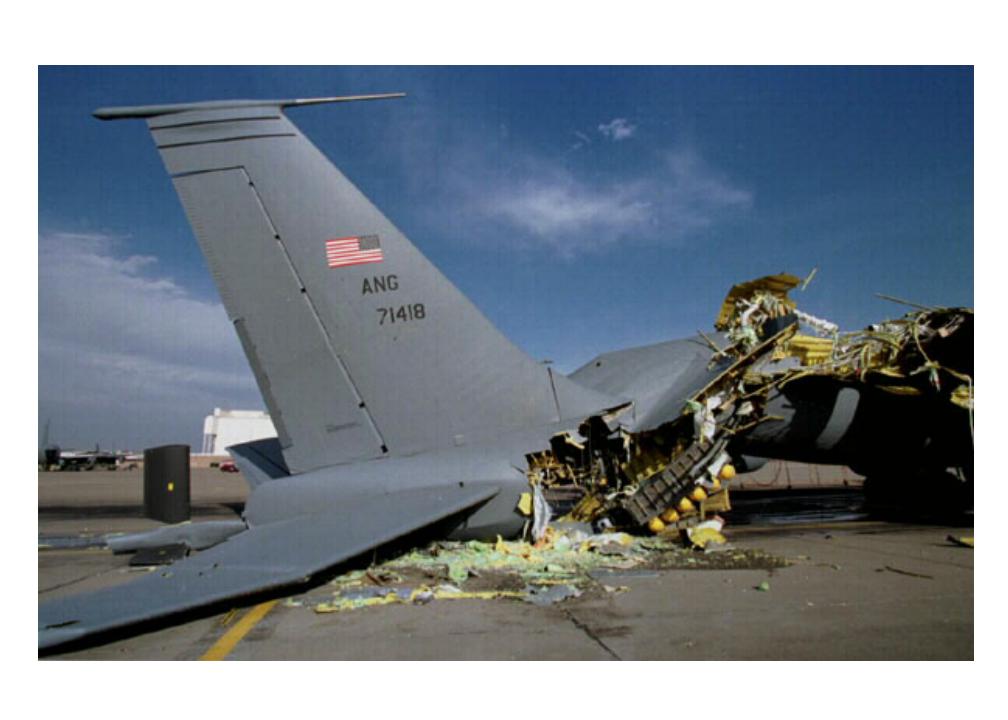
A KC-135 Aircraft was being pressurized at ground level. The outflow valves which are used to regulate the pressure of the aircraft were capped off during a 5-year overhaul and never re-opened. The post-investigation revealed that a civilian depot technician who “had always done it that way” was using a homemade gauge, and no procedure.
Apparently, the technician’s gauge didn’t even have a max “peg” for the needle, so it was no surprise he missed it when the needle went around the gauge the first time.
As the technician continued to pressurize the aircraft with the needle on its second trip around the gauge there was a “boom”. One KC-135 went bang! Indeed, the rear hatch was blown over 70 yards away, through a blast fence!
An incident like this is never funny and is further regrettable when we consider that this mistake is one that we taxpayers will end up paying for. Fortunately, no one was reported as being injured.
This was a good “Lessons Learned” for making sure we have trained people, with the correct tools, and who are following detailed procedures. It should serve as a reminder that just because you’ve always done it that way, it does not make it the “right” way!
A stirring set of pictures from the Queen’s Jubilee
At the end of June, pilot friend Bob Derham sent me an email which contained all of what follows. I ‘filed’ it away and then forgot I had received it! My apologies. But as Europe was the subject of yesterday’s post, then maybe this can be seen as remaining on theme. Enjoy.
oooOOOooo
One last look back at those amazing Jubilee celebrations . . . as seen by the ‘Tail-end Charlie’ in Britain’s last airworthy Lancaster
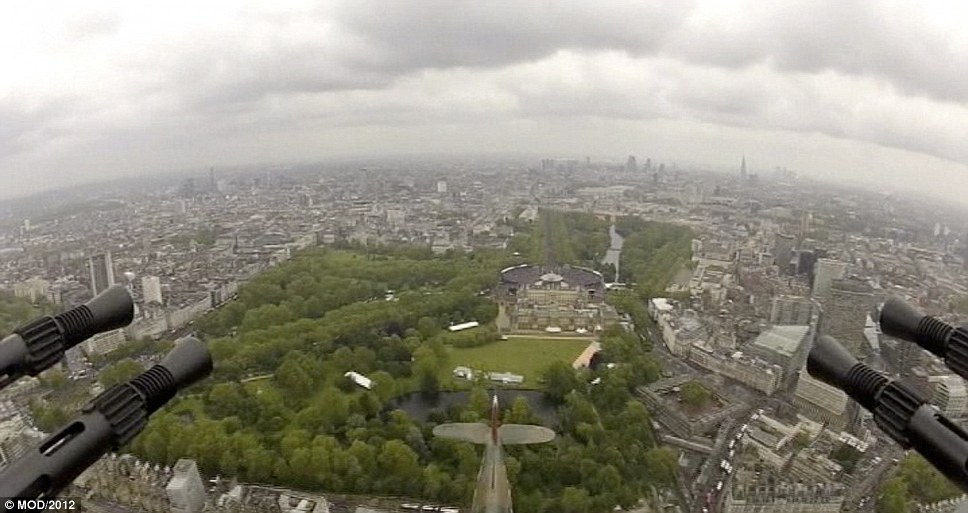
Incredible footage has been released showing the bird’s eye view enjoyed by the crew aboard a Lancaster bomber flying over London for the Queen’s Diamond Jubilee celebrations.
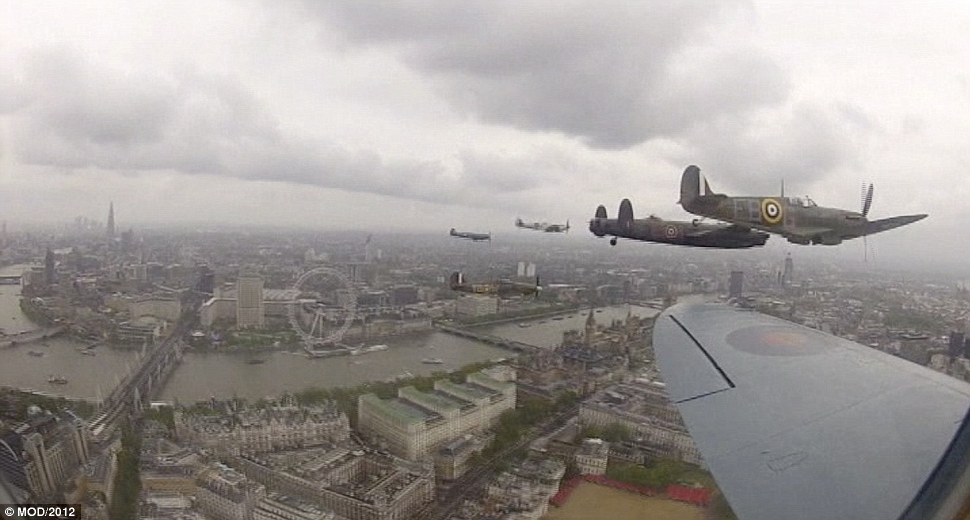
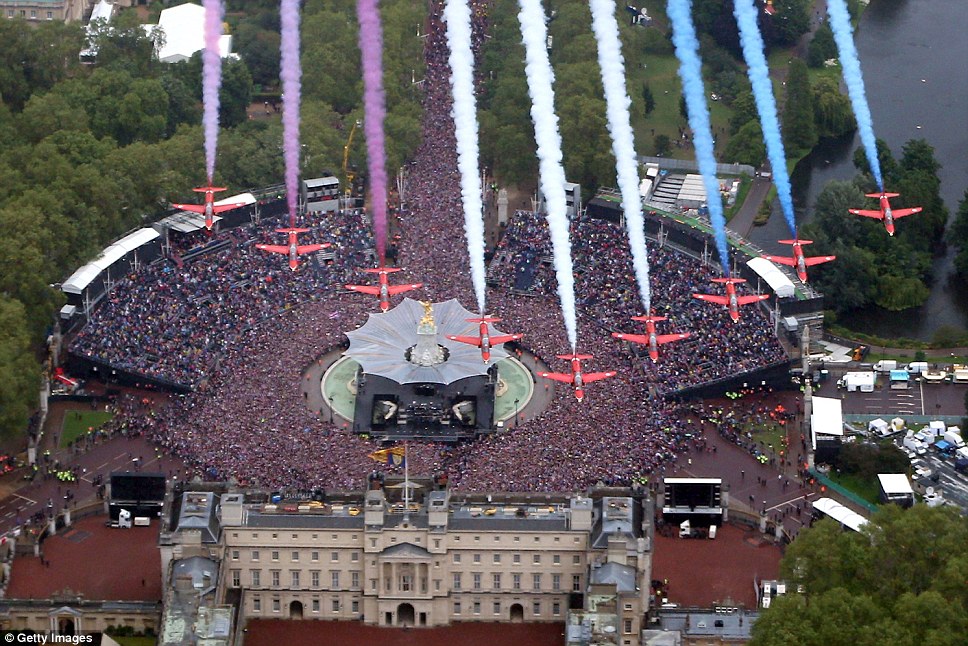
The aeroplane, which is part of the RAF’s Battle of Britain Memorial Flight (BBMF), flew in formation with aircraft including a Spitfire, Hurricane and Dakota transport aircraft down The Mall, followed by the Red Arrows aerobatic team – to the delight of crowds and the Royal Family at Buckingham Palace below.
As well as preserving a fleet of priceless aircraft and keeping them in tip-top flying condition, the BBMF reminds the nation of the sacrifices made during World War Two.
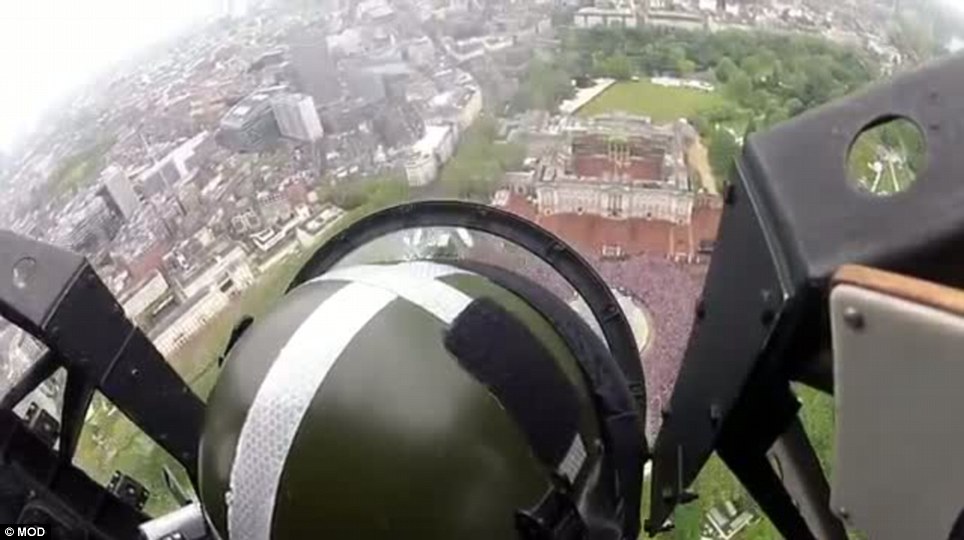
Spectacular: The tail gunner’s view from the Lancaster bomber, as it completed the Diamond Jubilee flypast. Buckingham Palace Gardens can be seen behind the tail of a Hurricane fighter, also of the Battle of Britain Memorial Flight, which flew in formation with the LancasterFinal approach: Having lined up on The Mall, the RAF Battle of Britain Memorial Flight Lancaster flies towards Buckingham Palace with St James’ Park on the left and Birdcage Walk beyond.The nose of the Lancaster passes over the Memorial to Queen Victoria in front of Buckingham Palace.
The BBMF is based at RAF Coningsby in Lincolnshire with many of its personnel, including pilots, acting as volunteers; the flight costs about £3m a year to run.
Squadron Leader Ian Smith, who is in charge of the BBMF, is the only permanent member, with all of the remaining pilots, navigators, air engineers and other crew coming from different airbases and ordinarily flying several different types of aircraft; from Typhoon fighters to the huge Hercules transport plane.
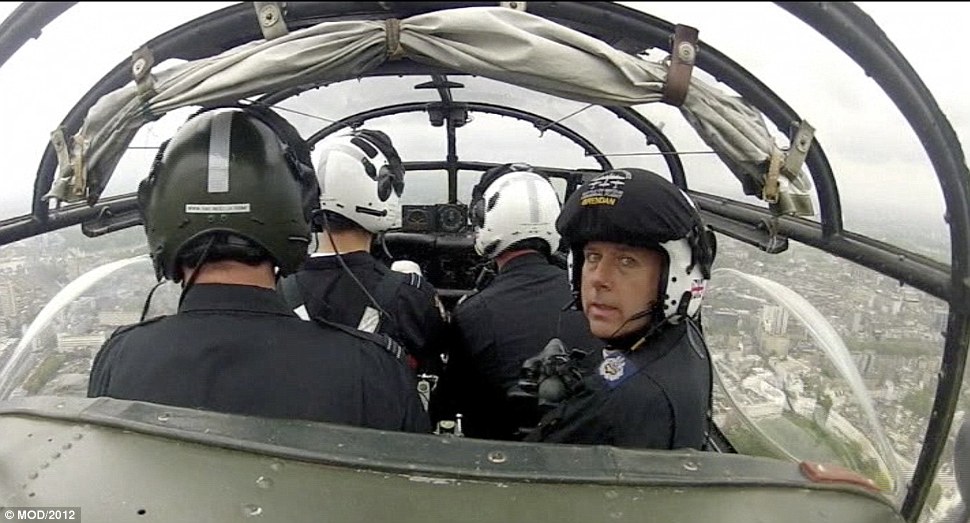
Cramped: The footage shows just how tight a fit it can be aboard a vintage aircraft and what a tight squeeze it is for the crew aboard the Lancaster bomber.
The aircrew give up three out of every four weekends from May to the end of September in order to fly and display the historic aircraft.
The footage, released by the Ministry of Defence, shows just how tight a fit it can be aboard a vintage aircraft, with the crew – clearly eager to catch a glimpse of the Queen – taking up most of the available space.
The historic flight includes the Lancaster, which first saw service in 1942. The ‘Lanc’ was the most famous of the Second World War bombers and gained renown for its starring role in the momentous ‘Dambuster’ raid on Germany’s Ruhr Valley in 1943.
Carrying a payload of 22,000lb and with a 1,500-mile range, the RAF bomber wreaked havoc on Germany. Some 3,500 were lost in action during the war.
The view of Buckingham Palace and The Mall beyond from the Lancaster bomber.In formation: Incredible footage has been released showing the view enjoyed by crew aboard a Lancaster bomber flying over London for the Queen’s Diamond Jubilee celebrations.
Hurricane single-seater fighters played a crucial role in the Battle of Britain. Heavier and slower than the Spitfire, it was considered the RAF’s ‘workhorse’ against the Luftwaffe.
A remarkable total of 14,533 Hurricanes were built and served operationally on every day and in every theatre during the war. Only 12 are still airworthy worldwide.
The Spitfire is the iconic fighter that won legendary status against the Luftwaffe in the Battle of Britain. It possessed a top speed of 378mph, an altitude of 35,000ft and armed with two 20mm cannons, four Browning machine guns and two 250lb bombs.
One of the four that flew yesterday was P7350 – the oldest airworthy Spitfire in the world and the only one which actually fought in the Battle of Britain. It was shot up by a Messerschmitt 109 during combat in October 1940 but its wounded Polish pilot Ludwik Martel managed to crash-land it, wheels up, near Hastings.
The pride of Britain: The vintage planes – all powered by classic World War Two Merlin engines – roar across the London sky.Flypast: The Duchess of Cornwall, the Prince of Wales, the Queen, the Duke and Duchess of Cambridge and Prince Harry watch the aerial action.Aerobatic aces: The Red Arrows display team fly in formation over Buckingham Palace.Stirring image: The Lancaster, centre, was accompanied by two Spitfires on both flanks and tailed by a Hurricane.
oooOOOooo
A wonderful and incredibly nostalgic set of photographs. Finally, let me close with a short piece of video of that Lancaster Bomber in flight.
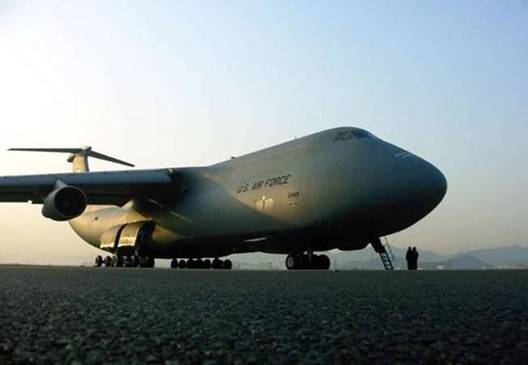
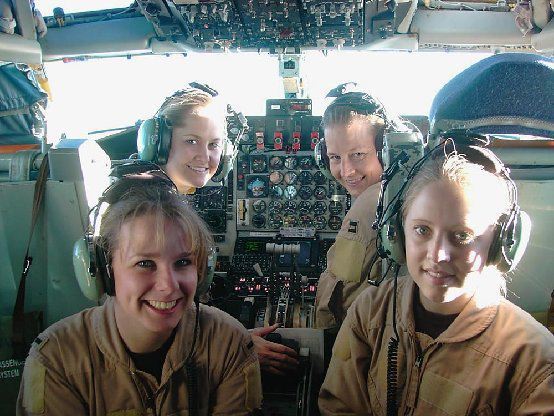
While the C-5 was turning over its engines, a female crewman gave the G.I.s on board the usual information regarding seat belts, emergency exits, etc.
Finally, she said, ‘Now sit back and enjoy your trip while your captain, Judith Campbell, and crew take you safely to Afghanistan‘
An old Master Sergeant sitting in the eighth row thought to himself, ‘Did I hear her right? Is the captain a woman? ‘
When the attendant came by he said ‘Did I understand you right? Is the captain a woman?‘
‘Yes,’! said the attendant, ‘In fact, this entire crew is female.’
‘My God,’ he said, ‘I wish I had two double scotch and sodas. I don’t know what to think with only women up there in the cockpit.’
‘That’s another thing, Sergeant,’ said the crew member, ‘We No Longer Call It The Cockpit‘
‘It’s The Box Office.’
oooOOOooo
Quote for today:
‘Whatever you give a woman, she will make greater. If you give her sperm, she’ll give you a baby. If you give her a house, she’ll give you a home. If you give her groceries, she’ll give you a meal. If you give her a smile, she’ll give you her heart. She multiplies and enlarges what is given to her. So, if you give her any crap, be ready to receive a ton of shit.’
Big thanks to Cynthia S. for forwarding this to me.
Before writing about Brutus, did you read yesterday’s item about George, the rescue dog, and the wonderful effort to raise funds for more life-saving efforts? If not, read it here. Whatever you can spare, please donate to this super cause.
Now to Cynthia’s item, that has been fairly widely spread across the internet.
How to hug a baby
Brutus
Thought you might like to know about this dog and his history, I especially like the ending, Cynthia.
The dog above is Brutus, a military dog at McChord.. . He’s huge, part Boxer and part British Bull Mastiff, and tops the scales at 200 lbs. His handler took the picture and explains, “Brutus is running toward me because he knows I have some Milk Bone treats, so he’s slobbering away! I had to duck around a tree just before he got to me in case he couldn’t stop, but he did.”
Brutus was the recipient of the Congressional Medal of Honor last year from his tour in Iraq. His handler and four other soldiers were taken hostage by insurgents. Brutus and his handler communicate by sign language and he gave Brutus the signal that meant ‘go away but come back and find me’. The Iraqis paid no attention to Brutus. He came back later and quietly tore the throat out of one guard at one door and another guard at another door. He then jumped against one of the doors repeatedly (the guys were being held in an
old warehouse) until it opened. He went in and untied his handler and they all escaped. Brutus is the first dog to receive this honor, the Congressional Medal of Honor. If he knows you’re ok, he’s a big old lug and wants to sit in your lap. Enjoys the company of cats..
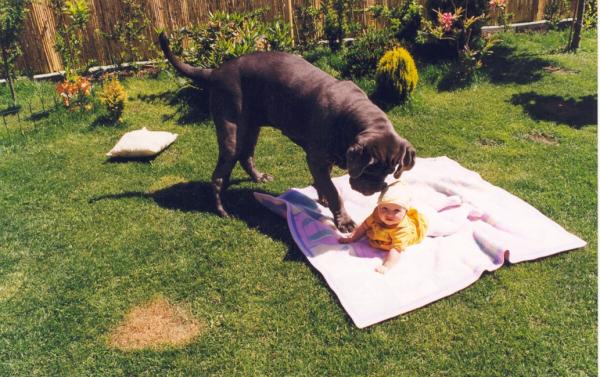
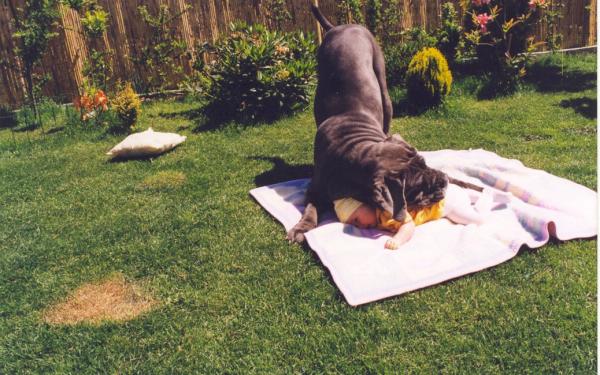
Instructions for properly hugging a baby with Brutus
(A quick Google search found that the words accompanying the same pictures on Daniela’s website, The Daily Tail, were perfect, thus they have been used.)
Step One – Place the baby on a flat, uncluttered surface. Important: Do not attempt this without the assistance of a qualified parent.
Step One
Step Two – Conduct a sniff test to verify the specimen is actually a baby. The scent of baby powder is usually sufficient evidence.
Step Two
Step Three – Carefully adjust the baby’s position until its head faces the mother’s camera. Note: Babies have two ends. The end covered with a hat or hair is the head. The end covered with a diaper is the butt. Babies do not have tails.
Step Three
Step Four – Lay your body down over baby. Do not apply pressure. While gently placing your paws around the baby’s body, lick your lips to condition them for the kiss (essential part of the hug).
Step Four
Step Five – Lean in toward the baby and let your heart melt. Repeat as necessary until the parent finds the camera and takes a perfect picture.
Yesterday, I wrote about the fabulous success of the British otter having gone from the crumbling edge of extinction to now being found in every English county.
For something completely different, and I do mean completely, have a read of this item that appeared in the British Guardian newspaper of the 18th August.
Aliens may destroy humanity to protect other civilisations, say scientists
Rising greenhouse emissions could tip off aliens that we are a rapidly expanding threat, warns a report
It may not rank as the most compelling reason to curb greenhouse gases, but reducing our emissions might just save humanity from a pre-emptive alien attack, scientists claim.
Watching from afar, extraterrestrial beings might view changes in Earth’s atmosphere as symptomatic of a civilisation growing out of control – and take drastic action to keep us from becoming a more serious threat, the researchers explain.
This highly speculative scenario is one of several described by a Nasa-affiliated scientist and colleagues at Pennsylvania State University that, while considered unlikely, they say could play out were humans and alien life to make contact at some point in the future.
Shawn Domagal-Goldman of Nasa’s Planetary Science Division and his colleagues compiled a list of plausible outcomes that could unfold in the aftermath of a close encounter, to help humanity “prepare for actual contact”.
Beneficial encounters ranged from the mere detection of extraterrestrial intelligence (ETI), for example through the interception of alien broadcasts, to contact with cooperative organisms that help us advance our knowledge and solve global problems such as hunger, poverty and disease.
Another beneficial outcome the authors entertain sees humanity triumph over a more powerful alien aggressor, or even being saved by a second group of ETs. “In these scenarios, humanity benefits not only from the major moral victory of having defeated a daunting rival, but also from the opportunity to reverse-engineer ETI technology,” the authors write.
Other kinds of close encounter may be less rewarding and leave much of human society feeling indifferent towards alien life. The extraterrestrials may be too different from us to communicate with usefully. They might invite humanity to join the “Galactic Club” only for the entry requirements to be too bureaucratic and tedious for humans to bother with. They could even become a nuisance, like the stranded, prawn-like creatures that are kept in a refugee camp in the 2009 South African movie, District 9, the report explains.
The most unappealing outcomes would arise if extraterrestrials caused harm to humanity, even if by accident. While aliens may arrive to eat, enslave or attack us, the report adds that people might also suffer from being physically crushed or by contracting diseases carried by the visitors. In especially unfortunate incidents, humanity could be wiped out when a more advanced civilisation accidentally unleashes an unfriendly artificial intelligence, or performs a catastrophic physics experiment that renders a portion of the galaxy uninhabitable.
To bolster humanity’s chances of survival, the researchers call for caution in sending signals into space, and in particular warn against broadcasting information about our biological make-up, which could be used to manufacture weapons that target humans. Instead, any contact with ETs should be limited to mathematical discourse “until we have a better idea of the type of ETI we are dealing with.”
The authors warn that extraterrestrials may be wary of civilisations that expand very rapidly, as these may be prone to destroy other life as they grow, just as humans have pushed species to extinction on Earth. In the most extreme scenario, aliens might choose to destroy humanity to protect other civilisations.
“A preemptive strike would be particularly likely in the early phases of our expansion because a civilisation may become increasingly difficult to destroy as it continues to expand. Humanity may just now be entering the period in which its rapid civilisational expansion could be detected by an ETI because our expansion is changing the composition of the Earth’s atmosphere, via greenhouse gas emissions,” the report states.
“Green” aliens might object to the environmental damage humans have caused on Earth and wipe us out to save the planet. “These scenarios give us reason to limit our growth and reduce our impact on global ecosystems. It would be particularly important for us to limit our emissions of greenhouse gases, since atmospheric composition can be observed from other planets,” the authors write.
Even if we never make contact with extraterrestrials, the report argues that considering the potential scenarios may help to plot the future path of human civilisation, avoid collapse and achieve long-term survival.
I am bound to say that if Mr Domagal-Goldman and his colleagues believe that spending time and money on the possible outcomes of contact with extraterrestrials is a good idea in these present times then I am minded about those other visitors from outer space who passed Planet Earth by because there were no signs of intelligent life!
















 Learning from Dogs