A pleasure to highlight the creative work of Ira Wiesenfeld DVM
Earlier on this week, we were fortunate in having a long-term friend of Jean and her late husband, Ben, stay with us. In distant times, Ira, him being the friend, had been a horse veterinarian but many years ago had changed course. As he explains on his web-site:
I grew up the scientist in an artistic family. I didn’t discover my right brain until midlife; my left was burned out and a crisis was upon me. First came the craft of blacksmithing, which I found therapeutic and immensely satisfying. Then a style of work developed that was biomorphic, botanical and branching. Finally a passion for sculpture evolved, made from forged, found, and fabricated metal.
Ten years ago I decided to get serious; I gave up my day job and began working full time in my smithy. Now I like to say that I forge and weld furniture, sculpture and anything in- between. I especially enjoy working in that in-between space, where aesthetics, function and narrative meet.
Ira was en-route to an exhibition in Portland which gave us the opportunity both to have him stay and for us to browse over some of the pieces he had with him.
Ira
oooo
My impromptu picture-taking didn’t do justice to this piece. A much better version is the one below taken directly from Ira’s website Circle of Iron Forge.
Iron and Copper Nestbowl.
oooo
Ira discussing with Jean what could be done with an old iron pulley-wheel we found here at home.
oooo
Just missing the water and fish!
Have to say that I was very impressed by both Ira’s creative artistry and his metal-working skills.
Let me leave you with one more example of Ira’s work, taken from his web-site and his contact details in case any of you dear readers are motivated to be in direct touch with Ira.
Empty Nest Forged and welded steel, copper, bronze, and stainless steel.
Ira Wiesenfeld DVM
Tucson, Arizona
Treeira@hotmail.com
520-742-5274
First of all a Very Happy Summer Solstice wherever you are (in the Northern Hemisphere!)
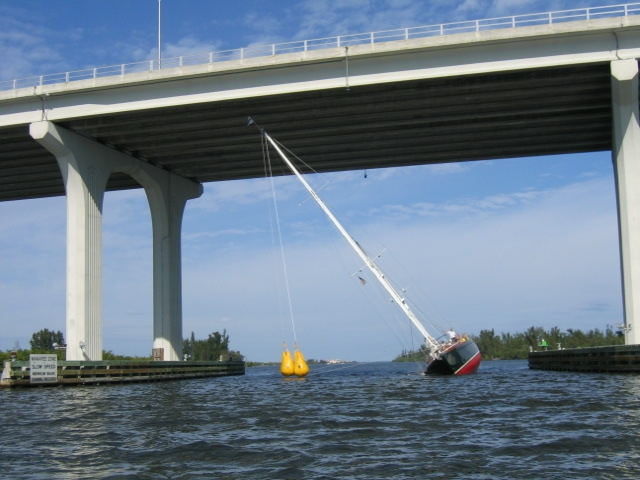
Neighbour Larry sent me a link to a delightful story about solving the problem of a yacht, with a mainmast stretching 85 feet above the water level, passing under a bridge that had a clearance of 65 feet above that same water level.
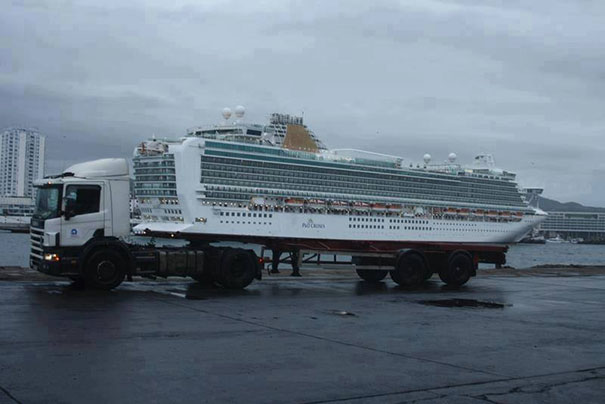
Here’s a picture to whet your interest. (Notice I wrote ‘whet’ not ‘wet’!)
A case of lateral thinking!
The story was reported in UK’s The Daily Mail newspaper nearly three years ago. So I shall take a chance and republish it for you.
Beats going the long way round! How sailors got their 80ft mast under 65ft bridge
It may not look like an entirely safe practice – but it sure beats going the long way round.
These sailors came up with an ingenious way to get their boat – complete with 80ft mast – under a 65ft bridge on the Intracoastal Waterway. A video posted on YouTube shows how the sailors keeled the boat over by dangling containers filled with two tons of water from the mast.
But it is not a solution for the faint hearted.
Any miscalculation with the weight has the potential to send the whole boat crashing into the water.
The sailor ‘hunterparrot’ who posted the video said he initiates the roll by fixing the containers to the mast and slowly turning to port. The severity of the roll is then controlled by letting the ropes affixed to the mast out gradually with a cockpit winch.
The intracoastal waterway is a 3000-mile network of waterways that run up the Gulf and Atlantic coasts of the U.S. It runs from New Jersey, around Florida to Texas.
Follow us: @MailOnline on Twitter | DailyMail on Facebook
The photographs in that Daily Mail article may be viewed here.
Really? If the bridge clearance is 65 feet and the mast height is 80 feet, then the cosine of the heel angle would be 65 / 80. This corresponds to a heel angle of about 36 degrees; the mast is 54 degrees above the horizontal. Still, a pretty impressive maneuver.
If the bags are full of water, then his setup is self-limiting. As the bags start to immerse, the pull on the halyard is reduced. This means he would be nearly unable to capsize unless he winches the bags WAY too high. I think he has done this trick before.
I think the reason he is sitting on the high side is twofold: He can see the masthead more easily and it is more comfortable
The weight of one person really doesn’t make much difference when you are trying to heel that big a boat that far.
If someone had to do this sort of trick a lot, would it be worth putting a small video camera on the top of the mainmast? This would make it easier to judge clearance.
How food and carbon-based energy are irresistibly woven together.
Jean and I watched this BBC Nature programme the other evening. Not directly from the BBC but because it has been uploaded to YouTube and thence was promoted on Top Documentary Films.
The film is 48-minutes long and, frankly, there’s not much point in reading the rest of the post until you have viewed the film!
Wildlife film maker Rebecca Hosking investigates how to transform her family’s farm in Devon into a low energy farm for the future, and discovers that nature holds the key.
With her father close to retirement, Rebecca returns to her family’s wildlife-friendly farm in Devon, to become the next generation to farm the land. But last year’s high fuel prices were a wake-up call for Rebecca. Realising that all food production in the UK is completely dependent on abundant cheap fossil fuel, particularly oil, she sets out to discover just how secure this oil supply is.
Alarmed by the answers, she explores ways of farming without using fossil fuel. With the help of pioneering farmers and growers, Rebecca learns that it is actually nature that holds the key to farming in a low-energy future.
Nature holds the key!
So, rather than tempt you to read on and not watch the film, that’s all you are getting for today! 😉
Settle yourself down somewhere comfortable and watch the film.
Today is Memorial Day for all Americans that have died while serving their country.
Just a short preamble.
I was born in London six months to the day before the day on which the second world war ended. On that day in early May, 1945 my mother breathed a sigh of relief and knew I was going to live! The fact that I am writing this post does rather confirm that! 😉
Not only is this the year of my seventieth birthday (but, PLEASE, don’t remind me!) but my mother is also still alive and well and is coming to see Jean and me in our Oregon home in ten weeks time.
I served as a Radio Operator in the Royal Naval Reserve between 1963 and 1968. That is the totality of my military experiences. Ergo, I have been more than fortunate not to have experienced military conflict at any time in my life.
So today’s post is just something gentle to remind us all of the advantages of freedom for humans and animals alike.
The Bear
An orphan bear cub hooks up with an adult male as they try to dodge human hunters.
Director: Jean-Jacques Annaud
Writers: James Oliver Curwood (novel), Gérard Brach (screenplay)
Stars: Tchéky Karyo, Bart the Bear, Youk the Bear
Sometimes less says more: a growl or a snarl can be worth a thousand words. Without any verbal dialogue, the raw emotions of the wilderness are vivid in this segment of The Bear, a film about the actions of animals in relation to humans. In this suspenseful part of the story, a cub is hunted by a mountain lion who shows no mercy. Without any verbal dialogue, the raw emotions of the wilderness shine through.
Film Reviews:
Storytelling doesn’t get much purer than this–a film with virtually no dialogue and not a minute that isn’t fascinating, either for the plot it pursues or the way director Jean-Jacques Annaud gets his ursine stars to do what he wants. The story deals with a young cub who, after his mother is killed in a landslide, bonds to a lumbering male Kodiak. The two of them then must cope with an invasion of hunters into their territory – and Annaud makes it clear whose side he’s on. Aside from stunning scenery, the film offers startlingly close-up looks at bear behavior. They say the best actors are the ones that let you see what they’re thinking, a trick Annaud manages with his big, furry stars. – Marshall Fine
The Bear has all the marks of a classic. Lauded by animal rights groups for its respect for the integrity of all species, it manages to speak out eloquently against the senseless hunting of wildlife without having to depict killing to make its point. Instead, it emphasizes the ties that bind the human and animal worlds together. – Frederic and Mary Ann Brussat
May your day wherever you are in the world be a peaceful one.
Taking a bit of an emotional rest after the last two days!
Wanted to share with you something that Dan Gomez sent me. It was an email with a link to an item in the British newspaper, The Independent. It was an article headlined: Incredible Nasa footage shows a ‘hole in the Sun’ that’s bigger than Jupiter. The article opened:
Nasa has released new footage showing a square ‘hole’ in the Sun captured by the space agency’s Solar Dynamics Observatory (SDO) spacecraft.
The phenomenon – known as a coronal hole – is perfectly normal and shows an area of the Sun’s corona that contains plasma with lower than average density. Nasa says that the coronal hole appears dark in the ultraviolet filter “as there is less material to emit in these wavelengths.”
It was then a simple matter to go to that NASA report and enjoy this stunning image.
Coronal Hole Squared
Coronal Hole Squared
A coronal hole, almost square in its shape, is one of the most noticeable features on the Sun of late (May 5-7, 2014). A coronal hole is an area where high-speed solar wind streams into space. It appears dark in extreme ultraviolet light as there is less material to emit in these wavelengths. Inside the coronal hole you can see bright loops where the hot plasma outlines little pieces of the solar magnetic field sticking above the surface. Because it is positioned so far south on the Sun, there is less chance that the solar wind stream will impact us here on Earth. Credit: Solar Dynamics Observatory/NASA
There were a total of twenty-four of these wonderful photographs sent to me by Su. Thus I am inclined to present them to you, dear reader, in a further two batches of eight over the next two weekends.
Yesterday, I posted about the prediction that in four billion years the Milky Way galaxy would collide with the Andromeda galaxy. I called the post Not of immediate concern.
Today, I am writing about something that is of immediate concern. That is if you regard the next couple of decades as ‘immediate’.
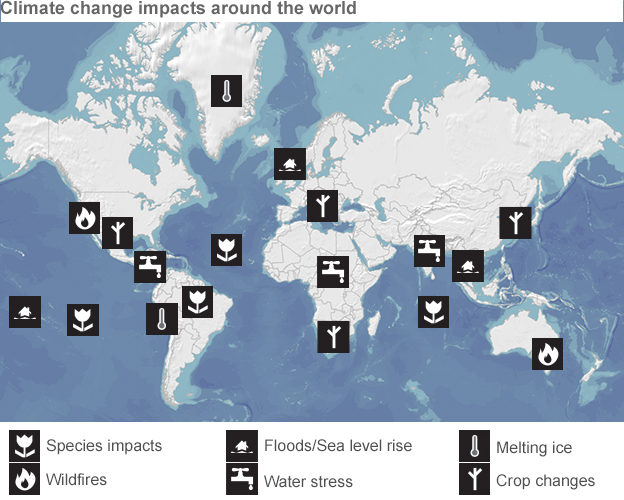
The post is prompted by an item that was published on the BBC News website two days ago. It carried the title Climate inaction catastrophic – US
Climate inaction catastrophic – US
By Matt McGrath
Environment correspondent, BBC News, Yokohama, Japan
The costs of inaction on climate change will be “catastrophic”, according to US Secretary of State John Kerry.
Mr Kerry was responding to a major report by the UN which described the impacts of global warming as “severe, pervasive and irreversible”.
He said dramatic and swift action was required to tackle the threats posed by a rapidly changing climate.
Our health, homes, food and safety are all likely to be threatened by rising temperatures, the report says.
Scientists and officials meeting in Japan say the document is the most comprehensive assessment to date of the impacts of climate change on the world.
In a statement, Mr Kerry said: “Unless we act dramatically and quickly, science tells us our climate and our way of life are literally in jeopardy. Denial of the science is malpractice. There are those who say we can’t afford to act. But waiting is truly unaffordable. The costs of inaction are catastrophic.”
Putting to one side the mild irony of a representative of the US Government wringing his hands about what mankind is doing to our climate, the report is valuable and potentially significant.
The report was from the Intergovernmental Panel on Climate Change (IPCC) which is, as their website explains:
The Intergovernmental Panel on Climate Change (IPCC) was established by the United Nations Environmental Programme (UNEP) and the World Meteorological Organization (WMO) in 1988 to assess the scientific, technical and socio-economic information relevant for the understanding of human induced climate change, its potential impacts and options for mitigation and adaptation.
Watch this 5-minute video of Stanford professor Dr. Chris Field, co-chair of that IPCC working group, addressing some of the key questions raised by this latest report. In particular, focus on Dr. Field discussing the potential of the loss of the Greenland ice cap around 3 min 30 seconds.
Back to the BBC report (which you should read in full!). Back to Dr. Chris Field being quoted as saying:
I think the really big breakthrough in this report is the new idea of thinking about managing climate change as a problem in managing risks. Climate change is really important but we have a lot of the tools for dealing effectively with it – we just need to be smart about it.
It would be easy to get into the mindset that humanity is not going to change its ways in time.
But, then again, the pace of growing awareness about what the changes are that we all need to make, and make relatively soon, is dramatic.
Maybe, just maybe, this will turn out alright!
For all the young people in the world, I do so hope!
Or, perhaps I should have written that sub-heading, “Adding a gloss to what are mostly bright days!”.
What on earth am I rabbeting on about?
From time to time on Learning from Dogs I have touched on the topic of democracy. The most recent post of any relevance was on the 27th January this year in a post called Unconditional love. In essence that blog post was recording an email exchange between Martin Lack, Chris Snuggs and Patrice Ayme. Let me reproduce a part of that ‘discussion’:
Paul: Chris/Martin, To my way of thinking, there is a more fundamental issue at work. That is the corrupting effect of power. I’m certain you know the famous saying. Thus whatever fine motives propel a person to enter politics, that person seems unable to avoid the call of power and its corrupting effect. The only hope is that key countries, and none so key as the USA, evolve a better, more representative, political process. Otherwise, I fear for the coming years.
Patrice: I agree with Paul 100%. I saw the call of power. Unimaginable. People just get insane. There are also filtering systems to insure they get that way (it starts right away with one week retreats in extremely posh resorts; does not matter if you are capitalist, socialist, blueist, reddist, ecologist, independentist, etc.).
Chris: Agreed. It has been clear time and time again throughout history. Well, so much is obvious, but WHAT TO DO about it?
A) We must end the practice of having career politicians: you serve a maximum of TEN years, at the end of which you go.
B) Inherited wealth allowing the building up of immensely powerful family dynasties over generations must be ended. It is simply untenable. The rich-poor gap is getting obscene everywhere, and money is of course power. My “Abolish inheritance” idea will be wildly unpopular because we are naturally acquisitive and “greedy” and of course would hit those with most to lose who also therefore have the most power.
Patrice: With all due respect, Chris and Martin sound rather naïve… Huge wealth and power is where it’s at. And it attracts to politics first, foremost, and soon uniquely, those it attracts most, namely the basest sort.
Without in any way of knowing in a reliable manner, as in statistically reliable, the attitudes of folk, nonetheless there is no question that a huge number of the ordinary folk that live around us here in Merlin, Joesephine County, Oregon and others that one meets in the course of being ‘out and about’ are worried; frequently deeply worried.
Worried about the “Huge wealth and power ..” and the gross inequalities that flow from that.
So with that in mind, consider the pleasant surprise offered me when I read the day’s roundup from the Permaculture Research Institute email distribution and it included:
The Missing Part of the Internet – Collaborative Decision-Making Made Easy with Loomio
The world needs a better way to make decisions together
“The new era of digital democracy is one source of hope. New formats for web-based participation, like Loomio, and enablers of grassroots engagement… are flourishing.” —The Huffington Post
Democracy isn’t just about politics — it’s people getting together and deciding how things should be. It’s a skill we can practice with people wherever we are: in our workplaces, our schools, and our communities.
Loomio is a user-friendly tool for collaborative decision-making: not majority-rules polling, but actually coming up with solutions that work for everyone. We’re a small team in New Zealand, and we’ve built a prototype that people are already doing great things with. Now we’re crowdfunding so we can build the real thing: a new tool for truly inclusive decision-making.
It was but a hop and a skip to go to the Loomio website and read:
The world needs a better way to make decisions together.
Help us build it.
Loomio is free and open software for anyone, anywhere, to participate in decisions that affect them
and then with a further mouse-click on the Crowdfunding link to read:
THE WORLD NEEDS A BETTER WAY TO MAKE DECISIONS TOGETHER.
Democracy isn’t just about politics – it’s people getting together and deciding how things should be. It’s a skill we can practice with people wherever we are: in our workplaces, our schools, and our communities.
Loomio is a user-friendly tool for collaborative decision-making: not majority-rules polling, but actually coming up with solutions that work for everyone. We’re a small team in New Zealand, and we’ve built a prototype that people are already doing great things with. Now we’re crowdfunding so we can build the real thing: a new tool for truly inclusive decision-making.
At this point, I should declare an involvement. Jean and I decided to donate a modest amount. Thus it is not from an impartial position that I close today’s post with the following video. Bet you will be impressed!
If you enjoyed that video then do watch the following TED Talk.
Published on Aug 4, 2013
Ben Knight is part of a cooperative social enterprise building Loomio, an online tool for collaborative decision-making being used by thousands of people in more than 20 countries. Ben will be picking through ideas around how technology can enable everyday democracy.
It’s fair to say that today’s guest author writes about a topic as far removed from yesterday’s eloquent post as one could imagine. Readers will recall that yesterday’s post from Georgiana was on the subject of Man’s best Friend. It was called Just love.
Today’s guest post is all about dog fences! As I said very different from Georgiana’s essay. Yet there is a link. Both guest posts are about dogs.
About a month ago, I received an email from a Rohit Agarwal offering to write “a well written and resourceful article on topic related to dogs.” When I discovered that the article was about underground fences, I was sceptical about the value of such an essay. Then when I read the essay it struck me as a very sensible topic; the one of keeping dogs safely within their own property.
I had no foreknowledge of Rohit, who described himself thus:
Author Bio: Rohit is a dog lover and pet enthusiast; he owns two adorable and wonderful dogs that include a German shepherd and a Labrador retriever. As work keeps him away from home, concerns arise about the safety and comfort of his pet friends, which made him try out various products that facilitate the same. Recently he was worried about leaving his dogs in the yard of his house and tried the underground fence for dogs, which worked great.
Rohit also made clear that he is a contributor to Petstek.com, the company behind the link in the last sentence of his bio. So here is the article.
ooOOoo
Five Reasons Why an Underground Fence is Right for Your Dog.
Most of us love the company of a cuddly and playful dog, as dogs are the considered to be the best pets since their very existence. While it’s great to keep the friendly and loyal canines in your house, one often needs to take care of the dog and protect them from their surroundings while still making sure that the dog gets adequate freedom within your house’s boundaries without it feeling like it has been incarcerated in a concrete prison. We all have tried using leashes, chains and cages, but we know that those methods to contain are not only old fashioned but also to a certain degree, inhuman, especially for the dog that is so friendly and loyal to you. Modern technology today has brought forth a new revolutionary technology called in-ground or underground fence for dogs.
The underground dog fence is a virtual fence which is installed using a special wire that is buried according to the perimeter you want to set for your pet. The wire is coded with signals, and a special collar is worn by the dog, as soon as the dog approaches the buried wire, the collar around its neck makes a warning signal, and as soon as the dog gets too close to the virtual fence, it receives a minor electric shock via the collar which is technically harmless to the pet. Let’s discuss the advantages of installing this system.
1. Freedom To The Dog
Well, we like to have our pets without leashes or chain bound, and we’re sure that no one gets a dog to keep it chained all the time, the underground fence not only provides the dogs adequate freedom of movement but also is more effective and ‘humane’ than chains and leashes. It’s a great solution for the busy pet owners who get a little less time to take their dogs for a walk, but one cannot keep the dog on a leash or in a cage all the time, making it an effective solution.
2. Cost Effective As Compared To Real Fencing
The underground fence for dogs is certainly more cost effective than installing a real fence, which in turn requires really expensive maintenance. Not to mention its increase in cost depending on the material you choose and the installation cost is just a cherry on top of the icing that can totally topple your budget into smithereens. To make sure your pocket doesn’t come between the relationship that you share with your dog, the underground fence is a great option to save you from the regret of ever adopting a pet.
3. A Perfect Solution For Zoning Laws
In many cities or townships there are zoning laws that prohibit you from building fences around your house. If not the laws, then many a times your beloved neighbour might not like you building huge fences around your house and is often backed by the neighbourhood associations. An underground fence for dogs is a great option to keep your loyal guard away from them nosey neighbours.
4. Protection For The Dog And The Environment
It not only keeps your dog protected from straying into places you wouldn’t want it to go, but also is a great solution to keep certain areas of the house such as pools and your wife’s kitchen garden protected and out of reach of the ever curious dogs. Especially from that trash can you don’t want your dog snooping around and creating a litter you might have to clean up. It’s also a great way to keep your neighbours who often complain about the dog strolling and littering their yard.
5. Well Hidden To Maintain The Look Of Your House
While fences might work great for some, most of the time they look ugly, especially when none of the houses in your neighbourhood have fences. The underground fence is a great solution to such a problem. It works as a virtual barrier to not only keep your pet protected from straying in the hostile outside world, but also maintain that great look of your beloved abode.
The underground pet fence with the aforementioned advantages is a great option to keep your pet safe and well contained while giving it freedom of movement which is entirely unhindered and free from any leashes, cages or visible boundaries as we all know that ‘happy pets make happy owners’.
On Monday and Tuesday of the week I posted Legitimate Anger and Legitimate Hope. (And please see the footnote to today’s post)
Patrice Ayme left the following comment to the Legitimate Hope post:
It’s hard to live with elephants, especially in poor, crowded conditions. I remember bathing in Africa as a child with a bull elephant 200 meters away, on the other side of a stream, and being extremely worried, with all in attendance.
Europe used to have elephants, and North America, two species. Time to reintroduce them, and live according to our discourse.
Rewilding Euramerica can be done, and should be done, for the deepest philosophical and emotional reasons, and will create new, very productive jobs.
PA
Then on Friday came an email from reader and blogger Martin Lack:
It was but a moment to go across to The Conversation website (rather liked what I saw, by the way) and find the article that Martin linked to. It is republished here within the terms of The Conversation site.
ooOOoo
Restore large carnivores to save struggling ecosystems
By William Ripple, Oregon State University
We are losing our large carnivores. In ecosystems around the world, the decline of large predators such as lions, bears, dingoes, wolves, and otters is changing landscapes, from the tropics to the Arctic. Habitat loss, persecution by humans and loss of prey have combined to inflict great losses on these populations.
In fact more than 75% of the 31 largest carnivore species are declining, and 17 species now occupy less than half their former ranges. Southeast Asia, southern and East Africa, and the Amazon are among areas in which multiple large carnivore species are declining. And with only a few exceptions, large carnivores have already been exterminated from much of the developed world, including areas of Western Europe, and the eastern United States.
Top dogs keep ecosystems in order
Many of these large carnivore species are endangered and some are at risk of extinction, either in specific regions or entirely. Ironically, they are vanishing just as we are learning about their important ecological effects, which is what led us to write a new paper in the journal Science to document their role.
From a review of published reports, we singled out seven species that have been studied for their important ecological role and widespread effects, known as trophic cascades. These are the African lion, leopard, Eurasian lynx, cougar, gray wolf, sea otter and dingo.
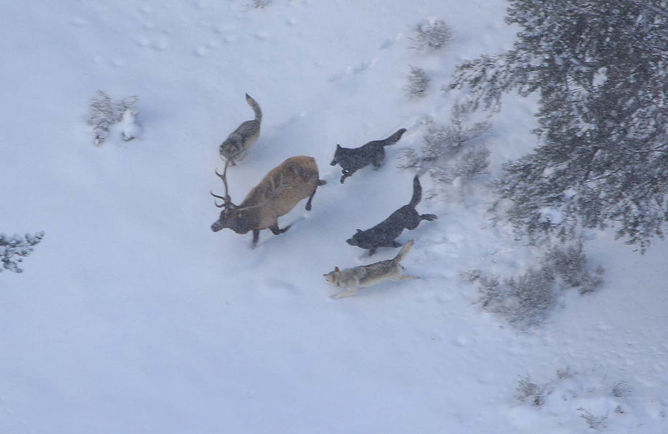
Based on field research, my Oregon State University co-author Robert Beschta and I documented the impact of cougars and wolves on the regeneration of forest tree stands and riverside vegetation in Yellowstone and other national parks in western North America. Fewer predators, we found, lead to an increase in browsing animals such as deer and elk. More browsing disrupts vegetation, reduces birds and some mammals and changes other parts of the ecosystem. From the actions of the top predator, widespread impacts cascade down the food chain.
Similar effects were found in studies of Eurasian lynx, dingoes, lions and sea otters. For example in Europe, absence of lynx has been closely tied to the abundance of roe deer, red fox and hare. In Australia, the construction of a 3,400-mile dingo-proof fence has enabled scientists to study ecosystems with and without dingoes which are closely related to gray wolves. They found that dingoes control populations of herbivores and exotic red foxes. The suppression of these species by dingoes reduces predation pressure, benefiting plants and smaller native prey.
In some parts of Africa, the decrease of lions and leopards has coincided with a dramatic increase in olive baboons, which threaten crops and livestock. In the waters off southeast Alaska, a decline in sea otters through killer whale predation has led to a rise in sea urchins and loss of kelp beds.
Predators are integral, not expendable
We are now obtaining a deeper appreciation of the impact of large carnivores on ecosystems, a view that can be traced back to the work of landmark ecologist Aldo Leopold. The perception that predators are harmful and deplete fish and wildlife is outdated. Many scientists and wildlife managers now recognise the growing evidence of carnivores’ complex role in ecosystems, and their social and economic benefits. Leopold recognised these relationships, but his observations were ignored for decades after his death in 1948.
Top carnivores, at work keeping things in check. Doug Smith
Human tolerance of these species is the major issue. Most would agree these animals have an intrinsic right to exist, but additionally they provide economic and ecological services that people value. Among the services documented in other studies are carbon sequestration, restoration of riverside ecosystems, biodiversity and disease control. For example, wolves may limit large herbivore populations, thus decreasing browsing on young trees that sequester carbon when they escape browsing and grow taller. Where large carnivore populations have been restored – such as wolves in Yellowstone or Eurasian lynx in Finland – ecosystems appear to be bouncing back.
I am impressed with how resilient the Yellowstone ecosystem is, and while ecosystem restoration isn’t happening quickly everywhere in this park, it has started. In some cases where vegetation loss has led to soil erosion, for example, full restoration may not be possible in the near term. What is certain is that ecosystems and the elements of them are highly interconnected. The work at Yellowstone and other places shows how species affect each another through different pathways. It’s humbling as a scientist to witness this interconnectedness of nature.
My co-authors and I have called for an international initiative to conserve large carnivores in co-existence with people. This effort could be modelled after a couple of other successful efforts including the Large Carnivore Initiative for Europe, a non-profit scientific group affiliated with the International Union for the Conservation of Nature, and the Global Tiger Initiative which involves all 13 of the tiger-range countries. With more tolerance by humans, we might be able to avoid extinctions. The world would be a scary place without these predators.
William Ripple does not work for, consult to, own shares in or receive funding from any company or organisation that would benefit from this article, and has no relevant affiliations.
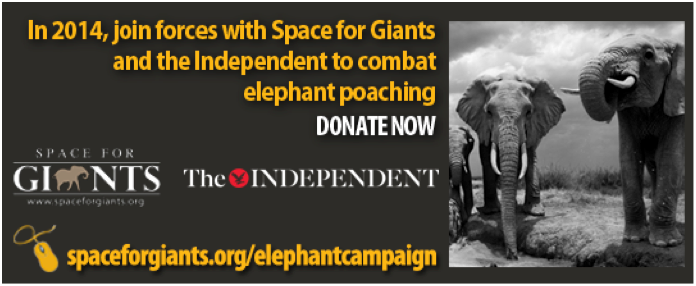
In 2011, more African elephants were killed than any other year in history. The figures for 2012 and 2013 are not yet known, but are likely to be even higher. At current rates, in twelve years, there will be none left.
It is a familiar cause, but it has never been more urgent. Poaching has turned industrial. Armed militia fly in helicopters over jungle clearings, machine gunning down entire herds. Their tusks are then sold to fund war and terrorism throughout the continent and the wider world. Ivory is still illegal, but as China booms, it is more popular than ever.
This campaign will raise money to support rangers on the ground to protect Kenya’s elephants from armed poachers, together with Space for Giants’ longer term work to create new wildlife sanctuaries where elephants will be safe, forever. More can be found about the charity at Space for Giants
The article above includes two videos. A shorter one that can be viewed on the paper’s campaign website. Then there is a longer, five-minute, video also on YouTube and included below.
Jean and I wanted to make a donation but found that without a UK bank account/UK Visa card it wasn’t possible. We contacted Space for Giants and received the following email from Amy.
Hi Paul
Sorry for the difficulties and thank you for your perseverance!
You can donate in USD through our CrowdRise page at www.crowdrise.com/spaceforgiants1. These funds are sent to TUSK USA who will then allocate them to us.
Alternatively, you can make out a cheque to ‘TUSK USA’ and send to TUSK USA, 40 East 94th Street, Apt 3A, New York, NY 10128 – please attach a covering note confirming that you would like your donation to be used to support the work of Space for Giants.
Many thanks,
Amy.
So if there’s anyone else out there not in the UK who would like to donate, here’s another option.
Please, for all our sakes, help these beautiful creatures.










 Learning from Dogs