Category: Innovation

A ‘growing’ awareness.

The pun is deliberate!

Just at the moment there seems to be an incredible explosion of awareness about the need to change. Won’t say anymore other than from the day of the Winter Solstice, less that two weeks away, I will be publishing a number of posts about this new awareness and the implications, the positive implications, for the coming years.

To set the tone, I am republishing an article that appeared on the website of the organisation Nature Needs Half. I am grateful for their permission to so do.

ooOOoo

Nature Needs Half in the Earth Island Journal

Originally published in the Earth Island Journal by William H. Funk

Conservation group promoting an ambitious new proposal for wilderness protection

During the last half century conservationists around the world have won some impressive victories to protect wild places. Here in the US, the Wilderness Act preserves some 110 million acres of public land. Private holdings by groups like The Nature Conservancy safeguard tens of millions of additional acres. The idea of protecting ecosystems from industrial development has spread around the world. There’s the Mavuradonha Wilderness in Zimbabwe, the El Carmen ecosystem in northern Mexico, Kissama National Park in Angola, and the Tasmanian Wilderness in Australia, to name just a few stunning parks and preserves; UNESCO’s world heritage list includes 197 sites of special beauty and/or biodiversity.

Photo by Trey Ratcliff Nature Needs Half has set out an unbelievable challenge: to formally, legally set aside one half of Earth’s land and water as interconnected natural areas.

But conservation biologists now recognize that these sanctuaries are limited in what they can accomplish precisely because they are special — which is to say, rare. Parks and preserves are all too often islands of biological integrity in a sea of human development. To really protect natural systems, healthy biomes need to be the rule, not the exception.

To achieve that vision, The WILD Foundation, a multinational NGO based in Boulder, Colorado, is pushing a bold concept called “Nature Needs Half.” In a world in which even the wealthiest governments routinely abdicate their responsibilities toward future generations and the environment, Nature Needs Half has set out an unbelievable challenge: to formally, legally set aside one half of Earth’s land and water as interconnected natural areas.

This is, of course, a hugely ambitious endeavor, opposing as it does the assumption that Earth’s resources are here to be exploited solely by humans. We live in what some have called the “Anthropocene,” the Age of Man, a world in which every aspect of physical being, from the oceanic depths to the troposphere, has been radically altered by humankind. Rivers are being dammed, forests leveled, oceans emptied and wildlife eradicated. It’s not a pretty picture, but as an empiric truth it’s difficult to refute. Consider a few facts:

The long-term acidification of the oceans by our ongoing buildup of industrial carbon dioxide is killing off coral reefs around the world, resulting in the loss of a critical barrier to storm surge and further endangering coastal areas at heightened risk from rising seas and stronger and more frequent storms.

Hydropower is increasingly being developed in South America, South Asia and sub-Saharan Africa, preventing the migration of anadromous fishes and destroying the elaborate flood-regime ecosystems of biomes like the Amazon.

The accelerating rate of animal and plants extinctions under the twin hammers of climate change and habitat loss is being compared to Earth’s five other extinction events that followed catastrophic geophysical change such as meteor impact or sudden tectonic shifts. In the case of the sixth great extinction, however, the root cause is purely biotic: us. Either from directly causing species decline through poaching, habitat conversion and the introduction of competitive exotic species, or by indirectly altering ecosystems through our industrial assault on the planet’s atmosphere, one in eight birds, one in four mammals, one in five invertebrates, one in three amphibians, and half of the world’s turtles are facing the eternal night of extinction.

Given those facts, the Nature Needs Half goal is startling in the grandiosity of its vision and the ambitious range of its projects. It is also, in a word, fair. “Half the world for humanity, half for the rest of life, to make a planet both self-sustaining and pleasant,” is how eminent naturalist E.O. Wilson explains the idea in his book The Future of Life. Other endorsers include marine explorer Sylvia Earle and the Zoological Society of London. And while the scope and scale of Nature Needs Half is unprecedented, conservation groups such as the World Wildlife Fund recognize that connecting biodiverse “hotspots” must guide preservation efforts.

The stated goal of Nature Needs Half is “to ensure that enough wild areas of land and water are protected and interconnected (usually at least about half of any given ecoregion) to maintain nature’s life-supporting systems and the diversity of life on Earth, to ensure human health and prosperity, and to secure a bountiful, beautiful legacy of resilient, wild nature.” Underlying this objective is the assumption that humanity, despite its often destructively “unnatural” behavior, is inescapably a part of life on Earth, and that efforts to preserve and protect untrammeled wilderness areas are ultimately means of assuring that the ecosystem services people depend upon are available to us in the distant future. We’re all in this together, and the sooner H. sapiens gets that through its pointy little head, the better off we’ll all be.

How is “protected” defined? The International Union for the Conservation of Nature defines it quite flexibly: “A protected area is a clearly defined geographical space, recognized, dedicated and managed, through legal or other effective means, to achieve the long term conservation of nature with associated ecosystem services and cultural values.” Thus any number of means may be put into play to preserve land, from conservation easements in Virginia to armed ranger patrols in Namibia; what matters is the end result, namely the retention of naturally functioning ecosystems over time.

During the past two decades scientists have determined that the planet’s ecoregions need at least 50 percent ecological integrity, and in some cases more, to ensure the survival of their biological productivity over the long term. (In plain language, “ecological integrity” means that an area’s biodiversity and basic processes are mostly intact.) The goals of Nature Needs Half simply echo the empirical scientific reality: to function over time the world’s biomes need at least half of their structural integrity preserved from human alteration. We are currently falling short of that. A recent report from Yale’s Environmental Performance Index states that just17 percent of Earth’s terrestrial areas and inland waters, and less than 10 percent of marine areas, are currently protected (though for many parks and refuges in poorer countries this protection is often illusory), while about 43 percent remains relatively open and undeveloped, with low human populations and generally undamaged ecosystems.

Nature Needs Half is pursuing its aim in two simultaneous directions: the protection of at least half of the planet’s mostly intact contiguous wilderness areas — concentrating on Eurasian boreal forests, the Amazon basin and Antarctica — and the identification and protection of those fragments or hotspots of abundant biodiversity that have become isolated islands in a sea of human activity.

The aims of Nature Needs Half are precisely the kind of bold approach, rooted in cutting-edge science, which our increasingly desperate times call for. In an Anthropocene of radical climate change and accelerating species extinctions, nothing less than a grand vision of what might yet be achieved will bring about the preservation of our remaining unspoiled landscapes. As the most farsighted wilderness preservation program on Earth, Nature Needs Half promises to be the kind of revolutionary undertaking that, if its aims are fully or even mostly achieved, will be looked back on centuries from now as perhaps the most important attainment in modern human history.

William H. Funk
William H. Funk is a freelance writer, documentary filmmaker and environmental lawyer living in Virginia’s Shenandoah Valley. His work explores the confluences of the natural world, history, culture, law and politics, and as an attorney he has had broad experience with land preservation and endangered species. He may be contacted at williamfunk3@icloud.com or williamhfunk.weebly.com

ooOOoo

Rather puts my next book chapter, Community, into perspective; that chapter being published in thirty minutes time.

One clever man and his dog!

A reposting of a fascinating item regarding Ra Paulette.

As is the way of our interconnected world, I clicked on a link in a recent post over on Sue Dreamwalker’s blog that then took me to an item on a new blog site from Vision Keeper called World Metamorphosis. The item was about an American, Ra Paulette, who …

The American artist Ra Paulette has spent the last 10 years carving wondrous creations in the walls of a cave located in Northern New Mexico. For many years now, Paulette has walked to work into the hot desert, with only his faithful dog by his side. After much hard work, Paulette has finally allowed the public to view the incredible masterpiece he has been working on all of this time.

It all began with a mile long walk into the wilderness where Paulette discovered the cave. He has since transformed the everyday limestone walls into gorgeous hallways and spaces that are surprisingly full of light. Learn more about the man behind the carvings and check out the magnificent cave artwork here! (Source: Phoenix is Risen)

Caves1


Then it was a ‘hop, skip and a jump’ to go across to Ra Paulette’s website, where one reads such glorious details as:

Process

Process

Manual labor is the foundation of my self expression. To do it well, to do it beautifully, is a “whole-person” activity, engaging mental and emotional strengths as well as physical strength.

When digging and excavating the caves I break down all the movements into their simplest parts and reassemble them into the most efficient patterns and strategies that will accomplish the task while maintaining bodily ease. Like a dancer, I “feel” the body and its movement in a conscious way.

I’m fond of calling this “the dance of digging”, and it is the secret of how this old man can get so much done.

Then words that are more poem than anything else:

The Present

LUMINOUS CAVES
the world within the earth and ourselves

My final and most ambitious project is both an environmental and social art project that uses solitude and the beauty of the natural world to create an experience that fosters spiritual renewal and personal well being. It is a culmination of everything I have learned and dreamed of in creating caves.

A mile walk in the wilderness becomes a pilgrimage journey to a hand dug, elaborately sculpted cave complex illuminated by the sun through multiple tunneled windows. The cave is both a shared ecumenical shrine and an otherworldly venue for presentations and performances designed to address issues of social welfare and the art of well being.

In social art, creating the work of art is not the objective in itself, as in an exhibit, but is a means to bring about social change. The response to the artwork is not merely left to its audience as an endpoint in the process but is an element in a larger encompassing creative process. In the analogy of art being one of the colors on the social artist’s palette, the canvas would be society itself, its social conditions in a particular location. In using the aesthetic to address societal suffering, social art is not content with merely decorating the world; its intent is to change it.

Changing the world is a tall order. Art doesn’t attempt to force change through direct action but to catalyze it by affecting the emotional basis from which change can occur.

Begging the question, “How can we change what we do before we change how we feel?” Its underlying premise is that when through wonder and the sense of beauty we move from the emotional realm of our desires and fears to the more expansive and deeper feelings of thanksgiving and appreciation of life with a sense of its sacredness, our actions will automatically be modified, creating a better world – ‘like magic’.

This is the magic of art, music, theatre, and of the beauty of the natural world. We need for that magic to play a more direct role in our lives.

Please, please read the rest of these wonderful thoughts and ideas

Will close with another photograph of Ra working inside the caves.

Cave2

Maybe I’m not even here.

Lovely interlude during the week.

I came across this a few weeks ago and made a mental note to share it with you before too long.

Here’s what I saw:

Here are the details:

A film by Shixie (Xiangjun Shi)

Graduation Project at Rhode Island School of Design 2013
A Science Communication Project at Brown University Department of Physics
NYC ACM SIGGRAPH MetroCAF 2013 Jury Award
Vimeo Staff Pick – October 27th 2013
10th NYC Downtown Short Film Festival

It is rather cute; and clever!

Never looking backwards!

“They didn’t bring us here to change the past!”

That quote is from the film Interstellar.  Last Thursday, Jean and me, with our neighbours Dordie and Bill, went into Grants Pass to watch the film.  Speaking for myself, even after three days have passed, I still haven’t settled on a clear opinion of the film. Don’t get me wrong, it was a magnificent production and held one’s attention for every minute of the three-hour performance.

All of which is a preamble for an insightful essay from George Monbiot published on November 11th and republished here with George’s kind permission.

ooOOoo

Better Dead Than Different

Our visions of the future are defined, like the film Interstellar, by technological optimism and political defeatism.

By George Monbiot, published in the Guardian 12th November 2014

“It’s like we’ve forgotten who we are,” the hero of Interstellar complains. “Explorers, pioneers, not caretakers … We’re not meant to save the world. We’re meant to leave it.” It could be the epigraph of our age.

Don’t get me wrong. Interstellar is a magnificent film, true to the richest traditions of science fiction, visually and auditorally astounding. See past the necessary silliness and you will find a moving exploration of parenthood, separation and ageing. It is also a classic exposition of two of the great themes of our age: technological optimism and political defeatism.

The Earth and its inhabitants are facing planetary catastrophe, caused by “six billion people, and every one of them trying to have it all”, which weirdly translates into a succession of blights, trashing the world’s crops and sucking the oxygen out of the atmosphere. (When your major receipts are in the US, you can’t afford to earn the hatred of the broadcast media by mentioning climate change. The blight, an obvious substitute, has probably averted millions of dollars of lost takings).

The civilisational collapse at the start of the film is intercut with interviews with veterans of the Dust Bowl of the 1930s. Their worn faces prefigure the themes of ageing and loss. But they also remind us inadvertently of a world of political agency. Great follies were committed but big, brave things were done to put them right: think of the New Deal and the Civilian Conservation Corps (1). That world is almost as different from our own as the planets visited by Interstellar’s astronauts.

They leave the Earth to find a place to which humans can escape or, if that fails, one in which a cargo of frozen embryos can be deposited. It takes an effort, when you emerge, to remember that such fantasies are taken seriously by millions of adults, who consider them a realistic alternative to addressing the problems we face on Earth.

NASA runs a website devoted to the idea (2). It claims that gigantic spaceships, “could be wonderful places to live; about the size of a California beach town and endowed with weightless recreation, fantastic views, freedom, elbow-room in spades, and great wealth.” Of course, no one could leave, except to enter another spaceship, and the slightest malfunction would cause instant annihilation. But “settlements in earth orbit will have one of the most stunning views in our solar system – the living, ever-changing Earth.” We can look back and remember how beautiful it was.

And then there’s the money to be made. “Space colonization is, at its core, a real estate business. … Those that colonize space will control vast lands, enormous amounts of electrical power, and nearly unlimited material resources. [This] will create wealth beyond our wildest imagination and wield power – hopefully for good rather than for ill.”(3) In other words, we would leave not only the Earth behind but also ourselves.

That’s a common characteristic of such fantasies: their lack of imagination. Wild flights of technological fancy are accompanied by a stolid incapacity to picture the inner life of those who might inhabit such systems. People who would consider the idea of living in the Gobi Desert intolerable – where, an estate agent might point out, there is oxygen, radiation-screening, atmospheric pressure and 1g of gravity – rhapsodise about living on Mars. People who imagine that human life on Earth will end because of power and greed and oppression imagine we will escape these forces in pressure vessels controlled by technicians, in which we would be trapped like tadpoles in a jamjar.

If space colonisation is impossible today, when Richard Branson, for all his billions, cannot even propel people safely past the atmosphere(4), how will it look in a world that has fallen so far into disaster that leaving it for a lifeless, airless lump of rock would be perceived as a good option? We’d be lucky in these circumstances to possess the wherewithal to make bricks.

Only by understanding this as a religious impulse can we avoid the conclusion that those who gleefully await this future are insane. Just as it is easier to pray for life after death than it is to confront oppression, this fantasy permits us to escape the complexities of life on Earth for a starlit wonderland beyond politics. In Interstellar, as in many other versions of the story, space is heaven, overseen by a benign Technology, peopled by delivering angels with oxygen tanks.

Space colonisation is an extreme version of a common belief: that it is easier to adapt to our problems than to solve them. Earlier this year, the economist Andrew Lilico argued in the Telegraph(5) that we can’t afford to prevent escalating climate change, so instead we must learn to live with it. He was challenged on Twitter to explain how people in the tropics might adapt to a world in which four degrees of global warming had taken place. He replied: “I imagine tropics adapt to 4C world by being wastelands with few folk living in them. Why’s that not an option?”(6)

Re-reading his article in the light of this comment, I realised that it hinged on the word “we”. When the headline maintained that “We have failed to prevent global warming, so we must adapt to it” (7), the “we” referred in these instances to different people. We in the rich world can brook no taxation to encourage green energy, or regulation to discourage the consumption of fossil fuels. We cannot adapt even to an extra penny of tax. But the other “we”, which turns out to mean “they” – the people of the tropics – can and must adapt to the loss of their homes, their land and their lives, as entire regions become wastelands. Why is that not an option?

The lives of the poor appear unimaginable to people in his position, like the lives of those who might move to another planet or a space station. So reducing the amount of energy we consume and replacing fossil fuels with other sources, simple and cheap as these are by comparison to all other options, is inconceivable and outrageous, while the mass abandonment of much of the inhabited surface of the world is a realistic and reasonable request. “It is not contrary to reason to prefer the destruction of the whole world to the scratching of my finger”, David Hume noted (8), and here we see his contemplation reified.

But at least Andrew Lilico could explain what he meant, by contrast to most of those who talk breezily about adapting to climate breakdown. Relocating cities to higher ground? Moving roads and railways, diverting rivers, depopulating nations, leaving the planet? Never mind the details. Technology, our interstellar god, will sort it out, some day, somehow.

George: this is a formula for the deferment of hard choices to an ever-receding neverland of life after planetary death.

No wonder it is popular.

www.monbiot.com

References:

1. http://www.cityprojectca.org/blog/archives/5392

2. http://settlement.arc.nasa.gov

3. http://settlement.arc.nasa.gov/

4. http://www.theguardian.com/science/2014/nov/01/sir-richard-branson-space-tourism-project-doubt

5. http://www.telegraph.co.uk/finance/economics/10644867/We-have-failed-to-prevent-global-warming-so-we-must-adapt-to-it.html

6. http://www.businessgreen.com/bg/james-blog/2337458/climate-adaptation-lobby-is-reckless-dangerous-and-partly-right

7. http://www.telegraph.co.uk/finance/economics/10644867/We-have-failed-to-prevent-global-warming-so-we-must-adapt-to-it.html

8. https://ebooks.adelaide.edu.au/h/hume/david/h92t/B2.3.3.html

ooOOoo

Do go and see Interstellar!

Ambition; the film.

Striving to achieve what is humanly possible.

A day almost exclusively devoted to writing left me wondering what to post for today.

Then in my ‘blog’ folder was this recent item from the blog site EarthSky.

It is republished here as it was received by me.

ooOOoo

Exciting Rosetta space mission inspires a magical short film

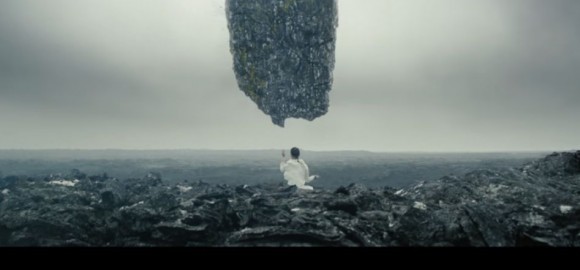
A very good 7-minute film, called Ambition. It’s not like any film about space exploration you’ve ever seen. The Rosetta comet mission lies at its heart.

Everything about the European Space Agency’s Rosetta mission – which, in August, caught up to Comet 67P/Churyumov–Gerasimenko and began moving in tandem with it – has been fantastic so far. For us space buffs, this mission has gone a long way toward fulfilling our fantasies about what might be accomplished in outer space. It’s caused us to remember why we got so excited about space exploration in the first place. And now – just weeks before Rosetta will send a lander to the surface of its comet – ESA and Platige Image have released a very good short film, called Ambition. It’s not a space documentary, or like any film about space exploration you’ve ever seen. It doesn’t focus so much on the mission itself – although the Rosetta mission does lie at the heart of the film – as on why we need to go into space.

The film features an apprentice magician and her master, talking about the making of solar systems.

I won’t tell you more; you should watch the film. It might touch your heart in ways you’ve forgotten, as the Rosetta mission itself has touched mine.

Tomek Baginski directed the film Ambition, which stars Aiden Gillen – who played Littlefinger in Game of Thrones – and Aisling Franciosi. Its producers shot Ambition on location in Iceland and produced it primarily in Poland. Its first public screening was October 24, 2014 during the British Film Institute’s celebration of Sci-Fi: Days of Fear and Wonder, at the Southbank, London.

By the way, Tim Reyes at UniverseToday.com has written a very good essay about the film Ambition, and what it means in the context of U.S. and European space efforts, and in the larger context of our striving to meet challenges in the world today. He also says you should watch the film. Because it’s about what it means to want to know what’s possible.

In the film Ambition, a young magician tries to build a solar system … but fails.
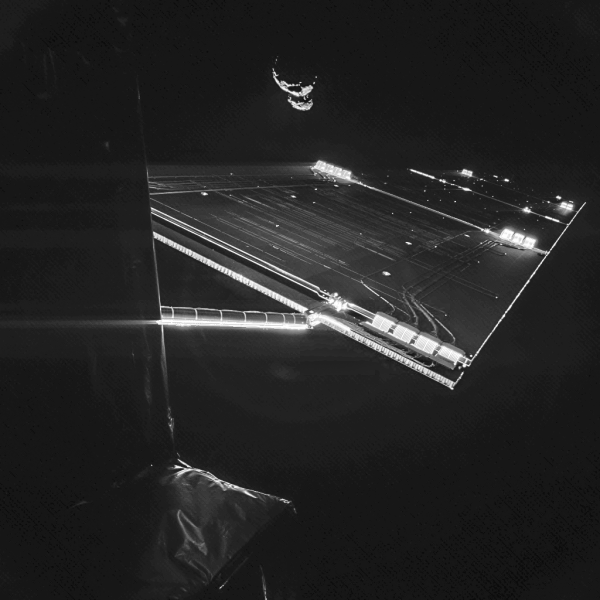
Did you assume this was an artist’s concept? It’s not. It’s a real image. It’s the Rosetta spacecraft’s selfie with comet 67P/Churyumov–Gerasimenko, imaged Sunday, September 7, 2014. Image via ESA/Rosetta/Philae/CIVA

Bottom line: A very good 7-minute film, called Ambition. It’s not like any film about space exploration you’ve ever seen. The Rosetta comet mission lies at its heart.

ooOOoo

And here is that film.

Published on Oct 24, 2014
Ambition is a collaboration between Platige Image and ESA. Directed by Tomek Bagiński and starring Aidan Gillen and Aisling Franciosi, Ambition was shot on location in Iceland, and screened on 24 October 2014 during the British Film Institute’s celebration of Sci-Fi: Days of Fear and Wonder, at the Southbank, London.

The intelligence of dogs?

Fascinating article in the UK’s Daily Telegraph newspaper.

This post was written last Monday in the hope that I will be back home from my ‘op’ by today, or more accurately expressed as hoping I was back home yesterday.

Friend, Chris Snuggs, sent me an item that appeared in The Daily Telegraph about measuring the intelligence of your dog.  Here’s how it opened:

Quiz: how intelligent is your dog?

Take our special test to gauge your pet’s brainpower

Canine brains: test your dog's intelligence Photo: Alamy
Canine brains: test your dog’s intelligence Photo: Alamy

By Andrew Bake

7:00AM BST 25 Oct 2014

We all love our dogs. They repay us with affection, loyalty, fun and amusement, and we boast of their beauty, athletic prowess and impeccable behaviour. But while we can subtly promote our own academic achievements, and hint heavily at the brightness of our children, it is hard to prove – really prove, beyond reasonable doubt – that our canine companions are as intelligent as we know in our hearts they must be.

There is no doubt that some breeds are more intelligent than others, the result – as so much else about dogs – of selective breeding for many generations. But human classification and stereotyping of breeds has also evolved – not always fairly – and there are exceptions within breeds. So it is perfectly possible for an ostensibly airheaded Chihuahua to perform very well in intelligence tests, while a supposedly sagacious German shepherd will fail to distinguish “sit” from “fetch”.

Behaviour that seems to demonstrate intelligence in dogs is often the result of a combination of breeding and intense training. It is often suggested that Border collies are outstandingly bright, and that may be so: but they have been bred for generations to respond rapidly to complex commands; and sheepdogs – the rock stars of the obedience world – are trained from puppyhood, in many cases at the side of their parents.

Andrew Bake closes his piece, thus:

So how can we arrive at a reasonable estimation of our dog’s mental abilities? The Telegraph canine intelligence test combines observation of the subject’s regular behaviours, some of which may have been influenced by training, habituation and what might loosely be termed upbringing, with a series of simple staged exercises which attempt to measure the dog’s ability to think sequentially and to respond to challenges.

Putting the scores from the two together will produce a fair estimate of general intelligence: good enough, at least, to boast about in the park.

No special equipment is needed — though patience, a new dog-toy and a supply of dog-treats will undoubtedly come in handy.

Then at the bottom of the article is a link ‘Let’s Play‘ that takes you to the test questions.

Enjoy!

The Nightingale.

… and the Canary – Breathtakingly creative.

Australian artist Andy Thomas specializes in creating ‘audio life forms’: beautiful abstract shapes that react to sounds. In this animated short, he visualizes two recorded bird sounds from the archives of the Netherlands Institute for Sound and Vision in Hilversum.

I was blown away when I came across that video.  Then a quick search found this place, from where one reads:

Australian multimedia artist Andy Thomas makes bird songs dance with 3D animations. It’s the latest in his line of “audio life forms.”

Using 3D visualization software and other programs, Thomas breaks down photos of insects, orchids, and birds into their composite parts. He then reassembles the images in a sort of collage and builds trippy animations that react, based on rules he’s set, to sound – in this case, archival bird song.

The resulting multimedia visualizations are stunning. They also suggest what you might see if you stood in the forest listening to the birds, while tripping on acid. The psychedelic feel is enhanced by the constant shape-shifting of the form, which in turn encourages you to be hyper-aware of the full range of tweets and trills.

Thomas has been painting and drawing since he was a child. In 1997 he began exploring the realm of digital art, and in recent years started experimenting with “creating a visual fusion between Nature and Technology.” But he also describes this work a bit moralistically “corrupting nature with technology.”

It was then a moment to go across to Andy’s website; which I strongly encourage you to do – the pictures are stunning: trust me!  Just try yesterday’s Insect Friday photograph!

Another of Andy's wonderful images.
Another of Andy’s wonderful images.

Golly, there are some very clever people out there!

Thank you WordPress!

Recognising the incredible contribution made to the world of modern communications.

This blog runs using software called WordPress. The WordPress community is vast. “Over 409 million people view more than 15.8 billion pages each month. Users produce about 43.7 million new posts and 58.8 million new comments each month.”  Millions and millions of websites run under WordPress.

No mistake it is a community in every sense of the word.  I feel fortunate and humbled to have made so many friends across the ‘bloggersphere’ despite not having met a single person face-to-face.  I just can’t imagine a life without my circle of followers and without me, in turn, following so many other bloggers.

Thus it seems entirely appropriate to publish in full a news item sent to all WordPress bloggers in the last twenty-four hours.

ooOOoo

Engaged, Inspired, and Ready to Build a Better Web

One week every year, the entire Automattic staff gets together to connect, work, and laugh. And then, of course, we blog about it! Could you be blogging about your experience with us in 2015?

Automattic is a distributed company — we all work from wherever we are. Right now, “where we are” is 197 cities around the world: New Orleans, USA. Montevideo, Uruguay. Tokyo, Japan. Vilnius, Lithuania.

Once a year, we get together somewhere in the world to meet, work alongside, learn from, and laugh with one another in an exhilarating, exhausting week called the Grand Meetup. This year, 277 Automatticians descended on Park City, Utah, for seven days in mid-September.

Chris Hardie @ChrisHardie
I flew across the country to spend time in a mountain lodge with a bunch of strangers I met on the Internet. And they are wonderful.

We introduced ourselves to new colleagues, reconnected with coworkers we haven’t seen since last year, and worked on ways to make WordPress.com even better. And of course, lots of us blogged about the experience, in words and images.

We were blown away by the brilliance and generosity of our colleagues…

I’m grateful to have met so many Automatticians from around the world who brought such kindness, curiosity, patience, fierce intelligence, creativity and humor to the time we had together. I’m grateful to have learned about their hobbies, families, personal journeys, quirks, pet peeves, amazing skills, unmitigated geekiness, and brilliant senses of humor.

– VIP Wrangler Chris Hardie

We marveled at the range of conversations we had, from the sublime to the absurd…

Here are some of the things I talked about this week:

  • Scottish independence
  • Taylor Swift
  • Goats
  • Sexism
  • My children
  • Other people’s children
  • Infertility
  • Tattoos
  • Swing dancing
  • Whiskey
  • Javascript
  • Waffles (lack thereof)
  • VideoPress
  • Houston
  • Leadership
  • Fake morning talkshows
  • Mario Kart

Happiness Engineer Zandy Ring

We soaked in the natural beauty of Utah…

Early morning takeoff, by yours truly.

And some of us got up close and personal with the wide Utah sky…

Happiness Engineer Jeremey DuVall realizes he’s just jumped out of an airplane.

We learned from one another, and had fun doing it…

I learned how to analyze data in Python with Carly, and went skydiving with Prasath. After discussing common security vulnerabilities with Anne, Cami and I plotted a podcast about absolutely nothing, and recorded part of our first episode…

If you asked me four years ago if I thought it were possible to enjoy working, I’d be dubious. If you asked me whether one could ever genuinely love and respect all their coworkers, I’d hesitate.

Over the past four years, the people of Automattic have demonstrated to me that it’s possible to do work you love with people you love. It’s not common — not yet — but it’s possible.

– VaultPress Eclectic Happiffier Chris Rudzki

We burned the midnight oil…

We worked, we played, we ate, we drank, we slept very little. We tried to make the world a better place, and if you think that’s me being dramatic you don’t know the people I have the honor of working with.

– Dot Organizer Cami Kaos

We took a lot of photos

On the final day, Automattic founder Matt Mullenweg led us in a toast that summed up the reason we’re all here…

I’m really grateful that I get to work with the people I do, and on the problems that we work on together. It’s far from easy, in fact each year brings new challenges and I make mistakes as often as not, but it is worthwhile and incredibly fulfilling. A few hours ago I gave a closing toast and teared up looking around the room. So many folks that give their passion and dedicate themselves to jobs both large and small, visible and unseen, to help make the web a better place.

– WordPress co-founder and Automattic CEO Matt Mullenweg

And when the week was over, heading home was bittersweet…

This morning was filled with so many hugs (and maybe a tear or two). I told myself that I was looking forward to returning home. To my own bed (although the sleep I got in the silence of the Park City night was the best I may have ever experienced). To regular exercise and home cooking. To the routine of my everyday life. And I was looking forward to that. And even though I knew I would miss my colleagues (it’s happened every time I return from a trip), the weight of the fog of sadness still surprises me when it descends.

I read their blogs. I like their Facebook posts. I retweet their Tweets. And I miss them.

– Happiness (w)Rangler Lori McLeese

If you think you might want to work with this motley crew and join us in 2015’s mayhem…

2014-company-animated

we’re hiring. (And yes, you’ll get to make up your own job title, too.)

ooOOoo

Seriously, if you think there is any way you can contribute to the success of WordPress, then do go across to this page – from where I note the following employee benefits:

BENEFITS

  • Open vacation policy (no set number of days per year). We encourage our employees to take the time they need to take vacation, develop interests, and spend time with friends and family.
  • Health, dental, & vision insurance for US and Canadian employees, their spouses or domestic partners, and children.
  • 401(k) plan and match for US employees and RRSP matching plan for Canadian employees.
  • We cover all costs of company travel.
  • We happily provide or reimburse hardware and software you’ll need, as well as books or conferences that promote continued learning.
  • Home office setup stipend, and co-working office allowance.

Well done the team!

Playing in the sand!

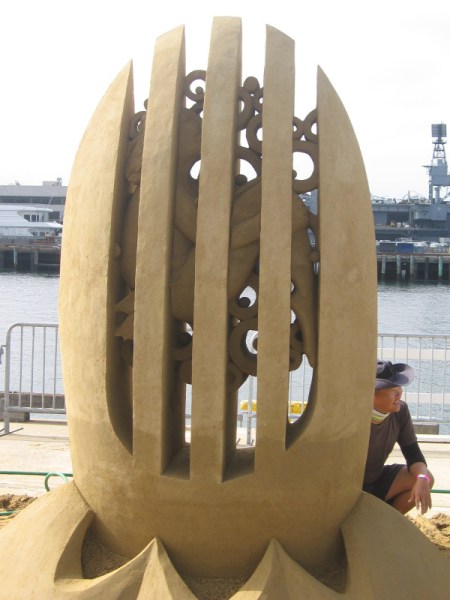
Now this is what I call making sand-castles!

Apologies to the person that sent me the link to: PHOTOS OF WORLD-CLASS SAND SCULPTORS AT WORK!  Their name has slipped my mind.

The event was the 2014 US Sand Sculpting Challenge and 3D Art Exposition held recently in San Diego, California.

In any case, I wasn’t going to reblog the whole article because it’s much, much better if you go and read about the talented artists directly. Artists who produced this:

sand1

and this:

sand2

not overlooking this:

sand4

or this:

sand3

No, you absolutely have to drop into this place and read about these most talented artists.

Now how far is it to the nearest beach? …..

Must start practising …. wonder how long it would take me to build this:

sand5


Ashleigh and Pudsey.

In terms of the bond between dog and human, it doesn’t get much better than this!

Britain’s Got Talent is a British talent television show that started in June 2007 and has been running very successfully ever since. Originally broadcast by Thames Television it is now part of the ITV ‘stable’.  Inevitably there is a website!

Anyway, Jean and I were browsing YouTube one evening looking for something to watch and came across this:

Published on Apr 7, 2012

Ashleigh and Pudsey the dancing dog wow the judges with their flintstones dance act.

Britain searches for a new act to perform in front of the royal family at the royal variety performance.
Judged by Simon Cowell, Amanda Holden, Carmen Electra, Alesha Dixon and David Walliams.

Resist the urge to watch the semi-finals until you have watched the above; less than five minutes long.

Published on May 6, 2012

Britain’s got talent 2012 Live Semi finals.

Ashleigh and Pudsey the dancing dog perform their dance routine to Peppy and George in the Live Semi-finals.

Of course, you know where this is going!

Here are the finals.

Published on May 12, 2012

The performance of Ashleigh and Pudsey in the Britain’s Got Talent 2012 Final.

Of course they won, deservedly so.