This came in from Bob Derham yesterday.
Our next door neighbour has had the upstairs of their house painted by a British Airways pilot on furlough.
Dogs are animals of integrity. We have much to learn from them.
Category: Innovation
This came in from Bob Derham yesterday.
Our next door neighbour has had the upstairs of their house painted by a British Airways pilot on furlough.
This is a wonderful, innovative way to look after dogs.
It’s not that often that something comes along that is wonderfully refreshing, both as an idea and in practice. I am speaking of a way of housing shelter dogs.
It’s the work of Austin Pets Alive and I’m not surprised in the slightest to read from their website:
Austin Pets Alive! is not your average animal shelter. We pioneer innovative lifesaving programs designed to save the animals most at risk of euthanasia.
They are in Texas.
But back to the article which appeared on the Treehugger website.
ooOOoo
They offer a calm alternative to the chaos of shelter life.
By Mary Jo DiLonardo, October 1st, 2020

The shelter environment can be incredibly overwhelming for any dog. There are strange sights, smells, and sounds, and the presence of unfamiliar animals and people can be constantly changing. Some pets adapt more quickly than others, while some struggle with the frenetic surroundings.
One animal shelter in Texas is building tiny houses as a solution for those anxious dogs that need a calmer place to stay. The non-profit rescue is creating two small cabins on their shelter grounds complete with heating and air conditioning, dog-friendly furniture, and their own private yards. The cabins will also provide workspaces for staff and volunteers.
The tiny homes should be ready for their first guests later this month.
“The idea is to provide more of a home-like environment for the unique population of dogs Austin Pets Alive! cares for as the safety net for shelter animals who need us most — a place for decompression, training, and quality-of-life purposes,” Director of Operations Stephanie Bilbro tells Treehugger. “It seemed like the best opportunity for the investment, and also has the benefit of being a project that can be repeated as many times as we want!”
Having tiny homes for some of the shelter’s canine residents was a long-time dream of the rescue’s executive director, veterinarian Ellen Jefferson. The rescue put together a committee of staff and volunteers in 2019 to assess the facility and see what improvement could be made.
They decided to build the tiny homes “as a way to provide a better quality of life for some of our longest-stay or most behaviorally challenged dogs”, Bilbro says.
The cabins will house one dog at a time and they will remain there for the rest of their stay until they find a foster or adoptive home. The cabins will primarily be used for dogs who are overstimulated by the standard kennel environment.

“Overstimulation can lead not only to higher stress in the animal, but can actually be dangerous for a handler, or other animals, if you have a dog who expresses stress by showing impulsive or aggressive behaviors,” Bilbro says.
“Overstimulation is also a big barrier to successful training or behavior modification, so it can be difficult to make progress with dogs like this in a kennel or shelter environment. The cabins will ideally provide a quiet and low-stimulation place for the dogs to decompress and relax in a way that will help our staff and volunteers get through to them easier.”
The rescue is relying on donations to keep saving lives and trying out innovations like these, Bilbro says. When the pandemic first started, the rescue increased its intakes so smaller and more rural shelters that were temporarily closing wouldn’t have to euthanize animals.
The first dogs should be moving into their tiny houses soon. And maybe they won’t be staying long.
“We also hope that the ‘home-like’ environment of the cabins will help us learn a little more about how a dog would act in a home, which could tell us more about what kind of foster or adopter they need for our matchmakers to match them with their forever families,” Bilbro says.
“Would they be calm or anxious, would they be destructive or tidy, are they possibly housetrained, will they let people come into their space without conflict? These are things we would hope to learn from a foster home but without needing to find a foster who is willing to take on a challenging dog, or a dog we don’t know a lot about.”
ooOOoo
I have nothing to do with neither Treehugger nor Austin Pets Alive.
However, I was so impressed with the way they operated that we made a very small donation. So, if there’s anybody else out there who can afford some money then this is the link to donate.
I just donated to Austin Pets Alive!, an organization that serves the animals most at-risk through innovative programs that address the animals’ needs. I’m proud to support a mission that believes that animal shelters should do just that – provide every animal the chance to find their forever home!
“Provide every animal the chance to find their forever home.“
It doesn’t get any better for our lovely dogs than that.
Whichever way you look there are substantial challenges.
This post is largely a republication of a recent post from Patrice Ayme. Because when I read it I was profoundly affected. I thought that it needed to be shared with all you good people because if nothing is done then life as we know it is going to come to an end. Period! That includes our gorgeous dogs as well as us humans! So, please, please read it all the way through!
But before Patrice’s post is presented The Economist this last week came out with a special report entitled Business and climate change. I offer a small extract:
For most of the world, this year will be remembered mainly for covid-19. Starting in Asia, then spreading across Europe and America before taking hold in the emerging world, the pandemic has infected millions and killed hundreds of thousands. And it has devastated economies even more severely that did the global financial crisis which erupted in 2008.But the impact of covid-19 has also given a sense of just how hard it will be to deal with climate change. As economic activity has stalled, energy-related CO2 emissions have fallen sharply. This year the drop will be between 4% and 7%. But to have a decent chance of keeping Earth’s mean temperature less than 2 deg C above pre-industrial levels, net emissions of CO2 and other greenhouse gases must fall to more or less zero by mid-century. And such a drop needs to be achieved not by halting the world economy in its tracks, but by rewiring it.
The next section in the special report was A grim outlook and it was, indeed, a very grim read.
So onto Patrice’s article.
ooOOoo
Greenhouse gases (GHG) used to be 280 parts per million. Now they are around 500 ppm (including CH4, Nitrogen oxides, chlorofluorocarbons, etc.). This is more GHG than in at least thirty million years, when the Earth was much warmer, and it is similar to CO2 densities during the Jurassic.
So we are presently transiting to a Jurassic climate. The transition to the Jurassic climate is happening at a rate many orders of magnitude faster than changes in the past. This implies that most forests of the Earth , desiccating and incapable to adapt fast enough, are going to burn… worldwide. This generalized combustion has a drastic potential consequence: generalized hypoxia.
So we should talk about climate catastrophe rather than climate change, and global heating rather than global warming: recent fires got helped by temperatures dozen of degrees higher than normal, in part from compression of the air due to record breaking winds. This is why parts of the Pacific Northwest which never burn are now burning. This will extend to Canada, Alaska, Siberia and already did in recent years. The catastrophic massive release of frozen methane hydrates could happen any time (it already does, but not as bad as it is going to get). It has up to one hundred times more warming power than CO2 (fires release it by billions of tons).
What is the way out? Well, hydrogen is the solution, in two ways, but has not been deployed as it could be. A decade ago, thermonuclear fusion, on the verge of becoming a solution, was starved for funding, and so was green hydrogen (the then energy secretary, Obama’s Steven Chu, prefered investing in batteries, it was more lucrative for his little greedy self).
Green hydrogen enables to store energy for renewables, avoiding blackouts which cut electricity to pumps to fight fires.

Climate forcing is a fascinating subject, with vast areas without a high level of scientific understanding (LOSU). However we know enough to realize forceful mitigation has to be engaged in immediately.
Joan Katsareas from Philadelphia, PA wrote back: “Thank you @Patrice Ayme for sharing your knowledge of the causes and extent of the climate crisis. I will be seeking out more information on hydrogen as a solution.”
@Joan Katsareas Thank you for thanking me, that is much appreciated. Hydrogen is indeed the overall solution we need at this point. Actually Australia, in collaboration with Japan, is building a gigantic, 15 Gigawatts, project in north west Australia, AREH, the Asian Renewable Energy Hub, to convert renewables from sun and wind into hydrogen products which will then be shipped to Japan. The same needs to be done all over, it would collapse the price of “green hydrogen” (99% of the US hydrogen is from fossil fuels).
In the case of thermonuclear fusion, the international thermonuclear experimental reactor (ITER) being built in France was slowed down by ten years, from reduced funding, and uses obsolete magnets (superconducting, but not High Temperature Superconductors, which can now be engineered with more compact and powerful fields). A massive effort would bring a positive energy thermonuclear reactor within 10 years… But that effort has not been made… except in China, the usual suspect, where a project, the China Fusion Engineering Test Reactor (CFETR), aims at an energy gain of 12 and a total power equivalent to a fission nuclear reactor. Its detailed engineering has been launched for a while (it’s supposedly symbiotic with the European DEMO project, which will produced as much as a large power station and will be connected to the grid. That too has been delayed, to the 2050s, although it’s feasible now). The USA needs to launch a similar project, right away.
We face ecological constraints incomparably more severe than those of the Roman state. Rome did not solve its paltry problems, and let them fester: they had to do mostly with a dearth of metals, and the Franks solved them readily. This hindered the Roman economy. The situation we are facing, the threat of a runaway greenhouse is a terminal existential threat.
Look at Venus, we can look at our sparkling neighbor when the forests have finished burning, and the smoke dissipates (we were told it could be months). Once Venus probably had a vast ocean, and probably, life. But it died from a brutal greenhouse generated by Large Igneous Provinces (LIP). The same happened on Earth, on a smaller scale, more than once, in particular with the Permian Triassic mass extinction, which destroyed 95% of known species..
Now the rumor has it that indeed some life may have survived in the atmosphere. This is not a joke. Consider: Life on Venus? Astronomers See a Signal in Its Clouds. The detection of a gas in the planet’s atmosphere could turn scientists’ gaze to a planet long overlooked in the search for extraterrestrial life.
Life on Venus? Ah, science, all those possibilities… We never imagined we would ever think possible.
Patrice Ayme
***
P/S: I argued in the past, before anybody else, that the dinosaur-pterosaurs-plesiosaurs extinction, and extinction of anything bigger than 20 kilograms was due to volcanism (I was at UC Berkeley when the two Alvarez were, and they seemed too full of themselves with the iridium layer, and I like to contradict certainties…)
How would LIP volcanism set forests on fire? Well, by the same exact mechanism as now: through a massive CO2 driven greenhouse, what may have terminated the Venusians…
In this perspective climate cooling, for millions of years, visible in the graph above, would have disrupted those species which were not equipped to generate enough heat, and then the LIP accelerated into a vast holocaust…
The end with general burning and acidic oceans is hard to duplicate with a bolide, so the impactophiles have argued that the bolide magically impacted the most CO2 generating rock imaginable… Maybe. But an enormous LIP does all that CO2 production/destruction of the oceans, effortlessly… A friend of mine who is the biggest of the big in this academic domain, he decides who publishes, replied to me that the 66 million year old Dekkan LIP is too small… To which I replied that we don’t know what lays below the ocean…
I guess this story is real!
I am not normally a sceptical person.
But when I read the latest article from The Dodo about a corgi that freaked out when she saw a bush made to look like a dog I did wonder. But whatever it makes a nice story.
ooOOoo
“She looked confused and concerned” 😂
Lily Feinn
Published on 8/28/2020.
Luna isn’t usually scared of other dogs — in fact, she’s kinda bossy.
“Luna, like a lot of other corgis, has a big dog attitude in a smaller package,” Matt, Luna’s dad who asked that his last name not be included, told The Dodo. “She loves policing other dogs at the dog park.”

So it came as a surprise when the little dog freaked out when she met a larger, greener version of herself.
Luna and Matt were visiting a friend earlier this year when they spotted an adorable topiary in the neighbor’s yard. “I just thought it was hilarious ’cause I instantly thought it was a corgi-shaped hedge,” Matt said. “Maybe that’s just what my brain defaults to ’cause my dog is a corgi.”

Matt placed Luna in front of the hedge for a photo and it became clear she was not interested in making friends.
“I think she was afraid cause it was so large and maybe the way I reacted to it,” Matt said. “She looked confused and concerned.”
Matt was surprised to learn that his tough dog is actually a bit of a scaredy cat — when it comes to large plants, at least. “She has a pretty expressive face so it feels like I know what she’s thinking,” Matt said.

Matt snapped the photo of Luna and posted it to Twitter, with the caption: “Neighbors are a big fan of Luna apparently.”
People were so impressed by the likeness that the post quickly went viral. However, all the attention didn’t change Luna’s mind when it came to topiaries.
After eight years of living with Luna, Matt appreciates her now more than ever.
“She’s been great to have around,” Matt said. “The neighbors love her as well and I’m glad I can appreciate her more right now, having to stay home more often.”
But, to keep Luna happy, they haven’t walked by the bush since.
ooOOoo
It takes all sorts!
How hard could it be, really? Just a few snips here and there should do it.
I hadn’t intended to publish a post for today. But then I saw Stephen Messenger’s post over at The Dodo and I thought that it was far too good not to share with you.
ooOOoo
“I fell on the floor laughing.”
By Stephen Messenger
Published on 8/15/2020
How hard could it be, really? Just a few snips here and there should do it.
That, apparently, was what one well-meaning dog mom thought when she decided to cut her dog’s overgrown hair herself at home.
And, well, you’ll see how that turned out.

The other week, Susana Soares was hanging out with her dog, Mano, when she realized his hair had gotten rather overgrown. It’d been a while since Mano had been to the groomers, and his shag was becoming a bit of an issue.
“Hair was getting in his eyes,” Soares told The Dodo.
Mano wasn’t loving it.

Soares, who’s actually worked as a hair stylist for humans, figured that taming Mano’s unruly mane would be no sweat.
“I decided to cut his hair at home,” she said.
So, Soares grabbed some scissors and got down to business — and this is what resulted:

Soares had solved Mano’s hair-in-the-eyes issues sure enough.
She gave him bangs — bangs that inadvertently gave Mano a questionable new look.
It was almost as if the little dog had cut his bangs himself. Without a mirror.

Mano didn’t have to ask Soares how she thought his new ‘do’ turned out.
“I fell on the floor laughing,” she said.

Did the cut look ridiculous? Yes, of course it did. But Mano’s not vain. He could see clearly again, after all.
“He likes it,” Soares said.
Fortunately, when tussled, Mano’s haircut looks less silly. If only slightly so.
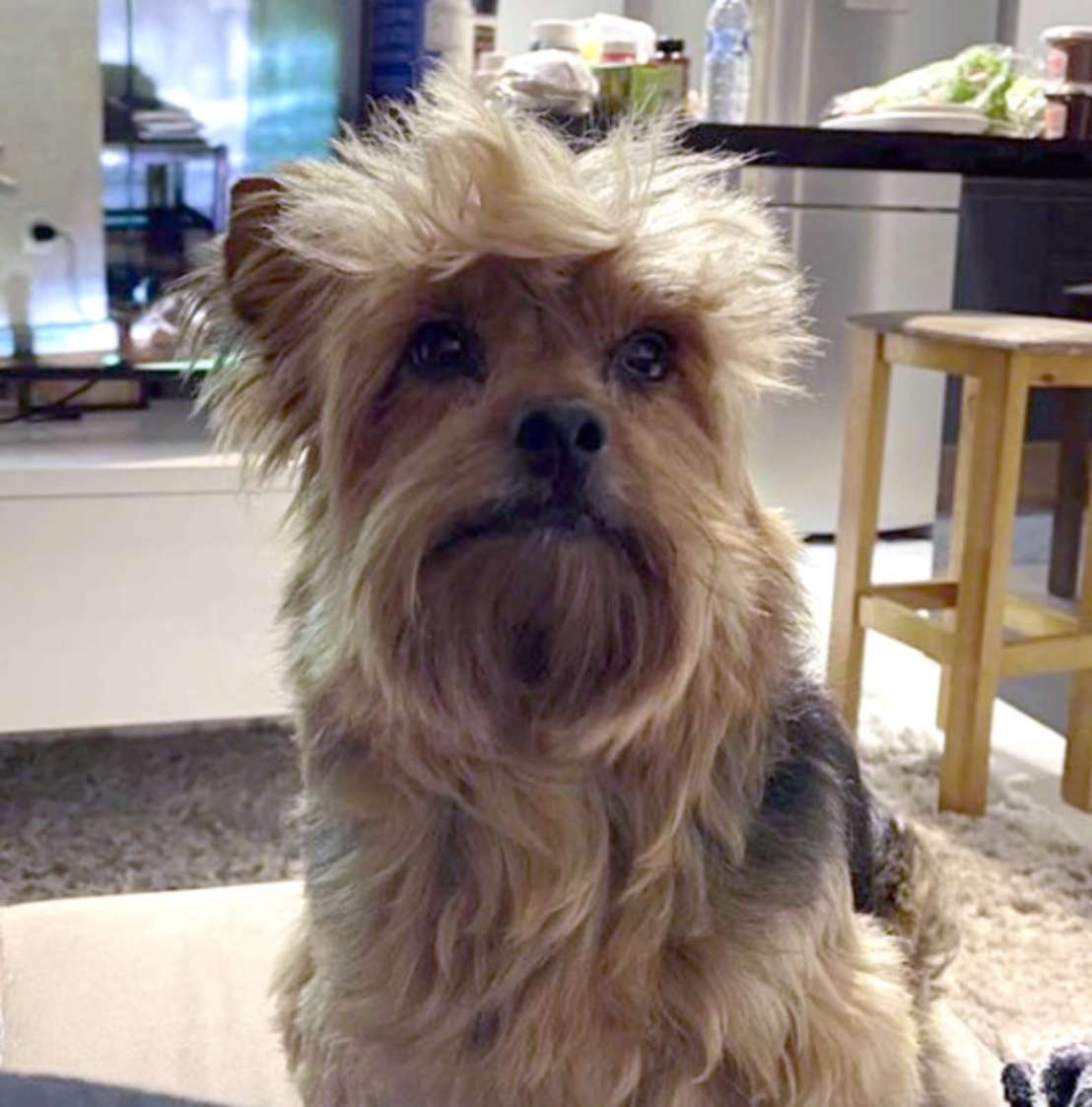
Despite how things turned out, Soares did have the best intentions — and that’s what matters most.

Bad haircuts come and go. And thankfully, in time, Mano’s bangs will grow back into a more natural look.
When it comes time to trim them again, Soares plans to keep her scissors in the drawer and leave it to the pros.
“I will not be repeating that!” she said.
ooOOoo
See what I mean. This was a delightful story and I really have nothing to add other than joining in with the laughter!
Yes, you heard that correctly.
There was an article on the website EarthSky News yesterday that, literally, took me out of this world. It described the role of magnetic rivers in newly forming star clusters.
There’s not a dog in sight but nevertheless I wanted to share this article with you.
ooOOoo
Astronomers have learned that the pull of gravity can sometimes overcome the strong magnetic fields found in great star-forming clouds in space. The resulting weakly magnetized gas flow can feed the growth of new stars.

Astronomers have known for decades that stars like our sun form when giant clouds of gas and dust in space – sometimes called molecular clouds – collapse under their own gravity. But how does the material from interstellar space flow into these clouds, and what controls the collapse? The image above helps illustrate an answer to these questions. It’s a composite, made with data from SOFIA – an airborne telescope designed for infrared astronomy – overlaid on an image from the now-retired Spitzer Space Telescope. This composite shows that the pull of gravity can sometimes overcome the strong magnetic fields found in great star-forming clouds in space. And it shows that, when that happens, weakly magnetized gas can flow – as on a conveyor belt – to feed the growth of newly forming star clusters.
A statement from the Max Planck Institute in Bonn, Germany, explained:
A major finding in the last decade has been that extensive networks of filaments permeate every molecular cloud. A picture has emerged that stars like our own sun form preferentially in dense clusters at the intersection of filaments.
Now look back at the image above, which shows the Serpens South star cluster, a star-forming region located some 1,400 light-years from Earth. In that image, you see a dark filament in the lower left. Now notice the “stripes” on the image, which astronomers call streamlines. They represent magnetic structures, discovered by SOFIA. The astronomers said these magnetic structures act like rivers, channeling material into the great star-forming cloud.
As you can see in the image, these magnetic streamlines have been dragged by gravity to align with the narrow, dark filament on the lower left. Astronomers say this configuration helps material from interstellar space flow into the cloud.
This is different from the upper parts of the image, where the magnetic fields are perpendicular to the filaments; in those regions, the magnetic fields in the cloud are opposing gravity.

The scientists said in a statement from Universities Space Research Association (USRA) that they are:
… studying the dense cloud to learn how magnetic fields, gravity and turbulent gas motions contribute to the creation of stars. Once thought to slow star birth by counteracting gravity, SOFIA’s data reveals magnetic fields may actually be working together with gravity as it pulls the fields into alignment with the filaments, nourishing the birth of stars.
The results were published in the peer-reviewed journal Nature Astronomy on August 17. The lead author of the new study is Thushara Pillai of Boston University and the Max Planck Institute for Radio Astronomy in Bonn, Germany.
In 1835, the French philosopher Auguste Comte wrote of the unknowable nature of stars:
On the subject of stars, all investigations which are not ultimately reducible to simple visual observations are … necessarily denied to us. While we can conceive of the possibility of determining their shapes, their sizes, and their motions, we shall never be able by any means to study their chemical composition or their mineralogical structure … Our knowledge concerning their gaseous envelopes is necessarily limited to their existence, size … and refractive power, we shall not at all be able to determine their chemical composition or even their density…
He was, famously, wrong.
He couldn’t have envisioned the range of tools available to modern astronomers. It’s a beautiful thing that, nowadays, astronomers can not only learn about the compositions of stars via their studies of their spectra, but also probe the deeper mysteries, going all the way to the births of these colossal, self-luminous balls in space.

Bottom line: Astronomers have learned that the pull of gravity can sometimes overcome the strong magnetic fields found in great star-forming clouds in space. The resulting weakly magnetized gas flow can feed the growth of new stars.
Source: Magnetized filamentary gas flows feeding the young embedded cluster in Serpens South
ooOOoo
Just read that paragraph just before the end of the article: “He couldn’t have envisioned the range of tools available to modern astronomers. It’s a beautiful thing that, nowadays, astronomers can not only learn about the compositions of stars via their studies of their spectra, but also probe the deeper mysteries, going all the way to the births of these colossal, self-luminous balls in space.”
What a long way we have come from just, say, 50 years ago.
It would be easy to get lost in the article in a scientific manner, and that would be entirely appropriate.
But there’s another beautiful way to get lost in the article; by dreaming of outer space and forgetting just for a moment or two this Earthly planet we all live on!
Now that’s what I call a good idea!
And not one that would immediately have occurred to me. For I am not the world’s greatest thinker in the sense of thinking around the problem.
So this post captures the essence of that ‘alternative’ view; for and on behalf of their dog.
It comes from the Daily Dodo.
ooOOoo
“People walk up and take selfies with the fence and Burger.”
A few months after he was adopted last year, Burger started digging under his family’s fence. He wanted to be able to watch all the people going by, and after thinking about it for a while, his dad came up with the best idea.
He decided to cut a hole in the fence to make a little window for Burger so he could watch the world go by, and Burger instantly fell in love with it.
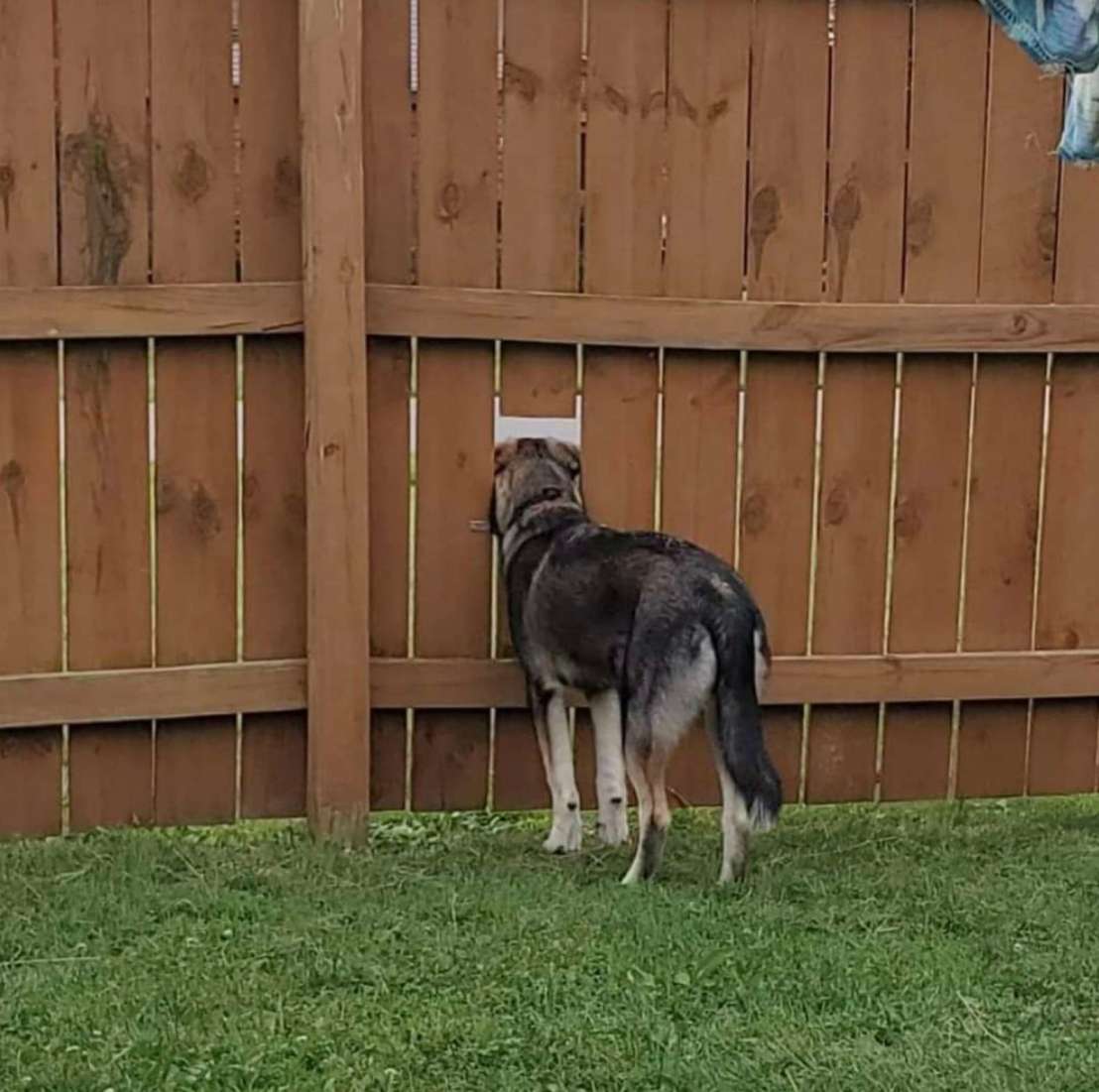
“As soon as I was done, Burger had his head through it and immediately stopped digging,” Brian Stanley, Burger’s dad, told The Dodo. “Best decision ever!”
Now, every time he goes outside, Burger goes straight to his little window. He loves greeting people as they pass by, and he definitely brings a smile to all his neighbors whenever they see his little head peeking out through the window.

When the coronavirus pandemic forced things to shut down in March, Stanley and his family noticed that there were suddenly a lot more people out and about walking past their fence than there had been before. The family hoped that seeing Burger would help bring a smile to everyone’s faces during such a hard time — and then Stanley had an idea to take it to the next level.
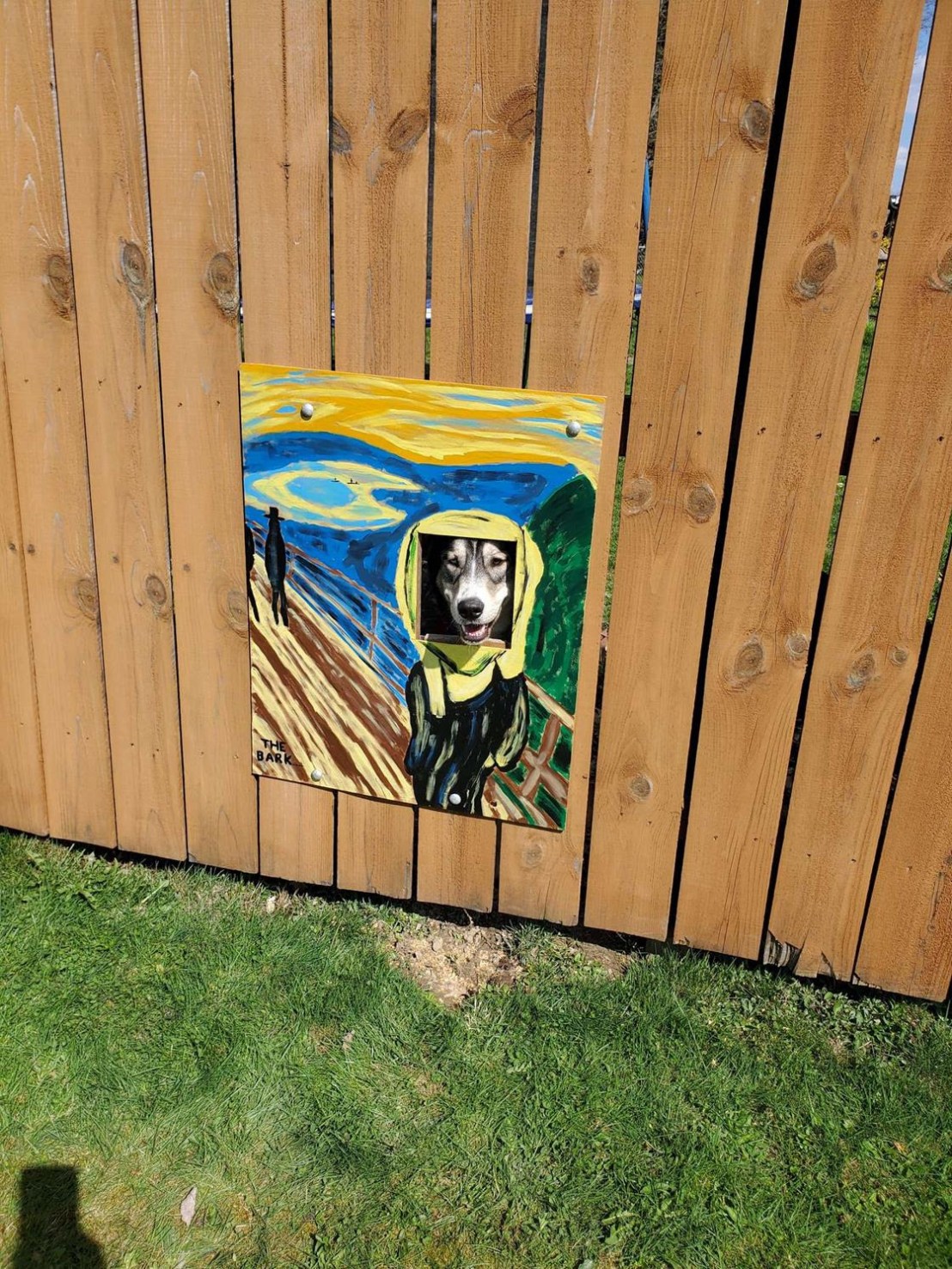
“At first it started as a joke with my wife that I was going to paint something on the street side of the fence around the dog window, but then the idea of painting an actual picture and hanging it up to frame the hole started to form in my mind,” Stanley said. “The shutdown brought an obvious black cloud along with it. Even though more people were out on the street walking or biking, we knew it was due to job loss and uncertain times. I first talked about it to my son who was 100% behind the idea of putting something up on the fence to hopefully bring a smile to people’s faces.”
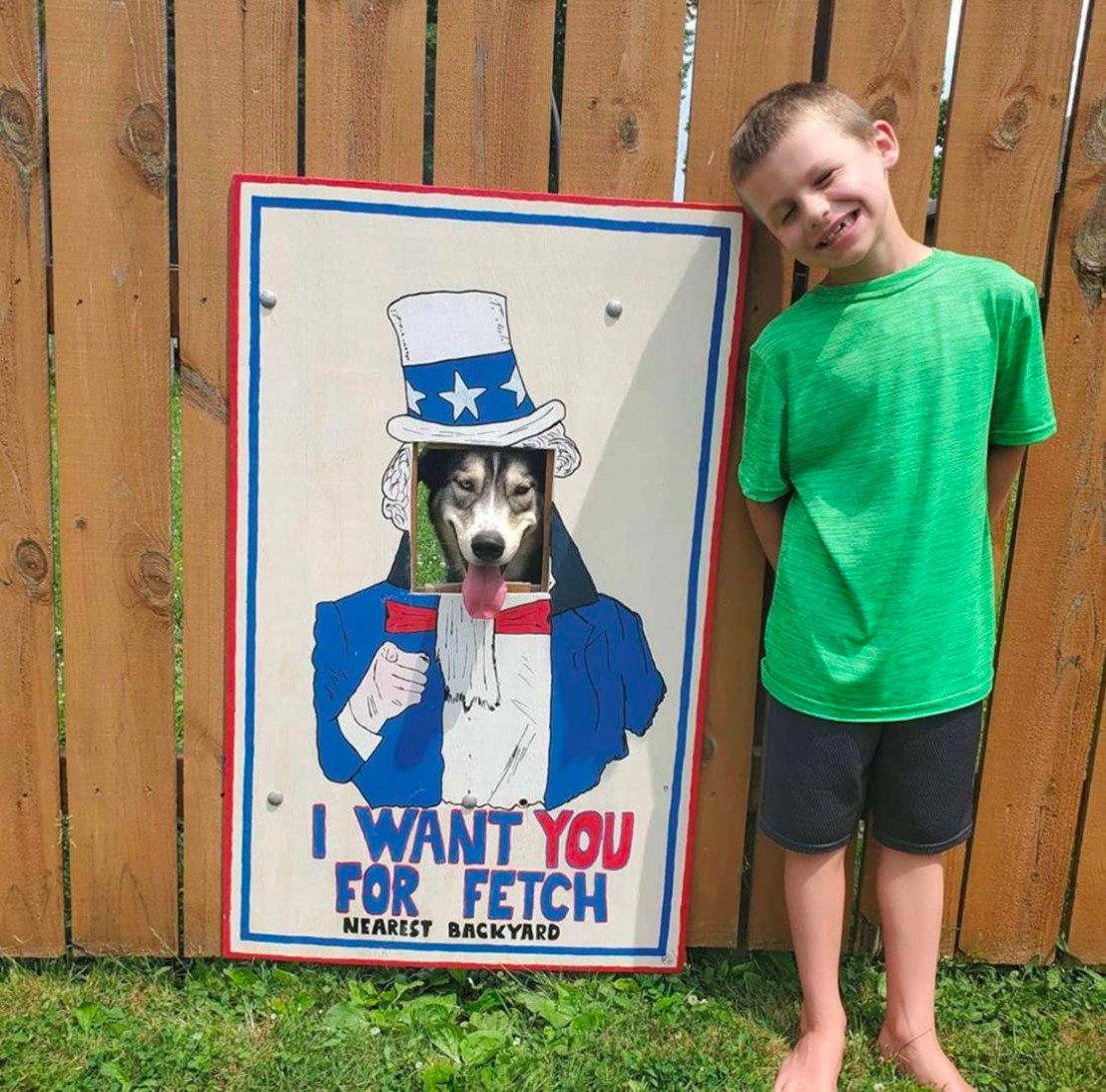
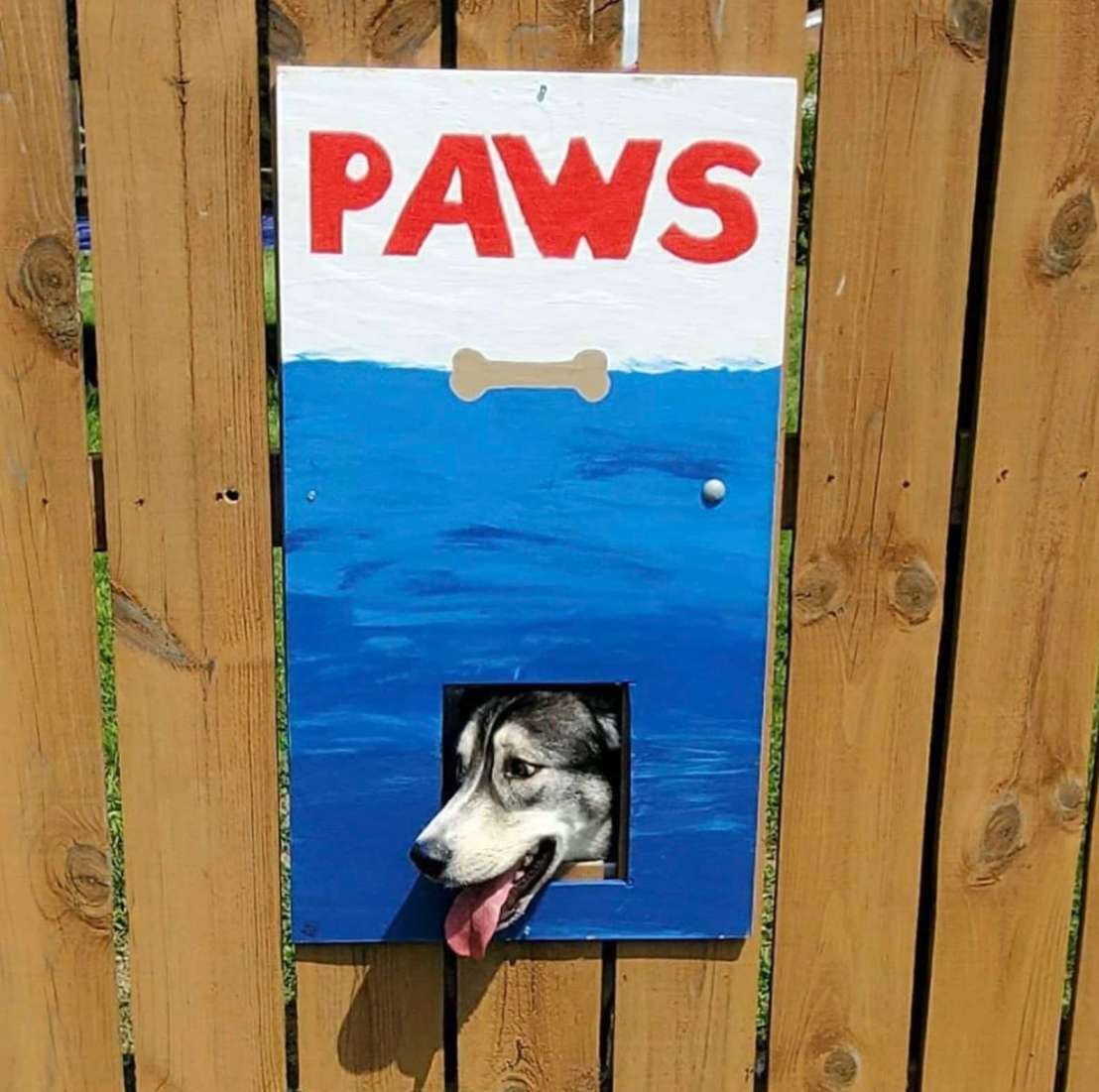
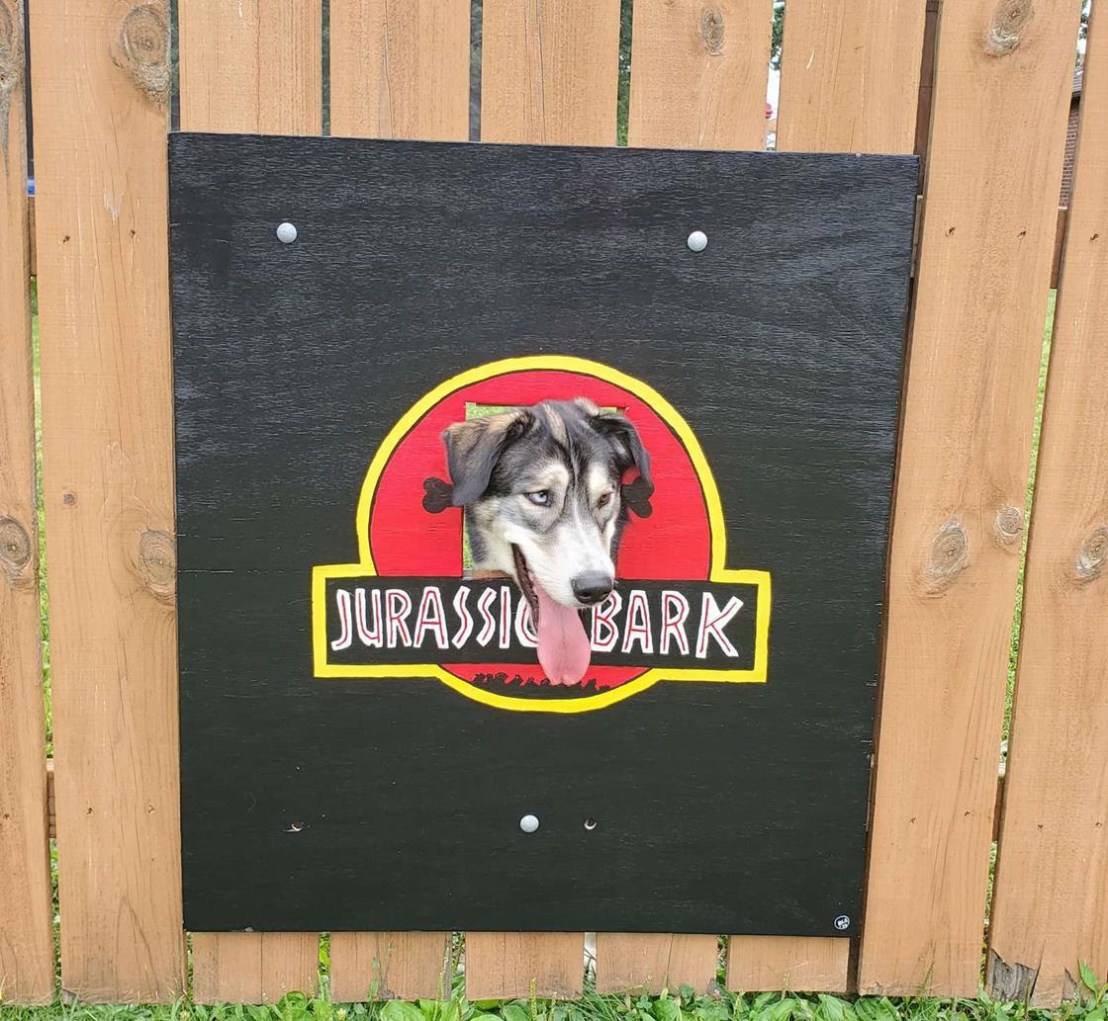
With the idea cemented in their minds, Stanley and his 7-year-old son Cameron got to work on their first painting. They decided to create a version of the famous painting “The Scream” and call it “The Bark.” They hung up the painting and admired their work. They hadn’t been planning on making any more paintings, but after the first one, the ideas just kept coming — and now the artwork framing Burger’s window is constantly changing.
So far they’ve done “Paws” …
… “Jurassic Bark” …
… and even a Pac-Man-themed painting.

Every time his family puts up a new creation, Burger is always right there, and quickly sticks his head out of his window to admire their work.
Of course, the initial goal of the paintings was to help brighten people’s days, and so far that’s absolutely been achieved.
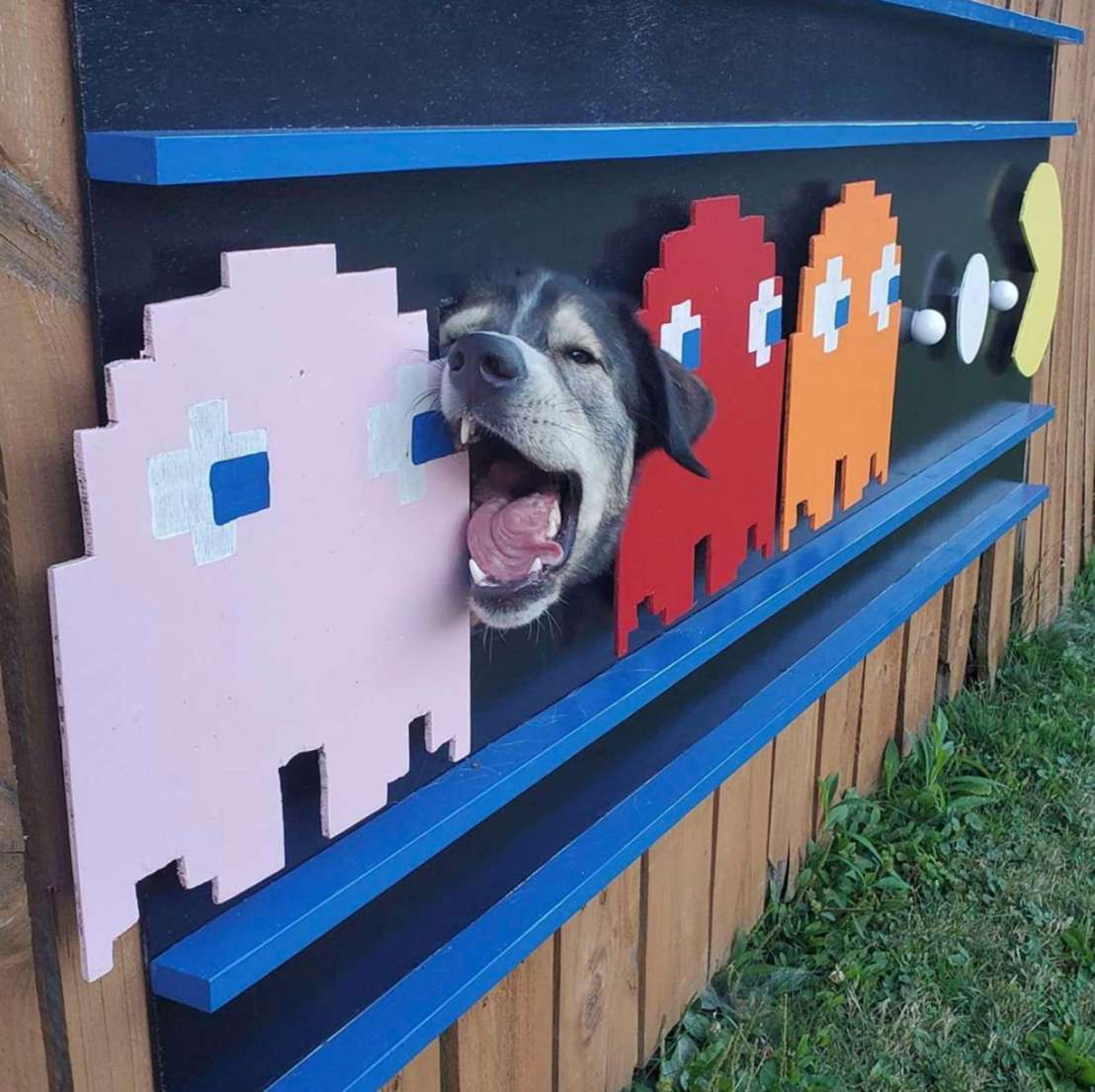
“People have told us that they plan their walks and bike rides to go by our fence and some people will even alter their drives so it takes them past it,” Stanley said. “I have been outside on multiple days with the dogs and see people walk up and take selfies with the fence and Burger. People bring treats to him and he just soaks up the attention. Both my wife and I have been stopped by people when they see us outside so they can tell us how much they love what we are doing and that they hope we don’t stop.”

Stanley and his family currently have new painting ideas planned all the way through January 2024. They’re so happy that their paintings and Burger are able to bring a little joy to their community. Of course, Burger probably loves the paintings most of all, because they’ve brought so many new people to his fence who he can watch and say hello to.
“All in all, it’s brought us closer to the community and the community closer to us while making everyone happy … it doesn’t get much better than that,” Stanley said.
ooOOoo
This post comes with a good number of fabulous photographs. Makes one really think of Burger as the dog next door. And it shows the ingenuity of Brian Stanley and his wife and son, Cameron; first class!
It is a very nice article. A’hh, that’s too tame. It’s a brilliant article! Much better.
This article in The Smithsonian is well worth reading.
I think that strictly speaking I should not be republishing articles from The Smithsonian and if I am instructed to take the post down then all you will read is this introduction.
But hopefully they will look kindly towards me.
For there was an article recently that spoke about dogs and their ability to find their way across often strange land. Very interesting!
Here it is!
ooOOoo
Our canine companions aren’t the only animals that may be capable of magnetoreception
 A terrier fitted with GPS remote tracking device and camera (Kateřina Benediktová / Czech University of Life Sciences
SMITHSONIANMAG.COM
July 27, 2020, JULY 27, 2020
Last week, Cleo the four-year-old yellow Labrador retriever showed up on the doorstep of the home her family moved away from two years ago, reports Caitlin O’Kane for CBS News. As it turns out, Cleo traveled nearly 60 miles from her current home in Kansas to her old one in Missouri. Cleo is just one of many dogs who have made headlines for their homing instincts; in 1924, for example, a collie known as “Bobbie the Wonder Dog” traveled 2,800 miles in the dead of winter to be reunited with his people.
Now, scientists suggest these incredible feats of navigation are possible in part due to Earth’s geomagnetic field, according to a new study published in the journal eLife.
Researchers led by biologists Kateřina Benediktová and Hynek Burda of the Czech University of Life Sciences Department of Game Management and Wildlife Biology outfitted 27 hunting dogs representing 10 different breeds with GPS collars and action cameras, and tracked them in more than 600 excursions over the course of three years, Michael Thomsen reports for Daily Mail. The dogs were driven to a location, led on-leash into a forested area, and then released to run where they pleased. The team only focused on dogs that ventured at least 200 meters away from their owners.
But the researchers were more curious about the dogs’ return journeys than their destinations. When called back to their owners, the dogs used two different methods for finding their way back from an average of 1.1 kilometers (about .7 miles) away. About 60 percent of the dogs used their noses to follow their outbound route in reverse, a strategy known as “tracking,” while the other 30 percent opted to use a new route, found through a process called “scouting.”
According to the study authors, both tactics have merits and drawbacks, and that’s why dogs probably alternate between the two depending on the situation.
“While tracking may be safe, it is lengthy,” the authors write in the study. “Scouting enables taking shortcuts and might be faster but requires navigation capability and, because of possible errors, is risky.”
 Data from the scouting dogs revealed that their navigation capability is related to a magnetic connection (Kateřina Benediktová / Czech University of Life Sciences)
Data from the scouting dogs revealed that their navigation capability is related to a magnetic connection. All of the dogs who did not follow their outbound path began their return with a short “compass run,” a quick scan of about 20 meters along the Earth’s north-south geomagnetic axis, reports the Miami Herald’s Mitchell Willetts. Because they don’t have any familiar visual landmarks to use, and dense vegetation at the study sites made “visual piloting unreliable,” the compass run helps the dogs recalibrate their own position to better estimate their “homing” direction.
Whether the dogs are aware that they are tapping into the Earth’s magnetic field is unclear. Many dogs also poop along a north-south axis, and they certainly are not the only animals to use it as a tool. Chinook salmon have magnetoreceptors in their skin that help guide their epic journeys; foxes use magnetism to hone in on underground prey; and, sea turtles use it to find their beachside birthplaces.
Catherine Lohmann, a biologist at the University of North Carolina, Chapel Hill, who studies magnetoreception and navigation in such turtles tells Erik Stokstad at Science that the finding of the compass run, however, is a first in dogs. This newfound ability means that they can likely remember the direction they had been pointing when they started, and then use the magnetic compass to find the most efficient way home.
To learn more about how magneto-location works for the dogs, the study authors will begin a new experiment placing magnets on the dogs’ collars to find out if this disrupts their navigational skills.
ooOOo
Courtney Sexton, a writer and researcher based in Washington, DC, studies human-animal interactions. She is a 2020 AAAS Mass Media Fellow and the co-founder and director of The Inner Loop, a nonprofit organization for writers.
This is, as I mentioned earlier, a most interesting article. I can’t wait to read more in The Smithsonian. We actually subscribe to the paper version of the magazine. So fingers crossed that in time there will be a further report from Catherine Lohmann.
Why should we not be surprised!
At the power of smell that a dog has.
I have written about the dog’s nose before. Or rather I have written about the dog’s sense of smell;
Dogs’ noses just got a bit more amazing. Not only are they up to 100 million times more sensitive than ours, they can sense weak thermal radiation—the body heat of mammalian prey, a new study reveals. The find helps explain how canines with impaired sight, hearing, or smell can still hunt successfully.
But I wanted to draw your attention to an article in 2017; June 26th to be precise. In an article called What a nose!
Here’s how that post opened.
Two items that recently caught my eye.
The power of a dog’s nose is incredible and it is something that has been written about in this place on more than one occasion.
But two recent news items reminded me once again of the way we humans can be helped by our wonderful canine partners.
The first was a report that appeared on the Care2 website about how dogs are being used to search for victims in the burnt out ruins following that terrible Grenfell Tower fire. That report opened, thus:
By: Laura Goldman June 24, 2017
About Laura Follow Laura at @lauragoldmanWearing heat-proof booties to protect their feet, specially trained dogs have been dispatched in London’s Grenfell Tower to help locate victims and determine the cause of last week’s devastating fire that killed at least 79 people.
Because they’re smaller and weigh less than humans, urban search-and-rescue dogs with the London Fire Brigade (LFB) are able to access the more challenging areas of the charred 24-story building, especially the upper floors that sustained the most damage.
Because I read recently, on the EarthSky website, about dogs in Australia that are being trained to detect Covid-19 in humans.
ooOOoo
Posted by Eleanor Imster in Human World, August 10, 2020
Scientists have been working with professional trainers in South Australia, Victoria and New South Wales to train dogs to sniff out Covid-19. Most of the dogs have a 100% success rate.
Susan Hazel, University of Adelaide and Anne-Lise Chaber, University of Adelaide
What does a pandemic smell like? If dogs could talk, they might be able to tell us.
We’re part of an international research team, led by Dominique Grandjean at France’s National Veterinary School of Alfort, that has been training detector dogs to sniff out traces of the novel coronavirus (SARS-CoV-2) since March.
These detector dogs are trained using sweat samples from people infected with Covid-19. When introduced to a line of sweat samples, most dogs can detect a positive one from a line of negative ones with 100% accuracy.
Across the globe, coronavirus detector dogs are being trained in the United Arab Emirates (UAE), Chile, Argentina, Brazil and Belgium.
In the UAE, detector dogs – stationed at various airports – have already started helping efforts to control Covid-19’s spread. This is something we hope will soon be available in Australia too.
A keen nose
Our international colleagues found detector dogs were able to detect SARS-CoV-2 in infected people when they were still asymptomatic, before later testing positive.
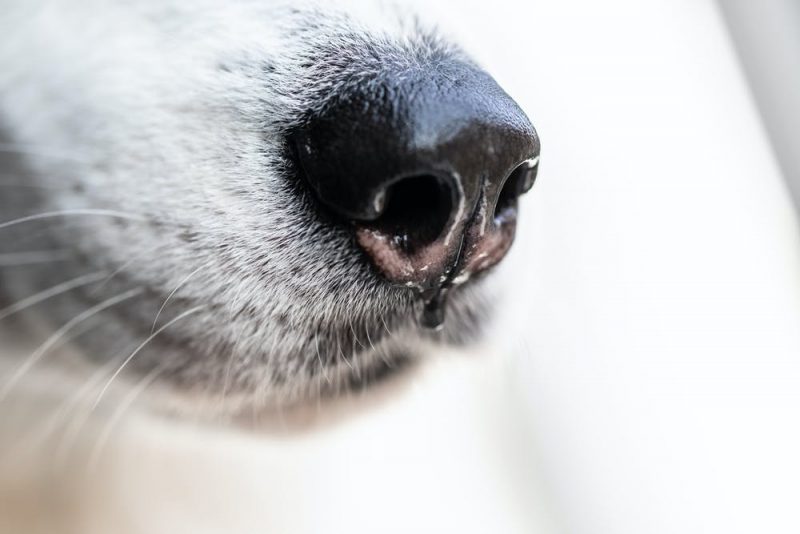
When it comes to SARS-CoV-2 detection, we don’t know for sure what the dogs are smelling.
The volatile organic compounds (VOCs) given off in the sweat samples are a complex mix. So it’s likely the dogs are detecting a particular profile rather than individual compounds.
Sweat is used for tests as it’s not considered infectious for Covid-19. This means it presents less risk when handling samples.
Covid-19 sniffing dogs in Australia
Here in Australia, we’re currently working with professional trainers of detector dogs in South Australia, Victoria and New South Wales. The most common breed used for this work so far has been the German shepherd, with various other breeds also involved.
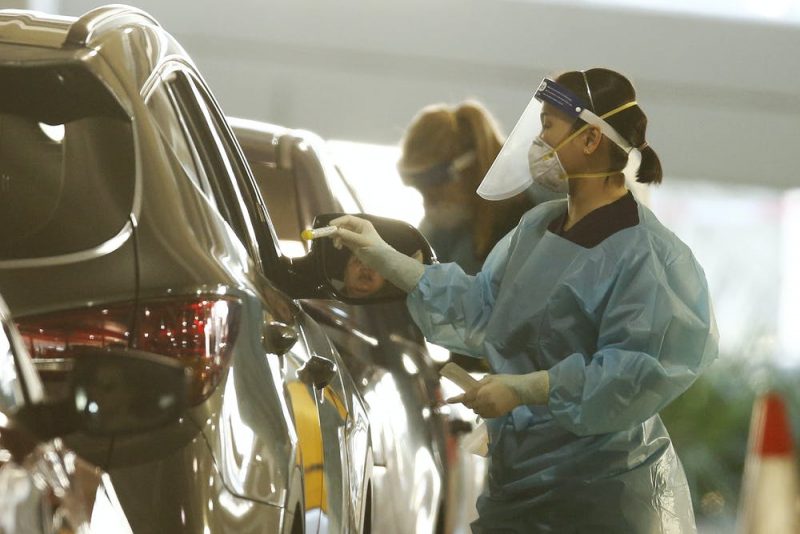
We are also negotiating with health authorities to collect sweat samples from people who have tested positive for the virus, and from those who are negative. We hope to start collecting these within the next few months.
We will need to collect thousands of negative samples to make sure the dogs aren’t detecting other viral infections, such as the common cold or influenza. In other countries, they’ve passed this test with flying colors.
Once operational, detector dogs in Australia could be hugely valuable in many scenarios, such as screening people at airports and state borders, or monitoring staff working in aged care facilities and hospitals daily (so they don’t need repeat testing).
To properly train a dog to detect SARS-CoV-2, it takes:
– 6-8 weeks for a dog that is already trained to detect other scents, or
– 3-6 months for a dog that has never been trained.
Could the dogs spread the virus further?
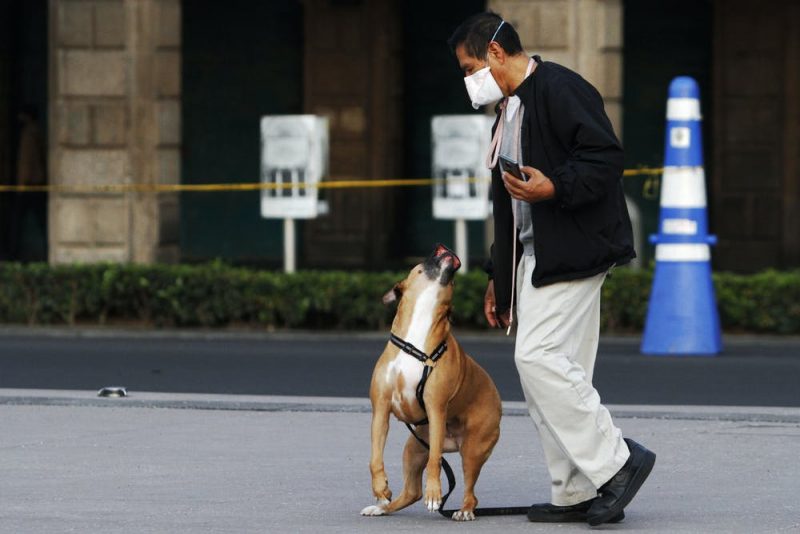
Dogs in experimental studies have not been shown to be able to replicate the virus (within their body). Simply, they themselves are not a source of infection.
Currently, there are two case reports in the world of dogs being potentially contaminated with the Covid-19 virus by their owners. Those dogs didn’t become sick.
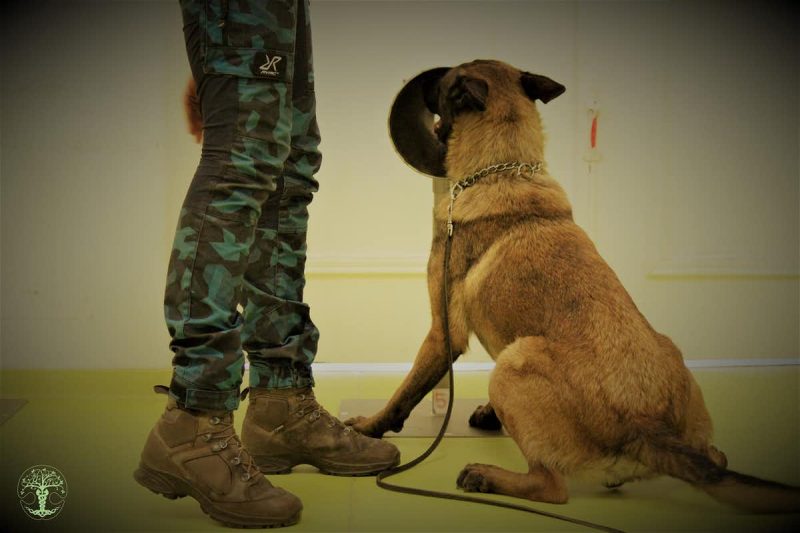
To further reduce any potential risk of transmission to both people and dogs, the apparatus used to train the dogs doesn’t allow any direct contact between the dog’s nose and the sweat sample.
The dog’s nose goes into a stainless steel cone, with the sweat sample in a receptacle behind. This allows free access to the volatile olfactory compounds but no physical contact.
Furthermore, all the dogs trained to detect Covid-19 are regularly checked by nasal swab tests, rectal swab tests and blood tests to identify antibodies. So far, none of the detector dogs has been found to be infected.
Hurdles to jump
Now and in the future, it will be important for us to identify any instances where detector dogs may present false positives (signaling a sample is positive when it’s negative) or false negatives (signaling the sample is negative when it’s positive).
We’re also hoping our work can reveal exactly which volatile olfactory compound(s) is/are specific to Covid-19 infection.
This knowledge might help us understand the disease process resulting from Covid-19 infection – and in detecting other diseases using detector dogs.
This pandemic has been a huge challenge for everyone. Being able to find asymptomatic people infected with the coronavirus would be a game-changer – and that’s what we need right now.
A friend to us (and science)
Perhaps we shouldn’t be surprised about dogs’ ability to detect Covid-19, as we already know their noses are amazing.
Dogs can help detect hypoglycemia in diabetics, warn people who are about to have an epileptic seizure and have been used to sniff out some cancers.
Their great potential in dealing with the current pandemic is just one of myriad examples of how dogs enrich our lives.
We acknowledge Professor Riad Sarkis from the Saint Joseph University (Beirut) and Clothilde Lecoq-Julien from the Alfort Veterinary School (France) for first conceiving the idea underpinning this work back in March.
Susan Hazel, Senior Lecturer, School of Animal and Veterinary Science, University of Adelaide and Anne-Lise Chaber, One Health Lecturer, School of Animal and Veterinary Science, University of Adelaide
This article is republished from The Conversation under a Creative Commons license. Read the original article.
Bottom line: Dogs are being trained to use their sense of smell to detect the novel coronavirus that causes Covid-19.
ooOOoo
To be honest, we humans just cannot fathom out what it is like to have a sense of smell that is 100 million times more sensitive than us!
So I can republish articles, such as this one, and we can be amazed, or whatever. But in truth we don’t have a clue. Not a clue!
I hope those scientists down under have a smooth experience with their very clever dogs!
The Golden Circle.
This, again, is not about our beloved animals; in other words, this is not about our dogs.
But it is about something of supreme importance: The role of innovation. That’s innovation in all aspects of our human lives. Think of it as a process of innovation.
There was the Diffusion of Innovation (DOI) Theory developed by E.M. Rogers in 1962. There is a comprehensive explanation of DOI here, from where I take the following diagram, but before explaining, from that same site, the meanings behind the definitions, I would like to emphasize one important point: “It works better with adoption of behaviors rather than cessation or prevention of behaviors.“.
So here is that diagram:
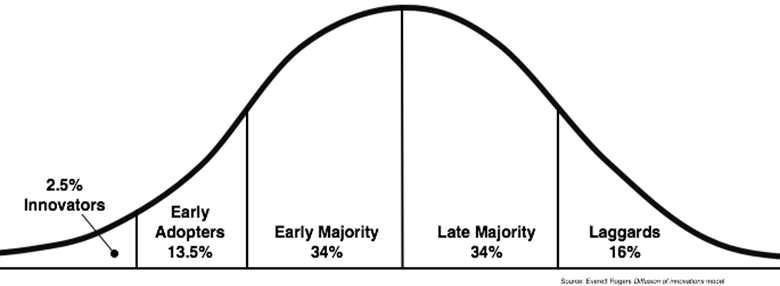
Here are the meanings of those terms (my emboldening):
Adoption of a new idea, behavior, or product (i.e., “innovation”) does not happen simultaneously in a social system; rather it is a process whereby some people are more apt to adopt the innovation than others.
Researchers have found that people who adopt an innovation early have different characteristics than people who adopt an innovation later. When promoting an innovation to a target population, it is important to understand the characteristics of the target population that will help or hinder adoption of the innovation.
There are five established adopter categories, and while the majority of the general population tends to fall in the middle categories, it is still necessary to understand the characteristics of the target population. When promoting an innovation, there are different strategies used to appeal to the different adopter categories.
- Innovators – These are people who want to be the first to try the innovation. They are venturesome and interested in new ideas. These people are very willing to take risks, and are often the first to develop new ideas. Very little, if anything, needs to be done to appeal to this population.
- Early Adopters – These are people who represent opinion leaders. They enjoy leadership roles, and embrace change opportunities. They are already aware of the need to change and so are very comfortable adopting new ideas. Strategies to appeal to this population include how-to manuals and information sheets on implementation. They do not need information to convince them to change.
- Early Majority – These people are rarely leaders, but they do adopt new ideas before the average person. That said, they typically need to see evidence that the innovation works before they are willing to adopt it. Strategies to appeal to this population include success stories and evidence of the innovation’s effectiveness.
- Late Majority – These people are skeptical of change, and will only adopt an innovation after it has been tried by the majority. Strategies to appeal to this population include information on how many other people have tried the innovation and have adopted it successfully.
- Laggards – These people are bound by tradition and very conservative. They are very skeptical of change and are the hardest group to bring on board. Strategies to appeal to this population include statistics, fear appeals, and pressure from people in the other adopter groups.
Now there’s a TED Talk that I hadn’t seen, and yet nearly 51 million people had! It came to me as an email from TED and yesterday, while we were sitting up in bed early in the morning, I watched it. It ‘spoke’ to me and I felt that I just had to share it with you.
Because so many of the problems that face our society today are global issues and if humans are to have a future on this planet then we need great leaders who will inspire us.
Now watch the following video, it’s just over 18 minutes long, but it says it all.

 Learning from Dogs