One of the many things that we adore about living here in Merlin, Southern Oregon is the closeness of nature. Not just the nature of the slopes and mountains but the nature of the trees, creeks, grasses and wild plants.
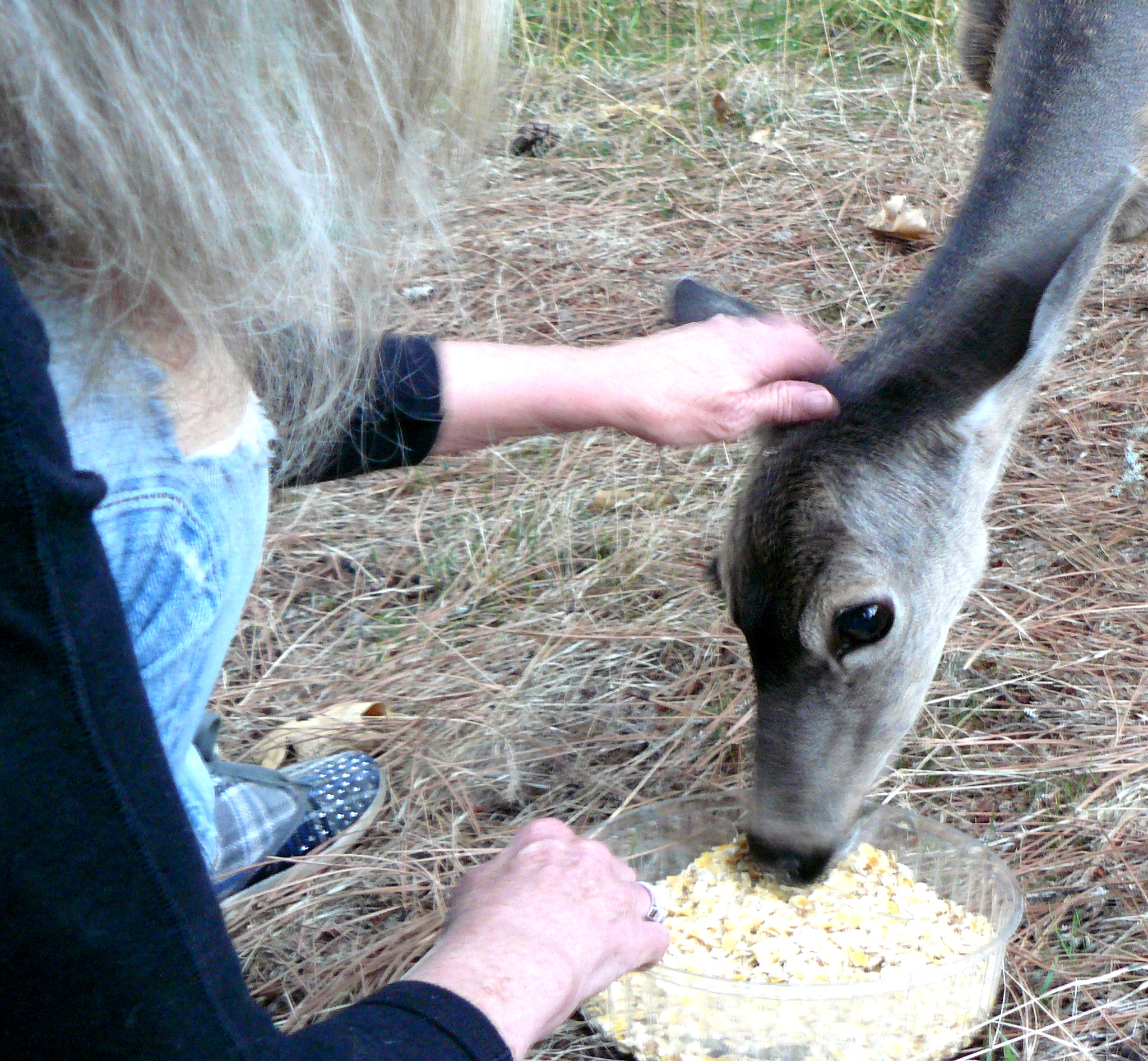
Plus the awareness over the 4+ years that we have been here of how easy it is to gain the trust of wild animals. I will go to my grave holding on to the sweet sensation of a wild deer trusting me and Jean to the point where we could stroke the deer’s neck when we were feeding her.
The trust between the deer and Jean then enabled the deer to feed from Jean’s hand.Then, unbelievably, the wild deer continues feeding as Jean fondles the deer’s ear.
(Both photographs taken in October, 2014 in the area of grassland near to our stables.)
The measure of how we, as in humanity, really feel about the only home we have, as in Planet Earth, is how we regard our planet.
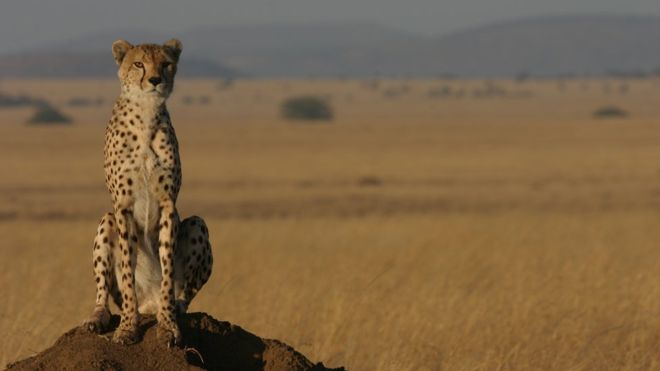
The pain that we feel when we read, as I did yesterday, about another animal species possibly heading towards extinction. In this case, an item on the BBC News website about Cheetahs.
Cheetahs heading towards extinction as population crashes
By Matt McGrath Environment correspondent
Protected parks and reserves for cheetahs are not sufficient as the animal ranges far beyond these areas.
The sleek, speedy cheetah is rapidly heading towards extinction according to a new study into declining numbers.
The report estimates that there are just 7,100 of the world’s fastest mammals now left in the wild.
Cheetahs are in trouble because they range far beyond protected areas and are coming increasingly into conflict with humans.
The authors are calling for an urgent re-categorisation of the species from vulnerable to endangered.
It’s no good tut-tutting; something different has to be done. For otherwise nature will have the last word to say about the future of vast numbers of species especially homo sapiens!
All of which leads me to the main theme of today’s post: holding nature in higher esteem as in higher legal esteem.
Read the following that was published on The Conversation blogsite on October 10th, 2016 and is republished here within their terms. The author is Chip Colwell , Lecturer on Anthropology, University of Colorado, Denver.
ooOOoo
What if nature, like corporations, had the rights and protections of a person?
October 10, 2016 8.16am EDT
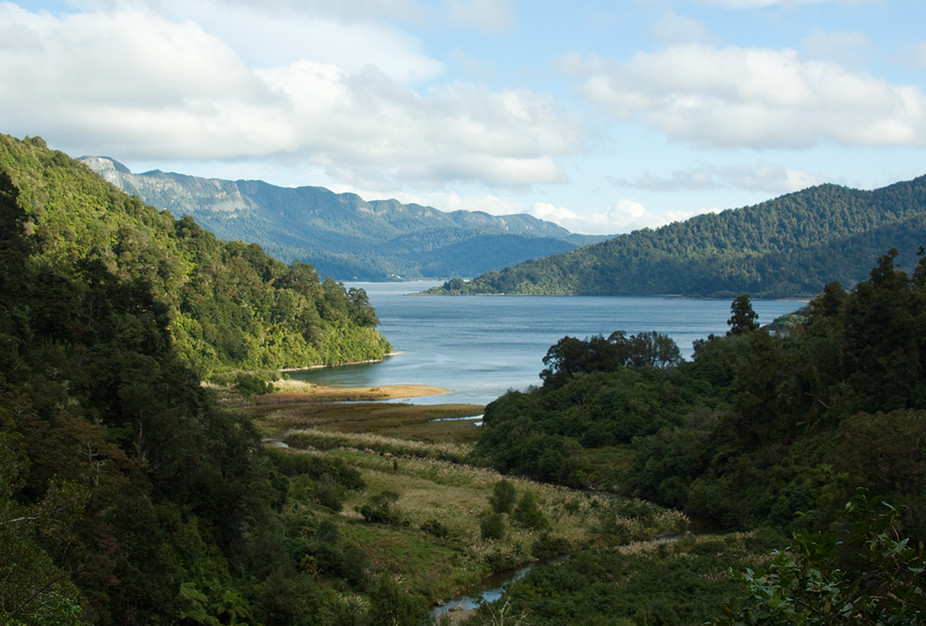
The forest around Lake Waikaremoana in New Zealand has been given legal status of a person because of its cultural significance. Paul Nelhams/flickr, CC BY-SA
In recent years, the U.S. Supreme Court has solidified the concept of corporate personhood. Following rulings in such cases as Hobby Lobby and Citizens United, U.S. law has established that companies are, like people, entitled to certain rights and protections.
But that’s not the only instance of extending legal rights to nonhuman entities. New Zealand took a radically different approach in 2014 with the Te Urewera Act which granted an 821-square-mile forest the legal status of a person. The forest is sacred to the Tūhoe people, an indigenous group of the Maori. For them Te Urewera is an ancient and ancestral homeland that breathes life into their culture. The forest is also a living ancestor. The Te Urewera Act concludes that “Te Urewera has an identity in and of itself,” and thus must be its own entity with “all the rights, powers, duties, and liabilities of a legal person.” Te Urewera holds title to itself.
Although this legal approach is unique to New Zealand, the underlying reason for it is not. Over the last 15 years I have documented similar cultural expressions by Native Americans about their traditional, sacred places. As an anthropologist, this research has often pushed me to search for an answer to the profound question: What does it mean for nature to be a person?
The snow-capped mountain
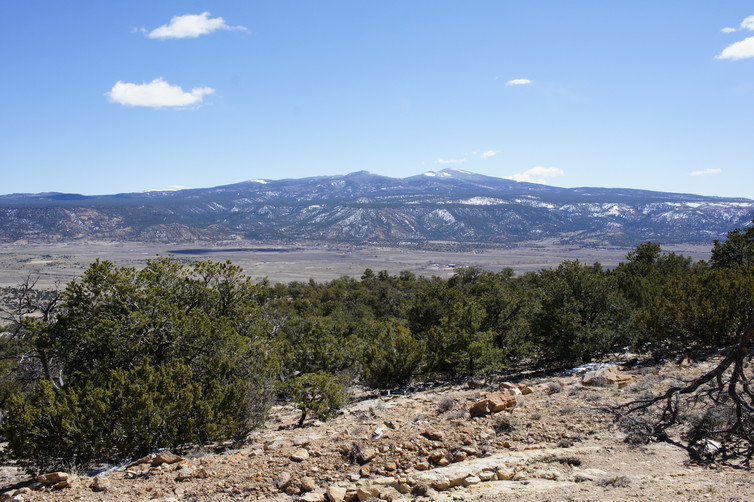
A majestic mountain sits not far northwest of Albuquerque, New Mexico. Like a low triangle, with long gentle slopes, Mount Taylor is clothed in rich forests that appear a velvety charcoal-blue from the distance. Its bald summit, more than 11,000 feet high, is often blanketed in snow – a reminder of the blessing of water, when seen from the blazing desert below.
The Zuni tribe lives about 40 miles west of Mount Taylor. In 2012, I worked with a team to interview 24 tribal members about the values they hold for Dewankwin K’yaba:chu Yalanne (“In the East Snow-capped Mountain”), as Mount Taylor is called in the Zuni language. We were told that their most ancient ancestors began an epic migration in the Grand Canyon.
Mount Taylor in New Mexico, a sacred site to the Zuni who believe it is a living being. Chip Colwell, Author provided.
Over millennia they migrated across the Southwest, with important medicine societies and clans living around Mount Taylor. After settling in their current pueblo homes, Zunis returned to this sacred mountain to hunt animals like deer and bear, harvest wild plants like acorns and cattails, and gather minerals used in sacrosanct rituals that keep the universe in order. Across the generations Dewankwin Kyaba:chu Yalanne has come to shape Zuni history, life, and identity no less than the Vatican has for Catholics.
But unlike holy places in the Western world, Zunis believe Mount Taylor is a living being. Zuni elders told me that the mountain was created within the Earth’s womb. As a mountain formed by volcanic activity, it has always grown and aged. The mountain can give life as people do. The mountain’s snow melts in spring and nourishes plants and wildlife for miles. Water is the mountain’s blood; buried minerals are the mountain’s meat. Because it lives, deep below is its beating heart. Zunis consider Mount Taylor to be their kin.
There is a stereotype that Native American peoples have a singular connection to nature. And yet in my experience, they do see the world in a fundamentally different way from most people I know. Whether it is mountains, rivers, rocks, animals, plants, stars or weather, they see the natural world as living and breathing, deeply relational, even at times all-knowing and transcendent.
In my work with Arizona’s Hopi tribe, I have traveled with cultural leaders to study sacred places. They often stop to listen to the wind, or search the sky for an eagle, or smile when it begins to rain, which they believe is a blessing the ancestors bestow upon them.
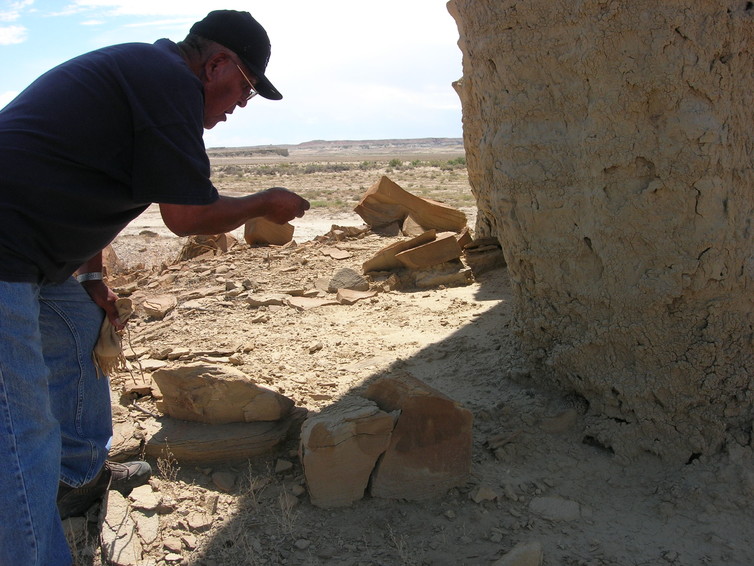
During one project with the Hopi tribe, we came across a rattlesnake coiled near an ancient fallen pueblo. “Long ago, one of them ancestors lived here and turned into a rattlesnake,” the elder Raleigh H. Puhuyaoma Sr. shared with me, pointing to the nearby archaeological site. “It’s now protecting the place.” The elders left an offering of corn meal to the snake. An elder later told me that it soon rained on his cornfield, a result from this spiritual exchange.
Violent disputes
Understanding these cultural worldviews matters greatly in discussions over protecting places in nature. The American West has a long history of battles over the control of land. We’ve seen this recently from the Bundy family’s takeover of the federal wildlife refuge in Oregon to the current fight over turning Bears Ears – 1.9 million acres of wilderness – into a national monument in Utah.
Yet often these battles are less about the struggle between private and public interests, and more about basic questions of nature’s purpose. Do wild places have intrinsic worth? Or is the land a mere tool for human uses?
A Hopi elder making an offering to a snake to protect a sacred space. Chip Colwell, Author provided.
Much of my research has involved documenting sacred places because they are being threatened by development projects on public land. The Zuni’s sacred Mount Taylor, much of it managed by the U.S. National Forest Service, has been extensively mined for uranium, and is the cause of violent disputes over whether it should be developed or protected.
Even though the U.S. does not legally recognize natural places as people, some legal protections exist for sacred places. Under the National Historic Preservation Act, for example, the U.S. government must take into consideration the potential impacts of certain development projects on “traditional cultural properties.”
This and other federal heritage laws, however, provide tribes a small voice in the process, little power, and rarely lead to preservation. More to the point, these laws reduce what tribes see as living places to “properties,” obscuring their inherent spiritual value.
In New Zealand, the Te Urewera Act offers a higher level of protection, empowering a board to be the land’s guardian. The Te Urewera Act, though, does not remove its connection to humans. With a permit, people can hunt, fish, farm and more. The public still has access to the forest. One section of the law even allows Te Urewera to be mined.
Te Urewera teaches us that acknowledging cultural views of places as living does not mean ending the relationship between humans and nature, but reordering it – recognizing nature’s intrinsic worth and respecting indigenous philosophies.
In the U.S. and elsewhere, I believe we can do better to align our legal system with the cultural expressions of the people it serves. For instance, the U.S. Congress could amend the NHPA or the American Indian Religious Freedom Act to acknowledge the deep cultural connection between tribes and natural places, and afford better protections for sacred landscapes like New Mexico’s Mount Taylor.
Until then, it says much about us when companies are considered people before nature is.
It is a function of the news media to highlight alarming events; many of them with some justification.
But it’s all too easy to be drawn into a world that seems almost to be uniformly dark and foreboding.
Thus the following item seen over on the Care2 site really does deserve the widest sharing because it reminds us that there are countless good people who work so hard for our wonderful animals.
ooOOoo
Christmas Rescuers Save 1,300 Dogs and Cats From Winter Without Electricity
DONETSK — In the days before Christmas, a Ukrainian animal shelter drifting toward a winter of complete darkness has experienced an unexpected tidal wave of support from international animal lovers determined to keep the power on.
Last week, the shelter – located on the Russian border- sent out a distress call about the imminent threat of blackout for their 1,300 dogs and cats, many of whom were left behind by refugees during violent attacks over the last two years. After losing their local business sponsor during the military conflict, the shelter team have been enduring an intense struggle to feed the animals and to simply stay afloat.
“I can’t even remember the last time something good happened to us,” shelter manager Vita Bryzgalova explained in an email to the Harmony Fund international rescue charity. “We are now facing a power shut-down since the debt for electricity accumulated over the past year. It is almost $7,000 since the beginning of 2016.”
“If the electricity in the shelter would be cut, the veterinary appliances will not work and the shelter will be under sub-zero temperatures with no way to provide treatment or carry out operations,” Vita continued. “There will be no place to keep medications and vaccines and food for all animals living in the shelter as everything will freeze. The building is heated by a boiler but it doesn’t not work without the electric pump. There are three hospital wards with animals here and there are about 80 animals that are being treated and they especially need warmth and care. Also we have 35 employees who give daily care of the animals and they will be sick more often without heat in the rooms. Without electricity, we will also have no external communications by telephone or internet.”
Having provided donations of food and staff wages during this difficult time, the Harmony Fund turned to Facebook to see if people might be willing to help keep the electricity on. Within 48 hours, half the funds were raised ($3,500) and this sum was enough to keep the power on for the next few months while the charity attempts to raise funds for the rest of the debt to the electricity supplier.
The Great Animal Rescue Chase celebrates the art of animal rescue with a worldwide race to rescue one million. It’s a free event, open to all, and is perhaps the only global animal rescue event aimed at helping any animal in distress, anywhere in the world. Our ambition is to create a culture of enthusiasm and pride in animal activism. We believe in teaching, by example, that there is a hero in each of us just waiting to be unleashed. Empowered animal lovers can not only save lives, but build the momentum for powerful animal welfare reform.
The Harmony Fund
The Harmony Fund offers a lifeline to so called “underdog” animal rescue squads across the planet. Our partners are the small but incredibly courageous and effective animal rescue teams who operate in parts of the world where funding is very hard to come by. Our supporters are helping us to dramatically impact the capacity of these rescue teams to touch thousands upon thousands of animals who might otherwise be unreachable.
Gratitude and respect are at the cornerstone of our relationship with our supporters. We do not expose our supporters to graphic photos of animal suffering or distribute dire forecasts about animal suffering. Instead we focus on a spirit of joy and determination as we pursue essential operations to provide food, veterinary medicine, shelter and protection from cruelty for animals worldwide.
Contact Us
To contact The Great Animal Rescue Chase or the Harmony Fund, view our Contact Us page.
In the space of time it takes a raindrop to roll down your cheek, a life changing decision is made. You either turn sorrowfully away from an animal in distress or summon the courage to run forward and help. For all you runners out there, welcome home.
Come on in and rest your feet a while. Then join us in a planet-wide race to save 1 million suffering animals who are about to learn the spectacular meaning of second chances.
I know that all of you dear readers of this place will, without hesitation, summon the courage to run forward and help.
Just a few days ago I wrote of the time when I was living in the small village of Harberton in South Devon, England. Harberton was a wonderful reminder that these modern times don’t reach to everyone all of the time. There were still plenty of folk who recalled the past times in very beautiful ways. (I wish I could remember the name of the old Devonian who used to come into the village pub on a regular basis and demonstrate that by listening to a local’s accent he could tell which Devon village they were from!)
It’s all too easy to lose sight of the fact that many things change very slowly, and local and regional accents are examples of that.
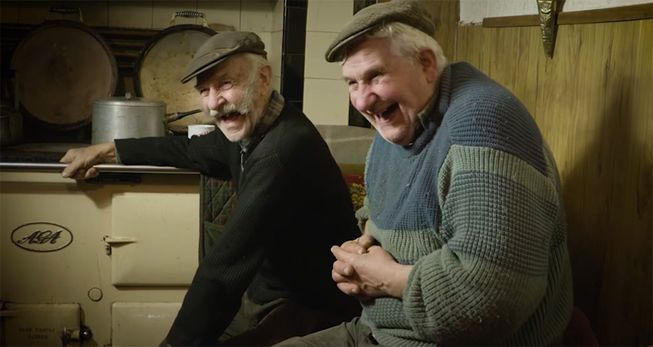
Welsh farmers Howell and Gerwyn George’s secret to a rich life is plain to see: just enjoy a good laugh! (Photo: Riverlea/YouTube)
If we told you that listening to two old Welsh farmers recount the good ol’ days might just become the highlight of your day, would you believe us?
For whatever reason, whether it’s their charm, genuine brotherly love, or endearing/confounding Welsh dialect, Howell and Gerwyn George have mesmerized nearly everyone who has given up a few moments to watch them reminisce.
“They don’t make boys like that any more, more is the pity!!!,” said one commenter on Facebook. “Quality, pleasure to watch.”
“I could listen to this pair all day long…,” said another.
In the 18-minute video, the George brothers discuss everything from livestock to family and changing agricultural practices. Everything is interjected with anecdotes that invariably lead to one or both of the men to erupt into laughter. Several times, I found myself laughing without even knowing what in the world they were saying.
But enough gab from us; we’ll gladly let Howell and Gerwyn take over the conversation. Someone throw these two a reality television contract.
I deliberately planned for this post to be published at the precise moment, in Pacific Time that is, when the solstice occurs.
Welcome to the shortest day of 2016.
Winter Solstice at the Stonehenge Monument in Southern England.
I am now republishing much of what appeared on the EarthSky blog a few days ago.
Late dawn. Early sunset. Short day. Long night. For us in the Northern Hemisphere, the December solstice marks the longest night and shortest day of the year. Meanwhile, on the day of the December solstice, the Southern Hemisphere has its longest day and shortest night. This special day is coming up on Wednesday, December 21 at 10:44 UTC (December 21 at 4:44 a.m. CST). No matter where you live on Earth’s globe, a solstice is your signal to celebrate.
Want to know what time it is where you are living?
When is the solstice where I live? The solstice happens at the same instant for all of us, everywhere on Earth. In 2016, the December solstice comes on December 21 at 4:44 a.m. CST. That’s on December 21 at 10:44 Universal Time. It’s when the sun on our sky’s dome reaches its farthest southward point for the year. At this solstice, the Northern Hemisphere has its shortest day and longest night of the year.
This morning I read an interesting set of facts about the Solstice over on the Mother Nature Network. It included this:
The word “solstice” comes from the Latin solstitium, meaning “point at which the sun stands still.” Since when has the sun ever moved?! Of course, before Renaissance astronomer Nicolaus Copernicus (aka “super smartypants”) came up with the ‘ol heliocentric model, we all figured that everything revolved around the Earth, sun included. Our continued use of the word “solstice” is a beautiful reminder of just how far we’ve come and provides a nice opportunity to give a tip of the hat to great thinkers who challenged the status quo.
Giving from the heart; in this case a dog’s heart.
As many readers know we have nine dogs here at home, divided into the ‘kitchen’ group (Paloma, Casey and Ruby) and the ‘bedroom’ group (Pharaoh, Brandy, Cleo, Sweeny, Pedy and Oliver). Inevitably the latter group are closer to us because they share the bulk of the home with Jeannie and me, and sleep in our bedroom. Don’t get me wrong, I am not saying that the kitchen group are any less affectionate than the bedroom group it’s just that, for me especially, I am able to be emotionally and physically closer to our bedroom group because for most of the hours of each day they are close to me.
Brandy, Cleo and Oliver seem to be incredibly sensitive to Jeannie’s and my feelings. If something makes me cry then one of them will be next to me in seconds. When Jeannie and I hug, Oliver will stand on his rear legs, place his front legs on our bodies above our waists and act as if he is hugging us. Even the mention of the word “out” has Cleo running to the front door.
So many more examples but you get the drift!
Last Friday The Washington Post published a heart-breaking story. It concerned a young man, just 33-years-old, who was dying from a brain hemorrhage. Here’s an extract from that story:
Ryan Thomas Jessen had gone to the hospital for what he thought was a migraine, but it turned out to be a brain hemorrhage, his sister, Michelle Jessen, wrote on Facebook earlier this month.
The hemorrhage, which doctors believe may have been brought on by high blood pressure, would prove fatal.
But before Jessen died, the 33-year-old Californian’s family wanted to let his dog, Mollie, see him one last time.
Michelle Jessen filmed that last visit by Mollie and, as one might expect, the video has been shared right across the world.
So very often words come so difficult when one wants to reflect on what we have just watched.
I included in yesterday’s post the interview with Bill Kotke and his concern that humanity’s greed, and that’s the correct term in my view, focusing on each generation having more, howsoever one defines ‘more’, was utterly at odds with a sustainable future on the only home we have: Planet Earth. A finite planet in a finite solar system.
On Monday I was chatting with Roger D. back in the old country. It was Roger who introduced me to gliding back in the late 70s. Later we were in business together in Colchester, Essex and we still keep in touch.
Anyway, Roger was bemoaning the current state of affairs in the UK regarding Brexit and went on to say that every economic strategy offered by this or that UK Government was about growth. Whether we are talking economic growth, improvement in living standards or population growth why are there no leading figures in any leading government standing up and saying this can’t go on! Because it can’t!
We are presently a global population of 7.5 billion. This year alone, as of today, there have been 56,000,000 deaths. But also, as of today, there have been 133,000,000 births. (I rounded the figures but what difference does it make!) That’s a growth of 77 million persons in this one year. It cannot go on!
Bill Kotke also spoke of soil loss. Just last Sunday there was a Care2 item about soil loss. From which I extract:
Could soil ever actually run out?
Yes. If we continue to harm and degrade topsoil at the current rate, it’s estimated that the world could lose all its topsoil within 60 years.
Topsoil is the uppermost layer of soil on the surface of the earth. It’s the most fertile type of soil that typically contains lots of nutrient-rich organic matter from broken down plants and other organisms. Topsoil is also alive with beneficial microbes, fungi and critters like earth worms, which feed on the organic matter.
The deeper layers of soil beneath the topsoil are not nearly as rich. They are primarily made up of decomposing rock that provides the raw material for future topsoil as well as a substrate for deeply rooted plants to anchor in.
If the delicate ecosystem within topsoil is disrupted, it will essentially die. Plants can’t grow in topsoil that doesn’t have abundant organic matter and thriving populations of microbes.
Yes, there are street protests about this political action or that political action but why aren’t we seeing tens of thousands on the streets protesting about the loss of our topsoil!!
Moving on.
There was a recent essay from Patrice Ayme in which he wrote about the Australian Asthma Thunderstorm. Just read this long extract from that essay:
(November 29th, 2016 Italics are from the story as presented in the New York Times)
Mr. McGann was one of thousands of people in Melbourne having an attack of thunderstorm asthma. About 8,500 people went to hospitals. Eight have died, and one remains in intensive care more than a week after a thunderstorm surged across Melbourne, carrying pollen that strong winds and rain broke into tiny fragments.
Perennial ryegrass seeds were swept up in whorls of wind and carried from four million hectares of pasturelands (about 9.9 million acres) that lie to Melbourne’s north and west. If broken into fragments, they are so fine that they can be inhaled.”
Actually what also lie north and west of Melbourne are giant fields of canola. Consider the following propaganda picture:
Mr. McGann did not end up in the hospital. “Every breath I took made the next breath harder,” he said, adding that he had no family history of asthma. “I just didn’t realize it could have the effect it had.”
Grass pollen is the primary source of allergies in southern Australia, and tracking the data allowed scientists to forecast high levels of grass seeds in the atmosphere on Nov. 21. Still, Ms. Hennessy said, the government was taken by surprise.”
Surprise, indeed, this did not happen before, by two orders of magnitude. How come so much more severity?
My lawyer’s theory is different. It evolved from my own observations and theories of why asthma and allergies, let alone weird cancers, have been augmenting spectacularly. There are around 150,000 artificial, man-made chemical products in use. By medical drug standards, they are untested (in earlier essays, I mentioned 80,000, which is the number brandished in the USA; however, French specialists talk about 150,000 untested chemicals.).
Canola (or rapeseed), Brassica napus, is an oilseed crop which is cultivated for its high quality edible oil used in many foods (eg. margarines and cooking oil) and seed meal (the fibrous material left after the oil pressing process), which has a high protein content. That makes it highly desirable as a stock feed.
In 2010-11, the Australian state of Victoria, where Melbourne is located, produced 476 thousand tonnes of canola with a gross value of $293 million.
Control of weeds, particularly weeds from the Brassicaceae family (broadleaf), through herbicide application during the canola-growing season, significantly improves the quantity of the grain produced. Weeds compete for space, nutrients and sunlight. (African countries have dismissed that the quality of GMO seed is higher, in contradistinction with US propaganda; quite the opposite, they say)
Two genetically modified (GM) canola varieties have been developed in Australia, Roundup Ready® (by Monsanto Australia Ltd) and InVigor® (by Bayer CropSciences Pty Ltd). For maximum effect, each GM variety has been developed to be tolerant to and hence used with, a specific herbicide. The result is the mass poisoning of the planet, horizon to horizon.
The same poisoning trick is used for insecticides. To boot, the poison resistance spreads, demanding even higher doses of poison to be used in the grand outdoors..
In other words, massive quantities of poisons are put in the soil, and from there, are kicked up, in the air.
Exposed to this life destroying poisons, the body reacts by shutting down all pores. Asthma.
It cannot go on!
It is time for you and me and millions of others to be the change we want to see. Whether it’s the little things like recycling, or car sharing, or the bigger things like moving to an eco village we have to make a difference.
We have to learn from those communities that for thousands of years lived harmonious and sustainable lives on the planet. Doing so many thousands of years before farming man came on to the scene
In 1969 I spent a year in the outback of Australia as a correspondent for KotiPosti; a Finnish magazine. While I was out in the wilderness looking for Finns to write about it was impossible not to be drawn into the history of the aboriginal Australian.
ABORIGINAL AUSTRALIANS ARE descendents of the first people to leave Africa up to 75,000 years ago, a genetic study has found, confirming they may have the oldest continuous culture on the planet.
Professor Eske Willerslev of the University of Copenhagen, who led the study, says Aboriginal Australians were the first modern humans to traverse unknown territory in Asia and Australia. “It was a truly amazing journey that must have demanded exceptional survival skills and bravery,” he says.
A century-old lock of hair, given by a West Australian indigenous man to an anthropologist, has led to the discovery that ancestors of Aboriginal Australians reached Asia at least 24,000 years before another wave of migration that populated Europe and Asia.
It was back then that I truly understood the relationship that those early Australians had with the earth; with their planet. Forget religions and churches, the Aborigines had a spiritual relationship with the planet that sustained them.
I will never forget exploring quietly, just me and my wife of those days, the caves and darker recesses around the base of Ayers Rock, better called Uluru, the most amazing monolith right out there in the middle of the desert. The unmistakable signs of so many of those quiet recesses being spiritual places for those ancient people. Uluru, or Ayers Rock, is a massive sandstone monolith in the heart of the Northern Territory’s arid “Red Centre”. The nearest large town is Alice Springs, 450km away. Uluru is sacred to indigenous Australians and is thought to have started forming around 550 million years ago. It’s within Uluru-Kata Tjuta National Park, which also includes the 36 red-rock domes of the Kata Tjuta (colloquially “The Olgas”) formation.
It is just he same for the North American Indians. They have a spiritual relationship with the land.
Back to Bill Kotke’s talk. He spoke of how when each of us was the product of the fertilisation of the egg by the sperm in utero we grow first as a fish, then as a mammal and, finally, emerge as a human: “We are connected to the earth!”
As you all know I am a secular humanist. But that doesn’t mean that I don’t have deep, as in spiritual, feelings for the lands and the oceans and for the wildlife of this planet
So let me close by repeating what I said at that meeting where Bill was presenting. For Bill spoke of being connected, in a heartfelt manner, with the planet. For if one is so connected then it is natural for one to want to love and protect the planet.
This is what I said:
Bill,
In 1991 I departed Gibraltar Harbour solo on my yacht Songbird of Kent heading West out across the Atlantic.
After I had settled in to the routine of being at sea, better described as settling in to being connected to the ocean, I loved watching the dolphins come up to the boat, give it the once over, raise their heads and offer me a brief eye contact and then slip away.
Then I became aware that when I was laying down on my bunk in the cabin I could sense when the dolphins were close to my hull. Each time I had that sense I would come up to the deck, briefly pausing to clip on my safety harness lest I truly joined the dolphins, and one or two of those dolphins were always by my boat.
I called this post What To Say To The Kids. Not just my son and daughter, now both mature adults, but my grandson Morten son to my daughter and her husband.
Because I feel so strongly that waiting for our leaders and politicians to lead humanity in protecting our planet is pointless. They are driven by other values.
It cannot go on!
I want to be measured by my son and my daughter, and by my grandson in due time, as a person who made a difference; even just a small one.
For I truly believe that showing love for our planet will make a difference and that is what I want to say to my kids.
We have to return to community living; a twenty-first century version of such living. Even in the giant populations of big cities we have to reach out and form local communities. Groups of people who are driven by the imperative to curtail population growth, eager to share in as many ways as possible and totally committed to taking no more from the planet than they put in.
We, as in humanity, could be very close to the end!
Now my sub-title could be argued as being a tad provocative and, perhaps, it is. But I wanted to catch your attention and then hope that you stay with me for today’s post.
Jean and I belong to the Humanists & Freethinkers Group of Grants Pass. At last Saturday’s meeting the main item was a talk given by William Kötke: His website is here. Bill, as he was happy to be called, is the author of the books The Final Empire and Garden Planet (the links take you to the respective Amazon pages). Bill also has more details of his first book here.
The essence of Bill’s talk was that when we ‘evolved’ from a life of hunting and gathering to developing the land for agricultural purposes we lost our connection to the planet. For the simple reason that as foragers we depended on always being able to find edible wild plants and fruit, and therefore lived in balance with the land, but when we started to farm we became protective, materialistic and greedy. For having more land, even if one took it by force from another, equated to making more; making more food, using the surplus to buy favours, sell, etc.
Some of the facts that Bill presented in his talk were truly frightening such as soil loss; a topic I highlight in tomorrow’s post.
But for now just settle down and watch this interview of Bill filmed by Woodburn Community Access Television.
Published on Jan 10, 2016
Author and Futurist William H. Kotke shares with Woodburn his years of knowledge and understandings of the Human History and The Current Dilemma all of us face as a species.
Is there a way forward?
Yes, I think so and it’s all to do with communities; more on that in a later post.
Is this anything to do with dogs?
Here’s what the Welcome page of this blog says (in part):
As man’s companion, protector and helper, history suggests that dogs were critically important in man achieving success as a hunter-gatherer. Dogs ‘teaching’ man to be so successful a hunter enabled evolution, some 20,000 years later, to farming, thence the long journey to modern man. But in the last, say 100 years, that farming spirit has become corrupted to the point where we see the planet’s plant and mineral resources as infinite. Mankind is close to the edge of extinction, literally and spiritually.
Dogs know better, much better! Time again for man to learn from dogs!
Taken in the round I don’t think I’m ageing too badly. But there is one aspect of my world that does drive me bonkers from time to time. That is a decline (and that’s putting it politely) in my short-term memory. Everything from forgetting what it was I wanted to say to Jeannie to still being unsure of finding regularly visited places in Grants Pass, our local city. To put that last point into context we moved here to Merlin, some 12 miles from Grants Pass, back in September, 2012.
Turning to the cognitive skills of our wonderful dogs it is clear to me that we can only go so far in understanding how our dogs think and how much of their world is dealing with the present supported by their memories of previous events. (Frankly, in writing the last sentence I realised how even that premise was more of a guess than a known fact.)
A recent study at Eotvos Lorand University in Budapest about the memories of dogs has been widely referred to across many news outlets. So when it appeared on the Care2 site it was a natural to republish it for all you good people.
My doorbell has been broken for a few years, but every time my 9-year-old dog, Leroy, hears one chiming on a TV show, he looks at the front door.
Many pet owners have similar tales to tell about their dogs being able to remember long-ago experiences and events. And now we have proof that this really is possible. A new study found that dogs may have a more complex form of memory than most other nonhuman animals (sorry, elephants).
“Every move you make, every step you take, I’ll be watching you,” Sting once sang, and these lyrics could apply to our dogs, too. They’re not only watching us, but they’re remembering what they’re observing, no matter how trivial it may seem to us.
In the study at Eotvos Lorand University in Budapest, published Nov. 23 in Current Biology, 17 dogs were taught a training method called “Do As I Do.” The dogs would watch their owners perform an action. When the dogs were told, “Do it” and imitated their owners’ action, they were rewarded with a treat.
Next, the owners performed various actions but told the dogs to lie down instead of “Do it.” After a while, the dogs began lying down without being told to do so. The study’s authors noted that this showed the dogs had lost the expectation that they would be given the “Do it” command to imitate their owners.
Finally, the owners performed various actions, and when their dogs would lie down, the owners would wait either a minute or an hour and then give them the “Do it” command.
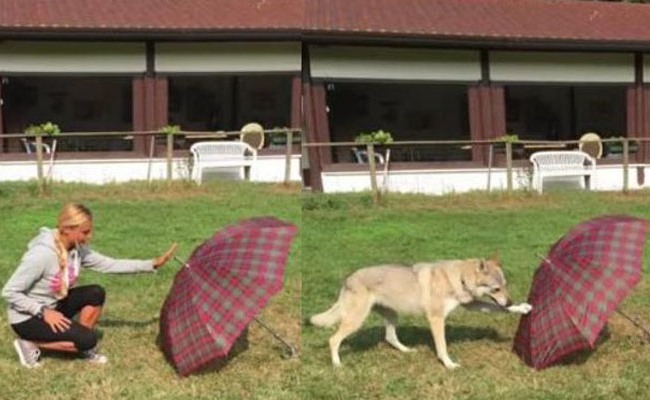
Some of the actions were unfamiliar to the dogs, such as their owners tapping on an open umbrella. The dogs would be led behind a partition, and a minute to an hour later would be led back to the umbrella and given the “Do it” command.
The dogs were able to remember what their owners had done, and tapped the umbrella with their paws.
“We cannot directly investigate what is in the dog’s mind,” psychologist Claudia Fugazza, an author of the study and owner of a Czechoslovakian Wolfdog who participated, told the Washington Post. “So we have to find behavioral evidence of what they expect or not.”
Remembering events in our lives is known as episodic memory. Until recently, only humans were thought to have this ability, but studies have found evidence that rats, monkeys and birds also have it, and so do dogs.
However, the researchers said the dogs don’t have full-fledged episodic memory, which would give them self awareness. Fugazza told NPR she didn’t think there was a method available to test whether dogs are self aware.
Victoria Templer, a behavioral neuroscientist at Providence College who wasn’t involved in the study, told NPR the results could be useful in helping scientists understand how episodic memory developed in humans and how it’s helped us to survive.
One interesting possibility Templer suggested is that “we evolved the ability to relive the past in order to imagine the future.”
ooOOoo
Of course what would be a marvelous aspect of a dog’s memory is being able to take note and remember where his male human companion left items around the house!
My post of last Tuesday week, the one about Murat Şahin feeding the dogs and cats in Istanbul, was so warmly welcomed by you.
So with your ‘Likes’ and wonderful comments still feeling like a long hug, metaphorically speaking, a week-and-a-half later I thought it would be nice to publish this today. It was seen over on the Care2 website.
ooOOoo
Over-The-Moon Taxi Driver Saves Dog From River
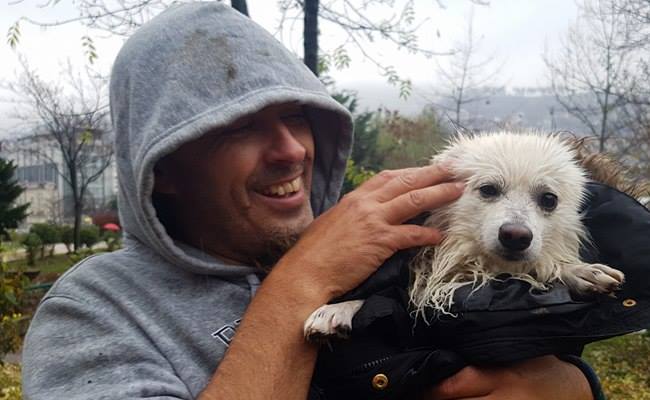
Caki Bravo is becoming rather well known across Sarajevo as the man who saves dogs. The 6′ 2″ tall taxi driver is a gentle giant whose passion leads to the rescue of at least a dozen street dogs each month. Caki’s latest rescue was caught on video, and his over-the-moon reaction is something viewers can’t stop watching.
Watch Caki’s Unbridled Happiness When He Saves The Dog
(The video is not on YouTube but you may watch it by going here.)
“People said that he was pushed by a passerby, a man of about 30 years old,” Caki says explaining how the dog now named Rio ended up in the river. “We were trying to pull him up but it was really hard because he was in a panic.”
And when dealing with a frightened dog, patience is an essential element for success. Fortunately, having rescued several hundred dogs in recent years, Caki knew just what to do.
“When he was brought to dry ground, he was shaking from the cold and from the fear,” Caki explains.
But within minutes, Rio was warming to the idea of human touch and sitting comfortably in the lap of rescue teammate Edina Pasic. Rio is now adjusting very well in foster care.”
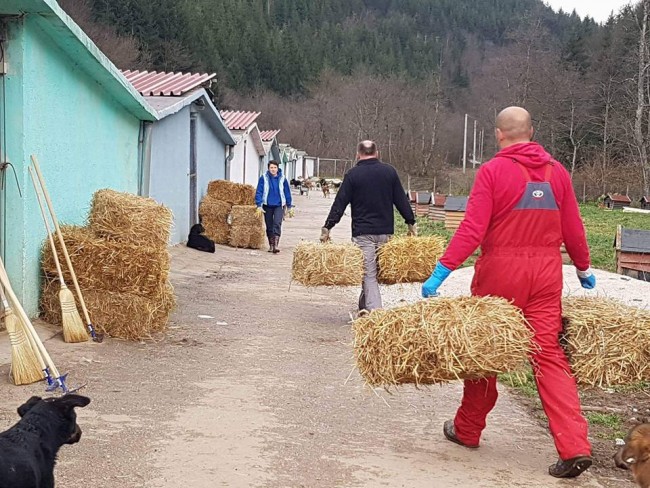
Caki belongs to a collective of rescuers in Bosnia who are caring for at least a couple thousand dogs in any given month. He and the others spent last weekend delivering bales of straw to a municipal dog pound to keep the dogs warm for winter.
The volunteer visit each Sunday includes delivering a large meal to each and every dog. Unfortunately, the town feeds the dogs only stale bread during the week. Rescuers are attempting to provide good quality food more often.
The USA-based Harmony Fund charity has just provided meals for the volunteers to deliver to the dogs throughout the month of December. The group often posts updates of the Bosnian rescue efforts on their Facebook page.
ooOOoo
Again and again dogs show us the power of love! (And forgiveness!)
That saying from the lips of Henry David Thoreau, the American essayist, poet and philosopher, reminds us that we must be that change before that change comes along.
Thus whatever you or I, or anyone else, thinks is wrong with these times, so eloquently expressed by George Monbiot in his essay republished in this place yesterday, bringing about the changes that you or I, or anyone else, want has to start with the individual.
That, inevitably, requires many to chose which path to follow.
Last Saturday, Sue Dreamwalker of the blog Dreamwalker’s Sanctuary, published a post that truly couldn’t have been better written in terms of following on to yesterday’s post.
Here it is republished with Sue’s kind permission.
I felt the need to post something deeper again today, and I could find no better words to write than I have already written as my thoughts go out to the many places around our globe in conflict right now.
I know there are many new subscribers here to Dreamwalker’s Sanctuary this year who may not have read this post.. I thank all in advance for their contributions..
If I am slow getting back to you, it’s because I want some time to paint this weekend and walk out in nature..
So look after each other and choose your Pathway well..
Love and Blessings
Sue❤
Much is happening with our Earth Plane at this time of transformation, the Mayans called it
“ A crossroads of time of Great External Changes and Major Internal Upheavals”.
We have seen around the globe how many nations are starting to change, we are also changing ourselves internally through our awareness and intuition and I see many withdrawing into themselves as they seek peace as they set about clearing the debris of our emotional bodies, myself included as we adjust to the vibrations around us.
At times all that is thrown our way is too disturbing to cope with, so we withdraw within our inner sanctuaries finding solace within Nature and our meditations..
I have to remind myself daily of the GOOD in this world as we get constantly bombarded with the BAD… So many things which are UGLY in this world which led me to revisit a post first posted in 2012.. The Good Bad and Ugly.. in which I used the Mayan quote above..
Everything in this world mirrors everything else, and everything is part of everything else, as difficult as that is to comprehend. So while we react with outrage, our rage is joining the tide of Anger already out there which is foaming back and forth in the sea of discontent.
It seems as if our very Earth Mother feels that anger as she too is rumbling ever louder in the bowels of our planet as we have seen how devastating her energies can be in Earthquakes and volcanic eruptions which are now becoming more active again around our globe..
We have to be careful not to be taken down the road of Fear.. Lest it trap us into engaging in giving out more fear by our failure to see how we are all quick to judge and use our own prejudices in labelling that which we are not in alignment with. Whether that be in our politics, beliefs, or idealisms. None of us is perfect.
We are now ‘Shifting’ from duality to Unity Consciousness, this was brought home again to me on how many of us are thinking similar thoughts even here on WP we see similar themes as we link into the Mass Consciousness as we join together our thoughts as we link subconsciously to the Cosmic web of thoughts..
We need to be aware of the Power of our thoughts and how we can assist in raising our planets vibration and our own collective Consciousness..
Much has been spoken upon Ascension, but first we need to ascend through our own layers as we climb ever higher, leaving behind the things that no longer serve us.
We do that by not getting swept up in conflict.. by being more loving and tolerant and being compassionate rather than being judgmental holding hate and anger.
We need to put the Care back in the world and if we embrace and choose Love over fear and we stop looking who to blame, but start to set examples of living in harmony and unity, then the true magnificence of who we really are can begin to manifest that ‘Golden Age’ which was once prophesied to bring about Peace..
But it’s up to us to pledge to change our own lives,and when we each start bringing back that peace within our own Lives, It’s up to each of us which road we want to take. And what dominant energy we want to prevail.. I choose Love.
Blessings
Sue.
ooOOoo
You must take personal responsibility. You cannot change the circumstances, the seasons, or the wind, but you can change yourself. That is something you have charge of.
So said Jim Rohn, the American businessman who died in 2009.

 My dreams of hope!








 Learning from Dogs