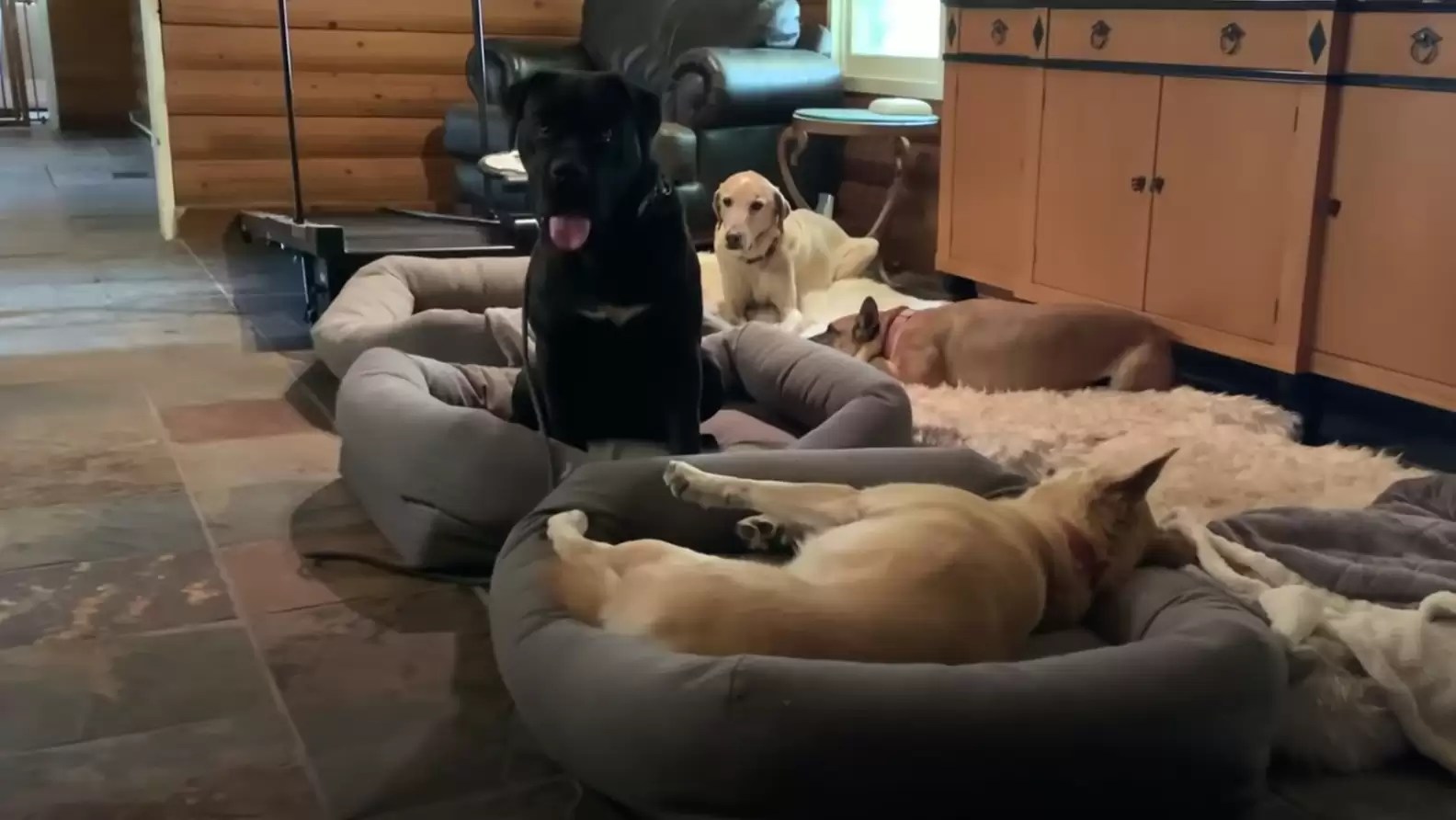
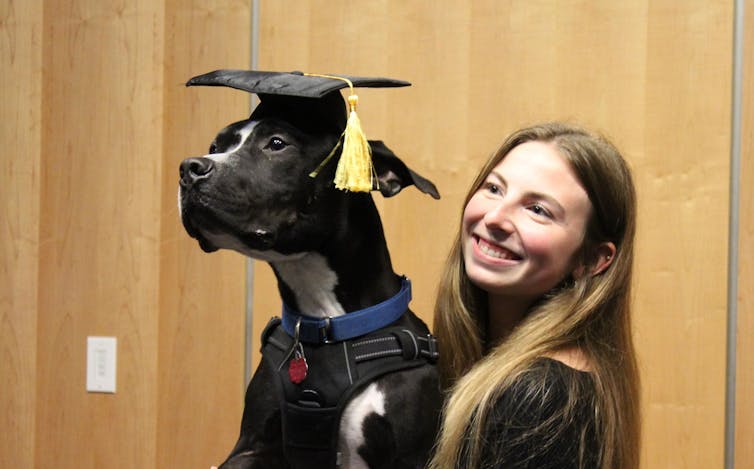
A woman who knew no bounds when it came to rescuing three large dogs.
This is such a beautiful account of Veronica Shea taking action, and personal risks, to provide, firstly trust, and then love for Princess George, Grace and Steve, as they were named. The story was published on The Dodo.
Please read for yourself.
ooOOoo
Woman Visits Mountain Every Day To Convince Huge Dogs To Let Her Rescue Them
“They couldn’t be touched. They couldn’t be leashed. They were just terrified.”
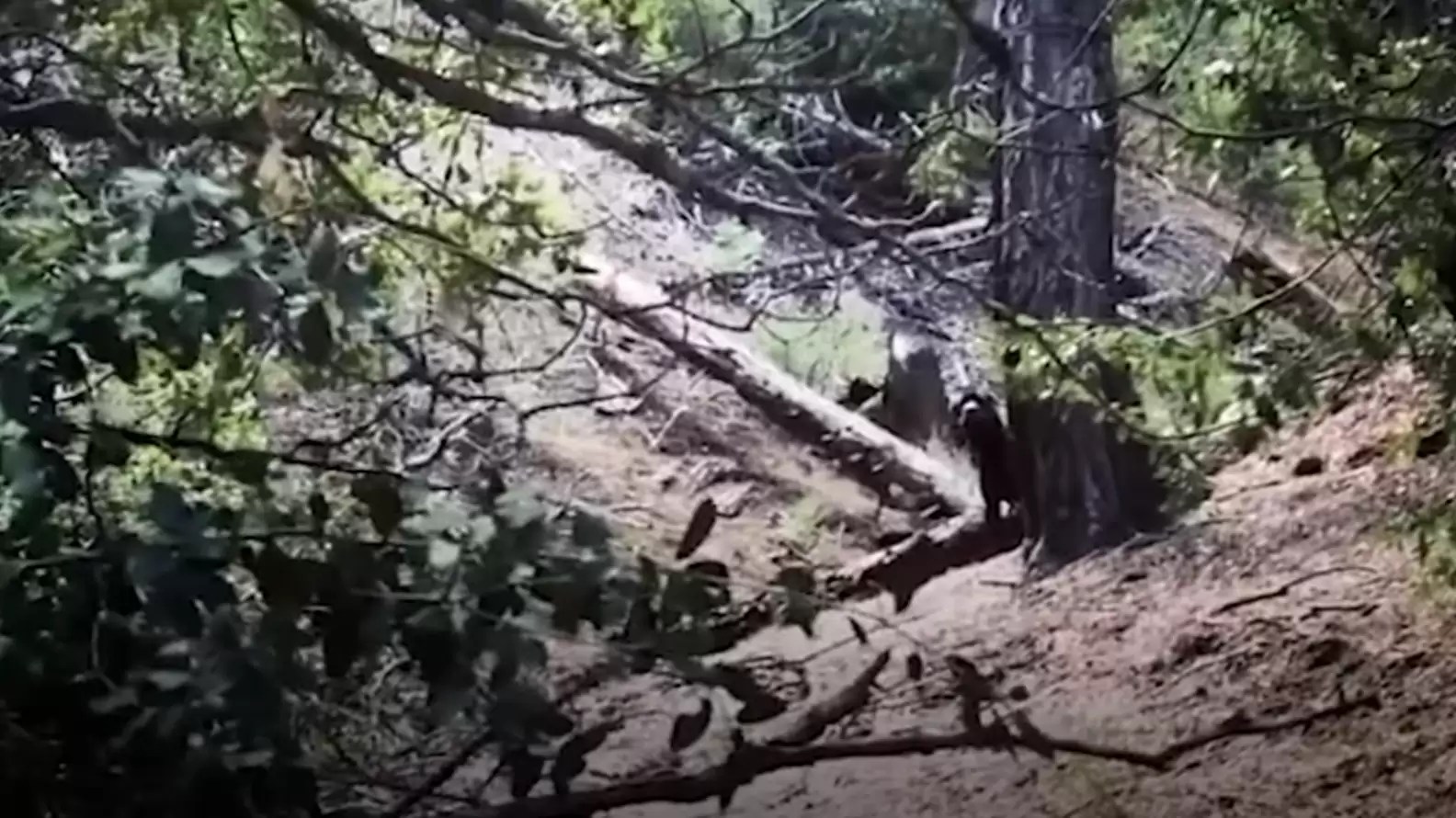
In 2020, Veronica Shea was out hiking with her dog in the Angeles National Forest in California, when she spotted something strange moving ahead of them.
“We whip around the curve, and I look over and there was this huge black thing,” Shea told The Dodo. “He went up the side of a cliff.”
Veronica Shea
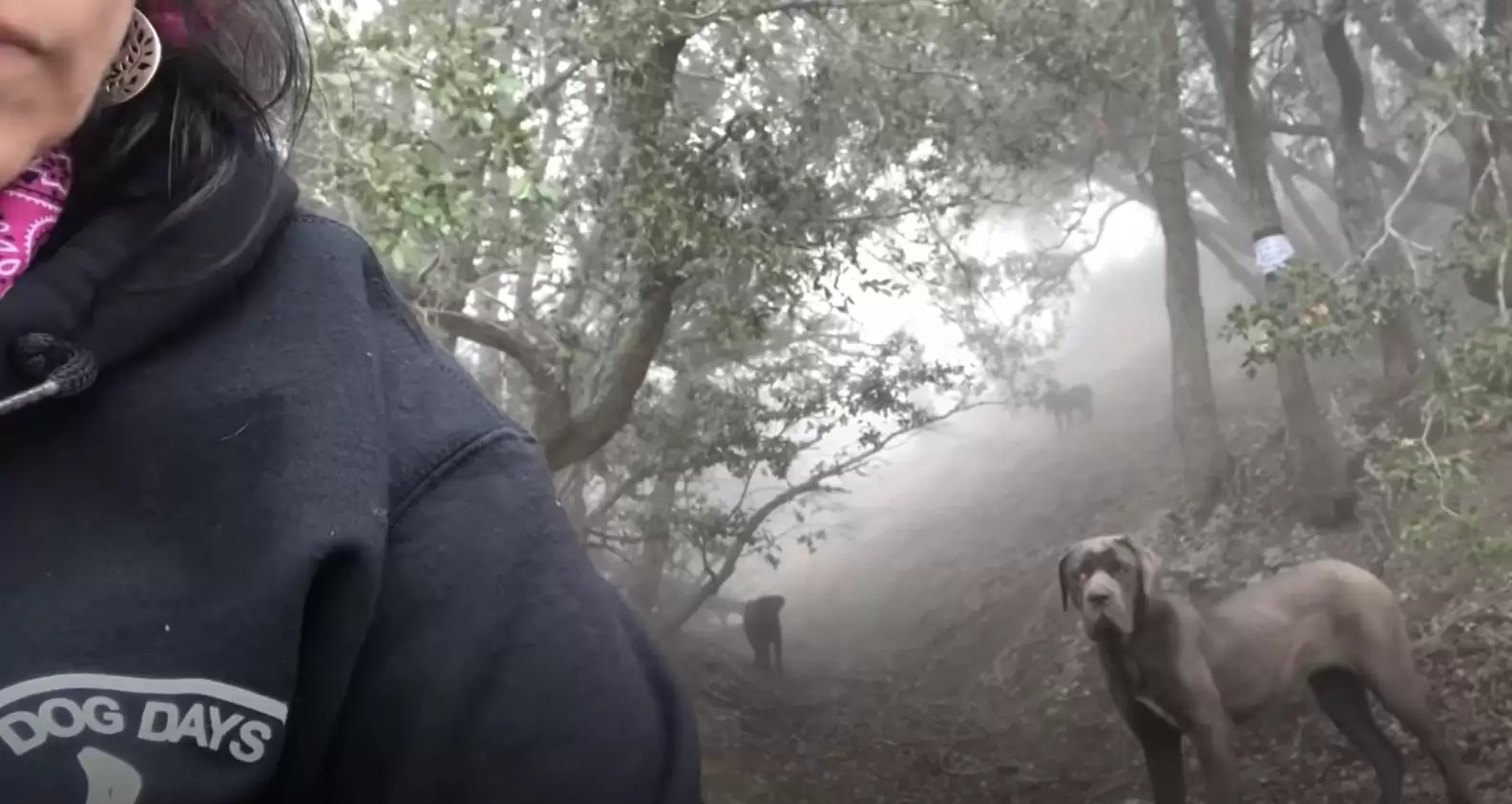
Shea followed the furry animal and came face to face with three malnourished dogs alone in the wilderness. Realizing the dogs had been abandoned, she knew she had to help them. Every day for several weeks, Shea trudged up the mountain to feed the dogs and work on gaining their trust.
Veronica Shea
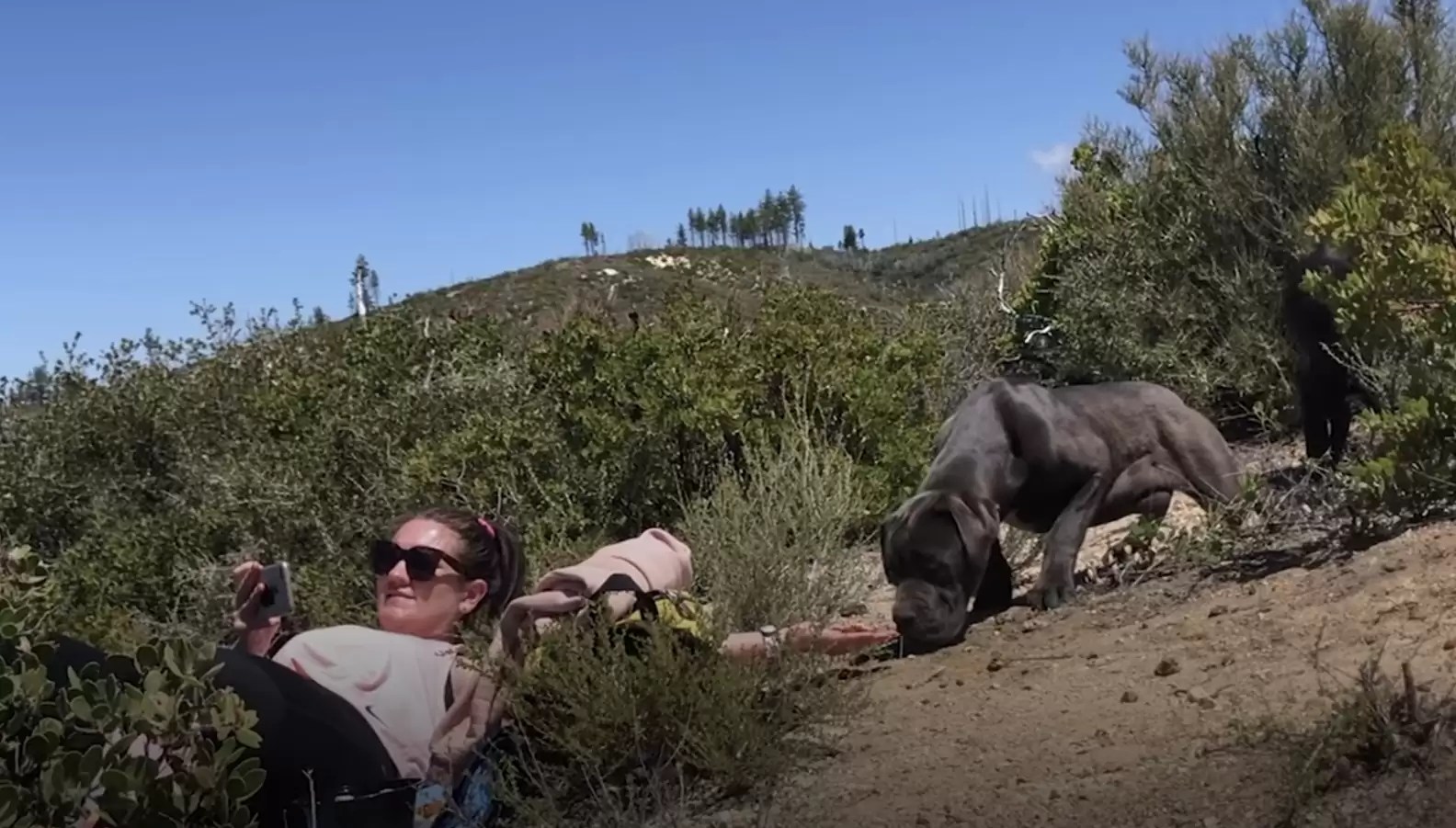
Slowly, the dogs got used to her and even began eating out of her hand. But Shea had no idea how to get them off the mountain. If she trapped one dog, would the others flee? She knew she couldn’t do it alone.
Veronica Shea
When she asked for help, a whole team of rescuers stepped forward. Together, they carried equipment up the mountain and put together a makeshift cage. The rescuers carefully lured the dogs inside and carried them down the mountain.
The three dogs —mastiffs named Princess George, Grace and Steve, who are believed to be siblings — were safe now. But they still had a long journey ahead.
Veronica Shea
The rescuers approached Cheri Wulff Lucas, a well known dog behaviorist and trainer in California, to see if she could help the nervous dogs learn to trust again.
“They weren’t adoptable the way they came,” Lucas told The Dodo. “They couldn’t be touched. They couldn’t be leashed. They were just terrified.”
Princess George, Grace and Steve responded well to Lucas’ training. Still, they continued to have a “very strong startle reflex,” said Lucas. This made it difficult to find them the perfect home.
“It was going to take a very special home for them to go into because they’re not the kind of dogs that are going to go to the dog park,” Lucas said. “Even walking them on city streets would be a lot for them. And if they do spook, they weigh 125 pounds, so [they would be] very hard to contain.”
But Lucas knew the dogs were safe on her own property.
“I’m out in the middle of nowhere,” Lucas said. “There’s no traffic around here. You can’t even see another home from here. So if they did get out, they would just come back here to me.”
Veronica Shea
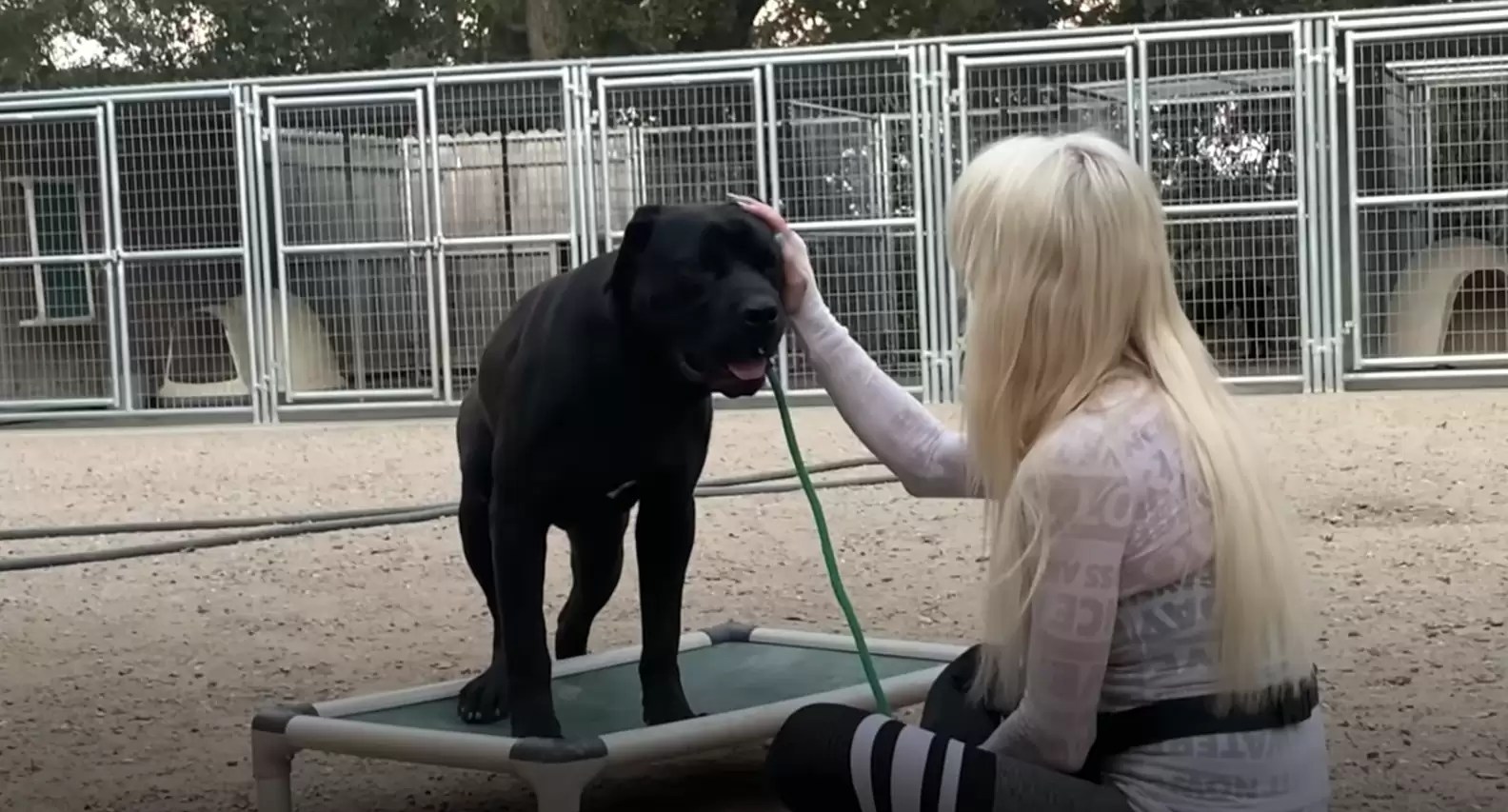
While Lucas never planned on keeping the dogs herself, that’s exactly what she ended up doing. This turned out to be the best decision for everyone. Princess George, Grace, and Steve continued to live in a safe and supportive environment. And Lucas discovered that the dogs could help her with her work as a trainer.
“If I get dogs that needs socialization — to be more familiar and less reactive with other dogs — I use my pack to help rehabilitate them,” Lucas said. “And all three of them are highly social with dogs. They know how to smell properly, how to not overpower the dog that needs the socialization. They’re just flawless. And that’s not something I taught them — they came that way.”
Veronica Shea
The threesome were particularly helpful when Lucas started working with another dog named Andi, who was rescued from a hoarding case.
“She had lived in a pen for seven years without human touch or being leashed or anything and she was terrified,” Lucas said. “They just came in and really made her feel comfortable. It was really sweet to see. They brought her around in a way that I never could as a human.”
Lucas ended up adopting Andi as well, bringing her personal pack of dogs to 12.
Princess George, Grace and Steve have been living with Lucas now for over three years, and they’re completely different dogs now.
“They’re incredibly playful,” Lucas said. “If you came to my house and did not know their backstory, you would think they were like any other dog.”
Lucas describes George as a “couch potato” who loves hanging around the house and socializing with the other dogs. Steve is the one who likes to play endless games of “chase” out in the yard. Grace remains a bit timid, but she shares a very close relationship with Steve.
“They’re pets — they’re really pets now,” she said. “They’re not cases for me anymore.”
ooOOoo
Lucas sums it up perfectly in that last sentence; “They’re pets – they’re really pets now,“
Lucas reminds me of Jean for when we first met, in December 2007, Jean had more than twenty dogs at home, all rescues, and led to me publishing my first book in 2009: Learning from Dogs.
“The Future of Democracy” is, for me, incredibly interesting.
I haven’t a clue as to how long I have been listening to the annual Reith Lecture on BBC Radio 4. It has been many years.
As Wikipedia explains:
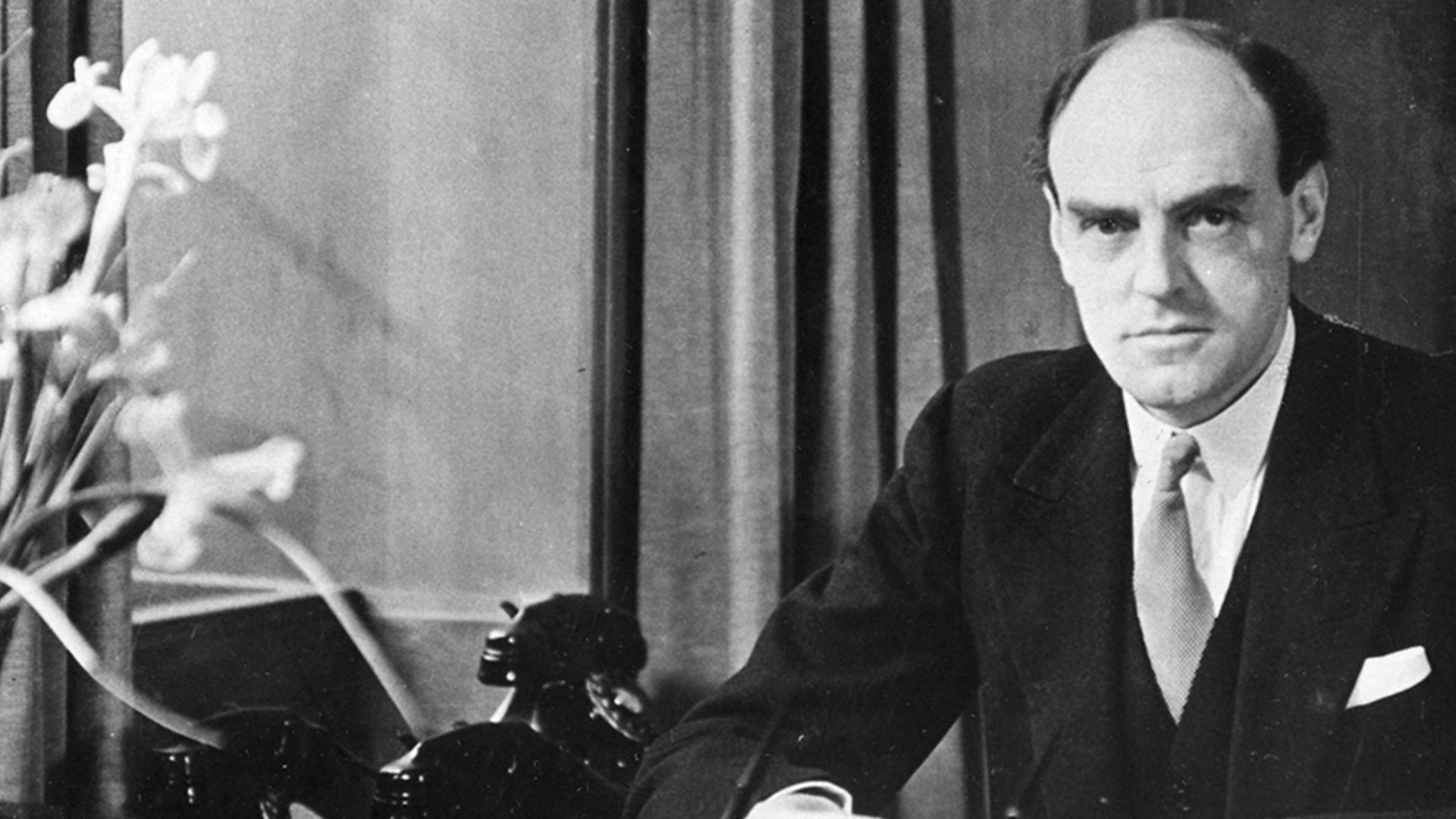
The Reith Lectures is a series of annual BBCradiolectures given by leading figures of the day. They are commissioned by the BBC and broadcast on Radio 4 and the World Service. The lectures were inaugurated in 1948 to mark the historic contribution made to public service broadcasting by Lord Reith, the corporation’s first director-general.
Reith maintained that broadcasting should be a public service that aimed to enrich the intellectual and cultural life of the nation. It is in this spirit that the BBC each year invites a leading figure to deliver the lectures. The aim is to advance public understanding and debate about issues of contemporary interest.
Wikipedia
From the BBC’s History of the BBC.
As the BBC explains on the BBC Sounds website:
Released On: 29 Nov 2023
Available for over a year
This year’s BBC Reith Lecturer is Ben Ansell, Professor of Comparative Democratic Institutions at Nuffield College, Oxford University.
He will deliver four lectures called “Our Democratic Future,” asking how we can build a politics that works for all of us with systems which are robust to the challenges of the twenty first century, from climate change to artificial intelligence. In this first lecture, recorded at New Broadcasting House in London in front of an audience, Professor Ansell asks whether we are in a ‘democratic recession’, where longstanding democracies are at risk of breakdown and authoritarianism is resurgent. And he examines how resilient democracies are to the challenges of artificial intelligence, social media and if they can effectively address core challenges from climate change to inequality.
The Reith Lectures are presented by Anita Anand and produced by Jim Frank. The Editor is China Collins. Reith Co-ordinator is Brenda Brown. The series is mixed by Rod Farquhar and Neil Churchill.
Welcome to my website. I am Professor of Comparative Democratic Institutions at Nuffield College, University of Oxford. My work focuses on a variety of issues in political economy, including both comparative politics and international relations.
I am also co-editor (with David Samuels) of Comparative Political Studies.
My 2010 book, From the Ballot to the Blackboard, published by Cambridge University Press, is available here. My 2014 book (with David Samuels), Inequality and Democratization: An Elite-Competition Approach, published by Cambridge University Press, is available here.
This site contains a variety of working papers, syllabi, my biography, and other information about my academic work. My CV is available here.
We take it for granted! Of that I am sure. But the question of how oxygen first came to be built up in our atmosphere is fascinating. There was a recent article written by Elizabeth Swanner, who is Associate Professor of Geology, Iowa State University that was published in The Conversation. It makes for a very interesting read.
ooOOoo
A layered lake is a little like Earth’s early oceans − and lets researchers explore how oxygen built up in our atmosphere billions of years ago
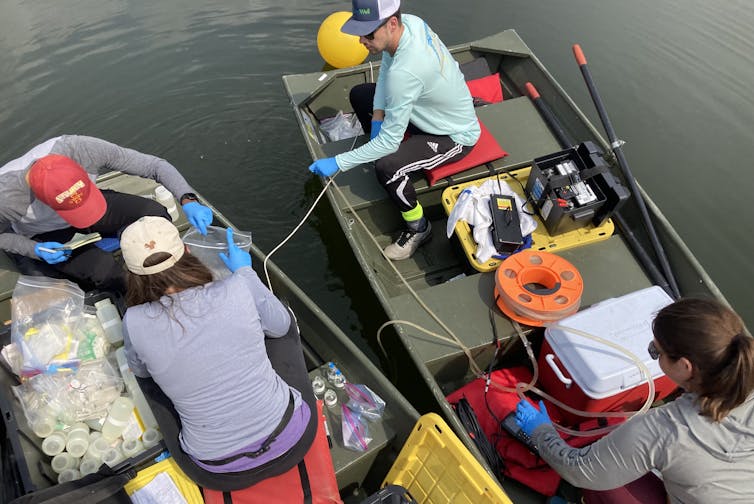
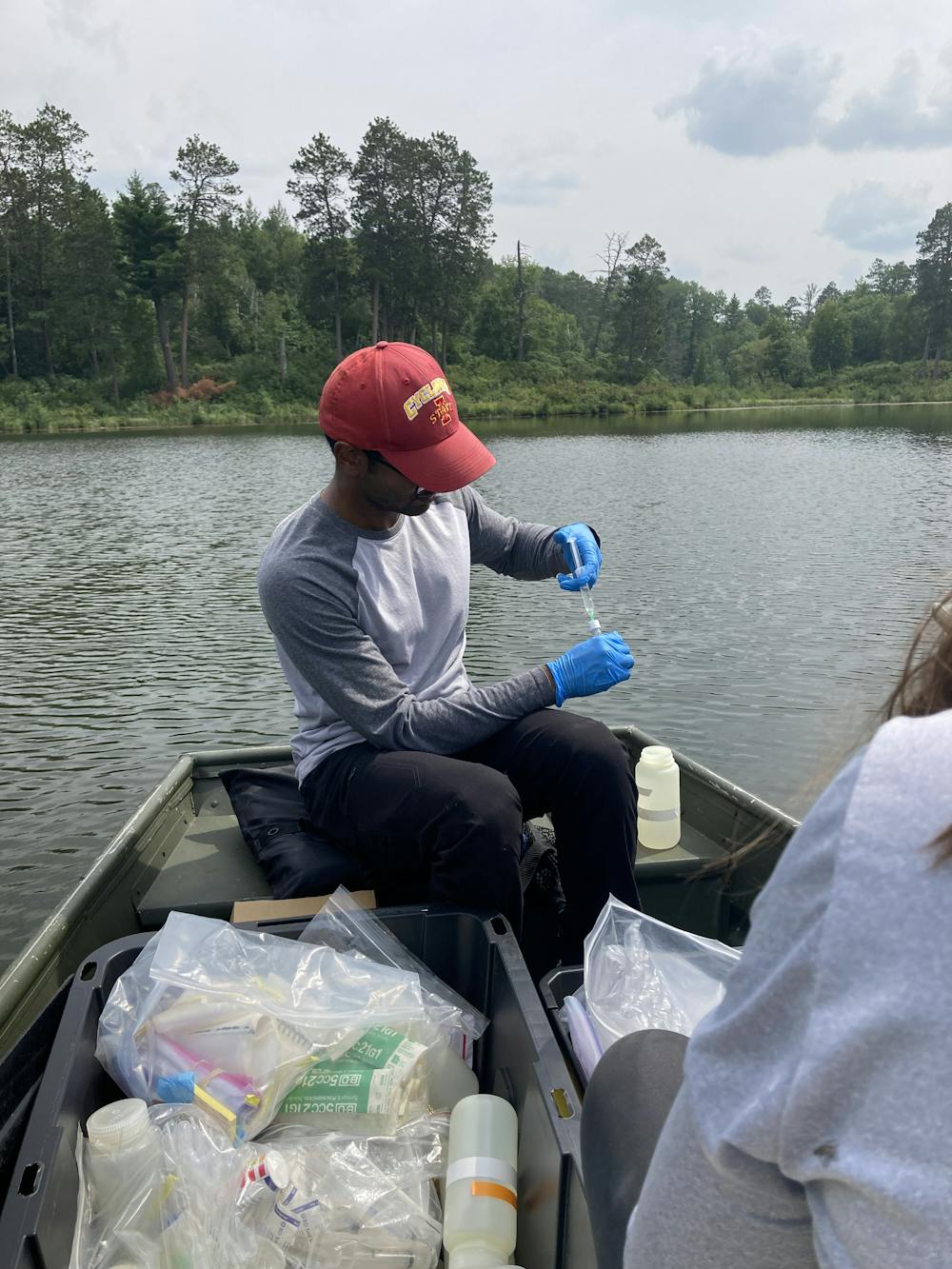
Researchers sample water from various layers to analyze back in the lab. Elizabeth Swanner, CC BY-ND
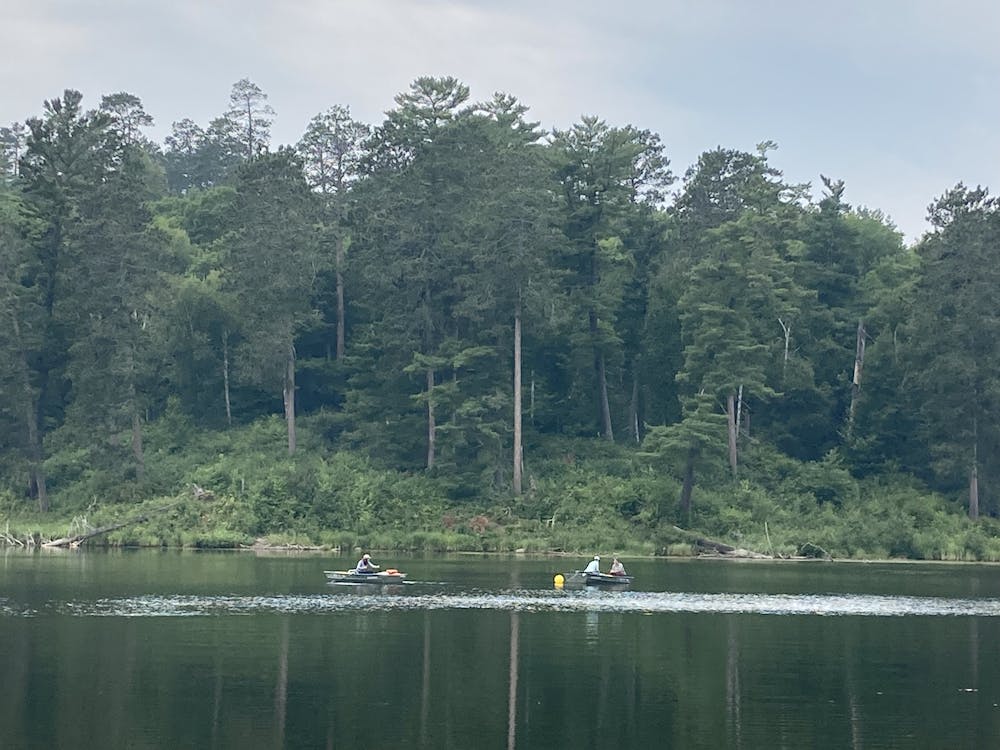
Little Deming Lake doesn’t get much notice from visitors to Itasca State Park in Minnesota. There’s better boating on nearby Lake Itasca, the headwaters of the Mississippi River. My colleagues and I need to maneuver hundreds of pounds of equipment down a hidden path made narrow by late-summer poison ivy to launch our rowboats.
But modest Deming Lake offers more than meets the eye for me, a geochemist interested in how oxygen built up in the atmosphere 2.4 billion years ago. The absence of oxygen in the deep layers of Deming Lake is something this small body of water has in common with early Earth’s oceans.
On each of our several expeditions here each year, we row our boats out into the deepest part of the lake – over 60 feet (18 meters), despite the lake’s surface area being only 13 acres. We drop an anchor and connect our boats in a flotilla, readying ourselves for the work ahead.
Researchers’ boats on Deming Lake. Elizabeth Swanner, CC BY-ND
Deming Lake is meromictic, a term from Greek that means only partially mixing. In most lakes, at least once a year, the water at the top sinks while the water at the bottom rises because of wind and seasonal temperature changes that affect water’s density. But the deepest waters of Deming Lake never reach the surface. This prevents oxygen in its top layer of water from ever mixing into its deep layer.
Less than 1% of lakes are meromictic, and most that are have dense, salty bottom waters. Deming Lake’s deep waters are not very salty, but of the salts in its bottom waters, iron is one of the most abundant. This makes Deming Lake one of the rarest types of meromictic lakes.
Postdoc researcher Sajjad Akam collects a water sample for chemical analysis back in the lab. Elizabeth Swanner, CC BY-ND
The lake surface is calm, and the still air is glorious on this cool, cloudless August morning. We lower a 2-foot-long water pump zip-tied to a cable attached to four sensors. The sensors measure the temperature, amount of oxygen, pH and amount of chlorophyll in the water at each layer we encounter. We pump water from the most intriguing layers up to the boat and fill a myriad of bottles and tubes, each destined for a different chemical or biological analysis.
My colleagues and I have homed in on Deming Lake to explore questions about how microbial life adapted to and changed the environmental conditions on early Earth. Our planet was inhabited only by microbes for most of its history. The atmosphere and the oceans’ depths didn’t have much oxygen, but they did have a lot of iron, just like Deming Lake does. By investigating what Deming Lake’s microbes are doing, we can better understand how billions of years ago they helped to transform the Earth’s atmosphere and oceans into what they’re like now.
Chlorophyll colors water from the lake slightly green. Elizabeth Swanner, CC BY-ND
At Deming Lake, my colleagues and I pay special attention to the water layer where the chlorophyll readings jump. Chlorophyll is the pigment that makes plants green. It harnesses sunlight energy to turn water and carbon dioxide into oxygen and sugars. Nearly 20 feet (6 meters) below Deming’s surface, the chlorophyll is in cyanobacteria and photosynthetic algae, not plants.
But the curious thing about this layer is that we don’t detect oxygen, despite the abundance of these oxygen-producing organisms. This is the depth where iron concentrations start to climb to the high levels present at the lake’s bottom.
This high-chlorophyll, high-iron and low-oxygen layer is of special interest to us because it might help us understand where cyanobacteria lived in the ancient ocean, how well they were growing and how much oxygen they produced.
We suspect the reason cyanobacteria gather at this depth in Deming Lake is that there is more iron there than at the top of the lake. Just like humans need iron for red blood cells, cyanobacteria need lots of iron to help catalyze the reactions of photosynthesis.
A likely reason we can’t measure any oxygen in this layer is that in addition to cyanobacteria, there are a lot of other bacteria here. After a good long life of a few days, the cyanobacteria die, and the other bacteria feed on their remains. These bacteria rapidly use up any oxygen produced by still photosynthesizing cyanobacteria the way a fire does as it burns through wood.
We know there are lots of bacteria here based on how cloudy the water is, and we see them when we inspect a drop of this water under a microscope. But we need another way to measure photosynthesis besides measuring oxygen levels.
Long-running lakeside laboratory
The other important function of photosynthesis is converting carbon dioxide into sugars, which eventually are used to make more cells. We need a way to track whether new sugars are being made, and if they are, whether it’s by photosynthetic cyanobacteria. So we fill glass bottles with samples of water from this lake layer and seal them tight with rubber stoppers.
We drive the 3 miles back to the Itasca Biological Station and Laboratories where we will set up our experiments. The station opened in 1909 and is home base for us this week, providing comfy cabins, warm meals and this laboratory space.
In the lab, we inject our glass bottle with carbon dioxide that carries an isotopic tracer. If cyanobacteria grow, their cells will incorporate this isotopic marker.
We had a little help to formulate our questions and experiments. University of Minnesota students attending summer field courses collected decades worth of data in Itasca State Park. A diligent university librarian digitized thousands of those students’ final papers.
My students and I pored over the papers concerning Deming Lake, many of which tried to determine whether the cyanobacteria in the chlorophyll-rich layer are doing photosynthesis. While most indicated yes, those students were measuring only oxygen and got ambiguous results. Our use of the isotopic tracer is trickier to implement but will give clearer results.
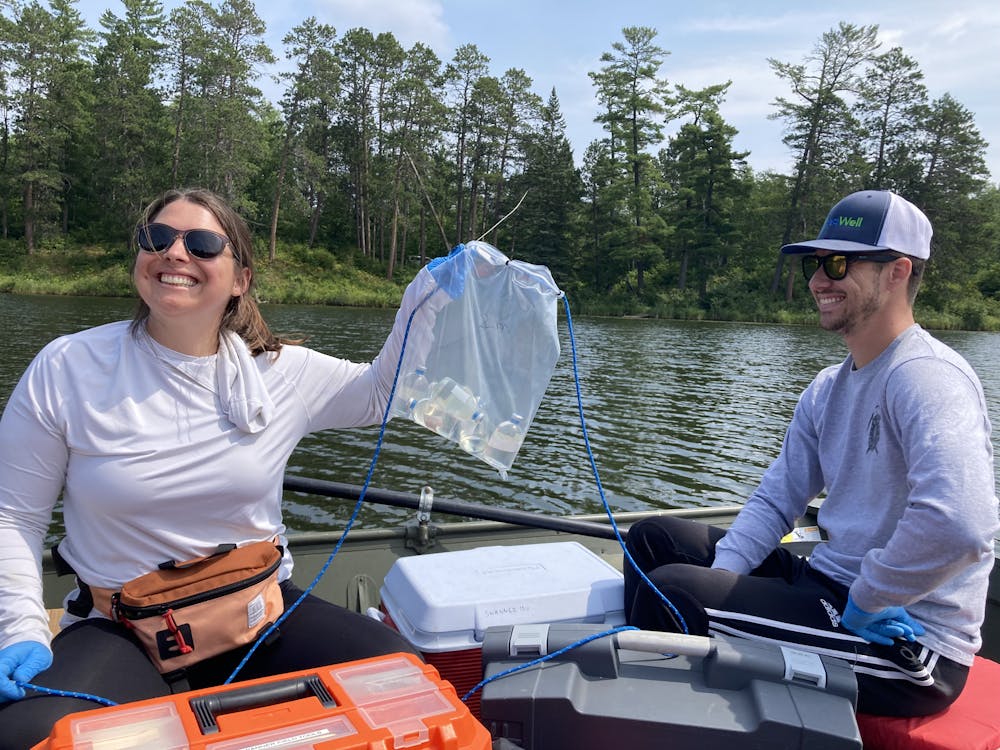
Graduate students Michelle Chamberlain and Zackry Stevenson about to sink the bottles for incubation in Deming Lake. Elizabeth Swanner, CC BY-ND
That afternoon, we’re back on the lake. We toss an anchor; attached to its rope is a clear plastic bag holding the sealed bottles of lake water now amended with the isotopic tracer. They’ll spend the night in the chlorophyll-rich layer, and we’ll retrieve them after 24 hours. Any longer than that and the isotopic label might end up in the bacteria that eat the dying cyanobacteria instead of the cyanobacteria themselves. We tie off the rope to a floating buoy and head back to the station’s dining hall for our evening meal.
Iron, chlorophyll, oxygen
The next morning, as we wait for the bottles to finish their incubation, we collect water from the different layers of the lake and add some chemicals that kill the cells but preserve their bodies. We’ll look at these samples under the microscope to figure out how many cyanobacteria are in the water, and we’ll measure how much iron is inside the cyanobacteria.
That’s easier said than done, because we have to first separate all the “needles” (cyanobacteria) from the “hay” (other cells) and then clean any iron off the outside of the cyanobacteria. Back at Iowa State University, we’ll shoot the individual cells one by one into a flame that incinerates them, which liberates all the iron they contain so we can measure it.
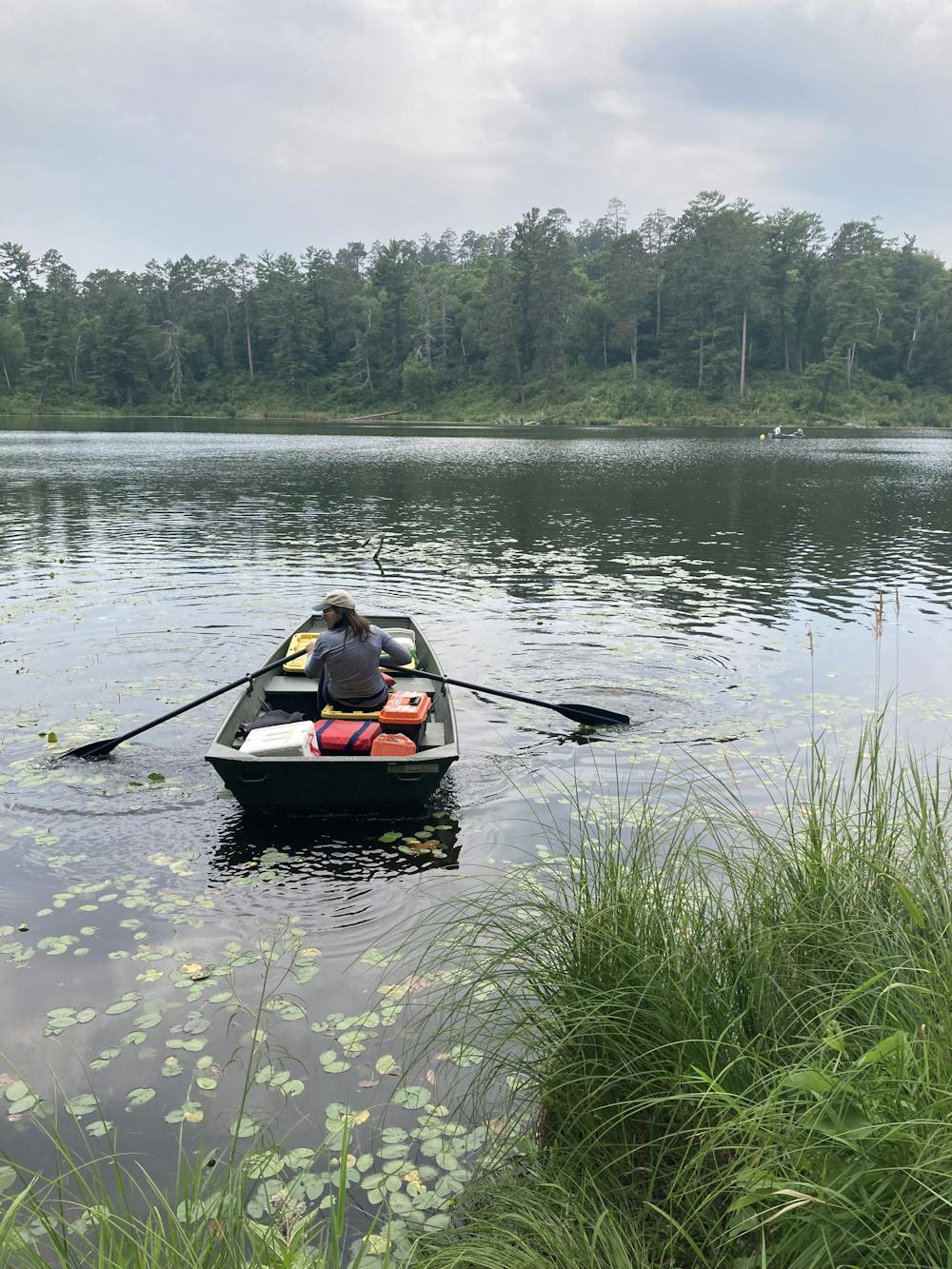
Biogeochemist Katy Sparrow rows a research vessel to shore. Elizabeth Swanner, CC BY-ND
Our scientific hunch, or hypothesis, is that the cyanobacteria that live in the chlorophyll- and iron-rich layer will contain more iron than cyanobacteria that live in the top lake layer. If they do, it will help us establish that greater access to iron is a motive for living in that deeper and dimmer layer.
These experiments won’t tell the whole story of why it took so long for Earth to build up oxygen, but they will help us to understand a piece of it – where oxygen might have been produced and why, and what happened to oxygen in that environment.
Deming Lake is quickly becoming its own attraction for those with a curiosity about what goes on beneath its tranquil surface – and what that might be able to tell us about how new forms of life took hold long ago on Earth.
I thought it very worthwhile to repeat this, plus a real treat at the end of the post!
Scamming in all its forms has only got worse in the last couple of years, since I parted with $9,000 in 2021!
As a direct result of that error, I changed my bank, installed a VPN at home (Proton), changed my email account to ProtonMail, and also changed my calendar (also to Proton).
But I still do not take it as important as it is. I guess because it is not my first thought whenever I come across an unfamiliar email.
ooOOoo
Please read this; and do not make the same mistake as me!
The Story of a Scam
(or how I lost the thick end of $10,000.)
On Friday, 6th August, 2021 at 05:51 in came the following email:
Norton Customer ,
User name:paulhandover
*we like to confim you that the NortonDesk re-newal. has been done on your request*
It is very easy to unsubscribe it,
and related to your any query, reach us at +1-(860) – (852) – (6259).
Product-Name : NortonDesk
……………………………………………………………………………………………………..
Price : $475.04
……………………………………………………………………………………………………..
Subscription ID : 8837-77942826-947192-8126
……………………………………………………………………………………………………..
Expiration Date : 3 Year from the Date of Purchase
………………………………………………………………………………………………
* If you wish to Cancel this Membership then please feel free to Contact our Billing department as soon as Possible*
……………………………………………………………………………………………………..
*Please do not write to this mail address, that will not help*
Reach us on +1 – (860) – (852) – (6259)
……………………………………………………………………………………………………..
Regards,
Billing department
Contact: +1 – (860) – (852) – (6259)
693 Amwell Rd, Hillsborough, NJ
My first mistake was not to check the incoming email address. It was mahaliashomakerxhv928@gmail.com
I telephoned the number given and told the person that I wanted to cancel this membership. Indeed that I had never subscribed for this membership in the first place.
I spoke with ‘Adam’. I was then asked to go to a webpage where I filled in a Refund Application Order form. I filled in my details including the refund amount and my bank details: Sort Code & Account Number.
I then submitted the form and imagine my surprise when a few minutes later I was informed that I had received the sum of $10,000. I quickly checked our bank account online and there was the $10,000 credit in our checking account.
My second mistake was me not examining the total in our accounts. I have the facility to show the total funds in our accounts. Why I didn’t do that I can not explain.
Then it was back on the telephone and Adam also was surprised (later I realised that this was a feigned surprise and all part of the scam) and said could I go to the bank and fill in an International Wire Transfer for the amount of $9,500. Adam also said that he would give me the details of the person in Thailand that was to receive the funds, and could I say this was for a medical operation because it would save ‘Norton’ the taxation.
My third mistake was not to discuss this with Jeannie and to assume that it was just a harmless error.
The details came through and I went to our bank in Grants Pass. I got to the bank a little after 09:00. I saw a staff member of the bank and explained what I needed to do. The bank member queried this and said that it sounded like a scam. I lied and said I knew the woman in Thailand and wanted to go ahead. That was what I had been instructed to say.
My fourth mistake was not listening to the woman at the bank. (And I still thought that the ‘Norton’ funds were in my account.)
The International Wire Transfer was completed and I signed it. I also asked the balances on our two accounts. It was about $10,000 less than I expected and I queried it but was told that there had been a transfer from my savings account to my checking account of $10,000 for Norton. I thought that this was still a little low but that I could check it carefully once I got home. I had a thirty-minute window to change my mind.
Mistake number five, a huge mistake, was while at the bank not to ask them carefully to go through all my transactions that day because that would have revealed that the receipt of $10,000 that I had seen online had mysteriously disappeared. Indeed had never been received. That would have enabled me to stop the wire transfer within the thirty-minute window.
I returned home and found out the truth. I had been scammed out of $9,500.
The strange thing was that ‘Adam’ of the billing department of so-called Norton kept ringing me throughout the day to say that the funds would be sent back to me and gave me the details of three wires and that the funds would be back in my bank account on Monday, 9th August!
Later that morning I rang Kevin Dick who manages our investments and told him the tale. He said that there was a huge amount of scamming about and that I should make three phone calls: to the bank and report the fraud; to the Sheriff’s office and report the fraud; and to my insurance company. The first two were done straight away. Kevin also told me to close my bank accounts and amend my email address. Alex, my son, said to use my Proton mail account and straight away I started to make the change.
A person from the humanists group that we belong to said also to inform The Daily Courier.
On Monday morning Ryan of ‘Norton’ called me at 07:15 and said that Adam Prescott was no longer with the firm. Ryan said that their General Manager, Ron Cooper, would call me shortly. Ron did indeed call me and said that they would return the money but that the minimum cheque they could write was $30,000. I was then told that in advance of me receiving the money I would have to pay a small amount to them. At this point I put the phone down for it was clearly a second attempt to steal more funds from me.
Finally we went back to the bank on Monday morning. We were informed that there was never a credit of $10,000 but that a clever switch of the money from one account to another made it look as though the money had been credited. The event had been reported to the bank’s fraud department.
On Tuesday morning, the 10th August, the bank said that as well as our two accounts being locked out from us and that only cheques and cash withdrawals would be honoured for the time being, the fraud department had made the decision to issue us with a ten-day notice to terminate our accounts. In other words, within ten days the bank would no longer want us as customers. Since then I have done much research and found out via the Forbes website that this was more to do with the bank being ultra conservative than anything else. Indeed Kevin said that he had spoken with his IT department and they thought that it was strange that my ex-bank had terminated us so quickly. The IT department thought that the teller at the bank realised that she had been partly culpable.
However the bank did recommend another bank to go to in Grants Pass.
I have since reset my iMac and changed my email address.
It is a most humiliating affair. I have beaten myself up several times over and have at last understood the frame of mind that I had gotten myself into.
To explain that, first of all I thought that I needed to stop the billing urgently and because it was early on a Friday morning thought that the best thing to do was to call immediately.
Secondly, during the call that scammers spoke to me in friendly tones and quietly complimented me on my integrity. I am sure that this ‘spoke’ to my psychological fear of rejection that I have had since I my father died in 1956.
Then in the morning of the 11th August I received a call from a regular contact at the English company who manage my UK SIPP. He wanted to check if I had tried to log on at 09:00 UK time and I replied that there was no way that was me for that UK time was 01:00 Pacific time. There were apparently three attempts to log on. Unsuccessfully as it turned out and my SIPP account is temporarily closed as a result.
The scammers are very thorough in their crooked craft!
Now as of Thursday, the 12th August, we are pretty much out of the grim shadow of this event. We have new accounts at The People’s Bank here in Grants Pass. I have changed my email address and yesterday afternoon I decided that the only safe way of protecting myself was to get another iMac. I was speaking to the sales department of Apple and mentioned the scam and the woman immediately said I should speak with their Technical Support and transferred me. Then I was helped via screen sharing to go through many pages deleting unnecessary files and other stuff. And the helpful woman found another item of malware that was deleted and removed. She spent 54 minutes getting me properly cleaned out and then forwarded an email with all the links for me to do the same process at a later date. It was a superb experience.
So that is it.
Now watch these two YouTube videos. The first is just 5 minutes long and is important to all who use computers and want to be protected against scammers. (NB: This first video is now not included.)
and then watch this slightly longer video from Jim
Be safe! Please!
An addendum dated Saturday, 14th August, at 7am Pacific Time.
Only to say that I also posted my scamming report on Ugly HedgeHog under their General Chit Chat forum. Of the many responses that came in I wanted to post here two of them.
The first from ‘Stanikon’:
Sorry you had to go through this. Your first clue should have been the grammar and phrasing of the original email. That would have given it away. Legitimate companies go to great lengths to make sure their grammar, phrasing and language are correct. I have avoided several scams by paying attention to that so there is some value in being slightly OCD.
and the second from ‘Red6’:
The safest thing to do in these situations is simply not to open the email. I receive on a daily basis, emails telling me that the items I ordered are being shipped, my subscription to something has been renewed etc, etc. 99.9% of these are scams and nothing bad will happen if you just delete them. Older working people often have the fear that there’s a bill out there that has not been paid and they are afraid of getting a bad credit report. So they aggressively try to send someone money for something they cannot even recognize. If it is a true debt, you will be reminded of it several times before any reports are made.
I follow several simple rules in preventing scams. There are many more but this will take care of most of them.
1. Examine the sender’s email address, if you do not recognize it then DO NOT OPEN and DELETE immediately. Most of these scammer’s email addresses will not have the company name in the email address OR it will be combined with other names. Most will not have the .com, .org, etc but will be gmail, Hotmail, or other generic URL. Many of these scammers “broadcast” their emails to everyone on a purchased email list not knowing whether some or valid or not. If you open or reply to these it verifies your email as valid and active and worthy of more attention. Also, if it is an unknown email address, it could be a carrier of a virus or some other bad computer/software infection.
2. If you do get involved with something that does not feel right and you take it to the bank – TRUST THE BANK if they tell you it is suspicious. They see these things every day and develop a feel for them. I received a cashier’s check for something I sold on craigslist. I took it to the bank to deposit and the bank rep immediately recognized the cashier’s check as a fake. She even called the bank the check was supposed to be drawn on and they checked the records and told her that it was counterfeit. You trust your bankers, credit union, etc with your money every day so trust them when they tell you something does not seem right.
3. Scammers know that many older people do NOT like to use credit cards. So a lot of their dealings involve checks, bank transfers, and other forms of older less secure payment methods that older citizens are comfortable with. I NEVER, NEVER send money for something I purchase or order online unless it is through a credit card. In fact, I rarely buy ANYTHING anymore that does not go on the credit card. They are safer, quicker, and easier. If somehow you do get something on your bill that you did not authorize, the credit card company will investigate and go after the person or company that charged you. This is one more safety step that protects the consumer. This does not always apply to debit cards. Debit cards are issued by individual banks or credit unions and some have policies in the fine print that they do NOT have the same policies as the big credit card companies and may not forgive or relieve the user for bad charges made to their debit card.
4. Just do not believe anyone or any company that says they sent you a huge refund or overpayment or some amount of money by mistake. That rarely happens. It is even rarer if they also tell you to return the money to some foreign address, email, or wire transfer. When in doubt, wait for a week or so before you do ANYTHING. If they sent you the check, transfer etc, wait to see if it clears or is valid. We are conditioned by TV and movies that we need to act immediately in situations such as this. This is rarely the case. Take time to see what happens. During this cooling-off period check them out, research the internet to see if others have experienced this scam. It is almost a sure thing that if you are being scammed, others have been also and it has been reported somewhere with law enforcement agencies or on websites on the internet. Check them out before acting. Or better yet, do nothing for a while and most likely they will just go away. Much like the telephone scammers, they make their money on volume, calling as many as possible in the least amount of time. Scammers will not waste time working on you for days, they have thousands of other emails, accounts to call. Remember, they are after the fastest, easiest targets – the low-hanging fruit.
If it is a true mistake or debt you owe then most likely you will receive some official correspondence in regards to the debt. A good example is the IRS and Social Security phone scams in the past couple of years. You get a call from the IRS or Social Security informing you that you may have committed fraud and law enforcement is on their way to arrest you. But if you arrange repayment with their representative, an arrest can be avoided. The IRS and Social Security NEVER take action without first sending several official US Postal letters to you. If you are still inclined to send money to someone in a foreign country then discuss it with your bank and listen.
Hope this helps.
ooOOoo
All very sound advice and as relevant today as it was when first published.
Finally, for something completely different; have a look at the recent Hunter’s Moon as featured on YouTube.
For most of us these days old age is part of the scene (and I am classifying old age as being over 70 years). Here are a few facts from the website of the World Health Organization.
Key facts
Worldwide obesity has nearly tripled since 1975.
In 2016, more than 1.9 billion adults, 18 years and older, were overweight. Of these over 650 million were obese.
39% of adults aged 18 years and over were overweight in 2016, and 13% were obese.
Most of the world’s population live in countries where overweight and obesity kills more people than underweight.
39 million children under the age of 5 were overweight or obese in 2020.
Over 340 million children and adolescents aged 5-19 were overweight or obese in 2016.
Obesity is preventable.
What are obesity and overweight Overweight and obesity are defined as abnormal or excessive fat accumulation that may impair health.
Body mass index (BMI) is a simple index of weight-for-height that is commonly used to classify overweight and obesity in adults. It is defined as a person’s weight in kilograms divided by the square of his height in meters (kg/m2).
Adults
For adults, WHO defines overweight and obesity as follows:
overweight is a BMI greater than or equal to 25; and
obesity is a BMI greater than or equal to 30.
BMI provides the most useful population-level measure of overweight and obesity as it is the same for both sexes and for all ages of adults. However, it should be considered a rough guide because it may not correspond to the same degree of fatness in different individuals.
World Health Organisation
This is the link for anyone who wants to use the BMI Calculator.
Now this is not a post about obesity or being overweight. It is a post taken from The Conversation about staying as healthy as one can in one’s older years.
ooOOoo
Steep physical decline with age is not inevitable – here’s how strength training can change the trajectory
Raise your hand if you regularly find yourself walking up a flight of stairs. What about carrying heavy bags of groceries? How about picking up your child or grandchild? Most of us would raise our hands to doing at least one of those weekly, or even daily.
As people age, it can become more and more difficult to perform some physical tasks, even those that are normal activities of daily living. However, prioritizing physical fitness and health as you get older can help you go through your normal day-to-day routine without feeling physically exhausted at the end of the day.
It can also help you continue to have special memories with your family and loved ones that you might not have been able to have if you weren’t physically active. For example, I ran two half-marathons with my dad when he was in his 60s!
I am an exercise physiologist who studies how people can use resistance training to improve human performance, whether it be in sports and other recreational settings, in everyday life, or both. I am also a certified strength and conditioning specialist. My career has given me the opportunity to design exercise programs for kids, college athletes and elderly adults.
Staying physically active as you get older doesn’t need to include running a half-marathon or trying to be a bodybuilder; it could be as simple as trying to get through the day without feeling winded after you go up a flight of stairs. Although our muscles naturally get weaker as we age, there are ways we can combat that to help improve quality of life as we get older.
From left are the author’s father, who was age 61 at the time, the author’s wife and the author after completing the Lincoln Half Marathon. Zachary Gillen, CC BY-NC-ND
Muscle loss and chronic disease
One of the most important parts of exercise programming, no matter who I am working with, is proper resistance training to build muscle strength. Some amount of age-related loss of muscle function is normal and inevitable. But by incorporating resistance training that is appropriate and safe at any ability level, you can slow down the rate of decline and even prevent some loss of muscle function.
In one of our team’s previous studies, we saw that otherwise healthy individuals with sarcopenia had issues delivering vital nutrients to muscle. This could lead to greater likelihood of various diseases, such as Type 2 diabetes, and slow down recovery from exercise.
Recent estimates suggest that sarcopenia affects 10% to 16% of the elderly population worldwide. But even if a person doesn’t have clinically diagnosed sarcopenia, they may still have some of the underlying symptoms that, if not dealt with, could lead to sarcopenia.
Strength training is key
So the question is, what can be done to reverse this decline?
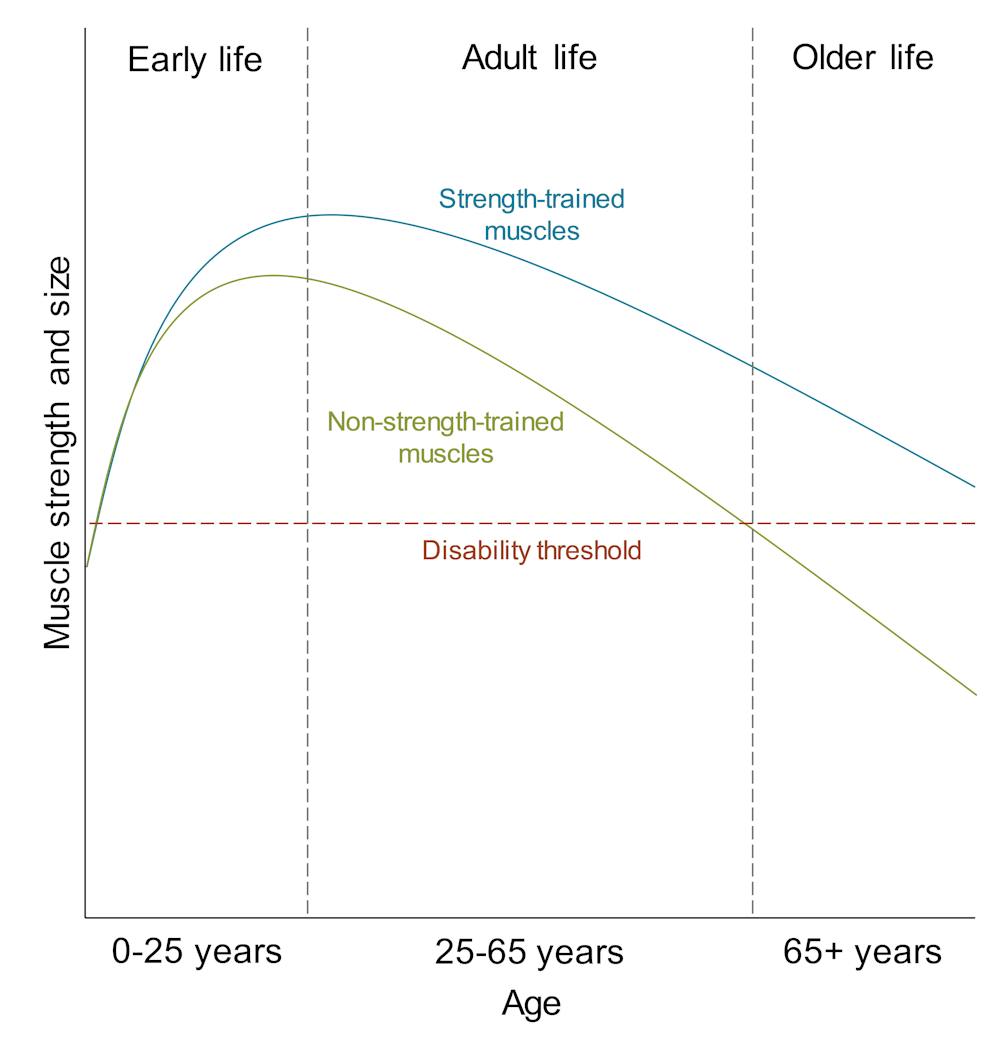
Recent evidence suggests that one of the key factors leading to sarcopenia is low muscle strength. In other words, combating or reversing sarcopenia, or both, may be best done with a proper resistance-training program that prioritizes improving strength. In fact, the decline in muscle strength seems to occur at a much faster rate than the decline in muscle size, underscoring the importance of proper strength training as people age.
Typical age-related changes in muscle strength and size with and without strength training. Zachary Gillen
Continuing to regularly strength train with moderate to heavy weights has been shown to be not only effective at combating the symptoms of sarcopenia but also very safe when done properly. The best way to make sure you are strength training properly is to seek out guidance from a qualified individual such as a personal trainer or strength and conditioning specialist.
Despite the clear benefits of strength training, it’s been shown that only about 13% of Americans age 50 and older do some form of strength training at least twice a week.
Finding what works for you
So how does a person properly strength train as they age?
The National Strength and Conditioning Association, a leading organization in advancing strength and conditioning around the world, states that for older adults, two to three days per week of strength training can be incredibly helpful for maintaining healthy muscle and bone and combating a number of chronic conditions.
The organization recommends that these workouts involve one to two exercises involving multiple joints per major muscle group, with six to 12 repetitions per set. These are done at an intensity of 50% to 85% of what’s known as one-repetition maximum – the most weight you could handle for a single repetition – with the exception of body weight exercises that use one’s own body weight as the resistance, such as pushups.
I would also recommend resting for about two to three minutes between sets, or even up to five minutes if the set was challenging. For older adults, particularly those age 60 and older, the National Strength and Conditioning Association guidelines suggest that a program like this be performed two to three days per week, with 24 to 48 hours between sessions.
An example of a strength training routine for older adults based on the National Strength and Conditioning Association guidelines
There are a great variety of exercises that could be done interchangeably in a strength training program like this.
The guidelines above are only one example out of many options, but they provide a framework that you can use to build your own program. However, I would highly recommend seeking out a professional in the field to give specific exercise programming advice that can be tailored to your own needs and goals as you age.
Following such a program would give your muscles an excellent stimulus to enhance strength, while also allowing enough recovery, a very important consideration as people age. You might think it looks like a huge time commitment, but an exercise routine like this can be done in less than an hour. This means that in less than three hours of strength training per week you can help improve your muscle health and reduce the risk of getting sarcopenia and associated health issues.
It’s also important to note that there is no one right way to do resistance training, and it needn’t involve traditional weight equipment. Group classes like Pilates and yoga or those that involve circuit training and work with resistance bands can all produce similar results. The key is to get out and exercise regularly, whatever that entails.
My wife, Jean, was diagnosed with Parkinson’s Disease (PD) in December, 2015. Many of you know that.
Fortunately at our local Club Northwest there was a group of PD sufferers who twice a week held a ‘Rock Steady Class’ under the instruction of a professional coach; Jean joined the group. It was a brilliant move for Jean and she gets a huge amount of care from being with them.
Luckily for me having to drive Jean into Club Northwest it made sense for me to sign up to a fitness class at the same time so I am put through a regular fitness routine under the coaching of Bruce. Plus I try and go bike riding three times a week.
In other words, we both try and stay as fit as we can.
I was very short of time yesterday so my apologies for going straight into this post. Plus, it is a post that talks about the learning process for dogs and, as such, looking more thoroughly will discover more material.
ooOOoo
Canines go to college in this class that seeks to give shelter dogs a fresh start
Associate Professor of Psychology, Saint Francis University
Published August 24th, 2023
Shelter animals often display problematic behaviors. Can they be retrained? Shlomit Flaisher-Grinberg
What prompted the idea for the course?
When I was growing up, my love for animals led me to volunteer at animal shelters. But it wasn’t until I started teaching psychology that I found another way to support the well-being of shelter animals. During my first year of teaching a psychology course about learning, I realized that the course’s content could be used to train shelter dogs.
Since some shelter dogs display problematic behaviors, such as fearfulness, destructiveness and disobedience, they are less likely to get adopted. I wanted my students to use their knowledge, passion and care to train shelter dogs and improve their chances of finding a permanent home.
What does the course explore?
The course teaches students how to apply behavioral analysis and modification techniques toward the training of shelter dogs. Students work with dogs on learning to follow cues such as “sit,” “down,” “stay” and “come”; perform tricks such as “high-five,” and “roll over”; and complete agility courses made of tunnels, hoops and weaving poles.
The course also explores the emotional, psychological and physiological benefits of the human-animal bond, such as reduced stress, by integrating the dogs into educational and therapeutic environments. For instance, the students train the dogs to sit by them calmly for the entire duration of a lecture. This skill may be important for future adopters who work within an educational setting or need their dog to accompany them into the classroom.
The students also train the dogs to visit our clinical educational facility, the Experiential Learning Commons, which was built as a mock hospital. Within our simulated emergency room, intensive care room, patient room, maternity room and exam room, students train the dogs to walk next to simulated patients’ wheelchairs, sit by patients’ beds and provide them with affectionate and nurturing companionship.
Finally, the course instructs students on how to apply for grants for nonprofits, with the idea being to secure funding to support animal shelters.
Why is this course relevant now?
This course creates a collaborative and reciprocal partnership between a university and the community in which it is located. Focusing on the care for shelter dogs, it allows for faculty, students and a shelter’s staff and volunteers to exchange knowledge and resources. As such, it uses an instructional approach known as community engagement.
What’s a critical lesson from the course?
Working alongside our animal shelter community partners, and under the direction of my co-instructor, talented dog trainer Megan Mills, students learn that they can make a true and visible impact on society, one dog at a time.
Students will learn to use psychological learning principles to work effectively with shelter dogs – and this knowledge can later be translated to other domains of their lives. I believe that by training shelter dogs and learning to write nonprofit grant proposals, my students will develop into ethical and responsible citizens – both locally and globally.
Back in mid-May I received an email from Jess. It said:
Paul, as of about two years ago I’ve been writing my life story. I wanted my kids and grandkids to know what it was like when I was a kid. Some of my best memories are times spent with my dogs. This is one story I wrote about Koko’s last hunt.
It was a lovely story and I have no idea why I have left it so long before publishing it. But here it is!
ooOOoo
Koko
By Jesse Anderson
When I was just a young boy, I was gifted a puppy that was a Chesapeake/setter cross. Because of his chocolate color, we called him Koko. Koko was my constant companion thru everything I did as a kid. When I was old enough to hunt, he was my bird dog, and a good one he was.
My family was a very poor one. Our house was about 750 square feet, and there were eight of us living in it. There were four boys in the same bed, and there was still room for Koko.
It just got too crowded in that little house, so in my junior year I went to the old barn and took over one of the calf sheds, turning it into my very own bedroom. It would be my very first one! I made a bunk, covered it with straw, swept the dirt floor and put an old rug on it, then hung some of my paintings on the walls. It was far from perfect, but Koko and I thought it was incredible. He slept, with me, inside my sleeping bag on the straw. No one was allowed inside unless they were invited.
With six kids and a disabled father, it took a lot to keep things going. We all worked in the fields, even at a very young age. When hunting seasons started, it was my que to get out there and put as much game in the freezer as I could. My mother had worked for a meat packing company, and when they bought new equipment, they gave us the old freezer. I tried my best to keep it full.
Koko and I were tied at the hip. When we hunted, even with others, he was always aware to my presence. Anytime a bird was shot, it was always brought back to me. I could control him with nothing more than a hand signal. Some of the best times I had, as a kid, were out in the field with that dog. He was my very best friend.
As he grew older his hips started going bad. One morning I got my shotgun out and headed for the car. He could hardly get up, whimpering as he tried. I decided to leave him behind, thinking it would be the best for him. I was very wrong.
For the entire day he sat in front of the window, waiting for my return. When I got home, I walked into the house with my days harvest, only to be met at the door by Koko. He stood very still, staring me right in the eyes, for a long time. Then he just turned and walked away. He said everything he wanted to say. I just felt terrible. I had let my best friend down. After that, if I knew his hips were bad that day, and some were worse than others, I would sneak out the back bedroom window before I left.
I went into the Army shortly after I graduated from High School. After basic, I came home, bringing one of the recruits from Guam with me. He got to see this wonderful dog in action. Again, I had to leave, this time being stationed in Alabama. A year later the Army thought I should be in Germany. I, once again, came home on leave. By this time, old Koko was completely deaf, couldn’t smell a skunk, and his eyes were failing. It really hurts me to see my dogs get old. That’s the only real fault they have.
I decided that I had to take him out for the last big hunt. I owed him that much after all the years we had together. I had to pick him up and put him in the car, but he knew we were going hunting, and the look on his face was incredible! Don’t tell me that a dog can’t smile. That smile said it all!
When we got into the field, he knew he couldn’t hear, and after every ten or twelve steps, he would look at me to see if he was doing what I wanted. A big rooster pheasant flew up and I shot it. Koko didn’t even hear the shot. When he looked up to get directions, I guided him right to the bird. You have never seen a happier dog in your life. He laid that bird at my feet and looked me right in the eye and had the hugest smile on his face. I knelt down to him and cried such happy tears, hugging him the entire time. I was so happy that I was able to bring such joy into that old man’s life.
That would be the last time I would see him. Germany kept me for another year and a half, and his age caught up to him. I was notified thru the mail that he had died. The vision that has stuck with me my entire life, and now I’m 76, is the look on that old dog’s face the day we had his last hunt. It could not have been planned better. JESS
ooOOoo
What a beautiful account of Koko.
Jesse is just a couple of years younger than me so I resonate with him. I still miss Pharaoh, my German-Shepherd, and he died in 2017. Dogs are incredible companions.
Jesse has his own website that is here. I share with you a little bit about Jesse from his website.
Born in Nampa, Idaho, Jesse Anderson has been doing artwork most of his life. There wasn’t a time, as a youngster, that he wasn’t sitting and drawing whatever his fancy was at the moment. He was given his first set of oil paints at age 11. In High School he was encouraged by his art teacher, Dorothy Long, to pursue art as far as he could go and they stayed in touch for the next 40 years. After high school, Jess went directly into the U.S. Army. Upon learning of his art abilities, Uncle Sam saw fit to put him in charge of the Battalion Training-Aids Department (aka, the art department). Following his discharge in 1968, he enrolled in Boise State College in hopes of getting a degree in Commercial Art. The College would only allow ONE art class the first year, and it was beginning drawing. This was not what he was looking for as the next step in his art career so he dropped out. Before leaving college, he met Cheryl, his wife of over 50 years. With Cheryl working as a bookkeeper to keep the bills paid, he enrolled in the “Advertising Art School” in Portland, Oregon where he graduated top of his class. He started his own commercial art business and his dream of making a living as a full time artist was in motion.
It is a rare family that is not touched by cancer.
My father died at the age of 55 from lung cancer. That was December 20th, 1956 and while he did not smoke he did have his regular cigar every Sunday afternoon. I suspect he may have smoked from time to time in his office. It was a tragic time for me and Elizabeth, my younger sister. Speaking personally I did not fully understand the personal implications until shortly after the 50th anniversary of his death: December 20th, 2006.
You may not realize it, but aging is a risk factor for cancer. The longer your cells are turning over, the more likely miscopying can happen. Though we can’t control aging, we can control the speed at which we age. “We know, in theory, we can kind of age ourselves faster or slower, depending on how much insult we give our bodies,” Gustashaw says.
Chen explains: “Lifestyle is key. So when you are concerned about cancer from external forces, it’s important to realize that you can actually do something about a lot of them.”
Here are some key lifestyle changes you can make to reduce your cancer risk.
Cancer prevention action plan
1. Stop smoking — or better yet, don’t start.
Choosing not to use tobacco is one of the most effective forms of cancer prevention.
And it’s not just lung cancer that’s preventable either. By not smoking you can also prevent the following types of cancer:
Bladder cancer
Mouth cancer
Oral cancer
Pancreatic cancer
Tongue cancer
Throat cancer
Traditional cigarettes pose the biggest threat. But e-cigarettes, or vaping, also pose a risk of cancer. With cigarette smoking, the nicotine and tar can cause cancer. With e-cigarettes, you’re still getting the nicotine in your lungs but without the smoke and tar of regular cigarettes.
Since e-cigarettes are still relatively new to the market, the long-term health effects remain unknown, but they’re still potentially problematic.
“The vapor you’re breathing in has chemicals and particles, especially the flavored ones, that can damage or scar your lungs,” Chen says.
“It’s one of those lifestyle factors that I tell my patients, ‘We’ll do all we can as a provider to help you quit or at least cut down, but if you haven’t started, don’t start.’ Because once you start, it’s hard to stop; it’s an addiction.”
2. Watch your alcohol consumption
With alcohol, the main cancer mechanism is how it breaks down in our bodies. The ethanol in alcohol is metabolized through acetaldehyde, which is a poisonous byproduct and a known carcinogen.
After you drink, the alcohol is metabolized as acetaldehyde. It doesn’t stay around in our bodies for long because it gets further broken down into less toxic compounds, and then it’s eliminated in our bodies. That means the more you drink, the more you increase your risk for developing cancer.
“Acetaldehyde is a carcinogen that causes the cancer,” says Chen. “So when you’re drinking large quantities of alcohol then you’re going to build up acetaldehyde. And that buildup can accumulate in your saliva, your stomach acid and your GI tract.”
Alcohol also has a solvent property, which means it allows other carcinogens to get into our cells and wreak havoc. So, for example, if you smoke and drink alcohol together, alcohol’s solvent property helps harmful chemicals in tobacco get into the cells that line your mouth, throat and esophagus — putting you at a higher risk of developing oral cancers.
Nutrient absorption, specifically the vitamin folate, can also be affected by alcohol. Folate tells our body to stay healthy so alcohol inhibits its ability to pass that message on to the body.
“Alcohol also acts as an irritant to our bodies, specifically to the cells lining our mouths, throats and stomach cells,” says Chen. “When exposed to that irritant, your cells try to repair themselves, which could lead to your cells making mistakes and mutations that lead to cancer.”
A recent study in The Lancet Public Health revealed that younger adults (ages 25 to 49) in the U.S. are at an increased risk of developing obesity-related cancers. The study also reports that because of the obesity epidemic over the past 40 years, due in part to poor diet, younger generations have weight issues for a longer period of time than previous generations. This indicates that in the future, cancer may be more prevalent in this generation as they age into older adults.
According to Chen, carrying excessive weight is associated with increased risk for the following cancers:
Colorectal cancer
Gallbladder cancer
Gastrointestinal cancers
Kidney cancer
Liver cancer
Ovarian cancer
Pancreatic cancer
Post-menopausal breast cancer
Stomach cancer
In addition to a healthy diet, exercise can also help you maintain a healthy weight and keep cancer at bay.
In fact, a recent study published in Cell Metabolism found that exercise can reduce your chances of getting cancer by improving your immune system, lowering the risk of recurrence and slows cancer progression by reducing tumor growth and lessening the harsh effects of cancer treatment on the body.
Reducing your stress is key if you’re looking at trying to avoid or outlive cancer.
4. Avoid UV exposure from the sun, tanning beds and other culprits.
Yet another lifestyle factor you can control that prevents cancer is limiting ultraviolet (UV) ray exposure. Whether it’s natural UV exposure from the sun or artificial UV exposure from tanning beds, both put you at risk for skin cancer. UV exposure causes gene mutations that can cause cancer.
A tan is a result of your skin cells being damaged. There are also spray tans and lotions that don’t give you exposure to UV radiation but have other concerns. There’s a color additive in the spray tans and lotions called dihydroxyacetone or DHA. While DHA is FDA-approved for external application to the skin, with spray tans you could be inhaling some of that ingredient.
The FDA states that it shouldn’t be inhaled or applied to areas that are covered by mucous membranes. Mucous membranes are your lips, mouth, your nose, around your eyes and your face.
“Protect yourself in a spray booth by using eye protection like goggles, nose plugs or put lip balm on beforehand and try to keep your mouth closed to not inhale that ingredient. That would be a safer way to get that sun-kissed glow that everyone wants,” Chen says.
Also, don’t be fooled into thinking that a spray tan offers protection against the sun. Just because you think you’re getting a so-called base tan, you still have to use sunscreen.
With UV exposure, certain tanning salons might propose that it’s the UV rays that help your body get vitamin D. But UVB are the UV rays needed for the body to produce vitamin D.
“The majority of tanning bulbs are actually UVA rays so you’re not getting vitamin D from a tanning bed,” Chen explains.
Like alcohol, UV exposure also builds up over time. So, for example, if you start young and go frequently to tanning beds, that will put you more at risk for skin cancer.
Gel manicures can also pose UV exposure risk that increases your likelihood for cancer. UVA rays are used to dry or set the polish. But once again, it’s dose cumulative. If you regularly get gel manicures and you started in your teenage years, you may have a greater risk for developing cancer because you’re exposing your hands to UVA rays more often.
Chen recommends giving your nails a break by not getting this type of manicure week after week.
5. Visit your doctor regularly for preventive care and well visits.
One of the best things you can do to help prevent cancer and other diseases is to see your primary care physician regularly.
“Try to prevent cancer by getting your routine care, your routine immunizations and your proper screenings,” says Chen. “It’s great that you are healthy, but preventive care/well visits are important because a lot of conditions, especially cancer, can be treated properly if we catch it early.”
Other effective prevention strategies
All in all, your best strategy for cancer prevention, particularly for the external agents you can control, is to limit your exposures — or avoid them, if at all possible.
Gustashaw also cites the importance of stress management. “How you manage stress is associated with longevity. Stress itself is not directly associated with an increased risk of cancer, however, stress can often lead to unhealthy habits such as making unhealthy food choices, overeating, smoking, drinking and not exercising,” she says.
Gustashaw adds: “Reducing your stress is key if you’re looking at trying to avoid or outlive cancer and to live longer and healthier overall.”
Plenty of other opportunities for cancer prevention behavior also exist. A study from JAMA Internal Medicine found that participants with the following four lifestyle factors had approximately one-third less risk of developing cancer compared to those who had none of those lifestyle factors:
Never having smoked
Having a body mass index (BMI) of less than 30
Getting physical activity more than 3.5 hours each week (or basically 30 minutes daily)
Eating a healthy diet
ooOOoo
So there we are. It is a long post but so important to us all.