Category: History

Neuschwanstein, Crown Jewel of Bavaria

A King’s folly?

We are lucky enough to live near Füssen in the Allgäu, Bavaria. This is where King Ludwig built Schloss Neuschwanstein as his retirement home. Sadly, he never lived to inhabit it, dying in somewhat mysterious circumstances before it was completed.

neuschwanstein
Schloss Neuschwanstein, Schwangau, Bavaria

His death may have had something to do with the astronomical amount he spent on it, yet ironically, it was a magnificent long-term marketing coup, for today it is one of Europe’s most popular tourist attractions. Millions visit it each year, and for the Japanese tourist on his one and only lifetime visit to Europe it is top of the list of sights.

So, was it a humongous folly and waste of money or a shrewd investment that has given pleasure to countless millions since 1886?

Sometimes in life, it is difficult to be categorical about certain things ….. and one can’t help wondering, will Britain’s Millenium Dome one day rival the  Schloss?

Here’s another picture of the Castle and one of the Dome – just to help you answer that last question …

Neuschwansteinmillennium_dome


New Dawn For Russia?

Red-letter weekend?

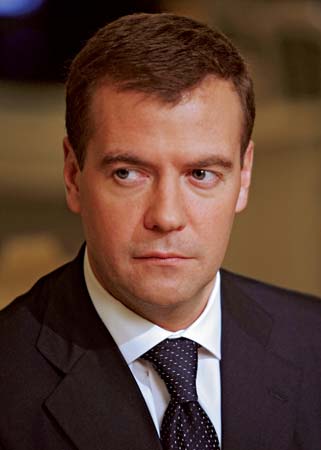
medvedev
Dmitry MEDVEDEV

Dimitry Medvedev, President of Russia, hitherto regarded as something of a stooge for “Czar” Vladimir Putin, recently made an extraordinary attack on those trying to rehabilitate Josef Stalin, who has strong claim to be the greatest mass-murderer and originator of human misery in history.

On the face of it, it seems extraordinary that anyone in their right mind could possibly seek to rehabilitate such a monster, but for many Russians he represents “the good old days”, when Russia was “great”, and in particular the dark days of WWII, when he is supposed to have “saved” Russia from the Nazis.

This last of course ignores  the small detail that those who saved Russia were mostly young boys in Red Army uniforms who faced down the Wehrmacht in Stalingrad and elsewhere in unimaginably-terrible conditions.

However, despite being an “international communist”, Stalin “saved” Russia by appealing to nationalist sentiments. As this great country is once more going through tough times, the Russian conservatives, headed by Putin (“the loss of the Soviet Union was the greatest tragedy of my life”) have been seeking to play upon nationalistic sentiment by rehabilitating Stalin.

Now, nationalism is the most destructive of forces (apart perhaps from those inspired by “God”), and so we have a lot to fear from the extreme Russian version. But Medvedev has pricked the bubble in an act of considerable courage, for many enemies of the  Kremlin have died for less – witness Alexander Litvinenko in London …

So, hats off to Medvedev.

Is he deliberately distancing himself from Putin? We should follow these events closely. We need Russia as a friendly partner on the world stage, and not just because of her resources.

By Chris Snuggs

The Polanski Affair

France, Polanski and respect for the Law.

Roman-Polanski2
Polanski

I have always associated France with surrealism after, at a fairly young age, seeing those amazing photos of early 1920s surrealist art by Duchamp, Ernst and others. In recent days this surrealist experience has returned with a vengeance in the bizarre case of Roman Polanski, with a reported 62% of French people believing that the arrest of Polanski in Switzerland was an unjustified affront to a long-standing resident “artist” and citizen of France.

The strongest condemnation of this arrest was initially by the French Minister of Culture, Mr Frédéric Mitterand, who said the affair “had no sense” and who expressed his “profound emotion” at the arrest of this “film director of international repute.”

Read more of Polanski’s arrest

Harvest Festival and “The Midnight Truce”.

An old Saxon church and echoes of world wars

Recently, the children from our small school in Breamore started their day with a Harvest Festival service in the old breamorechurch-350wSaxon village church which is over 1,000 years old.

Rural life has not changed much for generations.

The Breamore Estate, set in beautiful Hampshire countryside has some 300 inhabitants, many of them living in old thatched cottages. The main Breamore House is where General Patton stayed in the run up to the D-Day landings.

Read more about Breamore

Fate is the Hunter, part two

The introduction to this Post was published yesterday. The rest of this Post is Lex’s words and published with his written permission.

Fri – January 9, 2004 (post date)
The worst day ever

I don’t tell this story very often. Although the events inside it happened almost 12 years ago, the memory is still fresh, and still painful.

Over the years I’ve told it to two ready rooms, both by way of instruction – a kind of “been there, seen that,” in order to prevent anything like it from ever happening again. But it’s not one of those sea stories you tell over a beer, among friends. It’s a sad story. Maybe I post this one. Maybe I don’t.

Read more about Lex’s powerful story

Fate is the Hunter, part one

A theme about flying, pilots and fate.

Many, many pilots whether civil or military or private, have read the book by Ernest K. Gann entitled Fate is the Hunter.  Ernest Gann was born a little under a hundred years ago, on October 13th 1910 and died, aged 81, in 1991.  HeGann is known, in the main, as an aviation writer and airline pilot pioneer but achieved much more besides.

Fate is the Hunter is a book about the workings of fate. And this Post is more than a reminder of Ernest Gann’s book and the message it carries, it is also about fate, as Part Two published tomorrow reveals.

Fate or serendipity has happened along to cause a number of recent Posts to be about flying.  We had the Post about low-level RAF flight training in North Wales – Mach Loop.  Then we had three Posts about air carrier operations prompted by the PBS Series, the first one being published on the 2nd October.  Today, circumstance brought me to the Blog  of another naval aviator, published by Neptunus Lex.  More about him and links to the Blog later.

I want to set the scene by using the words of Ernest K Gann as he starts the preface to his book.

Read more about this Post

Integrity: adding up to something

Integrity as an idea that can deliver more than the sum of the parts

People who add up to something are remarkable, while at the same time being more common than we might think.

As I’ve discussed elsewhere, integrity is also about “wholeness”. The “adding up” aspect is relevant, because it links the parts to the whole. Many people achieve extreme and, sometimes, amazing feats; these are typically formed from many steps. But then to do that repeatedly, and continually exceeding one’s earlier achievements, has the effect of generating an overall record of achievement which is much greater than the sum of its parts.

Read more about the wholeness of integrity

Defence forces and integrity

A personal reflection on the emotions stirred by the PBS series on the USS Nimitz

The last three days have seen Posts on the USS Nimitz.  On the 2nd there was the first part of air carrier operations specifically looking at the challenges of a pitching deck.  On the 3rd came the second part as the pilots and crew operated into night, still with the deck of the USS Nimitz pitching significantly. Yesterday, the Post carried links to background information including the excellent web site that PBS have on the USS Nimitz series.

So why raise the question of integrity?

Read more of this Post

“What does economics mean?” by an economist

Keynes, macro economics and other terms need to be more widely understood.

Macroeconomics as a field is not very impressive, frankly.

In my view, it is more glorified accounting and policy than anything remotely related to testable economic theory!

Keynesian economics — the stuff that most macro courses are made of — smacks of a model created to justify a pre-conceived belief that government can run businesses better than private industry can.  Keynes spoke strictly of demand-side policies, namely fiscal and monetary policies, which create a large role for government intervention, as opposed to supply side policies, which basically get government out of the way by lowering taxes, fees, paperwork, and restrictions, and allow private industry to take risks and create value and manifest economic freedom.

Read more about economics

Very few really saw this crisis coming; are we still in the dark?

Who really understood the forces of destruction building up in the global economy?

(This Post is longer than usual but doesn’t lend itself to being divided into multiple Posts – trust it is worth the read.)

Part One – How investing in the 80s was so hit and miss.

My education with respect to the sound management of one’s wealth came from a propitious mistake by a global insurance company, one of Britain’s largest insurance companies as it happens.  Here’s the story.

Read the rest of this Post