Yet despite it being so obvious it hadn’t crossed my mind before.
I’m referring to the wonderful idea of using those people, who through circumstance have found themselves homeless, to care for animals via an animal shelter.
Glenn Greenwald Unveils New Project to Build Animal Shelter in Brazil Staffed by Homeless People
Published on May 10, 2017
http://democracynow.org – Pulitzer Prize-winning journalist Glenn Greenwald unveils his plans to build an animal shelter in Brazil with his husband David Miranda, a city council member in Rio de Janeiro. The shelter will be staffed by homeless people who live on the streets with abandoned pets.
ooOOoo
If you, like me, needed to be reminded as to Mr. Greenwald’s background there’s plenty online.
Glenn Greenwald is one of three co-founding editors of The Intercept. He is a journalist, constitutional lawyer, and author of four New York Times best-selling books on politics and law. His most recent book, No Place to Hide, is about the U.S. surveillance state and his experiences reporting on the Snowden documents around the world. Prior to co-founding The Intercept, Glenn’s column was featured at The Guardian and Salon. He was the debut winner, along with Amy Goodman, of the Park Center I.F. Stone Award for Independent Journalism in 2008, and also received the 2010 Online Journalism Award for his investigative work on the abusive detention conditions of Chelsea Manning. For his 2013 NSA reporting, he received the George Polk award for National Security Reporting; the Gannett Foundation award for investigative journalism and the Gannett Foundation watchdog journalism award; the Esso Premio for Excellence in Investigative Reporting in Brazil (he was the first non-Brazilian to win), and the Electronic Frontier Foundation’s Pioneer Award. Along with Laura Poitras, Foreign Policy magazine named him one of the top 100 Global Thinkers for 2013. The NSA reporting he led for The Guardian was awarded the 2014 Pulitzer Prize for public service.
That post in April also included a picture of a recent stray supported by the Fund. He was named Socks by Jean.
Socks starting a new and better life.
Anyway, a few days ago Dionete sent me an email that I wanted to share with you.
Hello Paul – how’s things with you & Jean & dogs? Fine, I hope.
We’ve got some news: Socks has just been neutered. We picked him up at the clinic an hour ago and took him to a temporary shelter. Unfortunately it is just for a couple of nights but at least he is safe and can recover from the grogginess tonight.
Here are the pics we’ve taken.
Thank you very much (again) for allowing it to happen.
All the very best,
Here are those photographs of Socks.
oooo
oooo
Socks has a really gentle look in those eyes. Hopefully, he will find a new loving home before too long.
It takes so little good news to uplift one’s heart!
For reasons I can’t readily put my finger on it’s been feeling like a bit of a struggle recently. But that’s enough of that! For our gorgeous dogs have yet another lesson for me: How little it takes for a dog to wag it’s tail!
I so frequently share stuff that I read over on the Care 2 site and why not because as the home page declares:
40,107,687 members: the world’s largest community for good
Just three days ago there was a wonderful article shared on the Care 2 site about some dogs being rescued from a so-called backyard breeder. Better than that, it highlighted the wonderful consequence of a donation from George and Amal Clooney.
Here’s the story.
ooOOoo
9 Dogs Successfully Rescued From Backyard Breeder Thanks to George and Amal Clooney
Nine lucky dogs have just had their world turned upside down in the best way possible.
Camp Cocker Rescue, based in California, just took in the “Mojave 9″ who were being kept by a backyard breeder. They’ll be getting all the love and veterinary care they desperately need thanks to a generous donation made by George and Amal Clooney.
The nine dogs have had little human contact, and are all in need of extensive veterinary treatment for health issues ranging from mammary tumors and dental disease to skin and ear infections to ingrown toenails. The organization relies on donations, and expenses for this rescue operation were quickly rising.
“We literally didn’t know how we were even going to begin to start paying for all of these new dogs that we took in on the same day,” Camp Cocker’s founder Cathy Stanley told PEOPLE.
Now, the organization is celebrating a generous and unexpected donation of $10,000 made by George and Amal Clooney, who are parents to two adopted cocker spaniels from Camp Cocker — Einstein and Louie.
Their donation is going to help cover the cost of care for these dogs, who have never been to a vet. The Clooney’s will also be matching donations up to $10,000 for the rest of May.
“After we all did happy dances and cried with happiness for this unbelievable matching donation offer – we then asked the donors if (and only if they gave us their permission) . . . if we could reveal their names to our supporters in order to help us reach our big goal this month. They were so very gracious to give us permission to reveal their names,” Camp Cocker wrote in an update.
While this was a huge boost for them, Camp Cocker is quick to point out that no donation is too small to help.
“We have a philosophy where we want to be very inclusive of all of our supporters and it’s important to us that no matter how small of a donation, every person feels like their donation is meaningful and that we appreciate them,” Stanley added.
Hopefully news about the Mojave 9 and the attention it’s getting will help raise awareness about rescue and inspire more people to get involved … and will help find each of these precious dogs their perfect forever home.
For more on how to help, and info on how to adopt one of these dogs, check out Camp Cocker Rescue and follow updates on Facebook.
It concerns possible contamination of food with Salmonella so please read and share as widely as you can.
ooOOoo
Smallbatch Dog and Cat Food Recall of May 2017
May 5, 2017 — Smallbatch Pets Inc. of Portland, OR, is voluntarily recalling two lots of its Smallbatch frozen chicken blend for dogs and cats due to the potential to be contaminated with Salmonella.
About Salmonella
Salmonella can affect animals eating the products and there is risk to humans from handling contaminated pet products, especially if they have not thoroughly washed their hands after having contact with the products or any surfaces exposed to these products.
Symptoms of infection in people include nausea, vomiting, diarrhea or bloody diarrhea, abdominal cramping and fever.
Rarely, Salmonella can result in more serious ailments, including arterial infections, endocarditis, arthritis, muscle pain, eye irritation, and urinary tract symptoms.
Consumers exhibiting these signs after having contact with this product should contact their healthcare providers.
Pets with Salmonella infections may be lethargic and have diarrhea or bloody diarrhea, fever, and vomiting.
Some pets will have only decreased appetite, fever and abdominal pain.
Infected but otherwise healthy pets can be carriers and infect other animals or humans.
If your pet has consumed the recalled product and has these symptoms, please contact your veterinarian.
No pet or consumer illnesses from this product have been reported to date. However, because of their commitment to safety and quality, Smallbatch Pets is conducting a voluntary recall of this product.
Consumers should also follow the Simple Handling Tips published on the Smallbatch Pets package when disposing of the affected product.
What’s Recalled?
The affected lots of 2 pound bags of Smallbatch Chicken Blend were distributed to retail pet food stores in the following states:
California
Colorado
Oregon
Washington
Two hundred eighty-two cases of this product were sold between the dates of 2/1/17 and 5/5/17.
The affected products are sold frozen in 2 pound bags.
The products affected by this recall are identified with the following manufacturing codes and “Best By” dates, located on the back of the package.
Lot: D032
UPC: 705105970974
Best By: 2/1/2018
Lot: E058
UPC: 705105970974
Best By: 2/27/2018
What Caused the Recall?
The recall was initiated after routine testing by the Food and Drug Administration of a 2 pound bag of Smallbatch Chicken Blend that was collected at a distributor revealed the presence of Salmonella.
This recall is being made with the knowledge of the U.S. Food and Drug Administration.
What to Do?
Consumers who have purchased the above lots of Smallbatch Chicken Blend are urged to stop feeding the product to their dogs or cats and to return product to place of purchase for a full refund.
Or dispose of them immediately.
Consumers with questions are asked to call the company at 888-507-2712, Monday through Friday, 9:00 AM to 4:00 PM PST.
Or via email at info@smallbatchpets.com.
U.S. citizens can report complaints about FDA-regulated pet food products by calling the consumer complaint coordinator in your area.
I chose the title for today’s post deliberately. Wanting it to act as a metaphor for our senior years, as the dear Americans like to put it, or leaning on my English roots, preferring the metaphor of the sinking sun for the Autumnal years of our lives.
We live in a part of the world where “The median age was 47.3 years.”
Josephine County, Oregon
As of the 2010 United States Census, there were 82,713 people, 34,646 households, and 22,498 families residing in the county.[20] The population density was 50.4 inhabitants per square mile (19.5/km2). There were 38,001 housing units at an average density of 23.2 per square mile (9.0/km2).[21] The racial makeup of the county was 92.4% white, 1.4% American Indian, 0.8% Asian, 0.4% black or African American, 0.2% Pacific islander, 1.5% from other races, and 3.2% from two or more races. Those of Hispanic or Latino origin made up 6.3% of the population.[20] In terms of ancestry, 26.3% were German, 15.6% were Irish, 15.5% were English, 5.5% were Italian, and 5.5% were American.[22]
Of the 34,646 households, 25.5% had children under the age of 18 living with them, 49.2% were married couples living together, 11.0% had a female householder with no husband present, 35.1% were non-families, and 28.3% of all households were made up of individuals. The average household size was 2.34 and the average family size was 2.82. The median age was 47.3 years.[20]
Yet in the rural areas of this County one does see a fair number of people who, as with Jean and me, are the wrong side of 65!!
But one very frequent observation of those ‘senior’ people is that they have a dog in their lives.
On April 10th, I posted a guest article written by Jessica Brody. It was very well received and I closed that post by saying: “I know many will agree with me when I say that it would be good to receive some more articles from Jessica.”
Our wishes have been granted. Here is Jessica’s second guest article.
ooOOoo
The Wonderful Benefits of Pet Ownership for Seniors
It’s no mystery that pet ownership can bring joy to people’s lives, but it turns out that having a pet may benefit seniors in ways that reach far beyond the pleasures of companionship. For elderly people who live alone or in senior care facilities, owning a pet can improve mental and physical health, paving the way for longer, healthier, and happier lives. Here are five ways that having a critter companion can benefit senior health. Pets Improve Senior Mental Health
One of the greatest benefits of pet ownership for people of any age is the unconditional friendship and love that a pet provides. This support is especially important for elderly people, who are prone to loneliness and isolation as they leave the workforce, children move away, and friends and loved ones begin to pass on. Isolation is one of the biggest risks to senior health; isolation can cause depression (and related issues), cognitive decline, and even early death. The company of a beloved pet can help seniors stave off loneliness and preserve their mental health. Caring for a pet can also give seniors something to focus on other than negative thoughts about grief, physical ailments, and aging, thereby reducing their overall stress levels.
Pets Keep Seniors Social
Pets do more than provide a social outlet for seniors — they can actually lead the elderly to be more social with their peers as well. People are naturally drawn to dogs, and a senior who is out walking a pet is more likely to meet new people than if walking alone. Pets can help bring people together in senior living facilities, too. Dogs, cats, and other animals give people a common interest over which they can come together, share stories, and develop friendships.
Pets Reduce Heart Attack Risk
Companion animals like dogs, cats, birds, and even fish can improve heart health by lowering blood pressure. One study showed that being in the presence of your dog can even have a greater impact on your blood pressure than some medications. And by lowering blood pressure, pets can reduce heart attack risk in seniors. Pets Keep Seniors Active
The daily routine of caring for a pet helps seniors maintain functional mobility. Giving food and water, cleaning a litter box, and letting the dog outside makes a sedentary senior get up and get moving. These simple activities can support an elderly person’s ability to complete the activities of daily living like bending, preparing meals, bathing, and dressing. Older people who own dogs are also more likely to stay active into their later years. Not only do they get out to walk the dog, but they’re also more likely to be involved in other active hobbies like gardening. Pets Improve Senior Personal Care
A senior who has a daily pet care routine is more likely to adhere to a daily personal care routine. Having a routine gives structure to a senior’s days, making it easier to adhere to medication schedules, meal times, and personal care. Maintaining a daily routine can even help seniors sleep better.
Seniors can be saviors to pets, too. When older people adopt adult or senior pets, they provide a loving, stable home to an animal that may not have found a home otherwise. Dogs and cats aged seven and older are adopted at staggeringly low rates, even though they still have years of love to give. Many shelters and rescues even offer discounts for seniors adopting senior pets, so be sure to ask if you might be able to adopt your new friend at a reduced rate.
This is a guest post coming up today. A reflection on what any dog lover feels when their beloved dog dies. (I don’t even want to think about the end of Pharaoh that can’t be too many weeks off!) But as has been said before it is one the key lessons that we learn from our dogs.
Not too many days ago I received an email from Liz Nelson.
I wanted to submit a synopsis of how our fur babies have dealt with the loss of a friend and the addition of another one to see if you wanted to use it as a guest post.
There was no question that I wanted to publish Liz’s synopsis so it could be shared with you. Here it is.
ooOOoo
The death of Zeke
See footnote for details of this photograph.
A little over a year ago we lost our precious Rottweiler, Zeke, to bone cancer.
Zeke, a rescue who still had remnants of buckshot in his torso from his days living in the woods of Mississippi, was with our family for about 8 years. A gentler giant there never was. He and our cat were friends and Zeke frequently bathed the cat’s head and ears. Zeke and our Chow-mix (Fiona) were also very close. We joked he was in love with her because he let her collect all the toys and win at tug-a-war, despite the size difference.
Losing Zeke was a tremendous blow for our household. Both dogs and our 2 cats were visibly impacted by Zeke’s loss. Fiona took it the hardest. She became listless, fatigued, and generally out of sorts. She wasn’t interested in playing and she became an even pickier eater. She would skip several meals in a row and then eat everybody’s food at one time (including the cats’). She and the other animals refused to touch the dog bed in the living room that Zeke had used. She also refused to chew on a large rawhide we found that had once been Zeke’s. It felt like she was saving his things for when he came back to claim them. We noticed the hair under her eyes starting to go gray. She started to show and act all 9 of her years (she’s a rescue and special needs dog so we’re amazed we’ve had 9 years with her).
The vet said we could explore antidepressants but I wanted to see if we could let her try to work through it without medication. Though they remain an option if needed.
In January, my husband said he was ready to think about getting a puppy and several weeks later we adopted an adorable rescue named Pierce. The rescue told us he was part Husky and part Lab. Now that he’s older we think there’s a hefty dose of hound in there. After a few days of wariness and some growling, the older dogs decided to accept the puppy as part of the household. Fiona regained her energy and she was often seen in the yard with the puppy, teaching Pierce how to play fight or stalk birds. She would chase the puppy until they were both exhausted (which we were grateful for). Sometimes she got annoyed with the puppy but for the most part she took on a big sister role.
Fast forward a few months and the puppy is now the biggest dog in the house. While he really is a good dog, he’s still a puppy. Now when he is too energetic there is a lot more of him bouncing around a room. Fiona spends much of her time reinforcing her dominance by taking his toys and putting them under her chin where Pierce is afraid to attempt to retrieve them. She’s stopped running around the yard to play with him. Perhaps because it hurts when you collide with 45 lbs of speeding, clumsy puppy (just ask my husband)? She has gone back to spending most of her time looking pitiful. She will let me pet her though she acts as if it is an imposition.
We’re hoping that when the puppy matures a little more Fiona will regain interest in playing with him. Or at least his behavior won’t annoy her as much. I know that the puppy can never replace Zeke’s place in the family but I really hope Fiona doesn’t spend the rest of her dog life mourning Zeke and ignoring the new dog!
Liz Nelson
Footnote (re the photo above):
I have a great picture of our family with Zeke and Fiona in it (and my third dog). It’s one of our engagement photos and I’m so glad we included the pups. As you can see Zeke was super cuddly! It’s one of my favorite pictures. You can use any of the information in my about section for an introduction. I don’t have it very detailed (I only started this blog this week) so if there is any additional info you want to include please let me know. I looked around for a more recent photo of myself but all of my recent ones are from Halloweens and involve costumes. Not really an everyday look!
So I guess let’s stick with the family photo. Thank you Paul!
I am a supervisor at a small non-profit agency. I’m also in school part-time working on a doctorate. I’m a social worker so I’ve been working in non-profit agencies since I got my master’s degree around 8 years ago. I’ve been in management for around 5 years. I have had to deal with pretty intense social anxiety for as long as I can remember.
For all my life this has felt like a very special month.
And, dear friends, at the risk of repeating myself to many of you, this is why the month of May is special for me.
Simply that I was born in London during the closing months of the Second World War. Inevitably, I was unaware of the number of German bombs that were falling on London during those last few months. But there were thousands.
On May 8th. 1945, the day that WWII ended and six months to the day from when I was born, my mother looked down at me and said aloud to me: “You are going to live”. Despite the fact that I don’t recall my mother saying that, it was verified many times later when I was growing up.
Now here we are approaching May 8th. 2017 and in a very real sense it seems that we are in another war.
A war of consequence.
A war that we have been engaged in for many, many years.
A war where we are inadvertently fighting on a global battlefield.
A war where 99.99% of us don’t consciously identify the weapons we are using. Weapons that are incredibly effective. So much so that we are in sight of winning the last battle; winning the war.
Yet a war where winning is no win at all. Indeed, where winning this war, this global war, spells the end. The end of life for 99.99% of us humans (and much else besides).
Now what on earth has got me so fired up?
Two things have:
The first is that I am living in my 73rd year of life. I have no idea of when my life comes to an end. But that death is a guarantee. Indeed, if one takes note of the average life expectancy of a male today in the USA (75.6 years) , it may not be that far away.
The second thing is that before my death I truly want to know that humankind has laid down its weapons of war against our planet and that there really is an unstoppable mission, a united wave of passion, to live in peace on this planet. Perhaps better put to live in peace with this planet.
Or in the words of an organization that I now want to introduce:
A mission which will require the hard work and dedication of each and every one of us as we do everything in our power as individuals, but also as we galvanize businesses, entrepreneurs, innovators, city planners, communities, people and politicians—all those who share our purpose.
OK! Thank you if you are still reading this! (Someone give Fred in that soft arm-chair over there a nudge; I can hear his snores from here!)
In the last Smithsonian electronic newsletter that I was reading yesterday morning there was a reference to an organization that I hadn’t previously come across. Here is the link to that item on The Smithsonian website. I am republishing it in full in this place. As you read it you will understand why I am republishing it.
ooOOoo
Using a New Roadmap to Democratize Climate Change
A new tool aims to bypass governments and put the power of climate action in the people’s hands
Olafur Grimsson, who was president of Iceland from 1996 to 2016 and saw his country through the worst economic crisis in its history, making headlines all over the world as banks collapsed and the country fell into a depression, is the very picture of an urbane statesman. Collected and poised, with a striking full head of white hair, as comfortable in English as in his native Icelandic, he seems an unlikely revolutionary, not the sort of person you’d look at and immediately find yourself thinking: “Power to the People.”
But Grimsson is one of the primary architects of a quietly radical new idea whose aim is to facilitate action on climate change without any of the usual suspects—governments, countries, international bodies, negotiating parties.
He and several other veterans of the historic 2015 Paris Agreement on climate change were in Washington, D.C., last year, just before COP22, the climate meeting held in Marrakesh in 2016. They were pondering next steps when the conversation took a new and interesting turn, Grimsson says, addressing the question: “Was it possible to have the success of Paris without governments necessarily being in the leading role?”
The group included movers and shakers such as Peter Seligmann, the chairman of Conservation International; Laurene Powell Jobs, president of the philanthropic organization the Emerson Collective; and Andy Karsner, an assistant energy secretary during the administration of George W. Bush. Galvanized by their own query, they decided to try to answer it—to set about creating a new tool to aid in achieving the goals of the Paris accord.
At the Smithsonian’s Earth Optimism Summit, a gathering this past weekend of conservation-minded citizens, scientists and activists, Grimsson explained: “You get governments that are opposed or even hostile to climate action. We decided to bring together in Marrakesh a gathering of thinkers and scientists and innovators and policymakers from different countries in order to discuss a new model of securing the success of the future of the climate movement.”
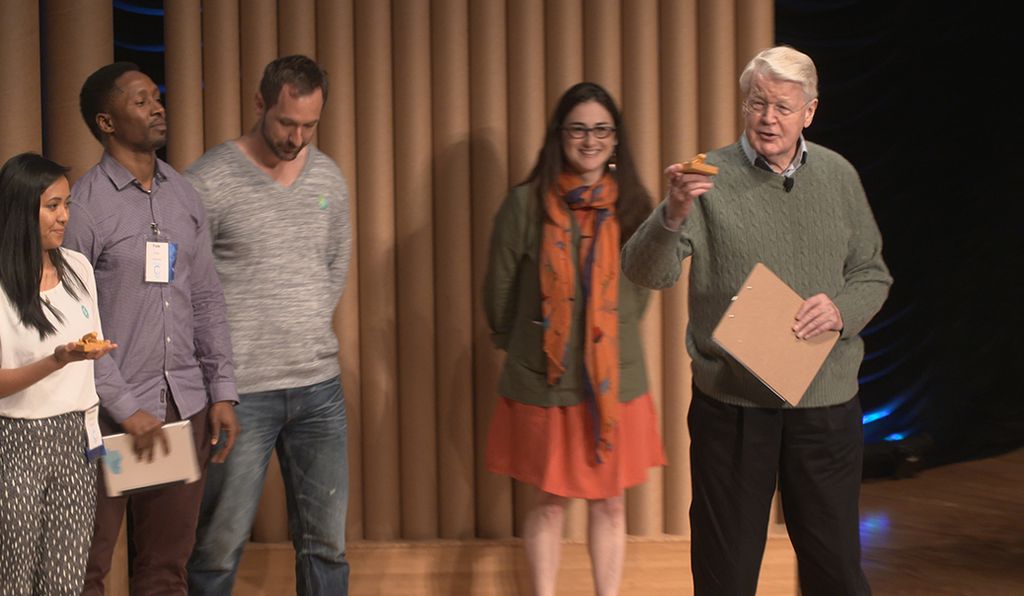
At the Smithsonian’s Earth Optimism Summit, the former president of Iceland Olafur Grimsson encouraged new solutions to climate change, awarding cash prizes to the winners of the “Make for the Planet” challenge. (The Roadmap)
Grimsson’s group felt that due to changes in information technology and social transformations, the large organizations and structures that used to be necessary to effect change were now not needed. And thus was born Roadmap, a new crowdsourcing tool for anyone and everyone interested in climate action. Still in its very early stages, Roadmap’s founders envision it as a platform for those working on climate issues—from scientist and policymaker to farmer and fisherman—to facilitate the sharing of knowledge and ideas, methods and techniques.
“A new political model is possible—where everyone can be a doer, where you no longer need big government or big enterprises to bring about success,” Grimsson says.
This new model for social change that skips the usual cumbersome channels and processes has been seen everywhere from public health, where the Bill & Melinda Gates Foundation has redefined the sector, to the hospitality industry, which is working to combat the human trafficking that plagues its businesses, to perhaps most famously the Arab Spring, where the role of social media in bringing about political change is still being debated today.
And this new model is complemented by technological changes. “The innovation in energy technology is such that we no longer have to wait for the big energy breakthrough,” Grimsson says. “We already have the available technologies. Every individual, home, village, community, town and region can execute change. The good news from the climate point of view is that, in addition to the information technology revolution, there has now also taken place an energy revolution. A house can be a power station: If the people who live in that house have extra energy, they can sell their energy through the smart grid. The notion that every house can be a power station is as revolutionary as saying that every mobile phone can be a media company.”
Grimsson admits that it may seem odd for someone in his position to be advocating that ordinary citizens take action apart from the conventional corridors of governmental power.
“For me to say that these traditional political organizations and positions are somewhat outdated is perhaps a strange statement: I was a professor of political science, I’ve been a member of parliament, I’ve been a minister of finance, I was president for 20 years,” he says.
It was during Iceland’s financial meltdown that he first experienced this new kind of social change: “I saw this very strongly through the financial crisis in my own country, which led to a big social economic uprising. All those activities were engineered by unknown people, people who were not part of a big organization, who used Facebook and the information media to bring thousands of people together in one day.”
Right now, Roadmap consists of a website and a lofty manifesto that speaks of raising the value of “moral currency” and creating a “best practices warehouse.” Visitors to the site can fill out a form if they want to become part of its community of “doers.” The practical part of the manifesto speaks of identifying the best methodologies and models; implementing a “real-time system of measurement” and a way to “gauge and understand what is working, what is not, and exactly what is being achieved.” As the platform develops, it will be interesting to see exactly what form these gauges, measurement systems, and warehouses take.
After the Paris Agreement, Grimsson says of himself and his Roadmap co-founders, “We were all optimistic, but we are all also realists.” It is his belief that if you “give people the tools, they can execute the transformation and the change—without governmental leadership.” Perhaps Roadmap will be one of those tools.
ooOOoo
Here’s a video that spells it out in ways that I find impossible to ignore. (And, yes, I signed up, as in joining, yesterday afternoon.)
Because in hundreds of years time I want others to look at the following picture of Troutbeck Valley in England and know how precious is this one and only planet we live on.
We are witnessing more storms, more unseasonal weather patterns, and I just hope that we wake up soon to the damage we are doing to our beloved Mother that has held us in her eternal arms for so long..
Photo credit: Getty Images
Enjoy the month of May wherever you are in the world!
Closing by repeating a key pronouncement in that RoadMap video above:
Another delightful travel account from Natalie Derham-Weston.
Albeit perhaps travels of a more inward nature.
ooOOoo
Travel Blog: Installment 3: Living on a boat.
Simple Peace
I fancied an interlude this week to share a morning I enjoyed over the weekend. It isn’t often that the chance arises to enjoy our local surroundings without time limits, overdue deadlines or inconvenient meetings. However, I had a day off Saturday; a concept becoming more and more valued having since started a new full-time job, which is quite demanding on my time. I have requested this high load of hours but after months of travelling and not having regular work, it is taking a while for me to adjust to the mental and physical demands.
Anyway, without going into the irrelevant details, I have been spending my time living on a boat in a marina in Lymington, a small sea side town in the New Forest on the South Coast of England. This means my commute to work is a 2 minute walk and although I do not know the first notion about sailing, I have quickly fallen for the lifestyle of boats and water. I have found it to be extremely sociable and relaxing and I have all I need around me. This includes a bicycle, a car, swimming facilities, work, grocery shops and a very modest yet comfortable boat.
So last Saturday, I woke up early, as I was already in the routine of being awake from my work shifts and saw the sun streaming in through the port hole windows. This immediately buoyed me and I pulled the curtains and opened the hatch to let in the fresh air. I had a few items on a to do list but I certainly didn’t intend on wasting the valuable time I had.
I did have an appointment I couldn’t shirk but made it as quick as possible and on the way back picked up some lunch items. Back on the boat, I had a quick tidy and clean as I firmly believe an orderly workspace leads to a clearer mind.
I pre-empt this by saying I am usually accompanied by my father on the boat but this specific day was the first time I had been left in solo charge and this gave me somewhat of an independent free feeling. So my next mission was to cook some eggs which I did on our very small gas camping stove. I took some cushions out on deck and had my lunch in the warm April sunshine. Our pontoon seems to be quite an active mooring site and there were people constantly wandering along it all day, carrying tools, bags and equipment back and forth. So although I was alone, I did not feel isolated.
I then left everything behind on the boat, including my phone and took my bicycle around the headland on a trail I had never been on before. The channel was extremely clear and I had a wonderful view over to the Isle of Wight and watched the bustle of boats going to and fro. I passed lots of families, dogs, bird watchers and couples but kept going at a steady pace along the gravel track headed towards Keyhaven, the next fishing village along.
There is no specific reason why I enjoyed this so much, just the whole atmosphere and surroundings made for a very encompassing uplifting day. I continued along the path, and had no care as to where I was or where I was going. I was confident enough that I knew I’d always find my way back somehow and so without that pre-conditioned feeling of panic, I cycled on along the back roads and hauled my bicycle over fences and gates.
Two hours later I cycled back in to the marina and abandoned the bike next to the boat. The boat is never locked, another aspect I really appreciate. I don’t think this would be possible everywhere, but it allows for a very open way of life. So I grabbed a cushion and headed to the bow of the boat, lying in the sun, drinking a beer, watching the world go by.
This just proved to me how easy it is to be happy sometimes. We need very little but that day will stay in my memory for a long time as a point in time where I was 100% content.
ooOOoo
I had the great fortune of living on a yacht Songbird of Kent, a Tradewind 33, for five years in the late ’80s early ’90s based out of Larnaca on the Greek side of Cyprus. I can fully vouch for the peace that Natalie has written about.
Are you a dog owner? Then here’s something else that you gain from your wonderful friend.
I was rather short on time yesterday so apologies for cutting my introduction to a minimum. But you will still love this item that appeared on the Care2 site three days ago.
ooOOoo
People Who Talk to Their Pets Are Actually Quite Intelligent
If you’ve ever owned a pet, you’ve probably talked to it at one point or another. And even though you may have been fully aware that your pet couldn’t talk back or even really comprehend what you were saying, you still did it anyway.
Why do we do this? Why do we talk to our pets like human friends when we know their little minds just aren’t built to think or feel the same way we do?
When we talk to our pets, we subconsciously create a human-like bond in our own minds with non-human creatures. We’re built for connection — and we feel more connected to things when we recognize that they’re just like us.
Talking to animals (and even to inanimate objects, such as house plants) is called anthropomorphism. We usually call it “cute” when kids do it, but when adults do it, we tend to view it as a little weird and immature.
According to behavioral science professor at the University of Chicago and anthropomorphism expert Nicholas Epley, talking to animals and objects is actually a sign of intelligent social cognition. Humans are very social creatures, so our brains are wired to see faces and perceive minds everywhere.
Epley explains that we anthropomorphize the things that we love as opposed to the things that we hate. The more we like something, the more likely we are to want to engage with its mind — even if it doesn’t actually have a mind.
In a 2011 study where a group of participants were shown photos of baby animals and adult animals, most admitted to liking the baby animals better and were more likely to anthropomorphize them. If the participants could own one of the baby animals, they said that they would name it, talk to it and refer to it by its appropriate gender pronoun.
The most common way we anthropomorphize animals and objects is by giving them names, but it can apply to character traits, too. For example, a person may describe their cat as “sassy” or their car as a “rickety old man.” These human-like character traits given to non-human things reflect our relationship with them and perhaps even symbolize extensions of ourselves.
Anthropomorphizing only benefits us when inanimate objects are involved, but when it comes to anthropomorphizing domesticated animals like dogs and cats, both ourselves and our pets can benefit. Since these animals evolved over thousands of years to become human companions, they are biologically designed to bond with us.
Studies have shown that when we talk to dogs, they can distinguish between the meaning of the words and the emotional cues we give them. Cats may not be as responsive to human language as dogs are, but they do have the ability to recognize their owners’ voices and they also have 16 different types of vocalizations they use to communicate.
So you can let go of the widely held belief that talking to your pet, your houseplants, your car or anything else is childish or even a little bit crazy. From a scientific viewpoint, it turns out that quite the opposite is true.
ooOOoo
Let me close by reminding all you good people of yet another wonderful aspect of the relationship between humans and dogs. In that we all know the dog evolved from the grey wolf. But had you pondered on the fact that wolves don’t bark! Yes, they howl but they do not bark.
There is good science to underpin the reason why dogs evolved barking; to have a means of communicating with us humans.
Every person who has a dog in their life will instinctively understand the meaning of most, if not all, of the barks their dog utters.
Jean and I went to a conference down in Medford last Saturday. It was a conference to do with Parkinson’s Disease and was arranged by the group Parkinson’s Resources of Oregon (PRO).
Almost immediately upon our arrival at 1pm we saw a gentleman in his wheel chair accompanied by his service dog. That gentleman soon identified himself as Ken Schiff and his wonderful service dog was named Lacey. It was clear within moments how beautifully behaved was Lacey and, by implication, how well trained he had been to perform his role as a service dog to Ken.
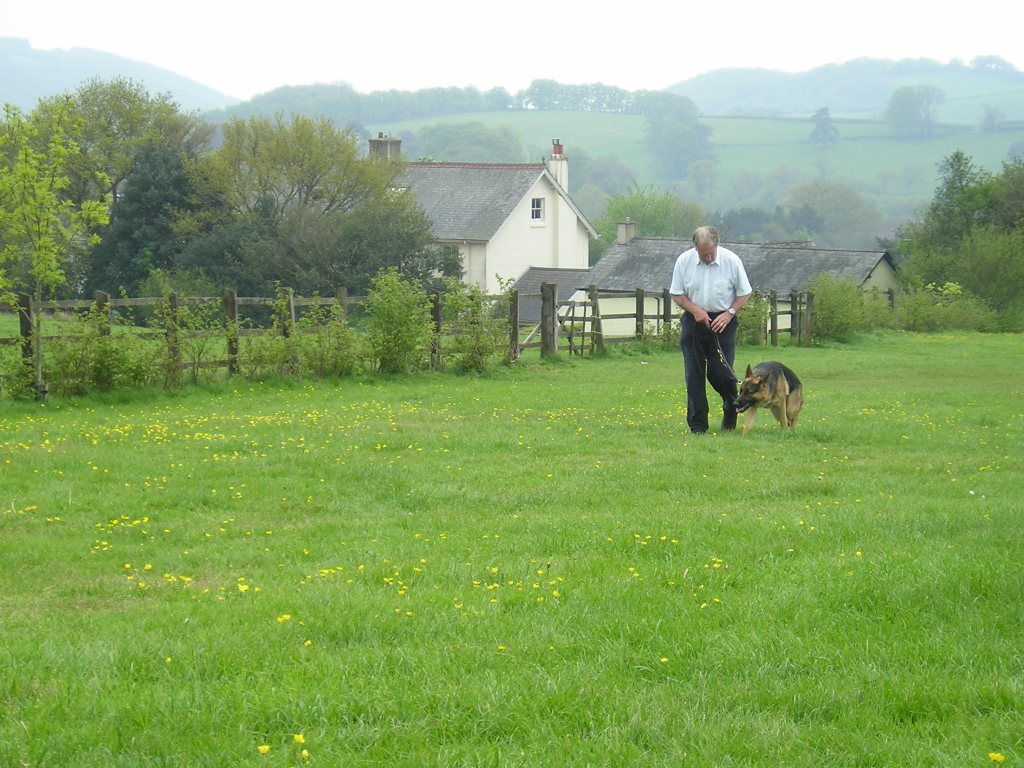
That took me way back to my days of working with Pharaoh back in Devon; before Jean and I met. Living in a very rural part of England with, reputedly, there being more sheep than people, one of the early requirements was to train Pharaoh to behave properly in the vicinity of sheep. Here are a couple of pictures from that training day in Devon.
Pharaoh’s training the afternoon of the 11th May, 2004.
oooo
Luckily the training paid off! Pharaoh was fabulous in and around sheep!
Needless to say, Pharaoh also received professional training for his general behaviours.
So treat all of the above as my introduction to a guest post by Robert Michael. On dog training. So who is Robert Michael?
Robert Michael
Robert is professional dog trainer having an experience of almost 8 years now. And he loves to contribute to the pets blogs to enjoy his passion. Plus, I write free of cost for those pets blogs: do you have one? Contact me rob.michael47@gmail.com
ooOOoo
A Comprehensive Visual Guide on Dog Training Schedule to Get 100% Outcomes
by Robert Michael. April 26th. 2017
There are a number of acts to follow on time, when your dog is on a training with you! So, if it is said that, you can get no any effective outcomes of the dog training, without making a proper schedule; it would not be wrong at all.
So, you must be aware of the fact that:
Making an appropriate dog training scheduleis necessary for a super effective output. Now you might be thinking that:
How to make a dog training schedule?
So, it is not a tough task to do so! You just can make a schedule by following the tips given below:
Take a pen and diary specified in writing and following the schedule.
Save notes in your mobile phone, and set the reminders.
Make an Excel sheet containing the schedule.
Make an MS Word document to file the training schedule.
Make a training schedule chart and attach to one of the walls of your home.
So, these are the super easy ways, you can make and follow the training schedule of your dogs.
You will be habituated by the training schedule.
Your dog will get habituated by the schedule timings.
You will get a punctual routine.
Your training sessions will prove to be more effective.
You will be able to train your dog by an organized manner.
What can you include in the schedule?
The feeding timings.
The playing timings.
The walk timings.
The toilet timings.
The training sessions’ timings.
The exercise timings.
The sleeping and waking up timings.
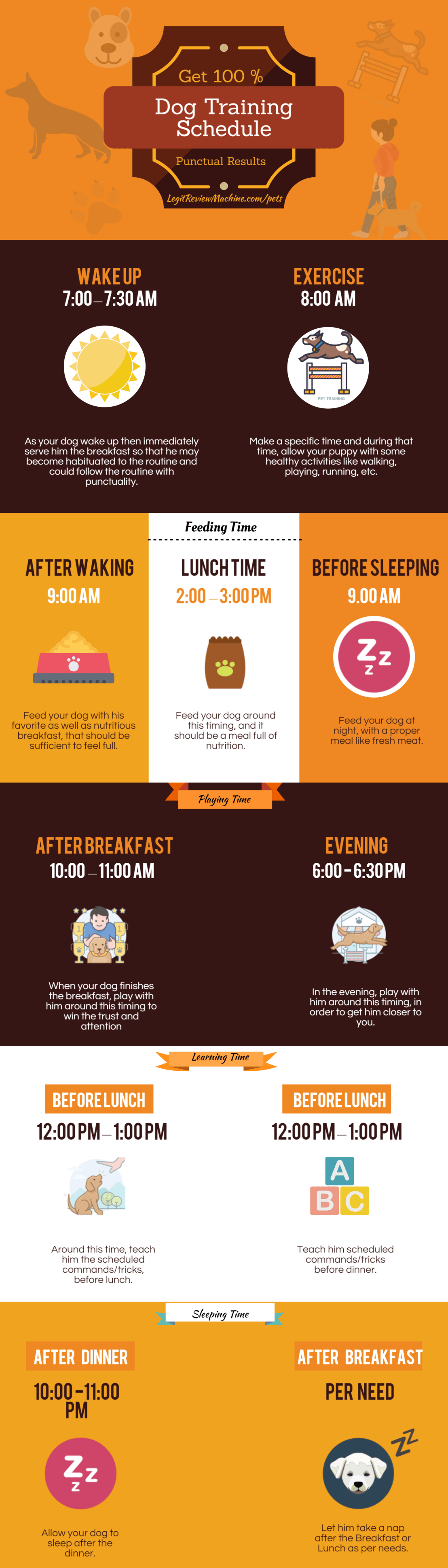
You can see the Legit Review Machine infographic to better understand the dog training schedule ways and steps.
ooOOoo
And here is that infographic that Robert included as a separate image in his email to me.
Puppy Training Schedule
I’m sure many of you will have found this very useful and I do hope there will be more guest posts from Robert.