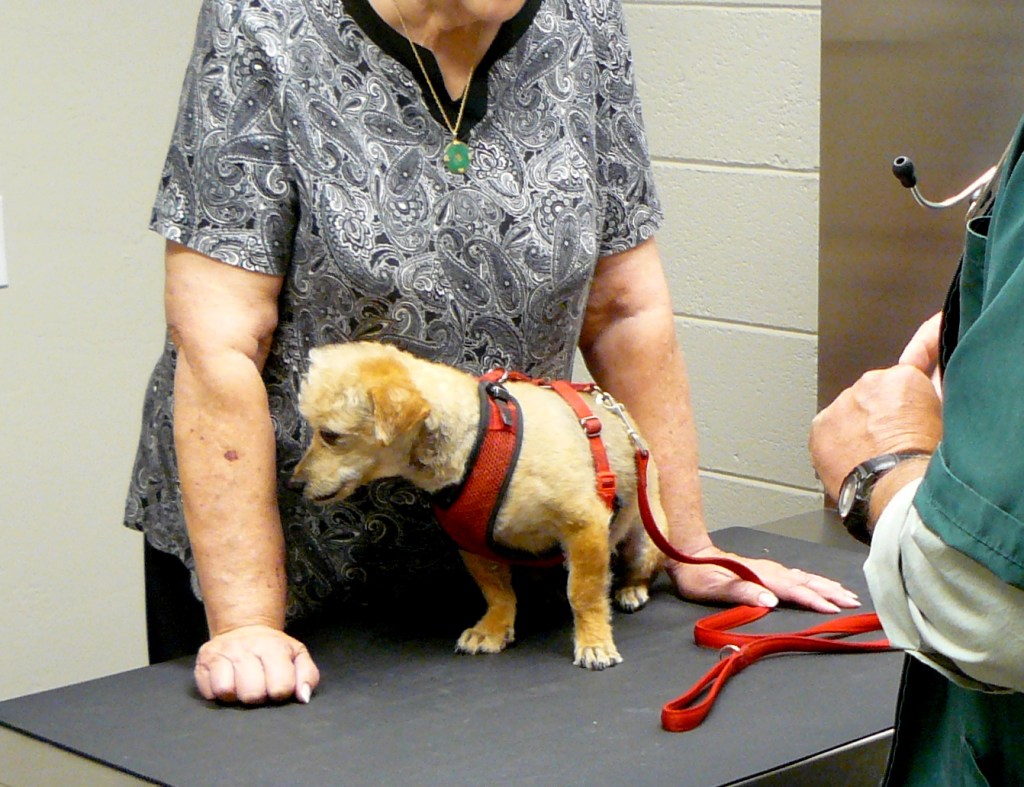
This is Buffy, a nine-year-old Dachshund crossed with a Terrier, who is drinking and peeing too much according to the lady who brought Buffy in to the clinic this morning. Adding that Buffy seems to be always hungry and quieter than normal.
Jim runs a blood test and not long after says that nothing has jumped out at him as a potential issue from Part One of the test results. (Apparently, the blood test comprised two parts – I will learn more in a subsequent visit to Lincoln Road.)
Buffy’s heart sounds good. Buffy has not lost weight.
Then Part Two of the blood test results reveal, thankfully, that Buffy is not diabetic, is not indicating Cushing’s Syndrome, and that Buffy’s kidneys are fine.
In other words, Buffy has the look of a healthy dog.
Has this all been a waste of time and money? Not at all, says Dr. Jim. This is the first time the clinic has seen Buffy and all the test results can now be logged providing a baseline of data for future reference purposes.
11:50 In comes Chloe.
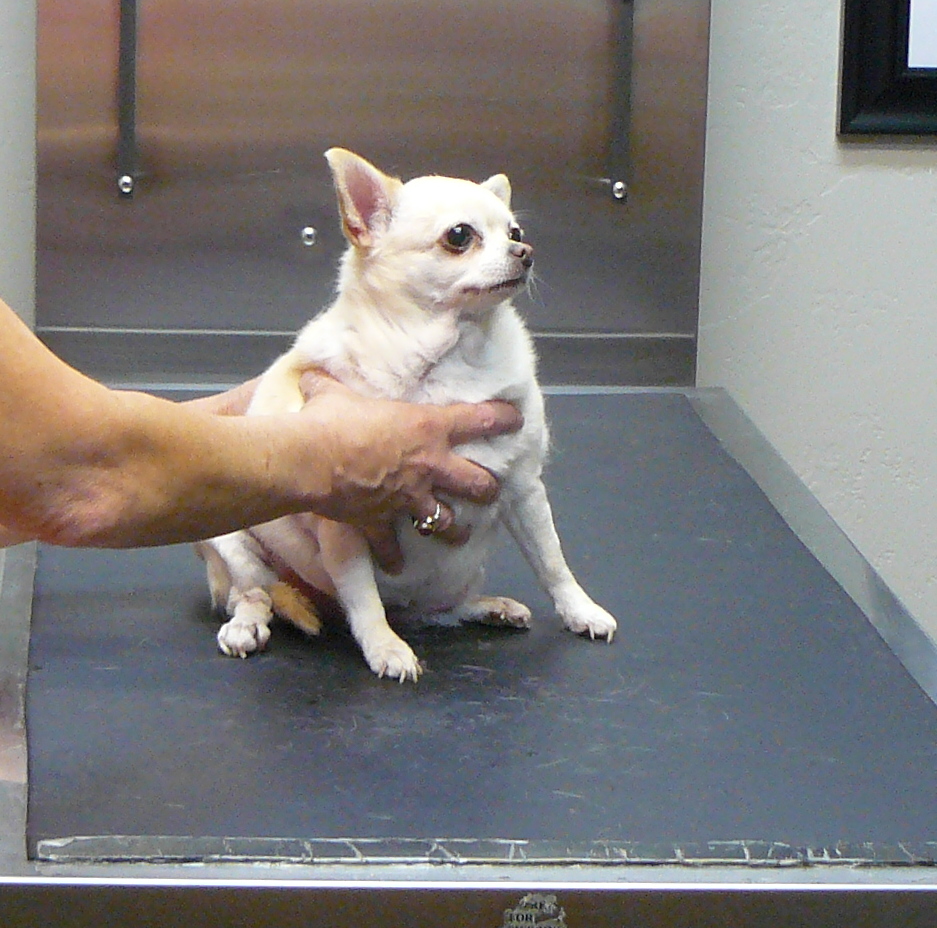
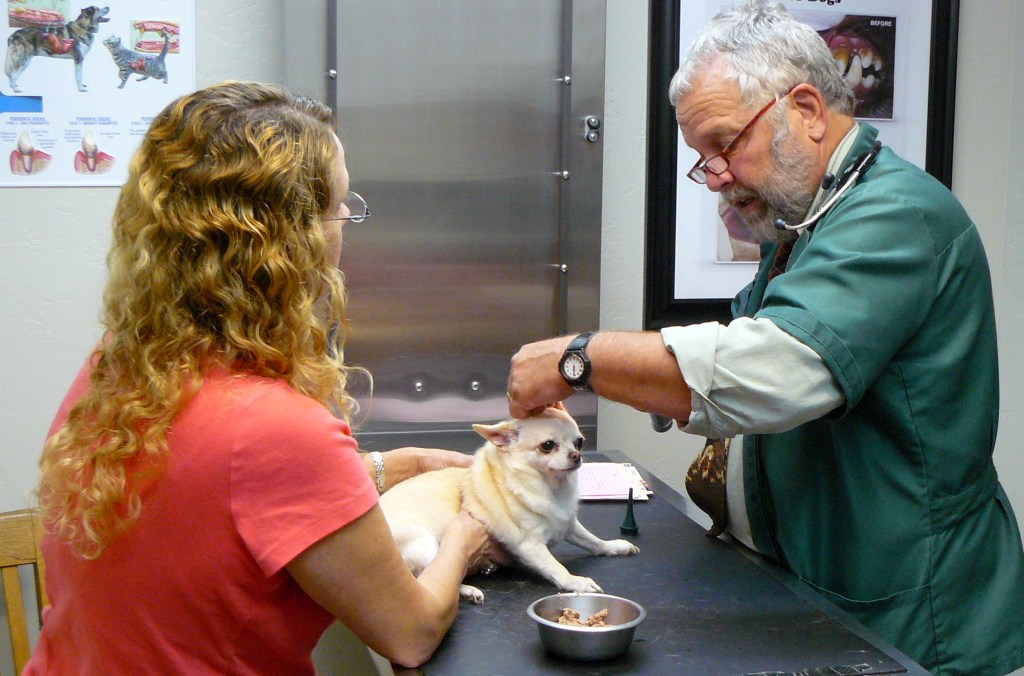
Chloe has been vomiting up her food and, consequently, has stopped eating. Jim is concerned that Chloe is overweight and that in the very hot weather of recent days (high 90s F./mid 30s C.) he has been seeing a number of dogs with excessive heat problems.
One thing that could be done to Chloe was to clip her excessively long toe nails.
Jim does that.
12:15 All done.
To be continued:
(Please note: These observations are mine alone and because of the busy environment it must be assumed that my interpretation of what was taking place might not be totally accurate. Nothing in this blog post should be used by a reader to make any medical judgment about an animal. If you have any concern about an animal do make an appointment to see a properly qualified veterinarian doctor.)
Please forgive the shortness of the introduction. It’s just that Jean and I were out all day and I didn’t sit down to present today’s post for all you good people until 4pm.
Frankly, this is such a wonderful account of caring for dogs that any intro from me would be superfluous!
ooOOoo
From Rags to Kisses: Abused Dogs Find Happy Homes in Colorado
In December 2014, Animal House Rescue and Grooming in Fort Collins, Colorado, found a very special delivery on its doorstep. Three dogs arrived from the Pine Ridge Reservation in South Dakota, an Oglala Lakota Native American reservation.
One of the poorest communities in the country, the reservation has an overabundance of unwanted pets facing the risk of disease, starvation, exposure to the elements and, unfortunately, violence.
After a five-hour drive, DeeDee, Prince and Maizy made the first step to finding new and happy lives.
DeeDee was originally discovered living in the trash dump on the Pine Ridge Reservation, where she made her home upon an old discarded sofa atop a pile of tires. A local rescuer, aware of her plight, spent a week slowly gaining DeeDee’s trust with food.
Once the understandably nervous dog allowed the rescuer to get close enough to her, she found herself on a leash and then in a car. Little did DeeDee know she was on her long way home.
DeeDee spent some time in foster care in South Dakota, recovering from mange and learning to trust again before she was transferred to Animal House to give her a better chance of finding her future family. It didn’t take long for them to find each other, with DeeDee’s charming and playful nature quickly winning over their hearts.
Prince, a 2-year-old shepherd mix, had been found covered in matted fur and burrs. He showed up at Animal House having been shaved, but full of affection.
When Prince arrived, they noticed that there was a problem with his back leg and quickly got him in for x-rays. The cause became quickly apparent, and horrible: Prince had been shot on the reservation. The bullet had travelled through his rear hip and shattered his femoral head.
Not knowing how long he had been suffering through the pain of his injury, the staff at Animal House was anxious for Prince to find relief as quickly as possible. He was sent to CSU Veterinary Teaching Hospital for a femoral head osteotomy, a surgery that alleviated his pain and allowed him to keep his rear leg.
Thankfully, his lovable nature showed through. Prince was able to recover in comfort and bask in newfound love, as he went to his new home shortly after surgery.
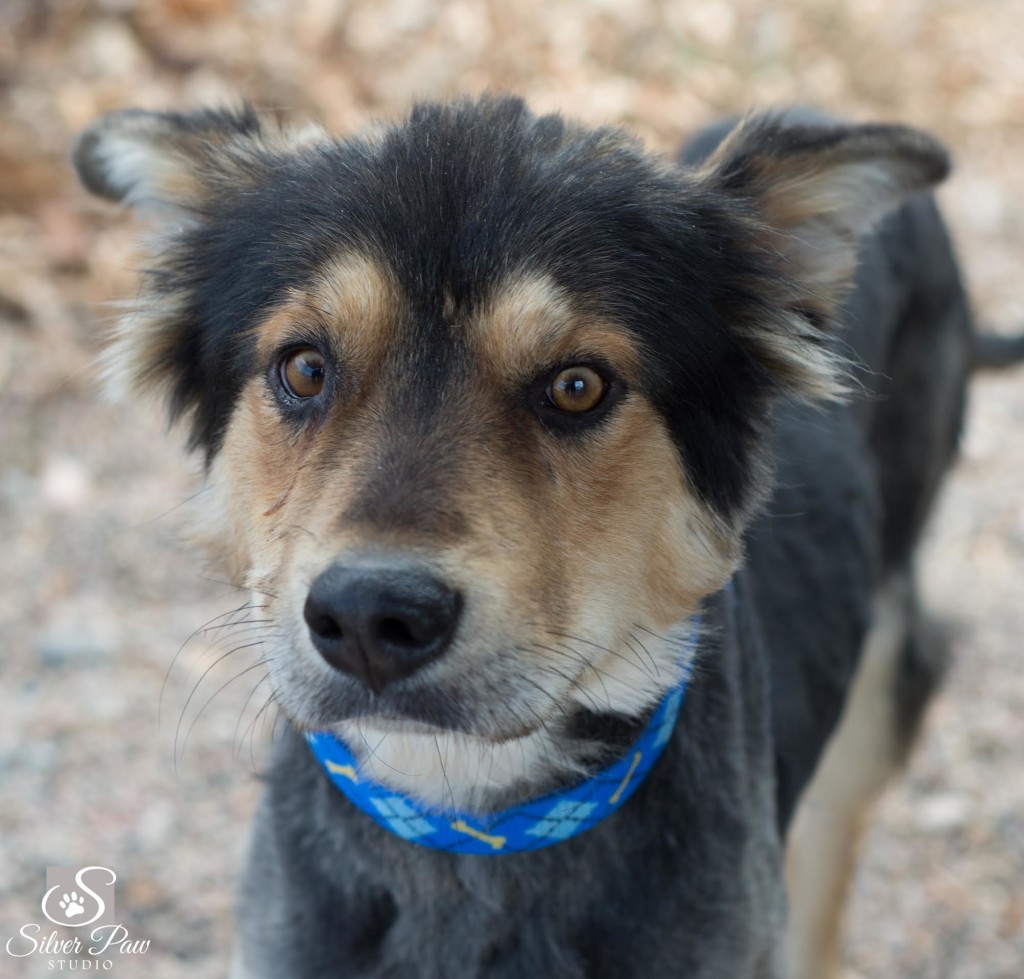
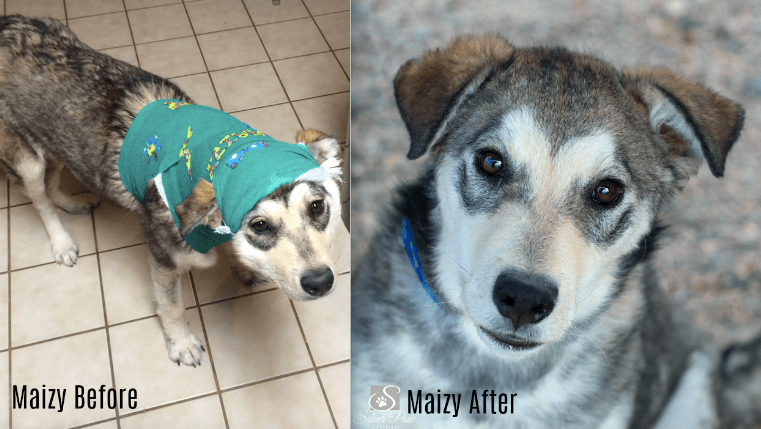
Maizy was a beautiful 8-month-old Husky mix puppy with eyes that melted hearts. Whatever happened to Maizy on the reservation, something that will remain a mystery, she came to Animal House in a lot of pain.
Maizy had several neurological symptoms and pain in her neck. After x-rays, the shelter soon found that the puppy had a fractured cervical vertebra, which was causing compression on her spinal cord. This could have been catastrophic for Maizy, but she’s a fighter.
Maizy’s foster family dedicated their time to bringing her to CSU Veterinary Teaching Hospital for regular bandaging and casting to keep her spine in place. Her beautiful face and wonderful personality through all of this ended up winning the heart of an Animal House volunteer. Having made a full recovery and a lifelong connection, Maizy now lives happily in her loving forever home.
Adoption Highlight: Special Needs Dogs
These adorable special needs dogs are still waiting to find their way to new homes.
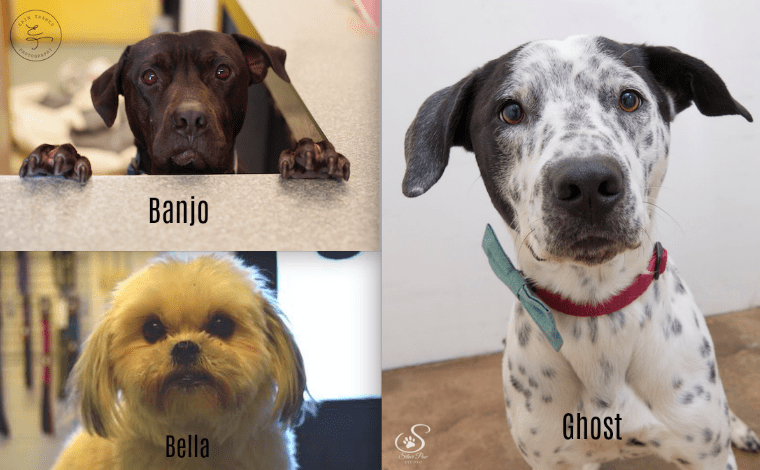
Banjo is a 6-year-old pit bull terrier mix who had a rough start to life, facing his many challenges with a great attitude. He arrived at Animal House with skin issues related to allergies, worn down teeth and scarring on his body, as well as kidney disease. Banjo gives the best hugs and thinks he is a lap dog, so he would make an excellent snuggle buddy.
Bella is a 2-year-old shih tzu mix who arrived at Animal House after her former sanctuary had to close its doors. Bella has a love for life and gets along well with other dogs and cats. She does struggle in some areas, though, specifically with constipation and some house-training. Bella is looking for a patient and kind forever home willing to help her live comfortably with her condition.
Ghost is a 2-year-old Australian Cattle Dog mix who is sensitive, intelligent, and inquisitive. He is nervous about new people and environments and needs a home that can build his confidence so that he can be happy and comfortable in a variety of situations. Ghost just wants some good old-fashioned love and patience!
You can find out more about these adoptable dogs here.
Photo credits: Animal House Rescue and Grooming, Colorado
ooOOoo
Whatever the state of the world, as long as there are organisations and people who will love and care for animals in need then I will be at peace.
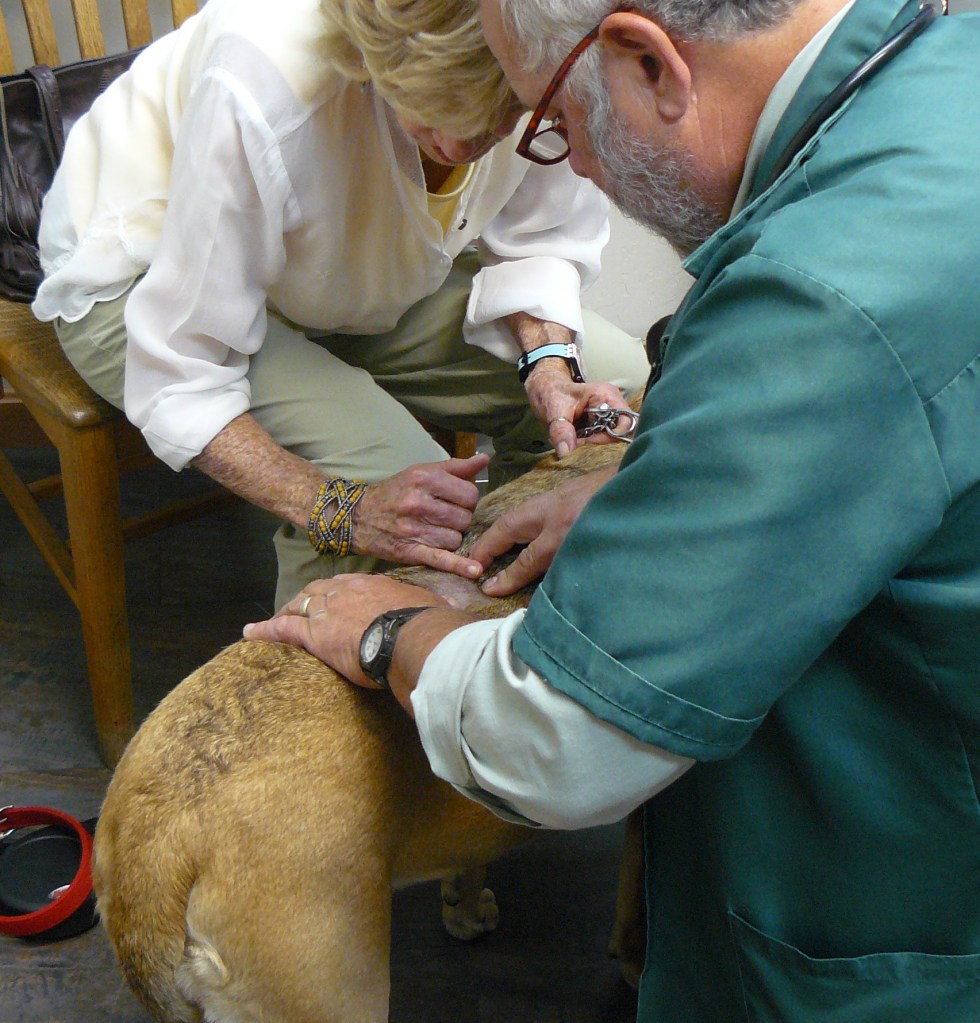
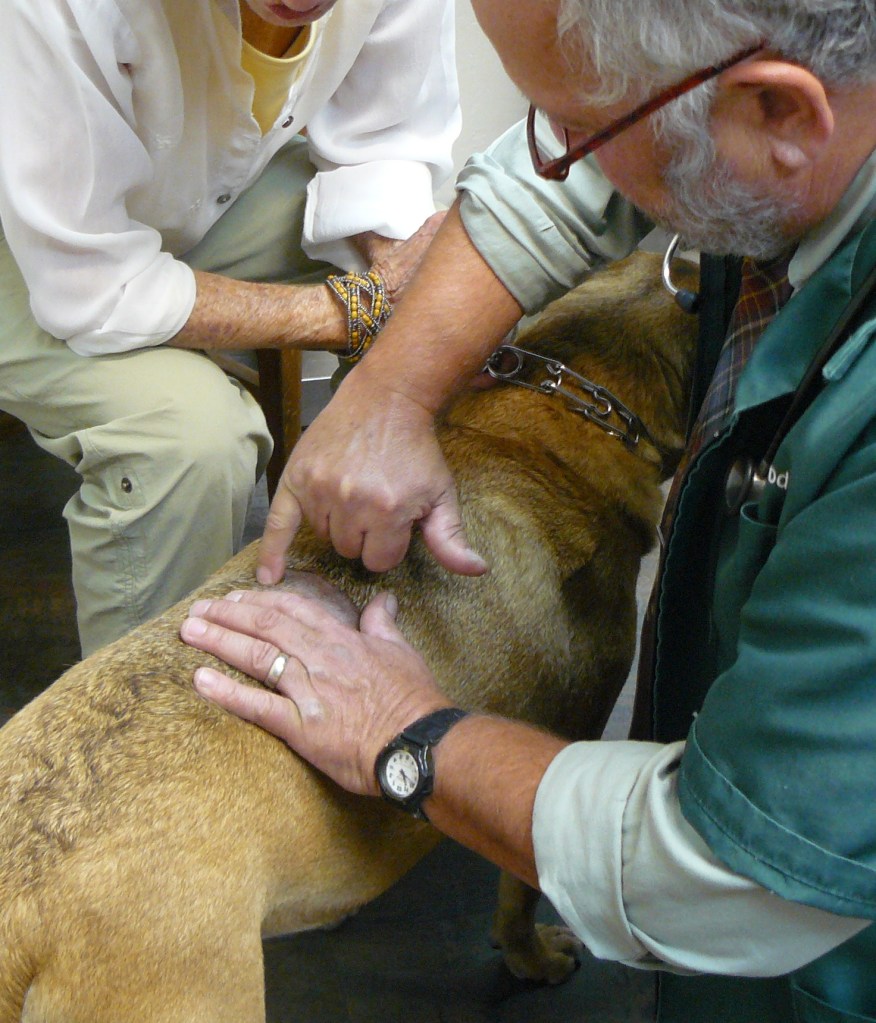
The story was that after a raw patch had appeared on Kenya’s back it had then become very itchy for the brave dog.
Jim shaved the area clear of fur and cleaned the skin to aid a closer examination.
Jim then explained that the challenge in these sorts of cases is that it is very easy to throw a lot of money at the problem without any guarantee of success. Not only were there cost considerations but also the question of whether to go down the route of injections or administer pills.
As an observer I was struck, but not surprised knowing Jim as a friend, to see how an open and honest assessment of the problem came way before any commercial implications.
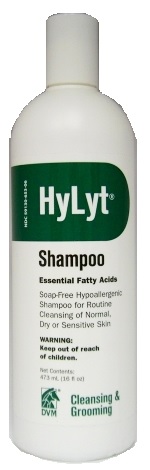
Jim’s view was to leave it for the time being but he did recommend using a hypoallergenic shampoo. There were a number to choose from but Jim supported the shampoo manufactured by Bayer and sold under the brand name of Hylyt Shampoo.
There are a number of online sources for this shampoo. I chose, more or less at random, the one at Allvet Supply.
That website describes the shampoo, thus:
HyLyt Shampoo is a hypoallergenic dog shampoo and is perfect for routine use in bathing dogs and cats. The shampoo is safe for normal, dry or sensitive skin types and may be used in conjunction with topical therapeutics.
HyLyt shampoo contains a light fragrance that will leave your pets smelling clean and fresh. The gentle shampoo formula is ideal for bathing both dogs and cats. The soap-free formula is pH balanced and will not dry out delicate skin or fur.
In addition to the gentle formula, HyLyt shampoo also contains special emollients for moisturizing and proteins for conditioning. The hypoallergenic dog shampoo also contains fatty acids to reduce scaling and flaking of the skin. If your pet suffers from seasonal or acute dryness, HyLyt shampoo will help restore their skin and coat to optimal health and beauty.
Then it was time for a quick checkup underneath Kenya, so to speak, and that was it!
11:00 All done!
I am having trouble getting my head around the fact that I have only been watching proceedings for two-and-a-half hours! So much knowledge on show. So much experience. So much compassion for our beloved pets!
To be continued:
(Please note: These observations are mine alone and because of the busy environment it must be assumed that my interpretation of what was taking place might not be totally accurate. Nothing in this blog post should be used by a reader to make any medical judgment about an animal. If you have any concern about an animal do make an appointment to see a properly qualified veterinarian doctor.)
As soon as it was time to say ‘goodbye’ to Ace the cat then in came an entirely different case.
1020 – Back to dogs!
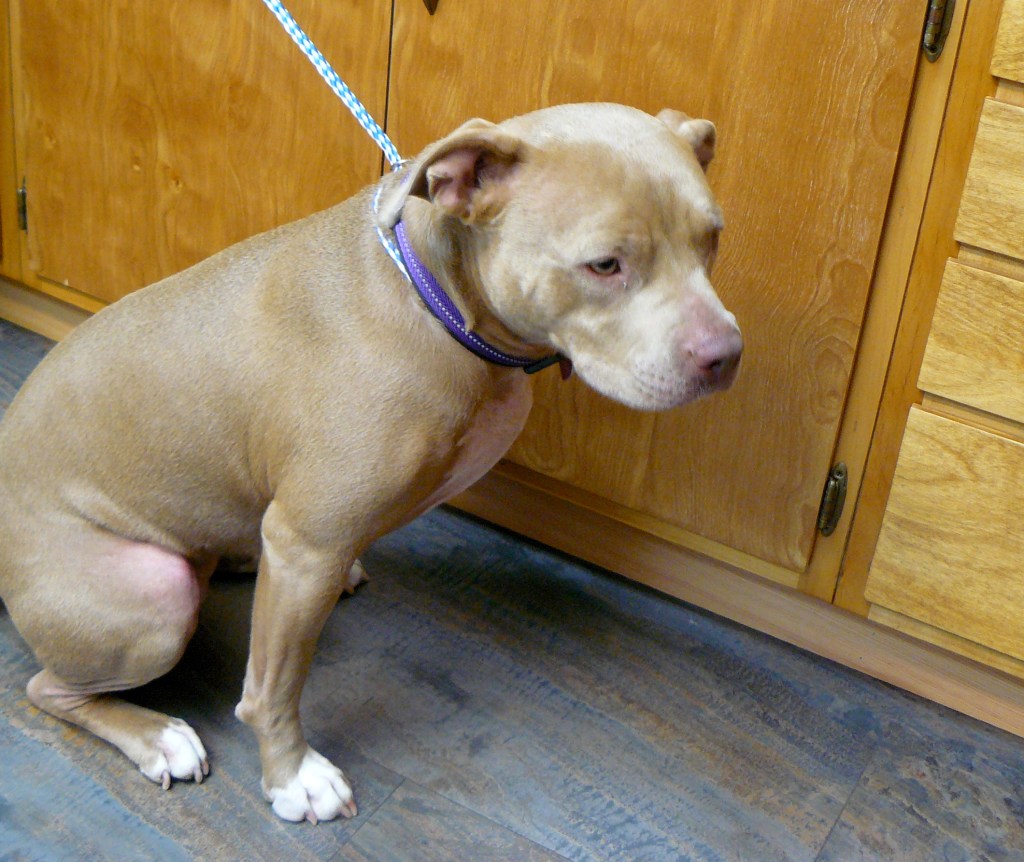
This was Millie, a pit mix, who had been dropped off at the Clinic earlier on. Millie’s owner said that there appeared to be something troubling Millie’s ears. Millie was, indeed, shaking her head a great deal.
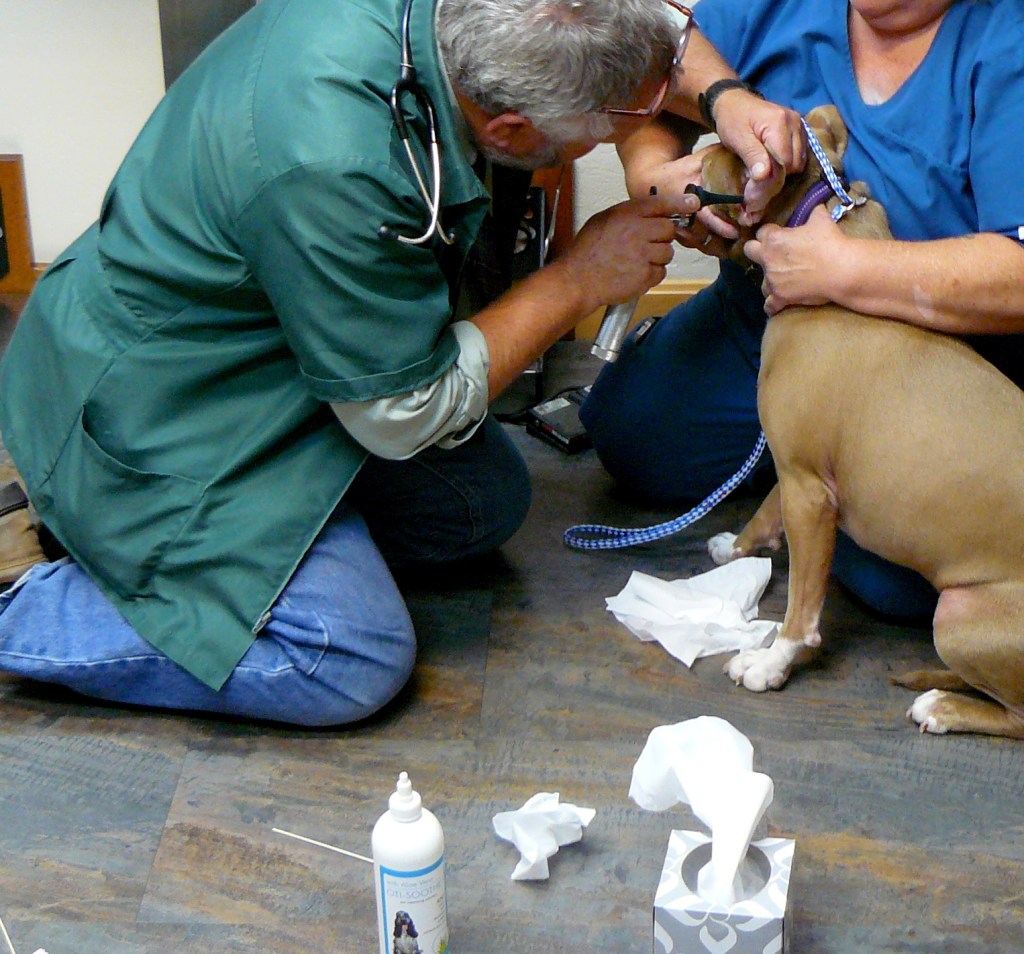
Jim established that it was Millie’s left ear that was the source of the irritation. This was immediately obvious since Millie cried as soon as Jim touched that left ear.
The first examination didn’t identify anything that might be the cause. But apparently the endoscope had such a narrow field of view that it was easy to miss an irritant. Time for another, more extensive examination using that same endoscope.
This time the problem was identified. A foxtail that had penetrated Millie’s ear so deeply that the seed-head had pierced Millie’s eardrum.
Carefully, oh so carefully, Jim pulled the foxtail out from Millie’s ear. I couldn’t believe just how large it was.
About an inch (2.5 cm) long.
I was unable to grab a photograph of Millie’s face once the foxtail had been removed. Trust me it was a face full of doggie smiles.
But I can’t move on to the next patient without remarking how Millie was so beautifully behaved. How maligned the Pitbull and Pitbull Mixes are!
10:45 All done with Millie!
To be continued:
(Please note: These observations are mine alone and because of the busy environment it must be assumed that my interpretation of what was taking place might not be totally accurate. Nothing in this blog post should be used by a reader to make any medical judgment about an animal. If you have any concern about an animal do make an appointment to see a properly qualified veterinarian doctor.)
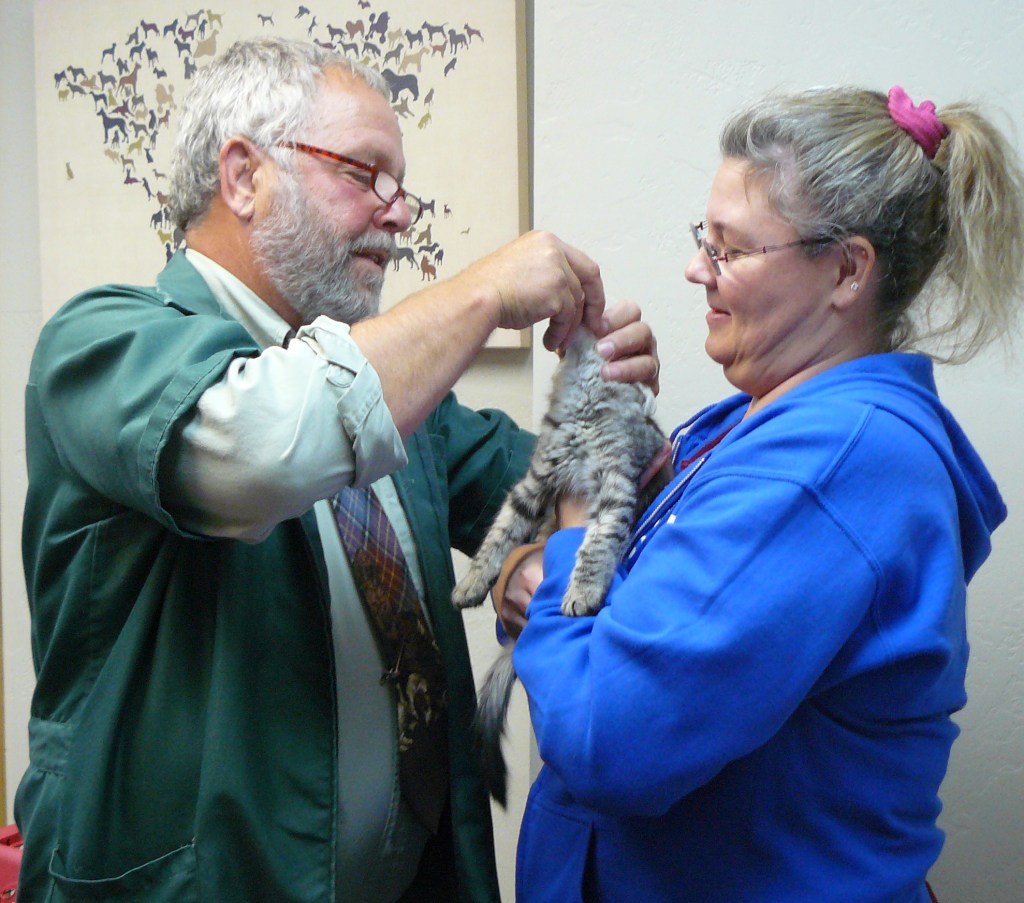
It’s 09:00 and the next animals to be brought in to see Dr. Jim are a couple of cats requiring vaccination.
The kittens are named Grace and Frankie and both were adopted from the Nevada Humane Society although I wasn’t familiar with the circumstances surrounding that adoption.
But great to see them being cared for by the two women and the degree of professional service that I saw in Jim’s briefing of these new cat owners.
That care included giving one of the kittens the necessary pills by mouth.
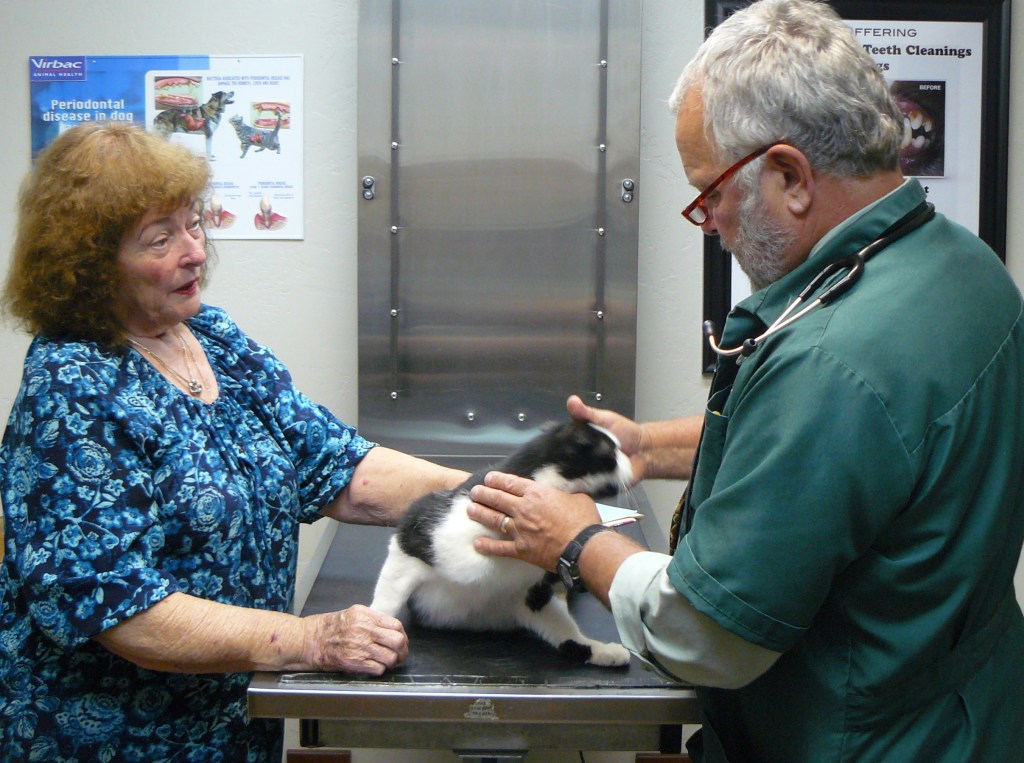
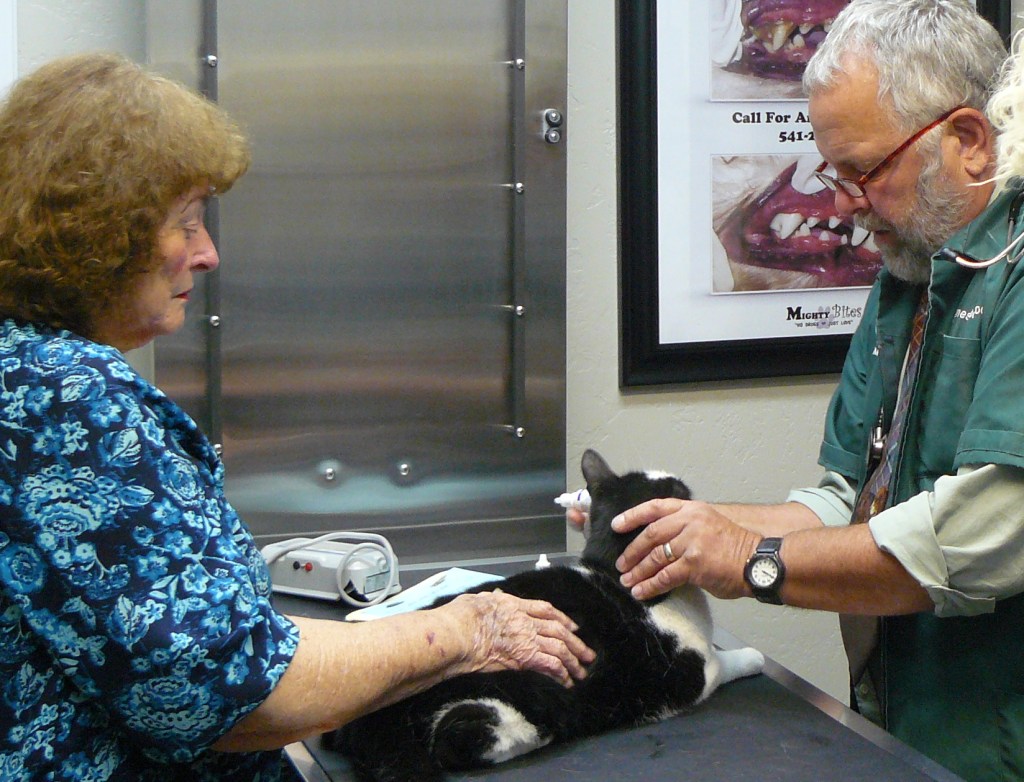
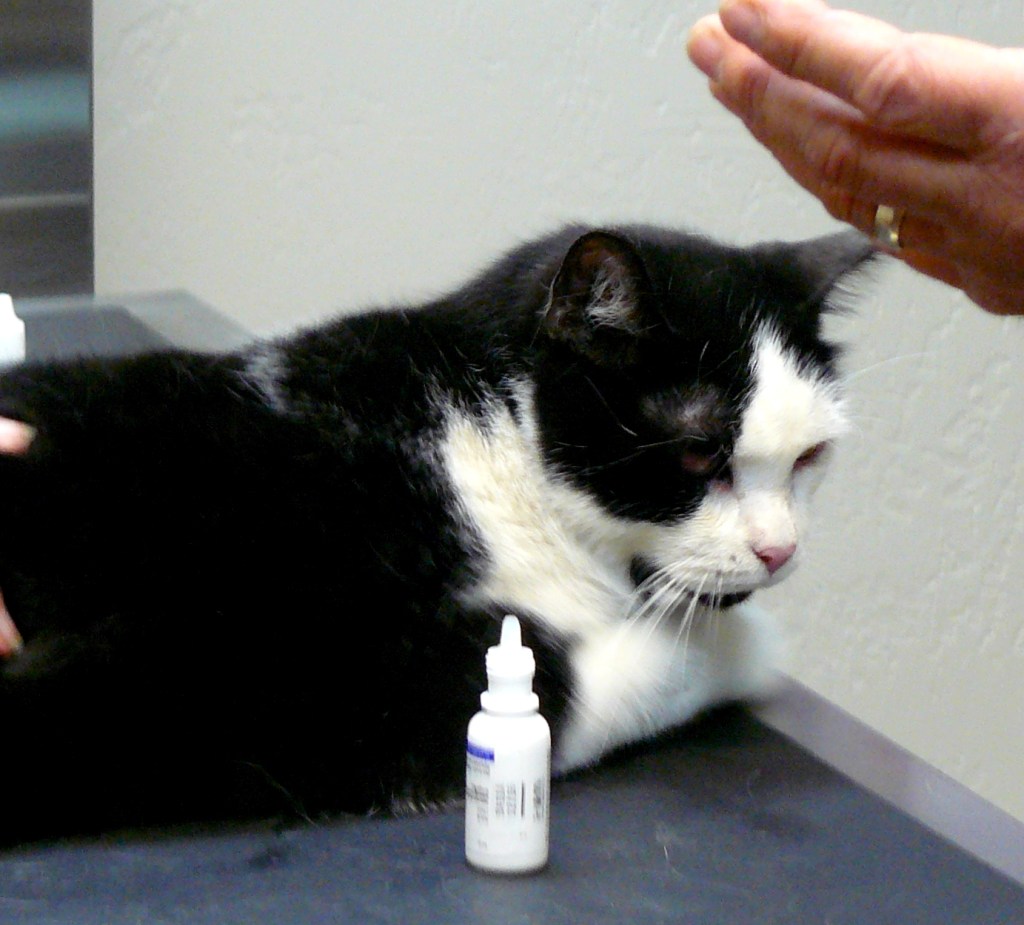
It is now 09:25 and the next case for Jim is another cat. In this case a cat, named Ace, that the owner thinks is having trouble seeing out of it’s right eye.
Jim applies a fluorescent stain to the Ace’s eye that then enables Jim to use a special UV lamp to determine the degree of damage to the eye.
It is determined that the pressure in Ace’s eyeball is normal and Jim is pretty certain that Ace has no sight at all in that right eye. He recommends giving the cat some antibiotics and explains to the owner that cat’s can function perfectly adequately with just one eye. Indeed, if necessary the eyeball could be removed, something that would not be a disadvantage for Ace.
The lady owner of Ace takes note of Jim’s advice and is clearly grateful for what has been explained to her.
It is 10:10.
To be continued:
(Please note: These observations are mine alone and because of the busy environment it must be assumed that my interpretation of what was taking place might not be totally accurate. Nothing in this blog post should be used by a reader to make any medical judgment about an animal. If you have any concern about an animal do make an appointment to see a properly qualified veterinarian doctor.)
I was left behind, abandoned by my owner who has had me for 14 years. He left me tied up on a 3-foot leash in a trailer for about two weeks (maybe longer) with little or no care by my owner’s parents who were unable to care for me daily. Luckily, a kind and lovely lady named Chrissy, found me after she heard my desperate cries. Chrissy spoke to my owner’s parents and was able to get me out of my filthy living condition and to my foster home, where I’m getting endless love and doggy playmates. Please help me find a forever, loving home!
Roman is old, but he’s still strong and playful. He hops, runs, and bounces around as if he were still a pup. If you’re interested, please contact me!
ooOOoo
Roman’s present home is in Seattle, Washington and if you know of anyone who might be interested then the contact details are here.
Plus, please share this as far and wide as possible.
Thank you!
UPDATE
In response to me querying what Roman was like with other dogs and how far he could be taken in terms of meeting up with a new owner:
He is great with other dogs 🙂 I have two other big pups and they all get along just fine.
It depends on the location. Within a 5hr drive is fair.
oooooooooo
On Monday, the following was left as a comment to that post” (my emboldening!)
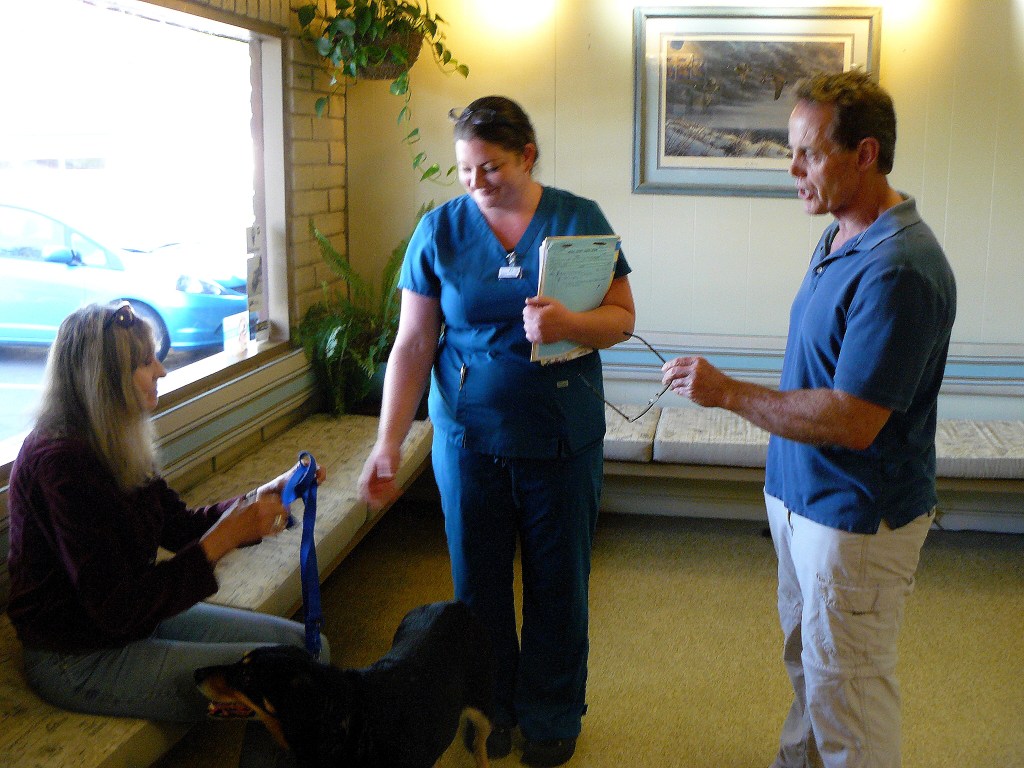
I arrived a little before 8:30 to find both receptionists busy on the telephone. They signaled for me to wait in the reception area until Dr. Jim came out to meet me.
As I waited it quickly became clear that Janice, one of persons behind the front desk, was speaking to someone who was having to make the decision to euthanize their dog. I hadn’t bargained for how that made me feel since it was so recently that Jean and I had trodden the same path. I had to give myself a stern reminder that I was here as the quiet, unobtrusive observer and that my own feelings had to be tucked out of sight.
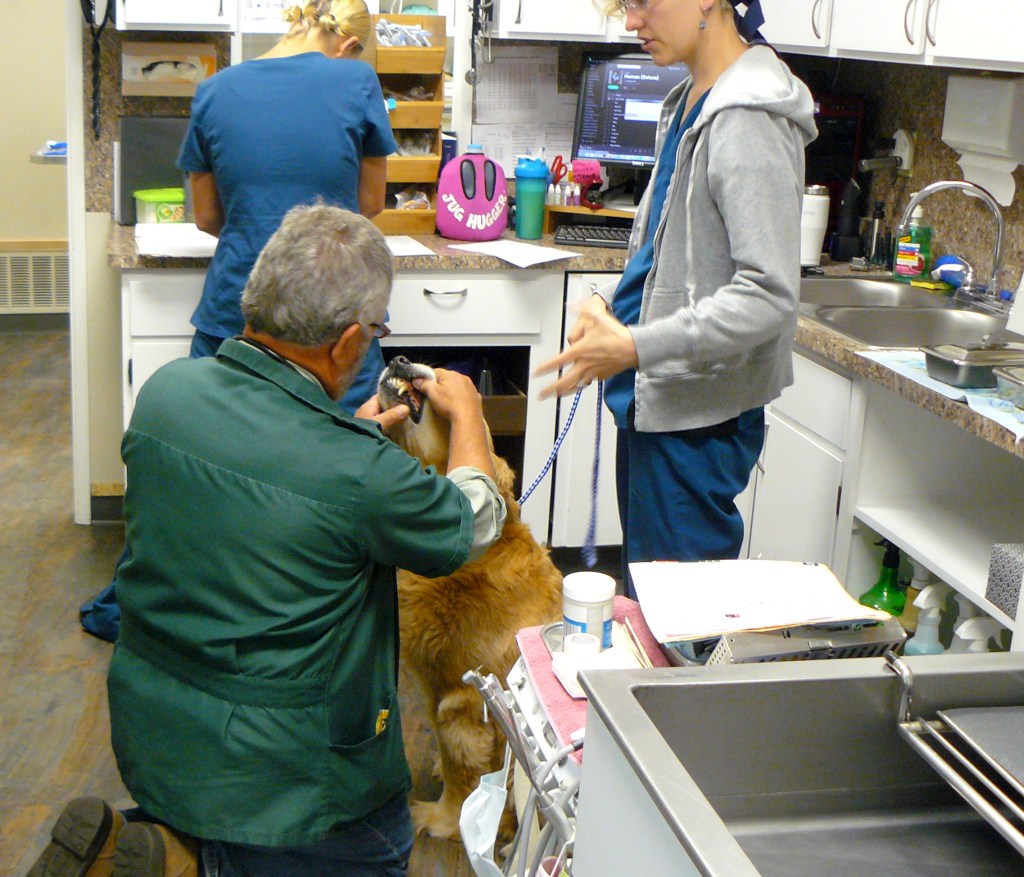
Shortly thereafter, with Janice still on the telephone patiently and compassionately speaking with that dog’s owner, someone came in with Daisy who was here for teeth cleaning. Jim came out to meet her and advise the owner that one of the team would be doing Daisy’s teeth not himself.
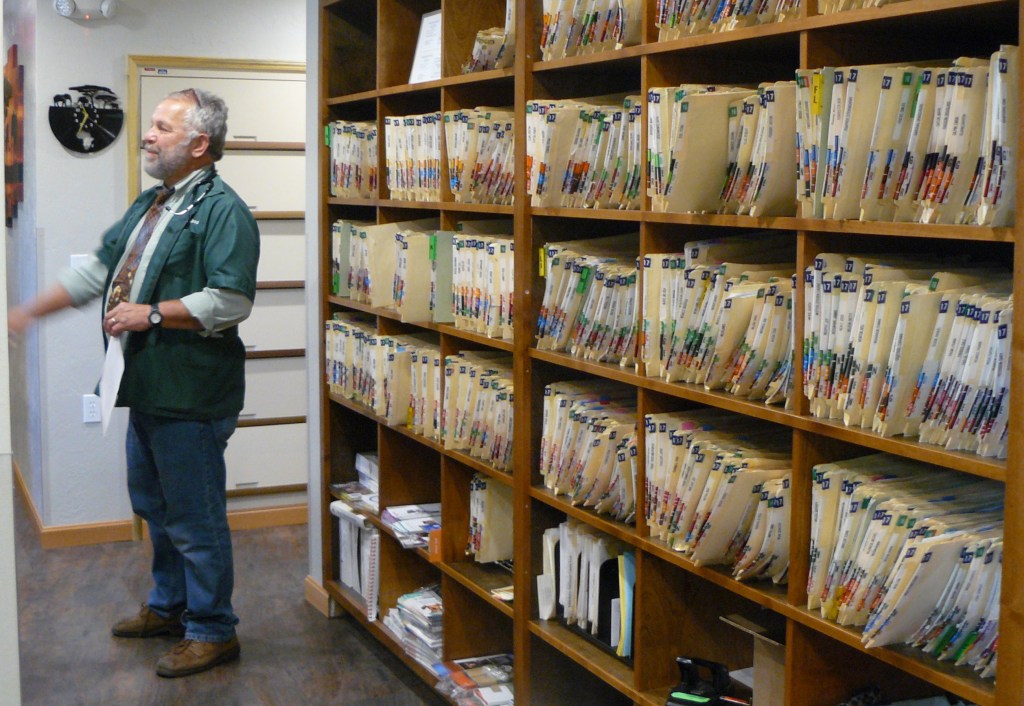
Then it was time for me to go back with Jim and start the day with him. (Jim had arrived at 8:20am.)
Jim’s first case was Ginger. Ginger, a female Golden Retriever, had been brought in earlier on because she had lost weight, was lethargic and was generally off-color.
Jim started to examine Ginger assisted by Cianna, a veterinary technician at the clinic.
It was immediately clear to Jim when he listened to Ginger’s heart that it was racing; Jim thought at something like 200 beats per minute. Jim continued to check Ginger over although, as he told me later, he had an idea that Ginger’s medical problem was a cardiac issue. Jim arranged for Ginger to be given an X-ray as well as blood work.
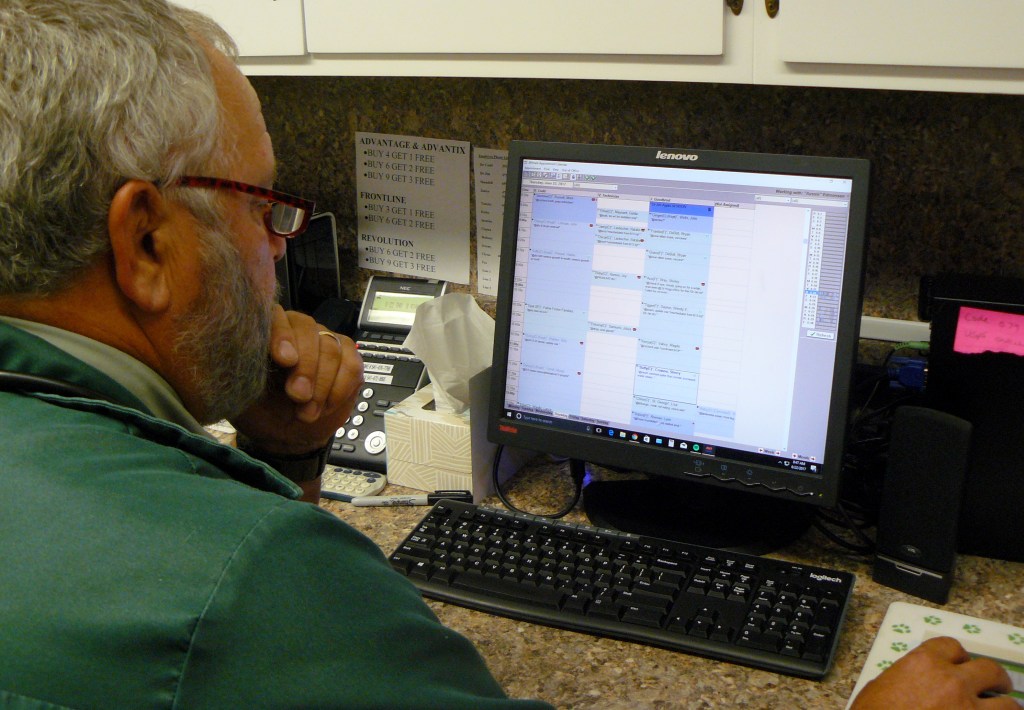
It would take a few minutes for the results of Ginger’s X-ray to come through so Jim showed me the primary software program used in the clinic to record all the details of each patient and all the individual medical details. The software was called AVImark.
I was impressed, very much so, but then again not surprised. For the veterinary business is big business in many countries. For instance, the American Veterinary Medical Association (AVMA) reports that in 2016 there were 107,995 veterinarians in the USA. Of course, there would be a wide range of software tools for the industry.
Back to Ginger’s status.
Her X-ray having been taken, the digital image of her heart was transferred electronically to Dr. Jim’s computer. It showed an extremely enlarged heart. Jim said that the owners of Ginger would be facing a potentially complex analysis but in the interim Ginger should be put on one of the ‘pril’ drugs to reduce the very high stress on Ginger’s heart: Lisinopril; Enalapril; Benazepril. That was arranged then and there. (I didn’t make a note of which drug was given to Ginger.)
Time to call Ginger’s owners and report the findings.
The owners said that they would be in to collect Ginger at 12:30.
I looked at my watch. It was 8:58!
Already the next patient is ready to be seen by the good Doctor.
To be continued:
(Please note: These observations are mine alone and because of the busy environment it must be assumed that my interpretation of what was taking place might not be totally accurate. Nothing in this blog post should be used by a reader to make any medical judgment about an animal. If you have any concern about an animal do make an appointment to see a properly qualified veterinarian doctor.)
Opening up the world of a busy veterinary practice.
Like the majority of pet owners, our experiences of taking a cat or a dog to the local vet clinic are gained entirely in regard to those particular animals. The only small difference between this household and most others is that we have the distinct privilege of having Jim and Janet Goodbrod as close friends just a short distance away. Jim is a Doctor of Veterinary Medicine (DVM) and thank goodness for that as it was more than wonderful that Jim was able to be on hand a week ago when it came to Pharaoh’s last few moments.
Jim is a regular DVM working at Lincoln Road Veterinary Practice in nearby Grants Pass. That practice is run by Dr. Russel Codd.
Dr. Russel Codd (RHS) speaking with Jean at the Clinic back in the days of our dear Hazel.
Some time ago, when we were visiting Lincoln Road, it struck me that the detail of what takes place ‘behind the counter’ of a busy vet clinic is most likely not commonly appreciated by those that visit said clinic.
I asked Russel one day if I might be allowed to spend time watching and listening to what goes on behind the scenes; so to speak. Russel said that he would be delighted for me to do that.
So it came to pass that last Thursday, June 22nd, I did just that.
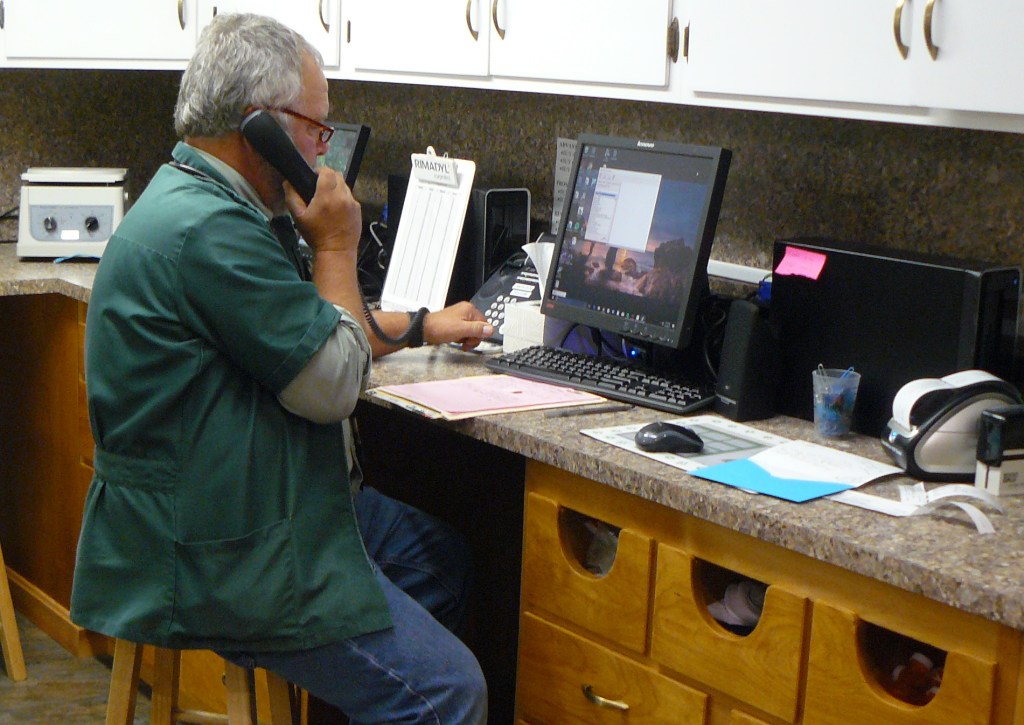
It was a day when Dr. Jim worked a half-day at the clinic and I spent the thick end of six hours listening and observing what took place. I had a camera with me but as was only fit and proper was very sensitive to what photographs were taken. Likewise, I didn’t interrupt the proceedings with my questions although each pet owner had specifically said it was alright for me to be in the same room. In other words, what I will be writing in each post is much more my impressions of the workings of a day in the life of a veterinary clinic.
So tomorrow I will publish the first of my articles and at regular intervals report more from my day at Lincoln Road.
They will be published under the overall heading of Visiting The Vet.
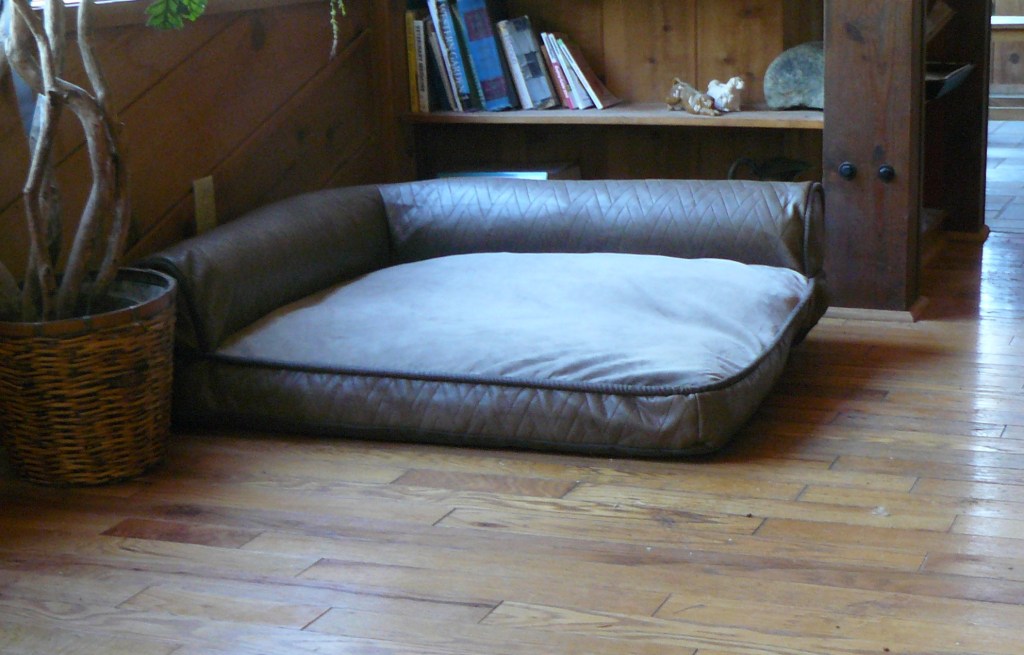
You will all recall the shock of me seeing Pharaoh’s empty bed that first morning after he had died. This picture:
Not only was it difficult to look at but not one of our other dogs went near it. This was despite the fact that Jean had washed and cleaned the whole bed.
One could almost imagine the dogs understanding that it would not have respected their memory of Pharaoh to immediately takeover his rather nice bed.
But life has to move on!
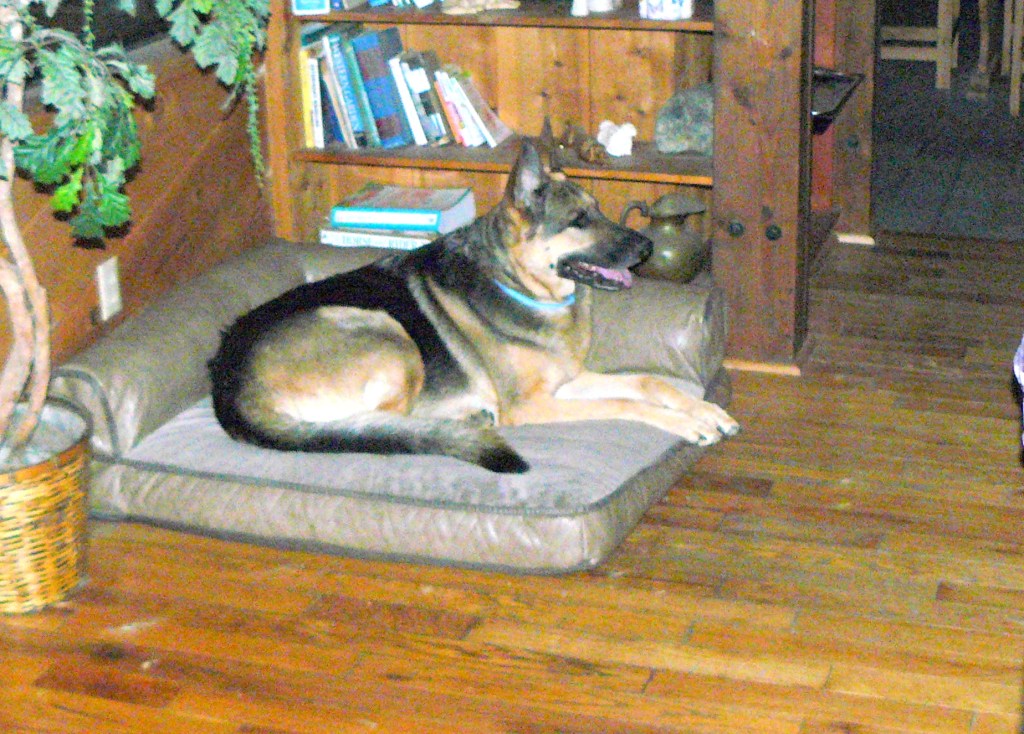
Yesterday evening, just as Jean and I were getting everyone ready for bedtime, Cleo signaled that she was moving on.
She had settled herself down on the bed.
That was so good to see and was another step in the right direction in settling me down as well!
So on the theme of being calm, especially in these hot summer months, do read this recent article that was published on the Care2 site.
My dogs are both terrified of thunderstorms. These are some of the tricks that vets and trainers have recommended to help our poor babes when stormy weather rolls in.
Our lab mix, Jenna, trembles in the corner when it thunders, while our 60-pound dog, Bandit, tries to leap into my lap. These are some of the ways to calm a dog during thunderstorms that we’ve tried.
Every dog is different, so what works for one may not work for another. Jenna is terrified of the Thundershirt, for example, but many people I know swear by it. Chances are, not all of these calming techniques will help your dog during a thunderstorm. You’re basically throwing spaghetti at the wall to see what sticks.
Ways to Calm a Dog During Thunderstorms
Lavender and massage oil on a old wooden background
1. Lavender Oil
You don’t want your dog to ingest lavender oil, so put a few drops on her collar when a storm is freaking her out. The soothing scent can help calm some dogs’ nerves, and the smell is a distraction from what’s going on in the sky.
2. Massage
Just like humans, dogs find massage soothing. The video above shows a calming massage that you can use on your dog during a thunderstorm. You can also try an ear massage, which Jenna responds to really well. Basically, you gently run your hand up the dog’s ear, from where the ear meets the head to the tip of the ear. When you reach the tip, gently massage for a second, then repeat. Like in the video, it seems to work best if I also talk to her in a soothing voice while massaging.
3. A Hand on the Back
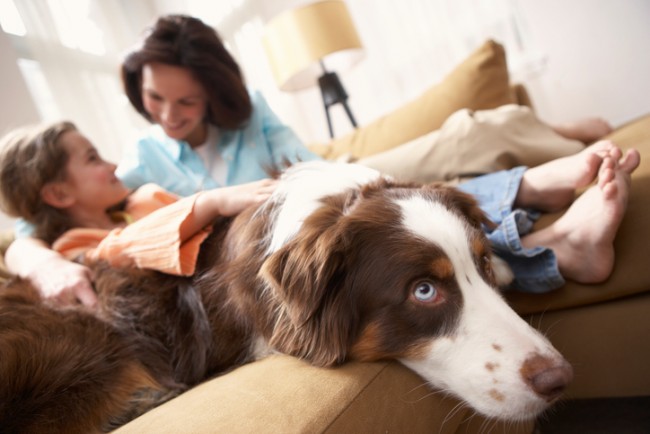
Sometimes, your dog just needs to know that you are there and in control of the situation. This trick works well on our dog, Bandit, who is definitely boss dog in our house. During a storm, a hand on his back helps him feel like he can step back from being the pack leader, which helps him feel secure and safe. Talking in a soothing voice helps here, too.
4. Training Exercises
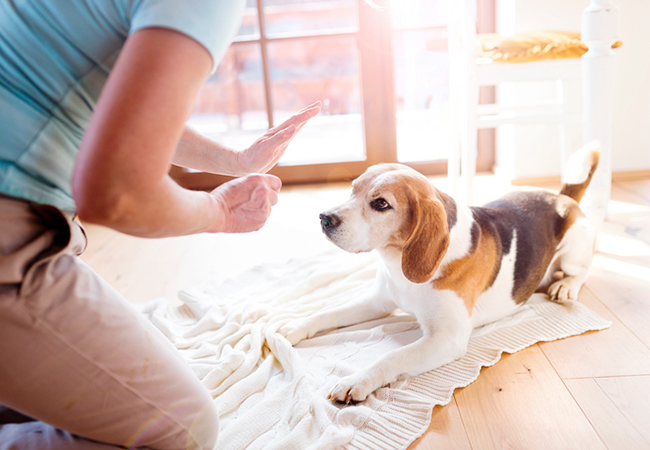
You may feel like it’s mean to start bossing your scared dog around, but practicing her sit/stay/shake is a great way to distract your dog from the storm and remind her that you’ve got this under control. This one works well on both of my dogs.
5. Thundershirt
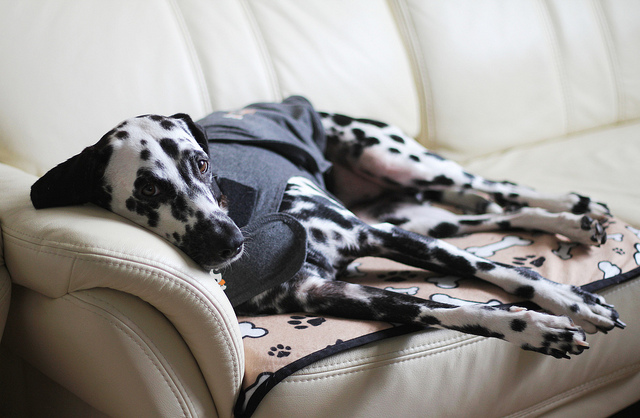
These wrap shirts help soothe a lot of dogs during thunderstorms, and they’re available at any pet store. Many friends with dogs have recommended the Thundershirt to me. It made Jenna more anxious, but she is clearly in the minority in this situation.
6. White Noise
If your dog can’t hear the storm, your dog won’t be so scared. Dogs can feel the shift in pressure from a storm, even when they can’t hear it, so this technique seems to work best in conjunction with other calming techniques, like massage or lavender oil. Bring your dog to her favorite room, turn down the lights, and turn up the white noise. If you don’t have a white noise machine, you can find free white noise tracks on YouTube, like the one above.
7. Rescue Remedy for Pets
Rescue Remedy is a blend of plant extracts. They make homeopathic drops and gummies for humans, and they have drops for pets, as well. The site recommends putting the drops into water, but I’ve also had good luck putting them onto a treat or into a glob of peanut butter, if my dogs aren’t too scared from the storm to take a treat.
As I mentioned above, different natural remedies will work for different dogs, so don’t be discouraged if the first thing you try doesn’t work out. Sometimes, especially for high anxiety dogs, you’ll have the best results combining a few of these ways to calm a dog during a thunderstorm.
ooOOoo
I don’t know about tips for calming dogs, some of these sound great for yours truly!


 Jim’s view was to leave it for the time being but he did recommend using a hypoallergenic shampoo. There were a number to choose from but Jim supported the shampoo manufactured by Bayer and sold under the brand name of Hylyt Shampoo.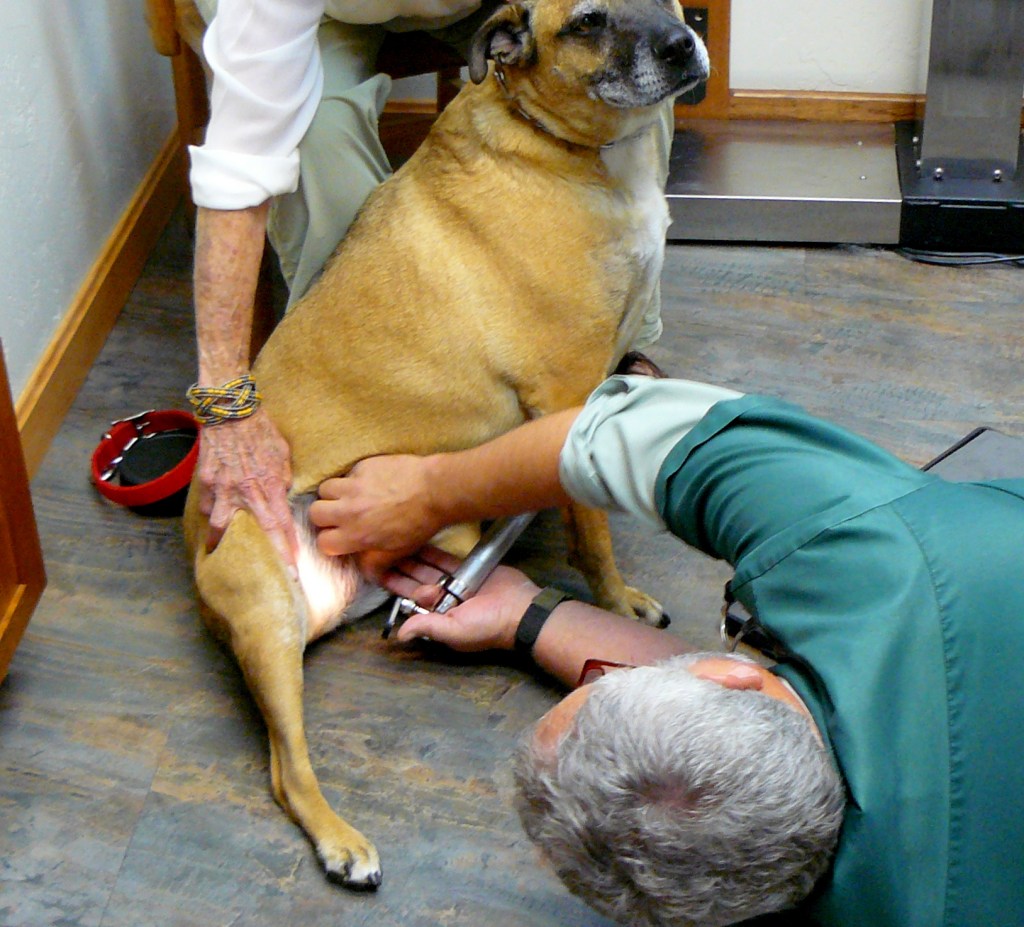






 Learning from Dogs