Category: Health

“Don’t worry, it’s only an old man!”

A passer by invokes a lesson for us all.
.

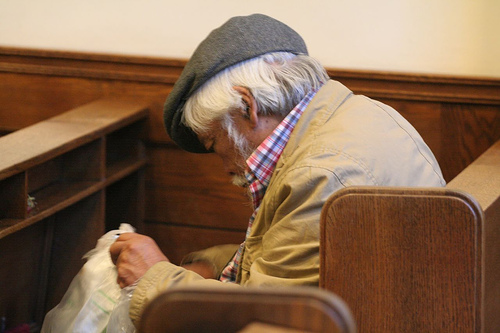
Recently while busy in the garden our two dogs started barking. This in itself is not unusual because they sit at the front gate waiting for passers by to stop and talk to them. It can be a horse, or cyclist that sometimes causes them to bark, and our children have grown to show the same awareness as the dogs in who is passing.  I didn’t see the cause this time but our young daughter did.

Don’t worry, Daddy, it’s only an old man!

Stephanie is only 8 years old, but without meaning any harm had given sufficient information to explain the risk to us and paint a quick picture in a few words as to why the dogs were barking.

Of late for some reason I have been more aware of people who are ageing. This generation do not normally stand around telling stories, this is left to the young who always seem to have something to shout about.

However all older people will have many interesting tales, often almost unbelievable, yet true. They have lived through war, happy, sad, interesting, and hard times. Each has learnt about life through experience that we can not buy.

Recently my ex Mother-in-law passed away. I thought I knew her very well, but it wasn’t until family stories started coming out that we all found out there had been much more in the life of this modest lady.
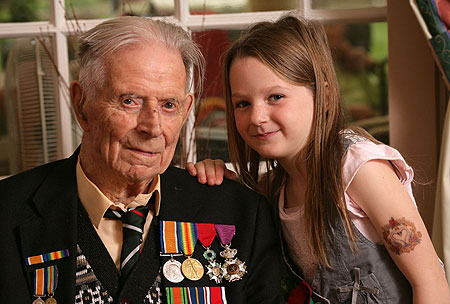
How it should be.

Christmas is coming and probably there will be family gatherings. This year I am going to try and turn the attention to the older generation, and see if they will open up and give us an insight into their childhood days and memories so that we can give them the respect they deserve, ask them to read stories to the children, ask them to tell their own tales.

Oh and the old man? Yes I did see him again, in church at a Remembrance service, and he had some medals under his coat, so did have a story to tell!

By Bob Derham
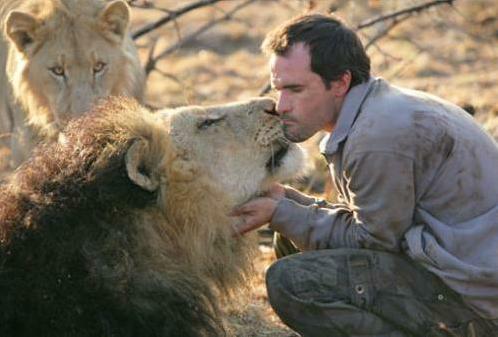
A hero

Another example of the power of social media.

I subscribe to Naked Capitalism, as much for the Antidote du Jour, as for the fine economic commentaries.  In my inbox of the 16th December was this wonderful antidote.  A quick Google search shows that these pictures are spreading like wildfire around the world’s email servers.  Not without reason.

Maybe these pictures resonate in all of us when we long for some simpler way of life …..

This Ranger is assigned to prevent poaching around the wildlife refuge area of Lanseria, South Africa. The way these animals interact with him is absolutely stunning! The lions seem to know he’s there to protect them. His charm works with hyenas and cougars too. Hyenas are usually vicious. Check out the pictures taken in the river – amazing because lions hate water.

As they say, don’t try this at home!

View the rest of these stunning photos

The Insanity of Medicare 2.0

US still struggling to find a proper health care solution

We’ve all heard this definition of insanity: doing the same thing over and over again but expecting a different result.

Here, in a nutshell, is the insanity of the current U.S. health care debate:

  1. Medicare, the government’s single-payer wealth redistribution health care program, is quickly going bankrupt.  No one disputes this fact.
  2. When President Obama refers to “cutting costs of healthcare,” he is referring to cutting the Medicare budget. Period.  No increased efficiencies, no improved services, no reduced market-clearing prices. No, cutting costs refers to reducing the fraction of the U.S. government’s tax collections devoted to Medicare.
  3. The new Health Care Plan is fundamentally a new Medicare program. Let’s call is Medicare 2.0.
  4. Medicare 2.0 is being funded in large part by cutting the current Medicare budget item. We are supposed to ignore the fact that the funds cut from the current Medicare program will be spent on Medicare 2.0.
  5. The Medicare 2.0 plan shifts as much as 25% of its (under)estimated costs (e.g. payments to physicians) to other accounts.  The costs are still there; these obligations would still need to be paid by the government under the proposed legislation, but Congress is hoping the public won’t “count” the shifted costs if they slap another name on them, further fostering the illusion of “lowering costs of health care.”
  6. Medicare 2.0 will also go bankrupt but, as a larger, more far-reaching entitlement program, the impact on the U.S. budget will be larger and more far-reaching.

By Sherry Jarrell

Greg Craven and his message

How to approach the global warming dilemma.

Yesterday, a Post was published a Post about Greg Craven.  It made the point that social media was becoming a very real force in influencing opinions and how that threatened traditional politics.  Here’s an extract:

I was doing some research for an earlier Post about Copenhagen and came across a YouTube video created by Greg.  More details and links later after making a more fundamental point.

This video of Greg’s has had 2,704,000 viewings! The information on that YouTube ‘page’ has had over 7,500,000 viewings. Greg has now written a book and so on, and so on.

Now I want to return to the core subject of how we deal with very complex issues that have the power to decimate humanity, e.g. global warming.

The fact is that the majority of people who think about such issues as global warming don’t have the skills and knowledge to determine what to do for the best.  It comes down to determining risks, which was the theme of an earlier Post acknowledging the work of Peter L Bernstein.

That’s also the theme of Greg Craven’s video on YouTube.  It’s a noble effort by a concerned citizen of Planet Earth.  Watch it.

By Paul Handover

Copenhagen – the unspoken issue

It’s getting crowded down here!

For those readers who are not regular BBC television viewers, the Beeb has for many years run an excellent factual/science & nature series under the name of Horizon.  Just recently there was a programme with the title of How Many People Can Live on Planet Earth?

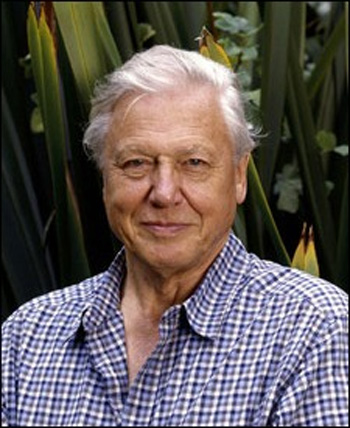
Sir David Attenborough

It was presented by that familiar face on the BBC in terms of the natural world, Sir David Attenborough.  It was an appropriate and worthy person to present the information.

But before getting into some of the details underpinning the programme, there seems to been an enormous and unspoken omission at Copenhagen – why no debate about global population trends?

Luckily the media noticed the rather obvious exclusion.  Here’s the UK Daily Telegraph newspaper (online version) of the 8th December, 2009. An extract:

Population growth is the one issue accused of causing driving climate change that no one at the Copenhagen climate summit dares to talk about.

The argument is that more people consume more resources, therefore producing more greenhouse gases that cause global warming.

The global population is currently at 6 billion and could rise to 11 billion by 2050 if fertility rates continue, not only threatening the climate, but food shortages and conflict as well.

Organisations like the Optimum Population Trust, that is backed by Sir Jonathan Porritt, Dame Jane Goodall and Sir David Attenborough, advocate birth control as a way of slowing climate change.

As Sir David has said: “I’ve never seen a problem that wouldn’t be easier to solve with fewer people, or harder, and ultimately impossible, with more.”

A study by the London School of Economics found contraception is almost five times cheaper as a means of preventing climate change than conventional green solutions such as investing in green technology.

Read more of this Post

The Future of the British National Health Service

Is Britain’s Health Service now terminally ill.

Near the end of November came more bad news from the British National Health Service, an institution that many Brits both love and hate at the same time.  The truth is that the NHS has simply become too big, too bureaucratic and is in many areas failing though over-regulation and poor management.

Not that it lacks managers of course;  I believe there are more managers per bed than in any other country of Europe.

Why is it that the more managers you have the worse the overall performance ends up? Too much working by committee and passing the buck for failure, perhaps?

It has to be broken up; vast organisations just don’t work. Smaller is beautiful. I feel confident the world will eventually understand this; already there are serious calls for the big banks to be split up after the credit fiasco and just recently we read about  calls for some of the big British supermarkets to be ‘smallered’. This is significant, coming from one of the “Neo-Conservative” gurus likely to have great influence in the next British government.

Have we passed through a period of worshipping size, power, takeovers, mergers, money, financial domination, vast stock options, fees for lawyers, obscene bonuses and instant gratification?

Economies of scale are one thing, but at some point other factors reduce their value to society as a whole. The bigger an institution of any kind the greater the possible abuse. And sadly, at some time or other there will be abuse, as we have seen so often.

The period of “Big is Beautiful” may be ending, and not before time.

By Chris Snuggs

Poetry and dogs

Thanks to Daniel Caride for pointing us to this poem from an unknown author.

It is called Inner Peace.

If you can start the day without caffeine,

If you can always be cheerful, ignoring aches and pains,

If you can resist complaining and boring people with your troubles,

If you can eat the same food every day and be grateful for it,

If you can understand when your loved ones are too busy to give you any time,

If you can take criticism and blame without resentment,

If you can conquer tension without medical help,

If you can relax without liquor,

If you can sleep without the aid of drugs,

You are probably the family dog!

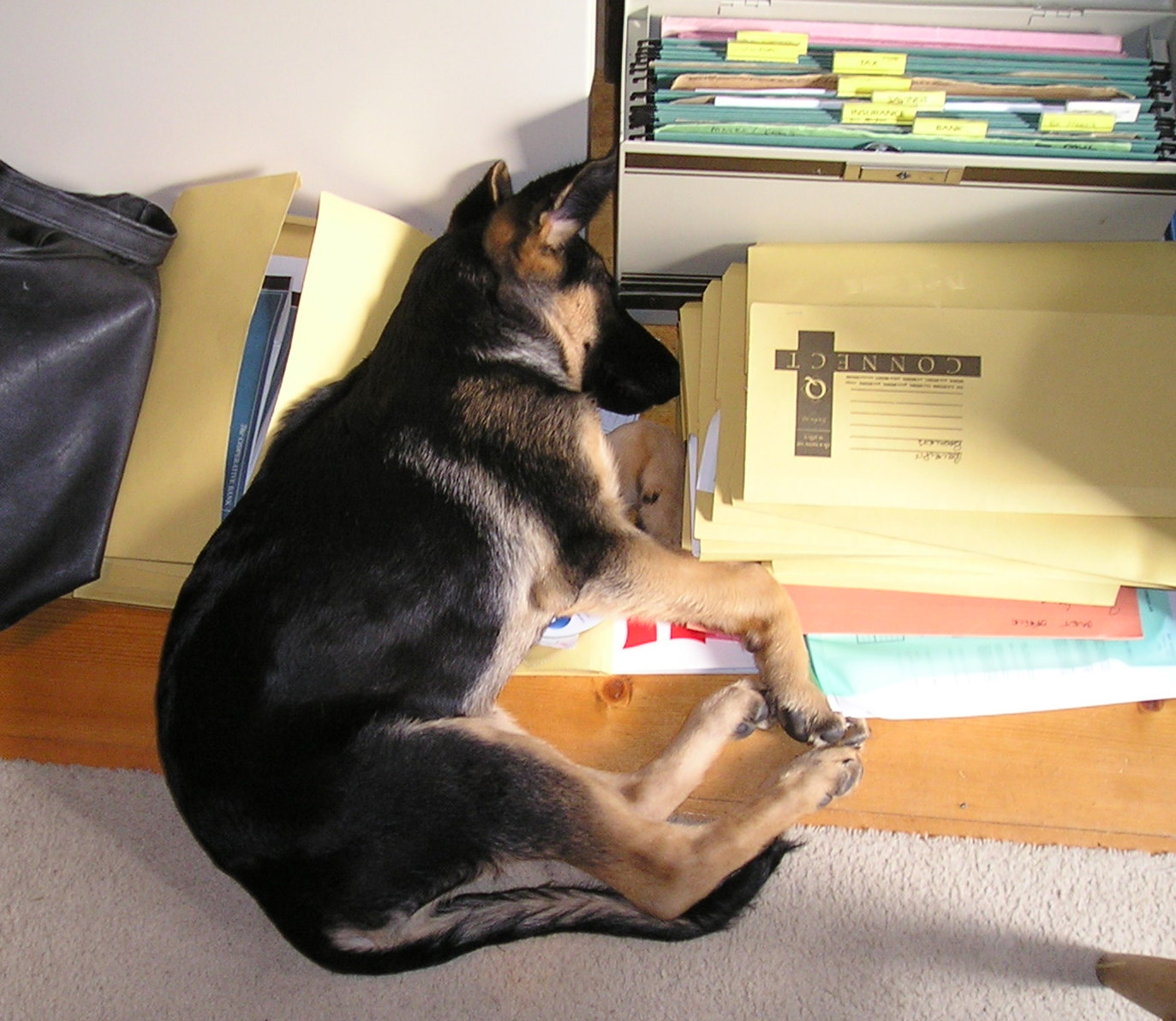
Pharaoh, 3 months, asleep oblivious to the world!

Yes, we certainly have much to learn from dogs!

By Paul Handover

Save the planet – eat a carrot!

Another political masterpiece!

British Health Minister Andy Burnham is urging us to give up meat; this will apparently help to save the planet.

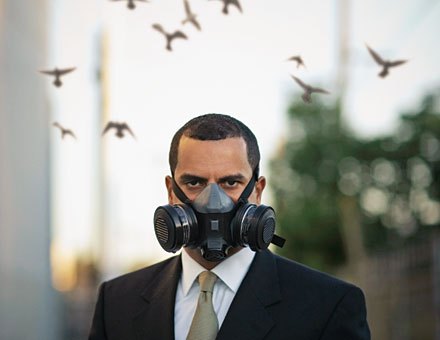
Andy Burnham! (Seriously)

Now, it is very noble of the Minister to try to help save the planet. However, his efforts do raise some questions.

  • The thing is, if it is essential to stop eating meat then shouldn’t the government put its money where its mouth is and DO something about it? Such as tax it? (usually the first instinct!) Or do they only do things that are electorally favourable? (this is a rhetorical question, by the way – feel free not to answer it …)
  • Or is this perhaps a long process of “educating the electorate”? Well, there are plenty who leave school hardly literate already, so he’s being a bit optimistic, isn’t he? And why start with poor, little Britain? There are tens if not hundreds of millions of our American buddies to convince ….

And at the same time as we are being sermonised about our meat-eating the the USA is edging towards the opening-up to oil-exploration of previously off-limit areas.

In our quaint British lingo this is known as “not singing from the same song-sheet”.  And as for oil, I wish they would make up their minds once and for all; either we have to reduce its use or we don’t.

At the moment, all they seem to be doing is organising conferences (at vast carbon footprint) where they promise to reduce emissions. This is schizophrenia, isn’t it?

Re the British sermon, one wonders whether the noble minister is himself a vegetarian, and of course whether he is among the vast government contingent attending the international climate conference. And does he drive the car 50 metres to the baker’s on Sunday mornings?

Personally, I’d be prepared to give up meat if: A) I were convinced it would do any good and B) I thought that the great and good (and rich) would make a similar sacrifice.

These are two VERY big “ifs” ………

Must go – got some burgers in the pan …..

By Chris Snuggs

Resignation, anger or possibilities

A recap on some important messages.

One of the great benefits of being a team of authors is that we, too, are learning from each other.  So on that theme I wanted to review some of the Posts that have been written by my fellow authors as a reminder of some powerful motivational ideas.

Sir Ranulph Fiennes

When asked about his approach to climbing Everest at the third attempt in May 2009 and, at age 65, the oldest Briton to do so, he captured the full spirit of separating actions from goals when he said:

Plod forever! Don’t expect to get there. Don’t think there is going to be a top to this mountain. Just plod forever!

Watch the video.

Read more about these examples

Consequences and probabilities

How Peter L Bernstein’s work helps us make the safest decision with regard to global warming.

Probably like me you hadn’t heard of Peter Bernstein. He was instrumental in understanding risk and that alone makes him worth knowing about.  Here’s the entry from Wikipedia:

Peter Lewyn Bernstein (January 22, 1919 – June 5, 2009) was a financial historian, economist and educator whose development and refinement of the efficient market theory made him one of the country’s [USA] best known authorities in popularizing and presenting investment economics to the general public.

Watch the YouTube video before reading on:

You could not have missed a fundamental message in the interview – if the consequence of something is critically harmful then don’t take ANY risks. Bernstein’s book on risk is Against the Gods.

Continue reading “Consequences and probabilities”