“Have the courage to say no. Have the courage to face the truth. Do the right thing because it is right. These are the magic keys to living your life with integrity.”
The above is attributed to W. Clement Stone, a businessman, philanthropist and author who died in 2002, aged 100. It seemed an appropriate quotation with which to introduce a recent article by Bill McKibben, on the Grist blog, about the proposed Keystone XL pipeline.
Bill McKibben
Keystone pipeline’s last defense: Cold, hard cash
What do you do if you’ve lost an argument?
Say you really really want to build a big pipeline from the tar sands of Alberta so that you can sell your bitumen to the world
But 20 of the nation’s top scientists have written to the president to say it’s a terrible idea — and the planet’s leading climatologist says burning the tar sands would be “game over for the climate.” And nine recent winners of the Nobel Peace Prize have condemned the plan. And Robert Redford has just made a video explaining why the plan is an attack on the nation’s heartland. Then, if you’re a poor forlorn oil industry feeling unloved and under assault, what do you do?
There’s really only one answer: Flash your wad.
As we get to the final chapters of the Keystone pipeline saga (the president has said he’ll make his decision by year’s end), money’s the only argument these guys have left.
They managed to buy a favorable environmental review from the U.S. State Department, which helpfully outsourced the job to a company that was a “major client” of TransCanada, the pipeline builder.
And yesterday, they proposed a $100 million “performance bond” to the state of Nebraska, whose Republican governor and senator have come out against the pipeline. The money is apparently designed to pay for damage to the Ogallala Aquifer if the pipeline starts to leak.
Meanwhile, when 33 Democratic representatives sent a letter to the White House demanding a rejection of the plan, lobbyists for TransCanada rounded up their own list of lawmakers from the president’s party to issue a rejoinder. But they only found 22. And what do you know — they included nine of the top 10 Democratic recipients of oil money in the House. On average the signatories received over 4.25 times more oil money than the average House Democrat in the 112th Congress. That would be 325 percent more. That would be how the game is played.
The other side — that is, scientists, Nobelists, and the kind of average people who went to jail in record numbers this summer to block the plan — doesn’t have that kind of money. We’ve had to figure out other currencies to work in: spirit, passion, creativity. We’ve spent our bodies, putting them on the line. The odds are still against us, but the odds are changing; we’re on a roll as we head toward Nov. 6, when we’ll ring the White House with people, exactly one year before the election. (You can sign up here.)
But every once in a while we get to play the money game too! While TransCanada was out there setting the $100 million price on the Ogallala Aquifer, this news story rolled across my screen. It described a big Democratic giver, Barbarina Heyerdahl. She gave 120 grand to Obama and the Democratic National Committee over the last three years, not to mention knocking on doors for the 2008 campaign. But she said Keystone is a bridge too far, that “she won’t be writing any more checks to Obama if he approves the carbon conduit that’s become the focus of the climate-change movement. ‘It’s a baseline issue,’ she says.”
I have no doubt that, even with Heyerdahl and other donors accounted for, the oil industry has all the money they need to win this fight. The Koch brothers are the third and fourth richest men in America, and they filed papers in Canada declaring their “direct and substantial” interest in the project. If money’s the only thing that matters, they’ll carry the day.
But if money’s the only thing that matters, we’re done for anyway. So we’ll keep using science and art and courage. And we’ll hope that Barack Obama hasn’t sold his soul. We’re going to find out in the next few weeks.
Bill McKibben is founder of 350.org and Schumann Distinguished Professor at Middlebury College in Vermont. He also serves on Grist’s Board of Directors.
Bill’s website may be found here. Also, please PLEASE watch the video made by Robert Redford. Only 3 mins 25 seconds long, the ink to the video is here.
A return to the beautiful writings of Irishman, John O’Donohue
Last week, I published a Post about John O’Donuhue‘s book Anam Cara, entitled Soul friend, the meaning of anam cara in Gaelic. There were a number of lovely responses, both as comments to the Post, and as emails sent to me. I thought I would share another essay with you. First, some reflections about transfiguration or, perhaps a better word for today’s challenging times is ‘change’.
I have made no secret of my belief that we are in a period of great change, perhaps greater than mankind has faced before. Possibly that is slightly hyperbolic, but looked at from the perspective of the extinction of homo sapiens then perhaps it is no exaggeration. The vast majority of people, who stop and reflect, sense that on several fronts it is change or die!
A classic behavioural attribute of modern man is to see ‘change’ as something that others should do, rather than change coming from within. From time to time, I have quoted this,
For today, I am in charge of my life.
Today, I choose my thoughts,
Today, I choose my attitudes,
Today, I choose my actions and behaviours,
With these, I create my life and my destiny.
Much, much easier to say, and write, than to undertake. But it does underscore the obvious – change flows from our journey inwards. Let’s turn to John O’Donohue’s inspirational words about this subject.
From the John O’Donohue website
Spirituality of transfiguration
Spirituality is the art of transfiguration. We should not force ourselves to change by hammering our lives into any predetermined shape. We do not need to operate according to the idea of a predetermined programme or plan for our lives. Rather, we need to practise a new art of attention to our inner rhythm of our days and lives. This attention brings a new awareness of our own human and divine presence. A dramatic example of this kind of transfiguration is the one all parents know. You watch your children carefully, but one day they surprise you; you still recognise them, but your knowledge of them is insufficient. You have to start listening to them all over again.
It is far more creative to work with the idea of mindfulness rather than with the idea of will. Too often people try to change their lives by using the will as a kind of hammer to beat their life into proper shape. The intellect identifies the goal of the programme, and the will accordingly forces the life into that shape. This way of approaching the sacredness of one’s own presence is externalistic and violent. It brings you falsely outside your own self and you can spend years lost in the wilderness of your own mechanical, spiritual programmes. You can perish in a famine of your own making.
If you work with a different rhythm, you will come easily and naturally home to your self. Your soul knows the geography of your destiny. Your soul alone has a map of your future, therefore you can trust this indirect, oblique side of your self. If you do, it will take you where you need to go, but more importantly it will teach you a kindness of rhythm in your journey. There are no general principles for this art of being. Yet the signature of this unique journey is inscribed deeply in each soul. If you attend to your self and seek to come into your own presence, you will find exactly the right rhythm for your life. The senses are generous pathways which can bring you home.
A renewal, indeed a complete transfiguration of your life, can come through attention to your senses. Your senses are the guides to take you deep into the inner world of your heart. The greatest philosophers admit that to a large degree all knowledge comes through the senses. The senses are our bridge to the world. Human skin is porous; the world flows through you. Your senses are large pores which let the world in. Through attunement to the wisdom of your senses, you will never become an exile in your own life, an outsider lost in an external spiritual place which your will and intellect have constructed.
Please just read those words from John again. Re-read the last paragraph. Then go one paragraph up and read that again, “Your soul knows the geography of your destiny. Your soul alone has a map of your future, therefore you can trust this indirect, oblique side of your self. If you do, it will take you where you need to go, but more importantly it will teach you a kindness of rhythm in your journey.”
Each of us taking us to where we need to go, and one by one, each of us taking our world to where it needs to go.
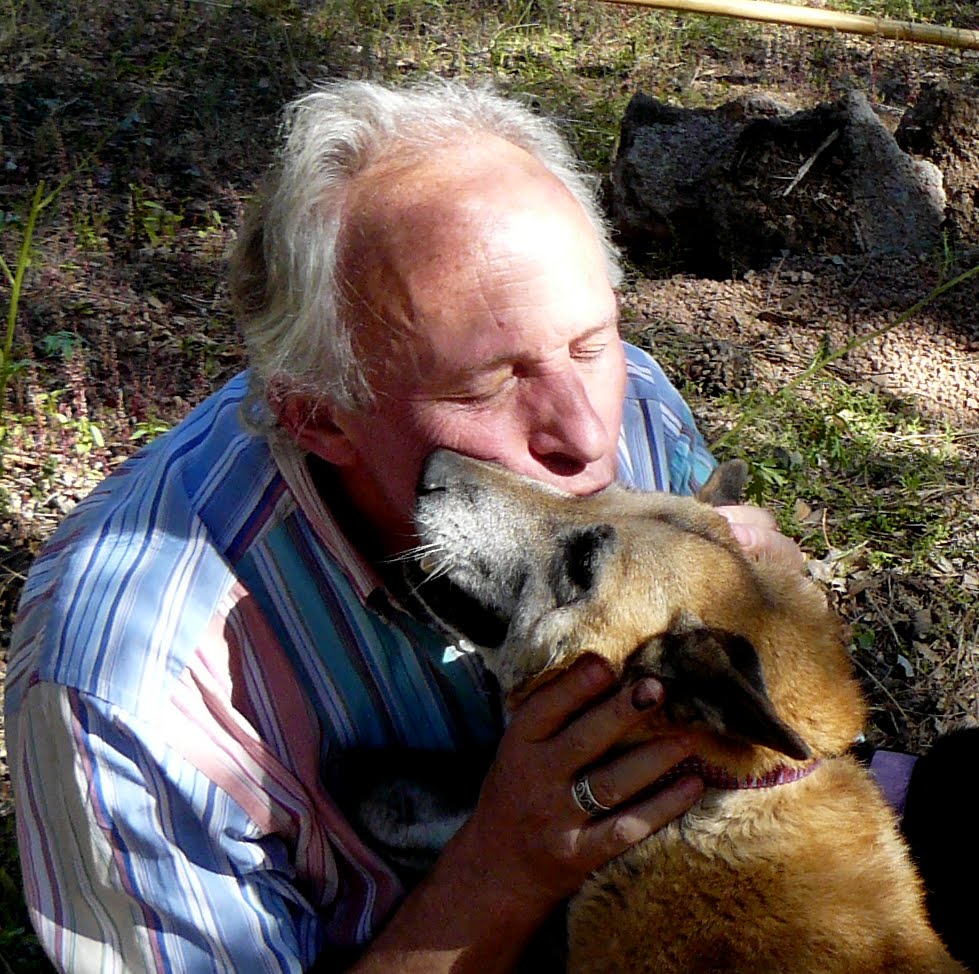
The brown dog with her head nestled against my chest is Loopy. Like Phoebe, the black dog looking at the camera, they are dogs that Jean originally had rescued in Mexico.
Here’s Loopy’s story.
Loopy and Phoebe
When I first met Jean in December 2007 in San Carlos, Mexico, it was immediately clear that she was an animal lover extraordinaire! There were 13 dogs and 6 cats in her home and many other dogs in a fenced off compound not so far away from the house.
Abandoned and stray dogs in that part of Mexico were numerous, there was no humane society and no real care or interest from the Mexicans for these dogs. So many years ago, Jean decided to run her own unofficial dog rescue society, supported by more than a few Americans who had winter homes in San Carlos. Over the years, Jeannie and her team must have rescued and found homes for well over 50 dogs.
In my introduction to the post last Tuesday, Please Help a George, I wrote about how long it had taken for Loopy to bond with me, but Jean’s experience of Loopy goes way back before I entered their lives.
I mentioned above that Jean had a piece of land in San Carlos that she used as a rescue compound for her dogs. One morning, back in 2003, as usual she had gone to the compound to attend to her dogs. Jeannie noticed immediately, cowering in one corner, this young female, brown-haired dog, the dog had been tossed over the fence of the compound. Jean estimated that she was about a year old, hadn’t yet had any pups. The dog had very cold eyes, growled aggressively as soon as Jean approached her; clearly deeply traumatised.
Jean set out food and water before the dog, hoping that whatever had traumatised the dog would soon abate. The dog was named: Loopy!
Despite the fact that Loopy wouldn’t mix with the other dogs in the compound, she was not mean. But the days turned into weeks, the weeks into months, and still Loopy would not allow Jean to get close to her. One could only imagine the degree of cruelty that must have been metered out to Loopy – or, rather, one couldn’t imagine it!
Then, one day, when Jean went to the compound, Loopy was amongst the other dogs. Loopy cautiously came up to Jean, sniffed her feet and legs and then, miraculously, allowed Jean to gently stroke her head and back. Loopy’s cold, angry eyes were now soft and brown; Loopy had melted. For obvious reasons, Loopy would never be available for adoption and soon moved into the main house.
When I became a permanent part of the Mexican household in 2008, Loopy was deeply suspicious of me. I was given the cold, hard-eyed stare from Loopy and any attempt by me to touch her was returned with growling, fanged teeth. There were a number of instances where I collected teeth rips across my hands from Loopy.
The aggression towards me lasted a long time, about a year. But then one day, quite unexpectedly, Loopy decided that I was friend, not some reminder of a demon foe from her past. She trusted me, first with strokes and cuddles and then with the most passionate and trusting embraces. I love her so much.
One could wax lyrical about love, patience and trust, but I won’t. The photograph below says it all. We really do have so much to learn from dogs!
A chance dip into the BBC News website a few days ago allowed me to come across an article about the vanishing glaciers in the Himalayas. It just about broke my heart. Here’s what it said,
Rivers of ice: Vanishing glaciers
Stunning images from high in the Himalayas – showing the extent by which many glaciers have shrunk in the past 80 years or so – have gone on display at the Royal Geographical Society in central London.
Between 2007 and 2010, David Breashears retraced the steps of early photographic pioneers such as Major E O Wheeler, George Mallory and Vittorio Sella – to try to re-take their views of breathtaking glacial vistas.
The mountaineer and photographer is the founder of GlacierWorks – a non-profit organisation that uses art, science and adventure to raise public awareness about the consequences of climate change in the Himalayas.
Rivers of Ice: Vanishing Glaciers of the Greater Himalaya can be seen at the RGS in London until 11 November 2011. Admission free.
All photos courtesy GlacierWorks and Royal Geographical Society. Map copyright Jay Hart. All images subject to copyright.
Music courtesy KPM Music. Audio slideshow production by Paul Kerley. Publication date 11 October 2011.
Then follows a 3:59 film made by David Breashears that is so beautiful as well as so upsetting. I don’t have a way of linking to the film directly but it’s easy to watch, just click here and be very moved.
David Breashears has his own website, from where one can learn that,
David Breashears is an accomplished filmmaker, adventurer, author, mountaineer, and professional speaker. Since 1978, he has combined his skills in climbing and filmmaking to complete more than forty film projects.
In 1983, Breashears transmitted the first live television pictures from the summit of Mount Everest, and in 1985 became the first American to reach the summit of Mount Everest twice.
In the spring of 1996, Breashears co-directed and co-produced the first IMAX film shot on Mount Everest. When the now infamous blizzard of May 10, 1996 hit Mount Everest, killing eight climbers, Expedition Leader Breashears and his team were in the midst of making this historic film. In the tragedy that soon followed, Breashears and his team stopped filming to provide assistance to the stricken climbers. After returning to Base Camp, Breashears and his team then regrouped and reached the summit of the mountain on May 23, 1996, achieving their goal of becoming the first to record IMAX film images at Earth’s highest point. Breashears has said that if there is a lesson to be learned from the May 1996 tragedy, it is that for him, success that year was not to be found in reaching the summit, it was that everyone on his team returned safely. The film, titled EVEREST, premiered in March 1998.
As was written in that BBC item, David is the founder of GlacierWorks which is full of beautiful, albeit tinged with sadness, images of the glaciers featured in that BBC item. As the GlacierWorks website explains on the home page,
The Mighty Himalayan Glaciers are Vanishing.
The rate of recession is unprecedented, accelerating and, without some remedy to the problem of climate change, unstoppable. GlacierWorks is a non-profit organization that uses art, science, and adventure to raise awareness about the consequences of climate change in the Greater Himalaya.
Read that first sentence again, “The rate of recession is unprecedented, accelerating and, without some remedy to the problem of climate change, unstoppable.” [my emphasis]
There are a number of videos on YouTube if you search for David Breashears, none up to the beauty of the slide show in the BBC item so don’t miss that at all. However, the following is also worth watching,
OK, a change of topic but one that connects with the underlying message about the disappearing glaciers. This was an article in the American The Nation newspaper written by Naomi Klein, following her speech to the demonstrators at Occupy Wall Street. The article really should be read in full but I wanted to highlight just the following words from Naomi,
The point is, today everyone can see that the system is deeply unjust and careening out of control. Unfettered greed has trashed the global economy. And it is trashing the natural world as well. We are overfishing our oceans, polluting our water with fracking and deepwater drilling, turning to the dirtiest forms of energy on the planet, like the Alberta tar sands. And the atmosphere cannot absorb the amount of carbon we are putting into it, creating dangerous warming. The new normal is serial disasters: economic and ecological.
We all know, or at least sense, that the world is upside down: we act as if there is no end to what is actually finite—fossil fuels and the atmospheric space to absorb their emissions. And we act as if there are strict and immovable limits to what is actually bountiful—the financial resources to build the kind of society we need.
The task of our time is to turn this around: to challenge this false scarcity. To insist that we can afford to build a decent, inclusive society—while at the same time, respect the real limits to what the earth can take.
Thanks to Bill Mitchell of Billy Blog for linking me to the Naomi Klein speech.
We can afford to build a decent, inclusive society and we must – not tomorrow but now. Start with your local community, think about transition. Some of our grandchildren will be mountaineers – let them see the beautiful rivers of ice.
The ways of our carbon-consuming past & present cannot be continued into the future.
In many ways that sub-heading above is not controversial for millions of citizens of Planet Earth. The challenge is in changing behaviours, ending old habits of energy use, and working towards a truly sustainable relationship with the only planetary home we have!
Like many others, Jean and I are of the view that the Keystone XL Pipeline is not required. Last week there was an update from EPI about this subject illustrating how the pipeline is not required. That update is published in full, as follows,
Plan B Updates
OCTOBER 06, 2011
U.S. Gasoline Use Declining: Keystone XL Pipeline Not Needed
Lester R. Brown
As the debate unfolds about whether to build a 1,711-mile pipeline to carry crude oil from the tar sands in Canada to refineries in Texas, the focus is on the oil spills and carbon emissions that inevitably come with it. But we need to ask a more fundamental question. Do we really need that oil?
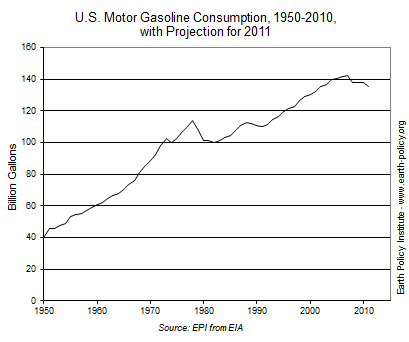
The United States currently consumes more gasoline than the next 16 countries combined. Yes, you read that right. Among them are China, Japan, Russia, Germany, and Brazil. (See data.)
But now this is changing. Not only is the affluence that sustained this extravagant gasoline consumption eroding, but the automobile-centered lifestyle that was considered part of the American birthright is fading as well. U.S. gasoline use has dropped 5 percent in four years.
Four key developments are set to further reduce U.S. gasoline use: a shrinking car fleet, a decline in the miles driven per car, dramatic mandated future gains in new car fuel efficiency, and the shift from gasoline to electricity to power our cars.
The U.S. fleet appears to have peaked at 250 million vehicles in 2008. From 1994 through 2007, new-car sales were in the range of 15–17 million per year. Since then they have totaled 10–13 million per year, and they are unlikely to top 14 million again. Retirees likely will exceed sales of new cars throughout this decade.
The contraction that began when the fleet dropped from 250 million in 2008 to 248 million in 2010 is likely to continue. Sales of new cars are not matching those of earlier years in part because the economic prospect has dimmed and in part because we are still urbanizing. Today 82 percent of us live in urban areas where cars are becoming less essential.
On top of urbanization, we also have a change in the manner in which young people socialize. For teenagers in rural communities a half century ago, getting a driver’s license and something to drive—a car, a pickup, or even a farm truck—was a rite of passage. That’s what everyone did.
This too is changing. Today’s teenagers, most of whom grew up in an urban setting, socialize through smartphones and the Internet. For many of them, a car is of little interest. The number of licensed teenage drivers in this country—the car owners of the future—has dropped from a peak of 12 million in 1978 to 10 million today.
Cities are also being redesigned for people. Among other things, this means cities are becoming pedestrian- and bicycle-friendly, with ready access to public transit.
Many cities are building a cycling infrastructure of bicycle trails, dedicated bike lanes, and bike racks for parking. Bike-sharing programs are showing up, too. In Washington, D.C., the Capital Bikeshare program that began in 2010 has expanded to 116 stations with 1,100 bicycles. Within the first year, some 16,000 riders signed up for annual membership in the program. Denver and Chicago have similar bike share programs. And New York City is about to launch a huge program of its own.
The second reason that gasoline use is falling is the decline in miles driven per car. This is partly in response to economic uncertainty and the high price of gasoline. When gas costs nearly $4 a gallon, people think twice before jumping in a car and using a gallon of gasoline to pick up a half-gallon of milk.
A third trend that is reducing gasoline use is the rising fuel efficiency of the U.S. automobile fleet. New cars sold in 2008 averaged 27 miles per gallon. But in early 2009, President Obama raised the average fuel efficiency standard so that those sold in 2016 will get 36 miles per gallon. Additional standards announced in 2011 mean that new cars sold in 2025 will use less than half as much gasoline as the 2008 models.
The game changer in reducing gasoline use is going to come as drivers shift from gasoline to electrically powered vehicles, including plug-in hybrids and all-electric cars. General Motors recently introduced the Chevrolet Volt, designed to run largely on electricity, and Nissan unveiled the Leaf, an all-electric vehicle. Beyond these, Toyota is accepting orders for the plug-in version of its Prius hybrid, the pacesetter in fuel efficiency. It will be followed by a steady flow of new plug-in hybrid and all-electric car models coming to market.
Although these electrically powered vehicles are typically more costly to buy, the day-to-day cost of operating them is extraordinarily low. An analysis by Professor Michael McElroy at Harvard indicates that running a car on wind-generated electricity could cost less than the equivalent of 80-cent-a-gallon gasoline.
With the auto fleet shrinking, with the average car being driven less, with the fuel use of new cars to be cut in half by 2025, and with electricity starting to replace gasoline as a fuel, why do we need to build a pipeline to bring crude oil from Canada’s tar sands to oil refineries in Texas? The answer is we don’t.
Lester R. Brown is president of the Earth Policy Institute and author of World on the Edge.
There’s a footnote that I would like to add from the Center for Biological Diversity (great website!) that came out in a recent newsletter.
Here it is,
Lawsuit Seeks to Halt Work on Controversial Keystone XL Pipeline
Keystone Pipeline
The hotly contested Keystone XL pipeline hasn’t been approved for construction, but federal officials don’t seem to care; they’ve allowed the pipeline company to mow down 100 miles of native prairie grasslands in Nebraska to clear the way — before any public hearings were held on whether Keystone XL should move forward at all.
The Center for Biological Diversity and Friends of the Earth filed a lawsuit in federal court in Omaha Wednesday to halt that work. Specifically, we’re challenging decisions by the State Department and U.S. Fish and Wildlife Service to allow work to begin before a decision’s been made on the pipeline or the public hearings, which look like little more than a sham at this point.
If approved, TransCanada’s 1,700-mile pipeline would carry up to 35 million gallons of oil a day from tar sands in Canada to refineries in Texas. Not only will this project add fuel to the global climate crisis, but the pipeline will cut across Nebraska’s legendary Sandhills, hundreds of rivers and streams, and the Ogallala Aquifer, which provides drinking water for millions of people. TransCanada’s existing pipeline, called Keystone 1, has reportedly leaked 14 times since it started operating in June 2010.
A canine charitable opportunity that deserves wide support.
The details that follow strike a chord with me, strike a chord in a big way. When I first came to live with Jean back in 2008 it was clear that this wasn’t going to be a normal relationship. Why? Because, at that time Jean had 12 dogs living with her in San Carlos, Mexico and my arrival, together with my Shepherd dog, Pharaoh (see home page for a picture of him), took that number to 13. Jean’s dogs were all Mexican rescues; she also ran her own local humane society in San Carlos and over the years had found homes for literally dozens of dogs.
One of those Mexican rescues was a dog called Loopy, who had been terribly treated by local Mexicans. The consequence when I arrived, a stranger in the middle of Loopy’s life with Jean, was that Loopy was very aggressive towards me; my hands have small scars to bear witness to the number of nips Loopy launched in my direction.
It took over a year before I was able to just let my hand ‘accidentally’ brush her side. Slowly Loopy’s trust in me built up until now I can press my face to her face and cuddle her for ages. (To underline the love that Loopy bestows on me, I will get Jean to take a picture and publish that before the end of the week.) So with that in mind, let me turn to the details recently sent to me by friend and colleague, Dapinder Singh, from England.
———————
George and loving owner, Ian.
This is George. He was in an English dog pound and condemned to death.
He had been very badly abused, one eye blinded by what was thought to be a kick, he trusted no-one and had rejected all human contact. He was desperate and in despair.
After an exhaustive search for anyone who take on the rescue of George, we (as in Doris Banham) took him into our care just a day before he was due to be euthanased. His veterinary problems were easier to deal with than the mental ones. His eye was damaged beyond repair causing him constant pain so it had to be removed, teaching George to trust again was much harder.
That journey back to trusting humans was long, George had suffered severe and terrible abuse, but there was no question of giving up on him and slowly but surely he began to live again as we fought to undo the wrongs that had been done to him. After some months with us, a wonderful family came to the rescue and offered George his ‘forever’ home where he found the love that he so deserved. His family are completely devoted to him.
His story, however, could have been a very different one were it not for the work of the team at Doris Banham’s. Below is an extract written by the lovely family who adopted him and from our fantastic volunteer, Sheila, who helped bring George back to life again.
“Hi, Sheila. Here is a shot of George in his new garden. He is settling down very well and seems to be very happy. I will keep you posted as to his progress. All the best Liz and Ian.”
There were a number of photographs sent to Sheila, however I have taken editor’s liberty and moved them to the foot of the article – I want you to stay with this to the point where you can see how to help. Here’s Sheila’s reply,
“WELL THESE BOUGHT ME TO TEARS , OUR GEORGE , THIS IS TRUE RESCUE , THIS IS ALL DOWN TO YOU DORIS BANHAM NOTHING ELSE TO SAY …” SHEILA X.
Are there other Georges out there? You bet! Far too many of them, right across the world. So let’s all do something to help these special creatures, who show us humans just what unconditionally love feels like.
Friday 4th November, 7.30pm – Come to the Hellaby Hall Hotel, Old Hellaby, Maltby, Yorkshire, S66 8SN
Call for tickets now to the Pound Dog Ball telephone number (UK) 07772 538513 or email pogpublications@yahoo.com Full details here.
Please help all the Georges out there by supporting this Charity Fundraising Event: Black Tie, Dinner/Dance at Hellaby Hall, Rotherham, 7.30pm, on Friday 4th November. It’s a don’t miss night…..3 course meal, live entertainment all night and dancing ’til late!!!! It’s going to be a great night.
If you can’t make the Ball but would like to send in a donation then please post a cheque, made out to Pound Dog Ball, to the following address:
c/o Jennifer Smith
Clumber Lodge,
50 Hemingfield Road
Wombwell, S73 0LY.
Or if you prefer an electronic donation, further details are:
Pound Dog Ball
A/C 31542265
Sort 40-45-29 (HSBC)
The account is a charity account, set up only for this event. Once the money has been paid to the charities the account will be closed.
I know that Dapinder, and everyone else involved in helping these precious animals, sends you their heartfelt thanks.
Finally, more photos of George enjoying life as all dogs should. What a wonderful story, an honour to be able to publish it, and promote the Ball, on Learning from Dogs. Please help.
Sometimes when I want to clear a space in my head I like to either listen to music or Draw… This week I had some spare time on my hands and so the Sketch pad and Pastels came out once again..
And here is the result.
I hope you enjoy the result of this German Shepherd Dog I drew in Pastels..
I wasn’t brought up with Dogs my family always had cats, But I just love German Shepherds, well all four legged Dogs and Cats and animals .. But I remember one German Shepherd which was rather special… her name was Xena who belonged to a dear friend..
Xena
She sent me this picture of her some years ago now.. Sadly Xena she is no longer with us…My earliest memory of a German Shepherd was when I was 6 or 7 years of age. I remember I had to walk past the Vicarage gates to the infant school in our village where this huge GS was usually safe behind… His bark I think was worse than his bite.. But to a young girl I was scared of him.. One day the gate was open and he bounded out as I went past, and he barked loudly at me..
My heart raced and I think I started to cry.. as I was on my own.. I remember a woman coming to my aid and saying he wouldn’t hurt me.. as she calmed me down..
The German Shepherd was ushered back behind the gate, But not before someone had let me stroke him and take away my fear.. Or I may have been afraid of dogs in the future..
Funny how when one’s mind is trying to empty itself.. It then becomes full of past memories.. That are triggered by something else..
Have a Great weekend all of you, and Sorry if I didn’t get around to visit all of you but your on my to do list.. Next week as I’m working this weekend..
Maybe less is more is really at the heart of our thirst for something more
A number of disparate recent experiences seem to have an underlying common thread.
See if these strike you in a similar fashion.
Yesterday, Joelle Jordan wrote about joy, about the wonderful relationship that dogs have with the world around them. As Joelle wrote,
Joy is a difficult commodity to come by these days. I don’t mean entertainment, I don’t mean a good laugh, I mean pure joy, where, even just for a single moment, all worries and doubts, frustration and anger are lifted as though by Atlas.
Like so many other humans in our world, I often find myself in a constant state of stress. There always seems to be something to worry about, whether it’s money, job fulfilment, the state of my relationships, getting the house cleaned, finding time to get to the market, and more. If given the chance, I know we all could spend nearly all of our waking hours (and some of our sleeping hours, too) worrying about something. We spend so much time on the many things that inevitably work themselves out, and so little time on things that will create a memory and a crystal moment of joy.
My little dog Charlie spends his time in the completely opposite fashion; spending his waking hours seeking joy, and committing less time to things that worry him.
Charlie seems to exist normally in three states of being; content, happy and utterly joyful.
How many of us can echo Charlie’s existance in our own lives?
Then last Sunday, Father D’s sermon spoke about our tendency to develop habitual behaviours and rarely challenge the point of them.
The truth is that we get used to doing things a certain way and keep doing them without ever thinking of what we are doing. We say things in the liturgy without even thinking of what we are saying. I’m sure many people utter the words in the Book of Common Prayer without thinking of the theology behind the words, or the relationship between church and state that they express.
Later on,
There was a desire for “something more” but it was hard to put a finger on what it was. I realized from these conversations that we are involved today in a time of intense searching. Few of us are satisfied with what the church and society have served up.
The honest among us will readily admit we lead fractured lives – with a disembodied spirituality on one side, and a soulless daily existence on the other. We are desperate for something more, for a faith with the power to transform both ourselves and our world.
“…. we are involved today in a time of intense searching“! That smacked me right in the eye!
These are clearly challenging times with mankind facing increasing odds of an ecological disaster of Old Testament proportions, and much of the western world on the cusp of a long and difficult recession. It is so easy to go on “doing things a certain way and keep doing them without ever thinking of what we are doing” while we wait for the leaders of our societies to fix our problems.
The truth is that we have to be the first to change, to question what we do on a daily basis and amend it if it is not truly healthy for us and for the planet. As was said in that sermon, “It means bringing forth each day the fruits of the Spirit: Love, joy, patience, kindness, generosity, faithfulness, gentleness and self-control.”
Go back and read yesterday’s Post and reflect on how many of those ‘fruits’ are the ways of dogs.
My final connection with the theme of today’s essay is with a recent series from the BBC called ‘Status Anxiety’. The programmes are still on YouTube and the first 10 minutes is below,
Status Anxiety discusses the desire of people in many modern societies to “climb the social ladder” and the anxieties that result from a focus on how one is perceived by others. De Botton claims that chronic anxiety about status is an inevitable side effect of any democratic, ostensibly egalitarian society. De Botton lays out the causes of and solutions to status anxiety.
Or if you prefer, all 2 hours 23 minutes may be watched on Top Documentary Films, described thus,
De Botton's book
Why doesn’t money (usually) buy happiness? Alain de Botton breaks new ground for most of us, offering reasons for something our grandparents may well have told us, as children.
It is rare, and pleasing, to see a substantial philosophical argument sustained as well as it is in this documentary. De Botton claims that we are more anxious about our own importance and achievements than our grandparents were. This is status anxiety.
Alain quotes philosophical writings, such as Democracy in America, a report by Alexis de Tocqueville on his visit to the USA in 1831. De Tocqueville noted that American equality, notable in those times, was accompanied by a climate of envy.
We jump to present-day USA, and see what, to de Botton, are some awful examples ofThe American Way. A Christian preaches get rich. A steelworker tells of his insecure life in an industry being closed down through others’ love of money.
Our protagonist points out the advantage of high status: those with high status will enjoy the care and attention of the world. Then joins this advantage with the illusion, orattempt at meritocracy in the USA, mentioning Jefferson’s notion of an aristocracy of talent.
Some of the messages towards the end of the programme are very thought-provoking indeed. Let me draw this all together.
If you own a dog, or a cat, or any pet, stop a while today and see how their simplicity of life brings them so much more. Naturally, we can never live life in the same way that our pet does but there are strong metaphors that carry equally strong messages for us. Less is more.
Now watch the last part of Status Anxiety even if you didn’t watch the first segment above, Reason? Watch and it will become clear.
I know that expression from my days as a private pilot. It makes such obvious sense, especially in a single-engined light aircraft with one pilot on board. It’s all about risk.
Frederick Herzberg, the famous American psychologist, coined the term ‘hygiene factor’. It was the second part of a two-factor approach to the management of people. According to Herzberg’s theory, people are influenced by two sets of factors, motivation factors and hygiene factors. More background on this aspect here.
To me, as I reflect on the messages offered in the Sceptical Voices article, Part One and Part Two, the concepts of risk and hygiene seem totally appropriate to the topic of AGW, Anthropogenic Global Warming.
Whether or not AGW is a valid theory behind the rapid change in global warming is utterly irrelevant. It is the risk to humanity that matters. There is absolutely no harm done from assuming that AGW is happening and that feedback processes run a grave risk of tipping planetary conditions out of control, and getting that wrong.
On the other hand, assume that AGW is such an uncertain concept that it really isn’t wise to adjust our life styles, and getting that wrong would endanger the human species.
Think of being on a commercial airline flight and you become aware that one of the two pilots in the cockpit is incapacitated through food poisoning. No doubt that you, with all your fellow passengers, would vote for an immediate diversionary landing. It’s to do with risk.
From the perspective of Herzberg, a co-ordinated program by the world’s leading governments to tackle AGW might also improve the overall motivation of their peoples in a whole manner of ways.
Yes, question all we want, yes, there are other important issues to resolve in the world, but WHAT IF “Climate Change/Global Warming“ is for real, what then?
Dan wrote also in that Part One piece,
And by “peel-back-the-onion”, I mean that any ardent, independent researcher should publish both sides of the story as a matter of course. Especially in regards to global warming.
But publishing both sides of the story is not the argument. The argument is the risk to humanity of doing nothing, and getting it wrong.
That well-respected weekly newspaper The Economist had a recent article about the melting of Arctic ice, from which is quoted,
Arctic sea ice is melting far faster than climate models predict. Why?
Sep 24th 2011 - from the print edition
ON SEPTEMBER 9th, at the height of its summertime shrinkage, ice covered 4.33m square km, or 1.67m square miles, of the Arctic Ocean, according to America’s National Snow and Ice Data Centre (NSIDC). That is not a record low—not quite. But the actual record, 4.17m square km in 2007, was the product of an unusual combination of sunny days, cloudless skies and warm currents flowing up from mid-latitudes. This year has seen no such opposite of a perfect storm, yet the summer sea-ice minimum is a mere 4% bigger than that record. Add in the fact that the thickness of the ice, which is much harder to measure, is estimated to have fallen by half since 1979, when satellite records began, and there is probably less ice floating on the Arctic Ocean now than at any time since a particularly warm period 8,000 years ago, soon after the last ice age.
That Arctic sea ice is disappearing has been known for decades. The underlying cause is believed by all but a handful of climatologists to be global warming brought about by greenhouse-gas emissions. Yet the rate the ice is vanishing confounds these climatologists’ models. These predict that if the level of carbon dioxide, methane and so on in the atmosphere continues to rise, then the Arctic Ocean will be free of floating summer ice by the end of the century. At current rates of shrinkage, by contrast, this looks likely to happen some time between 2020 and 2050.
Re-read the sentence, “The underlying cause is believed by all but a handful of climatologists to be global warming brought about by greenhouse-gas emissions.” In particular, “by all but a handful of climatologists” Think of risk.
That article, which should be read in full, concludes thus,
A warming Arctic will bring local benefits to some. The rest of the world may pay the cost.
Indeed, the rest of the world may pay the cost! As I wrote, it’s all about risk.
So whether or not one wants to believe every word of that Economist article is irrelevant. Or whether one should have believed, or not, the article in New York’s The Sun newspaper back in 2007,
By SETH BORENSTEIN, Associated Press | December 12, 2007
WASHINGTON — An already relentless melting of the Arctic greatly accelerated this summer, a warning sign that some scientists worry could mean global warming has passed an ominous tipping point. One even speculated that summer sea ice would be gone in five years.
Greenland’s ice sheet melted nearly 19 billion tons more than the previous high mark, and the volume of Arctic sea ice at summer’s end was half what it was just four years earlier, according to new NASA satellite data obtained by the Associated Press.
“The Arctic is screaming,” a senior scientist at the government’s snow and ice data center in Boulder, Colo., Mark Serreze, said.
Last year, two scientists surprised their colleagues by projecting that the Arctic sea ice was melting so fast that it could disappear entirely by the summer of 2040. This week, after reviewing his own new data, a NASA climate scientist, Jay Zwally, said: “At this rate, the Arctic Ocean could be nearly ice-free at the end of summer by 2012, much faster than previous predictions.”
So scientists in recent days have been asking themselves these questions: Was the record melt seen all over the Arctic in 2007 a blip amid relentless and steady warming? Or has everything sped up to a new climate cycle that goes beyond the worst case scenarios presented by computer models? “The Arctic is often cited as the canary in the coal mine for climate warming,” Mr. Zwally, who as a teenager hauled coal, said. “Now as a sign of climate warming, the canary has died. It is time to start getting out of the coal mines.” [My emphasis, PH]
So, in conclusion, scepticism is healthy and is an important aspect of open debate within an open society, part of determining truth, however challenging that simple concept might be.
But eventually one needs to take a position, to take a stand on the really important issues in life and in the case of climate change the risk of being too sceptical, too cautious is to put the lives of future generations at stake. For me, and I guess for tens of thousands of others, that is a risk too far.








 Learning from Dogs