If you eat food, and hope to do so in the future, read this!
I subscribe to Food Freedom News and often read their articles when they appear in my ‘in-box’. Especially so yesterday morning when the headline jumped off the ‘page’ at me: Autism and Disappearing Bees: A Common Denominator?
So, in a sense, hand-in-hand with the article in yesterday’s Learning from DogsFood, glorious food! Because if trying to feed 9 billion people living on a planet where ‘farmers holding seeds that won’t sprout‘ means the even greater use of chemicals then ….. then, I don’t know what!
The Food Freedom website showed that the article came from Brian Moench of the Common Dreams website. Not a website I had come across before but one that quickly impressed me!
A few days ago the Salt Lake Tribune’s front page headline declared, “Highest rate in the nation, 1 in 32 Utah boys has autism.” This is a national public health emergency, whose epicenter is Utah, Gov. Herbert. A more obscure story on the same day read: “New pesticides linked to bee population collapse.” If you eat food, and hope to do so in the future, this is another national emergency, Pres. Obama. A common denominator may underlie both headlines.
A honeybee pollinates a flower in a citrus grove just coming into blossom. (Photograph: David Silverman/Getty Images)
A Stanford University study with 192 pairs of twins, with one twin autistic and one not, found that genetics accounts for 38% of the risk of autism, and environmental factors account for 62%.
Supporting an environmental/genetic tag team are other studies showing autistic children and their mothers have a high rate of a genetic deficiency in the production of glutathione, an anti-oxidant and the body’s primary means of detoxifying heavy metals. High levels of toxic metals in children are strongly correlated with the severity of autism. Low levels of glutathione, coupled with high production of another chemical, homocysteine, increase the chance of a mother having an autistic child to one in three. That autism is four times more common among boys than girls is likely related to a defect in the single male X chromosome contributing to anti-oxidant deficiency. There is no such thing as a genetic disease epidemic because genes don’t change that quickly. So the alarming rise in autism must be the result of increased environmental exposures that exploit these genetic defects.
During the critical first three months of gestation a human embryo adds 250,000 brain cells per minute reaching 200 billion by the fifth month. There is no chemical elixir that improves this biologic miracle, but thousands of toxic substances can cross the placenta and impair that process, leaving brain cells stressed, inflamed, less well developed, fewer in number and with fewer connections with each other all of which diminish brain function. The opportunity to repair the resulting deficits later on is limited.
The list of autism’s environmental suspects is long and comes from many studies that show higher rates of autism with greater exposure to flame retardants, plasticizers like BPA, pesticides, endocrine disruptors in personal care products, heavy metals in air pollution, mercury, and pharmaceuticals like anti-depressants. [my emphasis] (Utah’s highest in the nation autism rates are matched by the highest rates of anti-depressant use and the highest mercury levels in the country in the Great Salt Lake).
Doctors have long advised women during pregnancy to avoid any unnecessary consumption of drugs or chemicals. But as participants in modern society we are all now exposed to over 83,000 chemicals from the food we eat, the water we drink, the air we breathe and the consumer products we use. Pregnant women and their children have 100 times more chemical exposures today than 50 years ago. The average newborn has over 200 different chemicals and heavy metals contaminating its blood when it takes its first breath. 158 of them are toxic to the brain. Little wonder that rates of autism, attention deficit and behavioral disorders are all on the rise.
How does this relate to vanishing bees and our food supply? Two new studies, published simultaneously in the journal Science, show that the rapid rise in use of insecticides is likely responsible for the mass disappearance of bee populations. The world’s food chain hangs in the balance because 90% of native plants require pollinators to survive.
The brain of insects is the intended target of these insecticides. They disrupt the bees homing behavior and their ability to return to the hive, kind of like “bee autism.” But insects are different than humans, right? Human and insect nerve cells share the same basic biologic infrastructure. Chemicals that interrupt electrical impulses in insect nerves will do the same to humans. But humans are much bigger than insects and the doses to humans are miniscule, right?
During critical first trimester development a human is no bigger than an insect so there is every reason to believe that pesticides could wreak havoc with the developing brain of a human embryo. But human embryos aren’t out in corn fields being sprayed with insecticides, are they? A recent study showed that every human tested had the world’s best selling pesticide, Roundup, detectable in their urine at concentrations between five and twenty times the level considered safe for drinking water.
The autism epidemic and disappearing bees are real public health emergencies created by allowing our world to be overwhelmed by environmental toxins. Environmental protection is human protection, especially for the smallest and most vulnerable among us.
Please bring this to the notice of any couples who you know are planning for a family!
If all this sort of information makes you want to curl up and kiss your backside goodnight, then hold on. Next week I hope to publish a summary of a fascinating presentation given to a local women’s group here in Payson that shows the many obvious and easy steps we can all take to revert back to a resilient life on this planet.
This Post includes the details of a live broadcast of an important event Feeding the World While the Earth Cooks from Washington D.C. If you would like to watch that broadcast then it starts at:
6am US Mountain Time Zone
9am US Eastern Daylight Time
13:00 Greenwich Mean Time (GMT/UTC)
2pm British Summer Time
Full details below.
H’mm, maybe the days of Oliver are well and truly numbered!
A quick ‘search’ found the lyrics of the famous song from the musical Oliver. Here’s a part of the chorus:
Food, glorious food!
Don’t care what it looks like —
Burned!
Underdone!
Crude!
Don’t care what the cook’s like.
Just thinking of growing fat —
Our senses go reeling
One moment of knowing that
Full-up feeling!
Not to be taken for granted.
However, a recent announcement from Arizona State University quite rightly points out the challenges that lay ahead in terms of feeding the world’s population. Here are the details of that ASU announcement.
The future of food: feeding the world while the Earth cooks
Editor’s Note: This event is presented by Future Tense, a partnership between Arizona State University, the New America Foundation and Slate, that examines emerging technologies, public policy and society.
The event considers the agricultural crisis that may ensue when today’s toddlers are parents themselves – a time when the world population will reach 9 billion. “A growing global middle class will demand more food. And climate change will leave farmers holding seeds that won’t sprout. By 2050, will our global appetite outgrow our agricultural capacity?”
Tune in to find out how everyone – growers, technologists, governments, business leaders, and carbon-conscious consumers – will be part of the solution.
Speakers include Nina Fedoroff, special advisor on science and technology to the Secretary of State; Fred Kirschenmann, Distinguished Fellow at the Leopold Center for Sustainable Agriculture and President of Stone Barnes Center; Debra Eschmeyer, founder and program director of FoodCorps; and Bill Hohenstein, director of the USDA Global Change Program Office.
Let me highlight that the event is being carried live and is available to view.
The link you need to that ASUtv programme is here. From where you will see that:
Arizona State University, the New America Foundation , and Slate present “Feeding the World While the Earth Cooks” live from Washington, D.C., this April 12 from 6:00 am to 12:15 pm. The program will air in it’s entirety onASUtv.
(From the New America Foundation): When today’s toddlers are parents themselves, they will face an agricultural crisis. The world population will reach 9 billion. A growing global middle class will demand more food. And climate change will leave farmers holding seeds that won’t sprout. By 2050, will our global appetite outgrow our agricultural capacity?
Join us to find out how everyone—growers, technologists, governments, business leaders, and carbon-conscious consumers—will be part of the solution.
The day’s speakers include Dr. Nina Fedoroff, Special Advisor on Science and Technology to the Secretary of State; Dr. Fred Kirschenmann, Distinguished Fellow at the Leopold Center for Sustainable Agriculture and President of Stone Barnes Center; Debra Eschmeyer, Founder and Program Director of FoodCorps; Bill Hohenstein, Director of the USDA Global Change Program Office; and many more.
So if you want to watch that event then here are the UTC times.
April 12 from 6:00 am to 12:15 pm US Mountain Time equates to 13:00 – 19:15 UTC (2 pm to 8:15 pm British Summer Time)
Brilliant mathematics without the need for a calculator!
Thanks to the bottomless resources of the Internet, I could quickly find a relevant quote or two to open up today’s Post. Rene Descartes (1596-1650) was reputed to have said, “Perfect numbers like perfect men are very rare.”
Sorry, couldn’t resist that! It wasn’t the quote relevant to this essay but it was too good to miss. (Descartes was also the person who coined the phrase: I think therefore I am!)
The quote that I thought was relevant was this one from Descartes, “With me everything turns into mathematics.” Well until I read something recently on the Big Think website I would have been certain that the emotions, such as happiness, were well beyond reach of the logical power of mathematics. I was wrong!
….. argues (against Einstein, as it happens), that everything that counts can and ought to be counted. A hotelier by trade, he says that GDP and the bottom line are blunt instruments for measuring the health of a society or a business. After the dot.com crash of 2001, and a visit to the Buddhist nation of Bhutan, which has a “Gross National Happiness” index, Conley and his team decided to create indices for measuring the well-being of their employees and customers.
And a paragraph later continues,
In Emotional Equations, Conley takes the mathematics of human happiness a step further, creating simple formulas like anxiety = uncertainty x powerlessness, which, when used systematically, he says, can give individuals and organizations a concrete method for addressing the human needs that drive them.
The description of the book on the Amazon website is thus,
Mr Chip Conley
Using brilliantly simple math that illuminates universal emotional truths, Emotional Equations crystallizes some of life’s toughest challenges into manageable facets that readers can see clearly—and bits they can control. Popular motivational speaker and bestselling author Chip Conley has created an exciting, new, immediately accessible visual lexicon for mastering the age of uncertainty. Making mathematics out of emotions may seem a counterintuitive idea, but it’s an inspiring and incredibly effective one in Chip Conley’s hands. When Conley, dynamic author of the bestselling Peak, suffered a series of tragedies, he began using what he came to call “Emotional Equations” (like Joy = Love – Fear) to help him focus on the variables in life that he could deal with, rather than ruminating on the unchangeable constants he couldn’t, like the bad economy, death, and taxes. Now this award-winning entrepreneur shares his amazing new self-help paradigm with the rest of us. Emotional Equations offers an immediately understandable means of identifying the elements in our lives that we can change, those we can’t, and how they interact to create the emotions that define us and can help or hurt our progress through life. Equations like “Despair = Suffering – Meaning” and “Happiness = Wanting What You Have/Having What You Want” (Which Chip presented at the prestigious TED conference) have been reviewed for mathematical and psychological accuracy by experts. Conley shows how to solve them through life examples and stories of inspiring people and role models who have worked them through in their own lives. In these turbulent times, when so many are trying to become “superhuman” to deal with our own and the world’s problems, Emotional Equations arms readers with effective formulas for becoming super human beings.
So it all seems not quite so daft as one might initially guess. Indeed, settle down for twenty minutes and watch Chip eloquently explain his ideas captured at that TED Conference referred to above.
There’s also an audio conversation with Mr. Conley that you can download free from here.
Finally, let me close with yet another quote from Rene Descartes, “It is not enough to have a good mind. The main thing is to use it well.” Amen to that!
The arrival of Cleo brings us back to eleven dogs.
Way back in 2003 when I became the proud ‘Dad’ of Pharaoh, my German Shepherd dog that you see on the home page of Learning from Dogs, Sandra Tucker who ran the GSD Breeders Jutone, where Pharaoh was born, gave me some advice. Sandra said that when Pharaoh was getting on in life, then bring in a German Shepherd puppy. Apparently, there were two solid reasons why this made sense. The first was that Pharaoh would teach the new puppy many of the skills and disciplines that Pharaoh had learnt as a young dog and, secondly, the puppy would keep Pharaoh active.
Now we know this to be true because years later when Pharaoh had his own mini pack here in Payson, we introduced a new ‘rescue’ puppy called Sweeny. Pharaoh took an instant like to him and became very tolerant to Sweeny’s ‘games’.
Hi! I'm Pharaoh, going to be my buddy? (February, 2011)
But as adorable as Sweeny is, Jean understood the deep reasons why I always wanted a German Shepherd in our lives. So when a chance encounter in Payson Feed Store between Jean and Brendon S. revealed that Brendon had a litter of German Shepherd puppies for sale, just a couple of miles outside Payson, the temptation was irresistible!
Thus a few days ago, Jean and I went round to Brendon’s home and spent a couple of hours mingling with the puppies and their GSD mother. They all looked excellent dogs and a review of their blood lines showed that their genetic background included German stock not too far back. It was difficult to select any one pup as they were all wonderful animals. But one youngster seemed to catch Jean’s eye.
Little bit of bonding going on!
Then the next test was to introduce Pharaoh to the puppies. That took place last Friday and it was wonderful to see how well he coped with the onslaught of puppies!
More puppies that one could shake a stick at!
In the end, we ran out of reasons not to follow Sandra’s advice from all those years ago and we agreed terms on a young female GSD that, inevitably, was christened Cleopatra (Cleo) by Jean!
Cleo meet your new Mum!
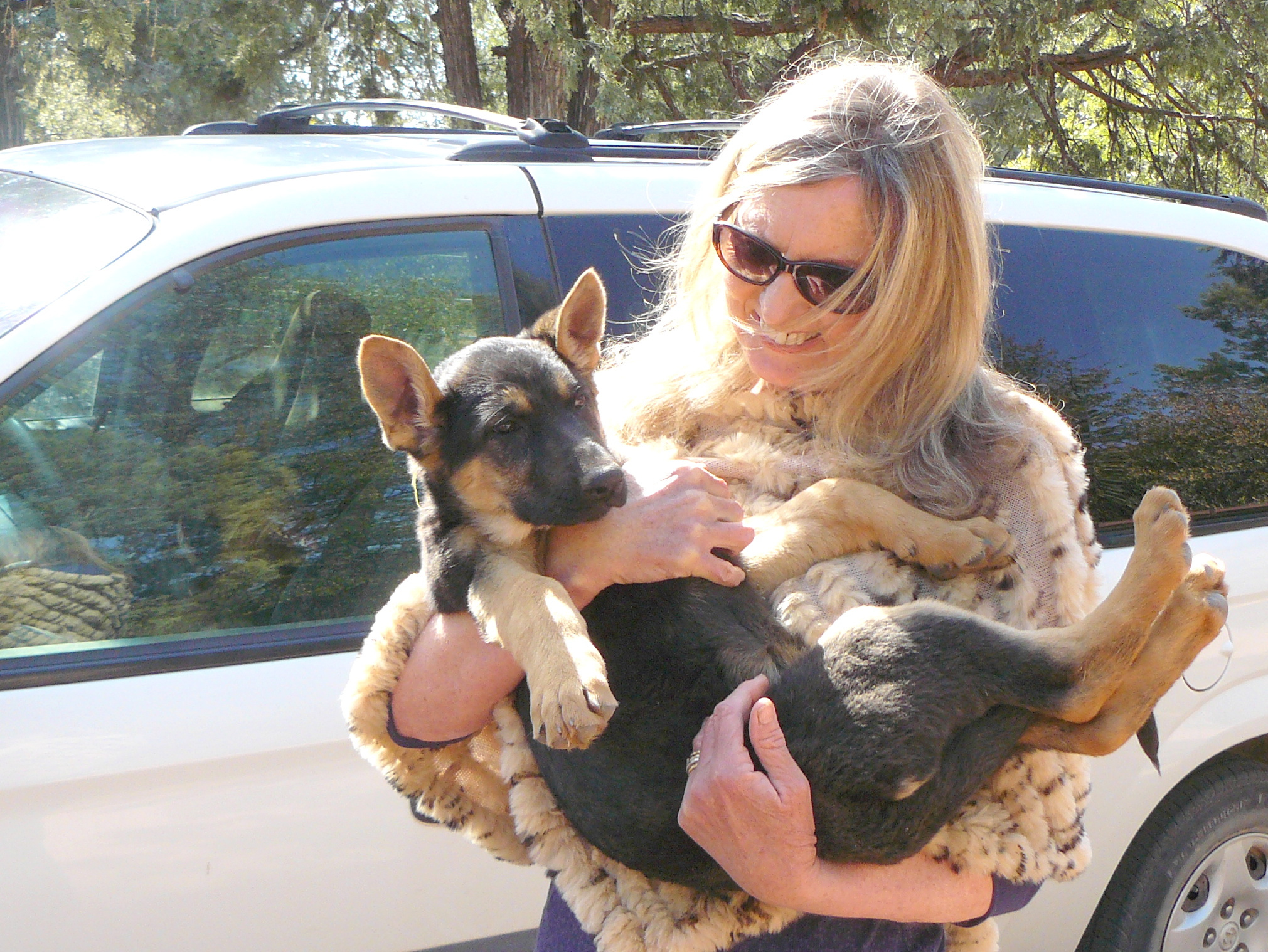
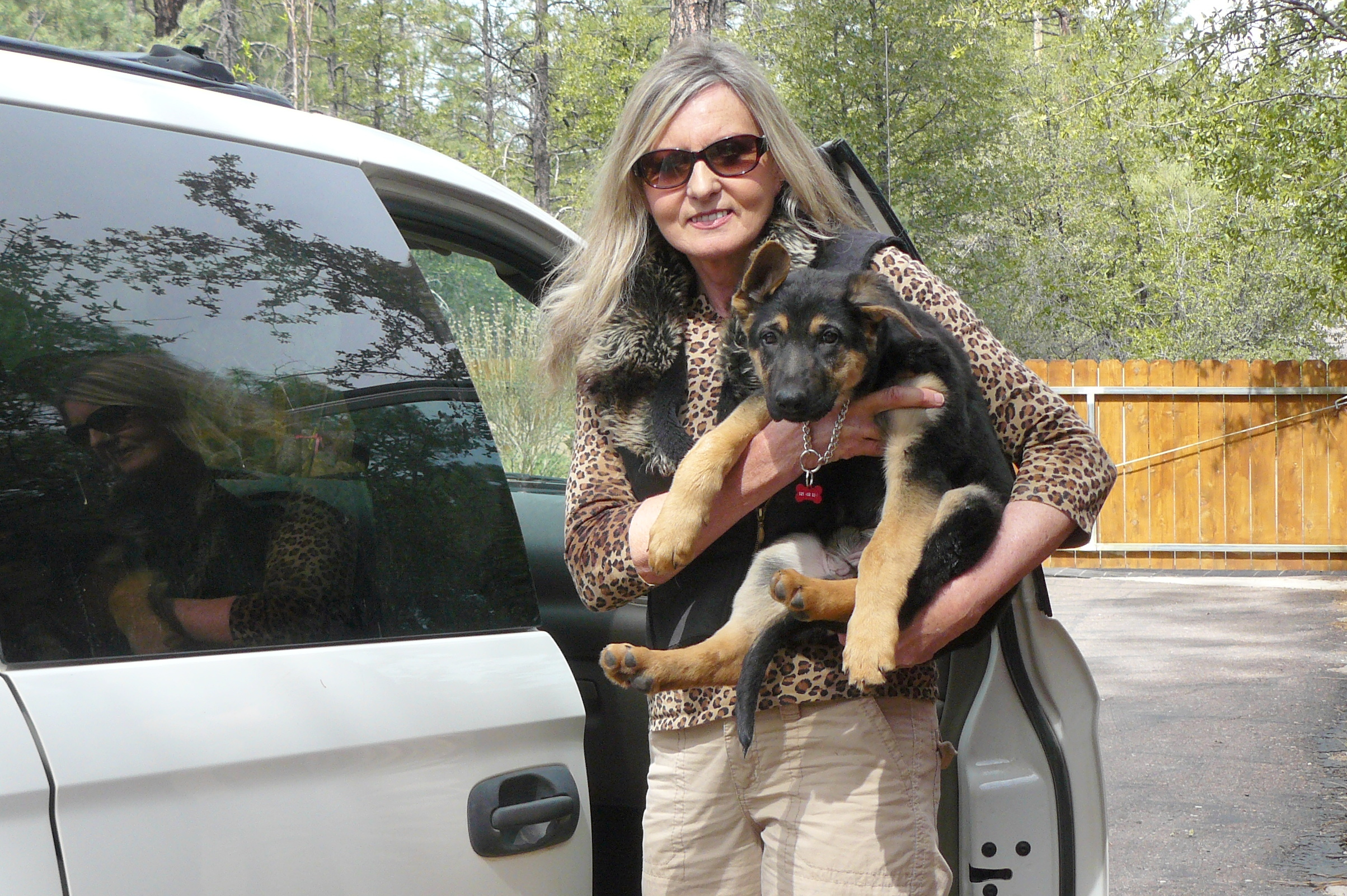
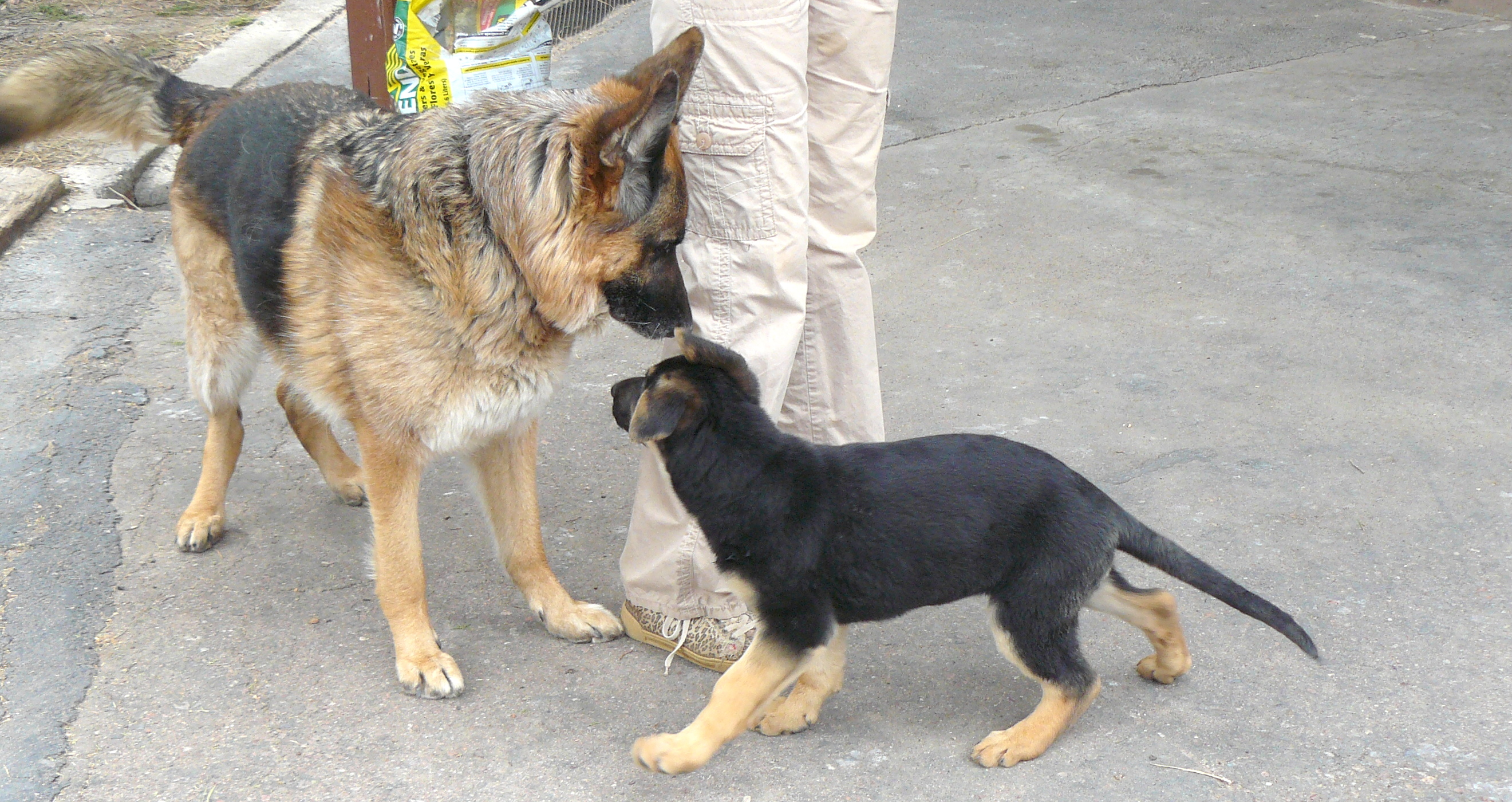
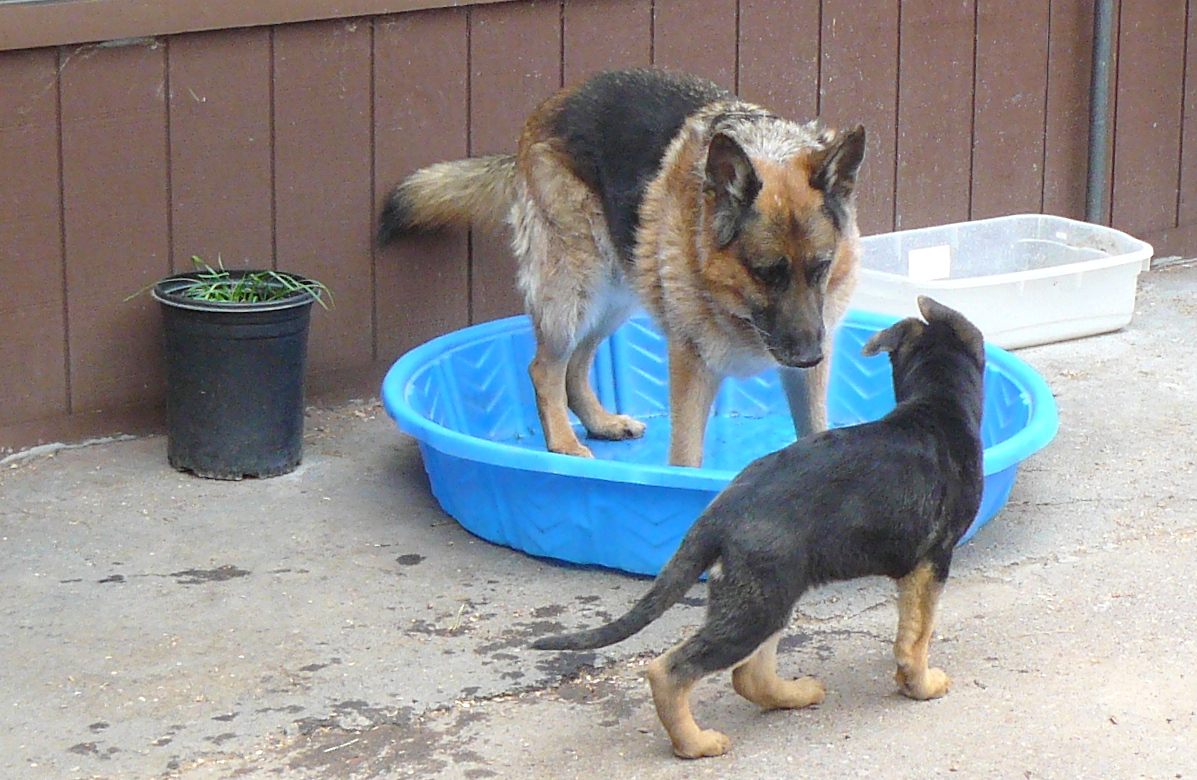
Then yesterday, Saturday, we went back round to collect young Cleo, meeting Brendan’s wife Ebony in the process. The following photographs record some of the key moments.
Homeward bound to a new life!Next step is to meet the gang!Welcome, young lady. I'm the boss around here!It's my pool but you can use it!Hey Sweeny, fancy having one's own woods to play in!She'll do! Nice addition to my family!
So there we are. Back up to eleven dogs, five chickens, six cats, and a fish!
Finally, a big thanks to Sandra of Jutone for her guidance in the last few days.
It’s been a while since Sue of Dreamwalker’s Sanctuary and I started following each other’s Blogs and from time to time Sue sends me an email with something for Learning from Dogs. On the 20th March, I published a guest post from Sue called the Winds of Change. If you didn’t read her wonderful poem then do go there and read it.
Anyway, just a couple of days ago Sue sent me an email with a link to a YouTube video. Put aside a few minutes and be entranced.
So you have just watched the video. How do you feel? I bet that your feelings are not a million miles from the realisation that, like Fiona the dog, being ‘lost‘ is an uncomfortable, unsettling but necessary step along the journey of being ‘found‘. As I wrote in the concluding part of my story Night messages, “The message from the night, as clear as the rays of this new day’s sun, the message to pass to all those he loved. If you don’t get lost, there’s a chance you may never be found.”
When the bond between a human and a dog is expressed as deep love, as it so often is, we relearn the most important lesson of all creation. That mankind’s only hope for the future comes from the pool of love.
No better portrayed than by the photograph below that I presented in a Post on the 17th March, Change out of Hope.
The power of love.
“The one absolutely unselfish friend that man can have in this selfish world, the one that never deserts him, the one that never proves ungrateful or treacherous, is his dog.“ Samuel Coleridge
An interesting reflection on the rearing of cattle and an ‘Anti-Meat pill! No kidding!
I was vaguely aware of the contribution of cattle towards the overall rise in greenhouse gases. A very quick web search found this news item from the United Nations which included,
29 November 2006 – Cattle-rearing generates more global warming greenhouse gases, as measured in CO2 equivalent, than transportation, and smarter production methods, including improved animal diets to reduce enteric fermentation and consequent methane emissions, are urgently needed, according to a new United Nations report released today.
“Livestock are one of the most significant contributors to today’s most serious environmental problems,” senior UN Food and Agriculture Organization (FAO) official Henning Steinfeld said. “Urgent action is required to remedy the situation.”
But what prompted me to look a little closer at this was a recent article on the Big Think website that was entitled, The Anti-Meat Pill: Human Engineering to Combat Climate Change.
Let me quote a little from the article, presented on the Big Think website by Daniel Honan.
NYU Bio-ethicist Matthew Liao has caused a stir recently with a forthcoming paper that explores the biomedical modification of humans in order to stop us from consuming red meat.
and a paragraph later continued with,
In a forthcoming paper to be published in Ethics, Policy and the Environment, Liao suggests that humans might take pills to bring about mild nausea to rid ourselves of our appetite for red meat. This would have a mitigating effect on climate change, he argues.
Liao refers to studies such as a widely-sited UN report that estimates 18 percent of greenhouse emissions come from livestock, which is a higher share than transportation. Another report, from 2009, estimates livestock emissions are significantly higher, at 50 percent. Fact of life: cows fart. Other negative impacts of increased livestock farming includes deforestation and a drain on water supplies.
The Internet rapidly found Matthew Liao’s website and from there the paper referred to above, which is introduced thus,
Professor Matthew Liao of New York University
Anthropogenic climate change is arguably one of the biggest problems that confront us today. There is ample evidence that climate change is likely to affect adversely many aspects of life for all people around the world, and that existing solutions such as geoengineering might be too risky and ordinary behavioural and market solutions might not be sufficient to mitigate climate change. In this paper, we consider a new kind of solution to climate change, what we call human engineering, which involves biomedical modifications of humans so that they can mitigate and/or adapt to climate change. We argue that human engineering is potentially less risky than geoengineering and that it could help behavioural and market solutions succeed in mitigating climate change. We also consider some possible ethical concerns regarding human engineering such as its safety, the implications of human engineering for our children and for the society, and we argue that these concerns can be addressed. Our upshot is that human engineering deserves further consideration in the debate about climate change.
Now if we go back to that UN article, we can see that emissions from cattle and livestock in general is not a minor issue.
When emissions from land use and land use change are included, the livestock sector accounts for 9 per cent of CO2 deriving from human-related activities, but produces a much larger share of even more harmful greenhouse gases. It generates 65 per cent of human-related nitrous oxide, which has 296 times the Global Warming Potential (GWP) of CO2. Most of this comes from manure.
And it accounts for respectively 37 per cent of all human-induced methane (23 times as warming as CO2), which is largely produced by the digestive system of ruminants, and 64 per cent of ammonia, which contributes significantly to acid rain.
With increased prosperity, people are consuming more meat and dairy products every year, the report notes. Global meat production is projected to more than double from 229 million tonnes in 1999/2001 to 465 million tonnes in 2050, while milk output is set to climb from 580 to 1043 million tonnes.
But modifying humans, frankly, misses the point.
That is unless we wholeheartedly embrace the need to change, to sustain the only planet we can call home, and do it because we care, Planet Earth will do the bioengineering for us – engineering us into extinction. For example, just cut back on eating meat! And if you don’t want to do it for the planet, do it for the health of your children as this Health Petition underlines in spades.
So I’m sorry Professor Liao but this seems like a step too far – by a long way.
A reflection of our unconscious minds – and the potential perils ahead.
Last Monday, March 12th, the BBC aired a programme under their excellent Horizon science series. This programme was entitled, Out of Control? Here’s how the programme was introduced,
We all like to think we are in control of our lives – of what we feel and what we think. But scientists are now discovering this is often simply an illusion.
Surprising experiments are revealing that what you think you do and what you actually do can be very different. Your unconscious mind is often calling the shots, influencing the decisions you make, from what you eat to who you fall in love with. If you think you are really in control of your life, you may have to think again.
The whole 60 minute programme was fascinating right from the start when Professor Nobre introduced the secret world of our unconscious mind. Professor Anna Nobre heads The Brain & Cognition Laboratory, a cognitive neuroscience research group at the Department of Experimental Psychology in the University of Oxford.
For starters, how much of your mind do you think is your conscious mind as opposed to your unconscious mind? Watch this clip and be amazed!
“Are you in control of your unconscious, or is it in control of you?”
So let me link how our mind works to something more relevant today than possibly any other aspect of life.
I’m thinking of the fundamental question that bothers me and, perhaps millions of others. That question being: “Why, with the overwhelming scientific evidence that man is critically threatening the planet’s biosphere upon which we all depend, is there not an equally overwhelming global commitment for change to a sustainable way of life?”
Take, for example, this compelling story.
Last Saturday the BBC News website published a report by Richard Black, the BBC’s Environment correspondent, that opened thus,
An eminent UK engineer is suggesting building cloud-whitening towers in the Faroe Islands as a “technical fix” for warming across the Arctic.
Scientists told UK MPs this week that the possibility of a major methane release triggered by melting Arctic ice constitutes a “planetary emergency“. [my emboldening]
The Arctic could be sea-ice free each September within a few years.
and later goes into this detail (do please read it all, it’s only a few minutes of quiet reading),
On melting ice
The area of Arctic Ocean covered by ice each summer has declined significantly over the last few decades as air and sea temperatures have risen.
For each of the last four years, the September minimum has seen about two-thirds of the average cover for the years 1979-2000, which is used a baseline. The extent covered at other times of the year has also been shrinking.
What more concerns some scientists is the falling volume of ice.
Analysis from the University of Washington, in Seattle, using ice thickness data from submarines and satellites, suggests that Septembers could be ice-free within just a few years.
Data for September suggests the Arctic Ocean could be free of sea ice in a few years
“In 2007, the water [off northern Siberia] warmed up to about 5C (41F) in summer, and this extends down to the sea bed, melting the offshore permafrost,” said Peter Wadhams, professor of ocean physics at Cambridge University.
Among the issues this raises is whether the ice-free conditions will quicken release of methane currently trapped in the sea bed, especially in the shallow waters along the northern coast of Siberia, Canada and Alaska.
Methane is a much more potent greenhouse gas than carbon dioxide, though it does not last as long in the atmosphere.
Several teams of scientists trying to measure how much methane is actually being released have reported seeing vast bubbles coming up through the water – although analysing how much this matters is complicated by the absence of similar measurements from previous decades.
Nevertheless, Prof Wadhams told MPs, the release could be expected to get stronger over time. “With ‘business-as-usual’ greenhouse gas emissions, we might have warming of 9-10C in the Arctic. That will cement in place the ice-free nature of the Arctic Ocean – it will release methane from offshore, and a lot of the methane on land as well.”
This would – in turn – exacerbate warming, across the Arctic and the rest of the world.
Abrupt methane releases from frozen regions may have played a major role in two events, 55 and 251 million years ago, that extinguished much of the life then on Earth.
Meteorologist Lord (Julian) Hunt, who chaired the meeting of the All Party Parliamentary Group on Climate Change, clarified that an abrupt methane release from the current warming was not inevitable, describing that as “an issue for scientific debate”.
But he also said that some in the scientific community had been reluctant to discuss the possibility.
“There is quite a lot of suppression and non-discussion of issues that are difficult, and one of those is in fact methane,” he said, recalling a reluctance on the part of at least one senior scientists involved in the Arctic Climate Impact Assessment to discuss the impact that a methane release might have.
Reams of other factual evidence shows that mankind may have only a few years left to stop the planet going into a runaway condition that would then extinguish much of the life on Earth!
So what’s stopping us?
Dr. Sharot
Well back to that Horizon programme. In the programme, Dr. Tali Sharot of University College London explains how we are all optimists despite the risks. I.e. our unconscious mind deliberately prevents negative information from affecting our conscious mind, our conscious judgment.
In an experiment, an individual is asked to guess the likelihood of a whole range of outcomes, 80 in all. Ergo, you see a gentleman guessing the likelihood of cancer as 18%, of a bone fracture as 10%, of Alzheimer’s as 2%, and so on.
In some cases he guessed a pessimistic probability, in others an optimistic probability. After each guess he was shown the correct probability. E.g. cancer 30% vs his estimate of 18%, for a bone fracture 34% vs his guess of 10%, and the risk in reality of Alzheimer’s is 10% versus his instinct of just 2%. I’ve just quoted his optimistic guesses, in many questions his guess was a pessimistic view, i.e. he guessed a higher likelihood than the statistical reality.
Then he was asked all 80 questions again, having seen the accurate probability compared to his intuitive guess.
So here’s the fascinating outcome.
Where his instinct was a negative guess versus the statistical probability then he adjusted his mind and was able to quote a more accurate figure the second time around. But where the reality was more pessimistic than his first guess, then that adjusted knowledge wasn’t retained. In other words, our beliefs only change when we can adjust to a more positive view of the future.
I just hope I have made that clear. Readers may like to view an article written by Dr. Sharot published in TIME Magazine in May, 2011, called The Optimism Bias or read the introduction to a lecture given in Seattle in June, 2011; “A sunny outlook doesn’t just make you a more pleasant companion: Tali Sharot argues that optimism is a tool for survival and happiness that gets us through hard times—even an economic recession. Sharot, author of The Optimism Bias, uncovers myths about optimism, illuminates the ways it can affect our lives, examines why optimism is necessary for us to function, and illustrates how the human brain is extremely adept at turning lead into gold.”
A summary of a publication, Sharot, T. (2011). The optimism bias. Curr Biol 21(23), R941-R945, reads,
The ability to anticipate is a hallmark of cognition. Inferences about what will occur in the future are critical to decision making, enabling us to prepare our actions so as to avoid harm and gain reward. Given the importance of these future projections, one might expect the brain to possess accurate, unbiased foresight. Humans, however, exhibit a pervasive and surprising bias: when it comes to predicting what will happen to us tomorrow, next week, or fifty years from now, we overestimate the likelihood of positive events, and underestimate the likelihood of negative events. For example, we underrate our chances of getting divorced, being in a car accident, or suffering from cancer. We also expect to live longer than objective measures would warrant, overestimate our success in the job market, and believe that our children will be especially talented. This phenomenon is known as the optimism bias, and it is one of the most consistent, prevalent, and robust biases documented in psychology and behavioral economics.
Our bias towards an optimistic future is a “tool for survival and happiness that gets us through hard times.” But if that ancient bias is preventing mankind from recognising just how close we may be to some form of ‘tipping point’ then this tool for survival may be our undoing.
But if on the other hand, we now unite in changing our ways, first by community then by town then by country our future is incredibly optimistic.
“A single candle may light a thousand others and they in turn many thousands more” – Buddha
Don’t worry, this is not going to be some chest-banging Post! I leave those for Monday to Friday. 😉 No, I just wanted to offer a couple of examples of the power of goodness and how making a positive difference is no more than wanting it. As Perfect Stranger commented last Tuesday, “A single candle may light a thousand others and they in turn many thousands more” – Buddha
The first example is about how a group of upstanding citizens rescue a school of dolphins that became stuck on a beach in Brazil.
The second example comes from closer to home. Ginger I. is a Board Member of the Humane Society of Central Arizona and is based at Payson. Jean has been a volunteer at the Society’s Thrift Store for some time and has got to know Ginger well.
Ginger recently emailed me this; it has already done the rounds of the WWW, and quite rightly so. It reminds me of the book Dogs Never Lie About Love, written by Jeffrey Masson, from which comes the following,
This ambiguity, which includes a certain ambivalence as well, has been memorialized in our speech, in our sayings, and in our tributes to and about dogs. Sir John Davies, in his epigram In Cineam (written in 1594), observed:
Thou sayest thou art as weary as a dog,
As angry, sick, and hungry as a dog,
As dull and melancholy as a dog,
As lazy, sleepy, idle as a dog.
But why dost thou compare thee to a dog?
In that for which all men despise a dog,
I will compare thee better to a dog.
Thou art as fair and comely as a dog,
Thou art as true and honest as a dog,
Thou art as kind and liberal as a dog,
Thou art as wise and valiant as a dog.
Ever since Madame Roland said in the eighteenth century “Plus je vois les hommes, plus j’admire les chiens” (The more I see of men, the more I admire dogs), generally what has been written about dogs tends to be positive. Sometimes it is even wonderful, as in William James’s statement “Marvelous as may be the power of my dog to understand my moods, deathless as is his affection and fidelity, his mental state is as unsolved a mystery to me as it was to my remotest ancestor.” Or it may be delicious, like Ambrose Bierce’s definition in his Devil’s Dictionary, “Dog, n. A kind of additional or subsidiary Deity designed to catch the overflow and surplus of the world’s worship.” Samuel Coleridge, in Table-Talk (May 2, 1830), was one of the first to note that “the best friend a man has in the world may turn against him and become his enemy. His son or daughter … may prove ungrateful. Those who are nearest and dearest to him … may become traitors to their faith…. The one absolutely unselfish friend that man can have in this selfish world, the one that never deserts him, the one that never proves ungrateful or treacherous, is his dog.”
Just read that last sentence again from Samual Coleridge as you look at the photograph below, “The one absolutely unselfish friend that man can have in this selfish world, the one that never deserts him, the one that never proves ungrateful or treacherous, is his dog.”
A plea to those who understand climate science so much better than I do!
Background to this Post.
Among my friends, two go way back. One of them, Dan Gomez, a lively, ebullient Californian, was indirectly responsible for me and Jean meeting in Mexico back on December 17th, 2007. I first met Dan at a dealers’ conference in Boston way back in the early days of Commodore Computers. That was the Spring of 1979 and I had flown to Boston as the owner of the 8th Commodore Computer dealership to be appointed in the UK, based in Colchester, Essex. Later, I became the global distributor of an English word processing program known as Wordcraft, written by Pete Dowson in the UK, and appointed Dan as my US West Coast Wordcraft distributor. It gave me a wonderful reason to come out to Southern California several times a year; on business, of course!
Dan and I therefore go back 33 years! Dan’s sister Suzann has a house down in San Carlos, Mexico. Suzann invited me out to Mexico for Christmas 2007 which is where I first met Jean and, bingo, Jean and I then fell in love with each other! How life flows! (Two years ago yesterday, Jean and I moved into our house in Payson with our, then, 13 dogs and 6 cats!)
Paul & Dan Jan. 15th 2008
OK, to the Post!
Dan has been a climate change skeptic, as in caused by man, for many years. Regular readers of Learning from Dogs will know I see things very differently. But Dan and I agree fundamentally on getting to the truth. This Blog proudly claims to seek “The underlying theme of Learning from Dogs is about truth, integrity, honesty and trust in every way.”
So when the other day Dan sent me a number of links supporting his view that “My point remains that climate change is an enormous, complex process that no computer model is going to predict and no human activity modify significantly. Big money is now at stake here and as the article shows, even trusted scientists will produce fraudulent information to further their goals as well as fill politician’s coffers.” I found my faith in my own views slighted dented. Dan is a smart guy, a good thinker and not beholden to any firm or organisation with a vested interest in denying anthropogenic global warming.
IPCC Scientist Admits Fake Data Used To Pressure World Leaders
A scientist responsible for a key 2007 United Nations Intergovernmental Panel on Climate Change report warning Himalayan glaciers would be completely melted by 2035 has admitted that the claim was made to put political pressure on world leaders.
Such was revealed by the British Daily Mail Sunday in an article destined to further reduce the credibility of the world’s so-called leading authority on manmade global warming.
As NewsBusters reported Saturday, the IPCC acknowledged earlier this week that its claim concerning these glaciers was based on junk science.
Anthropogenic (Human Caused) Global Warming – Is This The Greatest Scientific Myth of our Generation?”
January 25th, 2012, Portland, Oregon
First Speaker – Gordon Fulks, PhD Physics, University of Chicago
[Extract]
Dr. Fulks said: “My thesis tonight is simple: virtually ALL of what climate alarmists put forth as science is not. Some is half correct, some is incorrect, and too much is just plain nonsense or worse.”
This led him into what he called “one of the central problems with Anthropogenic Global Warming,” “the integrity of the data.” He discussed a variety of temperature data from land surface data that shows various manipulations and biases to the best global data from NASA satellites to the excellent ice core temperature proxies going back 450,000 years.
Second Speaker – Chuck Wiese, Meteorologist – Oregon State University
[Extract]
Mr. Wiese finished his presentation with the following conclusions:
1. There is nothing in the REAL atmospheric record that supports the recent temperature rise of the last century to carbon dioxide induced anthropogenic warming.
2. The tropospheric water vapor optical depth is remarkably stable but has declined recently over the last 70 years of record as carbon dioxide rose substantially in the atmosphere during the same period. This is a consistent outcome as expected by the first principle founding physics and inconsistent with atmospheric climate models.
3. Without water vapor acting as a positive feedback ( growth pattern ) to increasing carbon dioxide concentrations, the projected radiative forcing on the earth’s surface is but a grossly exaggerated calculation of what the earth’s temperature will actually do in response to carbon dioxide.
4. The earth’s “greenhouse effect” is NOT controlled by atmospheric carbon dioxide. It is modulated and governed by atmospheric water vapor and clouds, where the warming modulation is controlled by the amount of vapor and optical depth. Clouds with the hydrological cycle act to trim out water vapor into a hydrostatic, convective equilibrium. The stable atmospheric optical depth likes the earth mean temperature of 59 deg F without further solar or planetary modulation.
5. The Anthropogenic warming hypothesis by atmospheric CO2 is falsified by the real record and radiation physics.
Third Speaker – George Taylor, former Oregon State Climatologist
[Extract]
His presentation finished with his conclusions:
1. Human activities DO affect climate, in a variety of ways. Greenhouse gases are just one parameter.
2. Natural variations affect climate. I believe that they have been more significant influences on climate because they do a much better job of explaining observed variations.
3. Effects of future changes in CO2 are likely to be modest and manageable.
4. Many aspects of climate remain poorly understood.
The full transcripts and supporting materials may be seen here.
Then, in stark contrast, this week’s edition of The Economist has a leader about the problem of overfishing. “Of all the sea’s many problems, overfishing should be the most fixable. ” What jumped off the page at me was how that leader article started,
ACIDIFICATION, warming, the destruction of coral reefs: the biggest problems facing the sea are as vast, deep and seemingly intractable as the oceans themselves. So long as the world fails to cut its emissions of greenhouse gases, cause of the global warming behind these troubles, they will grow.
So a newspaper of the standing of The Economist is clear, “So long as the world fails to cut its emissions of greenhouse gases, cause of the global warming behind these troubles”
So if, dear reader, you can offer good supporting evidence as to why the Oregon Chapter of the American Meteorological Society seems to contradict what so many now believe, that mankind is changing the Earth’s climate, please comment or, better still, consider writing a guest post.












 Learning from Dogs