Lack of sleep can have a role in obesity and diabetes.
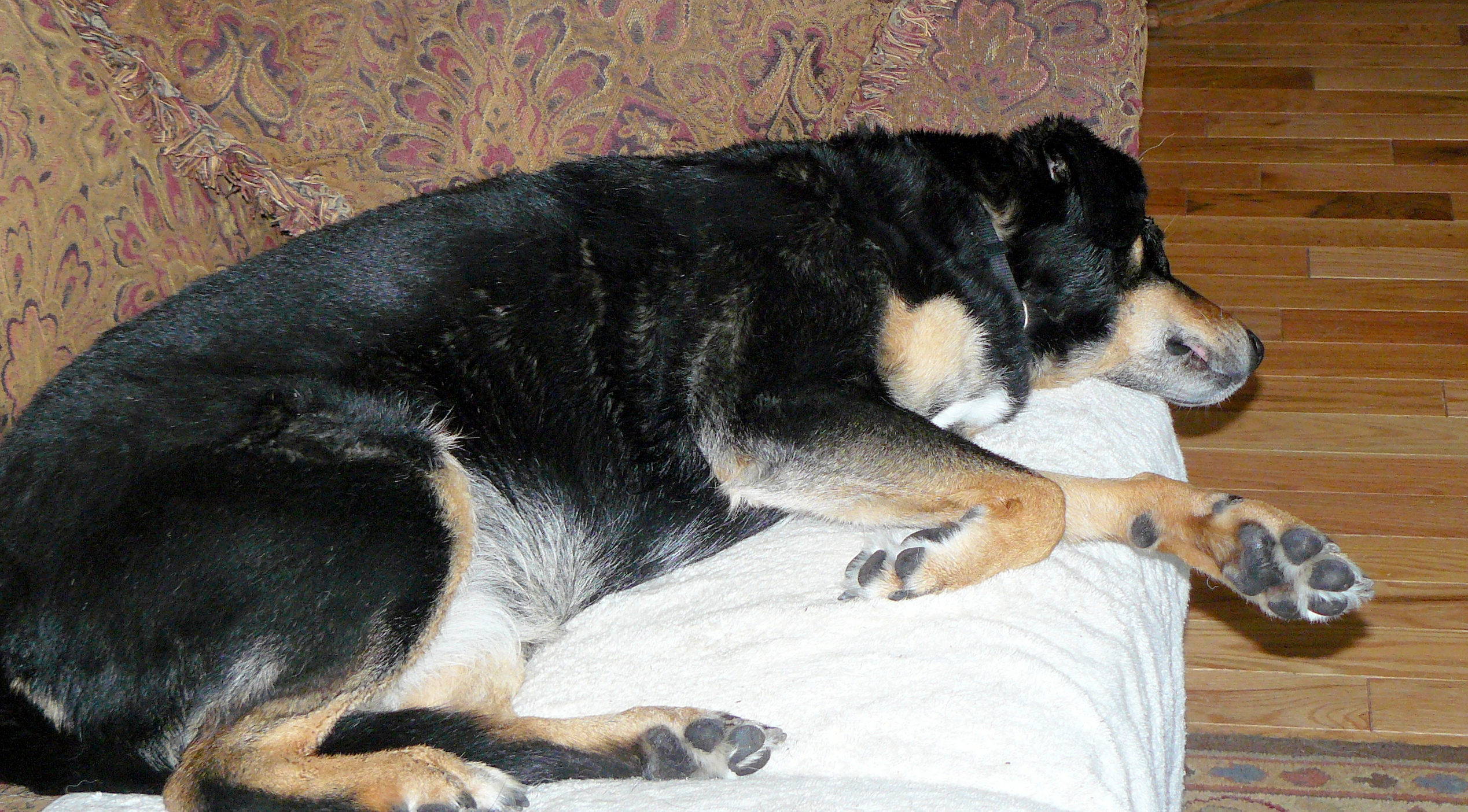
Hazel asleep on the living-room couch at 2pm yesterday.
The sub-heading is taken from an item on the BBC News website that I read yesterday morning. (I’m republishing it in full so that readers are fully informed.)
Lack of sleep can have role in obesity and diabetes, study says
By James Gallagher, Health editor, BBC News website, San Diego
If you need a lie-in at weekends to make up for lack of sleep in the week, you may be at risk of obesity and type 2 diabetes, a study suggests.
The sleeping habits of 522 people found those losing sleep on weekdays were more likely to develop the conditions.
The findings, shown at the Endocrine Society‘s annual meeting, suggested increasing sleep could help patients.
Experts said the findings were interesting and called for the idea to be tested in large trials.
Studies have already shown that shift work can rapidly put healthy people into a pre-diabetic state.
The action of throwing the body clock out of sync is thought to disrupt the natural rhythm of hormones in the body, leading to a host of health problems.
But the pressures of work and social lives mean many people cut their sleep during the week and catch up at the weekend. Researchers are investigating whether there is a health impact.
Widespread
The study, by a team at the University of Bristol in the UK and Weill Cornell Medical College in Qatar, assessed “sleep debt” – a measure of the difference in the nightly hours asleep on weekdays and at the weekend.
“We found that as little as 30 minutes a day sleep debt can have significant effects on obesity and insulin resistance,” said Prof Shahrad Taheri from Weill Cornell.
He added: “Sleep loss is widespread in modern society, but only in the last decade have we realised its metabolic consequences.
“Our findings suggest that avoiding sleep debt could have positive benefits for waistlines and metabolism and that incorporating sleep into lifestyle interventions for weight loss and diabetes might improve their success.”
The study was funded by the UK’s Department of Health, where 10% of healthcare budgets are already spent on treating diabetes.
The disease can lead to blindness, increase the risk of heart attacks and strokes, as well as damaging nerves and blood vessels – dramatically increasing the risk of a foot needing to be amputated.
What the researchers do not know is the impact of improving people’s sleep so they get more on a weeknight and do not need a weekend lie-in.
Dr Denise Robertson, a senior lecturer from the University of Surrey, commented: “This work is interesting and consistent with prospective data found in healthy individuals without type 2 diabetes.
“However, before this association between sleep length, obesity and metabolic status can be used in terms of public health we need the next tier of evidence.
“To date there have been no randomised controlled trials where sleep debt is addressed and a metabolic benefit is observed. However, the potential for such interventions to impact on health is great.”
So while it might be regarded as a little ‘tongue-in-cheek’ to say that we need to learn to sleep more effectively from dogs, the BBC item suggests that it’s not as silly as one might think.
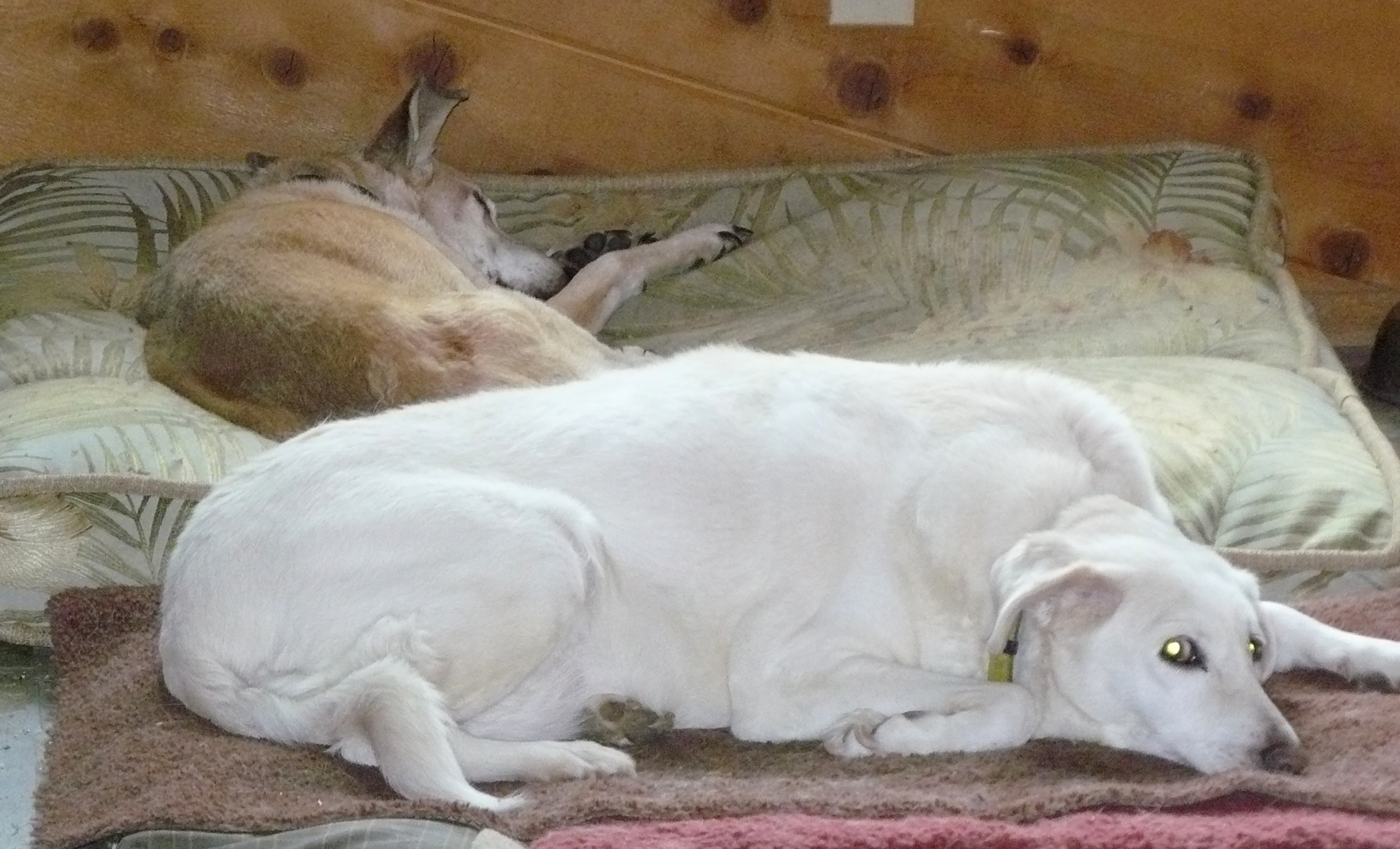
Lilly, to the rear of Paloma, sleeping soundly yesterday afternoon.
In the photograph above of Lilly and Paloma, both Mexican feral dogs rescued by Jean many years ago, sleep and a gentle life have allowed Lilly to achieve the grand old age of 17! In human terms that would be the equivalent of 136-years-old!
Dogs watch us all the time and read our body language like a sixth sense.
A fascinating, and inspiring, insight into our favourite animal companion.
Published on Jan 26, 2014
Check out BBC Earth on BBC online
Dogs watch us all the time and read our body language like a sixth sense. They also smell our bodies for changes.
Max smelt cancer in Maureen before any medical scans could pick it up. Dogs do this naturally and can be trained to pick up on tiny volatile chemicals given off by cancerous tumors. They can even be taught to alert diabetics to low blood sugar levels.
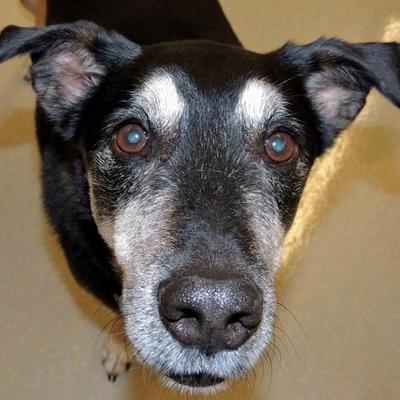
This is Frankie, a German shepherd mix. He can sniff out thyroid cancer in patients’ urine samples with 88% accuracy, according to a new study.
Image via The Endocrine Society.
A trained scent dog accurately identified whether patients’ urine samples had thyroid cancer or were benign (noncancerous) 88 percent of the time, according to a new study by researchers at University of Arkansas for Medical Sciences (UAMS). The results were presented March 6 at the Endocrine Society’s annual meeting in San Diego.
Approximately 62,450 new cases of thyroid cancer will be diagnosed in the US this year, and around 1,950 Americans will die from the disease.
Techniques used to diagnose thyroid cancer include fine-needle aspiration biopsy, which involves the patient having a thin needle inserted into the thyroid gland in the neck to obtain a tissue sample. Donald Bodenner, MD, PhD chief of endocrine oncology at UAMS is the study’s senior investigator. Bodenner said:
Scent-trained canines could be used by physicians to detect the presence of thyroid cancer at an early stage and to avoid surgery when unwarranted.
Study-coauthor Arny Ferrando previously “imprinted,” or scent-trained, a rescued male German Shepherd-mix named Frankie to recognize the smell of cancer in thyroid tissue. Ferrando, who noted that dogs have at least 10 times more smell receptors than humans, said:
Frankie is the first dog trained to differentiate benign thyroid disease from thyroid cancer by smelling a person’s urine.
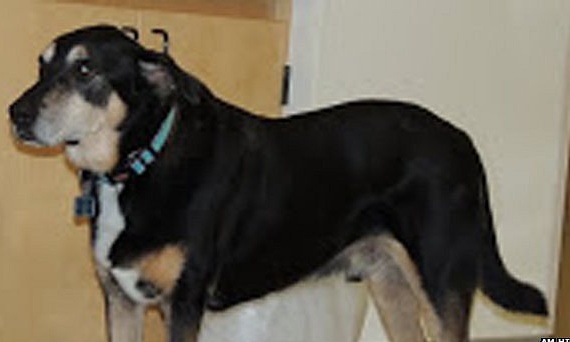
German shepherd mix Frankie, a formerly stray dog rescued in Little Rock, Arkansas, was trained to diagnosis thyroid cancer through scent imprinting. Image credit: AM Hinson/BBC
In this study, 34 patients gave a urine sample before they went on to have a biopsy of suspicious thyroid nodules and surgery. The surgical pathology result was diagnosed as cancer in 15 patients and benign thyroid disease in 19. These urine samples were presented one at a time to Frankie to sniff. Frankie had been trained to alert to a cancer sample by lying down, and turning away from a benign sample to alert the absence of cancer.
The dog’s alert matched the surgical pathology diagnosis in 30 of the 34 study samples, the investigators reported.
Bottom line: A new study by University of Arkansas for Medical Sciences (UAMS) researchers presented March 6, 2015 at the Endocrine Society’s annual meeting in San Diego described Frankie, a trained scent dog that accurately identified whether patients’ urine samples had thyroid cancer or were benign 88 percent of the time.
Last Friday, I published a post under the title: Written with a heavy heart! It was about the appalling atrocities being carried out by ISIS. I was humbled by the many replies.
Yesterday, Su sent me another email that contained a link to a short video of what happened in Holland in September, 2011 when a Muslim attempted to make his personal beliefs known to Queen Beatrix of Holland.
All will become clear when you watch the video.
Love is the answer!
Now at first sight this may seem a silly, naive comment from a Brit who is way past longing for the hippie days of the 60s.
Sue, I looked at Paul’s post and came away with tears rolling down my face. Why isn’t this shown on our news, why aren’t we doing more to save these people? We start wars for oil and political ideology but not to save children. Today i just heard that the last group of the Peace Corp just pulled out of Israel because it was no longer safe enough to be there. We can’t keep ignoring what is going on in other parts of the world yet what can we as individuals do? Your poem was perfect for the subject and brings out much of the same questions I have swirling in my head now.
Here’s another reminder of the power of love; a reminder of the role of dogs in allowing us humans to open our hearts and practice unconditional love.
It’s what Jean and I experienced when we were out shopping in Grants Pass yesterday morning.
We were in a largish store when I saw a grey-haired woman pushing her shopping cart. Nothing unusual about that! But this shopping cart had a small, black puppy riding in the section where handbags are placed; just beyond the push-bar.
Halfway down the same aisle that we were in, the lady paused, lifted the puppy into her arms, and was looking at some food items on a shelf. It was more than Jean and I could resist and we both approached the woman.
It turned out that the lady was 71 and had recently lost a dog from old age. As we petted the little puppy we learnt that he was 10 weeks old and that his name was Shadow.
Then without any prompting she went on to say:
People said I’m too old to be taking on a puppy. But I was so heart-broken when my dog died; so lonely without having him in my life. Now I have Shadow and I can face my days again. Little Shadow means the world to me. And I’m not going to worry about the future – I’m sure someone will take Shadow when I die. I just know that there is nothing better than the love of a little dog.
The power of love.
Of all the many things we can learn from dogs love is the greatest.
How to finish today’s post?
To me, only one way. Over to you: Simply Red.
Lives and loves
Don’t tell me about it
To respond to something permanent
You’ve got to be strong
Lives and loves
Only you know in your heart
How the pain felt
How the love made you melt
Me and you love
We have a way that seems to brighten up the day
We have our problems
Is the whole world asking, “Is it worth it?”
All the lovers in the world
Should they go on?
After all, they say
“You only live once”
Lives and loves
Only you know in your heart
How the pain felt
How the love made you melt
Me and you love
We have a way, that seems to brighten up the day
We have our problems
Is the whole world asking, “Is it worth it?”
All the lovers in the world
Should they go on
On and on and on
Lives and loves
Don’t tell me about it
Someone always gets hurt in it
You’ve got to be strong
Yeah lives and loves
Only we know in our hearts
How the pain felt
Oh your love made me melt
Me and you love
We had a way that seemed to brighten up the day
We had our problems
Is the whole world asking, “Is it worth it?”
All the lovers in the world
Should they go on?
After all, they say
“You only live once”
(NB: I am presently away with my son enjoying the Wintry delights of Bend, Or and Mount Bachelor.)
In yesterday’s post, Be good to yourself, I featured a poem from Danna Faulds. I had not come across her before and this time around it was thanks to a recent post over on Val Boyco’s blog Find Your Middle Ground.
It didn’t take much effort to find more beautiful ideas from Ms. Faulds. Try these, for example:
Awakening Now by Danna Faulds
Why wait for your awakening?
Do you value your reasons for staying small
more than the light shining through the open door?
Forgive yourself,
Forgive yourself.
Now is the only time you have to be whole.
Now.
Now is the sole moment that exists to live in the light of your true nature.
Perfection is not a prerequisite for anything but pain.
Perfection is not a prerequisite for anything but pain.
Please, oh please, don’t continue to believe
in your stories of deficiency and failure.
This is the day of your awakening.
Elsewhere, on a yoga website, we learn that Danna is:
Danna Faulds, poet and dedicated practitioner of Kripalu Yoga, is the author of four popular books of yoga poetry: Go In and In; One Soul; Prayers to the Infinite; and From Root to Bloom. She credits Kripalu Yoga and expressive writing with transforming her life.
Another web search very quickly finds this item over on the All Things Healing blogsite.
ooOOoo
Allow
by Danna Faulds
Editor’s Note from Diane Renz: I have just returned from the Center for Mindfulness Scientific conference, a powerful gathering for all teachers, researchers, clinicians, and practitioners engaged in Mindfulness in the world. The Center for Mindfulness if the base point for Jon Kabat Zinn’s MBSR (Mindfulness Based Stress Reduction) program developed over 30 years ago which, through science, has proven to benefit psychological, physiological, emotional, cognitive, and the many neural correlates relative to well-being. The last day we had the chance to practice mindfulness with Jon Kabat Zinn, Saki Santorelli, Florence Meleo-Meyer, Bob Stahl, which is where I first heard the Poem here called “Allow”. It is through our allowing where we each find our healing and return to our wholeness. In light of spring and all rebirth and beginning again, learning how to turn toward our pain so we can open to bright new growth rising up from the dark compost of our suffering.
There is no controlling life.
Try corralling a lightning bolt,
containing a tornado. Dam a
stream and it will create a new
channel. Resist, and the tide
will sweep you off your feet.
Allow, and grace will carry
you to higher ground. The only
safety lies in letting it all in –
the wild and the weak; fear,
fantasies, failures and success.
When loss rips off the doors of
the heart, or sadness veils your
vision with despair, practice
becomes simply bearing the truth.
In the choice to let go of your
known way of being, the whole
world is revealed to your new eyes.
ooOOoo
Again from that All Things Healing website:
About the Author
Danna Faulds is a long-term practitioner and teacher of Kripalu Yoga. A former librarian, she incorporated writing into her spiritual practices years ago, and this book is the result. Drawing inspiration from yoga and meditation, from the natural world, and from life, her poems capture both the struggle and the delight of the attempt to live consciously, in a voice that always encourages and uplifts. Common themes include awakening to true nature, touching the divinity within, overcoming fear and self-judgement, and the ineffable joy of spiritual union.
(NB: By the time you read this, I will be away for three days with my son enjoying the Wintry delights of Bend, Or and Mount Bachelor.)
I spoke yesterday about the many writers who follow this place and, in turn, are followed by me. Val Boyco is one such example. Val writes the blog Find Your Middle Ground and it is with her permission that I republish a recent post of hers.
ooOOoo
Inspiration – Self Observation
Posted on February 24, 2015 by Val Boyko
A reminder for all of us who are working on self observation and dealing with our inner critic.
Be gentle with yourself on this part of the journey.
Self-Observation Without Judgment
Release the harsh and pointed inner voice.
It’s just a throwback to the past, and holds no truth about this moment.
Let go of self-judgment, the old, learned ways of beating yourself up for each imagined inadequacy.
Allow the dialogue within the mind to grow friendlier, and quiet.
Shift out of inner criticism and life suddenly looks very different.
I can say this only because I make the choice a hundred times a day to release the voice that refuses to acknowledge the real me.
What’s needed here isn’t more prodding toward perfection, but intimacy – seeing clearly, and embracing what I see.
Love, not judgment, sows the seeds of tranquility and change.
The strong case for maintaining the very best of emotional hygiene.
As is the way of things, last night, after I had read out aloud to Jean yesterday’s conclusion to my personal story entitled The Pen (the first part was on Monday), Jean and I were looking around for something to watch. We dipped into TED Talks and found a recent addition from a Dr. Guy Winch, a licensed psychologist, keynote speaker and author. Here is that talk that so perfectly rounds off the previous two days.
Published on Feb 16, 2015
We’ll go to the doctor when we feel flu-ish or a nagging pain. So why don’t we see a health professional when we feel emotional pain: guilt, loss, loneliness? Too many of us deal with common psychological-health issues on our own, says Guy Winch. But we don’t have to. He makes a compelling case to practice emotional hygiene — taking care of our emotions, our minds, with the same diligence we take care of our bodies.
Dr. Guy Winch
If you want to learn more about Guy Winch then his website is here, and there is an item about Dr. Winch on the Psychology Today website.
(Please note that this is a long post that potentially may be upsetting for some readers. Please trust me when I say there is no intention to upset anyone. I should add that the motivation for writing The Pen is from reading Sue Dreamwalker’s recent post Cracking our Inner Shells.)
Yesterday, I wrote about the circumstances of my father’s death on December, 20th 1956. I wrote:
I became twelve-years-old in November, 1956. Just six weeks after my twelfth birthday, on the evening of December 19th, 1956, my mother, as normal, came into my bedroom to kiss me goodnight. However, what transpired was very far from normal.
For she sat down on the edge of the bed and told me that my father was not well and may not live for much longer. To this day, I can still see her sitting on the edge of the bed, adjacent to my knees covered by the sheet and bedcover, a very drawn look on her face.
I had been aware of my father being at home in bed for a while but had no notion whatsoever, prior to this moment, that he was seriously unwell. In hindsight, it was more than I could emotionally embrace for not only did I not go back into my parent’s bedroom and again say goodnight to my father, I went off to sleep without any problem.
During that night, in the early hours of December 20th, my father died, the family doctor attended and my father’s body was removed; I slept through it all and awoke in the morning to find my father gone.
It’s also relevant to reveal that it was deemed potentially too upsetting for my sister, Elizabeth, my junior by four years, and me to attend my father’s cremation.
Upper Barn, Harberton.
OK! Fast forward to 2006. I was happily married to Julie, my third wife, and had been since the year 2000. Her daughter from a previous marriage, Amy, was also part of the family. We were living in a three-bedroomed converted stone barn known as Upper Barn in the village of Harberton, a few miles west of Totnes, Devon, South-West England. A lovely tranquil home in a very tranquil village; population 300 persons.
I had my two wonderful sisters, Corinne and Rhona, from my father’s first marriage, living within short distances. My work, home-based, involved offering entrepreneurial mentoring to local business owners, and my wife and I had a wonderful local network of good friends. Indeed, in the last months of 2006 I had been working with a professional psychotherapist, Jon, as he was expanding his client base from individuals to working within companies. And Pharaoh had been in the family since 2003! It seemed about as perfect as it could be for me.
December 20th, 2006 was the fiftieth anniversary of my father’s death. I could never settle into the pre-Christmas mood until after the 20th December each year and this anniversary day seemed more poignant than ever. I had missed my father since the day he had died in 1956.
As it happened, that same day Julie seemed off-colour. She was frequently in the bathroom during the day and, naturally, I was concerned. Towards the end of the day I asked what was troubling her. Julie replied that she had had a miscarriage earlier that afternoon. A year after my son and daughter had been born to my first wife in 1972/1973, I had opted to have a vasectomy! Julie’s miscarriage was not of my making.
I won’t go into the details of how my life exploded but will just say that it was traumatic in every way imaginable.
In desperation, a few weeks into the New Year of 2007, I called my psychotherapist business client, Jon, and begged him to take me on as his client. He was initially uncertain, stating that we already had a relationship, but agreed on the understanding that if he thought the counselling relationship wasn’t properly established then he would ask me not to continue working with him. Of course, I agreed.
I want to offer what has been written elsewhere by me, explaining what happened in my fourth counselling session with Jon back in 2007. Clearly my memory of what was said can’t be word perfect but the essence of the dialogue is accurate.
“Paul, when we had our first session and I asked you to relate the key life events that came to you, the first event you spoke of was the death of your father. Tell me more about that time of your life.”
“I don’t have clear memories of my father much before he died that year. He was a lot older than my mother, some eighteen years, and I had been the product of a liaison between them; my father being married at the time. They met when they were both members of an amateur orchestra in London during the height of the Second World War. My father had had two daughters with his wife and longed for a son. I came along just six months before the end of the war.”
I paused for a few moments, sensing how dipping back to that December in 1956 was making me feel uncomfortable.
“I had turned twelve-years-old in early November 1956. Just finished my first term at Grammar School. To be honest, I can’t recall when my father became ill and how long he had been bed-ridden. But on the evening of December 19th, after I had kissed my father goodnight and jumped into my bed next door, my mother came in, closed my bedroom door, sat on the edge of my bed and told me that my father was very ill and that he may not live for much longer.
It clearly didn’t register with me at any significant emotional level because I went off to sleep without any problem. But when I awoke in the morning, Mum told me that my father had died during the night, the family doctor had attended and my father’s body had been removed from the house.”
Jon looked at me and quietly asked, “What feelings do you have about that night and that morning?”
“To be honest, Jon, I have an almost complete absence of feelings. I’ve often tried to discover what I truly felt at the time or, indeed, what I feel all these years later. But the best I have ever been able to come up with is that I was never able to say goodbye. In fact, because it was decided that it would be too upsetting for me, I wasn’t even present at the funeral and cremation, thus reinforcing my sense of not saying goodbye to my father.”
There was a pause before Jon asked his next question. “So, Paul, you have a son and a daughter. What are their ages?”
“My son, Alex, is now thirty-five and my daughter, Maija, thirty-four.”
Jon put his hands together fingers-to-fingers and lent his chin against them. “So your son would have been twelve in 1984. That was when you were very busy running your own business, if I recall.”
I nodded in reply.
“So Paul, let’s say that during that year of 1984 you had been diagnosed with some terminal illness, say cancer, as with your father. That you were given a life expectancy of six months or so. What thoughts come to mind?”
“Jon, you mean in the sense of what it would have meant for Alex and Maija?”
Jon nodded.
“Wow, what a truly terrible thing to reflect upon. But what comes to mind without doubt is that I would have walked away from my business immediately. After all, it very soon wasn’t going to be my business. My kids were still living at home, of course. I would have wanted to share every minute of my life with them. Try to let them understand as much about me, who I was, what I believed in, what made Paul Handover the person he was.”
Jon almost breathed the next question into the air of the room. “Translate the circumstances of the death of your father across to your son. What I mean by that is Alex experiencing the same circumstances from your death. What’s your reaction to that situation, admittedly hypothetical situation, thank goodness?”
I reacted with an immediate passion. “To know that I was terminally ill and to keep that from my son and daughter; that’s terrible, no it’s disgusting. Then to compound it by having everything associated with my death and the disposal of my body denied to Alex and Maija …..,” I left the sentence unfinished before adding, “It’s cruel beyond description. My poor children wouldn’t have a clue as to why they were excluded from what is, whether or not one agrees with it, one of life’s most important moments.”
Jon seemed to hold my anger in the room all about us, as he asked, “How would you reword your last sentences in the manner of a headline; in just a few words?”
I hardly hesitated. “The word that comes to mind is rejection. Alex and Maija, aged twelve and eleven, losing their father in a way that suggested they weren’t important. Yes, that’s it. They would see it as a total rejection of them by their father. Not unreasonably, I might add.”
There was a silence in the room that seemed to go on forever. Then Jon said, “Paul, we are not quite up to the hour but I’m going to suggest you just sit here quietly with Pharaoh and let yourself out when you are confident of being OK to drive home.”
He added, almost as an afterthought, “Just let today settle itself into your consciousness just however it wants to. Don’t force your thoughts either way, neither dwelling on today nor preventing thoughts naturally coming to the surface of your mind. As we have discussed before, pay attention to your dreams. Maybe have a notebook by your bedside so you can jot down what you have been dreaming about. I’ll see you next Friday same time, if that’s alright with you.”
When a crossroads is neither a roadway, nor a choice of pathways, when that crossroads is in our minds, we seldom know it’s there or that we’ve made the choice to take one path and not the other until it’s long past. Sometimes, the best you can do is look for the tiniest clues as to which path one has taken in life and where one is really heading.
I had read that in a book quite recently although, typically, could no longer remember the name of the said book. It had spoken to me in a way that I couldn’t fathom, but of sufficient strength and clarity for me to jot it down on a sheet of paper. I had been sorting papers out on my desk on the Sunday following that last session with Jon when I came across the sheet. The words hammered at me again, but in a way that was now so much more full of meaning than the first time around.
Because, to my very great surprise, my nights’ sleeps on Friday and Saturday had not only been dream free but had taken me to a place of such sweet contentment that it was almost as though I had been reborn. Alright, perhaps reborn was a little over the top, but there was no question that I was in an emotional place quite unlike anything I could ever before recall. Almost as if for the first time in my life I truly liked who I was.
On the Sunday morning, after I had taken Pharaoh over to the woods for our regular walk, I called in on Corinne and shared a cup of tea with her. As I was leaving, Corinne asked me if I was alright. In querying why she had asked, Corinne simply said, “Oh, I don’t know. There’s something different about you today that I can’t put my finger on. A happiness about you that I haven’t seen in ages, possibly never seen in you.”
I gave my sister a long and deep hug and gently said, “I miss our father at times, don’t you?”
She answered, “Oh, I miss him too, miss him so much at times. He was such a wonderful, gentle man who lived for his children. Then to die at such a young age.”
As the week rolled by, I found a truth that had been denied me for the whole of my life. I couldn’t wait to share it with Jon. As I drove across to Torquay, I was full of what I wanted to say.
Jon could tell that I was fit to burst. Indeed, I had hardly sat down on the chair when Jon asked me how my week had gone.
“Jon, It’s been an amazing week. I’ve at last understood some fundamental aspects of my life.”
“That sounds wonderful, Paul, do tell me more.”
“Well, it’s this. I have now realised the emotional consequences of the way my father’s death was handled. In other words, what became hidden deep in my subconscious, far from sight, so to speak, was a belief of having been emotionally rejected. That despite that being so far down in my subconscious world, it clearly explained two conscious ways in which I behave.”
Jon’s demeanour, his wonderful listening demeanour, encouraged me to continue. “The first thing that came to me was the reason why I have been so unfortunate in my relationships with women. Well this is how I figured it out. Whenever a woman took a shine to me, I would do anything and everything to come over as a potentially attractive spouse. In other words, I was being driven by a terrible fear of rejection, rather than rationally wondering if this woman had the potential to be a woman I would love as a wife. Ergo, I oversold myself and, inevitably, made poor long-term relationships; Julie being the classic example.”
I paused and took a sip from the glass of water that was on the small table by my side.
“But the positive aspect of my fear of rejection is that throughout the whole of my business and professional life, I have been successful. Because, I have always put the feelings of the other person above my own as a means of avoiding rejection. Jon, I can’t tell you what a release this has been for me.”
“Paul, that’s a fabulous example of how when we really get to know the person we are, how it then gives us a psychological freedom, a freedom to be the person we truly are, to be happy with ourselves.”
He continued, “One thing I should mention is this. It’s likely that what happened to you back in December 1956 is not necessarily ‘hard-wired’ but certainly is a very deep-rooted emotional aspect of who you are. This new-found awareness will be of huge value to you but that sensitivity to rejection is not going to disappear; probably never will. The difference is that you are now aware of it and quite quickly you will spot the situations, as they are happening, that stir up those ancient feelings. The difference is this new self-awareness will deliver a much deeper emotional understanding of who you are and why you behave in the way you do.”
There was a wonderful sense of peace and calm in the room that ran on for some minutes.
Then Jon just voiced what seemed like the perfect closing thought. “Paul, this mindfulness you have so beautifully revealed is wonderful. You do know you are fine, don’t you!”
I was motivated to reveal these details of my past by what Sue wrote in her recent post Cracking our Inner Shells. She included these words:
Sometimes we have to go within to the silent places we all have in order to find out what is really going on with our emotional bodies. Even knowing all the things I do, we are within our Human form to learn and grow..
I needed to ask myself a few questions as to why I was feeling so lost, depressed and sad… More was going on than just bereavement. Yes the fall I had had,both bruised and shook me, but what else was shaking me to the core?
For those who know a little about my Soul Journey, You will also know that my own Mother and I had not spoken for 10 years prior to her passing some eleven years ago now….Despite many attempts I knew I was only wounding myself more by continually trying to bridge the rift, to be continually rejected.. So this rejection and other issues related to overwork and stress, resulted in a Nervous Breakdown in my mid forties..
So when my Mother died, while I was sad, I guess I never really grieved her loss. Because to me.. I had grieved her long before her death as lost to me.. As I had had to shut down my emotions to cope with her rejection.. I had undergone counselling within my breakdown, and my Mother jumped up at every dark corner of why even in my teens I had suffered from deep depression.
We often go through whole chapters of our lives creating a protective shell around ourselves because we need it in order to heal from some early trauma. I know I had built many such Layers of shell around myself from various experiences over the years..
But more than that, I recommend that if you have any sense of there being hidden parts of your consciousness that would be better brought to the light, then you involve a professional counsellor or psychotherapist. For the reward will be beyond measure.
As mine was.
For on December 14th, 2007 I first met Jean when invited to San Carlos in Mexico for the Christmas period by Suzann and Don Reeves; Suzann being the sister of my very long-term Californian friend Dan Gomez.
Jean and I have now known each other for over seven years and have been married for over four years. I love her beyond imagination. Because I can reveal to Jean the strange, quirky, often fragile person that I am. And I am loved for who I am by Jean.
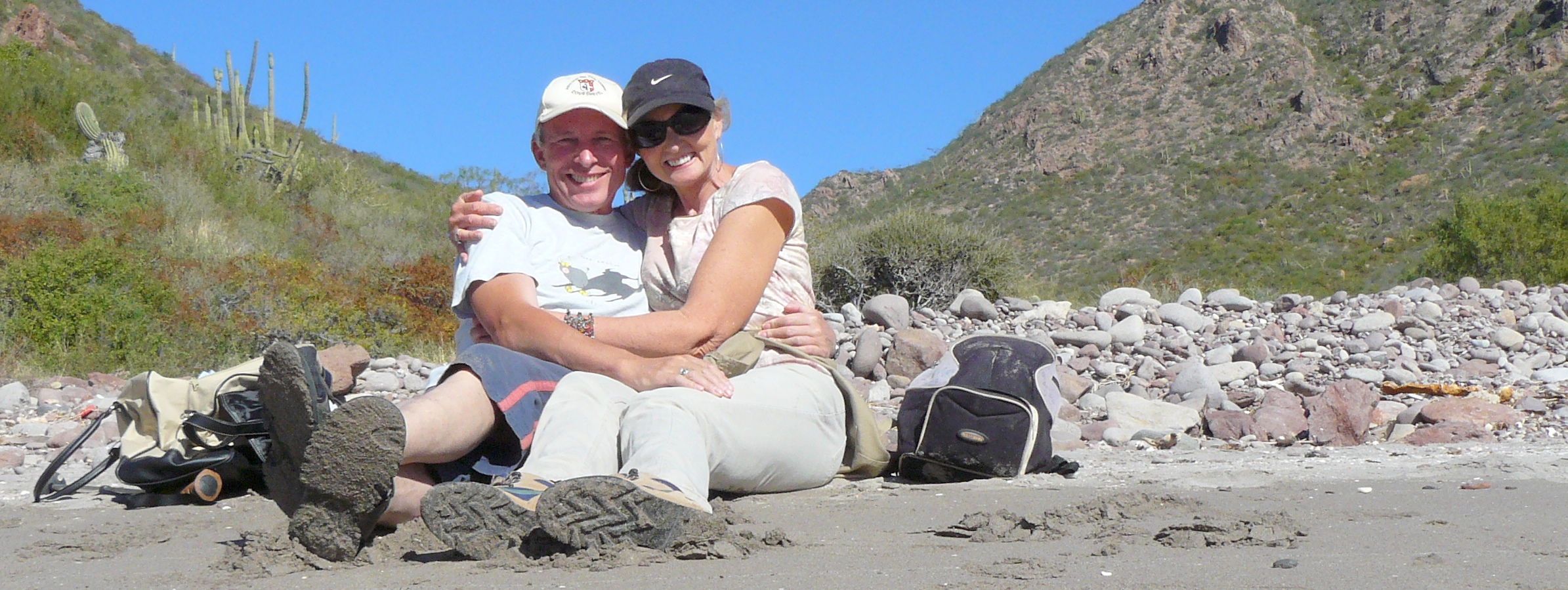
6th January, 2008. Jean and me on a beach in Mexico.
This is the poem I wrote for Jean for this Valentine’s Day just gone.
What’s in a number?
Numbers spell out so much.
From a year of birth,
To a year of death,
From a chance event,
To a predictable breath.
Numbers spell out so much more.
From the day that we met,
To the year we were joined,
From the day we married,
To this day of love today.
So many days of happiness.
Yet numbers that spill beyond the digits.
For they are reflections of times a past,
And they are beacons of our lives,
Numbers that carry so much meaning,
To places so far beyond their count.
Yet today there is a number,
A number that carries all thoughts of love,
Almost endless thoughts of love from me to you,
Two little figures that say seventy-four.
For seventy-four months ago,
This very day,
I met you,
And you met me.
I loved you so soon,
Loved you so well.
And still do.
If you have read this far then well done! 🙂 If only one person has been touched by my experiences then that is wonderful.
I shall close by publishing a paragraph towards the end of Sue’s blog post.
Only you can know the how’s and why’s of your life. The answers that you seek can be found when you start answering your own questions, Sometimes we have to get a little lost in order to find oneself again.. But the journey in finding oneself is all part of our Earth Journey.
Embracing St. Valentines Day and the power of love. (With huge gratitude to Sue Dreamwalker who included the following song from Bette Midler in Sue’s tribute to the loss of her dear Aunt on January 28th, 2015.)
Possibly the most important lesson to be learnt from dogs.
As is the way, a number of separate happenings seemed to be ‘singing from the same song sheet’ in bringing about today’s post.
Earlier yesterday morning Jean and I had a meeting with the executive director of an important charity that is helping the many homeless and disadvantaged young persons in this part of Oregon. For example, Jean and I were told that there were 300-500 homeless teenagers in Josephine County alone (Josephine County is where our home is.)
One of the ideas that was floated in the conversation was how kids are so loving to animals and whether our dogs and horses might help.
Then later, when back home, I recalled that over two years ago I published a post called Sticks and stones.
It wasn’t a long post and is republished now.
oooo
Sticks and stones
I make no apologies for today’s post being more emotional and sentimental. The phrase ‘sticks and stones may break my bones but names will never hurt me‘ is well known throughout the English-speaking world and surprisingly goes back some way. A quick web search found that in the The Christian Recorder of March 1862, there was this comment:
Remember the old adage, ‘Sticks and stones will break my bones, but words will never harm me’. True courage consists in doing what is right, despite the jeers and sneers of our companions.
So if in 1862 the saying was referred to as an ‘old adage’ then it clearly pre-dated 1862 by some degree. A few days ago, Dusty M., here in Payson, AZ, sent me a short YouTube video called The Power of Words. I’m as vulnerable as the next guy to needing being reminded about what’s important in this funny old world.
Then I started mulling over the tendency for all of us to be sucked into a well of doom and gloom. Take my posts on Learning from Dogs over the last couple of days, as an example. There is no question that the world in which we all live is going through some extremely challenging times but anger and negativity is not going to be the answer. As that old reference spelt out so clearly, “True courage consists in doing what is right, despite the jeers and sneers of our companions.” So first watch the video,
then let me close by reminding us all that courage is yet something else we can learn from dogs.
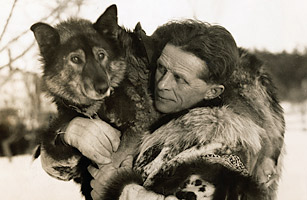
Togo the husky
In 1925, a ravaging case of diphtheria broke out in the isolated Alaskan village of Nome. No plane or ship could get the serum there, so the decision was made for multiple sled dog teams to relay the medicine across the treacherous frozen land. The dog that often gets credit for eventually saving the town is Balto, but he just happened to run the last, 55-mile leg in the race. The sled dog who did the lion’s share of the work was Togo. His journey, fraught with white-out storms, was the longest by 200 miles and included a traverse across perilous Norton Sound — where he saved his team and driver in a courageous swim through ice floes.
More about Togo another day.
oooo
One of the comments left to that post back in November, 2012 was from Virginia Hamilton. Her website, Canine Commandos, is about just that: dogs helping youngsters. This is what Virginia wrote:
Our sermon today was about sticks and stones which is perfect timing because my sixth graders are throwing words at each other and it is hurting. So I looked up the phrase and found you. We were shown the video in a faculty meeting and since you tie into dogs I was hoping to find “the answer.” When you look at the website you’ll see out community project where I have twenty schools training in three shelters. One would think that because these kids are so loving to the animals that they could pass that kindness to each other. Any words of wisdom? Also check this out. Thank you, Virginia.
Now I would be the first to admit that there’s a difference between a homeless young person and a gifted young person. Yet the difference may not be so great. In this one sense: that caring for an animal changes lives and what young people, from all backgrounds and circumstances, need to learn is the power of unconditional love.
Not just caring for dogs, horses and cats, by the way.





 Learning from Dogs