“This is far ahead of my knowledge of science. I applaud you for writing this despite me not understanding it”
So it may seem a little strange that I now publish the following. It was published originally on Skeptic. It is quite a long video but, please, settle down and watch it.
ooOOoo
Sean Carroll is creating a profoundly new approach to sharing physics with a broad audience, one that goes beyond analogies to show how physicists really think. He cuts to the bare mathematical essence of our most profound theories, explaining every step in a uniquely accessible way.
Quantum field theory is how modern physics describes nature at its most profound level. Starting with the basics of quantum mechanics itself, Sean Carroll explains measurement and entanglement before explaining how the world is really made of fields. You will finally understand why matter is solid, why there is antimatter, where the sizes of atoms come from, and why the predictions of quantum field theory are so spectacularly successful. Fundamental ideas like spin, symmetry, Feynman diagrams, and the Higgs mechanism are explained for real, not just through amusing stories. Beyond Newton, beyond Einstein, and all the intuitive notions that have guided homo sapiens for millennia, this book is a journey to a once unimaginable truth about what our universe is.
Sean Carroll is Homewood Professor of Natural Philosophy at Johns Hopkins University, and Fractal Faculty at the Santa Fe Institute. He is host of the Mindscape podcast, and author of From Eternity to Here, The Particle at the End of the Universe, The Big Picture, and Something Deeply Hidden. He has been awarded prizes and fellowships by the National Science Foundation, NASA, the American Institute of Physics, the Royal Society of London, and many others. He lives in Baltimore with his wife, writer Jennifer Ouellette. His new book series, The Biggest Ideas in the Universe, includes one volume on Space, Time, and Motion, and this new volume on Quanta and Fields.
Shermer and Carroll discuss:
the measurement problem in physics
wave functions
entanglement
fields
interactions
scale
symmetry
gauge theory
phases
matter
atoms
What is time?
Is math all there is? Is math universal?
double-slit experiment
superposition
metaphors in science
limitations of models and theories of reality
What banged the Big Bang?
Why is there something rather than nothing?
Second Laws of Thermodynamics and directionality in nature
Is there a place for God in scientific epistemology?
many interpretations of quantum mechanics
multiple dimensions and the multiverse
string theory and the multiverse
known unknowables: Are there things we can never know, even in principle?
God
hard problem of consciousness
free will/determinism.
ooOOoo
I’m assuming you have watched the video because in a world that is pre-occupied with the trivial this is just the opposite. Sean shares his physics in a profoundly different and powerful way!
EVENT: A coronal mass ejection (CME) is an eruption of solar material. When they arrive at Earth, a geomagnetic storm can result. Watches at this level are very rare. TIMING: Several CMEs are anticipated to merge and arrive at Earth on May 12th. EFFECTS: The general public should visit our webpage to keep properly informed. The aurora mav become visible over much of the northern half of the country, and maybe as far south as Alabama to northern California.
Meanwhile, Earth.com presented the following (and it is a long but extremely interesting report):
Update: New solar flare, secondary peak today in this “Extreme” solar storm
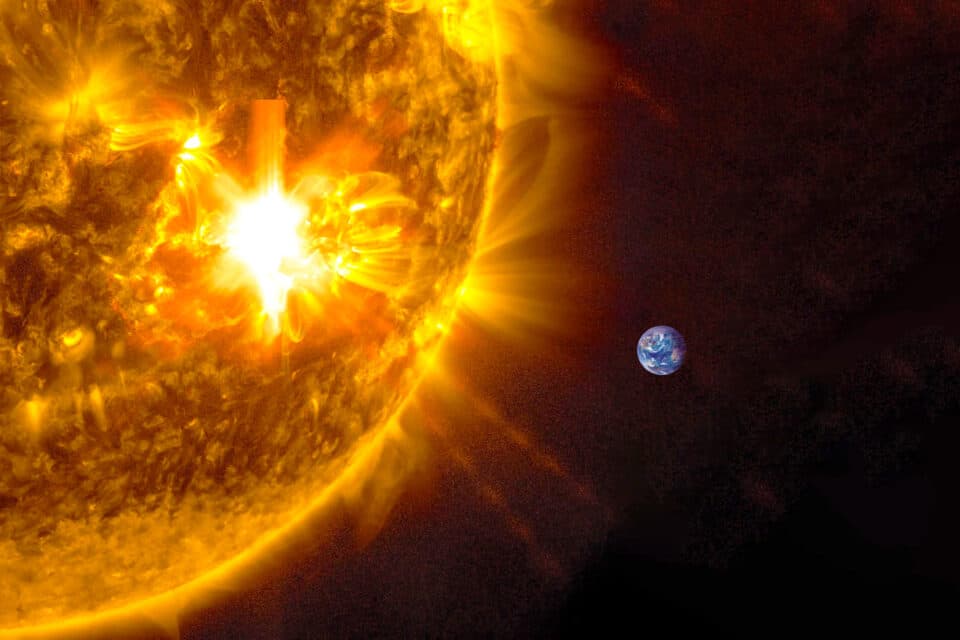
The Sun released another powerful burst of energy today, known as a solar flare, reaching its peak intensity at 12:26 p.m. Eastern Time. The flare originated from a region on the Sun’s surface called sunspot Region 3664, which has been quite active lately.
NASA’s Solar Dynamics Observatory, a spacecraft that keeps a constant eye on our nearest star, was able to capture a striking image of this latest solar outburst.
Solar flares are immense explosions on the Sun that send energy, light and high speed particles into space. They occur when the magnetic fields in and around the Sun reconnect, releasing huge amounts of stored magnetic energy. Flares are our solar system’s most powerful explosive events.
The NOAA’s Space Weather Prediction Center (SWPC) has extended the Geomagnetic Storm Warning until the afternoon of May 13, 2024.
Understanding different classes of solar flares
Today’s flare was classified as an X1.0 flare. Solar flares are categorized into classes based on their strength, with X-class flares being the most intense. The number provides additional information about the flare’s strength within that class. An X1 flare is ten times more powerful than an M1 flare.
These energetic solar eruptions can significantly impact Earth’s upper atmosphere and near-Earth space environment. Strong flares can disrupt high-frequency radio communications and GPS navigation signals. The particle radiation and X-rays from flares can also pose potential risks to astronauts in space.
Additionally, the magnetic disturbances from flares, if particularly strong, have the ability to affect electric power grids on Earth, sometimes causing long-lasting blackouts.
However, power grid problems are more commonly caused by coronal mass ejections (CMEs), another type of powerful solar eruption often associated with strong flares.
Scientists are always on alert, monitoring the Sun for these explosive events so that any potential impacts can be anticipated and prepared for. NASA’s Solar Dynamics Observatory, along with several other spacecraft, help provide this early warning system.
Stay tuned to Earth.com and the Space Weather Prediction Center (SWPC) for updates.
Update — May 12, 2024 at 9:41 AM EDT
The ongoing geomagnetic storm is expected to intensify later today, Sunday, May 12, 2024. Several intense Coronal Mass Ejections (CMEs), traveling from the Sun at speeds up to 1,200 miles per second, are anticipated to reach the Earth’s outer atmosphere by late afternoon.
Over the past two days, preliminary reports have surfaced regarding power grid irregularities, degradation of high-frequency communications, GPS outages, and satellite navigation issues. These disruptions are likely to persist as the geomagnetic storm strengthens.
Auroras visible across the continental United States
Weather permitting, auroras will be visible again tonight over most of the continental United States. This spectacular display of lights is a direct result of the ongoing geomagnetic storm.
The threat of additional strong solar flares and CMEs, which ultimately result in spectacular aurora displays, will persist until the large and magnetically complex sunspot cluster, NOAA Region 3664, rotates out of view of the Earth. This is expected to occur by Tuesday, May 14, 2024.
Solar activity remains at moderate to high levels
Solar activity has been at moderate levels over the past 24 hours. Region 3664 produced an M8.8/2b flare, the strongest of the period, on May 11 at 15:25 UTC. A CME signature was observed, but an Earth-directed component is not suspected.
Solar activity is expected to remain at high levels from May 12-14, with M-class and X-class flares anticipated, primarily due to the flare potential of Region 3664.
Energetic particle flux and solar wind enhancements
The greater than 10 MeV proton flux reached minor to moderate storm levels on May 10. Additional proton enhancements are likely on May 13-14 due to the flare potential and location of Region 3664.
The solar wind environment has been strongly enhanced due to continued CME activity. Solar wind speeds reached a peak of around 620 miles/second on May 12 at 00:55 UTC.
A strongly enhanced solar wind environment and continued CME influences are expected to persist on May 12-13, and begin to wane by May 14.
Geomagnetic field reaches G4 “Severe” storm levels
The geomagnetic field reached G4 (Severe) geomagnetic storm levels in the past 24 hours due to continued CME activity.
Periods of G3 (Strong) geomagnetic storms are likely, with isolated G4 levels possible, on May 12. Periods of G1-G3 (Minor-Strong) storming are likely on May 13, and periods of G1 (Minor) storms are likely on May 14.
Stay informed and enjoy the light show
As the geomagnetic storm rages on, we must remain vigilant and prepared for the potential consequences. Monitor official sources for updates on the storm’s progress and any further disruptions to our technological infrastructure.
Take a moment to step outside tonight and marvel at the incredible auroras painting the night sky — a stunning reminder of the raw power and beauty of our Sun.
While these solar storms can cause temporary inconveniences, they also provide us with an opportunity to reflect on our place in the universe and the awe-inspiring forces that shape our world.
Stay tuned to Earth.com and the Space Weather Prediction Center (SWPC) for updates.
Understanding geomagnetic solar storms
Geomagnetic storms are disturbances in the Earth’s magnetic field caused by the interaction between the solar wind and the planet’s magnetosphere. These storms can have significant impacts on technology, infrastructure, and even human health.
Causes of geomagnetic storms
Geomagnetic storms typically originate from the Sun. They are caused by two main phenomena:
Coronal Mass Ejections (CMEs): Massive bursts of plasma and magnetic fields ejected from the Sun’s surface.
Solar Flares: Intense eruptions of electromagnetic radiation from the Sun’s surface.
When these events occur, they send charged particles streaming towards Earth at high speeds, which can take anywhere from one to five days to reach our planet.
Effects on Earth’s magnetic field
As the charged particles from CMEs and solar flares reach Earth, they interact with the planet’s magnetic field. This interaction causes the magnetic field lines to become distorted and compressed, leading to fluctuations in the strength and direction of the magnetic field.
Impacts on technology and infrastructure
Geomagnetic storms can have significant impacts on various aspects of modern technology and infrastructure:
Power Grids: Strong geomagnetic storms can induce currents in power lines, causing transformers to overheat and potentially leading to widespread power outages.
Satellite Communications: Charged particles can damage satellite electronics and disrupt communication signals.
GPS and Navigation Systems: Geomagnetic disturbances can interfere with the accuracy of GPS and other navigation systems.
Radio Communications: Storms can disrupt radio signals, affecting communication systems that rely on HF, VHF, and UHF bands.
As charged particles collide with Earth’s upper atmosphere, they excite oxygen and nitrogen atoms, causing them to emit light in various colors.
Monitoring and forecasting
Scientists continuously monitor the Sun’s activity and use various instruments to detect and measure CMEs and solar flares.
This data helps them forecast the timing and intensity of geomagnetic storms, allowing for better preparedness and mitigation of potential impacts.
Historical geomagnetic storms
Some of the most notable geomagnetic storms in history include:
The Carrington Event (1859): The most powerful geomagnetic storm on record, which caused widespread telegraph system failures and auroras visible as far south as the Caribbean.
The Halloween Storms (2003): A series of powerful geomagnetic storms that caused power outages in Sweden and damaged transformers in South Africa.
The Quebec Blackout (1989): A geomagnetic storm that caused a massive power outage affecting millions of people in Quebec, Canada.
Understanding geomagnetic storms is crucial for protecting our technology-dependent world and mitigating the potential risks associated with these powerful space weather events.
—–
Like what you read? Subscribe to our newsletter for engaging articles, exclusive content, and the latest updates.
Check us out on EarthSnap, a free app brought to you by Eric Ralls and Earth.com.
Although I was born in London in 1944, as a result of an affair between my father and mother, my father had two daughters with his wife, Maud, and Rhona and Corinne, for they were their names, took me under their wing. In the 50s Maud, Rhona and Corinne all moved to Devon and I started going regularly to Totnes. When I started driving I usually stopped for a break close by Stonehenge so the site has a special interest to me.
So when I saw this article in The Conversation it had to be shared.
ooOOoo
Stonehenge may have aligned with the Moon as well as the Sun
When it comes to its connection to the sky, Stonehenge is best known for its solar alignments. Every midsummer’s night tens of thousands of people gather at Stonehenge to celebrate and witness the rising Sun in alignment with the Heel stone standing outside of the circle. Six months later a smaller crowd congregates around the Heel stone to witness the midwinter Sun setting within the stone circle.
But a hypothesis has been around for 60 years that part of Stonehenge also aligns with moonrise and moonset at what is called a major lunar standstill. Although a correlation between the layout of certain stones and the major lunar standstill has been known about for several decades, no one has systematically observed and recorded the phenomenon at Stonehenge.
This is what we are aiming to do in a project bringing together archaeologists, astronomers and photographers from English Heritage, Oxford, Leicester and Bournemouth universities as well as the Royal Astronomical Society.
There is now an abundance of archaeological evidence that indicates the solar alignment was part of the architectural design of Stonehenge. Around 2500 BC, the people who put up the large stones and dug an avenue into the chalk seemed to want to cement the solstice axis into the architecture of Stonehenge.
Archaeological evidence from nearby Durrington Walls, the place where scientists believe the ancient people who visited Stonehenge stayed, indicates that of the two solstices it was the midwinter one that drew the largest crowd.
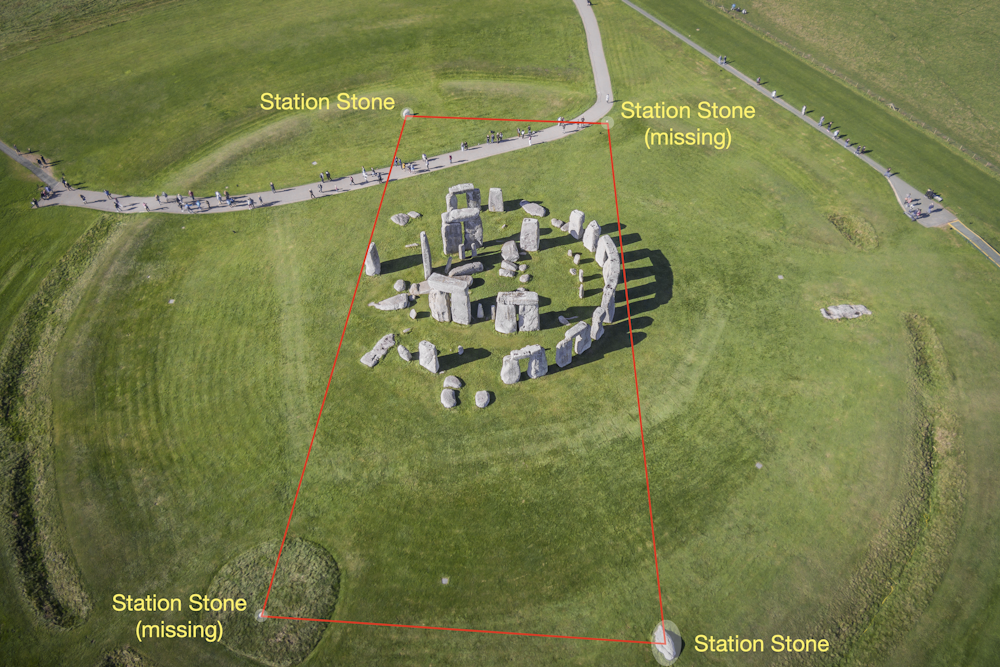
But Stonehenge includes other elements, such as 56 pits arranged in a circle, an earthwork bank and ditch, and other smaller features such as the four station stones. These are four sarsen stones, a form of silicified sandstone common in Wiltshire, that were carefully placed to form an almost exact rectangle encompassing the stone circle.
Only two of these stones are still there, and they pale in comparison to their larger counterparts as they are only a few feet high. So what could their purpose be?
Only two of the station stones are still there. Drone Explorer/Shutterstock
Lunar standstill
The rectangle that they form is not just any rectangle. The shorter sides are parallel to the main axis of the stone circle and this may be a clue as to their purpose. The longer sides of the rectangle skirt the outside of the stone circle.
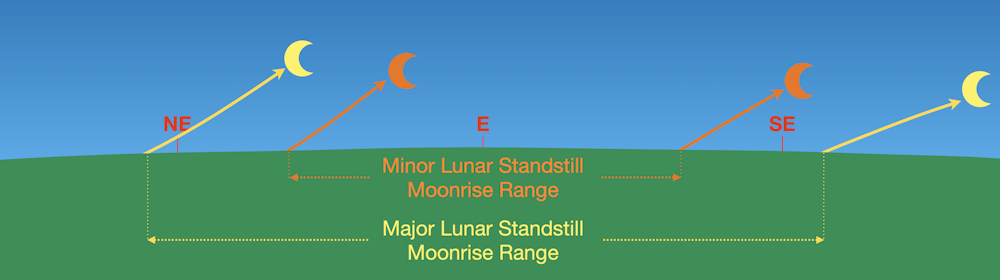
It is these longer sides that are thought to align with the major lunar standstill. If you marked the position of moonrise (or set) over the course of a month you would see that it moves between two points on the horizon. These southern and northern limits of moonrise (or set) change on a cycle of 18.6 years between a minimum and a maximum range – the so-called minor and major lunar standstills, respectively.
The major lunar standstill is a period of about one and a half to two years when the northernmost and southernmost moonrises (or sets) are furthest apart. When this happens the Moon rises (and sets) outside the range of sunrises and sets, which may have imbued this celestial phenomenon with meaning and significance.
The range of Moonrise positions on the horizon during minor and major lunar standstills. Fabio Silva, CC BY-NC
The strongest evidence we have for people marking the major lunar standstill comes from the US southwest. The Great House of Chimney Rock, a multi-level complex built by the ancestral Pueblo people in the San Juan National Forest, Colorado, more than 1,000 years ago.
It lies on a ridge that ends at a natural formation of twin rock pillars – an area that has cultural significance to more than 26 native American tribal nations. From the vantage point of the Great House, the Sun will never rise in the gap between the pillars.
However, during a major standstill the Moon does rise between them in awe-inspiring fashion. Excavations unearthed preserved wood that meant researchers could date to the year episodes of construction of the Great House.
Of six cutting dates, four correspond to major lunar standstill years between the years AD1018 and AD1093, indicating that the site was renewed, maintained or expanded on consecutive major standstills.
Returning to southern England, archaeologists think there is a connection between the major lunar standstill and the earliest construction phase of Stonehenge (3000-2500 BC), before the sarsen stones were brought in.
Several sets of cremated human remains from this phase of construction were found in the southeastern part of the monument in the general direction of the southernmost major standstill moonrise, where three timber posts were also set into the bank. It is possible that there was an early connection between the site of Stonehenge and the Moon, which was later emphasised when the station stone rectangle was built.
The major lunar standstill hypothesis, however, raises more questions than it answers. We don’t know if the lunar alignments of the station stones were symbolic or whether people were meant to observe the Moon through them. Neither do we know which phases of the Moon would be more dramatic to witness.
A search for answers
In our upcoming work, we will be trying to answer the questions the major lunar standstill hypothesis raises. It’s unclear whether the Moon would have been strong enough to cast shadows and how they would have interacted with the other stones. We will also need to check whether the alignments can still be seen today or if they are blocked by woods, traffic and other features.
The Moon will align with the station stone rectangle twice a month from about February 2024 to November 2025, giving us plenty of opportunities to observe this phenomenon in different seasons and phases of the Moon.
To bring our research to life, English Heritage will livestream the southernmost Moonrise in June 2024, and host a series of events throughout the year, including talks, a pop-up planetarium, stargazing and storytelling sessions.
Across the Atlantic, our partners at the US Forest Service are developing educational materials about the major lunar standstill at Chimney Rock National Monument. This collaboration will result in events showcasing and debating the lunar alignments at both Stonehenge and at Chimney Rock.
The challenge in deciding what is best for our forests.
As a great many of you already know, we live in a rural area in Southern Oregon. It is a beautiful place and we look out to the East upon Mount Sexton. But locally a great many houses are built on rural sites with the local forest just yards away.
In the U.S., wildland firefighters are able to stop about 98% of all wildfires before the fires have burned even 100 acres. That may seem comforting, but decades of quickly suppressing fires has had unintended consequences.
However, fuel accumulation isn’t the only consequence of fire suppression.
Fire suppression also disproportionately reduces certain types of fire. In a new study, my colleagues and I show how this effect, known as the suppression bias, compounds the impacts of fuel accumulation and climate change.
What happened to all the low-intensity fires?
Most wildfires are low-intensity. They ignite when conditions aren’t too dry or windy, and they can often be quickly extinguished.
The 2% of fires that escape suppression are those that are more extreme and much harder to fight. They account for about 98% of the burned area in a typical year.
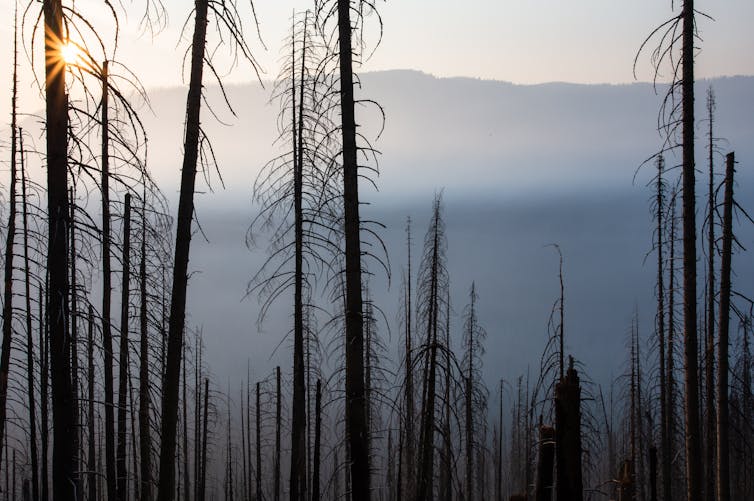
The author and colleagues discuss changing wildfire in Montana and Idaho’s Bitterroot Mountains. By Mark Kreider.
In our study, we used a fire modeling simulation to explore the effects of the fire suppression bias and see how they compared to the effects of global warming and fuel accumulation alone.
Fuel accumulation and global warming both inherently make fires more severe. But over thousands of simulated fires, we found that allowing forests to burn only under the very worst conditions increased fire severity by the same amount as more than a century’s worth of fuel accumulation or 21st-century climate change.
The suppression bias also changes the way plants and animals interact with fire.
By removing low-intensity fires, humans may be changing the course of evolution. Without exposure to low-intensity fires, species can lose traits crucial for surviving and recovering from such events.
In contrast, low-intensity fires free up space and resources for new growth, while still retaining living trees and other biological legacies that support seedlings in their vulnerable initial years.
By quickly putting out low-intensity fires and allowing only extreme fires to burn, conventional suppression reduces the opportunities for climate-adapted plants to establish and help ecosystems adjust to changes like global warming.
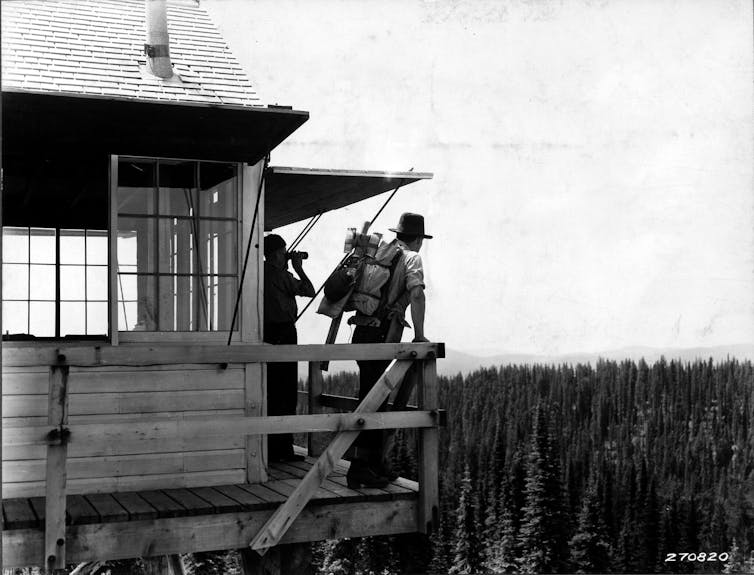
Firefighters keep watch for smoke from a fire tower in the Coeur d’Alene National Forest, Idaho, in 1932. Forest Service photo by K. D. Swan
Suppression makes burned area increase faster
As the climate becomes hotter and drier, more area is burning in wildfires. If suppression removes fire, it should help slow this increase, right?
In fact, we found it does just the opposite.
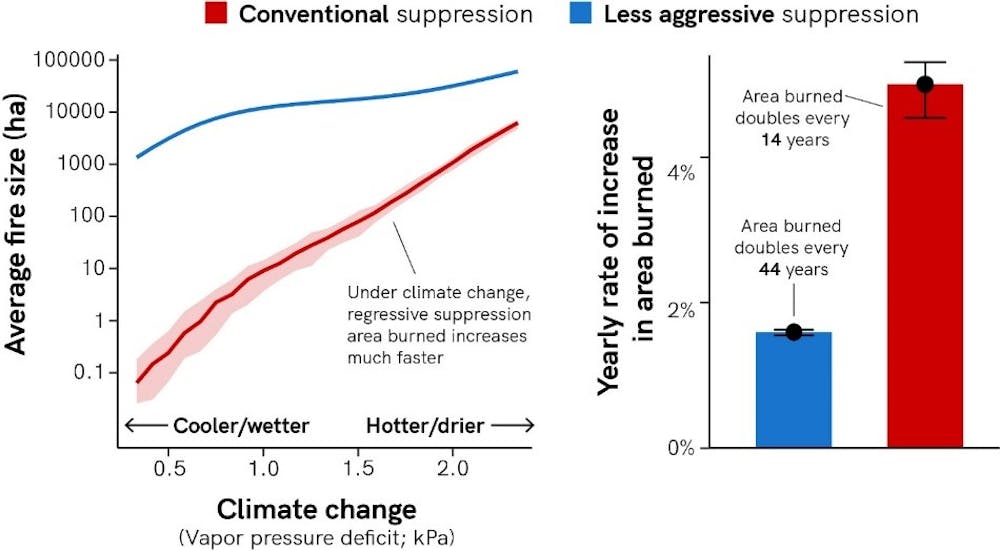
We found that while conventional suppression led to less total area burning, the yearly burned area increased more than three times faster under conventional suppression than under less aggressive suppression efforts. The amount of area burned doubled every 14 years with conventional fire suppression under simulated climate change, instead of every 44 years when low- and moderate-intensity fires were allowed to burn. That raises concerns for how quickly people and ecosystems will have to adapt to extreme fires in the future.
With conventional fire suppression, the average fire size will increase faster as the planet warms than it would under a less aggressive approach. Mark Kreider
The fact that the amount of area burned is increasing is undoubtedly driven by climate change. But our study shows that the rate of this increase may also be a result of conventional fire management.
The near total suppression of fires over the last century means that even a little additional fire in a more fire-prone future can create big changes. As climate change continues to fuel more fires, the relative increase in area burned will be much bigger.
To address the wildfire crisis, fire managers can be less aggressive in suppressing low- and moderate-intensity fires when it is safe to do so. They can also increase the use of prescribed fire and cultural burning to clear away brush and other fuel for fires.
These low-intensity fires will not only reduce the risk of future extreme fires, but they also will create conditions that favor the establishment of species better suited to the changing climate, thereby helping ecosystems adapt to global warming.
Coexisting with wildfire requires developing technologies and approaches that enable the safe management of wildfires under moderate burning conditions. Our study shows that this may be just as necessary as other interventions, such as reducing the number of fires unintentionally started by human activities and mitigating climate change.
The article makes a great deal of sense and presents a solution that may not be our first thought. But especially the message is fundamentally important, and please watch the video because it very clearly presents the benefits of the solution.
So we want more low-intensity fires! Please! Or to say it another way, we want more prescribed fires.
Jean and I live in an ideal part of America: Merlin in Southern Oregon. We did not plan to come here but in 2012 we wanted to move from Payson, Az. and fortune brought us here. However, I started this blog in 2009 when I had seen the integrity and happiness of dogs and wanted to write about them.
However the wider world is far, far from just the integrity and happiness of dogs.
On March 17th Patrice Ayme posted yet another post on his blog about war and I felt that it was important to be read by as many followers of Learning from Dogs as is possible. (The few small typographical changes are mine.)
ooOOoo
Want No War? A Symptom That Nazism Perdures
Do not whine that war is bad. Ask instead what it is for.
Friend of a friend Manfred Krieger: Will mankind ever learn that wars do no good to anyone?
Patrice Ayme: All over the world, the vermin helping Putin claim that war does not do any good. Similarly the Nazis, after claiming for years that they were the party of peace and minorities, accused big bad France of having launched WW2. France did, indeed, but that was after the Nazis had invaded a few countries, including two democracies, and officially killed a few hundred thousands of alleged mental retards and genetically defective (including a relative of Hitler).
Vermin helping Putin vermin has been crawling around the French and German leadership for a quarter of a century. That Putin was a war criminal was obvious as early as 1999.
The Putinists claim that war never helped anyone. So the war to stop Hitler did not do good to anyone? Only an obdurate Nazi would hold that opinion.
My family was hunted by the Gestapo: I am delighted that more than five million Nazis got exterminated like the vicious vermin they were. It would have been better if the French Republic had declared war on the Nazi gangrene earlier. Destroying the vermin when it was weaker would have saved the lives of in excess of 50 million thoroughly innocent people who got killed as a result of having let the Axis fly from victory to victory, gathering alliances with nearly as equally repulsive tyrannies in the process.
This may well be happening now: the Chinese dictatorship is sitting on a fence, not trying to help the Kremlin tyrant too much. The fascist Iranian theocracy retreated a bit when threatened recently by the West after attacks in the Red Sea, the Gulf of Aden and Syria.
This hesitancy on the part of fascists also happened in World War Two; for a long time Mussolini did not dare to join Hitler, but then they militarily cooperated attacking Spain and three years later, attacking France. But ultimately, except for Franco who looked degenerate, but was smarter, fellow dictators, even Stalin, sided with the Axis.
In final analysis, WW2, and also WW1, happened because, primarily, not enough Germans fought the forces of fascist imperialistic plutocracy inside Germany.
So it is a lack of war, not an excess of it, which brought disaster.
That happened because not enough Morally Correct Germans realized in a timely manner that it would do some good to destroy the fascist imperialistic plutocratic mentality.
None of this deplorable meta-mentality is obsolete; France and Germany encouraged and empowered the Kremlin vermin in the last quarter of a century, by building its economy and financing it with advantageous trade. Now the Kremlin vermin is potentially the greatest threat against humanity and civilization, ever. And what does the German government do? Claim that one should not fight the Kremlin gangrene too much, to not aggravate matters too much.
But that appeasement in face of the unacceptable only encourages the latter. Germans still have to understand the biggest lessons of history.
‘An appeaser is one who feeds the crocodile quality food, hoping
that the ferocious creature will die of indigestion.’
A dramatic article from George Monbiot about water!
I read the latest from George Monbiot yesterday morning and was startled. Startled because I hadn’t thought of it before. Startled because here in Merlin, Southern Oregon we have had so much rain since the beginning of November, 2023 that our acres are swimming in the wet. Startled since that time also our Bummer Creek, which flows across our land, has been at record depths.
But this report is incredibly important and I wanted to share it with you, as I have Geo. Monbiot’s permission for so doing.
ooOOoo
Dry Run
Posted on11th March 2024
The mega-droughts in Spain and the US are a portent of a gathering global water crisis.
By George Monbiot, published in the Guardian 4th March 2024
There’s a flaw in the plan. It’s not a small one: it is an Earth-sized hole in our calculations. To keep pace with the global demand for food, crop production needs to grow by at least 50% by 2050. In principle, if nothing else changes, this is feasible, thanks mostly to improvements in crop breeding and farming techniques. But everything else is going to change.
Even if we set aside all other issues – heat impacts, soil degradation, epidemic plant diseases accelerated by the loss of genetic diversity – there is one which, without help from any other cause, could prevent the world’s people from being fed. Water.
A paper published in 2017 estimated that to match crop production to expected demand, water use for irrigation would have to increase by 146% by the middle of this century. One minor problem. Water is already maxed out.
In general, the dry parts of the world are becoming drier, partly through reduced rainfall; partly through declining river flow as mountain ice and snow retreats; and partly through rising temperatures causing increased evaporation and increased transpiration by plants. Many of the world’s major growing regions are now threatened by “flash droughts”, in which hot and dry weather sucks moisture from the soil at frightening speed. Some places, such as the southwest of the US, now in its 24th year of drought, may have switched permanently to a drier state. Rivers fail to reach the sea, lakes and aquifers are shrinking, species living in freshwater are becoming extinct at roughly five times the rate of species that live on land and major cities are threatened by extreme water stress.
Already, agriculture accounts for 90% of the world’s freshwater use. We have pumped so much out of the ground that we’ve changed the Earth’s spin. The water required to meet growing food demand simply does not exist.
That 2017 paper should have sent everyone scrambling. But as usual, it was ignored by policymakers and the media. Only when the problem arrives in Europe do we acknowledge that there’s a crisis. But while there is understandable panic about the drought in Catalonia and Andalusia, there’s an almost total failure among powerful interests to acknowledge that this is just one instance of a global problem, a problem that should feature at the top of the political agenda.
Though drought measures have triggered protests in Spain, this is far from the most dangerous flashpoint. The catchment of the Indus river is shared by three nuclear powers – India, Pakistan and China – and several highly unstable and divided regions already afflicted by hunger and extreme poverty. Today, 95% of the river’s dry season flow is extracted, mostly for irrigation. But water demand in both Pakistan and India is growing rapidly. Supply – temporarily boosted by the melting of glaciers in the Himalayas and the Hindu Kush – will, before long, peak and then go into decline.
Even under the most optimistic climate scenario, runoff from Asian glaciers is expected to peak before mid-century, and glacier mass will shrink by about 46% by 2100. Some analysts see water competition between India and Pakistan as a major cause of the repeated conflicts in Kashmir. But unless a new Indus waters treaty is struck, taking falling supplies into account, this fighting could be a mere prelude for something much worse.
There’s a widespread belief that these problems can be solved simply by enhancing the efficiency of irrigation: huge amounts of water are wasted in agriculture. So let me introduce you to the irrigation efficiency paradox. As better techniques ensure that less water is required to grow a given volume of crops, irrigation becomes cheaper. As a result, it attracts more investment, encourages farmers to grow thirstier, more profitable plants, and expands across a wider area. This is what happened, for instance, in the Guadiana river basin in Spain, where a €600m investment to reduce water use by improving the efficiency of irrigation has instead increased it.
You can overcome the paradox through regulation: laws to limit both total and individual water consumption. But governments prefer to rely on technology alone. Without political and economic measures, it doesn’t work.
Nor are other technofixes likely to solve the problem. Governments are planning massive engineering schemes to pipe water from one place to another. But climate breakdown and rising demand ensure that many of the donor regions are also likely to run dry. Water from desalination plants typically costs five or 10 times as much as water from the ground or the sky, while the process requires masses of energy and generates great volumes of toxic brine.
Above all, we need to change our diets. Those of us with dietary choice (in other words, the richer half of the world’s population) should seek to minimise the water footprint of our food. With apologies for harping on about it, this is yet another reason to switch to an animal-free diet, which reduces both total crop demand and, in most cases, water use. The water demand of certain plant products, especially almonds and pistachios in California, has become a major theme in the culture wars, as rightwing influencers attack plant-based diets. But, excessive as the watering of these crops is, more than twice as much irrigation water is used in California to grow forage plants to feed livestock, especially dairy cows. Dairy milk has much higher water demand even than the worst alternative (almond milk), and is astronomically higher than the best alternatives, such as oat or soya milk.
This is not to give all plant products a free pass: horticulture can make massive demands on water supplies. Even within a plant-based diet, we should be switching from some grains, vegetables and fruit to others. Governments and retailers should help us through a combination of stronger rules and informative labelling.
Instead, they do the opposite. Last month, at the behest of the EU’s agricultural commissioner, Janusz Wojciechowski, the European Commission deleted from its new climate plan the call to incentivise “diversified” (animal-free) protein sources. Regulatory capture is never stronger than in the food and farming sector.
I hate to pile yet more on to you, but some of us have to try to counter the endless bias against relevance in politics and most of the media. This is yet another of those massive neglected issues, any one of which could be fatal to peace and prosperity on a habitable planet. Somehow, we need to recover our focus.
There have been so many disastrous activities on climate change, and I am not belittling them, but it was amazing to come across a TED Talk last Saturday that I watched. But first the speaker, Asmeret Asefaw Berhe, who was born in Asmara, Eritrea. Her bio (in part):
From WikiPedia:
ooOOoo
Asmeret Asefaw Berhe is a soil biogeochemist and political ecologist who is the current Director of the Office of Science at the US Department of Energy. She was previously the Professor of Soil Biogeochemistry and the Ted and Jan Falasco Chair in Earth Sciences and Geology in the Department of Life and Environmental Sciences; University of California, Merced.[1] Her research group worked to understand how soil helps regulate the Earth’s climate.
Advocacy and global impact work
Berhe’s work at the intersection of soil, climate change, and political ecology lends itself well to a number of global issues. During her graduate career, she was a member of the working group that produced the Millennium Ecosystem Assessment, which was called for by the United Nations Secretary Kofi Annan to assess the impact of humans on the environment. She was one of the lead authors on the 2005 report’s chapter on “Drivers of Change in Ecosystem Condition and Services.”[19] The Assessment received the Zayed International Prize for the Environment in 2005.[20]
In 2018, Berhe was selected as part of the inaugural National Academies of Sciences, Engineering, and Medicine New Voices in Sciences, Engineering, and Medicine cohort, as an early career leader working to advance the conversation around key emerging global issues and communicate the evidence base around those challenges.[21]
An advocate for women in science, Berhe is currently a co-Principal Investigator of ADVANCEGeo, which is working to transform the workplace climate of the geosciences to increase retention of women in the field and develop a sustainable model that can be transferred to other scientific domains. Currently, the Earth Science Women’s Network (ESWN), the Association for Women Geoscientists, and the American Geophysical Union (AGU) have partnered to address the issue of sexual harassment in the earth, space and environmental sciences.[22] The program led by Erika Marín-Spiotta and is run with support from a four-year $1.1 million grant from the National Science Foundation.[23]
She currently serves as an advisory board member of 500 Women Scientists, a grassroots organization working to make science open, inclusive, and accessible, and is on the leadership board of the Earth Science Women’s Network.
Earth’s soil can store vast amounts of carbon. Biogeochemist Asmeret Asefaw Berhe says soil could be a powerful tool for fighting climate change – if only we stopped treating it like dirt.
About Asmeret Asefaw Berhe
Asmeret Asefaw Berhe is a soil biogeochemist and President Biden’s nominee to lead the Department of Energy Office of Science. She is a professor of soil biogeochemistry at University of California, Merced. Her research group works to understand how soil helps regulate the earth’s climate.
Berhe’s work exists at the intersection of soil, climate change, and political ecology. During her graduate career, she was a member of the working group that produced the Millennium Ecosystem Assessment, which was called for by the United Nations to assess the impact of humans on the environment.
Berhe received a B.Sc. in Soil and Water Conservation at the University of Asmara in Eritrea. She has an M.Sc. in Political Ecology from Michigan State University and a Ph.D. in Biogeochemistry from University of California, Berkeley.
This segment of the TED Radio Hour was produced by Matthew Cloutier and Sylvie Douglis and edited by Rachel Faulkner and Katie Simon. You can follow us on Facebook @TEDRadioHour and email us at TEDRadioHour@npr.org.
Now that positive TED Talk:
We wish Asmeret the very best of fortune in bringing about these changes.
The challenge with writing posts, albeit not so often, about the global environment, especially when I am a non-scientist, is that one relies entirely on the words of others. In the case of a recent article, published by The Conversation, the authors are claimed to be specialists, and I do not doubt their credentials.
The three authors are René van Westen who is a Postdoctoral Researcher in Climate Physics, at Utrecht University, Henk A. Dijkstra who is a Professor of Physics, also at Utrecht University, and Michael Kliphuis, a Climate Model Specialist, again at Utrecht University.
So, here is their article:
ooOOoo
Atlantic Ocean is headed for a tipping point − once melting glaciers shut down the Gulf Stream, we would see extreme climate change within decades, study shows
Superstorms, abrupt climate shifts and New York City frozen in ice. That’s how the blockbuster Hollywood movie “The Day After Tomorrow” depicted an abrupt shutdown of the Atlantic Ocean’s circulation and the catastrophic consequences.
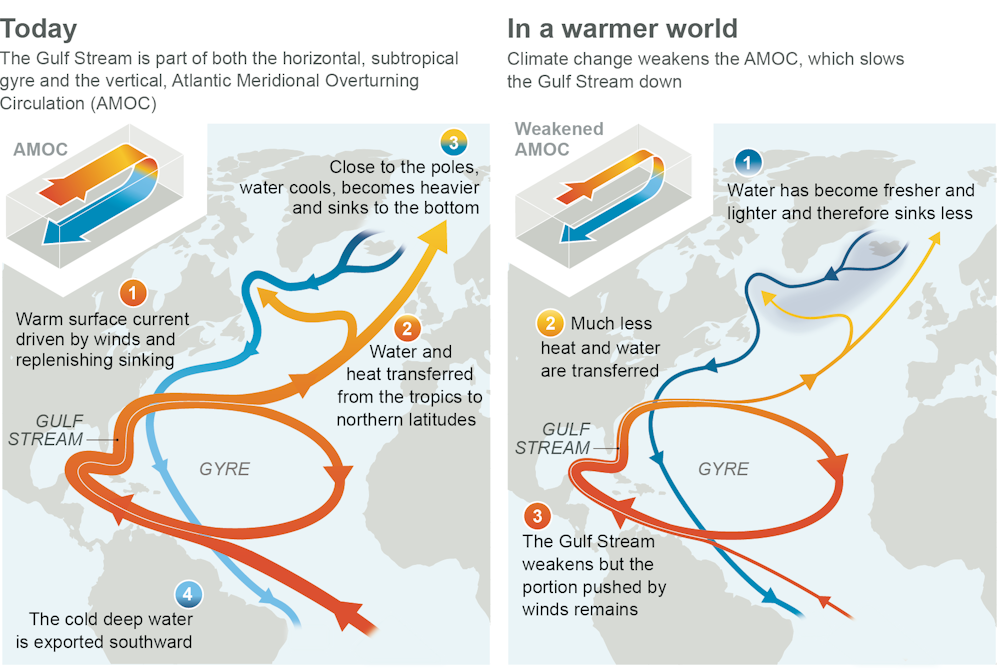
While Hollywood’s vision was over the top, the 2004 movie raised a serious question: If global warming shuts down the Atlantic Meridional Overturning Circulation, which is crucial for carrying heat from the tropics to the northern latitudes, how abrupt and severe would the climate changes be?
In a new study using the latest generation of Earth’s climate models, we simulated the flow of fresh water until the ocean circulation reached that tipping point.
The results showed that the circulation could fully shut down within a century of hitting the tipping point, and that it’s headed in that direction. If that happened, average temperatures would drop by several degrees in North America, parts of Asia and Europe, and people would see severe and cascading consequences around the world.
We also discovered a physics-based early warning signal that can alert the world when the Atlantic Ocean circulation is nearing its tipping point.
In the Atlantic Ocean circulation, the relatively warm and salty surface water near the equator flows toward Greenland. During its journey it crosses the Caribbean Sea, loops up into the Gulf of Mexico, and then flows along the U.S. East Coast before crossing the Atlantic.
This current, also known as the Gulf Stream, brings heat to Europe. As it flows northward and cools, the water mass becomes heavier. By the time it reaches Greenland, it starts to sink and flow southward. The sinking of water near Greenland pulls water from elsewhere in the Atlantic Ocean and the cycle repeats, like a conveyor belt.
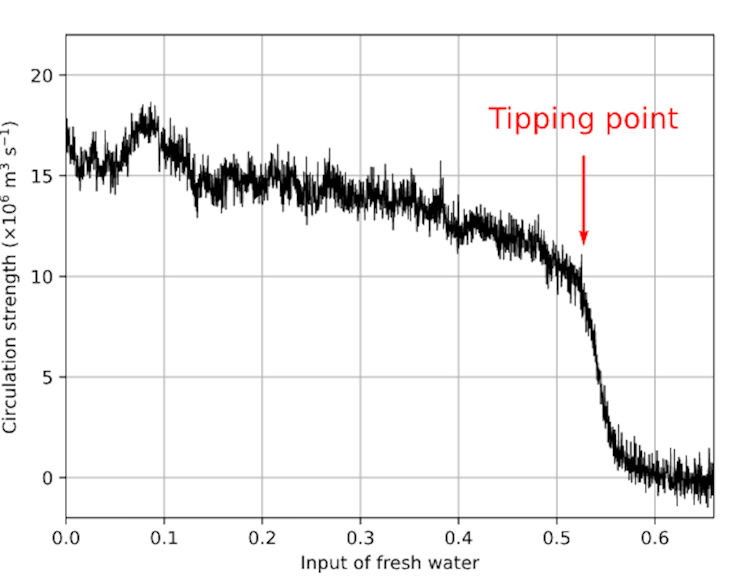
This is where our study comes in. We performed an experiment with a detailed climate model to find the tipping point for an abrupt shutdown by slowly increasing the input of fresh water.
We found that once it reaches the tipping point, the conveyor belt shuts down within 100 years. The heat transport toward the north is strongly reduced, leading to abrupt climate shifts.
The result: Dangerous cold in the North
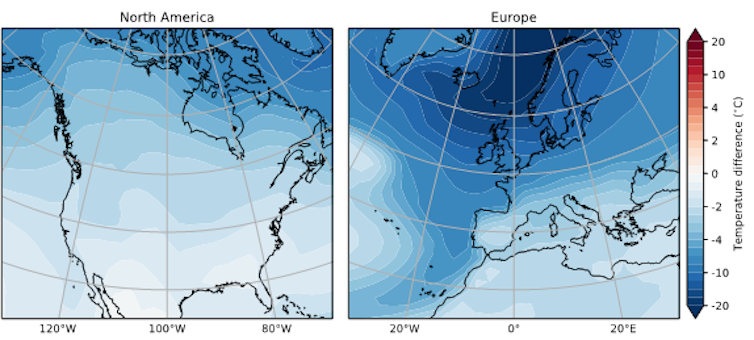
Regions that are influenced by the Gulf Stream receive substantially less heat when the circulation stops. This cools the North American and European continents by a few degrees.
The European climate is much more influenced by the Gulf Stream than other regions. In our experiment, that meant parts of the continent changed at more than 5 degrees Fahrenheit (3 degrees Celsius) per decade – far faster than today’s global warming of about 0.36 F (0.2 C) per decade. We found that parts of Norway would experience temperature drops of more than 36 F (20 C). On the other hand, regions in the Southern Hemisphere would warm by a few degrees.
The annual mean temperature changes after the conveyor belt stops reflect an extreme temperature drop in northern Europe in particular. René M. van Westen
These temperature changes develop over about 100 years. That might seem like a long time, but on typical climate time scales, it is abrupt.
The conveyor belt shutting down would also affect sea level and precipitation patterns, which can push other ecosystems closer to their tipping points. For example, the Amazon rainforest is vulnerable to declining precipitation. If its forest ecosystem turned to grassland, the transition would release carbon to the atmosphere and result in the loss of a valuable carbon sink, further accelerating climate change.
The Atlantic circulation has slowed significantly in the distant past. During glacial periods when ice sheets that covered large parts of the planet were melting, the influx of fresh water slowed the Atlantic circulation, triggering huge climate fluctuations.
So, when will we see this tipping point?
The big question – when will the Atlantic circulation reach a tipping point – remains unanswered. Observations don’t go back far enough to provide a clear result. While a recent study suggested that the conveyor belt is rapidly approaching its tipping point, possibly within a few years, these statistical analyses made several assumptions that give rise to uncertainty.
Instead, we were able to develop a physics-based and observable early warning signal involving the salinity transport at the southern boundary of the Atlantic Ocean. Once a threshold is reached, the tipping point is likely to follow in one to four decades.
A climate model experiment shows how quickly the AMOC slows once it reaches a tipping point with a threshold of fresh water entering the ocean. How soon that will happen remains an open question. René M. van Westen
The climate impacts from our study underline the severity of such an abrupt conveyor belt collapse. The temperature, sea level and precipitation changes will severely affect society, and the climate shifts are unstoppable on human time scales.
It might seem counterintuitive to worry about extreme cold as the planet warms, but if the main Atlantic Ocean circulation shuts down from too much meltwater pouring in, that’s the risk ahead.
This article was updated to Feb. 11, 2024, to fix a typo: The experiment found temperatures in parts of Europe changed by more than 5 F per decade.
I am 79! I like to think that whatever is coming down the wires, so to speak, will be after my death. But that is a cop out for a) I have a son and a daughter who are in their early fifties, b) I have a grandson, my daughter and son-in-law’s young man, who is a teenager, with his birthday next month, and c) I could possibly live for another twenty years.
The challenge is how to bring this imminent catastrophic global change in temperature to the fore. We need a global solution now enforced by a globally respected group of scientists and leaders, and, frankly, I do not see that happening.
All one can do is to hope. Hope that the global community will eschew the present-day extremes of warring behaviour and see the need for change. That is NOW!
So that the Hollywood movie, The Day After Tomorrow, remains a fictional story. And for those that have forgotten the film or who have never seen it, here is a small slice of a Wikipedia report:
Patrice Ayme is a writer who lives in France and is a person of extreme breadth of knowledge, and very clever to boot.
He writes blog posts on a variety of topics. His latest post is breathtakingly powerful and could be the way we all go over the future years. Read it for yourself online or as follows:
ooOOoo
How Solar System Colonization Will Save Earth
By Patrice Ayme
Saving Earth and colonizing the Solar System are basically the same problem and have the same solution: much more advanced technology [1].There is no contradiction, far from it. There is complementarity, as technology that will have to be developed for space will be found to be useful for Earth. For psycho-political reasons those technologies won’t be developed directly for Earth. So those who complain about space, while claiming we should focus on Earth, get it only half right.
Colonizing Mars with present technology is not going to happen anymore than the technology of the 1960s enabled to colonize the Moon. A visit from a human crew on Mars with the technology SpaceX wants to develop is imaginable… Barely. And those will just be visits, multi-year commitments full of lethal radiation and worse living accommodations than the highest maximum security prison: basically what was done on the Moon in the 1960s, but much more daunting.
It’s much more feasible to establish bases on the Moon. First, there is plenty of oxygen and hydrogen (so water) on the Moon, imprisoned in rocks: one only needs energy to extract them, and the Moon has plenty of that (solar panels!) Second, the gravity well of the Moon is also half that of Mars. Third, the Moon is close by and one can go there all the time (whereas Mars can be visited with present fossil fuel tech only every two years, when the planets align; serious commuting of goods and people between Earth and Mars will require nuclear propulsion).Monitoring robots on the Moon is possible, whereas on Mars, with up to twenty minutes delay, one will have to use advanced, autonomous AI. Fixing problems caused by dust in robots on the Moon with roaming human crews… A solution that won’t exist on Mars, for decades.
Thus AI is the first order solution: AI just needs energy, not shelter, air, water and food. AI colonies on the Moon, and then, later, Mars could build environments that humans could then inhabit. Say pressurized lava tubes…
Skeptics could object that I didn’t roll out specific techs. But space colonization, especially if robot and AI driven, will require much higher tech. For example solar energy, which works wonderfully, was led by its usage in space… where it has long worked splendidly. The solar cells used in space have an efficiency more than twice that of the ones used on the ground… from using more advanced (but expensive) materials, like Gallium… That has invited researchers and companies to boost the efficiency of the silicon and now perovskites cells used on the ground. SpaceX uses Reliable Reusable Rockets (RRR), lowering the cost of space access… That is revolutionary, but actually follows the tech used to land on the Moon in the first place. But the first landing rockets, the LEMS, were Lunar Exploration Modules… They showed the way…
Technology is impossible without wisdom, and wisdom impossible without technology. One can’t grow without the other. The quest for tech is a quest for wisdom.
We don’t need AI on Earth, at least so many “leaders” will think (and they would be very wrong)… However, for space colonization, clearly, we need AI. Space AI will then bring in the Earth AI we need to solve countless problems, including the ones we didn’t think we had.
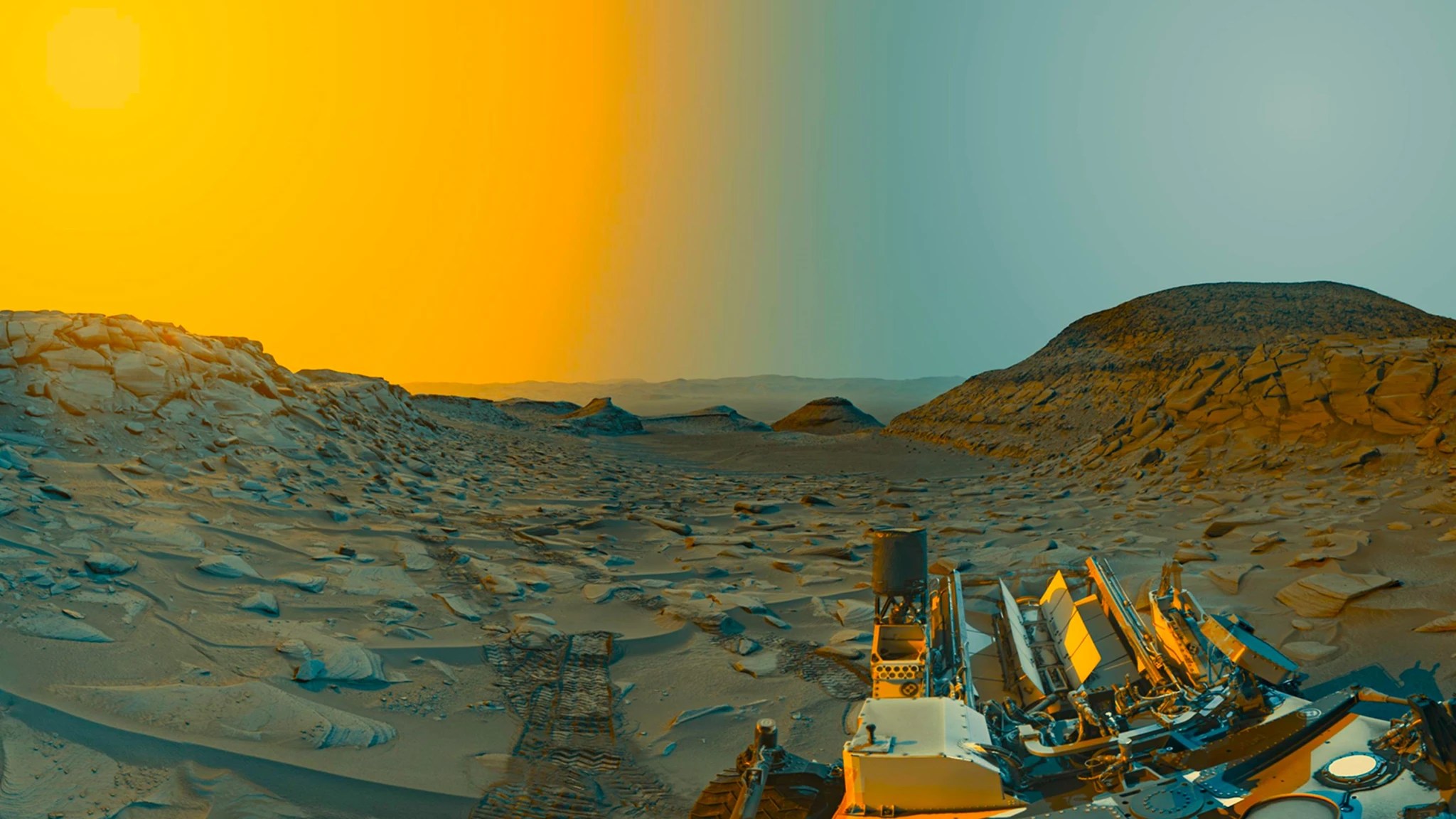
NASA picture from Curiosity rover on a rather barren, poisonous, irradiated, dusty and dry Mars
P/S: Scifi novels are an old genre: The Birds of Aristophanes, making fun of the colonies Athens established everywhere, by establishing one in the sky, preceded the space colonization of Lucian by seven centuries…
***
[1] The European solution to the Earth Crisis has been Mathusianism: use less energy. This weakens Europe and encourages its dictatorial enemies. Actually the best solution is rather the opposite: to use more ABSOLUTE WORTH ENERGY. Use, much more EFFICIENT energy. In particular, we have to leverage fossil fuels to get out of them… using the energy they provide to invent new science and tech….
ooOOoo
Yet another masterpiece from Mr. Ayme. I cannot add anything to this post except to applaud it.







 Learning from Dogs