Category: Government

Parkinson’s Disease

It affects so many but it is also a cruel disease.

Parkinson’s Disease (PD) is unique to each individual as it is a disease of the brain. Yet there are aspects of the disease that affect most and especially the people who are close to the PD sufferer.

From the National Institute of Neurological Disorders and Stroke comes a small extract:

Following Alzheimer’s disease, Parkinson’s disease (PD) is the second-most common neurodegenerative disorder in the United States. Most people diagnosed with PD are age 60 years or older, however, an estimated 5 to 10 percent of people with PD are diagnosed before the age of 50. Approximately 500,000 Americans are diagnosed with PD, but given that many individuals go undiagnosed or are misdiagnosed the actual number is likely much higher. Some experts estimate that as many as 1 million Americans have PD. Of course, given the progressive nature of the disabilities associated with PD, the disease affects thousands more wives, husbands, children, and other caregivers.

NINDS website

Jean was diagnosed in December, 2015 at the same time as my best friend in England, Richard Maugham.

More than 10 million people worldwide are living with PD!

Here is a video put out by Parkinson’s UK that is introduced as follows:

In this honest and often funny live talk Colin describes his experience with Parkinson’s and his hopes for the future.

So a wish on behalf of those countless other people: May there be a cure soon!

Why is intelligent life so rare?

Maybe it is because of a ‘Great Filter‘.

Like so many others I read many items online. One of the websites that I follow is the EarthSky site because for a long time I have been interested in space.

So when I saw an article on why intelligent life is so rare in our Milky Way I read it fully. And hoped it would be of interest to others.

Here it is:

ooOOoo

What is the Great Filter, and can we survive it?

Posted by

Kelly Kizer Whitt and Deborah Byrd

November 17, 2022

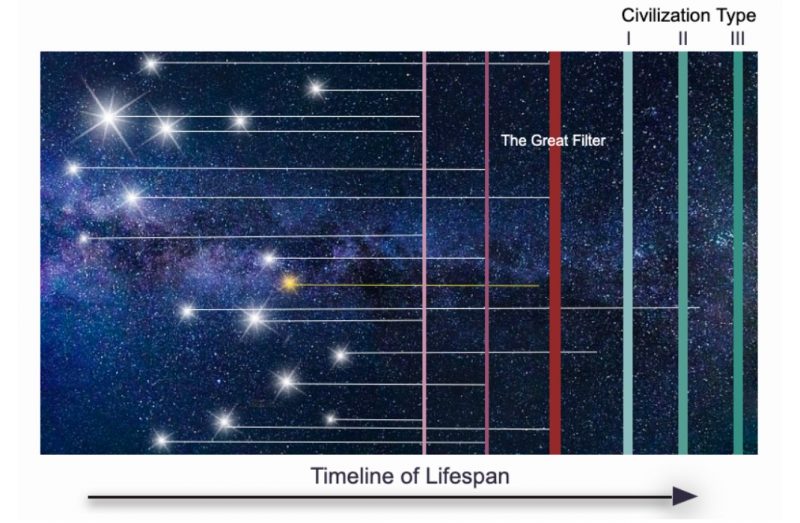
This graphic depicts intelligent civilizations as stars. The vertical lines represent Great Filters that civilizations do or don’t survive. This graphic depicts Earth’s human population (the yellow “star”) approaching its own Great Filter. How would we surpass it, and keep going? Image via NASA/ arXiv.

What is the Great Filter?

Is intelligent life common, or rare in our Milky Way galaxy? If it’s common, why haven’t we encountered it? While discussing UFOs on a walk to lunch in the year 1950, the physicist Enrico Fermi is famously said to have asked, “But where is everybody?” Scientists today call that riddle Fermi’s Paradox. Now a new paper by NASA scientists explores one possible answer to the paradox. The answer may be what’s called the Great Filter.

Economist Robin Hanson first proposed the Great Filter, in the late 1990s. It’s the idea of that – even if life forms abundantly in our Milky Way galaxy – each extraterrestrial civilization ultimately faces some barrier to its own survival. The barrier might come from without (for example, an asteroid striking a planet, and wiping out all life forms). Or it might come from within (for example, all-out nuclear war).

Hanson proposed that a Great Filter might be at work within our Milky Way galaxy. He argued – from what we can see here on Earth – life expands to fill every niche. And so, he argued, we should see signs of intelligent life beyond Earth in nearby star systems, perhaps even in our solar system. But we don’t see this.

Is humanity facing a Great Filter?

The authors of the new paper take Hanson’s idea further. They explore the idea that humanity may now be facing a Great Filter. The authors wrote:

We postulate that an existential disaster may lay in wait as our society advances exponentially towards space exploration, acting as the Great Filter: a phenomenon that wipes out civilizations before they can encounter each other … In this article, we propose several possible scenarios, including anthropogenic and natural hazards, both of which can be prevented with reforms in individual, institutional and intrinsic behaviors. We also take into account multiple calamity candidates: nuclear warfare, pathogens and pandemics, artificial intelligence, meteorite impacts, and climate change. 

And they offer solutions, beginning with, as they say:

… a necessary period of introspection, followed by appropriate refinements to properly approach our predicament, and addressing the challenges and methods in which we may be able to mitigate risk to mankind and the nearly 9 million other species on Earth.

In a sense, the authors of the new paper – including lead author Jonathan H. Jiang of NASA’s Jet Propulsion Laboratory in Pasadena, California – are engaging in a “necessary period of introspection” by the act of writing their paper.

And, with their paper, they’re laying out the challenges we’re facing and methods of addressing them.

We’ve already survived some ‘filters’

The scientists point to life’s resilience. Life on Earth has already survived a number of filters in the form of mass extinction events. The Permian-Triassic extinction – aka the Great Dying – occurred 250 million years ago and nearly ended all life on the planet. This extinction event wiped out about 96% of marine life and 70% of land species. The exact cause of the Great Dying is still a matter of study, but some scientists have said it was a combination of warming temperatures and decreasing oxygen.

But these previous filters, or extinction events, have been natural, arising from the evolution of our planet and solar system, including volcanic eruptions and asteroid impacts

A Great Filter of our own making

But now, clearly, humanity may be facing a Great Filter of our own making, and one that other intelligent civilizations in the galaxy have faced … and failed to withstand. Perhaps it’s no surprise that the technological advancements humans have achieved might ultimately lead to our undoing. Perhaps that’s nature’s way. As the new paper said:

It seems as though nearly every great discovery or invention, while pushing back the borders of our technological ignorance, is all too quickly and easily turned to destructive ends. Examples such as splitting the atom, biomedical innovations and resource extraction and consumption come to mind with disconcerting swiftness. Still, some have suggested artificial intelligence (AI) as yet another factor, which, pending substantial technical hurdles, may yet have its chance to prove friend or foe.

Here’s a look at some of the issues that might compose Earth’s Great Filter.

Unchecked population growth

One of the factors Earth faces, according to the paper, is unchecked population growth. Earth just passed a milestone on November 15, 2022, when it reached 8 billion human inhabitants. The paper said with our current population figures, Earth has experienced:

… an exponential rise from about 1.6 billion [people] at the start of the 20th century.

Technological advancements in farming, energy production and distribution have made such a large population possible on Earth. But, as the paper said, these advancements cannot:

… indefinitely offset the multifaceted stresses imposed by an ever-escalating population.

When will Earth’s human population reach its peak size? Some projections report that education in developing nations might allow Earth’s population to peak at 10 billion in the 2060s. But, of course, no one really knows.

Nuclear war

While warfare has long been a factor of life on Earth, only in the past century has humanity had a weapon that could destroy all nations, not just those participating in a nuclear war. The scientists said the greater the number of democracies in the world, the better our chances for avoiding nuclear war. The scientist also saw other encouraging signs, including:

Peace agreements in the historically troubled Middle East, a vast reduction in nuclear warheads since the height of the Cold War and a wide coalition of nations rallying their support for the besieged in Eastern Europe.

Pathogens and pandemics

The threat of illness and pandemics continues to grow simply because our world is so interconnected. Spreading diseases have a much easier time in our global society. But on the positive side, advancements in medicine have also given us an edge. The scientists said that having current and reliable data is crucial:

… in predicting how future pandemics will spread, how deadly they will be and how quickly and effectively we will be able to leverage our knowledge of the life sciences to counter this manifestation of the Great Filter.

Artificial intelligence

While true artificial intelligence as a separate sentient being is not yet reality, the authors of the paper urge a proactive plan to peacefully share Earth. They project that computer sophistication will one day rival that of the human mind. The scientists said:

As for whether AI would be benign or otherwise, self-imposing a Great Filter of our own invention, that will depend on the evolving nature and disposition of Earth’s first high-tech species.

Asteroid and comet impacts

Here’s an extinction event from the past that could still spell our doom in the future. While large impacts are exceedingly rare, there is, as the scientists said:

… a non-zero percentage [of asteroids or comets] which are large enough to survive passage through the atmosphere and, impacting the surface, cause catastrophic destruction to our sensitive biosphere.

The odds of a mass extinction level event in the coming years is vanishingly small. But, over time periods extending into the very distant future, the odds increase toward 100%. Meanwhile, with projects such as the DART mission, and given enough lead time, humanity has a way of defending itself.

Climate change

Climate change has become one of the most studied threats to life on Earth. Because the threats from climate change happen on a slower time scale than, say, the time it takes to launch a nuclear weapon, the efforts to curb these effects have not been as rapid as they could have been. The scientists said:

The major impediment to taking more decisive actions, however, are the challenges imposed by transitioning to non-carbon-based energy sources such as solar, wind, nuclear power. Here again, rapidly advancing technologies in areas such as modularized nuclear power plants and carbon capture and sequestration (CCS) are among the best hopes for avoiding slow-motion ensnarement by this lulling but lethal Great Filter.

Avoiding the Great Filter

So you see there’s not just one possible Great Filter for Earth, but many. Any one of them could be our downfall. These scientists are suggesting something that sounds simple on its face, but is (apparently) hard to do. That is, in order to avoid the Great Filter, humans must work together and recognize the big picture. As the paper said:

History has shown that intraspecies competition and, more importantly, collaboration, has led us toward the highest peaks of invention. And yet, we prolong notions that seem to be the antithesis of long-term sustainable growth. Racism, genocide, inequity, sabotage … the list sprawls.

Meanwhile, we continue to look outward, peering at the dark depths between the stars, hoping for a sign that we aren’t alone in the universe. Ultimately, our quest to find life beyond Earth is part of trying to understand life on our planet and where we fit in. As Carl Sagan said:

In the deepest sense, the search for extraterrestrial intelligence is a search for ourselves.

Bottom line: Scientists say the reason we haven’t found intelligent civilizations in the galaxy is that they may not have survived the Great Filter. And they say we may be facing down our own Great Filter.

Source: https://arxiv.org/ftp/arxiv/papers/2210/2210.10582.pdf

ooOOoo

We are a funny bunch! As was said just a couple of paragraphs ago we humans must work together and recognise the big picture. But we do not!

Why do we not do that?

I wish I knew the answer to that conundrum! Nevertheless, I hope you enjoyed the article.

Herman Daly.

A recent article in The Conversation

I was short of time yesterday when I turned my mind to Tuesday’s post. So I hope you won’t mind if I leave you with this very interesting article.

ooOOoo

The inconvenient truth of Herman Daly: There is no economy without environment

The economy depends on the environment. Economics can seem to forget that point. Ines Lee Photos/Moment via Getty Images

Jon D. Erickson, University of Vermont

Herman Daly had a flair for stating the obvious. When an economy creates more costs than benefits, he called it “uneconomic growth.” But you won’t find that conclusion in economics textbooks. Even suggesting that economic growth could cost more than it’s worth can be seen as economic heresy.

The renegade economist, known as the father of ecological economics and a leading architect of sustainable development, died on Oct. 28, 2022, at the age of 84. He spent his career questioning an economics disconnected from an environmental footing and moral compass.


In an age of climate chaos and economic crisis, his ideas that inspired a movement to live within our means are increasingly essential.

The seeds of an ecological economist

Herman Daly grew up in Beaumont, Texas, ground zero of the early 20th century oil boom. He witnessed the unprecedented growth and prosperity of the “gusher age” set against the poverty and deprivation that lingered after the Great Depression.

To Daly, as many young men then and since believed, economic growth was the solution to the world’s problems, especially in developing countries. To study economics in college and export the northern model to the global south was seen as a righteous path.

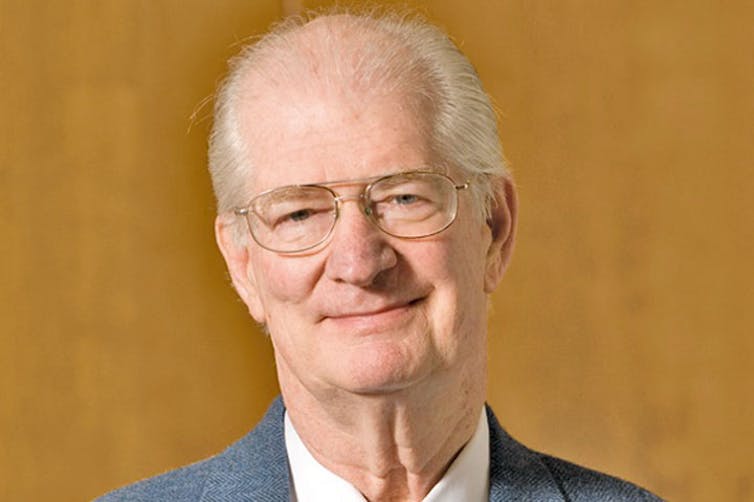
Headshot photo of Daly as an older man, with glasses and thinning hair,
Economist Herman Daly (1938-2022) Courtesy of Island Press

But Daly was a voracious reader, a side effect of having polio as a boy and missing out on the Texas football craze. Outside the confines of assigned textbooks, he found a history of economic thought steeped in rich philosophical debates on the function and purpose of the economy.

Unlike the precision of a market equilibrium sketched on the classroom blackboard, the real-world economy was messy and political, designed by those in power to choose winners and losers. He believed that economists should at least ask: Growth for whom, for what purpose and for how long?

Daly’s biggest realization came through reading marine biologist Rachel Carson’s 1962 book “Silent Spring,” and seeing her call to “come to terms with nature … to prove our maturity and our mastery, not of nature but of ourselves.” By then, he was working on a Ph.D. in Latin American development at Vanderbilt University and was already quite skeptical of the hyperindividualism baked into economic models. In Carson’s writing, the conflict between a growing economy and a fragile environment was blindingly clear.

After a fateful class with Nicholas Georgescu-Roegen, Daly’s conversion was complete. Georgescu-Roegen, a Romanian-born economist, dismissed the free market fairy tale of a pendulum swinging back and forth, effortlessly seeking a natural state of equilibrium. He argued that the economy was more like an hourglass, a one-way process converting valuable resources into useless waste.

Daly became convinced that economics should no longer prioritize the efficiency of this one-way process but instead focus on the “optimal” scale of an economy that the Earth can sustain. Just shy of his 30th birthday in 1968, while working as a visiting professor in the poverty-stricken Ceará region of northeastern Brazil, Daly published “On Economics as a Life Science.”

His sketches and tables of the economy as a metabolic process, entirely dependent on the biosphere as source for sustenance and sink for waste, were the road map for a revolution in economics.

Economics of a full world

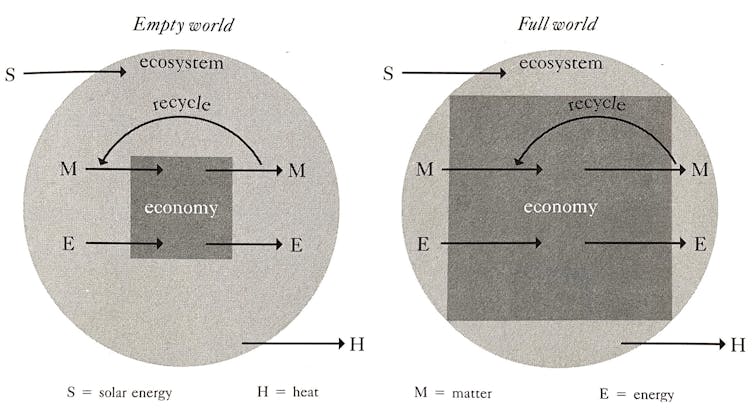
Daly spent the rest of his career drawing boxes in circles. In what he called the “pre-analytical vision,” the economy – the box – was viewed as the “wholly owned subsidiary” of the environment, the circle.

When the economy is small relative to the containing environment, a focus on the efficiency of a growing system has merit. But Daly argued that in a “full world,” with an economy that outgrows its sustaining environment, the system is in danger of collapse.

Illustrations of a square (economy) inside a circle (ecosystem). Energy and matter go into and out of the economy square, and some is recycled. Meanwhile solar energy enters the ecosystem circle and some heat escapes. In one, the square is too large.
Herman Daly’s conception of the economy as a subsystem of the environment. In a ‘full world,’ more growth can become uneconomic. Adapted from ‘Beyond Growth.’ Used with permission from Beacon Press.

While a professor at Louisiana State University in the 1970s, at the height of the U.S. environmental movement, Daly brought the box-in-circle framing to its logical conclusion in “Steady-State Economics.” Daly reasoned that growth and exploitation are prioritized in the competitive, pioneer stage of a young ecosystem. But with age comes a new focus on durability and cooperation. His steady-state model shifted the goal away from blind expansion of the economy and toward purposeful improvement of the human condition.

The international development community took notice. Following the United Nations’ 1987 publication of “Our Common Future,” which framed the goals of a “sustainable” development, Daly saw a window for development policy reform. He left the safety of tenure at LSU to join a rogue group of environmental scientists at the World Bank.

For the better part of six years, they worked to upend the reigning economic logic that treated “the Earth as if it were a business in liquidation.” He often butted heads with senior leadership, most famously with Larry Summers, the bank’s chief economist at the time, who publicly waved off Daly’s question of whether the size of a growing economy relative to a fixed ecosystem was of any importance. The future U.S. treasury secretary’s reply was short and dismissive: “That’s not the right way to look at it.”

But by the end of his tenure there, Daly and colleagues had successfully incorporated new environmental impact standards into all development loans and projects. And the international sustainability agenda they helped shape is now baked into the U.N. Sustainable Development Goals of 193 countries, “a plan of action for people, planet and prosperity.” In 1994, Daly returned to academia at the University of Maryland, and his life’s work was recognized the world over in the years to follow, including by Sweden’s Right Livelihood Award, the Netherlands’ Heineken Prize for Environmental Science, Norway’s Sophie Prize, Italy’s Medal of the Presidency, Japan’s Blue Planet Prize and even Adbuster’s person of the year.

Today, the imprint of his career can be found far and wide, including measures of the Genuine Progress Indicator of an economy, new Doughnut Economics framing of social floors within environmental ceilings, worldwide degree programs in ecological economics and a vibrant degrowth movement focused on a just transition to a right-sized economy.

I knew Herman Daly for two decades as a co-author, mentor and teacher. He always made time for me and my students, most recently writing the foreword to my upcoming book, “The Progress Illusion: Reclaiming Our Future from the Fairytale of Economics.” I will be forever grateful for his inspiration and courage to, as he put it, “ask the naive, honest questions” and then not be “satisfied until I get the answers.”

Jon D. Erickson, Professor of Sustainability Science and Policy, University of Vermont

This article is republished from The Conversation under a Creative Commons license. Read the original article.

ooOOoo

I found this to be absolutely fascinating and I am sure many besides me agree.

A fascinating article about Pit Bulls

The breed has come full circle!

We have had a couple of pit bull mixes here at home and they have been nothing but fabulous dogs.

So just three weeks ago The Conversation published an extensive account of the recent history of the breed. It is republished for you all today.

ooOOoo

Pit bulls went from America’s best friend to public enemy – now they’re slowly coming full circle.

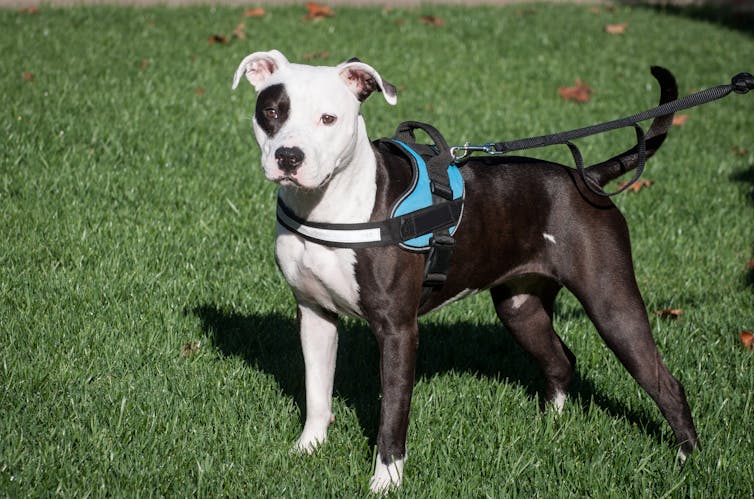
A pit bull is not an official breed – it’s an umbrella term for a type of dog. Barbara Rich via Getty Images

Colin Dayan, Vanderbilt University

As recently as 50 years ago, the pit bull was America’s favorite dog. Pit bulls were everywhere. They were popular in advertising and used to promote the joys of pet-and-human friendship. Nipper on the RCA Victor label, Pete the Pup in the “Our Gang” comedy short films, and the flag-wrapped dog on a classic World War I poster all were pit bulls.

With National Pit Bull Awareness Day celebrated on Oct. 26, it’s a fitting time to ask how these dogs came to be seen as a dangerous threat.

A black and white dog runs with a tennis ball in its mouth
Stella, a pit bull owned by author Colin Dayan. Colin Dayan, CC BY-ND

Starting around 1990, multiple features of American life converged to inspire widespread bans that made pit bulls outlaws, called “four-legged guns” or “lethal weapons.” The drivers included some dog attacks, excessive parental caution, fearful insurance companies and a tie to the sport of dog fighting.

As a professor of humanities and law, I have studied the legal history of slaves, vagrants, criminals, terror suspects and others deemed threats to civilized society. For my books “The Law is a White Dog” and “With Dogs at the Edge of Life,” I explored human-dog relationships and how laws and regulations can deny equal protection to entire classes of beings.

In my experience with these dogs – including nearly 12 years living with Stella, the daughter of champion fighting dogs – I have learned that pit bulls are not inherently dangerous. Like other dogs, they can become dangerous in certain situations, and at the hands of certain owners. But in my view, there is no defensible rationale for condemning not only all pit bulls, but any dog with a single pit bull gene, as some laws do.

I see such action as canine profiling, which recalls another legal fiction: the taint or stain of blood that ordained human degradation and race hatred in the United States.

Painting of a black and white dog looking into the horn of a Victorian record player
English artist Francis Barraud (1856-1924) painted his brother’s dog Nipper listening to the horn of an early phonograph in 1898. Victor Talking Machine Co. began using the symbol in its trademark, His Master’s Voice, in 1900. Wikipedia

Bred to fight

The pit bull is strong. Its jaw grip is almost impossible to break. Bred over centuries to bite and hold large animals like bears and bulls around the face and head, it’s known as a “game dog.” Its bravery and strength won’t allow it to give up, no matter how long the struggle. It loves with the same strength; its loyalty remains the stuff of legend.

For decades pit bulls’ tenacity encouraged the sport of dogfighting, with the dogs “pitted” against each other. Fights often went to the death, and winning animals earned huge sums for those who bet on them.

But betting on dogs is not a high-class sport. Dogs are not horses; they cost little to acquire and maintain. Pit bulls easily and quickly became associated with the poor, and especially with Black men, in a narrative that connected pit bulls with gang violence and crime.

That’s how prejudice works: The one-on-one lamination of the pit bull onto the African American male reduced people to their accessories.

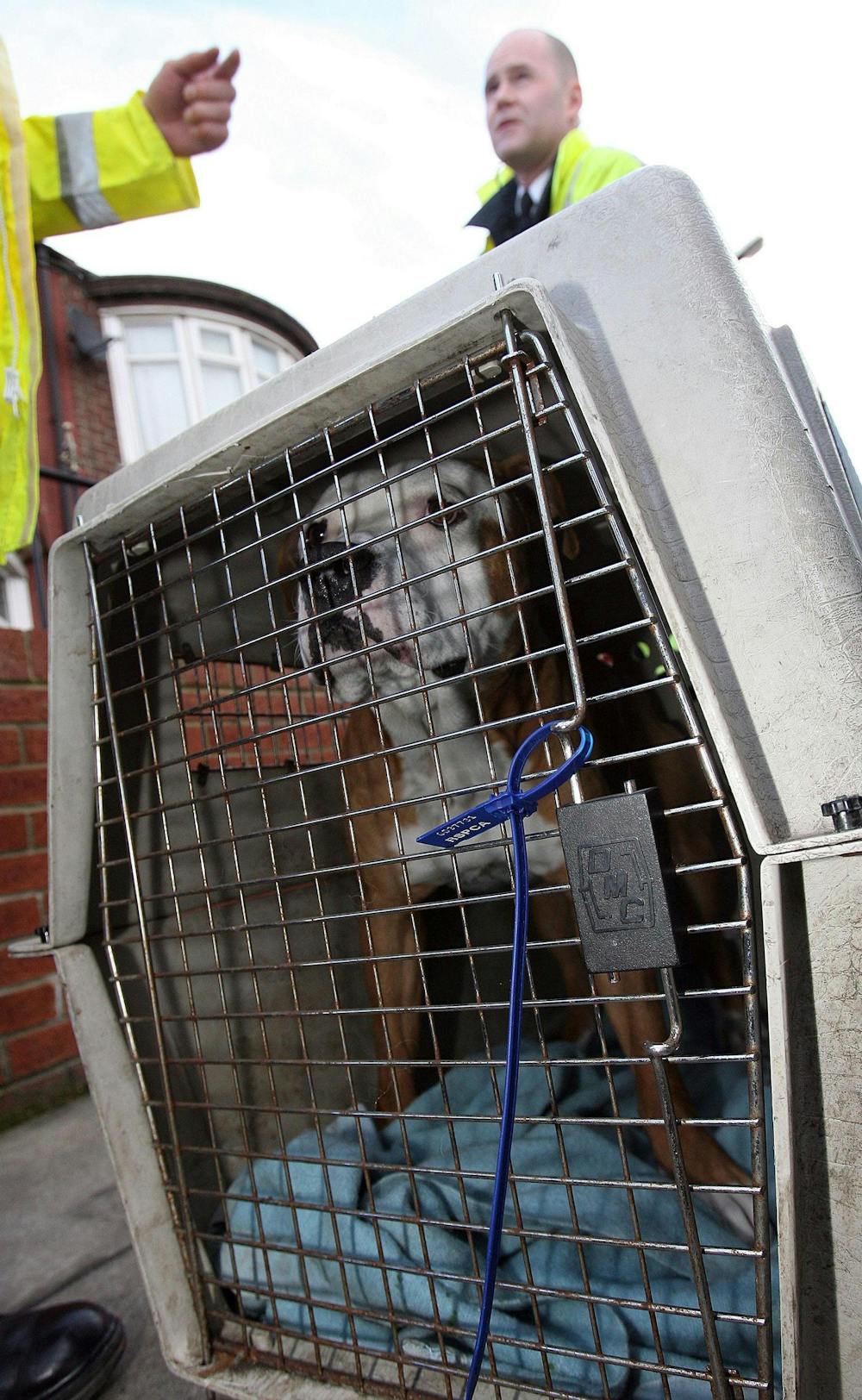
A dog confined in an animal crate, with police in the background.
A pit bull-type dog seized during a 2007 raid on an illegal dogfighting operation in East Cleveland, Ohio. Owen Humphreys – PA Images via Getty Images

Dogfighting was outlawed in all 50 states by 1976, although illegal businesses persisted. Coverage of the practice spawned broad assertions about the dogs that did the fighting. As breed bans proliferated, legal rulings proclaimed these dogs “dangerous to the safety or health of the community” and judged that “public interests demand that the worthless shall be exterminated.”

In 1987 Sports Illustrated put a pit bull, teeth bared, on its cover, with the headline “Beware of this Dog,” which it characterized as born with “a will to kill.” Time magazine published “Time Bombs on Legs” featuring this “vicious hound of the Baskervilles” that “seized small children like rag dolls and mauled them to death in a frenzy of bloodletting.”

Presumed vicious

If a dog has “vicious propensities,” the owner is assumed to share in this projected violence, both legally and generally in public perception. And once deemed “contraband,” both property and people are at risk.

This was evident in the much-publicized 2007 indictment of Atlanta Falcons quarterback Michael Vick for running a dogfighting business called Bad Newz Kennels in Virginia. Even the Humane Society of the United States and People for the Ethical Treatment of Animals – two of the nation’s leading animal welfare advocacy groups – argued that the 47 pit bulls recovered from the facility should be killed because they posed a threat to people and other animals.

If not for the intervention of Best Friends Animal Society, Vick’s dogs would have been euthanized. As the film “Champions” recounts, a court-appointed special master determined each dog’s fate. Ultimately, nearly all of the dogs were successfully placed in sanctuaries or adoptive homes.

This 2010 report describes the successful rehabilitation of dogs rescued from Michael Vick’s Bad Newz dogfighting operation.

Debating breed bans

Pit bulls still suffer more than any other dogs from the fact that they are a type of dog, not a distinct breed. Once recognized by the American Kennel Club as an American Staffordshire terrier, popularly known as an Amstaff, and registered with the United Kennel Club and the American Dog Breeders Association as an American pit bull terrier, now any dog characterized as a “pit bull type” can be considered an outlaw in many communities.

For example, in its 2012 Tracey v. Solesky ruling, the Maryland Court of Appeals modified the state’s common law in cases involving dog injuries. Any dog containing pit bull genes was “inherently dangerous” as a matter of law.

This subjected owners and landlords to what the courts call “strict liability.” As the court declared: “When an attack involves pit bulls, it is no longer necessary to prove that the particular pit bull or pit bulls are dangerous.”

Dissenting from the ruling, Judge Clayton Greene recognized the absurdity of the majority opinion’s “unworkable rule”: “How much ‘pit bull,’” he asked, “must there be in a dog to bring it within the strict liability edict?”

It’s equally unanswerable how to tell when a dog is a pit bull mix. From the shape of its head? Its stance? The way it looks at you?

Conundrums like these call into question statistics that show pit bulls to be more dangerous than other breeds. These figures vary a great deal depending on their sources.

Any statistics about pit bull attacks depend on the definition of a pit bull – yet it’s really hard to get good dog bite data that accurately IDs the breed

Prince George’s County, Md., is negotiating with advocates suing to revoke the county’s pit bull ban.

Over the past decade, awareness has grown that breed-specific legislation does not make the public safer but does penalize responsible owners and their dogs. Currently 21 states prohibit local government from enforcing breed-specific legislation or naming specific breeds in dangerous dog laws. Maryland passed a law reversing the Tracey ruling in 2014. Yet 15 states still allow local communities to enact breed-specific bans.

Pit bulls demand a great deal more from humans than some dogs, but alongside their bracing way of being in the world, we humans learn another way of thinking and loving. Compared with many other breeds, they offer a more demanding but always affecting communion.

Colin Dayan, Professor of English, Robert Penn Warren Professor in the Humanities, and Professor of Law, Vanderbilt University

This article is republished from The Conversation under a Creative Commons license. Read the original article.

ooOOoo

That is a very interesting account of the breed and shows the complexities of owning Pit Bulls in certain States, or rather local communities enacting breed-specific bans.

However, in our experience, we have found them to be smart, loving animals, and we know we are not alone in having those thoughts.

The end maybe in sight!

A rather gloomy analysis about the next few years!

One makes decisions all one’s life. But too few of us are making decisions that will prevent our planet from over-heating.

Patrice Ayme wrote a comment in a recent post that said (in part): “However we are tracking to a much higher temperature: + 7 (seven) Celsius in some now temperate parts… imminently. That is going to be catastrophic.”

There is a terrible change going on right now. From the deforestation in the Amazon rainforest to the unseasonable heat in Europe, as reported in the Guardian newspaper: “The result of this advection has been anomalously warm temperatures across large parts of Europe – in particular across France and Spain, where temperatures soared to over 10C above normal. Maximum temperatures widely exceeded 30C in parts of Spain on Thursday, with 35.2C measured at Morón de la Frontera, south-east of Seville.

One would think that our governments would be pulling together in order to have a co-ordinated global plan. But there’s no sight of that yet. What we do have is a sort of craziness of Governments that causes me to lament over our, as in a global ‘our’, distractions. We are running out of time!

To this end I am republishing in full the latest George Monbiot essay. I hasten to add with Mr Monbiot’s permission.

ooOOoo

The Oligarch’s Oligarch

Published 30th October 2022.

Just as we need to get the money out of politics, we have been gifted a Prime Minister who represents the ultra-rich.

By George Monbiot, published in the Guardian 26th October 2022

Before we decide what needs to change, let’s take stock of what we have lost. I want to begin with what happened last week. I don’t mean the resignation of the prime minister. This is more important.

Almost all the media reported a scripted comment by the newly reinstated home secretary, Suella Braverman, about the “Guardian-reading, tofu-eating wokerati”. Astonishingly, scarcely any of them reported what she was doing at the time. She was pushing through the House of Commons the most repressive legislation of the modern era.

Under the public order bill, anyone who has protested in the previous five years, or has encouraged other people to protest, can be forced to “submit to … being fitted with, or the installation of, any necessary apparatus” to monitor their movements. In other words, if you attend or support any protest in which “serious disruption to two or more individuals or to an organisation” occurs, you can be forced to wear an electronic tag. “Serious disruption” was redefined by the 2022 Police Act to include noise.

This is just one of a series of astounding measures in the bill, which has been hardly remarked upon in public life as it passes through Britain’s legislature. What we see here is two losses in one moment: the final erasure of the right to protest, and political journalism’s mutation from reporting substance to reporting spectacle. These are just the latest of our losses.

So extreme has inequality become, and so dangerous is the combination of frozen wages, lagging benefits, rising rents and mortgage repayments, soaring bills and food inflation, that millions of people are being pushed towards destitution. Unless something changes, many will soon lose their homes. In the midst of this crisis, we have been gifted a prime minister who owns four luxury “homes”. One of them is an empty flat in Kensington that he reserves for visiting relatives.

While Rishi Sunak was chancellor, the government repeatedly delayed its manifesto promise to ban no-fault evictions. Landlords are ruthlessly exploiting this power to throw their tenants on to the street or use the threat to force them to accept outrageous rent rises and dismal conditions. Had Sunak’s “help to buy” mortgage scheme succeeded (it was a dismal flop), it would have raised house prices, increasing rents and making ownership less accessible: the opposite of its stated aim. But this, as with all such schemes, was surely its true purpose: to inflate the assets of existing owners, the Conservative party’s base.

Public services are collapsing at breathtaking speed. Headteachers warn that 90% of schools in England could run out of money next year. NHS dentistry is on the verge of extinction. Untold numbers are now living in constant pain and, in some cases, extracting their own teeth. The suspicion that the NHS is being deliberately dismembered, its core services allowed to fail so that we cease to defend it against privatisation, rises ever higher in the mind.

But Sunak appears determined only to hack ever further. Sitting on a family fortune of £730m, he seems unmoved by the plight of people so far removed from him in wealth that they must seem to exist on another planet. He is the oligarch’s oligarch, ever responsive to the demands of big capitaland the three offshore plutocrats who own the country’s biggest newspapers, oblivious of the needs of the 67 million people who live here.

After 12 years of Conservative austerity and chaos, the very rich have taken almost everything. They have even captured virtue. They now appropriate the outward signs of an ethical life while continuing – despite or because of their organic cotton jackets and second homes, their electric cars and pasture-fed meat, their carbon offsets and ayahuasca retreats, philanthropy and holidays in quiet resorts whose palm-thatched cabins mimic the vernacular of the people evicted to make way for them – to grasp the lion’s share of everything.

Corruption is embedded in public life. Fraud is scarcely prosecuted. Organised crime has been so widely facilitated, through the destruction of the state’s capacity to regulate everything from money laundering to waste dumping, that you could almost believe it was deliberate. Our rivers have been reduced to sewers, our soil is washing off the land, the planning system is being dismantled, and hundreds of environmental laws are now under threat. We hurtle towards Earth systems oblivion, while frenetically talking about anything but.

In other words, it’s not just a general election we need, it’s a complete rethink of who we are and where we stand. It’s not just proportional representation we need, but radical devolution to the lowest possible levels at which decisions can be made, accompanied by deliberative, participatory democracy. It’s not just new lobbying laws we require, but a comprehensive programme to get the money out of politics, ending all private political donations, breaking up the billionaire press and demanding full financial transparency for everyone in public life. We should seek not only the repeal of repressive legislation, but – as civil disobedience is the bedrock of democracy – positive rights to protest.

All this now feels far away. Jeremy Corbyn offered some (though by no means all) of these reforms. Keir Starmer offers none. Though Labour MPs voted against the public order bill, his only public comment so far has been to endorse its headline policy: longer sentences for people who glue themselves to roads. But if the Labour party or its future coalition partners can persuade him to agree to just one aspect of this programme, proportional representation, we can start work on the rest, building the political alliances that could transform the life of this nation. Without PR, we’re stuck with a dysfunctional duopoly, in hock to the billionaire press and the millionaires it appoints to govern us. We cannot carry on like this.

http://www.monbiot.com

ooOOoo

So much is really telling but I just want to draw your attention to this sentence: In other words, it’s not just a general election we need, it’s a complete rethink of who we are and where we stand.

It is not just in England and Wales but also in the USA. Indeed, most of the countries in the world.

Here is an excerpt from the latest email from The Economist. It presages the COP27 to be held in Egypt next week.

By burning fossil fuels, humans have altered Earth’s atmosphere, which has consequences for almost everything on the planet. It is reshaping weather systems and coastlines, transforming where crops can be grown, which diseases thrive, and how armies fight . Rising temperatures affect geopolitics, migration, ecosystems and the economy. Over the next century and beyond, climate change—and the responses to it—will remake societies and the world.

And a paragraph later:

This week I wrote about the seven texts I recommend as an introduction to the climate crisis—and explained why each is worth turning to—as a part of our “Economist reads” series. They range from Bill Gates’s assessment of technological solutions to a discussion of international justice by the former UN High Commissioner on Human Rights. One book I find myself recommending over and over again is “What We Know About Climate Change” by Kerry Emanuel, an atmospheric scientist at MIT. At 88 pages, it is a blessedly short, readable primer on the science, history and economics of climate change. The climate crisis touches everything. Understanding it, even a little, is essential for anyone who is engaged with the world and its future. This is a good place to start

Please follow this advice because it is an excellent place to start.

I wish with all my heart that I am wrong and maybe, just maybe, I am having a ‘down in the dumps’ day. Whatever, my judgement is that we have a few more years at most to find out.

One of the puzzles of this age.

Why society doesn’t worry a whole lot more about the changing climate.

There was an article recently on Treehugger that I read in full.

It was predictable, in a way, and very disturbing. Have a read yourself.

ooOOoo

Why Don’t People Care About Climate Change?

They have other things on their mind, like being hit by a car.

By Lloyd Alter,

Published October 21, 2022

People fear this more than climate change. Halfpoint/ Getty Images

Treehugger was founded by Graham Hill as “a green lifestyle website dedicated to driving sustainability mainstream.” Sustainability is often defined as “meeting our own needs without compromising the ability of future generations to meet their own needs,” and doesn’t seem to be much more mainstream now than it was then. Here we are, 18 years later, and key sustainability issues like climate change are not top of mind for most people, and Treehugger is not the world’s biggest website.

One reason might be because of people’s perception of risk. The Lloyd’s Register Foundation is a charity that “helps to protect life and property at sea, on land, and in the air.” It hired Gallup to do a World Risk Poll in 2020, using 2019 data, and just published its latest 2022 poll with 2021 data, after polling 125,911 people in 121 countries, mostly by telephone. One poll was pre-pandemic, and the other during it.1Chief executive Dr. Ruth Boumphrey compares the two:

“Looking at this first report of the 2021 World Risk Poll, what strikes me most about the findings is what hasn’t changed, as much as what has. People globally still worry about perennial threats such as road crashes, crime, and violence more than any other risks, including Covid-19, and this has important implications for how policymakers work with communities to manage emerging public health challenges in the context of their everyday lives.”

Perhaps the most surprising statistic is that North Americans believe that their greatest daily source of risk is from road-related accidents and injuries at 29%, followed by crime and violence at 11%. Australia and New Zealand put road risk at 33%, weirdly followed by cooking and household accidents at 11%.1

At first, I thought this is terrible; we have been writing about road safety for years, and nothing gets fixed, and yet it is North Americans’ biggest worry! And what’s wrong with Australian kitchens? But when you look at the numbers, you realize that this is a result of rich countries not suffering as much from many of the things other countries worry about, such as Latin America with crime and violence at 43%, Africa worrying about not having money, and North Africa worried about disease.1

Covid-19 was considered a major risk in some parts of the world, but “its impact was moderate overall, and day-to-day risks such as road-related injuries, crime and violence, and economic concerns remained top-of-mind for most people.”

This has been the perennial sustainability story; day-to-day issues and worries have higher priority. Climate change gets its own special section of the risk report and it comes to much the same conclusion. The authors start by noting that “the global risk posed by climate change is widely recognised, and warnings about its effects are increasingly dire. A recent joint statement by more than 200 medical journals called the rapidly warming climate the ‘greatest threat to global public health.'”

But then they dig into the data and find that, while 67% of respondents consider climate change a threat, only 41% deem it serious.1 It varies by education:

“The likelihood of people viewing climate change as a very serious threat to their country was much lower among those with primary education or less (32%) than among those with secondary (47%) or post-secondary (50%) education. More than a quarter of people in the lowest education group (28%) said they ‘don’t know,’ compared to 13% among those with secondary education and 7% with at least some post-secondary education.”

Logically, people who had experienced severe weather events were more likely to consider climate change to be a serious threat, although even then, there is a correlation with education. So university grads in Fort Myers are probably pretty convinced that climate change is a problem right now. The conclusion:

“As in 2019, the 2021 World Risk Poll findings demonstrate the powerful influence of education on global perceptions of climate change. The data highlight the challenge of reaching people who may be vulnerable to risk from extreme weather but have low average education levels, such as agricultural communities in low- and middle-income countries and territories… Spreading awareness of how climate change may directly impact people’s lives may be crucial in broadening local efforts to reduce carbon emissions and build resilience to the effects of rising temperatures.”

Education has always been a problem because, as climate journalist Amy Westervelt noted after the latest IPCC report, there are powerful forces interested in downplaying the importance of climate change. She wrote, “The report made one thing abundantly clear: the technologies and policies necessary to adequately address climate change exist, and the only real obstacles are politics and fossil fuel interests.” Education would have a lot to do with how susceptible people are to their stories.

In many ways, we have seen this movie before, in the Great Recession of 2008. When people are worrying about whether they can heat or they can eat, or apparently whether they will survive crossing the street, then climate change is something they can worry about later.

  1. 2021 Report: A Changed World? Perceptions and Experiences of Risk in the Covid Age.” Lloyd’s Register Foundation, 2022.

ooOOoo

This is the reason why we need leaders, as in country leaders, because only these people are sufficiently committed to plan and to legislate for the most important tasks facing that country. In the case of climate change it requires even more co-ordination across all the countries in the world; we do have a way to go before that is achieved.

The wonders of soil!

Jane Zelikova gives a very powerful TED Talk.

The promotion for this TED Talk appeared in my ‘in box’ last week and I was curious as to its contents. So I watched the talk on Sunday afternoon and was amazed. This is so much more significant to all of us than the title suggests.

First watch the talk.

Then some background to Jane, who is a ecosystem scientist:

Dr. Tamara Jane Zelikova works at the intersection of climate science and policy. Her work focuses on advancing the science of carbon removal and she has published in scientific journals like Nature and Proceedings of the National Academy of Sciences, written and contributed to climate policy reports and published articles in popular media outlets like Scientific American. She is currently the executive director of the Soil Carbon Solutions Center at Colorado State University, where she works with leading scientists to build the tools and approaches needed to accelerate the deployment of credible soil-based climate solutions, measure their impacts and bring them to scale.

That then led me to the Soil Carbon Solutions Center website and this is a site you should visit. A little piece from their About section:

Unlocking the potential of soil for a more sustainable planet

Soil is one of the largest natural carbon reservoirs and an important climate mitigation tool that is ready to deploy today. Accelerating the adoption of regenerative agricultural practices that build soil carbon on working lands offers the potential to substantially draw down atmospheric carbon while improving the environmental, economic and social sustainability of food, fiber and bioenergy production.

Please, please watch the TED Talk!

A disturbing report from NASA.

About the 2022 Artic Summer Sea Ice.

There’s no way to make this pleasant; the Arctic Summer Sea Ice tied for the tenth lowest on record.

ooOOoo

This image visualizes sea ice change in the Arctic using data provided by the Japan Aerospace Exploration Agency’s Global Change Observation Mission 1st-Water “SHIZUKU” satellite, which is part of a NASA-led partnership to operate several Earth-observing satellites. The visualization can be accessed at https://svs.gsfc.nasa.gov/5030. Credit: NASA’s Scientific Visualization Studio.

According to satellite observations, Arctic sea ice reached its annual minimum extent (lowest amount of ice for the year) on Sept. 18, 2022. The ice cover shrank to an area of 4.67 million square kilometers (1.80 million square miles) this year, roughly 1.55 million square kilometers (598,000 square miles) below the 1981-2010 average minimum of 6.22 million square kilometers (2.40 million square miles).

The average September minimum extent record shows significant declines since satellites began measuring consistently in 1978. The last 15 years (2007 to 2021) are the lowest 15 minimum extents in the 43-year satellite record.

This visualization, created at NASA’s Goddard Space Flight Center in Greenbelt, Maryland, shows data provided by the Japan Aerospace Exploration Agency (JAXA), acquired by the Advanced Microwave Scanning Radiometer 2 (AMSR2) instrument aboard JAXA’s Global Change Observation Mission 1st-Water “SHIZUKU” (GCOM-W1) satellite.

Music: “Celestial Vault” from Universal Production Music

Video credit: NASA’s Goddard Space Flight Center

Kathleen Gaeta (GSFC AIMMS): Lead Producer

Trent L. Schindler (USRA): Lead Animator

Roberto Molar (KBR): Lead Writer

ooOOoo

As I said, a sorry tale for which there is no good news. I wish there were!

Our climate: Welcome to the New Normal!

An article read on Sunday is the motivation for today’s post.

The article, published by The Conversation blog site, was made public last Wednesday week.

I make no apologies for banging the climate change gong again, it is in my opinion the most important subject going.

Enough from me; now to the article.

(And it had been planned for last Tuesday but because of Pedi it is now today.)

ooOOoo

By Professor Shuang-Ye Wu

This article was written by Professor Shuang-Ye Wu. It is very good.

Professor Wu is the Professor of Geology and Environmental Geosciences at the University of Dayton, USA.

Looking back on America’s summer of heat, floods and climate change: Welcome to the new abnormal!

Much of the South and Southern Plains faced a dangerous heat wave in July 2022, with highs well over 100 degrees for several days. Brandon Bell/Getty Images

The summer of 2022 started with a historic flood in Montana, brought on by heavy rain and melting snow, that tore up roads and caused large areas of Yellowstone National Park to be evacuated.

It ended with a record-breaking heat wave in California and much of the West that pushed the power grid to the breaking point, causing blackouts, followed by a tropical storm that set rainfall records in southern California. A typhoon flooded coastal Alaska, and a hurricane hit Puerto Rico with more than 30 inches of rain.

In between, wildfires raged through California, Arizona and New Mexico on the background of a megadrought in Southwestern U.S. that has been more severe than anything the region has experienced in at least 1,200 years. Near Albuquerque, New Mexico, a five-mile stretch of the Rio Grande ran dry for the first time in 40 years. Persistent heat waves lingered over many parts of the country, setting temperature records.

At the same time, during a period of five weeks between July and August, five 1,000-year rainfall events occurred in St. Louis, eastern Kentucky, southern Illinois, California’s Death Valley and in Dallas, causing devastating and sometimes deadly flash floods. Extreme rainfall also led to severe flooding in Mississippi, Virginia and West Virginia.

The United States is hardly alone in its share of climate disasters.

In Pakistan, record monsoon rains inundated more than one-third of the country, killing over 1,500 people. In India and China, prolonged heat waves and droughts dried up rivers, disrupted power grids and threatened food security for billions of people.

In Europe, heat waves set record temperatures in Britain and other places, leading to severe droughts and wildfires in many parts of the continent. In South Africa, torrential rains brought flooding and mudslides that killed more than 400 people. The summer may have come to an end on the calendar, but climate disasters will surely continue.

This isn’t just a freak summer: Over the years, such extreme events are occurring in increasing frequency and intensity.

Climate change is intensifying these disasters

The most recent international climate assessment from the United Nations’ Intergovernmental Panel on Climate Change found significant increases in both the frequency and intensity of extreme temperature and precipitation events, leading to more droughts and floods.

A recent study published in the scientific journal Nature found that extreme flooding and droughts are also getting deadlier and more expensive, despite an improving capacity to manage climate risks. This is because these extreme events, enhanced by climate change, often exceed the designed levels of such management strategies.

A girl in rain boots walks through a mud-filled yard. Damaged mattresses and other belongings from a flooded house are piled nearby.
Flash flooding swept through mountain valleys in eastern Kentucky in July 2022, killing more than three dozen people. It was one of several destructive flash floods. Seth Herald/AFP via Getty Images

Extreme events, by definition, occur rarely. A 100-year flood has a 1% chance of happening in any given year. So, when such events occur with increasing frequency and intensity, they are a clear indication of a changing climate state.

The term “global warming” can sometimes be misleading, as it seems to suggest that as humans put more heat-trapping greenhouse gases into the atmosphere, the world is going to get a bit warmer everywhere. What it fails to convey is that warming temperatures also lead to a more violent world with more extreme climate disasters, as we saw this past summer.

Climate models showed these risks were coming

Much of this is well-understood and consistently reproduced by climate models.

As the climate warms, a shift in temperature distribution leads to more extremes. The magnitudes of changes in extreme temperature are often larger than changes in the mean. For example, globally, a 1 degree Celsius increase in annual average temperature is associated with 1.2 C to 1.9 C (2.1 Fahrenheit to 3.4 F) of increase in the annual maximum temperature.

A man works on a car with an older mechanic in overalls standing next to him under the shade of a large beach umbrealla.
Heat waves, like the heat dome over the South in July 2022, can hit outdoor workers especially hard. Brandon Bell/Getty Images

In addition, global warming causes changes in the vertical profile of the atmosphere and equator-to-pole temperature gradients, leading to changes in how the atmosphere and ocean move. The temperature difference between equator and the poles is the driving force for global wind. As the polar regions warm at much higher rates then the equator, the reduced temperature difference causes a weakening of global winds and leads to a more meandering jet stream.

Some of these changes can create conditions such as persistent high-pressure systems and atmosphere blocking that favor more frequent and more intense heat waves. The heat domes over the Southern Plains and South in June and the West in September are examples.

The initial warming can be further amplified by positive feedbacks. For example, warming increases snow melt, exposing dark soil underneath, which absorbs more heat than snow, further enhancing the warming.

Warming of the atmosphere also increases its capacity to hold water vapor, which is a strong greenhouse gas. Therefore, more water vapor in the air leads to more warming. Higher temperatures tend to dry out the soil, and less soil moisture reduces the land’s heat capacity, making it easier to heat up.

These positive feedbacks further intensify the initial warming, leading to more heat extremes. More frequent and persistent heat waves lead to excessive evaporation, combined with decreased precipitation in some regions, causing more severe droughts and more frequent wildfires.

Higher temperatures increase the atmosphere’s capacity to hold moisture at a rate of about 7% per degree Celsius.

This increased humidity leads to heavier rainfall events. In addition, storm systems are fueled by latent heat, or the large amount of energy released when water vapor condenses to liquid water. Increased moisture content in the atmosphere also enhances latent heat in storm systems, increasing their intensity. Extreme heavy or persistent rainfall leads to increased flooding and landslides, with devastating social and economic consequences.

Even though it’s difficult to link specific extreme events directly to climate change, when these supposedly rare events occur with increasing frequency in a warming world, it is hard to ignore the changing state of our climate.

A woman with her eyes closed holds a screaming 1-year-old boy in a National Guard helicopter, with a guardsman standing in the open helicopter door.
A family had to be airlifted from their home in eastern Kentucky after it was surrounded by floodwater in July 2022. Michael Swensen/Getty Images

The new abnormal

So this past summer might just provide a glimpse of our near future, as these extreme climate events become more frequent.

To say this is the new “normal,” though, is misleading. It suggests that we have reached a new stable state, and that is far from the truth.

Without serious effort to curb greenhouse gas emissions, this trend toward more extreme events will continue. Things will keep getting worse, and this past summer will become the norm a few years or decades down the road – and eventually, it will seem mild, like one of those “nice summers” we look back on fondly with nostalgia.

This article is republished from The Conversation under a Creative Commons license. Read the original article.

ooOOoo

There is growing evidence that things are really changing globally. I used to say that I would be dead before the impacts of climate change really hit home. As in, it would be a good twenty years before things really took a hold. But it is now much more likely that the next five years are going to see a continuation of the changes and that there isn’t time to hang around.

I may not be as sharp as I used to be but the changing climate will affect me and Jean and all those in our area. Will our leaders grasp this nettle now? I wish I knew.

Educational Support Animals

Today and tomorrow there are guest posts for you. I must say that I really appreciate these guest articles. So without any more delay, here is today’s post.

ooOOoo

A guest post by Indiana Lee.

How To Effectively Discuss Your ESA With Your Employer

If you have — or want to obtain — an emotional support animal (ESA), it’s natural that you may want to bring it to work. If this is the case, you need to discuss your ESA with your employer. Yet, doing so is often easier said than done.

For some people, bringing an ESA to work may seem problematic. Your ESA helps you feel and perform your best. However, you may be concerned that your emotional support animal will be a distraction. Even worse, you may be worried that your ESA may disrupt your relationship with your employer.

When it comes to ESAs at work, it is important to keep in mind that you and your employer share a common goal: to achieve the best-possible results at work. If you know how to discuss your needs with your employer, you can highlight the benefits for all parties involved. 

Now, let’s look at five tips to help you effectively bring up an ESA with your employer. 

1. Have a Face-to-face Conversation With Your Employer

Schedule a date and time to meet with your employer to discuss your ESA. Once you set up the meeting, plan accordingly.

Consider how you will deliver your message to your employer. It can be beneficial to illustrate the health benefits of having a pet for emotional support. You can also provide details about how you’ll manage the animal while you work and ensure it does not hamper your and your colleagues’ productivity. 

2. Respond to Your Employer’s Concerns and Questions About Your ESA

Give your employer plenty of time to share their concerns and questions about your emotional support animal. If your employer has concerns or questions about why you need an animal at work, you should be ready to address them. 

The most common emotional support animals are dogs. Complete any paperwork required by your employer so you can take a dog or other type of emotional support animal to work. They will perhaps already have a policy on bringing dogs to work, but if it is a cat or other type of pet, you should make this clear in the meeting. 

Employers are also allowed to request medical documentation if you want to bring an ESA to work due to a disability. You can meet with a medical professional to get this documentation.

3. Let Your Employer Share Your ESA’s Story

Encourage your employer to use your ESA to promote its workplace culture. This can help your employer attract top talent and keep its staff happy. 

For instance, your employer can share the story of your ESA with job candidates and employees. This can show job candidates that your employer is committed to do what it can to accommodate its workers. Giving the background of the pet and how it has helped you be a productive, happy employee can be heartwarming and aid in their search for top performers.

Meanwhile, your coworkers can see that your employer wants them to feel comfortable. This can lead to a positive work culture in which all employees are treated with the respect and dignity they deserve. After all, workplace efficiency is improved when employees feel valued and comfortable in the work environment.

4. Keep Your Employer Up to Date About Your ESA

Communicate with your employer about your ESA. If any problems arise that involve the animal, you can share them with your employer immediately. That way, you and your employer can address any issues before they escalate. For example, if your emotional support dog contracts an infectious disease, let your employer know. You can make accommodations to work from home or not bring the animal during that period to keep others safe.

5. Explore Alternatives to Bringing Your ESA to Work

If your employer will not allow you to bring your ESA to work, try not to stress about it. Rather, continue to work with your employer to explore alternatives. For example, your employer may let you work remotely so you can have your ESA by your side while you work. Or, your employer may allow you to work a flexible schedule. If this isn’t possible, it’s entirely okay to look for a job that accommodates your needs.

Don’t Wait To Discuss Your ESA With Your Employer 

An emotional support animal can provide a great source of comfort and companionship. If you feel having an ESA at work would be beneficial, you should discuss this topic with your employer right away.

Many employers are more willing than ever before to let their employees have an ESA at work. By discussing the topic with your employer, you can find out what it can offer. From here, you and your employer can work together to ensure you receive the support you need to thrive at work.

ooOOoo

That is very good advice and I am grateful to Indiana for writing it and then offering it to Learning from Dogs. Thank you, Indiana.