Not all heroes wear capes — but when it comes to helping animals in need, some really do.
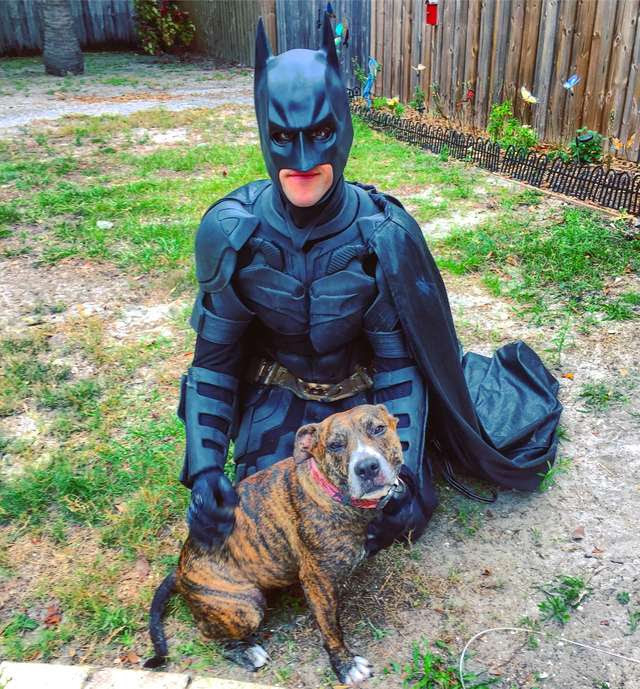
That’s what one homeless pit bull named Koko learned when the Caped Crusader himself changed her life forever.
Photo Credit: Batman4Paws
Koko arrived at the Pet Resource Center of Tampa as a stray. Day after day, she waited patiently for a family to choose her. But, before that day could come, she was put on the euthanasia list. With an hour left to live, Koko was pulled from the shelter by her foster mom and months later found a forever home in Gatlinburg, Tennessee.
The only problem? She had no way of getting there.
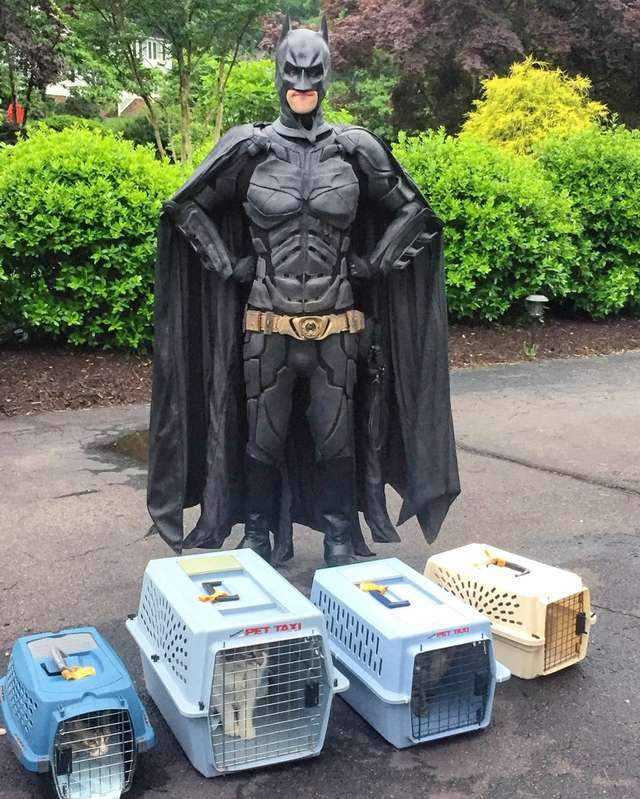
Enter the Dark Knight — otherwise known as Chris Van Dorn, founder of the animal rescue nonprofit Batman4Paws.
Batman4Paws
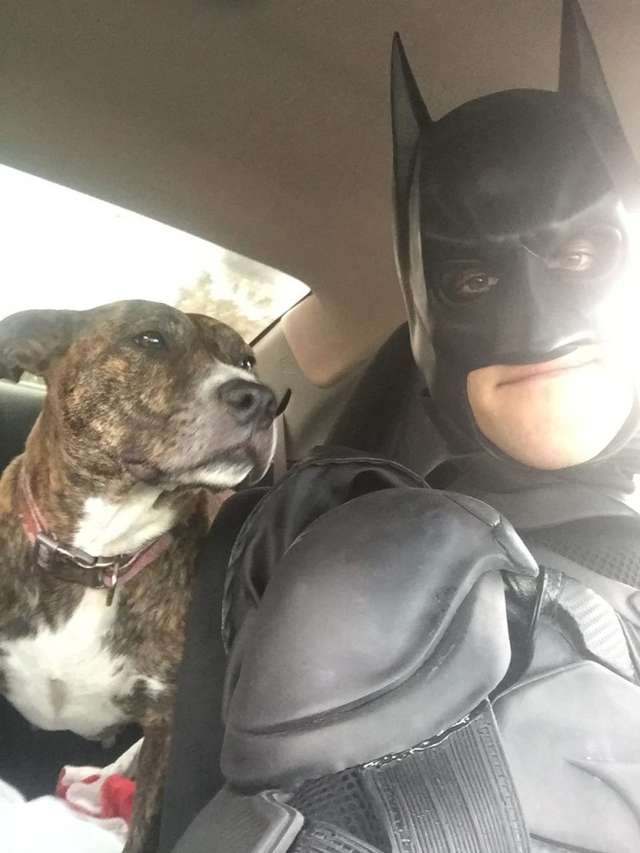
An eight-hour road trip dressed in an elaborate Batman costume is all in a day’s work for Van Dorn. “I would say I’m just the middleman,” Van Dorn told The Dodo. “The real heroes are the people giving these dogs a good, loving home.”
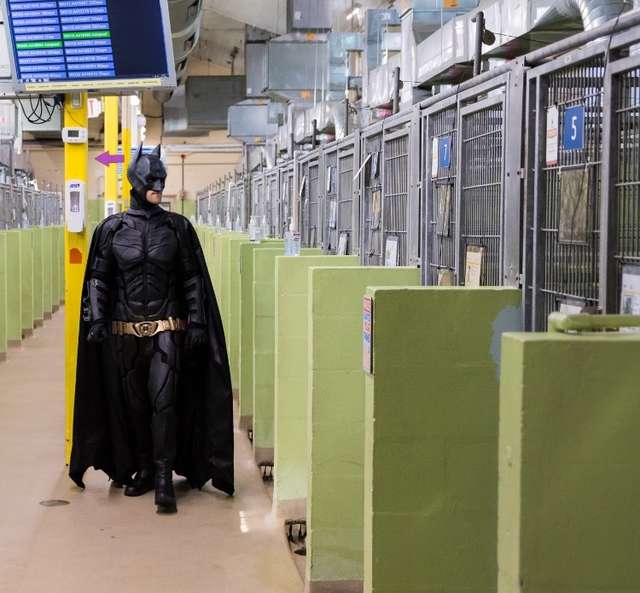
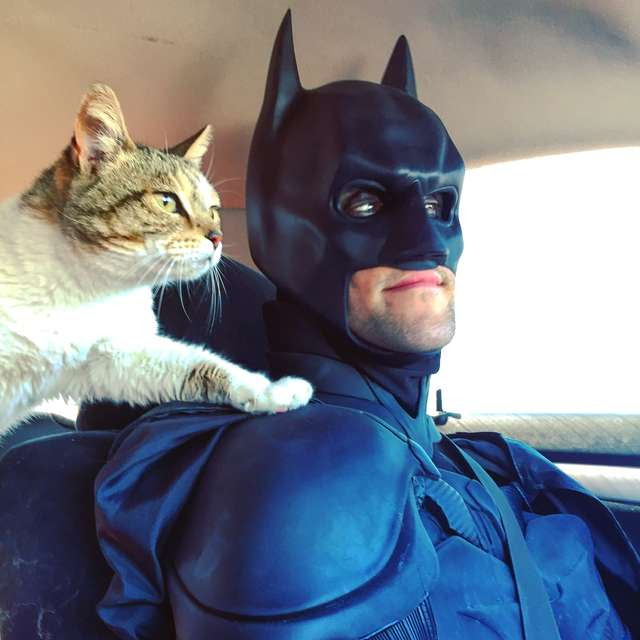
Koko is one of many dogs and cats whom Van Dorn has helped transport from overcrowded shelters to the safety of their forever homes.
And while dressing as Batman isn’t necessary to save an animal’s life, it has helped Van Dorn open up a dialogue about the importance of adoption and fostering.
Batman4Paws
The costume just makes everybody happy and smile,” Van Dorn said. “It’s special to see Batman walking around, and when they find out that he’s doing a good deed in the world they get even more excited.”
“It kind of just came as a way to embody all the good I wanted to do in the world,” he added, “and make it easy for people to talk to me right off the bat.”
Batman4Paws[/caption]
Van Dorn grew up watching the Batman animated series and began volunteering with animal rescues when his family adopted an Australian shepherd named Mr. Boots. When it came time for Van Dorn to start his own rescue organization, he decided to do it as Batman with, of course, Mr. Boots occasionally stepping in as Robin.
Batman4Paws
Every superhero has a secret identity, and for Van Dorn, wearing a mask was an intentional way of keeping the focus on his mission of saving animals.
“When I was first starting out, I was keeping everything really anonymous,” Van Dorn said. “I would sign everything ‘Bruce Wayne’ and not put my real name out there … My catchphrase is, ‘It’s not who I am underneath but what I do that defines me,’ and I still hold that true today.”
Batman4Paws
His cover was blown when GoFundMe honored his campaign, naming him as their GoFundMe Hero for May. Van Dorn hopes soon to put his private pilot’s license to good use by purchasing a plane so he can fly the animals to their forever homes every week.
But for the time being, he’s using his Batmobile, and making a difference whenever he can.
“Actions speak louder than words and I’m just doing my best to empty the cages,” Van Dorn said. “And I challenge anyone to go to their local shelter because it’s a depressing place, but if you can help out in any way — whether that’s to foster a dog or adopt a dog or just volunteer your time, then you should go out and do it.”
ooOOoo
This is one amazing guy. Simple and straightforward!
This is the post (and I trust I can share it with you!)
ooOOoo
If you have ever wondered what it must be like to be a bird flying alongside them is about as close as you can come.
Christian Moullec takes us some amazing flights with his birds in this wonderful video. He has been helping birds migrate from Germany to Sweden since 1995. His efforts have raised awareness about the disappearance of migratory birds in Europe. I hope you enjoy this beautiful video as much as I did!
This has nothing to do with dogs but it’s a beautiful story none the less!
I follow the Daily Dodo as it most frequently relays lovely stories about dogs.
But not always.
On the 28th May Lily Feinn wrote about the way that dozens of motorists avoided a bald eagle on the freeway and one in a particular, Dandon Miller, a motorcyclist, did much more than that. He saved her!
ooOOoo
Guy Sees A Bald Eagle Caught In Traffic — And Saves Her Life
“It was just amazing to hold that bird and for her to be calm like that.”
BY LILY FEINN
PUBLISHED ON 05/28/2019
Dandon Miller’s favorite piece of clothing is a red and black flannel. He’s had the shirt for eight years and wears it all the time — but he never thought it would one day come in handy when saving a life.
On Saturday of Memorial Day weekend, Miller was on his way home from Philadelphia when traffic slowed in front of him. Miller pulled his motorcycle off to the side of the two-way highway and was shocked when he realized what was causing the traffic jam.
“I looked down to see why everyone was stopping and there was a bald eagle in the middle of the road,” Miller told The Dodo. “Another person was there and they kind of nudged her a little bit to see if she would walk off the road or fly away. She spread her wings open and was not going to go anywhere.”
Dandon Miller
An avid animal lover, Miller knew he had to help the injured bird get out of harm’s way.
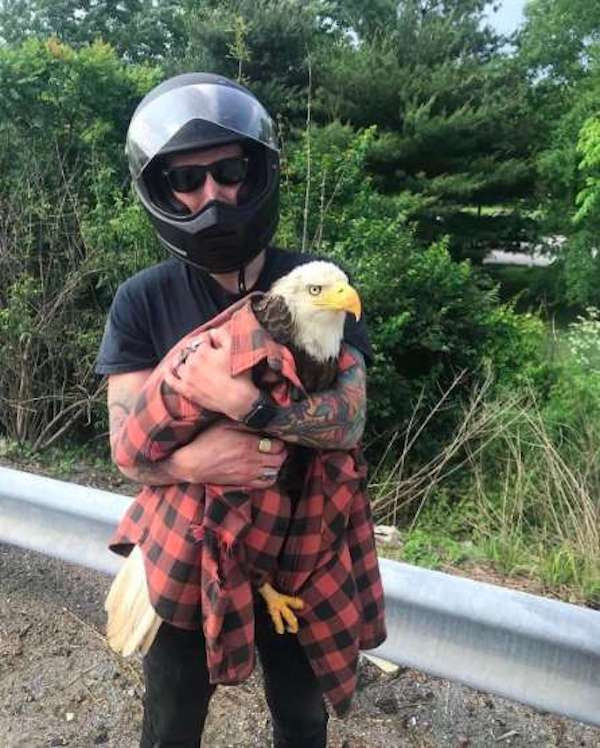
The large animal was too hurt to fly, but her powerful talons were reason enough for Miller to take off his favorite flannel and throw it over her. To Miller’s surprise, the eagle remained sedate as he wrapped her in the shirt.
“I picked her up and she was very calm,” Miller said. “She got a little worked up when people started wanting to take pictures, but we were able to get that under control.”
Dandon Miller
Once Miller moved the eagle out of the road, he called 911 and eventually got in touch with Tri-State Bird Rescue and Research, a local rehabilitation center for wild birds. Miller held the 15-pound bird for about 45 minutes while waiting for rescue staffers to arrive. But the time seemed to pass quickly.
Dandon Miller
“I wasn’t really thinking about it when I was holding her,” Miller said. “I was just trying to keep her calm and make sure she knows she’s secure, and I wasn’t going to drop her or anything.”
“It was just amazing to hold that bird and for her to be calm like that,” Miller added. “Just amazing.”
Dandon Miller
After a few days of treatment, the rescue is confident that the bald eagle will eventually be able to be released into the wild.
“She had a mild injury to one eye and soft tissue injuries, but no broken bones,” Rebecca Stansell with Tri-State Bird Rescue and Research told The Dodo. “Her wounds were treated by our wildlife veterinarian while the eagle was under anesthesia. The unexpected can always happen, but we are optimistic that she will make a full recovery.”
As for Miller’s favorite flannel, it has certainly seen better days.
The shirt now has a few large talon holes in it, but Miller knows it was for the best cause — and he will definitely be wearing it again.
I can’t really imagine what it felt like to hold that eagle in your arms for 45 minutes. Especially with all the traffic rushing past. But for sure it felt more than amazing. A beautiful wild eagle!
One can’t have too many opportunities to meld with the natural world.
Two days of nostalgia follow! (You have been warned!)
As many of you already know, my father died fairly suddenly on December 20th, 1956. I had turned 12 some six weeks previously.
After about a year my mother remarried. His name was Richard Mills. Richard came to live at the house in Toley Avenue and had the unenviable task of taking on a new ‘son’ and ‘daughter’. (My sister, Elizabeth, some four years younger than I.)
Richard was a technical author in the newly-arrived electronics industry and one day he asked me if I would like to build a short-wave receiver. He coached me in the strange art of soldering wires and radio valves and other components and in the end I had a working receiver. That led, in turn, to me studying for an amateur radio licence. More of that tomorrow.
Simply elegant, Morse code marks 175 years and counting
The elegantly simple code works whether flashing a spotlight or blinking your eyes—or even tapping on a smartphone touchscreen
There’s still plenty of reason to know how to use this Morse telegraph key. (Jason Salmon/Shutterstock.com)
By Eddie King
Ph.D. Student in Electrical Engineering, University of South Carolina
May 21st, 2019
The first message sent by Morse code’s dots and dashes across a long distance traveled from Washington, D.C., to Baltimore on Friday, May 24, 1844 – 175 years ago. It signaled the first time in human history that complex thoughts could be communicated at long distances almost instantaneously. Until then, people had to have face-to-face conversations; send coded messages through drums, smoke signals and semaphore systems; or read printed words.
Thanks to Samuel F.B. Morse, communication changed rapidly, and has been changing ever faster since. He invented the electric telegraph in 1832. It took six more years for him to standardize a code for communicating over telegraph wires. In 1843, Congress gave him US$30,000 to string wires between the nation’s capital and nearby Baltimore. When the line was completed, he conducted a public demonstration of long-distance communication.
Morse wasn’t the only one working to develop a means of communicating over the telegraph, but his is the one that has survived. The wires, magnets and keys used in the initial demonstration have given way to smartphones’ on-screen keyboards, but Morse code has remained fundamentally the same, and is still – perhaps surprisingly – relevant in the 21st century. Although I have learned, and relearned, it many times as a Boy Scout, an amateur radio operator and a pilot, I continue to admire it and strive to master it.
Samuel F.B. Morse’s own handwritten record of the first Morse code message ever sent, on May 24, 1844. Library of Congress
Easy sending
Morse’s key insight in constructing the code was considering how frequently each letter is used in English. The most commonly used letters have shorter symbols: “E,” which appears most often, is signified by a single “dot.” By contrast, “Z,” the least used letter in English, was signified by the much longer and more complex “dot-dot-dot (pause) dot.”
In 1865, the International Telecommunications Union changed the code to account for different character frequencies in other languages. There have been other tweaks since, but “E” is still “dot,” though “Z” is now “dash-dash-dot-dot.”
The reference to letter frequency makes for extremely efficient communications: Simple words with common letters can be transmitted very quickly. Longer words can still be sent, but they take more time.
Going wireless
The communications system that Morse code was designed for – analogue connections over metal wires that carried a lot of interference and needed a clear on-off type signal to be heard – has evolved significantly.
The first big change came just a few decades after Morse’s demonstration. In the late 19th century, Guglielmo Marconi invented radio-telegraph equipment, which could send Morse code over radio waves, rather than wires.
The shipping industry loved this new way to communicate with ships at sea, either from ship to ship or to shore-based stations. By 1910, U.S. law required many passenger ships in U.S. waters to carry wireless sets for sending and receiving messages.
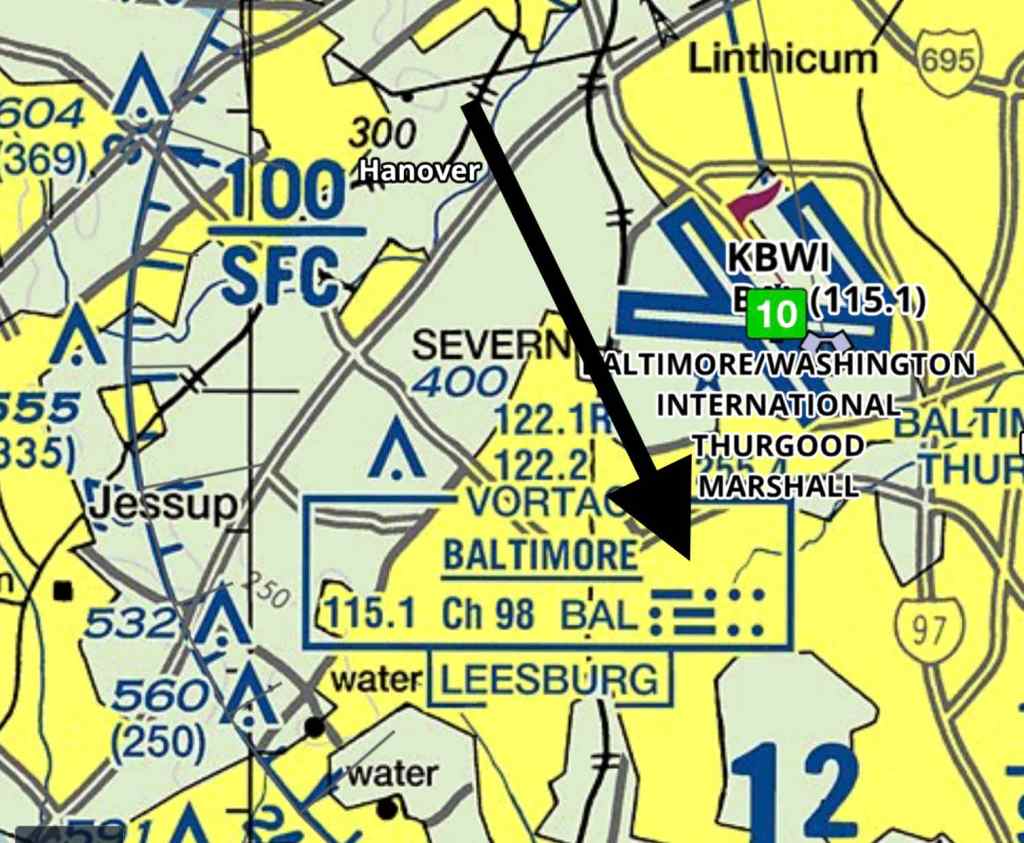
The arrow points at the chart label indicating the Morse code equivalent to the ‘BAL’ signal for a radio beacon near Baltimore. Edited screenshot of an FAA map, CC BY-ND
Aviators also use Morse code to identify automated navigational aids. These are radio beacons that help pilots follow routes, traveling from one transmitter to the next on aeronautical charts. They transmit their identifiers – such as “BAL” for Baltimore – in Morse code. Pilots often learn to recognize familiar-sounding patterns of beacons in areas they fly frequently.
There is a thriving community of amateur radio operators who treasure Morse code, too. Among amateur radio operators, Morse code is a cherished tradition tracing back to the earliest days of radio. Some of them may have begun in the Boy Scouts, which has made learning Morse variably optional or required over the years. The Federal Communications Commission used to require all licensed amateur radio operators to demonstrate proficiency in Morse code, but that ended in 2007. The FCC does still issue commercial licenses that require Morse proficiency, but no jobs require it anymore.
Blinking Morse
Because its signals are so simple – on or off, long or short – Morse code can also be used by flashing lights. Many navies around the world use blinker lights to communicate from ship to ship when they don’t want to use radios or when radio equipment breaks down. The U.S. Navy is actually testing a system that would let a user type words and convert it to blinker light. A receiver would read the flashes and convert it back to text.
Skills learned in the military helped an injured man communicate with his wife across a rocky beach using only his flashlight in 2017.
Other Morse messages
Perhaps the most notable modern use of Morse code was by Navy pilot Jeremiah Denton, while he was a prisoner of war in Vietnam. In 1966, about one year into a nearly eight-year imprisonment, Denton was forced by his North Vietnamese captors to participate in a video interview about his treatment. While the camera focused on his face, he blinked the Morse code symbols for “torture,” confirming for the first time U.S. fears about the treatment of service members held captive in North Vietnam.
Navy pilot Jeremiah Denton, a prisoner of war, blinks Morse code spelling out ‘torture’ during a forced interview with his captors.
There are still many ways people can learn Morse code, and practice using it, even online. In emergency situations, it can be the only mode of communications that will get through. Beyond that, there is an art to Morse code, a rhythmic, musical fluidity to the sound. Sending and receiving it can have a soothing or meditative feeling, too, as the person focuses on the flow of individual characters, words and sentences. Overall, sometimes the simplest tool is all that’s needed to accomplish the task.
ooOOoo
I do hope you read this article in full because it contains much interesting information. Many people will not have a clue about The Morse Code and, as you can see above, it is still relevant.
Finally, I can still remember the The Morse Code after all these years!
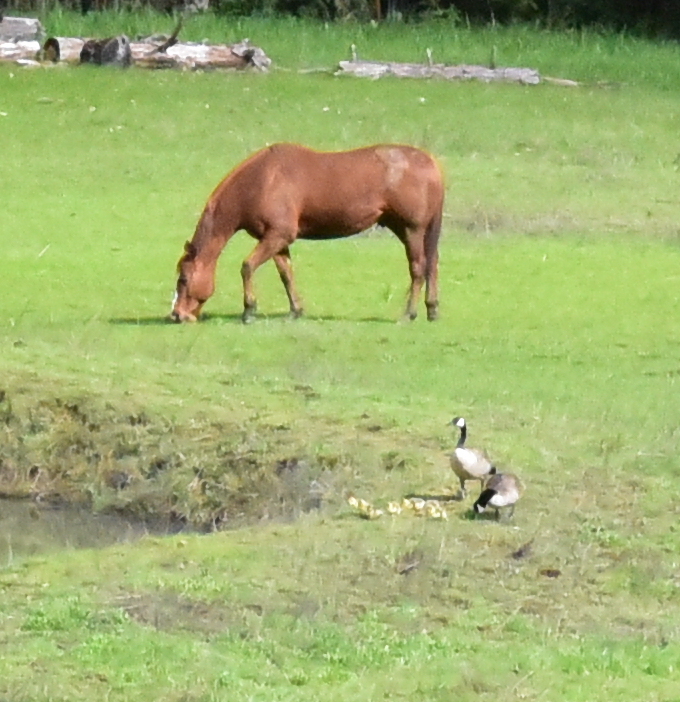
At the start of the week, indeed last Tuesday, a pair of geese hatched a brood of goslings.
I tried very hard to take some photographs of them but they stayed their distance and all I got was the following. (These are cropped down from the original.)
They are at the limits of the camera lens.
This is the morning of birth, Tuesday 16th April, and the goslings are still in the nest underneath the mother’s belly.
oooo
oooo
Five or six goslings; it’s still too difficult to tell.
oooo
oooo
oooo
Nothing to do with dogs but I’m sure you enjoyed them! This is the second time that we have had a pair of geese build a nest, lay eggs and bring the goslings into the world. The last time was April 23rd, 2015. Pictures here!
This is both an unlikely story and a beautiful one.
For a hawk had ‘grabbed’ a puppy but then, for whatever reason, chose to let it go. But that’s enough from me, here’s the story.
ooOOoo
This puppy literally fell from the sky
From the clutches of despair to the most compassionate hands.
By CHRISTIAN COTRONEO, January 15, 2019.
The aptly named Tony Hawk is recovering from his high-flying adventure with a foster family. (Photo: Austin Animal Center)
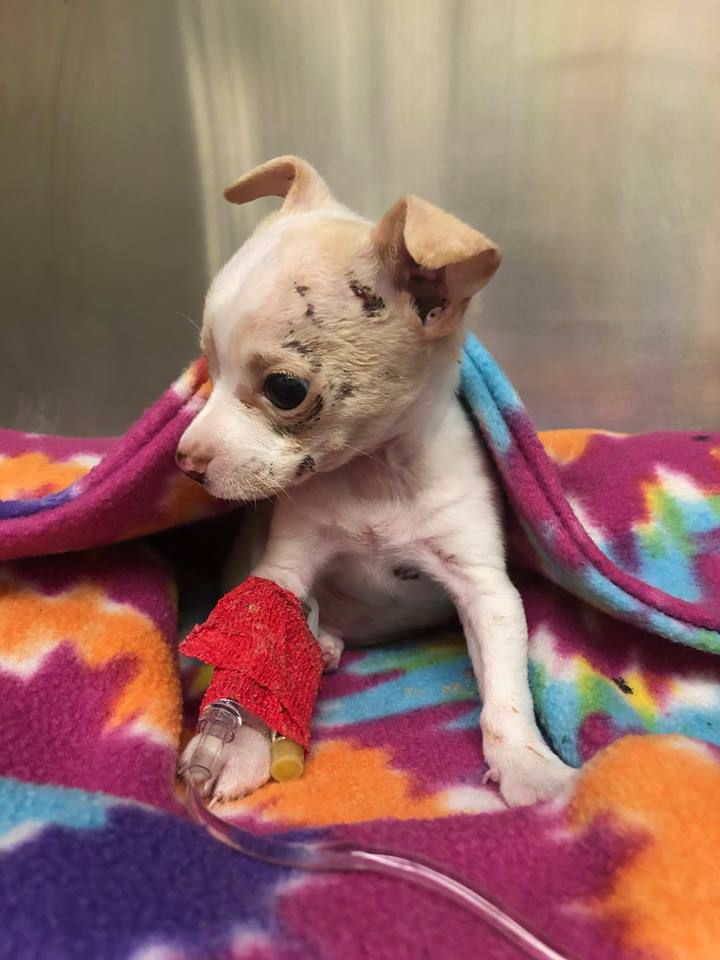
Not much is known about the tiny chihuahua who suddenly appeared at a construction site near Austin, Texas, last week.
In fact, he literally fell from the sky.
Workers at the project heard his cries long before they saw him. They figured a puppy was trapped somewhere among the debris.
“They were going around the construction site trying to figure out where these cries were coming from,” Jennifer Olohan, communications director for the Austin Animal Center, tells MNN.
“And then they realized it was actually coming from the sky.”
High above their heads, a puppy was flying through the air — in the clutches of a hawk.
At that very moment, the bird suddenly let go and a tiny screaming puppy — no older than 6 weeks — fell into their midst.
Aside from a few superficial wounds on his head, the chihuahua was surprisingly unhurt. But terrified.
The puppy only suffered a few superficial cuts form his fall. (Photo: Austin Animal Center)
But that didn’t last long, as the workers quickly brought him to a medical clinic, and from there, the puppy found his way into the care of the Austin Animal Center.
“We don’t know where he came from — whether he was born as a stray or whether he was in a home and got out,” Olohan explains.
The unlikely paratrooper’s new name, however, came naturally: He would be called Tony Hawk.
Tony Hawk will be ready for his forever home in about four weeks. (Photo: Austin Animal Center)
Considering his sheer tininess — not much bigger than a mouse — Tony Hawk probably seemed like a good idea to a hungry hawk.
But maybe he wasn’t ready to deal with all that crying. In any case, Tony Hawk’s fears subsided soon after he found some traction on terra firma.
Mostly because he found a living foster home to ease him into his new life. In a month or so, Tony Hawk will be looking for a forever home.
But Olohan suspects he won’t wait long.
“We’ve had plenty of interest, tons of applications for him,” she says. “He’s certainly not going to have a problem finding a home.”
And so a tiny puppy without a past found himself free from the clutches of despair — thanks to the warm, caring hands that will help him shape a brand new future.
Tony Hawk is guaranteed nothing but soft landings from here on in. (Photo: Austin Animal Center)
ooOOoo
In a world that sometimes seems a little strange this is a heck of a good news story.
Well done all involved especially the crew at Austin Animal Center.
A post that involves dogs but not what I had in mind!
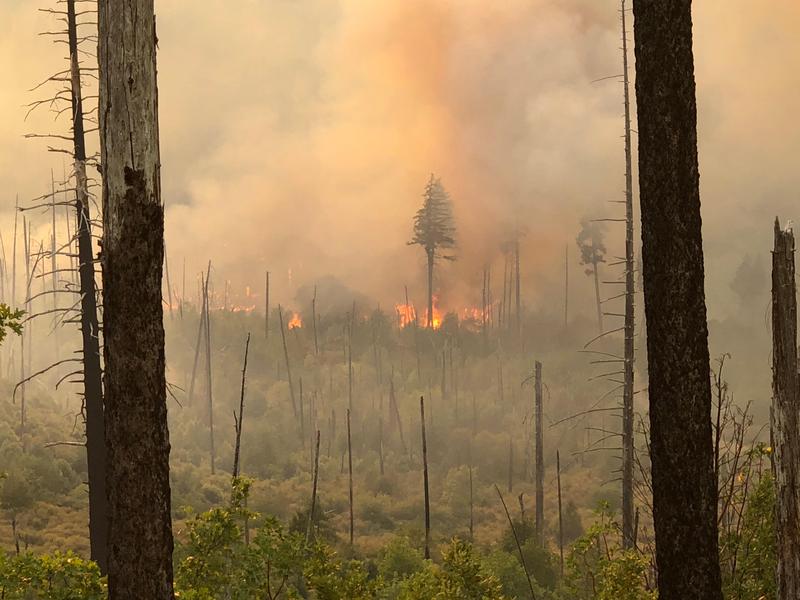
Last Saturday I published a post The burning of our forests! that included a photograph of the nearby Klondike fire.
Courtesy Jeffersen Public Radio
Then last Sunday I was speaking to Maija, my daughter back in England, and she was asking how the fires were and I distinctly recall saying: “Sweetheart, I think we are over the worst!”
That same Sunday evening, around 9:45pm, in other words two evenings ago, one of our neighbours, Margo, who lives on 60 acres adjacent to the west of us, called with real alarm in her voice:
Paul, have you seen the fire that is burning just to the North-East of us?
I replied that I had not but immediately went to our deck that runs the whole Eastern length of our house. Mount Sexton is just a few miles to the North-East of us.
This is what I saw!
Taken on the 2nd September, 2018 at 21:44 PDT
Apparently, a short while previously the wind had blown down a tree that had fallen across some high-voltage power lines causing sparking that had, in turn, ignited the extremely dry grassland.
The fire was between Oxyoke Road and Three Pines Road and roughly 2 miles from us line of sight.
That explained why some thirty minutes before, in the last of the light of the setting sun, there had been a number of helicopter flights come across us en route to dropping fire retardant close by. It hadn’t occurred to me that it was an incident so close to us.
Many of us living nearby then called each other to spread the word.
Jeannie and I, in turn, drew up an evacuation checklist and started getting things ready. More importantly, getting ourselves psychologically prepared to have to vacate the property at very short notice: Jeannie and me: six dogs; two horses; two parakeets; three cats; two chickens!
Thankfully an order to evacuate did not come during the night.
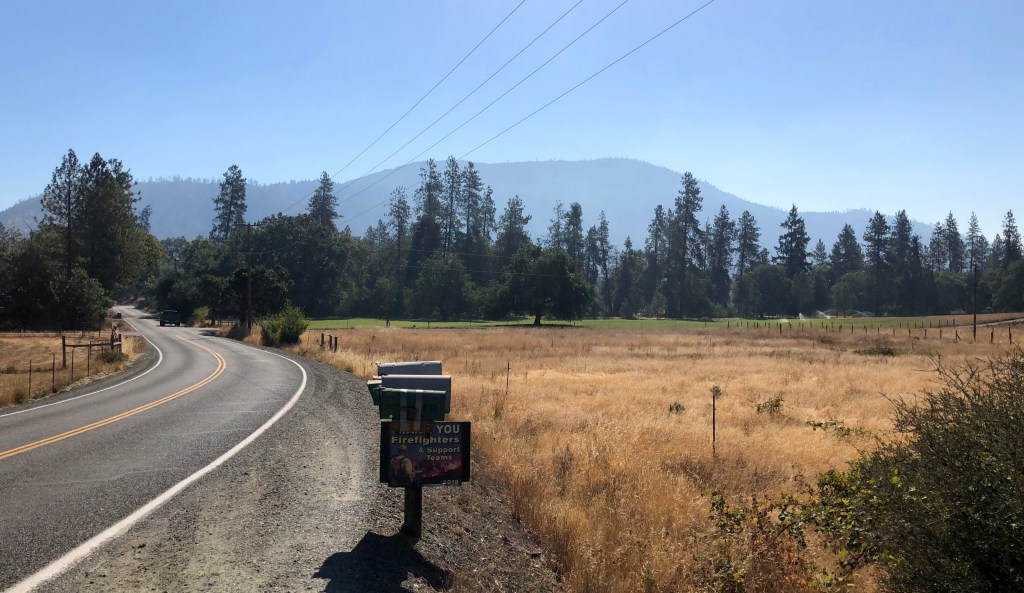
So yesterday morning I grabbed my bike and rode to Oxyoke Road. On the way I stopped to photograph the smoke in the air.
Three Pines Road looking to the East.
Once at Oxyoke Road I chatted to a search and rescue volunteer on duty controlling the traffic.
His report, as of 11:30 on September 3rd, was that the fire was just 15% contained, was “pretty active”, and that they were keeping an eye on the winds that were expected to be rather gusty later on that afternoon. I am writing this at 13:40 on the 3rd and the present winds are 6 mph, gusting 12 mph, from the North-West.
I rode back home to brief Jeannie and found her working her way through an idea for evacuating the dogs!
H’mmm! I am not sure Pedy is getting the message!
But a few words from Sweeny seemed to sort things out.
So there you are my good people, a post about dogs! Sort of!
Fingers crossed we will speak again tomorrow!
Assuming we don’t have a repeat of last night’s spectacular sights!!
Photo taken by Holmes Ariel of the Hugo Road Neighbourhood Watch group.
… not to be in such a hurry to shut the garage door!
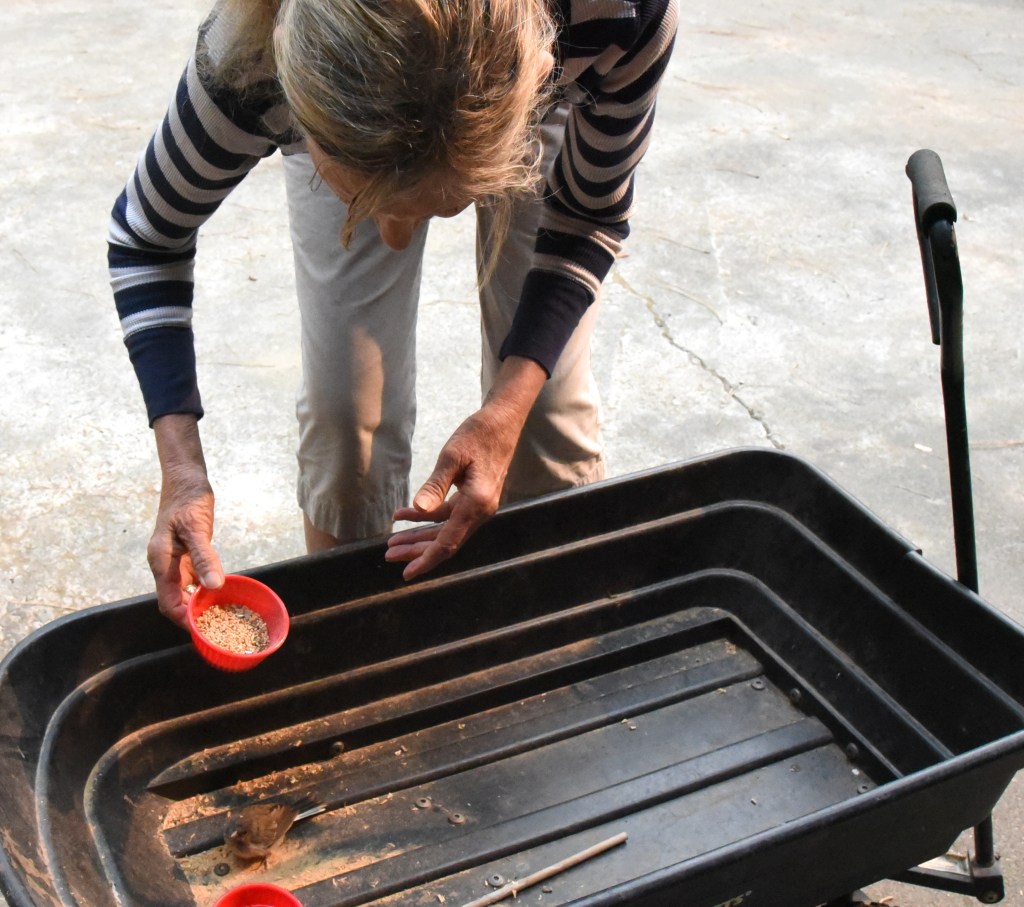
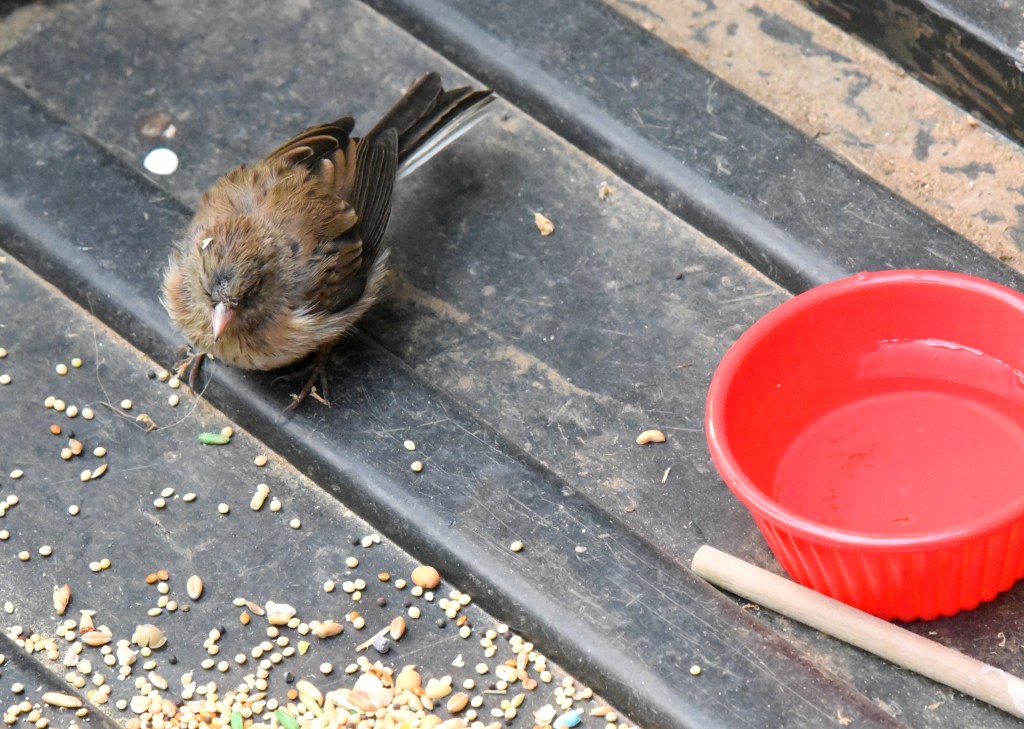
I went out to the garage yesterday morning to sort out a few things and found a small bird almost fast asleep in a trolley cart I use about the place.
It clearly had got caught inside the garage when I closed the electric door the previous evening. (Some of the local birds do come in to the garage to feast on insects and spiders that they come across.)
(That’s sawdust in the bottom of the cart.)
I called Jeannie to come out and look at the little chap and she had the brilliant idea of feeding the bird some of the bird food we give our two parakeets. Plus, she brought out a bowl of water.
It worked!
In next to no time the aforesaid bird had had sufficient to eat and it was time to relax in the warm air.
Twenty minutes later he had flown away!
OK!!
The real point of today’s post is to advise you that my son, Alex, and his longterm partner, Lisa, are staying with us for a few days and quite naturally blogging is going to be on the back-burner.
Rather than go ‘silent’ I am going to share with you over the next six days a beautiful series of posts on the clouds.
 Batman4Paws[/caption]
 Batman4Paws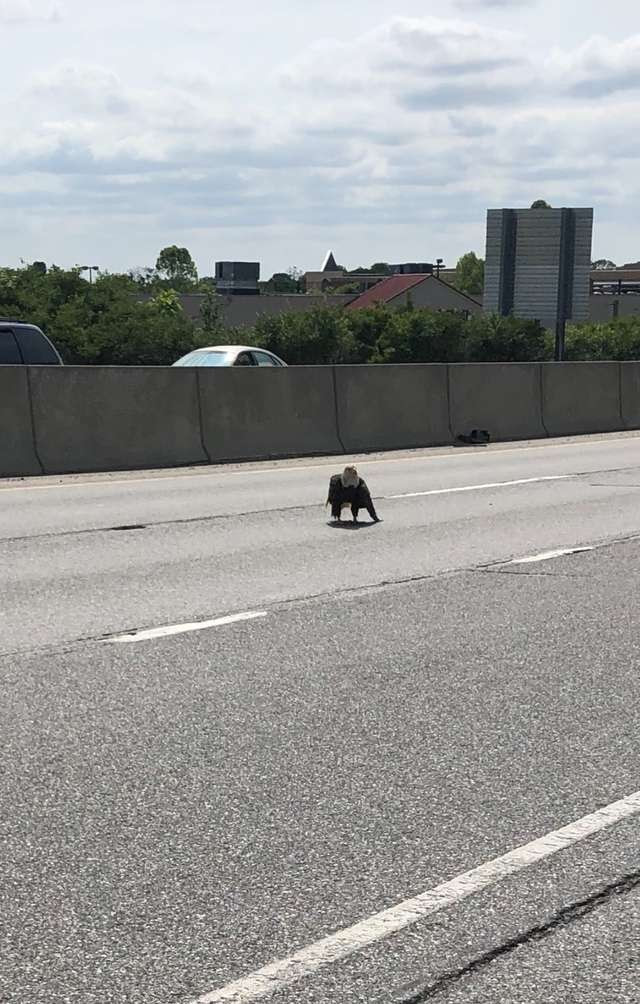















 Learning from Dogs